


All Exams > Class 8 > Science Class 8 > All Questions
All questions of Light for Class 8 Exam
What is the name of object through which light can pass?- a)Opaque
- b)Translucent
- c)Transparent
- d)Luminous
Correct answer is option 'C'. Can you explain this answer?
What is the name of object through which light can pass?
a)
Opaque
b)
Translucent
c)
Transparent
d)
Luminous
 | Sanaya Shah answered |
The object through which light can pass easily is called transparent object. Glass, water and thin plastic sheets are transparent object.

What is the phenomenon of light bouncing back into the same medium called?- a)Reflection
- b)Refraction
- c)Dispersion
- d)Splitting
Correct answer is option 'A'. Can you explain this answer?
What is the phenomenon of light bouncing back into the same medium called?
a)
Reflection
b)
Refraction
c)
Dispersion
d)
Splitting
 | Anoushka Das answered |
The phenomenon of light in which, light is reflected or bounced back into the same medium is called reflection.
In human eyes, image is formed on- a)Eye lens
- b)Cornea
- c)Retina
- d)Pupil
Correct answer is option 'C'. Can you explain this answer?
In human eyes, image is formed on
a)
Eye lens
b)
Cornea
c)
Retina
d)
Pupil
 | Bhaskar Desai answered |
Formation of Image in Human Eye
The human eye is a complex organ that is responsible for vision. It captures the light that enters the eye and converts it into electrical impulses that are sent to the brain for interpretation. The image formation in the human eye involves the following steps:
1. Cornea:
The cornea is the transparent outer layer of the eye that covers the iris, pupil, and anterior chamber. It acts as a protective barrier and helps to refract (bend) light as it enters the eye.
2. Pupil:
The pupil is the black circular opening in the center of the iris. It controls the amount of light that enters the eye by dilating (opening up) or constricting (closing down) in response to changes in light intensity.
3. Lens:
The lens is a transparent, biconvex structure located behind the iris. It helps to focus light onto the retina by changing its shape. The process of changing the shape of the lens is called accommodation.
4. Retina:
The retina is the innermost layer of the eye that contains photoreceptor cells called rods and cones. These cells convert light into electrical impulses that are sent to the brain via the optic nerve for interpretation.
5. Optic Nerve:
The optic nerve is a bundle of nerve fibers that carries the electrical impulses from the retina to the brain.
6. Brain:
The brain receives the electrical impulses from the optic nerve and interprets them as images.
Conclusion:
Thus, the image is formed on the retina of the human eye. The cornea and lens work together to focus the light onto the retina, which contains the photoreceptor cells that convert the light into electrical impulses that are sent to the brain for interpretation.
The human eye is a complex organ that is responsible for vision. It captures the light that enters the eye and converts it into electrical impulses that are sent to the brain for interpretation. The image formation in the human eye involves the following steps:
1. Cornea:
The cornea is the transparent outer layer of the eye that covers the iris, pupil, and anterior chamber. It acts as a protective barrier and helps to refract (bend) light as it enters the eye.
2. Pupil:
The pupil is the black circular opening in the center of the iris. It controls the amount of light that enters the eye by dilating (opening up) or constricting (closing down) in response to changes in light intensity.
3. Lens:
The lens is a transparent, biconvex structure located behind the iris. It helps to focus light onto the retina by changing its shape. The process of changing the shape of the lens is called accommodation.
4. Retina:
The retina is the innermost layer of the eye that contains photoreceptor cells called rods and cones. These cells convert light into electrical impulses that are sent to the brain via the optic nerve for interpretation.
5. Optic Nerve:
The optic nerve is a bundle of nerve fibers that carries the electrical impulses from the retina to the brain.
6. Brain:
The brain receives the electrical impulses from the optic nerve and interprets them as images.
Conclusion:
Thus, the image is formed on the retina of the human eye. The cornea and lens work together to focus the light onto the retina, which contains the photoreceptor cells that convert the light into electrical impulses that are sent to the brain for interpretation.
Splitting of white rays of light into seven colours is called- a)Dispersion of light
- b)Reflection of light
- c)Refraction of light
- d)Scattering of light
Correct answer is option 'A'. Can you explain this answer?
Splitting of white rays of light into seven colours is called
a)
Dispersion of light
b)
Reflection of light
c)
Refraction of light
d)
Scattering of light
 | Gargi Shah answered |
Splitting of white rays of light into seven colour when passes through a prism is called dispersion of light.
With what is glass coated in order to convert it into a mirror?- a)Silver
- b)Copper
- c)Aluminium
- d)Platinum
Correct answer is option 'A'. Can you explain this answer?
With what is glass coated in order to convert it into a mirror?
a)
Silver
b)
Copper
c)
Aluminium
d)
Platinum
 | Ashwin Jain answered |
Glasses are coated with silver to be used as mirrors to increase their reflection property.
Speed light is fastest in- a)Air
- b)Water
- c)Diamond
- d)Glass
Correct answer is option 'A'. Can you explain this answer?
Speed light is fastest in
a)
Air
b)
Water
c)
Diamond
d)
Glass
 | Baishali Menon answered |
Speed of light is fastest in air. Speed of light decreases with increase in density. Light travels slowest in diamond.
X is a surface that cannot produce clear images. What is X?- a)Rough surface
- b)Ideal surface
- c)Smooth surface
- d)Smooth but curved surface
Correct answer is option 'A'. Can you explain this answer?
X is a surface that cannot produce clear images. What is X?
a)
Rough surface
b)
Ideal surface
c)
Smooth surface
d)
Smooth but curved surface
 | Prerna Chavan answered |
When light is incident on a rough surface, irregular reflection takes place, hence the image formed is not clear.
If the angle of incidence is 80o, what will be the angle of reflection?- a) 80o
- b) 100o
- c) 160o
- d) 20o
Correct answer is option 'A'. Can you explain this answer?
If the angle of incidence is 80o, what will be the angle of reflection?
a)
80o
b)
100o
c)
160o
d)
20o
 | Pallabi Choudhury answered |
The angle of incidence = the angle of reflection. So, the angle of reflection is 80o.
If the angle of incidence is 50o, then calculate the angle between the incident ray and the reflected ray.- a)50o
- b)100o
- c)130o
- d)80o
Correct answer is option 'B'. Can you explain this answer?
If the angle of incidence is 50o, then calculate the angle between the incident ray and the reflected ray.
a)
50o
b)
100o
c)
130o
d)
80o
 | Geetika Shah answered |
In reflection of light, ∠i = 50oand ∠i = ∠r = the angle between incident ray and reflected ray = 50° + 50° = 100°
In a periscope, how are the reflecting mirrors arranged?- a)Perpendicular to each other
- b)At an angle of 45o
- c)At an angle of 90o
- d)At an angle of 60o
Correct answer is option 'B'. Can you explain this answer?
In a periscope, how are the reflecting mirrors arranged?
a)
Perpendicular to each other
b)
At an angle of 45o
c)
At an angle of 90o
d)
At an angle of 60o
 | Amit Sharma answered |
Correct Answer :-B
Explanation:- A periscope is an optical instrument used to view object which is not in direct sight of human eye. It works by using the Laws of Reflection and are widely used in submarines to navigate under water.
It works by using two mirrors placed at angle of 45 degree with each other. When light falls on one mirror, it bounces to the other mirror and then reaches the human eye.
A simple periscope only uses mirrors but complex periscope uses prisms instead of mirror. These periscopes are used in the field of medicine particularly in cystoscopy and endoscopy.
The image formed by plane mirror is- a)real and inverted
- b)real and erect
- c)virtual and inverted
- d)virtual and erect.
Correct answer is option 'D'. Can you explain this answer?
The image formed by plane mirror is
a)
real and inverted
b)
real and erect
c)
virtual and inverted
d)
virtual and erect.
 | Kavya Saxena answered |
Plane mirrors are the only type of mirror for which a real object always produces an image that is virtual, errect and of the same size as the object.
What is the result of looking directly at the Sun or a powerful light source?- a)Improved vision
- b)Temporary blindness
- c)Retinal injury
- d)Enhanced color perception
Correct answer is option 'C'. Can you explain this answer?
a)
Improved vision
b)
Temporary blindness
c)
Retinal injury
d)
Enhanced color perception
 | EduRev Class 8 answered |
Looking directly at the Sun or a powerful light source can cause retinal injury due to the intense light damaging the sensitive cells in the retina. This can lead to permanent vision damage.
The characteristics of an eye disease are given below.
(i) Eye sight becomes foggy
(ii) Eye lens becomes cloudy
(iii) There is a loss of visionIn which of the following are the above characteristics observed?- a)Myopia
- b)Presbyopia
- c)Hypermetropia
- d)Cataract
Correct answer is option 'D'. Can you explain this answer?
The characteristics of an eye disease are given below.
(i) Eye sight becomes foggy
(ii) Eye lens becomes cloudy
(iii) There is a loss of vision
(i) Eye sight becomes foggy
(ii) Eye lens becomes cloudy
(iii) There is a loss of vision
In which of the following are the above characteristics observed?
a)
Myopia
b)
Presbyopia
c)
Hypermetropia
d)
Cataract
 | Shubham Sharma answered |
Cataract occurs in old age due to the given characteristics and can be cured by introducing a new artificial lens.
What makes objects visible?- a)The absorption of light by objects
- b)The reflected light from the object
- c)The total internal reflection taking place in an object
- d)The refracted light from the object
Correct answer is option 'B'. Can you explain this answer?
What makes objects visible?
a)
The absorption of light by objects
b)
The reflected light from the object
c)
The total internal reflection taking place in an object
d)
The refracted light from the object
 | Nidhi Ahuja answered |
An object is visible only when reflected light from the object reaches the retina of our eyes.
The angle of incidence is always ______ to the angle of reflection.- a)greater
- b)smaller
- c)equal
- d)none of these.
Correct answer is option 'C'. Can you explain this answer?
The angle of incidence is always ______ to the angle of reflection.
a)
greater
b)
smaller
c)
equal
d)
none of these.
 | Skyhigh Academy answered |
Suspended particulate matter (SPM) refers to microscopic solid or liquid matter suspended in the Earth’s atmosphere. Air pollutants consist of gaseous pollutants, odours, and SPM, (suspended particulate matter) such as dust, fumes, mist, and smoke. The high concentration of these in and near urban areas causes severe pollution to the surroundings. A high amount of SPM in air leads to respiratory problems and lung-related diseases like asthma.
Object that emit light is called- a)Luminous object
- b)Opaque object
- c)Non-luminous object
- d)Transparent object
Correct answer is option 'A'. Can you explain this answer?
Object that emit light is called
a)
Luminous object
b)
Opaque object
c)
Non-luminous object
d)
Transparent object
 | Rajesh Yadav answered |
The objects that emit light is called luminous object. Sun, stars, bulb, tube etc are example of luminous object.
Which of the following is the requirement of nocturnal animals like owl an bat?- a)Large cornea
- b)Large pupil
- c)Retina with large number of rods
- d)All of the above
Correct answer is option 'D'. Can you explain this answer?
Which of the following is the requirement of nocturnal animals like owl an bat?
a)
Large cornea
b)
Large pupil
c)
Retina with large number of rods
d)
All of the above
| | Amit Kumar answered |
The nocturnal animals need more light to see at night. The large cornea and pupil allow more light to enter into their eyes. They also have retina with large number of rods.
What is the purpose of the iris in our eyes?- a)It helps us see colors
- b)It controls the amount of light entering our eyes
- c)It protects our eyes from accidents
- d)It helps us focus on objects
Correct answer is option 'B'. Can you explain this answer?
What is the purpose of the iris in our eyes?
a)
It helps us see colors
b)
It controls the amount of light entering our eyes
c)
It protects our eyes from accidents
d)
It helps us focus on objects
 | K.L Institute answered |
The iris in our eyes acts like a camera lens, adjusting the size of the pupil to control how much light comes in. This helps us see clearly in different light conditions. So, the iris is like a gatekeeper for light entering our eyes!
How many images are obtained when plane mirrors are arranged parallel to each other?- a)A single image
- b)Two images
- c)Infinite number of images
- d)Zero image
Correct answer is option 'C'. Can you explain this answer?
How many images are obtained when plane mirrors are arranged parallel to each other?
a)
A single image
b)
Two images
c)
Infinite number of images
d)
Zero image
| | Kavya Saxena answered |
When two mirrors are kept parallel to each other, an infinite number of images can be seen.
Which of the following statements is true?- a)The angle of incidence is twice the angle of reflection.
- b)The incident ray, the reflected ray and the normal drawn at the point of incidence lie in the same plane.
- c)Some virtual images can be caught on the screen.
- d)A convex mirror forms a real image.
Correct answer is option 'B'. Can you explain this answer?
Which of the following statements is true?
a)
The angle of incidence is twice the angle of reflection.
b)
The incident ray, the reflected ray and the normal drawn at the point of incidence lie in the same plane.
c)
Some virtual images can be caught on the screen.
d)
A convex mirror forms a real image.
 | Abhiram Das answered |
When a light ray is reflected from the reflecting surface, the incident ray, the reflected ray and the normal lie in the same plane. The angle of incidence = The angle of reflection.
What is the perpendicular drawn at any point on a mirror called?- a)Incident ray
- b)Reflected ray
- c)Normal
- d)Image
Correct answer is option 'C'. Can you explain this answer?
What is the perpendicular drawn at any point on a mirror called?
a)
Incident ray
b)
Reflected ray
c)
Normal
d)
Image
| | Pragati Roy answered |
Perpendicular drawn at any point on a mirror is called a normal.
The normal is an important concept in the study of optics and mirrors. It is a line that is perpendicular to the surface of the mirror at a specific point. The normal is used to measure the angle of incidence and the angle of reflection when light rays interact with the mirror.
Definition:
The normal is a line that is perpendicular to the surface of the mirror at a given point. It helps in understanding the behavior of light when it interacts with the mirror.
Explanation:
When a light ray hits a mirror, it undergoes reflection. The angle of incidence is the angle between the incident ray and the normal, and the angle of reflection is the angle between the reflected ray and the normal.
Key Points:
- The normal is always perpendicular to the surface of the mirror at a specific point.
- It is used to measure the angle of incidence and the angle of reflection.
- The angle of incidence is the angle between the incident ray and the normal.
- The angle of reflection is the angle between the reflected ray and the normal.
Importance:
The concept of the normal is important in understanding how light interacts with mirrors. It helps in determining the angles at which light rays are reflected. The angle of incidence and the angle of reflection are equal when light reflects off a mirror.
Conclusion:
In conclusion, the perpendicular drawn at any point on a mirror is called a normal. The normal is a line that is perpendicular to the surface of the mirror at a specific point. It is used to measure the angle of incidence and the angle of reflection when light interacts with the mirror.
The normal is an important concept in the study of optics and mirrors. It is a line that is perpendicular to the surface of the mirror at a specific point. The normal is used to measure the angle of incidence and the angle of reflection when light rays interact with the mirror.
Definition:
The normal is a line that is perpendicular to the surface of the mirror at a given point. It helps in understanding the behavior of light when it interacts with the mirror.
Explanation:
When a light ray hits a mirror, it undergoes reflection. The angle of incidence is the angle between the incident ray and the normal, and the angle of reflection is the angle between the reflected ray and the normal.
Key Points:
- The normal is always perpendicular to the surface of the mirror at a specific point.
- It is used to measure the angle of incidence and the angle of reflection.
- The angle of incidence is the angle between the incident ray and the normal.
- The angle of reflection is the angle between the reflected ray and the normal.
Importance:
The concept of the normal is important in understanding how light interacts with mirrors. It helps in determining the angles at which light rays are reflected. The angle of incidence and the angle of reflection are equal when light reflects off a mirror.
Conclusion:
In conclusion, the perpendicular drawn at any point on a mirror is called a normal. The normal is a line that is perpendicular to the surface of the mirror at a specific point. It is used to measure the angle of incidence and the angle of reflection when light interacts with the mirror.
What is the nature of image formed on the retina of human eye of an object?- a)Virtual and erect
- b)Virtual and inverted
- c)Real and erect
- d)Real and inverted
Correct answer is option 'D'. Can you explain this answer?
What is the nature of image formed on the retina of human eye of an object?
a)
Virtual and erect
b)
Virtual and inverted
c)
Real and erect
d)
Real and inverted
| | Amit Sharma answered |
The human eye serves as a convex lens. It forms real, inverted and diminished image of an object.
A uniform magnetic field B exists in the region between x = 0 and x =  (region 2 in the figure) pointing normally into the plane of the paper. A particle with charge +Q and momentum p directed along x-axis enters region 2 from region 1 at point P1(y = –R). Which of the following options(s) is/are correct ?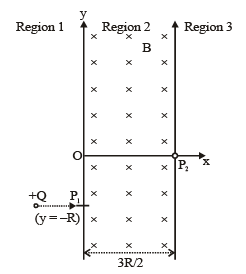
- a)For B =
 the particle will enter region 3 through the point P2 on x-axis
 - b)For B >
 the particle will re-enter region 1
 - c)For a fixed B, particle of same charge Q and same velocity v, the distance between the point P1 and the point of re-entry into region 1 is inversely proportional to the mass of the particle.
- d)When the particle re-enters region 1 through the longest possible path in region 2, the magnitude of the chage in its linear momentum between point P1 and the farthest point from y-axis is

Correct answer is option 'A,B'. Can you explain this answer?
A uniform magnetic field B exists in the region between x = 0 and x = (region 2 in the figure) pointing normally into the plane of the paper. A particle with charge +Q and momentum p directed along x-axis enters region 2 from region 1 at point P1(y = –R). Which of the following options(s) is/are correct ?
(region 2 in the figure) pointing normally into the plane of the paper. A particle with charge +Q and momentum p directed along x-axis enters region 2 from region 1 at point P1(y = –R). Which of the following options(s) is/are correct ?a)
For B =
the particle will enter region 3 through the point P2 on x-axisb)
For B >
the particle will re-enter region 1
the particle will re-enter region 1c)
For a fixed B, particle of same charge Q and same velocity v, the distance between the point P1 and the point of re-entry into region 1 is inversely proportional to the mass of the particle.
d)
When the particle re-enters region 1 through the longest possible path in region 2, the magnitude of the chage in its linear momentum between point P1 and the farthest point from y-axis is
| | Raghav Bansal answered |
(A, B) For the charge +Q to return region 1, the radius of the circular path taken by charge should by 3R/2.
mv² ÷ (3R/2) = QvB
Therefore,
2p / 3R = Q
So,
B = 2p / 3QR
i.e., B should be equal or greater than 2p/2QR
'A' is the correct option.
When B = 8p / 13QR
mv² / r = Qv (8p / 13QR)
Therefore, v = 13R / 8
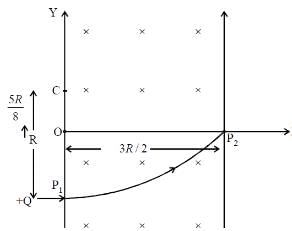
Also CP2² = CO² + OP2²
= [(5R/8)² + (3R/2)²]²
CP2 = 13R / 8
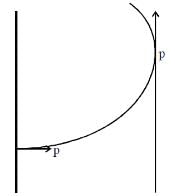
Thus the particle will enter region 3 through the point P1 on X-axis 'B' is the correct option.
Change in momentum =√2p
Thus, 'C' is incorrect.
Further, mv² / r = qvB
Therefore, r = mv / qB
'D' is incorrect.
mv² ÷ (3R/2) = QvB
Therefore,
2p / 3R = Q
So,
B = 2p / 3QR
i.e., B should be equal or greater than 2p/2QR
'A' is the correct option.
When B = 8p / 13QR
mv² / r = Qv (8p / 13QR)
Therefore, v = 13R / 8
Also CP2² = CO² + OP2²
= [(5R/8)² + (3R/2)²]²
CP2 = 13R / 8
Thus the particle will enter region 3 through the point P1 on X-axis 'B' is the correct option.
Change in momentum =√2p
Thus, 'C' is incorrect.
Further, mv² / r = qvB
Therefore, r = mv / qB
'D' is incorrect.
Identify the value of persistence of vision.- a)1/1 0th of a second
- b)1/12th of a second
- c)1/16th of a second
- d)1/20th of a second
Correct answer is option 'C'. Can you explain this answer?
Identify the value of persistence of vision.
a)
1/1 0th of a second
b)
1/12th of a second
c)
1/16th of a second
d)
1/20th of a second
| | Rutuja Kumar answered |
Understanding Persistence of Vision
Persistence of vision is a phenomenon that allows us to perceive motion in a series of still images. It plays a crucial role in how we experience animation and video.
Definition
- Persistence of vision refers to the optical illusion where the human eye retains an image for a fraction of a second after the source has changed.
- This ability helps create the illusion of motion when images are displayed in quick succession.
Duration of Persistence of Vision
- The commonly accepted duration for persistence of vision is approximately 1/16th of a second.
- This means that if a series of images are shown within this timeframe, they can be perceived as continuous movement rather than a series of still frames.
Importance in Media
- This concept is foundational in animation and film, where frames are played rapidly (typically 24 frames per second in cinema).
- By using persistence of vision, filmmakers can create smooth visual narratives that engage viewers.
Correct Answer Explanation
- Among the options given, the correct answer is c) 1/16th of a second.
- This time frame is crucial for ensuring that our brains process the images as fluid motion, rather than as individual frames.
Conclusion
- Understanding persistence of vision enriches our appreciation for visual media and its underlying mechanics.
- It explains why animations and movies feel seamless, drawing viewers into the story being told.
Persistence of vision is a phenomenon that allows us to perceive motion in a series of still images. It plays a crucial role in how we experience animation and video.
Definition
- Persistence of vision refers to the optical illusion where the human eye retains an image for a fraction of a second after the source has changed.
- This ability helps create the illusion of motion when images are displayed in quick succession.
Duration of Persistence of Vision
- The commonly accepted duration for persistence of vision is approximately 1/16th of a second.
- This means that if a series of images are shown within this timeframe, they can be perceived as continuous movement rather than a series of still frames.
Importance in Media
- This concept is foundational in animation and film, where frames are played rapidly (typically 24 frames per second in cinema).
- By using persistence of vision, filmmakers can create smooth visual narratives that engage viewers.
Correct Answer Explanation
- Among the options given, the correct answer is c) 1/16th of a second.
- This time frame is crucial for ensuring that our brains process the images as fluid motion, rather than as individual frames.
Conclusion
- Understanding persistence of vision enriches our appreciation for visual media and its underlying mechanics.
- It explains why animations and movies feel seamless, drawing viewers into the story being told.
What happens in lateral inversion?- a)The right side of the object will be on the right side of the image.
- b)The left side of the object will be on the left side of the image.
- c)The top of the object will be the bottom of the object.
- d)The right side of the object will be on the left side of the image.
Correct answer is option 'D'. Can you explain this answer?
What happens in lateral inversion?
a)
The right side of the object will be on the right side of the image.
b)
The left side of the object will be on the left side of the image.
c)
The top of the object will be the bottom of the object.
d)
The right side of the object will be on the left side of the image.
 | Rishika Ahuja answered |
Lateral inversion is a phenomenon in which left appears to be right and vice versa. It is due to direction that light follows when it strikes a reflecting surface, generally a mirror.
State whether the following statement is True or False:When two plane mirrors are set at right angles to each other with their edges touching, only one image of an object is formed.- a)False
- b)True
Correct answer is option 'A'. Can you explain this answer?
State whether the following statement is True or False:
When two plane mirrors are set at right angles to each other with their edges touching, only one image of an object is formed.
a)
False
b)
True
| | Arpita Sharma answered |
Understanding Reflection in Plane Mirrors
When two plane mirrors are placed at right angles to each other, they create unique conditions for image formation.
Image Formation with Mirrors
- Multiple Images: In this scenario, two mirrors positioned at 90 degrees will produce multiple reflections of an object.
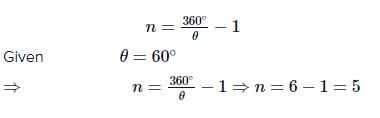
- Angle of Reflection: The angle between the mirrors (90 degrees) plays a crucial role in determining the number of images. The formula to calculate the number of images formed by mirrors is given by (360/θ) - 1, where θ is the angle between the mirrors.
- Calculation: For mirrors at right angles (θ = 90 degrees):
- (360/90) - 1 = 4 - 1 = 3 images.
Hence, three images of the object will be seen.
Visualizing the Scenario
- Arrangement: Imagine placing an object between two mirrors that meet at a right angle. The light rays from the object strike the mirrors, reflecting back and forth.
- Resulting Images: Each reflection creates an image, and due to the positioning, you can see multiple distinct images instead of just one.
Conclusion
Thus, the statement that only one image is formed when two mirrors are at right angles is False. Instead, multiple images are visible, confirming that the correct answer is option 'A'.
When two plane mirrors are placed at right angles to each other, they create unique conditions for image formation.
Image Formation with Mirrors
- Multiple Images: In this scenario, two mirrors positioned at 90 degrees will produce multiple reflections of an object.
- Angle of Reflection: The angle between the mirrors (90 degrees) plays a crucial role in determining the number of images. The formula to calculate the number of images formed by mirrors is given by (360/θ) - 1, where θ is the angle between the mirrors.
- Calculation: For mirrors at right angles (θ = 90 degrees):
- (360/90) - 1 = 4 - 1 = 3 images.
Hence, three images of the object will be seen.
Visualizing the Scenario
- Arrangement: Imagine placing an object between two mirrors that meet at a right angle. The light rays from the object strike the mirrors, reflecting back and forth.
- Resulting Images: Each reflection creates an image, and due to the positioning, you can see multiple distinct images instead of just one.
Conclusion
Thus, the statement that only one image is formed when two mirrors are at right angles is False. Instead, multiple images are visible, confirming that the correct answer is option 'A'.
How does a periscope allow one to see objects that are not directly visible?- a)By using a single mirror
- b)By using a telescope
- c)By using two plane mirrors
- d)By using a magnifying glass
Correct answer is option 'C'. Can you explain this answer?
a)
By using a single mirror
b)
By using a telescope
c)
By using two plane mirrors
d)
By using a magnifying glass
| | EduRev Class 8 answered |
A periscope enables visibility of objects that are not directly in sight by employing two plane mirrors arranged at angles to reflect light from the objects to the viewer's eyes. This arrangement allows one to see over obstacles or around corners.
What is the role of the retina in the process of vision?- a)To focus light on the eye
- b)To protect the eye from damage
- c)To process visual information and send it to the brain
- d)To control the amount of light entering the eye
Correct answer is option 'C'. Can you explain this answer?
a)
To focus light on the eye
b)
To protect the eye from damage
c)
To process visual information and send it to the brain
d)
To control the amount of light entering the eye
| | EduRev Class 8 answered |
The retina processes visual information by converting light into neural signals, which are then sent to the brain through the optic nerve for interpretation.
Which part of the eye focuses light onto the retina?- a)Cornea
- b)Lens
- c)Pupil
- d)Iris
Correct answer is option 'B'. Can you explain this answer?
a)
Cornea
b)
Lens
c)
Pupil
d)
Iris
| | EduRev Class 8 answered |
The lens of the eye focuses light onto the retina, allowing us to see a clear image.
What is the main purpose of using optical aids for visually impaired individuals?- a)To enhance tactile feedback
- b)To provide auditory information
- c)To correct or enhance vision
- d)To offer financial assistance
Correct answer is option 'C'. Can you explain this answer?
a)
To enhance tactile feedback
b)
To provide auditory information
c)
To correct or enhance vision
d)
To offer financial assistance
| | EduRev Class 8 answered |
Optical aids are used to correct or enhance vision for visually impaired individuals. These include devices such as magnifiers, bifocal lenses, and contact lenses.
In our houses, which of the following is used for looking at ourselves?- a)Convex mirror
- b)Concave mirror
- c)Convex lens
- d)Plane mirror
Correct answer is option 'D'. Can you explain this answer?
In our houses, which of the following is used for looking at ourselves?
a)
Convex mirror
b)
Concave mirror
c)
Convex lens
d)
Plane mirror
| | Anoushka Das answered |
We use plane mirrors to see ourselves, because the image formed by a plane mirror is virtual, erect and of the same size.
The persistent impression of an image on the retina for about 1/16th of a second allows us to perceive what phenomenon?- a)Depth perception
- b)Night vision
- c)Continuous motion
- d)Color vision
Correct answer is option 'C'. Can you explain this answer?
a)
Depth perception
b)
Night vision
c)
Continuous motion
d)
Color vision
 | Alok Banerjee answered |
Understanding Continuous Motion
The phenomenon of perceiving continuous motion is largely attributed to the persistence of vision, which is the ability of the human eye to retain an image for a brief period, approximately 1/16th of a second. This allows us to perceive motion smoothly rather than as a series of disconnected frames.
How Persistence of Vision Works:
- When we see an object in motion, its image is captured on the retina.
- Due to the persistence of vision, the image remains on the retina for a short duration even after the object has moved.
- This overlapping of images creates the illusion of fluid motion, similar to how frames in a film appear to move seamlessly when played in quick succession.
Importance in Everyday Life:
- The ability to perceive continuous motion is crucial for various activities, such as watching movies, playing video games, and even driving.
- This phenomenon allows us to interpret rapid movements and changes in our environment, providing a sense of action and interaction.
Examples of Continuous Motion:
- Animation: In cartoons, individual images are shown rapidly to create the illusion of movement.
- Film: Movies utilize frames that are projected quickly to make scenes appear as if they are in motion.
- Sports: The quick movements of players are perceived as smooth actions rather than abrupt stops.
In summary, the persistent impression of an image on the retina for about 1/16th of a second enables us to perceive continuous motion, which is essential for interpreting the dynamic world around us.
The phenomenon of perceiving continuous motion is largely attributed to the persistence of vision, which is the ability of the human eye to retain an image for a brief period, approximately 1/16th of a second. This allows us to perceive motion smoothly rather than as a series of disconnected frames.
How Persistence of Vision Works:
- When we see an object in motion, its image is captured on the retina.
- Due to the persistence of vision, the image remains on the retina for a short duration even after the object has moved.
- This overlapping of images creates the illusion of fluid motion, similar to how frames in a film appear to move seamlessly when played in quick succession.
Importance in Everyday Life:
- The ability to perceive continuous motion is crucial for various activities, such as watching movies, playing video games, and even driving.
- This phenomenon allows us to interpret rapid movements and changes in our environment, providing a sense of action and interaction.
Examples of Continuous Motion:
- Animation: In cartoons, individual images are shown rapidly to create the illusion of movement.
- Film: Movies utilize frames that are projected quickly to make scenes appear as if they are in motion.
- Sports: The quick movements of players are perceived as smooth actions rather than abrupt stops.
In summary, the persistent impression of an image on the retina for about 1/16th of a second enables us to perceive continuous motion, which is essential for interpreting the dynamic world around us.
What is a unique feature of a kaleidoscope?- a)It shows the same pattern every time.
- b)It can create music.
- c)It produces a variety of patterns that are never repeated.
- d)It is only used by artists.
Correct answer is option 'C'. Can you explain this answer?
What is a unique feature of a kaleidoscope?
a)
It shows the same pattern every time.
b)
It can create music.
c)
It produces a variety of patterns that are never repeated.
d)
It is only used by artists.
 | Trisha Vashisht answered |
When you peep through the hole, you will be able to see a variety of patterns in the tube. An interesting feature of a kaleidoscope is that you will never see the same pattern again. Designers of wallpapers and fabrics and artists often use kaleidoscopes to get ideas for new patterns.
What visual defect is commonly associated with aging and results from a cloudy lens?- a)Myopia
- b)Hyperopia
- c)Astigmatism
- d)Cataract
Correct answer is option 'D'. Can you explain this answer?
a)
Myopia
b)
Hyperopia
c)
Astigmatism
d)
Cataract
| | Dhruba Sengupta answered |
Cataract: A Common Visual Defect in Aging
Cataracts are a prevalent age-related visual defect characterized by the clouding of the lens in the eye. This condition can significantly impact vision and is often associated with the natural aging process.
Understanding Cataracts
- What are Cataracts?
- They occur when proteins in the lens of the eye clump together, leading to cloudiness.
- This cloudiness prevents light from passing through clearly, resulting in blurred or dim vision.
- Causes of Cataracts
- Aging is the primary factor, but other causes may include:
- Long-term exposure to UV sunlight
- Smoking
- Diabetes
- Certain medications, such as corticosteroids
Symptoms of Cataracts
- Common Symptoms Include:
- Blurred or cloudy vision
- Difficulty seeing at night
- Sensitivity to light and glare
- Frequent changes in glasses or contact lens prescriptions
Treatment Options
- Managing Cataracts:
- Initially, stronger lighting and anti-glare sunglasses may help manage symptoms.
- Surgical intervention is often required as the condition progresses. This involves removing the cloudy lens and replacing it with an artificial one.
Conclusion
Cataracts are a significant concern for the aging population, leading to a decline in vision quality. Awareness and early detection can help manage the condition effectively, ensuring a better quality of life for those affected.
Cataracts are a prevalent age-related visual defect characterized by the clouding of the lens in the eye. This condition can significantly impact vision and is often associated with the natural aging process.
Understanding Cataracts
- What are Cataracts?
- They occur when proteins in the lens of the eye clump together, leading to cloudiness.
- This cloudiness prevents light from passing through clearly, resulting in blurred or dim vision.
- Causes of Cataracts
- Aging is the primary factor, but other causes may include:
- Long-term exposure to UV sunlight
- Smoking
- Diabetes
- Certain medications, such as corticosteroids
Symptoms of Cataracts
- Common Symptoms Include:
- Blurred or cloudy vision
- Difficulty seeing at night
- Sensitivity to light and glare
- Frequent changes in glasses or contact lens prescriptions
Treatment Options
- Managing Cataracts:
- Initially, stronger lighting and anti-glare sunglasses may help manage symptoms.
- Surgical intervention is often required as the condition progresses. This involves removing the cloudy lens and replacing it with an artificial one.
Conclusion
Cataracts are a significant concern for the aging population, leading to a decline in vision quality. Awareness and early detection can help manage the condition effectively, ensuring a better quality of life for those affected.
What happens to the light entering the eye once it passes through the cornea and pupil?- a)It is blocked by the lens
- b)It is focused on the retina
- c)It is reflected back out of the eye
- d)It is absorbed by the iris
Correct answer is option 'B'. Can you explain this answer?
a)
It is blocked by the lens
b)
It is focused on the retina
c)
It is reflected back out of the eye
d)
It is absorbed by the iris
| | EduRev Class 8 answered |
After passing through the cornea and pupil, light is focused on the retina by the lens. The retina then processes the light and sends visual information to the brain through the optic nerve.
What is the function of the pupil in the human eye?- a)Reflect light
- b)Refract light
- c)Control the amount of light entering the eye
- d)Detect colors
Correct answer is option 'C'. Can you explain this answer?
a)
Reflect light
b)
Refract light
c)
Control the amount of light entering the eye
d)
Detect colors
| | Trisha Vashisht answered |
The pupil controls the amount of light entering the eye by expanding or contracting.
In what application are periscopes commonly used?- a)To view underwater fish
- b)In submarines
- c)For taking photographs
- d)To observe the night sky
Correct answer is option 'B'. Can you explain this answer?
In what application are periscopes commonly used?
a)
To view underwater fish
b)
In submarines
c)
For taking photographs
d)
To observe the night sky
| | Rhea Nambiar answered |
Understanding Periscopes
A periscope is an optical instrument that allows an observer to see things that are not in their direct line of sight. This is achieved by using mirrors or prisms to redirect light.
Common Applications
- Submarines: The most notable application of periscopes is in submarines. They are used extensively for surveillance and navigation purposes.
- Functionality:
- Periscopes enable submarines to observe the surface of the water while remaining submerged.
- This capability is crucial for military operations, as it allows submarines to gather intelligence without revealing their location.
Advantages of Using Periscopes in Submarines
- Stealth:
- By staying underwater, submarines can avoid detection by enemy forces while still monitoring the environment above.
- Safety:
- Periscopes allow submarines to assess potential threats, such as other ships or aircraft, while maintaining a safe distance.
Other Applications
While periscopes can be used in other contexts, such as educational tools for observing the sky or for viewing underwater, their primary and most critical application remains in military submarines.
Conclusion
In conclusion, periscopes are essential in submarines, providing a strategic advantage that is not easily replicated by other observational tools. This makes option 'B' the correct answer to the question regarding common applications of periscopes.
A periscope is an optical instrument that allows an observer to see things that are not in their direct line of sight. This is achieved by using mirrors or prisms to redirect light.
Common Applications
- Submarines: The most notable application of periscopes is in submarines. They are used extensively for surveillance and navigation purposes.
- Functionality:
- Periscopes enable submarines to observe the surface of the water while remaining submerged.
- This capability is crucial for military operations, as it allows submarines to gather intelligence without revealing their location.
Advantages of Using Periscopes in Submarines
- Stealth:
- By staying underwater, submarines can avoid detection by enemy forces while still monitoring the environment above.
- Safety:
- Periscopes allow submarines to assess potential threats, such as other ships or aircraft, while maintaining a safe distance.
Other Applications
While periscopes can be used in other contexts, such as educational tools for observing the sky or for viewing underwater, their primary and most critical application remains in military submarines.
Conclusion
In conclusion, periscopes are essential in submarines, providing a strategic advantage that is not easily replicated by other observational tools. This makes option 'B' the correct answer to the question regarding common applications of periscopes.
How does a lens in the human eye adjust to focus on different distances?- a)By changing its curvature
- b)By altering the iris size
- c)By changing the pupil size
- d)By adjusting the retina's position
Correct answer is option 'A'. Can you explain this answer?
a)
By changing its curvature
b)
By altering the iris size
c)
By changing the pupil size
d)
By adjusting the retina's position
 | C K Academy answered |
The lens in the human eye changes its curvature to focus light on the retina for objects at different distances. This adjustment helps in clear vision of both near and distant objects.
When all the parallel rays reflected from a rough or irregular surface are not parallel, the reflection is known as _____ reflection.- a)Diffused
- b)Regular
- c)Transparent
- d)Opaque
Correct answer is option 'A'. Can you explain this answer?
a)
Diffused
b)
Regular
c)
Transparent
d)
Opaque
 | Upsc Toppers answered |
Diffused reflection happens when all the parallel rays reflected from a rough or irregular surface are not parallel. This means the light bounces off in different directions instead of staying in nice straight lines.
How does the lens in the human eye adjust to focus on near and distant objects?- a)By changing its shape
- b)By altering the iris size
- c)By changing the amount of light
- d)By adjusting the retina's position
Correct answer is option 'A'. Can you explain this answer?
a)
By changing its shape
b)
By altering the iris size
c)
By changing the amount of light
d)
By adjusting the retina's position
| | EduRev Class 8 answered |
The lens in the human eye adjusts its shape to focus on objects at varying distances. This process, known as accommodation, helps in clearly viewing both near and distant objects.
Which part of the human eye is resposible for color perception?- a)Rods
- b)Optic nerve
- c)Cones
- d)Retina
Correct answer is option 'C'. Can you explain this answer?
Which part of the human eye is resposible for color perception?
a)
Rods
b)
Optic nerve
c)
Cones
d)
Retina
| | Kalyan Pillai answered |
Understanding Color Perception in the Human Eye
Color perception is a fascinating aspect of human vision, primarily facilitated by specific cells within the eye.
Key Role of Cones
- Cones are specialized photoreceptor cells located in the retina.
- They are responsible for detecting color and fine detail.
- Cones operate best in bright light conditions, unlike their counterparts, rods.
Types of Cones
- There are three types of cones, each sensitive to different wavelengths of light:
- S-cones: Sensitive to short wavelengths (blue light).
- M-cones: Sensitive to medium wavelengths (green light).
- L-cones: Sensitive to long wavelengths (red light).
How Color Perception Works
- When light enters the eye, it hits the retina, where cones convert the light into electrical signals.
- These signals are then transmitted through the optic nerve to the brain.
- The brain processes these signals to create the perception of color by comparing the input from the different types of cones.
Importance of Cones
- Without cones, humans would only perceive the world in shades of gray, as rods do not detect color.
- The ability to see color enhances our ability to distinguish objects, navigate environments, and enjoy visual art.
In conclusion, the correct answer, option 'C', highlights the critical role of cones in enabling color perception in the human eye.
Color perception is a fascinating aspect of human vision, primarily facilitated by specific cells within the eye.
Key Role of Cones
- Cones are specialized photoreceptor cells located in the retina.
- They are responsible for detecting color and fine detail.
- Cones operate best in bright light conditions, unlike their counterparts, rods.
Types of Cones
- There are three types of cones, each sensitive to different wavelengths of light:
- S-cones: Sensitive to short wavelengths (blue light).
- M-cones: Sensitive to medium wavelengths (green light).
- L-cones: Sensitive to long wavelengths (red light).
How Color Perception Works
- When light enters the eye, it hits the retina, where cones convert the light into electrical signals.
- These signals are then transmitted through the optic nerve to the brain.
- The brain processes these signals to create the perception of color by comparing the input from the different types of cones.
Importance of Cones
- Without cones, humans would only perceive the world in shades of gray, as rods do not detect color.
- The ability to see color enhances our ability to distinguish objects, navigate environments, and enjoy visual art.
In conclusion, the correct answer, option 'C', highlights the critical role of cones in enabling color perception in the human eye.
Which of the following is used by doctors?- a)Convex mirror
- b)Convex lens
- c)Plane mirror
- d)Concave mirror
Correct answer is option 'D'. Can you explain this answer?
Which of the following is used by doctors?
a)
Convex mirror
b)
Convex lens
c)
Plane mirror
d)
Concave mirror
| | Meghana Banerjee answered |
Understanding the Use of Concave Mirrors in Medicine
In the medical field, concave mirrors play a crucial role in various applications. Here's a detailed explanation of their use:
1. Image Formation
- Concave mirrors can produce magnified images, which are essential in medical examinations.
- They focus light rays that converge at a point, allowing for a clear and enlarged view of the object being examined.
2. Applications in Medical Instruments
- Ophthalmoscope: This instrument uses a concave mirror to examine the interior of the eye, providing a detailed view of the retina.
- Dental Mirrors: Dentists utilize concave mirrors to get a better view of hard-to-reach areas in the mouth, allowing for effective diagnosis and treatment.
3. Advantages of Concave Mirrors
- Enhanced Visibility: The ability to magnify images helps doctors in identifying issues more accurately.
- Illumination: Concave mirrors can also direct light towards the area of interest, improving visibility in darker areas.
4. Contrast with Other Mirrors
- Convex Mirrors: While these provide a wider field of view, they do not magnify images, making them less suitable for detailed medical examinations.
- Plane Mirrors: These reflect images without distortion but do not provide magnification or focus light effectively.
In summary, concave mirrors are indispensable tools for doctors, particularly in fields like ophthalmology and dentistry, where clear and magnified images are vital for accurate diagnosis and treatment.
In the medical field, concave mirrors play a crucial role in various applications. Here's a detailed explanation of their use:
1. Image Formation
- Concave mirrors can produce magnified images, which are essential in medical examinations.
- They focus light rays that converge at a point, allowing for a clear and enlarged view of the object being examined.
2. Applications in Medical Instruments
- Ophthalmoscope: This instrument uses a concave mirror to examine the interior of the eye, providing a detailed view of the retina.
- Dental Mirrors: Dentists utilize concave mirrors to get a better view of hard-to-reach areas in the mouth, allowing for effective diagnosis and treatment.
3. Advantages of Concave Mirrors
- Enhanced Visibility: The ability to magnify images helps doctors in identifying issues more accurately.
- Illumination: Concave mirrors can also direct light towards the area of interest, improving visibility in darker areas.
4. Contrast with Other Mirrors
- Convex Mirrors: While these provide a wider field of view, they do not magnify images, making them less suitable for detailed medical examinations.
- Plane Mirrors: These reflect images without distortion but do not provide magnification or focus light effectively.
In summary, concave mirrors are indispensable tools for doctors, particularly in fields like ophthalmology and dentistry, where clear and magnified images are vital for accurate diagnosis and treatment.
What is the purpose of using a periscope in submarines and tanks?- a)To magnify objects
- b)To see through walls
- c)To view objects outside without direct line of sight
- d)To measure distances
Correct answer is option 'C'. Can you explain this answer?
a)
To magnify objects
b)
To see through walls
c)
To view objects outside without direct line of sight
d)
To measure distances
| | EduRev Class 8 answered |
A periscope is used in submarines and tanks to view objects outside without needing a direct line of sight. This is achieved by reflecting light through a series of mirrors.
What visual condition results when a person cannot see distant objects clearly but can see nearby objects well?- a)Myopia
- b)Hyperopia
- c)Astigmatism
- d)Presbyopia
Correct answer is option 'A'. Can you explain this answer?
a)
Myopia
b)
Hyperopia
c)
Astigmatism
d)
Presbyopia
| | EduRev Class 8 answered |
Myopia, or nearsightedness, is a condition where a person can see nearby objects clearly but has difficulty seeing distant objects. Corrective lenses can help focus light correctly on the retina.
What is the phenomenon where light rays are reflected multiple times between mirrors called?- a)Single reflection
- b)Diffused reflection
- c)Multiple reflections
- d)Irregular reflection
Correct answer is option 'C'. Can you explain this answer?
a)
Single reflection
b)
Diffused reflection
c)
Multiple reflections
d)
Irregular reflection
| | EduRev Class 8 answered |
Multiple reflections occur when light rays are reflected several times between mirrors, as seen in a kaleidoscope.
The part of the eye that controls the amount of light entering into the eye is the _____.- a)Cornea
- b)Iris
- c)Retina
- d)Lens
Correct answer is option 'B'. Can you explain this answer?
The part of the eye that controls the amount of light entering into the eye is the _____.
a)
Cornea
b)
Iris
c)
Retina
d)
Lens
| | Anjana Chavan answered |
Understanding the Iris
The iris is a crucial component of the eye that plays a significant role in regulating light entry. Here’s a detailed explanation of its function and importance:
Function of the Iris
- The iris is the colored part of the eye, located between the cornea and the lens.
- Its primary function is to control the size of the pupil, which determines how much light enters the eye.
Mechanism of Light Regulation
- The iris consists of two muscles: the sphincter pupillae and the dilator pupillae.
- Sphincter Pupillae: This muscle constricts the pupil in bright light conditions, reducing the amount of light that enters the eye to protect the retina.
- Dilator Pupillae: This muscle dilates the pupil in low light conditions, allowing more light to enter, which enhances vision in darker environments.
Importance in Vision
- Proper functioning of the iris is essential for optimal vision. It helps in adapting to varying light conditions, ensuring that the retina receives the right amount of light.
- Without the iris, the eyes would be susceptible to excessive light, which could damage the sensitive structures of the eye.
Conclusion
In summary, the iris is the part of the eye that controls the amount of light entering by adjusting the size of the pupil. This regulation is vital for protecting the eye and enhancing visual acuity under different lighting conditions. Understanding the role of the iris highlights its importance in overall eye health and function.
The iris is a crucial component of the eye that plays a significant role in regulating light entry. Here’s a detailed explanation of its function and importance:
Function of the Iris
- The iris is the colored part of the eye, located between the cornea and the lens.
- Its primary function is to control the size of the pupil, which determines how much light enters the eye.
Mechanism of Light Regulation
- The iris consists of two muscles: the sphincter pupillae and the dilator pupillae.
- Sphincter Pupillae: This muscle constricts the pupil in bright light conditions, reducing the amount of light that enters the eye to protect the retina.
- Dilator Pupillae: This muscle dilates the pupil in low light conditions, allowing more light to enter, which enhances vision in darker environments.
Importance in Vision
- Proper functioning of the iris is essential for optimal vision. It helps in adapting to varying light conditions, ensuring that the retina receives the right amount of light.
- Without the iris, the eyes would be susceptible to excessive light, which could damage the sensitive structures of the eye.
Conclusion
In summary, the iris is the part of the eye that controls the amount of light entering by adjusting the size of the pupil. This regulation is vital for protecting the eye and enhancing visual acuity under different lighting conditions. Understanding the role of the iris highlights its importance in overall eye health and function.
The Braille system uses _____ patterns or characters to represent letters, words, or signs.- a)26
- b)63
- c)100
- d)50
Correct answer is option 'B'. Can you explain this answer?
The Braille system uses _____ patterns or characters to represent letters, words, or signs.
a)
26
b)
63
c)
100
d)
50
 | Future Foundation Institute answered |
The Braille system uses 63 different dot patterns or characters to represent letters, words, or signs. Each pattern is made up of two vertical rows of three dots each, forming a specific character that can be recognized by touch.
__________ are used to enhance the vision of visually impaired persons and include devices like talking calculators.- a)Optical aids
- b)Auditory aids
- c)Tactual aids
- d)Non-optical aids
Correct answer is option 'D'. Can you explain this answer?
__________ are used to enhance the vision of visually impaired persons and include devices like talking calculators.
a)
Optical aids
b)
Auditory aids
c)
Tactual aids
d)
Non-optical aids
| | EduRev Class 8 answered |
Non-optical aids, such as talking calculators and electronic devices, help visually impaired persons perform various tasks by using sound or tactile feedback instead of visual input.
What is the common treatment for cataracts?- a)Corrective lenses
- b)Eye exercises
- c)Surgical removal of the opaque lens
- d)Medication
Correct answer is option 'C'. Can you explain this answer?
a)
Corrective lenses
b)
Eye exercises
c)
Surgical removal of the opaque lens
d)
Medication
| | EduRev Class 8 answered |
The common treatment for cataracts is the surgical removal of the opaque lens and its replacement with an artificial lens, which restores clear vision.
Chapter doubts & questions for Light - Science Class 8 2026 is part of Class 8 exam preparation. The chapters have been prepared according to the Class 8 exam syllabus. The Chapter doubts & questions, notes, tests & MCQs are made for Class 8 2026 Exam. Find important definitions, questions, notes, meanings, examples, exercises, MCQs and online tests here.
Chapter doubts & questions of Light - Science Class 8 in English & Hindi are available as part of Class 8 exam. Download more important topics, notes, lectures and mock test series for Class 8 Exam by signing up for free.
Science Class 8136 videos|531 docs|57 tests |
