


All Exams > Class 8 > Social Studies (SST) Class 8 > All Questions
All questions of Weavers, Iron Smelters and Factory Owners (Old NCERT) for Class 8 Exam
Which one of the following does Muslin refer to?- a)A type of coffee
- b)A fine cotton fabric
- c)A piece of metal
- d)A type of cultivation
Correct answer is option 'B'. Can you explain this answer?
Which one of the following does Muslin refer to?
a)
A type of coffee
b)
A fine cotton fabric
c)
A piece of metal
d)
A type of cultivation
 | Ojasvi Mehta answered |
The European traders first encountered fine cotton cloth from India carried by Arab merchants in Mosul, in present day Iraq. Therefore, they began to refer to all finely woven textiles as ‘muslin’.

From where did the English word chintz derive from?- a)Texture
- b)Chhint
- c)China
- d)Consistency
Correct answer is option 'B'. Can you explain this answer?
From where did the English word chintz derive from?
a)
Texture
b)
Chhint
c)
China
d)
Consistency
 | UPSC Achievers answered |
Chintz is a cotton fabric decorated with flowery patterns.
Complete the following. When its ________________________ industry started growing from the 1850s , Britain came to be known as the workshop of the world- a)Silk
- b)Paper
- c)Cement
- d)Iron and Steel
Correct answer is option 'D'. Can you explain this answer?
Complete the following. When its ________________________ industry started growing from the 1850s , Britain came to be known as the workshop of the world
a)
Silk
b)
Paper
c)
Cement
d)
Iron and Steel
 | Krish Sengupta answered |
When its Iron and Steel industry started growing from the 1850s, Britain came to be known as the workshop of the world.
Explanation:
I. Introduction
The Industrial Revolution, which began in Britain in the late 18th century, transformed the country into a global industrial powerhouse. One of the key industries that contributed to this transformation was the Iron and Steel industry.
II. Growth of the Iron and Steel Industry in Britain
During the 1850s, Britain witnessed a significant expansion of its Iron and Steel industry. This growth was fueled by several factors:
1. Abundant Natural Resources: Britain had access to extensive reserves of iron ore and coal, which were essential for the production of Iron and Steel.
2. Technological Innovations: The Industrial Revolution introduced new technologies and machinery that improved the efficiency and productivity of the Iron and Steel industry. The development of the Bessemer process in the 1850s revolutionized steel production by enabling the mass production of steel at a lower cost.
3. Infrastructure Development: The construction of canals, railways, and ports facilitated the transportation of raw materials, finished products, and machinery, thereby supporting the growth of the Iron and Steel industry.
4. Capital Investment: The availability of capital and investments from wealthy entrepreneurs and investors allowed for the establishment of large-scale Iron and Steel factories.
III. Impact on the British Economy
The growth of the Iron and Steel industry had a profound impact on the British economy:
1. Employment Generation: The industry created numerous job opportunities, attracting a large workforce from rural areas to urban centers. This led to the growth of cities and towns around the iron and steel manufacturing hubs.
2. Exports and Trade: The production of Iron and Steel enabled Britain to become a dominant player in international trade. British-made iron and steel products were exported to various parts of the world, contributing to the country's economic prosperity.
3. Technological Advancement: The Iron and Steel industry drove technological advancements in manufacturing processes, machinery, and transportation. This innovation spilled over into other industries, further strengthening Britain's industrial capabilities.
4. Economic Powerhouse: The growth of the Iron and Steel industry, along with other sectors of the economy, solidified Britain's status as the workshop of the world. The country became the leading industrial nation, producing a wide range of goods for domestic consumption and export.
IV. Conclusion
The growth of the Iron and Steel industry in Britain from the 1850s played a pivotal role in the country's industrial development. It transformed Britain into a global manufacturing hub and contributed to its economic dominance during the Industrial Revolution. The iron and steel produced in Britain became the backbone of industrialization, powering various sectors and establishing the country's reputation as the workshop of the world.
Explanation:
I. Introduction
The Industrial Revolution, which began in Britain in the late 18th century, transformed the country into a global industrial powerhouse. One of the key industries that contributed to this transformation was the Iron and Steel industry.
II. Growth of the Iron and Steel Industry in Britain
During the 1850s, Britain witnessed a significant expansion of its Iron and Steel industry. This growth was fueled by several factors:
1. Abundant Natural Resources: Britain had access to extensive reserves of iron ore and coal, which were essential for the production of Iron and Steel.
2. Technological Innovations: The Industrial Revolution introduced new technologies and machinery that improved the efficiency and productivity of the Iron and Steel industry. The development of the Bessemer process in the 1850s revolutionized steel production by enabling the mass production of steel at a lower cost.
3. Infrastructure Development: The construction of canals, railways, and ports facilitated the transportation of raw materials, finished products, and machinery, thereby supporting the growth of the Iron and Steel industry.
4. Capital Investment: The availability of capital and investments from wealthy entrepreneurs and investors allowed for the establishment of large-scale Iron and Steel factories.
III. Impact on the British Economy
The growth of the Iron and Steel industry had a profound impact on the British economy:
1. Employment Generation: The industry created numerous job opportunities, attracting a large workforce from rural areas to urban centers. This led to the growth of cities and towns around the iron and steel manufacturing hubs.
2. Exports and Trade: The production of Iron and Steel enabled Britain to become a dominant player in international trade. British-made iron and steel products were exported to various parts of the world, contributing to the country's economic prosperity.
3. Technological Advancement: The Iron and Steel industry drove technological advancements in manufacturing processes, machinery, and transportation. This innovation spilled over into other industries, further strengthening Britain's industrial capabilities.
4. Economic Powerhouse: The growth of the Iron and Steel industry, along with other sectors of the economy, solidified Britain's status as the workshop of the world. The country became the leading industrial nation, producing a wide range of goods for domestic consumption and export.
IV. Conclusion
The growth of the Iron and Steel industry in Britain from the 1850s played a pivotal role in the country's industrial development. It transformed Britain into a global manufacturing hub and contributed to its economic dominance during the Industrial Revolution. The iron and steel produced in Britain became the backbone of industrialization, powering various sectors and establishing the country's reputation as the workshop of the world.
The East India Company sent to its representatives an order book in 1730 with a list. How many varieties of cotton and silk orders were in that order book ?- a)98
- b)220
- c)158
- d)125
Correct answer is option 'A'. Can you explain this answer?
The East India Company sent to its representatives an order book in 1730 with a list. How many varieties of cotton and silk orders were in that order book ?
a)
98
b)
220
c)
158
d)
125
 | Varun Kapoor answered |
There are many other words which point to the popularity of Indian textiles in Western markets. The order that year was for 5,89,000 pieces of cloth. Browsing through the order book you would have seen a list of 98 varieties of cotton and silk cloths. These were known by their common name in the European trade as piece goods – usually woven cloth pieces that were 20 yards long and 1 yard wide.
Why was the Indian textiles popular ?- a)By its fine quality
- b)By its cheap price
- c)By its fine quality and exquisite craftsmanship
- d)By its exquisite craftsmanship
Correct answer is option 'C'. Can you explain this answer?
Why was the Indian textiles popular ?
a)
By its fine quality
b)
By its cheap price
c)
By its fine quality and exquisite craftsmanship
d)
By its exquisite craftsmanship
 | Debanshi Mukherjee answered |
Their Fine quality and beautiful craftsmanship made them renowned all over the world.Cotton and silk textiles had a huge market in Europe. Indian textiles were by far the most popular. Different varieties of Indian textiles were sold in the Western markets; for example, chintz, cossaes or khassa, bandanna.
Practice Quiz or MCQ (Multiple Choice Questions) with solutions are available for Practice, which would help you prepare for chapter Weavers Iron Smelters and Factory Owners, Class 8, Social Science Studies. You can practice these practice quizzes as per your speed and improvise the topic. Q.Mechanized production of which textiles made Britain the foremost industrial nation in the 19th century ?- a)Cotton
- b)Silk
- c)Mining
- d)Chemical
Correct answer is option 'A'. Can you explain this answer?
Practice Quiz or MCQ (Multiple Choice Questions) with solutions are available for Practice, which would help you prepare for chapter Weavers Iron Smelters and Factory Owners, Class 8, Social Science Studies. You can practice these practice quizzes as per your speed and improvise the topic.
Q.
Mechanized production of which textiles made Britain the foremost industrial nation in the 19th century ?
a)
Cotton
b)
Silk
c)
Mining
d)
Chemical
 | Sanchita Datta answered |
Mechanized Production and Its Impact
The question focuses on the significance of mechanized production in textiles during the 19th century, particularly in Britain.
Cotton as the Foremost Textile
- Mechanized production, especially in cotton textiles, revolutionized the industry.
- Innovations like the spinning jenny, water frame, and power loom significantly increased production capacity.
Economic Growth
- The rise of cotton manufacturing established Britain as the leading industrial nation.
- Cotton became a staple export, contributing to economic prosperity and global trade.
Social Transformation
- The demand for cotton textiles led to urbanization, as people moved to cities for factory jobs.
- This shift transformed social structures, with new working classes emerging.
Global Influence
- Britain's dominance in cotton production influenced global trade patterns.
- It set a precedent for industrialization in other nations, leading to global economic changes.
In summary, the mechanized production of cotton textiles was pivotal for Britain in the 19th century, driving economic growth, social change, and establishing its position as a global industrial leader.
The question focuses on the significance of mechanized production in textiles during the 19th century, particularly in Britain.
Cotton as the Foremost Textile
- Mechanized production, especially in cotton textiles, revolutionized the industry.
- Innovations like the spinning jenny, water frame, and power loom significantly increased production capacity.
Economic Growth
- The rise of cotton manufacturing established Britain as the leading industrial nation.
- Cotton became a staple export, contributing to economic prosperity and global trade.
Social Transformation
- The demand for cotton textiles led to urbanization, as people moved to cities for factory jobs.
- This shift transformed social structures, with new working classes emerging.
Global Influence
- Britain's dominance in cotton production influenced global trade patterns.
- It set a precedent for industrialization in other nations, leading to global economic changes.
In summary, the mechanized production of cotton textiles was pivotal for Britain in the 19th century, driving economic growth, social change, and establishing its position as a global industrial leader.
In which place in present day Iraq did the European trader's first encountered fine cotton from India carried by Arab merchants?- a)Basra
- b)Mosul
- c)Tekrit
- d)Baghdad
Correct answer is option 'B'. Can you explain this answer?
In which place in present day Iraq did the European trader's first encountered fine cotton from India carried by Arab merchants?
a)
Basra
b)
Mosul
c)
Tekrit
d)
Baghdad
| | Ritika Choudhury answered |
B is the correct option.Indian cotton textiles which were of fine quality and intricate design had a large market ... This word has originated from Mosul which is in present day Iraq. This was the place where European traders first became aware about fine cotton cloth from India. The Arab merchants used to bring find cotton cloths in Mosul.
It is believed that the word calico is derived from the name of a particular place in Kerala. Identify the place.- a)Calicut
- b)Cochin
- c)Chittur
- d)Cannanore
Correct answer is option 'A'. Can you explain this answer?
It is believed that the word calico is derived from the name of a particular place in Kerala. Identify the place.
a)
Calicut
b)
Cochin
c)
Chittur
d)
Cannanore
 | Shail Unni answered |
Explanation:
The word "calico" is believed to be derived from the name of a particular place in Kerala, India. The correct answer is option 'A' - Calicut.
Calicut:
- Calicut, also known as Kozhikode, is a city located on the Malabar Coast of Kerala.
- It has a rich history and was a significant trading port during ancient and medieval times.
- Calicut was renowned for its trade in various commodities, including spices, silk, and cotton textiles.
- The city played a crucial role in the spice trade between India and the rest of the world.
Origin of the Word "Calico":
- The word "calico" is believed to have originated from "Calicut" due to the city's association with the textile trade.
- Calicut was known for its production of high-quality cotton fabrics, which were exported to various parts of the world.
- The cotton textiles produced in Calicut were characterized by their bright colors and intricate designs.
- These textiles gained popularity in Europe, leading to the term "calico" being used to refer to similar printed cotton fabrics.
Calico Textiles:
- Calico textiles are typically made from unbleached cotton and are printed with vibrant designs.
- The printing technique used for calico fabrics involves applying colored dyes or pigments to the fabric using wooden blocks or screens.
- The designs on calico textiles often feature floral patterns, geometric motifs, or abstract designs.
- Calico fabrics are lightweight, breathable, and comfortable, making them suitable for clothing and home furnishings.
Conclusion:
- The word "calico" is believed to have originated from the name of the city Calicut, also known as Kozhikode, in Kerala, India.
- Calicut was renowned for its production of high-quality cotton textiles, which were exported to various parts of the world.
- The popularity of these textiles led to the term "calico" being used to refer to similar printed cotton fabrics.
The word "calico" is believed to be derived from the name of a particular place in Kerala, India. The correct answer is option 'A' - Calicut.
Calicut:
- Calicut, also known as Kozhikode, is a city located on the Malabar Coast of Kerala.
- It has a rich history and was a significant trading port during ancient and medieval times.
- Calicut was renowned for its trade in various commodities, including spices, silk, and cotton textiles.
- The city played a crucial role in the spice trade between India and the rest of the world.
Origin of the Word "Calico":
- The word "calico" is believed to have originated from "Calicut" due to the city's association with the textile trade.
- Calicut was known for its production of high-quality cotton fabrics, which were exported to various parts of the world.
- The cotton textiles produced in Calicut were characterized by their bright colors and intricate designs.
- These textiles gained popularity in Europe, leading to the term "calico" being used to refer to similar printed cotton fabrics.
Calico Textiles:
- Calico textiles are typically made from unbleached cotton and are printed with vibrant designs.
- The printing technique used for calico fabrics involves applying colored dyes or pigments to the fabric using wooden blocks or screens.
- The designs on calico textiles often feature floral patterns, geometric motifs, or abstract designs.
- Calico fabrics are lightweight, breathable, and comfortable, making them suitable for clothing and home furnishings.
Conclusion:
- The word "calico" is believed to have originated from the name of the city Calicut, also known as Kozhikode, in Kerala, India.
- Calicut was renowned for its production of high-quality cotton textiles, which were exported to various parts of the world.
- The popularity of these textiles led to the term "calico" being used to refer to similar printed cotton fabrics.
Around 1750, before British conquered Bengal, India was by far the world's largest producer of this. Which one of the following options will replace the term this here?- a)Cotton textiles
- b)Cement
- c)Paper
- d)Coffee
Correct answer is option 'A'. Can you explain this answer?
Around 1750, before British conquered Bengal, India was by far the world's largest producer of this. Which one of the following options will replace the term this here?
a)
Cotton textiles
b)
Cement
c)
Paper
d)
Coffee
 | Saptarshi Patel answered |
Explanation:
Production of Cotton Textiles in India before British Conquest
Heading: Introduction
Before the British conquered Bengal, India was a major producer of a particular commodity. The question asks us to identify this commodity.
Heading: Answer
The correct answer is option 'A' - Cotton textiles.
Heading: Explanation
- India has a long history of producing cotton textiles, with evidence of cotton cultivation and weaving dating back to ancient times.
- By the mid-18th century, India was producing over a quarter of the world's cotton textiles, with the industry centered in regions such as Bengal, Gujarat, and Madras.
- The British East India Company's conquest of Bengal in 1757 marked the beginning of a period of British colonial rule in India, during which time the Indian textile industry was systematically undermined in favor of British-made textiles.
- British policies such as the imposition of high tariffs on Indian textiles and the forced cultivation of raw cotton for export to Britain contributed to the decline of the Indian textile industry.
- By the early 20th century, India's share of the world textile market had dropped to less than 2%.
- However, the Indian textile industry has since rebounded, and today India is once again a major producer and exporter of cotton textiles.
Heading: Conclusion
In conclusion, before the British conquered Bengal, India was the world's largest producer of cotton textiles. However, British colonial policies contributed to the decline of the Indian textile industry, which has since recovered.
Production of Cotton Textiles in India before British Conquest
Heading: Introduction
Before the British conquered Bengal, India was a major producer of a particular commodity. The question asks us to identify this commodity.
Heading: Answer
The correct answer is option 'A' - Cotton textiles.
Heading: Explanation
- India has a long history of producing cotton textiles, with evidence of cotton cultivation and weaving dating back to ancient times.
- By the mid-18th century, India was producing over a quarter of the world's cotton textiles, with the industry centered in regions such as Bengal, Gujarat, and Madras.
- The British East India Company's conquest of Bengal in 1757 marked the beginning of a period of British colonial rule in India, during which time the Indian textile industry was systematically undermined in favor of British-made textiles.
- British policies such as the imposition of high tariffs on Indian textiles and the forced cultivation of raw cotton for export to Britain contributed to the decline of the Indian textile industry.
- By the early 20th century, India's share of the world textile market had dropped to less than 2%.
- However, the Indian textile industry has since rebounded, and today India is once again a major producer and exporter of cotton textiles.
Heading: Conclusion
In conclusion, before the British conquered Bengal, India was the world's largest producer of cotton textiles. However, British colonial policies contributed to the decline of the Indian textile industry, which has since recovered.
The image given below is a particular type of weave that was woven in Surat, Ahmedabad and Patan. This became a part of the local weaving tradition later. Name this type of weave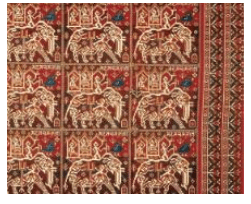
- a)Jamdani
- b)Kalamkari
- c)Patola
- d)Ikat
Correct answer is option 'C'. Can you explain this answer?
The image given below is a particular type of weave that was woven in Surat, Ahmedabad and Patan. This became a part of the local weaving tradition later. Name this type of weave
a)
Jamdani
b)
Kalamkari
c)
Patola
d)
Ikat
 | Pooja Sengupta answered |
Patola is a double ikat woven sari, usually made from silk,[1] made in Patan, Gujarat, India.[2] The word patola is the plural form; the singular is patolu.[3] They are very expensive, once worn only by those belonging to royal and aristocratic families. These saris are popular among those who can afford the high prices.[4][5] Velvet patola styles are also made in Surat. Patola-weaving is a closely guarded family tradition. There are three families in Patan that weave these highly prized double ikat saris. It is said that this technique is taught to no one in the family, but only to the sons. It can take six months to one year to make one sari due to the long process of dying each strand separately before weaving them together.Patola was woven in Surat, Ahmedabad and Patan.Highly valued in Indonesia, became part of the local weaving tradition there.
Chapter doubts & questions for Weavers, Iron Smelters and Factory Owners (Old NCERT) - Social Studies (SST) Class 8 2026 is part of Class 8 exam preparation. The chapters have been prepared according to the Class 8 exam syllabus. The Chapter doubts & questions, notes, tests & MCQs are made for Class 8 2026 Exam. Find important definitions, questions, notes, meanings, examples, exercises, MCQs and online tests here.
Chapter doubts & questions of Weavers, Iron Smelters and Factory Owners (Old NCERT) - Social Studies (SST) Class 8 in English & Hindi are available as part of Class 8 exam. Download more important topics, notes, lectures and mock test series for Class 8 Exam by signing up for free.
Social Studies (SST) Class 886 videos|559 docs|53 tests |
