


All Exams > Class 8 > Social Studies (SST) Class 8 > All Questions
All questions of Human Resources for Class 8 Exam
Land covers only about ____ percent of the total area of the earth’s surface- a)20
- b)25
- c)30
- d)35
Correct answer is option 'C'. Can you explain this answer?
Land covers only about ____ percent of the total area of the earth’s surface
a)
20
b)
25
c)
30
d)
35
 | Rahul Choudhury answered |
Area of land: 148 326 000 km2 (57 268 900 square miles), this are 30% of the total surface of Planet Earth. Area of water: 361 740 000 km2 (139 668 500 square miles), this are 71% of the total surface of the Earth. 97 percent is salt water and only 3 percent is fresh water.

Which of the following is not the region where very few people live?- a)High altitudes areas
- b)Plains
- c)Dry desert areas
- d)Equatorial forest area
Correct answer is option 'B'. Can you explain this answer?
Which of the following is not the region where very few people live?
a)
High altitudes areas
b)
Plains
c)
Dry desert areas
d)
Equatorial forest area
 | Manasa Nambiar answered |
Understanding Population Distribution
Population distribution refers to how people are spread across different regions of the world. Various geographical factors influence where people choose to live.
Regions with Sparse Populations
- High altitude areas: These regions, such as mountainous terrains, are often inhospitable due to harsh climates, thin air, and difficulty in accessing resources. This results in very few inhabitants.
- Dry desert areas: Deserts have extreme temperatures and limited water resources, making them unsuitable for large populations. The harsh living conditions lead to sparse settlement.
- Equatorial forest areas: Dense forests, particularly in equatorial regions, can be challenging for human habitation due to thick vegetation and disease prevalence (like malaria). However, some indigenous communities do live there, but the overall population density remains low.
Plains: The Exception
- Plains, in contrast to the aforementioned regions, are generally flat, fertile lands that are highly conducive to agriculture and settlement.
- They provide ample resources such as water, arable land, and favorable climates, which support larger populations.
- Historically, many civilizations have flourished in plains due to their agricultural potential, leading to higher population densities.
Conclusion
In summary, option 'B', the plains, is indeed the region where very few people do not live. Instead, plains are often densely populated, making them a stark contrast to the other options listed. Understanding these differences is crucial in the study of geography and human settlement patterns.
Population distribution refers to how people are spread across different regions of the world. Various geographical factors influence where people choose to live.
Regions with Sparse Populations
- High altitude areas: These regions, such as mountainous terrains, are often inhospitable due to harsh climates, thin air, and difficulty in accessing resources. This results in very few inhabitants.
- Dry desert areas: Deserts have extreme temperatures and limited water resources, making them unsuitable for large populations. The harsh living conditions lead to sparse settlement.
- Equatorial forest areas: Dense forests, particularly in equatorial regions, can be challenging for human habitation due to thick vegetation and disease prevalence (like malaria). However, some indigenous communities do live there, but the overall population density remains low.
Plains: The Exception
- Plains, in contrast to the aforementioned regions, are generally flat, fertile lands that are highly conducive to agriculture and settlement.
- They provide ample resources such as water, arable land, and favorable climates, which support larger populations.
- Historically, many civilizations have flourished in plains due to their agricultural potential, leading to higher population densities.
Conclusion
In summary, option 'B', the plains, is indeed the region where very few people do not live. Instead, plains are often densely populated, making them a stark contrast to the other options listed. Understanding these differences is crucial in the study of geography and human settlement patterns.
A few important statements with respect to the Human Resources are given below. Pick out the one that is not TRUE- a)The numbers and characteristics of human resources do not change.
- b)Human resource is the ultimate resource
- c)Human resources like other resources are not equally distributed
- d)Human resources differ in educational levels, age and sex
Correct answer is option 'A'. Can you explain this answer?
A few important statements with respect to the Human Resources are given below. Pick out the one that is not TRUE
a)
The numbers and characteristics of human resources do not change.
b)
Human resource is the ultimate resource
c)
Human resources like other resources are not equally distributed
d)
Human resources differ in educational levels, age and sex
| | Kavya Saxena answered |
As human resources are unlimited resources they change in numbers as well as they have different characteristics.
From the following list , pick out the percent of total population that lives in Asia alone.- a)80
- b)20
- c)60
- d)40
Correct answer is option 'C'. Can you explain this answer?
From the following list , pick out the percent of total population that lives in Asia alone.
a)
80
b)
20
c)
60
d)
40
 | Ashwin Jain answered |
Asia is the most populous continent, with its 4.54 billion inhabitants accounting for 60% of the world population. The world's two most populated countries, China and India, together constitute about 36% of the world's population.
Osaka in Japan and Mumbai in India are two densely populated areas. Give reason- a)These areas are topographically favourable.
- b)These are areas of religious significance
- c)They are industrial belts providing large employment opportunities
- d)These are areas with excellent climatic conditions
Correct answer is option 'C'. Can you explain this answer?
Osaka in Japan and Mumbai in India are two densely populated areas. Give reason
a)
These areas are topographically favourable.
b)
These are areas of religious significance
c)
They are industrial belts providing large employment opportunities
d)
These are areas with excellent climatic conditions
 | Geetika Shah answered |
As this region has highly developed and provided more employment opportunities.
What does the following image infer? 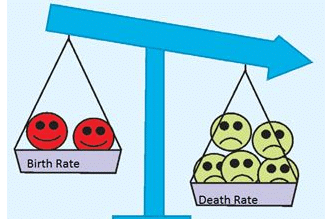
- a)Balanced population
- b)Decrease in population
- c)Increase in population
- d)All of the above
Correct answer is option 'B'. Can you explain this answer?
What does the following image infer?
a)
Balanced population
b)
Decrease in population
c)
Increase in population
d)
All of the above
 | C K Academy answered |
The image implies a decrease in population.
- Therefore, the correct answer is B: Decrease in population.
- Therefore, the correct answer is B: Decrease in population.
The number of deaths per 1,000 people refer to- a)Migration
- b)Birth Rate
- c)Death rate
- d)Population change
Correct answer is option 'C'. Can you explain this answer?
The number of deaths per 1,000 people refer to
a)
Migration
b)
Birth Rate
c)
Death rate
d)
Population change
| | Ashwin Jain answered |
Death rate, crude (per 1,000 people)
Definition: Crude death rate indicates the number of deaths occurring during the year, per 1,000 population estimated at midyear.
Which one from the following refers to Census?- a)The process of counting the number of states in a country
- b)The process of taking a count of total number of people in a country
- c)The process of counting the land area in a country
- d)The process of counting the mountains and hilly terrains in a country
Correct answer is option 'B'. Can you explain this answer?
Which one from the following refers to Census?
a)
The process of counting the number of states in a country
b)
The process of taking a count of total number of people in a country
c)
The process of counting the land area in a country
d)
The process of counting the mountains and hilly terrains in a country
 | Amit Kumar answered |
A census is the procedure of systematically acquiring and recording information about the members of a given population.
Life expectancy refer to- a)The number of working people in the country
- b)The number of literate people in the country
- c)The number of years that an average person can expect to live
- d)The number of illiterate and uneducated people in the country
Correct answer is option 'C'. Can you explain this answer?
Life expectancy refer to
a)
The number of working people in the country
b)
The number of literate people in the country
c)
The number of years that an average person can expect to live
d)
The number of illiterate and uneducated people in the country
| | Sanjana Saha answered |
Life Expectancy
Life expectancy refers to the number of years that an average person can expect to live. It is a key indicator of the overall health and well-being of a population.
Factors Affecting Life Expectancy
- Access to healthcare: Countries with better healthcare systems tend to have higher life expectancies.
- Socioeconomic status: Income level and education can also impact life expectancy.
- Lifestyle factors: Diet, exercise, and smoking habits play a significant role in determining life expectancy.
- Environmental factors: Pollution, access to clean water, and sanitation can affect life expectancy.
Importance of Life Expectancy
- It is a measure of the quality of life in a country.
- It can help policymakers make decisions about healthcare, social services, and infrastructure.
- A higher life expectancy is generally associated with a higher standard of living and overall well-being.
In conclusion, life expectancy is a crucial measure of the health and prosperity of a population. By improving healthcare, reducing poverty, and promoting healthy lifestyles, countries can increase their life expectancy and improve the overall quality of life for their citizens.
Population density refer to- a)The number of skilled people in a country
- b)The number of people living per square unit of area.
- c)The number of unskilled people in a country
- d)The way in which people are spread across the earth's surface
Correct answer is option 'B'. Can you explain this answer?
Population density refer to
a)
The number of skilled people in a country
b)
The number of people living per square unit of area.
c)
The number of unskilled people in a country
d)
The way in which people are spread across the earth's surface
| | Alok Verma answered |
Measure of the intensity of land use, expressed as number of people per square kilometer or square mile. Also called density of population.
Population density
Two important measures of a population are population size, the number of individuals, and population density, the number of individuals per unit area or volume.
Population density tells you how crowded an area is, on average. It can help you figure out the resources that a certain area requires, and it can help you compare areas. You'll need to gather data about the area and population size, then plug the numbers into the population density formula: Population Density = Number of People / Land Area.
A few facts pertaining to the density of population are given below. Pick out the one that is not TRUE.- a)Availability of mineral resources , industrial development ,good transport network contribute to the high density of population in the North Eastern and South Western coasts of America
- b)In China the population is concentrated along the banks of the Yangtze Yang and Hwang Ho rivers
- c)The coastal parts of Africa, Europe and Asia have a moderate density of population
- d)Deserts like Sahara , Kalahari etc are have a high density of population.
Correct answer is option 'D'. Can you explain this answer?
A few facts pertaining to the density of population are given below. Pick out the one that is not TRUE.
a)
Availability of mineral resources , industrial development ,good transport network contribute to the high density of population in the North Eastern and South Western coasts of America
b)
In China the population is concentrated along the banks of the Yangtze Yang and Hwang Ho rivers
c)
The coastal parts of Africa, Europe and Asia have a moderate density of population
d)
Deserts like Sahara , Kalahari etc are have a high density of population.
| | Anagha Kaur answered |
Explanation:
The statement that is not true is option D: Deserts like Sahara, Kalahari etc have a high density of population. This statement is incorrect because deserts are characterized by harsh climatic conditions, lack of water and vegetation, making it difficult for human habitation.
Here are some explanations on the other options:
a) Availability of mineral resources, industrial development, good transport network contribute to the high density of population in the North Eastern and South Western coasts of America: This statement is true as these factors attract people to settle in these regions, leading to a high population density.
b) In China, the population is concentrated along the banks of the Yangtze Yang and Hwang Ho rivers: This statement is true as these two rivers are the most significant in China and provide water for agriculture and other activities. The areas around these rivers are also more fertile and suitable for human habitation.
c) The coastal parts of Africa, Europe, and Asia have a moderate density of population: This statement is generally true as coastal areas tend to have more economic activity and access to transportation, leading to a higher population density than inland areas. However, there may be exceptions to this trend in some specific coastal regions.
In conclusion, the statement that deserts like Sahara, Kalahari etc have a high density of population is not true.
The statement that is not true is option D: Deserts like Sahara, Kalahari etc have a high density of population. This statement is incorrect because deserts are characterized by harsh climatic conditions, lack of water and vegetation, making it difficult for human habitation.
Here are some explanations on the other options:
a) Availability of mineral resources, industrial development, good transport network contribute to the high density of population in the North Eastern and South Western coasts of America: This statement is true as these factors attract people to settle in these regions, leading to a high population density.
b) In China, the population is concentrated along the banks of the Yangtze Yang and Hwang Ho rivers: This statement is true as these two rivers are the most significant in China and provide water for agriculture and other activities. The areas around these rivers are also more fertile and suitable for human habitation.
c) The coastal parts of Africa, Europe, and Asia have a moderate density of population: This statement is generally true as coastal areas tend to have more economic activity and access to transportation, leading to a higher population density than inland areas. However, there may be exceptions to this trend in some specific coastal regions.
In conclusion, the statement that deserts like Sahara, Kalahari etc have a high density of population is not true.
State whether the following statement is True or False:
More than 90% of the world's population lives on about 10% of the land surface.- a)False
- b)True
Correct answer is option 'A'. Can you explain this answer?
State whether the following statement is True or False:
More than 90% of the world's population lives on about 10% of the land surface.
More than 90% of the world's population lives on about 10% of the land surface.
a)
False
b)
True
 | Abhijeet Ghosh answered |
Understanding the Statement
The assertion that "more than 90% of the world's population lives on about 10% of the land surface" is actually False. Let's break down why this is the case.
Population Distribution
- The global population is distributed unevenly across various regions.
- Major concentrations of people are found in urban areas, fertile plains, and along coastlines.
- Significant populations exist in countries like China and India, which occupy large land areas.
Land Surface Usage
- While densely populated regions occupy small portions of land, the total area used for habitation is much larger than 10%.
- Urbanization has led to high population densities in cities, but these cities constitute a small fraction of total land area.
Geographical Considerations
- Around 30% of the Earth’s land is habitable, including plains, valleys, and coastal regions.
- The majority of the world’s land surface consists of deserts, mountains, and other uninhabitable areas that do not support large populations.
Conclusion
- The statement overemphasizes the extent of urban concentration by suggesting that such a vast majority of people live on a minimal portion of land.
- In reality, while urban areas are densely populated, they do not account for over 90% of the global population living on only 10% of the land.
In summary, the correct answer is False, as more than 90% of the global population does not reside on just 10% of the land surface.
The assertion that "more than 90% of the world's population lives on about 10% of the land surface" is actually False. Let's break down why this is the case.
Population Distribution
- The global population is distributed unevenly across various regions.
- Major concentrations of people are found in urban areas, fertile plains, and along coastlines.
- Significant populations exist in countries like China and India, which occupy large land areas.
Land Surface Usage
- While densely populated regions occupy small portions of land, the total area used for habitation is much larger than 10%.
- Urbanization has led to high population densities in cities, but these cities constitute a small fraction of total land area.
Geographical Considerations
- Around 30% of the Earth’s land is habitable, including plains, valleys, and coastal regions.
- The majority of the world’s land surface consists of deserts, mountains, and other uninhabitable areas that do not support large populations.
Conclusion
- The statement overemphasizes the extent of urban concentration by suggesting that such a vast majority of people live on a minimal portion of land.
- In reality, while urban areas are densely populated, they do not account for over 90% of the global population living on only 10% of the land.
In summary, the correct answer is False, as more than 90% of the global population does not reside on just 10% of the land surface.
Using resources carefully, judicially & giving them time to get renewed is called .................- a)Resource Development
- b)Sustainable Conservation
- c)Sustainable Development
- d)Resource Conservation
Correct answer is option 'D'. Can you explain this answer?
Using resources carefully, judicially & giving them time to get renewed is called .................
a)
Resource Development
b)
Sustainable Conservation
c)
Sustainable Development
d)
Resource Conservation
 | Bhavana Patel answered |
Using resources carefully, judicially and giving them time to get renewed is called resource conservation. It is very necessary to use the resources very carefully as they are part of our life support system.
Which of the following factors is responsible for population change?- a)Topography
- b)Climate
- c)Births, deaths and migration
- d)Soil fertility
Correct answer is option 'C'. Can you explain this answer?
Which of the following factors is responsible for population change?
a)
Topography
b)
Climate
c)
Births, deaths and migration
d)
Soil fertility
 | Nidhi Bhatt answered |
Population change refers to change in the number of people during a specific time. The three main factors that cause population change are births, deaths and migration. Births and deaths are natural causes, while migration is the movement of people in and out of an area.
If the birth rate is high and the death rate is low in a country then the population pyramid will- a)Not narrow at the base
- b)Not narrow rapidly towards the top
- c)Narrow at the base
- d)Narrow rapidly towards the top
Correct answer is option 'B'. Can you explain this answer?
If the birth rate is high and the death rate is low in a country then the population pyramid will
a)
Not narrow at the base
b)
Not narrow rapidly towards the top
c)
Narrow at the base
d)
Narrow rapidly towards the top
 | Maheshwar Verma answered |
Understanding Population Pyramids
A population pyramid is a graphical representation of the age and sex distribution of a population. Its shape can reveal a lot about the demographic trends of a country, particularly in relation to birth and death rates.
High Birth Rate and Low Death Rate
- When a country has a high birth rate, it means that a significant number of children are being born, leading to a broad base in the population pyramid.
- A low death rate indicates that fewer people are dying, allowing a larger proportion of the population to survive into older age groups.
Implications for the Population Pyramid
- The combination of a high birth rate and a low death rate results in a population pyramid that does not narrow rapidly towards the top. This is because:
- A large cohort of younger individuals will push the base of the pyramid wide.
- As individuals age, the population remains substantial due to low mortality rates, preventing a sharp decline in size at the higher age groups.
Why Option B is Correct
- The answer to the question is option 'B': Not narrow rapidly towards the top.
- This reflects the situation where many individuals survive into older age, creating a more balanced or even slightly broader top compared to a pyramid that would narrow rapidly if death rates were higher.
Conclusion
In summary, a high birth rate combined with a low death rate leads to a population pyramid that is characterized by a broad base and a relatively stable top, illustrating a youthful population with a significant number of individuals surviving into older age.
A population pyramid is a graphical representation of the age and sex distribution of a population. Its shape can reveal a lot about the demographic trends of a country, particularly in relation to birth and death rates.
High Birth Rate and Low Death Rate
- When a country has a high birth rate, it means that a significant number of children are being born, leading to a broad base in the population pyramid.
- A low death rate indicates that fewer people are dying, allowing a larger proportion of the population to survive into older age groups.
Implications for the Population Pyramid
- The combination of a high birth rate and a low death rate results in a population pyramid that does not narrow rapidly towards the top. This is because:
- A large cohort of younger individuals will push the base of the pyramid wide.
- As individuals age, the population remains substantial due to low mortality rates, preventing a sharp decline in size at the higher age groups.
Why Option B is Correct
- The answer to the question is option 'B': Not narrow rapidly towards the top.
- This reflects the situation where many individuals survive into older age, creating a more balanced or even slightly broader top compared to a pyramid that would narrow rapidly if death rates were higher.
Conclusion
In summary, a high birth rate combined with a low death rate leads to a population pyramid that is characterized by a broad base and a relatively stable top, illustrating a youthful population with a significant number of individuals surviving into older age.
State whether the following statement is True or False:Mountains are preferred over plains for farming and manufacturing.- a)True
- b)False
Correct answer is option 'B'. Can you explain this answer?
State whether the following statement is True or False:
Mountains are preferred over plains for farming and manufacturing.
a)
True
b)
False
| | Nidhi Bhatt answered |
- False! Plains are preferred over mountains for farming and manufacturing because they are more suitable for these activities.
- Plains have flat lands which make it easier to grow crops and build factories.
- Mountains, on the other hand, have rough and steep terrains, making it difficult to farm and set up industries.
Areas with accessible fresh water are densely populated due to their ______.- a)Extreme climates
- b)Fertile soils
- c)Moderate climates
- d)Water
Correct answer is option 'D'. Can you explain this answer?
Areas with accessible fresh water are densely populated due to their ______.
a)
Extreme climates
b)
Fertile soils
c)
Moderate climates
d)
Water
 | Ishan Mehra answered |
Importance of Accessible Fresh Water
Accessible fresh water is a critical resource that influences population density and settlement patterns. Areas with abundant fresh water typically attract larger populations due to several key factors.
1. Essential for Survival
- Fresh water is vital for drinking, cooking, and sanitation.
- Access to clean water reduces the risk of waterborne diseases.
2. Agricultural Productivity
- Fresh water supports irrigation, allowing for the cultivation of crops.
- Fertile agricultural lands near rivers, lakes, or aquifers produce food efficiently.
3. Economic Opportunities
- Water bodies provide resources such as fish, which contribute to local economies.
- Industries often develop near water sources for manufacturing and transportation needs.
4. Settlement Patterns
- Historically, civilizations have flourished near rivers and lakes, as they provide essential resources.
- Cities and towns are frequently established in areas where fresh water is readily available.
5. Quality of Life
- Access to fresh water enhances the overall quality of life, making areas more attractive for settlement.
- Communities with reliable water sources often experience better health outcomes and economic growth.
In conclusion, the presence of accessible fresh water is the primary reason behind the dense population in certain areas. It facilitates survival, agriculture, economic development, and ultimately shapes human settlement patterns. This essential resource is pivotal for sustaining life and supporting thriving communities.
Accessible fresh water is a critical resource that influences population density and settlement patterns. Areas with abundant fresh water typically attract larger populations due to several key factors.
1. Essential for Survival
- Fresh water is vital for drinking, cooking, and sanitation.
- Access to clean water reduces the risk of waterborne diseases.
2. Agricultural Productivity
- Fresh water supports irrigation, allowing for the cultivation of crops.
- Fertile agricultural lands near rivers, lakes, or aquifers produce food efficiently.
3. Economic Opportunities
- Water bodies provide resources such as fish, which contribute to local economies.
- Industries often develop near water sources for manufacturing and transportation needs.
4. Settlement Patterns
- Historically, civilizations have flourished near rivers and lakes, as they provide essential resources.
- Cities and towns are frequently established in areas where fresh water is readily available.
5. Quality of Life
- Access to fresh water enhances the overall quality of life, making areas more attractive for settlement.
- Communities with reliable water sources often experience better health outcomes and economic growth.
In conclusion, the presence of accessible fresh water is the primary reason behind the dense population in certain areas. It facilitates survival, agriculture, economic development, and ultimately shapes human settlement patterns. This essential resource is pivotal for sustaining life and supporting thriving communities.
More than 90% of World’s population lives in about of land surface?- a)20%
- b)30%
- c)50%
- d)35%
Correct answer is option 'B'. Can you explain this answer?
More than 90% of World’s population lives in about of land surface?
a)
20%
b)
30%
c)
50%
d)
35%
| | Harshitha Choudhary answered |
More than 90% of the world's population lives in the Northern Hemisphere.
Pick out the non-physical factor that affects the distribution of population in a country ?- a)Water
- b)Stable Governments
- c)Shape and Height of land
- d)Climate
Correct answer is option 'B'. Can you explain this answer?
Pick out the non-physical factor that affects the distribution of population in a country ?
a)
Water
b)
Stable Governments
c)
Shape and Height of land
d)
Climate
 | Sneha Mishra answered |
**Non-Physical Factor Affecting the Distribution of Population: Stable Governments**
The distribution of population in a country can be influenced by various factors, both physical and non-physical. While physical factors such as water, land characteristics, and climate play a significant role, non-physical factors like stable governments also have a profound impact on population distribution.
**1. Introduction**
Population distribution refers to the pattern of where people live within a country or region. It is influenced by a combination of physical, social, economic, and political factors. Stable governments, which provide a conducive environment for people to live and work, are one such non-physical factor that affects population distribution.
**2. Influence of Stable Governments on Population Distribution**
a) Political Stability:
- Stable governments ensure political stability and security within a country. This creates a sense of safety and attracts people to settle in areas governed by a reliable and secure administration.
- In regions with unstable or weak governments, people may choose to migrate to more stable areas to escape conflict, violence, or political turmoil.
b) Economic Opportunities:
- Stable governments typically create an environment conducive to economic growth and development. They establish favorable policies, attract investments, and promote entrepreneurship.
- These economic opportunities act as a pull factor, attracting people to settle in areas where there are better prospects for employment, income, and overall livelihood.
c) Infrastructure Development:
- Stable governments often prioritize infrastructure development, including transportation networks, communication systems, healthcare facilities, and educational institutions.
- These developments play a vital role in attracting people to settle in certain areas, as they provide essential services and improve the overall quality of life.
d) Public Services and Welfare:
- Stable governments are more likely to provide basic public services and welfare programs to their citizens, such as healthcare, education, housing, and social security.
- Access to these services and benefits is an important consideration for individuals and families when deciding where to live, resulting in population concentration in areas with better public service provisions.
**3. Conclusion**
While physical factors like water, land characteristics, and climate certainly influence population distribution, non-physical factors such as stable governments play an equally important role. Political stability, economic opportunities, infrastructure development, and public services provided by stable governments greatly influence people's decisions on where to settle, leading to variations in population distribution within a country.
The distribution of population in a country can be influenced by various factors, both physical and non-physical. While physical factors such as water, land characteristics, and climate play a significant role, non-physical factors like stable governments also have a profound impact on population distribution.
**1. Introduction**
Population distribution refers to the pattern of where people live within a country or region. It is influenced by a combination of physical, social, economic, and political factors. Stable governments, which provide a conducive environment for people to live and work, are one such non-physical factor that affects population distribution.
**2. Influence of Stable Governments on Population Distribution**
a) Political Stability:
- Stable governments ensure political stability and security within a country. This creates a sense of safety and attracts people to settle in areas governed by a reliable and secure administration.
- In regions with unstable or weak governments, people may choose to migrate to more stable areas to escape conflict, violence, or political turmoil.
b) Economic Opportunities:
- Stable governments typically create an environment conducive to economic growth and development. They establish favorable policies, attract investments, and promote entrepreneurship.
- These economic opportunities act as a pull factor, attracting people to settle in areas where there are better prospects for employment, income, and overall livelihood.
c) Infrastructure Development:
- Stable governments often prioritize infrastructure development, including transportation networks, communication systems, healthcare facilities, and educational institutions.
- These developments play a vital role in attracting people to settle in certain areas, as they provide essential services and improve the overall quality of life.
d) Public Services and Welfare:
- Stable governments are more likely to provide basic public services and welfare programs to their citizens, such as healthcare, education, housing, and social security.
- Access to these services and benefits is an important consideration for individuals and families when deciding where to live, resulting in population concentration in areas with better public service provisions.
**3. Conclusion**
While physical factors like water, land characteristics, and climate certainly influence population distribution, non-physical factors such as stable governments play an equally important role. Political stability, economic opportunities, infrastructure development, and public services provided by stable governments greatly influence people's decisions on where to settle, leading to variations in population distribution within a country.
Pick out from the following, the apt definition for natural growth rate.- a)The difference between the birth rate and the death rate of a country
- b)The age- sex composition of a country.
- c)The way in which people are spread across the earth's surface
- d)The number of people living per square unit of area.
Correct answer is option 'A'. Can you explain this answer?
Pick out from the following, the apt definition for natural growth rate.
a)
The difference between the birth rate and the death rate of a country
b)
The age- sex composition of a country.
c)
The way in which people are spread across the earth's surface
d)
The number of people living per square unit of area.
| | Pooja Lagyan answered |
Growth rate of the population is the difference between the birth rate and the death rate. As long as the birth rate exceeds the death rate, the population grows. If the birth rate is lower than the death rate, the population declines.
Cite an example where religious or cultural activities tend to attract more people- a)Mumbai
- b)Sahara
- c)Osaka
- d)Jerusalem
Correct answer is option 'D'. Can you explain this answer?
Cite an example where religious or cultural activities tend to attract more people
a)
Mumbai
b)
Sahara
c)
Osaka
d)
Jerusalem
| | Sanskriti Singh answered |
Religious and cultural activities tend to attract more people in Jerusalem.
Reasons:
1. Religious Significance: Jerusalem is considered a holy city by three major religions - Judaism, Christianity, and Islam. As a result, the city attracts millions of pilgrims and tourists every year who come to visit the holy sites and participate in religious ceremonies.
2. Cultural Significance: Jerusalem is also a center for cultural activities like music, dance, and art. The city hosts several festivals throughout the year, including the Jerusalem International Film Festival, the Jerusalem Beer Festival, and the Jerusalem Light Festival. These events attract a large number of people from around the world.
3. Historical Significance: Jerusalem is an ancient city with a rich history that dates back thousands of years. The city is home to numerous historical sites like the Western Wall, the Temple Mount, and the Church of the Holy Sepulchre. These sites attract visitors who are interested in history and archaeology.
4. Political Significance: Jerusalem is also a center for political activities, as it is the capital of Israel and a contested city between Israel and Palestine. Political events like protests and demonstrations also attract people to the city.
Conclusion:
In conclusion, Jerusalem's religious, cultural, historical, and political significance make it a popular destination for people from all over the world. The city's diverse attractions ensure that there is always something for everyone, and this is why it tends to attract more people compared to other cities.
Reasons:
1. Religious Significance: Jerusalem is considered a holy city by three major religions - Judaism, Christianity, and Islam. As a result, the city attracts millions of pilgrims and tourists every year who come to visit the holy sites and participate in religious ceremonies.
2. Cultural Significance: Jerusalem is also a center for cultural activities like music, dance, and art. The city hosts several festivals throughout the year, including the Jerusalem International Film Festival, the Jerusalem Beer Festival, and the Jerusalem Light Festival. These events attract a large number of people from around the world.
3. Historical Significance: Jerusalem is an ancient city with a rich history that dates back thousands of years. The city is home to numerous historical sites like the Western Wall, the Temple Mount, and the Church of the Holy Sepulchre. These sites attract visitors who are interested in history and archaeology.
4. Political Significance: Jerusalem is also a center for political activities, as it is the capital of Israel and a contested city between Israel and Palestine. Political events like protests and demonstrations also attract people to the city.
Conclusion:
In conclusion, Jerusalem's religious, cultural, historical, and political significance make it a popular destination for people from all over the world. The city's diverse attractions ensure that there is always something for everyone, and this is why it tends to attract more people compared to other cities.
Birth rate refer to- a)The number of people moving from one place to another
- b)The number of infants died per 1,000 people
- c)The number of live births per 1,000 people
- d)The number of deaths per 1,000 people
Correct answer is option 'C'. Can you explain this answer?
Birth rate refer to
a)
The number of people moving from one place to another
b)
The number of infants died per 1,000 people
c)
The number of live births per 1,000 people
d)
The number of deaths per 1,000 people
 | Ias Masters answered |
The correct answer is C: The number of live births per 1,000 people.
- Birth rate refers to the number of live births per 1,000 people in a specified population.
- It is a crucial demographic indicator that helps in understanding the growth and dynamics of a population.
- By calculating the birth rate, we can assess the fertility level and make projections about future population trends.
- It is usually represented as the number of live births per 1,000 individuals in a given year.
- Birth rate refers to the number of live births per 1,000 people in a specified population.
- It is a crucial demographic indicator that helps in understanding the growth and dynamics of a population.
- By calculating the birth rate, we can assess the fertility level and make projections about future population trends.
- It is usually represented as the number of live births per 1,000 individuals in a given year.
Population change refer to- a)The number of people living per square unit of area.
- b)The way in which people are spread across the earth's surface
- c)The change in the number of people living in a particular area.
- d)The age- sex composition of a country.
Correct answer is option 'C'. Can you explain this answer?
Population change refer to
a)
The number of people living per square unit of area.
b)
The way in which people are spread across the earth's surface
c)
The change in the number of people living in a particular area.
d)
The age- sex composition of a country.
| | Surbhi Nambiar answered |
Population change refers to the change in the number of people living in a particular area. It is a measure of how the population of an area has increased or decreased over a specific period of time. Population change is a key indicator of demographic trends and can have significant social, economic, and environmental implications.
There are several factors that contribute to population change, including birth rate, death rate, migration, and natural disasters. These factors can cause the population of an area to either increase or decrease.
The key points to understand about population change are as follows:
1. Definition of population change:
- Population change refers to the change in the number of people living in a particular area.
- It is measured by comparing the population at the beginning and end of a specific time period.
2. Factors influencing population change:
- Birth rate: The number of births per 1,000 individuals in a population.
- Death rate: The number of deaths per 1,000 individuals in a population.
- Migration: The movement of people from one area to another.
- Natural disasters: Events such as earthquakes, floods, or epidemics that can cause a significant loss of life.
3. Calculation of population change:
- Population change can be calculated using the formula: Population change = (Births + Immigration) - (Deaths + Emigration).
- If the result is positive, it indicates population growth, while a negative result indicates population decline.
4. Importance of population change:
- Population change is an important indicator of demographic trends and can help in understanding the dynamics of a population.
- It can have significant social, economic, and environmental implications.
- Understanding population change is crucial for policy-making, resource allocation, and planning for the future.
In conclusion, population change refers to the change in the number of people living in a particular area. It is influenced by factors such as birth rate, death rate, migration, and natural disasters. Population change is an important indicator of demographic trends and has significant implications for society, the economy, and the environment.
There are several factors that contribute to population change, including birth rate, death rate, migration, and natural disasters. These factors can cause the population of an area to either increase or decrease.
The key points to understand about population change are as follows:
1. Definition of population change:
- Population change refers to the change in the number of people living in a particular area.
- It is measured by comparing the population at the beginning and end of a specific time period.
2. Factors influencing population change:
- Birth rate: The number of births per 1,000 individuals in a population.
- Death rate: The number of deaths per 1,000 individuals in a population.
- Migration: The movement of people from one area to another.
- Natural disasters: Events such as earthquakes, floods, or epidemics that can cause a significant loss of life.
3. Calculation of population change:
- Population change can be calculated using the formula: Population change = (Births + Immigration) - (Deaths + Emigration).
- If the result is positive, it indicates population growth, while a negative result indicates population decline.
4. Importance of population change:
- Population change is an important indicator of demographic trends and can help in understanding the dynamics of a population.
- It can have significant social, economic, and environmental implications.
- Understanding population change is crucial for policy-making, resource allocation, and planning for the future.
In conclusion, population change refers to the change in the number of people living in a particular area. It is influenced by factors such as birth rate, death rate, migration, and natural disasters. Population change is an important indicator of demographic trends and has significant implications for society, the economy, and the environment.
Chapter doubts & questions for Human Resources - Social Studies (SST) Class 8 2026 is part of Class 8 exam preparation. The chapters have been prepared according to the Class 8 exam syllabus. The Chapter doubts & questions, notes, tests & MCQs are made for Class 8 2026 Exam. Find important definitions, questions, notes, meanings, examples, exercises, MCQs and online tests here.
Chapter doubts & questions of Human Resources - Social Studies (SST) Class 8 in English & Hindi are available as part of Class 8 exam. Download more important topics, notes, lectures and mock test series for Class 8 Exam by signing up for free.
Social Studies (SST) Class 886 videos|559 docs|53 tests |
