


All Exams > Class 8 > Mathematics (Maths) Class 8 > All Questions
All questions of Cubes & Cubes Roots for Class 8 Exam
36 x K is a perfect cube number, then K = ______a)6b)5c)4d)3Correct answer is option 'A'. Can you explain this answer?
 | Kavya Saxena answered |
6×6=36 and 36×6=216, which is the cube of 6.

Ones place digit in the cube of 5832 is ______.- a)5
- b)7
- c)2
- d)8
Correct answer is option 'D'. Can you explain this answer?
Ones place digit in the cube of 5832 is ______.
a)
5
b)
7
c)
2
d)
8
 | Shiksha Academy answered |
A number ending with 1 , 2 , 3 , 4 , 5 , 6 , 7 , 8 , 9 , 0 then it's cube ends with 1 , 8 , 7 , 4 , 5 , 6 , 3 , 2 , 0 respectively
⇒ One's digit of 5832= 2
⇒ Cube of 2=23 = 8
⇒ Cube of 2=23 = 8
So, the one's digit of cube of 5832=8
A natural number is said to be a perfect cube, if it is the cube of some ________.- a)cube number
- b)square numbers
- c)natural number
- d)none of these
Correct answer is 'C'. Can you explain this answer?
A natural number is said to be a perfect cube, if it is the cube of some ________.
a)
cube number
b)
square numbers
c)
natural number
d)
none of these
| | Kavya Saxena answered |
A natural number is said to be a perfect cube if it is the cube of some natural number.
Example
8 = 2 x 2 x 2
8 = 2 3
8 is the perfect cube because it is a cube of 2 which is a natural number.
But 12 is not a perfect cube because it is not a cube of any natural numbers.
Example
8 = 2 x 2 x 2
8 = 2 3
8 is the perfect cube because it is a cube of 2 which is a natural number.
But 12 is not a perfect cube because it is not a cube of any natural numbers.
What is the cube of double of ‘a’?- a)16a3
- b)2a
- c)8a3
- d)4a2
Correct answer is option 'C'. Can you explain this answer?
What is the cube of double of ‘a’?
a)
16a3
b)
2a
c)
8a3
d)
4a2
 | Vivek Rana answered |
Double of a here a+a=2a
So cube of (2a)³=8a³
Express 63 as the sum of odd numbers.- a)31 + 33 + 35 + 37 + 39 + 41 + 43
- b)31 + 33 + 35 + 37 + 39 + 41
- c)31 + 33 + 35 + 37 + 39 + 41 + 43 + 45
- d)none of these
Correct answer is option 'B'. Can you explain this answer?
Express 63 as the sum of odd numbers.
a)
31 + 33 + 35 + 37 + 39 + 41 + 43
b)
31 + 33 + 35 + 37 + 39 + 41
c)
31 + 33 + 35 + 37 + 39 + 41 + 43 + 45
d)
none of these
 | Pooja Shah answered |
We know,
⇒ 31 + 33 + 35 + 37 + 39 + 41 = 216
And the cube of 6 is also 216
⇒ 6 × 6 × 6 = 216
The cube of an even number is always ____________.- a)odd number
- b)even number
- c)prime number
- d)none of these
Correct answer is option 'B'. Can you explain this answer?
The cube of an even number is always ____________.
a)
odd number
b)
even number
c)
prime number
d)
none of these
 | Biswa Ranjan Parida Pari answered |
Because multiplication of even number is always even.
for ex 2³=2.2.2=8
for ex 2³=2.2.2=8

By which smallest natural number 392 must be multiplied so as to make the product a perfect cube ?- a)2
- b)14
- c)7
- d)49
Correct answer is option 'C'. Can you explain this answer?
By which smallest natural number 392 must be multiplied so as to make the product a perfect cube ?
a)
2
b)
14
c)
7
d)
49
 | Rohini Seth answered |
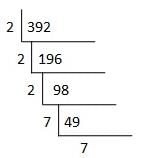
392 = 2 × 2 × 2 × 7 × 7
Hence the number should be multiplied by 7 to make it a perfect cube.
Can you explain the answer of this question below:The numbers 1, 8, 27... are ____________.
- A:
negative numbers
- B:
cube numbers
- C:
square numbers
- D:
none of these
The answer is B.
The numbers 1, 8, 27... are ____________.
negative numbers
cube numbers
square numbers
none of these
 | Saranya Khanna answered |
1×1×1 =1
2×2×2 = 8
3×3×3 = 27
4×4×4 = 64
5×5×5 = 125
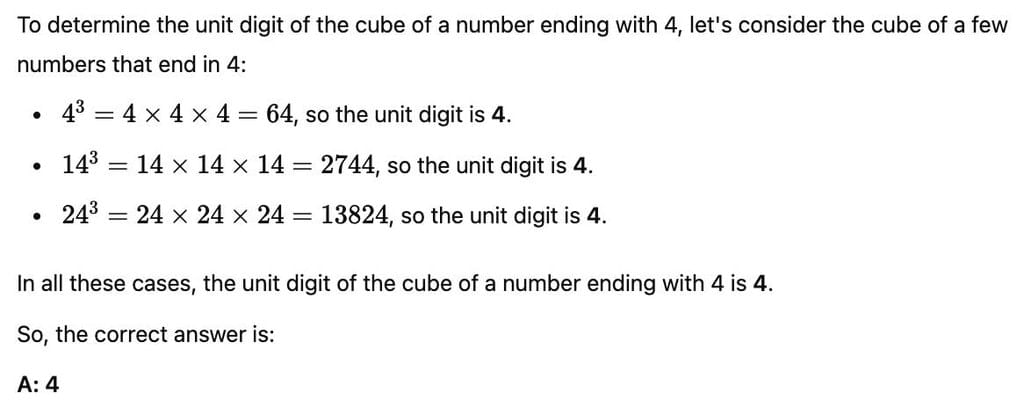
729 is the value of _______________.- a)83
- b)93
- c)63
- d)43
Correct answer is option 'B'. Can you explain this answer?
729 is the value of _______________.
a)
83
b)
93
c)
63
d)
43
 | EduRev Class 8 answered |
To find the value of 729729729, we check cube powers:

What will be the unit digit of ∛216- a)3
- b)6
- c)4
- d)2
Correct answer is option 'B'. Can you explain this answer?
What will be the unit digit of ∛216
a)
3
b)
6
c)
4
d)
2
 | Humaira Tabassum answered |
We can find it by Prime Factorization method
³√216 = 2×2×2×3×3×3
= 2 and 3 are making triplets i.e. 2 and 3
= 2×3 = 6 Thus, we can say that 6 i.e option 'B' is correct.
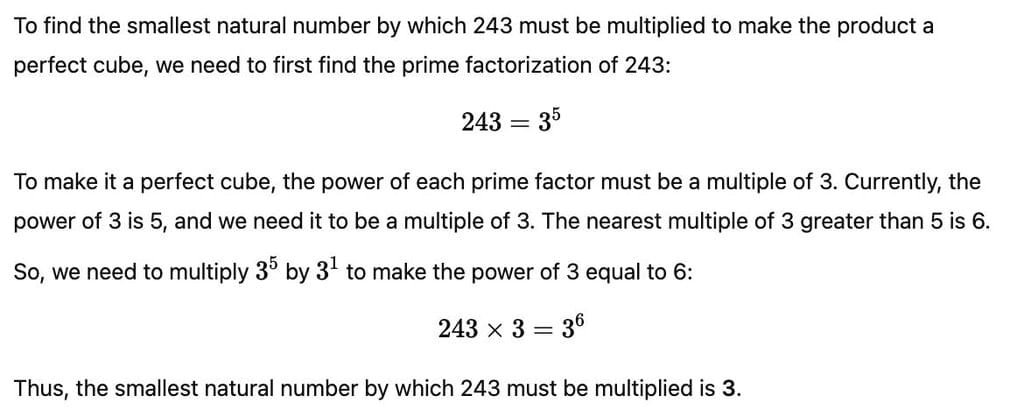

Which of the following is a perfect cube ?- a)125
- b)135
- c)145
- d)115
Correct answer is option 'A'. Can you explain this answer?
Which of the following is a perfect cube ?
a)
125
b)
135
c)
145
d)
115
| | Athul Sen answered |
Identifying a Perfect Cube
A perfect cube is a number that can be expressed as the product of three identical factors. For example, 27 is a perfect cube because it can be expressed as 3 x 3 x 3. To determine whether a number is a perfect cube, we need to find the cube root of that number. Here, we are given four options, and we can use the cube root method to identify the perfect cube.
Solution
a) 125
The cube root of 125 is 5. Since 125 can be expressed as 5 x 5 x 5, it is a perfect cube. Therefore, option A is the correct answer.
b) 135
The cube root of 135 is approximately 5.5. Since 5.5 is not a whole number, 135 is not a perfect cube.
c) 145
The cube root of 145 is approximately 5.7. Since 5.7 is not a whole number, 145 is not a perfect cube.
d) 115
The cube root of 115 is approximately 4.8. Since 4.8 is not a whole number, 115 is not a perfect cube.
Therefore, the only perfect cube among the given options is 125, which is option A.
A perfect cube is a number that can be expressed as the product of three identical factors. For example, 27 is a perfect cube because it can be expressed as 3 x 3 x 3. To determine whether a number is a perfect cube, we need to find the cube root of that number. Here, we are given four options, and we can use the cube root method to identify the perfect cube.
Solution
a) 125
The cube root of 125 is 5. Since 125 can be expressed as 5 x 5 x 5, it is a perfect cube. Therefore, option A is the correct answer.
b) 135
The cube root of 135 is approximately 5.5. Since 5.5 is not a whole number, 135 is not a perfect cube.
c) 145
The cube root of 145 is approximately 5.7. Since 5.7 is not a whole number, 145 is not a perfect cube.
d) 115
The cube root of 115 is approximately 4.8. Since 4.8 is not a whole number, 115 is not a perfect cube.
Therefore, the only perfect cube among the given options is 125, which is option A.
The cube of an odd number is always __________.- a)odd number
- b)even number
- c)prime number
- d)none of these
Correct answer is option 'A'. Can you explain this answer?
The cube of an odd number is always __________.
a)
odd number
b)
even number
c)
prime number
d)
none of these
 | Isha Desai answered |
The cube of a natural odd number is always odd.
For natural numbers, we know,
odd x odd = odd
odd x even = even
even x even = even.
So, cube of a natural odd number is
odd x odd x odd
= odd x odd
= odd.
Eg.: Cube of an odd number 3 is 27, which is also odd.
For natural numbers, we know,
odd x odd = odd
odd x even = even
even x even = even.
So, cube of a natural odd number is
odd x odd x odd
= odd x odd
= odd.
Eg.: Cube of an odd number 3 is 27, which is also odd.
The number of digits in the cube root of a 6-digit number is _______ .- a)3
- b)2
- c)4
- d)6
Correct answer is option 'B'. Can you explain this answer?
The number of digits in the cube root of a 6-digit number is _______ .
a)
3
b)
2
c)
4
d)
6
 | Jaideep Nair answered |
As 1003 = 1000000 which is the smallest 3 digit number. So it’s only 2 digit number which is the cube root of a 6 digit number

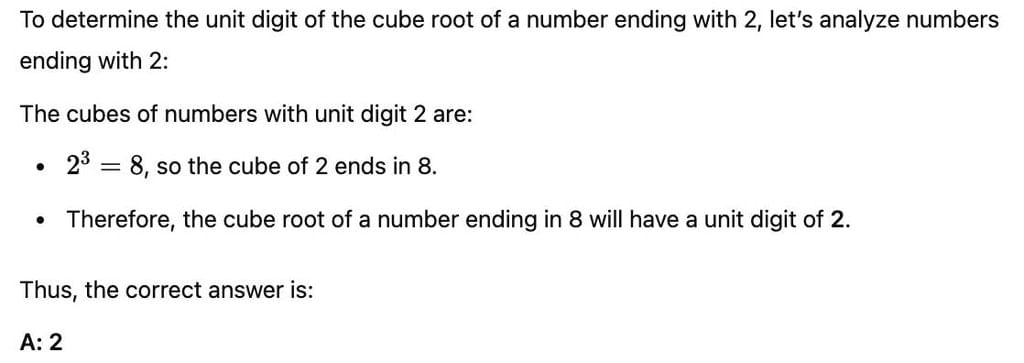
Each prime factor appears _________ times in its cube?- a)2
- b)3
- c)1
- d)4
Correct answer is option 'B'. Can you explain this answer?
Each prime factor appears _________ times in its cube?
a)
2
b)
3
c)
1
d)
4
| | EduRev Class 8 answered |
True
If a3 is the cube and m is one of the prime factors of a. Then, m appears three times in a3.
If a3 is the cube and m is one of the prime factors of a. Then, m appears three times in a3.
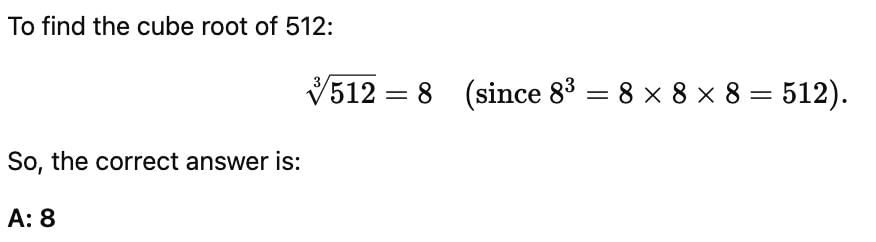

What will be the unit digit of the cube of a number ending with 6 ?- a)4
- b)6
- c)2
- d)8
Correct answer is option 'B'. Can you explain this answer?
What will be the unit digit of the cube of a number ending with 6 ?
a)
4
b)
6
c)
2
d)
8
 | Sanjay Verma answered |
For this ,
let 6 is our primary number
its cube is 216
36's cube is 36×36=1296
1296×36=46656
here you can see the unit number is six every time
let 6 is our primary number
its cube is 216
36's cube is 36×36=1296
1296×36=46656
here you can see the unit number is six every time
For a number ending with 7, the unit digit of its cube is equal to:- a)3
- b)7
- c)6
- d)5
Correct answer is option 'A'. Can you explain this answer?
For a number ending with 7, the unit digit of its cube is equal to:
a)
3
b)
7
c)
6
d)
5
| | Anushka Patel answered |
Unit digit of a number
The unit digit of a number refers to the digit in the ones place or the rightmost digit of the number. For example, in the number 347, the unit digit is 7.
Cube root of a number
The cube root of a number is the value that, when multiplied by itself twice, gives the original number. For example, the cube root of 27 is 3, because 3 x 3 x 3 = 27.
Finding the unit digit of the cube root of a number ending with 7
To find the unit digit of the cube root of a number ending with 7, we can use the property that the unit digit of a number and its cube are the same. In other words, the unit digit of the cube root of a number is equal to the unit digit of the number itself.
Let's take a number ending with 7, such as 17. The cube of 17 is 4913, and the unit digit of 4913 is 3. When we take the cube root of 17, we get a number close to 2.571. Since the unit digit of 17 is 7, the unit digit of its cube root should also be 7.
Similarly, if we take another number ending with 7, such as 27, the cube of 27 is 19683, and the unit digit of 19683 is 3. The cube root of 27 is approximately 3.000. Again, the unit digit of 27 is 7, so the unit digit of its cube root should be 7.
Therefore, in general, the unit digit of the cube root of a number ending with 7 will always be 7.
Conclusion
The unit digit of the cube root of a number ending with 7 is always 7. This can be determined by observing the pattern that the unit digit of a number and its cube are the same.
The unit digit of a number refers to the digit in the ones place or the rightmost digit of the number. For example, in the number 347, the unit digit is 7.
Cube root of a number
The cube root of a number is the value that, when multiplied by itself twice, gives the original number. For example, the cube root of 27 is 3, because 3 x 3 x 3 = 27.
Finding the unit digit of the cube root of a number ending with 7
To find the unit digit of the cube root of a number ending with 7, we can use the property that the unit digit of a number and its cube are the same. In other words, the unit digit of the cube root of a number is equal to the unit digit of the number itself.
Let's take a number ending with 7, such as 17. The cube of 17 is 4913, and the unit digit of 4913 is 3. When we take the cube root of 17, we get a number close to 2.571. Since the unit digit of 17 is 7, the unit digit of its cube root should also be 7.
Similarly, if we take another number ending with 7, such as 27, the cube of 27 is 19683, and the unit digit of 19683 is 3. The cube root of 27 is approximately 3.000. Again, the unit digit of 27 is 7, so the unit digit of its cube root should be 7.
Therefore, in general, the unit digit of the cube root of a number ending with 7 will always be 7.
Conclusion
The unit digit of the cube root of a number ending with 7 is always 7. This can be determined by observing the pattern that the unit digit of a number and its cube are the same.
What will be the unit digit of the cube root of a number ends with 3?- a)3
- b)7
- c)5
- d)2
Correct answer is option 'B'. Can you explain this answer?
What will be the unit digit of the cube root of a number ends with 3?
a)
3
b)
7
c)
5
d)
2
 | Chirag Chawla answered |
**Explanation:**
To determine the unit digit of the cube root of a number that ends with 3, we need to understand the patterns of the unit digits of cubes.
**Pattern of unit digits of cubes:**
- The unit digits of cubes follow a specific pattern.
- The cubes of numbers 0, 1, 2, 3, 4, 5, 6, 7, 8, and 9 have the unit digits 0, 1, 8, 7, 4, 5, 6, 3, 2, and 9, respectively.
**Finding the unit digit of the cube root:**
- Let's consider a number that ends with 3, such as 3, 13, 23, 33, 43, etc.
- We can observe that the unit digit of the cube of these numbers is always 7.
- For example, the cube of 3 is 27, the cube of 13 is 2197, the cube of 23 is 12167, and so on.
- Therefore, the unit digit of the cube root of a number that ends with 3 will be 7.
**Example:**
Let's take the number 63, which ends with 3.
- The cube of 63 is 250047.
- The cube root of 250047 is approximately 63.
- The unit digit of 63 is 7.
Hence, the unit digit of the cube root of a number that ends with 3 will always be 7.
**Conclusion:**
Therefore, the correct answer is option B) 7.
To determine the unit digit of the cube root of a number that ends with 3, we need to understand the patterns of the unit digits of cubes.
**Pattern of unit digits of cubes:**
- The unit digits of cubes follow a specific pattern.
- The cubes of numbers 0, 1, 2, 3, 4, 5, 6, 7, 8, and 9 have the unit digits 0, 1, 8, 7, 4, 5, 6, 3, 2, and 9, respectively.
**Finding the unit digit of the cube root:**
- Let's consider a number that ends with 3, such as 3, 13, 23, 33, 43, etc.
- We can observe that the unit digit of the cube of these numbers is always 7.
- For example, the cube of 3 is 27, the cube of 13 is 2197, the cube of 23 is 12167, and so on.
- Therefore, the unit digit of the cube root of a number that ends with 3 will be 7.
**Example:**
Let's take the number 63, which ends with 3.
- The cube of 63 is 250047.
- The cube root of 250047 is approximately 63.
- The unit digit of 63 is 7.
Hence, the unit digit of the cube root of a number that ends with 3 will always be 7.
**Conclusion:**
Therefore, the correct answer is option B) 7.
How many zeros will be there in the cube root of 800?- a)3
- b)0
- c)1
- d)cube root does not exist
Correct answer is option 'B'. Can you explain this answer?
How many zeros will be there in the cube root of 800?
a)
3
b)
0
c)
1
d)
cube root does not exist
 | Coders Trust answered |
To find the cube root of 800, we first need to understand what a cube root is. The cube root of a number is a value that, when multiplied by itself three times, gives the original number.
Now, let's break down the number 800 into its prime factors:
- 800 can be factored as 8 × 100.
- Further breaking it down, 8 is 23 and 100 is 10 × 10, which is 22 × 52.
- So, 800 = 23 × (22 × 52) = 25 × 52.
When we take the cube root, we divide the powers by 3:
- The cube root of 25 is 21.67 (approximately).
- The cube root of 52 is 50.67 (approximately).
After calculating the cube root, we find that 800 does not have any complete sets of three in its prime factorisation. Therefore, it does not produce a whole number.
Thus, the number of zeros in the cube root of 800 is 0.
What will be the unit digit of the cube of a number ending with 2 ?- a)8
- b)4
- c)2
- d)6
Correct answer is option 'A'. Can you explain this answer?
What will be the unit digit of the cube of a number ending with 2 ?
a)
8
b)
4
c)
2
d)
6
| | Priya Mukherjee answered |
Solution:
We know that the unit digit of the cube of any number depends only on the unit digit of that number. So, we only need to focus on the unit digit of the given number.
Let's consider the numbers ending with 2 and their cubes:
- 2^3 = 8
- 12^3 = 1728
- 22^3 = 10648
- 32^3 = 32768
- 42^3 = 74088
We can observe that the unit digit of the cubes of these numbers is always 8. Therefore, the unit digit of the cube of any number ending with 2 is 8.
Hence, the correct option is (a) 8.
We know that the unit digit of the cube of any number depends only on the unit digit of that number. So, we only need to focus on the unit digit of the given number.
Let's consider the numbers ending with 2 and their cubes:
- 2^3 = 8
- 12^3 = 1728
- 22^3 = 10648
- 32^3 = 32768
- 42^3 = 74088
We can observe that the unit digit of the cubes of these numbers is always 8. Therefore, the unit digit of the cube of any number ending with 2 is 8.
Hence, the correct option is (a) 8.
The smallest natural number by which 135 must be divided to obtain a perfect cube is- a)5
- b)3
- c)15
- d)9
Correct answer is option 'A'. Can you explain this answer?
The smallest natural number by which 135 must be divided to obtain a perfect cube is
a)
5
b)
3
c)
15
d)
9
 | Anshul Ghosh answered |
we have 135 = 3 x 3 x 3 x 5

Grouping the prime factors of 135 into triples, we are left over with 5.
∴ 135 is not a perfect cube
Now, [135]divided by5 = [ 3 x 3 x 3 x 5] divided by5
or 27 = 3 x 3 x 3
i.e. 27 is a perfect cube.
Thus, the required smallest number is 5
Grouping the prime factors of 135 into triples, we are left over with 5.
∴ 135 is not a perfect cube
Now, [135]divided by5 = [ 3 x 3 x 3 x 5] divided by5
or 27 = 3 x 3 x 3
i.e. 27 is a perfect cube.
Thus, the required smallest number is 5
What is the smallest number by which 72 must be multiplied to make it a perfect cube?- a)2
- b)9
- c)6
- d)3
Correct answer is option 'D'. Can you explain this answer?
What is the smallest number by which 72 must be multiplied to make it a perfect cube?
a)
2
b)
9
c)
6
d)
3
 | Learnpro Institute answered |
Prime factorising 72, we get, 72 = 2×2×2×3×3 We know, a perfect cube has multiples of 3 as powers of prime factors. Here, number of 2's is 3 and number of 3's is 2. So we need to multiply another 3 in the factorization to make 72 a perfect cube.
Which of the following is Hardy-Ramanujan Number ?- a)1724
- b)1725
- c)1727
- d)1729
Correct answer is option 'D'. Can you explain this answer?
Which of the following is Hardy-Ramanujan Number ?
a)
1724
b)
1725
c)
1727
d)
1729
 | Amita Verma answered |
This story is very famous among mathematicians. 1729 is sometimes called the “Hardy-Ramanujan number”.
There are two ways to say that 1729 is the sum of two cubes. 1x1x1=1; 12x12x12=1728. So 1+1728=1729 But also: 9x9x9=729; 10x10x10=1000. So 729+1000=1729 There are other numbers that can be shown to be the sum of two cubes in more than one way, but 1729 is the smallest of them.
Ramanujan did not actually discover this fact. It was known in 1657 by a Frenchmathematician Bernard Franicle de Bessy.
But it got famous after the ramanujans above conversation.
So it's famously known as Ramanujan Number.
9 is the cube root of __________.- a)343
- b)729
- c)629
- d)81
Correct answer is option 'B'. Can you explain this answer?
9 is the cube root of __________.
a)
343
b)
729
c)
629
d)
81
 | Meghana Choudhary answered |
Understanding Cube Roots
Cube roots are a way to determine what number, when multiplied by itself three times, equals a specific value. For example, the cube root of a number x is a number y such that y * y * y = x.
Finding the Cube Root of 729
To determine if 9 is the cube root of 729, we need to compute:
- 9 * 9 * 9
Calculating this step-by-step:
- First, calculate 9 * 9 = 81
- Then, multiply 81 by 9:
- 81 * 9 = 729
Since 9 * 9 * 9 equals 729, we confirm that:
- The cube root of 729 is indeed 9.
Evaluating Other Options
Let's briefly look at the other options to clarify why they are incorrect:
- 343:
- Cube root calculation: 7 * 7 * 7 = 343, so the cube root is 7.
- 629:
- Cube root calculation: The cube root of 629 is not a whole number.
- 81:
- Cube root calculation: 4 * 4 * 4 = 64 (not equal to 81).
Conclusion
The correct answer to the question "9 is the cube root of __________" is option 'B', which is 729. This confirms that the value of 729 can be expressed as 9 raised to the power of 3.
Cube roots are a way to determine what number, when multiplied by itself three times, equals a specific value. For example, the cube root of a number x is a number y such that y * y * y = x.
Finding the Cube Root of 729
To determine if 9 is the cube root of 729, we need to compute:
- 9 * 9 * 9
Calculating this step-by-step:
- First, calculate 9 * 9 = 81
- Then, multiply 81 by 9:
- 81 * 9 = 729
Since 9 * 9 * 9 equals 729, we confirm that:
- The cube root of 729 is indeed 9.
Evaluating Other Options
Let's briefly look at the other options to clarify why they are incorrect:
- 343:
- Cube root calculation: 7 * 7 * 7 = 343, so the cube root is 7.
- 629:
- Cube root calculation: The cube root of 629 is not a whole number.
- 81:
- Cube root calculation: 4 * 4 * 4 = 64 (not equal to 81).
Conclusion
The correct answer to the question "9 is the cube root of __________" is option 'B', which is 729. This confirms that the value of 729 can be expressed as 9 raised to the power of 3.
Which of the following is not a perfect cube ?- a)1
- b)9
- c)8
- d)27
Correct answer is option 'B'. Can you explain this answer?
Which of the following is not a perfect cube ?
a)
1
b)
9
c)
8
d)
27
 | Kds Coaching answered |
To determine which of the following numbers is not a perfect cube, we need to check whether the number can be expressed as the cube of an integer.
- a) 1 is a perfect cube because 1=13.
- b) 9 is not a perfect cube. The cube root of 9 is not an integer.
- c) 8 is a perfect cube because 8 = 23.
- d) 27 is a perfect cube because 27 = 33.
Thus, the number that is not a perfect cube is:
b) 9.
The cube of an odd natural number is:- a)even
- b)odd
- c)may be even, may be odd
- d)prime number
Correct answer is option 'B'. Can you explain this answer?
The cube of an odd natural number is:
a)
even
b)
odd
c)
may be even, may be odd
d)
prime number
 | Trisha Vashisht answered |
Solution:
The cube of an odd natural number is always odd. This is because when you multiply three odd numbers together (odd × odd × odd), the result is always odd.
The cube of an odd natural number is always odd. This is because when you multiply three odd numbers together (odd × odd × odd), the result is always odd.
Correct Answer: (b) odd
Chapter doubts & questions for Cubes & Cubes Roots - Mathematics (Maths) Class 8 2026 is part of Class 8 exam preparation. The chapters have been prepared according to the Class 8 exam syllabus. The Chapter doubts & questions, notes, tests & MCQs are made for Class 8 2026 Exam. Find important definitions, questions, notes, meanings, examples, exercises, MCQs and online tests here.
Chapter doubts & questions of Cubes & Cubes Roots - Mathematics (Maths) Class 8 in English & Hindi are available as part of Class 8 exam. Download more important topics, notes, lectures and mock test series for Class 8 Exam by signing up for free.
Mathematics (Maths) Class 8112 videos|670 docs|49 tests |
