


All Exams > Class 8 > Mathematics (Maths) Class 8 > All Questions
All questions of Mensuration for Class 8 Exam
Find the perimeter of the a square with side 4cm.- a)16 cm
- b)12 cm
- c)10 cm
- d)8 cm
Correct answer is option 'A'. Can you explain this answer?
Find the perimeter of the a square with side 4cm.
a)
16 cm
b)
12 cm
c)
10 cm
d)
8 cm
 | Sreesha Phalod answered |
Sol. perimeter of square=4* sides
=4*4 (sides is 4)
=16.
=4*4 (sides is 4)
=16.

Find the volume of a cuboid whose length is 8 cm, width is 3 cm and height is 5 cm. - a)135 cm3
- b)125 cm3
- c)120 cm3
- d)130 cm3
Correct answer is option 'C'. Can you explain this answer?
Find the volume of a cuboid whose length is 8 cm, width is 3 cm and height is 5 cm.
a)
135 cm3
b)
125 cm3
c)
120 cm3
d)
130 cm3
 | Tanishq Joshi answered |
Finding Volume of a Cuboid
Given: length = 8 cm, width = 3 cm, height = 5 cm
To find: Volume of the cuboid
Formula: Volume of a cuboid = length x width x height
Substituting the given values in the formula, we get:
Volume = 8 cm x 3 cm x 5 cm
Volume = 120 cm3
Therefore, the correct answer is option C, 120 cm3.
Given: length = 8 cm, width = 3 cm, height = 5 cm
To find: Volume of the cuboid
Formula: Volume of a cuboid = length x width x height
Substituting the given values in the formula, we get:
Volume = 8 cm x 3 cm x 5 cm
Volume = 120 cm3
Therefore, the correct answer is option C, 120 cm3.
Practice Quiz or MCQ (Multiple Choice Questions) with solutions are available for Practice, which would help you prepare for chapter Mensuration, Class 8, Mathematics . You can practice these practice quizzes as per your speed and improvise the topic. Q.Find the volume of a cuboid whose length is 8 cm, breadth 6 cm and height 3.5 cm. - a)215 cm3
- b)172 cm3
- c)150 cm3
- d)168 cm3
Correct answer is option 'D'. Can you explain this answer?
Practice Quiz or MCQ (Multiple Choice Questions) with solutions are available for Practice, which would help you prepare for chapter Mensuration, Class 8, Mathematics . You can practice these practice quizzes as per your speed and improvise the topic.
Q.
Find the volume of a cuboid whose length is 8 cm, breadth 6 cm and height 3.5 cm.
a)
215 cm3
b)
172 cm3
c)
150 cm3
d)
168 cm3
 | Ankita Shah answered |
Given,
Length (l) = 8 cm
Breadth (b) = 6 cm
Height (h) = 3.5 cm
We know that the volume of a cuboid is given by the formula:
Volume = length × breadth × height
Substituting the given values, we get:
Volume = 8 cm × 6 cm × 3.5 cm
Volume = 168 cm³
Therefore, the volume of the given cuboid is 168 cm³.
Hence, the correct option is (d) 168 cm³.
Length (l) = 8 cm
Breadth (b) = 6 cm
Height (h) = 3.5 cm
We know that the volume of a cuboid is given by the formula:
Volume = length × breadth × height
Substituting the given values, we get:
Volume = 8 cm × 6 cm × 3.5 cm
Volume = 168 cm³
Therefore, the volume of the given cuboid is 168 cm³.
Hence, the correct option is (d) 168 cm³.
Find the area of adjoining figure is
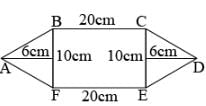
- a)1.54 cm2
- b)15.4 cm2
- c)7.7 cm2
- d)260 cm2
Correct answer is option 'D'. Can you explain this answer?
Find the area of adjoining figure is
a)
1.54 cm2
b)
15.4 cm2
c)
7.7 cm2
d)
260 cm2
 | C K Academy answered |
Base and height of ΔABF and ΔCED are same. Thus their respective areas will be same.
Total area = (Area of △ABF)×2+Area of rectangle BCEF
Total area = (12×10×6)×2+(10×20) = 60+200
Total area = 260cm2
Find the area of a triangle whose base is 4 cm and altitude is 6 cm.- a)10 cm2
- b)14 cm2
- c)16 cm2
- d)12 cm2
Correct answer is option 'D'. Can you explain this answer?
Find the area of a triangle whose base is 4 cm and altitude is 6 cm.
a)
10 cm2
b)
14 cm2
c)
16 cm2
d)
12 cm2
 | Kavya Saxena answered |
We know that area of triangle is equals to 1/2 base × altitude.
Here, base = 4 cm and altitude = 6 cm.
So, area = 1/2 × 4 × 6= 24 /2= 12 cm2.
Here, base = 4 cm and altitude = 6 cm.
So, area = 1/2 × 4 × 6= 24 /2= 12 cm2.
The formula for finding total surface area of cuboid is - a)2 (lb x bh x hl)
- b)2 (lb + bh + hl)
- c)2h (l + b)
- d)2 lb (bh + hl)
Correct answer is option 'B'. Can you explain this answer?
The formula for finding total surface area of cuboid is
a)
2 (lb x bh x hl)
b)
2 (lb + bh + hl)
c)
2h (l + b)
d)
2 lb (bh + hl)
 | EduRev Class 8 answered |
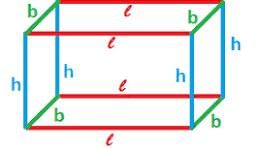
Lets break the figure -
It has 6 surfaces.
Area of bottom surface = L * B
Area of Top Surface = L * B
Area of Right side surface = B * H
Area of Left Side surface = B * H
Area of front Surface = H * L
Area of Back surface = H * L
Total surface area of Cuboid = sum of all the surfaces.
=> (Bottom surface area + Top surface area + Right side surface area + Left side surface area + front side surface area
back side surface area)
=> (LB + LB + BH + BH + HL + HL)
=> (2LB + 2BH + 2HL)
hence option B is correct.
The area of trapezium in the adjoining figure is 
- a)30 cm2
- b)42 cm2
- c)15 cm2
- d)12 cm
Correct answer is option 'C'. Can you explain this answer?
The area of trapezium in the adjoining figure is
a)
30 cm2
b)
42 cm2
c)
15 cm2
d)
12 cm
 | Gunjan Lakhani answered |
Area of Trapezium = 1/2 (sum of Parallel sides ) * height
let a and b are the parallel sides:
a= 4cm
b= 6 cm
h= 3cm
according to formula -> 1/2(4+6)*(3)
=>1/2(10)(3)
=>30/2
=>15 cm2
let a and b are the parallel sides:
a= 4cm
b= 6 cm
h= 3cm
according to formula -> 1/2(4+6)*(3)
=>1/2(10)(3)
=>30/2
=>15 cm2
The formula for lateral surface area of cuboid is - a)2h (l + b)
- b)2l (h + b)
- c)2b (l + h)
- d)2 (lb + bh + hl)
Correct answer is option 'A'. Can you explain this answer?
The formula for lateral surface area of cuboid is
a)
2h (l + b)
b)
2l (h + b)
c)
2b (l + h)
d)
2 (lb + bh + hl)
 | Aditya Datta answered |
Explanation:
A cuboid is a 3-dimensional figure that has six rectangular faces. The lateral surface area of a cuboid is the area of the four vertical rectangular faces, excluding the top and bottom faces.
Let's consider a cuboid with length (l), breadth (b) and height (h).
Formula for Lateral Surface Area of Cuboid:
The formula for the lateral surface area of a cuboid is:
Lateral Surface Area of Cuboid = 2h(l+b)
Proof:
To find the lateral surface area of a cuboid, we need to add the areas of all the four vertical rectangular faces.
- The area of the first vertical face = l x h
- The area of the second vertical face = b x h
- The area of the third vertical face = l x h
- The area of the fourth vertical face = b x h
Adding all these areas, we get:
Lateral Surface Area of Cuboid = lh + bh + lh + bh
= 2lh + 2bh
= 2h(l+b)
Therefore, the formula for the lateral surface area of a cuboid is 2h(l+b).
A cuboid is a 3-dimensional figure that has six rectangular faces. The lateral surface area of a cuboid is the area of the four vertical rectangular faces, excluding the top and bottom faces.
Let's consider a cuboid with length (l), breadth (b) and height (h).
Formula for Lateral Surface Area of Cuboid:
The formula for the lateral surface area of a cuboid is:
Lateral Surface Area of Cuboid = 2h(l+b)
Proof:
To find the lateral surface area of a cuboid, we need to add the areas of all the four vertical rectangular faces.
- The area of the first vertical face = l x h
- The area of the second vertical face = b x h
- The area of the third vertical face = l x h
- The area of the fourth vertical face = b x h
Adding all these areas, we get:
Lateral Surface Area of Cuboid = lh + bh + lh + bh
= 2lh + 2bh
= 2h(l+b)
Therefore, the formula for the lateral surface area of a cuboid is 2h(l+b).
If the parallel sides of a parallelogram are 2 cm apart and their sum is 10 cm then its area is:- a)20 cm2
- b)5 cm2
- c)10 cm2
- d)none of these
Correct answer is option 'C'. Can you explain this answer?
If the parallel sides of a parallelogram are 2 cm apart and their sum is 10 cm then its area is:
a)
20 cm2
b)
5 cm2
c)
10 cm2
d)
none of these
| | EduRev Class 8 answered |
use formula:1/2(sum of of parallel sides)(distance between them)
= 1/2 *(10)*2 = 10 cm2
The height of cuboid whose volume is 200 cm3 and base area is 20 cm2 is- a)220 cm
- b)100 cm
- c)10 cm
- d)20 cm
Correct answer is option 'C'. Can you explain this answer?
The height of cuboid whose volume is 200 cm3 and base area is 20 cm2 is
a)
220 cm
b)
100 cm
c)
10 cm
d)
20 cm
 | Athira Rane answered |
Finding the Height of a Cuboid
Given information: Volume = 200 cm³, Base Area = 20 cm²
To find: Height of the cuboid
Formula to find the volume of a cuboid: V = l × b × h, where l is the length, b is the breadth, and h is the height of the cuboid.
Formula to find the base area of a cuboid: A = l × b
We are given that the volume of the cuboid is 200 cm³. Therefore, we can write:
l × b × h = 200
We are also given that the base area of the cuboid is 20 cm². Therefore, we can write:
l × b = 20
Solving the above two equations, we get:
h = 200 / (l × b)
l × b = 20
h = 200 / 20
h = 10 cm
Therefore, the height of the cuboid is 10 cm.
Answer: Option (c) 10 cm.
Given information: Volume = 200 cm³, Base Area = 20 cm²
To find: Height of the cuboid
Formula to find the volume of a cuboid: V = l × b × h, where l is the length, b is the breadth, and h is the height of the cuboid.
Formula to find the base area of a cuboid: A = l × b
We are given that the volume of the cuboid is 200 cm³. Therefore, we can write:
l × b × h = 200
We are also given that the base area of the cuboid is 20 cm². Therefore, we can write:
l × b = 20
Solving the above two equations, we get:
h = 200 / (l × b)
l × b = 20
h = 200 / 20
h = 10 cm
Therefore, the height of the cuboid is 10 cm.
Answer: Option (c) 10 cm.
The base radius and height of a right circular cylinder are 5 cm and 10 cm. Its total surface area is- a)150π cm2
- b)300π cm2
- c)150 cm2
- d)300 cm2
Correct answer is option 'A'. Can you explain this answer?
The base radius and height of a right circular cylinder are 5 cm and 10 cm. Its total surface area is
a)
150π cm2
b)
300π cm2
c)
150 cm2
d)
300 cm2
 | Devika Reddy answered |
Total Surface Area of a Cylinder
To find the total surface area of a right circular cylinder, we use the formula:
Total Surface Area (TSA) = 2πr(h + r)
Where:
- r = radius of the base
- h = height of the cylinder
Given Values
- Radius (r) = 5 cm
- Height (h) = 10 cm
Calculating the Total Surface Area
1. Substituting the values:
- TSA = 2π(5 cm)(10 cm + 5 cm)
2. Calculating the height plus radius:
- h + r = 10 cm + 5 cm = 15 cm
3. Continuing with the formula:
- TSA = 2π(5 cm)(15 cm)
4. Perform the multiplication:
- TSA = 2π(75 cm²)
- TSA = 150π cm²
Conclusion
Thus, the total surface area of the cylinder is 150π cm².
The correct answer is option 'A' (150π cm²).
This formula effectively combines the lateral surface area and the area of the two circular bases, giving a complete picture of the cylinder's surface.
To find the total surface area of a right circular cylinder, we use the formula:
Total Surface Area (TSA) = 2πr(h + r)
Where:
- r = radius of the base
- h = height of the cylinder
Given Values
- Radius (r) = 5 cm
- Height (h) = 10 cm
Calculating the Total Surface Area
1. Substituting the values:
- TSA = 2π(5 cm)(10 cm + 5 cm)
2. Calculating the height plus radius:
- h + r = 10 cm + 5 cm = 15 cm
3. Continuing with the formula:
- TSA = 2π(5 cm)(15 cm)
4. Perform the multiplication:
- TSA = 2π(75 cm²)
- TSA = 150π cm²
Conclusion
Thus, the total surface area of the cylinder is 150π cm².
The correct answer is option 'A' (150π cm²).
This formula effectively combines the lateral surface area and the area of the two circular bases, giving a complete picture of the cylinder's surface.
If each edge of a cube is doubled, its surface are will increase- a)two times
- b)three times
- c)four times
- d)five times
Correct answer is option 'C'. Can you explain this answer?
If each edge of a cube is doubled, its surface are will increase
a)
two times
b)
three times
c)
four times
d)
five times
 | Aman Chawla answered |
Explanation:
When we double the edge of a cube, we are essentially multiplying the length of each edge by 2. Let the original edge length be l. After doubling the edge, new edge length will be 2l.
Calculating the surface area of the original cube:
The surface area of a cube is given by the formula 6l^2, where l is the length of an edge. Here, l is the original edge length. So, the surface area of the original cube is 6l^2.
Calculating the surface area of the doubled cube:
The surface area of the doubled cube is given by the formula 6(2l)^2, since each edge length is now 2l. Simplifying this expression, we get:
6(2l)^2 = 6(4l^2) = 24l^2
So, the surface area of the doubled cube is 24l^2.
Calculating the ratio of the surface areas:
To find the ratio of the surface areas, we need to divide the surface area of the doubled cube by the surface area of the original cube:
(24l^2) / (6l^2) = 4
So, the surface area of the doubled cube is 4 times the surface area of the original cube.
Conclusion:
Therefore, the correct option is C, that is, the surface area of the cube will increase four times if each edge of a cube is doubled.
When we double the edge of a cube, we are essentially multiplying the length of each edge by 2. Let the original edge length be l. After doubling the edge, new edge length will be 2l.
Calculating the surface area of the original cube:
The surface area of a cube is given by the formula 6l^2, where l is the length of an edge. Here, l is the original edge length. So, the surface area of the original cube is 6l^2.
Calculating the surface area of the doubled cube:
The surface area of the doubled cube is given by the formula 6(2l)^2, since each edge length is now 2l. Simplifying this expression, we get:
6(2l)^2 = 6(4l^2) = 24l^2
So, the surface area of the doubled cube is 24l^2.
Calculating the ratio of the surface areas:
To find the ratio of the surface areas, we need to divide the surface area of the doubled cube by the surface area of the original cube:
(24l^2) / (6l^2) = 4
So, the surface area of the doubled cube is 4 times the surface area of the original cube.
Conclusion:
Therefore, the correct option is C, that is, the surface area of the cube will increase four times if each edge of a cube is doubled.
The length of parallel sides of trapezium is 14 cm and 6 cm and its height is 5 cm. Its area will be- a)50 cm2
- b)100 cm2
- c) 210 cm2
- d)10 cm2
Correct answer is option 'A'. Can you explain this answer?
The length of parallel sides of trapezium is 14 cm and 6 cm and its height is 5 cm. Its area will be
a)
50 cm2
b)
100 cm2
c)
210 cm2
d)
10 cm2
| | EduRev Class 8 answered |
Given that, the length of one side of the trapezium b1�1 = 6cm and another is b2�2 =14cm.
The height of the trapezium h = 5cm.
Drawing the figure from the given data.
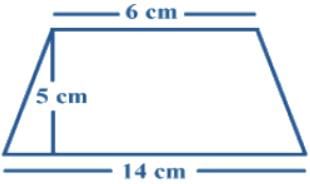

The height of the trapezium h = 5cm.
Drawing the figure from the given data.
The area of the circle is 2464 cm2 and the ratio of the breadth of the rectangle to radius of the circle is 6:7. If the circumference of the circle is equal to the perimeter of the rectangle, then what is the area of the rectangle.- a)1456 cm2
- b)1536 cm2
- c)1254 cm2
- d)5678 cm2
Correct answer is option 'B'. Can you explain this answer?
The area of the circle is 2464 cm2 and the ratio of the breadth of the rectangle to radius of the circle is 6:7. If the circumference of the circle is equal to the perimeter of the rectangle, then what is the area of the rectangle.
a)
1456 cm2
b)
1536 cm2
c)
1254 cm2
d)
5678 cm2
 | Luminary Institute answered |
Area of the circle=πr2
2464 = 22/7 * r2
Radius of the circle=28 cm
Circumference of the circle=2 * π* r =2 * 22/7 * 28
= 176 cm
Breadth of the rectangle=6/7 * 28=24 cm
Perimeter of the rectangle=2 * (l + b)
176 = 2 * (l + 24)
Length of the rectangle = 64 cm
Area of the rectangle = l * b = 24 * 64 = 1536 cm2
The formula for finding total surface area of cylinder is - a)2πrh
- b)2πr(r+h)
- c)πr2h
- d)2πr 2h2
Correct answer is option 'B'. Can you explain this answer?
The formula for finding total surface area of cylinder is
a)
2πrh
b)
2πr(r+h)
c)
πr2h
d)
2πr 2h2
| | Shubham Sharma answered |
Total surface area of a cylinder = πr2+2πrh+πr2=2πr(r+h)
If the edge of a cube is 1 cm then which of the following is its total surface area?- a)1 cm2
- b)4 cm2
- c)6 cm2
- d)none of these
Correct answer is option 'C'. Can you explain this answer?
If the edge of a cube is 1 cm then which of the following is its total surface area?
a)
1 cm2
b)
4 cm2
c)
6 cm2
d)
none of these
| | Stuti Basak answered |
Explanation:
To find the total surface area of a cube, we need to find the area of all its six faces and add them up. Since all the faces of a cube are identical squares, we can find the area of one face and multiply it by 6 to get the total surface area.
Given, the edge of the cube is 1 cm. Therefore, the area of one face of the cube is:
Area of square = side × side
Area of square = 1 cm × 1 cm
Area of square = 1 cm²
To find the total surface area of the cube, we need to multiply the area of one face by 6:
Total surface area of cube = 6 × area of one face
Total surface area of cube = 6 × 1 cm²
Total surface area of cube = 6 cm²
Therefore, the total surface area of the cube is 6 cm², which is option C.
To find the total surface area of a cube, we need to find the area of all its six faces and add them up. Since all the faces of a cube are identical squares, we can find the area of one face and multiply it by 6 to get the total surface area.
Given, the edge of the cube is 1 cm. Therefore, the area of one face of the cube is:
Area of square = side × side
Area of square = 1 cm × 1 cm
Area of square = 1 cm²
To find the total surface area of the cube, we need to multiply the area of one face by 6:
Total surface area of cube = 6 × area of one face
Total surface area of cube = 6 × 1 cm²
Total surface area of cube = 6 cm²
Therefore, the total surface area of the cube is 6 cm², which is option C.
If a cuboidal box has height, length and width as 20 cm, 15 cm and 10 cm respectively. Then its total surface area is:- a)1100 cm2
- b)1200 cm2
- c)1300 cm2
- d)1400 cm2
Correct answer is option 'C'. Can you explain this answer?
If a cuboidal box has height, length and width as 20 cm, 15 cm and 10 cm respectively. Then its total surface area is:
a)
1100 cm2
b)
1200 cm2
c)
1300 cm2
d)
1400 cm2
| | EduRev Class 8 answered |
Total surface area = 2 (20 x 15 + 20 x 10 + 10 x 15)
TSA = 2(300 + 200 + 150) = 1300 cm2


A rectangular field is twice as long as it is wide. If its area is 2420 m2, what is its perimeter?- a)110 m
- b)180 m
- c)209 m
- d)240 m
Correct answer is option 'C'. Can you explain this answer?
A rectangular field is twice as long as it is wide. If its area is 2420 m2, what is its perimeter?
a)
110 m
b)
180 m
c)
209 m
d)
240 m
 | Nidhi Bhatt answered |
The correct answer is Option C - 209 m
Let the width be w and the length be 2w.
The area is given by length × width = 2w × w = 2w2, and this equals 2420; so 2w2 = 2420.
Thus w2 = 1210, so w = √1210 (take the positive root for a length).
The perimeter is 2(l + w) = 2(2w + w) = 6w, so P = 6√1210.
Numerically, √1210 ≈ 34.785, hence P ≈ 6 × 34.785 = 208.71 m ≈ 209 m
The area of a rhombus is 200 cm², and one of its diagonals is 20 cm. The length of the other diagonal is _____- a)20 cm
- b)20 m
- c)22 cm
- d)22 m
Correct answer is option 'A'. Can you explain this answer?
The area of a rhombus is 200 cm², and one of its diagonals is 20 cm. The length of the other diagonal is _____
a)
20 cm
b)
20 m
c)
22 cm
d)
22 m
| | EduRev Class 8 answered |
Let the length of one diagonal be d1 = 20 cm, and the length of the other diagonal be d2
The formula for the area of a rhombus is:
Area = 1/2 x d1 x d
Area = 1/2 x d1 x d
2
Substitute the given values:
200 cm² = 1/2 x 20 x d2
200 cm² = 10 x d2
20cm = d2
The height of a cylinder whose radius is 7 cm and the total surface area is 968 cm2 is:- a)15 cm
- b)17 cm
- c)19 cm
- d)21 cm
Correct answer is option 'A'. Can you explain this answer?
The height of a cylinder whose radius is 7 cm and the total surface area is 968 cm2 is:
a)
15 cm
b)
17 cm
c)
19 cm
d)
21 cm
| | C K Academy answered |
Total surface area = 2πr (h + r)
968 = 2 x 22/7 x 7 (7+h)
h = 15 cm
968 = 2 x 22/7 x 7 (7+h)
h = 15 cm
The curved surface area of a cylinder is equal to the total surface area of a cube whose each edge is 7 cm. If the height of the cylinder is 10 cm, what is its radius?
(π=22/7)- a)3.5 cm
- b)5 cm
- c)7 cm
- d)10 cm
Correct answer is option 'B'. Can you explain this answer?
The curved surface area of a cylinder is equal to the total surface area of a cube whose each edge is 7 cm. If the height of the cylinder is 10 cm, what is its radius?
(π=22/7)
(π=22/7)
a)
3.5 cm
b)
5 cm
c)
7 cm
d)
10 cm
| | Nidhi Bhatt answered |
Cube Total Surface Area = 6a2 = 6×72 = 6×49 = 294 cm2
Given
Curved Surface Area of cylinder = 294
Curved Surface Area of cylinder = 294
CSA = 2πrh
2 × 22/7 × r × 10 = 294
2 × 22/7 × r × 10 = 294
44r/7 ×10 = 294
(440r)/7 = 294
440r = 2058
r = 4.68 ≈ 5 cm
(440r)/7 = 294
440r = 2058
r = 4.68 ≈ 5 cm
So, option (b) is the correct answer.
If the base of rhombus of 7 cm and its altitude is 4 cm, its area will be - a)14 cm2
- b)29 cm2
- c)24 cm2
- d)28 cm2
Correct answer is option 'D'. Can you explain this answer?
If the base of rhombus of 7 cm and its altitude is 4 cm, its area will be
a)
14 cm2
b)
29 cm2
c)
24 cm2
d)
28 cm2
| | EduRev Class 8 answered |
Base = 7 cm and Height = 4 cm
Area of Rhombus = Base×Height
= 7 * 4
= 28 cm2
Area of Rhombus = Base×Height
= 7 * 4
= 28 cm2
The height of a cuboid whose volume is 275 cm3 and base area is 25 cm2 is:- a)10 cm
- b)11 cm
- c)12 cm
- d)13 cm
Correct answer is option 'B'. Can you explain this answer?
The height of a cuboid whose volume is 275 cm3 and base area is 25 cm2 is:
a)
10 cm
b)
11 cm
c)
12 cm
d)
13 cm
 | Swara Das answered |
Understanding the Problem
To find the height of a cuboid given its volume and base area, we can use the formula for the volume of a cuboid:
- Volume = Base Area × Height
In this case, we know the following:
- Volume = 275 cm³
- Base Area = 25 cm²
Finding the Height
We can rearrange the formula to solve for height:
- Height = Volume / Base Area
Now, substituting the known values:
- Height = 275 cm³ / 25 cm²
Performing the Calculation
Now we perform the division:
- Height = 275 / 25
- Height = 11 cm
Conclusion
Thus, the height of the cuboid is:
- 11 cm
The correct answer is option 'B'.
To find the height of a cuboid given its volume and base area, we can use the formula for the volume of a cuboid:
- Volume = Base Area × Height
In this case, we know the following:
- Volume = 275 cm³
- Base Area = 25 cm²
Finding the Height
We can rearrange the formula to solve for height:
- Height = Volume / Base Area
Now, substituting the known values:
- Height = 275 cm³ / 25 cm²
Performing the Calculation
Now we perform the division:
- Height = 275 / 25
- Height = 11 cm
Conclusion
Thus, the height of the cuboid is:
- 11 cm
The correct answer is option 'B'.
A water tank is in the shape of a cuboid of dimensions 6 m × 5 m × 4 m. The capacity of the tank is- a)120 L
- b)1200 L
- c)12000 L
- d)120000 L
Correct answer is option 'D'. Can you explain this answer?
A water tank is in the shape of a cuboid of dimensions 6 m × 5 m × 4 m. The capacity of the tank is
a)
120 L
b)
1200 L
c)
12000 L
d)
120000 L
| | Nidhi Bhatt answered |
Volume = 6×5×4 = 120 m3
1 m3 = 1000 L
So capacity = 120000 L
A square park and a circular park have the same area. If the side of the square is 14 m, the radius of the circular park is approximately:- a)6 m
- b)8 m
- c)10 m
- d)14 m
Correct answer is option 'B'. Can you explain this answer?
A square park and a circular park have the same area. If the side of the square is 14 m, the radius of the circular park is approximately:
a)
6 m
b)
8 m
c)
10 m
d)
14 m
| | Soumya Gupta answered |
Understanding the Problem
We have a square park and a circular park with the same area. The side of the square park is given as 14 meters. We need to find the radius of the circular park.
Calculating the Area of the Square Park
- The area of a square is calculated using the formula:
Area = side × side
- Given that the side is 14 meters:
Area of square = 14 m × 14 m = 196 m²
Setting the Area of the Circular Park
- Since the areas are equal, the area of the circular park is also 196 m².
- The formula for the area of a circle is:
Area = π × r², where r is the radius of the circle.
Finding the Radius of the Circular Park
- We set the area of the circle equal to 196 m²:
π × r² = 196
- Rearranging gives us:
r² = 196 / π
Calculating the Approximate Radius
- Using π ≈ 3.14:
r² ≈ 196 / 3.14 ≈ 62.43
- To find r, take the square root:
r ≈ √62.43 ≈ 7.9 m
Conclusion
- The radius of the circular park is approximately 8 meters.
- Therefore, the correct answer is option 'B'.
This calculation shows how to equate areas and solve for the radius of the circular park based on the given dimensions of the square park.
We have a square park and a circular park with the same area. The side of the square park is given as 14 meters. We need to find the radius of the circular park.
Calculating the Area of the Square Park
- The area of a square is calculated using the formula:
Area = side × side
- Given that the side is 14 meters:
Area of square = 14 m × 14 m = 196 m²
Setting the Area of the Circular Park
- Since the areas are equal, the area of the circular park is also 196 m².
- The formula for the area of a circle is:
Area = π × r², where r is the radius of the circle.
Finding the Radius of the Circular Park
- We set the area of the circle equal to 196 m²:
π × r² = 196
- Rearranging gives us:
r² = 196 / π
Calculating the Approximate Radius
- Using π ≈ 3.14:
r² ≈ 196 / 3.14 ≈ 62.43
- To find r, take the square root:
r ≈ √62.43 ≈ 7.9 m
Conclusion
- The radius of the circular park is approximately 8 meters.
- Therefore, the correct answer is option 'B'.
This calculation shows how to equate areas and solve for the radius of the circular park based on the given dimensions of the square park.
The length of each side of a cube is 24 cm. The volume of the cube is equal to the volume of a cuboid. If the breadth and the height of the cuboid are 32 cm and 12 cm, respectively, then what will be the length of the cuboid?- a)36
- b)27
- c)16
- d)20
Correct answer is option 'A'. Can you explain this answer?
The length of each side of a cube is 24 cm. The volume of the cube is equal to the volume of a cuboid. If the breadth and the height of the cuboid are 32 cm and 12 cm, respectively, then what will be the length of the cuboid?
a)
36
b)
27
c)
16
d)
20
| | C K Academy answered |
Given:
The length of each side of a cube is 24 cm.
The breadth and the height of the cuboid are 32 cm and 12 cm, respectively.
The length of each side of a cube is 24 cm.
The breadth and the height of the cuboid are 32 cm and 12 cm, respectively.
Concept used:
The volume of the cube is equal to the volume of a cuboid.
Volume of cube = a³
Volume of cuboid = lbh
The volume of the cube is equal to the volume of a cuboid.
Volume of cube = a³
Volume of cuboid = lbh
Calculation:
The volume of the cube is equal to the volume of a cuboid.
⇒ 24³ = l × 32 × 12
⇒ l = 3 × 12
⇒ l = 36
The volume of the cube is equal to the volume of a cuboid.
⇒ 24³ = l × 32 × 12
⇒ l = 3 × 12
⇒ l = 36
∴ Option 1 is the correct answer.
Top surface of a raised platform is in the shape of regular octagon as shown in the figure. Find the area of the octagonal surface.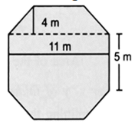
- a)11.9 cm3
- b)119 cm
- c)119 m2
- d)None of these
Correct answer is option 'C'. Can you explain this answer?
Top surface of a raised platform is in the shape of regular octagon as shown in the figure. Find the area of the octagonal surface.
a)
11.9 cm3
b)
119 cm
c)
119 m2
d)
None of these
| | C K Academy answered |
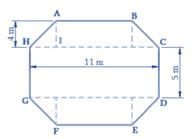
Visually, the area of the octagonal surface will be the sum of the area of two trapezia and the area of rectangular region.
Area of octagon ABCDEFGH = Area of Trapezium ABCH + Area of rectangle HCDG + Area of trapezium EFGD
Side of the regular octagon = 5 cm
Area of trapezium ABCH = Area of trapezium EFGD
Area of trapezium ABCH = 1/2 × (AB + CH) × AI
= 1/2 × (5 m + 11 m) × 4 m
= 1/2 × 16 m × 4 m
= 32 m2
Area of trapezium ABCH = Area of trapezium EFGD = 32 m2
Area of rectangle HCDG = HC × CD = 11 m × 5 m = 55 m2
Area of ABCDEFGH = Area of trapezium ABCH + Area of rectangle HCDG + Area of trapezium EFGD
= 32 m2+ 55 m2+ 32 m2
= 119 m2
Thus the area of the octagonal surface is 119 m2
Chapter doubts & questions for Mensuration - Mathematics (Maths) Class 8 2026 is part of Class 8 exam preparation. The chapters have been prepared according to the Class 8 exam syllabus. The Chapter doubts & questions, notes, tests & MCQs are made for Class 8 2026 Exam. Find important definitions, questions, notes, meanings, examples, exercises, MCQs and online tests here.
Chapter doubts & questions of Mensuration - Mathematics (Maths) Class 8 in English & Hindi are available as part of Class 8 exam. Download more important topics, notes, lectures and mock test series for Class 8 Exam by signing up for free.
Mathematics (Maths) Class 8112 videos|670 docs|49 tests |
