


All Exams > NEET > NCERT Textbooks, Tests & Solutions > All Questions
All questions of Body Fluids and Circulation for NEET Exam
Which of the following match is correct?

- a)a
- b)b
- c)c
- d)d
Correct answer is option 'B'. Can you explain this answer?
Which of the following match is correct?
a)
a
b)
b
c)
c
d)
d
 | Harshprit.chelani answered |
Step 1: Analyze the given options and identify the cell types
The image displays diagrams of different white blood cells (leukocytes) along with their typical percentages in the blood and their primary functions. We need to identify the correct match among the given options.
(a) Eosinophil: The image shows a cell with a bilobed nucleus and prominent granules. This morphology is characteristic of an eosinophil.
(b) Basophil: The image shows a cell with a lobed nucleus often obscured by large, dark-staining granules. This is characteristic of a basophil.
(c) Neutrophil: The image shows a cell with a multi-lobed nucleus. This is characteristic of a neutrophil.
(d) Monocyte: The image shows a large cell with a kidney-shaped or horseshoe-shaped nucleus. This is characteristic of a monocyte.
Step 2: Evaluate the percentage and function for each cell type
(a) Eosinophil: Eosinophils typically constitute 2-4% of total white blood cells and are primarily involved in defense against parasites and allergic reactions, not phagocytosis as their main function.
(b) Basophil: Basophils are the least numerous white blood cells, making up 0.5-1.0% of the total. They contain granules that release histamine and serotonin during allergic and inflammatory responses.
(c) Neutrophil: Neutrophils are the most abundant white blood cells, making up 60-70% of the total. Their primary function is phagocytosis of bacteria and other pathogens.
(d) Monocyte: Monocytes constitute 3-8% of total white blood cells and differentiate into macrophages, which are highly phagocytic and involved in antigen presentation and removal of cellular debris, not primarily allergic reactions.
Step 3: Determine the correct match
Based on the analysis in Step 2, option (b) correctly matches the basophil's structure, percentage (0.5-1.0%), and function (secreting histamine and serotonin).
Answer:
The correct match is (b) because basophils, which make up 0.5-1.0% of white blood cells, are responsible for secreting histamine and serotonin, key mediators in allergic and inflammatory responses.
The image displays diagrams of different white blood cells (leukocytes) along with their typical percentages in the blood and their primary functions. We need to identify the correct match among the given options.
(a) Eosinophil: The image shows a cell with a bilobed nucleus and prominent granules. This morphology is characteristic of an eosinophil.
(b) Basophil: The image shows a cell with a lobed nucleus often obscured by large, dark-staining granules. This is characteristic of a basophil.
(c) Neutrophil: The image shows a cell with a multi-lobed nucleus. This is characteristic of a neutrophil.
(d) Monocyte: The image shows a large cell with a kidney-shaped or horseshoe-shaped nucleus. This is characteristic of a monocyte.
Step 2: Evaluate the percentage and function for each cell type
(a) Eosinophil: Eosinophils typically constitute 2-4% of total white blood cells and are primarily involved in defense against parasites and allergic reactions, not phagocytosis as their main function.
(b) Basophil: Basophils are the least numerous white blood cells, making up 0.5-1.0% of the total. They contain granules that release histamine and serotonin during allergic and inflammatory responses.
(c) Neutrophil: Neutrophils are the most abundant white blood cells, making up 60-70% of the total. Their primary function is phagocytosis of bacteria and other pathogens.
(d) Monocyte: Monocytes constitute 3-8% of total white blood cells and differentiate into macrophages, which are highly phagocytic and involved in antigen presentation and removal of cellular debris, not primarily allergic reactions.
Step 3: Determine the correct match
Based on the analysis in Step 2, option (b) correctly matches the basophil's structure, percentage (0.5-1.0%), and function (secreting histamine and serotonin).
Answer:
The correct match is (b) because basophils, which make up 0.5-1.0% of white blood cells, are responsible for secreting histamine and serotonin, key mediators in allergic and inflammatory responses.

Carotid artery supplies- a)Oxygenated blood to lungs
- b)Oxygenated blood to intestine
- c)Oxygenated blood to brain
- d)None of these
Correct answer is option 'C'. Can you explain this answer?
Carotid artery supplies
a)
Oxygenated blood to lungs
b)
Oxygenated blood to intestine
c)
Oxygenated blood to brain
d)
None of these
 | Rohit Jain answered |
The carotid arteries are major blood vessels in the neck that supply blood to the brain, neck, and face. There are two carotid arteries, one on the right and one on the left. In the neck, each carotid artery branches into two divisions:
(i) The internal carotid artery supplies blood to the brain.
(ii) The external carotid artery supplies blood to the face and neck.
So, the correct answer is 'Oxygenated blood to brain'
(i) The internal carotid artery supplies blood to the brain.
(ii) The external carotid artery supplies blood to the face and neck.
So, the correct answer is 'Oxygenated blood to brain'
Read the following statements and select the correct option.
Statement 1: The SA node acts as pacemaker.
Statement 2: The SA node is located in the wall of the right atrium near the inter-atrial septum.- a)Both Assertion and Reason are correct and Reason is the correct explanation for Assertion.
- b)Both Assertion and Reason are correct but Reason is not the correct explanation for Assertion.
- c)Assertion is correct but Reason is incorrect.
- d)Both Assertion and Reason are incorrect.
Correct answer is option 'C'. Can you explain this answer?
Read the following statements and select the correct option.
Statement 1: The SA node acts as pacemaker.
Statement 2: The SA node is located in the wall of the right atrium near the inter-atrial septum.
Statement 1: The SA node acts as pacemaker.
Statement 2: The SA node is located in the wall of the right atrium near the inter-atrial septum.
a)
Both Assertion and Reason are correct and Reason is the correct explanation for Assertion.
b)
Both Assertion and Reason are correct but Reason is not the correct explanation for Assertion.
c)
Assertion is correct but Reason is incorrect.
d)
Both Assertion and Reason are incorrect.
 | Lavanya Menon answered |
The heart beat originates from the SA node which acts a pacemaker. SA node lies in the wall of the right atrium near the opening of the superior vena cava.
In ECG, P-R interval corresponds to- a)time delay in A-V node
- b)S-A nodal conduction time
- c)increased ventricular contraction
- d)time interval between onset of ventricular contraction
Correct answer is option 'A'. Can you explain this answer?
In ECG, P-R interval corresponds to
a)
time delay in A-V node
b)
S-A nodal conduction time
c)
increased ventricular contraction
d)
time interval between onset of ventricular contraction
 | Vivek Patel answered |
- Each peak in the ECG is identified with a letter from P to T that corresponds to a specific electrical activity of the heart.
- The P- wave represents the electrical excitation or depolarization of the atria.
- The QRS complex represents the depolarization of the ventricles which initiates the ventricular contraction.
- The contraction starts shortly after Q and marks the beginning of the systole.
- The T- wave represents the return of the ventricles from excited to a normal state or repolarization.
- The end of the T-wave marks the end of systole.
So, the correct option is 'Time delay in A-V node'.
The problem of electrical discontinuity caused in the normal heart by the connective tissue separating the atria from the ventricles is solved by?- a)Having the A-V node function as a secondary pacemaker
- b)Coordinating electrical activity in the atria with electrical activity in the ventricles by connecting them via the bundle of His
- c)Having an ectopic pacemaker
- d)Coordinating electrical activity in the atria with electrical activity in the ventricles by connecting them via the vagus nerve
Correct answer is option 'A'. Can you explain this answer?
The problem of electrical discontinuity caused in the normal heart by the connective tissue separating the atria from the ventricles is solved by?
a)
Having the A-V node function as a secondary pacemaker
b)
Coordinating electrical activity in the atria with electrical activity in the ventricles by connecting them via the bundle of His
c)
Having an ectopic pacemaker
d)
Coordinating electrical activity in the atria with electrical activity in the ventricles by connecting them via the vagus nerve
| | Sanaya Mishra answered |
Solution:
The connective tissue separating the atria from the ventricles is called the atrioventricular (AV) node. This node acts as an electrical insulator and prevents electrical signals from directly passing between the atria and ventricles. This separation is necessary for the normal functioning of the heart, as it allows the atria to contract first, pumping blood into the ventricles before they contract and pump blood out of the heart.
To overcome this electrical discontinuity, the heart has a specialized conducting system that connects the atria and ventricles and coordinates their electrical activity. This system starts with the sinoatrial (SA) node, located in the right atrium, which acts as the primary pacemaker of the heart. The electrical signals generated by the SA node spread through the atria, causing them to contract.
The electrical signals then pass through the AV node, which slows down the conduction of the signal, allowing the ventricles time to fill with blood. After a brief delay, the electrical signals pass through the bundle of His, a specialized bundle of fibers that divides into the left and right bundle branches, which then spread through the ventricles and cause them to contract.
Coordinating electrical activity in the atria with electrical activity in the ventricles by connecting them via the bundle of His:
The bundle of His is a specialized group of cells that conducts electrical impulses from the atria to the ventricles. It is an essential part of the heart's electrical conduction system and helps coordinate the contraction of the atria and ventricles. The bundle of His is located in the interventricular septum and divides into the left and right bundle branches, which then spread through the ventricles and cause them to contract. By connecting the electrical activity in the atria with the electrical activity in the ventricles via the bundle of His, the electrical discontinuity caused by the connective tissue separating the atria from the ventricles is solved.
The connective tissue separating the atria from the ventricles is called the atrioventricular (AV) node. This node acts as an electrical insulator and prevents electrical signals from directly passing between the atria and ventricles. This separation is necessary for the normal functioning of the heart, as it allows the atria to contract first, pumping blood into the ventricles before they contract and pump blood out of the heart.
To overcome this electrical discontinuity, the heart has a specialized conducting system that connects the atria and ventricles and coordinates their electrical activity. This system starts with the sinoatrial (SA) node, located in the right atrium, which acts as the primary pacemaker of the heart. The electrical signals generated by the SA node spread through the atria, causing them to contract.
The electrical signals then pass through the AV node, which slows down the conduction of the signal, allowing the ventricles time to fill with blood. After a brief delay, the electrical signals pass through the bundle of His, a specialized bundle of fibers that divides into the left and right bundle branches, which then spread through the ventricles and cause them to contract.
Coordinating electrical activity in the atria with electrical activity in the ventricles by connecting them via the bundle of His:
The bundle of His is a specialized group of cells that conducts electrical impulses from the atria to the ventricles. It is an essential part of the heart's electrical conduction system and helps coordinate the contraction of the atria and ventricles. The bundle of His is located in the interventricular septum and divides into the left and right bundle branches, which then spread through the ventricles and cause them to contract. By connecting the electrical activity in the atria with the electrical activity in the ventricles via the bundle of His, the electrical discontinuity caused by the connective tissue separating the atria from the ventricles is solved.
Which of the following statements regarding platelets are correct?
A. Platelets are also called thrombocytes
B. Platelets are nucleated cell fragments
C. Normal platelet count is 1.5-3.5 lakhs per cubic mm of blood
D. Platelets play important role in blood clotting
E. Platelets are produced in the bone marrow from megakaryocytes- a)A, C, D and E only
- b)A, B, C and D only
- c)B, C, D and E only
- d)A, B, D and E only
Correct answer is option 'A'. Can you explain this answer?
A. Platelets are also called thrombocytes
B. Platelets are nucleated cell fragments
C. Normal platelet count is 1.5-3.5 lakhs per cubic mm of blood
D. Platelets play important role in blood clotting
E. Platelets are produced in the bone marrow from megakaryocytes
a)
A, C, D and E only
b)
A, B, C and D only
c)
B, C, D and E only
d)
A, B, D and E only
 | Lead Academy answered |
The correct answer is Option A - A, C, D and E only
Statement A is true. Platelets are commonly called thrombocytes; they are small anucleate fragments formed from the cytoplasm of larger marrow cells.
Statement B is false. Platelets are not nucleated; they are anucleate cell fragments that contain cytoplasmic organelles and granules but no nucleus.
Statement C is true. Normal platelet count is about 1.5-3.5 lakhs per cubic mm of blood; values well below or above this range indicate thrombocytopenia or thrombocytosis, respectively.
Statement D is true. Platelets play a key role in blood clotting; they aggregate to form a platelet plug and release factors that promote coagulation, leading to fibrin formation and haemostasis.
Statement E is true. Platelets are produced in the bone marrow by fragmentation of the cytoplasm of megakaryocytes; each megakaryocyte gives rise to many platelets.
Which of the following statement(s) regarding the cardiac system is/are correct?
(i) Human heart is an ectodermal derivative.
(ii) Mitral valve guards the opening between the right atrium and left ventricle.
(iii) SAN is located on the left upper corner of the right atrium.
(iv) Stroke x Heart rate = Cardiac output.- a)(i) only
- b)(i) and (ii)
- c)(ii) and (iii)
- d)(iv) only
Correct answer is option 'D'. Can you explain this answer?
Which of the following statement(s) regarding the cardiac system is/are correct?
(i) Human heart is an ectodermal derivative.
(ii) Mitral valve guards the opening between the right atrium and left ventricle.
(iii) SAN is located on the left upper corner of the right atrium.
(iv) Stroke x Heart rate = Cardiac output.
(i) Human heart is an ectodermal derivative.
(ii) Mitral valve guards the opening between the right atrium and left ventricle.
(iii) SAN is located on the left upper corner of the right atrium.
(iv) Stroke x Heart rate = Cardiac output.
a)
(i) only
b)
(i) and (ii)
c)
(ii) and (iii)
d)
(iv) only
 | Nishtha Shah answered |
Cardiac System
The cardiac system is a complex network of structures and processes that work together to pump and circulate blood throughout the body. Understanding the different components and functions of the cardiac system is essential for understanding how the heart and circulatory system function as a whole.
(i) Human heart is an ectodermal derivative.
This statement is incorrect. The human heart is not derived from the ectoderm, but from the mesoderm. During embryonic development, the heart forms from the mesodermal layer, specifically the splanchnic mesoderm. The splanchnic mesoderm gives rise to the cardiogenic area, which eventually differentiates into the heart tube. This tube then undergoes further development to form the four chambers of the heart.
(ii) Mitral valve guards the opening between the right atrium and left ventricle.
This statement is incorrect. The mitral valve, also known as the bicuspid valve, is located between the left atrium and left ventricle. It consists of two leaflets or cusps that prevent the backflow of blood from the left ventricle to the left atrium during ventricular contraction.
(iii) SAN is located on the left upper corner of the right atrium.
This statement is incorrect. The sinoatrial node (SAN), also known as the pacemaker of the heart, is located in the upper part of the right atrium near the opening of the superior vena cava. It is responsible for initiating the electrical impulses that regulate the rhythm of the heart.
(iv) Stroke x Heart rate = Cardiac output.
This statement is correct. Cardiac output is the amount of blood pumped by the heart per minute, and it is calculated by multiplying the stroke volume (the amount of blood pumped with each heartbeat) by the heart rate (the number of heartbeats per minute). Therefore, the formula for cardiac output is stroke volume x heart rate.
In summary, the correct statement regarding the cardiac system is option (iv) only, which states that the formula for cardiac output is stroke volume x heart rate.
The cardiac system is a complex network of structures and processes that work together to pump and circulate blood throughout the body. Understanding the different components and functions of the cardiac system is essential for understanding how the heart and circulatory system function as a whole.
(i) Human heart is an ectodermal derivative.
This statement is incorrect. The human heart is not derived from the ectoderm, but from the mesoderm. During embryonic development, the heart forms from the mesodermal layer, specifically the splanchnic mesoderm. The splanchnic mesoderm gives rise to the cardiogenic area, which eventually differentiates into the heart tube. This tube then undergoes further development to form the four chambers of the heart.
(ii) Mitral valve guards the opening between the right atrium and left ventricle.
This statement is incorrect. The mitral valve, also known as the bicuspid valve, is located between the left atrium and left ventricle. It consists of two leaflets or cusps that prevent the backflow of blood from the left ventricle to the left atrium during ventricular contraction.
(iii) SAN is located on the left upper corner of the right atrium.
This statement is incorrect. The sinoatrial node (SAN), also known as the pacemaker of the heart, is located in the upper part of the right atrium near the opening of the superior vena cava. It is responsible for initiating the electrical impulses that regulate the rhythm of the heart.
(iv) Stroke x Heart rate = Cardiac output.
This statement is correct. Cardiac output is the amount of blood pumped by the heart per minute, and it is calculated by multiplying the stroke volume (the amount of blood pumped with each heartbeat) by the heart rate (the number of heartbeats per minute). Therefore, the formula for cardiac output is stroke volume x heart rate.
In summary, the correct statement regarding the cardiac system is option (iv) only, which states that the formula for cardiac output is stroke volume x heart rate.
Find the incorrect answer from the following?- a)Veins are typically larger in diameter than arteries
- b)Because of their small size,capillaries contain blood that is moving more quickly than in other parts of the circulatory system
- c)The walls of arteries are elastic,enabling them to stretch and shrink during changes in blood pressure
- d)Veins contain more blood than any other part of the circulatory system
Correct answer is option 'B'. Can you explain this answer?
Find the incorrect answer from the following?
a)
Veins are typically larger in diameter than arteries
b)
Because of their small size,capillaries contain blood that is moving more quickly than in other parts of the circulatory system
c)
The walls of arteries are elastic,enabling them to stretch and shrink during changes in blood pressure
d)
Veins contain more blood than any other part of the circulatory system
| | Raghav Bansal answered |
On an average, capillaries are about 1 mm long and 8 mm in diameter. Although each capillary is very narrow, there are so many of them that the capillaries have the greatest total cross sectional area of any other type of vessel. Consequently, the blood decreases in velocity as it passes through the capillary beds, allowing more time for it to exchange materials with the surrounding extracellular fluid. Blood also loses most of its pressure in passing through the vast capillary networks and so is under very low pressure when it enters the veins.
During ventricular systole:- a)Oxygenated blood is pumped into the pulmonary artery and deoxygenated blood is pumped into the artery
- b)Oxygenated blood is pumped into the aorta and deoxygenated blood is pumped into the pulmonary vein
- c)Oxygenated blood is pumped into the pulmonary vein and deoxygenated blood is pumped into the pulmonary artery
- d)Oxygenated blood is pumped into the aorta and deoxygenated blood is pumped into the pulmonary artery
Correct answer is option 'D'. Can you explain this answer?
During ventricular systole:
a)
Oxygenated blood is pumped into the pulmonary artery and deoxygenated blood is pumped into the artery
b)
Oxygenated blood is pumped into the aorta and deoxygenated blood is pumped into the pulmonary vein
c)
Oxygenated blood is pumped into the pulmonary vein and deoxygenated blood is pumped into the pulmonary artery
d)
Oxygenated blood is pumped into the aorta and deoxygenated blood is pumped into the pulmonary artery
 | Ananya Das answered |
Due to contraction of the ventricles (ventricular systole), the pressure inside the ventricles rises, that force open the semilunar valves of aorta and pulmonary artery so that the blood enters into these vessels. Oxygenated blood is pumped into the aorta from the left ventricle while deoxygenated blood is pumped into the pulmonary artery from the right ventricle.
Which of the following sequences is truly a systemic circulation pathway?- a)Right ventricle → Pulmonary aorta → Tissues → Pulmonary veins → Left auricle
- b)Right auricle → Left ventricle → Aorta → Tissues → Veins → Right auricle
- c)Left auricle → Left ventricle → Pulmonary aorta → Tissues → Right auricle
- d)Left auricle → Left ventricle → Aorta → Arteries → Tissues → Veins → Right atrium
Correct answer is option 'D'. Can you explain this answer?
Which of the following sequences is truly a systemic circulation pathway?
a)
Right ventricle → Pulmonary aorta → Tissues → Pulmonary veins → Left auricle
b)
Right auricle → Left ventricle → Aorta → Tissues → Veins → Right auricle
c)
Left auricle → Left ventricle → Pulmonary aorta → Tissues → Right auricle
d)
Left auricle → Left ventricle → Aorta → Arteries → Tissues → Veins → Right atrium
 | Dev Patel answered |
Systemic circulation is the movement of the blood between heart and rest of the body (tissues) and the back to the heart. The oxygenated blood moves from the left auricle into the left ventricle. From here the blood moves into the aorta which ultimately divides into arteries that carry oxygenated blood to various tissues in the body. From the tissues deoxygenated blood is carried by the veins into the right atrium via superior vena cava and inferior vena cava.
Which of the following statements regarding Rh blood grouping are correct?
A. Rh factor is an antigen present on the surface of RBCs
B. Rh positive individuals have Rh antibodies naturally present in plasma
C. Nearly 80% of Indians are Rh positive
D. Rh negative blood can be donated to Rh positive individuals
E. Rh incompatibility can cause haemolytic disease of newborn- a)A, C, D and E only
- b)A, B and C only
- c)B, D and E only
- d)A, B, C and D only
Correct answer is option 'A'. Can you explain this answer?
A. Rh factor is an antigen present on the surface of RBCs
B. Rh positive individuals have Rh antibodies naturally present in plasma
C. Nearly 80% of Indians are Rh positive
D. Rh negative blood can be donated to Rh positive individuals
E. Rh incompatibility can cause haemolytic disease of newborn
a)
A, C, D and E only
b)
A, B and C only
c)
B, D and E only
d)
A, B, C and D only
 | Sonal Reddy answered |
Understanding Rh Blood Grouping
The correct answer to the statements regarding Rh blood grouping is option 'A'. Here's a detailed breakdown of each statement:
Statement A: Rh factor is an antigen present on the surface of RBCs
- This statement is correct. The Rh factor, specifically the D antigen, is a protein that can be present on the surface of red blood cells (RBCs). People who have this antigen are classified as Rh positive, while those who do not are Rh negative.
Statement B: Rh positive individuals have Rh antibodies naturally present in plasma
- This statement is incorrect. Rh positive individuals typically do not have Rh antibodies in their plasma unless they have been sensitized to Rh positive blood, such as through a blood transfusion or during pregnancy.
Statement C: Nearly 80% of Indians are Rh positive
- This statement is correct. Studies indicate that a significant majority of Indians, approximately 80%, are Rh positive.
Statement D: Rh negative blood can be donated to Rh positive individuals
- This statement is correct. Rh negative blood can be safely donated to Rh positive individuals without causing an immune response.
Statement E: Rh incompatibility can cause haemolytic disease of the newborn
- This statement is also correct. If an Rh negative mother carries an Rh positive fetus, her body can produce antibodies against the Rh factor, potentially leading to hemolytic disease in the newborn.
In conclusion, since statements A, C, D, and E are correct, option 'A' is indeed the correct choice.
The correct answer to the statements regarding Rh blood grouping is option 'A'. Here's a detailed breakdown of each statement:
Statement A: Rh factor is an antigen present on the surface of RBCs
- This statement is correct. The Rh factor, specifically the D antigen, is a protein that can be present on the surface of red blood cells (RBCs). People who have this antigen are classified as Rh positive, while those who do not are Rh negative.
Statement B: Rh positive individuals have Rh antibodies naturally present in plasma
- This statement is incorrect. Rh positive individuals typically do not have Rh antibodies in their plasma unless they have been sensitized to Rh positive blood, such as through a blood transfusion or during pregnancy.
Statement C: Nearly 80% of Indians are Rh positive
- This statement is correct. Studies indicate that a significant majority of Indians, approximately 80%, are Rh positive.
Statement D: Rh negative blood can be donated to Rh positive individuals
- This statement is correct. Rh negative blood can be safely donated to Rh positive individuals without causing an immune response.
Statement E: Rh incompatibility can cause haemolytic disease of the newborn
- This statement is also correct. If an Rh negative mother carries an Rh positive fetus, her body can produce antibodies against the Rh factor, potentially leading to hemolytic disease in the newborn.
In conclusion, since statements A, C, D, and E are correct, option 'A' is indeed the correct choice.
Heart pumps blood more forcefully in older persons than younger ones due to- a)Decrease in oxygen content of blood
- b)Decrease in elasticity of arteries
- c)Fall in nutrient content of blood
- d)Increase in elasticity of arteries
Correct answer is option 'B'. Can you explain this answer?
Heart pumps blood more forcefully in older persons than younger ones due to
a)
Decrease in oxygen content of blood
b)
Decrease in elasticity of arteries
c)
Fall in nutrient content of blood
d)
Increase in elasticity of arteries
| | Ajay Yadav answered |
As one ages, arteries lose their elasticity. Consequently the heart has to pump the blood more forcefully in order to fulfill the need of the body cells.
Read the following statements and select the correct ones.
(i) Nodal tissue is specialised cardiac musculature in human heart which has the ability to generate action potential due to an external stimuli
(ii) Position of SAN - right corner of right atrium
(iii) Position of AVN - right corner of ventricle
(iv) AV bundle continues from AVN
(v) Purkinje fibres are modified cardiac muscle fibres that originate from the atrioventricular node and spread into the two ventricles.- a)(i) and (ii)
- b)(i) and (iii)
- c)(ii), (iv) and (v)
- d)all of these
Correct answer is option 'C'. Can you explain this answer?
Read the following statements and select the correct ones.
(i) Nodal tissue is specialised cardiac musculature in human heart which has the ability to generate action potential due to an external stimuli
(ii) Position of SAN - right corner of right atrium
(iii) Position of AVN - right corner of ventricle
(iv) AV bundle continues from AVN
(v) Purkinje fibres are modified cardiac muscle fibres that originate from the atrioventricular node and spread into the two ventricles.
(i) Nodal tissue is specialised cardiac musculature in human heart which has the ability to generate action potential due to an external stimuli
(ii) Position of SAN - right corner of right atrium
(iii) Position of AVN - right corner of ventricle
(iv) AV bundle continues from AVN
(v) Purkinje fibres are modified cardiac muscle fibres that originate from the atrioventricular node and spread into the two ventricles.
a)
(i) and (ii)
b)
(i) and (iii)
c)
(ii), (iv) and (v)
d)
all of these
| | Sharmila Banerjee answered |
Position of SAN and AVN in the Human Heart
Nodal tissue is specialized cardiac musculature in the human heart that plays a crucial role in generating and coordinating the electrical signals responsible for the heartbeat. Let's examine the given statements and identify the correct ones.
(i) Nodal tissue is specialized cardiac musculature in the human heart which has the ability to generate action potential due to an external stimulus.
- This statement is correct. The nodal tissue, specifically the sinoatrial node (SAN) and atrioventricular node (AVN), are responsible for generating and conducting electrical impulses throughout the heart.
(ii) Position of SAN - right corner of right atrium.
- This statement is correct. The SAN is located in the right corner of the right atrium, near the opening of the superior vena cava.
(iii) Position of AVN - right corner of ventricle.
- This statement is incorrect. The AVN is located at the base of the right atrium, near the interatrial septum, and not in the right corner of the ventricle.
(iv) AV bundle continues from AVN.
- This statement is correct. The atrioventricular bundle, also known as the bundle of His, is a continuation of the electrical pathway from the AVN. It extends through the interventricular septum and divides into the right and left bundle branches, which further distribute the electrical signals to the respective ventricles.
(v) Purkinje fibers are modified cardiac muscle fibers that originate from the atrioventricular node and spread into the two ventricles.
- This statement is correct. Purkinje fibers are specialized conducting fibers that originate from the AVN and spread throughout the walls of the ventricles. They facilitate the rapid and synchronized contraction of the ventricles.
In conclusion, the correct statements are (ii), (iv), and (v). The SAN is indeed located in the right corner of the right atrium, the AV bundle continues from the AVN, and Purkinje fibers originate from the AVN and spread into the two ventricles.
Nodal tissue is specialized cardiac musculature in the human heart that plays a crucial role in generating and coordinating the electrical signals responsible for the heartbeat. Let's examine the given statements and identify the correct ones.
(i) Nodal tissue is specialized cardiac musculature in the human heart which has the ability to generate action potential due to an external stimulus.
- This statement is correct. The nodal tissue, specifically the sinoatrial node (SAN) and atrioventricular node (AVN), are responsible for generating and conducting electrical impulses throughout the heart.
(ii) Position of SAN - right corner of right atrium.
- This statement is correct. The SAN is located in the right corner of the right atrium, near the opening of the superior vena cava.
(iii) Position of AVN - right corner of ventricle.
- This statement is incorrect. The AVN is located at the base of the right atrium, near the interatrial septum, and not in the right corner of the ventricle.
(iv) AV bundle continues from AVN.
- This statement is correct. The atrioventricular bundle, also known as the bundle of His, is a continuation of the electrical pathway from the AVN. It extends through the interventricular septum and divides into the right and left bundle branches, which further distribute the electrical signals to the respective ventricles.
(v) Purkinje fibers are modified cardiac muscle fibers that originate from the atrioventricular node and spread into the two ventricles.
- This statement is correct. Purkinje fibers are specialized conducting fibers that originate from the AVN and spread throughout the walls of the ventricles. They facilitate the rapid and synchronized contraction of the ventricles.
In conclusion, the correct statements are (ii), (iv), and (v). The SAN is indeed located in the right corner of the right atrium, the AV bundle continues from the AVN, and Purkinje fibers originate from the AVN and spread into the two ventricles.
Pacemaker is situated in heart- a)In the wall of right atrium
- b)On interauricular septum
- c)On interventricular septum
- d)In the wall of left atrium
Correct answer is option 'A'. Can you explain this answer?
Pacemaker is situated in heart
a)
In the wall of right atrium
b)
On interauricular septum
c)
On interventricular septum
d)
In the wall of left atrium
| | Raghav Bansal answered |
Sino-atrial node, also called pacemaker is situated in the right upper corner of the right atrium.
Right atrium receives blood from- a)Pulmonary aorta
- b)Pulmonary veins
- c)Inferior vena cava
- d)Superior and inferior vena cav
Correct answer is option 'D'. Can you explain this answer?
Right atrium receives blood from
a)
Pulmonary aorta
b)
Pulmonary veins
c)
Inferior vena cava
d)
Superior and inferior vena cav
 | Mira Joshi answered |
Superior vena cava and inferior vena cava are the large veins. Superior vena cava brings deoxygenated blood from upper part of the body while inferior vena cava brings blood from lower part of the body into the right atrium of the heart.
A red blood cell, entering the right side of the heart passes by or through the following structures.
1. Atrioventricular valves
2. Semilunar valves
3. Right atrium
4. Right ventricle
5. SAN
Which of the following options represents the correct sequence?- a)2 → 3 → 1→ 4 → 5
- b)3 → 1 → 5 → 2 → 4
- c)3 → 5 → 1 → 2 → 4
- d)5 → 3 → 1 → 4 → 2
Correct answer is option 'D'. Can you explain this answer?
A red blood cell, entering the right side of the heart passes by or through the following structures.
1. Atrioventricular valves
2. Semilunar valves
3. Right atrium
4. Right ventricle
5. SAN
Which of the following options represents the correct sequence?
1. Atrioventricular valves
2. Semilunar valves
3. Right atrium
4. Right ventricle
5. SAN
Which of the following options represents the correct sequence?
a)
2 → 3 → 1→ 4 → 5
b)
3 → 1 → 5 → 2 → 4
c)
3 → 5 → 1 → 2 → 4
d)
5 → 3 → 1 → 4 → 2
 | Priya Menon answered |
Red blood cell (blood) will first meet SAN in the right atrium. Then from the right atrium it passes into right ventricle through atrio ventricular valve. From the right ventricle it enters into pulmonary artery through semilunar valve.
'X' is the rhythmic contraction and relaxation in the aorta and its main arteries. What is X?- a)Heartbeat
- b)Heart rate
- c)Pulse
- d)Cardiac output
Correct answer is option 'C'. Can you explain this answer?
'X' is the rhythmic contraction and relaxation in the aorta and its main arteries. What is X?
a)
Heartbeat
b)
Heart rate
c)
Pulse
d)
Cardiac output
| | Lavanya Menon answered |
Pulse is the rhythmic contraction and relaxation in the aorta and its main aeteries. It is a regular jerk of an artery. It is same as the heart rate because an artery pulses every time the heart beats.
During the arterial systole,- a)Auricles are in relaxed phase
- b)Both auricles and ventricles are in relaxed phase
- c)Ventricles are in contraction phase
- d)Ventricles are in relaxed phase
Correct answer is option 'D'. Can you explain this answer?
During the arterial systole,
a)
Auricles are in relaxed phase
b)
Both auricles and ventricles are in relaxed phase
c)
Ventricles are in contraction phase
d)
Ventricles are in relaxed phase
 | Ambition Institute answered |
Ventricles are in relaxed phase during arterial systole. In arterial systole, simultaneous contraction of the auricles takes place and as a result, blood passes into the ventricles which are in relaxing phase.
NCERT Topic: Cardiac cycle
NCERT Line: "The atria undergoes relaxation (diastole), coinciding with the ventricular systole."
What happens when the pacemaker becomes nonfunctional?- a)Only auricles contract rhythmically
- b)Only ventricles contract rhythmically
- c)Cardiac muscles do not undergo co-ordinated rhythmic movements
- d)Auricles and ventricles contract rhythmically
Correct answer is option 'C'. Can you explain this answer?
What happens when the pacemaker becomes nonfunctional?
a)
Only auricles contract rhythmically
b)
Only ventricles contract rhythmically
c)
Cardiac muscles do not undergo co-ordinated rhythmic movements
d)
Auricles and ventricles contract rhythmically
 | Jyoti Sengupta answered |
The SA node possesses a unique property of self-excitation, which enables it to act as the pacemaker of heart. It spontaneously generates a wave of contraction which spreads over both the auricles more or less simultaneously along the muscle fibres that fan out from the pacemaker. The pacemaker establishes the basic rhythm at which the heart beats. Thus, if the pacemaker becomes nonfunction, then the cardiac muscles do not undergo co-ordinated rhythmic movements.
In a standard ECG which one of the following alphabets is the correct representation of the respective activity of the human heart?- a)S - start of systole
- b)T - end of diastole
- c)P - depolarisation of the atria
- d)R - repolarisastion of ventricles
Correct answer is option 'C'. Can you explain this answer?
In a standard ECG which one of the following alphabets is the correct representation of the respective activity of the human heart?
a)
S - start of systole
b)
T - end of diastole
c)
P - depolarisation of the atria
d)
R - repolarisastion of ventricles
 | Geetika Shah answered |
In a standard ECG, the P wave is a small upward wave that represents depolarisation of atria which leads to contraction of both atria.
All veins carry deoxygenated blood except- a)Pulmonary vein
- b)Hepatic vein
- c)Hepatic portal vein
- d)Renal vein
Correct answer is option 'A'. Can you explain this answer?
All veins carry deoxygenated blood except
a)
Pulmonary vein
b)
Hepatic vein
c)
Hepatic portal vein
d)
Renal vein
| | Priya Menon answered |
All veins carry deoxygenated blood from different parts of the body to heart, Pulmonary veins is the only vein that carries oxtgenated blood from the lungs to the left atrium of the heart.
The lymph serves to- a)Return the interstitial fluid to the blood
- b)Return the WBCs and RBCs to the lymph nodes
- c)Transport CO2 to the lungs
- d)Transport O2 to the brain
Correct answer is option 'A'. Can you explain this answer?
The lymph serves to
a)
Return the interstitial fluid to the blood
b)
Return the WBCs and RBCs to the lymph nodes
c)
Transport CO2 to the lungs
d)
Transport O2 to the brain
| | Vivek Patel answered |
Lymph return the interstitial fluid back to the blood, This interstitial fluid, also called extracellular fluid, is filtered from og blood without its cellular component.
In which one of the following pairs, two terms represent the same thing?- a)Lymphocyte - leucocyte
- b)Plasma - serum
- c)Mitral valve - bicuspid valve
- d)Atrioventricular node - pacemaker
Correct answer is option 'C'. Can you explain this answer?
In which one of the following pairs, two terms represent the same thing?
a)
Lymphocyte - leucocyte
b)
Plasma - serum
c)
Mitral valve - bicuspid valve
d)
Atrioventricular node - pacemaker
| | Lavanya Menon answered |
The opening between the left atrium and left ventricle is guarded by a bisuspid valve, also known as mitral valve.
Which of the following walls separate the right and left atria?- a)Thin, intra-atrial septum
- b)Thin, inter-atrial septum
- c)Thick, inter-atrial septum
- d) Thick, intra-atrial septum
Correct answer is option 'B'. Can you explain this answer?
Which of the following walls separate the right and left atria?
a)
Thin, intra-atrial septum
b)
Thin, inter-atrial septum
c)
Thick, inter-atrial septum
d)
Thick, intra-atrial septum
 | Top Rankers answered |
A thin, muscular wall called as the inter-atrial septum separates the right and the left atria, whereas a thick-walled, inter-ventricular septum separates the left and the right ventricles.
Compared to blood the lymph has- a)More RBCs and less WBCs
- b)No plasma
- c)Plasma without protiens
- d)More WBCs and no RBCs
Correct answer is option 'D'. Can you explain this answer?
Compared to blood the lymph has
a)
More RBCs and less WBCs
b)
No plasma
c)
Plasma without protiens
d)
More WBCs and no RBCs
| | Riya Banerjee answered |
Lymph is a fluid connective tissue containing lymph plasma and cells. The cells in lymph are floating amoeboid cells called WBCs (white blood cells) which are monthly lymphocytes. RBCs and platelets are absent in lymph.
To measure ECG, usually how many electrodes are connected to a patient?- a)Three
- b)Two
- c)One
- d)Four
Correct answer is option 'A'. Can you explain this answer?
To measure ECG, usually how many electrodes are connected to a patient?
a)
Three
b)
Two
c)
One
d)
Four
| | Prasenjit Ghosh answered |
Number of Electrodes in ECG Measurement
ECG (electrocardiogram) is a diagnostic test that records the electrical activity of the heart. To measure ECG, usually three electrodes are connected to a patient's body.
Explanation:
- Three electrodes: In a standard ECG setup, three electrodes are typically used - one on the right arm, one on the left arm, and one on the left leg. These electrodes are placed strategically to capture electrical signals from different areas of the heart.
- Placement: The electrode on the right arm is the positive electrode, the electrode on the left arm is the negative electrode, and the electrode on the left leg is the ground electrode.
- Lead system: The three electrodes create a 3-lead ECG, which provides a basic view of the heart's electrical activity. Additional electrodes can be added for a more comprehensive ECG, such as a 12-lead ECG which uses ten electrodes placed on various areas of the chest and limbs.
- Monitoring: The electrodes pick up electrical signals generated by the heart and transmit them to the ECG machine, which then produces a graphical representation of the heart's activity.
In conclusion, three electrodes are typically connected to a patient to measure ECG, providing essential information about the heart's electrical function. Additional electrodes may be used for more detailed assessments in certain situations.
ECG (electrocardiogram) is a diagnostic test that records the electrical activity of the heart. To measure ECG, usually three electrodes are connected to a patient's body.
Explanation:
- Three electrodes: In a standard ECG setup, three electrodes are typically used - one on the right arm, one on the left arm, and one on the left leg. These electrodes are placed strategically to capture electrical signals from different areas of the heart.
- Placement: The electrode on the right arm is the positive electrode, the electrode on the left arm is the negative electrode, and the electrode on the left leg is the ground electrode.
- Lead system: The three electrodes create a 3-lead ECG, which provides a basic view of the heart's electrical activity. Additional electrodes can be added for a more comprehensive ECG, such as a 12-lead ECG which uses ten electrodes placed on various areas of the chest and limbs.
- Monitoring: The electrodes pick up electrical signals generated by the heart and transmit them to the ECG machine, which then produces a graphical representation of the heart's activity.
In conclusion, three electrodes are typically connected to a patient to measure ECG, providing essential information about the heart's electrical function. Additional electrodes may be used for more detailed assessments in certain situations.
What is the duration of a single cardiac cycle?- a)0.5 seconds
- b)0.8 seconds
- c)1.0 seconds
- d)1.5 seconds
Correct answer is option 'B'. Can you explain this answer?
What is the duration of a single cardiac cycle?
a)
0.5 seconds
b)
0.8 seconds
c)
1.0 seconds
d)
1.5 seconds
| | Ameya Mehta answered |
Understanding Cardiac Cycle Duration
The cardiac cycle refers to the sequence of events that occur within the heart during one complete heartbeat. The duration of a single cardiac cycle varies based on factors such as heart rate, but it is typically around 0.8 seconds in a resting adult.
Key Components of the Cardiac Cycle
- Phases of the Cardiac Cycle
Each cycle consists of two main phases: diastole (relaxation) and systole (contraction).
- Diastole: The heart chambers fill with blood.
- Systole: The heart pumps blood out to the body.
- Heart Rate Influence
The duration of the cardiac cycle is inversely related to heart rate. For example:
- At a resting heart rate of about 75 beats per minute, each cardiac cycle lasts approximately 0.8 seconds (60 seconds/75 beats).
- As heart rate increases (e.g., during exercise), the duration of each cycle decreases.
Why Option B is Correct
- Typical Duration
The average duration of 0.8 seconds is based on the average resting heart rate and normal physiological conditions.
- Clinical Relevance
Understanding the duration helps in diagnosing and monitoring various cardiac conditions. A prolonged or shortened cycle might indicate underlying heart issues.
In conclusion, the duration of a single cardiac cycle is approximately 0.8 seconds in a healthy adult at rest, making option 'B' the correct answer.
The cardiac cycle refers to the sequence of events that occur within the heart during one complete heartbeat. The duration of a single cardiac cycle varies based on factors such as heart rate, but it is typically around 0.8 seconds in a resting adult.
Key Components of the Cardiac Cycle
- Phases of the Cardiac Cycle
Each cycle consists of two main phases: diastole (relaxation) and systole (contraction).
- Diastole: The heart chambers fill with blood.
- Systole: The heart pumps blood out to the body.
- Heart Rate Influence
The duration of the cardiac cycle is inversely related to heart rate. For example:
- At a resting heart rate of about 75 beats per minute, each cardiac cycle lasts approximately 0.8 seconds (60 seconds/75 beats).
- As heart rate increases (e.g., during exercise), the duration of each cycle decreases.
Why Option B is Correct
- Typical Duration
The average duration of 0.8 seconds is based on the average resting heart rate and normal physiological conditions.
- Clinical Relevance
Understanding the duration helps in diagnosing and monitoring various cardiac conditions. A prolonged or shortened cycle might indicate underlying heart issues.
In conclusion, the duration of a single cardiac cycle is approximately 0.8 seconds in a healthy adult at rest, making option 'B' the correct answer.
Which of the following statements is/are incorrect about lymph?
(i) Lymph is colourful as it has haemoglobin but no RBC.
(ii) It contains specialised lymphocytes which are responsible for immunity of the body.
(iii) Lymph is an important carrier for nutrients and hormones.
(iv) Fats are absorbed through lymph in the lacteals present in the intestinal villi.- a)i only
- b)iii and iv
- c)ii and iii
- d)iv only
Correct answer is option 'A'. Can you explain this answer?
Which of the following statements is/are incorrect about lymph?
(i) Lymph is colourful as it has haemoglobin but no RBC.
(ii) It contains specialised lymphocytes which are responsible for immunity of the body.
(iii) Lymph is an important carrier for nutrients and hormones.
(iv) Fats are absorbed through lymph in the lacteals present in the intestinal villi.
(i) Lymph is colourful as it has haemoglobin but no RBC.
(ii) It contains specialised lymphocytes which are responsible for immunity of the body.
(iii) Lymph is an important carrier for nutrients and hormones.
(iv) Fats are absorbed through lymph in the lacteals present in the intestinal villi.
a)
i only
b)
iii and iv
c)
ii and iii
d)
iv only
| | Ananya Das answered |
Lymph is a colourless fluid containing lymphocytes which are involved in immune response of the body.
Match List-I with List-II regarding formed elements of blood:
List-I (Cell Type) List-II (Characteristic) A. Erythrocytes I. Contain histamine and heparin B. Neutrophils II. Biconcave, enucleated in mammals C. Basophils III. Most abundant WBC type D. Eosinophils IV. Increase during allergic conditions
- a)A-II, B-III, C-I, D-IV
- b)A-III, B-II, C-IV, D-I
- c)A-II, B-IV, C-I, D-III
- d)A-I, B-III, C-II, D-IV
Correct answer is option 'A'. Can you explain this answer?
| List-I (Cell Type) | List-II (Characteristic) |
|---|---|
| A. Erythrocytes | I. Contain histamine and heparin |
| B. Neutrophils | II. Biconcave, enucleated in mammals |
| C. Basophils | III. Most abundant WBC type |
| D. Eosinophils | IV. Increase during allergic conditions |
a)
A-II, B-III, C-I, D-IV
b)
A-III, B-II, C-IV, D-I
c)
A-II, B-IV, C-I, D-III
d)
A-I, B-III, C-II, D-IV
| | Uday Singh answered |
Explanation of the Answer
The question requires matching the blood cell types (List-I) with their corresponding characteristics (List-II). Here's a breakdown:
A. Erythrocytes
- Characteristic: II. Biconcave, enucleated in mammals
- Erythrocytes, or red blood cells, are known for their biconcave shape which increases surface area for gas exchange and makes them flexible to navigate through blood vessels. In mammals, they lack a nucleus.
B. Neutrophils
- Characteristic: III. Most abundant WBC type
- Neutrophils are the most prevalent type of white blood cells, constituting about 60-70% of the total WBC count. They play a crucial role in the immune response by engulfing pathogens.
C. Basophils
- Characteristic: I. Contain histamine and heparin
- Basophils are a type of white blood cell involved in inflammatory responses. They contain granules rich in histamine (which promotes blood flow and inflammation) and heparin (an anticoagulant).
D. Eosinophils
- Characteristic: IV. Increase during allergic conditions
- Eosinophils are primarily involved in combating multicellular parasites and are also known to increase in number during allergic reactions and asthma.
Correct Matching:
- A-II: Erythrocytes - Biconcave, enucleated in mammals
- B-III: Neutrophils - Most abundant WBC type
- C-I: Basophils - Contain histamine and heparin
- D-IV: Eosinophils - Increase during allergic conditions
Thus, the correct answer is option 'A': A-II, B-III, C-I, D-IV.
The question requires matching the blood cell types (List-I) with their corresponding characteristics (List-II). Here's a breakdown:
A. Erythrocytes
- Characteristic: II. Biconcave, enucleated in mammals
- Erythrocytes, or red blood cells, are known for their biconcave shape which increases surface area for gas exchange and makes them flexible to navigate through blood vessels. In mammals, they lack a nucleus.
B. Neutrophils
- Characteristic: III. Most abundant WBC type
- Neutrophils are the most prevalent type of white blood cells, constituting about 60-70% of the total WBC count. They play a crucial role in the immune response by engulfing pathogens.
C. Basophils
- Characteristic: I. Contain histamine and heparin
- Basophils are a type of white blood cell involved in inflammatory responses. They contain granules rich in histamine (which promotes blood flow and inflammation) and heparin (an anticoagulant).
D. Eosinophils
- Characteristic: IV. Increase during allergic conditions
- Eosinophils are primarily involved in combating multicellular parasites and are also known to increase in number during allergic reactions and asthma.
Correct Matching:
- A-II: Erythrocytes - Biconcave, enucleated in mammals
- B-III: Neutrophils - Most abundant WBC type
- C-I: Basophils - Contain histamine and heparin
- D-IV: Eosinophils - Increase during allergic conditions
Thus, the correct answer is option 'A': A-II, B-III, C-I, D-IV.
Which of the following is the diagrammatic representation of standard electrocardiogram(ECG)?- a)
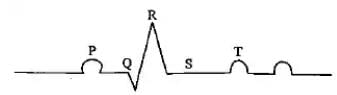
- b)
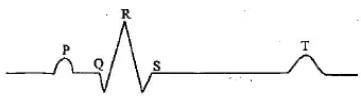
- c)

- d)
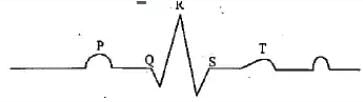
Correct answer is option 'D'. Can you explain this answer?
Which of the following is the diagrammatic representation of standard electrocardiogram(ECG)?
a)
b)
c)
d)
| | Priya Menon answered |
A normal electrogram (ECG) is composed of a ‘P’ wave, a QRS wave (complex), and a T wave. The ‘P’ wave is a small upward wave that represents electrical excitation or atrial depolarization which leads to contraction of both the atria. QRS wave (complex) begins after a fraction of a second of the P wave. It begins as a small downward deflection (Q) and continues as a larger upright (R) and triangular wave, ending as a downward wave (S) at its base. It represents ventricular depolarization. The ‘T’ wave is dome-shaped which represents ventricular repolarization. The potential generated by the recovery of the ventricle from the depolarization state is called the repolarization wave. The end of the ‘T’ wave marks the end of the systole.
In veins, valves are present to check backward flow of blood flowing at: - a)Atmospheric pressure
- b)High pressure
- c)Low pressure
- d)All of the above
Correct answer is option 'C'. Can you explain this answer?
In veins, valves are present to check backward flow of blood flowing at:
a)
Atmospheric pressure
b)
High pressure
c)
Low pressure
d)
All of the above
| | Suresh Iyer answered |
Veins brings blood from different body parts to the heart. The flow of blood in veins is not so fast because the blood in veins is under low pressure. Veins posses valves which present backward flow of blood.
Which of the following chambers of the heart has the thickest muscular wall?- a)Left atrium
- b)Right atrium
- c)Right ventricle
- d)Left ventricle
Correct answer is option 'D'. Can you explain this answer?
Which of the following chambers of the heart has the thickest muscular wall?
a)
Left atrium
b)
Right atrium
c)
Right ventricle
d)
Left ventricle
| | Suresh Iyer answered |
Left ventricle has the thickest muscular wall as it has to pump the oxygenated blood with great force to all visceral organs and parts of body through aorta.
Which one of the following is a matching pair?- a)Lub - sound associated with the closure of the tricuspid and bicuspid valves
- b)Dup - sound is associated with the opening of the semilunar valves
- c)Pulsation of the radial artery - Valves in the blood vessels
- d)Initiation of the heart beat - Purkinje fibres
Correct answer is option 'A'. Can you explain this answer?
Which one of the following is a matching pair?
a)
Lub - sound associated with the closure of the tricuspid and bicuspid valves
b)
Dup - sound is associated with the opening of the semilunar valves
c)
Pulsation of the radial artery - Valves in the blood vessels
d)
Initiation of the heart beat - Purkinje fibres
 | EduRev NEET answered |
Option C is incorrect, while Pulsation of the radial artery is due to rhythmic contraction and relaxation in the aorta. Option D is incorrect, while Initiation of the heart beat occurs in the SA node.
NCERT Topic: Heart sounds
NCERT Line: "During each cardiac cycle two prominent sounds are produced which can be easily heard through a stethoscope. The first heart sound (lub) is associated with the closure of the tricuspid and bicuspid valves whereas the second heart sound (dub) is associated with the closure of the semilunar valves."
In the above diagram, which blood vessel represents vena cava?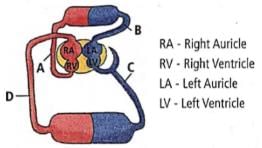
- a)C
- b)D
- c)A
- d)B
Correct answer is option 'B'. Can you explain this answer?
In the above diagram, which blood vessel represents vena cava?
a)
C
b)
D
c)
A
d)
B
| | Raghav Bansal answered |
In the given diagram 'D' represent the vena cava. Vena cava is either of two large veins that carry deoxygenated blood into the right atrium.
In the given figure of the heart which of the labelled part (1,2,3,4,5) carries oxygenated blood?
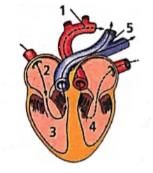
- a)1, 2, 3 and 4
- b)1 and 5
- c)1 and 4
- d)3 and 5
Correct answer is option 'C'. Can you explain this answer?
In the given figure of the heart which of the labelled part (1,2,3,4,5) carries oxygenated blood?
a)
1, 2, 3 and 4
b)
1 and 5
c)
1 and 4
d)
3 and 5
| | Priya Menon answered |
The labelled parts '1' and '4' are aorta and left ventricle respectively, which carry oxygenated blood. Left ventricle receives oxygenated blood from left auricle which received it from pulmonary veins and this oxygenaed blood then moves into the aorta to be supplied to the whole body.
Consider the following four statements and select the correct option stating which ones are true (T) and which ones are false (F)?
I. Proteins contribute 6-8% of the blood plasma
II. Plasma contains very high amount of minerals
III. Plasma without the clotting factors is called serum
IV. Glucose, amino acids, lipids, etc., are also present in the plasma as they are always in transit in the body.
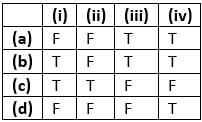
- a)a
- b)b
- c)c
- d)d
Correct answer is option 'B'. Can you explain this answer?
Consider the following four statements and select the correct option stating which ones are true (T) and which ones are false (F)?
I. Proteins contribute 6-8% of the blood plasma
II. Plasma contains very high amount of minerals
III. Plasma without the clotting factors is called serum
IV. Glucose, amino acids, lipids, etc., are also present in the plasma as they are always in transit in the body.
I. Proteins contribute 6-8% of the blood plasma
II. Plasma contains very high amount of minerals
III. Plasma without the clotting factors is called serum
IV. Glucose, amino acids, lipids, etc., are also present in the plasma as they are always in transit in the body.
a)
a
b)
b
c)
c
d)
d
 | Hansa Sharma answered |
Plasma contains small amounts of minerals like Na+,Mg2+, Ca2+, HCO3- Cl- etc.
Consider the following statements each with one or two blanks.
(i) Left auriculoventricular aperture is guarded by (1) valve while right auriculoventricular aperture is guarded by (2) valve.
(ii) In man left auricle receives (3) blood by (4) pulmonary veins.
(iii) (5) ions play a significant role in clotting.
Which one of the following options, gives the correct fill-ups for the respective blank numbers from (1) to (5) in the statements?- a)(3)-deoxygenated, (4)-four, (5)-magnesium
- b)(1) biscuspid valve, (2) tricuspid valve (5)-calcium
- c)(1)-tricuspid valve, (2)-bicuspid valve, (3)-oxygenated, (4)-two
- d)(1)-bicuspid valve, (2) tricuspid valve, (5)-sodium
Correct answer is option 'B'. Can you explain this answer?
Consider the following statements each with one or two blanks.
(i) Left auriculoventricular aperture is guarded by (1) valve while right auriculoventricular aperture is guarded by (2) valve.
(ii) In man left auricle receives (3) blood by (4) pulmonary veins.
(iii) (5) ions play a significant role in clotting.
Which one of the following options, gives the correct fill-ups for the respective blank numbers from (1) to (5) in the statements?
(i) Left auriculoventricular aperture is guarded by (1) valve while right auriculoventricular aperture is guarded by (2) valve.
(ii) In man left auricle receives (3) blood by (4) pulmonary veins.
(iii) (5) ions play a significant role in clotting.
Which one of the following options, gives the correct fill-ups for the respective blank numbers from (1) to (5) in the statements?
a)
(3)-deoxygenated, (4)-four, (5)-magnesium
b)
(1) biscuspid valve, (2) tricuspid valve (5)-calcium
c)
(1)-tricuspid valve, (2)-bicuspid valve, (3)-oxygenated, (4)-two
d)
(1)-bicuspid valve, (2) tricuspid valve, (5)-sodium
| | Ruchi Dey answered |
Statement Analysis:
(i) Left auriculoventricular aperture is guarded by (1) valve while right auriculoventricular aperture is guarded by (2) valve.
(ii) In man left auricle receives (3) blood by (4) pulmonary veins.
(iii) (5) ions play a significant role in clotting.
Correct Fill-Ups:
(1) Biscuspid valve
(2) Tricuspid valve
(3) Oxygenated
(4) Four
(5) Calcium
Explanation:
(i) The left auriculoventricular aperture is guarded by a biscuspid valve, which is also known as the mitral valve. The right auriculoventricular aperture is guarded by a tricuspid valve.
(ii) In human beings, the left auricle receives oxygenated blood from four pulmonary veins, which is then pumped into the left ventricle and then to the rest of the body.
(iii) Calcium ions play a significant role in the process of clotting of blood. Calcium is required for the activation of several clotting factors, which leads to the formation of a clot at the site of injury.
(i) Left auriculoventricular aperture is guarded by (1) valve while right auriculoventricular aperture is guarded by (2) valve.
(ii) In man left auricle receives (3) blood by (4) pulmonary veins.
(iii) (5) ions play a significant role in clotting.
Correct Fill-Ups:
(1) Biscuspid valve
(2) Tricuspid valve
(3) Oxygenated
(4) Four
(5) Calcium
Explanation:
(i) The left auriculoventricular aperture is guarded by a biscuspid valve, which is also known as the mitral valve. The right auriculoventricular aperture is guarded by a tricuspid valve.
(ii) In human beings, the left auricle receives oxygenated blood from four pulmonary veins, which is then pumped into the left ventricle and then to the rest of the body.
(iii) Calcium ions play a significant role in the process of clotting of blood. Calcium is required for the activation of several clotting factors, which leads to the formation of a clot at the site of injury.
In the given figure the durations of the events of the cardiac cycle are given. Identify these events and select the correct option.
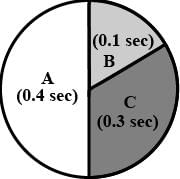
- a)A - Auricular systole
B - Joint diastole
C - Ventricular systole - b)A - Ventricular systole
B - Joint diastole
C - Auricular systole - c)A - Ventricular systole
B - Auricular systole
C - Joint diastole - d)A - Joint diastole
B - Auricular systole
C - Ventricular systole
Correct answer is option 'D'. Can you explain this answer?
In the given figure the durations of the events of the cardiac cycle are given. Identify these events and select the correct option.
a)
A - Auricular systole
B - Joint diastole
C - Ventricular systole
B - Joint diastole
C - Ventricular systole
b)
A - Ventricular systole
B - Joint diastole
C - Auricular systole
B - Joint diastole
C - Auricular systole
c)
A - Ventricular systole
B - Auricular systole
C - Joint diastole
B - Auricular systole
C - Joint diastole
d)
A - Joint diastole
B - Auricular systole
C - Ventricular systole
B - Auricular systole
C - Ventricular systole
| | Meera Singh answered |
Duration of joint diastole is 0.4 sec, that of auricular systole is 0.1 sec and that of ventricular systole is 0.3 sec.
What is the nature of blood passing through blood vessels A, B, C and D respectively?
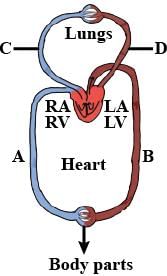
- a)A - Deoxygenated, B - Oxygenated, C - Deoxygenated, D - Oxygenated
- b)A - Deoxygenated, B - Deoxygenated, C - Oxygenated, D - Oxygenated
- c)A - Oxygenated, B - Oxygenated, C - Deoxygenated, D - Deoxygenated
- d)A - Oxygenated, B - Deoxygenated, C - Oxygenated, D - Deoxygenated
Correct answer is option 'A'. Can you explain this answer?
What is the nature of blood passing through blood vessels A, B, C and D respectively?
a)
A - Deoxygenated, B - Oxygenated, C - Deoxygenated, D - Oxygenated
b)
A - Deoxygenated, B - Deoxygenated, C - Oxygenated, D - Oxygenated
c)
A - Oxygenated, B - Oxygenated, C - Deoxygenated, D - Deoxygenated
d)
A - Oxygenated, B - Deoxygenated, C - Oxygenated, D - Deoxygenated
| | Lavanya Menon answered |
'A' is vena cava that carries deoxygenated blood
'B' is aorta that carries oxygenated blood
'C' is pulmonary artery that carries deoxygenated blood
'D' is pulmonary vein that carries oxygenated blood.
'B' is aorta that carries oxygenated blood
'C' is pulmonary artery that carries deoxygenated blood
'D' is pulmonary vein that carries oxygenated blood.
Choose the schematic diagram which properly respresents pulmonary circulation in humans.- a)

- b)

- c)

- d)

Correct answer is option 'C'. Can you explain this answer?
Choose the schematic diagram which properly respresents pulmonary circulation in humans.
a)
b)
c)
d)
| | Preeti Iyer answered |
Pulmonary circulation is the movement of blood between heart and lungs. During this pathway deoxygenated blood entering the right atrium, moves into the right ventricle From here it moves through the pulmonary arch into the lungs for oxygenation. Then from lungs oxygenated blood moves into the left atrium through pulmonary veins.
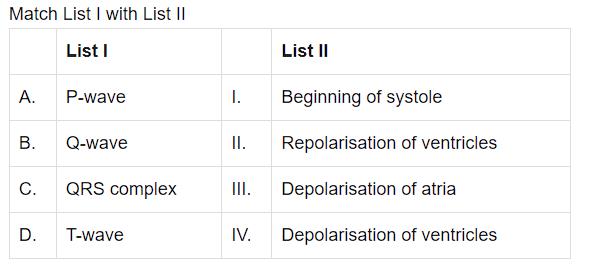
- a)1-I, 2-III, 3-IV, 4-II
- b)1- III , 2- I, 3-IV, 4- II
- c)1-III, 2-IV, 3-II, 4-I
- d)1-IV, 2 -II, 3-I, 4-II
Correct answer is option 'B'. Can you explain this answer?
a)
1-I, 2-III, 3-IV, 4-II
b)
1- III , 2- I, 3-IV, 4- II
c)
1-III, 2-IV, 3-II, 4-I
d)
1-IV, 2 -II, 3-I, 4-II
 | Arien Instructors answered |
The P-wave represents the electrical excitation (or depolarisation) of the atria, which leads to the contraction of both the atria.
The contraction starts shortly after Q and marks the beginning of the systole.
The T-wave represents the return of the ventricles from excited to normal state (repolarisation).
The contraction starts shortly after Q and marks the beginning of the systole.
The T-wave represents the return of the ventricles from excited to normal state (repolarisation).
Rate of heart beat is determined by- a)Purkinje fibres
- b)Papillary muscles
- c)SA node
- d)AV node
Correct answer is option 'C'. Can you explain this answer?
Rate of heart beat is determined by
a)
Purkinje fibres
b)
Papillary muscles
c)
SA node
d)
AV node
| | Lavanya Menon answered |
The cardiac impulse originates from SA node. This impulse is of highest rhythmicity. By determining the rate of discharge of the cardiac impulse the SA node determines the rate of heart beat.
Chordae tendineae are found in- a)ventricles of heart
- b)joints of legs
- c)ventricles of brain
- d)atria of heart
Correct answer is option 'A'. Can you explain this answer?
Chordae tendineae are found in
a)
ventricles of heart
b)
joints of legs
c)
ventricles of brain
d)
atria of heart
| | Suresh Iyer answered |
Chordae tendineae are the special fibrous cords attached to the flaps of tricuspid valve on one end and on the other end with the special muscles of the ventricular wall, the papillary muscles.
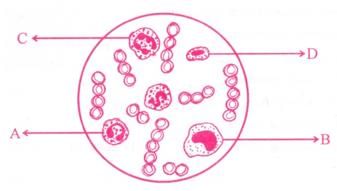
Study the given figure and identify the cells labelled as A, B, C and D.
- a)A - Eosinophil, B - Erythrocyte
C - Neutrophil, D - Basophil - b)A - Eosinophil, B - Lymphocyte
C - Neutrocyte, D - Monocyte - c)A - Erythrocyte, B - Basophil,
C - Neutrophil, D - Lymphocyte - d)A - Eosinophil, B - Monocyte
C - Neutrophil, D - Lymphocyte
Correct answer is option 'D'. Can you explain this answer?
Study the given figure and identify the cells labelled as A, B, C and D.
a)
A - Eosinophil, B - Erythrocyte
C - Neutrophil, D - Basophil
C - Neutrophil, D - Basophil
b)
A - Eosinophil, B - Lymphocyte
C - Neutrocyte, D - Monocyte
C - Neutrocyte, D - Monocyte
c)
A - Erythrocyte, B - Basophil,
C - Neutrophil, D - Lymphocyte
C - Neutrophil, D - Lymphocyte
d)
A - Eosinophil, B - Monocyte
C - Neutrophil, D - Lymphocyte
C - Neutrophil, D - Lymphocyte
| | Meera Singh answered |
The diagram shows the different types of blood cells.
The label A refers to eosinophils. The nucleus of these cells is bilobed. They are involved in allergic and inflammatory reactions.
The label B refers to monocytes. They have a kidney-shaped nucleus.
The label C refers to neutrophils. They have a multilobed nucleus. the monocytes and neutrophils are involved in phagocytosis.
The label D refers to lymphocytes. They have a large circular nucleus. They form the immune T cells and B cells.
The label A refers to eosinophils. The nucleus of these cells is bilobed. They are involved in allergic and inflammatory reactions.
The label B refers to monocytes. They have a kidney-shaped nucleus.
The label C refers to neutrophils. They have a multilobed nucleus. the monocytes and neutrophils are involved in phagocytosis.
The label D refers to lymphocytes. They have a large circular nucleus. They form the immune T cells and B cells.
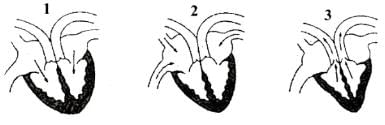
The figure given below three stages in the cardiac cycle
- a)2, 3, 1
- b)1, 2, 3
- c)2, 1, 3
- d)3, 1, 2
Correct answer is option 'C'. Can you explain this answer?
The figure given below three stages in the cardiac cycle
a)
2, 3, 1
b)
1, 2, 3
c)
2, 1, 3
d)
3, 1, 2
| | Anjali Sharma answered |
In figure (2), blood is entering into the right auricle through superior and inferior vena cava and blood is entering into left auricle through pulmonary vein. Figure (1) shows movement of blood from the auricles into the ventricles. Figure (2) shows movement of blood from the right ventricle into the pulmonary artery and from the left ventricle into aorta.
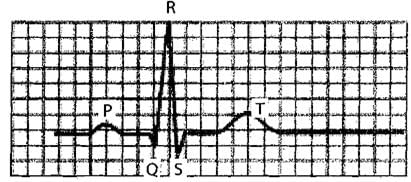
The given figure is the ECG of a normal human. Which one of its components is correctly interpreted below
- a)Complex QRS - one complete pulse
- b)Peak T - initiation of total cardiac contraction
- c)Peak P and peak R together - systolic and diastolic blood pressures
- d)Peak P- initiation of left atrial contraction only
Correct answer is option 'A'. Can you explain this answer?
The given figure is the ECG of a normal human. Which one of its components is correctly interpreted below
a)
Complex QRS - one complete pulse
b)
Peak T - initiation of total cardiac contraction
c)
Peak P and peak R together - systolic and diastolic blood pressures
d)
Peak P- initiation of left atrial contraction only
| | Lavanya Menon answered |
The QRS complex represents the depolarisation of the ventricles, which initiates the ventricular contraction. By counting the number of QRS complexes that occur in a given time period, One can determine the rate of heart beat of an individual.
The given figure illustrates a section through the human heart.
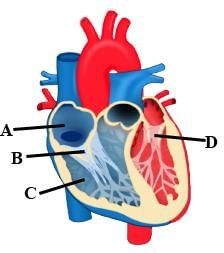
Which labelled part represents the site for the generation of action potential in human heart?- a)A
- b)B
- c)C
- d)D
Correct answer is option 'A'. Can you explain this answer?
The given figure illustrates a section through the human heart.
Which labelled part represents the site for the generation of action potential in human heart?
Which labelled part represents the site for the generation of action potential in human heart?
a)
A
b)
B
c)
C
d)
D
| | Gaurav Kumar answered |
A' is SA node that is the site for generation of action potential in human heart.
Chapter doubts & questions for Body Fluids and Circulation - NCERT Textbooks, Tests & Solutions 2026 is part of NEET exam preparation. The chapters have been prepared according to the NEET exam syllabus. The Chapter doubts & questions, notes, tests & MCQs are made for NEET 2026 Exam. Find important definitions, questions, notes, meanings, examples, exercises, MCQs and online tests here.
Chapter doubts & questions of Body Fluids and Circulation - NCERT Textbooks, Tests & Solutions in English & Hindi are available as part of NEET exam. Download more important topics, notes, lectures and mock test series for NEET Exam by signing up for free.
NCERT Textbooks, Tests & Solutions238 docs|243 tests |
