


All Exams > NEET > NCERT Textbooks, Tests & Solutions > All Questions
All questions of Chemical Coordination and Integration for NEET Exam
Which of the following is called emergency gland of the body?- a)Testis
- b)Adrenal Medulla
- c)Thymus
- d)Pituitary
Correct answer is option 'B'. Can you explain this answer?
Which of the following is called emergency gland of the body?
a)
Testis
b)
Adrenal Medulla
c)
Thymus
d)
Pituitary
 | Vivek Patel answered |
Adrenal gland is called the emergency gland of the body. Adrenaline is secreted by adrenal medulla on stimulation by sympathetic nervous system for meeting an emergency of stress condition, like injury, pain fear, Accident, grief, fall in blood pressure etc. Hence adrenal gland is called emergency hormone.

Prostaglandins are- a)Amino acid
- b)Steroid
- c)Fatty acid
- d)Carbohydrate
Correct answer is option 'C'. Can you explain this answer?
Prostaglandins are
a)
Amino acid
b)
Steroid
c)
Fatty acid
d)
Carbohydrate
 | Ciel Knowledge answered |
Prostaglandins are hormone-like compounds derived from 20-carbon polyunsaturated fatty acids. Their richest sources are the secretion of seminal vesicles in males and menstrual fluid in females. They have variety of effects such as vasodilation, vasoconstriction, uterine stimulation etc.
Estrogen and testosterone are steroid hormones, and are most likely bind to- a)membrane ions channels
- b)enzyme-linked membrane receptors
- c)G-protein linked membrane receptors
- d)cytoplasmic receptors
Correct answer is option 'D'. Can you explain this answer?
Estrogen and testosterone are steroid hormones, and are most likely bind to
a)
membrane ions channels
b)
enzyme-linked membrane receptors
c)
G-protein linked membrane receptors
d)
cytoplasmic receptors
 | Preeti Iyer answered |
Estrogen and testosterone being steroid hormones are soluble in lipids, therefore they can cross the plasma membrane and bind to the cytoplasmic receptors to trigger their action.
The source of somatostatin is same as that of- a)Thyroxine and calcitonin
- b)Insulin and glucagon
- c)Somatotropin and prolactin
- d)Vasopressin and adrenline
Correct answer is option 'B'. Can you explain this answer?
The source of somatostatin is same as that of
a)
Thyroxine and calcitonin
b)
Insulin and glucagon
c)
Somatotropin and prolactin
d)
Vasopressin and adrenline
 | Dev Patel answered |
Insulin, glucagon and somatostatin, are secreted by islets of Langerhans of pancreas, Somatostatin suppresses the release of other hormones from pancreas.
What is the function of calcitonin?- a)To increase calcium level in blood
- b)To decrease calcium level in blood
- c)To stimulate steroid synthesis
- d)To increase absorption of water in kidney tubules
Correct answer is option 'B'. Can you explain this answer?
What is the function of calcitonin?
a)
To increase calcium level in blood
b)
To decrease calcium level in blood
c)
To stimulate steroid synthesis
d)
To increase absorption of water in kidney tubules
| | Deepak Mukherjee answered |
Function of Calcitonin:
Calcitonin is a hormone produced by the parafollicular or C cells of the thyroid gland. Its main function is to regulate calcium levels in the blood by decreasing the levels when they are too high.
Decrease Calcium Level in Blood:
- Calcitonin works to decrease blood calcium levels by inhibiting the activity of osteoclasts, which are cells responsible for breaking down bone tissue. By reducing the activity of osteoclasts, calcitonin helps to prevent the release of calcium from bones into the bloodstream.
- In addition to inhibiting osteoclast activity, calcitonin also promotes the uptake of calcium by the bones, further reducing the amount of calcium in the blood.
- Overall, the action of calcitonin helps to maintain a balance of calcium in the body by preventing excessive levels of calcium in the blood.
- It is important to note that calcitonin's role in calcium regulation is complementary to the action of another hormone, parathyroid hormone (PTH), which works to increase blood calcium levels when they are too low.
In conclusion, the main function of calcitonin is to decrease blood calcium levels by inhibiting the activity of osteoclasts and promoting calcium uptake by bones. This helps to maintain a balance of calcium in the body and prevent harmful effects of excessive calcium levels in the blood.
Calcitonin is a hormone produced by the parafollicular or C cells of the thyroid gland. Its main function is to regulate calcium levels in the blood by decreasing the levels when they are too high.
Decrease Calcium Level in Blood:
- Calcitonin works to decrease blood calcium levels by inhibiting the activity of osteoclasts, which are cells responsible for breaking down bone tissue. By reducing the activity of osteoclasts, calcitonin helps to prevent the release of calcium from bones into the bloodstream.
- In addition to inhibiting osteoclast activity, calcitonin also promotes the uptake of calcium by the bones, further reducing the amount of calcium in the blood.
- Overall, the action of calcitonin helps to maintain a balance of calcium in the body by preventing excessive levels of calcium in the blood.
- It is important to note that calcitonin's role in calcium regulation is complementary to the action of another hormone, parathyroid hormone (PTH), which works to increase blood calcium levels when they are too low.
In conclusion, the main function of calcitonin is to decrease blood calcium levels by inhibiting the activity of osteoclasts and promoting calcium uptake by bones. This helps to maintain a balance of calcium in the body and prevent harmful effects of excessive calcium levels in the blood.
Which one of the following hormones never reaches to cytoplasm?- a)Estrogen
- b)FSH
- c)Progesterone
- d)Testosterone
Correct answer is option 'B'. Can you explain this answer?
Which one of the following hormones never reaches to cytoplasm?
a)
Estrogen
b)
FSH
c)
Progesterone
d)
Testosterone
| | Ashwini Chavan answered |
Hormone that never reaches cytoplasm
FSH (Follicle-stimulating hormone) is the hormone that never reaches the cytoplasm. Let's understand this in detail.
Introduction to Hormones
Hormones are chemical messengers that are secreted by various glands in the body. They travel through the bloodstream and act on specific target cells or organs to regulate various physiological processes. Hormones can be classified into different types, such as peptide hormones, steroid hormones, and amino acid-derived hormones.
Mechanism of Hormonal Action
Hormones act on target cells by binding to specific receptors on the cell membrane or inside the cell. Once the hormone binds to its receptor, it triggers a series of intracellular signaling pathways that ultimately lead to a specific physiological response. The response can be either short-term, such as muscle contraction, or long-term, such as growth and development.
Hormones that Reach Cytoplasm
Most hormones, such as estrogen, progesterone, and testosterone, are lipid-soluble and can diffuse through the cell membrane. Once inside the cell, they bind to specific receptors in the cytoplasm or nucleus. This binding activates gene expression and initiates the synthesis of new proteins, which ultimately lead to a physiological response.
Hormones that Never Reach Cytoplasm
In contrast, peptide hormones, such as FSH, are water-soluble and cannot diffuse through the cell membrane. Therefore, they bind to specific receptors on the cell membrane. This binding activates intracellular signaling pathways that ultimately lead to a physiological response. However, FSH never reaches the cytoplasm or nucleus of the cell.
Conclusion
In conclusion, FSH is a peptide hormone that binds to specific receptors on the cell membrane and activates intracellular signaling pathways. However, it never reaches the cytoplasm or nucleus of the cell.
FSH (Follicle-stimulating hormone) is the hormone that never reaches the cytoplasm. Let's understand this in detail.
Introduction to Hormones
Hormones are chemical messengers that are secreted by various glands in the body. They travel through the bloodstream and act on specific target cells or organs to regulate various physiological processes. Hormones can be classified into different types, such as peptide hormones, steroid hormones, and amino acid-derived hormones.
Mechanism of Hormonal Action
Hormones act on target cells by binding to specific receptors on the cell membrane or inside the cell. Once the hormone binds to its receptor, it triggers a series of intracellular signaling pathways that ultimately lead to a specific physiological response. The response can be either short-term, such as muscle contraction, or long-term, such as growth and development.
Hormones that Reach Cytoplasm
Most hormones, such as estrogen, progesterone, and testosterone, are lipid-soluble and can diffuse through the cell membrane. Once inside the cell, they bind to specific receptors in the cytoplasm or nucleus. This binding activates gene expression and initiates the synthesis of new proteins, which ultimately lead to a physiological response.
Hormones that Never Reach Cytoplasm
In contrast, peptide hormones, such as FSH, are water-soluble and cannot diffuse through the cell membrane. Therefore, they bind to specific receptors on the cell membrane. This binding activates intracellular signaling pathways that ultimately lead to a physiological response. However, FSH never reaches the cytoplasm or nucleus of the cell.
Conclusion
In conclusion, FSH is a peptide hormone that binds to specific receptors on the cell membrane and activates intracellular signaling pathways. However, it never reaches the cytoplasm or nucleus of the cell.
Hormones of which of the following endocrine glands lacks peptides, amines and sulphur?- a)Thyroid and Adrenal gland
- b)Anterior pituitary
- c)Testes and gonads
- d)Posterior pituitary and Pancreas
Correct answer is option 'C'. Can you explain this answer?
Hormones of which of the following endocrine glands lacks peptides, amines and sulphur?
a)
Thyroid and Adrenal gland
b)
Anterior pituitary
c)
Testes and gonads
d)
Posterior pituitary and Pancreas
 | Mira Joshi answered |
Hormones of testes and gonads are steroid in nature. They are derived from cholesterol.
Which of the following is not a characteristics of insulin?- a)It leads to direct uptake of glucose by hepatocytes.
- b)It binds to glycoprotein receptors on cell membrane.
- c)Its deficiency leads to diabetes mellitus.
- d)Its over secretion leads to insulin shock.
Correct answer is option 'A'. Can you explain this answer?
Which of the following is not a characteristics of insulin?
a)
It leads to direct uptake of glucose by hepatocytes.
b)
It binds to glycoprotein receptors on cell membrane.
c)
Its deficiency leads to diabetes mellitus.
d)
Its over secretion leads to insulin shock.
 | Hansa Sharma answered |
Insulin hormone produced by beta cells of pancreas, is central to regulating carbohydrate metabolism in the body. It causes cells in the skeletal muscles, and fat tissue to absorb glucose from the blood.
The hormone which regulates the basal metabolism in our body is secretd from- a)Adrenal cortex
- b)Pancreas
- c)Pituitary
- d)Thyroid
Correct answer is option 'D'. Can you explain this answer?
The hormone which regulates the basal metabolism in our body is secretd from
a)
Adrenal cortex
b)
Pancreas
c)
Pituitary
d)
Thyroid
| | Vivek Patel answered |
Thyroid hormones, thyroxine and tri-iodothyronine regulate the basal metabolism of our body.
Which one of the following pairs of hormones are the examples of those that can easily pass through the cell membrane of the target cell and bind to a receptor inside it (mostly in the nucleus)?- a)Insulin, glucagon
- b)Thyroxine, insulin
- c)Somatostatin, oxytocin
- d)Cortisol, testosterone
Correct answer is option 'D'. Can you explain this answer?
Which one of the following pairs of hormones are the examples of those that can easily pass through the cell membrane of the target cell and bind to a receptor inside it (mostly in the nucleus)?
a)
Insulin, glucagon
b)
Thyroxine, insulin
c)
Somatostatin, oxytocin
d)
Cortisol, testosterone
| | Dev Patel answered |
Cortisol and testosterone are steroid hormones and are easily soluble in lipids. They regulate gene expression by the interaction of hormone receptor complex with the genome. So, these easily pass through the cell membrane of the target cell and bind to a receptor inside it.
MSH is secreted by- a)Anterior lobe of pituitary
- b)Middle lobe of pituitary
- c)Posterior lobe of pituitary
- d)Endostyle
Correct answer is option 'B'. Can you explain this answer?
MSH is secreted by
a)
Anterior lobe of pituitary
b)
Middle lobe of pituitary
c)
Posterior lobe of pituitary
d)
Endostyle
 | Anjali Sharma answered |
Middle lobe of pituitary secretes MSH (melanocyte stimulating hormone) that controls the synthesis of melanin granules in the chromatophores.
TSH (thyroid stimulating hormone) is produced by- a)adrenal cortex
- b)middle pituitary lobe
- c)anterior pituitary lobe
- d)posterior pituitary lobe
Correct answer is option 'C'. Can you explain this answer?
TSH (thyroid stimulating hormone) is produced by
a)
adrenal cortex
b)
middle pituitary lobe
c)
anterior pituitary lobe
d)
posterior pituitary lobe
| | Vivek Patel answered |
Thyroid stimulating hormone (TSH) is produced by the anterior lobe of the pituitary and it stimulates production and secretion of thyroid hormones.
The blood calcium level is lowered by the deficiency of- a)Thyroxine
- b)Calcitonin
- c)Parathormone
- d)Both (a) and (b)
Correct answer is option 'C'. Can you explain this answer?
The blood calcium level is lowered by the deficiency of
a)
Thyroxine
b)
Calcitonin
c)
Parathormone
d)
Both (a) and (b)
| | Dev Patel answered |
Parathormone secreted by parathyroid gland regulates the level of calcium in the blood. It stimulates the release of calcium from the bones into the blood, increases calcium absorption from the intestine into the blood and it also increases calcium reabsorption from the nephrons into the blood. Therefore, its deficiency leads to low blood calcium level.
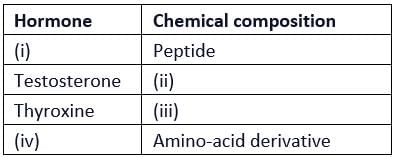
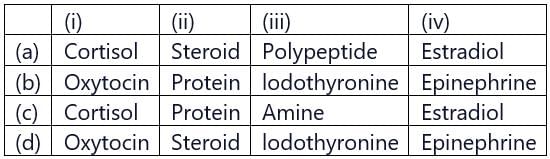
The given table enlists various hormones and their chemical nature. Select the option which completes the table.
- a)A
- b)B
- c)C
- d)D
Correct answer is option 'D'. Can you explain this answer?
The given table enlists various hormones and their chemical nature. Select the option which completes the table.
a)
A
b)
B
c)
C
d)
D
 | Gaurav Kumar answered |
(i) Peptides: These hormones are further of two types: Short peptide and long peptide.
Short peptide: The hormones oxytocin and vasopressin from the posterior lobe of the pituitary gland.
Long peptide: The hormones insulin and glucagon from the pancreas.
(ii) Steroid: The hormones from adrenal cortex, testes, ovaries and placenta are steroids. So, testosterone is a steroid.
(iii) Amino acid derivative: The hormones epinephrine and norepinephrine from the adrenal medulla and thyroxine from the thyroid gland are derived from the amino acid tyrosine.
So, the correct answer is '(i)- Oxytocin, (ii)- Steroid, (iii)- Iodothyronine, (iv)- Epinephrine'.
Short peptide: The hormones oxytocin and vasopressin from the posterior lobe of the pituitary gland.
Long peptide: The hormones insulin and glucagon from the pancreas.
(ii) Steroid: The hormones from adrenal cortex, testes, ovaries and placenta are steroids. So, testosterone is a steroid.
(iii) Amino acid derivative: The hormones epinephrine and norepinephrine from the adrenal medulla and thyroxine from the thyroid gland are derived from the amino acid tyrosine.
So, the correct answer is '(i)- Oxytocin, (ii)- Steroid, (iii)- Iodothyronine, (iv)- Epinephrine'.
Which hormone causes dilation of blood vessels, increased oxygen consumption and glucogenesis?- a)Glucagon
- b)ACTH
- c)Insulin
- d)Adrenalin
Correct answer is option 'D'. Can you explain this answer?
Which hormone causes dilation of blood vessels, increased oxygen consumption and glucogenesis?
a)
Glucagon
b)
ACTH
c)
Insulin
d)
Adrenalin
| | Ajay Yadav answered |
Adrenaline (Epinephrine) hormone is secreted by adrenal medulla under the conditions of emergency. Therefore, it is also known as emergency hormone. During emergency, it is released and causes dilation of blood vessels, so that the blood flow is increased. It also increases heart beat so that more oxygen is consumed and it also increases blood glucose level.
Which of the following sentences about steroid hormones is false?- a)They act by affecting gene expression.
- b)They can pass through nuclear membranes.
- c)The steroid hormone-receptor complex binds to hormone response elements in DNA.
- d)Steroid hormones are proteinaceous in nature.
Correct answer is option 'D'. Can you explain this answer?
Which of the following sentences about steroid hormones is false?
a)
They act by affecting gene expression.
b)
They can pass through nuclear membranes.
c)
The steroid hormone-receptor complex binds to hormone response elements in DNA.
d)
Steroid hormones are proteinaceous in nature.
 | Prasenjit Chavan answered |
False Statement about Steroid Hormones:
Steroid Hormones are Proteinaceous in Nature:
- This statement is false because steroid hormones are not proteinaceous in nature. They are actually derived from cholesterol and are lipid-based molecules.
- Steroid hormones are synthesized in the endocrine glands such as the adrenal glands, gonads, and placenta.
- These hormones are characterized by their ability to pass through cell membranes easily due to their lipid nature.
Correct Statements about Steroid Hormones:
- They act by affecting gene expression: Steroid hormones bind to specific receptors inside the cell and then move into the nucleus where they can affect gene expression.
- They can pass through nuclear membranes: Steroid hormones are lipid-soluble molecules that can easily pass through the nuclear membrane to bind to their receptors inside the cell.
- The steroid hormone-receptor complex binds to hormone response elements in DNA: Once the steroid hormone binds to its receptor, the complex can bind to specific hormone response elements in the DNA, leading to changes in gene expression.
All hypophysiotropic hormones are peptides except- a)Corticotropin releasing hormone
- b)Growth hormone inhibitory hormone
- c)Somatostatin
- d)Prolactin release inhibiting hormone
Correct answer is option 'D'. Can you explain this answer?
All hypophysiotropic hormones are peptides except
a)
Corticotropin releasing hormone
b)
Growth hormone inhibitory hormone
c)
Somatostatin
d)
Prolactin release inhibiting hormone
 | Manisha Sarkar answered |
Peptide Hypophysiotropic Hormones:
Hypophysiotropic hormones are hormones that regulate the release of other hormones from the anterior pituitary gland. These hormones are primarily peptides, with the exception of a few non-peptide hormones.
Explanation:
Corticotropin Releasing Hormone (CRH):
- CRH is a peptide hormone that stimulates the release of adrenocorticotropic hormone (ACTH) from the anterior pituitary gland, which in turn stimulates the adrenal glands to produce cortisol.
Growth Hormone Inhibitory Hormone:
- This is not a specific hormone but rather a general term used to describe hormones that inhibit the release of growth hormone from the pituitary gland. These hormones are typically peptides.
Somatostatin:
- Somatostatin is a peptide hormone that inhibits the release of growth hormone, as well as other hormones such as insulin and glucagon. It acts as a negative regulator of hormone secretion.
Prolactin Release Inhibiting Hormone:
- Prolactin release inhibiting hormone, also known as dopamine, is a non-peptide hormone that inhibits the release of prolactin from the pituitary gland. It acts as a negative regulator of prolactin secretion.
Conclusion:
In conclusion, all hypophysiotropic hormones are peptides except for prolactin release inhibiting hormone, which is a non-peptide hormone. These hormones play crucial roles in regulating the endocrine system and maintaining homeostasis in the body.
Hypophysiotropic hormones are hormones that regulate the release of other hormones from the anterior pituitary gland. These hormones are primarily peptides, with the exception of a few non-peptide hormones.
Explanation:
Corticotropin Releasing Hormone (CRH):
- CRH is a peptide hormone that stimulates the release of adrenocorticotropic hormone (ACTH) from the anterior pituitary gland, which in turn stimulates the adrenal glands to produce cortisol.
Growth Hormone Inhibitory Hormone:
- This is not a specific hormone but rather a general term used to describe hormones that inhibit the release of growth hormone from the pituitary gland. These hormones are typically peptides.
Somatostatin:
- Somatostatin is a peptide hormone that inhibits the release of growth hormone, as well as other hormones such as insulin and glucagon. It acts as a negative regulator of hormone secretion.
Prolactin Release Inhibiting Hormone:
- Prolactin release inhibiting hormone, also known as dopamine, is a non-peptide hormone that inhibits the release of prolactin from the pituitary gland. It acts as a negative regulator of prolactin secretion.
Conclusion:
In conclusion, all hypophysiotropic hormones are peptides except for prolactin release inhibiting hormone, which is a non-peptide hormone. These hormones play crucial roles in regulating the endocrine system and maintaining homeostasis in the body.
Thyroxine and Tri-iodothyronine, produced by the thyroid gland, are synthesised from iodine and ___________.- a)Phenylalanine
- b)Tyrosine
- c)Tryptophan
- d)Cholesterol
Correct answer is option 'B'. Can you explain this answer?
Thyroxine and Tri-iodothyronine, produced by the thyroid gland, are synthesised from iodine and ___________.
a)
Phenylalanine
b)
Tyrosine
c)
Tryptophan
d)
Cholesterol
| | Meera Singh answered |
Thyroxine and Triiodothyronine are iodinated form of an amino acid called tyrosine
Which part of our body secretes the hormone secretin?- a)Stomach
- b)Oesophagus
- c)Ileum
- d)Duodenum
Correct answer is option 'D'. Can you explain this answer?
Which part of our body secretes the hormone secretin?
a)
Stomach
b)
Oesophagus
c)
Ileum
d)
Duodenum
| | Geetika Shah answered |
Secretin hormone is secreted by the Brunner's glands present in the wall of the duodenum.
According to the accepted concept of hormone action, if receptor molecules are removed from target organs, then the target organ will- a)continue to respond to the hormone without any difference
- b)not respond to the hormone
- c)continue to respond to the hormone but will require
- d)higher concentration
Correct answer is option 'B'. Can you explain this answer?
According to the accepted concept of hormone action, if receptor molecules are removed from target organs, then the target organ will
a)
continue to respond to the hormone without any difference
b)
not respond to the hormone
c)
continue to respond to the hormone but will require
d)
higher concentration
| | Preeti Iyer answered |
Hormones recognise target organs by the presence of specific receptor molecules on the plasma membrane of target organs, if these receptor molecules are removed then a hormone will be unable to give any response.
Endorine glands have___ to carry their secretions to the specific organ.- a)Capillaries
- b)Tubules
- c)No ducts
- d)Ducts
Correct answer is option 'C'. Can you explain this answer?
Endorine glands have___ to carry their secretions to the specific organ.
a)
Capillaries
b)
Tubules
c)
No ducts
d)
Ducts
 | Dhruba Chakraborty answered |
Understanding Endocrine Glands
Endocrine glands are specialized organs that play a crucial role in the body's hormonal regulation. They differ significantly from exocrine glands, which utilize ducts to transport their secretions.
Characteristics of Endocrine Glands
- Ductless Nature: Endocrine glands do not possess ducts. Instead, they secrete hormones directly into the bloodstream. This allows for a more efficient and widespread distribution of hormones throughout the body.
- Hormonal Secretion: Hormones are chemical messengers that travel through the circulatory system to target organs or tissues. Each hormone has specific functions and effects, influencing various physiological processes.
Comparison with Exocrine Glands
- Exocrine Glands: In contrast, exocrine glands, such as sweat glands and salivary glands, have ducts that carry their secretions to specific sites. This means they deliver their products directly to the surface or into cavities of the body.
- Example of Endocrine Glands: Major endocrine glands include the pituitary gland, thyroid gland, adrenal glands, and pancreas. Each of these glands releases hormones that regulate metabolism, growth, stress response, and other vital functions.
Conclusion
- The absence of ducts in endocrine glands allows for the rapid and systemic effects of hormones. This ductless mechanism is fundamental to the endocrine system's ability to maintain homeostasis and coordinate complex bodily functions. Understanding this distinction is essential for comprehending human physiology, particularly in the context of examinations like NEET.
Endocrine glands are specialized organs that play a crucial role in the body's hormonal regulation. They differ significantly from exocrine glands, which utilize ducts to transport their secretions.
Characteristics of Endocrine Glands
- Ductless Nature: Endocrine glands do not possess ducts. Instead, they secrete hormones directly into the bloodstream. This allows for a more efficient and widespread distribution of hormones throughout the body.
- Hormonal Secretion: Hormones are chemical messengers that travel through the circulatory system to target organs or tissues. Each hormone has specific functions and effects, influencing various physiological processes.
Comparison with Exocrine Glands
- Exocrine Glands: In contrast, exocrine glands, such as sweat glands and salivary glands, have ducts that carry their secretions to specific sites. This means they deliver their products directly to the surface or into cavities of the body.
- Example of Endocrine Glands: Major endocrine glands include the pituitary gland, thyroid gland, adrenal glands, and pancreas. Each of these glands releases hormones that regulate metabolism, growth, stress response, and other vital functions.
Conclusion
- The absence of ducts in endocrine glands allows for the rapid and systemic effects of hormones. This ductless mechanism is fundamental to the endocrine system's ability to maintain homeostasis and coordinate complex bodily functions. Understanding this distinction is essential for comprehending human physiology, particularly in the context of examinations like NEET.
Which of the following statements regarding glucagon is false?- a)It is secreted by α-cells of islets of Langerhans.
- b)It acts antagonistically to insulin.
- c)It decreases blood sugar level.
- d)The gland responsible for it's secretion is heterocrine gland.
Correct answer is option 'C'. Can you explain this answer?
Which of the following statements regarding glucagon is false?
a)
It is secreted by α-cells of islets of Langerhans.
b)
It acts antagonistically to insulin.
c)
It decreases blood sugar level.
d)
The gland responsible for it's secretion is heterocrine gland.
 | Naveen Desai answered |
The pancreas.
b)It raises blood glucose levels.
c)It promotes glycogen breakdown in the liver.
d)It inhibits insulin secretion.
e)It is released in response to low blood glucose levels.
b)It raises blood glucose levels.
c)It promotes glycogen breakdown in the liver.
d)It inhibits insulin secretion.
e)It is released in response to low blood glucose levels.
Adrenocorticotropic hormone is secreted by- a)Thyroid
- b)Adrenal
- c)Pancreas
- d)Anterior pituitary
Correct answer is option 'D'. Can you explain this answer?
Adrenocorticotropic hormone is secreted by
a)
Thyroid
b)
Adrenal
c)
Pancreas
d)
Anterior pituitary
| | Priya Kaur answered |
Adrenocorticotropic hormone secretion
Adrenocorticotropic hormone (ACTH) is secreted by the anterior pituitary gland in the brain. This hormone plays a crucial role in the regulation of the adrenal glands, which are located on top of the kidneys.
Stimulus for ACTH secretion
ACTH secretion is stimulated by the release of corticotropin-releasing hormone (CRH) from the hypothalamus. CRH triggers the anterior pituitary gland to release ACTH into the bloodstream.
Function of ACTH
ACTH acts on the adrenal glands to stimulate the production and release of cortisol, a stress hormone that helps the body respond to stress and regulate metabolism. It also plays a role in the production of other hormones, such as aldosterone and androgens.
Regulation of ACTH secretion
ACTH secretion is regulated by a negative feedback mechanism. When cortisol levels in the blood are high, they inhibit the release of CRH and ACTH, thereby reducing cortisol production. Conversely, when cortisol levels are low, the hypothalamus and pituitary gland increase the secretion of CRH and ACTH to stimulate cortisol production.
In conclusion, the secretion of adrenocorticotropic hormone is primarily regulated by the hypothalamus and the anterior pituitary gland, and it plays a crucial role in the regulation of adrenal gland function and cortisol production.
Adrenocorticotropic hormone (ACTH) is secreted by the anterior pituitary gland in the brain. This hormone plays a crucial role in the regulation of the adrenal glands, which are located on top of the kidneys.
Stimulus for ACTH secretion
ACTH secretion is stimulated by the release of corticotropin-releasing hormone (CRH) from the hypothalamus. CRH triggers the anterior pituitary gland to release ACTH into the bloodstream.
Function of ACTH
ACTH acts on the adrenal glands to stimulate the production and release of cortisol, a stress hormone that helps the body respond to stress and regulate metabolism. It also plays a role in the production of other hormones, such as aldosterone and androgens.
Regulation of ACTH secretion
ACTH secretion is regulated by a negative feedback mechanism. When cortisol levels in the blood are high, they inhibit the release of CRH and ACTH, thereby reducing cortisol production. Conversely, when cortisol levels are low, the hypothalamus and pituitary gland increase the secretion of CRH and ACTH to stimulate cortisol production.
In conclusion, the secretion of adrenocorticotropic hormone is primarily regulated by the hypothalamus and the anterior pituitary gland, and it plays a crucial role in the regulation of adrenal gland function and cortisol production.
Low level of progesterone and estrogen in blood stimulate- a)FSH-RH production
- b)LH production
- c)GH production
- d)All of these
Correct answer is option 'A'. Can you explain this answer?
Low level of progesterone and estrogen in blood stimulate
a)
FSH-RH production
b)
LH production
c)
GH production
d)
All of these
| | Ajay Yadav answered |
When secretion of hormones is under the control of factors or other hormones, it is called the feedback control. If the level of progesterone and estrogen is low in the blood, it stimulates the hypothalamus to secrete more FSH-RH which results in increased production of FSH from anterior pituitary which in turn stimulates the increased secretion of estrogen and progesterone from ovary.
Reabsorption of Na+ is controlled by which one of the following hormones?- a)Aldosterone
- b)Estrogen
- c)Glucocorticoids
- d)Testosterone
Correct answer is option 'A'. Can you explain this answer?
Reabsorption of Na+ is controlled by which one of the following hormones?
a)
Aldosterone
b)
Estrogen
c)
Glucocorticoids
d)
Testosterone
| | Vivek Patel answered |
Aldosterone (secreted by adrenal medulla) acts mainly on the renal tubules and stimulates the reabsorption of Na+ and water and excretion of K+ and phosphate ions.
The gonadotropic hormones are secreted by- a)Anterior lobe of pituitary
- b)Interstitial cells of testes
- c)Adrenal cortex
- d)Posterior part of thyroid
Correct answer is option 'A'. Can you explain this answer?
The gonadotropic hormones are secreted by
a)
Anterior lobe of pituitary
b)
Interstitial cells of testes
c)
Adrenal cortex
d)
Posterior part of thyroid
| | Ananya Das answered |
Gonadotropic hormones (LH and FSH), secreted by anterior lobe of pituitary regulate growth and activity of gonads.
Which of the following hormones is necessary for the development of secondary sexual characters in human beings?- a)Estrogen
- b)FSH
- c)Testosterone
- d)Both (a) and (c)
Correct answer is option 'D'. Can you explain this answer?
Which of the following hormones is necessary for the development of secondary sexual characters in human beings?
a)
Estrogen
b)
FSH
c)
Testosterone
d)
Both (a) and (c)
| | Ajay Yadav answered |
Estrogen, secreted by ovaries in females, stimulates the development of secondary sexual characters during puberty and maintains them through the reproductive years of adult life in females Testosterone is produced by testes in males, it stimulates the development of male secondary sexual characters like beard, moustache, etc.
Which one of the following statements is correct?- a)Endocrine galnds regulate neural activity. But not vice versa.
- b)Neurons regulate endocrine activity, but not vice versa.
- c)Endocrine glands regulate neural activity, and nervous system regulates endocrine glands.
- d)Neither hormones control neutral activity nor the neurons control endocrine activity.
Correct answer is option 'C'. Can you explain this answer?
Which one of the following statements is correct?
a)
Endocrine galnds regulate neural activity. But not vice versa.
b)
Neurons regulate endocrine activity, but not vice versa.
c)
Endocrine glands regulate neural activity, and nervous system regulates endocrine glands.
d)
Neither hormones control neutral activity nor the neurons control endocrine activity.
| | Gaurav Kumar answered |
Endocrine system, like the nervous system, is meant for internal communication and regulation of the animal body. These two systems operate in a coordinated way on many occasions. Many important functions of the endocrine system are infact, under the control of nervous system. Therefore, the two systems are often collectively called as neuroendocrine system.
Ovulation in females in under the control of- a)ADH and LH
- b)LH
- c)TSH and LH
- d)LTH and TSH
Correct answer is option 'B'. Can you explain this answer?
Ovulation in females in under the control of
a)
ADH and LH
b)
LH
c)
TSH and LH
d)
LTH and TSH
| | Shilpa Iyer answered |
Understanding Ovulation in Females
Key Point: Ovulation in females is primarily under the control of LH.
Luteinizing Hormone (LH)
- LH is a hormone produced by the pituitary gland in the brain.
- It plays a crucial role in the menstrual cycle and ovulation in females.
- LH surge triggers the release of the mature egg from the ovary during ovulation.
Role of LH in Ovulation
- At the beginning of the menstrual cycle, LH levels are low.
- As the cycle progresses, LH levels rise, leading to a surge in LH around the middle of the cycle.
- This surge in LH triggers the release of the mature egg from the ovary, marking the peak of ovulation.
Other Hormones
- While other hormones such as estrogen and progesterone also play important roles in the menstrual cycle, LH is the primary hormone responsible for ovulation.
- ADH, TSH, LTH do not have a direct role in ovulation.
Conclusion:
- Ovulation in females is primarily controlled by LH, which triggers the release of the mature egg from the ovary. Other hormones like estrogen and progesterone also contribute to the menstrual cycle, but LH is the key player in ovulation.
Key Point: Ovulation in females is primarily under the control of LH.
Luteinizing Hormone (LH)
- LH is a hormone produced by the pituitary gland in the brain.
- It plays a crucial role in the menstrual cycle and ovulation in females.
- LH surge triggers the release of the mature egg from the ovary during ovulation.
Role of LH in Ovulation
- At the beginning of the menstrual cycle, LH levels are low.
- As the cycle progresses, LH levels rise, leading to a surge in LH around the middle of the cycle.
- This surge in LH triggers the release of the mature egg from the ovary, marking the peak of ovulation.
Other Hormones
- While other hormones such as estrogen and progesterone also play important roles in the menstrual cycle, LH is the primary hormone responsible for ovulation.
- ADH, TSH, LTH do not have a direct role in ovulation.
Conclusion:
- Ovulation in females is primarily controlled by LH, which triggers the release of the mature egg from the ovary. Other hormones like estrogen and progesterone also contribute to the menstrual cycle, but LH is the key player in ovulation.
The signal transduction of steroid hormone across cell is through- a)binding of hormone to the cytoplasmic receptor and the complex binds to hormone response element on DNA within promoter DNA
- b)binding of hormone to the transmembrane receptor which initiates the production of second messenger that activates enzymes which further activates transcription factors
- c)binding of hormone to the transmembrane receptor which diffuse inside the cell cytoplasm and then activates the enzyme necessary for the activation of transcription factors
- d)binding of hormone to the cytoplasmic receptor that initiates the production of second messenger which activates enzymes that further activates transcription factors
Correct answer is option 'A'. Can you explain this answer?
The signal transduction of steroid hormone across cell is through
a)
binding of hormone to the cytoplasmic receptor and the complex binds to hormone response element on DNA within promoter DNA
b)
binding of hormone to the transmembrane receptor which initiates the production of second messenger that activates enzymes which further activates transcription factors
c)
binding of hormone to the transmembrane receptor which diffuse inside the cell cytoplasm and then activates the enzyme necessary for the activation of transcription factors
d)
binding of hormone to the cytoplasmic receptor that initiates the production of second messenger which activates enzymes that further activates transcription factors
| | Raghav Bansal answered |
Steroid hormones, being hydrophobic molecules, diffuse freely into all cells and act within the cell. Steroid hormones enter the cytoplasm of a target cell and bind with specific receptor proteins (mobile). Hormone-receptor complex then diffuses into nucleus and activates specific genes to form a new protein. This protein carries out the specific response for a particular steroid hormone.
The function of pineal body is to- a)Lighten the skin colour
- b)Control sexual behaviour
- c)Regulate the period of puber
- d)All of the above
Correct answer is option 'D'. Can you explain this answer?
The function of pineal body is to
a)
Lighten the skin colour
b)
Control sexual behaviour
c)
Regulate the period of puber
d)
All of the above
| | Jyoti Sengupta answered |
Pineal body is a very small, reddish-grey, vascular, conical, solid body located in the brain. It secretes a hormone named melatonin. Melatonin makes the skin colour lighter in certain animals and also regulates the functioning of gonads, thus, controls sexual behaviour and regulates the period of puberty.
Secretion of which of the following is under the control of neurosecretory nerve cells?- a)Pineal
- b)Adrenal cortex
- c)Anterior pituitary
- d)Thymus
Correct answer is option 'C'. Can you explain this answer?
Secretion of which of the following is under the control of neurosecretory nerve cells?
a)
Pineal
b)
Adrenal cortex
c)
Anterior pituitary
d)
Thymus
| | Suresh Iyer answered |
The neurosecretory cells of the hypothalamus secrete releasing factors (neurohormones) that regulate the secretion of hormones from the anterior pituitary.
A person is having problem with calcium and phosphorus metabolism in his body. Which one of the following glands may not be functioning properly?- a)Parotid
- b)Pancreas
- c)Adrenal cortex
- d)Parathyroid
Correct answer is option 'D'. Can you explain this answer?
A person is having problem with calcium and phosphorus metabolism in his body. Which one of the following glands may not be functioning properly?
a)
Parotid
b)
Pancreas
c)
Adrenal cortex
d)
Parathyroid
| | Hansa Sharma answered |
Parathyroid glands located behind the thyroid gland, produce a hormone called parathormone. This hormone maintains calcium and phosphorus balance in the body. Thus, if a person is having problem with calcium and phosphorus metabolism in the body, this means, his parathyroid gland is not functioning properly.
Which of the following hormones does not have a particular target organ in the body?- a)Growth hormone
- b)TSH
- c)Oxytocin
- d)FSH
Correct answer is option 'A'. Can you explain this answer?
Which of the following hormones does not have a particular target organ in the body?
a)
Growth hormone
b)
TSH
c)
Oxytocin
d)
FSH
| | Mira Joshi answered |
Growth hormone secreted by the anterior pituitary has a widespread effect in the body it stimulates growth of various body cells, promotes protein anabolism, absorption of calcium from bowel and conversion of glycogen to glucose.
Diabetes insipidus occurs due to the hyposecretion of- a)Thymosine
- b)Oxytocin
- c)Insulin
- d)Vasopressin
Correct answer is option 'D'. Can you explain this answer?
Diabetes insipidus occurs due to the hyposecretion of
a)
Thymosine
b)
Oxytocin
c)
Insulin
d)
Vasopressin
| | Hansa Sharma answered |
Vasopressin (antidiuretic hormone, ADH) released from posterior pituitary increases reabsorption of water from distal and collecting tubules of the kidney, thus, helping in producing concentrated urine. If there is hyposecretion of vasopressin, then water will not be reabsorbed from the tubules and the urine thus produced will be dilute. This disorder is called diabetes insipidus which is characterised by producing dilute urine several times a day.
Which one of the following endocrine glands stores its secretion in the extracellular space before discharging it into the blood?- a)Testis
- b)Thyroid
- c)Pancreas
- d)Adrenal
Correct answer is option 'B'. Can you explain this answer?
Which one of the following endocrine glands stores its secretion in the extracellular space before discharging it into the blood?
a)
Testis
b)
Thyroid
c)
Pancreas
d)
Adrenal
| | Ananya Das answered |
Thyroid gland stores its hormones in the colloid. Colloid is a homogenous material present in the thyroid follicles of thyroid gland.
Secretion of progesterone by corpus luteum is initiated by- a)Testosterone
- b)Thyroxine
- c)MSH
- d)LH
Correct answer is option 'D'. Can you explain this answer?
Secretion of progesterone by corpus luteum is initiated by
a)
Testosterone
b)
Thyroxine
c)
MSH
d)
LH
| | Geetika Shah answered |
Luteinising hormone (LH) secreted by the anterior lobe of pituitary gland stimulates corpus luteum of the ovary to secrete progesterone.
Increase in bleeding time and delay in blood coagulation is due to the deficiency of which hormone?- a)Adrenaline
- b)Noradrenaline
- c)Parathormone
- d)Thyroxine
Correct answer is option 'C'. Can you explain this answer?
Increase in bleeding time and delay in blood coagulation is due to the deficiency of which hormone?
a)
Adrenaline
b)
Noradrenaline
c)
Parathormone
d)
Thyroxine
| | Ajay Yadav answered |
Calcium plays an important role in blood clotting. Parathormone, a hormone released by parathyroid glands, increases calcium level in the blood. Therefore, deficiency of this hormone will decrease Ca2+ level in blood, thus leading to delay in blood clotting and increase in bleeding time.
Which of the following is synthesised in both the brain and endocrine glands?- a)ACTH
- b)Cortisol
- c)Oxytocin
- d)Somatostatin
Correct answer is option 'D'. Can you explain this answer?
Which of the following is synthesised in both the brain and endocrine glands?
a)
ACTH
b)
Cortisol
c)
Oxytocin
d)
Somatostatin
| | Vivek Patel answered |
Somatostatin is an inhibitory hormone which is secreted by hypothalamus in the brain and pancreas. Somatostatin from hypothalamus inhibits the secretion of growth hormone from the anterior lobe of pituitary. Somatostatin from pancreas inhibits the release of other hormones from pancreas like insulin and glucagon.
The function of oxytocin is to help in- a)Child birth
- b)Gametogenesis
- c)Growth
- d)All of these
Correct answer is option 'A'. Can you explain this answer?
The function of oxytocin is to help in
a)
Child birth
b)
Gametogenesis
c)
Growth
d)
All of these
| | Raghav Bansal answered |
Oxytocin, secreted by the posterior pituitary gland causes contraction of smooth muscles of the uterus during child birth.
Adrenaline directly affects on- a)S.A. node
- b)β-cells of Langerhans
- c)Dorsal root of spinal nerve
- d)Epithelial cells of stomach
Correct answer is option 'A'. Can you explain this answer?
Adrenaline directly affects on
a)
S.A. node
b)
β-cells of Langerhans
c)
Dorsal root of spinal nerve
d)
Epithelial cells of stomach
| | Ajay Yadav answered |
Adrenaline prepares the body for emergency reactions like fight and flight. Therefore, it directly affects the SA node to increase the rate of heart beat.
The islets of Langerhans are found in- a)Liver
- b)Pancreas
- c)Stomach
- d)Alimentary canal
Correct answer is option 'B'. Can you explain this answer?
The islets of Langerhans are found in
a)
Liver
b)
Pancreas
c)
Stomach
d)
Alimentary canal
| | Vivek Patel answered |
Islets of Langerhans are found in pancreas. It consists of four types of cells - alpha cells that secrete glucagon, β-cells that secrete insulin, delta cells that secrete somatostatin and F cells that secrete pancreatic polypeptide.
Chapter doubts & questions for Chemical Coordination and Integration - NCERT Textbooks, Tests & Solutions 2026 is part of NEET exam preparation. The chapters have been prepared according to the NEET exam syllabus. The Chapter doubts & questions, notes, tests & MCQs are made for NEET 2026 Exam. Find important definitions, questions, notes, meanings, examples, exercises, MCQs and online tests here.
Chapter doubts & questions of Chemical Coordination and Integration - NCERT Textbooks, Tests & Solutions in English & Hindi are available as part of NEET exam. Download more important topics, notes, lectures and mock test series for NEET Exam by signing up for free.
NCERT Textbooks, Tests & Solutions238 docs|243 tests |
