


All Exams > NEET > Topic-wise MCQ Tests for NEET > All Questions
All questions of Moving Charges and Magnetism for NEET Exam
If we double the radius of a current carrying coil keeping the current unchanged. what happens to the magnetic field at its Centre?- a)halved
- b)doubled
- c)remains unchanged
- d)becomes four times
Correct answer is option 'A'. Can you explain this answer?
If we double the radius of a current carrying coil keeping the current unchanged. what happens to the magnetic field at its Centre?
a)
halved
b)
doubled
c)
remains unchanged
d)
becomes four times
 | Ciel Knowledge answered |
As,
B=μonI/2a
a ->radius
B ∝1/a
B1/B2=a2/a1
B1=2B2
B2=(1/2) x B1,
Magnetic field is halved.
B=μonI/2a
a ->radius
B ∝1/a
B1/B2=a2/a1
B1=2B2
B2=(1/2) x B1,
Magnetic field is halved.

Two thin long parallel wires separated by a distance b are carrying a current i ampere each. The magnitude of the force per unit length exerted by one wire on the other is- a)

- b)

- c)

- d)

Correct answer is option 'D'. Can you explain this answer?
Two thin long parallel wires separated by a distance b are carrying a current i ampere each. The magnitude of the force per unit length exerted by one wire on the other is
a)
b)
c)
d)
 | EduRev Humanities answered |
Given, i1=i2=i
∴F=μ0i2l/2πb
Hence, force per unit length is F=μ0i2/2πb
∴F=μ0i2l/2πb
Hence, force per unit length is F=μ0i2/2πb

An electron and proton enter a magnetic field with equal velocities. Which one of them experiences a greater force?- a)electron
- b)proton
- c)Both experience same magnitude of force
- d)No prediction can be made.
Correct answer is option 'C'. Can you explain this answer?
An electron and proton enter a magnetic field with equal velocities. Which one of them experiences a greater force?
a)
electron
b)
proton
c)
Both experience same magnitude of force
d)
No prediction can be made.
 | Divey Sethi answered |
As charges and velocities are same
F=q(V×B)
So having the same magnitude of charge and same velocity, they'll experience the same magnitude of force.
F=q(V×B)
So having the same magnitude of charge and same velocity, they'll experience the same magnitude of force.
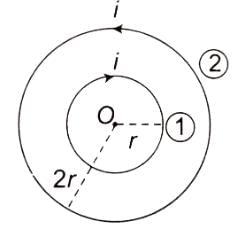
Two concentric coils carry the same current in opposite directions. The diameter of the inner coil is half that of the outer coil. If the magnetic field produced by the outer coil at the common centre are 1 T, the net field at the centre is- a)4T
- b)2T
- c)1T
- d)3T
Correct answer is option 'C'. Can you explain this answer?
Two concentric coils carry the same current in opposite directions. The diameter of the inner coil is half that of the outer coil. If the magnetic field produced by the outer coil at the common centre are 1 T, the net field at the centre is
a)
4T
b)
2T
c)
1T
d)
3T
 | Krishna Iyer answered |
The magnetic field produced by a current-carrying coil at its center is given by the formula,
B = μ0 * (N*I/R),
where,
B is the magnetic field,
μ0 is the permeability of free space,
N is the number of turns in the coil,
I is the current through the coil, and
R is the radius of the coil.
In this case, both the coils carry the same current but in opposite directions. So, the fields produced by them will be in opposite directions. Also, the diameter of the inner coil is half that of the outer coil. Thus, the radius of the inner coil will be half that of the outer coil.
Therefore, the field at the center due to the inner coil will be double that due to the outer coil (because the magnetic field is inversely proportional to the radius).
Since the fields are in opposite directions, the net field at the center will be the difference between the two fields. That is, 2B (due to the inner coil) - B (due to the outer coil) = B.
So, if the field due to the outer coil is 1 T (Tesla), the net field at the center will also be 1 T.
Hence, the correct answer is 3. 1T.
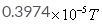
The magnetic field due to circular coil of 200 turns of diameter 0.1m carrying a current of 5A at a point on the axis of the coil at a distance 0.15m from the center of the coil will be- a)

- b)
- c)
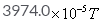
- d)

Correct answer is option 'D'. Can you explain this answer?
The magnetic field due to circular coil of 200 turns of diameter 0.1m carrying a current of 5A at a point on the axis of the coil at a distance 0.15m from the center of the coil will be
a)
b)
c)
d)
 | Gunjan Lakhani answered |
B=μ02πnIa2/4π (a2+x2)3/2
=10−7×2×(22/7)×200×5×(0⋅1/2)2/ [(0⋅1/2)2+(0⋅15)2]3/2
=39.74x10-5
=10−7×2×(22/7)×200×5×(0⋅1/2)2/ [(0⋅1/2)2+(0⋅15)2]3/2
=39.74x10⁻⁵
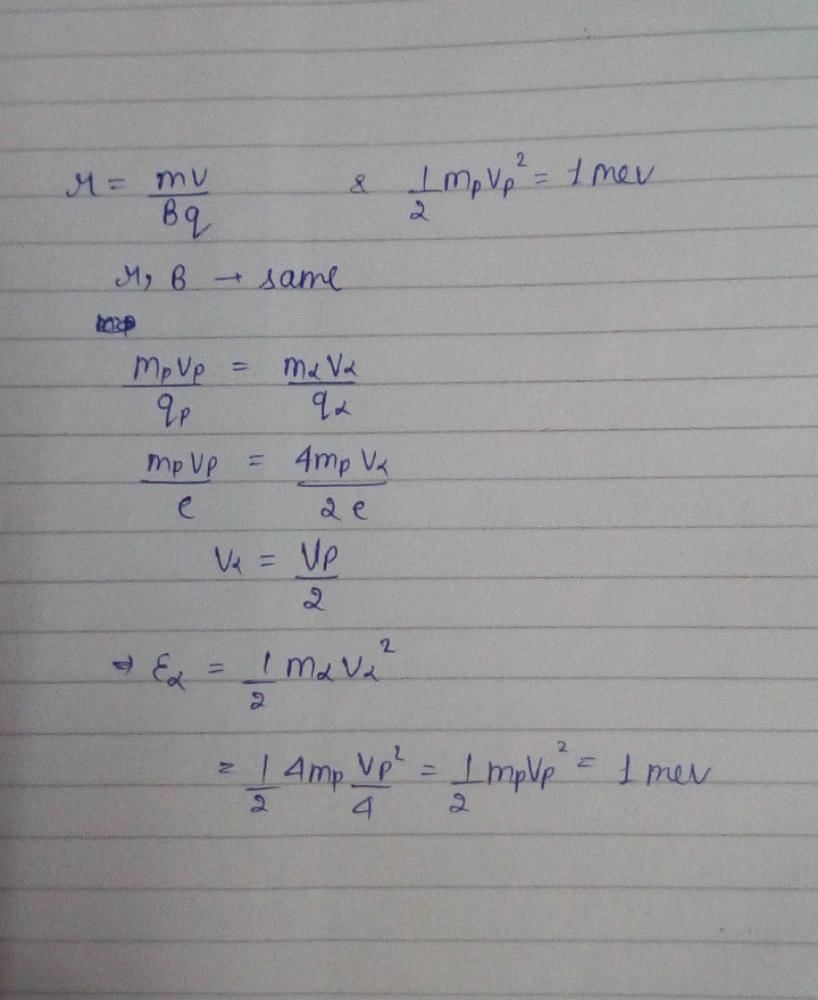
A proton with 1MeV kinetic energy is moving in a circular path of radius R in a uniform magnetic field. What should be the energy of an α – particle to describe a circle of same radius in the same magnetic field?- a)2 MeV
- b)0.5 MeV
- c)1 MeV
- d)4 MeV
Correct answer is option 'C'. Can you explain this answer?
A proton with 1MeV kinetic energy is moving in a circular path of radius R in a uniform magnetic field. What should be the energy of an α – particle to describe a circle of same radius in the same magnetic field?
a)
2 MeV
b)
0.5 MeV
c)
1 MeV
d)
4 MeV
 | Shraddha Singh answered |
Wire of length l, carries a steady current I. It is bent first to form a circular coil of one turn. The same wire of same length is now bent more sharply to give two loops of smaller radius the magnetic field at the centre caused by the same current is- a)one third of its initial value
- b)nine times of its initial value
- c)four times of its initial value
- d)unaltered
Correct answer is option 'C'. Can you explain this answer?
Wire of length l, carries a steady current I. It is bent first to form a circular coil of one turn. The same wire of same length is now bent more sharply to give two loops of smaller radius the magnetic field at the centre caused by the same current is
a)
one third of its initial value
b)
nine times of its initial value
c)
four times of its initial value
d)
unaltered
 | Om Desai answered |
Let the radii be r1 and r2 respectively.
Since there are two turns of radius r2, r1=2r2
Magnetic field B at the centre of the coil of radius r1 B1=μoi/2r1=μoi/4r2
Magnetic field B at the center of the coil of radius r2 B2=2×μoi/2r2
∴ B2/B1 =(2× μoi/2r2)/(μoi /4r2) =4
Hence the answer is option C, four times its initial value.
Since there are two turns of radius r2, r1=2r2
Magnetic field B at the centre of the coil of radius r1 B1=μoi/2r1=μoi/4r2
Magnetic field B at the center of the coil of radius r2 B2=2×μoi/2r2
∴ B2/B1 =(2× μoi/2r2)/(μoi /4r2) =4
Hence the answer is option C, four times its initial value.
The frequency (v) of charged particle, moving at right angles to the magnetic field is independent of- a)radius of circular trajectory (r)
- b)magnetic induction (B)
- c)speed of the particle (v)
- d)both speed of the particle (v) and radius of trajectory (r).
Correct answer is option 'D'. Can you explain this answer?
The frequency (v) of charged particle, moving at right angles to the magnetic field is independent of
a)
radius of circular trajectory (r)
b)
magnetic induction (B)
c)
speed of the particle (v)
d)
both speed of the particle (v) and radius of trajectory (r).
 | Infinity Academy answered |
Frequency (v) = qB/2πm.
Frequency is independent of radius of trajectory of particle and speed of particle.
Frequency is independent of radius of trajectory of particle and speed of particle.
A 2 cm long copper wire having mass of 6 gm, dips in to two mercury pools to form a complete circuit. The wire is placed between the poles of a magnet which causes a field strength of 0.3 T. Find the initial upward acceleration of copper wire after 100 A of current is passed through the wire (g = 10 m/s2)- a)1 m/s2
- b)10 m/s2
- c)100 m/s2
- d)90 m/s2
Correct answer is option 'D'. Can you explain this answer?
A 2 cm long copper wire having mass of 6 gm, dips in to two mercury pools to form a complete circuit. The wire is placed between the poles of a magnet which causes a field strength of 0.3 T. Find the initial upward acceleration of copper wire after 100 A of current is passed through the wire (g = 10 m/s2)
a)
1 m/s2
b)
10 m/s2
c)
100 m/s2
d)
90 m/s2
 | Hansa Sharma answered |
ma=Bil−mg
a=0.3×100×2×10−2−10×6×10−3/ m
a= 0.6−0.06/6×10−3
=100−10
=90ms−2
a=0.3×100×2×10−2−10×6×10−3/ m
a= 0.6−0.06/6×10−3
=100−10
=90ms−2
A particle of charge 1.6 x 10⁻¹⁹ C and mass 1.8 x 10⁻²⁷ kg is moving around the path of radius 2 x 10⁴ m with velocity 2.4 x 10⁶ m/s. The magnetic field necessary is (in Wb/m²)- a)13.5 x 10⁻⁶
- b)135 x 10-6
- c)0.135 x 10
- d)1.35 x 10⁻⁶
Correct answer is option 'D'. Can you explain this answer?
A particle of charge 1.6 x 10⁻¹⁹ C and mass 1.8 x 10⁻²⁷ kg is moving around the path of radius 2 x 10⁴ m with velocity 2.4 x 10⁶ m/s. The magnetic field necessary is (in Wb/m²)
a)
13.5 x 10⁻⁶
b)
135 x 10-6
c)
0.135 x 10
d)
1.35 x 10⁻⁶
 | Sreemoyee Choudhury answered |
Explanation:
When an electron is projected in a uniform electric field and a uniform magnetic field, both pointing in the same direction as the electron's velocity, the following happens:
1. Electric field:
The electric field exerts a force on the electron in the direction of the field. Since the electron is negatively charged, it experiences a force opposite to the direction of the electric field. Therefore, the electric field does not affect the direction of the electron's motion.
2. Magnetic field:
The magnetic field exerts a force on the electron perpendicular to both the field direction and the electron's velocity. The force is given by the Lorentz force equation:
F = q(v x B)
where F is the force, q is the charge of the electron, v is its velocity, and B is the magnetic field.
In this case, the force is directed inward, towards the center of the circular path. The magnitude of the force is given by:
|F| = qvB
where |F| is the magnitude of the force.
Since the force is perpendicular to the velocity, it causes the electron to move in a circular path around the magnetic field lines. The radius of the path is given by:
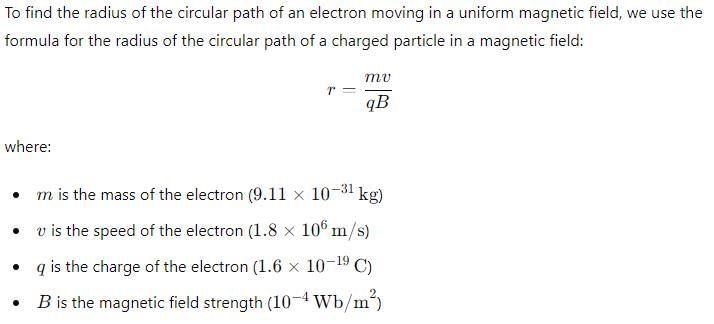
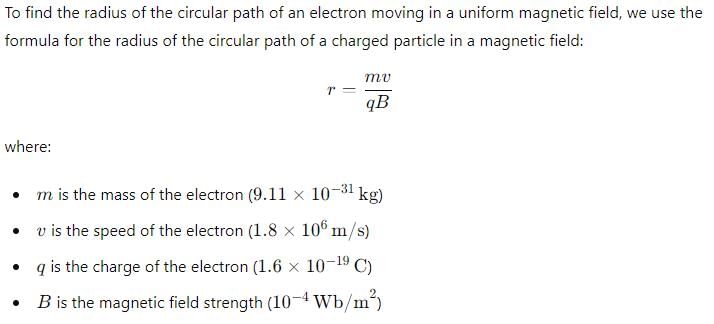
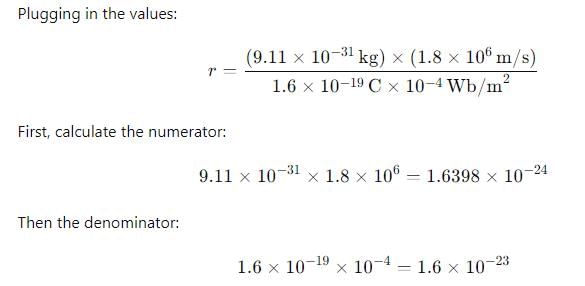
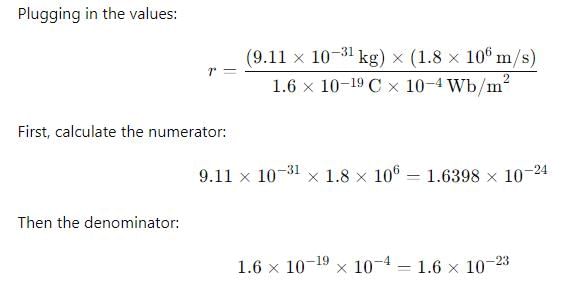
r = mv/qB
where r is the radius of the path, m is the mass of the electron, and v is its velocity.
3. Combined effect:
Since the electric field does not affect the direction of the electron's motion, the only effect is due to the magnetic field. As the electron moves in a circular path, it loses kinetic energy due to the work done by the magnetic force. Therefore, its velocity decreases in magnitude.
Hence, the correct option is D- The electron velocity will decrease in magnitude.
When an electron is projected in a uniform electric field and a uniform magnetic field, both pointing in the same direction as the electron's velocity, the following happens:
1. Electric field:
The electric field exerts a force on the electron in the direction of the field. Since the electron is negatively charged, it experiences a force opposite to the direction of the electric field. Therefore, the electric field does not affect the direction of the electron's motion.
2. Magnetic field:
The magnetic field exerts a force on the electron perpendicular to both the field direction and the electron's velocity. The force is given by the Lorentz force equation:
F = q(v x B)
where F is the force, q is the charge of the electron, v is its velocity, and B is the magnetic field.
In this case, the force is directed inward, towards the center of the circular path. The magnitude of the force is given by:
|F| = qvB
where |F| is the magnitude of the force.
Since the force is perpendicular to the velocity, it causes the electron to move in a circular path around the magnetic field lines. The radius of the path is given by:
r = mv/qB
where r is the radius of the path, m is the mass of the electron, and v is its velocity.
3. Combined effect:
Since the electric field does not affect the direction of the electron's motion, the only effect is due to the magnetic field. As the electron moves in a circular path, it loses kinetic energy due to the work done by the magnetic force. Therefore, its velocity decreases in magnitude.
Hence, the correct option is D- The electron velocity will decrease in magnitude.
A circular coil of radius r carries current I. The magnetic field at its center is B. at what distance from the center on the axis of the coil magnetic field will be B/8- a)√3R
- b)√2R
- c)2R
- d)3R
Correct answer is option 'A'. Can you explain this answer?
A circular coil of radius r carries current I. The magnetic field at its center is B. at what distance from the center on the axis of the coil magnetic field will be B/8
a)
√3R
b)
√2R
c)
2R
d)
3R
 | Shilpa Saha answered |
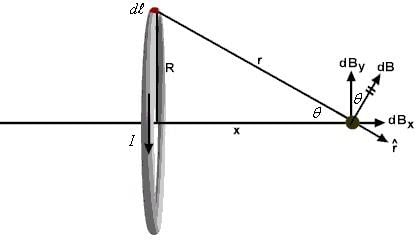
As you know that magnetic field at point on the axis of current carrying ring is
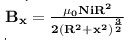
where x is the point on the axis of ring, R is the radius of ring , i is the current carrying on ring and N is the number of turns .
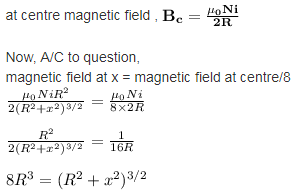
This is possible only when x = +-√3R
Hence, √3R distance from the centre magnetic field is equal to magnetic field at centre .
A conductor of length l, carrying current I and placed in a magnetic field B experiences a force F given by- a)

- b)

- c)

- d)

Correct answer is option 'C'. Can you explain this answer?
A conductor of length l, carrying current I and placed in a magnetic field B experiences a force F given by
a)
b)
c)
d)
 | Deepali Tripathi answered |
F=q(v x B)
=q(dl/dt x B)
=q/dt(l x B)
=i(l x B)
=q(dl/dt x B)
=q/dt(l x B)
=i(l x B)
A charged particle is moving on circular path with velocity v in a uniform magnetic field B, if the velocity of the charged particle is doubled and strength of Magnetic field is halved, then radius becomes- a)8 times
- b)4 times
- c)2 times
- d)16 times
Correct answer is option 'B'. Can you explain this answer?
A charged particle is moving on circular path with velocity v in a uniform magnetic field B, if the velocity of the charged particle is doubled and strength of Magnetic field is halved, then radius becomes
a)
8 times
b)
4 times
c)
2 times
d)
16 times
 | Meera Singh answered |
As 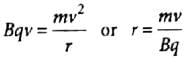
According to the question, v‘ = 2v and B' = B/2
∴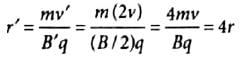
According to the question, v‘ = 2v and B' = B/2
∴
The force acting on a charge q moving with velocity in a magnetic field
 is given by
- a)

- b)

- c)

- d)

Correct answer is option 'C'. Can you explain this answer?
The force acting on a charge q moving with velocityin a magnetic field is given by
in a magnetic field is given bya)
b)
c)
d)
 | Neha Sharma answered |
The magnetic force on a free moving charge is perpendicular to both the velocity of the charge and the magnetic field with direction given by the right hand rule . The force is given by the charge times the vector product of velocity and magnetic field.
Which of the following laws give the direction of induced e.m.f- a)Faraday’s Law
- b)Ampere’s Theorem
- c)Biot Savart Law
- d)Lenz’s Law
Correct answer is option 'D'. Can you explain this answer?
Which of the following laws give the direction of induced e.m.f
a)
Faraday’s Law
b)
Ampere’s Theorem
c)
Biot Savart Law
d)
Lenz’s Law
 | Knowledge Hub answered |
Lenz’s law is used for determining the direction of induced current.
Lenz’s law of electromagnetic induction states that the direction of induced current in a given magnetic field is such that it opposes the induced change by changing the magnetic field.
Following is the formula of Lenz’s law:
ϵ=−N (∂ϕB/∂t)
Where,
- ε is the induced emf
- ∂ΦB is the change in magnetic flux
- N is the number of turns in the coil
Lenz’s law finds application in electromagnetic braking and in electric generators
A Charge is fired through a magnetic field. The magnetic force acting on it is maximum when the angle between the direction of motion and magnetic field is- a)π
- b)zero
- c)π/2
- d)π/4
Correct answer is option 'C'. Can you explain this answer?
A Charge is fired through a magnetic field. The magnetic force acting on it is maximum when the angle between the direction of motion and magnetic field is
a)
π
b)
zero
c)
π/2
d)
π/4
| | Krishna Iyer answered |
The force will have a magnitude F=qvB sin q, thus it will be maximum if sin q is maximum. Thus, angle between velocity and magnetic field should be 90o or the charge particle moves perpendicular to the velocity vector.
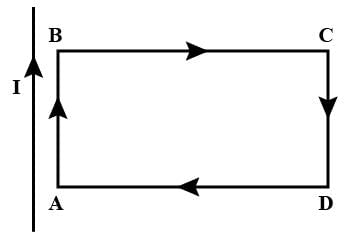
A rectangular loop carrying a current I is situated near a long straight wire such that the wire is parallel to the one of the sides of the loop and is in a plane of the loop. If a steady current I is established in wire as shown in figure, the loop will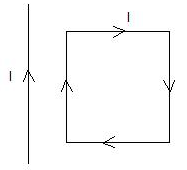
- a)move away from the wire or towards right
- b)remain stationary
- c)rotate about an axis parallel to the wire
- d)move towards the wire
Correct answer is option 'D'. Can you explain this answer?
A rectangular loop carrying a current I is situated near a long straight wire such that the wire is parallel to the one of the sides of the loop and is in a plane of the loop. If a steady current I is established in wire as shown in figure, the loop will
a)
move away from the wire or towards right
b)
remain stationary
c)
rotate about an axis parallel to the wire
d)
move towards the wire
 | Top Rankers answered |
The long straight wire and side AB carry current in the same direction, hence will attract each other.
The long straight wire and side CD carry current in the opposite direction, hence will repel each other.
Force on side BC will be equal and opposite to force on side DA.
Since CD is farther from the wire than AB, the force of attraction on AB will exceed the force of repulsion on CD.
Hence, there will be a net force of attraction on the loop ABCD and it will move towards the wire.
The long straight wire and side CD carry current in the opposite direction, hence will repel each other.
Force on side BC will be equal and opposite to force on side DA.
Since CD is farther from the wire than AB, the force of attraction on AB will exceed the force of repulsion on CD.
Hence, there will be a net force of attraction on the loop ABCD and it will move towards the wire.
The force between two current carrying conductors is due to which of the following- a)Magnetic effect of electric current
- b)Electrostatic interaction
- c)Electromagnetic induction
- d)Polarisation
Correct answer is option 'A'. Can you explain this answer?
The force between two current carrying conductors is due to which of the following
a)
Magnetic effect of electric current
b)
Electrostatic interaction
c)
Electromagnetic induction
d)
Polarisation
 | Virat answered |
Current carring wire produce magnetic field
A wire of length l, carrying current is bent into a loop and placed with its plane perpendicular to a magnetic field. In which of the following shapes, is the torque acting on the loop maximum?- a)Rectangle
- b)Circle
- c)Square
- d)Equilateral triangle
Correct answer is option 'B'. Can you explain this answer?
A wire of length l, carrying current is bent into a loop and placed with its plane perpendicular to a magnetic field. In which of the following shapes, is the torque acting on the loop maximum?
a)
Rectangle
b)
Circle
c)
Square
d)
Equilateral triangle
| | Om Desai answered |
The torque on a current loop depends upon the area of the current loop, when the magnetic field is perpendicular to the plane of the loops the torque has its maximum value,
Τ=I A B
We know I and B for all these cases but A depends upon the geometry. The circle has the greatest area so it should provide the greatest torque.
Τ=I A B
We know I and B for all these cases but A depends upon the geometry. The circle has the greatest area so it should provide the greatest torque.
A straight conductor carrying current I is split into circular loop as shown in figure a , the magnetic induction at the center of the circular loop is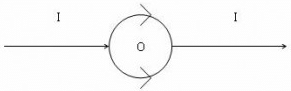
- a)Zero
- b)

- c)

- d)Infinite
Correct answer is option 'A'. Can you explain this answer?
A straight conductor carrying current I is split into circular loop as shown in figure a , the magnetic induction at the center of the circular loop is
a)
Zero
b)
c)
d)
Infinite
 | Jayant Mishra answered |
The magnetic field at the center O due to the upper side of the semicircular current loop is equal and opposite to that due to the lower side of the loop.
In a current carrying conductor varying electric field generates- a)Magnetic field
- b)Potential gradient
- c)Resistance
- d)Current
Correct answer is option 'A'. Can you explain this answer?
In a current carrying conductor varying electric field generates
a)
Magnetic field
b)
Potential gradient
c)
Resistance
d)
Current
 | Animesh Nhagal answered |
Moving electrons in conducter produce electromagnetic wave...
When a charged particle moves in a magnetic field, its kinetic energy always- a)remain constant
- b)first increases then decreases.
- c)decreases
- d)increases
Correct answer is option 'A'. Can you explain this answer?
When a charged particle moves in a magnetic field, its kinetic energy always
a)
remain constant
b)
first increases then decreases.
c)
decreases
d)
increases
 | Rajeev Saxena answered |
The magnetic field does no work, so the kinetic energy and speed of a charged particle in a magnetic field remain constant. The magnetic force, acting perpendicular to the velocity of the particle, will cause circular motion.
A solenoid coil of 300 turns /m is carrying a current of 5 A. Calculate the magnitude of magnetic intensity inside the solenoid.- a)1.9 T
- b)1.9 X 10⁻⁶ T
- c)1.9 X 10⁻³ T
- d)1.9 X 10⁻⁷ T
Correct answer is option 'C'. Can you explain this answer?
A solenoid coil of 300 turns /m is carrying a current of 5 A. Calculate the magnitude of magnetic intensity inside the solenoid.
a)
1.9 T
b)
1.9 X 10⁻⁶ T
c)
1.9 X 10⁻³ T
d)
1.9 X 10⁻⁷ T
| | Jyoti Sengupta answered |
We know, Magnetic field of solenoid,
= μonI
=4πx10-7x300x5
=4πx15x10-5
=6πx10-9
=18.89x10⁻⁹
≈1.9x10⁻³T
= μonI
=4πx10-7x300x5
=4πx15x10-5
=6πx10-9
=18.89x10⁻⁹
≈1.9x10⁻³T
Along an infinitely long conductor carrying a current of 8 A we keep another conductor of length 5 m carrying a current of 3 A. Both the conductors are 10 cm apart. Find the force on small conductor.- a)2.4 X 10⁻⁴ N
- b)9.6 X 10⁻⁴ N
- c)2.6 X 10⁻⁶ N
- d)9.6 X 10⁻⁵ N
Correct answer is option 'A'. Can you explain this answer?
Along an infinitely long conductor carrying a current of 8 A we keep another conductor of length 5 m carrying a current of 3 A. Both the conductors are 10 cm apart. Find the force on small conductor.
a)
2.4 X 10⁻⁴ N
b)
9.6 X 10⁻⁴ N
c)
2.6 X 10⁻⁶ N
d)
9.6 X 10⁻⁵ N
| | Shreya Singh answered |
F=4π×10^-7 i1 i2 l/2π rF= 4π × 10^-7×8×3× 5./2π×10^-2.F= 2×10^-7×8×3× 5 ×100.F=2.4×10^-4.

Two straight horizontal parallel wires are carrying the same current in same direction, d is the distnace between the wires. You are povided with a small freely suspended magnetic needle. At which of the following positions will the orientation of the needle be independent of the magnitude of current in the wires?- a)At a distance d/2 from any of the wires.
- b)At a distance d/2 from any of the wires in the horizontal plane.
- c)Anywhere on the circumference of a vertical circle of radius d ans centre half way between the wires.
- d)At points half way between the wires in the horizontal plane.
Correct answer is option 'A'. Can you explain this answer?
Two straight horizontal parallel wires are carrying the same current in same direction, d is the distnace between the wires. You are povided with a small freely suspended magnetic needle. At which of the following positions will the orientation of the needle be independent of the magnitude of current in the wires?
a)
At a distance d/2 from any of the wires.
b)
At a distance d/2 from any of the wires in the horizontal plane.
c)
Anywhere on the circumference of a vertical circle of radius d ans centre half way between the wires.
d)
At points half way between the wires in the horizontal plane.
| | Nandini Patel answered |
The answer is d.
At these points, the resultant field =0
At these points, the resultant field =0
A circular loop of radius 0.0157 m carries a current of 2 A. The magnetic field at the centre of the loop is- a)3.14 x 10⁻⁵ weber /m2
- b)1.57 x 10⁻⁵ weber /m2
- c)1.57 x 10⁻⁵ weber /m2
- d)8.0 x 10⁻⁵ weber /m2
Correct answer is option 'D'. Can you explain this answer?
A circular loop of radius 0.0157 m carries a current of 2 A. The magnetic field at the centre of the loop is
a)
3.14 x 10⁻⁵ weber /m2
b)
1.57 x 10⁻⁵ weber /m2
c)
1.57 x 10⁻⁵ weber /m2
d)
8.0 x 10⁻⁵ weber /m2
| | Hansa Sharma answered |
The magnetic field due to a circular loop is given by:
B= μ02πi/4πr
=10−7×2π×2/0.0157
=8×10⁻⁵ Wb/m2
B= μ02πi/4πr
=10−7×2π×2/0.0157
=8×10⁻⁵ Wb/m2
A particle having a mass of 10–2 kg carries a charge of 5 × 10⁻⁸ C. The particle is given an initial horozontal velocity of 105 ms–1 in the presence of electric field  and magnetic field
  . To keep the particle moving in a horizontal direction, it is necessary that(1) should be perpendicular to the direction of velocity and should be along the direction of velocity.(2) Both and should be along the direction of velocity.(3) Both and are mutually perpendicular and perpendicular to the direction of velocity.(4) should be along the direction of velocity and should be perpendicular to the direction of velocityWhich one of the following pairs of statements is possible?
- a)(2) and (4)
- b)(1) and (3)
- c)(3) and (4)
- d)(2) and (3)
Correct answer is option 'D'. Can you explain this answer?
A particle having a mass of 10–2 kg carries a charge of 5 × 10⁻⁸ C. The particle is given an initial horozontal velocity of 105 ms–1 in the presence of electric field and magnetic field . To keep the particle moving in a horizontal direction, it is necessary that
and magnetic field . To keep the particle moving in a horizontal direction, it is necessary that(1) should be perpendicular to the direction of velocity and should be along the direction of velocity.
should be perpendicular to the direction of velocity and should be along the direction of velocity.(2) Both and should be along the direction of velocity.
and should be along the direction of velocity.(3) Both and are mutually perpendicular and perpendicular to the direction of velocity.
and are mutually perpendicular and perpendicular to the direction of velocity.(4) should be along the direction of velocity and should be perpendicular to the direction of velocity
should be along the direction of velocity and should be perpendicular to the direction of velocityWhich one of the following pairs of statements is possible?
a)
(2) and (4)
b)
(1) and (3)
c)
(3) and (4)
d)
(2) and (3)
 | Ayush Sengupta answered |
Force due to electric field acts along the direction of the electric field but force due to the magnetic field acts along a direction perpendicular to both the velocity of the charged particle and the magnetic field.
Hence both statements (2) and (3) are true.
In statement (2), magnetic force is zero, so, electric force will keep the particle continue to move in horizontal direction. In statement (3), both electric and magnetic forces will be opposite to each other. If their magnitudes will be equal then the particle will continue horizontal motion.
Hence both statements (2) and (3) are true.
In statement (2), magnetic force is zero, so, electric force will keep the particle continue to move in horizontal direction. In statement (3), both electric and magnetic forces will be opposite to each other. If their magnitudes will be equal then the particle will continue horizontal motion.
The magnetic field due to current element depends upon which of the following factors:- a)Current flowing through it.
- b)Distance from it.
- c)Its length.
- d)All of above.
Correct answer is option 'D'. Can you explain this answer?
The magnetic field due to current element depends upon which of the following factors:
a)
Current flowing through it.
b)
Distance from it.
c)
Its length.
d)
All of above.
 | Geetika Shah answered |
From Biot-Savart law, magnetic field at a point p, B= (μ0/4π)∫ [(Idl×r)/ r3]
where r is the distance of point p from conductor and I is the current in the conductor.
Thus magnetic field due to current carrying conductor depends on the current flowing through conductor and distance from the conductor and length of the conductor.
where r is the distance of point p from conductor and I is the current in the conductor.
Thus magnetic field due to current carrying conductor depends on the current flowing through conductor and distance from the conductor and length of the conductor.
The magnetic field inside a toroid of radius R is B. If the current through it is doubled and the radius increased four times keeping the number of turns per unit length same, then the magnetic field produced by it will be- a)B
- b)2B
- c)4B
- d)B/2
Correct answer is option 'B'. Can you explain this answer?
The magnetic field inside a toroid of radius R is B. If the current through it is doubled and the radius increased four times keeping the number of turns per unit length same, then the magnetic field produced by it will be
a)
B
b)
2B
c)
4B
d)
B/2
| | Nandini Iyer answered |
In the 1st case,
B1= μ0Ni/2πr
In the 2nd case,
B2= μ0N2i/2π4r
Comparing both of them,
μ0Ni/2πr=μ0N2i/2π4r
B1=B2/2
B2=2B1
B1= μ0Ni/2πr
In the 2nd case,
B2= μ0N2i/2π4r
Comparing both of them,
μ0Ni/2πr=μ0N2i/2π4r
B1=B2/2
B2=2B1
A closely wound solenoid of 2000 turns and areaof cross-section 1.5 × 10⁻⁴ m2 carries a currentof 2.0 A. It suspended through its centre andperpendicular to its length, allowing it to turn ina horizontal plane in a uniform magnetic field 5 ×10⁻² tesla making an angle of 30° with the axis ofthe solenoid. The torque on the solenoid will be:- a)3 × 10⁻² N-m
- b)3 × 10⁻³ N-m
- c)1.5 × 10⁻³ N-m
- d)1.5 × 10⁻² N-m
Correct answer is option 'D'. Can you explain this answer?
A closely wound solenoid of 2000 turns and areaof cross-section 1.5 × 10⁻⁴ m2 carries a currentof 2.0 A. It suspended through its centre andperpendicular to its length, allowing it to turn ina horizontal plane in a uniform magnetic field 5 ×10⁻² tesla making an angle of 30° with the axis ofthe solenoid. The torque on the solenoid will be:
a)
3 × 10⁻² N-m
b)
3 × 10⁻³ N-m
c)
1.5 × 10⁻³ N-m
d)
1.5 × 10⁻² N-m
 | Lalit Yadav answered |
Torque on the solenoid is given by ζ = MB sinθ where θ is the angle between the magnetic field and the axis of solenoid.
M = niA
∴ ζ = niA B sin 30°
M = niA
∴ ζ = niA B sin 30°

= 1.5 x 10⁻² N-m
A current loop in a magnetic field [NEET 2013]- a)can be in equilibrium in one orientation
- b)can be in equilibrium in two orientations,both the equilibrium states are unstable
- c)can be in equilibrium in two orientations,one stable while the other is unstable
- d)experiences a torque whether the field isuniform or non-uniform in all orientations
Correct answer is option 'C'. Can you explain this answer?
A current loop in a magnetic field [NEET 2013]
a)
can be in equilibrium in one orientation
b)
can be in equilibrium in two orientations,both the equilibrium states are unstable
c)
can be in equilibrium in two orientations,one stable while the other is unstable
d)
experiences a torque whether the field isuniform or non-uniform in all orientations
 | Shivani Tiwari answered |
A current loop in a magnetic field is in equilibrium in two orientations one is stable and another unstable.
 = M B sinθ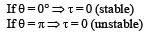
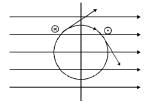
Do not experience a torque in some orientations Hence option (c) is correct.
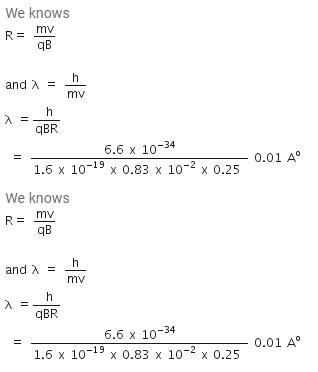
The constant μo is called- a)Absolute Permeability
- b)Coefficient of mutual induction
- c)Coefficient of self induction
- d)Relative permeability
Correct answer is option 'A'. Can you explain this answer?
The constant μ
o
is calleda)
Absolute Permeability
b)
Coefficient of mutual induction
c)
Coefficient of self induction
d)
Relative permeability
| | Harsh Singhal answered |
B&c direct wrong
now for d relative permeability is Ur/U0
now for d relative permeability is Ur/U0
In two current carrying conductors parallel currents________, anti parallel currents_________ .- a)attract , attract
- b)attract , repel
- c)repel , attract
- d)repel , repel
Correct answer is option 'B'. Can you explain this answer?
In two current carrying conductors parallel currents________, anti parallel currents_________ .
a)
attract , attract
b)
attract , repel
c)
repel , attract
d)
repel , repel
 | Pooja Mehta answered |
Two current carrying straight conductors placed near each other will exert (magnetic) forces on each other due to magnetic field of each other. ... Note − Parallel current carrying wires attract, and anti-parallel current carrying wires repel each other.
The connecting wires of a battery of an automobile carry 200 A of current. Calculate the force per unit length between the wires if they are 50 cm long and 2 cm apart?- a)4Nm-1
- b)0.4Nm-1
- c)0.04Nm-1
- d)40Nm-1
Correct answer is option 'B'. Can you explain this answer?
The connecting wires of a battery of an automobile carry 200 A of current. Calculate the force per unit length between the wires if they are 50 cm long and 2 cm apart?
a)
4Nm-1
b)
0.4Nm-1
c)
0.04Nm-1
d)
40Nm-1
| | Naina Bansal answered |
Current in both wires, I = 200 A
Distance between the wires, r = 2 cm = 0.02 m
Length of the two wires, l = 50 cm = 0.5 m
Force between the two wires is given by the relation,
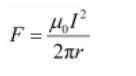
where, μo = permeability of free space = 4π x 10^-7 TmA^-1
So, F = [4π x 10^-7 x (200^2)]/[2π x 0.02]
=> F = 0.4 Nm^-1


A plane square loop PQRS of side ‘a’ made of thin copper wire has ‘n’ turns and it carries a direct current ‘I’ ampere in the direction shown in the adjoining figure. This wire loop is placed in a magnetic field of flux density ‘B’ tesla, which is directed perpendicularly in to the plane of the loop. What is the torque acting on the loop?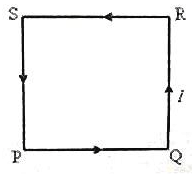
- a)nIaB
- b)Zero
- c)IaB
- d)nIa2B
Correct answer is option 'B'. Can you explain this answer?
A plane square loop PQRS of side ‘a’ made of thin copper wire has ‘n’ turns and it carries a direct current ‘I’ ampere in the direction shown in the adjoining figure. This wire loop is placed in a magnetic field of flux density ‘B’ tesla, which is directed perpendicularly in to the plane of the loop. What is the torque acting on the loop?
a)
nIaB
b)
Zero
c)
IaB
d)
nIa2B
| | Ram Mohith answered |
The magnetic moment of this loop is in direction perpendicular to the plane of loop and coming out of the plane. The magnetic field is also directed perpendicularly into the loop. So, magnetic moment magnetic field are antiparallel. The torque acting on the loop, which is given by the cross product of moment and field, is zero since sin 180 = 0
A square current carrying loop is suspended in a uniform magnetic field acting in the plane of the loop. If the force on one arm of the loop is  , the net force on the remaining three arms of the loop is
- a)3
- b)-
- c)-3
- d)
Correct answer is option 'B'. Can you explain this answer?
A square current carrying loop is suspended in a uniform magnetic field acting in the plane of the loop. If the force on one arm of the loop is , the net force on the remaining three arms of the loop is
, the net force on the remaining three arms of the loop isa)
3
b)
-
c)
-3
d)
 | Arya Khanna answered |
The force on the two arms parallel to the field is zero.
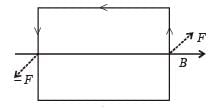
∴ Force on remaining arms = – F
Under the influence of a uniform magnetic field,a charged particle moves with constant speed vin a circle of radius R. The time period of rotationof the particle: [2009]- a)depends on R and not on v
- b)is independent of both v and R
- c)depends on both v and R
- d)depends on v and not on R
Correct answer is option 'B'. Can you explain this answer?
Under the influence of a uniform magnetic field,a charged particle moves with constant speed vin a circle of radius R. The time period of rotationof the particle: [2009]
a)
depends on R and not on v
b)
is independent of both v and R
c)
depends on both v and R
d)
depends on v and not on R
 | Anu Bajaj answered |
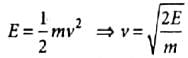
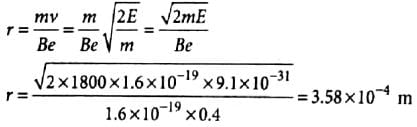
The time period of the charged particle is
given by
given by
Thus, time period is independent of both v and R.

A long solenoid carrying a current produces a magnetic field B along its axis. If the current is doubled and the number of turns per cm is halved, the new value of magnetic field will be equal to- a)B
- b)2B
- c)4B
- d)B/2
Correct answer is option 'A'. Can you explain this answer?
A long solenoid carrying a current produces a magnetic field B along its axis. If the current is doubled and the number of turns per cm is halved, the new value of magnetic field will be equal to
a)
B
b)
2B
c)
4B
d)
B/2
 | Ambition Institute answered |
The magnetic field B inside a long solenoid is given by the formula:
⇒ B = μ0ni
Now i → 2i
And
n → n/2

∴ The new magnetic field remains the same as the original magnetic field B
⇒ B = μ0ni
Now i → 2i
And
n → n/2
∴ The new magnetic field remains the same as the original magnetic field B
A long wire carrying a certain current produces a magnetic field of 0.8 Tesla at a distance 0.5 cm. Then magnetic field at a distance of 1 cm is:- a)0.16 Tesla
- b)0.2 Tesla
- c)0.8 Tesla
- d)0.4 Tesla
Correct answer is option 'D'. Can you explain this answer?
A long wire carrying a certain current produces a magnetic field of 0.8 Tesla at a distance 0.5 cm. Then magnetic field at a distance of 1 cm is:
a)
0.16 Tesla
b)
0.2 Tesla
c)
0.8 Tesla
d)
0.4 Tesla
| | Ambition Institute answered |
Ampere's Circuital Law:
- It gives the relationship between the current and the magnetic field created by it.
- This law says that the integral of magnetic field density (B) along an imaginary closed path is equal to the product of current enclosed by the path and permeability of the medium.
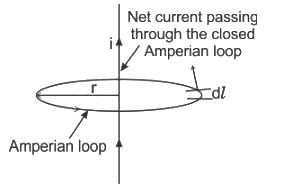
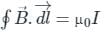
Where B = magnetic field, μ0 = permeability of free space and I = current passing through the coil
Given:
B1 = 0.8 T, d1 = 0.5 cm
The intensity of the magnetic field due to wire of infinite length at a distance d from it is given by

Where μ0 = permeability of free space, I = current in a wire, d = distance
As current is constant in the wire, then the magnetic field varies with the distance 'd' as
B∝1 / d
⇒ B1d1 = B2d2

= 0.4 T
A uniform electric field and uniform magneticfield are acting along the same direction in acertain region. If an electron is projected in theregion such that its velocity is pointed alongthe direction of fields, then the electron [2011]- a)will turn towards right of direction of motion
- b)speed will decrease
- c)speed will increase
- d)will turn towards left direction of motion
Correct answer is option 'B'. Can you explain this answer?
A uniform electric field and uniform magneticfield are acting along the same direction in acertain region. If an electron is projected in theregion such that its velocity is pointed alongthe direction of fields, then the electron [2011]
a)
will turn towards right of direction of motion
b)
speed will decrease
c)
speed will increase
d)
will turn towards left direction of motion
 | Arya Nair answered |
 are in same direction so that magnetic force on electron becomes zero, only electric force acts. But force on electron due to electric field is opposite to the direction of velocity.
Convert the following sentences into simple past passive.
They never sent me the bill.Correct answer is 'I was never sent the bill'. Can you explain this answer?
Convert the following sentences into simple past passive.
They never sent me the bill.
They never sent me the bill.
| | Disha Saha answered |
When we convert an active sentence in the simple past tense into the passive voice, we use the verb 'was/were + past participle'. 'Was' is used when the subject is a singular noun or pronoun.
So the answer is, 'I was never sent the bill'.
So the answer is, 'I was never sent the bill'.
A long straight wire in the horizontal plane carries a current of 75 A in north to south direction, magnitude and direction of field B at a point 3 m east of the wire is- a)4 x 10⁻⁶ T, vertical up
- b)5 x 10⁻⁶ T, vertical down
- c)5 x 10⁻⁶ T, vertical up
- d)4 x 10⁻⁶ T, vertical down
Correct answer is option 'C'. Can you explain this answer?
A long straight wire in the horizontal plane carries a current of 75 A in north to south direction, magnitude and direction of field B at a point 3 m east of the wire is
a)
4 x 10⁻⁶ T, vertical up
b)
5 x 10⁻⁶ T, vertical down
c)
5 x 10⁻⁶ T, vertical up
d)
4 x 10⁻⁶ T, vertical down
| | Anjali Sharma answered |
From Ampere circuital law
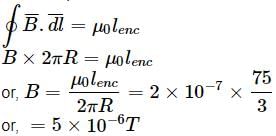
The direction of field at the given point will be vertical up determined by the screw rule or right hand rule.
The direction of field at the given point will be vertical up determined by the screw rule or right hand rule.
An electron is moving in a circular orbit in a magnetic field 2 x 10⁻³ Wb/m², the time period of electron is- a)17.85 x 10⁻³ sec
- b)17.85 x 10⁻⁸ sec
- c)17.85 x 10⁻⁹ sec
- d)17.85 x 10⁻⁵ sec
Correct answer is option 'C'. Can you explain this answer?
An electron is moving in a circular orbit in a magnetic field 2 x 10⁻³ Wb/m², the time period of electron is
a)
17.85 x 10⁻³ sec
b)
17.85 x 10⁻⁸ sec
c)
17.85 x 10⁻⁹ sec
d)
17.85 x 10⁻⁵ sec
 | Aryan Dasgupta answered |
Understanding the Problem
An electron is moving in a circular orbit within a magnetic field of 2 x 10^-3 Wb/m². We need to determine the time period of the electron's motion.
Key Concepts
- Magnetic Field (B): The magnetic field influences the motion of charged particles like electrons.
- Charge of Electron (e): The charge of an electron is approximately 1.6 x 10^-19 C.
- Mass of Electron (m): The mass of an electron is about 9.11 x 10^-31 kg.
Formula for Time Period
The time period (T) of the circular motion of a charged particle in a magnetic field can be derived using the formula:
- T = (2πm) / (eB)
Where:
- T = Time period
- m = Mass of the electron
- e = Charge of the electron
- B = Magnetic field strength
Calculating the Time Period
1. Substituting Values:
- m = 9.11 x 10^-31 kg
- e = 1.6 x 10^-19 C
- B = 2 x 10^-3 Wb/m²
2. Calculation:
- Plugging in the values:
- T = (2π * 9.11 x 10^-31 kg) / (1.6 x 10^-19 C * 2 x 10^-3 Wb/m²)
3. Result:
- Upon calculation, T approximately equals 17.85 x 10^-9 seconds.
Conclusion
Thus, the correct answer for the time period of the electron in this magnetic field is option 'C': 17.85 x 10^-9 seconds. This illustrates how the interplay of charge, mass, and magnetic field influences the motion of charged particles.
An electron is moving in a circular orbit within a magnetic field of 2 x 10^-3 Wb/m². We need to determine the time period of the electron's motion.
Key Concepts
- Magnetic Field (B): The magnetic field influences the motion of charged particles like electrons.
- Charge of Electron (e): The charge of an electron is approximately 1.6 x 10^-19 C.
- Mass of Electron (m): The mass of an electron is about 9.11 x 10^-31 kg.
Formula for Time Period
The time period (T) of the circular motion of a charged particle in a magnetic field can be derived using the formula:
- T = (2πm) / (eB)
Where:
- T = Time period
- m = Mass of the electron
- e = Charge of the electron
- B = Magnetic field strength
Calculating the Time Period
1. Substituting Values:
- m = 9.11 x 10^-31 kg
- e = 1.6 x 10^-19 C
- B = 2 x 10^-3 Wb/m²
2. Calculation:
- Plugging in the values:
- T = (2π * 9.11 x 10^-31 kg) / (1.6 x 10^-19 C * 2 x 10^-3 Wb/m²)
3. Result:
- Upon calculation, T approximately equals 17.85 x 10^-9 seconds.
Conclusion
Thus, the correct answer for the time period of the electron in this magnetic field is option 'C': 17.85 x 10^-9 seconds. This illustrates how the interplay of charge, mass, and magnetic field influences the motion of charged particles.
Two particles of equal charges after being accelerated through the same potential difference enter in a uniform transverse magnetic field and describe circular paths of radii R1 and R2. Then the ratio of their respective masses (M1/M2) is - a)R1/R2
- b)(R1/R2)2
- c)R2/R1
- d)(R2/R1)2
Correct answer is option 'B'. Can you explain this answer?
Two particles of equal charges after being accelerated through the same potential difference enter in a uniform transverse magnetic field and describe circular paths of radii R1 and R2. Then the ratio of their respective masses (M1/M2) is
a)
R1/R2
b)
(R1/R2)2
c)
R2/R1
d)
(R2/R1)2
| | Gaurav Kumar answered |
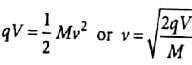
And Bqv = Mv2/R Or
 Using (i)
or
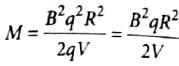
∴ M ∝ R2 (∵ B, q and V are same for the given two particles)
Hence (M1/M2) = (R1/R2)2
Magnetic Field inside a solenoid is ________.- a)increases from one end to another
- b)uniform
- c)varies from point to point
- d)None of the above
Correct answer is option 'B'. Can you explain this answer?
Magnetic Field inside a solenoid is ________.
a)
increases from one end to another
b)
uniform
c)
varies from point to point
d)
None of the above
 | Mohit Rajpoot answered |
Solenoid: A cylindrical coil of many tightly wound turns of insulated wire with a general diameter of the coil smaller than its length is called a solenoid.
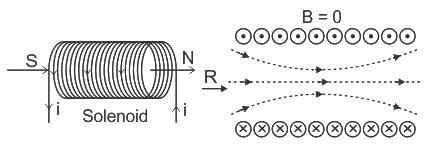
- A magnetic field is produced around and within the solenoid.
- The magnetic field within the solenoid is uniform and parallel to the axis of the solenoid.
The strength of the magnetic field in a solenoid is given by:-

Where, N = number of turns,
l = length of the solenoid,
l = current in the solenoid and
μo = absolute permeability of air or vacuum.
The magnetic field inside a solenoid is uniform. So option 2 is correct.
l = length of the solenoid,
l = current in the solenoid and
μo = absolute permeability of air or vacuum.
The magnetic field inside a solenoid is uniform. So option 2 is correct.
Chapter doubts & questions for Moving Charges and Magnetism - Topic-wise MCQ Tests for NEET 2026 is part of NEET exam preparation. The chapters have been prepared according to the NEET exam syllabus. The Chapter doubts & questions, notes, tests & MCQs are made for NEET 2026 Exam. Find important definitions, questions, notes, meanings, examples, exercises, MCQs and online tests here.
Chapter doubts & questions of Moving Charges and Magnetism - Topic-wise MCQ Tests for NEET in English & Hindi are available as part of NEET exam. Download more important topics, notes, lectures and mock test series for NEET Exam by signing up for free.
Topic-wise MCQ Tests for NEET6 docs|803 tests |
