


All Exams > Class 8 > Advance Learner Course: Mathematics (Maths) Class 8 > All Questions
All questions of Number System for Class 8 Exam
Which of the following (100 - 990) x 100?- a)10000
- b)100
- c)9900
- d)99000
Correct answer is option 'C'. Can you explain this answer?
Which of the following (100 - 990) x 100?
a)
10000
b)
100
c)
9900
d)
99000
 | Preksha Kapoor answered |
Calculation:
(100 - 990) x 100
= (-890) x 100
= -89000
= -9900 x (-1)
= 9900
Explanation:
To solve the given expression, we need to follow the order of operations, which is also known as BODMAS or PEMDAS. In this case, we have only multiplication and subtraction, so we can perform them from left to right.
(100 - 990) x 100
= (-890) x 100 [Subtract 990 from 100, which gives -890]
= -89000 [Multiply -890 by 100]
= -9900 x (-1) [Express -89000 as a product of -9900 and -1]
= 9900 [Since a negative number multiplied by a negative number gives a positive number, the answer is positive]
Therefore, the correct answer is option 'C' (9900).
(100 - 990) x 100
= (-890) x 100
= -89000
= -9900 x (-1)
= 9900
Explanation:
To solve the given expression, we need to follow the order of operations, which is also known as BODMAS or PEMDAS. In this case, we have only multiplication and subtraction, so we can perform them from left to right.
(100 - 990) x 100
= (-890) x 100 [Subtract 990 from 100, which gives -890]
= -89000 [Multiply -890 by 100]
= -9900 x (-1) [Express -89000 as a product of -9900 and -1]
= 9900 [Since a negative number multiplied by a negative number gives a positive number, the answer is positive]
Therefore, the correct answer is option 'C' (9900).

Which among these is the approximate value of π?- a)14/3
- b)22/7
- c)7/22
- d)3/14
Correct answer is option 'D'. Can you explain this answer?
Which among these is the approximate value of π?
a)
14/3
b)
22/7
c)
7/22
d)
3/14
 | Aniket Yadav answered |
The number π is a mathematical constant. Originally defined as the ratio of a circle's circumference to its diameter, it now has various equivalent definitions and appears in many formulas in all areas of mathematics and physics. It is approximately equal to 3.14159. It has been represented by the Greek letter "π" since the mid-18th century, though it is also sometimes spelled out as "pi". It is also called Archimedes' constant.
Which of the following is an rational number?- a)0.323223222322223…….
- b)√180
- c)√31
- d)√196
Correct answer is option 'D'. Can you explain this answer?
Which of the following is an rational number?
a)
0.323223222322223…….
b)
√180
c)
√31
d)
√196
 | Zachary Foster answered |
- A rational number is a number that can be expressed as a fraction where both the numerator and denominator are integers.
- √196 is a rational number because it simplifies to 14/1, which is a fraction where both the numerator and denominator are integers.
- Options B and C are irrational numbers because they cannot be expressed as fractions.
- Option A is a repeating decimal, which can be rational if it eventually settles into a repeating pattern, but without further information, it is not clear if this is the case.
- √196 is a rational number because it simplifies to 14/1, which is a fraction where both the numerator and denominator are integers.
- Options B and C are irrational numbers because they cannot be expressed as fractions.
- Option A is a repeating decimal, which can be rational if it eventually settles into a repeating pattern, but without further information, it is not clear if this is the case.
Between 3 and 4 there are- a)10,000 rational numbers
- b)1000 rational numbers
- c)Infinitely many rational numbers
- d)500 rational numbers
Correct answer is option 'C'. Can you explain this answer?
Between 3 and 4 there are
a)
10,000 rational numbers
b)
1000 rational numbers
c)
Infinitely many rational numbers
d)
500 rational numbers
 | Anita Menon answered |
There is no single number between 3 and 4, there is an infinite amount of numbers. If you are asking for INTEGERS, there are none. If not, you can have unlimited numbers between 3 and 4. For example, a number could be 3.0000000000000000005 or 3.9999999999999997.
How many rational numbers can you find between 5 and 6?- a)infinite
- b)6
- c)1
- d)5
Correct answer is option 'A'. Can you explain this answer?
How many rational numbers can you find between 5 and 6?
a)
infinite
b)
6
c)
1
d)
5
 | Jyoti Kapoor answered |
There are infinitely many rational numbers between any two real numbers. For example ( 5 + 6 ) / 2 = 11 / 2 , the average of 5 and 6, is between them.
How many zeros after the decimal point will be there in the decimal form of the number 10 -n ?- a)n
- b)n+1
- c)n-1
- d)n/2
Correct answer is option 'C'. Can you explain this answer?
How many zeros after the decimal point will be there in the decimal form of the number 10 -n ?
a)
n
b)
n+1
c)
n-1
d)
n/2
 | Rishi Agrawal answered |
Because one will be before the decimal point
Which of the following is a rational number?- a)2√3
- b)0
- c)π
- d)1+√3
Correct answer is option 'B'. Can you explain this answer?
Which of the following is a rational number?
a)
2√3
b)
0
c)
π
d)
1+√3
 | Abhay Yadav answered |
Rational Number
A rational number is a number that can be expressed in the form of p/q where p and q are integers and q is not equal to zero.
Given Options
a) 23 - This is an integer and can be written as 23/1. It is a rational number.
b) 0 - This can be written as 0/1. It is a rational number.
c) √2 - This is an irrational number as it cannot be expressed in the form of p/q where p and q are integers.
d) 1 3 - This is a mixed fraction and can be written as 4/3. It is a rational number.
Conclusion
Hence, the only rational number among the given options is 0.
A rational number is a number that can be expressed in the form of p/q where p and q are integers and q is not equal to zero.
Given Options
a) 23 - This is an integer and can be written as 23/1. It is a rational number.
b) 0 - This can be written as 0/1. It is a rational number.
c) √2 - This is an irrational number as it cannot be expressed in the form of p/q where p and q are integers.
d) 1 3 - This is a mixed fraction and can be written as 4/3. It is a rational number.
Conclusion
Hence, the only rational number among the given options is 0.

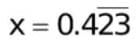
 is equivalent to the following on the number line.
- a)7/3
- b)2/3
- c)23
- d)23/3
Correct answer is option 'A'. Can you explain this answer?
is equivalent to the following on the number line.a)
7/3
b)
2/3
c)
23
d)
23/3
 | Sanjana answered |
Let x = 2.333 (1) multiply both side with 10 = 10x = 23.333
(2) now eq. (2) - (1) = 10x - x = 23.333 - 2.333 = 9x = 21 = x = 21/ 9 =x = 7/3


 is :-
is :-
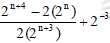 is equal to :-
- a)2n+1
- b)-2n+1 + (1/8)
- c)(9/8 - 2n)
- d)1
Correct answer is option 'D'. Can you explain this answer?
is equal to :-a)
2n+1
b)
-2n+1 + (1/8)
c)
(9/8 - 2n)
d)
1
 | EduRev Class 9 answered |
2n(24-2) + 2-3
2nx2x23
14 + 2-3
24
7/8+1/8
1
2nx2x23
14 + 2-3
24
7/8+1/8
1
 is equal to ——


- a)128
- b)32
- c)26
- d)64
Correct answer is option 'D'. Can you explain this answer?
a)
128
b)
32
c)
26
d)
64
 | Tanya Pathak answered |
(4)4^3/4
(4)^3/4×4
(4)^3
4×4×4
64
(4)^3/4×4
(4)^3
4×4×4
64
 is :-
is :-
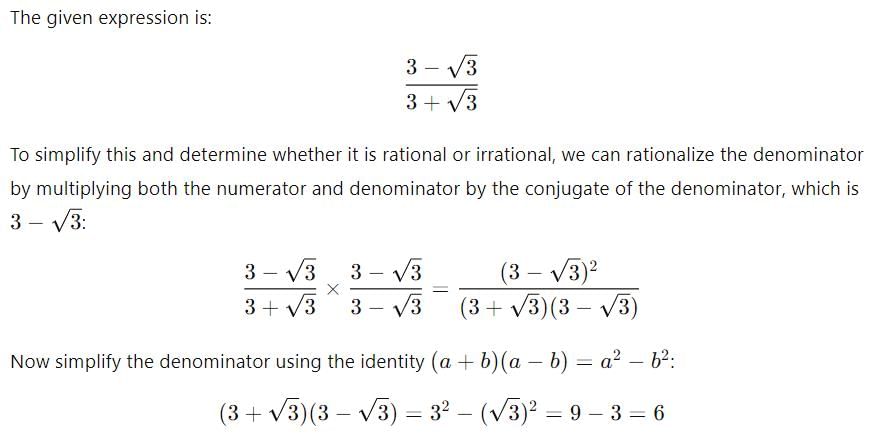
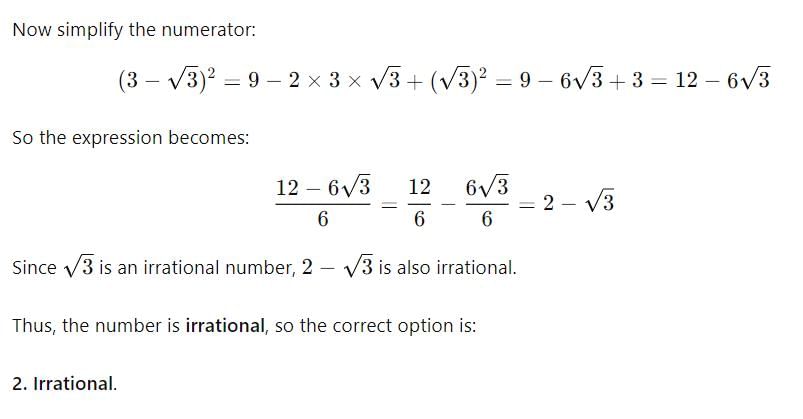
 is
is
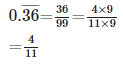
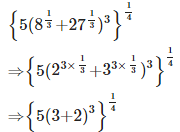
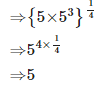
 is represented by the fraction……………. on the number line.
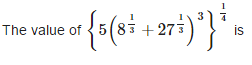


To represent √3 which of the following method would be used.- a)By the process of successive magnification
- b)By visualization
- c)By using Pythogoras Theorem (Geometrical construction)
- d)By converting into dicimal form
Correct answer is option 'C'. Can you explain this answer?
To represent √3 which of the following method would be used.
a)
By the process of successive magnification
b)
By visualization
c)
By using Pythogoras Theorem (Geometrical construction)
d)
By converting into dicimal form
| | Dipanjan Kapoor answered |
Something means to symbolize or stand for it. It can be through language, images, or actions. For example, a red traffic light represents the signal for drivers to stop. A heart symbol represents love or affection. A national flag represents a country or nation. A logo represents a brand or company. Representing something is important in communication and establishing meaning.
Can you explain the answer of this question below:A number is irrational if and only if its decimal representation is:- A:Terminating
- B:non- terminating and repeating
- C:non- terminating
- D:non- terminating and non-repeating
The answer is d.
A number is irrational if and only if its decimal representation is:
A:
Terminating
B:
non- terminating and repeating
C:
non- terminating
D:
non- terminating and non-repeating
 | Prachi Singh answered |
The number is irrational if it's decimal representation is non terminating and non repeating.
 in the form of fraction is
- a)2/13
- b)3/11
- c)3/13
- d)2/11
Correct answer is option 'C'. Can you explain this answer?
in the form of fraction isa)
2/13
b)
3/11
c)
3/13
d)
2/11
 | Krishna Shukla answered |
X=0.230769 (1) 1000000=230769.230769
(2) subtracting
(1) from (2) 230769 =9999999x then, x =230769/9999999 =3/13
 is
is - a)a terminating decimal.
- b)a non terminating recurring decimal
- c)a non terminating non recurring decimal
- d)an integer
Correct answer is option 'B'. Can you explain this answer?
is a)
a terminating decimal.
b)
a non terminating recurring decimal
c)
a non terminating non recurring decimal
d)
an integer
 | Uttam Shukla answered |
Because we know that those decimals are known as non terminating recurring in which a digit or a set of digits repeats hoti infinitive times so here same things happen 17÷3=5.666666666.....
If 5/13 = 0.384615……, then the value of 10/13 _____- a)1.153795
- b)1.153845
- c)0.769230
- d)0.789210
Correct answer is option 'C'. Can you explain this answer?
If 5/13 = 0.384615……, then the value of 10/13 _____
a)
1.153795
b)
1.153845
c)
0.769230
d)
0.789210
| | Zachary Foster answered |
5/13 = 0.384615……, - (1)
to find 10/13
just multiply (1) by 2
10/13 = 0.769230
to find 10/13
just multiply (1) by 2
10/13 = 0.769230
 =
=- a)-1/5
- b)1/25
- c)-1/25
- d)1/5
Correct answer is option 'B'. Can you explain this answer?
=a)
-1/5
b)
1/25
c)
-1/25
d)
1/5
| | Sanjana answered |
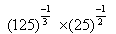
(1/125)⅓ × (1/25)½ = [(1/5)³]⅓ × [(1/5)²]½ = (1/5)³×⅓ × (1/5 )²×½ = 1/5 × 1/5 = 1/25 ......ans
What is equal to?
- a)1/64
- b)1/4
- c)1/32
- d)1/16
Correct answer is option 'C'. Can you explain this answer?
What isequal to?
equal to?a)
1/64
b)
1/4
c)
1/32
d)
1/16
 | Yogesh Singla answered |
Yes cube root of 8 is 2 then 2 raise to the power -5 is equal to 1/32

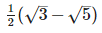
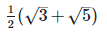
A rational number between  and
and  is
is- a)
- b)
- c)2.1
- d)3.1
Correct answer is option 'C'. Can you explain this answer?
A rational number between and is
and isa)
b)
c)
2.1
d)
3.1
| | Jyoti Kapoor answered |
Rational numbers are those which can be expressed in the p/q form where q isn't equal to 0 and p,q are integers
There exists infinite rational numbers between any two numbers
Few rational numbers between √3=1.7320... and √5=2.236.. are
2, 1.8, 1.81, 1.9, 2.1, 2.22
Find (64)-3/2- a)-1/512
- b)1/512
- c)64
- d)1/64
Correct answer is option 'B'. Can you explain this answer?
Find (64)-3/2
a)
-1/512
b)
1/512
c)
64
d)
1/64
 | Mohit Chavan answered |
To solve the given expression, we need to follow the order of operations or BODMAS (Brackets, Order or Exponents, Division or Multiplication, Addition or Subtraction) rule. Here, we have only division and exponent operations. So, we will perform the exponent operation first and then the division operation.
Given expression: (64)-3/2
Step 1: Exponent operation
(64)-3/2 = 1/(64)3/2
= 1/(64)(2/3) [since, a^m/n = (n√a)^m]
= 1/√(64)^2
= 1/√4096
= 1/64
Therefore, the correct option is (b) 1/512.
Given expression: (64)-3/2
Step 1: Exponent operation
(64)-3/2 = 1/(64)3/2
= 1/(64)(2/3) [since, a^m/n = (n√a)^m]
= 1/√(64)^2
= 1/√4096
= 1/64
Therefore, the correct option is (b) 1/512.
Every rational number is- a)a real number
- b)a natural number
- c)a whole number
- d)an integer
Correct answer is option 'A'. Can you explain this answer?
Every rational number is
a)
a real number
b)
a natural number
c)
a whole number
d)
an integer
 | Cυtαʅιcισυʂ Cԋαɾɱιɳɠ answered |
Every rational number is a real number... Becoz combination of rational and irrational no.s together make Real number..........
Identify the irrational number among these.- a)√13
- b)9
- c)36
- d)25
Correct answer is option 'A'. Can you explain this answer?
Identify the irrational number among these.
a)
√13
b)
9
c)
36
d)
25
 | Aditi Deshpande answered |
A)3 (This is a rational number as it can be expressed as 3/1 or 6/2 or any other integer divided by 1)
The value of 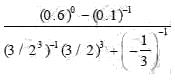 is :-
is :- - a)3/2
- b)- 3/2
- c)2/3
- d)- 1/2
Correct answer is option 'B'. Can you explain this answer?
The value of is :-
is :- a)
3/2
b)
- 3/2
c)
2/3
d)
- 1/2
 | Gunjan Lakhani answered |
(1 - 10)/(9 + (-3))
=-9/6 = -3/2
The value of  is equal to———
- a)1/49
- b)49
- c)7
- d)1/7
Correct answer is option 'C'. Can you explain this answer?
The value of is equal to———
is equal to———a)
1/49
b)
49
c)
7
d)
1/7
| | Sanjana answered |
We can write 49= 7² (7²)½ = (7)²×½ = 7
जुंडी का अर्थ है- a)मक्का
- b)गेहूँ की बाली
- c)धान की बाली
- d)ज्वार की बाली
Correct answer is option 'D'. Can you explain this answer?
जुंडी का अर्थ है
a)
मक्का
b)
गेहूँ की बाली
c)
धान की बाली
d)
ज्वार की बाली
 | Priyanka Sharma answered |
जुंडी का अर्थ है ज्वार की बाली।
जुंडी का तात्पर्य उन खाद्यान्नों से हे जो मोठे अनाजों के तौर पर प्रयुक्त होते हैं जैसे की बाजरा , ज्वार , रागी , मोठे अन्न.
जुंडी का तात्पर्य उन खाद्यान्नों से हे जो मोठे अनाजों के तौर पर प्रयुक्त होते हैं जैसे की बाजरा , ज्वार , रागी , मोठे अन्न.
Can you explain the answer of this question below:Which of the following statement is true?
- A:
Every real number is a rational number.
- B:
Every real number is irrational.
- C:
The real number line contains both rational as well as irrational numbers.
- D:
Half the numbers on the number line are rational and the remaining half irrational
The answer is c.
Which of the following statement is true?
Every real number is a rational number.
Every real number is irrational.
The real number line contains both rational as well as irrational numbers.
Half the numbers on the number line are rational and the remaining half irrational
 | Rooplata Singh answered |
C is correct

The product or quotient of a non-zero rational number with an irrational number is:- a)Rational number
- b)Whole number
- c)Irrational number
- d)Natural number
Correct answer is option 'C'. Can you explain this answer?
The product or quotient of a non-zero rational number with an irrational number is:
a)
Rational number
b)
Whole number
c)
Irrational number
d)
Natural number
 | Molik answered |
let the no. be 2 and√2so product of it is 2√2 I.e a rational no.
The value obtained on simplifying (√5 + √6)2- a)12 + 5√30
- b)13 + 2√33
- c)11 - 2√30
- d)11 + 2√30
Correct answer is option 'D'. Can you explain this answer?
The value obtained on simplifying (√5 + √6)2
a)
12 + 5√30
b)
13 + 2√33
c)
11 - 2√30
d)
11 + 2√30
| | Pooja Shah answered |
(a + b)2 = a2 + b2 + 2ab
= (√5 + √6)2
= (√5)2 + (√6)2 + 2(√5)(√6)
= (√5 + √6)2
= (√5)2 + (√6)2 + 2(√5)(√6)
= 5 + 6 +2√30
= 11 + 2√30
Of the given numbers
(i) √23
(ii) √256
(iii) 0.3796
(iv) 7.478478…
(v) 1.101001000100001…- a)(i) and (v) are irrational
- b)(iv) and (v) is irrational
- c)only (v) is irrational
- d)none are irrational
Correct answer is option 'A'. Can you explain this answer?
Of the given numbers
(i) √23
(ii) √256
(iii) 0.3796
(iv) 7.478478…
(v) 1.101001000100001…
(i) √23
(ii) √256
(iii) 0.3796
(iv) 7.478478…
(v) 1.101001000100001…
a)
(i) and (v) are irrational
b)
(iv) and (v) is irrational
c)
only (v) is irrational
d)
none are irrational
| | EduRev Class 9 answered |
i) √23
√23 = √23/1 = p/q, but p is not an integer.
Hence √23 is an irrational number.
ii) √225
√225 = 15/1 = p/q, where p and q are integers and q ≠ 0.
Hence √225 is a rational number.
iii) 0.3796
0.3796 is a rational number because it is a terminating decimal number.
iv) 7.478478...
7.478478... is a rational number as it is a non-terminating recurring decimal i.e, the block of numbers 478 is repeating.
v) 1.101001000100001 . . . .
It is an irrational number because it is a non-terminating and non-recurring decimal.
The sum of the digits of a number is subtracted from the number, the resulting number is always divisible by:- a)9
- b)2
- c)5
- d)8
Correct answer is option 'A'. Can you explain this answer?
The sum of the digits of a number is subtracted from the number, the resulting number is always divisible by:
a)
9
b)
2
c)
5
d)
8
| | Ravi Verma answered |
The answer is b.
The sum of the digit of the number is x if we subtract it frm any number the number is two.
let consider the number is 22 and sum is 4 hence it isdivided by 2.
The product of 4 √6 and 3√24 is :-- a) 124
- b) 134
- c) 144
- d) 154
Correct answer is option 'C'. Can you explain this answer?
The product of 4 √6 and 3√24 is :-
a)
124b)
134c)
144d)
154| | Jyoti Kapoor answered |
4√6*3√24=4√6*3√2*√2*√*2*√3
=4√6*6√6
4*6*√6*√6=4*6*6=24*6=144
The exponential form of  is :-
is :-- a)61/2
- b)61/3
- c)61/4
- d)6
Correct answer is option 'C'. Can you explain this answer?
The exponential form of is :-
is :-a)
61/2
b)
61/3
c)
61/4
d)
6
 | Vikas Kapoor answered |
(√2×√3)½ = (2×3)½×½ = (6)¼
 is
is 
From the choices given below mark the co-prime numbers- a)2, 3
- b)2, 4
- c)2, 6
- d)2, 110
Correct answer is option 'A'. Can you explain this answer?
From the choices given below mark the co-prime numbers
a)
2, 3
b)
2, 4
c)
2, 6
d)
2, 110
| | Zachary Foster answered |
To determine if two numbers are co-prime, we check if their greatest common divisor (GCD) is 1.
- 2 and 3: HCF is 1. They are co-prime.
- 2 and 4: HCF is 2. They are not co-prime.
- 2 and 6: HCF is 2. They are not co-prime.
- 2 and 110: HCF is 2. They are not co-prime.
Therefore, the correct answer is A: 2, 3.
To represent 9 x  which of following fraction form is appropriate.
- a)3
- b)5
- c)2
- d)4
Correct answer is option 'C'. Can you explain this answer?
To represent 9 x which of following fraction form is appropriate.
which of following fraction form is appropriate.a)
3
b)
5
c)
2
d)
4
| | Aditi Sharma answered |
( x=0.222)-eq1
(10x=2.22 after multiplying 10 to both side)-eq2
(9x=2after subtract eq2 from 1)
x= 2/9
we have find 9x so,
9×(2/9)
9×2/9
2
(10x=2.22 after multiplying 10 to both side)-eq2
(9x=2after subtract eq2 from 1)
x= 2/9
we have find 9x so,
9×(2/9)
9×2/9
2
 is equivalent to the following on the number line.
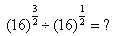
- a)8
- b)4
- c)12
- d)16
Correct answer is option 'D'. Can you explain this answer?
a)
8
b)
4
c)
12
d)
16
| | Molik answered |
16^3/2÷16^1/2 16^3/2-1/2 16^1 16..
The product of two numbers is -20/9. If one of the numbers is 4, find the other. - a)–5/9
- b)3/11
- c)12/39
- d)–9/11
Correct answer is option 'A'. Can you explain this answer?
The product of two numbers is -20/9. If one of the numbers is 4, find the other.
a)
–5/9
b)
3/11
c)
12/39
d)
–9/11
| | Tamanna Aujla answered |
The answer is -5/9 because -5/9 x 4 =-20/9
Chapter doubts & questions for Number System - Advance Learner Course: Mathematics (Maths) Class 8 2026 is part of Class 8 exam preparation. The chapters have been prepared according to the Class 8 exam syllabus. The Chapter doubts & questions, notes, tests & MCQs are made for Class 8 2026 Exam. Find important definitions, questions, notes, meanings, examples, exercises, MCQs and online tests here.
Chapter doubts & questions of Number System - Advance Learner Course: Mathematics (Maths) Class 8 in English & Hindi are available as part of Class 8 exam. Download more important topics, notes, lectures and mock test series for Class 8 Exam by signing up for free.
Advance Learner Course: Mathematics (Maths) Class 85 videos|58 docs|20 tests |
