


All Exams > Class 8 > GK Olympiad for Class 8 > All Questions
All questions of Resources of India and World for Class 8 Exam
Which of the following statements is true about the rainforests?- a)An estimated 50 percent of terrestrial biodiversity is found in rainforests.
- b)Most rainforest trees are covered with epiphytes, attached to trunk and branches of trees and absorb moisture from the surroundings.
- c)Over 2000 types of plants found in rainforests can be used to help in cancer treatment due to their anti-cancer properties.
- d)All of these
Correct answer is option 'D'. Can you explain this answer?
Which of the following statements is true about the rainforests?
a)
An estimated 50 percent of terrestrial biodiversity is found in rainforests.
b)
Most rainforest trees are covered with epiphytes, attached to trunk and branches of trees and absorb moisture from the surroundings.
c)
Over 2000 types of plants found in rainforests can be used to help in cancer treatment due to their anti-cancer properties.
d)
All of these
 | Kajal Joshi answered |
The correct answer is option 'D' - All of these statements are true about the rainforests. Let's discuss each statement in detail:
a) An estimated 50 percent of terrestrial biodiversity is found in rainforests:
- Rainforests are incredibly biodiverse ecosystems, housing a wide variety of plant and animal species.
- It is estimated that around 50 percent of all terrestrial biodiversity can be found in rainforests.
- This means that a significant portion of the Earth's plant and animal species call rainforests their home.
b) Most rainforest trees are covered with epiphytes, attached to trunk and branches of trees and absorb moisture from the surroundings:
- Epiphytes are plants that grow on other plants, such as trees, without taking nutrients from them.
- Rainforest trees are often covered in epiphytes, including ferns, orchids, and bromeliads.
- These epiphytes attach themselves to the trunks and branches of trees and absorb moisture from the surrounding air and rain.
- This adaptation allows them to thrive in the dense canopy of the rainforest where sunlight may be limited.
c) Over 2000 types of plants found in rainforests can be used to help in cancer treatment due to their anti-cancer properties:
- Rainforests are rich sources of medicinal plants, and many plant species found in rainforests have been discovered to possess anti-cancer properties.
- Researchers have identified over 2,000 types of plants in rainforests that can potentially be used in cancer treatment.
- These plants contain compounds and chemicals that have shown promising anti-cancer effects in laboratory studies.
- The exploration of rainforest plants for medicinal purposes is an ongoing field of research, and it holds great potential for the development of new cancer treatments.
In conclusion, all of the given statements are true about rainforests. They highlight the incredible biodiversity, the presence of epiphytes on rainforest trees, and the potential of rainforest plants in cancer treatment.
a) An estimated 50 percent of terrestrial biodiversity is found in rainforests:
- Rainforests are incredibly biodiverse ecosystems, housing a wide variety of plant and animal species.
- It is estimated that around 50 percent of all terrestrial biodiversity can be found in rainforests.
- This means that a significant portion of the Earth's plant and animal species call rainforests their home.
b) Most rainforest trees are covered with epiphytes, attached to trunk and branches of trees and absorb moisture from the surroundings:
- Epiphytes are plants that grow on other plants, such as trees, without taking nutrients from them.
- Rainforest trees are often covered in epiphytes, including ferns, orchids, and bromeliads.
- These epiphytes attach themselves to the trunks and branches of trees and absorb moisture from the surrounding air and rain.
- This adaptation allows them to thrive in the dense canopy of the rainforest where sunlight may be limited.
c) Over 2000 types of plants found in rainforests can be used to help in cancer treatment due to their anti-cancer properties:
- Rainforests are rich sources of medicinal plants, and many plant species found in rainforests have been discovered to possess anti-cancer properties.
- Researchers have identified over 2,000 types of plants in rainforests that can potentially be used in cancer treatment.
- These plants contain compounds and chemicals that have shown promising anti-cancer effects in laboratory studies.
- The exploration of rainforest plants for medicinal purposes is an ongoing field of research, and it holds great potential for the development of new cancer treatments.
In conclusion, all of the given statements are true about rainforests. They highlight the incredible biodiversity, the presence of epiphytes on rainforest trees, and the potential of rainforest plants in cancer treatment.

The crop which grows in alluvial soil and needs 150 cm rainfall is- a)Wheat
- b)Rice
- c)Groundnut
- d)Sugarcane
Correct answer is option 'B'. Can you explain this answer?
The crop which grows in alluvial soil and needs 150 cm rainfall is
a)
Wheat
b)
Rice
c)
Groundnut
d)
Sugarcane
 | Anjana Kumar answered |
Introduction:
Rice is the crop that grows in alluvial soil and requires a rainfall of 150 cm. Alluvial soil is formed by the deposition of sediments brought by rivers and is characterized by its fertility and high water-holding capacity. Rice is a staple crop in many countries and is well-suited to grow in alluvial soil due to its specific water requirements.
Explanation:
Here is a detailed explanation of why rice is the correct answer:
1. Alluvial soil:
Alluvial soil is formed by the deposition of sediments carried by rivers. It is rich in organic matter, minerals, and nutrients, making it highly fertile. Alluvial soil is well-drained and has a good water-holding capacity, making it suitable for growing a variety of crops.
2. Water requirement:
Rice is a semi-aquatic crop that requires a significant amount of water for its growth and development. It is typically grown in areas with abundant rainfall or in regions with access to irrigation facilities. The water requirement of rice is around 150 cm, which means it needs a consistent supply of water throughout its growing season.
3. Adaptation to alluvial soil:
Rice has adapted well to alluvial soil due to its unique water requirements. Alluvial soil's high water-holding capacity ensures that the rice plants have access to sufficient moisture for their growth. The soil's fertility provides the necessary nutrients for the crop to thrive.
4. Other crops:
While other crops like wheat, groundnut, and sugarcane can also grow in alluvial soil, they may have different water requirements. Wheat, for example, requires less rainfall and can be grown in different soil types. Groundnut prefers well-drained soil and can tolerate a range of rainfall conditions. Sugarcane requires a significant amount of water but can be grown in various soil types.
Conclusion:
In conclusion, rice is the crop that grows in alluvial soil and requires 150 cm of rainfall. Its adaptation to alluvial soil and specific water requirements make it a suitable choice for cultivation in regions with this type of soil.
Rice is the crop that grows in alluvial soil and requires a rainfall of 150 cm. Alluvial soil is formed by the deposition of sediments brought by rivers and is characterized by its fertility and high water-holding capacity. Rice is a staple crop in many countries and is well-suited to grow in alluvial soil due to its specific water requirements.
Explanation:
Here is a detailed explanation of why rice is the correct answer:
1. Alluvial soil:
Alluvial soil is formed by the deposition of sediments carried by rivers. It is rich in organic matter, minerals, and nutrients, making it highly fertile. Alluvial soil is well-drained and has a good water-holding capacity, making it suitable for growing a variety of crops.
2. Water requirement:
Rice is a semi-aquatic crop that requires a significant amount of water for its growth and development. It is typically grown in areas with abundant rainfall or in regions with access to irrigation facilities. The water requirement of rice is around 150 cm, which means it needs a consistent supply of water throughout its growing season.
3. Adaptation to alluvial soil:
Rice has adapted well to alluvial soil due to its unique water requirements. Alluvial soil's high water-holding capacity ensures that the rice plants have access to sufficient moisture for their growth. The soil's fertility provides the necessary nutrients for the crop to thrive.
4. Other crops:
While other crops like wheat, groundnut, and sugarcane can also grow in alluvial soil, they may have different water requirements. Wheat, for example, requires less rainfall and can be grown in different soil types. Groundnut prefers well-drained soil and can tolerate a range of rainfall conditions. Sugarcane requires a significant amount of water but can be grown in various soil types.
Conclusion:
In conclusion, rice is the crop that grows in alluvial soil and requires 150 cm of rainfall. Its adaptation to alluvial soil and specific water requirements make it a suitable choice for cultivation in regions with this type of soil.
This shark is rarely seen by humans and was discovered in 1976. It is found in deep tropical water and is believed that it swims with its mouth open. Name the shark.- a)Megamouth
- b)Mako
- c)Hammerhead
- d)Blacktip
Correct answer is option 'A'. Can you explain this answer?
This shark is rarely seen by humans and was discovered in 1976. It is found in deep tropical water and is believed that it swims with its mouth open. Name the shark.
a)
Megamouth
b)
Mako
c)
Hammerhead
d)
Blacktip
 | Sanchita Banerjee answered |
The Megamouth Shark
The shark that is rarely seen by humans and was discovered in 1976 is called the Megamouth Shark. It is a fascinating and mysterious creature that inhabits deep tropical waters. Let's explore this unique shark in more detail.
Discovery and Rarity
The Megamouth Shark was first discovered in 1976 off the coast of Hawaii when it accidentally got caught in a U.S. Navy ship's anchor. This accidental encounter provided scientists with an opportunity to study and learn about this previously unknown species. Since then, there have been only a few hundred confirmed sightings of the Megamouth Shark, making it one of the rarest species of sharks on the planet.
Habitat and Distribution
The Megamouth Shark is primarily found in deep tropical waters around the world. It has been observed in various locations, including the Pacific, Atlantic, and Indian Oceans. However, due to its elusive nature, little is known about its exact distribution and population size. The shark is known to inhabit depths ranging from 50 to 500 meters, making it a deep-sea dweller.
Distinctive Features
One of the most intriguing features of the Megamouth Shark is its large mouth, which is believed to remain open as it swims. This unique behavior is thought to be an adaptation for filter-feeding. The shark's mouth contains numerous long, slender, and comb-like teeth that help it filter small planktonic organisms from the water.
Size and Appearance
The Megamouth Shark is a massive creature, with adults reaching an average length of around 5 meters and weighing up to 1,500 kilograms. It has a robust body and a distinctive rounded head. The shark's body is dark in color, with a white underside.
Role in the Ecosystem
As a filter-feeder, the Megamouth Shark plays an important role in the marine ecosystem. By consuming large quantities of plankton, it helps maintain the balance of these microscopic organisms in the ocean. Additionally, as a rare and understudied species, the Megamouth Shark provides valuable insights into the biodiversity and ecology of deep-sea environments.
In conclusion, the Megamouth Shark is a rarely seen and enigmatic species that was discovered in 1976. It inhabits deep tropical waters, swims with its mouth open, and feeds on plankton. Its unique characteristics and scarcity make it a fascinating subject for scientific research and conservation efforts.
The shark that is rarely seen by humans and was discovered in 1976 is called the Megamouth Shark. It is a fascinating and mysterious creature that inhabits deep tropical waters. Let's explore this unique shark in more detail.
Discovery and Rarity
The Megamouth Shark was first discovered in 1976 off the coast of Hawaii when it accidentally got caught in a U.S. Navy ship's anchor. This accidental encounter provided scientists with an opportunity to study and learn about this previously unknown species. Since then, there have been only a few hundred confirmed sightings of the Megamouth Shark, making it one of the rarest species of sharks on the planet.
Habitat and Distribution
The Megamouth Shark is primarily found in deep tropical waters around the world. It has been observed in various locations, including the Pacific, Atlantic, and Indian Oceans. However, due to its elusive nature, little is known about its exact distribution and population size. The shark is known to inhabit depths ranging from 50 to 500 meters, making it a deep-sea dweller.
Distinctive Features
One of the most intriguing features of the Megamouth Shark is its large mouth, which is believed to remain open as it swims. This unique behavior is thought to be an adaptation for filter-feeding. The shark's mouth contains numerous long, slender, and comb-like teeth that help it filter small planktonic organisms from the water.
Size and Appearance
The Megamouth Shark is a massive creature, with adults reaching an average length of around 5 meters and weighing up to 1,500 kilograms. It has a robust body and a distinctive rounded head. The shark's body is dark in color, with a white underside.
Role in the Ecosystem
As a filter-feeder, the Megamouth Shark plays an important role in the marine ecosystem. By consuming large quantities of plankton, it helps maintain the balance of these microscopic organisms in the ocean. Additionally, as a rare and understudied species, the Megamouth Shark provides valuable insights into the biodiversity and ecology of deep-sea environments.
In conclusion, the Megamouth Shark is a rarely seen and enigmatic species that was discovered in 1976. It inhabits deep tropical waters, swims with its mouth open, and feeds on plankton. Its unique characteristics and scarcity make it a fascinating subject for scientific research and conservation efforts.
Which states in India has the largest number of cattle?- a)Uttar Pradesh
- b)Madhya Prdesh
- c)Punjab
- d)Maharashtra
Correct answer is option 'A'. Can you explain this answer?
Which states in India has the largest number of cattle?
a)
Uttar Pradesh
b)
Madhya Prdesh
c)
Punjab
d)
Maharashtra
 | Navya Gupta answered |
Cattle Population in India
India is one of the largest producers of milk and dairy products in the world. With a vast agricultural sector and a significant dependence on livestock farming, the country has a substantial population of cattle. Among the various states in India, Uttar Pradesh has the largest number of cattle.
Reasons for Uttar Pradesh having the largest number of cattle:
1. Agricultural Practices:
- Uttar Pradesh is primarily an agrarian state, with a significant portion of its population engaged in agriculture.
- The state has a large number of agricultural lands, which require the use of cattle for various farming activities like plowing fields, transportation of goods, and irrigation.
- The need for cattle in agricultural practices contributes to the high cattle population in Uttar Pradesh.
2. Dairy Farming:
- Uttar Pradesh has a well-developed dairy industry, with numerous dairy farms and milk cooperatives spread across the state.
- The state is known for its milk production, and the demand for milk and dairy products further increases the need for cattle.
- Many farmers in Uttar Pradesh rear cattle for milk production, resulting in a higher population of cows and buffaloes.
3. Traditional Livestock Culture:
- Uttar Pradesh has a rich tradition of livestock rearing, with cattle playing a vital role in the rural economy.
- Many communities in the state have a strong cultural affinity towards cattle and consider them as a symbol of wealth and prosperity.
- This cultural aspect leads to a higher concentration of cattle in Uttar Pradesh compared to other states.
4. Favorable Climatic Conditions:
- The climatic conditions in Uttar Pradesh are suitable for cattle rearing.
- The state experiences a diverse climate, ranging from sub-tropical to tropical, which is favorable for the growth and well-being of cattle.
- The availability of adequate grazing lands, water resources, and suitable weather conditions contribute to the higher cattle population in Uttar Pradesh.
Overall, the combination of agricultural practices, dairy farming, cultural traditions, and favorable climatic conditions in Uttar Pradesh leads to the state having the largest number of cattle in India.
India is one of the largest producers of milk and dairy products in the world. With a vast agricultural sector and a significant dependence on livestock farming, the country has a substantial population of cattle. Among the various states in India, Uttar Pradesh has the largest number of cattle.
Reasons for Uttar Pradesh having the largest number of cattle:
1. Agricultural Practices:
- Uttar Pradesh is primarily an agrarian state, with a significant portion of its population engaged in agriculture.
- The state has a large number of agricultural lands, which require the use of cattle for various farming activities like plowing fields, transportation of goods, and irrigation.
- The need for cattle in agricultural practices contributes to the high cattle population in Uttar Pradesh.
2. Dairy Farming:
- Uttar Pradesh has a well-developed dairy industry, with numerous dairy farms and milk cooperatives spread across the state.
- The state is known for its milk production, and the demand for milk and dairy products further increases the need for cattle.
- Many farmers in Uttar Pradesh rear cattle for milk production, resulting in a higher population of cows and buffaloes.
3. Traditional Livestock Culture:
- Uttar Pradesh has a rich tradition of livestock rearing, with cattle playing a vital role in the rural economy.
- Many communities in the state have a strong cultural affinity towards cattle and consider them as a symbol of wealth and prosperity.
- This cultural aspect leads to a higher concentration of cattle in Uttar Pradesh compared to other states.
4. Favorable Climatic Conditions:
- The climatic conditions in Uttar Pradesh are suitable for cattle rearing.
- The state experiences a diverse climate, ranging from sub-tropical to tropical, which is favorable for the growth and well-being of cattle.
- The availability of adequate grazing lands, water resources, and suitable weather conditions contribute to the higher cattle population in Uttar Pradesh.
Overall, the combination of agricultural practices, dairy farming, cultural traditions, and favorable climatic conditions in Uttar Pradesh leads to the state having the largest number of cattle in India.
Which of the following projects is administered by more than one State?- a)Nagarjuna Sagar Project
- b)Kosi Project
- c)Hirakud Project
- d)Tungbhadra Project
Correct answer is option 'D'. Can you explain this answer?
Which of the following projects is administered by more than one State?
a)
Nagarjuna Sagar Project
b)
Kosi Project
c)
Hirakud Project
d)
Tungbhadra Project
 | Divya Joshi answered |
Administered by more than one State: Tungbhadra Project
The Tungbhadra Project is the only project among the given options that is administered by more than one state. Let's explore the details of this project.
Overview of the Tungbhadra Project
The Tungbhadra Project is a major multi-purpose river project in India. It is built on the Tungabhadra River, which is formed by the confluence of the Tunga River and the Bhadra River. The project is jointly administrated by the states of Karnataka and Andhra Pradesh.
Location
The project is located in the Deccan Plateau region of India, primarily in the districts of Bellary and Raichur in Karnataka, and Kurnool district in Andhra Pradesh.
Purpose
The Tungbhadra Project serves multiple purposes, including irrigation, hydroelectric power generation, and flood control. The main aim of the project is to provide water for irrigation to the arid regions of Karnataka and Andhra Pradesh.
Components
1. Dam: The Tungabhadra Dam is a concrete gravity dam that forms a reservoir called the Tungabhadra Reservoir. It has a storage capacity of around 135 tmcft (thousand million cubic feet) of water.
2. Canals: The project has several canals that distribute water from the reservoir to the agricultural fields in both Karnataka and Andhra Pradesh.
3. Power Generation: The dam also has a power station that generates hydroelectricity. The power generated is shared between Karnataka and Andhra Pradesh.
Inter-State Agreement
The Tungbhadra Project is an inter-state project, which means that it involves cooperation and agreement between multiple states. Karnataka and Andhra Pradesh have entered into a water-sharing agreement to jointly manage and benefit from the project.
Conclusion
Among the given options, the Tungbhadra Project is the only project that is administered by more than one state. It is a significant multi-purpose river project that contributes to irrigation, hydroelectric power generation, and flood control in both Karnataka and Andhra Pradesh.
The Tungbhadra Project is the only project among the given options that is administered by more than one state. Let's explore the details of this project.
Overview of the Tungbhadra Project
The Tungbhadra Project is a major multi-purpose river project in India. It is built on the Tungabhadra River, which is formed by the confluence of the Tunga River and the Bhadra River. The project is jointly administrated by the states of Karnataka and Andhra Pradesh.
Location
The project is located in the Deccan Plateau region of India, primarily in the districts of Bellary and Raichur in Karnataka, and Kurnool district in Andhra Pradesh.
Purpose
The Tungbhadra Project serves multiple purposes, including irrigation, hydroelectric power generation, and flood control. The main aim of the project is to provide water for irrigation to the arid regions of Karnataka and Andhra Pradesh.
Components
1. Dam: The Tungabhadra Dam is a concrete gravity dam that forms a reservoir called the Tungabhadra Reservoir. It has a storage capacity of around 135 tmcft (thousand million cubic feet) of water.
2. Canals: The project has several canals that distribute water from the reservoir to the agricultural fields in both Karnataka and Andhra Pradesh.
3. Power Generation: The dam also has a power station that generates hydroelectricity. The power generated is shared between Karnataka and Andhra Pradesh.
Inter-State Agreement
The Tungbhadra Project is an inter-state project, which means that it involves cooperation and agreement between multiple states. Karnataka and Andhra Pradesh have entered into a water-sharing agreement to jointly manage and benefit from the project.
Conclusion
Among the given options, the Tungbhadra Project is the only project that is administered by more than one state. It is a significant multi-purpose river project that contributes to irrigation, hydroelectric power generation, and flood control in both Karnataka and Andhra Pradesh.
Plantation crops refer to monoculture crops which are cultivated on an extensive scale over a large area. Which of the following is usually grown in plantation farming?- a)Coffee
- b)Wheat
- c)Rubber
- d)Both (A) and (C)
Correct answer is option 'D'. Can you explain this answer?
Plantation crops refer to monoculture crops which are cultivated on an extensive scale over a large area. Which of the following is usually grown in plantation farming?
a)
Coffee
b)
Wheat
c)
Rubber
d)
Both (A) and (C)
| | Jaya Joshi answered |
Plantation farming is a type of commercial farming where a single crop is grown on a large scale over an extensive area. This practice is characterized by the cultivation of monoculture crops, which means that only one type of crop is grown. Plantation crops are typically grown in tropical or subtropical regions, where the climate and soil conditions are favorable for their growth.
The correct answer to the question is option 'D', which states that both coffee and rubber are usually grown in plantation farming. Let's explore why this answer is correct:
1. Coffee:
- Coffee is one of the most important plantation crops worldwide. It is primarily cultivated in regions with a tropical climate, such as Brazil, Colombia, Vietnam, and Ethiopia.
- Coffee plants require specific conditions to grow, including a temperature range of 60 to 70 degrees Fahrenheit and a well-drained soil with a pH between 6 and 6.5.
- Coffee beans are harvested from the plants and processed to produce coffee, which is a popular beverage consumed globally.
2. Rubber:
- Rubber is another significant plantation crop that is grown extensively in tropical regions, including countries like Thailand, Indonesia, and Malaysia.
- Rubber trees require a hot and humid climate to thrive, with temperatures between 70 and 95 degrees Fahrenheit and an annual rainfall of around 2000 to 3000 mm.
- The latex sap obtained from rubber trees is collected, processed, and used to produce various rubber products, including tires, gloves, and shoes.
Both coffee and rubber are examples of plantation crops because they are cultivated on a large scale over extensive areas. These crops require specific climate and soil conditions for their successful growth, making them suitable for plantation farming practices.
In conclusion, plantation crops refer to monoculture crops grown on a large scale over an extensive area. Coffee and rubber are two examples of plantation crops commonly grown in tropical regions.
The correct answer to the question is option 'D', which states that both coffee and rubber are usually grown in plantation farming. Let's explore why this answer is correct:
1. Coffee:
- Coffee is one of the most important plantation crops worldwide. It is primarily cultivated in regions with a tropical climate, such as Brazil, Colombia, Vietnam, and Ethiopia.
- Coffee plants require specific conditions to grow, including a temperature range of 60 to 70 degrees Fahrenheit and a well-drained soil with a pH between 6 and 6.5.
- Coffee beans are harvested from the plants and processed to produce coffee, which is a popular beverage consumed globally.
2. Rubber:
- Rubber is another significant plantation crop that is grown extensively in tropical regions, including countries like Thailand, Indonesia, and Malaysia.
- Rubber trees require a hot and humid climate to thrive, with temperatures between 70 and 95 degrees Fahrenheit and an annual rainfall of around 2000 to 3000 mm.
- The latex sap obtained from rubber trees is collected, processed, and used to produce various rubber products, including tires, gloves, and shoes.
Both coffee and rubber are examples of plantation crops because they are cultivated on a large scale over extensive areas. These crops require specific climate and soil conditions for their successful growth, making them suitable for plantation farming practices.
In conclusion, plantation crops refer to monoculture crops grown on a large scale over an extensive area. Coffee and rubber are two examples of plantation crops commonly grown in tropical regions.
Productivity being low, cottage industry produced a lot because- a)It employs large number of people
- b)No power is needed to manufacture most of the products
- c)Raw material is generally available locally
- d)It caters mostly to the rural population
Correct answer is option 'A'. Can you explain this answer?
Productivity being low, cottage industry produced a lot because
a)
It employs large number of people
b)
No power is needed to manufacture most of the products
c)
Raw material is generally available locally
d)
It caters mostly to the rural population
| | Abhishek Nair answered |
Productivity being low, cottage industry produced a lot because:
a) It employs a large number of people:
One of the main reasons why cottage industry produced a lot despite low productivity is because it employs a large number of people. Cottage industries are often small-scale, decentralized manufacturing units that operate within homes or in small workshops. These industries typically involve manual labor and utilize traditional techniques and tools. Due to their small-scale nature, cottage industries can provide employment opportunities to a significant number of individuals within a community or region.
- Cottage industries are labor-intensive and require skilled artisans to carry out various manufacturing processes. These industries rely on the expertise of craftsmen who possess specialized skills and knowledge in their respective fields.
- By employing a large number of people, cottage industries can increase their overall production capacity. Each individual worker contributes to the production process, which collectively leads to a substantial output.
- Moreover, cottage industries often involve division of labor, where different individuals specialize in specific tasks. This division of labor enhances efficiency and enables the industry to produce more goods within a given timeframe.
In addition to the employment aspect, other factors also contribute to the productivity of cottage industries:
b) No power is needed to manufacture most of the products:
Cottage industries typically produce goods that do not require extensive machinery or power-driven equipment. Instead, they rely on manual labor and traditional tools to carry out the manufacturing process. This eliminates the need for electricity or other power sources, which can be expensive and may not be readily available in rural areas where cottage industries are commonly found.
c) Raw material is generally available locally:
Another advantage of cottage industries is that they often utilize raw materials that are locally available. This reduces transportation costs and ensures a steady supply of materials for production. Additionally, using local resources can contribute to the growth and development of the local economy.
d) It caters mostly to the rural population:
Cottage industries primarily cater to the rural population, which has its own set of advantages. Rural areas often have a surplus of skilled artisans and craftsmen who possess traditional knowledge and expertise. By engaging these individuals in cottage industries, productivity can be enhanced as they can contribute their specialized skills.
In conclusion, despite low productivity, cottage industries are able to produce a lot due to their ability to employ a large number of people, the absence of power requirements, availability of local raw materials, and catering to the rural population. These factors collectively contribute to the success and productivity of cottage industries.
a) It employs a large number of people:
One of the main reasons why cottage industry produced a lot despite low productivity is because it employs a large number of people. Cottage industries are often small-scale, decentralized manufacturing units that operate within homes or in small workshops. These industries typically involve manual labor and utilize traditional techniques and tools. Due to their small-scale nature, cottage industries can provide employment opportunities to a significant number of individuals within a community or region.
- Cottage industries are labor-intensive and require skilled artisans to carry out various manufacturing processes. These industries rely on the expertise of craftsmen who possess specialized skills and knowledge in their respective fields.
- By employing a large number of people, cottage industries can increase their overall production capacity. Each individual worker contributes to the production process, which collectively leads to a substantial output.
- Moreover, cottage industries often involve division of labor, where different individuals specialize in specific tasks. This division of labor enhances efficiency and enables the industry to produce more goods within a given timeframe.
In addition to the employment aspect, other factors also contribute to the productivity of cottage industries:
b) No power is needed to manufacture most of the products:
Cottage industries typically produce goods that do not require extensive machinery or power-driven equipment. Instead, they rely on manual labor and traditional tools to carry out the manufacturing process. This eliminates the need for electricity or other power sources, which can be expensive and may not be readily available in rural areas where cottage industries are commonly found.
c) Raw material is generally available locally:
Another advantage of cottage industries is that they often utilize raw materials that are locally available. This reduces transportation costs and ensures a steady supply of materials for production. Additionally, using local resources can contribute to the growth and development of the local economy.
d) It caters mostly to the rural population:
Cottage industries primarily cater to the rural population, which has its own set of advantages. Rural areas often have a surplus of skilled artisans and craftsmen who possess traditional knowledge and expertise. By engaging these individuals in cottage industries, productivity can be enhanced as they can contribute their specialized skills.
In conclusion, despite low productivity, cottage industries are able to produce a lot due to their ability to employ a large number of people, the absence of power requirements, availability of local raw materials, and catering to the rural population. These factors collectively contribute to the success and productivity of cottage industries.
Deciduous trees, unlike evergreens, shed their leaves periodically, which then regrow. Which of the following is not a deciduous tree?- a)Magnolia
- b)Birch
- c)Spruce
- d)Beech
Correct answer is option 'C'. Can you explain this answer?
Deciduous trees, unlike evergreens, shed their leaves periodically, which then regrow. Which of the following is not a deciduous tree?
a)
Magnolia
b)
Birch
c)
Spruce
d)
Beech
 | Saptarshi Mehta answered |
Explanation:
Deciduous trees are a type of tree that sheds their leaves periodically, usually in the fall, and then regrows new leaves in the spring. Evergreen trees, on the other hand, retain their leaves year-round.
Magnolia:
Magnolia is a type of deciduous tree. It sheds its leaves in the fall and regrows them in the spring. Therefore, option 'a' is a deciduous tree.
Birch:
Birch is also a deciduous tree. It follows the same pattern of shedding its leaves in the fall and regrowing them in the spring. Therefore, option 'b' is a deciduous tree.
Spruce:
Spruce, on the other hand, is an evergreen tree. Evergreen trees do not shed their leaves seasonally, but instead retain them throughout the year. Therefore, option 'c' is not a deciduous tree.
Beech:
Beech is another type of deciduous tree. It sheds its leaves in the fall and grows new leaves in the spring. Therefore, option 'd' is a deciduous tree.
Conclusion:
Based on the information provided, the correct answer is option 'c' - Spruce. Spruce is not a deciduous tree because it is an evergreen tree that does not shed its leaves seasonally.
Deciduous trees are a type of tree that sheds their leaves periodically, usually in the fall, and then regrows new leaves in the spring. Evergreen trees, on the other hand, retain their leaves year-round.
Magnolia:
Magnolia is a type of deciduous tree. It sheds its leaves in the fall and regrows them in the spring. Therefore, option 'a' is a deciduous tree.
Birch:
Birch is also a deciduous tree. It follows the same pattern of shedding its leaves in the fall and regrowing them in the spring. Therefore, option 'b' is a deciduous tree.
Spruce:
Spruce, on the other hand, is an evergreen tree. Evergreen trees do not shed their leaves seasonally, but instead retain them throughout the year. Therefore, option 'c' is not a deciduous tree.
Beech:
Beech is another type of deciduous tree. It sheds its leaves in the fall and grows new leaves in the spring. Therefore, option 'd' is a deciduous tree.
Conclusion:
Based on the information provided, the correct answer is option 'c' - Spruce. Spruce is not a deciduous tree because it is an evergreen tree that does not shed its leaves seasonally.
Cultivation of trees, Shrubs and other woody plants is known as _______ .- a)Alchemy
- b)Hyboriculture.
- c)Arboriculture
- d)Aetiology
Correct answer is option 'C'. Can you explain this answer?
Cultivation of trees, Shrubs and other woody plants is known as _______ .
a)
Alchemy
b)
Hyboriculture.
c)
Arboriculture
d)
Aetiology
 | Kalyan Kumar answered |
Definition of Arboriculture
Arboriculture is the cultivation, management, and study of trees, shrubs, and other woody plants. It is a specialized branch of horticulture focusing on the care and maintenance of these plants, ensuring their health and longevity.
Key Aspects of Arboriculture
- Tree Management: This includes planting, pruning, and removing trees to promote growth and health.
- Plant Health Care: Arboriculturists assess and manage the health of trees, treating diseases and pest infestations.
- Soil and Water Management: Understanding the soil composition and water needs is crucial for the optimal growth of woody plants.
- Landscape Design: Arboriculture plays a significant role in creating aesthetically pleasing landscapes that incorporate trees and shrubs effectively.
Importance of Arboriculture
- Environmental Benefits: Trees improve air quality, provide shade, and contribute to biodiversity.
- Economic Value: Well-maintained trees can increase property values and contribute to local economies through tourism and recreation.
- Community Well-being: Green spaces enhance the quality of life in urban areas, providing areas for relaxation and recreation.
Conclusion
In summary, the cultivation of trees, shrubs, and other woody plants is known as arboriculture. This practice is essential for promoting healthy ecosystems, enhancing landscapes, and improving community well-being. Understanding and applying arboricultural principles ensures that these vital resources are sustained for future generations.
Arboriculture is the cultivation, management, and study of trees, shrubs, and other woody plants. It is a specialized branch of horticulture focusing on the care and maintenance of these plants, ensuring their health and longevity.
Key Aspects of Arboriculture
- Tree Management: This includes planting, pruning, and removing trees to promote growth and health.
- Plant Health Care: Arboriculturists assess and manage the health of trees, treating diseases and pest infestations.
- Soil and Water Management: Understanding the soil composition and water needs is crucial for the optimal growth of woody plants.
- Landscape Design: Arboriculture plays a significant role in creating aesthetically pleasing landscapes that incorporate trees and shrubs effectively.
Importance of Arboriculture
- Environmental Benefits: Trees improve air quality, provide shade, and contribute to biodiversity.
- Economic Value: Well-maintained trees can increase property values and contribute to local economies through tourism and recreation.
- Community Well-being: Green spaces enhance the quality of life in urban areas, providing areas for relaxation and recreation.
Conclusion
In summary, the cultivation of trees, shrubs, and other woody plants is known as arboriculture. This practice is essential for promoting healthy ecosystems, enhancing landscapes, and improving community well-being. Understanding and applying arboricultural principles ensures that these vital resources are sustained for future generations.
Every year thousands of rainforests and peatlands are being destroyed to make way for new palm oil plantation in this region which is destroying homes of tigers. To check forest destruction, Greenpeace had started a movement known as "Protect Paradise. In which region this movement has been started?- a)Malaysia
- b)Indonesia
- c)India
- d)Maldives
Correct answer is option 'B'. Can you explain this answer?
Every year thousands of rainforests and peatlands are being destroyed to make way for new palm oil plantation in this region which is destroying homes of tigers. To check forest destruction, Greenpeace had started a movement known as "Protect Paradise. In which region this movement has been started?
a)
Malaysia
b)
Indonesia
c)
India
d)
Maldives
 | Ishan Singh answered |
"Save Our Tigers, Save Our Forests" in this region. The movement aims to raise awareness about the impact of palm oil plantation expansion on tiger habitats and advocate for sustainable palm oil production.
Through this movement, Greenpeace is urging companies and governments to commit to zero deforestation policies and ensure the protection of tiger habitats. They are also calling for the implementation of sustainable practices in the palm oil industry, such as responsible land use planning, protection of high conservation value areas, and respect for the rights of local communities.
Greenpeace is actively engaging with consumers, pressuring companies to adopt sustainable sourcing policies and encouraging individuals to make informed choices by avoiding products containing unsustainable palm oil. They are also working with local communities and indigenous groups to support their rights and provide alternatives to destructive industries.
By mobilizing public support and advocating for change, Greenpeace hopes to halt the destruction of rainforests and peatlands, which are crucial ecosystems for tigers and numerous other species. The movement aims to promote a more sustainable and responsible palm oil industry that respects nature and protects endangered species like tigers.
Through this movement, Greenpeace is urging companies and governments to commit to zero deforestation policies and ensure the protection of tiger habitats. They are also calling for the implementation of sustainable practices in the palm oil industry, such as responsible land use planning, protection of high conservation value areas, and respect for the rights of local communities.
Greenpeace is actively engaging with consumers, pressuring companies to adopt sustainable sourcing policies and encouraging individuals to make informed choices by avoiding products containing unsustainable palm oil. They are also working with local communities and indigenous groups to support their rights and provide alternatives to destructive industries.
By mobilizing public support and advocating for change, Greenpeace hopes to halt the destruction of rainforests and peatlands, which are crucial ecosystems for tigers and numerous other species. The movement aims to promote a more sustainable and responsible palm oil industry that respects nature and protects endangered species like tigers.
Underground Railways are being built in India at- a)Bombay
- b)Calcutta
- c)Hyderabad
- d)Madras
Correct answer is option 'B'. Can you explain this answer?
Underground Railways are being built in India at
a)
Bombay
b)
Calcutta
c)
Hyderabad
d)
Madras
 | EduRev Class 8 answered |
Underground Railways being built in India
Answer: B. Calcutta
Explanation:
- Bombay: Underground railways are not currently being built in Bombay.
- Calcutta: Underground railways are being built in Calcutta.
- Hyderabad: Underground railways are not currently being built in Hyderabad.
- Madras: Underground railways are not currently being built in Madras.
Therefore, the correct answer is B. Calcutta.
This huge cactus is pleated like an accordion and expands as it soaks up water. Its flower is the state wildflower of Arizona. Identify it.- a)Peyote
- b)Prickly pear
- c)Saguaro
- d)Mesquite
Correct answer is option 'C'. Can you explain this answer?
This huge cactus is pleated like an accordion and expands as it soaks up water. Its flower is the state wildflower of Arizona. Identify it.
a)
Peyote
b)
Prickly pear
c)
Saguaro
d)
Mesquite
| | Gitanjali Gupta answered |
Identifying the Huge Cactus with Pleated Accordion-like Structure and State Wildflower of Arizona:
The huge cactus described in the question with pleated accordion-like structure and the state wildflower of Arizona is known as the Saguaro (option C). Let's explore the characteristics and significance of this remarkable cactus.
1. Appearance:
The Saguaro cactus (Carnegiea gigantea) is an iconic symbol of the American Southwest. It is easily recognized by its tall, columnar shape that can reach heights of up to 40 feet (12 meters) or more. This cactus has a pleated or accordion-like structure, with vertical ridges running down its length. These pleats allow the Saguaro to expand and contract as it absorbs and stores water.
2. Habitat and Distribution:
Saguaro cacti are native to the Sonoran Desert, which spans parts of Arizona, California, and Mexico. They thrive in the hot and arid conditions of this desert region. The Saguaro is particularly abundant in the southern parts of Arizona, which is why it was chosen as the state wildflower.
3. Growth and Lifespan:
Saguaros have a slow growth rate, typically taking 10 to 20 years to reach a height of just a few feet. However, they can live for several hundred years, with some individuals estimated to be over 150 years old. These cacti have a shallow root system that extends radially from the base, allowing them to quickly absorb rainfall.
4. Flower and State Wildflower of Arizona:
The Saguaro cactus produces large, white flowers that bloom during the spring and early summer. Each flower measures about 3 to 4 inches (7.5 to 10 centimeters) in diameter and has a waxy texture. The flowers open at night and close by midday. They are pollinated by bats, birds, and insects, which are attracted to the nectar and pollen.
The Saguaro flower was designated as the state wildflower of Arizona in 1931. It represents the beauty and resilience of the desert ecosystem and holds cultural significance for the indigenous people of the region.
Summary:
In summary, the huge cactus described with a pleated accordion-like structure and the state wildflower of Arizona is the Saguaro (Carnegiea gigantea). This iconic cactus is known for its tall stature, pleated appearance, and the large white flowers it produces. It is well adapted to the arid conditions of the Sonoran Desert and plays a vital role in the desert ecosystem.
The huge cactus described in the question with pleated accordion-like structure and the state wildflower of Arizona is known as the Saguaro (option C). Let's explore the characteristics and significance of this remarkable cactus.
1. Appearance:
The Saguaro cactus (Carnegiea gigantea) is an iconic symbol of the American Southwest. It is easily recognized by its tall, columnar shape that can reach heights of up to 40 feet (12 meters) or more. This cactus has a pleated or accordion-like structure, with vertical ridges running down its length. These pleats allow the Saguaro to expand and contract as it absorbs and stores water.
2. Habitat and Distribution:
Saguaro cacti are native to the Sonoran Desert, which spans parts of Arizona, California, and Mexico. They thrive in the hot and arid conditions of this desert region. The Saguaro is particularly abundant in the southern parts of Arizona, which is why it was chosen as the state wildflower.
3. Growth and Lifespan:
Saguaros have a slow growth rate, typically taking 10 to 20 years to reach a height of just a few feet. However, they can live for several hundred years, with some individuals estimated to be over 150 years old. These cacti have a shallow root system that extends radially from the base, allowing them to quickly absorb rainfall.
4. Flower and State Wildflower of Arizona:
The Saguaro cactus produces large, white flowers that bloom during the spring and early summer. Each flower measures about 3 to 4 inches (7.5 to 10 centimeters) in diameter and has a waxy texture. The flowers open at night and close by midday. They are pollinated by bats, birds, and insects, which are attracted to the nectar and pollen.
The Saguaro flower was designated as the state wildflower of Arizona in 1931. It represents the beauty and resilience of the desert ecosystem and holds cultural significance for the indigenous people of the region.
Summary:
In summary, the huge cactus described with a pleated accordion-like structure and the state wildflower of Arizona is the Saguaro (Carnegiea gigantea). This iconic cactus is known for its tall stature, pleated appearance, and the large white flowers it produces. It is well adapted to the arid conditions of the Sonoran Desert and plays a vital role in the desert ecosystem.
This strange looking tree is an icon of Southern Africa's most arid habitats. It is a tall branching species of aloe also known as choje to the indigenous San people. Identify it.
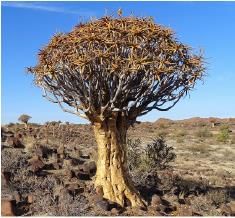
- a)Kauri tree
- b)Baobab tree
- c)Quiver tree
- d)Halfmens
Correct answer is option 'C'. Can you explain this answer?
This strange looking tree is an icon of Southern Africa's most arid habitats. It is a tall branching species of aloe also known as choje to the indigenous San people. Identify it.
a)
Kauri tree
b)
Baobab tree
c)
Quiver tree
d)
Halfmens
| | Priyanka Kapoor answered |
Quiver trees (Aloe dichotoma) also known as kokerboom are species of aloe indigenous to South Africa, specifically in the Northern Cape region and Namibia. The tree is known as Quiver tree because branches and bark of the tree are used by Kalahari San Bushmen to make quivers for their arrows, hence the name.
These trees are massive and can grow to a height of 50-84 m with a circumference of 20-30 ft. The wood was used mainly for shingles and fence posts or even for making matchsticks. The largest of them is called the 'General Sherman' which is located in California. Which trees are we talking about?- a)Sequoia
- b)Cedar
- c)Pine
- d)Maple
Correct answer is option 'A'. Can you explain this answer?
These trees are massive and can grow to a height of 50-84 m with a circumference of 20-30 ft. The wood was used mainly for shingles and fence posts or even for making matchsticks. The largest of them is called the 'General Sherman' which is located in California. Which trees are we talking about?
a)
Sequoia
b)
Cedar
c)
Pine
d)
Maple
| | Vivek Bansal answered |
Giant Sequoia is the world's largest tree in terms of total volume. They grow to an average height of 50-85 m (150-280 ft) and 5-7 m (16-23 ft) in diameter. Sequoia are found at elevations of 1,400–2,150 meters and can live to be 3,000 years old.
Believed to be around 2,500 years old, General Sherman is the mightiest giant sequoia still standing. The volume of its trunk alone makes it the largest non-clonal tree by volume. Sherman can be found in Sequoia National Park in California, where five of the 10 largest trees in the world exist.
Believed to be around 2,500 years old, General Sherman is the mightiest giant sequoia still standing. The volume of its trunk alone makes it the largest non-clonal tree by volume. Sherman can be found in Sequoia National Park in California, where five of the 10 largest trees in the world exist.
Which of the following cows gives maximum milk yield?- a)Jersey
- b)Holstein
- c)Red Sindhi
- d)Sahiwal
Correct answer is option 'A'. Can you explain this answer?
Which of the following cows gives maximum milk yield?
a)
Jersey
b)
Holstein
c)
Red Sindhi
d)
Sahiwal
| | Priyanka Kapoor answered |
- The Jersey breed of cows gives the maximum yield of the milk.
- The Jersey breed originated on the Island of Jersey, a small British island in the English Channel off the coast of France.
- Dairy milk yield is found to be 20 liters whereas cross breed jersey, cow gives 8-10 liter per day.
- Jersey is one of the oldest dairy breeds, having been reported by authorities as being purebred for nearly six centuries.
This nut can be sweet or bitter and its oil is used in cosmetics, aromatherapy and in making marzipan. USA is the top producer of it. Name this nut.- a)Pine nut
- b)Groundnut
- c)Cashew nut
- d)Almond
Correct answer is option 'D'. Can you explain this answer?
This nut can be sweet or bitter and its oil is used in cosmetics, aromatherapy and in making marzipan. USA is the top producer of it. Name this nut.
a)
Pine nut
b)
Groundnut
c)
Cashew nut
d)
Almond
| | Vivek Bansal answered |
Almonds are edible tree nuts. They contain lots of healthy fats, fibre, protein, magnesium and vitamin E which is good for the skin.
The US is the dominant producer of almonds in the world producing 2,002,742 tons annually.
The US is the dominant producer of almonds in the world producing 2,002,742 tons annually.
Which of the following countries is the largest producer of copper?- a)Chile
- b)Peru
- c)Indonesia
- d)China
Correct answer is option 'A'. Can you explain this answer?
Which of the following countries is the largest producer of copper?
a)
Chile
b)
Peru
c)
Indonesia
d)
China
| | Vivek Bansal answered |
Chile is a South American country, which is the largest producer of copper in the world. It produces at least one-third of the world's share. Peru became the second-largest producer of copper in the world in 2010, after replacing the US to third.
Best quality of wool is drawn from the Angora goats found in _____ .- a)USA
- b)Egypt
- c)Turkey
- d)China
Correct answer is option 'A'. Can you explain this answer?
Best quality of wool is drawn from the Angora goats found in _____ .
a)
USA
b)
Egypt
c)
Turkey
d)
China
 | Sushil Solanki answered |
Best quality of wool is drawn from the Angora goats found in Turkey.
Introduction:
The question is asking about the location where the best quality of wool is drawn from Angora goats.
Explanation:
The answer is C:
- Turkey is known for its high-quality Angora goats, which are bred specifically for their soft and luxurious wool.
- Angora goats in Turkey have been bred for centuries to produce the best quality mohair wool, which is highly valued for its softness, luster, and warmth.
- Turkish Angora goats have a unique genetic makeup, which contributes to the exceptional quality of their wool.
- The climate and natural conditions in Turkey are ideal for raising Angora goats, resulting in the production of superior wool.
- Turkish wool production is regulated to ensure the highest standards of quality and animal welfare.
- The wool from Turkish Angora goats is used in the production of high-end clothing, textiles, and luxury items worldwide.
Conclusion:
In conclusion, the best quality of wool is drawn from the Angora goats found in Turkey. Their wool is highly prized for its softness, luster, and warmth, making it a valuable commodity in the textile industry.
Here is a detailed explanation:
Introduction:
The question is asking about the location where the best quality of wool is drawn from Angora goats.
Explanation:
The answer is C:
Turkey
because:- Turkey is known for its high-quality Angora goats, which are bred specifically for their soft and luxurious wool.
- Angora goats in Turkey have been bred for centuries to produce the best quality mohair wool, which is highly valued for its softness, luster, and warmth.
- Turkish Angora goats have a unique genetic makeup, which contributes to the exceptional quality of their wool.
- The climate and natural conditions in Turkey are ideal for raising Angora goats, resulting in the production of superior wool.
- Turkish wool production is regulated to ensure the highest standards of quality and animal welfare.
- The wool from Turkish Angora goats is used in the production of high-end clothing, textiles, and luxury items worldwide.
Conclusion:
In conclusion, the best quality of wool is drawn from the Angora goats found in Turkey. Their wool is highly prized for its softness, luster, and warmth, making it a valuable commodity in the textile industry.
There are two basic branches of soil science, (i) is concerned with the influence of soils on living things, particularly plants and (ii) is focused on the formation, morphology and classification of soils in their natural environment. Select the option which correctly fills the blanks.- a)(i) Pedology (ii) Edaphology
- b)(i) Geology (ii) Pedology
- c)(i) Geology (ii) Meterology
- d)(i) Edaphology (ii) Pedology
Correct answer is option 'D'. Can you explain this answer?
There are two basic branches of soil science, (i) is concerned with the influence of soils on living things, particularly plants and (ii) is focused on the formation, morphology and classification of soils in their natural environment. Select the option which correctly fills the blanks.
a)
(i) Pedology (ii) Edaphology
b)
(i) Geology (ii) Pedology
c)
(i) Geology (ii) Meterology
d)
(i) Edaphology (ii) Pedology
| | Vivek Bansal answered |
Edaphology mainly focuses on how soil influences living things especially plants. It involves the study of how soil affects the way human nature uses the land for growing plants.
Pedology, on the other hand, involves the study of soil classification and soil morphology. It is the study of soils, including their chemical and physical properties as they are in their natural environment.
Pedology, on the other hand, involves the study of soil classification and soil morphology. It is the study of soils, including their chemical and physical properties as they are in their natural environment.
It is a major cereal grain grown in the temperate climate. It was one of the first cultivated grains in Eurasia. Celebration, Lacey and Legacy are few of its six-row malting varieties. Identify the crop.- a)Maize
- b)Barley
- c)Millet
- d)Rice
Correct answer is option 'B'. Can you explain this answer?
It is a major cereal grain grown in the temperate climate. It was one of the first cultivated grains in Eurasia. Celebration, Lacey and Legacy are few of its six-row malting varieties. Identify the crop.
a)
Maize
b)
Barley
c)
Millet
d)
Rice
| | Vivek Bansal answered |
Barley is a major cereal grain, commonly found in bread, beverages, and various cuisines of every culture. Barley grown for brewers malt is called malting barley, as opposed to feed barley, and is divided into two general types; 2 Row Barley and 6 Row Barley.
The most obvious difference between a head of 2-row barley and a head of 6-row barley is the arrangement of the kernels when the head is viewed down its axis.
The most obvious difference between a head of 2-row barley and a head of 6-row barley is the arrangement of the kernels when the head is viewed down its axis.
Chapter doubts & questions for Resources of India and World - GK Olympiad for Class 8 2026 is part of Class 8 exam preparation. The chapters have been prepared according to the Class 8 exam syllabus. The Chapter doubts & questions, notes, tests & MCQs are made for Class 8 2026 Exam. Find important definitions, questions, notes, meanings, examples, exercises, MCQs and online tests here.
Chapter doubts & questions of Resources of India and World - GK Olympiad for Class 8 in English & Hindi are available as part of Class 8 exam. Download more important topics, notes, lectures and mock test series for Class 8 Exam by signing up for free.
GK Olympiad for Class 814 videos|14 docs|37 tests |
