


All Exams > Class 8 > GK Olympiad for Class 8 > All Questions
All questions of Basic Science for Class 8 Exam
If there is a large amount of rainfall in a short period of time, it can leads to ______.- a)Flood
- b)Drought
- c)Famine
- d)Both (A) and (C)
Correct answer is option 'D'. Can you explain this answer?
If there is a large amount of rainfall in a short period of time, it can leads to ______.
a)
Flood
b)
Drought
c)
Famine
d)
Both (A) and (C)
 | Vivek Bansal answered |
If there is a large amount of rainfall in as short period of time, it results in the flood. The flood not destroy not only homes but also the agricultural crops which later lead to starvation. There is famine in a place where flood destroy crops as there is an extreme scarcity of food.

A change in which the substance can get back to its original form is called a physical change. Which of the following is a physical change?- a)Burning of paper
- b)Bursting of crackers
- c)Cooking of food
- d)Melting of ice
Correct answer is option 'D'. Can you explain this answer?
A change in which the substance can get back to its original form is called a physical change. Which of the following is a physical change?
a)
Burning of paper
b)
Bursting of crackers
c)
Cooking of food
d)
Melting of ice
 | Rajat Malik answered |
Understanding Physical Change
A physical change is a transformation that alters the form or appearance of a substance but does not change its chemical composition. This means that the original substance can be recovered after the change.
Examples of Changes
- Burning of Paper: This is a chemical change. When paper burns, it transforms into ash, smoke, and gases, making it impossible to revert to its original state.
- Bursting of Crackers: This is also a chemical change. The explosion results in new substances being formed, such as gases and heat, which cannot be returned to their original form.
- Cooking of Food: This is a chemical change as well. Cooking alters the chemical structure of the food, creating new flavors and textures that cannot be reverted to the raw ingredients.
- Melting of Ice: This is a physical change. When ice melts, it changes from a solid to a liquid (water), but its chemical composition (H2O) remains unchanged. If the water is frozen again, it can return to its original solid state.
Conclusion
The correct answer is option 'D' (Melting of ice) because it exemplifies a physical change where the substance can revert back to its original form. Understanding these distinctions helps in recognizing the nature of changes that substances undergo in everyday life.
A physical change is a transformation that alters the form or appearance of a substance but does not change its chemical composition. This means that the original substance can be recovered after the change.
Examples of Changes
- Burning of Paper: This is a chemical change. When paper burns, it transforms into ash, smoke, and gases, making it impossible to revert to its original state.
- Bursting of Crackers: This is also a chemical change. The explosion results in new substances being formed, such as gases and heat, which cannot be returned to their original form.
- Cooking of Food: This is a chemical change as well. Cooking alters the chemical structure of the food, creating new flavors and textures that cannot be reverted to the raw ingredients.
- Melting of Ice: This is a physical change. When ice melts, it changes from a solid to a liquid (water), but its chemical composition (H2O) remains unchanged. If the water is frozen again, it can return to its original solid state.
Conclusion
The correct answer is option 'D' (Melting of ice) because it exemplifies a physical change where the substance can revert back to its original form. Understanding these distinctions helps in recognizing the nature of changes that substances undergo in everyday life.
Raj is travelling with his father in a car. He asks his father to turn off the engine at red lights in order to conserve a natural resource. Which of the following is being conserved by this activity?- a)Coal
- b)Water
- c)Fuel
- d)None of these
Correct answer is option 'C'. Can you explain this answer?
Raj is travelling with his father in a car. He asks his father to turn off the engine at red lights in order to conserve a natural resource. Which of the following is being conserved by this activity?
a)
Coal
b)
Water
c)
Fuel
d)
None of these
 | Suyash Choudhury answered |
Conserving Fuel
Conserving fuel is the natural resource that is being conserved by turning off the car engine at red lights.
When a car engine is running, it consumes fuel to provide power for the vehicle to move. This fuel is typically derived from non-renewable sources such as petroleum, which is a finite resource. By turning off the engine at red lights, Raj and his father are reducing the amount of fuel being consumed during periods of idling.
Here are the reasons why conserving fuel is important and how turning off the engine at red lights helps in achieving that:
1. Environmental Impact: Burning fuel releases harmful emissions into the atmosphere, contributing to air pollution and climate change. By conserving fuel, we can reduce the amount of pollution being emitted into the air and mitigate the negative environmental impact.
2. Energy Conservation: Fuel is a valuable energy resource that should be used efficiently. Conserving fuel helps in reducing the overall energy consumption and ensures that the available fuel resources last longer.
3. Cost Savings: Fuel is a significant expense for vehicle owners. By conserving fuel, Raj and his father can save money on fuel costs in the long run. Turning off the engine at red lights reduces unnecessary fuel consumption during times when the car is stationary.
4. Sustainability: Conserving fuel aligns with the concept of sustainability, which focuses on meeting the needs of the present generation without compromising the ability of future generations to meet their own needs. By conserving fuel, we can ensure that there is enough fuel available for future generations to meet their energy requirements.
In conclusion, by turning off the car engine at red lights, Raj and his father are conserving fuel. This activity has multiple benefits, including reducing environmental impact, conserving energy, saving money, and promoting sustainability.
Conserving fuel is the natural resource that is being conserved by turning off the car engine at red lights.
When a car engine is running, it consumes fuel to provide power for the vehicle to move. This fuel is typically derived from non-renewable sources such as petroleum, which is a finite resource. By turning off the engine at red lights, Raj and his father are reducing the amount of fuel being consumed during periods of idling.
Here are the reasons why conserving fuel is important and how turning off the engine at red lights helps in achieving that:
1. Environmental Impact: Burning fuel releases harmful emissions into the atmosphere, contributing to air pollution and climate change. By conserving fuel, we can reduce the amount of pollution being emitted into the air and mitigate the negative environmental impact.
2. Energy Conservation: Fuel is a valuable energy resource that should be used efficiently. Conserving fuel helps in reducing the overall energy consumption and ensures that the available fuel resources last longer.
3. Cost Savings: Fuel is a significant expense for vehicle owners. By conserving fuel, Raj and his father can save money on fuel costs in the long run. Turning off the engine at red lights reduces unnecessary fuel consumption during times when the car is stationary.
4. Sustainability: Conserving fuel aligns with the concept of sustainability, which focuses on meeting the needs of the present generation without compromising the ability of future generations to meet their own needs. By conserving fuel, we can ensure that there is enough fuel available for future generations to meet their energy requirements.
In conclusion, by turning off the car engine at red lights, Raj and his father are conserving fuel. This activity has multiple benefits, including reducing environmental impact, conserving energy, saving money, and promoting sustainability.
Photosynthesis is the process by which a plant makes food. What does this process produce?- a)Glucose and oxygen
- b)Water, carbon dioxide and sugar
- c)Carbon dioxide and sugar
- d)Oxygen and proteins
Correct answer is option 'A'. Can you explain this answer?
Photosynthesis is the process by which a plant makes food. What does this process produce?
a)
Glucose and oxygen
b)
Water, carbon dioxide and sugar
c)
Carbon dioxide and sugar
d)
Oxygen and proteins
| | Vivek Bansal answered |
Plants are known as autotrophs because they can use energy from the sunlight to make their own food. When a plant uses sunlight, water, and carbon dioxide to make glucose which is a form of sugar that plants require in order to sustain. They also release oxygen during the process of photosynthesis.
It is a reflection of sound that arrives at the listener with a delay after the direct sound. You often observe this phenomenon in mountainous areas. What is it called?- a)Echo
- b)Mirage
- c)Decibel
- d)None of these
Correct answer is option 'A'. Can you explain this answer?
It is a reflection of sound that arrives at the listener with a delay after the direct sound. You often observe this phenomenon in mountainous areas. What is it called?
a)
Echo
b)
Mirage
c)
Decibel
d)
None of these
| | Vivek Bansal answered |
Echo is distinct, reflected sound wave from a surface. Principle of echo is used in echo sounder to find the depth of a sea or the location of shoals of fish. It is a reflection of sound that arrives at the listener with a delay after the direct sound. A true echo is a single reflection of the sound source.
Read the given paragraph.
As there is more and more ____(i)______, we are constructing taller buildings,factories and roads. The continuous process of building results in ____(ii)_____ of large quantities of waste formed by it in the landfill areas.Select the option which correctly fills up the blanks.- a)(i) Evolution, (ii) Disposition
- b)(i) Industrialisation, (ii) Buying
- c)(i) Evolution, (ii) Buying
- d)(i) Industrialisation, (ii) Disposition
Correct answer is option 'D'. Can you explain this answer?
Read the given paragraph.
As there is more and more ____(i)______, we are constructing taller buildings,factories and roads. The continuous process of building results in ____(ii)_____ of large quantities of waste formed by it in the landfill areas.
As there is more and more ____(i)______, we are constructing taller buildings,factories and roads. The continuous process of building results in ____(ii)_____ of large quantities of waste formed by it in the landfill areas.
Select the option which correctly fills up the blanks.
a)
(i) Evolution, (ii) Disposition
b)
(i) Industrialisation, (ii) Buying
c)
(i) Evolution, (ii) Buying
d)
(i) Industrialisation, (ii) Disposition
 | Priyanka Kapoor answered |
As there is more and more industrialisation, we are constructing taller buildings, factories and roads. The continuous process of building results in disposition of large quantities of waste formed by it in the landfill areas. To construct a structure requires land and to fulfill the land requirement the landfilled areas where the garbage is dumped are used in order to construct new industries and building.
Which of the following statements is incorrect?- a)The blood of insects does not contain haemoglobin, the oxygen carrier.
- b)A seed kept in an air tight contained does not germinate.
- c)Purple moorhen and pelican are local migratory birds of India.
- d)Begonia reproduces through roots.
Correct answer is option 'D'. Can you explain this answer?
Which of the following statements is incorrect?
a)
The blood of insects does not contain haemoglobin, the oxygen carrier.
b)
A seed kept in an air tight contained does not germinate.
c)
Purple moorhen and pelican are local migratory birds of India.
d)
Begonia reproduces through roots.
| | Vivek Bansal answered |
Begonia like any other flower reproduces asexually. They produce fruits which contain seeds. They are capable of propagating from a portion of the leaf.
The seeds of the given plant are light and spongy. Which of the following help in the dispersal of seeds of the given plant?- a)Wind
- b)Animals
- c)Humans
- d)Water currents
Correct answer is option 'D'. Can you explain this answer?
The seeds of the given plant are light and spongy. Which of the following help in the dispersal of seeds of the given plant?
a)
Wind
b)
Animals
c)
Humans
d)
Water currents
| | Priyanka Kapoor answered |
The seeds of plants growing near water or in water are dispersed by water. The seeds of these plants are light in weight. The lotus has spongy fruits that are dispersed through water.
Which of the following chemicals is called Hypo?- a)Sodium chloride
- b)Sodium thiosulphate
- c)Potassium sulphate
- d)Potassium nitrate
Correct answer is option 'B'. Can you explain this answer?
Which of the following chemicals is called Hypo?
a)
Sodium chloride
b)
Sodium thiosulphate
c)
Potassium sulphate
d)
Potassium nitrate
| | Vivek Bansal answered |
Sodium thiosulphate is a chemical which is readily soluble in water and is a mild reducing agent. Because of its tendency to dissolve silver salts, it is majorly used in photography for developing the film.
It is also used in chrome-tanning leather and in chemical manufacturing. It is also called sodium hyposulfite or hypo.
It is also used in chrome-tanning leather and in chemical manufacturing. It is also called sodium hyposulfite or hypo.
To check the level of harmful gases emitted by the vehicles, all vehicles in India which are in use need to obtain emission check certificate. What is this certificate known as?- a)Emission Under Control
- b)Emission Check Certificate
- c)Pollution Under Control
- d)Pollution Check Certificate
Correct answer is option 'C'. Can you explain this answer?
To check the level of harmful gases emitted by the vehicles, all vehicles in India which are in use need to obtain emission check certificate. What is this certificate known as?
a)
Emission Under Control
b)
Emission Check Certificate
c)
Pollution Under Control
d)
Pollution Check Certificate
| | Priyanka Kapoor answered |
Pollution Under Control certificate under Central Motor Vehicles Rule, 1989. The test assesses the emission of a vehicle and check it meets the standards set for pollution control.
This part of the plant is called its food factory because it produces food for the plant using sunlight, water and carbon dioxide. Which part of the plant is this?- a)Root
- b)Flower
- c)Leaf
- d)Stem
Correct answer is option 'C'. Can you explain this answer?
This part of the plant is called its food factory because it produces food for the plant using sunlight, water and carbon dioxide. Which part of the plant is this?
a)
Root
b)
Flower
c)
Leaf
d)
Stem
| | Priyanka Kapoor answered |
The leaf is the part of the plant that produces food for the plant by the process of photosynthesis. The leaf has chlorophyll which gives the green color to the leaf. Chlorophyll makes food for the plant using carbon dioxide, water, nutrients, and sunlight.
The given symbol is commonly seen on consumer products such as microwaves, refrigerators and lighting devices. What does this symbol indicates about the product?
- a)Energy-efficient product
- b)Energy-consuming product
- c)Energy-wasting product
- d)None of these
Correct answer is option 'A'. Can you explain this answer?
The given symbol is commonly seen on consumer products such as microwaves, refrigerators and lighting devices. What does this symbol indicates about the product?
a)
Energy-efficient product
b)
Energy-consuming product
c)
Energy-wasting product
d)
None of these
| | Vivek Bansal answered |
Energy star is an initiative by the governments that help the consumers to identify the energy-efficient products and help them save money and reduce greenhouse gas emissions. Energy star is a program run by the U.S. Environmental Protection Agency and U.S. Department of Energy.
Herbivores are animals that feed on plants, while carnivores are those that feed on animals. Omnivores, on the other hand, feed on both plants and animals. Which of the following is an omnivore?- a)Horse
- b)Fruit bat
- c)Human
- d)Leopard
Correct answer is option 'C'. Can you explain this answer?
Herbivores are animals that feed on plants, while carnivores are those that feed on animals. Omnivores, on the other hand, feed on both plants and animals. Which of the following is an omnivore?
a)
Horse
b)
Fruit bat
c)
Human
d)
Leopard
| | Priyanka Kapoor answered |
Omnivores are animals that eat both plants and animals. For example - Bears, raccoons, crows, and most humans are omnivores.
Horses are part of the herbivore family as they only eat plant material.
Fruit bats are herbivores, more specifically frugivores, as the bulk of their diet consists of fruit.
Leopards are carnivores, which means they are animals that only eat meat.
So, the correct answer is option C.
Horses are part of the herbivore family as they only eat plant material.
Fruit bats are herbivores, more specifically frugivores, as the bulk of their diet consists of fruit.
Leopards are carnivores, which means they are animals that only eat meat.
So, the correct answer is option C.
The classical Rutherford scattering of alpha particles against the nuclei of this element is an example of 'elastic scattering' because the energy and velocity of the outgoing scattered particle is the same as that with which it began. What element did Rutherford use in his experiment?- a)Copper
- b)Helium
- c)Gold
- d)Plutonium
Correct answer is option 'C'. Can you explain this answer?
The classical Rutherford scattering of alpha particles against the nuclei of this element is an example of 'elastic scattering' because the energy and velocity of the outgoing scattered particle is the same as that with which it began. What element did Rutherford use in his experiment?
a)
Copper
b)
Helium
c)
Gold
d)
Plutonium
| | Priyanka Kapoor answered |
Ernest Rutherford was a New Zealand-born British scientist, who won the Nobel Prize in Chemistry in 1908, for his work on nuclear physics, and for the theory of the structure of the atom.
In 1911, he performed the Alpha particle scattering experiment or the elastic scattering using a gold foil, which led to the birth of the nuclear model of an atom and was a major step towards how we see the atom today.
In 1911, he performed the Alpha particle scattering experiment or the elastic scattering using a gold foil, which led to the birth of the nuclear model of an atom and was a major step towards how we see the atom today.
An element is a substance that cannot be chemically interconverted or broken down into simpler substances. Which of these is an element?- a)Carbon dioxide
- b)Air
- c)Hydrogen
- d)Water
Correct answer is option 'C'. Can you explain this answer?
An element is a substance that cannot be chemically interconverted or broken down into simpler substances. Which of these is an element?
a)
Carbon dioxide
b)
Air
c)
Hydrogen
d)
Water
| | Vivek Bansal answered |
Chemical elements are those elements which cannot be chemically interconverted or broken down into simpler substances and are primary constituents of matter. They are fundamental ingredients of all matte in existence which came be combined in reaction to create a chemical substance. Each chemical element in the universe has unique properties that distinguish it from all of the other chemical elements. For example, Hydrogen is an element.
Which of the following is the instrument used to measure the depth of ocean?- a)Fathometer
- b)Audiometer
- c)Hygrometer
- d)None of these
Correct answer is option 'A'. Can you explain this answer?
Which of the following is the instrument used to measure the depth of ocean?
a)
Fathometer
b)
Audiometer
c)
Hygrometer
d)
None of these
| | Vivek Bansal answered |
Fathometer is a type of sonic depth finder. It is an instrument that uses sound waves to determine the depth of water.
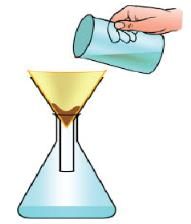
Filtration can separate substances from a mixture by using a funnel and filter paper. Which of the following materials can be separated using filtration?
- a)A solution of salt and water
- b)A solution of vinegar and water
- c)A mixture of mud and water
- d)A mixture of sand and sawdust
Correct answer is option 'C'. Can you explain this answer?
Filtration can separate substances from a mixture by using a funnel and filter paper. Which of the following materials can be separated using filtration?
a)
A solution of salt and water
b)
A solution of vinegar and water
c)
A mixture of mud and water
d)
A mixture of sand and sawdust
| | Vivek Bansal answered |
Filtration is a process in which insoluble matter is separated from a liquid. Filtration is a separation process in which a mixture is passed through a filter that allows one component to pass-through but blocks another component from passing through because of its matter and consistency.
Heterogeneous mixtures can be separated into their respective constituents. For example, a mixture of mud and water can be separated through filtration process easily, because water being liquid will pass through the filter paper easily but the mud will not because of it being solid.
Heterogeneous mixtures can be separated into their respective constituents. For example, a mixture of mud and water can be separated through filtration process easily, because water being liquid will pass through the filter paper easily but the mud will not because of it being solid.
Which of the following is the unit used to measure the distance between stars? - a)meter
- b)light year
- c)steller mile
- d)centimeter
Correct answer is option 'B'. Can you explain this answer?
Which of the following is the unit used to measure the distance between stars?
a)
meter
b)
light year
c)
steller mile
d)
centimeter
| | Vivek Bansal answered |
The astronomers usually use light-years to measure the distance between stars. A light-year is a distance of light that can travel in one year. The astronomers also use parsec. One parsec is equal to 3.3. light year's.
Noble gases or inert gases are so named because they are highly unreactive and do not form compounds under normal conditions. Which of these is not an inert gas?- a)Xenon
- b)Radon
- c)Oganesson
- d)Zirconium
Correct answer is option 'D'. Can you explain this answer?
Noble gases or inert gases are so named because they are highly unreactive and do not form compounds under normal conditions. Which of these is not an inert gas?
a)
Xenon
b)
Radon
c)
Oganesson
d)
Zirconium
| | Priyanka Kapoor answered |
An inert gas is a gas that does not usually react chemically with other things. They are the most stable elements as they have maximum number of valence electrons in their outer shell.
Examples of inert gases are Argon, Neon, Xenon and Helium. They are often used in welding and sealing.
Examples of inert gases are Argon, Neon, Xenon and Helium. They are often used in welding and sealing.
Gravitation or gravity is a natural phenomenon by which all things having mass are brought toward or gravitate toward one another, including stars and planets. Which of the following is the best example of gravitation or gravity? - a)A car hits a tree and motion stops
- b)A breeze blows and a sailboat moves
- c)A person drops a ball and it falls to the ground
- d)A book is pushed and it moves across the table.
Correct answer is option 'C'. Can you explain this answer?
Gravitation or gravity is a natural phenomenon by which all things having mass are brought toward or gravitate toward one another, including stars and planets. Which of the following is the best example of gravitation or gravity?
a)
A car hits a tree and motion stops
b)
A breeze blows and a sailboat moves
c)
A person drops a ball and it falls to the ground
d)
A book is pushed and it moves across the table.
| | Vivek Bansal answered |
Gravity is the force that attracts two objects. Gravity is responsible for many of the structures in the universe. On Earth, it gives weight to physical objects and causes the tides. One of the best examples of gravity is when a person drops a ball and it falls to the ground.
Chapter doubts & questions for Basic Science - GK Olympiad for Class 8 2026 is part of Class 8 exam preparation. The chapters have been prepared according to the Class 8 exam syllabus. The Chapter doubts & questions, notes, tests & MCQs are made for Class 8 2026 Exam. Find important definitions, questions, notes, meanings, examples, exercises, MCQs and online tests here.
Chapter doubts & questions of Basic Science - GK Olympiad for Class 8 in English & Hindi are available as part of Class 8 exam. Download more important topics, notes, lectures and mock test series for Class 8 Exam by signing up for free.
GK Olympiad for Class 814 videos|14 docs|37 tests |
