


All Exams > Class 8 > GK Olympiad for Class 8 > All Questions
All questions of Culture and Places of India and World for Class 8 Exam
It is one of the most beautiful basilicas in Goa. It houses the well-preserved body of St. Francis Xavier, a Catholic saint. Name the basilica.- a)Se Cathedral
- b)Basilica of Bom Jesus
- c)Church of St. Francis of Assisi
- d)Monte Hill
Correct answer is option 'B'. Can you explain this answer?
It is one of the most beautiful basilicas in Goa. It houses the well-preserved body of St. Francis Xavier, a Catholic saint. Name the basilica.
a)
Se Cathedral
b)
Basilica of Bom Jesus
c)
Church of St. Francis of Assisi
d)
Monte Hill
 | Nidhi Mishra answered |
The Basilica of Bom Jesus
The Basilica of Bom Jesus is one of the most significant landmarks in Goa, known for its stunning architecture and historical importance.
Historical Significance
- The basilica is dedicated to St. Francis Xavier, a prominent figure in the Catholic Church and a co-founder of the Society of Jesus (Jesuits).
- It was consecrated in 1605 and is one of the oldest churches in India.
Architectural Marvel
- The basilica is constructed in the Baroque style, featuring intricate carvings and beautiful altarpieces.
- Its facade is made of laterite stone, giving it a unique appearance that blends with the Goan landscape.
Resting Place of St. Francis Xavier
- The basilica houses the well-preserved body of St. Francis Xavier, which has been kept in a glass coffin since his death in 1552.
- This attracts numerous pilgrims and tourists, making it a site of religious and cultural significance.
UNESCO World Heritage Site
- The Basilica of Bom Jesus is part of the Churches and Convents of Goa, which were declared a UNESCO World Heritage Site in 1986.
- This recognition highlights its importance not just in India but also in global history.
In summary, the Basilica of Bom Jesus is a stunning example of Goa's rich heritage, a place of pilgrimage, and a testimony to the region's colonial past. Its beauty and significance make it a must-visit location for anyone exploring Goa.
The Basilica of Bom Jesus is one of the most significant landmarks in Goa, known for its stunning architecture and historical importance.
Historical Significance
- The basilica is dedicated to St. Francis Xavier, a prominent figure in the Catholic Church and a co-founder of the Society of Jesus (Jesuits).
- It was consecrated in 1605 and is one of the oldest churches in India.
Architectural Marvel
- The basilica is constructed in the Baroque style, featuring intricate carvings and beautiful altarpieces.
- Its facade is made of laterite stone, giving it a unique appearance that blends with the Goan landscape.
Resting Place of St. Francis Xavier
- The basilica houses the well-preserved body of St. Francis Xavier, which has been kept in a glass coffin since his death in 1552.
- This attracts numerous pilgrims and tourists, making it a site of religious and cultural significance.
UNESCO World Heritage Site
- The Basilica of Bom Jesus is part of the Churches and Convents of Goa, which were declared a UNESCO World Heritage Site in 1986.
- This recognition highlights its importance not just in India but also in global history.
In summary, the Basilica of Bom Jesus is a stunning example of Goa's rich heritage, a place of pilgrimage, and a testimony to the region's colonial past. Its beauty and significance make it a must-visit location for anyone exploring Goa.

The film Slumdog Millionaire is based on the book _____.- a)A Suitable Boy
- b)Q & A
- c)Maximum City
- d)The Millionaire Mind.
Correct answer is option 'B'. Can you explain this answer?
The film Slumdog Millionaire is based on the book _____.
a)
A Suitable Boy
b)
Q & A
c)
Maximum City
d)
The Millionaire Mind.
 | Vivek Bansal answered |
The film Slumdog Millionaire is based on the book Q & A by Vikas Swarup. It tells the story of an uneducated young Indian man who unexpectedly wins a fortune on a quiz show.
Accused of cheating, he is forced to explain how he knew the answer to each question by retelling the story of his life so far.
Accused of cheating, he is forced to explain how he knew the answer to each question by retelling the story of his life so far.
The original constitution of India is handwritten with beautiful calligraphy. Its each page was decorated by artists from Shantiniketan. Name the two great artists who made major contributions in decorating the original constitution.- a)M F Hussain and S H Raza
- b)raja ravi Varma and Tyed Mehta
- c)beohar rammanohar Sinha and Nandalal Bose
- d)Satish Gujral and Manjit Bawa
Correct answer is option 'C'. Can you explain this answer?
The original constitution of India is handwritten with beautiful calligraphy. Its each page was decorated by artists from Shantiniketan. Name the two great artists who made major contributions in decorating the original constitution.
a)
M F Hussain and S H Raza
b)
raja ravi Varma and Tyed Mehta
c)
beohar rammanohar Sinha and Nandalal Bose
d)
Satish Gujral and Manjit Bawa
| | Priyanka Kapoor answered |
The original Constitution of India, adopted on 26 January 1950, was not a printed document.
It was entirely handcrafted by the artists of Shantiniketan under the guidance of Acharya Nandalal Bose, with the calligraphy texts done by Prem Behari Narain Raizada in Delhi.
Prem Behari Narain Raizada of Delhi wrote the entire constitution in a flowing italic style in the best calligraphic tradition of our country.
It was entirely handcrafted by the artists of Shantiniketan under the guidance of Acharya Nandalal Bose, with the calligraphy texts done by Prem Behari Narain Raizada in Delhi.
Prem Behari Narain Raizada of Delhi wrote the entire constitution in a flowing italic style in the best calligraphic tradition of our country.
Which is the largest monastery in India?- a)Phuktal monastery
- b)Tawang monastery
- c)Kye monastery
- d)Thiksey monastery
Correct answer is option 'B'. Can you explain this answer?
Which is the largest monastery in India?
a)
Phuktal monastery
b)
Tawang monastery
c)
Kye monastery
d)
Thiksey monastery
| | Vivek Bansal answered |
Tawang Monastery, in the Indian state of Arunachal Pradesh, is the largest monastery in India and second largest in the world after the Potala Palace in Lhasa, Tibet.
It is situated in the valley of the Tawang River, near the small town of the same name in the northwestern part of Arunachal Pradesh, in close proximity to the Tibetan and Bhutanese border.
Tawang Monastery is known in Tibetan as Galden Namgey Lhatse, which translates to "celestial paradise in a clear night."
It is situated in the valley of the Tawang River, near the small town of the same name in the northwestern part of Arunachal Pradesh, in close proximity to the Tibetan and Bhutanese border.
Tawang Monastery is known in Tibetan as Galden Namgey Lhatse, which translates to "celestial paradise in a clear night."
It is a brimless, close-fitting, flat-topped cylindrical hat made of felt or cloth with a silk tassel. It is traditionally worn by the Muslim men throughout the eastern Mediterranean region. It is also called a Fez hat. What is its actual name?- a)Sarong
- b)Ushanka
- c)Tarboosh
- d)Huipil
Correct answer is option 'C'. Can you explain this answer?
It is a brimless, close-fitting, flat-topped cylindrical hat made of felt or cloth with a silk tassel. It is traditionally worn by the Muslim men throughout the eastern Mediterranean region. It is also called a Fez hat. What is its actual name?
a)
Sarong
b)
Ushanka
c)
Tarboosh
d)
Huipil
 | Jhanvi Shah answered |
Answer:
The correct answer is option 'C' - Tarboosh. The brimless, close-fitting, flat-topped cylindrical hat made of felt or cloth with a silk tassel, traditionally worn by Muslim men throughout the eastern Mediterranean region, is called a Tarboosh. It is also commonly known as a Fez hat.
What is a Tarboosh?
A Tarboosh is a type of headgear that originated in the Ottoman Empire and is closely associated with the Arab and Turkish cultures. It is typically made of felt or cloth and has a distinctive shape – a flat, round top with no brim. The hat is often adorned with a silk tassel that hangs from the center of the crown.
Traditionally Worn by Muslim Men
The Tarboosh has a long history and is traditionally worn by Muslim men in various countries across the eastern Mediterranean region, including Turkey, Egypt, Syria, and Lebanon. It is considered a part of traditional attire and is often worn on special occasions, religious ceremonies, or as a symbol of cultural identity.
Alternative Names for Tarboosh
The Tarboosh is commonly known as a Fez hat in many parts of the world, particularly in Western countries. The term "Fez" originated from the city of Fez in Morocco, where the hat was first manufactured and exported. Over time, the name "Fez" became synonymous with this particular style of hat.
Significance and Cultural Symbolism
The Tarboosh holds cultural and historical significance in the regions where it is worn. It is often associated with traditional values, religious identity, and social status. In some countries, the color of the tassel or the style of the hat may indicate the wearer's social or political affiliation.
Conclusion
In conclusion, the actual name for the brimless, close-fitting, flat-topped cylindrical hat made of felt or cloth with a silk tassel, traditionally worn by Muslim men throughout the eastern Mediterranean region, is Tarboosh. It is also commonly known as a Fez hat, which originated from the city of Fez in Morocco. The Tarboosh holds cultural significance and is a symbol of tradition, religious identity, and social status in the regions where it is worn.
The correct answer is option 'C' - Tarboosh. The brimless, close-fitting, flat-topped cylindrical hat made of felt or cloth with a silk tassel, traditionally worn by Muslim men throughout the eastern Mediterranean region, is called a Tarboosh. It is also commonly known as a Fez hat.
What is a Tarboosh?
A Tarboosh is a type of headgear that originated in the Ottoman Empire and is closely associated with the Arab and Turkish cultures. It is typically made of felt or cloth and has a distinctive shape – a flat, round top with no brim. The hat is often adorned with a silk tassel that hangs from the center of the crown.
Traditionally Worn by Muslim Men
The Tarboosh has a long history and is traditionally worn by Muslim men in various countries across the eastern Mediterranean region, including Turkey, Egypt, Syria, and Lebanon. It is considered a part of traditional attire and is often worn on special occasions, religious ceremonies, or as a symbol of cultural identity.
Alternative Names for Tarboosh
The Tarboosh is commonly known as a Fez hat in many parts of the world, particularly in Western countries. The term "Fez" originated from the city of Fez in Morocco, where the hat was first manufactured and exported. Over time, the name "Fez" became synonymous with this particular style of hat.
Significance and Cultural Symbolism
The Tarboosh holds cultural and historical significance in the regions where it is worn. It is often associated with traditional values, religious identity, and social status. In some countries, the color of the tassel or the style of the hat may indicate the wearer's social or political affiliation.
Conclusion
In conclusion, the actual name for the brimless, close-fitting, flat-topped cylindrical hat made of felt or cloth with a silk tassel, traditionally worn by Muslim men throughout the eastern Mediterranean region, is Tarboosh. It is also commonly known as a Fez hat, which originated from the city of Fez in Morocco. The Tarboosh holds cultural significance and is a symbol of tradition, religious identity, and social status in the regions where it is worn.
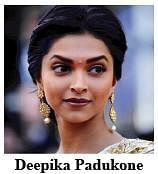
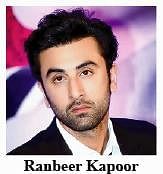
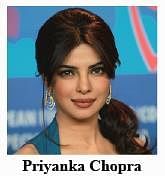
Which Bollywood personality has been honoured with the 24th Crystal Award at the World Economic Forum (WEF-2018)?- a)
- b)
- c)

- d)
Correct answer is option 'C'. Can you explain this answer?
Which Bollywood personality has been honoured with the 24th Crystal Award at the World Economic Forum (WEF-2018)?
a)
b)
c)
d)
| | Vivek Bansal answered |
Bollywood actor Shah Rukh Khan was honored with the 24th Crystal Award at the World Economic Forum in Davos, Switzerland.
He received Award for his leadership in championing children's and women's rights in India.
He received Award for his leadership in championing children's and women's rights in India.
This is an important place of pilgrimage for the Tibetan Buddhists in Himachal Pradesh. Dalai Lama settled here after he left Tibet. Name the place.- a)Manali
- b)Kullu
- c)Dharamsala
- d)Mussoorie
Correct answer is option 'C'. Can you explain this answer?
This is an important place of pilgrimage for the Tibetan Buddhists in Himachal Pradesh. Dalai Lama settled here after he left Tibet. Name the place.
a)
Manali
b)
Kullu
c)
Dharamsala
d)
Mussoorie
| | Vivek Bansal answered |
Dharamsala is a city in northern India and is the winter seat of government of the state of Himachal Pradesh.
McLeod Ganj, a village within Dharamshala municipality, is the home of the Dalai Lama and the exiled Tibetan government. It is where the Dalai Lama settled after fleeing Tibet in 1959 after a failed uprising against Chinese rule.
It is a popular place for Indian and foreign tourists, including students studying Tibet.
McLeod Ganj, a village within Dharamshala municipality, is the home of the Dalai Lama and the exiled Tibetan government. It is where the Dalai Lama settled after fleeing Tibet in 1959 after a failed uprising against Chinese rule.
It is a popular place for Indian and foreign tourists, including students studying Tibet.
Each year on the death anniversary of this famous saint, millions pf devotees of all religions converge upon his grave in Ajmer to pay homage and ask for boons and blessings. Who is this saint?- a)Nizamuddin Auliya
- b)Baba Farid
- c)Khwaja Moibuddin Chishti
- d)Salim Chishti
Correct answer is option 'C'. Can you explain this answer?
Each year on the death anniversary of this famous saint, millions pf devotees of all religions converge upon his grave in Ajmer to pay homage and ask for boons and blessings. Who is this saint?
a)
Nizamuddin Auliya
b)
Baba Farid
c)
Khwaja Moibuddin Chishti
d)
Salim Chishti
| | Vivek Bansal answered |
Khwaja Moibuddin Chishti is the most famous Sufi saint of the Chishti Order of South Asia. He is also known as Gharib Nawaz.
His shrine is at Ajmer, Rajasthan, India. It is the second most important pilgrimage after Mecca and Madina for the Muslims all over the world.
His shrine is at Ajmer, Rajasthan, India. It is the second most important pilgrimage after Mecca and Madina for the Muslims all over the world.
It is a type of beautiful metal embroidery once used to embellish the attire of the kings and the royals in India. Its work involves making elaborate design using gold and silver threads. Initially, it was done with pure silver sires and real gold leaves. Which type of embroidery is being talked about in the given paragraph?- a)Phulkari
- b)Meenakari
- c)ardozi
- d)Toda
Correct answer is option 'C'. Can you explain this answer?
It is a type of beautiful metal embroidery once used to embellish the attire of the kings and the royals in India. Its work involves making elaborate design using gold and silver threads. Initially, it was done with pure silver sires and real gold leaves. Which type of embroidery is being talked about in the given paragraph?
a)
Phulkari
b)
Meenakari
c)
ardozi
d)
Toda
| | Vivek Bansal answered |
Zardozi embroidery is beautiful metal embroidery, which once used to embellish the attire of the Kings and the royals in India. It was also used to adorn walls of the royal tents, scabbards, wall hangings and the paraphernalia of regal elephants and horses.
Zardozi embroidery work involves making elaborate designs, using gold and silver threads. Further adding to the magnificence of the work are the studded pearls and precious stones.
Zardozi embroidery work involves making elaborate designs, using gold and silver threads. Further adding to the magnificence of the work are the studded pearls and precious stones.
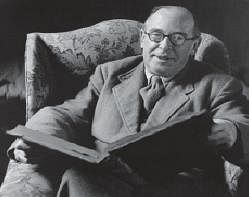
He was a lecturer at both Oxford University and Cambridge University who wrote a series of seven fantasy novels for children called 'The Chronicles of Narnia'. Who is the author?
- a)George Eliot
- b)C S Lewis
- c)Charles Dickens
- d)Enid Blyton
Correct answer is option 'B'. Can you explain this answer?
He was a lecturer at both Oxford University and Cambridge University who wrote a series of seven fantasy novels for children called 'The Chronicles of Narnia'. Who is the author?
a)
George Eliot
b)
C S Lewis
c)
Charles Dickens
d)
Enid Blyton
| | Vivek Bansal answered |
C.S. Lewis wrote a series of seven fantasy novels for children called "The Chronicles of Narnia". He was a prolific writer, poet, scholar of English literature. He held an academic position in English literature at both Oxford University and Cambridge University. He wrote more than 30 books which have been translated into more than 30 languages and have sold millions of copies.
This Kashmiri dance is performed only by the men-folk of the Wattal tribe. They wear long colourful robes and tall conical caps studded with beads and shells. The songs on which the dancers perform are folk songs that are sung by them in chorus. Name the dance.- a)Rauf
- b)Hikat
- c)Nagmagen
- d)Dumhal
Correct answer is option 'D'. Can you explain this answer?
This Kashmiri dance is performed only by the men-folk of the Wattal tribe. They wear long colourful robes and tall conical caps studded with beads and shells. The songs on which the dancers perform are folk songs that are sung by them in chorus. Name the dance.
a)
Rauf
b)
Hikat
c)
Nagmagen
d)
Dumhal
| | Vivek Bansal answered |
The Dumhal dance is performed by the men folk of the Wattal tribe of Kashmir.
This dance is performed with long colourful robes, tall conical caps. Dumhal dance is accompanied by songs which the performers themselves sing.
Performers of this dance place a banner into the ground at a fixed location and begin to dance around this banner.
This dance is performed with long colourful robes, tall conical caps. Dumhal dance is accompanied by songs which the performers themselves sing.
Performers of this dance place a banner into the ground at a fixed location and begin to dance around this banner.
Epithets are unique names given to places. They are usually based on some special features showcases the place. For example, lush green Ireland is called the Emerald Isle. Which country is called the Land of the Golden Pagoda?- a)Thailand
- b)Myanmar
- c)Malaysia
- d)Indonesia
Correct answer is option 'B'. Can you explain this answer?
Epithets are unique names given to places. They are usually based on some special features showcases the place. For example, lush green Ireland is called the Emerald Isle. Which country is called the Land of the Golden Pagoda?
a)
Thailand
b)
Myanmar
c)
Malaysia
d)
Indonesia
| | Priyanka Kapoor answered |
Myanmar is a Southeast Asian nation of more than 100 ethnic groups, bordering India, Bangladesh, China, Laos and Thailand. Pagodas are the unique landmarks of Myanmar.
It is often called The Land of Pagodas, as there are numerous temples and pagodas across the country,
It is often called The Land of Pagodas, as there are numerous temples and pagodas across the country,
The tower in the given picture is situated in Dubai. It is the tallest structure ever built by any human being. It also sets a world record with the maximum number of floor. The foot - print of the building looks like a desert flower, hymenocallis. Name the tower.
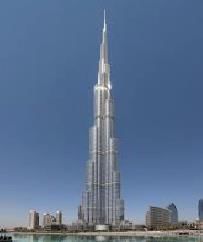
- a)Wills tower
- b)Burj Khalifa
- c)Petronas twin towers
- d)Taipei 101
Correct answer is option 'B'. Can you explain this answer?
The tower in the given picture is situated in Dubai. It is the tallest structure ever built by any human being. It also sets a world record with the maximum number of floor. The foot - print of the building looks like a desert flower, hymenocallis. Name the tower.
a)
Wills tower
b)
Burj Khalifa
c)
Petronas twin towers
d)
Taipei 101
| | Priyanka Kapoor answered |
The Burj Khalifa is the tallest ever structure constructed by any human being. It is situated in Dubai, United Arab Emirates. It has a whopping height of 829.8 mt. and a roof height of 828 m.
The largest camel fair in the world is held in a temple town of Rajasthan where one can find the only temple of Lord Brahma in India. Which fair are we talking about?
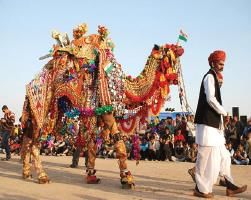
- a)Hemis Festival
- b)Pushkar Mela
- c)Carnival
- d)Phoolwalon ki Sair
Correct answer is option 'B'. Can you explain this answer?
The largest camel fair in the world is held in a temple town of Rajasthan where one can find the only temple of Lord Brahma in India. Which fair are we talking about?
a)
Hemis Festival
b)
Pushkar Mela
c)
Carnival
d)
Phoolwalon ki Sair
| | Priyanka Kapoor answered |
Pushkar Camel Fair is the largest camel fair in the world. It is held annually beginning on the Hindu calendar month of Kartik and ends on the Kartik Purnima at Pushkar. The fair actually celebrates the importance of camels in the life of Rajasthani people.
According to Hindu mythology, who among the three queens of king Dasharatha was the mother of Bharata, for whom Rama had to leave Ayodhya for fourteen long years?- a)Kaushalya
- b)Sumitra
- c)Kaikeyi
- d)Shanta
Correct answer is option 'C'. Can you explain this answer?
According to Hindu mythology, who among the three queens of king Dasharatha was the mother of Bharata, for whom Rama had to leave Ayodhya for fourteen long years?
a)
Kaushalya
b)
Sumitra
c)
Kaikeyi
d)
Shanta
| | Priyanka Kapoor answered |
Kaikeyi was one of the three wives of King Dasharatha and the Queen of Ayodhya, in Hindu mythology, Ramayana. She is the mother of Bharat and is the daughter of King of Ashwapati and Kekaya.
This delightful comedy starring Southern Superstar Kamal Haasan told the tale of a housekeeper at his divorced wife's house to be with his daughter. It was loosely based on the English movie 'Mrs. Doubtfire' starring the late Robin Willams. Can you name the movie?- a)Makdee
- b)Chachi 420
- c)Bhaag Milka Bhaag
- d)Matilda
Correct answer is option 'B'. Can you explain this answer?
This delightful comedy starring Southern Superstar Kamal Haasan told the tale of a housekeeper at his divorced wife's house to be with his daughter. It was loosely based on the English movie 'Mrs. Doubtfire' starring the late Robin Willams. Can you name the movie?
a)
Makdee
b)
Chachi 420
c)
Bhaag Milka Bhaag
d)
Matilda
| | Priyanka Kapoor answered |
Chachi 420 was the movie which was loosely based on the English movie Mrs. Doubtfire starring late Robin Williams. The Indian remake of the movie starred Kamal Hassan.
"The Golden Elephant" is a biennial festival that brings the best of the world's children's cinema to India. Where was this international children's film festival held in November 2017?- a)Hyderabad
- b)Mumbai
- c)Kolkata
- d)New Delhi
Correct answer is option 'A'. Can you explain this answer?
"The Golden Elephant" is a biennial festival that brings the best of the world's children's cinema to India. Where was this international children's film festival held in November 2017?
a)
Hyderabad
b)
Mumbai
c)
Kolkata
d)
New Delhi
| | Vivek Bansal answered |
The 19th International Children’s Film Festival of India popularly known as, ’The Golden Elephant,’ was organised in Hyderabad on 14th November 2017.
Children’s Film Society, India (CFSI) is the nodal organisation to conduct the festival. It organises an International Children’s Film Festival every alternate year in India.
Children’s Film Society, India (CFSI) is the nodal organisation to conduct the festival. It organises an International Children’s Film Festival every alternate year in India.
The screenplay for this evergreen classic movie about the wacky inventor Caractacus Pott and his flying car, was penned by the creator of the famous spy, James Bond. Who is he?- a)Stephen King
- b)Ian Fleming
- c)J K Rowling
- d)Agatha Christie
Correct answer is option 'B'. Can you explain this answer?
The screenplay for this evergreen classic movie about the wacky inventor Caractacus Pott and his flying car, was penned by the creator of the famous spy, James Bond. Who is he?
a)
Stephen King
b)
Ian Fleming
c)
J K Rowling
d)
Agatha Christie
| | Vivek Bansal answered |
Ian Lancaster Fleming was an English author, journalist and naval intelligence officer. He is known for his popular James Bond series of spy novels.
Which legendary playback singer was awarded the fifth edition of Yash Chopra Memorial Award for his/her outstanding contribution to Hindi film industry?- a)Lata Mangeshkar
- b)Asha Bhosle
- c)Sonu Nigam
- d)Alka Yagnik
Correct answer is option 'B'. Can you explain this answer?
Which legendary playback singer was awarded the fifth edition of Yash Chopra Memorial Award for his/her outstanding contribution to Hindi film industry?
a)
Lata Mangeshkar
b)
Asha Bhosle
c)
Sonu Nigam
d)
Alka Yagnik
| | Vivek Bansal answered |
The Yash Chopra Memorial award has been instituted by MP T Subbarami Reddy in the memory of renowned filmmaker Yash Chopra and carries a cash prize of Rs 10 lakhs.
Asha Bhosale is a well known playback singer in Hindi cinema
Asha Bhosale is a well known playback singer in Hindi cinema
On 12th December 2017, a very popular author was made a Member of the Order of the Companions of Honour, for her services to literature and philanthropy. Who are we talking about?- a)Toni Morrison
- b)J.K. Rowling
- c)Margaret Atwood
- d)Danselle steel
Correct answer is option 'B'. Can you explain this answer?
On 12th December 2017, a very popular author was made a Member of the Order of the Companions of Honour, for her services to literature and philanthropy. Who are we talking about?
a)
Toni Morrison
b)
J.K. Rowling
c)
Margaret Atwood
d)
Danselle steel
| | Vivek Bansal answered |
The Order of the Companions of Honour is a British award given to citizens of the Commonwealth. JK Rowling is a British author famous for writing the Harry Potter series.
She was made a Member of the Order of the Companions of Honour, for her services to literature and philanthropy.
She was made a Member of the Order of the Companions of Honour, for her services to literature and philanthropy.
Chapter doubts & questions for Culture and Places of India and World - GK Olympiad for Class 8 2026 is part of Class 8 exam preparation. The chapters have been prepared according to the Class 8 exam syllabus. The Chapter doubts & questions, notes, tests & MCQs are made for Class 8 2026 Exam. Find important definitions, questions, notes, meanings, examples, exercises, MCQs and online tests here.
Chapter doubts & questions of Culture and Places of India and World - GK Olympiad for Class 8 in English & Hindi are available as part of Class 8 exam. Download more important topics, notes, lectures and mock test series for Class 8 Exam by signing up for free.
GK Olympiad for Class 814 videos|14 docs|37 tests |
