


All Exams > Class 3 > International Computer Science Olympiad for Class 3 > All Questions
All questions of Mirror Images for Class 3 Exam
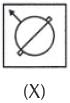
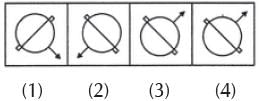
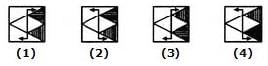
Which of the answer figures is exactly the mirror image of the given question figure when the mirror is held at XY?
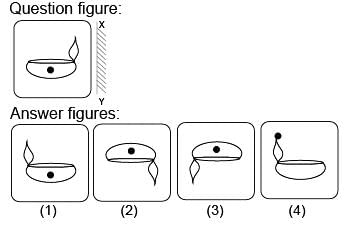
- a)2
- b)4
- c)3
- d)1
Correct answer is option 'D'. Can you explain this answer?
Which of the answer figures is exactly the mirror image of the given question figure when the mirror is held at XY?
a)
2
b)
4
c)
3
d)
1
 | Nisha Choudhury answered |
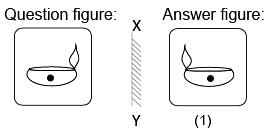
In the mirror image,
- The right side of the object becomes the left side
- The left side of the object becomes the right side
- The top and bottom sides of the object remain unchanged

When we look at a plane mirror, the reflection we see is called a:- a)Water image
- b)Mirror image
- c)Reflection image
- d)Reversed image
Correct answer is option 'B'. Can you explain this answer?
When we look at a plane mirror, the reflection we see is called a:
a)
Water image
b)
Mirror image
c)
Reflection image
d)
Reversed image
 | Anjana Singh answered |
Understanding Mirror Images
When you look into a plane mirror, the reflection you see is referred to as a "mirror image." This term describes how the mirror creates a visual representation of the objects in front of it.
What is a Mirror Image?
- A mirror image is the reflection of an object as seen in a plane mirror.
- It appears as if the object has been flipped horizontally.
- The left side of the object appears on the right side of the reflection and vice versa.
Key Characteristics of Mirror Images
- Reversal of Direction: A mirror image reverses the orientation of the object. For example, if you raise your right hand, your reflection will show your left hand raised.
- Symmetry: Mirror images are symmetrical. They maintain the same shape and size as the original object.
- Non-Physical Representation: The mirror image does not represent a physical object; it is an optical phenomenon created by the reflection of light.
Why Not Other Terms?
- Water Image: This term is typically used for reflections seen in water, which may distort the image due to ripples.
- Reflection Image: While this could imply a similar concept, it is not the standard terminology used in optics.
- Reversed Image: This term could be misleading as it does not specifically convey the nature of the image created by a mirror.
In conclusion, the correct answer is option 'B' because "mirror image" accurately describes how a plane mirror reflects light to create a symmetrical representation of the objects in front of it.
When you look into a plane mirror, the reflection you see is referred to as a "mirror image." This term describes how the mirror creates a visual representation of the objects in front of it.
What is a Mirror Image?
- A mirror image is the reflection of an object as seen in a plane mirror.
- It appears as if the object has been flipped horizontally.
- The left side of the object appears on the right side of the reflection and vice versa.
Key Characteristics of Mirror Images
- Reversal of Direction: A mirror image reverses the orientation of the object. For example, if you raise your right hand, your reflection will show your left hand raised.
- Symmetry: Mirror images are symmetrical. They maintain the same shape and size as the original object.
- Non-Physical Representation: The mirror image does not represent a physical object; it is an optical phenomenon created by the reflection of light.
Why Not Other Terms?
- Water Image: This term is typically used for reflections seen in water, which may distort the image due to ripples.
- Reflection Image: While this could imply a similar concept, it is not the standard terminology used in optics.
- Reversed Image: This term could be misleading as it does not specifically convey the nature of the image created by a mirror.
In conclusion, the correct answer is option 'B' because "mirror image" accurately describes how a plane mirror reflects light to create a symmetrical representation of the objects in front of it.
Which of the following is an example of a water image?- a)Reflection of a person in a mirror
- b)Reflection of a bird on a tree
- c)Reflection of a dog with a bone in a river
- d)Reflection of a building on a glass window
Correct answer is option 'C'. Can you explain this answer?
Which of the following is an example of a water image?
a)
Reflection of a person in a mirror
b)
Reflection of a bird on a tree
c)
Reflection of a dog with a bone in a river
d)
Reflection of a building on a glass window
 | Sudhir Mehta answered |
The reflection of a dog with a bone in a river exemplifies a water image. The image appears upside down, similar to how an object would appear when reflected in water.
Water images are reversed:- a)Horizontally
- b)Vertically
- c)Diagonally
- d)Radially
Correct answer is option 'B'. Can you explain this answer?
Water images are reversed:
a)
Horizontally
b)
Vertically
c)
Diagonally
d)
Radially
 | Subhankar Jain answered |
Understanding Water Reflection
When we consider how water reflects images, it's essential to visualize the behavior of light and how it interacts with surfaces. Here's a breakdown of why the correct answer is option 'B' - Vertically.
Nature of Reflection
- When light hits the surface of the water, it reflects back.
- The angle at which the light hits the surface is equal to the angle at which it reflects.
Vertical Reversal Explained
- In water, the reflection occurs across a horizontal axis (the water's surface).
- This means that the top of the object becomes the bottom in the reflection, thus reversing it vertically.
Examples of Vertical Reversal
- Imagine a tree: The top part of the tree reflects downwards, appearing as though the roots are at the top in the water.
- If you see a person standing by the water, their head will appear at the bottom of the reflection, and their feet will be at the top.
Other Options Explained
- Horizontally (Option A): Would mean a side-to-side flip, which does not occur in water reflections.
- Diagonally (Option C): Would imply a slant-wise flip, which is not how standard reflections work.
- Radially (Option D): Suggests a circular pattern, which is not applicable to flat water surfaces.
Conclusion
In summary, when observing reflections in water, the images appear reversed vertically. This unique property of water allows us to see a flipped version of ourselves and surrounding objects, enhancing our understanding of light and reflection.
When we consider how water reflects images, it's essential to visualize the behavior of light and how it interacts with surfaces. Here's a breakdown of why the correct answer is option 'B' - Vertically.
Nature of Reflection
- When light hits the surface of the water, it reflects back.
- The angle at which the light hits the surface is equal to the angle at which it reflects.
Vertical Reversal Explained
- In water, the reflection occurs across a horizontal axis (the water's surface).
- This means that the top of the object becomes the bottom in the reflection, thus reversing it vertically.
Examples of Vertical Reversal
- Imagine a tree: The top part of the tree reflects downwards, appearing as though the roots are at the top in the water.
- If you see a person standing by the water, their head will appear at the bottom of the reflection, and their feet will be at the top.
Other Options Explained
- Horizontally (Option A): Would mean a side-to-side flip, which does not occur in water reflections.
- Diagonally (Option C): Would imply a slant-wise flip, which is not how standard reflections work.
- Radially (Option D): Suggests a circular pattern, which is not applicable to flat water surfaces.
Conclusion
In summary, when observing reflections in water, the images appear reversed vertically. This unique property of water allows us to see a flipped version of ourselves and surrounding objects, enhancing our understanding of light and reflection.
Mirror images are reversed:- a)Horizontally
- b)Vertically
- c)Diagonally
- d)Radially
Correct answer is option 'A'. Can you explain this answer?
Mirror images are reversed:
a)
Horizontally
b)
Vertically
c)
Diagonally
d)
Radially
| | Nisha Choudhury answered |
Mirror images are reversed horizontally. The left side of the image appears on the right, and the right side appears on the left.
A water image appears:- a)Identical to the actual object
- b)Reversed perpendicular to the mirror's surface
- c)Upside down
- d)Transparent
Correct answer is option 'C'. Can you explain this answer?
A water image appears:
a)
Identical to the actual object
b)
Reversed perpendicular to the mirror's surface
c)
Upside down
d)
Transparent
| | Saumya Deshpande answered |
Understanding Water Images
When we refer to a water image, we are essentially discussing the reflection seen in the surface of a body of water. This reflection creates an illusion that can be explained as follows:
Characteristics of a Water Image
- Identical to the actual object: A water image looks similar to the actual object; however, it is not identical in the sense of orientation.
- Reversed perpendicular to the mirror's surface: The water image is indeed reversed, but this answer does not fully capture the essence of the water image as it refers to a more complex reflection.
- Upside down: This is the correct answer. In a water image, the object appears upside down compared to its actual position. When light reflects off the water's surface, the top of the object appears at the bottom of the reflection and vice versa. This phenomenon occurs due to the way light travels and reflects.
- Transparent: While water can be transparent, the image itself is not transparent. It is a reflection that may appear distorted depending on the clarity of the water and the angle of viewing.
Conclusion
The most accurate description of a water image is that it appears upside down. This phenomenon is primarily due to the reflection properties of water, giving a unique perspective that is both captivating and educational, especially for young learners.
When we refer to a water image, we are essentially discussing the reflection seen in the surface of a body of water. This reflection creates an illusion that can be explained as follows:
Characteristics of a Water Image
- Identical to the actual object: A water image looks similar to the actual object; however, it is not identical in the sense of orientation.
- Reversed perpendicular to the mirror's surface: The water image is indeed reversed, but this answer does not fully capture the essence of the water image as it refers to a more complex reflection.
- Upside down: This is the correct answer. In a water image, the object appears upside down compared to its actual position. When light reflects off the water's surface, the top of the object appears at the bottom of the reflection and vice versa. This phenomenon occurs due to the way light travels and reflects.
- Transparent: While water can be transparent, the image itself is not transparent. It is a reflection that may appear distorted depending on the clarity of the water and the angle of viewing.
Conclusion
The most accurate description of a water image is that it appears upside down. This phenomenon is primarily due to the reflection properties of water, giving a unique perspective that is both captivating and educational, especially for young learners.
If a rectangle is placed in front of a mirror, how many lines of symmetry will its mirror image have?- a)0
- b)2
- c)6
- d)4
Correct answer is option 'B'. Can you explain this answer?
If a rectangle is placed in front of a mirror, how many lines of symmetry will its mirror image have?
a)
0
b)
2
c)
6
d)
4
| | Nisha Choudhury answered |
A rectangle has one line of symmetry. When a rectangle is placed in front of a mirror, its mirror image will also have one line of symmetry.
In a mirror image, the left hand of a person appears as the:- a)Left hand
- b)Right hand
- c)Reversed hand
- d)Invisible hand
Correct answer is option 'B'. Can you explain this answer?
In a mirror image, the left hand of a person appears as the:
a)
Left hand
b)
Right hand
c)
Reversed hand
d)
Invisible hand
| | Pallabi Ahuja answered |
Understanding Mirror Images
When we look at ourselves in a mirror, the image we see is not a direct reflection of our body’s orientation. Instead, it reverses the left and right sides. Here’s how it works:
How Mirror Images Work
- A mirror reflects light in such a way that it reverses the direction perpendicular to its surface.
- This phenomenon causes the left side of your body to appear on the right side of the mirror image and vice versa.
Left Hand Appears as Right Hand
- When you raise your left hand in front of a mirror,
- The mirror reflects this image.
- As a result, what appears is your left hand on the right side of the mirror image.
- This is why we say the left hand of a person appears as the:
- Right hand in the mirror image.
Examples to Understand Better
- If you were to point with your left hand toward the mirror,
- In the reflection, it looks as if you are pointing with your right hand.
- Writing “L” on your left hand and showing it in the mirror,
- The “L” will appear reversed, making it look like a “J” or something else, not recognizable as “L”.
Conclusion
In summary, the correct answer is option 'B', as a mirror reverses the left and right sides. The left hand appears as the right hand due to this reversal, creating a mirrored image that can sometimes be confusing but is fascinating to observe.
When we look at ourselves in a mirror, the image we see is not a direct reflection of our body’s orientation. Instead, it reverses the left and right sides. Here’s how it works:
How Mirror Images Work
- A mirror reflects light in such a way that it reverses the direction perpendicular to its surface.
- This phenomenon causes the left side of your body to appear on the right side of the mirror image and vice versa.
Left Hand Appears as Right Hand
- When you raise your left hand in front of a mirror,
- The mirror reflects this image.
- As a result, what appears is your left hand on the right side of the mirror image.
- This is why we say the left hand of a person appears as the:
- Right hand in the mirror image.
Examples to Understand Better
- If you were to point with your left hand toward the mirror,
- In the reflection, it looks as if you are pointing with your right hand.
- Writing “L” on your left hand and showing it in the mirror,
- The “L” will appear reversed, making it look like a “J” or something else, not recognizable as “L”.
Conclusion
In summary, the correct answer is option 'B', as a mirror reverses the left and right sides. The left hand appears as the right hand due to this reversal, creating a mirrored image that can sometimes be confusing but is fascinating to observe.
If the word "OPEN" is written on a paper and viewed in a mirror, what will it appear as?- a)NOPE
- b)NEPO
- c)NPEO
- d)EPON
Correct answer is option 'B'. Can you explain this answer?
If the word "OPEN" is written on a paper and viewed in a mirror, what will it appear as?
a)
NOPE
b)
NEPO
c)
NPEO
d)
EPON
| | Nisha Choudhury answered |
When a word is viewed in a mirror, it appears reversed. So, the word "OPEN" will appear as "NOPE" in the mirror.
Which of the answer figures is exactly the mirror image of the given question figure when the mirror is held at XY?
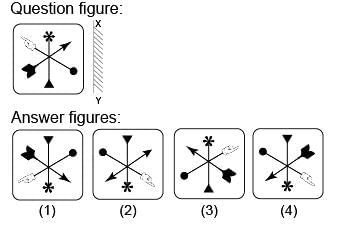
- a)2
- b)4
- c)3
- d)1
Correct answer is option 'C'. Can you explain this answer?
Which of the answer figures is exactly the mirror image of the given question figure when the mirror is held at XY?
a)
2
b)
4
c)
3
d)
1
| | Nisha Choudhury answered |
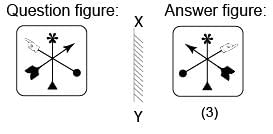
In the mirror image,
- The right side of the object becomes the left side
- The left side of the object becomes the right side
- The top and bottom sides of the object remain unchanged
In each of the following questions you are given a combination of letters and/or numbers followed by four alternatives (1), (2), (3) and (4). Choose the alternative which closely resembles the mirror image of the given combination.
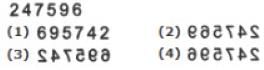
- a)1
- b)2
- c)3
- d)4
Correct answer is option 'D'. Can you explain this answer?
In each of the following questions you are given a combination of letters and/or numbers followed by four alternatives (1), (2), (3) and (4). Choose the alternative which closely resembles the mirror image of the given combination.
a)
1
b)
2
c)
3
d)
4
 | Divyanshu Pandey answered |
2
If the mirror is placed on the line XY, then identify the correct mirror image of the given question figure from the answer figures.
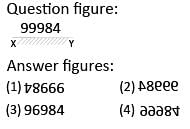
- a)2
- b)4
- c)3
- d)1
Correct answer is option 'B'. Can you explain this answer?
If the mirror is placed on the line XY, then identify the correct mirror image of the given question figure from the answer figures.
a)
2
b)
4
c)
3
d)
1
| | Nisha Choudhury answered |

In the mirror image,
- The right side of the object becomes the left side
- The left side of the object becomes the right side
- The top and bottom sides of the object remain unchanged
Which of the answer figures is exactly the mirror image of the given question figure when the mirror is held at XY?
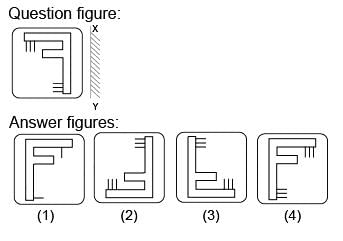
- a)2
- b)4
- c)3
- d)1
Correct answer is option 'B'. Can you explain this answer?
Which of the answer figures is exactly the mirror image of the given question figure when the mirror is held at XY?
a)
2
b)
4
c)
3
d)
1
| | Nisha Choudhury answered |
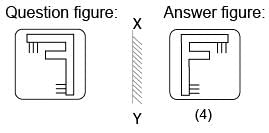
In the mirror image,
- The right side of the object becomes the left side
- The left side of the object becomes the right side
- The top and bottom sides of the object remain unchanged
When the mirror is held at XY, find the exact mirror image of the given question figure from the answer figures?
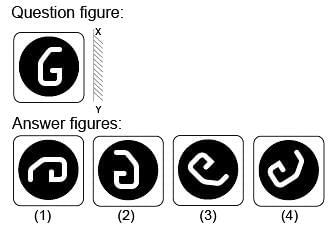
- a)2
- b)4
- c)3
- d)1
Correct answer is option 'A'. Can you explain this answer?
When the mirror is held at XY, find the exact mirror image of the given question figure from the answer figures?
a)
2
b)
4
c)
3
d)
1
| | Sudhir Mehta answered |
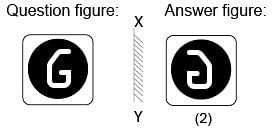
In the mirror image,
- The right side of the object becomes the left side
- The left side of the object becomes the right side
- The top and bottom sides of the object remain unchanged
If the mirror is placed on the line XY, then identify the correct mirror image of the given question figure from the answer figures.
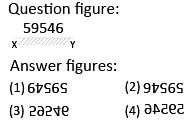
- a)2
- b)4
- c)3
- d)1
Correct answer is option 'C'. Can you explain this answer?
If the mirror is placed on the line XY, then identify the correct mirror image of the given question figure from the answer figures.
a)
2
b)
4
c)
3
d)
1
| | Nisha Choudhury answered |

In the mirror image,
- The right side of the object becomes the left side
- The left side of the object becomes the right side
- The top and bottom sides of the object remain unchanged
If the mirror is placed on the line XY, then identify the correct mirror image of the given question figure from the answer figures.
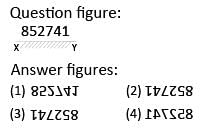
- a)2
- b)4
- c)3
- d)1
Correct answer is option 'D'. Can you explain this answer?
If the mirror is placed on the line XY, then identify the correct mirror image of the given question figure from the answer figures.
a)
2
b)
4
c)
3
d)
1
| | Sudhir Mehta answered |
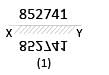
In the mirror image,
- The right side of the object becomes the left side
- The left side of the object becomes the right side
- The top and bottom sides of the object remain unchanged
If the mirror is placed on the line XY, then identify the correct mirror image of the given question figure from the answer figures.
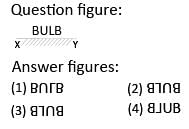
- a)2
- b)4
- c)3
- d)1
Correct answer is option 'D'. Can you explain this answer?
If the mirror is placed on the line XY, then identify the correct mirror image of the given question figure from the answer figures.
a)
2
b)
4
c)
3
d)
1
| | Sudhir Mehta answered |

In the mirror image,
- The right side of the object becomes the left side
- The left side of the object becomes the right side
- The top and bottom sides of the object remain unchanged
Which of the answer figures is exactly the mirror image of the given question figure when the mirror is held at XY?
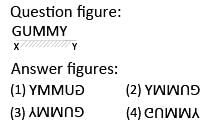
- a)2
- b)4
- c)3
- d)1
Correct answer is option 'B'. Can you explain this answer?
Which of the answer figures is exactly the mirror image of the given question figure when the mirror is held at XY?
a)
2
b)
4
c)
3
d)
1
| | Sudhir Mehta answered |

In the mirror image,
- The right side of the object becomes the left side
- The left side of the object becomes the right side
- The top and bottom sides of the object remain unchanged
When the mirror is held at XY, find the exact mirror image of the given question figure from the answer figures?
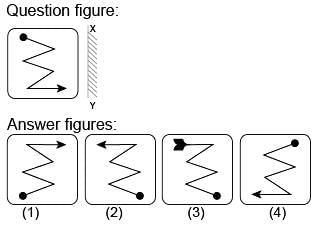
- a)2
- b)4
- c)3
- d)1
Correct answer is option 'B'. Can you explain this answer?
When the mirror is held at XY, find the exact mirror image of the given question figure from the answer figures?
a)
2
b)
4
c)
3
d)
1
| | Nisha Choudhury answered |
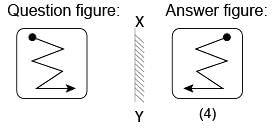
In the mirror image,
- The right side of the object becomes the left side
- The left side of the object becomes the right side
- The top and bottom sides of the object remain unchanged

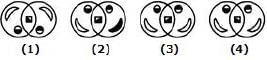

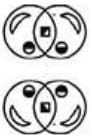
When the mirror is held at XY, find the exact mirror image of the given question figure from the answer figures?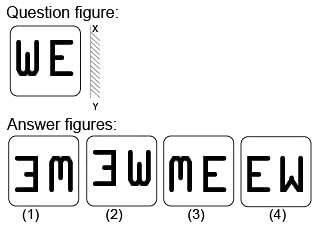
- a)2
- b)4
- c)3
- d)1
Correct answer is option 'A'. Can you explain this answer?
When the mirror is held at XY, find the exact mirror image of the given question figure from the answer figures?
a)
2
b)
4
c)
3
d)
1
| | Nisha Choudhury answered |
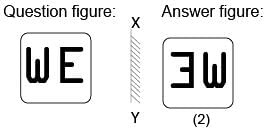
In the mirror image,
- The right side of the object becomes the left side
- The left side of the object becomes the right side
- The top and bottom sides of the object remain unchanged
Which of the answer figures is exactly the mirror image of the given question figure when the mirror is held at XY?
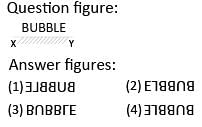
- a)2
- b)4
- c)3
- d)1
Correct answer is option 'C'. Can you explain this answer?
Which of the answer figures is exactly the mirror image of the given question figure when the mirror is held at XY?
a)
2
b)
4
c)
3
d)
1
| | Sudhir Mehta answered |

In the mirror image,
- The right side of the object becomes the left side
- The left side of the object becomes the right side
- The top and bottom sides of the object remain unchanged
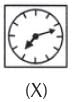
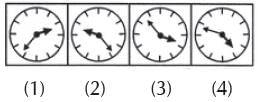

Chapter doubts & questions for Mirror Images - International Computer Science Olympiad for Class 3 2026 is part of Class 3 exam preparation. The chapters have been prepared according to the Class 3 exam syllabus. The Chapter doubts & questions, notes, tests & MCQs are made for Class 3 2026 Exam. Find important definitions, questions, notes, meanings, examples, exercises, MCQs and online tests here.
Chapter doubts & questions of Mirror Images - International Computer Science Olympiad for Class 3 in English & Hindi are available as part of Class 3 exam. Download more important topics, notes, lectures and mock test series for Class 3 Exam by signing up for free.
International Computer Science Olympiad for Class 323 videos|59 docs|64 tests |
