


All Exams > NEET > Biology CUET UG Mock Test Series 2026 > All Questions
All questions of Reproductive Health for NEET Exam

Which of the following is a technique of direct introduction of gametes into the oviduct?- a)ET
- b)IVF
- c)POST
- d)MTS
Correct answer is 'B'. Can you explain this answer?
Which of the following is a technique of direct introduction of gametes into the oviduct?
a)
ET
b)
IVF
c)
POST
d)
MTS
 | Keerthana Iyer answered |
The technique of direct introduction of gametes into oviduct is called GIFT (gamete intrafallopian transfer).
Which of the following birth control measures can be considered as the safest?- a)Termination of unwanted pregnancy
- b)The use of physical barriers
- c)Sterilisation techniques
- d)The rhythm method
Correct answer is 'C'. Can you explain this answer?
Which of the following birth control measures can be considered as the safest?
a)
Termination of unwanted pregnancy
b)
The use of physical barriers
c)
Sterilisation techniques
d)
The rhythm method
 | Sharvari Kuber answered |
In sterilisation method method, tubectomy or vasectomy is used in which the fallopian tube and vas deferens are cut respectively. This prevents the transfer of sperms in males and ova in females for fertilisation permanently. So this is the safest method.

Saheli was developed by scientists at _______ in India.- a)Indian Institute of Science
- b)Indian Institute of Technology
- c)Central Drug Research Institute
- d)Acropolis
Correct answer is option 'C'. Can you explain this answer?
Saheli was developed by scientists at _______ in India.
a)
Indian Institute of Science
b)
Indian Institute of Technology
c)
Central Drug Research Institute
d)
Acropolis
 | Snehal Khanna answered |
Saheli is a contraceptive pill that was developed by scientists at the Central Drug Research Institute in India. It is a non-steroidal contraceptive pill that is effective in preventing pregnancy.
Details:
• Saheli was developed in the 1980s by a team of scientists at the Central Drug Research Institute (CDRI) in Lucknow, India.
• The team was led by Dr. Pramila Srivastava.
• Saheli is a non-steroidal contraceptive pill that contains a compound called Centchroman.
• Centchroman is a selective estrogen receptor modulator (SERM) that acts as an anti-estrogen.
• It is effective in preventing pregnancy and has fewer side effects compared to other contraceptive pills.
• Saheli is also known as the "weekend pill" as it is taken only once a week.
• It has been approved for use in India and several other countries.
• Saheli is considered to be a breakthrough in contraceptive research and has been hailed as a safe and effective method of birth control for women.
Details:
• Saheli was developed in the 1980s by a team of scientists at the Central Drug Research Institute (CDRI) in Lucknow, India.
• The team was led by Dr. Pramila Srivastava.
• Saheli is a non-steroidal contraceptive pill that contains a compound called Centchroman.
• Centchroman is a selective estrogen receptor modulator (SERM) that acts as an anti-estrogen.
• It is effective in preventing pregnancy and has fewer side effects compared to other contraceptive pills.
• Saheli is also known as the "weekend pill" as it is taken only once a week.
• It has been approved for use in India and several other countries.
• Saheli is considered to be a breakthrough in contraceptive research and has been hailed as a safe and effective method of birth control for women.
Which one is not a sexually transmitted disease?- a)Syphilis
- b)AIDS
- c)Encephalitis
- d)Genital herpes
Correct answer is option 'C'. Can you explain this answer?
Which one is not a sexually transmitted disease?
a)
Syphilis
b)
AIDS
c)
Encephalitis
d)
Genital herpes
 | Rohan Singh answered |
Sexually transmitted diseases (STDs) comprise a diverse group that includes blood-borne diseases, sexually transmitted infections (STIs), and ulcerative lesions. Examples : Syphilis, Genital herpes, HIV /Aids
Encephalitis is an acute inflammation of the brain. The majority of cases are caused by either a viral infection or the immune system mistakenly attacking brain tissue.
Encephalitis is an acute inflammation of the brain. The majority of cases are caused by either a viral infection or the immune system mistakenly attacking brain tissue.
Which of the following contraceptive method is useful to control STD’s as well as unwanted pregnancy?- a)Tubectomy
- b)Condom
- c)Copper-T
- d)Oral pills
Correct answer is option 'B'. Can you explain this answer?
Which of the following contraceptive method is useful to control STD’s as well as unwanted pregnancy?
a)
Tubectomy
b)
Condom
c)
Copper-T
d)
Oral pills
 | Om Desai answered |
- Condoms are protective covering of penis that do not allow the passage of semen into vagina of female during sexual intercourse.
- This contracetive prevents the fusion of body fluid of male and female and protect from STDs.
Diaphragms are contraceptive devices used by females. Choose the correct option from the statements given below:
(i) They are introduced into the uterus.
(ii) They are placed to cover the cervical region.
(iii) They act as physical barriers for sperm entry.
(iv) They act as spermicidal agents.- a)(iii) and (iv)
- b)(i) and (ii)
- c)(i) and (iii)
- d)(ii) and (iii)
Correct answer is option 'D'. Can you explain this answer?
Diaphragms are contraceptive devices used by females. Choose the correct option from the statements given below:
(i) They are introduced into the uterus.
(ii) They are placed to cover the cervical region.
(iii) They act as physical barriers for sperm entry.
(iv) They act as spermicidal agents.
(i) They are introduced into the uterus.
(ii) They are placed to cover the cervical region.
(iii) They act as physical barriers for sperm entry.
(iv) They act as spermicidal agents.
a)
(iii) and (iv)
b)
(i) and (ii)
c)
(i) and (iii)
d)
(ii) and (iii)
 | Vanshika Rastogi answered |
Answer is Option D. Diaphragms ain't spermicidal Because it doesn't kill the sperms..instead prevents sperm entry as they are to be placed in the cervical region as a barrier / cover .
In ET technique the embryo is transferred into _________.- a)Always fallopian tube
- b)Always uterus
- c)Fallopian tube or uterus
- d)Ovary
Correct answer is option 'C'. Can you explain this answer?
In ET technique the embryo is transferred into _________.
a)
Always fallopian tube
b)
Always uterus
c)
Fallopian tube or uterus
d)
Ovary
 | Nikita Singh answered |
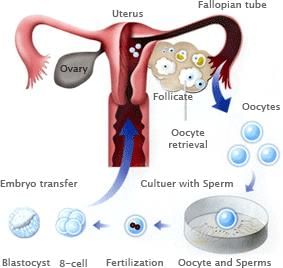
In ET (embryo transfer) technique, in vitro fertilized embryo is transferred into the fallopian tube or uterus for further development.
- In this type of technique, male and female gametes are fused outside the mother's body. It is used either when the male cannot produce enough sperms to fertilize the ovum or the females can not release ova for the purpose.
- After the embryo reaches 8 celled stages, known as the morula, it is transferred to the female fallopian tubule. If it is in the 16 celled stages, known as blastomere, it is transferred directly to the female uterus.
Embryo Transfer technique:
Hence, the correct option is C.
NCERT Reference: topic “INFERTILITY” of chapter: Reproductive Health of NCERT.
The technique involving the transfer of ovum of a donor female into the fallopian tube of a recipient female is called- a)GIFT
- b)IVF-ET
- c)IUT
- d)ZIFT
Correct answer is option 'A'. Can you explain this answer?
The technique involving the transfer of ovum of a donor female into the fallopian tube of a recipient female is called
a)
GIFT
b)
IVF-ET
c)
IUT
d)
ZIFT
 | Anjali Iyer answered |
Gamete Intrafallopian transfer (GIFT):
It is a technique that involves the transfer of gamete (ovum) from a donor into the fallopian tube of the recipient female who is unable to produce eggs, but has the ability to conceive and can provide right conditions for the development of an embryo.
1. Given below are four methods (A-D) and their modes of action (i) – (iv) in achieving contraception. Select their correct matching from the four options which follow.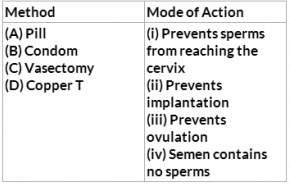
- a)A-(iii), B-(i), C-(iv), D-(ii)
- b)A-(iv), B-(i), C-(ii), D-(iii)
- c)A-(ii), B-(iii), C-(i), D-(iv)
- d)A-(iii), B-(iv), C-(i), D-(ii)
Correct answer is 'A'. Can you explain this answer?
1. Given below are four methods (A-D) and their modes of action (i) – (iv) in achieving contraception. Select their correct matching from the four options which follow.
a)
A-(iii), B-(i), C-(iv), D-(ii)
b)
A-(iv), B-(i), C-(ii), D-(iii)
c)
A-(ii), B-(iii), C-(i), D-(iv)
d)
A-(iii), B-(iv), C-(i), D-(ii)
 | New Words answered |
a) Most birth control pills are "combination pills" containing a mix of the hormones estrogen and progesterone to prevent ovulation.
b) A condom acts as a physical barrier that prevents sperm from entering the uterus and reaching an egg.
c) The testes still make sperm, but the sperm die and are absorbed by the body. A man who has had a vasectomy still makes semen and is able to ejaculate. But the semen doesn't contain sperm.
d) The copper IUD works by stopping the sperm and egg meeting and changing the lining of the uterus/womb. This makes it difficult for a fertilised egg to stick to the lining to start a pregnancy. When it is first inserted (put in) it starts working straight away to prevent pregnancy.
Identify mechanical contraceptive in figure below.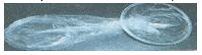
- a)Female condom
- b)Loop
- c)Cervical cap
- d)Male condom
Correct answer is option 'A'. Can you explain this answer?
Identify mechanical contraceptive in figure below.
a)
Female condom
b)
Loop
c)
Cervical cap
d)
Male condom
 | Ruchi Chopra answered |
Female condom is a mechanical contraceptive similar to condom used by male. It prevents the meeting of ovum with sperm as well as provide protection against STDs.
Indian population is_________________.- a)Mature population
- b)Young population
- c)Ageing population
- d)None of these
Correct answer is option 'B'. Can you explain this answer?
Indian population is_________________.
a)
Mature population
b)
Young population
c)
Ageing population
d)
None of these
 | Maya Gupta answered |
Lactational amenorrhea is a natural form of birth control that occurs when a woman is breastfeeding. It is caused by the hormones that are released during breastfeeding, which suppress ovulation. This means that women who are breastfeeding may not ovulate and therefore may not have a menstrual period for a period of time after giving birth.
Maximum Period after Parturition:
The maximum period after parturition during which lactational amenorrhea can prevent chances of fertilization is six months. After this time, the hormones that suppress ovulation begin to decrease, and the chances of ovulation and subsequent fertilization increase. Therefore, women who rely on lactational amenorrhea as a form of birth control should use another method of contraception after six months postpartum.
Effectiveness:
Lactational amenorrhea can be an effective form of birth control if certain conditions are met. These conditions include:
- The woman is exclusively breastfeeding, meaning that she is not giving the baby any other food or drink besides breast milk.
- The baby is less than six months old.
- The woman has not had a menstrual period since giving birth.
If these conditions are met, lactational amenorrhea can be up to 98% effective in preventing pregnancy. However, if any of these conditions change (for example, if the woman begins to supplement with formula or if the baby becomes older than six months), the effectiveness of lactational amenorrhea may decrease.
Conclusion:
In conclusion, lactational amenorrhea is a natural form of birth control that can be effective for up to six months postpartum. Women who rely on lactational amenorrhea as a form of birth control should be aware of its limitations and should use another form of contraception after the six-month period has ended.
Maximum Period after Parturition:
The maximum period after parturition during which lactational amenorrhea can prevent chances of fertilization is six months. After this time, the hormones that suppress ovulation begin to decrease, and the chances of ovulation and subsequent fertilization increase. Therefore, women who rely on lactational amenorrhea as a form of birth control should use another method of contraception after six months postpartum.
Effectiveness:
Lactational amenorrhea can be an effective form of birth control if certain conditions are met. These conditions include:
- The woman is exclusively breastfeeding, meaning that she is not giving the baby any other food or drink besides breast milk.
- The baby is less than six months old.
- The woman has not had a menstrual period since giving birth.
If these conditions are met, lactational amenorrhea can be up to 98% effective in preventing pregnancy. However, if any of these conditions change (for example, if the woman begins to supplement with formula or if the baby becomes older than six months), the effectiveness of lactational amenorrhea may decrease.
Conclusion:
In conclusion, lactational amenorrhea is a natural form of birth control that can be effective for up to six months postpartum. Women who rely on lactational amenorrhea as a form of birth control should be aware of its limitations and should use another form of contraception after the six-month period has ended.
Inability to conceive or produce children even after two years of unprotected sexual co-habitation is called?- a)Incapability
- b)Infertility
- c)Sterility
- d)Malfunction
Correct answer is option 'B'. Can you explain this answer?
Inability to conceive or produce children even after two years of unprotected sexual co-habitation is called?
a)
Incapability
b)
Infertility
c)
Sterility
d)
Malfunction
| | Rohan Singh answered |
Inability to conceive or produce children even after 2 years of unprotected sexual cohabitation is called infertility
Amniocentesis is a method to_________.- a)Detect genetic disorder
- b)Medical termination of pregnancy
- c)Fertilize the egg
- d)None of these
Correct answer is option 'A'. Can you explain this answer?
Amniocentesis is a method to_________.
a)
Detect genetic disorder
b)
Medical termination of pregnancy
c)
Fertilize the egg
d)
None of these
 | Akash Menon answered |
Amniocentesis is a prenatal diagnostic procedure that involves the removal of a small amount of amniotic fluid from the sac surrounding the fetus. This procedure is performed during the second trimester of pregnancy, typically between the 15th and 20th week.
Detection of Genetic Disorders:
The main purpose of amniocentesis is to detect genetic disorders in the developing fetus. The amniotic fluid contains cells shed by the fetus, which can be analyzed for chromosomal abnormalities or genetic mutations. This information can help parents and healthcare providers prepare for the birth of a child with a genetic disorder.
Procedure:
During the procedure, a thin needle is inserted through the belly into the amniotic sac, where a small amount of amniotic fluid is collected. The procedure is guided by ultrasound imaging to ensure that the needle is safely inserted and to monitor the fetus during the procedure. The collected fluid is then sent to a laboratory for analysis.
Risks:
Although amniocentesis is generally considered safe, there are some risks involved. These include a small risk of miscarriage or infection, as well as the possibility of injury to the fetus or mother during the procedure. However, the benefits of amniocentesis in detecting genetic disorders often outweigh these risks.
In conclusion, amniocentesis is a valuable tool for detecting genetic disorders during pregnancy, and it can help parents and healthcare providers make informed decisions about the care and treatment of the developing fetus.
Detection of Genetic Disorders:
The main purpose of amniocentesis is to detect genetic disorders in the developing fetus. The amniotic fluid contains cells shed by the fetus, which can be analyzed for chromosomal abnormalities or genetic mutations. This information can help parents and healthcare providers prepare for the birth of a child with a genetic disorder.
Procedure:
During the procedure, a thin needle is inserted through the belly into the amniotic sac, where a small amount of amniotic fluid is collected. The procedure is guided by ultrasound imaging to ensure that the needle is safely inserted and to monitor the fetus during the procedure. The collected fluid is then sent to a laboratory for analysis.
Risks:
Although amniocentesis is generally considered safe, there are some risks involved. These include a small risk of miscarriage or infection, as well as the possibility of injury to the fetus or mother during the procedure. However, the benefits of amniocentesis in detecting genetic disorders often outweigh these risks.
In conclusion, amniocentesis is a valuable tool for detecting genetic disorders during pregnancy, and it can help parents and healthcare providers make informed decisions about the care and treatment of the developing fetus.
From the sexually transmitted diseases mentioned below, identify the one which does not specifically affect the sex organs:- a)AIDS
- b)Genital warts
- c)Syphilis
- d)Gonorrhoea
Correct answer is option 'A'. Can you explain this answer?
From the sexually transmitted diseases mentioned below, identify the one which does not specifically affect the sex organs:
a)
AIDS
b)
Genital warts
c)
Syphilis
d)
Gonorrhoea
| | Rajeev Saxena answered |
Syphilis, gonorrhoea and genital warts as STD caused by Treponemapallidum ,Neisseria gonorrhoeae and human papilloma virus. These pathogens directly infectand damage sex organs causing ichting fluid discharge, slight pain and swelling of genitalia. AIDS (Acquired Immuno Deficiency Syndrome) is a set of symptoms caused by HIVvirus in humans. It is transmitted through sexual contacts from infected to healthy person. The HIV virus does not directly affect sex organs as such but produce other set of symptoms in the body of infected person.
In human female, menstruation can be deferred by the administration of______________.- a)Combination of estrogen and progesterone
- b)FSH only
- c)LH only
- d)Combination of FSH and LH
Correct answer is option 'A'. Can you explain this answer?
In human female, menstruation can be deferred by the administration of______________.
a)
Combination of estrogen and progesterone
b)
FSH only
c)
LH only
d)
Combination of FSH and LH
 | Gaurav Kumar answered |
Menstruation can be deferred by the administration of combination of hormone estrogen and progesterone. Follicle stimulating hormone and luteinizing hormone are produced during ovulation.
Identify the intra-uterine contraceptive device from the figure given below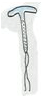
- a)Copper-T
- b)Loop
- c)LNG-20
- d)Progestasert
Correct answer is option 'A'. Can you explain this answer?
Identify the intra-uterine contraceptive device from the figure given below
a)
Copper-T
b)
Loop
c)
LNG-20
d)
Progestasert
| | Anchal Maurya answered |
This intra uterine device is Cu- T .read ncert
_________involve the transfer of embryo at 8-celled stage in the fallopian tube of female.- a)POST
- b)ZIFT
- c)IVF
- d)GIFT
Correct answer is option 'B'. Can you explain this answer?
_________involve the transfer of embryo at 8-celled stage in the fallopian tube of female.
a)
POST
b)
ZIFT
c)
IVF
d)
GIFT
| | Akanksha Das answered |
ZIFT (Zygote Intrafallopian Transfer) involves the transfer of an embryo at the 8-celled stage into the fallopian tube of a female. This is a type of assisted reproductive technology used to treat infertility.
Process of ZIFT:
The process of ZIFT involves the following steps:
1. Ovarian Stimulation: The female patient is given medication to stimulate the ovaries to produce multiple eggs.
2. Egg Retrieval: The eggs are retrieved from the ovaries using a needle guided by ultrasound.
3. Fertilization: The eggs are fertilized with sperm in a laboratory dish to create embryos.
4. Embryo Transfer: The embryos are transferred into the fallopian tube through a laparoscopic procedure.
5. Pregnancy Test: The patient is monitored for pregnancy through a blood test or ultrasound.
Advantages of ZIFT:
1. Higher Success Rates: ZIFT has higher success rates compared to traditional IVF methods.
2. Natural Implantation: The embryo is transferred into the fallopian tube, which is a natural environment for implantation, increasing the chances of pregnancy.
3. Fewer Multiple Pregnancies: ZIFT reduces the risk of multiple pregnancies compared to other assisted reproductive technologies.
Disadvantages of ZIFT:
1. Invasive Procedure: ZIFT requires a laparoscopic procedure, which is an invasive procedure that carries risks.
2. Limited Availability: ZIFT is not widely available in all fertility clinics.
3. Higher Cost: ZIFT is more expensive than traditional IVF methods.
Conclusion:
ZIFT is a type of assisted reproductive technology that involves transferring an embryo at the 8-celled stage into the fallopian tube of a female. It has higher success rates compared to traditional IVF methods and reduces the risk of multiple pregnancies. However, it is an invasive procedure that is not widely available and is more expensive than traditional IVF methods.
Process of ZIFT:
The process of ZIFT involves the following steps:
1. Ovarian Stimulation: The female patient is given medication to stimulate the ovaries to produce multiple eggs.
2. Egg Retrieval: The eggs are retrieved from the ovaries using a needle guided by ultrasound.
3. Fertilization: The eggs are fertilized with sperm in a laboratory dish to create embryos.
4. Embryo Transfer: The embryos are transferred into the fallopian tube through a laparoscopic procedure.
5. Pregnancy Test: The patient is monitored for pregnancy through a blood test or ultrasound.
Advantages of ZIFT:
1. Higher Success Rates: ZIFT has higher success rates compared to traditional IVF methods.
2. Natural Implantation: The embryo is transferred into the fallopian tube, which is a natural environment for implantation, increasing the chances of pregnancy.
3. Fewer Multiple Pregnancies: ZIFT reduces the risk of multiple pregnancies compared to other assisted reproductive technologies.
Disadvantages of ZIFT:
1. Invasive Procedure: ZIFT requires a laparoscopic procedure, which is an invasive procedure that carries risks.
2. Limited Availability: ZIFT is not widely available in all fertility clinics.
3. Higher Cost: ZIFT is more expensive than traditional IVF methods.
Conclusion:
ZIFT is a type of assisted reproductive technology that involves transferring an embryo at the 8-celled stage into the fallopian tube of a female. It has higher success rates compared to traditional IVF methods and reduces the risk of multiple pregnancies. However, it is an invasive procedure that is not widely available and is more expensive than traditional IVF methods.
Study of human population is called as?- a)Anthropology
- b)Sociology
- c)Ethnology
- d)Demography
Correct answer is option 'D'. Can you explain this answer?
Study of human population is called as?
a)
Anthropology
b)
Sociology
c)
Ethnology
d)
Demography
| | Shounak Chakraborty answered |
Preventing Transmission of STDs
Sexually transmitted diseases (STDs) are infections that are spread through sexual contact. The following measures can help in preventing the transmission of STDs:
Using Condoms during Intercourse
Using condoms is one of the most effective ways to prevent the transmission of STDs during sexual activity. Condoms act as a barrier and reduce the risk of infection. They should be used consistently and correctly to maximize their effectiveness.
Avoiding Sex with Multiple Partners
Having sex with multiple partners increases the risk of contracting STDs. Limiting sexual partners or being in a mutually monogamous relationship can decrease the risk of transmission.
Visiting a Qualified Doctor if Symptoms are Observed
If an individual experiences symptoms such as genital sores, abnormal discharge, or pain during urination, they should visit a qualified doctor. Early diagnosis and treatment can help prevent the spread of STDs.
Not Sharing Shaving Blades with Friends
Sharing personal items such as shaving blades, towels, or underwear can increase the risk of transmission of STDs. It is important to use personal items and avoid sharing them with others to prevent the spread of infection.
Conclusion
Preventing the transmission of STDs is crucial for maintaining sexual health. Using condoms, limiting sexual partners, seeking medical attention if symptoms are observed, and avoiding sharing personal items can all help decrease the risk of infection.
Sexually transmitted diseases (STDs) are infections that are spread through sexual contact. The following measures can help in preventing the transmission of STDs:
Using Condoms during Intercourse
Using condoms is one of the most effective ways to prevent the transmission of STDs during sexual activity. Condoms act as a barrier and reduce the risk of infection. They should be used consistently and correctly to maximize their effectiveness.
Avoiding Sex with Multiple Partners
Having sex with multiple partners increases the risk of contracting STDs. Limiting sexual partners or being in a mutually monogamous relationship can decrease the risk of transmission.
Visiting a Qualified Doctor if Symptoms are Observed
If an individual experiences symptoms such as genital sores, abnormal discharge, or pain during urination, they should visit a qualified doctor. Early diagnosis and treatment can help prevent the spread of STDs.
Not Sharing Shaving Blades with Friends
Sharing personal items such as shaving blades, towels, or underwear can increase the risk of transmission of STDs. It is important to use personal items and avoid sharing them with others to prevent the spread of infection.
Conclusion
Preventing the transmission of STDs is crucial for maintaining sexual health. Using condoms, limiting sexual partners, seeking medical attention if symptoms are observed, and avoiding sharing personal items can all help decrease the risk of infection.
Statement I: Ideal contraceptive should be easily available, effective, and reversible without no or least side effects.
Statement II: Condom is a barrier method of contraception that prevents from HIV infection also.
Statement III: Surgical method of contraception is reversible.- a)Statement only I is correct
- b)Statement I and II are correct
- c)Statement II and III are correct
- d)All statements are correct
Correct answer is option 'B'. Can you explain this answer?
Statement I: Ideal contraceptive should be easily available, effective, and reversible without no or least side effects.
Statement II: Condom is a barrier method of contraception that prevents from HIV infection also.
Statement III: Surgical method of contraception is reversible.
Statement II: Condom is a barrier method of contraception that prevents from HIV infection also.
Statement III: Surgical method of contraception is reversible.
a)
Statement only I is correct
b)
Statement I and II are correct
c)
Statement II and III are correct
d)
All statements are correct
 | Shruti Chauhan answered |
Ideal contraceptive should be easily available, effective and reversible without or least side effects. Condom is used to prevent unwanted pregnancy along with prevention against HIV infection. Surgical method of contraception is irreversible.
Which one of the following is the most widely accepted method of contraception in India at present?- a)Tubectomy
- b)Cervical caps
- c)Diaphragms
- d)IUDs (Intrauterine devices)
Correct answer is option 'D'. Can you explain this answer?
Which one of the following is the most widely accepted method of contraception in India at present?
a)
Tubectomy
b)
Cervical caps
c)
Diaphragms
d)
IUDs (Intrauterine devices)
 | Vijay Bansal answered |
Intra uterine device (IUD) is a method of contraception in India. The IUD is inserted in the woman’s uterus through the cervix.
Which period of menstrual cycle is called risky period of conception?- a)7th to 13th day
- b)17th to 25th day
- c)3rd to 7th day
- d)10th to 17th day
Correct answer is option 'D'. Can you explain this answer?
Which period of menstrual cycle is called risky period of conception?
a)
7th to 13th day
b)
17th to 25th day
c)
3rd to 7th day
d)
10th to 17th day
| | Akshara Choudhary answered |
The risky period of conception in the menstrual cycle is the ovulation period, which occurs around the 14th day of a 28-day menstrual cycle.
Explanation:
- Menstrual cycle is the regular natural change that occurs in the female reproductive system that makes pregnancy possible.
- The menstrual cycle is typically 28 days long, but can vary from 21 to 35 days.
- The cycle is divided into three phases: the follicular phase (days 1-14), ovulation (day 14), and the luteal phase (days 15-28).
- Ovulation is the process where an egg is released from the ovary and travels down the fallopian tube, where it can be fertilized by sperm.
- Ovulation typically occurs around day 14 of a 28-day menstrual cycle.
- The period around ovulation is considered the risky period of conception, as it is the time when the egg is available to be fertilized by sperm.
- Sperm can survive in the female reproductive tract for up to five days, so the fertile window for conception is actually the five days leading up to ovulation, as well as ovulation day itself.
- Therefore, the risky period of conception is considered to be from the 10th to the 17th day of the menstrual cycle (assuming a 28-day cycle).
Explanation:
- Menstrual cycle is the regular natural change that occurs in the female reproductive system that makes pregnancy possible.
- The menstrual cycle is typically 28 days long, but can vary from 21 to 35 days.
- The cycle is divided into three phases: the follicular phase (days 1-14), ovulation (day 14), and the luteal phase (days 15-28).
- Ovulation is the process where an egg is released from the ovary and travels down the fallopian tube, where it can be fertilized by sperm.
- Ovulation typically occurs around day 14 of a 28-day menstrual cycle.
- The period around ovulation is considered the risky period of conception, as it is the time when the egg is available to be fertilized by sperm.
- Sperm can survive in the female reproductive tract for up to five days, so the fertile window for conception is actually the five days leading up to ovulation, as well as ovulation day itself.
- Therefore, the risky period of conception is considered to be from the 10th to the 17th day of the menstrual cycle (assuming a 28-day cycle).
Induced abortion is also called- a)MTP
- b)PID
- c)SID
- d)IUD
Correct answer is option 'A'. Can you explain this answer?
Induced abortion is also called
a)
MTP
b)
PID
c)
SID
d)
IUD
| | Rajat Kapoor answered |
MTP is Medical Termination of Pregnancy. It also called induced abortion. It is the medical way of getting rid of unwanted pregnancy. Any qualified gynecologist (MD/DGO) can perform MTP. Any MBBS Doctor, who has obtained training in MTP, is allowed to perform this procedure. However, MTP should always be performed at a place recognized by government authorities.
A test-tube baby means a baby born when- a)It is developed by tissue culture method.
- b)The ovum is fertilised externally and thereafter implanted in the uterus.
- c)It is developed in a test tube
- d)It develops from a non-fertilised egg.
Correct answer is option 'B'. Can you explain this answer?
A test-tube baby means a baby born when
a)
It is developed by tissue culture method.
b)
The ovum is fertilised externally and thereafter implanted in the uterus.
c)
It is developed in a test tube
d)
It develops from a non-fertilised egg.
 | Jyoti Kapoor answered |
Test tube bay production involves two main steps - in vitro fertilization (IVF) and embryo transfer (ET). Historically the first attempt to produce the test tube baby was by an Italian scientise Petrucci (1959). In his experiment he removed an ovum from a patient and put it in the middle of spermatozoa in a glass dome. One of the sperms fertilized the egg and a small embryo formed, but this survived only for 29 days.
However Petrucci's experiment opened up a new horizon and a new hope for infertile parents. In recent years two British scientists Edwards and Steptoe have done pioneering work in the field of test tube babies. The first scientifically recorded test tube baby in the world was born on July 25 1978 and the baby girl was named Louise Joy Brown.
In our country the first recorded instane of a test tube baby was under the supervision of Dr. Indira Hinduja in KEM Hospital Bombay in 1986. Subsequently test tube babies have been reported by Dr. Baidyanath Chakravarthi of Calcutta.
What is the procedure for sterilization in males?- a)Vasectomy
- b)Tubectomy
- c)Decapitation
- d)Circumcision
Correct answer is option 'A'. Can you explain this answer?
What is the procedure for sterilization in males?
a)
Vasectomy
b)
Tubectomy
c)
Decapitation
d)
Circumcision
| | Riya Banerjee answered |
Vasectomy is the procedure used to sterilize males. It involves the removal of a part of vas deferens or it being tied up through an incision on the scrotum.
Absence of menstruation during period of intense lactation following parturition is called as?- a)Coitus interruption
- b)Mellitus
- c)Lactational amenorrhea
- d)Lactationalgonorrhea
Correct answer is option 'C'. Can you explain this answer?
Absence of menstruation during period of intense lactation following parturition is called as?
a)
Coitus interruption
b)
Mellitus
c)
Lactational amenorrhea
d)
Lactationalgonorrhea
 | Nilotpal Gupta answered |
During intense lactation just after the delivery the menstrual cycle get stopped and there is no chance of pregnancy. This absence of menstruation is called lactational amenorrhea.
Medical Termination of Pregnancy (MTP) is considered safe up to how many weeks of pregnancy?a)Six weeksb)Eight weeksc)Twelve weeksd)Eighteen weeksCorrect answer is option 'C'. Can you explain this answer?
a)Six weeks
b)Eight weeks
c)Twelve weeks
d)Eighteen weeks
Correct answer is option 'C'. Can you explain this answer?
| | Vijay Bansal answered |
Twelve weeks
Intentional or voluntary termination of pregnancy before full term is called medical termination of pregnancy (MTP) or induced abortion. MTPs are considered relatively safe during the first trimester, i.e., upto 12 weeks of pregnancy. Second trimseter abortions are much more risker.
Intentional or voluntary termination of pregnancy before full term is called medical termination of pregnancy (MTP) or induced abortion. MTPs are considered relatively safe during the first trimester, i.e., upto 12 weeks of pregnancy. Second trimseter abortions are much more risker.
Female hired to develop the in-vitro fertilized egg of another female to maturity is called?- a)Biological mother
- b)Step-mother
- c)Feeding mother
- d)Surrogate mother
Correct answer is option 'D'. Can you explain this answer?
Female hired to develop the in-vitro fertilized egg of another female to maturity is called?
a)
Biological mother
b)
Step-mother
c)
Feeding mother
d)
Surrogate mother
| | Awantika Gupta answered |
Surrogacy is a method that another female bears zygote of another fused gametes.
it is liagalised when mother can't provide proper environment for developing of embryo.
it is liagalised when mother can't provide proper environment for developing of embryo.
Which of the following is the correct reason for delivering sex education at schools?- a)Discouraging myths and misconceptions
- b)Encouraging rise in population
- c)Solve the issue of global warming
- d)Promote myths
Correct answer is option 'A'. Can you explain this answer?
Which of the following is the correct reason for delivering sex education at schools?
a)
Discouraging myths and misconceptions
b)
Encouraging rise in population
c)
Solve the issue of global warming
d)
Promote myths
| | Manoj Majumdar answered |
Importance of Sex Education in Schools
Sex education is a critical aspect of education that should be delivered in schools to help students understand human sexuality and sexual behavior. The correct reason for delivering sex education in schools is to discourage myths and misconceptions. Here are some of the reasons why sex education is necessary in schools:
1. Preventing Unwanted Pregnancies: Sex education helps students understand how to protect themselves from unintended pregnancies. It provides information on different contraceptive methods, their effectiveness, and how to use them correctly.
2. Preventing Sexually Transmitted Infections (STIs): Sex education helps students understand how to protect themselves from STIs. It provides information on how STIs are transmitted, their symptoms, and how to prevent them.
3. Encouraging Healthy Relationships: Sex education helps students understand the importance of healthy relationships. It provides information on how to build healthy relationships, how to communicate effectively, and how to recognize signs of an unhealthy relationship.
4. Reducing Sexual Violence: Sex education helps students understand the importance of consent and how to recognize sexual violence. It provides information on how to report sexual violence and where to seek help.
5. Overcoming Stigma: Sex education helps students overcome stigma and discrimination related to sexuality. It provides information on different sexual orientations and gender identities, and how to respect and accept diversity.
Conclusion
Sex education is an essential aspect of education that helps students make informed decisions about their sexual health and behavior. It provides information on how to protect themselves from unintended pregnancies, STIs, and sexual violence. It also encourages healthy relationships and respect for diversity. Therefore, it is necessary to deliver sex education in schools to discourage myths and misconceptions.
Sex education is a critical aspect of education that should be delivered in schools to help students understand human sexuality and sexual behavior. The correct reason for delivering sex education in schools is to discourage myths and misconceptions. Here are some of the reasons why sex education is necessary in schools:
1. Preventing Unwanted Pregnancies: Sex education helps students understand how to protect themselves from unintended pregnancies. It provides information on different contraceptive methods, their effectiveness, and how to use them correctly.
2. Preventing Sexually Transmitted Infections (STIs): Sex education helps students understand how to protect themselves from STIs. It provides information on how STIs are transmitted, their symptoms, and how to prevent them.
3. Encouraging Healthy Relationships: Sex education helps students understand the importance of healthy relationships. It provides information on how to build healthy relationships, how to communicate effectively, and how to recognize signs of an unhealthy relationship.
4. Reducing Sexual Violence: Sex education helps students understand the importance of consent and how to recognize sexual violence. It provides information on how to report sexual violence and where to seek help.
5. Overcoming Stigma: Sex education helps students overcome stigma and discrimination related to sexuality. It provides information on different sexual orientations and gender identities, and how to respect and accept diversity.
Conclusion
Sex education is an essential aspect of education that helps students make informed decisions about their sexual health and behavior. It provides information on how to protect themselves from unintended pregnancies, STIs, and sexual violence. It also encourages healthy relationships and respect for diversity. Therefore, it is necessary to deliver sex education in schools to discourage myths and misconceptions.
Which of the following is wrongly matched?- a)IUI - semen collected crom husband or donor is artificially introduced either into the vagina or into the uterus
- b)GIFT - transfer of embroys with more than 8 blastomers intothe Fallopian tube
- c)ICSI- sperm directily injected into the ovum
- d)ZIFT- transfer of embrys with upto 8 blastomeres into the Fallopian tube
Correct answer is option 'B'. Can you explain this answer?
Which of the following is wrongly matched?
a)
IUI - semen collected crom husband or donor is artificially introduced either into the vagina or into the uterus
b)
GIFT - transfer of embroys with more than 8 blastomers intothe Fallopian tube
c)
ICSI- sperm directily injected into the ovum
d)
ZIFT- transfer of embrys with upto 8 blastomeres into the Fallopian tube
 | Priya Menon answered |
GIFT (Gamete Intra Fallopian Transfer) is transfer of an ovum collected from a donor into the Fallopian tube of another female who cannot produce ovum but can provide proper environment for fertilization and further development.
Statement I: sperms and ovum are fertilized in laboratory condition to form zygote. If embryo is transferred up to 8 blastomeres, it is called zygote intra fallopian transfer(ZIFT).
Statement II: In intra uterine transfer, embryo more than 8 blastomeres are transferred to uterus.- a)Statement I is correct only
- b)Statement II is correct only
- c)Both statements are correct
- d)Both the statements are incorrect
Correct answer is option 'C'. Can you explain this answer?
Statement I: sperms and ovum are fertilized in laboratory condition to form zygote. If embryo is transferred up to 8 blastomeres, it is called zygote intra fallopian transfer(ZIFT).
Statement II: In intra uterine transfer, embryo more than 8 blastomeres are transferred to uterus.
Statement II: In intra uterine transfer, embryo more than 8 blastomeres are transferred to uterus.
a)
Statement I is correct only
b)
Statement II is correct only
c)
Both statements are correct
d)
Both the statements are incorrect
| | Aruna Devi answered |
Both the statements are correct . correct answer is (c)
What test is used to determine the sex of the fetus?- a)Amniocentesis
- b)Amyliodogenesis
- c)Amnionic
- d)Fluidic
Correct answer is option 'A'. Can you explain this answer?
What test is used to determine the sex of the fetus?
a)
Amniocentesis
b)
Amyliodogenesis
c)
Amnionic
d)
Fluidic
| | Suresh Iyer answered |
Fetal sex determination is based on the patterns of chromosomes in the amniotic fluid present around the embryo. Hence this test is called amniocentesis.
Contraceptive oral pills help in birth control by:- a)By preventing ovulation
- b)Killing the sperm
- c)Killing the ova
- d)Forming barrier between sperm and ova
Correct answer is option 'A'. Can you explain this answer?
Contraceptive oral pills help in birth control by:
a)
By preventing ovulation
b)
Killing the sperm
c)
Killing the ova
d)
Forming barrier between sperm and ova
| | Ankit Patel answered |
Oral contraceptive pills are a type of hormonal birth control method that contain synthetic versions of the hormones estrogen and progesterone. These hormones work together to prevent pregnancy in several ways:
Preventing Ovulation
- The primary way that contraceptive pills prevent pregnancy is by preventing ovulation. Ovulation is the process in which an egg is released from the ovary and can be fertilized by sperm. By taking the pill regularly, the hormones in the pill signal to the body that ovulation has already occurred, which prevents the release of an egg. Without an egg, there is no chance of fertilization and pregnancy cannot occur.
Thickening Cervical Mucus
- In addition to preventing ovulation, contraceptive pills also thicken the cervical mucus. The cervix is the opening at the bottom of the uterus that leads to the vagina. Normally, the cervical mucus is thin and watery, which allows sperm to swim through it and reach the egg. However, when a woman is taking contraceptive pills, the hormones in the pill cause the cervical mucus to thicken and become more viscous, making it more difficult for sperm to penetrate and reach the egg.
Altering the Uterine Lining
- Lastly, contraceptive pills can also alter the lining of the uterus. The lining of the uterus is where a fertilized egg implants and grows into a fetus. The hormones in the pill can change the lining of the uterus to make it less hospitable to a fertilized egg, making it less likely that a pregnancy will occur even if an egg is released and fertilized.
By working together in these ways, contraceptive pills are highly effective at preventing pregnancy when taken correctly and consistently.
Preventing Ovulation
- The primary way that contraceptive pills prevent pregnancy is by preventing ovulation. Ovulation is the process in which an egg is released from the ovary and can be fertilized by sperm. By taking the pill regularly, the hormones in the pill signal to the body that ovulation has already occurred, which prevents the release of an egg. Without an egg, there is no chance of fertilization and pregnancy cannot occur.
Thickening Cervical Mucus
- In addition to preventing ovulation, contraceptive pills also thicken the cervical mucus. The cervix is the opening at the bottom of the uterus that leads to the vagina. Normally, the cervical mucus is thin and watery, which allows sperm to swim through it and reach the egg. However, when a woman is taking contraceptive pills, the hormones in the pill cause the cervical mucus to thicken and become more viscous, making it more difficult for sperm to penetrate and reach the egg.
Altering the Uterine Lining
- Lastly, contraceptive pills can also alter the lining of the uterus. The lining of the uterus is where a fertilized egg implants and grows into a fetus. The hormones in the pill can change the lining of the uterus to make it less hospitable to a fertilized egg, making it less likely that a pregnancy will occur even if an egg is released and fertilized.
By working together in these ways, contraceptive pills are highly effective at preventing pregnancy when taken correctly and consistently.
The world population is ________- a)rising
- b)declining
- c)stabilized
- d)unpredictable
Correct answer is option 'A'. Can you explain this answer?
The world population is ________
a)
rising
b)
declining
c)
stabilized
d)
unpredictable
| | Riya Banerjee answered |
The global population is rising exponentially. It increased from 2 billion in 1900 to 6 billion in 2000 and has currently crossed 10 billion.
Directions: In the following questions a statement of assertion (A) is followed by a statement of reason (R). Mark the correct choice as:Assertion: Family planning is an action plan to attain reproductive health among people.Reason: Improved programmes covering reproduction related areas were propagated by RCH to create awareness among people.- a)Both assertion (A) and reason (R) are true and reason (R) is the correct explanation of assertion (A).
- b)Both assertion (A) and reason (R) are true but reason (R) is not the correct explanation of assertion (A).
- c)Assertion (A) is true but reason (R) is false.
- d)Assertion (A) is false but reason (R) is true.
Correct answer is option 'B'. Can you explain this answer?
Directions: In the following questions a statement of assertion (A) is followed by a statement of reason (R). Mark the correct choice as:
Assertion: Family planning is an action plan to attain reproductive health among people.
Reason: Improved programmes covering reproduction related areas were propagated by RCH to create awareness among people.
a)
Both assertion (A) and reason (R) are true and reason (R) is the correct explanation of assertion (A).
b)
Both assertion (A) and reason (R) are true but reason (R) is not the correct explanation of assertion (A).
c)
Assertion (A) is true but reason (R) is false.
d)
Assertion (A) is false but reason (R) is true.
| | Syed Aakif answered |
Ok
Saheli is______.- a)A surgical sterilization
- b)An oral contraceptive for females
- c)A diaphragm for females
- d)A diaphragm for male
Correct answer is option 'B'. Can you explain this answer?
Saheli is______.
a)
A surgical sterilization
b)
An oral contraceptive for females
c)
A diaphragm for females
d)
A diaphragm for male
 | Diya Datta answered |
Saheli is an oral contraceptive for females contain non-steroidal preparation. It is different from the other pills as it should be taken once in a week irrespective of daily in case of other pills.
Which of the following is not the correct reason for the use of MTP?- a)Get rid of unwanted pregnancy
- b)Terminate pregnancies that are fatal to mother
- c)Terminate pregnancies that are fatal to foetus
- d)Female foeticide
Correct answer is option 'D'. Can you explain this answer?
Which of the following is not the correct reason for the use of MTP?
a)
Get rid of unwanted pregnancy
b)
Terminate pregnancies that are fatal to mother
c)
Terminate pregnancies that are fatal to foetus
d)
Female foeticide
| | Hansa Sharma answered |
The purpose of MTP is to prevent an unwanted pregnancy that could have arisen due to casual unprotected coitus or incorrect use of contraceptive or due to rapes. They are also aimed at rescuing mothers from fatal pregnancies or from preventing parents from the shocks and expenses of a fatal fetus. They are not designed for female foeticide. Hence female foeticide has been illegalized by the Government of India.
Consider the following statements and select the option stating which ones are true (T) and which ones are false (F).
(i) Abortions could happen spontaneously too.
(ii) Infertility is the inability to produce viable offspring due to defects in the female partner only.
(iii) Complete lactation could help in contraception.
(iv) Creating awareness can help create a reproductively healthy society.- a)(i) F, (ii) F, (iii) T, (iv) - T
- b)(i) F, (ii) T, (iii) F, (iv) - T
- c)(i) T, (ii) F, (iii) T, (iv) - T
- d)(i) T, (ii) T, (iii) F, (iv) - F
Correct answer is option 'C'. Can you explain this answer?
Consider the following statements and select the option stating which ones are true (T) and which ones are false (F).
(i) Abortions could happen spontaneously too.
(ii) Infertility is the inability to produce viable offspring due to defects in the female partner only.
(iii) Complete lactation could help in contraception.
(iv) Creating awareness can help create a reproductively healthy society.
(i) Abortions could happen spontaneously too.
(ii) Infertility is the inability to produce viable offspring due to defects in the female partner only.
(iii) Complete lactation could help in contraception.
(iv) Creating awareness can help create a reproductively healthy society.
a)
(i) F, (ii) F, (iii) T, (iv) - T
b)
(i) F, (ii) T, (iii) F, (iv) - T
c)
(i) T, (ii) F, (iii) T, (iv) - T
d)
(i) T, (ii) T, (iii) F, (iv) - F
| | Meera Singh answered |
Abortions could occur spontaneously too. The reason for this could be any physiological problem in the mother or foetus or both. During complete lactation, there is no ovulation and thus chances of conceiving are nil or less during this period. Creating awareness about reproduction by audio-visual and print media, governmental and non-governmental agencies help in creating a reproductively healthy society. Infertility is the inability to produce viable offspring due to defects in either male or female or both the partners.
How many of the following are indicators of improved reproductive health of society?(a) More couples with larger families
(b) Better detection and cure of STIs
(c) Better post-natal care
(d) Increased number of medically assisted deliveries
(e) Increased IMR- a)One
- b)Three
- c)Four
- d)Five
Correct answer is option 'B'. Can you explain this answer?
How many of the following are indicators of improved reproductive health of society?
(a) More couples with larger families
(b) Better detection and cure of STIs
(c) Better post-natal care
(d) Increased number of medically assisted deliveries
(e) Increased IMR
(b) Better detection and cure of STIs
(c) Better post-natal care
(d) Increased number of medically assisted deliveries
(e) Increased IMR
a)
One
b)
Three
c)
Four
d)
Five
 | Mohit Rajpoot answered |
To determine which indicators reflect improved reproductive health, consider the following:
- (a) More couples with larger families: This is not an indicator of improved reproductive health, as larger family sizes can be associated with higher birth rates and potentially lower access to family planning resources.
- (b) Better detection and cure of STIs: Improved detection and treatment of sexually transmitted infections (STIs) are indicators of better reproductive health, as it enhances overall sexual health and reduces the spread of infections.
- (c) Better post-natal care: Enhanced post-natal care is a significant indicator of improved reproductive health, as it contributes to the health and well-being of both mothers and newborns.
- (d) Increased number of medically assisted deliveries: More medically assisted deliveries, such as those attended by trained professionals, indicate improved reproductive health as they contribute to safer childbirth practices.
- (e) Increased IMR (Infant Mortality Rate): An increased IMR indicates poorer reproductive health, as it reflects higher rates of infant deaths.
Thus, the indicators of improved reproductive health are (b), (c), and (d). Therefore, the correct option is Option 2: Three.
IUDs are small objects made up of plastic or copper that are inserted in the uterine cavity. Which of the following statements are correct about IUDs ?(a) IUDs decrease phagocytosis of sperm within the uterus.(b) The released copper ions suppress sperm motility.(c) IUDs do not make the cervix hostile to the sperm.(d) IUDs suppress the fertilization capacity of sperm.(e) The IUDs require surgical intervention for their insertion in the uterine cavity.- a)(a), (d) and (e) only
- b)(b) and (c) only
- c)(b) and (d) only
- d)(d) only
Correct answer is option 'C'. Can you explain this answer?
IUDs are small objects made up of plastic or copper that are inserted in the uterine cavity. Which of the following statements are correct about IUDs ?
(a) IUDs decrease phagocytosis of sperm within the uterus.
(b) The released copper ions suppress sperm motility.
(c) IUDs do not make the cervix hostile to the sperm.
(d) IUDs suppress the fertilization capacity of sperm.
(e) The IUDs require surgical intervention for their insertion in the uterine cavity.
a)
(a), (d) and (e) only
b)
(b) and (c) only
c)
(b) and (d) only
d)
(d) only
 | Ambition Institute answered |
The correct answer is C: (b) and (d) only.
- (b) The released copper ions suppress sperm motility: Copper IUDs release copper ions that are toxic to sperm, reducing their motility, which is crucial for fertilization prevention.
- (d) IUDs suppress the fertilization capacity of sperm: IUDs create an environment that hinders sperm survival and fertilization, contributing to their contraceptive effectiveness.
Therefore, these two statements accurately reflect the mechanisms by which IUDs function as contraceptives.
- (b) The released copper ions suppress sperm motility: Copper IUDs release copper ions that are toxic to sperm, reducing their motility, which is crucial for fertilization prevention.
- (d) IUDs suppress the fertilization capacity of sperm: IUDs create an environment that hinders sperm survival and fertilization, contributing to their contraceptive effectiveness.
Therefore, these two statements accurately reflect the mechanisms by which IUDs function as contraceptives.
Which two of the following statements are incorrect regarding in vitro fertilization?
(i) In this method, ova from the wife/donor female and sperms from the husband/donor male are induced to form zygote in the uterus.
(ii) If the embryo is having 2 blastomeres, it is transferred into the uterus.
(iii) If the embryo is with more than 8 blastomeres, it is transferred into the uterus.
(iv) The baby thus produced is called test tube baby.- a)(iii) and (iv)
- b)(i) and (ii)
- c)(ii) and (iii)
- d)(i) and (iv)
Correct answer is option 'B'. Can you explain this answer?
Which two of the following statements are incorrect regarding in vitro fertilization?
(i) In this method, ova from the wife/donor female and sperms from the husband/donor male are induced to form zygote in the uterus.
(ii) If the embryo is having 2 blastomeres, it is transferred into the uterus.
(iii) If the embryo is with more than 8 blastomeres, it is transferred into the uterus.
(iv) The baby thus produced is called test tube baby.
(i) In this method, ova from the wife/donor female and sperms from the husband/donor male are induced to form zygote in the uterus.
(ii) If the embryo is having 2 blastomeres, it is transferred into the uterus.
(iii) If the embryo is with more than 8 blastomeres, it is transferred into the uterus.
(iv) The baby thus produced is called test tube baby.
a)
(iii) and (iv)
b)
(i) and (ii)
c)
(ii) and (iii)
d)
(i) and (iv)
| | Priya Menon answered |
In-vitro fertilization technique essentially involves the fusion of ovum and sperm outside the body of the female. The zygote is allowed to develop in-vitro and embryo with 6-8 blastomere is transferred into the uterus. the baby thus developed is called test tube baby.
(i) In IVF, ova from the wife/donor female and sperm from the husband/donor male are induced to form zygote in the test-tube or in-vitro.
(ii) Embryo with 2 blastomeres is not transferred into the uterus. It is allowed to develop.
(iii) If the embryo has achieved 6-8 blastomeres, it is tranferred into the uterus for implantation.
(iv) The baby thus developed is called the test tube baby.
(i) In IVF, ova from the wife/donor female and sperm from the husband/donor male are induced to form zygote in the test-tube or in-vitro.
(ii) Embryo with 2 blastomeres is not transferred into the uterus. It is allowed to develop.
(iii) If the embryo has achieved 6-8 blastomeres, it is tranferred into the uterus for implantation.
(iv) The baby thus developed is called the test tube baby.
Which of the following birth control measures can be considered as the safest?- a)Termination of unwanted pregnancy
- b)The use of physical barriers
- c)Sterilisation techniques
- d)The rhythm method
Correct answer is option 'C'. Can you explain this answer?
Which of the following birth control measures can be considered as the safest?
a)
Termination of unwanted pregnancy
b)
The use of physical barriers
c)
Sterilisation techniques
d)
The rhythm method
 | Navya Banerjee answered |
In sterilisation method method, tubectomy or vasectomy is used in which the fallopian tube and vas deferens are cut respectively. This prevents the transfer of sperms in males and ova in females for fertilisation permanently. So this is the safest method.
Match the ARTs with their descriptionI. Collected gametes are made to form the zygote in the laboratory.
II. Zygote or early embryo with up to 8 blastomeres is transferred into the oviduct.
III. Zygote with more than 8 blastomeres is transferred into the uterus.
IV. Fusion of gametes within the female.
V. Transfer of ovum from a donor to the oviduct of the recipient.
VI. Sperm is injected into the ovum in-vitro.A. GIFT
B. ZIFT
C. AI
D. ICSI
E. IUT
F. IVF
G. IUI
H. In-vivo fertilization- a) I - G, II - B, III - F, IV - H, V - A, VI - D
- b) I - F, II - B, III - A, IV - H, V - A, VI - G
- c)I - F, II - B, III - E, IV - H, V - A, VI - D
- d)I - G, II - B, III - F, IV - H, V - C, VI - E
Correct answer is option 'C'. Can you explain this answer?
Match the ARTs with their description
I. Collected gametes are made to form the zygote in the laboratory.
II. Zygote or early embryo with up to 8 blastomeres is transferred into the oviduct.
III. Zygote with more than 8 blastomeres is transferred into the uterus.
IV. Fusion of gametes within the female.
V. Transfer of ovum from a donor to the oviduct of the recipient.
VI. Sperm is injected into the ovum in-vitro.
II. Zygote or early embryo with up to 8 blastomeres is transferred into the oviduct.
III. Zygote with more than 8 blastomeres is transferred into the uterus.
IV. Fusion of gametes within the female.
V. Transfer of ovum from a donor to the oviduct of the recipient.
VI. Sperm is injected into the ovum in-vitro.
A. GIFT
B. ZIFT
C. AI
D. ICSI
E. IUT
F. IVF
G. IUI
H. In-vivo fertilization
B. ZIFT
C. AI
D. ICSI
E. IUT
F. IVF
G. IUI
H. In-vivo fertilization
a)
I - G, II - B, III - F, IV - H, V - A, VI - D
b)
I - F, II - B, III - A, IV - H, V - A, VI - G
c)
I - F, II - B, III - E, IV - H, V - A, VI - D
d)
I - G, II - B, III - F, IV - H, V - C, VI - E
| | Ambition Institute answered |
- I - F (IVF): In vitro fertilization (IVF) involves the collection of gametes and their fertilization in the laboratory to form a zygote.
- II - B (ZIFT): Zygote intra-fallopian tube transfer (ZIFT) involves transferring a zygote or early embryo (up to 8 blastomeres) into the oviduct.
- III - E (IUT): Intrauterine transfer (IUT) involves transferring a zygote with more than 8 blastomeres into the uterus.
- IV - H (In-vivo fertilization): Fusion of gametes within the female, which is the natural process of fertilization.
- V - A (GIFT): Gamete intra-fallopian tube transfer (GIFT) involves transferring ovum from a donor to the oviduct of the recipient.
- VI - D (ICSI): Intracytoplasmic sperm injection (ICSI) involves injecting sperm directly into the ovum in vitro.
Thus, the correct match is: I - F, II - B, III - E, IV - H, V - A, VI - D.
Directions: In the following questions a statement of assertion (A) is followed by a statement of reason (R). Mark the correct choice as:Assertion: Rapid decline in death rate, MMR and IMR have lead to a staggering rise in population.Reason: Such an alarming growth rate has lead to an absolute scarcity of even the most basic requirements, i.e. food and shelter.- a)Both assertion (A) and reason (R) are true and reason (R) is the correct explanation of assertion (A).
- b)Both assertion (A) and reason (R) are true but reason (R) is not the correct explanation of assertion (A).
- c)Assertion (A) is true but reason (R) is false.
- d)Assertion (A) is false but reason (R) is true.
Correct answer is option 'B'. Can you explain this answer?
Directions: In the following questions a statement of assertion (A) is followed by a statement of reason (R). Mark the correct choice as:
Assertion: Rapid decline in death rate, MMR and IMR have lead to a staggering rise in population.
Reason: Such an alarming growth rate has lead to an absolute scarcity of even the most basic requirements, i.e. food and shelter.
a)
Both assertion (A) and reason (R) are true and reason (R) is the correct explanation of assertion (A).
b)
Both assertion (A) and reason (R) are true but reason (R) is not the correct explanation of assertion (A).
c)
Assertion (A) is true but reason (R) is false.
d)
Assertion (A) is false but reason (R) is true.
| | Sameer Roy answered |
Assertion and Reason:
Assertion: Rapid decline in death rate, MMR and IMR have led to a staggering rise in population.
Reason: Such an alarming growth rate has led to an absolute scarcity of even the most basic requirements, i.e. food and shelter.
Explanation:
The assertion states that the rapid decline in death rate, Maternal Mortality Rate (MMR), and Infant Mortality Rate (IMR) has led to a staggering rise in population. This assertion is true as a decline in death rate, MMR, and IMR implies that fewer people are dying, resulting in a higher population growth rate. When the death rate decreases, the number of individuals who survive and reproduce increases, leading to population growth.
The reason provided states that such an alarming growth rate has led to an absolute scarcity of even the most basic requirements, such as food and shelter. This reason is also true. With a rapid rise in population, the demand for resources like food and shelter increases significantly. If the supply of these basic requirements does not keep up with the growing population, scarcity can occur. The reason explains the consequences of the rapid population growth mentioned in the assertion.
Conclusion:
Both the assertion and the reason are true. The reason successfully explains the consequence of the rapid population growth mentioned in the assertion. Therefore, the correct choice is option 'B' - Both assertion (A) and reason (R) are true, but reason (R) is not the correct explanation of assertion (A).
Assertion: Rapid decline in death rate, MMR and IMR have led to a staggering rise in population.
Reason: Such an alarming growth rate has led to an absolute scarcity of even the most basic requirements, i.e. food and shelter.
Explanation:
The assertion states that the rapid decline in death rate, Maternal Mortality Rate (MMR), and Infant Mortality Rate (IMR) has led to a staggering rise in population. This assertion is true as a decline in death rate, MMR, and IMR implies that fewer people are dying, resulting in a higher population growth rate. When the death rate decreases, the number of individuals who survive and reproduce increases, leading to population growth.
The reason provided states that such an alarming growth rate has led to an absolute scarcity of even the most basic requirements, such as food and shelter. This reason is also true. With a rapid rise in population, the demand for resources like food and shelter increases significantly. If the supply of these basic requirements does not keep up with the growing population, scarcity can occur. The reason explains the consequences of the rapid population growth mentioned in the assertion.
Conclusion:
Both the assertion and the reason are true. The reason successfully explains the consequence of the rapid population growth mentioned in the assertion. Therefore, the correct choice is option 'B' - Both assertion (A) and reason (R) are true, but reason (R) is not the correct explanation of assertion (A).
Read the following text and answer the following questions on the basis of the same:Intrauterine devices are most widely accepted methods of contraception. These are used by females and are inserted by doctor or nurses in the uterus through vagina. However these devices are not recommended for those who eventually intend to conceive.Select the correct matched pair.- a)Hormone releasing IUD - LNG-20
- b)Non-medicated IUD - Progestasert
- c)Copper releasing IUD - Lippes loop
- d)None of these
Correct answer is option 'A'. Can you explain this answer?
Read the following text and answer the following questions on the basis of the same:
Intrauterine devices are most widely accepted methods of contraception. These are used by females and are inserted by doctor or nurses in the uterus through vagina. However these devices are not recommended for those who eventually intend to conceive.
Select the correct matched pair.
a)
Hormone releasing IUD - LNG-20
b)
Non-medicated IUD - Progestasert
c)
Copper releasing IUD - Lippes loop
d)
None of these
 | Dev Patel answered |
Lippes loop is a non-medicated IUD and progestasert is a hormone releasing IUD.
Read the following text and answer the following questions on the basis of the same:Lactational amenorrhea, is also called as postpartum infertility. It occurs when a women is not menstruating and fully breast feeding. It is a temporary family planning method. It is a contraceptive method where the mother is informed and supported in how to use breast feeding for contraception. As breast feeding delays the return of a mother’s ovulation (when the woman’s ovary releases an egg) and may make her infertile for six months or more.A procedure misused for female foeticide is :- a)Amniocentesis
- b)Parturition
- c)Lactational amenorrhea
- d)Artificial insemination
Correct answer is option 'A'. Can you explain this answer?
Read the following text and answer the following questions on the basis of the same:
Lactational amenorrhea, is also called as postpartum infertility. It occurs when a women is not menstruating and fully breast feeding. It is a temporary family planning method. It is a contraceptive method where the mother is informed and supported in how to use breast feeding for contraception. As breast feeding delays the return of a mother’s ovulation (when the woman’s ovary releases an egg) and may make her infertile for six months or more.
A procedure misused for female foeticide is :
a)
Amniocentesis
b)
Parturition
c)
Lactational amenorrhea
d)
Artificial insemination
| | Suresh Iyer answered |
Amniocentesis is the technique of sex determination of embryo in pregnancy using amnestic flied from mothers womb.
Read the following and answer the question given below:A 23 year old Sahil has been diagnosed with an infection of reproductive tract caused by bacteria. He complains about burning sensation during urination, pus-containing discharge and pain around genitalia. Ihis infection has incubation period of 2-5 days but can be cured.From which disease is Sahil suffering?- a)Chlamydiasis
- b)Herpes
- c)Gonorrhoea
- d)Syphilis
Correct answer is option 'C'. Can you explain this answer?
Read the following and answer the question given below:
A 23 year old Sahil has been diagnosed with an infection of reproductive tract caused by bacteria. He complains about burning sensation during urination, pus-containing discharge and pain around genitalia. Ihis infection has incubation period of 2-5 days but can be cured.
From which disease is Sahil suffering?
a)
Chlamydiasis
b)
Herpes
c)
Gonorrhoea
d)
Syphilis
| | Dev Patel answered |
Sahil is suffering from gonorrhoea, a sexually transmitted disease caused by an bacterium Neisseria gonorrhoeae.
Which of the following is a common restriction applied to Medical Termination of Pregnancy (MTP) in many jurisdictions?
Options:- a)MTP can only be performed in the first trimester of pregnancy, up to 12 weeks.
- b)MTP is permitted only if the pregnancy results from a consensual relationship.
- c)MTP must be carried out in government hospitals only.
- d)MTP is allowed up to 24 weeks of pregnancy if there are no health risks.
Correct answer is option 'A'. Can you explain this answer?
Options:
a)
MTP can only be performed in the first trimester of pregnancy, up to 12 weeks.
b)
MTP is permitted only if the pregnancy results from a consensual relationship.
c)
MTP must be carried out in government hospitals only.
d)
MTP is allowed up to 24 weeks of pregnancy if there are no health risks.
 | Infinity Academy answered |
Option A is a common restriction, as many jurisdictions restrict MTP to the first trimester (up to 12 weeks) due to lower risk and safety considerations.
Option B is incorrect because MTP can be permitted for various reasons beyond the nature of the relationship, especially when health risks are involved.
Option C is not universally applied; MTP can often be performed in both private and government hospitals, depending on local regulations.
Option D is incorrect as many jurisdictions restrict MTP to less than 24 weeks, with some exceptions for specific health reasons.
Thus, Option A is the most accurate reflection of common legal restrictions on MTP.
Option B is incorrect because MTP can be permitted for various reasons beyond the nature of the relationship, especially when health risks are involved.
Option C is not universally applied; MTP can often be performed in both private and government hospitals, depending on local regulations.
Option D is incorrect as many jurisdictions restrict MTP to less than 24 weeks, with some exceptions for specific health reasons.
Thus, Option A is the most accurate reflection of common legal restrictions on MTP.
Chapter doubts & questions for Reproductive Health - Biology CUET UG Mock Test Series 2026 2026 is part of NEET exam preparation. The chapters have been prepared according to the NEET exam syllabus. The Chapter doubts & questions, notes, tests & MCQs are made for NEET 2026 Exam. Find important definitions, questions, notes, meanings, examples, exercises, MCQs and online tests here.
Chapter doubts & questions of Reproductive Health - Biology CUET UG Mock Test Series 2026 in English & Hindi are available as part of NEET exam. Download more important topics, notes, lectures and mock test series for NEET Exam by signing up for free.
Biology CUET UG Mock Test Series 20264 docs|170 tests |
