


All Exams > NEET > Biology CUET UG Mock Test Series 2026 > All Questions
All questions of Evolution for NEET Exam
Fossils are generally found in:- a)Metamorphic rocks
- b)Igneous rocks
- c)Sedimentary rocks
- d)Any type of rock
Correct answer is option 'C'. Can you explain this answer?
Fossils are generally found in:
a)
Metamorphic rocks
b)
Igneous rocks
c)
Sedimentary rocks
d)
Any type of rock
 | Geetika Shah answered |
Fossils are generally found in sedimentary rocks.

Largest cranial capacity was found in : [CPMT 86]- a)Peking man
- b)Cro-magnon man
- c)Java man
- d)Neanderthal man
Correct answer is option 'D'. Can you explain this answer?
Largest cranial capacity was found in :
[CPMT 86]
a)
Peking man
b)
Cro-magnon man
c)
Java man
d)
Neanderthal man
 | Ritu Singh answered |
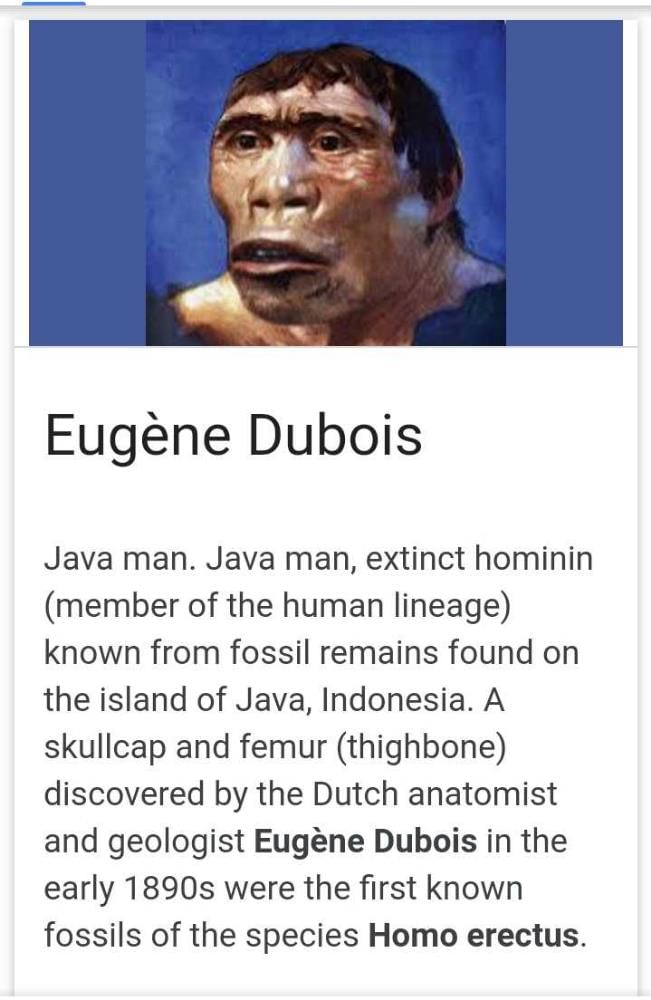
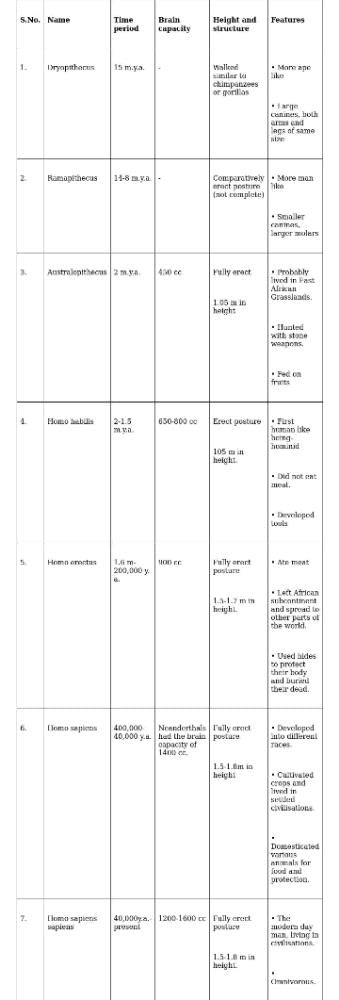
Largest cranial capacity was found in Neanderthal man.Cranial capacity of Peking man was 1000 cc to 1300 cc while that of Neanderthal man was 1350 to 1700 cm3. Java man and Cromagnon man had the cranial capacity of 900 cm3 and 1600 cm3 respectively.
Scientific name of man is :[CPMT 71, BHU 78]- a)Canis familiaris
- b)Homo habilis
- c)Homo erectus
- d)Homo sapiens
Correct answer is option 'D'. Can you explain this answer?
Scientific name of man is :
[CPMT 71, BHU 78]
a)
Canis familiaris
b)
Homo habilis
c)
Homo erectus
d)
Homo sapiens
 | Sathvika Tadri answered |
Scientific name of man is Homo sapiens
Tendrils in plants are an example of- a)Adaptive radiation
- b)Convergent evolution
- c)Divergent evolution
- d)Co-evolution
Correct answer is option 'C'. Can you explain this answer?
Tendrils in plants are an example of
a)
Adaptive radiation
b)
Convergent evolution
c)
Divergent evolution
d)
Co-evolution
 | Ayush Singh answered |
Yes answer should be convergent because no thorns were asked in ques tendrils are many types originating from leaf,stem,stipule which are different in origin
Which of the following orgn in man is not vestigial[CPMT 801]- a)Vermiform appendix
- b)Nictitating membrane
- c)Ear muscles
- d)Epiglottis
Correct answer is option 'D'. Can you explain this answer?
Which of the following orgn in man is not vestigial
[CPMT 801]
a)
Vermiform appendix
b)
Nictitating membrane
c)
Ear muscles
d)
Epiglottis
 | Gowshik.g answered |
Epiglottis.it prevents the entry of food in larynx.
Which of the following has homologous organs :[NCERT 78]- a)Hands of man, monkey and kangaroo and trunk of elephant
- b)Wings of insects, birds and bats
- c)Hindi limbs of grasshopper,horse and bat
- d)Mouthparts of cockroach, mosquito and honey bee
Correct answer is option 'D'. Can you explain this answer?
Which of the following has homologous organs :
[NCERT 78]
a)
Hands of man, monkey and kangaroo and trunk of elephant
b)
Wings of insects, birds and bats
c)
Hindi limbs of grasshopper,horse and bat
d)
Mouthparts of cockroach, mosquito and honey bee
 | Preeti Iyer answered |
The insects the mouth parts comprise labrum,mandibles and maxilla (representing similar origin and structure) but they have different functions.
Function of mouth in-
Cockroaches - biting and chewing
Honey bee - chewing and lapping
Mosquito - piercing and sucking.
Evidently,the same structure is developed along different divergent evolution and these structures are Homologous.
Function of mouth in-
Cockroaches - biting and chewing
Honey bee - chewing and lapping
Mosquito - piercing and sucking.
Evidently,the same structure is developed along different divergent evolution and these structures are Homologous.
Evolution is- a)Progressive development of race
- b)History of race
- c)History and development of a race along with variations
- d)Development of race
Correct answer is 'C'. Can you explain this answer?
Evolution is
a)
Progressive development of race
b)
History of race
c)
History and development of a race along with variations
d)
Development of race
| | Pooja Mehta answered |
The term evolution was coined by Herbert Spencer, an English philosopher which means unrolling or unfolding of nature that brings about an orderly change from one form or condition to another resulting in descendants becoming different from ancestors. Thus, it is history and development of race along with variations.
If a particular animal hs shelled eggs, hair and teats of the bodyand has cloaca, it may be a connecting link between- a)Reptiles and birds
- b)Birds and mammals
- c)Reptiles and mammals
- d)None of them
Correct answer is option 'C'. Can you explain this answer?
If a particular animal hs shelled eggs, hair and teats of the bodyand has cloaca, it may be a connecting link between
a)
Reptiles and birds
b)
Birds and mammals
c)
Reptiles and mammals
d)
None of them
| | Suresh Iyer answered |
Lycaenops was a mammal-like reptile. It is considered a missing link between reptiles and mammals. Laying shelled eggs is a characteristic of birds and reptiles. Having hair, teats on body and cloaca are characteristics of animals. So, particular animal has shelled eggs, hair and teats on the body and has cloaca, it may be a connecting link between reptiles and mammals. Thus, option C is correct and other options are wrong.
The probable first prehistoric man was: [CPMT 79] - a)Ramapithecus
- b)Homo habilis
- c)Australopithecus
- d)Zinjanthropus
Correct answer is option 'B'. Can you explain this answer?
The probable first prehistoric man was:
[CPMT 79]
a)
Ramapithecus
b)
Homo habilis
c)
Australopithecus
d)
Zinjanthropus
 | Pankaj Kulkarni answered |
Homo habilis is a proposed archaic (early) species of Homo which lived between roughly 2.1 and 1.5 million years ago, during the Gelasian (earliest period) and early Calabrian (geologic time scale) stages of the Pleistocene geological epoch (this period lasted from about 2,580,000 to 11,700 years ago).
Darwin judged the fitness of an individual by- a)Dominance over other individual
- b)Strategy to obtain food
- c)Ability to defend itself
- d)Number of offspring
Correct answer is option 'D'. Can you explain this answer?
Darwin judged the fitness of an individual by
a)
Dominance over other individual
b)
Strategy to obtain food
c)
Ability to defend itself
d)
Number of offspring
| | Rajeev Saxena answered |
Darwin realised that under the intense competition of members in a population, any variation which favoured survival in a particular environment would increase the individuals ability to reproduce and leave fertile offsprings. While less favourable variations decrease the chance of successful reproduction. Hence, Darwin judged the fitness of an individual by reproducing ability and the number of offsprings.
Which bird can not fly:[NCERT 77]- a)Stark
- b)penguins
- c)Duck
- d)Peacock
Correct answer is option 'B'. Can you explain this answer?
Which bird can not fly:
[NCERT 77]
a)
Stark
b)
penguins
c)
Duck
d)
Peacock
| | Palak Basu answered |
Penguins are birds that cannot fly, but are excellent swimmers, which is why they spend a lot of time in the water. Out of 18 penguin species, only 3 species live exclusively in Antarctica, while the rest are scattered in many places around the Southern Hemisphere
It is believed that the first organisms which inhabitated earth's surface were [MP PMT 01]- a)Autotrophs
- b)Mixotrophs
- c)Bacteria
- d)Chromatotrophs
Correct answer is option 'C'. Can you explain this answer?
It is believed that the first organisms which inhabitated earth's surface were
[MP PMT 01]
a)
Autotrophs
b)
Mixotrophs
c)
Bacteria
d)
Chromatotrophs
 | Srishti Shah answered |
The first organisms that inhabited Earth's surface were bacteria. This is supported by several lines of evidence.
Fossil Record:
The oldest fossils found on Earth are of bacteria-like organisms. These fossils date back to 3.5 billion years ago. These bacteria were anaerobic, which means that they did not require oxygen to survive.
Chemical Evidence:
The chemical composition of rocks that are 3.8 billion years old suggests that they were formed by bacteria. These rocks contain isotopes of carbon that are only produced by living organisms.
Evolutionary History:
Bacteria are the most ancient and diverse group of organisms on Earth. They have been evolving for billions of years and have adapted to almost every environment on the planet.
Autotrophs and Mixotrophs:
Autotrophs are organisms that can produce their own food using energy from the sun or from inorganic compounds. Mixotrophs are organisms that can switch between being autotrophic and heterotrophic (consuming other organisms for food). While these types of organisms are important in the history of life on Earth, they did not appear until much later in evolution.
Chromatotrophs:
Chromatotrophs are bacteria that use chemicals as their source of energy. While these types of bacteria are also ancient, they are not believed to be the first organisms on Earth.
In conclusion, the first organisms that inhabited Earth's surface were bacteria. They have been evolving for billions of years and have adapted to almost every environment on the planet.
Fossil Record:
The oldest fossils found on Earth are of bacteria-like organisms. These fossils date back to 3.5 billion years ago. These bacteria were anaerobic, which means that they did not require oxygen to survive.
Chemical Evidence:
The chemical composition of rocks that are 3.8 billion years old suggests that they were formed by bacteria. These rocks contain isotopes of carbon that are only produced by living organisms.
Evolutionary History:
Bacteria are the most ancient and diverse group of organisms on Earth. They have been evolving for billions of years and have adapted to almost every environment on the planet.
Autotrophs and Mixotrophs:
Autotrophs are organisms that can produce their own food using energy from the sun or from inorganic compounds. Mixotrophs are organisms that can switch between being autotrophic and heterotrophic (consuming other organisms for food). While these types of organisms are important in the history of life on Earth, they did not appear until much later in evolution.
Chromatotrophs:
Chromatotrophs are bacteria that use chemicals as their source of energy. While these types of bacteria are also ancient, they are not believed to be the first organisms on Earth.
In conclusion, the first organisms that inhabited Earth's surface were bacteria. They have been evolving for billions of years and have adapted to almost every environment on the planet.
According to abiogenesis life originates from ______.- a)Pre-exiting life
- b)Extra-terrestrial matter
- c)Non-living matter
- d)Chemicals
Correct answer is 'C'. Can you explain this answer?
According to abiogenesis life originates from ______.
a)
Pre-exiting life
b)
Extra-terrestrial matter
c)
Non-living matter
d)
Chemicals
 | Hansa Sharma answered |
According to abiogenesis theory of origin of life, life originated from non-living matter like gases, inorganic substance and water at particular temperature and pressure.
Life originated in which era : [CPMT 76]- a)Proterozoic
- b)Mesozoic
- c)Precambrian
- d)Coenozoic
Correct answer is option 'C'. Can you explain this answer?
Life originated in which era : [CPMT 76]
a)
Proterozoic
b)
Mesozoic
c)
Precambrian
d)
Coenozoic
 | Sandy Naaz answered |
The earliest undisputed evidence of life on Earth dates at least from 3.5billion years ago, during the Eoarchean Era, after a geological crust started to solidify following the earlier molten Hadean Eon.
Connecting link between annelida and mollusca : - a)Cuttle fish
- b)Octopus
- c)Neopilina
- d)Nautilus
Correct answer is option 'C'. Can you explain this answer?
Connecting link between annelida and mollusca :
a)
Cuttle fish
b)
Octopus
c)
Neopilina
d)
Nautilus
| | Prisha Bajaj answered |
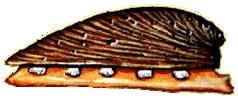
Neopilina is a connecting link between annelids and molluscans. It is the only segmented mollusc. It has a cup shaped shell like that of limpet. Its visceral mass is divided into five segments, each with a pair of shell muscles, gills, auricles, and nephidia.
Which charcter applies to Homo sapiens : [CPMT 81]- a)Opposable toe
- b)Large canine
- c)Cranial capacity 1450 cc
- d)Chin prominence absent
Correct answer is option 'C'. Can you explain this answer?
Which charcter applies to Homo sapiens :
[CPMT 81]
a)
Opposable toe
b)
Large canine
c)
Cranial capacity 1450 cc
d)
Chin prominence absent
 | Akhil George answered |
Homo sapiens ( meaning wise human)is considered to have a cranial capacity of 1350-1500cc. Cranial capacity is defined as the cubic capacity of the brain measured in the living by formula based on head measurements and for the skull by filling it with particulate material and measuring the volume of the latter.
Greatest advantage of bipeadal movement :[NCERT 71]- a)Fore arms becoming free for carrying out order of brain
- b)Greater speed
- c)Supports the body properly
- d)Loss of weight
Correct answer is option 'A'. Can you explain this answer?
Greatest advantage of bipeadal movement :
[NCERT 71]
a)
Fore arms becoming free for carrying out order of brain
b)
Greater speed
c)
Supports the body properly
d)
Loss of weight
| | Hitakshi Tamta answered |
Bipedalism is a form of terrestrial locomotion where an organism moves by means of its two rear limbs or legs. The greatest advantage of bipedal movement is forearms becoming free for carrying out order of brain. It also raises the head, this allows a greater field of vision with improved detection of distant dangers or resources, access to deeper water for wading animals and allows the animals to reach higher food sources with their mouths. So, the correct answer is option A.
- a)Geographical evolution
- b)Convergent evolution
- c)Divergent evolution
- d)Adaptive radiation
Correct answer is 'D'. Can you explain this answer?
| | Rajat Kapoor answered |
The diversification of an ancestral group into two or more species in different habitats is called divergent evolution. When this involves large number of species to occupy different ritches, this is called adaptive radiation. Adaptive radiation is the process of evolution of different species in a given geographical area starting from a species of animals or plants and literally radiating to other areas of geography (habitats). Darwin's finches represent one of best examples of this phenomenon. Australian marsupials are another example of adaptive radiation.
Dinosaurs are : [BHU 83]- a)Primitive amphinians
- b)Extinct reptiles
- c)Giant mammals
- d) Primitive mammals
Correct answer is option 'B'. Can you explain this answer?
Dinosaurs are :
[BHU 83]
a)
Primitive amphinians
b)
Extinct reptiles
c)
Giant mammals
d)
Primitive mammals
| | Kaneez Fatima answered |
Dinosaurs went extinct about 65 million years ago (at the end of the Cretaceous Period), after living on Earth for about 165 million years.
Which of the following organs in man is vestigial : [CPMT 77]- a)Pinna
- b)Wisdom tooth
- c)Fossa ovalis
- d)Ileum
Correct answer is option 'B'. Can you explain this answer?
Which of the following organs in man is vestigial : [CPMT 77]
a)
Pinna
b)
Wisdom tooth
c)
Fossa ovalis
d)
Ileum
 | Surya answered |
Vestigial organs means evidence for the evolution.. so as per the given option...wisdom teeth is the vestigial organ...so the option B is correct...
Dinosaurs originated : [CPMT 86]- a)After evolution of mammals
- b)With mammals
- c)Much before mammals
- d)Before mammals and they formed them
Correct answer is option 'B'. Can you explain this answer?
Dinosaurs originated : [CPMT 86]
a)
After evolution of mammals
b)
With mammals
c)
Much before mammals
d)
Before mammals and they formed them
| | Siddiq Zayeda answered |
Mammals appeared on the earth long before the extinction of the dinosaurs; in fact, dinosaurs and mammals originated within 10 million years of each other, in the late Triassic about 200 million years ago.........
Fossils are most commonly preserved in______.- a)Sedimentary rocks
- b)Igneous rocks
- c)Metamorphic rocks
- d)Any type of rock
Correct answer is option 'A'. Can you explain this answer?
Fossils are most commonly preserved in______.
a)
Sedimentary rocks
b)
Igneous rocks
c)
Metamorphic rocks
d)
Any type of rock
 | Prerana M N answered |
Sedimentary rocks are mostly involved in forming fossils, owing to the way in which they are formed.
Homologous organs have :[MP PMT 01]- a)Similar origin and similar or dissimilar functions
- b)Dissimilar origin and structure
- c)Dissimilar origin and function
- d)Dissimilar origin and similar functions
Correct answer is option 'A'. Can you explain this answer?
Homologous organs have :
[MP PMT 01]
a)
Similar origin and similar or dissimilar functions
b)
Dissimilar origin and structure
c)
Dissimilar origin and function
d)
Dissimilar origin and similar functions
| | Afifa Aaliya answered |
Organs such as bats of wings, wings of birds, seals of flippers, arms of humans have common underlying anatomy. That was present in last common Ancestors. forelimbs are homologous organs. homology refers to the traits inherited by two different organisms from common ancestry. so it has similar origin and different or similar functions.
So option " A " is correct answer.
So option " A " is correct answer.
Links between organisms that show branching pattern of evolutionary relationships are shown by- a)Phylogenetic trees
- b)Living fossils
- c)Comparative embryology
- d)Two fossil layers
Correct answer is option 'A'. Can you explain this answer?
Links between organisms that show branching pattern of evolutionary relationships are shown by
a)
Phylogenetic trees
b)
Living fossils
c)
Comparative embryology
d)
Two fossil layers
| | Krithika Kumar answered |
Phylogenetic trees are diagrams that show the evolutionary relationships between different organisms. They are used to display the branching pattern of evolutionary relationships between organisms. The diagram looks like a tree with branches that represent different groups of organisms. These branches are called clades, and they represent groups of organisms that have descended from a common ancestor.
Phylogenetic trees are constructed based on a variety of data, including:
1. Morphological characteristics: The physical features of organisms, such as their shape, size, and structure.
2. Molecular data: DNA and RNA sequences are used to compare the genetic makeup of different organisms.
3. Fossil records: The study of fossils provides evidence of the evolutionary history of organisms.
Phylogenetic trees are an important tool for understanding the relationships between organisms and how they have evolved over time. They can be used to answer questions about the origins of different species and how they are related to one another.
In conclusion, phylogenetic trees are diagrams that show the branching pattern of evolutionary relationships between organisms. They are constructed based on a variety of data, including morphological characteristics, molecular data, and fossil records. They are an important tool for understanding the evolutionary history of organisms.
Phylogenetic trees are constructed based on a variety of data, including:
1. Morphological characteristics: The physical features of organisms, such as their shape, size, and structure.
2. Molecular data: DNA and RNA sequences are used to compare the genetic makeup of different organisms.
3. Fossil records: The study of fossils provides evidence of the evolutionary history of organisms.
Phylogenetic trees are an important tool for understanding the relationships between organisms and how they have evolved over time. They can be used to answer questions about the origins of different species and how they are related to one another.
In conclusion, phylogenetic trees are diagrams that show the branching pattern of evolutionary relationships between organisms. They are constructed based on a variety of data, including morphological characteristics, molecular data, and fossil records. They are an important tool for understanding the evolutionary history of organisms.
By studying analogous structures we look for ______.- a)Similarities in appearance but differences in functions
- b)Similarities in appearance and function but different in structure
- c)Similarities in organ structure
- d)Similarities in cell make up
Correct answer is option 'B'. Can you explain this answer?
By studying analogous structures we look for ______.
a)
Similarities in appearance but differences in functions
b)
Similarities in appearance and function but different in structure
c)
Similarities in organ structure
d)
Similarities in cell make up
| | Usha Lakshmi answered |
Analogous structures are examples of convergent evolution that is evolution of structures from different organisms for the sake of similar functions. Thus analogous structures are those which perform similar function... but the basic origin is different. hope it helps you!!!
Mortality in babies is an example of ______- a)Stabilizing selection
- b)Directional selection
- c)Disruptive selection
- d)Abortion selection
Correct answer is option 'A'. Can you explain this answer?
Mortality in babies is an example of ______
a)
Stabilizing selection
b)
Directional selection
c)
Disruptive selection
d)
Abortion selection
 | Dhruba Mukherjee answered |
Mortality in babies is an example of Stabilizing selection.
Stabilizing Selection:
Stabilizing selection, also known as normalizing selection or purifying selection, is a type of natural selection that favors the average individuals in a population while selecting against extreme phenotypes. This type of selection reduces genetic diversity and maintains the status quo, resulting in a stable population over time.
Explanation:
In the case of mortality in babies, stabilizing selection is at play. Stabilizing selection occurs when the average individuals in a population have a higher fitness compared to individuals with extreme phenotypes. In this context, babies with average characteristics have a higher chance of survival compared to those with extreme characteristics.
Factors that contribute to baby mortality can include genetic abnormalities, birth defects, premature birth, low birth weight, maternal health issues, and environmental factors. Babies with extreme phenotypes, such as severe genetic abnormalities or extremely low birth weight, may have a lower chance of survival due to the increased risks associated with these conditions.
By favoring babies with average characteristics, stabilizing selection helps to maintain a stable population over time. This is because extreme phenotypes are more likely to be less fit and less likely to survive to reproductive age, reducing their contribution to future generations.
Stabilizing selection in the context of baby mortality helps to ensure that the average characteristics of the population are maintained and that genetic diversity is not significantly reduced. It acts as a natural mechanism to maintain the health and stability of the population by selecting against extreme phenotypes that may have a higher risk of mortality.
In conclusion, mortality in babies is an example of stabilizing selection because it favors average individuals in a population while selecting against extreme phenotypes, helping to maintain a stable population over time.
Stabilizing Selection:
Stabilizing selection, also known as normalizing selection or purifying selection, is a type of natural selection that favors the average individuals in a population while selecting against extreme phenotypes. This type of selection reduces genetic diversity and maintains the status quo, resulting in a stable population over time.
Explanation:
In the case of mortality in babies, stabilizing selection is at play. Stabilizing selection occurs when the average individuals in a population have a higher fitness compared to individuals with extreme phenotypes. In this context, babies with average characteristics have a higher chance of survival compared to those with extreme characteristics.
Factors that contribute to baby mortality can include genetic abnormalities, birth defects, premature birth, low birth weight, maternal health issues, and environmental factors. Babies with extreme phenotypes, such as severe genetic abnormalities or extremely low birth weight, may have a lower chance of survival due to the increased risks associated with these conditions.
By favoring babies with average characteristics, stabilizing selection helps to maintain a stable population over time. This is because extreme phenotypes are more likely to be less fit and less likely to survive to reproductive age, reducing their contribution to future generations.
Stabilizing selection in the context of baby mortality helps to ensure that the average characteristics of the population are maintained and that genetic diversity is not significantly reduced. It acts as a natural mechanism to maintain the health and stability of the population by selecting against extreme phenotypes that may have a higher risk of mortality.
In conclusion, mortality in babies is an example of stabilizing selection because it favors average individuals in a population while selecting against extreme phenotypes, helping to maintain a stable population over time.
Ancestor of man who first time showed bipedal movement [CPMT 80]- a)Cro-magnon
- b)Australopithecus
- c)Java apeman
- d)Peking man
Correct answer is option 'B'. Can you explain this answer?
Ancestor of man who first time showed bipedal movement
[CPMT 80]
a)
Cro-magnon
b)
Australopithecus
c)
Java apeman
d)
Peking man
| | Pooja Shah answered |
Bipedalism evolved well before the large human brain or the development of stone tools. Recent evidence regarding modern human sexual dimorphism (physical differences between male and female) in the lumbar spine has been seen in pre-modern primates such as Australopithecus africanus.

There are no life in which era :[CPMT 80]- a)Messozoic era
- b)Palaeozoic era
- c)Coenozoic era
- d)Azoic era
Correct answer is option 'D'. Can you explain this answer?
There are no life in which era :
[CPMT 80]
a)
Messozoic era
b)
Palaeozoic era
c)
Coenozoic era
d)
Azoic era
| | Ayeshashreya Mishra answered |
During Azoic era, the earth was with out plants and animals. The rock layers which were formed soon after azoic era contains the remains of limy sea plants.The word "Azoic" is derived from the Greek, a- meaning without and zoon meaning animal (or living being), it was first used to mean without life.....
An era ''age of birds and mammals'' is : [CPMT 93]- a)Mesozoic
- b)Palaecozoic
- c)Coenozoic
- d)Cretaceous
Correct answer is option 'C'. Can you explain this answer?
An era ''age of birds and mammals'' is : [CPMT 93]
a)
Mesozoic
b)
Palaecozoic
c)
Coenozoic
d)
Cretaceous
| | Afifa Aaliya answered |
The Cenozoic era is the most recent of the three major sub division of the animal history. The other two are the Mesozoic and Peliozoic eras. The Cenozoic era only about 65 million years. From the end of the Cretaceous period and the extension of non avian dinosaurs to the present. The Cenozoic is sometimes called as age of mammals because the largest land animals have been mammals during that time.
So option " C " is correct answer.
So option " C " is correct answer.
An inter-breeding population of finches became separated geographically, forming two isolated groups. Each group then became subject to different selective pressures. One group was then introduced into the habitat of the other. Which one of the following would determine whether they now formed two distinct species?- a)They had been separated for more than three million years
- b)They failed to produce fertile F1 hybrids
- c)They showed marked differences in the shape of their beaks
- d)Their plumage had become markedly different
Correct answer is option 'B'. Can you explain this answer?
An inter-breeding population of finches became separated geographically, forming two isolated groups. Each group then became subject to different selective pressures. One group was then introduced into the habitat of the other. Which one of the following would determine whether they now formed two distinct species?
a)
They had been separated for more than three million years
b)
They failed to produce fertile F1 hybrids
c)
They showed marked differences in the shape of their beaks
d)
Their plumage had become markedly different
 | Mira Joshi answered |
Once inter-breeding population of finches, now have failed to produce fertile F1 hybrids, this means they have now formed two distinct species.
If a starfish possess 6 arms instead of 5, it is an example of :[CPMT 84]- a)Variation
- b)Metamorphosis
- c)Biogenesis
- d)Evolution
Correct answer is option 'A'. Can you explain this answer?
If a starfish possess 6 arms instead of 5, it is an example of :
[CPMT 84]
a)
Variation
b)
Metamorphosis
c)
Biogenesis
d)
Evolution
| | Afifa Aaliya answered |
If a starfish possess 6 arms instead of 5 it's an example of variations. Because it is in difference between cells individual organisms of any species caused either genetic difference. Variations may show physical appearance, metabolism, fertility.., etc..,
So option " A " is correct answer.
So option " A " is correct answer.
Evolution of birds and mammals occurred in : [CPMT 83]- a)Eocene and oligocene periods
- b)Silurian and Devonian periods
- c)Carboniferous and Permain epochs
- d)Jurasic period
Correct answer is option 'D'. Can you explain this answer?
Evolution of birds and mammals occurred in :
[CPMT 83]
a)
Eocene and oligocene periods
b)
Silurian and Devonian periods
c)
Carboniferous and Permain epochs
d)
Jurasic period
| | Baishali Joshi answered |
The evolution of birds and mammals occurred in Jurassic period. The earliest birds were derived from a clade of theropod dinosaurs named paraves. Mammals evolved 10 times faster in the middle of the Jurassic period.
The mesozoic era of earth is called the : [CPMT 84]- a)Age of amphibians
- b)Age of armoured fishes
- c)Age of primitive man
- d)Age of ruling reptiles
Correct answer is option 'D'. Can you explain this answer?
The mesozoic era of earth is called the : [CPMT 84]
a)
Age of amphibians
b)
Age of armoured fishes
c)
Age of primitive man
d)
Age of ruling reptiles
 | Yamuna Mani answered |
Mesozoic era or middle life era is the life diversified rapidly and giant reptiles,dinosaurs and other monstrous beads roamed the earth. so it is called as age of reptiles era.
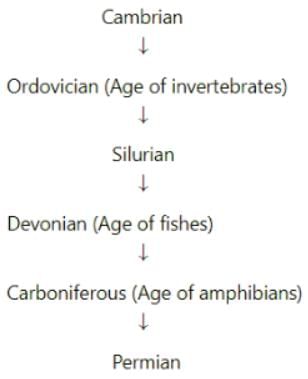
What is correct arrangement of periods of palaeozoic era in ascending order in geological time scale?- a)Cambrian → Devonian → Ordovician → Silurian → Carboniferous → Permian
- b)Cambrian → Ordovician → Silurian → Devonian → Carboniferous → Permian
- c)Cambrian → Ordovician Devonian → Silurian → Carboniferous → Permian
- d)Silurian → Devonian → Cambrian → Ordovician Permian → Carboniferous
Correct answer is option 'B'. Can you explain this answer?
What is correct arrangement of periods of palaeozoic era in ascending order in geological time scale?
a)
Cambrian → Devonian → Ordovician → Silurian → Carboniferous → Permian
b)
Cambrian → Ordovician → Silurian → Devonian → Carboniferous → Permian
c)
Cambrian → Ordovician Devonian → Silurian → Carboniferous → Permian
d)
Silurian → Devonian → Cambrian → Ordovician Permian → Carboniferous
 | Vivek Patel answered |
Palaezoic era is the era of ancient life and correct arrangement of periods in this era is:

Praying mantis is a good example of- a)Warning colouration
- b)Social insects
- c)Mullerianmimcry
- d)Camouflage
Correct answer is option 'D'. Can you explain this answer?
Praying mantis is a good example of
a)
Warning colouration
b)
Social insects
c)
Mullerianmimcry
d)
Camouflage
 | Stepway Academy answered |
Camouflage is a method to avoid predators from praying by mixing with surroundings. Praying mantis is an example of camouflage.
Connecting link between protozoa and one celled plants is : [CPMT 71, 72; NCERT 72]- a)Paramecium
- b)Euglena
- c)Amoeba
- d)Trypanosoma
Correct answer is option 'B'. Can you explain this answer?
Connecting link between protozoa and one celled plants is :
[CPMT 71, 72; NCERT 72]
a)
Paramecium
b)
Euglena
c)
Amoeba
d)
Trypanosoma
 | Atharva Goyal answered |
Connecting Link between Protozoa and One-Celled Plants: Euglena
Protozoa and one-celled plants are both types of single-celled organisms, but they belong to different biological groups. However, there is one organism that bridges the gap between these two groups and exhibits characteristics of both. That organism is Euglena.
Introduction to Protozoa and One-Celled Plants
Protozoa are unicellular organisms that belong to the animal kingdom. They are eukaryotic, meaning they have a well-defined nucleus and other membrane-bound organelles. Protozoa can be found in various habitats such as freshwater, marine environments, and soil. They play essential roles in the ecosystem as decomposers, predators, and parasites.
On the other hand, one-celled plants are unicellular organisms that belong to the plant kingdom. They are also eukaryotic and perform photosynthesis to produce their own food. One-celled plants, also known as algae, are found in diverse habitats such as freshwater, marine environments, and even in moist soil.
Characteristics of Euglena
Euglena is a unique organism that exhibits characteristics of both protozoa and one-celled plants. It possesses features of protozoa, such as the presence of a flexible cell membrane and the ability to move using whip-like structures called flagella. Euglena also has a nucleus and other membrane-bound organelles, similar to protozoa.
However, Euglena also shares traits with one-celled plants. It contains chloroplasts, which are responsible for photosynthesis, making it capable of producing its own food. Euglena can synthesize carbohydrates using sunlight, carbon dioxide, and water, just like one-celled plants.
Importance of Euglena
Euglena plays a significant role in aquatic ecosystems. It serves as a primary producer, carrying out photosynthesis to convert sunlight into organic compounds. This process releases oxygen into the water, contributing to the oxygen supply for other organisms. Euglena also serves as a food source for various organisms, including small aquatic animals.
Therefore, Euglena acts as a connecting link between protozoa and one-celled plants due to its ability to exhibit characteristics of both groups. Its presence highlights the evolutionary relationship between these two categories of single-celled organisms and provides insights into the diversity and complexity of life on Earth.
Protozoa and one-celled plants are both types of single-celled organisms, but they belong to different biological groups. However, there is one organism that bridges the gap between these two groups and exhibits characteristics of both. That organism is Euglena.
Introduction to Protozoa and One-Celled Plants
Protozoa are unicellular organisms that belong to the animal kingdom. They are eukaryotic, meaning they have a well-defined nucleus and other membrane-bound organelles. Protozoa can be found in various habitats such as freshwater, marine environments, and soil. They play essential roles in the ecosystem as decomposers, predators, and parasites.
On the other hand, one-celled plants are unicellular organisms that belong to the plant kingdom. They are also eukaryotic and perform photosynthesis to produce their own food. One-celled plants, also known as algae, are found in diverse habitats such as freshwater, marine environments, and even in moist soil.
Characteristics of Euglena
Euglena is a unique organism that exhibits characteristics of both protozoa and one-celled plants. It possesses features of protozoa, such as the presence of a flexible cell membrane and the ability to move using whip-like structures called flagella. Euglena also has a nucleus and other membrane-bound organelles, similar to protozoa.
However, Euglena also shares traits with one-celled plants. It contains chloroplasts, which are responsible for photosynthesis, making it capable of producing its own food. Euglena can synthesize carbohydrates using sunlight, carbon dioxide, and water, just like one-celled plants.
Importance of Euglena
Euglena plays a significant role in aquatic ecosystems. It serves as a primary producer, carrying out photosynthesis to convert sunlight into organic compounds. This process releases oxygen into the water, contributing to the oxygen supply for other organisms. Euglena also serves as a food source for various organisms, including small aquatic animals.
Therefore, Euglena acts as a connecting link between protozoa and one-celled plants due to its ability to exhibit characteristics of both groups. Its presence highlights the evolutionary relationship between these two categories of single-celled organisms and provides insights into the diversity and complexity of life on Earth.
Branch of biology which deals with fossils :[CPMT 75]- a)Ethology
- b)Ecology
- c)Palaeontology
- d)Ormitholgoy
Correct answer is option 'C'. Can you explain this answer?
Branch of biology which deals with fossils :
[CPMT 75]
a)
Ethology
b)
Ecology
c)
Palaeontology
d)
Ormitholgoy
| | Pooja Shah answered |
Paleontology is the branch of biology that studies the forms of life that existed in former geologic periods, mainly by studying fossils. It is the study of the history of life on earth, as reflected in the fossil record. Fossils are the remains or traces of organisms (plants, animals, fungi, bacteria and other single-celled living things) that lived in the geological past and are preserved in the crust of the earth.
Most recent man found as fossil was :[CPMT 73]- a)Java man
- b)Peking man
- c)Cro-magnon man
- d)Hiedelberg man
Correct answer is option 'C'. Can you explain this answer?
Most recent man found as fossil was :
[CPMT 73]
a)
Java man
b)
Peking man
c)
Cro-magnon man
d)
Hiedelberg man
 | Shreya Saini answered |
Most recent man found fossil was Cromagnon man. It lived during the upper Paleolithic period (40,000 to 10,000 years ago) in Europe. The fossils were discovered in 1868 in a shallow cave at Cro-Magnon in southwestern France. The body was generally heavy and solid, apparently with strong musculature. The forehead was straight, with slight brow ridges, and the face short and wide. Cro-Magnons were the first humans to have a prominent chin. The brain capacity was about 1,600 cc. So, option c is correct.
According to the Hardy-Weinberg principle, what condition indicates that evolution is occurring in a population?- a)Allele frequencies remain constant across generations.
- b)The frequency of homozygous dominant individuals equals p².
- c)Allele frequencies change due to factors like genetic drift or natural selection.
- d)The sum of p² + 2pq + q² equals 1 in all scenarios.
Correct answer is option 'C'. Can you explain this answer?
a)
Allele frequencies remain constant across generations.
b)
The frequency of homozygous dominant individuals equals p².
c)
Allele frequencies change due to factors like genetic drift or natural selection.
d)
The sum of p² + 2pq + q² equals 1 in all scenarios.
| | Nitya Menon answered |
Understanding the Hardy-Weinberg Principle
According to the Hardy-Weinberg principle, a population is in genetic equilibrium when specific conditions are met, resulting in constant allele frequencies across generations. However, if these conditions are violated, evolution is indicated.
Key Indicators of Evolution
- Allele Frequencies Change: The correct answer is option 'C', which states that allele frequencies change due to factors like genetic drift or natural selection. This change signifies that evolutionary processes are at work.
- Genetic Drift: Random fluctuations in allele frequencies can lead to significant changes in small populations, potentially resulting in evolution.
- Natural Selection: Differential survival and reproduction of individuals based on their phenotypic traits can alter allele frequencies over time, driving evolutionary change.
Other Options Explained
- Option A: This suggests that allele frequencies remain constant, which indicates that evolution is not occurring. This aligns with the Hardy-Weinberg equilibrium.
- Option B: The frequency of homozygous dominant individuals being equal to p² is a specific outcome of the Hardy-Weinberg equation but does not indicate evolution.
- Option D: The sum of p² + 2pq + q² equals 1 under Hardy-Weinberg equilibrium. This condition being satisfied does not imply evolution is occurring.
Conclusion
In summary, option 'C' accurately reflects that changes in allele frequencies due to mechanisms such as natural selection or genetic drift signify that evolution is occurring in a population. Understanding these concepts is crucial for interpreting population genetics and evolutionary biology.
According to the Hardy-Weinberg principle, a population is in genetic equilibrium when specific conditions are met, resulting in constant allele frequencies across generations. However, if these conditions are violated, evolution is indicated.
Key Indicators of Evolution
- Allele Frequencies Change: The correct answer is option 'C', which states that allele frequencies change due to factors like genetic drift or natural selection. This change signifies that evolutionary processes are at work.
- Genetic Drift: Random fluctuations in allele frequencies can lead to significant changes in small populations, potentially resulting in evolution.
- Natural Selection: Differential survival and reproduction of individuals based on their phenotypic traits can alter allele frequencies over time, driving evolutionary change.
Other Options Explained
- Option A: This suggests that allele frequencies remain constant, which indicates that evolution is not occurring. This aligns with the Hardy-Weinberg equilibrium.
- Option B: The frequency of homozygous dominant individuals being equal to p² is a specific outcome of the Hardy-Weinberg equation but does not indicate evolution.
- Option D: The sum of p² + 2pq + q² equals 1 under Hardy-Weinberg equilibrium. This condition being satisfied does not imply evolution is occurring.
Conclusion
In summary, option 'C' accurately reflects that changes in allele frequencies due to mechanisms such as natural selection or genetic drift signify that evolution is occurring in a population. Understanding these concepts is crucial for interpreting population genetics and evolutionary biology.
Which of the following evidences does not favour the Lamarckian concept of inheritance of acquired characters?- a)Lack of pigment in cave-dwelling animals
- b)Melanisation in peppered moth
- c)Absence of limbs in snakes
- d)Presence of webbed toes in aquatic birds
Correct answer is option 'B'. Can you explain this answer?
Which of the following evidences does not favour the Lamarckian concept of inheritance of acquired characters?
a)
Lack of pigment in cave-dwelling animals
b)
Melanisation in peppered moth
c)
Absence of limbs in snakes
d)
Presence of webbed toes in aquatic birds
| | Priya Menon answered |
According to Lamarckism (proposed by Lamarck), whatever characters an individual acquires in its life time due to internal vital force, effect of environment, new needs, use and disuse of organs, they are inherited to next generations. This process continues and after several generations, the variations are accumulated upto such an extent that they give rise to new species. Melanisation in peppered moth favours Darwin's theory of natural selection.
Evolution of different species in a given area starting from a point and spreading to other geographical areas is known as- a)Migration
- b)Divergent evolution
- c)Adaptive radiation
- d)Natural selection
Correct answer is option 'C'. Can you explain this answer?
Evolution of different species in a given area starting from a point and spreading to other geographical areas is known as
a)
Migration
b)
Divergent evolution
c)
Adaptive radiation
d)
Natural selection
| | Mansi Deshpande answered |
Adaptive Radiation:
Adaptive radiation is the evolution of different species in a given area starting from a point and spreading to other geographical areas. It is a type of divergent evolution that occurs when a single ancestral species evolves into many different species to adapt to different ecological niches. The term "adaptive radiation" was coined by the American evolutionary biologist Henry Fairfield Osborn in 1897.
Factors that contribute to adaptive radiation:
1. Ecological opportunity: When new habitats or resources become available, organisms can exploit them and evolve to fill new niches.
2. Morphological innovation: Morphological innovation can allow organisms to exploit new resources or habitats.
3. Competition: Competition for resources can drive organisms to evolve different adaptations, leading to adaptive radiation.
Examples of adaptive radiation:
1. Darwin's finches: The Galápagos Islands are home to a number of different finch species that evolved from a common ancestor. Each species has a specialized beak that allows it to feed on different types of food.
2. Hawaiian honeycreepers: The Hawaiian Islands are home to a diverse group of birds known as honeycreepers. These birds evolved from a single ancestral species and have adapted to different ecological niches on the islands.
3. Australian marsupials: Australia is home to a number of different marsupial species that evolved from a common ancestor. These marsupials have adapted to different ecological niches, such as the kangaroo, koala, and Tasmanian devil.
Conclusion:
Adaptive radiation is an important process in the evolution of new species. It allows organisms to adapt to new environments and resources and can lead to the development of new ecological niches. The study of adaptive radiation can provide insights into the mechanisms of evolution and the factors that contribute to biodiversity.
Adaptive radiation is the evolution of different species in a given area starting from a point and spreading to other geographical areas. It is a type of divergent evolution that occurs when a single ancestral species evolves into many different species to adapt to different ecological niches. The term "adaptive radiation" was coined by the American evolutionary biologist Henry Fairfield Osborn in 1897.
Factors that contribute to adaptive radiation:
1. Ecological opportunity: When new habitats or resources become available, organisms can exploit them and evolve to fill new niches.
2. Morphological innovation: Morphological innovation can allow organisms to exploit new resources or habitats.
3. Competition: Competition for resources can drive organisms to evolve different adaptations, leading to adaptive radiation.
Examples of adaptive radiation:
1. Darwin's finches: The Galápagos Islands are home to a number of different finch species that evolved from a common ancestor. Each species has a specialized beak that allows it to feed on different types of food.
2. Hawaiian honeycreepers: The Hawaiian Islands are home to a diverse group of birds known as honeycreepers. These birds evolved from a single ancestral species and have adapted to different ecological niches on the islands.
3. Australian marsupials: Australia is home to a number of different marsupial species that evolved from a common ancestor. These marsupials have adapted to different ecological niches, such as the kangaroo, koala, and Tasmanian devil.
Conclusion:
Adaptive radiation is an important process in the evolution of new species. It allows organisms to adapt to new environments and resources and can lead to the development of new ecological niches. The study of adaptive radiation can provide insights into the mechanisms of evolution and the factors that contribute to biodiversity.
Galapagos islands are connected with which scientist : [BHU 80]- a)Wallace
- b)Lamarck
- c)Malthus
- d)Darwin
Correct answer is option 'D'. Can you explain this answer?
Galapagos islands are connected with which scientist :
[BHU 80]
a)
Wallace
b)
Lamarck
c)
Malthus
d)
Darwin
| | Nayanika Patel answered |
The name of Charles Darwin and his famous book The Origin of Species will forever be linked with the Galapagos Islands. Although he was only in the Galapagos for five weeks in 1835, it was the wildlife that he saw there that inspired him to develop his Theory of Evolution.
Theory of evolution is mainly concerend with : [CPMT 73]- a)Spontaneous generation
- b)Theory of special creation
- c)Gradual change
- d)Conditions of environment
Correct answer is option 'C'. Can you explain this answer?
Theory of evolution is mainly concerend with : [CPMT 73]
a)
Spontaneous generation
b)
Theory of special creation
c)
Gradual change
d)
Conditions of environment
| | Shalini Chauhan answered |
The Theory of Evolution
The theory of evolution is a fundamental concept in biology that explains the diversity of life on Earth. It describes how species change over time through gradual processes, primarily driven by natural selection and genetic variation.
Key Concepts of the Theory of Evolution:
- Gradual Change:
Evolution posits that species undergo gradual changes over long periods. These changes accumulate, leading to the emergence of new species from common ancestors.
- Natural Selection:
A mechanism proposed by Charles Darwin, natural selection suggests that individuals with favorable traits are more likely to survive and reproduce. This process results in the adaptation of species to their environments.
- Genetic Variation:
Genetic diversity within populations provides the raw material for evolution. Mutations, gene flow, and sexual reproduction contribute to this variation, allowing populations to adapt to changing environments.
- Common Descent:
The theory also posits that all living organisms share a common ancestor. Over time, species diverge and evolve into different forms, leading to the rich diversity of life we observe today.
Conclusion:
In summary, the theory of evolution is mainly concerned with gradual change driven by natural selection, genetic variation, and common descent. Unlike spontaneous generation or the theory of special creation, which propose alternative explanations for the origin of life, the theory of evolution provides a scientific framework for understanding how life adapts and evolves over time.
The theory of evolution is a fundamental concept in biology that explains the diversity of life on Earth. It describes how species change over time through gradual processes, primarily driven by natural selection and genetic variation.
Key Concepts of the Theory of Evolution:
- Gradual Change:
Evolution posits that species undergo gradual changes over long periods. These changes accumulate, leading to the emergence of new species from common ancestors.
- Natural Selection:
A mechanism proposed by Charles Darwin, natural selection suggests that individuals with favorable traits are more likely to survive and reproduce. This process results in the adaptation of species to their environments.
- Genetic Variation:
Genetic diversity within populations provides the raw material for evolution. Mutations, gene flow, and sexual reproduction contribute to this variation, allowing populations to adapt to changing environments.
- Common Descent:
The theory also posits that all living organisms share a common ancestor. Over time, species diverge and evolve into different forms, leading to the rich diversity of life we observe today.
Conclusion:
In summary, the theory of evolution is mainly concerned with gradual change driven by natural selection, genetic variation, and common descent. Unlike spontaneous generation or the theory of special creation, which propose alternative explanations for the origin of life, the theory of evolution provides a scientific framework for understanding how life adapts and evolves over time.
Cranial capacity of Cro-magnon man was :- a)900 cc
- b)1075 cc
- c)1450 cc
- d)1600 cc
Correct answer is option 'D'. Can you explain this answer?
Cranial capacity of Cro-magnon man was :
a)
900 cc
b)
1075 cc
c)
1450 cc
d)
1600 cc
 | User4284711 answered |
Cranial capacity of cro- magnan man is 1600-1650cc.. cranial capacity of neanderthal man is 1300-1450cc..
cranial capacity of Homo erectus is 600-700cc..
cranial capacity of modern man is 1200-1600cc..
cranial capacity of Homo habilis is 735cc...
cranial capacity of Homo erectus is 600-700cc..
cranial capacity of modern man is 1200-1600cc..
cranial capacity of Homo habilis is 735cc...
Wings of locust, pigeon, and bat are example of :[CPMT 84]- a)Vestigial organs
- b)Analogous organs
- c)Homologous organs
- d)Evolution
Correct answer is option 'B'. Can you explain this answer?
Wings of locust, pigeon, and bat are example of :
[CPMT 84]
a)
Vestigial organs
b)
Analogous organs
c)
Homologous organs
d)
Evolution
 | Jyoti Sengupta answered |
The organs which have different embryonic origin but perform same function are called as analogous organs, e.g., wings of bat and insects. The organs which have same embryonic origin but adapted to perform different functions are known as homologous organs, e.g., wing of bat and forelimb of humans.
Chapter doubts & questions for Evolution - Biology CUET UG Mock Test Series 2026 2026 is part of NEET exam preparation. The chapters have been prepared according to the NEET exam syllabus. The Chapter doubts & questions, notes, tests & MCQs are made for NEET 2026 Exam. Find important definitions, questions, notes, meanings, examples, exercises, MCQs and online tests here.
Chapter doubts & questions of Evolution - Biology CUET UG Mock Test Series 2026 in English & Hindi are available as part of NEET exam. Download more important topics, notes, lectures and mock test series for NEET Exam by signing up for free.
Biology CUET UG Mock Test Series 20264 docs|170 tests |
