


All Exams > NEET > Biology CUET UG Mock Test Series 2026 > All Questions
All questions of Biotechnology & its Applications for NEET Exam
First fermented acid is :- a)Gluconic acid
- b) Lactic acid
- c)Fumaric acid
- d)All the above
Correct answer is option 'B'. Can you explain this answer?
First fermented acid is :
a)
Gluconic acid
b)
Lactic acid
c)
Fumaric acid
d)
All the above
| | Santunu Pradhan answered |
Lactic acid, fermented from bacillus lactii. It is the first fermented acid.

Genetically engineered bacteria have been used in commercial production of- a)Thyroxine
- b)Testosterone
- c)Human insulin
- d)Melatonium
Correct answer is option 'C'. Can you explain this answer?
Genetically engineered bacteria have been used in commercial production of
a)
Thyroxine
b)
Testosterone
c)
Human insulin
d)
Melatonium
| | Kadambala Hemalatha answered |
E coli is mainly used in biotechnology for the production of insulin. this artificially produced insulin is calld humulin.
The American company which is involved in the manufacturing of Humulin is- a)Elixir
- b)Ranbaxy
- c)Prohealth
- d)Eli Lily
Correct answer is option 'D'. Can you explain this answer?
The American company which is involved in the manufacturing of Humulin is
a)
Elixir
b)
Ranbaxy
c)
Prohealth
d)
Eli Lily
 | Harshitha Dey answered |
In 1983, the American company Eli Lily prepared two DNA sequences corresponding to A and B and introduced into plasmid of E.coli to produce insulin chain.
Conversion of sugar into alcohol during fermentation is due to the direct action of- a)Temperature
- b)Microorganisms
- c)Zymase
- d)Concentration of sugar solution
Correct answer is option 'C'. Can you explain this answer?
Conversion of sugar into alcohol during fermentation is due to the direct action of
a)
Temperature
b)
Microorganisms
c)
Zymase
d)
Concentration of sugar solution
| | Priyanshu Kumar answered |
Zymase is the enzyme which changes the simple sugars, dextrose and fructose into carbon dioxide gas and alcohol at 370C, and several esters which result in producing the unique aroma flavor and taste of bread.
Sugar or starch is used as the carbohydrate source. Zymase is the enzyme found in yeast and some bacteria.
* that why option """c""" is correct
Sugar or starch is used as the carbohydrate source. Zymase is the enzyme found in yeast and some bacteria.
* that why option """c""" is correct
Which one of the microorganism is used for production of citric acid in industries ?- a)Lactobacillus bulgaricus
- b)Penicillium citrinum
- c)Aspergillus niger
- d)Rhizopus nigricans
Correct answer is option 'C'. Can you explain this answer?
Which one of the microorganism is used for production of citric acid in industries ?
a)
Lactobacillus bulgaricus
b)
Penicillium citrinum
c)
Aspergillus niger
d)
Rhizopus nigricans
 | Vivek Patel answered |
Microorganisms can produce citric acid. The fungus Aspergillus Niger is most commonly used for industrial production of citric acid. The other organisms (although less important) include A. clavatus, A. wentii, Penicillium luteum, Candida catenula, C. guilliermondii and Corynebacterium sp.
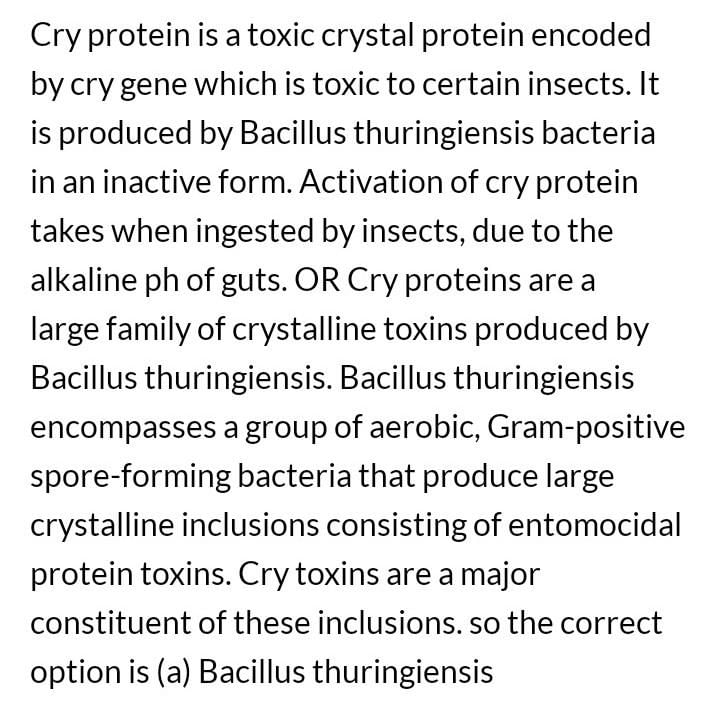
The term antibiotic was coined by- a)Alexander Fleming
- b)S.Waksman
- c)Louis Pasteur
- d)Edward Jenner
Correct answer is option 'B'. Can you explain this answer?
The term antibiotic was coined by
a)
Alexander Fleming
b)
S.Waksman
c)
Louis Pasteur
d)
Edward Jenner
| | Sanjana Singh answered |
Selman Waksman, the microbiologist who discovered streptomycin , first used the word 'Antibiotic' in medical in 1943.
So, the Correct answers is 'Waksman'.
So, the Correct answers is 'Waksman'.

The bacteria generally used for genetic engineering is - a)Agro bacterium
- b)Bacillus
- c)Pseudomonas
- d)Clostridium
Correct answer is option 'A'. Can you explain this answer?
The bacteria generally used for genetic engineering is
a)
Agro bacterium
b)
Bacillus
c)
Pseudomonas
d)
Clostridium
| | Ananya Singh answered |
The two most important bacterias are E.coli (which is used for commercial production) and Agrobacterium i.e. agrobacterium tumifaciens.
Agrobacterium has T. DNA which is transferred in host cells. That's why this bacteria is called as natural genetic engineer which is generally used for genetic engineering.
Agrobacterium has T. DNA which is transferred in host cells. That's why this bacteria is called as natural genetic engineer which is generally used for genetic engineering.
ELISA is- a)Enzyme ligated immunosorbent assay
- b)Enzye linked immunosorbent array
- c)Energy linked immunosorbent assessment
- d)Enzyme linked immunosorbent assay
Correct answer is option 'D'. Can you explain this answer?
ELISA is
a)
Enzyme ligated immunosorbent assay
b)
Enzye linked immunosorbent array
c)
Energy linked immunosorbent assessment
d)
Enzyme linked immunosorbent assay
 | Palak Khanna answered |
ELISA is abbreviation of Enzyme linked immunosorbent assay. It is used to detected the disease at early stage.

During the formation of bread it becomes porous due to release of CO2 by the action of- a)Yeast
- b)Bacteria
- c)Virus
- d)Protozoans
Correct answer is option 'A'. Can you explain this answer?
During the formation of bread it becomes porous due to release of CO2 by the action of
a)
Yeast
b)
Bacteria
c)
Virus
d)
Protozoans
| | Vishal Kumar answered |
Many breads are leavened by yeast. The yeast most commonly used for leavening bread is Saccharomyces cerevisiae, the same species used for brewing alcoholic beverages. This yeast ferments some of the carbohydrates in the flour, including any sugar, producing carbon dioxide. Commercial bakers often leaven their dough with commercially produced baker's yeast. Baker's yeast has the advantage of producing uniform, quick, and reliable results, because it is obtained from a pure culture. Many artisan bakers produce their own yeast with a growth culture. If kept in the right conditions, it provides leavening for many years.
The microorganism grown on molasses and sold as a food flavouring substance is- a)Saccharomyces
- b)Rhizopus
- c)Acetobacter
- d)Lactobacillus
Correct answer is option 'A'. Can you explain this answer?
The microorganism grown on molasses and sold as a food flavouring substance is
a)
Saccharomyces
b)
Rhizopus
c)
Acetobacter
d)
Lactobacillus
 | Gaurav Kumar answered |
The strain of Saccharomyces cerevisiae fungus is commonly known as baker's yeast. The organism is widely used in baking industry. It has the ability to produce desirable flavor. The organisms are added to the dough of bread and cakes and allowed to perform fermentation. The fermentation is brought by converting the fermentable sugars to alcohol and carbon dioxide. The organisms are also cultured or grown on molasses. They bring about the anaerobic fermentation and this helps in providing flavor to the substance.
Thus, the correct answer is option A.
Read the given statements and select the correct option.
Statement 1: Transgenic mouse is termed as 'super mouse' because it is twice big in size than the normal mouse.
Statement 2: In 'super mouse', the gene for human growth factor has been introduced and expressed.- a)Both statements 1 and 2 are correct and statement 2 is correct explanation of statement 1
- b)Statement 1 is correct but statement 2 is incorrect but statement 2 is not the correct explanation of statement 1
- c)Statement 1 is incorrect but statement 2 is correct
- d)Both statements 1 and 2 are incorrect
Correct answer is option 'A'. Can you explain this answer?
Read the given statements and select the correct option.
Statement 1: Transgenic mouse is termed as 'super mouse' because it is twice big in size than the normal mouse.
Statement 2: In 'super mouse', the gene for human growth factor has been introduced and expressed.
Statement 1: Transgenic mouse is termed as 'super mouse' because it is twice big in size than the normal mouse.
Statement 2: In 'super mouse', the gene for human growth factor has been introduced and expressed.
a)
Both statements 1 and 2 are correct and statement 2 is correct explanation of statement 1
b)
Statement 1 is correct but statement 2 is incorrect but statement 2 is not the correct explanation of statement 1
c)
Statement 1 is incorrect but statement 2 is correct
d)
Both statements 1 and 2 are incorrect
 | Saranya Tiwari answered |
Statement 1: Transgenic mouse is termed as super mouse because it is twice big in size than the normal mouse.
Statement 2: In super mouse, the gene for human growth factor has been introduced and expressed.
The correct answer is option 'A' - Statement 1 is incorrect, but statement 2 is correct.
Explanation:
Transgenic Mouse:
A transgenic mouse is a genetically modified mouse that carries genes from other species, often human genes. These genes are introduced into the mouse genome through genetic engineering techniques. Transgenic mice are widely used in medical research to study the function of genes and to model human diseases.
Statement 1: Transgenic mouse is termed as super mouse because it is twice big in size than the normal mouse.
This statement is incorrect. The term "super mouse" is not specifically used to describe the size of a transgenic mouse. Transgenic mice can be engineered to express specific traits or genes, but these traits can vary depending on the purpose of the study. Size may or may not be a characteristic of a transgenic mouse, and it is not a defining feature of transgenic mice in general.
Statement 2: In super mouse, the gene for human growth factor has been introduced and expressed.
This statement is correct. Transgenic mice can be engineered to express specific genes from other species, including human genes. In this case, the gene for a human growth factor has been introduced into the transgenic mouse and is being expressed. This genetic modification allows researchers to study the effects of the human growth factor in a mouse model, which can provide insights into human biology and potential therapeutic applications.
Conclusion:
In conclusion, statement 1 is incorrect because the term "super mouse" is not specifically related to the size of a transgenic mouse. However, statement 2 is correct as transgenic mice can be engineered to express specific genes, including human genes such as the gene for a human growth factor.
Statement 2: In super mouse, the gene for human growth factor has been introduced and expressed.
The correct answer is option 'A' - Statement 1 is incorrect, but statement 2 is correct.
Explanation:
Transgenic Mouse:
A transgenic mouse is a genetically modified mouse that carries genes from other species, often human genes. These genes are introduced into the mouse genome through genetic engineering techniques. Transgenic mice are widely used in medical research to study the function of genes and to model human diseases.
Statement 1: Transgenic mouse is termed as super mouse because it is twice big in size than the normal mouse.
This statement is incorrect. The term "super mouse" is not specifically used to describe the size of a transgenic mouse. Transgenic mice can be engineered to express specific traits or genes, but these traits can vary depending on the purpose of the study. Size may or may not be a characteristic of a transgenic mouse, and it is not a defining feature of transgenic mice in general.
Statement 2: In super mouse, the gene for human growth factor has been introduced and expressed.
This statement is correct. Transgenic mice can be engineered to express specific genes from other species, including human genes. In this case, the gene for a human growth factor has been introduced into the transgenic mouse and is being expressed. This genetic modification allows researchers to study the effects of the human growth factor in a mouse model, which can provide insights into human biology and potential therapeutic applications.
Conclusion:
In conclusion, statement 1 is incorrect because the term "super mouse" is not specifically related to the size of a transgenic mouse. However, statement 2 is correct as transgenic mice can be engineered to express specific genes, including human genes such as the gene for a human growth factor.
Human insulin is being commercially produced from a transgenic species of- a)Mycobacterium
- b)Rhizobium
- c)Saccharomyces
- d)Escherichia
Correct answer is option 'D'. Can you explain this answer?
Human insulin is being commercially produced from a transgenic species of
a)
Mycobacterium
b)
Rhizobium
c)
Saccharomyces
d)
Escherichia
| | Raza Great answered |
Human insulin is produced from genetically engineered E.coli. By using genetic engineering or recombinant DNA technology, insulin-producing genes from human beings have been transferred into E.coli. bacteria, which produced insulin called 'humulin' for clinical use. This type of insulin was produced commercially by an American pharmaceutical firm Eli Lily on 5th July, 1983
Rennin used in cheese industry is- a)Antibiotic
- b)Enzyme
- c)Alkaloid
- d)Inhibitor
Correct answer is option 'B'. Can you explain this answer?
Rennin used in cheese industry is
a)
Antibiotic
b)
Enzyme
c)
Alkaloid
d)
Inhibitor
| | Nirmala Sandru answered |
Renin used in cheese industry as an enzyme that helps in producing Rennet which helps in thickening and coagulation of milk during cheese making process.These transforms caseinogen in milk in to insoluble caseinogen.
Which one of the following is not true about antibiotics- a)First antibiotic was discovered by Alexander Fleming
- b)The term 'antibiotic' was coined by S. Waksman in 1942.
- c)Some persons can be allergic to a particular antibiotic
- d)Each antibiotic is effective only against one particular kind of germ.
Correct answer is option 'D'. Can you explain this answer?
Which one of the following is not true about antibiotics
a)
First antibiotic was discovered by Alexander Fleming
b)
The term 'antibiotic' was coined by S. Waksman in 1942.
c)
Some persons can be allergic to a particular antibiotic
d)
Each antibiotic is effective only against one particular kind of germ.
| | Rocky Handsome answered |
• The antibiotic is the chemical substance produced by the microorganisms that can kill or inhibit the growth of the other microorganisms. There are two types of antibiotics on the basis of their action.
-》 The broad-spectrum antibiotic refers to an antibiotic that acts against a wide range of disease-causing bacteria. A broad-spectrum antibiotic act against both Gram-positive and Gram-negative bacteria, in contrast to a narrow-spectrum antibiotic, which is effective against specific families of bacteria. An example of a commonly used broad-spectrum antibiotic is ampicillin.
•Thus, the correct answer is option D.
-》 The broad-spectrum antibiotic refers to an antibiotic that acts against a wide range of disease-causing bacteria. A broad-spectrum antibiotic act against both Gram-positive and Gram-negative bacteria, in contrast to a narrow-spectrum antibiotic, which is effective against specific families of bacteria. An example of a commonly used broad-spectrum antibiotic is ampicillin.
•Thus, the correct answer is option D.
A free living nitrogen-fixing cyanobacterium which can also from symbiotic association with the water fern Azolla is - a)Anabaena
- b)Tolypothrix
- c)Chlorella
- d)Nostoc
Correct answer is option 'A'. Can you explain this answer?
A free living nitrogen-fixing cyanobacterium which can also from symbiotic association with the water fern Azolla is
a)
Anabaena
b)
Tolypothrix
c)
Chlorella
d)
Nostoc
 | Saumya Banerjee answered |
Anabaena is a free-living nitrogen fixing cyanobacterium which can form symbiotic association with water fern Azolla. The alga Tolypothrix belongs to class-Cyanophyceae. Some forms of Chlorella form symbiotic association in lichens and in certain invertebrates such as Hydra, Paramecium and sponges. Some species of Nostoc have been reported to fix atmospheric nitrogen and tend to maintain fertility of paddy fields.
The new strain of bacteria produced by biotechnology in alcohol industry is- a)Escherichia coli
- b)Saccharomyces cerevisiae
- c)Bacillus subtilis
- d)Pseudomonas putida
Correct answer is option 'D'. Can you explain this answer?
The new strain of bacteria produced by biotechnology in alcohol industry is
a)
Escherichia coli
b)
Saccharomyces cerevisiae
c)
Bacillus subtilis
d)
Pseudomonas putida
 | Suresh Iyer answered |
Pseudomonas putida F1 (Bacteria 6.2 Mb) is a versatile environmental isolate that is capable of growth on several aromatic hydrocarbons, including benzene, toluene, ethylbenzene and p -cymene. Its broad substrate toluene dioxygenase has been widely utilized in biocatalytic syntheses of chiral chemicals, as well as in the metabolism and detoxification of TCE, and in the production of indigo from indole. P. putida F1 is known to be chemotactic to aromatic hydrocarbons and chlorinated aliphatic compounds and has the potential for use in bioremediation applications.
Which type of transgenic microorganism - a)Escherichia coli
- b)Entamoba coli
- c)Prendomona
- d)Clostridium
Correct answer is option 'A'. Can you explain this answer?
Which type of transgenic microorganism
a)
Escherichia coli
b)
Entamoba coli
c)
Prendomona
d)
Clostridium
| | Vikas Ganjai answered |
Escherichia-coli
coz they are used in RDna technology
coz they are used in RDna technology
Propionic-bacteria is an important source of- a)Vitamin-C
- b)Cobalamin
- c)Sugars
- d)Proteins
Correct answer is option 'B'. Can you explain this answer?
Propionic-bacteria is an important source of
a)
Vitamin-C
b)
Cobalamin
c)
Sugars
d)
Proteins
 | Nayanika Dasgupta answered |
Biomass of the bacteria from the Propionibacterium genus constitutes sources of vitamins from the B group, including B 12, trehalose and numerous bacteriocins. These bacteria are also capable of synthesizing organic acids such as propionic acid and acetic acid.
Cobalamin also called as vitamin B12, it is an important vitamin for the normal formation of red blood cells and for the health of the nerve tissues. Undetected and untreated vitamin B12 deficiency can lead to anemia and permanent nerve and brain damage.
Bio-energy is the energy obtained from- a)Biological sources
- b)Coal
- c)Petroleum
- d)Natural gases
Correct answer is option 'A'. Can you explain this answer?
Bio-energy is the energy obtained from
a)
Biological sources
b)
Coal
c)
Petroleum
d)
Natural gases
 | Itz_dm answered |
Answer is A ,because all the given options comes under the given remaining option A .
Cheese and yoghurt are products of- a)Pasteurisation
- b)Distillation
- c)Dehydration
- d)Fermentation
Correct answer is option 'D'. Can you explain this answer?
Cheese and yoghurt are products of
a)
Pasteurisation
b)
Distillation
c)
Dehydration
d)
Fermentation
| | Swati Verma answered |
Fermented milk is the collective name for products such as yoghurt, ymer, kefir, cultured buttermilk, filmjolk (Scandinavian sour milk), cultured cream and koumiss (a product based on mares’ milk). The generic name of fermented milk is derived from the fact that the milk for the product is inoculated with a starter culture which converts part of the lactose to lactic acid.
Insulin earlier was extracted from- a)Fishes
- b)Turkeys
- c)whales
- d)Slaughtered cattle and pigs
Correct answer is option 'D'. Can you explain this answer?
Insulin earlier was extracted from
a)
Fishes
b)
Turkeys
c)
whales
d)
Slaughtered cattle and pigs
| | Harshitha Dey answered |
Earlier time insulin required for controlling blood sugar was obtained from slaughtered cattle and pigs. This insulin caused allergy in diabetic patients.
First gene therapy was done for- a)Down’s syndrome
- b)Alkaptonuria
- c)ADA deficiency
- d)Cystic fibrosis
Correct answer is option 'C'. Can you explain this answer?
First gene therapy was done for
a)
Down’s syndrome
b)
Alkaptonuria
c)
ADA deficiency
d)
Cystic fibrosis
 | Shounak Nair answered |
First gene therapy was done in 1990 to a 4 year old girl with a ADA deficiency. ADA enzyme is essential for proper functioning of immune system.
Who is credited with identifying petrocrops?- a)M.S. Swaminathan
- b)M.Calvin
- c)K.Krebs
- d)N.Borlaug
Correct answer is option 'B'. Can you explain this answer?
Who is credited with identifying petrocrops?
a)
M.S. Swaminathan
b)
M.Calvin
c)
K.Krebs
d)
N.Borlaug
| | Sanjana Singh answered |
Euphorbiacea family consist of Petro plants .Dr.M.Calvin was the first to collect the hydrocarbons from the plants of Euphorbiacea and to innovate a renewable substitute for the petroleum sources .
so , the correct answer is Calvin
so , the correct answer is Calvin
The first transgenic cow was- a)Rosie
- b)Dolly
- c)Siana
- d)Verra
Correct answer is option 'A'. Can you explain this answer?
The first transgenic cow was
a)
Rosie
b)
Dolly
c)
Siana
d)
Verra
 | Vaibhav Basu answered |
The first transgenic cow is Rosie which produced human protein riched milk having alpha-lactalbumin, which is more balanced than conventional cow’s milk.
Escherichia coli is used as an indicator organism to determine pollution of water with- a)Heavy metals
- b)Faecal matter
- c)Industrial effluents
- d)Pollen of aquatic plant
Correct answer is option 'B'. Can you explain this answer?
Escherichia coli is used as an indicator organism to determine pollution of water with
a)
Heavy metals
b)
Faecal matter
c)
Industrial effluents
d)
Pollen of aquatic plant
| | Hitakshi 💞💞 answered |
Escherichia coli is the most common indicator of water pollution. It naturally occurs in the intestines of human beings and animals. They are commonly found in sewage and if E.coli are detected in water then it indicates fecal contamination. So if E.coli are detected in drinking water it indicates a serious health risk and that water should not be used for drinking. Hence, the correct answer is option 'B'.

First artificially synthesised hormone is- a)Secretin
- b)Insulin
- c)Glucagon
- d)Renin
Correct answer is option 'B'. Can you explain this answer?
First artificially synthesised hormone is
a)
Secretin
b)
Insulin
c)
Glucagon
d)
Renin
| | Raza Great answered |
First artificially synthesized hormone is human insulin or humulin. It was prepared by inserting the insulin gene into a suitable vector, the E. coli bacterial cell, to produce an insulin that is chemically identical to its naturally produced counterpart. This has been achieved using recombinant DNA technology
Which variety of rice was patented by a U.S. company even though the highest number of varieties of this rice is found in India?- a)Sharbati Sonara
- b)Co-667
- c)Basmati
- d)Lerma Roja
Correct answer is option 'C'. Can you explain this answer?
Which variety of rice was patented by a U.S. company even though the highest number of varieties of this rice is found in India?
a)
Sharbati Sonara
b)
Co-667
c)
Basmati
d)
Lerma Roja
| | Priya Sen answered |
Introduction
The patenting of rice varieties has sparked significant debate, particularly when a U.S. company patents a variety predominantly found in countries like India. Among these varieties, Basmati rice stands out as a notable example.
What is Basmati Rice?
- Basmati rice is known for its unique aroma, long grains, and fluffy texture.
- It has been cultivated in the Indian subcontinent for centuries and is a staple in various traditional dishes.
Patenting Issues
- In the late 1990s, a U.S. company, RiceTec, patented hybrid varieties that they claimed to be Basmati.
- This patent raised concerns among Indian farmers and stakeholders who argued that Basmati is a traditional variety that has been cultivated for generations in India and Pakistan.
Consequences of Patenting
- The patent led to legal battles over the rights to the name "Basmati."
- It highlighted the complexities of intellectual property rights in agriculture, especially concerning indigenous crops.
Conclusion
The case of Basmati rice serves as a significant example of the intersection between traditional agricultural practices and modern patent laws. Despite the patenting attempts, the highest number of Basmati rice varieties continues to be cultivated in India, emphasizing the importance of preserving indigenous agricultural heritage while navigating the challenges posed by globalization and intellectual property rights.
The patenting of rice varieties has sparked significant debate, particularly when a U.S. company patents a variety predominantly found in countries like India. Among these varieties, Basmati rice stands out as a notable example.
What is Basmati Rice?
- Basmati rice is known for its unique aroma, long grains, and fluffy texture.
- It has been cultivated in the Indian subcontinent for centuries and is a staple in various traditional dishes.
Patenting Issues
- In the late 1990s, a U.S. company, RiceTec, patented hybrid varieties that they claimed to be Basmati.
- This patent raised concerns among Indian farmers and stakeholders who argued that Basmati is a traditional variety that has been cultivated for generations in India and Pakistan.
Consequences of Patenting
- The patent led to legal battles over the rights to the name "Basmati."
- It highlighted the complexities of intellectual property rights in agriculture, especially concerning indigenous crops.
Conclusion
The case of Basmati rice serves as a significant example of the intersection between traditional agricultural practices and modern patent laws. Despite the patenting attempts, the highest number of Basmati rice varieties continues to be cultivated in India, emphasizing the importance of preserving indigenous agricultural heritage while navigating the challenges posed by globalization and intellectual property rights.
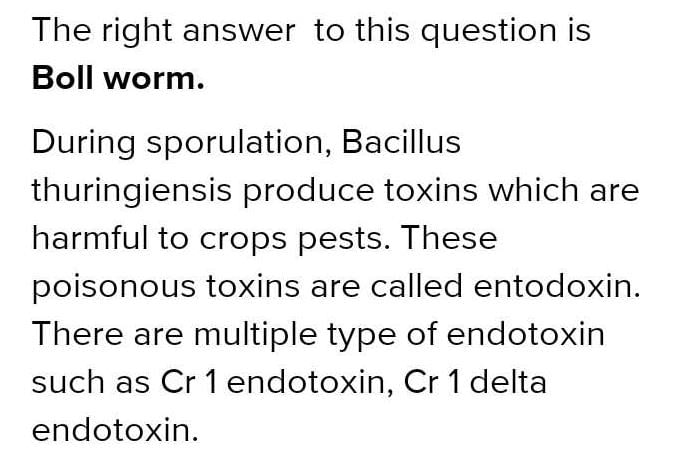
Cry I Ab controls- a)Stem Borer
- b)Corn Borer
- c)Cotton Bollworm
- d)Root pest
Correct answer is option 'B'. Can you explain this answer?
Cry I Ab controls
a)
Stem Borer
b)
Corn Borer
c)
Cotton Bollworm
d)
Root pest
| | Harshitha Dey answered |
Specific Bt toxin gene is isolated from Bacillus thuringiensis and incorporated into several crop plants. The protein encoded by gene CryI Ab controls corn borer.
Biogas is produced by anaerobic breakdown of biomass of agricultural waste by methanogenic bacteria. It is a- a)One step process
- b)Two step process
- c)Three step process
- d)Multi step process
Correct answer is option 'C'. Can you explain this answer?
Biogas is produced by anaerobic breakdown of biomass of agricultural waste by methanogenic bacteria. It is a
a)
One step process
b)
Two step process
c)
Three step process
d)
Multi step process
 | Rajni Kokate answered |
Answer c is correct.. the steps are as follows
1. the facultative anaerobic microbes degrade the complex polymers to simple monomers by enzymatic action.
2. 2nd stage , monomers are converted into organic acids by microbial action and finally converted to acetic acid.
3. in 3rd stage, acetic acid is oxidized into methane by activity of anaerobic methanogenic bacteria.
1. the facultative anaerobic microbes degrade the complex polymers to simple monomers by enzymatic action.
2. 2nd stage , monomers are converted into organic acids by microbial action and finally converted to acetic acid.
3. in 3rd stage, acetic acid is oxidized into methane by activity of anaerobic methanogenic bacteria.
Directions : In the following questions a statement of assertion (A) is followed by a statement of reason (R). Mark the correct choice as :Assertion (A) : ‘Bt’ in Bt toxin represents Bacillus thuringiensis.Reason (R) : ‘Bt’ toxin is produced by a virus.- a)Both assertion (A) and reason (R) are true and reason (R) is the correct explanation of assertion (A).
- b)Both assertion (A) and reason (R) are true but reason (R) is not the correct explanation of assertion (A).
- c)Assertion (A) is true but reason (R) is false.
- d)Assertion (A) is false but reason (R) is true.
Correct answer is option 'A'. Can you explain this answer?
Directions : In the following questions a statement of assertion (A) is followed by a statement of reason (R). Mark the correct choice as :
Assertion (A) : ‘Bt’ in Bt toxin represents Bacillus thuringiensis.
Reason (R) : ‘Bt’ toxin is produced by a virus.
a)
Both assertion (A) and reason (R) are true and reason (R) is the correct explanation of assertion (A).
b)
Both assertion (A) and reason (R) are true but reason (R) is not the correct explanation of assertion (A).
c)
Assertion (A) is true but reason (R) is false.
d)
Assertion (A) is false but reason (R) is true.
| | Gaurav Kumar answered |
Assertion (A) is true, but reason (R) is wrong as Bt toxin is produced by a bacterium called Bacillus thuringiensis.
Formation of vinegar from alcohol is caused by- a)Bacillus subtilis
- b)Clostridium
- c)Acetobacter aceti
- d)Azotobacter
Correct answer is option 'C'. Can you explain this answer?
Formation of vinegar from alcohol is caused by
a)
Bacillus subtilis
b)
Clostridium
c)
Acetobacter aceti
d)
Azotobacter
| | Arya Sen answered |
Vinegar is a sour-tasting liquid that is commonly used in cooking, pickling, and as a condiment. It is primarily composed of acetic acid, which gives it its distinctive taste and smell. Vinegar is produced through a process called fermentation, where alcohol is converted into acetic acid by certain types of bacteria.
The correct answer to the question is option 'C', which is Acetobacter acet. Acetobacter acet is a type of bacteria that plays a key role in the formation of vinegar from alcohol.
Here is a detailed explanation of why Acetobacter acet is responsible for the formation of vinegar from alcohol:
1. Alcohol Fermentation:
- The first step in the formation of vinegar is the fermentation of alcohol. This process occurs when yeasts break down sugars present in fruits, grains, or other sources, producing alcohol as a byproduct.
- This initial fermentation process can be seen in the production of alcoholic beverages such as wine or beer.
2. Acetic Acid Fermentation:
- The second step in the formation of vinegar is the conversion of alcohol into acetic acid. This process is known as acetic acid fermentation.
- Acetobacter acet is a type of bacteria that is naturally present in the environment, including the surfaces of fruits and grains.
- Acetobacter acet has the ability to oxidize ethanol (alcohol) into acetic acid through a series of enzymatic reactions.
- This process occurs in the presence of oxygen, which is why vinegar production often involves exposing the alcohol to air by allowing it to come into contact with oxygen.
3. Role of Acetobacter acet:
- Acetobacter acet is particularly efficient in converting alcohol to acetic acid. It produces an enzyme called alcohol dehydrogenase, which catalyzes the conversion of ethanol to acetaldehyde.
- Acetaldehyde is further oxidized by another enzyme called acetaldehyde dehydrogenase, which is also produced by Acetobacter acet, to form acetic acid.
- This acetic acid is the main component of vinegar, giving it its characteristic sour taste and odor.
In conclusion, the formation of vinegar from alcohol is caused by the bacteria Acetobacter acet. This bacterium has the ability to convert alcohol into acetic acid through a process called acetic acid fermentation. The enzymes produced by Acetobacter acet are responsible for the oxidation of alcohol, resulting in the production of vinegar.
The correct answer to the question is option 'C', which is Acetobacter acet. Acetobacter acet is a type of bacteria that plays a key role in the formation of vinegar from alcohol.
Here is a detailed explanation of why Acetobacter acet is responsible for the formation of vinegar from alcohol:
1. Alcohol Fermentation:
- The first step in the formation of vinegar is the fermentation of alcohol. This process occurs when yeasts break down sugars present in fruits, grains, or other sources, producing alcohol as a byproduct.
- This initial fermentation process can be seen in the production of alcoholic beverages such as wine or beer.
2. Acetic Acid Fermentation:
- The second step in the formation of vinegar is the conversion of alcohol into acetic acid. This process is known as acetic acid fermentation.
- Acetobacter acet is a type of bacteria that is naturally present in the environment, including the surfaces of fruits and grains.
- Acetobacter acet has the ability to oxidize ethanol (alcohol) into acetic acid through a series of enzymatic reactions.
- This process occurs in the presence of oxygen, which is why vinegar production often involves exposing the alcohol to air by allowing it to come into contact with oxygen.
3. Role of Acetobacter acet:
- Acetobacter acet is particularly efficient in converting alcohol to acetic acid. It produces an enzyme called alcohol dehydrogenase, which catalyzes the conversion of ethanol to acetaldehyde.
- Acetaldehyde is further oxidized by another enzyme called acetaldehyde dehydrogenase, which is also produced by Acetobacter acet, to form acetic acid.
- This acetic acid is the main component of vinegar, giving it its characteristic sour taste and odor.
In conclusion, the formation of vinegar from alcohol is caused by the bacteria Acetobacter acet. This bacterium has the ability to convert alcohol into acetic acid through a process called acetic acid fermentation. The enzymes produced by Acetobacter acet are responsible for the oxidation of alcohol, resulting in the production of vinegar.
Maximum percentage of alcohol present in the product of yeast fermentation - a)Rum
- b)Gin
- c)Brandy
- d)Wine
Correct answer is option 'A'. Can you explain this answer?
Maximum percentage of alcohol present in the product of yeast fermentation
a)
Rum
b)
Gin
c)
Brandy
d)
Wine
 | Pankaj Datta answered |
Alcoholic beverages have three categories: wine, beer and distilled liquors. Beer is produced by the fermentation of grains which produces only about 3-6% alcohol. Wine is produced by the fermentation of fruit and produces wine with an alcohol content of 6-14%. A distilled beverage, spirit, liquor or hard liquor is an alcoholic beverage produced by distillation of a mixture produced from alcoholic fermentation. This process purifies it and removes diluting components like water, for the purpose of increasing its proportion of alcohol content. Brandy a spirit, is distinct as a drink from wine (due to distillation), and has a 35% of alcohol content. Other examples of common distilled beverages include vodka, gin, tequila, rum, whisky.
Rum - 37.5%-80%, Brandy - 35%-60% (usually 40%), Vodka - 35%-50%. Thus, the correct answer is option A.
Rum - 37.5%-80%, Brandy - 35%-60% (usually 40%), Vodka - 35%-50%. Thus, the correct answer is option A.
Saccharomyces cerevisiae is used in the formation of - a)Ethanol
- b)Methanol
- c)Acetic acid
- d)Antibiotics
Correct answer is option 'A'. Can you explain this answer?
Saccharomyces cerevisiae is used in the formation of
a)
Ethanol
b)
Methanol
c)
Acetic acid
d)
Antibiotics
| | Rocky Handsome answered |
¥¥Saccharomyces cerevisiae is famously known for its role in food production. It is the critical component in the fermentation process that converts sugar into alcohol, an ingredient shared in beer, wine and distilled beverages. It is also used in the baking process as a leavening agent; yeast releasing gas into their environment results in the spongy-like texture of breads and cakes. Because of its role in fermentation, humans have known about and used Saccharomyces cerevisiae for a long time.
---)) In a process called as fermentation, yeast feeds off sugars from their substrate and convert it to ethanol,
---)) In a process called as fermentation, yeast feeds off sugars from their substrate and convert it to ethanol,
Biopiracy is- a)Monitoring GMO’s
- b)Commercial production of GMO’s
- c)Governing research on GMO’s
- d)Use of bio resources without proper authorization
Correct answer is option 'D'. Can you explain this answer?
Biopiracy is
a)
Monitoring GMO’s
b)
Commercial production of GMO’s
c)
Governing research on GMO’s
d)
Use of bio resources without proper authorization
 | Preeti Iyer answered |
Biopiracy is the use of biological resources without proper authorization from country or people concerned without compensate payment.
Rules of conduct that may be used to regulate our activities in relation to the biological world is called- a)bioethics
- b)biowar
- c)biopatent
- d)biopiracy
Correct answer is option 'A'. Can you explain this answer?
Rules of conduct that may be used to regulate our activities in relation to the biological world is called
a)
bioethics
b)
biowar
c)
biopatent
d)
biopiracy
| | Suresh Iyer answered |
Bioethics may be viewed as the set of standards that may be used to regulate various activities based on their effects on the biological world. This is because biotechnology has aroused social as well as political concerns, which have ranged from biotechnology being unnatural to detrimental to biodiversity.
Read the given statements and select the correct optionsStatement 1: In recombinant DNA technology, human genes are often transferred into bacteria (prokaryotes) or yeast (eukaryote).
Statement 2: Both bacteria and yeast multiply very fast to form huge population which expresses the desired gene.- a)Both statements 1 and 2 are correct and statement 2 is the correct explanation of statement 1.
- b)Both Both statements 1 and 2 are correct but statement 2 is not the correct explanation of statement 1.
- c)Statement 1 is correct and statement 2 is incorrect.
- d)Both statements 1 and 2 are incorrect.
Correct answer is option 'A'. Can you explain this answer?
Read the given statements and select the correct options
Statement 1: In recombinant DNA technology, human genes are often transferred into bacteria (prokaryotes) or yeast (eukaryote).
Statement 2: Both bacteria and yeast multiply very fast to form huge population which expresses the desired gene.
Statement 2: Both bacteria and yeast multiply very fast to form huge population which expresses the desired gene.
a)
Both statements 1 and 2 are correct and statement 2 is the correct explanation of statement 1.
b)
Both Both statements 1 and 2 are correct but statement 2 is not the correct explanation of statement 1.
c)
Statement 1 is correct and statement 2 is incorrect.
d)
Both statements 1 and 2 are incorrect.
 | EduRev NEET answered |
Recombinant DNA is a form of DNA whose nucleotide sequence has undergone alteration as a result of incorporation of exchange with another DNA strand. In recombinant DNA technology, human genes are often transferred into bacteria or yeast because both bacteria and yeast multiply very fast to form huge population, which expresses the desired gene. By doing so, one can observe the phenotypes of the gene more quickly and in a larger scale than by studying the same traist in humans.
A monopoly granted to a person who has either invented a new and useful article, made improvement in an existing article or invented a new process of making an article is called- a)biopiracy
- b)bioethics
- c)patent
- d)genetic modification
Correct answer is option 'C'. Can you explain this answer?
A monopoly granted to a person who has either invented a new and useful article, made improvement in an existing article or invented a new process of making an article is called
a)
biopiracy
b)
bioethics
c)
patent
d)
genetic modification
| | Ishan Roy answered |
Understanding Patents
A patent is a legal right granted to an inventor, providing exclusive rights to make, use, sell, or distribute an invention for a specified period, typically 20 years. This protection encourages innovation by allowing inventors to benefit from their creations.
Key Features of Patents
- Inventiveness: To qualify for a patent, the invention must be new, useful, and non-obvious. This means that it should not be something that anyone skilled in the field could easily deduce.
- Types of Innovations: Patents can be granted for various types of inventions, including:
- New and useful articles
- Improvements to existing products
- New processes for manufacturing or creating products
- Legal Protection: A patent holder can prevent others from making, using, or selling the invention without permission. This exclusivity allows inventors to recoup their investment in research and development.
Importance of Patents
- Encouraging Innovation: The patent system incentivizes inventors to develop new products and processes, fostering a culture of innovation.
- Economic Growth: By protecting intellectual property, patents contribute to economic development by allowing businesses to create jobs and introduce new technologies.
- Public Disclosure: In exchange for exclusive rights, inventors must publicly disclose their inventions, which facilitates knowledge sharing and further innovation.
In summary, a patent is crucial for safeguarding the rights of inventors while promoting technological advancement, which is why option 'C' is the correct answer.
A patent is a legal right granted to an inventor, providing exclusive rights to make, use, sell, or distribute an invention for a specified period, typically 20 years. This protection encourages innovation by allowing inventors to benefit from their creations.
Key Features of Patents
- Inventiveness: To qualify for a patent, the invention must be new, useful, and non-obvious. This means that it should not be something that anyone skilled in the field could easily deduce.
- Types of Innovations: Patents can be granted for various types of inventions, including:
- New and useful articles
- Improvements to existing products
- New processes for manufacturing or creating products
- Legal Protection: A patent holder can prevent others from making, using, or selling the invention without permission. This exclusivity allows inventors to recoup their investment in research and development.
Importance of Patents
- Encouraging Innovation: The patent system incentivizes inventors to develop new products and processes, fostering a culture of innovation.
- Economic Growth: By protecting intellectual property, patents contribute to economic development by allowing businesses to create jobs and introduce new technologies.
- Public Disclosure: In exchange for exclusive rights, inventors must publicly disclose their inventions, which facilitates knowledge sharing and further innovation.
In summary, a patent is crucial for safeguarding the rights of inventors while promoting technological advancement, which is why option 'C' is the correct answer.
Gene can therapy can be referred to as- a)pre - clinical testing for inherited diseases in newborns
- b)treatment of diseases caused by genetic defect
- c)genetic engineering using rDNA technology
- d)cancer treatment using in vitro cultured stem cells
Correct answer is option 'B'. Can you explain this answer?
Gene can therapy can be referred to as
a)
pre - clinical testing for inherited diseases in newborns
b)
treatment of diseases caused by genetic defect
c)
genetic engineering using rDNA technology
d)
cancer treatment using in vitro cultured stem cells
| | Geetika Shah answered |
Gene therapy is a collection of methods, that allows correction of gene defect that has been diagnosed in a child/embryo. Correcting of a genetic defect involves delivery of a normal gene into the individual or embryo to take over the function of and compensate for the non-functional gene.
Which one of the following is a correct statement ?- a)''Bt'' in ''Bt-cotton'' indicates that it is a genetically modified organism produced through biotechnology
- b)Somatic hybridization involves fusion of two complete plant cells carrying desired genes.
- c)The anticoagulant hirudin is being produced from transgenic Brassica napus seeds.
- d)''Flavr Savr'' variety of tomato has enhanced the production of ethylene which improves its taste
Correct answer is option 'C'. Can you explain this answer?
Which one of the following is a correct statement ?
a)
''Bt'' in ''Bt-cotton'' indicates that it is a genetically modified organism produced through biotechnology
b)
Somatic hybridization involves fusion of two complete plant cells carrying desired genes.
c)
The anticoagulant hirudin is being produced from transgenic Brassica napus seeds.
d)
''Flavr Savr'' variety of tomato has enhanced the production of ethylene which improves its taste
| | Awantika Gupta answered |
Bt stands for Bacillus thruengensis
There is no any requirements of desired gene in somatic hybridisation. It is ultimately fusion protoplast of two different plants.
Flavr Savar tomatoes has been made to increase its market period and for delayed flowering.
so according to above statement option c is correct.
There is no any requirements of desired gene in somatic hybridisation. It is ultimately fusion protoplast of two different plants.
Flavr Savar tomatoes has been made to increase its market period and for delayed flowering.
so according to above statement option c is correct.
Directions : In the following questions a statement of assertion (A) is followed by a statement of reason (R). Mark the correct choice as :Assertion (A) : An American company is allowed the company to sell a ‘new’ variety of Basmati rice.Reason (R) : Indian Basmati was crossed with semidwarf varieties and claimed as a novelty.- a)Both assertion (A) and reason (R) are true and reason (R) is the correct explanation of assertion (A).
- b)Both assertion (A) and reason (R) are true but reason (R) is not the correct explanation of assertion (A).
- c)Assertion (A) is true but reason (R) is false.
- d)Assertion (A) is false but reason (R) is true.
Correct answer is option 'B'. Can you explain this answer?
Directions : In the following questions a statement of assertion (A) is followed by a statement of reason (R). Mark the correct choice as :
Assertion (A) : An American company is allowed the company to sell a ‘new’ variety of Basmati rice.
Reason (R) : Indian Basmati was crossed with semidwarf varieties and claimed as a novelty.
a)
Both assertion (A) and reason (R) are true and reason (R) is the correct explanation of assertion (A).
b)
Both assertion (A) and reason (R) are true but reason (R) is not the correct explanation of assertion (A).
c)
Assertion (A) is true but reason (R) is false.
d)
Assertion (A) is false but reason (R) is true.
 | Dev Patel answered |
In 1997, an American company got patent rights on Basmati rice through the US Patent and Trademark Office. This allowed the company to sell a ‘new’ variety of Basmati which had actually been derived from Indian farmer’s varieties. Indian Basmati was crossed with semi-dwarf varieties and claimed as a novelty.
Humulin is the term used for- a)A new antibiotic
- b)A sex hormone
- c)Human insulin
- d)A vaccine
Correct answer is option 'C'. Can you explain this answer?
Humulin is the term used for
a)
A new antibiotic
b)
A sex hormone
c)
Human insulin
d)
A vaccine
| | Kaneez Fatima answered |
It is a form of insulin (trade name Humulin) made from recombinant DNA that is identical to human insulin; used to treat diabetics who are allergic to preparations made from beef or pork insulin.
Which of the following is not related with bio weapons :- a)Bacillus anthracis
- b)Clostridium botulinum
- c)E.Coli
- d)Yersinia Pestis
Correct answer is option 'C'. Can you explain this answer?
Which of the following is not related with bio weapons :
a)
Bacillus anthracis
b)
Clostridium botulinum
c)
E.Coli
d)
Yersinia Pestis
| | Sagar Jain answered |
Escherichia coli (E. coli) is a bacterium that is commonly found in the gut of humans and warm-blooded animals. Most strains of E. coli are harmless. Some strains however, such as Shiga toxin-producing E. coli, can cause severe foodborne disease. It is transmitted to humans primarily through consumption of contaminated foods, such as raw or undercooked ground meat products, raw milk, and contaminated raw vegetables and sprouts.
Biotechnology can be defined as the use of biological processes in industry and technology. During the past three decades biotechnology has gained attention due to the gene cloning process. Biotechnological applications are playing an important role in agriculture. They are used in agro-chemical based agriculture, in organic farming, geneticallyengineered crop-based agriculture. The green revolution is the milestone or result of these biotechnological processes.Q. GEAC stands for _________ .- a)Genetic Extension Approval Committee
- b)Genetic Engineering Approval Committee
- c)Genetic Engineering Approval Committee
- d)None of the above
Correct answer is option 'B'. Can you explain this answer?
Biotechnology can be defined as the use of biological processes in industry and technology. During the past three decades biotechnology has gained attention due to the gene cloning process. Biotechnological applications are playing an important role in agriculture. They are used in agro-chemical based agriculture, in organic farming, genetically
engineered crop-based agriculture. The green revolution is the milestone or result of these biotechnological processes.
Q. GEAC stands for _________ .
a)
Genetic Extension Approval Committee
b)
Genetic Engineering Approval Committee
c)
Genetic Engineering Approval Committee
d)
None of the above
| | Dev Patel answered |
The Genetic Engineering Appraisal Committee (GEAC) is a statutory body constituted under the 'Rules for the Manufacture, Use /Import /Export and Storage of Hazardous Microorganisms/Genetically Engineering Organisms or Cells, 1989' notified under the Environment (Protection) Act, 1986.
Chapter doubts & questions for Biotechnology & its Applications - Biology CUET UG Mock Test Series 2026 2026 is part of NEET exam preparation. The chapters have been prepared according to the NEET exam syllabus. The Chapter doubts & questions, notes, tests & MCQs are made for NEET 2026 Exam. Find important definitions, questions, notes, meanings, examples, exercises, MCQs and online tests here.
Chapter doubts & questions of Biotechnology & its Applications - Biology CUET UG Mock Test Series 2026 in English & Hindi are available as part of NEET exam. Download more important topics, notes, lectures and mock test series for NEET Exam by signing up for free.
Biology CUET UG Mock Test Series 20264 docs|170 tests |
