


All Exams > UPSC > Shankar IAS for Environment: Summaries & MCQs > All Questions
All questions of Aquatic Ecosystem for UPSC CSE Exam
The Island Protection Zone (IPZ) Notification 2011 was established to govern development activities in island territories, separate from the Coastal Regulation Zone (CRZ) Notification.- a)True.
- b)False.
- c)Partially True.
- d)Not Applicable.
Correct answer is option 'A'. Can you explain this answer?
The Island Protection Zone (IPZ) Notification 2011 was established to govern development activities in island territories, separate from the Coastal Regulation Zone (CRZ) Notification.
a)
True.
b)
False.
c)
Partially True.
d)
Not Applicable.
 | Upsc Toppers answered |
This statement is true. The Island Protection Zone (IPZ) Notification 2011 was specifically established to address the unique environmental and developmental challenges of island territories, distinct from the mainland coastal areas governed by the CRZ Notification.

Which of the following is not a feature of the CRZ Notification, 2018?- a)Streamlining of CRZ clearances.
- b)De-freezing of Floor Space Index (FSI) in CRZ-II areas.
- c)Establishment of a hazard line for coastal areas.
- d)Mandatory creation of marine parks in all CRZ-IV areas.
Correct answer is option 'D'. Can you explain this answer?
Which of the following is not a feature of the CRZ Notification, 2018?
a)
Streamlining of CRZ clearances.
b)
De-freezing of Floor Space Index (FSI) in CRZ-II areas.
c)
Establishment of a hazard line for coastal areas.
d)
Mandatory creation of marine parks in all CRZ-IV areas.
 | Sameer Nambiar answered |
The correct answer is option 'D' - Mandatory creation of marine parks in all CRZ-IV areas. This is not a feature of the CRZ Notification, 2018.
The Coastal Regulation Zone (CRZ) Notification, 2018 was introduced by the Ministry of Environment, Forest and Climate Change (MoEFCC) in January 2019. It aimed to streamline the coastal regulation process and provide a framework for sustainable development and conservation of coastal areas.
Let's discuss the features of the CRZ Notification, 2018 to understand why option 'D' is the correct answer:
1. Streamlining of CRZ clearances:
- The notification aimed to simplify and streamline the process of obtaining clearances for various activities in the coastal areas.
- The classification of CRZ areas was rationalized into four categories (CRZ-I, CRZ-II, CRZ-III, and CRZ-IV) based on their ecological sensitivity and development needs.
2. De-freezing of Floor Space Index (FSI) in CRZ-II areas:
- The CRZ Notification, 2018 allowed the state and Union Territory governments to formulate their own policies for construction activities in CRZ-II areas.
- The earlier restriction on the FSI was removed, giving more flexibility to the local authorities to decide on the permissible FSI.
3. Establishment of a hazard line for coastal areas:
- The notification introduced the concept of a hazard line, which is a line demarcating the area likely to be affected by coastal hazards such as sea-level rise, storms, and erosion.
- It aimed to regulate development activities and prevent construction in areas prone to hazards, ensuring the safety of coastal communities.
4. Mandatory creation of marine parks in all CRZ-IV areas:
- This statement is not a feature of the CRZ Notification, 2018.
- CRZ-IV areas are designated as the areas that are undeveloped or lightly developed, and they have been excluded from the purview of the CRZ Notification, 2018.
- The notification does not mandate the creation of marine parks in CRZ-IV areas.
In conclusion, the correct answer is option 'D' - Mandatory creation of marine parks in all CRZ-IV areas. This is not a feature of the CRZ Notification, 2018. The notification focuses on streamlining clearances, de-freezing FSI in CRZ-II areas, and establishing a hazard line for coastal areas.
The Coastal Regulation Zone (CRZ) Notification, 2018 was introduced by the Ministry of Environment, Forest and Climate Change (MoEFCC) in January 2019. It aimed to streamline the coastal regulation process and provide a framework for sustainable development and conservation of coastal areas.
Let's discuss the features of the CRZ Notification, 2018 to understand why option 'D' is the correct answer:
1. Streamlining of CRZ clearances:
- The notification aimed to simplify and streamline the process of obtaining clearances for various activities in the coastal areas.
- The classification of CRZ areas was rationalized into four categories (CRZ-I, CRZ-II, CRZ-III, and CRZ-IV) based on their ecological sensitivity and development needs.
2. De-freezing of Floor Space Index (FSI) in CRZ-II areas:
- The CRZ Notification, 2018 allowed the state and Union Territory governments to formulate their own policies for construction activities in CRZ-II areas.
- The earlier restriction on the FSI was removed, giving more flexibility to the local authorities to decide on the permissible FSI.
3. Establishment of a hazard line for coastal areas:
- The notification introduced the concept of a hazard line, which is a line demarcating the area likely to be affected by coastal hazards such as sea-level rise, storms, and erosion.
- It aimed to regulate development activities and prevent construction in areas prone to hazards, ensuring the safety of coastal communities.
4. Mandatory creation of marine parks in all CRZ-IV areas:
- This statement is not a feature of the CRZ Notification, 2018.
- CRZ-IV areas are designated as the areas that are undeveloped or lightly developed, and they have been excluded from the purview of the CRZ Notification, 2018.
- The notification does not mandate the creation of marine parks in CRZ-IV areas.
In conclusion, the correct answer is option 'D' - Mandatory creation of marine parks in all CRZ-IV areas. This is not a feature of the CRZ Notification, 2018. The notification focuses on streamlining clearances, de-freezing FSI in CRZ-II areas, and establishing a hazard line for coastal areas.
Statement 1: The Coastal Ocean Monitoring and Prediction System (COMAPS) was implemented for pollution monitoring in coastal waters since 1991.
Statement 2: The primary focus of COMAPS is on industrial development and maritime navigation.- a)Both statements are true.
- b)Both statements are false.
- c)Statement 1 is true, Statement 2 is false.
- d)Statement 1 is false, Statement 2 is true.
Correct answer is option 'C'. Can you explain this answer?
Statement 1: The Coastal Ocean Monitoring and Prediction System (COMAPS) was implemented for pollution monitoring in coastal waters since 1991.
Statement 2: The primary focus of COMAPS is on industrial development and maritime navigation.
Statement 2: The primary focus of COMAPS is on industrial development and maritime navigation.
a)
Both statements are true.
b)
Both statements are false.
c)
Statement 1 is true, Statement 2 is false.
d)
Statement 1 is false, Statement 2 is true.
 | Master Training Institute answered |
Statement 1 is true as COMAPS has been operational since 1991 for monitoring coastal water pollution. Statement 2 is false because the primary focus of COMAPS is on pollution monitoring and management, not specifically on industrial development or maritime navigation.
Assertion (A): Coral reefs are included in Schedule 1 of the Wild Life Protection Act, 1972.
Reason (R): This inclusion affords the highest degree of protection to coral reefs.- a)Both A and R are true, and R is the correct explanation of A.
- b)Both A and R are true, but R is not the correct explanation of A.
- c)A is true, but R is false.
- d)A is false, but R is true.
Correct answer is option 'A'. Can you explain this answer?
Assertion (A): Coral reefs are included in Schedule 1 of the Wild Life Protection Act, 1972.
Reason (R): This inclusion affords the highest degree of protection to coral reefs.
Reason (R): This inclusion affords the highest degree of protection to coral reefs.
a)
Both A and R are true, and R is the correct explanation of A.
b)
Both A and R are true, but R is not the correct explanation of A.
c)
A is true, but R is false.
d)
A is false, but R is true.
 | Meera Datta answered |
Understanding the Assertion and Reason
In this context, we analyze the statement regarding coral reefs and their inclusion in the Wild Life Protection Act, 1972.
Assertion (A): Coral reefs are included in Schedule 1 of the Wild Life Protection Act, 1972.
- True Statement: Coral reefs are indeed included in Schedule 1 of the Wild Life Protection Act, 1972.
- Protection Level: Schedule 1 provides the highest level of protection to species and habitats, indicating that coral reefs are recognized as critical and vulnerable ecosystems.
Reason (R): This inclusion affords the highest degree of protection to coral reefs.
- True Statement: The inclusion in Schedule 1 does afford the highest degree of protection to coral reefs.
- Explanatory Value: This reason correctly explains the significance of their inclusion, as it highlights the protective measures aimed at preserving these vital ecosystems.
Correct Answer: Option 'A'
- Both A and R are true: Coral reefs are indeed listed in Schedule 1, and this inclusion provides maximum protection.
- R is the correct explanation of A: The reason directly justifies the assertion, as the protection status is inherently linked to their listing in Schedule 1.
Conclusion
- The statement confirms both the factual accuracy of the assertion and the explanatory nature of the reason, solidifying the answer as option 'A'. This inclusion emphasizes the importance of coral reefs within the framework of wildlife protection laws in India, reflecting ecological, economic, and social significance.
In this context, we analyze the statement regarding coral reefs and their inclusion in the Wild Life Protection Act, 1972.
Assertion (A): Coral reefs are included in Schedule 1 of the Wild Life Protection Act, 1972.
- True Statement: Coral reefs are indeed included in Schedule 1 of the Wild Life Protection Act, 1972.
- Protection Level: Schedule 1 provides the highest level of protection to species and habitats, indicating that coral reefs are recognized as critical and vulnerable ecosystems.
Reason (R): This inclusion affords the highest degree of protection to coral reefs.
- True Statement: The inclusion in Schedule 1 does afford the highest degree of protection to coral reefs.
- Explanatory Value: This reason correctly explains the significance of their inclusion, as it highlights the protective measures aimed at preserving these vital ecosystems.
Correct Answer: Option 'A'
- Both A and R are true: Coral reefs are indeed listed in Schedule 1, and this inclusion provides maximum protection.
- R is the correct explanation of A: The reason directly justifies the assertion, as the protection status is inherently linked to their listing in Schedule 1.
Conclusion
- The statement confirms both the factual accuracy of the assertion and the explanatory nature of the reason, solidifying the answer as option 'A'. This inclusion emphasizes the importance of coral reefs within the framework of wildlife protection laws in India, reflecting ecological, economic, and social significance.
The 'Blue Flag' certification is an international label awarded to beaches and marinas that meet high environmental and safety standards.- a)True.
- b)False.
- c)Partially True.
- d)Not related to environmental standards.
Correct answer is option 'A'. Can you explain this answer?
The 'Blue Flag' certification is an international label awarded to beaches and marinas that meet high environmental and safety standards.
a)
True.
b)
False.
c)
Partially True.
d)
Not related to environmental standards.
 | Capstone Ias Learning answered |
This statement is true. The 'Blue Flag' certification is indeed an international label that recognizes beaches and marinas for their commitment to high environmental and safety standards, as well as sustainable development in marine and freshwater environments.
Statement 1: The Integrated Coastal and Marine Area Management (ICMAM) project was launched in 1998 for the integrated management of coastal and marine areas.
Statement 2: The primary focus of ICMAM is on industrial development along coastal regions.- a)Both statements are true.
- b)Both statements are false.
- c)Statement 1 is true, Statement 2 is false.
- d)Statement 1 is false, Statement 2 is true.
Correct answer is option 'C'. Can you explain this answer?
Statement 1: The Integrated Coastal and Marine Area Management (ICMAM) project was launched in 1998 for the integrated management of coastal and marine areas.
Statement 2: The primary focus of ICMAM is on industrial development along coastal regions.
Statement 2: The primary focus of ICMAM is on industrial development along coastal regions.
a)
Both statements are true.
b)
Both statements are false.
c)
Statement 1 is true, Statement 2 is false.
d)
Statement 1 is false, Statement 2 is true.
 | K.L Institute answered |
Statement 1 is true, as the Integrated Coastal and Marine Area Management (ICMAM) project was indeed launched in 1998 with the aim of integrated management of coastal and marine areas. Statement 2 is false because the focus of ICMAM is not solely on industrial development but rather on a broader scope of managing and conserving coastal and marine environments, including addressing pollution, ecological conservation, and sustainable development.
Statement 1: The Wildlife Crime Control Bureau focuses on strengthening enforcement of laws and controlling poaching.
Statement 2: Coral reefs are included in Schedule 2 of the Wild Life Protection Act, 1972.- a)Both statements are true.
- b)Both statements are false.
- c)Statement 1 is true, Statement 2 is false.
- d)Statement 1 is false, Statement 2 is true.
Correct answer is option 'C'. Can you explain this answer?
Statement 1: The Wildlife Crime Control Bureau focuses on strengthening enforcement of laws and controlling poaching.
Statement 2: Coral reefs are included in Schedule 2 of the Wild Life Protection Act, 1972.
Statement 2: Coral reefs are included in Schedule 2 of the Wild Life Protection Act, 1972.
a)
Both statements are true.
b)
Both statements are false.
c)
Statement 1 is true, Statement 2 is false.
d)
Statement 1 is false, Statement 2 is true.
 | Divey Sethi answered |
Statement 1 is correct as the Wildlife Crime Control Bureau does work on law enforcement and poaching control. Statement 2 is false because coral reefs are included in Schedule 1, not Schedule 2, of the Wild Life Protection Act, 1972, which offers them the highest degree of protection.
Assertion (A): The Namami Ganga Program includes initiatives for riverfront development in key locations.
Reason (R): Riverfront development is essential for promoting tourism along the Ganga River.- a)Both A and R are true, and R is the correct explanation of A.
- b)Both A and R are true, but R is not the correct explanation of A.
- c)A is true, but R is false.
- d)A is false, but R is true.
Correct answer is option 'B'. Can you explain this answer?
Assertion (A): The Namami Ganga Program includes initiatives for riverfront development in key locations.
Reason (R): Riverfront development is essential for promoting tourism along the Ganga River.
Reason (R): Riverfront development is essential for promoting tourism along the Ganga River.
a)
Both A and R are true, and R is the correct explanation of A.
b)
Both A and R are true, but R is not the correct explanation of A.
c)
A is true, but R is false.
d)
A is false, but R is true.
| | Divey Sethi answered |
Both the assertion and the reason are true. The Namami Ganga Program does include riverfront development initiatives. However, the reason provided is not the sole explanation for this aspect of the program, as riverfront development also encompasses environmental and infrastructural enhancements.
The Society of Integrated Coastal Management (SICOM) was established in 2010 as the nodal agency for Integrated Coastal Zone Management (ICZM) practices.- a)True.
- b)False.
- c)Partially True.
- d)Not Applicable.
Correct answer is option 'A'. Can you explain this answer?
The Society of Integrated Coastal Management (SICOM) was established in 2010 as the nodal agency for Integrated Coastal Zone Management (ICZM) practices.
a)
True.
b)
False.
c)
Partially True.
d)
Not Applicable.
 | Ias Masters answered |
This statement is true. SICOM was indeed established in 2010 and serves as the nodal agency responsible for implementing Integrated Coastal Zone Management practices, providing technical support to the National Coastal Zone Management Authority.
Statement 1: The Coastal Regulation Zone (CRZ) Notification (2011) governs development activities along the sea coast and tidal-influenced water bodies.
Statement 2: Mangroves and coral reef areas are not included in CRZ-1 category.- a)Both statements are true.
- b)Both statements are false.
- c)Statement 1 is true, Statement 2 is false.
- d)Statement 1 is false, Statement 2 is true.
Correct answer is option 'C'. Can you explain this answer?
Statement 1: The Coastal Regulation Zone (CRZ) Notification (2011) governs development activities along the sea coast and tidal-influenced water bodies.
Statement 2: Mangroves and coral reef areas are not included in CRZ-1 category.
Statement 2: Mangroves and coral reef areas are not included in CRZ-1 category.
a)
Both statements are true.
b)
Both statements are false.
c)
Statement 1 is true, Statement 2 is false.
d)
Statement 1 is false, Statement 2 is true.
| | Divey Sethi answered |
Statement 1 is correct as the CRZ Notification (2011) does regulate development along the sea coast and tidal-influenced water bodies. Statement 2 is false because mangroves and coral reef areas are indeed included in the CRZ-1 category, which is designated for ecologically sensitive areas.
The 'Namami Gange' initiative is part of the Integrated Ganga Conservation Mission and includes a comprehensive action plan for the conservation and enhancement of the Ganga River.- a)True.
- b)False.
- c)Partially True.
- d)Not related to the Ganga River.
Correct answer is option 'A'. Can you explain this answer?
The 'Namami Gange' initiative is part of the Integrated Ganga Conservation Mission and includes a comprehensive action plan for the conservation and enhancement of the Ganga River.
a)
True.
b)
False.
c)
Partially True.
d)
Not related to the Ganga River.
 | Lakshya Ias answered |
This statement is true. The 'Namami Gange' initiative is indeed a part of the Integrated Ganga Conservation Mission, focusing on a comprehensive action plan that encompasses various aspects of Ganga conservation and enhancement, including pollution abatement and sustainable development along the river.
Consider the following statements:1. Mangroves of Bhitarkanika is the largest in the Indian subcontinent2. Harbour high mangroves found in Gulf of KachchhWhich of these statements is/are correct?- a)1 Only
- b)2 Only
- c)Both 1 and 2
- d)Neither 1 nor 2
Correct answer is option 'B'. Can you explain this answer?
Consider the following statements:
1. Mangroves of Bhitarkanika is the largest in the Indian subcontinent
2. Harbour high mangroves found in Gulf of Kachchh
Which of these statements is/are correct?
a)
1 Only
b)
2 Only
c)
Both 1 and 2
d)
Neither 1 nor 2
 | Kavita Shah answered |
- The mangroves of Sundarbans are the largest single block of tidal halophytic mangroves of the world.
- The mangroves of Bhitarkanika (Orissa), which is the second largest in the Indian subcontinent, harbour high mangroves found in Gulf of Kachchh, to taller stands found in the Sunderbans.
- On the Andaman & Nicobar Islands, the small tidal estuaries, neritic inlets and the lagoons support a dense and diverse undisturbed mangrove flora.
Statement 1: Under the CRZ Notification, 2011, the No Development Zone (NDZ) has been uniformly set at 200 meters from the High Tide Line across all categories.
Statement 2: The NDZ stipulation is relaxed for certain densely populated rural areas under CRZ-III.- a)Both statements are true.
- b)Both statements are false.
- c)Statement 1 is true, Statement 2 is false.
- d)Statement 1 is false, Statement 2 is true.
Correct answer is option 'D'. Can you explain this answer?
Statement 1: Under the CRZ Notification, 2011, the No Development Zone (NDZ) has been uniformly set at 200 meters from the High Tide Line across all categories.
Statement 2: The NDZ stipulation is relaxed for certain densely populated rural areas under CRZ-III.
Statement 2: The NDZ stipulation is relaxed for certain densely populated rural areas under CRZ-III.
a)
Both statements are true.
b)
Both statements are false.
c)
Statement 1 is true, Statement 2 is false.
d)
Statement 1 is false, Statement 2 is true.
| | Upsc Toppers answered |
Statement 1 is false because the NDZ has been reduced in certain cases, particularly in densely populated rural areas under CRZ-III, where it can be as low as 50 meters. Statement 2 is true, reflecting this relaxation in specific areas.
Statement 1: The National Coastal Zone Management Authority (NCZMA) and State Coastal Zone Management Authority (SCZMA) were established under the Environmental (Protection) Act, 1986.
Statement 2: The NCZMA and SCZMA are responsible for implementing the Ganga Action Plan.- a)Both statements are true.
- b)Both statements are false.
- c)Statement 1 is true, Statement 2 is false.
- d)Statement 1 is false, Statement 2 is true.
Correct answer is option 'C'. Can you explain this answer?
Statement 1: The National Coastal Zone Management Authority (NCZMA) and State Coastal Zone Management Authority (SCZMA) were established under the Environmental (Protection) Act, 1986.
Statement 2: The NCZMA and SCZMA are responsible for implementing the Ganga Action Plan.
Statement 2: The NCZMA and SCZMA are responsible for implementing the Ganga Action Plan.
a)
Both statements are true.
b)
Both statements are false.
c)
Statement 1 is true, Statement 2 is false.
d)
Statement 1 is false, Statement 2 is true.
 | Goel UPSC Coaching Center answered |
Statement 1 is true as NCZMA and SCZMA were indeed established under the Environmental (Protection) Act, 1986. Statement 2 is false because these authorities are not responsible for the Ganga Action Plan, which focuses on the Ganga River and not on coastal zones.
Match the following activities with their corresponding CRZ categories where they are allowed:
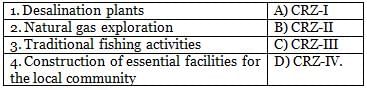
- a)1-B, 2-A, 3-D, 4-C.
- b)1-D, 2-C, 3-A, 4-B.
- c)1-C, 2-D, 3-B, 4-A.
- d)1-A, 2-B, 3-C, 4-D.
Correct answer is option 'A'. Can you explain this answer?
Match the following activities with their corresponding CRZ categories where they are allowed:
a)
1-B, 2-A, 3-D, 4-C.
b)
1-D, 2-C, 3-A, 4-B.
c)
1-C, 2-D, 3-B, 4-A.
d)
1-A, 2-B, 3-C, 4-D.
| | Master Training Institute answered |
Desalination plants are permissible in CRZ-II, natural gas exploration in CRZ-I, traditional fishing activities in CRZ-IV, and construction of essential facilities in CRZ-III.
Match the following CRZ categories with their descriptions:
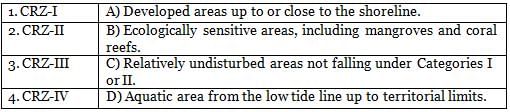
- a)1-B, 2-A, 3-C, 4-D.
- b)1-C, 2-D, 3-A, 4-B.
- c)1-D, 2-C, 3-B, 4-A.
- d)1-A, 2-B, 3-D, 4-C.
Correct answer is option 'A'. Can you explain this answer?
Match the following CRZ categories with their descriptions:
a)
1-B, 2-A, 3-C, 4-D.
b)
1-C, 2-D, 3-A, 4-B.
c)
1-D, 2-C, 3-B, 4-A.
d)
1-A, 2-B, 3-D, 4-C.
| | Goel UPSC Coaching Center answered |
CRZ-I refers to ecologically sensitive areas, CRZ-II to developed areas, CRZ-III to relatively undisturbed areas, and CRZ-IV to the aquatic area extending to territorial limits.
Statement 1: The Clean Ganga Fund is aimed at increasing public participation in the cleanup of the Ganga River.
Statement 2: Only domestic donors are eligible for tax benefits under the Clean Ganga Fund.- a)Both statements are true.
- b)Both statements are false.
- c)Statement 1 is true, Statement 2 is false.
- d)Statement 1 is false, Statement 2 is true.
Correct answer is option 'C'. Can you explain this answer?
Statement 1: The Clean Ganga Fund is aimed at increasing public participation in the cleanup of the Ganga River.
Statement 2: Only domestic donors are eligible for tax benefits under the Clean Ganga Fund.
Statement 2: Only domestic donors are eligible for tax benefits under the Clean Ganga Fund.
a)
Both statements are true.
b)
Both statements are false.
c)
Statement 1 is true, Statement 2 is false.
d)
Statement 1 is false, Statement 2 is true.
| | Divey Sethi answered |
Statement 1 is true as the Clean Ganga Fund is indeed intended to increase public participation in Ganga cleanup. Statement 2 is false because both domestic and foreign donors may receive tax benefits, with foreign donors potentially receiving suitable tax exemptions.
Under the Wild Life Protection Act, 1972, Protected Areas including National Parks, Sanctuaries, and Marine Biosphere Reserves were established for conserving marine life, including coral reefs.- a)True.
- b)False.
- c)Partially True.
- d)Not related to marine life conservation.
Correct answer is option 'A'. Can you explain this answer?
Under the Wild Life Protection Act, 1972, Protected Areas including National Parks, Sanctuaries, and Marine Biosphere Reserves were established for conserving marine life, including coral reefs.
a)
True.
b)
False.
c)
Partially True.
d)
Not related to marine life conservation.
| | Capstone Ias Learning answered |
This statement is true. The Wild Life Protection Act, 1972, facilitated the creation of Protected Areas such as National Parks, Sanctuaries, and Marine Biosphere Reserves, which play a crucial role in conserving marine life and habitats, including coral reefs.
Match the following initiatives with their primary focus:
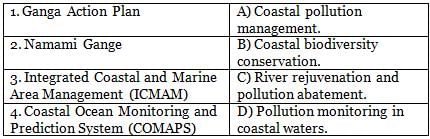
- a)1-C, 2-A, 3-B, 4-D.
- b)1-A, 2-C, 3-D, 4-B.
- c)1-C, 2-D, 3-A, 4-B.
- d)1-B, 2-A, 3-C, 4-D.
Correct answer is option 'A'. Can you explain this answer?
Match the following initiatives with their primary focus:
a)
1-C, 2-A, 3-B, 4-D.
b)
1-A, 2-C, 3-D, 4-B.
c)
1-C, 2-D, 3-A, 4-B.
d)
1-B, 2-A, 3-C, 4-D.
| | Ias Masters answered |
The Ganga Action Plan focuses on river rejuvenation and pollution abatement (C), Namami Gange is part of the Integrated Ganga Conservation Mission aiming at river conservation (A), ICMAM aims at integrated management of coastal and marine areas, including biodiversity conservation (B), and COMAPS is focused on pollution monitoring in coastal waters (D).
Statement 1: The Ganga Action Plan was launched in 1986 with the primary goal of pollution abatement.
Statement 2: The National Ganga River Basin Authority (NGRBA) was established under the Ganga Action Plan.- a)Both statements are true.
- b)Both statements are false.
- c)Statement 1 is true, Statement 2 is false.
- d)Statement 1 is false, Statement 2 is true.
Correct answer is option 'C'. Can you explain this answer?
Statement 1: The Ganga Action Plan was launched in 1986 with the primary goal of pollution abatement.
Statement 2: The National Ganga River Basin Authority (NGRBA) was established under the Ganga Action Plan.
Statement 2: The National Ganga River Basin Authority (NGRBA) was established under the Ganga Action Plan.
a)
Both statements are true.
b)
Both statements are false.
c)
Statement 1 is true, Statement 2 is false.
d)
Statement 1 is false, Statement 2 is true.
| | Lakshya Ias answered |
Statement 1 is true as the Ganga Action Plan was indeed launched in 1986 with the primary focus on pollution abatement. Statement 2 is false because the NGRBA was established later, under the "Mission Clean Ganga" initiative, not directly under the Ganga Action Plan.
Chapter doubts & questions for Aquatic Ecosystem - Shankar IAS for Environment: Summaries & MCQs 2026 is part of UPSC CSE exam preparation. The chapters have been prepared according to the UPSC CSE exam syllabus. The Chapter doubts & questions, notes, tests & MCQs are made for UPSC CSE 2026 Exam. Find important definitions, questions, notes, meanings, examples, exercises, MCQs and online tests here.
Chapter doubts & questions of Aquatic Ecosystem - Shankar IAS for Environment: Summaries & MCQs in English & Hindi are available as part of UPSC CSE exam. Download more important topics, notes, lectures and mock test series for UPSC CSE Exam by signing up for free.
Shankar IAS for Environment: Summaries & MCQs30 videos|62 docs|35 tests |
