


All Exams > Grade 8 > Science for Grade 8 > All Questions
All questions of Forces and Motion for Grade 8 Exam
S.I. unit of pressure is- a)Celsius
- b)Newton
- c)Kelvin
- d)Pascal
Correct answer is option 'D'. Can you explain this answer?
S.I. unit of pressure is
a)
Celsius
b)
Newton
c)
Kelvin
d)
Pascal
 | Saranya Nair answered |
S.I. unit of pressure is Pascal. One Pascal is equal to one Newton per meter square.

What is the average velocity of a car that moved 60 km in 3 hours?- a)60 km/h
- b)20 km/h
- c)30 km/h
- d)10 km/h
Correct answer is option 'B'. Can you explain this answer?
What is the average velocity of a car that moved 60 km in 3 hours?
a)
60 km/h
b)
20 km/h
c)
30 km/h
d)
10 km/h
| | Kamakshi Singh answered |
Calculation of Average Velocity
To calculate the average velocity of a car that moved 60 km in 3 hours, we need to use the formula:
Average Velocity = Total Distance/Total Time
Substituting the given values in the formula, we get:
Average Velocity = 60 km/3 hours
Simplifying this expression, we get:
Average Velocity = 20 km/h
Therefore, the average velocity of the car is 20 km/h.
Explanation
The average velocity of an object is the total distance covered by the object divided by the total time taken to cover that distance. In this case, the car covered a distance of 60 km in a time of 3 hours. Dividing the total distance by the total time gives us the average velocity of the car, which is 20 km/h.
Conclusion
The average velocity of a car that moved 60 km in 3 hours is 20 km/h. It is important to remember that velocity is a vector quantity, which means it has both magnitude and direction. In this case, since no direction is given, we assume that the car travelled in a straight line.
To calculate the average velocity of a car that moved 60 km in 3 hours, we need to use the formula:
Average Velocity = Total Distance/Total Time
Substituting the given values in the formula, we get:
Average Velocity = 60 km/3 hours
Simplifying this expression, we get:
Average Velocity = 20 km/h
Therefore, the average velocity of the car is 20 km/h.
Explanation
The average velocity of an object is the total distance covered by the object divided by the total time taken to cover that distance. In this case, the car covered a distance of 60 km in a time of 3 hours. Dividing the total distance by the total time gives us the average velocity of the car, which is 20 km/h.
Conclusion
The average velocity of a car that moved 60 km in 3 hours is 20 km/h. It is important to remember that velocity is a vector quantity, which means it has both magnitude and direction. In this case, since no direction is given, we assume that the car travelled in a straight line.
The SI unit for speed is- a)km/hour
- b)m/s
- c)cm/min
- d)none of the above
Correct answer is 'B'. Can you explain this answer?
The SI unit for speed is
a)
km/hour
b)
m/s
c)
cm/min
d)
none of the above
 | Shubham Unni answered |
SI unit for speed
The SI unit for speed is meter per second (m/s).
Explanation
Speed is defined as the distance traveled by an object in a given time. It is a scalar quantity and is measured in units of distance per time. The SI unit of distance is meter (m) and the SI unit of time is second (s). Therefore, the SI unit of speed is meter per second (m/s).
For example, if a car travels a distance of 100 meters in 10 seconds, its speed can be calculated as:
Speed = Distance/Time
= 100 meters/10 seconds
= 10 meters per second (m/s)
Therefore, the speed of the car is 10 m/s.
Conclusion
In conclusion, the SI unit for speed is meter per second (m/s). It is important to use the correct units when measuring speed to ensure consistency and accuracy in calculations.
The SI unit for speed is meter per second (m/s).
Explanation
Speed is defined as the distance traveled by an object in a given time. It is a scalar quantity and is measured in units of distance per time. The SI unit of distance is meter (m) and the SI unit of time is second (s). Therefore, the SI unit of speed is meter per second (m/s).
For example, if a car travels a distance of 100 meters in 10 seconds, its speed can be calculated as:
Speed = Distance/Time
= 100 meters/10 seconds
= 10 meters per second (m/s)
Therefore, the speed of the car is 10 m/s.
Conclusion
In conclusion, the SI unit for speed is meter per second (m/s). It is important to use the correct units when measuring speed to ensure consistency and accuracy in calculations.
A water tank has four taps fixed at points A, B, C, D as shown in Fig. 11.4. The water will flow out at the same pressure from taps at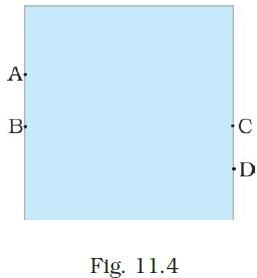
- a)A and B
- b)C and D
- c)B and C
- d)A and C
Correct answer is option 'C'. Can you explain this answer?
A water tank has four taps fixed at points A, B, C, D as shown in Fig. 11.4. The water will flow out at the same pressure from taps at
a)
A and B
b)
C and D
c)
B and C
d)
A and C
 | Raghavi Iyer answered |
As we know liquids exert equal pressure at the same depth.
From the figure, B and C are at the same level, hence pressure will be the same at B and C.
From the figure, B and C are at the same level, hence pressure will be the same at B and C.

The SI unit for speed is- a)km/hour
- b)m/s
- c)cm/min
- d)none of the above
Correct answer is option 'B'. Can you explain this answer?
The SI unit for speed is
a)
km/hour
b)
m/s
c)
cm/min
d)
none of the above
 | Prachi Rathore answered |
si unit of speed= si unit of distance/si unit of time =metre/second
1 km/ h = ________ m/s- a)3/50
- b)18/5
- c)50/3
- d)5/18
Correct answer is option 'D'. Can you explain this answer?
1 km/ h = ________ m/s
a)
3/50
b)
18/5
c)
50/3
d)
5/18
 | Amrutha Mukherjee answered |
Conversion of km/h to m/s
To convert km/h to m/s, we need to use the following conversion factor:
1 km/h = 1000 m/3600 s = 5/18 m/s
So, to convert 1 km/h to m/s, we simply multiply it by 5/18.
Solution
Given, 1 km/h = ?
We need to convert it to m/s.
1 km/h × 5/18 = 5/18 m/s
Therefore, the correct option is (d) 5/18.
To convert km/h to m/s, we need to use the following conversion factor:
1 km/h = 1000 m/3600 s = 5/18 m/s
So, to convert 1 km/h to m/s, we simply multiply it by 5/18.
Solution
Given, 1 km/h = ?
We need to convert it to m/s.
1 km/h × 5/18 = 5/18 m/s
Therefore, the correct option is (d) 5/18.
Which of the following is a correct measure of velocity?- a)30 s
- b)30 m/s
- c)30 South
- d)30 m/s, South
Correct answer is option 'D'. Can you explain this answer?
Which of the following is a correct measure of velocity?
a)
30 s
b)
30 m/s
c)
30 South
d)
30 m/s, South
 | Pooja Shah answered |
Velocity is a vector quantity, which means it has both magnitude and direction. To correctly measure and describe velocity, you need both these components.
Here’s the analysis of the provided options:
- 30 s: This is a measure of time, not velocity.
- 30 m/s: This is a measure of speed, not velocity, because it does not include a direction.
- 30 South: This describes a direction but lacks the magnitude (speed), so it is not a complete measure of velocity.
- 30 m/s, South: This provides both magnitude (30 m/s) and direction (South), making it a complete measure of velocity.
So, the correct measure of velocity is:
4. 30 m/s, South
Which of the following is an example of contact force?- a)Muscular force
- b)Gravitational force
- c)Electrostatic force
- d)Magnetic force
Correct answer is option 'A'. Can you explain this answer?
Which of the following is an example of contact force?
a)
Muscular force
b)
Gravitational force
c)
Electrostatic force
d)
Magnetic force
 | Kavya Chopra answered |
The forces in which to bodies acting on each other are in contact are called contact force. Muscular force is an example of contact force.
How far will a car travel in 25 min at 12 m/s?- a)24 km
- b)10 km
- c)18 km
- d)14 km
Correct answer is option 'C'. Can you explain this answer?
How far will a car travel in 25 min at 12 m/s?
a)
24 km
b)
10 km
c)
18 km
d)
14 km
 | Molik answered |
S=d/t. .......... t=25min=1500sec. and speed =12m/s.........d=s×t. ...........d=12×1500=18000m. as we hv to convert it into km so 1km=1000m and 1m =1/1000 km so , 18000m=18000/1000km=18km

Can you explain the answer of this question below:The speed at any instant of time is known as
- A:
velocity
- B:
given speed
- C:
average speed
- D:
instantaneous speed
The answer is d.
The speed at any instant of time is known as
velocity
given speed
average speed
instantaneous speed
 | Gunjan Lakhani answered |
The instantaneous speed of an object is defined as the speed of the object at any given instant. The instantaneous speed of an object can be determined by determining the average speed over a short distance (and short time), and using this approximation as the instantaneous speed.
Topic in NCERT: Motion and Acceleration
Line in NCERT: error Occcured while getting response from embedding
Weight of a body on earth is 48 N; its weight on moon is- a)98 N
- b)48 N
- c)9.8 N
- d)8 N
Correct answer is option 'D'. Can you explain this answer?
Weight of a body on earth is 48 N; its weight on moon is
a)
98 N
b)
48 N
c)
9.8 N
d)
8 N
| | Himaja Ammu answered |
Weight on moon=1/6of weight on earth =1/6×48 =8N
Gravitational force is acting on- a)Only on moon
- b)Only on other planets
- c)Only on earth
- d)All bodies
Correct answer is option 'D'. Can you explain this answer?
Gravitational force is acting on
a)
Only on moon
b)
Only on other planets
c)
Only on earth
d)
All bodies
| | Amit Kumar answered |
Gravitational force is acting on earth, moon and on all other planet. This force is acting on all the body having some mass.
Can you explain the answer of this question below:An object travels 20 m in 5 sec and then another 40 m in 5 sec. What is the average speed of the object?
- A:
6 m/s
- B:
2 m/s
- C:
12 m/s
- D:
0 m/s
The answer is a.
An object travels 20 m in 5 sec and then another 40 m in 5 sec. What is the average speed of the object?
6 m/s
2 m/s
12 m/s
0 m/s
 | Learning Education answered |
Average speed= (Total Distance)/(Total time)
= (20 m + 40 m)/(5 sec + 5 sec)
=60 m/10 sec
=6m/s
Apple falls towards the earth but the earth does not move towards the apple because- a)only earth exerts force on apple, apple does not exert force on earth
- b)apple experiences greater force than the earth
- c)only apple exerts force on earth, earth does not exert force on apple
- d)acceleration is inversely proportional to mass, so acceleration of earth is negligible.
Correct answer is option 'D'. Can you explain this answer?
Apple falls towards the earth but the earth does not move towards the apple because
a)
only earth exerts force on apple, apple does not exert force on earth
b)
apple experiences greater force than the earth
c)
only apple exerts force on earth, earth does not exert force on apple
d)
acceleration is inversely proportional to mass, so acceleration of earth is negligible.
 | Vikram Khanna answered |
Apple falls towards the earth, but the earth does not move towards the apple because acceleration is inversely proportional to mass. Earth’s mass being extremly large as compared to apple, it has negligible acceleration towards the apple.
Can you explain the answer of this question below:If a person walked at 2 m/s for 12 s he/she would travel a distance of
- A:
24 m
- B:
6 m
- C:
4 m
- D:
none of the answers
The answer is a.
If a person walked at 2 m/s for 12 s he/she would travel a distance of
24 m
6 m
4 m
none of the answers
 | Piyush Srivastava answered |
1second =2meter 12 second = 12*2meter 24metet
Name the instrument used to measure instantaneous speed of a vehicle- a)multimeter
- b)ammeter
- c)speedometer
- d)accelerator
Correct answer is option 'C'. Can you explain this answer?
Name the instrument used to measure instantaneous speed of a vehicle
a)
multimeter
b)
ammeter
c)
speedometer
d)
accelerator
| | Anita Menon answered |
The speedometer device is used to measure speed. A speedometer is also called a speedometer, it is a gauge that measures and displays the instantaneous speed of a vehicle.
The area under the speed-time graph gives the ________.- a)velocity
- b)distance
- c)acceleration
- d)time
Correct answer is 'B'. Can you explain this answer?
The area under the speed-time graph gives the ________.
a)
velocity
b)
distance
c)
acceleration
d)
time
 | Trisha Vashisht answered |
Area under the speed-time graph gives the distance:
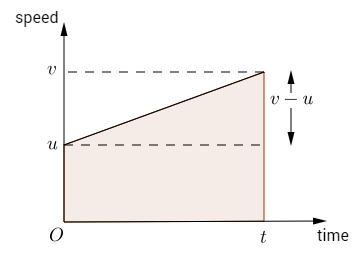
- When calculating the area under a speed-time graph, you are essentially finding the total distance traveled by an object over a certain period of time.
- This is because the area under a speed-time graph represents the total distance covered by an object as it moves at varying speeds.
- By finding the area under the curve on a speed-time graph, you can determine the total distance traveled by the object during that time interval.
If car A is at 40 km/h and car B is at 10 km/h in the opposite direction, what is the velocity of the car A relative to the car B?- a)40 km/h
- b)50 km/h.
- c)10 km/h
- d)30 km/h
Correct answer is option 'B'. Can you explain this answer?
If car A is at 40 km/h and car B is at 10 km/h in the opposite direction, what is the velocity of the car A relative to the car B?
a)
40 km/h
b)
50 km/h.
c)
10 km/h
d)
30 km/h
 | Hiral Datta answered |
Taking the formula when both bodies are moving along opposite direction we have :
V(AB) = V(A) - V(B) = 40 - (-10 ) = 50 km/hr
Hence the velocity of car A with respect to car B is 50 km/hr in opposite direction.
A ball is thrown vertically upwards with a velocity ‘u’. The velocity with which it falls to the earth again is:- a)Greater than ‘u’
- b)Greater than or equal to ‘u’
- c)Equal to ‘u’
- d)Less than ‘u’
Correct answer is option 'C'. Can you explain this answer?
A ball is thrown vertically upwards with a velocity ‘u’. The velocity with which it falls to the earth again is:
a)
Greater than ‘u’
b)
Greater than or equal to ‘u’
c)
Equal to ‘u’
d)
Less than ‘u’
| | Anita Menon answered |
For vertically upward motion: g is negative as it opposes the motion.
v = u – gt
0 = u – gt
t = u/g (1)
For vertically downward motion: g is positive as it is in the direction of motion.
v = u + gt
v = 0 + gt
t = v/g (2)
From equation 1 and 2
v = u
When pressing the bulb of a dropper with its nozzle in water, what causes water to rise in the dropper when pressure is released?- a)Pressure of water
- b)Gravity of the earth
- c)Shape of the rubber bulb
- d)Atmospheric pressure
Correct answer is option 'D'. Can you explain this answer?
When pressing the bulb of a dropper with its nozzle in water, what causes water to rise in the dropper when pressure is released?
a)
Pressure of water
b)
Gravity of the earth
c)
Shape of the rubber bulb
d)
Atmospheric pressure
 | Prepworks Coaching answered |
Releasing the bulb creates a lower pressure inside, causing water to rise due to atmospheric pressure, demonstrating fluid dynamics.
What is the mass of a body whose weight is 59 N? Take g = 9.8 m/s2- a)5 kg
- b)9 kg
- c)6 kg
- d)50 kg
Correct answer is 'C'. Can you explain this answer?
What is the mass of a body whose weight is 59 N? Take g = 9.8 m/s2
a)
5 kg
b)
9 kg
c)
6 kg
d)
50 kg
 | Nirali Shah answered |
To find the mass of a body, we can use the formula:
Weight = mass × acceleration due to gravity (g)
Given that the weight of the body is 59 N and the acceleration due to gravity is 9.8 m/s^2, we can rearrange the formula to solve for mass:
mass = weight / acceleration due to gravity
Substituting the given values:
mass = 59 N / 9.8 m/s^2
Calculating this equation gives us:
mass ≈ 6 kg
Therefore, the mass of the body is approximately 6 kg.
Explanation:
- Weight is the force exerted by a body due to gravity, and it is measured in Newtons (N).
- The acceleration due to gravity, denoted by 'g', is the acceleration an object experiences due to the gravitational force. On Earth, the average value of g is approximately 9.8 m/s^2.
- The formula weight = mass × acceleration due to gravity relates weight, mass, and acceleration due to gravity.
- To find the mass, we rearrange the formula and divide both sides by acceleration due to gravity.
- By substituting the given values of weight (59 N) and acceleration due to gravity (9.8 m/s^2) into the formula, we can calculate the mass.
- The final result is approximately 6 kg.
Weight = mass × acceleration due to gravity (g)
Given that the weight of the body is 59 N and the acceleration due to gravity is 9.8 m/s^2, we can rearrange the formula to solve for mass:
mass = weight / acceleration due to gravity
Substituting the given values:
mass = 59 N / 9.8 m/s^2
Calculating this equation gives us:
mass ≈ 6 kg
Therefore, the mass of the body is approximately 6 kg.
Explanation:
- Weight is the force exerted by a body due to gravity, and it is measured in Newtons (N).
- The acceleration due to gravity, denoted by 'g', is the acceleration an object experiences due to the gravitational force. On Earth, the average value of g is approximately 9.8 m/s^2.
- The formula weight = mass × acceleration due to gravity relates weight, mass, and acceleration due to gravity.
- To find the mass, we rearrange the formula and divide both sides by acceleration due to gravity.
- By substituting the given values of weight (59 N) and acceleration due to gravity (9.8 m/s^2) into the formula, we can calculate the mass.
- The final result is approximately 6 kg.
The strength of a force is usually expressed by its- a)Altitude
- b)Duration
- c)Direction
- d)Magnitude
Correct answer is 'D'. Can you explain this answer?
The strength of a force is usually expressed by its
a)
Altitude
b)
Duration
c)
Direction
d)
Magnitude
 | Dipika Mukherjee answered |
Force is a vector quantity as it contains both direction and magnitude but strength of a force is usually expressed by its magnitude.
The magnitude of gravitational force between the earth and 10 kg body is:- a)98 N
- b)90 N
- c)9.8 N
- d)100 N
Correct answer is option 'A'. Can you explain this answer?
The magnitude of gravitational force between the earth and 10 kg body is:
a)
98 N
b)
90 N
c)
9.8 N
d)
100 N
| | Achal Chinavalkar answered |
Gravity of earth is 9.8 N acceleration due to gravity is also 9.8 N gravitational force is nothing but the force applied by earth Therefore, f = m*a f,= 10*9.8 f= 98 N
How long would it take to travel 50 km traveling at a speed of 10 km/hr?- a)5 hours
- b)1 hour
- c)3 hours
- d)50 hours
Correct answer is option 'A'. Can you explain this answer?
How long would it take to travel 50 km traveling at a speed of 10 km/hr?
a)
5 hours
b)
1 hour
c)
3 hours
d)
50 hours
| | Bhaskar Chatterjee answered |
Given data:
Distance = 50 km
Speed = 10 km/hr
To find: Time taken to travel 50 km
Calculation:
We know that,
Speed = Distance/Time
⇒ Time = Distance/Speed
Substituting the given values, we get
Time = 50/10
Time = 5 hours
Therefore, the time taken to travel 50 km at a speed of 10 km/hr is 5 hours.
Answer: (a) 5 hours
Distance = 50 km
Speed = 10 km/hr
To find: Time taken to travel 50 km
Calculation:
We know that,
Speed = Distance/Time
⇒ Time = Distance/Speed
Substituting the given values, we get
Time = 50/10
Time = 5 hours
Therefore, the time taken to travel 50 km at a speed of 10 km/hr is 5 hours.
Answer: (a) 5 hours
Perpendicular force acting per unit area is called is called- a)Power
- b)Work
- c)Pressure
- d)Energy
Correct answer is option 'C'. Can you explain this answer?
Perpendicular force acting per unit area is called is called
a)
Power
b)
Work
c)
Pressure
d)
Energy
| | Amit Sharma answered |
The total force acting perpendicular on a given surface is called thrust. Thrust acting upon a unit area is called pressure.
A force has- a)Only direction
- b)Both magnitude and direction absent
- c)Both magnitude and direction
- d)Only magnitude
Correct answer is option 'C'. Can you explain this answer?
A force has
a)
Only direction
b)
Both magnitude and direction absent
c)
Both magnitude and direction
d)
Only magnitude
 | Sanjana Bose answered |
A force can cause an object with mass to change its velocity(which includes to begin moving from a state of rest), i.e., to accelerate. Force can also be described intuitively as a pushor a pull. A force has both magnitude and direction, making it a vector quantity.
The force exerted by a charged body on another charged or uncharged body is known as- a)Magnetic force
- b)Gravitational force
- c)Electrostatic force
- d)Muscular force
Correct answer is option 'C'. Can you explain this answer?
The force exerted by a charged body on another charged or uncharged body is known as
a)
Magnetic force
b)
Gravitational force
c)
Electrostatic force
d)
Muscular force
 | Pranab Chawla answered |
The force exerted by a charged body on another charged or uncharged body is known as electrostatic force. Electrostatic force is non-contact force.
The force of gravitation between two bodies varies with r as:- a)r2
- b)1/r2
- c)r
- d)1/r
Correct answer is option 'B'. Can you explain this answer?
The force of gravitation between two bodies varies with r as:
a)
r2
b)
1/r2
c)
r
d)
1/r
| | Arvind Singh answered |
Force of gravitation is inversely proportional to square of distance 1/r^2
Distance covered by a body from velocity-time graph is- a)Equal to the slope of the graph.
- b)Area under the graph .
- c)Is denoted by a line parallel to the time axis at any point on the distance axis.
- d)Is denoted by a line parallel to the distance axis at any point on the time axis
Correct answer is option 'B'. Can you explain this answer?
Distance covered by a body from velocity-time graph is
a)
Equal to the slope of the graph.
b)
Area under the graph .
c)
Is denoted by a line parallel to the time axis at any point on the distance axis.
d)
Is denoted by a line parallel to the distance axis at any point on the time axis
| | Ravi Verma answered |
The area under the line in a velocity-time graph represents the distance travelled. To find the distance travelled in the graph above, you need to find the area of the light-blue triangle and the dark-blue rectangle. The width of the rectangle is 6 seconds and the height is 8 metres per second.
Weight of an object is highest at- a)Center of earth
- b)Poles
- c)Above the earth’s surface
- d)Equator
Correct answer is option 'B'. Can you explain this answer?
Weight of an object is highest at
a)
Center of earth
b)
Poles
c)
Above the earth’s surface
d)
Equator
| | Sarita Reddy answered |
Earth is not a perfect sphere. Its radius at equator is greater than poles. Acceleration due to gravity is inversely proportional to the square of its radius. So, the acceleration due to gravity is greatest at poles. Hence, from relation, W = mg, it is clear that weight is highest at the poles.
Can you explain the answer of this question below:The ______ of a distance versus time graph is speed.
- A:
slope
- B:
y-intercept
- C:
origin
- D:
none of the answers
The answer is a.
The ______ of a distance versus time graph is speed.
slope
y-intercept
origin
none of the answers
| | Raghav Chatterjee answered |
The Relationship between Distance and Time
When an object moves, it covers a certain distance in a certain amount of time. The relationship between distance and time can be represented on a graph called a distance-time graph.
The Slope of a Distance-Time Graph
The slope of a distance-time graph represents the speed of the object. The slope is defined as the change in distance divided by the change in time. Mathematically, the slope can be written as:
Slope = Change in distance / Change in time
In other words, the slope of the graph gives us the rate at which the distance is changing with respect to time. This rate is the speed of the object.
Interpretation of the Slope
If the slope of the graph is steep, it means that the object is covering a large distance in a short amount of time. This indicates that the object is moving at a high speed.
If the slope of the graph is shallow, it means that the object is covering a small distance in a long amount of time. This indicates that the object is moving at a low speed.
Conclusion
Therefore, the correct answer to the given question is option 'A' - the slope of a distance versus time graph is speed. The slope of a distance-time graph gives us the speed of the object.
When an object moves, it covers a certain distance in a certain amount of time. The relationship between distance and time can be represented on a graph called a distance-time graph.
The Slope of a Distance-Time Graph
The slope of a distance-time graph represents the speed of the object. The slope is defined as the change in distance divided by the change in time. Mathematically, the slope can be written as:
Slope = Change in distance / Change in time
In other words, the slope of the graph gives us the rate at which the distance is changing with respect to time. This rate is the speed of the object.
Interpretation of the Slope
If the slope of the graph is steep, it means that the object is covering a large distance in a short amount of time. This indicates that the object is moving at a high speed.
If the slope of the graph is shallow, it means that the object is covering a small distance in a long amount of time. This indicates that the object is moving at a low speed.
Conclusion
Therefore, the correct answer to the given question is option 'A' - the slope of a distance versus time graph is speed. The slope of a distance-time graph gives us the speed of the object.
Friction arises due to- a)Contact between surfaces
- b)Repulsion between surfaces
- c)Attraction between surfaces
- d)All of the above
Correct answer is option 'A'. Can you explain this answer?
Friction arises due to
a)
Contact between surfaces
b)
Repulsion between surfaces
c)
Attraction between surfaces
d)
All of the above
 | Pritam Sen answered |
Friction arises due to contact between two surfaces. Friction force is more in case of solid body and less in case of gases.
A stone is dropped from a cliff. Its speed after it has fallen 100 m is- a)9.8 m/s
- b)44.2 m/s
- c)19.6 m/s
- d)98 m/s
Correct answer is option 'B'. Can you explain this answer?
A stone is dropped from a cliff. Its speed after it has fallen 100 m is
a)
9.8 m/s
b)
44.2 m/s
c)
19.6 m/s
d)
98 m/s
| | Sushant Choudhury answered |
Explanation:
When an object is dropped from a height, it falls freely under the influence of gravity. The acceleration due to gravity is approximately 9.8 m/s^2. So, as the stone falls, its speed increases due to the acceleration.
Using the kinematic equation:
We can use the kinematic equation to calculate the final speed of the stone after it has fallen 100 m. The equation is:
v^2 = u^2 + 2as
Where:
v = final velocity (unknown)
u = initial velocity (0 m/s, as the stone is dropped)
a = acceleration due to gravity (9.8 m/s^2)
s = displacement (100 m)
Substituting the given values:
v^2 = 0^2 + 2 * 9.8 * 100
v^2 = 0 + 1960
v^2 = 1960
Taking the square root of both sides:
v = √1960
v ≈ 44.2 m/s
Therefore, the speed of the stone after it has fallen 100 m is approximately 44.2 m/s. So, option B is the correct answer.
When an object is dropped from a height, it falls freely under the influence of gravity. The acceleration due to gravity is approximately 9.8 m/s^2. So, as the stone falls, its speed increases due to the acceleration.
Using the kinematic equation:
We can use the kinematic equation to calculate the final speed of the stone after it has fallen 100 m. The equation is:
v^2 = u^2 + 2as
Where:
v = final velocity (unknown)
u = initial velocity (0 m/s, as the stone is dropped)
a = acceleration due to gravity (9.8 m/s^2)
s = displacement (100 m)
Substituting the given values:
v^2 = 0^2 + 2 * 9.8 * 100
v^2 = 0 + 1960
v^2 = 1960
Taking the square root of both sides:
v = √1960
v ≈ 44.2 m/s
Therefore, the speed of the stone after it has fallen 100 m is approximately 44.2 m/s. So, option B is the correct answer.
The value of acceleration due to gravity at the poles- a)Is more than at the equator
- b)Same as at the equator
- c)Is less than at the equator
- d)zero
Correct answer is option 'A'. Can you explain this answer?
The value of acceleration due to gravity at the poles
a)
Is more than at the equator
b)
Same as at the equator
c)
Is less than at the equator
d)
zero
| | Arvind Singh answered |
In combination, the equatorial bulge and the effects of the surface centrifugal force due to rotation mean that sea-level effective gravity increases from about 9.780 m/s2 at the Equator to about 9.832 m/s2 at the poles, so an object will weigh about 0.5% more at the poles than at the Equator.
The speed-time graph for a particle moving at constant speed is a straight-line ________ to the time axis.- a)perpendicular
- b)parallel
- c)inclined
- d)aligned
Correct answer is option 'B'. Can you explain this answer?
The speed-time graph for a particle moving at constant speed is a straight-line ________ to the time axis.
a)
perpendicular
b)
parallel
c)
inclined
d)
aligned
| | Ananya Sharma answered |
The speed-time graph for a particle moving at constant speed is a straight-line parallel to the time axis.
What is the cause of change in motion or change in the state of motion?- a)Pressure
- b)Atmospheric Pressure
- c)Force
- d)Friction
Correct answer is option 'C'. Can you explain this answer?
What is the cause of change in motion or change in the state of motion?
a)
Pressure
b)
Atmospheric Pressure
c)
Force
d)
Friction
| | Sara Nair answered |
When force is applied to any object it may change its direction eg.foot ball it may change its shape eg dough it may change its state it may change its motion.
Which force enables us to perform all activities involving movement or bending of our body?- a)Frictional force
- b)Magnetic force
- c)Electrostatic force
- d)Muscular force
Correct answer is option 'D'. Can you explain this answer?
Which force enables us to perform all activities involving movement or bending of our body?
a)
Frictional force
b)
Magnetic force
c)
Electrostatic force
d)
Muscular force
 | Geetika Shah answered |
Muscular force enables us to perform all activities involving movement or bending of our body. Muscular force is developed inside muscle due to presence of contractile protein.
When a rocket is fired upwards, what forces act on it immediately after leaving the launch pad?- a)Gravity and magnetic force
- b)gravitational force and frictional force
- c)Friction and Magnetic Force
- d)Electrostatic force and thrust
Correct answer is option 'B'. Can you explain this answer?
When a rocket is fired upwards, what forces act on it immediately after leaving the launch pad?
a)
Gravity and magnetic force
b)
gravitational force and frictional force
c)
Friction and Magnetic Force
d)
Electrostatic force and thrust
 | Flembe Academy answered |
The thrust from the rocket engines and gravity act on the rocket, illustrating the forces involved in launching a rocket.
The tendency of a body to maintain its state of rest or uniform motion is called- a)Gravity
- b)Inertia
- c)Weight
- d)Acceleration
Correct answer is option 'B'. Can you explain this answer?
The tendency of a body to maintain its state of rest or uniform motion is called
a)
Gravity
b)
Inertia
c)
Weight
d)
Acceleration
| | Sanjana Bose answered |
The tendency of an object to maintain its state of motion, to remain at rest or to keep moving at a constant velocity, is known as inertia.
A metal in which iron can float is- a)Sodium
- b)Magnesium
- c)Mercury
- d)Manganese
Correct answer is option 'C'. Can you explain this answer?
A metal in which iron can float is
a)
Sodium
b)
Magnesium
c)
Mercury
d)
Manganese
 | Vanya Gupta answered |
Mercury is a non metal... in the question it is asked abt metal....
Why do the forces acting on a held plastic bucket not change its state of motion?- a)The forces are balanced
- b)The forces are unbalanced
- c)Only gravity acts
- d)Only muscular force acts
Correct answer is option 'A'. Can you explain this answer?
Why do the forces acting on a held plastic bucket not change its state of motion?
a)
The forces are balanced
b)
The forces are unbalanced
c)
Only gravity acts
d)
Only muscular force acts
 | S.S Career Academy answered |
The muscular force balances the gravitational force, keeping the bucket stationary, illustrating balanced forces.
When a load is suspended from a spring, what happens to the spring?- a)The spring pulls the load, creating a gravitational pull
- b)The load pulls the spring, causing it to stretch
- c)The hook compresses the spring, changing its shape
- d)The wall moves the hook, changing its motion
Correct answer is option 'B'. Can you explain this answer?
When a load is suspended from a spring, what happens to the spring?
a)
The spring pulls the load, creating a gravitational pull
b)
The load pulls the spring, causing it to stretch
c)
The hook compresses the spring, changing its shape
d)
The wall moves the hook, changing its motion
 | BT Educators answered |
When a load is suspended from a spring, the load pulls the spring, causing it to stretch. This phenomenon can be explained by Hooke's law, which describes the relationship between the force applied to the spring and the resulting extension or compression of the spring. This demonstrates the concept of elastic deformation in materials subjected to external forces.
Why does an inflated balloon stick to a wall after being rubbed with a synthetic cloth?- a)Gravitational force
- b)Magnetic force
- c)Electrostatic force
- d)Contact force
Correct answer is option 'C'. Can you explain this answer?
Why does an inflated balloon stick to a wall after being rubbed with a synthetic cloth?
a)
Gravitational force
b)
Magnetic force
c)
Electrostatic force
d)
Contact force
 | Future Foundation Institute answered |
Rubbing creates an electrostatic charge, causing the balloon to stick, demonstrating electrostatic forces.
Electrostatic force is exerted by charged body on- a)Another charged body or uncharged body
- b)Metallic body only
- c)Another uncharged body only
- d)Another charged body only
Correct answer is option 'A'. Can you explain this answer?
Electrostatic force is exerted by charged body on
a)
Another charged body or uncharged body
b)
Metallic body only
c)
Another uncharged body only
d)
Another charged body only
 | Harsh Datta answered |
Electrostatic force is exerted by charged body on another charged body or uncharged body. Two charged body having same kind of charge repels each other.
Calculate the change in momentum of a body weighing 10 kg when its velocity decreases from 20 m/s to 0.2 m/s.- a)-198 Ns
- b)204 Ns
- c)+198 Ns
- d)-204 Ns
Correct answer is option 'A'. Can you explain this answer?
Calculate the change in momentum of a body weighing 10 kg when its velocity decreases from 20 m/s to 0.2 m/s.
a)
-198 Ns
b)
204 Ns
c)
+198 Ns
d)
-204 Ns
 | Bhargavi Saha answered |
Given:
Mass of the body, m = 10 kg
Initial velocity, u = 20 m/s
Final velocity, v = 0.2 m/s
Formula:
Change in momentum, Δp = m(v - u)
Calculation:
Substituting the given values into the formula, we get:
Δp = 10(0.2 - 20)
= 10(-19.8)
= -198 Ns
Explanation:
- Momentum is a vector quantity that depends on the mass and velocity of an object.
- The change in momentum of an object is equal to the product of its mass and the change in velocity.
- In this case, the body weighs 10 kg and its initial velocity is 20 m/s.
- The final velocity is given as 0.2 m/s.
- To calculate the change in momentum, we subtract the initial velocity from the final velocity and multiply the result by the mass of the body.
- The change in velocity is (0.2 - 20) = -19.8 m/s.
- Multiplying this by the mass of the body (10 kg) gives us -198 Ns as the change in momentum.
- The negative sign indicates that the direction of the change in momentum is opposite to the initial momentum.
- Therefore, the correct answer is option 'A' (-198 Ns).
Mass of the body, m = 10 kg
Initial velocity, u = 20 m/s
Final velocity, v = 0.2 m/s
Formula:
Change in momentum, Δp = m(v - u)
Calculation:
Substituting the given values into the formula, we get:
Δp = 10(0.2 - 20)
= 10(-19.8)
= -198 Ns
Explanation:
- Momentum is a vector quantity that depends on the mass and velocity of an object.
- The change in momentum of an object is equal to the product of its mass and the change in velocity.
- In this case, the body weighs 10 kg and its initial velocity is 20 m/s.
- The final velocity is given as 0.2 m/s.
- To calculate the change in momentum, we subtract the initial velocity from the final velocity and multiply the result by the mass of the body.
- The change in velocity is (0.2 - 20) = -19.8 m/s.
- Multiplying this by the mass of the body (10 kg) gives us -198 Ns as the change in momentum.
- The negative sign indicates that the direction of the change in momentum is opposite to the initial momentum.
- Therefore, the correct answer is option 'A' (-198 Ns).
A batsman hits back a ball straight in the direction of the bowler without changing its initial speed of 12 m/s . If the mass of the ball is 0.15 kg, the impulse imported on the ball is- a)4.2 Ns
- b)3.6 Ns
- c)2.8 Ns
- d)1.6 Ns
Correct answer is option 'B'. Can you explain this answer?
A batsman hits back a ball straight in the direction of the bowler without changing its initial speed of 12 m/s . If the mass of the ball is 0.15 kg, the impulse imported on the ball is
a)
4.2 Ns
b)
3.6 Ns
c)
2.8 Ns
d)
1.6 Ns
 | Mihir Shah answered |
Understanding Impulse
Impulse is defined as the change in momentum of an object when a force is applied over a period of time. It can also be calculated using the formula:
Impulse = Change in Momentum = Final Momentum - Initial Momentum
Given Data
- Initial Speed of Ball (u): 12 m/s (towards the bowler)
- Final Speed of Ball (v): -12 m/s (back towards the batsman)
- Mass of Ball (m): 0.15 kg
Calculating Momentum
- Initial Momentum (p_initial):
p_initial = m * u = 0.15 kg * 12 m/s = 1.8 kg·m/s
- Final Momentum (p_final):
p_final = m * v = 0.15 kg * (-12 m/s) = -1.8 kg·m/s
Finding Change in Momentum
- Change in Momentum (Δp):
Δp = p_final - p_initial
= (-1.8 kg·m/s) - (1.8 kg·m/s)
= -3.6 kg·m/s
Calculating Impulse
Since impulse is equal to the change in momentum:
Impulse = Δp = -3.6 kg·m/s
The negative sign indicates a change in direction, but impulse is typically expressed as a positive value in magnitude.
Conclusion
Thus, the impulse imparted on the ball is 3.6 Ns, which corresponds to option B. This value represents the total effect of the force acting on the ball during the collision with the bat.
Impulse is defined as the change in momentum of an object when a force is applied over a period of time. It can also be calculated using the formula:
Impulse = Change in Momentum = Final Momentum - Initial Momentum
Given Data
- Initial Speed of Ball (u): 12 m/s (towards the bowler)
- Final Speed of Ball (v): -12 m/s (back towards the batsman)
- Mass of Ball (m): 0.15 kg
Calculating Momentum
- Initial Momentum (p_initial):
p_initial = m * u = 0.15 kg * 12 m/s = 1.8 kg·m/s
- Final Momentum (p_final):
p_final = m * v = 0.15 kg * (-12 m/s) = -1.8 kg·m/s
Finding Change in Momentum
- Change in Momentum (Δp):
Δp = p_final - p_initial
= (-1.8 kg·m/s) - (1.8 kg·m/s)
= -3.6 kg·m/s
Calculating Impulse
Since impulse is equal to the change in momentum:
Impulse = Δp = -3.6 kg·m/s
The negative sign indicates a change in direction, but impulse is typically expressed as a positive value in magnitude.
Conclusion
Thus, the impulse imparted on the ball is 3.6 Ns, which corresponds to option B. This value represents the total effect of the force acting on the ball during the collision with the bat.
Four balls A, B, C and D displace 10 mL 24 mL, 15 mL and 12 mL of a liquid α respectively when immersed completely. The ball which will undergo the maximum apparent loss in weight will be- a)A
- b)B
- c)C
- d)D
Correct answer is option 'B'. Can you explain this answer?
Four balls A, B, C and D displace 10 mL 24 mL, 15 mL and 12 mL of a liquid α respectively when immersed completely. The ball which will undergo the maximum apparent loss in weight will be
a)
A
b)
B
c)
C
d)
D
| | Siddharth Sarkar answered |
The apparent loss in weight of an object when it is immersed in a fluid is equal to the weight of the fluid displaced by the object. In this case, the four balls A, B, C, and D displace different volumes of liquid alpha when immersed completely. We need to determine which ball will undergo the maximum apparent loss in weight.
Let's analyze the volume of liquid displaced by each ball:
- Ball A displaces 10 mL of liquid alpha
- Ball B displaces 24 mL of liquid alpha
- Ball C displaces 15 mL of liquid alpha
- Ball D displaces 12 mL of liquid alpha
To determine the maximum apparent loss in weight, we need to find the ball that displaces the greatest volume of liquid alpha.
Comparing the volumes displaced, we can see that:
- Ball B displaces the greatest volume of liquid alpha (24 mL)
- Ball A displaces a smaller volume of liquid alpha (10 mL)
- Ball C displaces a smaller volume of liquid alpha (15 mL)
- Ball D displaces the smallest volume of liquid alpha (12 mL)
Therefore, the ball that will undergo the maximum apparent loss in weight is Ball B.
Let's analyze the volume of liquid displaced by each ball:
- Ball A displaces 10 mL of liquid alpha
- Ball B displaces 24 mL of liquid alpha
- Ball C displaces 15 mL of liquid alpha
- Ball D displaces 12 mL of liquid alpha
To determine the maximum apparent loss in weight, we need to find the ball that displaces the greatest volume of liquid alpha.
Comparing the volumes displaced, we can see that:
- Ball B displaces the greatest volume of liquid alpha (24 mL)
- Ball A displaces a smaller volume of liquid alpha (10 mL)
- Ball C displaces a smaller volume of liquid alpha (15 mL)
- Ball D displaces the smallest volume of liquid alpha (12 mL)
Therefore, the ball that will undergo the maximum apparent loss in weight is Ball B.
Chapter doubts & questions for Forces and Motion - Science for Grade 8 2026 is part of Grade 8 exam preparation. The chapters have been prepared according to the Grade 8 exam syllabus. The Chapter doubts & questions, notes, tests & MCQs are made for Grade 8 2026 Exam. Find important definitions, questions, notes, meanings, examples, exercises, MCQs and online tests here.
Chapter doubts & questions of Forces and Motion - Science for Grade 8 in English & Hindi are available as part of Grade 8 exam. Download more important topics, notes, lectures and mock test series for Grade 8 Exam by signing up for free.
Science for Grade 876 videos|173 docs|65 tests |
