


All Exams > JSS 2 > Mathematics for JSS 2 > All Questions
All questions of Squares & Square Roots for JSS 2 Exam
How many natural numbers lie between 92 and 102?
a) 36
b) 27
c) 9
d) 18
Correct answer is option 'D'. Can you explain this answer?
 | Sohini Das answered |
Between 92 and 102
Here, n = 9 and n + 1 = 10
∴ Natural number between 92 and 102 are (2 × n) or 2 x 9, i.e. 18.
Here, n = 9 and n + 1 = 10
∴ Natural number between 92 and 102 are (2 × n) or 2 x 9, i.e. 18.

Which of the following is a perfect square number?- a)222222
- b)23453
- c)1681
- d)1057
Correct answer is option 'C'. Can you explain this answer?
Which of the following is a perfect square number?
a)
222222
b)
23453
c)
1681
d)
1057
 | Shashwat Singh answered |
The answer is 1681 because it is the only number which has it's last digit as a number which a perfect square can have . 9×9=81 the last digit is 1.
Find the perfect square number between 30 and 40.- a)36
- b)49
- c)25
- d)none of these
Correct answer is option 'A'. Can you explain this answer?
Find the perfect square number between 30 and 40.
a)
36
b)
49
c)
25
d)
none of these
 | Amita Verma answered |
Since, 1 x 1 = 1
2 x 2 = 4
3 x 3 = 9
4 x 4 = 16
5 x 5 = 25
6 x 6 = 36
7 x 7 = 49
Thus, 36 is a perfact square number between 30 and 40.
Which of the following would end with digit 1?- a)1232
- b)1612
- c)772
- d)822
Correct answer is 'B'. Can you explain this answer?
Which of the following would end with digit 1?
a)
1232
b)
1612
c)
772
d)
822
 | Sneha Singh answered |
Option B is correct because the unit digit of 161 is 1 and if unit digit of any digit ends with 1 the its square will also end with 1.
Without adding, find the sum. 1 + 3 + 5 + 7 + 9 + 11 + 13- a)36
- b)49
- c)25
- d)19
Correct answer is option 'B'. Can you explain this answer?
Without adding, find the sum. 1 + 3 + 5 + 7 + 9 + 11 + 13
a)
36
b)
49
c)
25
d)
19
 | Preeti Khanna answered |
Total consecutive odd numbers (n) = 7
We know that, Sum = n2
= 72
= 49
Hence, the correct answer is 49
Without adding, find the sum. 1 + 3 + 5 + 7 + 9- a)16
- b)36
- c)9
- d)25
Correct answer is option 'D'. Can you explain this answer?
Without adding, find the sum. 1 + 3 + 5 + 7 + 9
a)
16
b)
36
c)
9
d)
25
 | Lakesway Classes answered |
Here, we have to find the sum of first five odd natural numbers.
Therefore, 1 + 3 + 5 + 7 + 9 = (5)2 = 25
Without adding, find the sum of 1 + 3 + 5 + 7 + 9 + 11 + 13 + 15 + 17 + 19- a)100
- b)64
- c)49
- d)81
Correct answer is option 'A'. Can you explain this answer?
Without adding, find the sum of 1 + 3 + 5 + 7 + 9 + 11 + 13 + 15 + 17 + 19
a)
100
b)
64
c)
49
d)
81
 | Target Study Academy answered |
Total consecutive odd numbers = 10
Thus n = 10
Therefore sum = n × n
= 10× 10 = 100
What is the least perfect square which is divisible by 2, 4 and 6?- a)36
- b)64
- c)16
- d)18
Correct answer is option 'A'. Can you explain this answer?
What is the least perfect square which is divisible by 2, 4 and 6?
a)
36
b)
64
c)
16
d)
18
| | Preeti Khanna answered |
LCM of 2,4,6= 2×1×2×3=12
Least perfect square which is a multiple of 12 is 36.
Least perfect square which is a multiple of 12 is 36.
Find the square of 39.- a)1500
- b)78
- c)1521
- d)none of these
Correct answer is option 'C'. Can you explain this answer?
Find the square of 39.
a)
1500
b)
78
c)
1521
d)
none of these
| | Ananya Das answered |
(40-1)2 = 1600+1-80 = 1521
How many numbers lie between square of 12 and 13- a)22
- b)23
- c)24
- d)25
Correct answer is option 'C'. Can you explain this answer?
How many numbers lie between square of 12 and 13
a)
22
b)
23
c)
24
d)
25
 | Rhea Reddy answered |
122 = 12*12 = 144
132 = 13*13 = 169
Now numbers are between144 and 169 are:
145, 146, 147,.............168
Total number = 24
So total numbers lies between 144 and 169 is 24
Find the least number that must be subtracted from 5607 so as to get a perfect square.- a)130
- b)135
- c)131
- d)none of these
Correct answer is option 'C'. Can you explain this answer?
Find the least number that must be subtracted from 5607 so as to get a perfect square.
a)
130
b)
135
c)
131
d)
none of these
 | Sounak Sengupta answered |
Square of 75 is 5625
square of 74 is 5476
so use must get 5476
5607 - x is 5476
x is 131
square root of 5476 is 74
If a number has 1 or 9 in the unit’s place, then it’s square ends in ________.- a)3
- b)9
- c)1
- d)none of these
Correct answer is option 'C'. Can you explain this answer?
If a number has 1 or 9 in the unit’s place, then it’s square ends in ________.
a)
3
b)
9
c)
1
d)
none of these
| | Aarav Sharma answered |
If a number has 1 or 9 in the unit's place, it means that the number ends with either 1 or 9.
Practice Quiz or MCQ (Multiple Choice Questions) with solutions are available for Practice, which would help you prepare for chapter Squares and Square Roots, Class 8, Mathematics . You can practice these practice quizzes as per your speed and improvise the topic.Q.Which of the following is a perfect square number?- a)222222
- b)23453
- c)1681
- d)1057
Correct answer is 'C'. Can you explain this answer?
Practice Quiz or MCQ (Multiple Choice Questions) with solutions are available for Practice, which would help you prepare for chapter Squares and Square Roots, Class 8, Mathematics . You can practice these practice quizzes as per your speed and improvise the topic.
Q.
Which of the following is a perfect square number?
a)
222222
b)
23453
c)
1681
d)
1057
 | Sanjana Bose answered |
A number is a perfect square (or a square number) if its square root is an integer; that is to say, it is the product of an integer with itself. Here, the square root of 1681 is 41.
Therefore, the square root of 1681 is an integer, and as a consequence 1681 is a perfect square.
As a consequence, 41 is the square root of 1681.
2025 plants are to be planted in a garden in such a way that each row contains as many plants as the number of rows. Find the number of plants in each row.- a)55
- b)65
- c)45
- d)none of these
Correct answer is option 'C'. Can you explain this answer?
2025 plants are to be planted in a garden in such a way that each row contains as many plants as the number of rows. Find the number of plants in each row.
a)
55
b)
65
c)
45
d)
none of these
| | Rajeev Kumar answered |
Let the number of rows be x
Thus, the each row contains x plants.
The total number of plants in the garden = number of rows × number of plants in each rows
Thus,
2025=x×x
=>x2 =2025
=>x= 3×3×3×3×5×5
=3×3×5
=45
Thus, there are 45 rows and each row contains 45 plants.
Thus, the each row contains x plants.
The total number of plants in the garden = number of rows × number of plants in each rows
Thus,
2025=x×x
=>x2 =2025
=>x= 3×3×3×3×5×5
=3×3×5
=45
Thus, there are 45 rows and each row contains 45 plants.
Practice Quiz or MCQ (Multiple Choice Questions) with solutions are available for Practice, which would help you prepare for chapter Squares and Square Roots, Class 8, Mathematics . You can practice these practice quizzes as per your speed and improvise the topic.Q.Which of the following is a perfect square number?- a)222222
- b)23453
- c)1681
- d)1057
Correct answer is option 'C'. Can you explain this answer?
Practice Quiz or MCQ (Multiple Choice Questions) with solutions are available for Practice, which would help you prepare for chapter Squares and Square Roots, Class 8, Mathematics . You can practice these practice quizzes as per your speed and improvise the topic.
Q.
Which of the following is a perfect square number?
a)
222222
b)
23453
c)
1681
d)
1057
| | Kavya Saxena answered |
The answer is 1681 because it is the only number which has it's last digit as a number which a perfect square can have . 9×9=81 the last digit is 1.
Find the perfect square numbers between 50 and 60.- a)64
- b)49
- c)no number
- d)none of these
Correct answer is option 'C'. Can you explain this answer?
Find the perfect square numbers between 50 and 60.
a)
64
b)
49
c)
no number
d)
none of these
| | Anita Menon answered |
Since we have 72=49 and 82=64. And both numbers lies outside 50 and 60 There is no perfect square between 50 and 60.
Find the square root of 529.- a)24
- b)23
- c)25
- d)none of these
Correct answer is option 'B'. Can you explain this answer?
Find the square root of 529.
a)
24
b)
23
c)
25
d)
none of these
| | Rajeev Kumar answered |
Square root of 529 is 23
If 5278 is squared, then what will be at unit place?- a)4
- b)7
- c)6
- d)8
Correct answer is option 'A'. Can you explain this answer?
If 5278 is squared, then what will be at unit place?
a)
4
b)
7
c)
6
d)
8
 | Trisha Vashisht answered |
When squaring the number 5278, the unit digit is determined by the square of the unit digit of the original number.
Since the unit digit of 5278 is 8, squaring it gives 8 × 8 = 64.
Therefore, the unit place digit of 5278² is 4.
Therefore correct answer : Option A
Therefore correct answer : Option A
None of the square numbers end with _________ at unit’s place.- a)3
- b)2
- c)7
- d)2, 3, 7 or 8
Correct answer is option 'D'. Can you explain this answer?
None of the square numbers end with _________ at unit’s place.
a)
3
b)
2
c)
7
d)
2, 3, 7 or 8
| | Preeti Khanna answered |
According to the Property 1, A number having 2, 3, 7 or 8 at it's unit's place is never a perfect square. In other words, no square number ebds in 2, 3, 7 or 8.
What will be the number of zeros in the square of 400?- a)4
- b)1
- c)3
- d)2
Correct answer is option 'A'. Can you explain this answer?
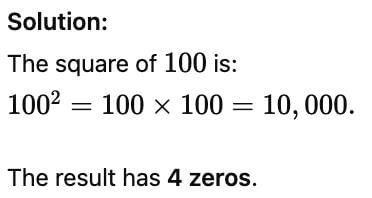
What will be the number of zeros in the square of 400?
a)
4
b)
1
c)
3
d)
2
| | Rajeev Kumar answered |
Square of 400 = 160000
Hence, the number of zeroes is 4
Find the greatest 4-digit number which is a perfect square.- a)9990
- b)9801
- c)9999
- d)none of these
Correct answer is option 'B'. Can you explain this answer?
Find the greatest 4-digit number which is a perfect square.
a)
9990
b)
9801
c)
9999
d)
none of these
| | Kavya Saxena answered |
By division method we find the root of 9999 and we get the remainder 198.So subtracting 198 from 9999 we get 9801 as the greatest 4-digit perfect square.
Find the square root of 729.- a)29
- b)28
- c)27
- d)30
Correct answer is option 'C'. Can you explain this answer?
Find the square root of 729.
a)
29
b)
28
c)
27
d)
30
| | Aarav Sharma answered |
The square root of 729 is 27.

What will be the number of zeros in the square of 60?- a)1
- b)2
- c)3
- d)none of these
Correct answer is option 'B'. Can you explain this answer?
What will be the number of zeros in the square of 60?
a)
1
b)
2
c)
3
d)
none of these
 | Samridhi Patel answered |
Square of 60 is 3600 therefore number of zeroes is 2.
________ is the inverse operation of square.- a)Square root
- b)Cube root
- c)Square
- d)none of these
Correct answer is option 'A'. Can you explain this answer?
________ is the inverse operation of square.
a)
Square root
b)
Cube root
c)
Square
d)
none of these
| | Rajeev Kumar answered |
The inverse of squaring a number is square root.
Which of the following numbers will have 6 at unit place?- a)192
- b)112
- c)242
- d)132
Correct answer is option 'C'. Can you explain this answer?
Which of the following numbers will have 6 at unit place?
a)
192
b)
112
c)
242
d)
132
 | EduRev Class 8 answered |
Answer: C
Explanation: 242 = 24 x 24 = 576
What is the least number to be added to 4523 to make it a perfect square?- a)101
- b)105
- c)110
- d)238
Correct answer is option 'A'. Can you explain this answer?
What is the least number to be added to 4523 to make it a perfect square?
a)
101
b)
105
c)
110
d)
238
 | Pankaj Mehra answered |
Calculation of the Perfect Square:
To find the least number that needs to be added to 4523 to make it a perfect square, we can start by determining the nearest perfect square to 4523.
The square root of 4523 is approximately 67.26. Therefore, the nearest perfect square is 67^2 (4489).
Finding the Difference:
To determine the difference between the nearest perfect square and 4523, we subtract 4489 from 4523:
4523 - 4489 = 34
Finding the Next Perfect Square:
Since the difference is positive, we need to find the next perfect square after 4523. We add twice the square root of 4523 (i.e., 2 * 67.26 ≈ 134.52) plus one to 4523:
4523 + 134.52 + 1 ≈ 4660.52
The square root of 4660.52 is approximately 68.25. Therefore, the next perfect square is 68^2 (4624).
Calculating the Least Number to be Added:
To find the least number to be added to 4523, we subtract 4523 from 4624:
4624 - 4523 = 101
Therefore, the least number that needs to be added to 4523 to make it a perfect square is 101.
Conclusion:
Based on the calculations, the correct answer is option 'A', which is 101.
To find the least number that needs to be added to 4523 to make it a perfect square, we can start by determining the nearest perfect square to 4523.
The square root of 4523 is approximately 67.26. Therefore, the nearest perfect square is 67^2 (4489).
Finding the Difference:
To determine the difference between the nearest perfect square and 4523, we subtract 4489 from 4523:
4523 - 4489 = 34
Finding the Next Perfect Square:
Since the difference is positive, we need to find the next perfect square after 4523. We add twice the square root of 4523 (i.e., 2 * 67.26 ≈ 134.52) plus one to 4523:
4523 + 134.52 + 1 ≈ 4660.52
The square root of 4660.52 is approximately 68.25. Therefore, the next perfect square is 68^2 (4624).
Calculating the Least Number to be Added:
To find the least number to be added to 4523, we subtract 4523 from 4624:
4624 - 4523 = 101
Therefore, the least number that needs to be added to 4523 to make it a perfect square is 101.
Conclusion:
Based on the calculations, the correct answer is option 'A', which is 101.
Four-fifth of one-eighth of 3/4th of A is 64. What is the cube root of 3/5th of A? - a)5
- b)8
- c)3
- d)4
Correct answer is option 'B'. Can you explain this answer?
Four-fifth of one-eighth of 3/4th of A is 64. What is the cube root of 3/5th of A?
a)
5
b)
8
c)
3
d)
4
| | Aarav Sharma answered |
**Given:**
- Four-fifths of one-eighth of three-fourths of A is 64.
**To find:**
The cube root of three-fifths of A.
**Solution:**
Let's break down the given information step by step.
1. Four-fifths of one-eighth of three-fourths of A is 64.
- Four-fifths of one-eighth: (4/5) * (1/8) = 4/40 = 1/10
- Three-fourths of A: (3/4) * A = 3A/4
- Combining the two: (1/10) * (3A/4) = 3A/40
- So, 3A/40 = 64
2. Solve for A:
- Multiply both sides of the equation by 40 to isolate A: (3A/40) * 40 = 64 * 40
- Simplifying: 3A = 2560
- Divide both sides of the equation by 3 to solve for A: A = 2560/3
3. Find the cube root of three-fifths of A:
- Three-fifths of A: (3/5) * A = (3/5) * (2560/3) = 2560/5 = 512
- Cube root of 512: ∛512 = 8
Therefore, the cube root of three-fifths of A is 8, which corresponds to option B.
- Four-fifths of one-eighth of three-fourths of A is 64.
**To find:**
The cube root of three-fifths of A.
**Solution:**
Let's break down the given information step by step.
1. Four-fifths of one-eighth of three-fourths of A is 64.
- Four-fifths of one-eighth: (4/5) * (1/8) = 4/40 = 1/10
- Three-fourths of A: (3/4) * A = 3A/4
- Combining the two: (1/10) * (3A/4) = 3A/40
- So, 3A/40 = 64
2. Solve for A:
- Multiply both sides of the equation by 40 to isolate A: (3A/40) * 40 = 64 * 40
- Simplifying: 3A = 2560
- Divide both sides of the equation by 3 to solve for A: A = 2560/3
3. Find the cube root of three-fifths of A:
- Three-fifths of A: (3/5) * A = (3/5) * (2560/3) = 2560/5 = 512
- Cube root of 512: ∛512 = 8
Therefore, the cube root of three-fifths of A is 8, which corresponds to option B.
Find the smallest number by which 180 must be multiplied so that the product becomes a perfect square.- a)2
- b) 3
- c) 5
- d) 10
Correct answer is option 'C'. Can you explain this answer?
Find the smallest number by which 180 must be multiplied so that the product becomes a perfect square.
a)
2
b)
3
c)
5
d)
10
 | Kirti Chakraborty answered |
Understanding Perfect Squares
A perfect square is a number that can be expressed as the square of an integer. To determine the smallest number by which 180 must be multiplied to become a perfect square, we first need to factor 180 into its prime factors.
Prime Factorization of 180
- The prime factorization of 180 is:
- 180 = 2 × 2 × 3 × 3 × 5
- This can also be written as: 180 = 2^2 × 3^2 × 5^1
Analyzing the Prime Factors
- For a number to be a perfect square, all prime factors must have even exponents.
- In the prime factorization of 180:
- The exponent of 2 is 2 (even)
- The exponent of 3 is 2 (even)
- The exponent of 5 is 1 (odd)
Determining What is Needed
- The only prime factor with an odd exponent is 5.
- To make the exponent of 5 even, we need to multiply by 5.
- Therefore, we need to multiply 180 by 5 to ensure all exponents become even.
Conclusion
- The smallest number by which 180 must be multiplied to become a perfect square is:
- 5
Thus, the correct answer is option 'C'.
A perfect square is a number that can be expressed as the square of an integer. To determine the smallest number by which 180 must be multiplied to become a perfect square, we first need to factor 180 into its prime factors.
Prime Factorization of 180
- The prime factorization of 180 is:
- 180 = 2 × 2 × 3 × 3 × 5
- This can also be written as: 180 = 2^2 × 3^2 × 5^1
Analyzing the Prime Factors
- For a number to be a perfect square, all prime factors must have even exponents.
- In the prime factorization of 180:
- The exponent of 2 is 2 (even)
- The exponent of 3 is 2 (even)
- The exponent of 5 is 1 (odd)
Determining What is Needed
- The only prime factor with an odd exponent is 5.
- To make the exponent of 5 even, we need to multiply by 5.
- Therefore, we need to multiply 180 by 5 to ensure all exponents become even.
Conclusion
- The smallest number by which 180 must be multiplied to become a perfect square is:
- 5
Thus, the correct answer is option 'C'.
Which of the following numbers is a perfect square?- a)145
- b)169
- c)180
- d)200
Correct answer is option 'B'. Can you explain this answer?
Which of the following numbers is a perfect square?
a)
145
b)
169
c)
180
d)
200
 | Nidhi Bhatt answered |
169 = 13 × 13, so it is a perfect square. The other numbers cannot be expressed as the square of a whole number.
The largest perfect square between 4 and 50 is- a)25
- b)36
- c)49
- d)45
Correct answer is option 'C'. Can you explain this answer?
The largest perfect square between 4 and 50 is
a)
25
b)
36
c)
49
d)
45
 | C K Academy answered |
The perfect squares between 4 and 50 are:
- 9 (3 x 3)
- 16 (4 x 4)
- 25 (5 x 5)
- 36 (6 x 6)
- 49 (7 x 7)
Among these, the largest is 49.
What is the square root of 144?- a)21
- b)14
- c)12
- d)10
Correct answer is option 'C'. Can you explain this answer?
What is the square root of 144?
a)
21
b)
14
c)
12
d)
10
 | Learners World answered |
122 = 144.
So, the square root of 144 is 12. Therefore, the correct option is a) 12.
Chapter doubts & questions for Squares & Square Roots - Mathematics for JSS 2 2026 is part of JSS 2 exam preparation. The chapters have been prepared according to the JSS 2 exam syllabus. The Chapter doubts & questions, notes, tests & MCQs are made for JSS 2 2026 Exam. Find important definitions, questions, notes, meanings, examples, exercises, MCQs and online tests here.
Chapter doubts & questions of Squares & Square Roots - Mathematics for JSS 2 in English & Hindi are available as part of JSS 2 exam. Download more important topics, notes, lectures and mock test series for JSS 2 Exam by signing up for free.
Mathematics for JSS 283 videos|132 docs|35 tests |
