


All Exams > Grade 8 > Mathematics for Grade 8 > All Questions
All questions of Pythagoras’ Theorem for Grade 8 Exam
A triangle in which two sides are of equal lengths is called _______________.- a)scalene
- b)acute-angled
- c)equilateral
- d)isosceles
Correct answer is option 'D'. Can you explain this answer?
A triangle in which two sides are of equal lengths is called _______________.
a)
scalene
b)
acute-angled
c)
equilateral
d)
isosceles
 | Praveen Kumar answered |
AB is the hypotenuse ⇒ C has the right angle.

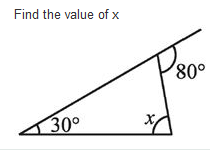
- a)50°
- b)120°
- c)110°
- d)30°
Correct answer is 'A'. Can you explain this answer?
a)
50°
b)
120°
c)
110°
d)
30°
 | Yash Kapoor answered |
An exterior angle of a triangle is equal to the sum of the opposite interior angles
So in the given figure
80deg = 30 deg + x
it implies x = 50deg.
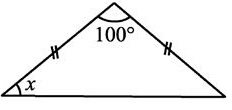
What is the measure of angle x ?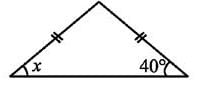
- a)30°
- b)40°
- c)25°
- d)60°
Correct answer is option 'B'. Can you explain this answer?
What is the measure of angle x ?
a)
30°
b)
40°
c)
25°
d)
60°
 | Rainbow Rise Classes answered |
if in a triangle 2 sides are equal then the angles would also be equal
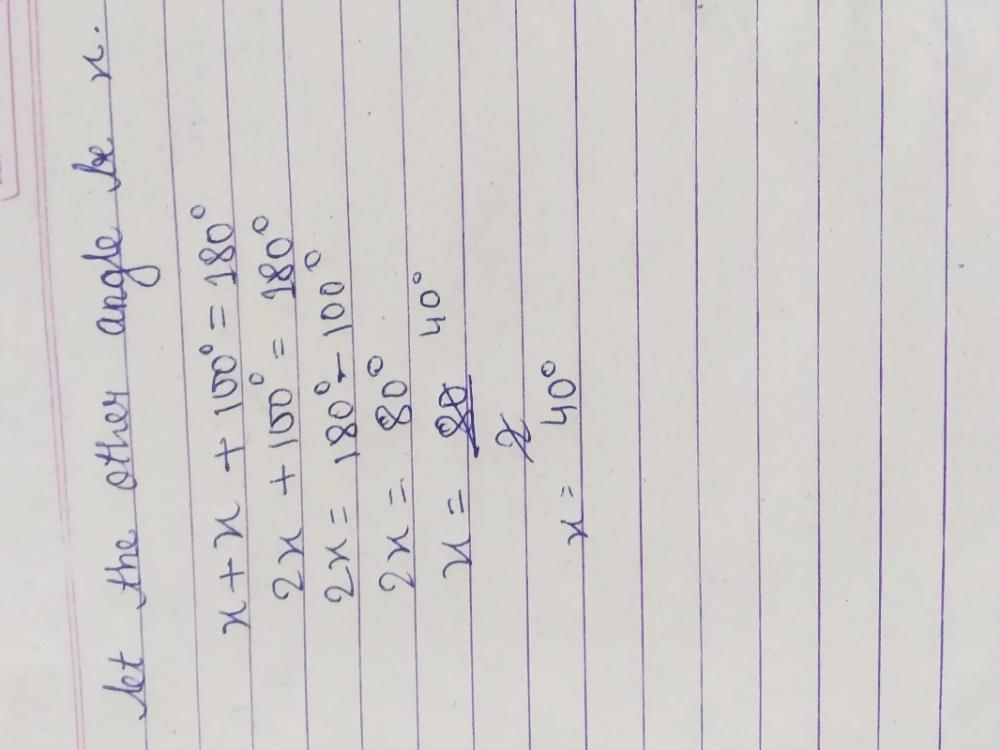
x = 40ο
x = 40ο
Can you explain the answer of this question below:How many medians a triangle can have?A:1B:2C:3D:none of theseThe answer is C.
 | Sneha Khanna answered |
In geometry, a median of a triangle is a line segment joining a vertex to the midpoint of the opposite side, thus bisecting that side. Every triangle has exactly three medians, one from each vertex, and they all intersect each other at the triangle's centroid.
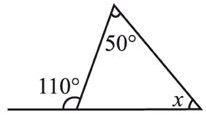
Find the value of x.
- a)110°
- b)60°
- c)70°
- d)50°
Correct answer is option 'B'. Can you explain this answer?
Find the value of x.
a)
110°
b)
60°
c)
70°
d)
50°
 | Rohini Seth answered |
An exterior angle of a triangle is equal to the sum of the opposite interior angles
So in the given figure
110o = 50o + x
110o - 50o = x
60o = x
So option B is correct answer.
The triangle whose lengths of sides are 3 cm, 4 cm, 5 cm is a- a)obtuse-angled triangle
- b)right-angled triangle
- c)acute-angled triangle
- d)None of these
Correct answer is option 'B'. Can you explain this answer?
The triangle whose lengths of sides are 3 cm, 4 cm, 5 cm is a
a)
obtuse-angled triangle
b)
right-angled triangle
c)
acute-angled triangle
d)
None of these
 | Sparsh Khanna answered |
a2+b2=c2
we find 32+42=52
9 + 16 = 25
as pythogoreus theorem can be applied
So, these sides also cause it to be a right triangle.
How many altitude can a triangle have?- a)1
- b)2
- c)3
- d)None of these
Correct answer is 'C'. Can you explain this answer?
How many altitude can a triangle have?
a)
1
b)
2
c)
3
d)
None of these
 | Anshul Rane answered |
A triangle can have 3 altitudes
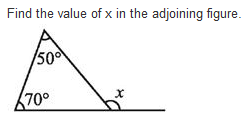
- a)60°
- b)50°
- c)120°
- d)70°
Correct answer is option 'C'. Can you explain this answer?
a)
60°
b)
50°
c)
120°
d)
70°
 | Rahul Shah answered |
An exterior angle of a triangle is equal to the sum of the opposite interior angles
x deg = 70 deg + 50 deg
x deg = 120 deg .
So option C is the correct answer.
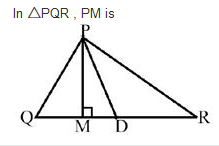
- a)median
- b)side
- c)altitude
- d)bisector
Correct answer is option 'C'. Can you explain this answer?
a)
median
b)
side
c)
altitude
d)
bisector
 | Sagar Manchala answered |
It is an altitude
ΔABC is right-angled at C. If AC = 5 cm and BC = 12 cm find the length of AB.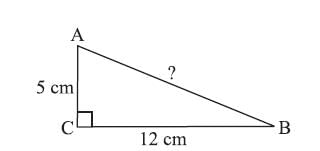
- a)13 cm
- b)11 cm
- c)20 cm
- d)None of these
Correct answer is option 'A'. Can you explain this answer?
ΔABC is right-angled at C. If AC = 5 cm and BC = 12 cm find the length of AB.
a)
13 cm
b)
11 cm
c)
20 cm
d)
None of these
 | Tutorpedia Coaching answered |
By Pythagoras property,
AB2 = AC2 + BC2
= 52 + 122 = 25 + 144 = 169 = 132
or AB2= 132. So, AB = 13 or the length of AB is 13 cm.
AB2 = AC2 + BC2
= 52 + 122 = 25 + 144 = 169 = 132
or AB2= 132. So, AB = 13 or the length of AB is 13 cm.
A/an _____________ connect a vertex of a triangle to the mid-point of the opposite side.- a)altitude
- b)median
- c)vertex
- d)None of these
Correct answer is option 'B'. Can you explain this answer?
A/an _____________ connect a vertex of a triangle to the mid-point of the opposite side.
a)
altitude
b)
median
c)
vertex
d)
None of these
 | Anita Menon answered |
A/an median connect a vertex of a triangle to the mid-point of the opposite side.

In ΔPQR, PD is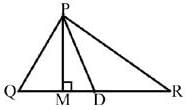
- a)Altitude
- b)Bisector
- c)side
- d)Median
Correct answer is option 'D'. Can you explain this answer?
In ΔPQR, PD is
a)
Altitude
b)
Bisector
c)
side
d)
Median
 | Priyanka Sharma answered |
Median is a line joining the vertex and middle of the opposite side, and hence dividing the triangle in two equal parts. So PD is the median.
ΔPQR is a triangle right-angled at P. If PQ = 3 cm and PR = 4 cm, find QR.- a)8 cm
- b)5 cm
- c)7 cm
- d)3 cm
Correct answer is option 'B'. Can you explain this answer?
ΔPQR is a triangle right-angled at P. If PQ = 3 cm and PR = 4 cm, find QR.
a)
8 cm
b)
5 cm
c)
7 cm
d)
3 cm
 | Arien Instructors answered |
Using pythagoras theorem,
QR2 = PR2 + PQ2
42+32
=16+9=25
QR = 5cm
QR2 = PR2 + PQ2
42+32
=16+9=25
QR = 5cm
What is the measure of angles x?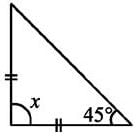
- a)30°
- b)60°
- c)90°
- d)45°
Correct answer is option 'C'. Can you explain this answer?
What is the measure of angles x?
a)
30°
b)
60°
c)
90°
d)
45°
| | Anita Menon answered |
Since the two sides are equal, the angles opposite to them are also equal.
So x + 45° + 45° = 180° (Angles sum property)
x = 90°
The value of x in the adjoining figure is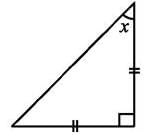
- a)15°
- b)90°
- c)30°
- d)45°
Correct answer is option 'D'. Can you explain this answer?
The value of x in the adjoining figure is
a)
15°
b)
90°
c)
30°
d)
45°
 | Shruti Baluni answered |
Answer is 45 because the given triangle is isosceles , by the property of two sides of triangle are equal then the angle opposite to the sides are equal . angle 1 + angle 2 + angle 3 = 180 ( angle sum property) x + 90 + x =180 ( angle 3 = angle 2) 2x+90 =180 2x= 180 - 90 2x= 90 x = 90/2 x= 45 hence proved
Vertex opposite to the side RT of ΔRST is 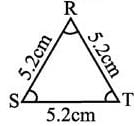
- a)T
- b)S
- c)R
- d)None of these
Correct answer is option 'B'. Can you explain this answer?
Vertex opposite to the side RT of ΔRST is
a)
T
b)
S
c)
R
d)
None of these
 | Geetika Shah answered |
The vertex opposite to side RT is S.
Step-by-step explanation:
In the given question,
We have a triangle RST which has sides RS, ST and TR.
We know that a triangle consists three vertices and three sides each of which is particularly opposite to any one of the side of the triangle and vice-versa.
Therefore, we can see here that in the triangle RST.
The side RS is opposite to the vertex T.
The side ST is opposite to the vertex R.
and,
The side TR is opposite to the vertex S.
Hence, the correct answer will be S as side RT is opposite to S.
One of the angles of a triangle is 110 degree and the other two angles are equal what is the measure of each of these equal angles- a)35 deg,35 deg
- b)40deg , 40deg
- c)11deg, 11 deg
- d)80deg , 80 deg
Correct answer is option 'A'. Can you explain this answer?
One of the angles of a triangle is 110 degree and the other two angles are equal what is the measure of each of these equal angles
a)
35 deg,35 deg
b)
40deg , 40deg
c)
11deg, 11 deg
d)
80deg , 80 deg
 | Dipanjan Goyal answered |
Let the two angles be x, y
x+y+110=180(angle sum property)
x+y=180-110
x+y=70
x=ytherefore x+x=70
2x =70
x=70/2
x=35,y=35
So x = y = 35
x+y+110=180(angle sum property)
x+y=180-110
x+y=70
x=ytherefore x+x=70
2x =70
x=70/2
x=35,y=35
So x = y = 35
- a)50°
- b)60°
- c)180°
- d)120°
Correct answer is option 'B'. Can you explain this answer?
a)
50°
b)
60°
c)
180°
d)
120°
| | Priyanka Sharma answered |
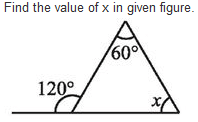
Exterior angle is equal to sum of interior opposite angles so,
120 = 60+x
x = 60°
120 = 60+x
x = 60°
A triangle in which all three sides are of equal lengths is called _________.- a)Scalene
- b)Isosceles
- c)Equilateral
- d)None of these
Correct answer is option 'C'. Can you explain this answer?
A triangle in which all three sides are of equal lengths is called _________.
a)
Scalene
b)
Isosceles
c)
Equilateral
d)
None of these
 | Ragini jain answered |
Equilateral Triangle: A Triangle with Equal Length Sides
An equilateral triangle is a specific type of triangle where all three sides are of equal lengths. It is a fundamental concept in geometry and is classified as a special case of triangles based on its side lengths.
Definition:
- An equilateral triangle is a polygon with three sides of equal lengths.
- Each internal angle of an equilateral triangle measures 60 degrees.
Key Points:
1. Equal Side Lengths: In an equilateral triangle, all three sides have the same length. This characteristic distinguishes it from other types of triangles.
2. Symmetry: Due to its equal side lengths, an equilateral triangle possesses symmetry. It can be folded along any of its medians, resulting in all three sides overlapping perfectly.
3. Regular Polygon: An equilateral triangle is the simplest form of a regular polygon. Regular polygons have all sides and angles equal.
4. Interior Angles: The interior angles of an equilateral triangle are all equal to 60 degrees. This means that when the angles are added together, they sum up to 180 degrees.
5. Exterior Angles: The exterior angles of an equilateral triangle are each equal to 120 degrees. The exterior angle is the supplementary angle to the interior angle.
Usage and Application:
- Equilateral triangles are used in various fields of study, including mathematics, art, and engineering.
- In mathematics, equilateral triangles serve as a basis for understanding geometric principles and properties.
- In art, equilateral triangles are often used to create symmetrical and balanced compositions.
- In engineering and architecture, equilateral triangles can be utilized to create stable and strong structures.
In conclusion, an equilateral triangle is a special type of triangle where all three sides are of equal lengths. It possesses symmetry, has interior angles measuring 60 degrees each, and is a fundamental concept in geometry. Understanding the properties and characteristics of an equilateral triangle is important in various fields of study and practical applications.
An equilateral triangle is a specific type of triangle where all three sides are of equal lengths. It is a fundamental concept in geometry and is classified as a special case of triangles based on its side lengths.
Definition:
- An equilateral triangle is a polygon with three sides of equal lengths.
- Each internal angle of an equilateral triangle measures 60 degrees.
Key Points:
1. Equal Side Lengths: In an equilateral triangle, all three sides have the same length. This characteristic distinguishes it from other types of triangles.
2. Symmetry: Due to its equal side lengths, an equilateral triangle possesses symmetry. It can be folded along any of its medians, resulting in all three sides overlapping perfectly.
3. Regular Polygon: An equilateral triangle is the simplest form of a regular polygon. Regular polygons have all sides and angles equal.
4. Interior Angles: The interior angles of an equilateral triangle are all equal to 60 degrees. This means that when the angles are added together, they sum up to 180 degrees.
5. Exterior Angles: The exterior angles of an equilateral triangle are each equal to 120 degrees. The exterior angle is the supplementary angle to the interior angle.
Usage and Application:
- Equilateral triangles are used in various fields of study, including mathematics, art, and engineering.
- In mathematics, equilateral triangles serve as a basis for understanding geometric principles and properties.
- In art, equilateral triangles are often used to create symmetrical and balanced compositions.
- In engineering and architecture, equilateral triangles can be utilized to create stable and strong structures.
In conclusion, an equilateral triangle is a special type of triangle where all three sides are of equal lengths. It possesses symmetry, has interior angles measuring 60 degrees each, and is a fundamental concept in geometry. Understanding the properties and characteristics of an equilateral triangle is important in various fields of study and practical applications.
- a)50°
- b)60°
- c)55°
- d)None of these
Correct answer is option 'B'. Can you explain this answer?
a)
50°
b)
60°
c)
55°
d)
None of these
 | Ishu answered |
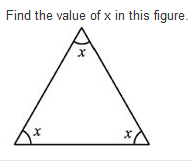
Because it is an equilateral triangle
ΔABC is right-angled at C. If AC = 5 cm and BC = 12 cm find the length of AB.- a)17 cm
- b)13 cm
- c)7 cm
- d)None of these
Correct answer is option 'B'. Can you explain this answer?
ΔABC is right-angled at C. If AC = 5 cm and BC = 12 cm find the length of AB.
a)
17 cm
b)
13 cm
c)
7 cm
d)
None of these
 | Varun Kapoor answered |
Acc to Pythagoras Theorem
AB2=AC2+BC2
AB2 = 52+122
=25+144 = 169
AB=13 cm
AB=13 cm
If one of the interior opposite angles of an exterior angle is 45∘ and the exterior angle is 130∘, what is the measure of the second interior opposite angle?- a)75∘
- b)85∘
- c)90∘
- d)95∘
Correct answer is option 'B'. Can you explain this answer?
If one of the interior opposite angles of an exterior angle is 45∘ and the exterior angle is 130∘, what is the measure of the second interior opposite angle?
a)
75∘
b)
85∘
c)
90∘
d)
95∘
 | Learning Enablers answered |
Using the exterior angle property:
Exterior Angle = Sum of Interior Opposite Angles
130∘= 45∘+ Other Angle
Other Angle = 130∘− 45∘= 85∘
Exterior Angle = Sum of Interior Opposite Angles
130∘= 45∘+ Other Angle
Other Angle = 130∘− 45∘= 85∘
Find the value of unknown x in the adjoining figure.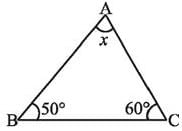
- a)60°
- b)80°
- c)45°
- d)70°
Correct answer is option 'D'. Can you explain this answer?
Find the value of unknown x in the adjoining figure.
a)
60°
b)
80°
c)
45°
d)
70°
 | Rohan Pradhan Pradhan answered |
Correct answer is option d because:-
Total perimeter of the triangle is 180 degree
= x+50+60=180
50+60=110
110-180
=70 degree
So please this is explained answer please followed.
please
Total perimeter of the triangle is 180 degree
= x+50+60=180
50+60=110
110-180
=70 degree
So please this is explained answer please followed.
please
If the angles of a triangle are in the raitio 4:5:9. Find all the angles of a the triangle- a) 40 deg, 50 deg , 90 deg
- b)90 deg, 72 deg, 18 deg
- c)9 deg, 90 deg, 55 deg
- d)45 deg, 60 deg, 18 deg
Correct answer is option 'A'. Can you explain this answer?
If the angles of a triangle are in the raitio 4:5:9. Find all the angles of a the triangle
a)
40 deg, 50 deg , 90 deg
b)
90 deg, 72 deg, 18 deg
c)
9 deg, 90 deg, 55 deg
d)
45 deg, 60 deg, 18 deg
| | Dipanjan Goyal answered |
The sum of the angles of a triangle is 180 degrees. As the ratio of the angles of the triangle is 4:5:9 they can be taken to be 4x, 5x and 9x. 4x + 5x + 9x = 180
=> 18x = 180
=> x = 10
This gives the angles of the triangle as 40, 50 and 90 degrees.
Which type of triangle is formed by BC=7.2cm, AC=6 cm and ∠120o?- a)An obtuse angled triangle.
- b)An acute angled triangle.
- c)A right angled triangle.
- d)An isosceles triangle.
Correct answer is option 'A'. Can you explain this answer?
Which type of triangle is formed by BC=7.2cm, AC=6 cm and ∠120o?
a)
An obtuse angled triangle.
b)
An acute angled triangle.
c)
A right angled triangle.
d)
An isosceles triangle.
 | Vp Classes answered |
Since ∠C=120o>90o, the triangle formed is obtuse.
The value of x in the adjoining figure is 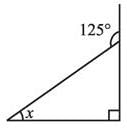
- a)35°
- b)55°
- c)49°
- d)None of these
Correct answer is option 'A'. Can you explain this answer?
The value of x in the adjoining figure is
a)
35°
b)
55°
c)
49°
d)
None of these
| | Tutorpedia Coaching answered |
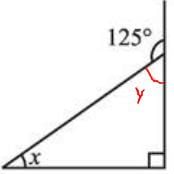
y + 125 = 180
y = 55
and x+ y + 90 = 180
x + 55 + 90 = 180
x = 35
Which is the longest side in the triangle PQR right angled at P?
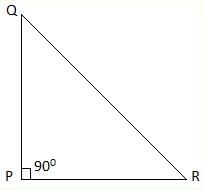
- a)PQ
- b)QR
- c)PR
- d)None of these
Correct answer is option 'B'. Can you explain this answer?
Which is the longest side in the triangle PQR right angled at P?
a)
PQ
b)
QR
c)
PR
d)
None of these
 | Dibyansu Paramanik answered |
QR because in a right angled triangle hypotenuse is the biggest line and here point P is 90 degrees so the QR line would make hypotenuse
In the figure (not drawn to scale), ABC is an equilateral triangle and ABD is an isosceles triangle with DA = DB, find x. 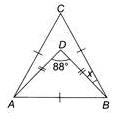
- a)14o
- b)16o
- c)12o
- d)32o
Correct answer is option 'A'. Can you explain this answer?
In the figure (not drawn to scale), ABC is an equilateral triangle and ABD is an isosceles triangle with DA = DB, find x.
a)
14o
b)
16o
c)
12o
d)
32o
 | Anmol Iyer answered |
Since ABC is an equilateral triangle.
∴ ∠CAB =∠ABC =∠BCA = 60o
And ∠DBA = ∠DAB = (60o−x)
[∵ DA = DB]
In ΔDAB, ∠DBA+∠DAB+∠ADB =180o (Angle sum Property)
⇒ 2(60o−x)+88o = 180o
⇒ 2(60o−x) = 92o
⇒ 60o−x = 46o ⇒ x = 14o
∴ ∠CAB =∠ABC =∠BCA = 60o
And ∠DBA = ∠DAB = (60o−x)
[∵ DA = DB]
In ΔDAB, ∠DBA+∠DAB+∠ADB =180o (Angle sum Property)
⇒ 2(60o−x)+88o = 180o
⇒ 2(60o−x) = 92o
⇒ 60o−x = 46o ⇒ x = 14o
In a triangle, two angles measure 45° and 55°. The exterior angle at the third vertex is equal to- a)100°
- b)125°
- c)80°
- d)45°
Correct answer is option 'A'. Can you explain this answer?
In a triangle, two angles measure 45° and 55°. The exterior angle at the third vertex is equal to
a)
100°
b)
125°
c)
80°
d)
45°
 | Kds Coaching answered |
Third interior angle = 180 − (45 + 55) = 80°
Exterior angle = 180 − 80 = 100°
Exterior angle = 180 − 80 = 100°
Practice Quiz or MCQ (Multiple Choice Questions) with solutions are available for Practice, which would help you prepare for chapter The Triangle and its Properties, Class 7, Mathematics . You can practice these practice quizzes as per your speed and improvise the topic. Q.How many medians a triangle can have?- a)1
- b)2
- c)3
- d)none of these
Correct answer is 'C'. Can you explain this answer?
Practice Quiz or MCQ (Multiple Choice Questions) with solutions are available for Practice, which would help you prepare for chapter The Triangle and its Properties, Class 7, Mathematics . You can practice these practice quizzes as per your speed and improvise the topic.
Q.
How many medians a triangle can have?
a)
1
b)
2
c)
3
d)
none of these
 | Anshu Basu answered |
In geometry, a median of a triangle is a line segment joining a vertex to the midpoint of the opposite side, thus bisecting that side. Every triangle has exactly three medians, one from each vertex, and they all intersect each other at the triangle's centroid.
The measure of three angles of a triangle are in the ratio 5:3:1.find the measure of this angles- a)100deg, 60deg, 20deg
- b)80deg, 30deg, 45deg
- c)120deg, 150deg, 30deg
- d)90deg, 90deg, 67deg
Correct answer is option 'A'. Can you explain this answer?
The measure of three angles of a triangle are in the ratio 5:3:1.find the measure of this angles
a)
100deg, 60deg, 20deg
b)
80deg, 30deg, 45deg
c)
120deg, 150deg, 30deg
d)
90deg, 90deg, 67deg
| | Dipanjan Goyal answered |
Let the angles be x
sum of the angles of a triangle=180
5x+3x+x=180
9x=180
x=20
angle 1=5x
=5*20=100
angle 2 =3x=3*20=60
angle 3=x=20
sum of the angles of a triangle=180
5x+3x+x=180
9x=180
x=20
angle 1=5x
=5*20=100
angle 2 =3x=3*20=60
angle 3=x=20
Find the measure of the angle x in the given figure.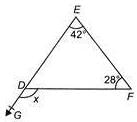
- a)50o
- b)70o
- c)60o
- d)30o
Correct answer is option 'B'. Can you explain this answer?
Find the measure of the angle x in the given figure.
a)
50o
b)
70o
c)
60o
d)
30o
 | Gowri Dey answered |
∠EFD+∠FED = x
(Exterior angle property of a triangle)
⇒ 28o+42o = ∠x or ∠x = 70o
(Exterior angle property of a triangle)
⇒ 28o+42o = ∠x or ∠x = 70o
In the figure (not drawn to scale), ABCD is a square, ADE is an equilateral triangle and BFE is a straight line, find y. 
- a)90o
- b)45o
- c)75o
- d)15o
Correct answer is option 'C'. Can you explain this answer?
In the figure (not drawn to scale), ABCD is a square, ADE is an equilateral triangle and BFE is a straight line, find y.
a)
90o
b)
45o
c)
75o
d)
15o
 | Mrinalini Shah answered |
In ΔAEB,
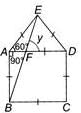
∠A=∠DAE+∠BAD ⇒ ∠A=60o+90o=15o
And, AE=AB ⇒ ∠ABE=∠AEB
[Angles opposite to equal sides are equal]
Now, ∠A+∠ABE+∠AEB=180o (Angle sum property)
⇒ 2∠AEB=180o −150o = 30o ⇒ ∠AEB = 15o
Now, ∠E=60o ⇒ ∠DEF=60o−15o = 45o
∴ In ΔEFD, ∠DEF+∠EDF+∠EFD
= 180o ⇒ 45o+60o+y = 180o
⇒ y = 180o−(45o+60o) = 75o
∠A=∠DAE+∠BAD ⇒ ∠A=60o+90o=15o
And, AE=AB ⇒ ∠ABE=∠AEB
[Angles opposite to equal sides are equal]
Now, ∠A+∠ABE+∠AEB=180o (Angle sum property)
⇒ 2∠AEB=180o −150o = 30o ⇒ ∠AEB = 15o
Now, ∠E=60o ⇒ ∠DEF=60o−15o = 45o
∴ In ΔEFD, ∠DEF+∠EDF+∠EFD
= 180o ⇒ 45o+60o+y = 180o
⇒ y = 180o−(45o+60o) = 75o
If the two legs of a right angled triangle are equal and the square of the hypotenuse is 100 sq units, what is the length of each leg?- a)10 units
- b)5√2 units
- c)10√2 units
- d)15 units
Correct answer is option 'B'. Can you explain this answer?
If the two legs of a right angled triangle are equal and the square of the hypotenuse is 100 sq units, what is the length of each leg?
a)
10 units
b)
5√2 units
c)
10√2 units
d)
15 units
| | Rainbow Rise Classes answered |
Let's solve the problem step by step:
Given:
- The two legs of a right-angled triangle are equal.
- The square of the hypotenuse is 100 square units.
Let the length of each leg be x units.
Using the Pythagorean theorem:
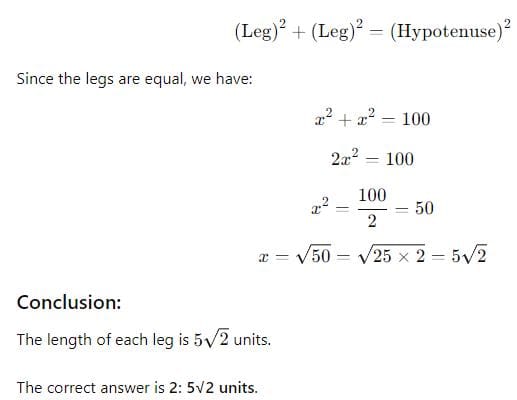
Find angle x in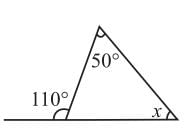
- a)60°
- b)160°
- c)80°
- d)100°
Correct answer is option 'A'. Can you explain this answer?
Find angle x in
a)
60°
b)
160°
c)
80°
d)
100°
 | Eduskill Classes answered |
Sum of interior opposite angles = Exterior angle
or 50° + x = 110°
or x = 60°
In a triangle, an exterior angle is always equal to __________.- a)The sum of the two adjacent interior angles
- b)The sum of the two opposite interior angles
- c)Twice the sum of all interior angles
- d)Half of the adjacent interior angles
Correct answer is option 'B'. Can you explain this answer?
In a triangle, an exterior angle is always equal to __________.
a)
The sum of the two adjacent interior angles
b)
The sum of the two opposite interior angles
c)
Twice the sum of all interior angles
d)
Half of the adjacent interior angles
| | Kds Coaching answered |
According to the exterior angle property, the measure of an exterior angle of a triangle is equal to the sum of the measures of its two interior opposite angles.
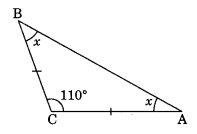
In ΔABC, AC = BC and ∠C = 110°. Find ∠A and ∠B.
- a)35°
- b)75°
- c)45°
- d)105°
Correct answer is option 'A'. Can you explain this answer?
In ΔABC, AC = BC and ∠C = 110°. Find ∠A and ∠B.
a)
35°
b)
75°
c)
45°
d)
105°
 | Shiksha Academy answered |
In given ΔABC, ∠C = 110°
Let ∠A = ∠B = x° (Angle opposite to equal sides of a triangle are equal)
x + x + 110° = 180° (Sum of all angles in a triangle is 180°)
⇒ 2x + 110° = 180°
⇒ 2x = 180° – 110°
⇒ 2x = 70°
⇒ x = 35°
Thus, ∠A = ∠B = 35°
Let ∠A = ∠B = x° (Angle opposite to equal sides of a triangle are equal)
x + x + 110° = 180° (Sum of all angles in a triangle is 180°)
⇒ 2x + 110° = 180°
⇒ 2x = 180° – 110°
⇒ 2x = 70°
⇒ x = 35°
Thus, ∠A = ∠B = 35°
Side opposite to the vertex Q of ΔPQR is
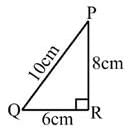
- a)PQ
- b)QR
- c)PR
- d)None of these
Correct answer is option 'C'. Can you explain this answer?
Side opposite to the vertex Q of ΔPQR is
a)
PQ
b)
QR
c)
PR
d)
None of these
| | Kds Coaching answered |
In Triangle ΔPQR, the side opposite to vertex Q is the side that does not touch vertex Q.
The side opposite to Q would be side PR, as it does not include the vertex Q.
for example,
Find the measure of the angle ∠x in the given figure. 
- a)72o
- b)82o
- c)90o
- d)40o
Correct answer is option 'A'. Can you explain this answer?
Find the measure of the angle ∠x in the given figure.
a)
72o
b)
82o
c)
90o
d)
40o
| | Rainbow Rise Classes answered |
∠UXV = y (Vertically opposite angles)
∴ y = 45o
∴ y = 45o
In ΔXYZ, y+x+63o = 180o (Angle sum property)
⇒ 45o+x+63o = 180o
⇒ x = 180o−(45o+63o)
⇒ x= 180o−108o = 72o
⇒ 45o+x+63o = 180o
⇒ x = 180o−(45o+63o)
⇒ x= 180o−108o = 72o
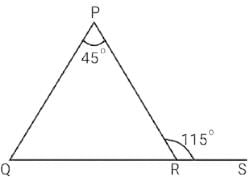
In the given figure, the side QR of a △PQR has been produced to the point S. If ∠PRS = 115o and ∠P = 45o , then ∠Q is equal to,
- a)20o
- b)105o
- c)70o
- d)80o
Correct answer is option 'C'. Can you explain this answer?
In the given figure, the side QR of a △PQR has been produced to the point S. If ∠PRS = 115o and ∠P = 45o , then ∠Q is equal to,
a)
20o
b)
105o
c)
70o
d)
80o
| | Shiksha Academy answered |
∠PRS = ∠RPQ + ∠PQR (By exterior angle property)
⇒ 115º = 45º + ∠PQR
⇒ ∠PQR = 115º - 45º ⇒ ∠PQR = 70º
⇒ 115º = 45º + ∠PQR
⇒ ∠PQR = 115º - 45º ⇒ ∠PQR = 70º
Classify the following triangle on basis of their sides 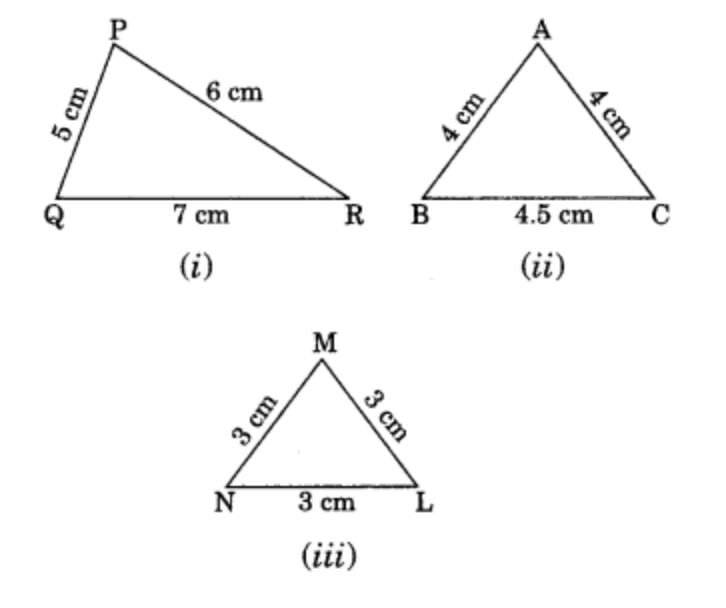
- a)(i)scalene, (ii) isoceles, (iii) equilateral
- b)(i) isosceles, (ii) right, (iii) equilateral
- c)(i) right, (ii) isosceles, (iii) equilateral
- d)(i) equilateral, (ii) scalene, (iii) isosceles
Correct answer is option 'A'. Can you explain this answer?
Classify the following triangle on basis of their sides
a)
(i)scalene, (ii) isoceles, (iii) equilateral
b)
(i) isosceles, (ii) right, (iii) equilateral
c)
(i) right, (ii) isosceles, (iii) equilateral
d)
(i) equilateral, (ii) scalene, (iii) isosceles
| | Rainbow Rise Classes answered |
(i) PQ = 5 cm, PR = 6 cm and QR = 7 cm
PQ ≠ PR ≠ QR
Thus, ∆PQR is a scalene triangle.
(ii) AB = 4 cm, AC = 4 cm, BC = 4.5 cm
AB = AC ≠ 4.5 cm
Thus, ∆ABC is an isosceles triangle.
(iii) MN = 3 cm, ML = 3 cm and NL = 3 cm
MN = ML = NL
Thus, ∆MNL is an equilateral triangle.
PQ ≠ PR ≠ QR
Thus, ∆PQR is a scalene triangle.
(ii) AB = 4 cm, AC = 4 cm, BC = 4.5 cm
AB = AC ≠ 4.5 cm
Thus, ∆ABC is an isosceles triangle.
(iii) MN = 3 cm, ML = 3 cm and NL = 3 cm
MN = ML = NL
Thus, ∆MNL is an equilateral triangle.
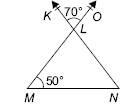
Find the measure of ∠LNM in the given figure.
- a)30o
- b)80o
- c)70o
- d)60o
Correct answer is option 'D'. Can you explain this answer?
Find the measure of ∠LNM in the given figure.
a)
30o
b)
80o
c)
70o
d)
60o
 | Kunal Mehra answered |
∠KLO = ∠MLN
∴ ∠MLN = 70o in ∠LMN
∴ ∠MLN = 70o in ∠LMN
Also,
∠MLN+∠LNM+∠LMN = 180o (Angle sum property)
⇒ 70o+∠LNM+50o=180o
⇒ ∠LNM = 180o−(70o+50o) = 60o
⇒ 70o+∠LNM+50o=180o
⇒ ∠LNM = 180o−(70o+50o) = 60o
Find value of angle 1, 2, and 3, where angle y is equal to angle 3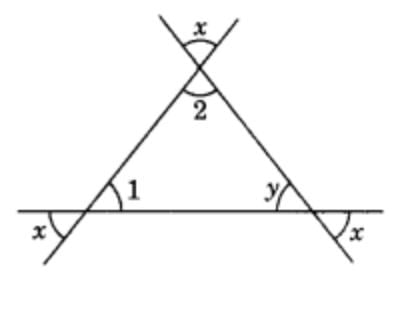
- a)60 degrees
- b)70 degrees
- c)140 degrees
- d)20 degrees
Correct answer is option 'A'. Can you explain this answer?
Find value of angle 1, 2, and 3, where angle y is equal to angle 3
a)
60 degrees
b)
70 degrees
c)
140 degrees
d)
20 degrees
| | Kds Coaching answered |
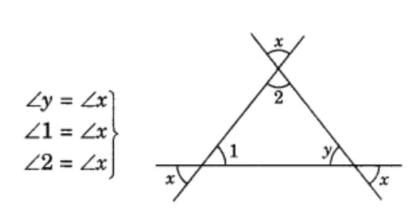
Adding both sides, we have:
∠y + ∠1 + ∠2 = 3∠x
∠y + ∠1 + ∠2 = 3∠x
Therefore, 180° = 3∠x (Angle sum property of a triangle)
So,∠x = 180° ÷ 3 = 60°
∠x = 60°, ∠y = 60°
Therefore, the value of all angles is 60° and it is an equilateral triangle
Therefore, the value of all angles is 60° and it is an equilateral triangle
If a triangle has angles measuring 40°, 60°, and x°, find the value of x.- a)70°
- b)80°
- c)90°
- d)100°
Correct answer is option 'B'. Can you explain this answer?
If a triangle has angles measuring 40°, 60°, and x°, find the value of x.
a)
70°
b)
80°
c)
90°
d)
100°
| | Kds Coaching answered |
The sum of all angles in a triangle is always 180°.
40° + 60° + x = 180°
x = 180° - (40° + 60°)
x = 180° - 100° = 80°
40° + 60° + x = 180°
x = 180° - (40° + 60°)
x = 180° - 100° = 80°
Chapter doubts & questions for Pythagoras’ Theorem - Mathematics for Grade 8 2026 is part of Grade 8 exam preparation. The chapters have been prepared according to the Grade 8 exam syllabus. The Chapter doubts & questions, notes, tests & MCQs are made for Grade 8 2026 Exam. Find important definitions, questions, notes, meanings, examples, exercises, MCQs and online tests here.
Chapter doubts & questions of Pythagoras’ Theorem - Mathematics for Grade 8 in English & Hindi are available as part of Grade 8 exam. Download more important topics, notes, lectures and mock test series for Grade 8 Exam by signing up for free.
Mathematics for Grade 868 videos|126 docs|43 tests |
