


All Exams > Year 4 > Mathematics for Year 4 > All Questions
All questions of Decimals for Year 4 Exam
Rename the following as hundredth - 0.8- a)0.0008
- b)0.80
- c)0.08
- d)None of these
Correct answer is option 'B'. Can you explain this answer?
Rename the following as hundredth - 0.8
a)
0.0008
b)
0.80
c)
0.08
d)
None of these
 | Sudhir Mehta answered |
0.8 as hundredth will be 0.80


Add: 0.27 + 0.67- a)0.96
- b)0.98
- c)0.97
- d)0.94
Correct answer is option 'D'. Can you explain this answer?
Add: 0.27 + 0.67
a)
0.96
b)
0.98
c)
0.97
d)
0.94
| | Sudhir Mehta answered |
0.27 + 0.67 = 0.94
Write in rupees = 1063 rupees 75 P- a)Rs. 10637.5
- b)Rs. 106.375
- c)Rs. 1063.75
- d)Rs. 10.6375
Correct answer is option 'C'. Can you explain this answer?
Write in rupees = 1063 rupees 75 P
a)
Rs. 10637.5
b)
Rs. 106.375
c)
Rs. 1063.75
d)
Rs. 10.6375
| | Sudhir Mehta answered |
1063 rupees 75 P in Rupees is Rs. 1063.75


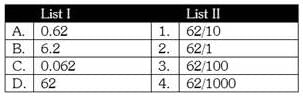
Which of these means “three and six-tenths”?- a)3.6
- b)36
- c)0.36
- d)6.3
Correct answer is option 'A'. Can you explain this answer?
Which of these means “three and six-tenths”?
a)
3.6
b)
36
c)
0.36
d)
6.3
 | Bhargavi Iyer answered |
Understanding the Number: Three and Six-Tenths
To interpret the phrase "three and six-tenths," we need to break down what this means in numerical form.
Breaking Down the Phrase
- Three: This indicates the whole number part, which is 3.
- Six-tenths: This represents a decimal fraction. The term "tenths" means that the number is divided into ten equal parts, and "six" indicates that we are considering six of those parts.
Combining the Parts
- When you combine the whole number (3) and the decimal fraction (six-tenths), you express this as:
- 3 (whole number) + 0.6 (decimal for six-tenths) = 3.6
Thus, "three and six-tenths" translates to the decimal 3.6.
Analyzing the Options
Now, let's evaluate the provided options to confirm our understanding:
- a) 3.6: Correct. This represents three and six-tenths.
- b) 36: Incorrect. This is a whole number, not a decimal.
- c) 0.36: Incorrect. This represents thirty-six hundredths, not six-tenths.
- d) 6.3: Incorrect. This means six and three-tenths, which is not what we are looking for.
Conclusion
The correct answer is option a) 3.6, which accurately represents "three and six-tenths." Understanding decimals and fractions is crucial in mathematics, and this exercise helps clarify how to express mixed numbers in decimal form.
To interpret the phrase "three and six-tenths," we need to break down what this means in numerical form.
Breaking Down the Phrase
- Three: This indicates the whole number part, which is 3.
- Six-tenths: This represents a decimal fraction. The term "tenths" means that the number is divided into ten equal parts, and "six" indicates that we are considering six of those parts.
Combining the Parts
- When you combine the whole number (3) and the decimal fraction (six-tenths), you express this as:
- 3 (whole number) + 0.6 (decimal for six-tenths) = 3.6
Thus, "three and six-tenths" translates to the decimal 3.6.
Analyzing the Options
Now, let's evaluate the provided options to confirm our understanding:
- a) 3.6: Correct. This represents three and six-tenths.
- b) 36: Incorrect. This is a whole number, not a decimal.
- c) 0.36: Incorrect. This represents thirty-six hundredths, not six-tenths.
- d) 6.3: Incorrect. This means six and three-tenths, which is not what we are looking for.
Conclusion
The correct answer is option a) 3.6, which accurately represents "three and six-tenths." Understanding decimals and fractions is crucial in mathematics, and this exercise helps clarify how to express mixed numbers in decimal form.
Subtract: 10000 – 9999.999- a)0.002
- b)0.001
- c)0.01
- d)0.1
Correct answer is option 'B'. Can you explain this answer?
Subtract: 10000 – 9999.999
a)
0.002
b)
0.001
c)
0.01
d)
0.1
| | Sudhir Mehta answered |
10000 – 9999.999 = 0.001
Fill in the missing numbers to complete the pattern: 4.4, ____, 4.8, ____, 5.2. 5.4- a)4.5, 5
- b)4.7, 5.1
- c)4.6, 5
- d)4.5, 5.1
Correct answer is option 'C'. Can you explain this answer?
Fill in the missing numbers to complete the pattern: 4.4, ____, 4.8, ____, 5.2. 5.4
a)
4.5, 5
b)
4.7, 5.1
c)
4.6, 5
d)
4.5, 5.1
| | Sudhir Mehta answered |
4.4, ___, 4.8, ____, 5.2, 5.4. By studying the pattern we can see that the previous number is smaller than the next by 0.2. Thus by adding 0.2 to 4.4 and 4.8 respectively, we get 4.6 and 5 to complete the decimal chain.
Subtract 7.03 – 2.76- a)42.7
- b)427
- c).427
- d)4.27
Correct answer is option 'D'. Can you explain this answer?
Subtract 7.03 – 2.76
a)
42.7
b)
427
c)
.427
d)
4.27
 | Jaideep Pillai answered |
There is no number provided to subtract 7.03 from. Please provide the number you would like to subtract 7.03 from.
0.83 means ________.- a)8 ones and 3 tens
- b)8 tenths and 3 hundredths
- c)8 hundredths and 3 tenths
- d)8 tens and 3 ones
Correct answer is option 'B'. Can you explain this answer?
0.83 means ________.
a)
8 ones and 3 tens
b)
8 tenths and 3 hundredths
c)
8 hundredths and 3 tenths
d)
8 tens and 3 ones
 | Kds Coaching answered |
The first digit after the decimal is tenths (8), the next is hundredths (3).
Which of the following is equal to 4/10?- a)0.04
- b)0.4
- c)0.40
- d)both b and c
Correct answer is option 'D'. Can you explain this answer?
Which of the following is equal to 4/10?
a)
0.04
b)
0.4
c)
0.40
d)
both b and c
 | Jai deshpande answered |
Understanding Fractions and Decimals
When we talk about fractions and decimals, it's important to understand how they relate to each other. The fraction 4/10 can be converted into a decimal by dividing the numerator (4) by the denominator (10).
Converting 4/10 to Decimal
- To convert 4/10 into a decimal, perform the division:
- 4 ÷ 10 = 0.4
Options Analysis
Now, let's analyze the options provided:
- a) 0.04: This is much smaller than 0.4.
- b) 0.4: This is exactly the result of our division and is equal to 4/10.
- c) 0.40: This is equivalent to 0.4 because in decimal notation, trailing zeros do not change the value.
- d) both b and c: Since both 0.4 and 0.40 represent the same value, this option is correct.
Correct Answer
Therefore, the correct answer is option 'D' because both 0.4 and 0.40 are equal to the fraction 4/10.
Conclusion
In summary, 4/10 is equal to both 0.4 and 0.40. Understanding how fractions convert to decimals helps in grasping more advanced mathematical concepts.
When we talk about fractions and decimals, it's important to understand how they relate to each other. The fraction 4/10 can be converted into a decimal by dividing the numerator (4) by the denominator (10).
Converting 4/10 to Decimal
- To convert 4/10 into a decimal, perform the division:
- 4 ÷ 10 = 0.4
Options Analysis
Now, let's analyze the options provided:
- a) 0.04: This is much smaller than 0.4.
- b) 0.4: This is exactly the result of our division and is equal to 4/10.
- c) 0.40: This is equivalent to 0.4 because in decimal notation, trailing zeros do not change the value.
- d) both b and c: Since both 0.4 and 0.40 represent the same value, this option is correct.
Correct Answer
Therefore, the correct answer is option 'D' because both 0.4 and 0.40 are equal to the fraction 4/10.
Conclusion
In summary, 4/10 is equal to both 0.4 and 0.40. Understanding how fractions convert to decimals helps in grasping more advanced mathematical concepts.
Write the decimals number for 48/100- a)0.4
- b)0.048
- c)0.8
- d)0.48
Correct answer is option 'D'. Can you explain this answer?
Write the decimals number for 48/100
a)
0.4
b)
0.048
c)
0.8
d)
0.48
| | Sudhir Mehta answered |
Because 100 has two zeroes , so we'll write point in front of two digits.
0.48
Write in rupees →3 rupees and 45 P- a)Rs. 350
- b)Rs. 3.45
- c)Rs. 3.50
- d)None of these
Correct answer is option 'B'. Can you explain this answer?
Write in rupees →3 rupees and 45 P
a)
Rs. 350
b)
Rs. 3.45
c)
Rs. 3.50
d)
None of these
| | Sudhir Mehta answered |
3 rupees and 45 P = Rs. 3.45
The dot that separates the whole number and fractional part in a decimal is called a ________.- a)decimal line
- b)decimal point
- c)fraction mark
- d)point value
Correct answer is option 'B'. Can you explain this answer?
The dot that separates the whole number and fractional part in a decimal is called a ________.
a)
decimal line
b)
decimal point
c)
fraction mark
d)
point value
 | Glitz Classes answered |
The dot in decimals (like 2.5) is called the decimal point.
Which of these decimals shows one-tenth?- a)0.1
- b)0.01
- c)0.001
- d)1.1
Correct answer is option 'A'. Can you explain this answer?
Which of these decimals shows one-tenth?
a)
0.1
b)
0.01
c)
0.001
d)
1.1
| | Kds Coaching answered |
0.1 means one part out of ten, i.e., one-tenth.
Which statement is correct about decimals?- a)0.2 = 0.20
- b)0.2 < 0.20
- c)0.2 > 0.20
- d)0.2 = 0.02
Correct answer is option 'A'. Can you explain this answer?
Which statement is correct about decimals?
a)
0.2 = 0.20
b)
0.2 < 0.20
c)
0.2 > 0.20
d)
0.2 = 0.02
| | Glitz Classes answered |
0.2 and 0.20 are equivalent decimals.
Chapter doubts & questions for Decimals - Mathematics for Year 4 2026 is part of Year 4 exam preparation. The chapters have been prepared according to the Year 4 exam syllabus. The Chapter doubts & questions, notes, tests & MCQs are made for Year 4 2026 Exam. Find important definitions, questions, notes, meanings, examples, exercises, MCQs and online tests here.
Chapter doubts & questions of Decimals - Mathematics for Year 4 in English & Hindi are available as part of Year 4 exam. Download more important topics, notes, lectures and mock test series for Year 4 Exam by signing up for free.
Mathematics for Year 422 videos|79 docs|23 tests |
