


All Exams > Bank Exams > IBPS PO Prelims & Mains Preparation > All Questions
All questions of Boats and Stream for Bank Exams Exam
A Boat takes total 16 hours for traveling downstream from point A to point B and coming back point C which is somewhere between A and B. If the speed of the Boat in Still water is 9 Km/hr and rate of stream is 6 Km/hr, then what is the distance between A and C?- a)30 Km
- b)60 Km
- c)90 Km
- d)100 Km
- e)Cannot be determined
Correct answer is option 'E'. Can you explain this answer?
A Boat takes total 16 hours for traveling downstream from point A to point B and coming back point C which is somewhere between A and B. If the speed of the Boat in Still water is 9 Km/hr and rate of stream is 6 Km/hr, then what is the distance between A and C?
a)
30 Km
b)
60 Km
c)
90 Km
d)
100 Km
e)
Cannot be determined
 | KS Coaching Center answered |
16 = D/9+6 + x/9-6

A Ship of Length 300m traveling from point A to B downstream passes a Ghat along the river in 18 sec, while in return it passes the same Ghat in 24 sec. If the rate of current is 9 Km/hr. Then what is the length of the Ghat?- a)50 m
- b)60 m
- c)80 m
- d)100 m
- e)Cannot be determined
Correct answer is option 'B'. Can you explain this answer?
A Ship of Length 300m traveling from point A to B downstream passes a Ghat along the river in 18 sec, while in return it passes the same Ghat in 24 sec. If the rate of current is 9 Km/hr. Then what is the length of the Ghat?
a)
50 m
b)
60 m
c)
80 m
d)
100 m
e)
Cannot be determined
| | KS Coaching Center answered |
Answer – 2. 60 m Explanation : (S+9)*18 = (S-9)*24
S =63
300+x = 72*5/18*18 x =60
S =63
300+x = 72*5/18*18 x =60
A Boat takes total 10 hours for traveling downstream from point A to point B and coming back point C which is somewhere between A and B. The speed of the Boat in Still water is 9 Km/hr and rate of Stream is 3 Km/hr, then what is the distance between A and B if the ratio of distance between A to C and distance between B to C is 2:1?- a)54 Km
- b)66 Km
- c)72 Km
- d)84 Km
- e)Cannot be determined
Correct answer is option 'C'. Can you explain this answer?
A Boat takes total 10 hours for traveling downstream from point A to point B and coming back point C which is somewhere between A and B. The speed of the Boat in Still water is 9 Km/hr and rate of Stream is 3 Km/hr, then what is the distance between A and B if the ratio of distance between A to C and distance between B to C is 2:1?
a)
54 Km
b)
66 Km
c)
72 Km
d)
84 Km
e)
Cannot be determined
| | Naman Agrawal answered |
Given ratio of distance = 2:1, let the distance between A and C =2X km and B To C = X km respectively. total dis. travelled A to B= 3X km downstream speed =(9+3)=12 km/hr. upstream Speed =(9-3)= 6km/hr; so, time taken to travel from A to B= 3X/12 hrs. similarly between B to C =X/6 hrs. Total time taken =(3X/12+X/6)= 5X/12 hrs. equating 5X/12= 10, we get X=24 kms. so, the distance between A to B= 3X=(3*24)= 72 kms. op(c)
A Boat covers upstream in 12 Hours 48 minutes to travel distance from Point A to B, while it takes 6 hours to cover 3/4th of the same distance running downstream. The speed of the current is 15 Km/hr. The boat covered both forward distance from A to B and backward distance from B to A. Then what is the distance between A and B?- a)360 Km
- b)480 Km
- c)540 Km
- d)640 Km
- e)Cannot be determined
Correct answer is option 'D'. Can you explain this answer?
A Boat covers upstream in 12 Hours 48 minutes to travel distance from Point A to B, while it takes 6 hours to cover 3/4th of the same distance running downstream. The speed of the current is 15 Km/hr. The boat covered both forward distance from A to B and backward distance from B to A. Then what is the distance between A and B?
a)
360 Km
b)
480 Km
c)
540 Km
d)
640 Km
e)
Cannot be determined
 | Target Study Academy answered |
Answer – 4. 640 Km Explanation : (S+R)*8 = (S-R)*64/5
S:R = 13:3
R = 15 S = 65
D = (65+15) *8 = 640
S:R = 13:3
R = 15 S = 65
D = (65+15) *8 = 640
A Boat takes 128 min less to travel to 48 Km downstream than to travel the same distance upstream. If the speed of the stream is 3 Km/hr. Then Speed of Boat in still water is?- a)6 Km/hr
- b)9 Km/hr
- c)12 Km/hr
- d)15 Km/hr
- e)None
Correct answer is option 'C'. Can you explain this answer?
A Boat takes 128 min less to travel to 48 Km downstream than to travel the same distance upstream. If the speed of the stream is 3 Km/hr. Then Speed of Boat in still water is?
a)
6 Km/hr
b)
9 Km/hr
c)
12 Km/hr
d)
15 Km/hr
e)
None
 | Karan Bajaj answered |
Speed of stream = 3km/hr
Distance = 48km
consider T1=time during downstream
T2=time during upstream
Condition given: T2-T1=128minutes = 128/60 hours
To find : SPEED OF BOAT IN STILL WATER (let's assume u)
Solution :- T2= 48/(u-3)
T1=48/(u+3)
using: T2-T1= 128/60
48/(u-3) - 48/(u+3)= 128/60
After taking LCM we get
288/(u²-9) =128/60
u²-9=(288×60)/128
u²-9= 15×9
u²= 135+9
u²= 144
u=12km/hr
so option C is the correct answer
Distance = 48km
consider T1=time during downstream
T2=time during upstream
Condition given: T2-T1=128minutes = 128/60 hours
To find : SPEED OF BOAT IN STILL WATER (let's assume u)
Solution :- T2= 48/(u-3)
T1=48/(u+3)
using: T2-T1= 128/60
48/(u-3) - 48/(u+3)= 128/60
After taking LCM we get
288/(u²-9) =128/60
u²-9=(288×60)/128
u²-9= 15×9
u²= 135+9
u²= 144
u=12km/hr
so option C is the correct answer
The speed of a boat in still water is 10 km/hr. If it can travel 26 km downstream and 14 km upstream at the same time, the speed of the stream is-- a)2 km/hr
- b)2.5 km/hr
- c)3 km/hr
- d)4 km/hr
- e)5 km/hr
Correct answer is option 'C'. Can you explain this answer?
The speed of a boat in still water is 10 km/hr. If it can travel 26 km downstream and 14 km upstream at the same time, the speed of the stream is-
a)
2 km/hr
b)
2.5 km/hr
c)
3 km/hr
d)
4 km/hr
e)
5 km/hr
 | Ayesha Joshi answered |
Let the speed of the stream be x km/hr
Then speed downstream = (10 + x) km/hr
Speed upstream
= (10 − x) km/hr
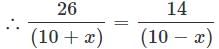
⇒ 260 − 26x = 140 + 14x
⇒ 40x = 120
⇒ x = 3 km/hr
Then speed downstream = (10 + x) km/hr
Speed upstream
= (10 − x) km/hr
⇒ 260 − 26x = 140 + 14x
⇒ 40x = 120
⇒ x = 3 km/hr
The speed of a boat when travelling downstream is 32 kmph whereas when travelling upstream it is 28 kmph. What is the speed of the boat in still water?- a)27 kmph
- b)29 kmph
- c)31 kmph
- d)30 kmph
- e)None of these
Correct answer is option 'D'. Can you explain this answer?
The speed of a boat when travelling downstream is 32 kmph whereas when travelling upstream it is 28 kmph. What is the speed of the boat in still water?
a)
27 kmph
b)
29 kmph
c)
31 kmph
d)
30 kmph
e)
None of these
 | Debolina Pillai answered |
Given information:
- Speed of the boat downstream = 32 kmph
- Speed of the boat upstream = 28 kmph
To find:
- Speed of the boat in still water
Assumption:
- Let the speed of the boat in still water be x kmph
- Let the speed of the current be y kmph
Explanation:
When the boat is traveling downstream, it gets the additional speed of the current. So, the effective speed is the sum of the speed of the boat in still water and the speed of the current.
- Speed downstream = (Speed of the boat in still water) + (Speed of the current)
- 32 = x + y
When the boat is traveling upstream, it has to overcome the speed of the current, which reduces its effective speed.
- Speed upstream = (Speed of the boat in still water) - (Speed of the current)
- 28 = x - y
Solving the equations:
We have two equations with two variables. By solving these equations simultaneously, we can find the values of x and y.
Adding the two equations:
(32 + 28) = (x + y) + (x - y)
60 = 2x
x = 60/2
x = 30
So, the speed of the boat in still water is 30 kmph. Therefore, the correct answer is option D) 32 kmph.
- Speed of the boat downstream = 32 kmph
- Speed of the boat upstream = 28 kmph
To find:
- Speed of the boat in still water
Assumption:
- Let the speed of the boat in still water be x kmph
- Let the speed of the current be y kmph
Explanation:
When the boat is traveling downstream, it gets the additional speed of the current. So, the effective speed is the sum of the speed of the boat in still water and the speed of the current.
- Speed downstream = (Speed of the boat in still water) + (Speed of the current)
- 32 = x + y
When the boat is traveling upstream, it has to overcome the speed of the current, which reduces its effective speed.
- Speed upstream = (Speed of the boat in still water) - (Speed of the current)
- 28 = x - y
Solving the equations:
We have two equations with two variables. By solving these equations simultaneously, we can find the values of x and y.
Adding the two equations:
(32 + 28) = (x + y) + (x - y)
60 = 2x
x = 60/2
x = 30
So, the speed of the boat in still water is 30 kmph. Therefore, the correct answer is option D) 32 kmph.
A man can row 6 km/h in still water. If the speed of the current is 2 km/h, it takes 3 hrs more in upstream than in the downstream for the same distance. The distance is- a)30 km
- b)24 km
- c)20 km
- d)32 km
- e)None of these
Correct answer is option 'B'. Can you explain this answer?
A man can row 6 km/h in still water. If the speed of the current is 2 km/h, it takes 3 hrs more in upstream than in the downstream for the same distance. The distance is
a)
30 km
b)
24 km
c)
20 km
d)
32 km
e)
None of these
| | Ayesha Joshi answered |
Let the required distance be x km. As per the question, Timeupstream – Timedownstream = 3

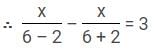
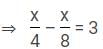
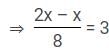
⇒ x = 3 × 8 = 24 km.
Hence, option B is correct.
⇒ x = 3 × 8 = 24 km.
Hence, option B is correct.
The speed of a boat downstream is 15 km/hr and the speed of current is 3 km/hr. Find the total time taken by the boat to cover 15 km upstream and 15 km downstream.- a)2 hours 40 minutes
- b)2 hours 42 minutes
- c)2 hours 10 minutes
- d)2 hours 30 minutes
- e)3 hours 30 minutes
Correct answer is option 'A'. Can you explain this answer?
The speed of a boat downstream is 15 km/hr and the speed of current is 3 km/hr. Find the total time taken by the boat to cover 15 km upstream and 15 km downstream.
a)
2 hours 40 minutes
b)
2 hours 42 minutes
c)
2 hours 10 minutes
d)
2 hours 30 minutes
e)
3 hours 30 minutes
 | Rhea Reddy answered |
Given,
Speed of boat in downstream = 15 km/hr
Speed of current = 3 km/hr
Speed of boat in still water = 12 km/h
Time taken at upstream

= 1 hour 40 minutes
Time taken at downstream
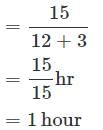
∴ Total time = 2 hours 40 minutes
Speed of boat in downstream = 15 km/hr
Speed of current = 3 km/hr
Speed of boat in still water = 12 km/h
Time taken at upstream
= 1 hour 40 minutes
Time taken at downstream
∴ Total time = 2 hours 40 minutes
The ratio of speed of A and B in still water is 3 : 2. A and B start from the same point in the river, A goes upstream and B goes downstream. After 3 hours the stream stops flowing and A starts rowing in the opposite direction to meet B. How much time after the stream stops flowing does A meet B?- a)16 hrs
- b)15 hrs
- c)12 hrs
- d)18 hrs
- e)None of these
Correct answer is option 'B'. Can you explain this answer?
The ratio of speed of A and B in still water is 3 : 2. A and B start from the same point in the river, A goes upstream and B goes downstream. After 3 hours the stream stops flowing and A starts rowing in the opposite direction to meet B. How much time after the stream stops flowing does A meet B?
a)
16 hrs
b)
15 hrs
c)
12 hrs
d)
18 hrs
e)
None of these
 | Pranav Mehta answered |
Given:
The ratio of speed of A and B in still water is 3 : 2.
Approach:
To solve this problem, we need to understand the relative speeds of A and B when they are rowing in opposite directions. Let's assume the speed of A in still water is 3x and the speed of B in still water is 2x.
When A is rowing upstream:
The effective speed of A = (Speed of A in still water) - (Speed of stream)
= 3x - x = 2x
When B is rowing downstream:
The effective speed of B = (Speed of B in still water) + (Speed of stream)
= 2x + x = 3x
After 3 hours, the stream stops flowing. At this point, A starts rowing in the opposite direction to meet B.
When A is rowing downstream:
The effective speed of A = (Speed of A in still water) + (Speed of stream)
= 3x + x = 4x
Now, let's calculate the time it takes for A and B to meet.
Calculation:
Let's assume they meet after t hours.
Distance travelled by A = Speed of A * Time taken = 4x * t
Distance travelled by B = Speed of B * Time taken = 3x * t
Since they start from the same point and meet, the distances travelled by A and B must be equal.
Therefore, 4x * t = 3x * t
Simplifying the equation, we get:
4x * t - 3x * t = 0
x * t = 0
Since x is a non-zero value, t must be 0.
Therefore, A and B meet immediately after the stream stops flowing.
Answer:
The time after the stream stops flowing when A meets B is 0 hours.
Explanation:
Option B is the correct answer because A and B meet immediately after the stream stops flowing.
The ratio of speed of A and B in still water is 3 : 2.
Approach:
To solve this problem, we need to understand the relative speeds of A and B when they are rowing in opposite directions. Let's assume the speed of A in still water is 3x and the speed of B in still water is 2x.
When A is rowing upstream:
The effective speed of A = (Speed of A in still water) - (Speed of stream)
= 3x - x = 2x
When B is rowing downstream:
The effective speed of B = (Speed of B in still water) + (Speed of stream)
= 2x + x = 3x
After 3 hours, the stream stops flowing. At this point, A starts rowing in the opposite direction to meet B.
When A is rowing downstream:
The effective speed of A = (Speed of A in still water) + (Speed of stream)
= 3x + x = 4x
Now, let's calculate the time it takes for A and B to meet.
Calculation:
Let's assume they meet after t hours.
Distance travelled by A = Speed of A * Time taken = 4x * t
Distance travelled by B = Speed of B * Time taken = 3x * t
Since they start from the same point and meet, the distances travelled by A and B must be equal.
Therefore, 4x * t = 3x * t
Simplifying the equation, we get:
4x * t - 3x * t = 0
x * t = 0
Since x is a non-zero value, t must be 0.
Therefore, A and B meet immediately after the stream stops flowing.
Answer:
The time after the stream stops flowing when A meets B is 0 hours.
Explanation:
Option B is the correct answer because A and B meet immediately after the stream stops flowing.
The speed of Boat in Still water is 40 Km/hr and speed of the stream is 20 Km/hr. The distance between Point A and Point B is 480 Km. The boat started traveling downstream from A to B, in the midway, it is powered by an Engine due to which speed of the Boat increased. Now Boat reached Point B and started back to point A with help of the same engine. It took 19 hours for the entire journey. Then with the help of the engine, the speed of the boat increased by how many Km/hr?- a)10 Km/hr
- b)15 Km/hr
- c)20 Km/hr
- d)24 Km/hr
- e)Cannot be determined
Correct answer is option 'C'. Can you explain this answer?
The speed of Boat in Still water is 40 Km/hr and speed of the stream is 20 Km/hr. The distance between Point A and Point B is 480 Km. The boat started traveling downstream from A to B, in the midway, it is powered by an Engine due to which speed of the Boat increased. Now Boat reached Point B and started back to point A with help of the same engine. It took 19 hours for the entire journey. Then with the help of the engine, the speed of the boat increased by how many Km/hr?
a)
10 Km/hr
b)
15 Km/hr
c)
20 Km/hr
d)
24 Km/hr
e)
Cannot be determined
| | Pranav Kulkarni answered |
Answer – 3. 20 Km/hr Explanation : 19 = 240/60 + 240/60+x + 480/20+x x = 20
Speeds of Boat A and B in still water are in the ratio of 3:2 Rate of current is 10 Km/hr. Both Boats started from Point P to point Q downstream at the same time. After Boat B reaching Point Q, in return journey, it is powered by engine due to which the speed of the boat in still water is increased by 70%, while retuned Boat A returned to Point Q as usual. Both the boats returned back to point P at the same time. Then what is the speed of Boat A?- a)20 Km/hr
- b)30 Km/hr
- c)40 Km/hr
- d)50 Km/hr
- e)Cannot be determined
Correct answer is option 'B'. Can you explain this answer?
Speeds of Boat A and B in still water are in the ratio of 3:2 Rate of current is 10 Km/hr. Both Boats started from Point P to point Q downstream at the same time. After Boat B reaching Point Q, in return journey, it is powered by engine due to which the speed of the boat in still water is increased by 70%, while retuned Boat A returned to Point Q as usual. Both the boats returned back to point P at the same time. Then what is the speed of Boat A?
a)
20 Km/hr
b)
30 Km/hr
c)
40 Km/hr
d)
50 Km/hr
e)
Cannot be determined
| | Rajeev Kumar answered |
Answer – 2. 30 Km/hr Explanation : S 1 /S 2 = 3/2
R = 10
then (1/3x+10)+ (1/3x-10) = (1/2x+10) + (1/3.4x-10) x = 10 Speed of boat A =3*10 = 30
R = 10
then (1/3x+10)+ (1/3x-10) = (1/2x+10) + (1/3.4x-10) x = 10 Speed of boat A =3*10 = 30
A man rows 8 km/h in still water. If the river is running at 2 km/h, it takes 32 min to row to a place and back. How far is the place?- a)1.5 km
- b)2.5 km
- c)2 km
- d)3 km
- e)4 km
Correct answer is option 'C'. Can you explain this answer?
A man rows 8 km/h in still water. If the river is running at 2 km/h, it takes 32 min to row to a place and back. How far is the place?
a)
1.5 km
b)
2.5 km
c)
2 km
d)
3 km
e)
4 km
| | Rahul Mehta answered |
To solve this question, we can apply a short trick approach;
A person can row a a speed of ‘x’ in still water. If stream is flowing at a speed of ‘y’, it takes time ‘T’ to row to a place and back, then distance
A person can row a a speed of ‘x’ in still water. If stream is flowing at a speed of ‘y’, it takes time ‘T’ to row to a place and back, then distance
between two placed is given by 
Given,
Total Time (T) = 32 min = 32/60 = 8/15hr
By the short trick approach, we get

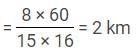
Hence, option C is correct.
Given,
Total Time (T) = 32 min = 32/60 = 8/15hr
By the short trick approach, we get
Hence, option C is correct.
. A Boat took 8 hours less to travel a distance downstream than to travel the same distance upstream. If the speed of a boat in still water is 9 Km/hr and speed of a stream is 3 Km/hr. In total how much distance traveled by boat?- a)96 Km
- b)144 Km
- c)164 Km
- d)192 Km
- e)216 Km
Correct answer is option 'D'. Can you explain this answer?
. A Boat took 8 hours less to travel a distance downstream than to travel the same distance upstream. If the speed of a boat in still water is 9 Km/hr and speed of a stream is 3 Km/hr. In total how much distance traveled by boat?
a)
96 Km
b)
144 Km
c)
164 Km
d)
192 Km
e)
216 Km
 | Nikita Singh answered |
Answer – 4. 192 Km Explanation : 8 =D(1/6 – 1/12) D =96 Total = 96+96 =192
If downstream speed of a boat is 16 kmph and its upstream speed is 11 kmph, what is the speed of stream?- a)1.5 kmph
- b)2 kmph
- c)3 kmph
- d)2.5 kmph
- e)3.5 kmph
Correct answer is option 'D'. Can you explain this answer?
If downstream speed of a boat is 16 kmph and its upstream speed is 11 kmph, what is the speed of stream?
a)
1.5 kmph
b)
2 kmph
c)
3 kmph
d)
2.5 kmph
e)
3.5 kmph
| | Rhea Reddy answered |
To solve this question, we can apply a short trick approach;
Speed of current
= 1/2 (Rate of downstream – Rate of upstream)
By the short trick approach, we get
= 1/2 (16 – 11) = 5/2 = 2.5 kmph.
Hence, option D is correct.
Speed of current
= 1/2 (Rate of downstream – Rate of upstream)
By the short trick approach, we get
= 1/2 (16 – 11) = 5/2 = 2.5 kmph.
Hence, option D is correct.
The speed of a boat along the stream is 8 km/h and against the stream is 6 km/hr. The time taken by the boat to sail 28 km in still water is- a)2 hrs
- b)3 hrs
- c)4 hrs
- d)8 hrs
- e)None of these
Correct answer is option 'C'. Can you explain this answer?
The speed of a boat along the stream is 8 km/h and against the stream is 6 km/hr. The time taken by the boat to sail 28 km in still water is
a)
2 hrs
b)
3 hrs
c)
4 hrs
d)
8 hrs
e)
None of these
| | Rhea Reddy answered |
Given, Speed downstream = 8 km/h Speed upstream = 6 km/h
∴ Speed of boat in still water

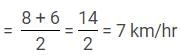

Hence, option C is correct.
∴ Speed of boat in still water
Hence, option C is correct.
Two boats A and B start towards each other from two places, 150 km apart. Speed of the boat A and B in still water are 16 km/hr and 14 km/hr respectively. If A proceeds down and B up the stream, they will meet after.- a)4.5 hours
- b)4 hours
- c)5 hours
- d)6 hours
- e)None of these
Correct answer is option 'C'. Can you explain this answer?
Two boats A and B start towards each other from two places, 150 km apart. Speed of the boat A and B in still water are 16 km/hr and 14 km/hr respectively. If A proceeds down and B up the stream, they will meet after.
a)
4.5 hours
b)
4 hours
c)
5 hours
d)
6 hours
e)
None of these
| | Ayesha Joshi answered |
Let the speed of the stream be x kmph and both the boats meet after t hours.
According to the question,
Distance covered while going downstream + Distance covered while going upstream = Total Distance
⇒ (16 + x) t + (14 – x) t = 150
⇒ 16t + 14t = 150
⇒ 30t = 150
⇒ t = 5 hrs
Hence, option C is correct.
According to the question,
Distance covered while going downstream + Distance covered while going upstream = Total Distance
⇒ (16 + x) t + (14 – x) t = 150
⇒ 16t + 14t = 150
⇒ 30t = 150
⇒ t = 5 hrs
Hence, option C is correct.
Speed of a boat is 25 km per hour in still water and the speed of the stream is 5 km per hour. If the boat takes 15 hrs to go to a place and come back, the distance of the place is- a)180 km
- b)160 m
- c)164 km
- d)220 km
- e)None of these
Correct answer is option 'A'. Can you explain this answer?
Speed of a boat is 25 km per hour in still water and the speed of the stream is 5 km per hour. If the boat takes 15 hrs to go to a place and come back, the distance of the place is
a)
180 km
b)
160 m
c)
164 km
d)
220 km
e)
None of these
| | Sounak Majumdar answered |
Given:
Speed of the boat in still water = 25 km/hr
Speed of the stream = 5 km/hr
Time taken to go to a place and come back = 15 hours
To find:
The distance of the place.
Formula:
Speed = Distance / Time
Approach:
Let's assume the distance of the place as 'd' km.
When the boat is moving upstream (against the stream), the effective speed is reduced by the speed of the stream.
So, the speed of the boat while moving upstream = (Speed of the boat in still water) - (Speed of the stream) = 25 - 5 = 20 km/hr.
When the boat is moving downstream (with the stream), the effective speed is increased by the speed of the stream.
So, the speed of the boat while moving downstream = (Speed of the boat in still water) + (Speed of the stream) = 25 + 5 = 30 km/hr.
Let's consider the time taken to go from the starting point to the place as 't1' hours.
Then, the time taken to return from the place to the starting point will be (15 - t1) hours.
Using the formula Speed = Distance / Time, we can write the following equations:
For the upstream journey:
20 = d / t1
For the downstream journey:
30 = d / (15 - t1)
Solving the above two equations will give us the value of 'd', which represents the distance of the place.
Calculation:
From the first equation, we can write:
d = 20 * t1
Substituting this value in the second equation, we get:
30 = (20 * t1) / (15 - t1)
Cross-multiplying and simplifying the equation, we get:
600 - 30t1 = 20t1
600 = 50t1
t1 = 12
Substituting the value of t1 in the equation d = 20 * t1, we get:
d = 20 * 12
d = 240 km
Therefore, the distance of the place is 240 km.
Hence, the correct answer is option A) 180 km.
Speed of the boat in still water = 25 km/hr
Speed of the stream = 5 km/hr
Time taken to go to a place and come back = 15 hours
To find:
The distance of the place.
Formula:
Speed = Distance / Time
Approach:
Let's assume the distance of the place as 'd' km.
When the boat is moving upstream (against the stream), the effective speed is reduced by the speed of the stream.
So, the speed of the boat while moving upstream = (Speed of the boat in still water) - (Speed of the stream) = 25 - 5 = 20 km/hr.
When the boat is moving downstream (with the stream), the effective speed is increased by the speed of the stream.
So, the speed of the boat while moving downstream = (Speed of the boat in still water) + (Speed of the stream) = 25 + 5 = 30 km/hr.
Let's consider the time taken to go from the starting point to the place as 't1' hours.
Then, the time taken to return from the place to the starting point will be (15 - t1) hours.
Using the formula Speed = Distance / Time, we can write the following equations:
For the upstream journey:
20 = d / t1
For the downstream journey:
30 = d / (15 - t1)
Solving the above two equations will give us the value of 'd', which represents the distance of the place.
Calculation:
From the first equation, we can write:
d = 20 * t1
Substituting this value in the second equation, we get:
30 = (20 * t1) / (15 - t1)
Cross-multiplying and simplifying the equation, we get:
600 - 30t1 = 20t1
600 = 50t1
t1 = 12
Substituting the value of t1 in the equation d = 20 * t1, we get:
d = 20 * 12
d = 240 km
Therefore, the distance of the place is 240 km.
Hence, the correct answer is option A) 180 km.
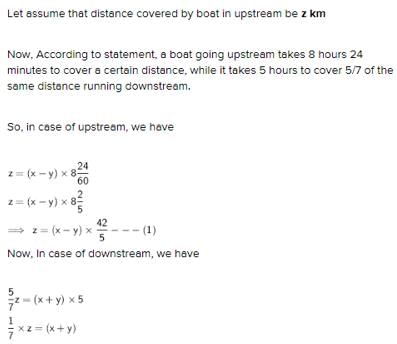
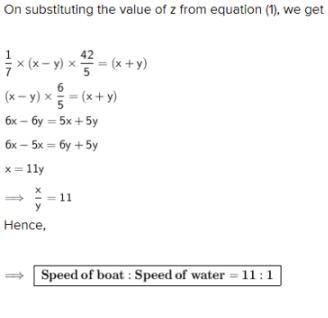
A Boat going upstream takes 8 hours 24 minutes to cover a certain distance, while it takes 5 hours to cover 5/7 of the same distance running downstream.Then what is the ratio of the speed of boat to speed of water current?- a)6:5
- b)11:5
- c)11:6
- d)11:1
- e)11:10
Correct answer is option 'D'. Can you explain this answer?
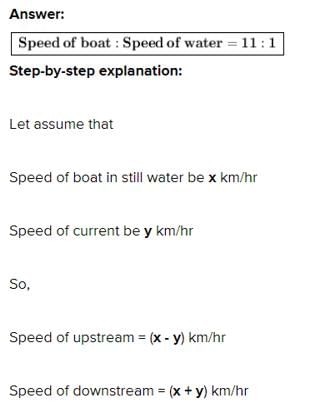
A Boat going upstream takes 8 hours 24 minutes to cover a certain distance, while it takes 5 hours to cover 5/7 of the same distance running downstream.Then what is the ratio of the speed of boat to speed of water current?
a)
6:5
b)
11:5
c)
11:6
d)
11:1
e)
11:10
| | Shivam Ghoshal answered |
The speed of a Boat in standing water is 10km/hr. It traveled Down Stream from point A to B in certain time. After reaching B the Boat is powered by Engine then Boat started to return from Point B to A. The time taken for Forward journey and Backward journey are same. Then what is the speed of the stream?- a)2 Km/hr
- b)3 Km/hr
- c)4 Km/hr
- d)5 Km/hr
- e)Cannot be determined
Correct answer is option 'E'. Can you explain this answer?
The speed of a Boat in standing water is 10km/hr. It traveled Down Stream from point A to B in certain time. After reaching B the Boat is powered by Engine then Boat started to return from Point B to A. The time taken for Forward journey and Backward journey are same. Then what is the speed of the stream?
a)
2 Km/hr
b)
3 Km/hr
c)
4 Km/hr
d)
5 Km/hr
e)
Cannot be determined
| | Aarav Sharma answered |
Analysis:
To solve the problem, we can use the formula:
Speed of boat in still water (B) = 1/2 (Speed downstream + Speed upstream)
Let the speed of the stream be 'S' km/hr.
Given,
Speed of boat in still water (B) = 10 km/hr
Time taken for forward journey (A to B) = Time taken for backward journey (B to A)
Let the distance between A and B be 'D' km.
Let the speed downstream be 'B + S' km/hr and speed upstream be 'B - S' km/hr.
Let the time taken for the forward journey be 't' hrs.
Then,
Time taken for backward journey = t hrs
Distance covered in the forward journey = Distance covered in backward journey = D km
Speed downstream = Distance/Time = D/t km/hr
Speed upstream = Distance/Time = D/t km/hr
Speed downstream = B + S km/hr
Speed upstream = B - S km/hr
Calculation:
Using the formula,
B = 1/2 (B + S + B - S)
10 = 1/2 (2B)
B = 5 km/hr
Substituting B = 5 km/hr in the equations,
D/t = (10 + S) km/hr
D/t = (10 - S) km/hr
Dividing both the equations,
(10 + S)/(10 - S) = 1
10 + S = 10 - S
2S = 0
S = 0
Conclusion:
The speed of the stream cannot be determined as the solution leads to 'S = 0'. This implies that the boat travels in still water and there is no current or stream. Therefore, the answer is option 'E'.
To solve the problem, we can use the formula:
Speed of boat in still water (B) = 1/2 (Speed downstream + Speed upstream)
Let the speed of the stream be 'S' km/hr.
Given,
Speed of boat in still water (B) = 10 km/hr
Time taken for forward journey (A to B) = Time taken for backward journey (B to A)
Let the distance between A and B be 'D' km.
Let the speed downstream be 'B + S' km/hr and speed upstream be 'B - S' km/hr.
Let the time taken for the forward journey be 't' hrs.
Then,
Time taken for backward journey = t hrs
Distance covered in the forward journey = Distance covered in backward journey = D km
Speed downstream = Distance/Time = D/t km/hr
Speed upstream = Distance/Time = D/t km/hr
Speed downstream = B + S km/hr
Speed upstream = B - S km/hr
Calculation:
Using the formula,
B = 1/2 (B + S + B - S)
10 = 1/2 (2B)
B = 5 km/hr
Substituting B = 5 km/hr in the equations,
D/t = (10 + S) km/hr
D/t = (10 - S) km/hr
Dividing both the equations,
(10 + S)/(10 - S) = 1
10 + S = 10 - S
2S = 0
S = 0
Conclusion:
The speed of the stream cannot be determined as the solution leads to 'S = 0'. This implies that the boat travels in still water and there is no current or stream. Therefore, the answer is option 'E'.
A man can row at a speed of 15/2 km/hr in still water. If he takes 4 times as long to row a distance upstream as to row the same distance downstream, then the speed of stream (in km/hr) is- a)4
- b)3.75
- c)5
- d)4.5
- e)None of these
Correct answer is option 'D'. Can you explain this answer?
A man can row at a speed of 15/2 km/hr in still water. If he takes 4 times as long to row a distance upstream as to row the same distance downstream, then the speed of stream (in km/hr) is
a)
4
b)
3.75
c)
5
d)
4.5
e)
None of these
| | Ayesha Joshi answered |
Let the speed of stream be x kmph
∴ Rate upstream = 15/2 - x
And rate downstream = 15/2 + x
Let's also assume the time taken in downstream and upstream is 1 hr and 4 hrs respectively. We know that, Distance = Speed × Time
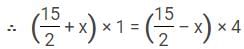
⇒ (15 + 2x) = (60 – 8x) ⇒ 10x = 45
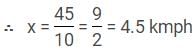
Hence, the option D is correct.
∴ Rate upstream = 15/2 - x
And rate downstream = 15/2 + x
Let's also assume the time taken in downstream and upstream is 1 hr and 4 hrs respectively. We know that, Distance = Speed × Time
⇒ (15 + 2x) = (60 – 8x) ⇒ 10x = 45
Hence, the option D is correct.
A motorboat, whose speed in 15 km/hr in still water goes 30 km downstream and comes back in a total of 4 hours 30 minutes. The speed of the stream (in km/hr) is:- a)4 km/hr
- b)5 km/hr
- c)6 km/hr
- d)10 km/hr
- e)11 km/hr
Correct answer is option 'B'. Can you explain this answer?
A motorboat, whose speed in 15 km/hr in still water goes 30 km downstream and comes back in a total of 4 hours 30 minutes. The speed of the stream (in km/hr) is:
a)
4 km/hr
b)
5 km/hr
c)
6 km/hr
d)
10 km/hr
e)
11 km/hr
| | Aisha Gupta answered |
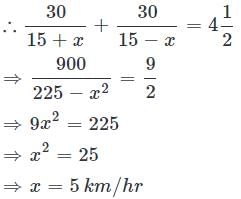
Let the speed of the stream be x km/hr
Then,
Speed downstream = (15 + x) km/hr
Speed upstream = (15 - x) km/hr
Then,
Speed downstream = (15 + x) km/hr
Speed upstream = (15 - x) km/hr
It is a common view that efficient management always satisfy its employees. Which point of features of management discussed here?- a)Group activity
- b)Dynamic function
- c)Intangible force
- d)Continuous process
Correct answer is option 'C'. Can you explain this answer?
It is a common view that efficient management always satisfy its employees. Which point of features of management discussed here?
a)
Group activity
b)
Dynamic function
c)
Intangible force
d)
Continuous process
 | Anu Saha answered |
Efficient management always satisfying its employees is a common view, but which point of features of management does it fall under? The answer is option 'C', which is the continuous process.
Continuous Process in Management:
Continuous process refers to the fact that management is not a one-time activity; rather, it is an ongoing process that requires constant monitoring, evaluating, and modifying. This means that efficient management is not just about satisfying employees once, but it is a continuous effort to keep them motivated, engaged, and satisfied.
The following are some of the reasons why management is a continuous process:
1. Changing Environment: The business environment is constantly changing, and management needs to adapt to these changes to stay relevant. This requires ongoing monitoring and evaluation of the business environment and making necessary adjustments to management practices.
2. Employee Needs: Employees' needs and expectations are constantly changing, and management needs to keep up with these changes to satisfy them. This requires ongoing communication with employees to understand their needs and expectations and making necessary adjustments to management practices.
3. Technology Advancements: Technology is constantly evolving, and management needs to adopt new technologies to stay competitive. This requires ongoing training and development of employees to keep up with the latest technologies.
4. Performance Evaluation: Management needs to evaluate employees' performance regularly to identify areas for improvement and provide feedback. This requires ongoing monitoring of employees' performance and providing necessary support and resources to improve their performance.
In conclusion, efficient management is a continuous process that requires ongoing monitoring, evaluating, and modifying to satisfy employees' needs and expectations. Management needs to adapt to the changing business environment, employee needs, technology advancements, and evaluate employees' performance regularly to improve and maintain their satisfaction.
Continuous Process in Management:
Continuous process refers to the fact that management is not a one-time activity; rather, it is an ongoing process that requires constant monitoring, evaluating, and modifying. This means that efficient management is not just about satisfying employees once, but it is a continuous effort to keep them motivated, engaged, and satisfied.
The following are some of the reasons why management is a continuous process:
1. Changing Environment: The business environment is constantly changing, and management needs to adapt to these changes to stay relevant. This requires ongoing monitoring and evaluation of the business environment and making necessary adjustments to management practices.
2. Employee Needs: Employees' needs and expectations are constantly changing, and management needs to keep up with these changes to satisfy them. This requires ongoing communication with employees to understand their needs and expectations and making necessary adjustments to management practices.
3. Technology Advancements: Technology is constantly evolving, and management needs to adopt new technologies to stay competitive. This requires ongoing training and development of employees to keep up with the latest technologies.
4. Performance Evaluation: Management needs to evaluate employees' performance regularly to identify areas for improvement and provide feedback. This requires ongoing monitoring of employees' performance and providing necessary support and resources to improve their performance.
In conclusion, efficient management is a continuous process that requires ongoing monitoring, evaluating, and modifying to satisfy employees' needs and expectations. Management needs to adapt to the changing business environment, employee needs, technology advancements, and evaluate employees' performance regularly to improve and maintain their satisfaction.
A man can swim 3 km/hr in still water. If the velocity of the stream is 2 km/hr, the time taken by him to swim to a place 10 km upstream and back is:- a)

- b)10 hr.
- c)12 hr.
- d)

- e)15 hr.
Correct answer is option 'C'. Can you explain this answer?
A man can swim 3 km/hr in still water. If the velocity of the stream is 2 km/hr, the time taken by him to swim to a place 10 km upstream and back is:
a)
b)
10 hr.
c)
12 hr.
d)
e)
15 hr.
| | Rhea Reddy answered |
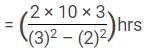
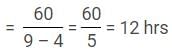
To solve this question, we can apply a short trick approach;

By the short trick approach, we get
Hence, option C is correct.
By the short trick approach, we get
Hence, option C is correct.
A man's speed with the current is 15 km/hr and the speed of the current is 2.5 km/hr. The man's speed against the current is:- a)8.5 km/hr
- b)9 km/hr
- c)10 km/hr
- d)12.5 km/hr
- e)None of these
Correct answer is option 'C'. Can you explain this answer?
A man's speed with the current is 15 km/hr and the speed of the current is 2.5 km/hr. The man's speed against the current is:
a)
8.5 km/hr
b)
9 km/hr
c)
10 km/hr
d)
12.5 km/hr
e)
None of these
| | Rahul Mehta answered |
Man's rate in still water
= (15 - 2.5) km/hr
= 12.5 km/hr.
Man's rate against the current
= (12.5 - 2.5) km/hr
= 10 km/hr.
= (15 - 2.5) km/hr
= 12.5 km/hr.
Man's rate against the current
= (12.5 - 2.5) km/hr
= 10 km/hr.
Speed of a along and against the current are 14 kms/hr and 8 kms/hr respectively. The speed of the current is?- a)11 km/hr
- b)6 km/hr
- c)5.5 km/hr
- d)3 km/hr
- e)4 km/hr
Correct answer is option 'D'. Can you explain this answer?
Speed of a along and against the current are 14 kms/hr and 8 kms/hr respectively. The speed of the current is?
a)
11 km/hr
b)
6 km/hr
c)
5.5 km/hr
d)
3 km/hr
e)
4 km/hr
| | Rahul Mehta answered |
S + W = 14 . . . . . . (i)
S - W = 8 . . . . . . . .(ii)
_________________
from equation (i) & (ii)
S = 11 km/hr, W = 3 km/hr
Speed of current = 3 km/hr
S - W = 8 . . . . . . . .(ii)
_________________
from equation (i) & (ii)
S = 11 km/hr, W = 3 km/hr
Speed of current = 3 km/hr
Chapter doubts & questions for Boats and Stream - IBPS PO Prelims & Mains Preparation 2026 is part of Bank Exams exam preparation. The chapters have been prepared according to the Bank Exams exam syllabus. The Chapter doubts & questions, notes, tests & MCQs are made for Bank Exams 2026 Exam. Find important definitions, questions, notes, meanings, examples, exercises, MCQs and online tests here.
Chapter doubts & questions of Boats and Stream - IBPS PO Prelims & Mains Preparation in English & Hindi are available as part of Bank Exams exam. Download more important topics, notes, lectures and mock test series for Bank Exams Exam by signing up for free.
IBPS PO Prelims & Mains Preparation665 videos|1092 docs|379 tests |
