


All Exams > MCAT > Psychology and Sociology for MCAT > All Questions
All questions of Sound (Audition) for MCAT Exam
Which of these is NOT a direction in auditory space?- a)Loudness
- b)Azimuth
- c)Elevation
- d)Distance
Correct answer is option 'A'. Can you explain this answer?
Which of these is NOT a direction in auditory space?
a)
Loudness
b)
Azimuth
c)
Elevation
d)
Distance
 | Ayesha Joshi answered |
Loudness is a perceptual attribute of sound that refers to the subjective perception of sound intensity or volume. It is not a direction in auditory space but rather a quality of sound perception. On the other hand, azimuth, elevation, and distance are all directions in auditory space.
- Azimuth refers to the horizontal direction or angle of a sound source relative to the listener's head. It determines whether a sound is perceived as coming from the left or right side.
- Elevation refers to the vertical direction or angle of a sound source relative to the listener's head. It determines whether a sound is perceived as coming from above or below.
- Distance refers to the perceived spatial distance or proximity of a sound source from the listener. It relates to the perception of how near or far a sound source is.
- While loudness is an important attribute of sound perception, it does not indicate a specific direction in auditory space.

Which of these points is loudest?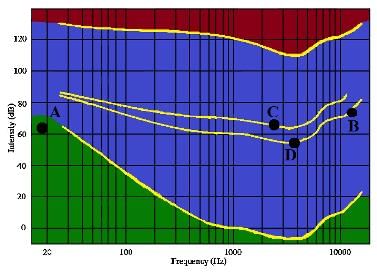
- a)A
- b)B
- c)C
- d)D
Correct answer is option 'C'. Can you explain this answer?
Which of these points is loudest?
a)
A
b)
B
c)
C
d)
D
| | Ayesha Joshi answered |
- Loudness is dependent on both sound pressure and frequency.
- Points along the equal loudness curve are all perceived at the same volume. Therefore, all points on the threshold of feeling would be at the threshold of pain.
- Point A is below the threshold of hearing and would be inaudible.
- Points B and D both fall along the same equal loudness curve.
- Point C is located on an equal loudness curve above the equal loudness curve that contains points B and D.
Which of these events is caused by the stapes pushing against membrane covering the oval window?- a)The pressure change causes the organ of Corti to vibrate horizontally.
- b)The pressure change causes the tectorial membrane to move horizontally.
- c)The pressure change causes the tectorial membrane to vibrate vertically.
- d)The pressure change causes the organ of Corti to vibrate vertically.
Correct answer is option 'D'. Can you explain this answer?
Which of these events is caused by the stapes pushing against membrane covering the oval window?
a)
The pressure change causes the organ of Corti to vibrate horizontally.
b)
The pressure change causes the tectorial membrane to move horizontally.
c)
The pressure change causes the tectorial membrane to vibrate vertically.
d)
The pressure change causes the organ of Corti to vibrate vertically.
 | Orion Classes answered |
The stapes is the third bone of the middle ear and is connected to the oval window, which is a membrane-covered opening between the middle ear and the inner ear. When the stapes pushes against the membrane covering the oval window, it generates pressure waves in the fluid-filled cochlea of the inner ear.
These pressure waves cause the basilar membrane, a component of the cochlea, to vibrate. The organ of Corti, which sits on the basilar membrane, contains hair cells responsible for transducing sound vibrations into electrical signals. The pressure changes transmitted by the stapes and the resulting vibrations of the basilar membrane cause the organ of Corti to vibrate vertically.
The vertical vibrations of the organ of Corti result in the bending of hair cells and the activation of auditory receptor cells, initiating the process of auditory transduction and leading to the perception of sound.
The tympanic reflex helps prevent damage from loud sounds. How does the tensor tympani work to protect one’s hearing?- a)The tensor tympani dampens loud sounds by tightening the tympanic membrane. This slows down transduction.
- b)The tensor tympani produces sounds by vibrating. This allows the ear to adapt to loud sounds.
- c)The tensor tympani loosens the tympanic membrane. This allows the vibrations to pass more easily through the ear.
- d)The tensor tympani tightens the tympanic membrane. This changes the frequency of the sound to a frequency outside the range of hearing.
Correct answer is option 'A'. Can you explain this answer?
The tympanic reflex helps prevent damage from loud sounds. How does the tensor tympani work to protect one’s hearing?
a)
The tensor tympani dampens loud sounds by tightening the tympanic membrane. This slows down transduction.
b)
The tensor tympani produces sounds by vibrating. This allows the ear to adapt to loud sounds.
c)
The tensor tympani loosens the tympanic membrane. This allows the vibrations to pass more easily through the ear.
d)
The tensor tympani tightens the tympanic membrane. This changes the frequency of the sound to a frequency outside the range of hearing.
 | Claire Powell answered |
The Tympanic Reflex and Hearing Protection
The tympanic reflex is a protective mechanism that helps safeguard the inner ear from potentially damaging loud sounds. The tensor tympani muscle plays a crucial role in this reflex.
Function of the Tensor Tympani
- The tensor tympani is a small muscle located in the middle ear.
- Its primary function is to respond to loud sounds by contracting.
Mechanism of Action
- Upon exposure to loud noises, the tensor tympani tightens the tympanic membrane (eardrum).
- This tightening increases the stiffness of the membrane, which reduces its ability to vibrate freely.
- As a result, the transmission of sound vibrations to the inner ear is dampened.
Impact on Sound Transduction
- By decreasing the movement of the tympanic membrane, the tensor tympani effectively slows down the transduction of sound.
- This dampening action helps to protect the delicate hair cells in the cochlea from excessive stimulation and potential damage.
Conclusion
- Overall, the tensor tympani aids in preventing hearing damage from loud sounds by tightening the tympanic membrane, thereby controlling the intensity of sound vibrations that reach the inner ear.
- This protective mechanism is vital for maintaining hearing health, especially in environments with sudden loud noises.
Understanding the role of the tensor tympani in the tympanic reflex underscores the intricate design of the auditory system in protecting our hearing.
The tympanic reflex is a protective mechanism that helps safeguard the inner ear from potentially damaging loud sounds. The tensor tympani muscle plays a crucial role in this reflex.
Function of the Tensor Tympani
- The tensor tympani is a small muscle located in the middle ear.
- Its primary function is to respond to loud sounds by contracting.
Mechanism of Action
- Upon exposure to loud noises, the tensor tympani tightens the tympanic membrane (eardrum).
- This tightening increases the stiffness of the membrane, which reduces its ability to vibrate freely.
- As a result, the transmission of sound vibrations to the inner ear is dampened.
Impact on Sound Transduction
- By decreasing the movement of the tympanic membrane, the tensor tympani effectively slows down the transduction of sound.
- This dampening action helps to protect the delicate hair cells in the cochlea from excessive stimulation and potential damage.
Conclusion
- Overall, the tensor tympani aids in preventing hearing damage from loud sounds by tightening the tympanic membrane, thereby controlling the intensity of sound vibrations that reach the inner ear.
- This protective mechanism is vital for maintaining hearing health, especially in environments with sudden loud noises.
Understanding the role of the tensor tympani in the tympanic reflex underscores the intricate design of the auditory system in protecting our hearing.
The kinocilium attaches to a potassium channel in the hair bundle. What type of gate is the potassium channel?- a)Mechanical gate
- b)Voltage gate
- c)Chemical gate
- d)Ligand gate
Correct answer is option 'A'. Can you explain this answer?
The kinocilium attaches to a potassium channel in the hair bundle. What type of gate is the potassium channel?
a)
Mechanical gate
b)
Voltage gate
c)
Chemical gate
d)
Ligand gate
| | Ayesha Joshi answered |
The potassium channel in the hair bundle of the auditory system is a type of ion channel that is gated by mechanical stimuli. When sound vibrations cause the hair bundle to bend, it exerts tension on the mechanosensitive channels, including the potassium channels. This mechanical force opens or closes the channel, allowing the flow of potassium ions.
Therefore, the potassium channel in the hair bundle is classified as a mechanical gate because it responds to physical forces or mechanical stimuli, such as the bending of the hair bundle. This mechanical gating mechanism plays a crucial role in the transduction of sound vibrations into electrical signals in the auditory system.
Researchers showed participants a video of two objects that appeared to be moving toward one another at a 90 degree angle. More than 88% of the participants saw the objects pass each other and continue on their original course. In a second condition, participants were played a click sound when the objects appeared to be close together. This time 63% perceived the objects as bouncing off each other in opposite directions. What impact did sound have on visual perception?- a)The sound reinforced the condition perceived by the visual system.
- b)The image modulated the perception of the sound of the click.
- c)The sound and the image were processed and perceived separately.
- d)The input from the auditory system modulated visual perception.
Correct answer is option 'D'. Can you explain this answer?
Researchers showed participants a video of two objects that appeared to be moving toward one another at a 90 degree angle. More than 88% of the participants saw the objects pass each other and continue on their original course. In a second condition, participants were played a click sound when the objects appeared to be close together. This time 63% perceived the objects as bouncing off each other in opposite directions. What impact did sound have on visual perception?
a)
The sound reinforced the condition perceived by the visual system.
b)
The image modulated the perception of the sound of the click.
c)
The sound and the image were processed and perceived separately.
d)
The input from the auditory system modulated visual perception.
| | Orion Classes answered |
The given scenario demonstrates the phenomenon of cross-modal interaction, where auditory information (the click sound) influenced the visual perception of the participants. In the first condition, without the click sound, the majority of participants perceived the objects as passing each other. However, in the second condition, when the click sound coincided with the visual perception of the objects being close together, a significant number of participants perceived the objects as bouncing off each other.
This suggests that the auditory input (the click sound) influenced or modulated the participants' visual perception, leading to a different interpretation of the visual stimulus. It highlights the integration and interaction of sensory information from different modalities, indicating that the auditory system can impact visual perception.
What is the purpose of the eustachian tube in the auditory system?- a)Equalizing pressure between the middle ear and the outside environment
- b)Transmitting sound waves from the outer ear to the middle ear
- c)Amplifying sound vibrations in the inner ear
- d)Protecting the inner ear from loud sounds
Correct answer is option 'A'. Can you explain this answer?
What is the purpose of the eustachian tube in the auditory system?
a)
Equalizing pressure between the middle ear and the outside environment
b)
Transmitting sound waves from the outer ear to the middle ear
c)
Amplifying sound vibrations in the inner ear
d)
Protecting the inner ear from loud sounds
| | Ayesha Joshi answered |
The eustachian tube connects the middle ear to the back of the throat. Its primary function is to equalize the pressure between the middle ear and the outside environment. This is important for maintaining optimal sound transmission and preventing discomfort or damage to the structures of the middle ear.
What forms the border between the middle and inner ear?- a)Tympanic membrane
- b)Oval window
- c)Incus
- d)Pinnae
Correct answer is option 'B'. Can you explain this answer?
What forms the border between the middle and inner ear?
a)
Tympanic membrane
b)
Oval window
c)
Incus
d)
Pinnae
| | Ayesha Joshi answered |
The oval window forms the border between the middle ear and the inner ear. It is a membrane-covered opening that separates the middle ear, which contains the ossicles (including the incus), from the fluid-filled cochlea of the inner ear. When sound waves vibrate the eardrum, the vibrations are transmitted through the ossicles to the oval window, initiating the process of auditory transduction in the inner ear.
How do the ossicles help to amplify the sound that reaches the tympanic membrane?- a)By transferring vibration from a membrane of small area, the tympanic membrane, to a membrane of large area, the circular window.
- b)By transferring vibration from a membrane of large area, the tympanic membrane, to a membrane of small area, the oval window.
- c)By transferring vibration from a membrane of small area, the tympanic membrane, to a membrane of large area, the oval window.
- d)By transferring vibration from a membrane of large area, the circular window, to a membrane of small area, the oval window.
Correct answer is option 'B'. Can you explain this answer?
How do the ossicles help to amplify the sound that reaches the tympanic membrane?
a)
By transferring vibration from a membrane of small area, the tympanic membrane, to a membrane of large area, the circular window.
b)
By transferring vibration from a membrane of large area, the tympanic membrane, to a membrane of small area, the oval window.
c)
By transferring vibration from a membrane of small area, the tympanic membrane, to a membrane of large area, the oval window.
d)
By transferring vibration from a membrane of large area, the circular window, to a membrane of small area, the oval window.
| | Ayesha Joshi answered |
The ossicles, which consist of the malleus (hammer), incus (anvil), and stapes (stirrup), are small bones located in the middle ear. They play a crucial role in amplifying sound waves as they travel from the outer ear to the inner ear. When the tympanic membrane (eardrum) vibrates in response to sound waves, the vibrations are transmitted to the ossicles. The malleus is connected to the tympanic membrane and transfers the vibrations to the incus, which then transfers them to the stapes. The stapes is attached to the oval window, a membrane-covered opening that leads to the inner ear. The transfer of vibrations from the larger surface area of the tympanic membrane to the smaller surface area of the oval window results in mechanical amplification of the sound waves, allowing for more efficient transmission of sound energy into the fluid-filled cochlea of the inner ear.
Which part of the auditory pathway is responsible for encoding sound frequency?- a)Cochlea
- b)Auditory nerve
- c)Superior olivary complex
- d)Auditory cortex
Correct answer is option 'A'. Can you explain this answer?
Which part of the auditory pathway is responsible for encoding sound frequency?
a)
Cochlea
b)
Auditory nerve
c)
Superior olivary complex
d)
Auditory cortex
| | Ayesha Joshi answered |
The cochlea is the primary structure in the auditory system responsible for encoding sound frequency. It contains the sensory hair cells that detect different frequencies of sound vibrations and convert them into electrical signals that can be transmitted to the brain.
Chapter doubts & questions for Sound (Audition) - Psychology and Sociology for MCAT 2026 is part of MCAT exam preparation. The chapters have been prepared according to the MCAT exam syllabus. The Chapter doubts & questions, notes, tests & MCQs are made for MCAT 2026 Exam. Find important definitions, questions, notes, meanings, examples, exercises, MCQs and online tests here.
Chapter doubts & questions of Sound (Audition) - Psychology and Sociology for MCAT in English & Hindi are available as part of MCAT exam. Download more important topics, notes, lectures and mock test series for MCAT Exam by signing up for free.
Psychology and Sociology for MCAT339 videos|20 docs|42 tests |
