


All Exams > SSC CGL > SSC CGL Previous Year Papers > All Questions
All questions of Algebra for SSC CGL Exam
The total area (in sq. unit) of the triangles formed by the graph of 4x + 5y = 40, x-axis, y-axis and x = 5 and y = 4 is (SSC CGL 2014)- a)10
- b)20
- c)30
- d)40
Correct answer is option 'A'. Can you explain this answer?
The total area (in sq. unit) of the triangles formed by the graph of 4x + 5y = 40, x-axis, y-axis and x = 5 and y = 4 is (SSC CGL 2014)
a)
10
b)
20
c)
30
d)
40
 | Mira Sharma answered |
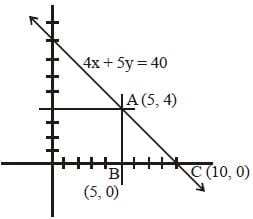
Area of ΔABC = (1/2) × base × height
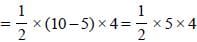
Area = 10 sq unit.

If a = 2017, b = 2016 and c = 2015, then what is the value of a2 + b2 + c2 – ab – bc – ca? (SSC Sub. Ins. 2017)- a)–2
- b)0
- c)3
- d)4
Correct answer is option 'C'. Can you explain this answer?
If a = 2017, b = 2016 and c = 2015, then what is the value of a2 + b2 + c2 – ab – bc – ca? (SSC Sub. Ins. 2017)
a)
–2
b)
0
c)
3
d)
4
 | EduRev SSC CGL answered |
Here, a = 2017, b = 2016, and c = 2015
∴ a2 + b2 + c2 – ab – bc – ca
⇒ (2017)2 + (2016)2 + (2015)2 – 2017× 2016 – 2016 × 2015 – 2015 × 2017 = 3
∴ a2 + b2 + c2 – ab – bc – ca
⇒ (2017)2 + (2016)2 + (2015)2 – 2017× 2016 – 2016 × 2015 – 2015 × 2017 = 3
If (x – y) = 7, th en wh at is the value of (x – 15)3 – (y – 8)3? (SSC CGL 2017)- a)0
- b)343
- c)392
- d)2863
Correct answer is option 'A'. Can you explain this answer?
If (x – y) = 7, th en wh at is the value of (x – 15)3 – (y – 8)3? (SSC CGL 2017)
a)
0
b)
343
c)
392
d)
2863
| | Mira Sharma answered |
Here,
(x – y) = 7
then,
∴ a3 – b3 = (a – b) (a2 + ab + b2)
(x – 15)3 – (y – 8)3 = ?
⇒ (x – 15 – y + 8) [(x –15)2 + (x – 15) (y – 8) + (y – 8)2]
⇒ (x – y – 7)[ (x – 15)2 + (x – 15) (y – 8) + (y – 8)2]
⇒ (7 – 7) [(x – 15)2 + (x – 15) (y – 8) + (y – 8)2]
⇒ 0 × [(x – 15)2 + (x – 15) (y – 8) + (y – 8)2]
⇒ 0
(x – y) = 7
then,
∴ a3 – b3 = (a – b) (a2 + ab + b2)
(x – 15)3 – (y – 8)3 = ?
⇒ (x – 15 – y + 8) [(x –15)2 + (x – 15) (y – 8) + (y – 8)2]
⇒ (x – y – 7)[ (x – 15)2 + (x – 15) (y – 8) + (y – 8)2]
⇒ (7 – 7) [(x – 15)2 + (x – 15) (y – 8) + (y – 8)2]
⇒ 0 × [(x – 15)2 + (x – 15) (y – 8) + (y – 8)2]
⇒ 0
The line passing through (–2, 5) and (6, b) is perpendicular to the line 20x + 5y = 3. Find b? (SSC CHSL 2017)- a)–7
- b)4
- c)7
- d)–4
Correct answer is option 'C'. Can you explain this answer?
The line passing through (–2, 5) and (6, b) is perpendicular to the line 20x + 5y = 3. Find b? (SSC CHSL 2017)
a)
–7
b)
4
c)
7
d)
–4
| | EduRev SSC CGL answered |
Here,
20x + 5y = 3
⇒ 5y = – 20x + 3
∴ y = – 4x + (3/5)
Slope of 20x + 5y = 3 ⇒ –4
We know, product of slopes = –1 for perpendicular lines
Hence, the slope of the line which passes through (–2, 5) and (6, b) =
Now,
⇒ b – 5 = 2
∴ b = 5 + 2 = 7
20x + 5y = 3
⇒ 5y = – 20x + 3
∴ y = – 4x + (3/5)
Slope of 20x + 5y = 3 ⇒ –4
We know, product of slopes = –1 for perpendicular lines
Hence, the slope of the line which passes through (–2, 5) and (6, b) =
Now,
⇒ b – 5 = 2
∴ b = 5 + 2 = 7
If p, q, r are all real numbers, then (p – q)3 + (q – r)3 + (r – p)3 is equal to (SSC Sub. Inspector 2016)- a)0
- b)3 (p – q) (q – r) (r – p)
- c)(p – q) (q – r) (r – p)
- d)1
Correct answer is option 'C'. Can you explain this answer?
If p, q, r are all real numbers, then (p – q)3 + (q – r)3 + (r – p)3 is equal to (SSC Sub. Inspector 2016)
a)
0
b)
3 (p – q) (q – r) (r – p)
c)
(p – q) (q – r) (r – p)
d)
1
 | Ssc Cgl answered |
If a + b + c = 0 then a3 + b3 + c3 = 3abc
let, a = (p – q), b = (q – r), c - (r – p)
than, a + b + c = p – q + q – r + r – p = 0
∴ (p – q)3 + (q – r)2 + (r – p)3
= 3(p – q) (q – r) (r – p) = 0
let, a = (p – q), b = (q – r), c - (r – p)
than, a + b + c = p – q + q – r + r – p = 0
∴ (p – q)3 + (q – r)2 + (r – p)3
= 3(p – q) (q – r) (r – p) = 0
If 'a' and 'b' are positive integers such that a2 – b2 = 19, then the value of 'a' is : (SSC MTS 2017)- a)20
- b)19
- c)10
- d)9
Correct answer is option 'C'. Can you explain this answer?
If 'a' and 'b' are positive integers such that a2 – b2 = 19, then the value of 'a' is : (SSC MTS 2017)
a)
20
b)
19
c)
10
d)
9
 | Vinod Mehta answered |
According to question,
a2 – b2 = 19
(a + b) (a – b) = 19
Since 19 is prime, one of (a + b) (a – b) is 19
Therefore, (10)2 – (9)2 = 19
∴ a = 10
a2 – b2 = 19
(a + b) (a – b) = 19
Since 19 is prime, one of (a + b) (a – b) is 19
Therefore, (10)2 – (9)2 = 19
∴ a = 10
The area of the triangle formed by the graphs of the equations x = 0, 2x + 3y = 6 and x + y = 3 is (SSC CGL 1st Sit. 2015)- a)3 sq. unit
- b)1(1/2) sq. unit
- c)1 sq. unit
- d)4(1/2) sq. unit
Correct answer is option 'B'. Can you explain this answer?
The area of the triangle formed by the graphs of the equations x = 0, 2x + 3y = 6 and x + y = 3 is (SSC CGL 1st Sit. 2015)
a)
3 sq. unit
b)
1(1/2) sq. unit
c)
1 sq. unit
d)
4(1/2) sq. unit
 | Ishaan Roy answered |
To find the area of the triangle formed by the given equations, we need to find the vertices of the triangle and then use the formula for the area of a triangle.
Given equations:
1) x = 0
2) 2x - 3y = 6
3) x + y = 3
To find the vertices, we can solve the equations to find the points of intersection.
Solving equations 2) and 3) simultaneously:
2x - 3y = 6
x + y = 3
Multiplying the second equation by 2 to eliminate x:
2(x + y) = 2(3)
2x + 2y = 6
Now we have the system of equations:
2x - 3y = 6
2x + 2y = 6
Subtracting the equations to eliminate x:
(2x - 3y) - (2x + 2y) = 6 - 6
-5y = 0
y = 0
Substituting y = 0 into equation 2):
2x - 3(0) = 6
2x = 6
x = 3
The point of intersection of equations 2) and 3) is (3, 0).
Next, we need to find the point of intersection of equations 1) and 2).
Substituting x = 0 into equation 2):
2(0) - 3y = 6
-3y = 6
y = -2
The point of intersection of equations 1) and 2) is (0, -2).
Lastly, we need to find the point of intersection of equations 1) and 3).
Substituting x = 0 into equation 3):
0 + y = 3
y = 3
The point of intersection of equations 1) and 3) is (0, 3).
Now we have the three vertices of the triangle: (3, 0), (0, -2), and (0, 3).
To find the area of the triangle, we can use the formula for the area of a triangle given its vertices:
Area = 1/2 * |x1(y2 - y3) + x2(y3 - y1) + x3(y1 - y2)|
Substituting the coordinates of the vertices into the formula:
Area = 1/2 * |3(3 - (-2)) + 0((-2) - 0) + 0(0 - 3)|
Area = 1/2 * |3(5) + 0 + 0|
Area = 1/2 * |15|
Area = 1/2 * 15
Area = 7.5
Therefore, the area of the triangle formed by the given equations is 7.5 square units, which is equivalent to option B).
Given equations:
1) x = 0
2) 2x - 3y = 6
3) x + y = 3
To find the vertices, we can solve the equations to find the points of intersection.
Solving equations 2) and 3) simultaneously:
2x - 3y = 6
x + y = 3
Multiplying the second equation by 2 to eliminate x:
2(x + y) = 2(3)
2x + 2y = 6
Now we have the system of equations:
2x - 3y = 6
2x + 2y = 6
Subtracting the equations to eliminate x:
(2x - 3y) - (2x + 2y) = 6 - 6
-5y = 0
y = 0
Substituting y = 0 into equation 2):
2x - 3(0) = 6
2x = 6
x = 3
The point of intersection of equations 2) and 3) is (3, 0).
Next, we need to find the point of intersection of equations 1) and 2).
Substituting x = 0 into equation 2):
2(0) - 3y = 6
-3y = 6
y = -2
The point of intersection of equations 1) and 2) is (0, -2).
Lastly, we need to find the point of intersection of equations 1) and 3).
Substituting x = 0 into equation 3):
0 + y = 3
y = 3
The point of intersection of equations 1) and 3) is (0, 3).
Now we have the three vertices of the triangle: (3, 0), (0, -2), and (0, 3).
To find the area of the triangle, we can use the formula for the area of a triangle given its vertices:
Area = 1/2 * |x1(y2 - y3) + x2(y3 - y1) + x3(y1 - y2)|
Substituting the coordinates of the vertices into the formula:
Area = 1/2 * |3(3 - (-2)) + 0((-2) - 0) + 0(0 - 3)|
Area = 1/2 * |3(5) + 0 + 0|
Area = 1/2 * |15|
Area = 1/2 * 15
Area = 7.5
Therefore, the area of the triangle formed by the given equations is 7.5 square units, which is equivalent to option B).
If x – (1/x) = 6, then x3 – (1/x3) is equal to: (SSC Sub. Ins. 2018 )- a)234
- b)198
- c)176
- d)216
Correct answer is option 'A'. Can you explain this answer?
If x – (1/x) = 6, then x3 – (1/x3) is equal to: (SSC Sub. Ins. 2018 )
a)
234
b)
198
c)
176
d)
216
| | EduRev SSC CGL answered |


Now.

= 6(38 + 1) = 6 × 39 = 234.
If a + b + c = 10 and ab + bc + ca = 32 then a3 + b3 + c3 – 3abc is equal to: (SSC CGL-2018)- a)50
- b)40
- c)60
- d)70
Correct answer is option 'B'. Can you explain this answer?
If a + b + c = 10 and ab + bc + ca = 32 then a3 + b3 + c3 – 3abc is equal to: (SSC CGL-2018)
a)
50
b)
40
c)
60
d)
70
 | Nilesh Banerjee answered |
We cannot determine the value of a3 + b3 + c3 without additional information.
If the square of the sum of two numbers is equal to 4 times of their product. then the ratio of these numbers is : (SSC Sub. Ins. 2013)- a)2 : 1
- b)1 : 3
- c)1 : 1
- d)1 : 2
Correct answer is option 'C'. Can you explain this answer?
If the square of the sum of two numbers is equal to 4 times of their product. then the ratio of these numbers is : (SSC Sub. Ins. 2013)
a)
2 : 1
b)
1 : 3
c)
1 : 1
d)
1 : 2
| | Nilesh Banerjee answered |
**Problem Analysis:**
Let's assume the two numbers to be x and y. According to the given condition, the square of the sum of the two numbers is equal to 4 times their product, which can be written as:
(x + y)^2 = 4xy
**Solution:**
To find the ratio of the two numbers, we can solve the equation using algebraic manipulation.
Expanding the left side of the equation:
(x + y)(x + y) = 4xy
x^2 + xy + xy + y^2 = 4xy
x^2 + 2xy + y^2 = 4xy
Rearranging the terms:
x^2 - 2xy + y^2 = 0
This equation can be factored as:
(x - y)^2 = 0
Taking the square root of both sides:
x - y = 0
Adding y to both sides:
x = y
Therefore, the two numbers are equal.
**Ratio of the Numbers:**
Since the two numbers are equal, the ratio of the two numbers is 1:1.
**Conclusion:**
The ratio of the two numbers is 1:1.
Let's assume the two numbers to be x and y. According to the given condition, the square of the sum of the two numbers is equal to 4 times their product, which can be written as:
(x + y)^2 = 4xy
**Solution:**
To find the ratio of the two numbers, we can solve the equation using algebraic manipulation.
Expanding the left side of the equation:
(x + y)(x + y) = 4xy
x^2 + xy + xy + y^2 = 4xy
x^2 + 2xy + y^2 = 4xy
Rearranging the terms:
x^2 - 2xy + y^2 = 0
This equation can be factored as:
(x - y)^2 = 0
Taking the square root of both sides:
x - y = 0
Adding y to both sides:
x = y
Therefore, the two numbers are equal.
**Ratio of the Numbers:**
Since the two numbers are equal, the ratio of the two numbers is 1:1.
**Conclusion:**
The ratio of the two numbers is 1:1.
If x + y + z = 0, then the value of  is (SSC CGL 2014)
- a)-1
- b)0
- c)1
- d)2
Correct answer is option 'D'. Can you explain this answer?
If x + y + z = 0, then the value of is (SSC CGL 2014)
is (SSC CGL 2014)a)
-1
b)
0
c)
1
d)
2
| | Ssc Cgl answered |
x + y + z = 0
y + z = –x
Squaring both sides
y2 + z2 + 2yz = x2
⇒ y2 + z2 = x2 – 2yz ...(1)

y + z = –x
Squaring both sides
y2 + z2 + 2yz = x2
⇒ y2 + z2 = x2 – 2yz ...(1)
If (2x + 3)3 + (x – 8)3 + (x + 13)3 = (2x + 3) (3x – 24) (x +13), then what is the value of x? (SSC Sub. Ins. 2018 )- a)–2
- b)–2.5
- c)–1
- d)–1.5
Correct answer is option 'A'. Can you explain this answer?
If (2x + 3)3 + (x – 8)3 + (x + 13)3 = (2x + 3) (3x – 24) (x +13), then what is the value of x? (SSC Sub. Ins. 2018 )
a)
–2
b)
–2.5
c)
–1
d)
–1.5
| | Ssc Cgl answered |
(2x + 3)3 + (x – 8)3 + (x + 13)3 = (2x + 3) (3x – 24) (x + 13)
(2x + 3)3 + (x – 8)3 + (x + 13)3 = 3(2x + 3)(x – 8)(x +13)
We know that if a3 + b3 + c3 = 3 abc
then, a + b + c = 0
(2x + 3) + (x – 8) + (x + 13) = 0
4x + 8 = 0
x = (-8)/4
∴ x = – 2
(2x + 3)3 + (x – 8)3 + (x + 13)3 = 3(2x + 3)(x – 8)(x +13)
We know that if a3 + b3 + c3 = 3 abc
then, a + b + c = 0
(2x + 3) + (x – 8) + (x + 13) = 0
4x + 8 = 0
x = (-8)/4
∴ x = – 2
If the expression (px3 – 8x2 – qx + 1) is completely divisible by the expression (3x2 – 4x + 1), then what will be the value of p and q respectively? (SSC Sub. Ins. 2017)- a)(21/4,15/8)
- b)(6, 1)
- c)(33/4, 5/4)
- d)(1, 6)
Correct answer is option 'C'. Can you explain this answer?
If the expression (px3 – 8x2 – qx + 1) is completely divisible by the expression (3x2 – 4x + 1), then what will be the value of p and q respectively? (SSC Sub. Ins. 2017)
a)
(21/4,15/8)
b)
(6, 1)
c)
(33/4, 5/4)
d)
(1, 6)
| | EduRev SSC CGL answered |
Let p(x) = px3 – 8x2 – qx + 1
Since, (3x2 – 4x + 1) is factor of p (x), so p (a) = 0
∴ 3x2 – 4x + 1 = 0
3x2 – 3x – x + 1 = 0
3x (x – 1) – 1 (x – 1) = 0
(3x – 1) (x – 1) = 0
∴ x = 1/3, 1
∴ p(x) = 1/3, 1
i.e.,


⇒ p – 24 – 9q + 27
⇒ p – 9q = –3 ...(i)
p (1) = px3 – 8x2 – qx + 1
⇒ p (1)3 – 8 (1)2 – q × 1 + 1
⇒ p – 8 – q + 1
⇒ p – q = 7 ....(ii)
From Eq. (i) and (ii),
p = 33/4, q = 5/4
Since, (3x2 – 4x + 1) is factor of p (x), so p (a) = 0
∴ 3x2 – 4x + 1 = 0
3x2 – 3x – x + 1 = 0
3x (x – 1) – 1 (x – 1) = 0
(3x – 1) (x – 1) = 0
∴ x = 1/3, 1
∴ p(x) = 1/3, 1
i.e.,
⇒ p – 24 – 9q + 27
⇒ p – 9q = –3 ...(i)
p (1) = px3 – 8x2 – qx + 1
⇒ p (1)3 – 8 (1)2 – q × 1 + 1
⇒ p – 8 – q + 1
⇒ p – q = 7 ....(ii)
From Eq. (i) and (ii),
p = 33/4, q = 5/4

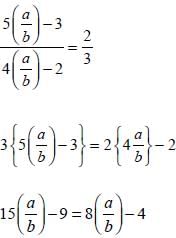

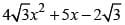 is: (SSC Sub. Ins. 2013)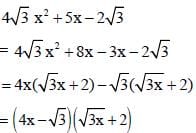
If (p2 + q2) / (r2 + s2) = (pq) / (rs), then what is the value of (p – q) (p + q) in terms of r and s? (SSC Sub. Ins. 2017)- a)(r + s) / (r – s)
- b)(r – s) / (r + s)
- c)(r + s)/ (rs)
- d)(rs) / (r – s)
Correct answer is option 'B'. Can you explain this answer?
If (p2 + q2) / (r2 + s2) = (pq) / (rs), then what is the value of (p – q) (p + q) in terms of r and s? (SSC Sub. Ins. 2017)
a)
(r + s) / (r – s)
b)
(r – s) / (r + s)
c)
(r + s)/ (rs)
d)
(rs) / (r – s)
 | Abhiram Mehra answered |
The given equation is:
(p2 q2) / (r2 s2) = (pq) / (rs)
To find the value of (p?), we need more information or another equation. Please provide more information or another equation.
(p2 q2) / (r2 s2) = (pq) / (rs)
To find the value of (p?), we need more information or another equation. Please provide more information or another equation.
When  then value of
  is (SSC CGL 1st Sit. 2016)
- a)2/7
- b)7/8
- c)7/2
- d)8/7
Correct answer is option 'B'. Can you explain this answer?
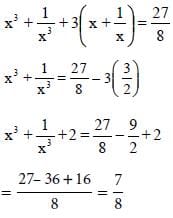
When then value of is (SSC CGL 1st Sit. 2016)
then value of is (SSC CGL 1st Sit. 2016)a)
2/7
b)
7/8
c)
7/2
d)
8/7
 | Knowledge Centre answered |

Dividing eq by 2
 Cubing both sides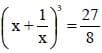
If then the value of
  is (SSC CGL 1st Sit. 2016)
- a)0
- b)1
- c)1/4
- d)2
Correct answer is option 'A'. Can you explain this answer?
If then the value of is (SSC CGL 1st Sit. 2016)
then the value of is (SSC CGL 1st Sit. 2016)a)
0
b)
1
c)
1/4
d)
2
| | Knowledge Centre answered |
 dividing Eq. by 2
 Squaring on both sides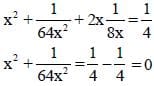
If x + (1/x) = 17, then what is the value of  (SSC CGL 2017)
- a)2431/7
- b)3375/7
- c)3375/14
- d)3985/9
Correct answer is option 'A'. Can you explain this answer?
If x + (1/x) = 17, then what is the value of (SSC CGL 2017)
(SSC CGL 2017)a)
2431/7
b)
3375/7
c)
3375/14
d)
3985/9
| | EduRev SSC CGL answered |
Here,
x + (1/x) = 17
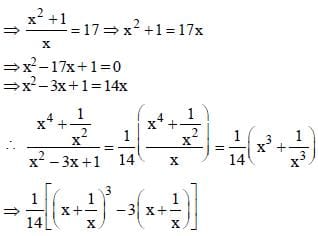
= 1/14 (4913-3x17)
⇒ (1/14) x 4862 = 2431/7
x + (1/x) = 17
= 1/14 (4913-3x17)
⇒ (1/14) x 4862 = 2431/7
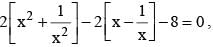 then what two values of x - (1/x)? (SSC CGL 2017)
If x2 – 3x + 1 = 0, then the value of 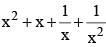 is (SSC CGL 1st Sit. 2013)
- a)6
- b)8
- c)10
- d)2
Correct answer is option 'C'. Can you explain this answer?
If x2 – 3x + 1 = 0, then the value of is (SSC CGL 1st Sit. 2013)
is (SSC CGL 1st Sit. 2013)a)
6
b)
8
c)
10
d)
2
| | Mira Sharma answered |
x2 – 3x + 1 = 0
⇒ x2 + 1 = 3x
Dividing both sides by x,

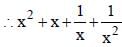

= 9 – 2 + 3 = 10
⇒ x2 + 1 = 3x
Dividing both sides by x,
= 9 – 2 + 3 = 10
If x2 – 3x + 1 = 0, then what is the value of  (SSC Sub. Ins. 2017)
- a)3
- b)7
- c)11
- d)18
Correct answer is option 'D'. Can you explain this answer?
If x2 – 3x + 1 = 0, then what is the value of (SSC Sub. Ins. 2017)
(SSC Sub. Ins. 2017)a)
3
b)
7
c)
11
d)
18
 | Target Study Academy answered |
If x2 – 3x + 1 = 0 then 
Dividing equation by x

= (3)3 – 3 × 3
= 27 – 9 = 18
Dividing equation by x
= (3)3 – 3 × 3
= 27 – 9 = 18
If  then x2 + (1/x2) is equal to: (SSC CGL-2018)
- a)192
- b)326
- c)322
- d)256
Correct answer is option 'C'. Can you explain this answer?
If then x2 + (1/x2) is equal to: (SSC CGL-2018)
then x2 + (1/x2) is equal to: (SSC CGL-2018)a)
192
b)
326
c)
322
d)
256
 | T.S Academy answered |
Given that: 
Squaring both sides, we get
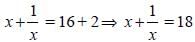
Again, squaring both sides, we get

Squaring both sides, we get
Again, squaring both sides, we get
If a3 + b3 = 5824 and a + b = 28, then (a – b)2 + ab is equal to: (SSC Sub. Ins. 2018 )- a)208
- b)180
- c)236
- d)152
Correct answer is option 'A'. Can you explain this answer?
If a3 + b3 = 5824 and a + b = 28, then (a – b)2 + ab is equal to: (SSC Sub. Ins. 2018 )
a)
208
b)
180
c)
236
d)
152
| | Mira Sharma answered |
a3 + b3 = 5824
(a + b) (a2 + b2 – ab) = 5824
28(a2 + b2 – ab) = 5824
(a2 + b2 – ab) = 5824/28 = 208
Now, (a – b)2 + ab = a2 + b2 – 2ab + ab
= a2 + b2 – ab = 208
(a + b) (a2 + b2 – ab) = 5824
28(a2 + b2 – ab) = 5824
(a2 + b2 – ab) = 5824/28 = 208
Now, (a – b)2 + ab = a2 + b2 – 2ab + ab
= a2 + b2 – ab = 208
 then what is the value of
  (SSC CGL 2017)
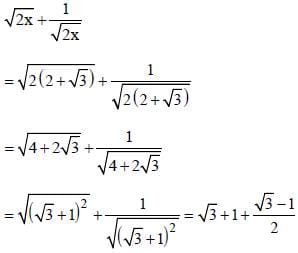

What is the value of x in the equation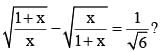 (SSC CGL 2017)
- a)-2
- b)3
- c)2
- d)none of these
Correct answer is option 'C'. Can you explain this answer?
What is the value of x in the equation (SSC CGL 2017)
(SSC CGL 2017)a)
-2
b)
3
c)
2
d)
none of these
 | Kiran Reddy answered |
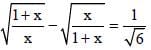
By squaring both sides
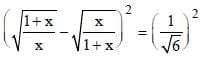
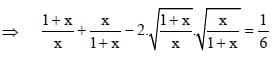
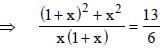
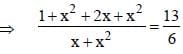
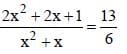
⇒ 13x2 + 13x = 12x2 + 12x + 6
⇒ x2 + 3x – 2x – 6 = 0
⇒ x (x + 3) – 2 (x + 3) = 0
⇒ (x – 2) (x + 3) = 0
⇒ x – 2 = 0 ∴ x = 2
⇒ x + 3 = 0 ∴ x = – 3
If x = 31/3 – 3–1/3 then 3x3 + 9x is equal to (SSC CGL 1st Sit. 2016)- a)5
- b)6
- c)7
- d)8
Correct answer is option 'D'. Can you explain this answer?
If x = 31/3 – 3–1/3 then 3x3 + 9x is equal to (SSC CGL 1st Sit. 2016)
a)
5
b)
6
c)
7
d)
8
 | Nidhi Bhatt answered |
x = 31/3 – 3–1/3
Cubing on both sides
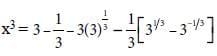
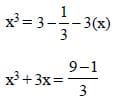
3x3 + 9x = 8
Cubing on both sides
3x3 + 9x = 8
If x = 6+ 2√6, then what is the value of 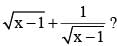 (SSC CGL 2017)
- a)2√3
- b)3√2
- c)2√2
- d)3√3
Correct answer is option 'A'. Can you explain this answer?
If x = 6+ 2√6, then what is the value of (SSC CGL 2017)
(SSC CGL 2017)a)
2√3
b)
3√2
c)
2√2
d)
3√3
| | Nidhi Bhatt answered |
x = 6 + 2√6
Subtraction by 1 in both side.
x -1 = 6 + 2√6 - 1
x -1 = 5 + 2√6 ⇒ 3 + 2√6

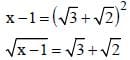
Now,
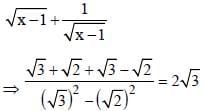
Subtraction by 1 in both side.
x -1 = 6 + 2√6 - 1
x -1 = 5 + 2√6 ⇒ 3 + 2√6
Now,
If x =  then the value of x4 + y4 – 2x2y2 is (SSC CGL 1st Sit. 2016)
- a)16
- b)20
- c)10
- d)5
Correct answer is option 'A'. Can you explain this answer?
If x = then the value of x4 + y4 – 2x2y2 is (SSC CGL 1st Sit. 2016)
then the value of x4 + y4 – 2x2y2 is (SSC CGL 1st Sit. 2016)a)
16
b)
20
c)
10
d)
5
| | Knowledge Centre answered |
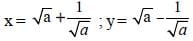
x4 + y4 – 2 x2y2
= (x2 – y2)2



Chapter doubts & questions for Algebra - SSC CGL Previous Year Papers 2026 is part of SSC CGL exam preparation. The chapters have been prepared according to the SSC CGL exam syllabus. The Chapter doubts & questions, notes, tests & MCQs are made for SSC CGL 2026 Exam. Find important definitions, questions, notes, meanings, examples, exercises, MCQs and online tests here.
Chapter doubts & questions of Algebra - SSC CGL Previous Year Papers in English & Hindi are available as part of SSC CGL exam. Download more important topics, notes, lectures and mock test series for SSC CGL Exam by signing up for free.
SSC CGL Previous Year Papers313 docs|325 tests |
