


All Exams > SSC CGL > SSC CGL Previous Year Papers > All Questions
All questions of Percentage for SSC CGL Exam
The number of seats in an auditorium is increased by 25%. The price of a ticket is also increased by 12%. Then the increase in revenue collection will be (SSC CGL 1st Sit. 2012)- a)40%
- b)35%
- c)45%
- d)48%
Correct answer is option 'A'. Can you explain this answer?
The number of seats in an auditorium is increased by 25%. The price of a ticket is also increased by 12%. Then the increase in revenue collection will be (SSC CGL 1st Sit. 2012)
a)
40%
b)
35%
c)
45%
d)
48%
 | Pranab Goyal answered |
Increase in Seats and Ticket Price:
- The number of seats in the auditorium is increased by 25%.
- The price of a ticket is increased by 12%.
Calculation:
Let's assume the original number of seats = 100 and the original ticket price = $10.
After the increase:
- Number of seats = 100 + 25% of 100 = 125
- Ticket price = $10 + 12% of $10 = $11.20
Revenue Calculation:
- Original revenue = 100 seats * $10 = $1000
- New revenue = 125 seats * $11.20 = $1400
Percentage Increase in Revenue:
- Increase in revenue = New revenue - Original revenue = $1400 - $1000 = $400
- Percentage increase = (Increase in revenue / Original revenue) * 100%
- Percentage increase = ($400 / $1000) * 100% = 40%
Therefore, the increase in revenue collection will be 40%.
- The number of seats in the auditorium is increased by 25%.
- The price of a ticket is increased by 12%.
Calculation:
Let's assume the original number of seats = 100 and the original ticket price = $10.
After the increase:
- Number of seats = 100 + 25% of 100 = 125
- Ticket price = $10 + 12% of $10 = $11.20
Revenue Calculation:
- Original revenue = 100 seats * $10 = $1000
- New revenue = 125 seats * $11.20 = $1400
Percentage Increase in Revenue:
- Increase in revenue = New revenue - Original revenue = $1400 - $1000 = $400
- Percentage increase = (Increase in revenue / Original revenue) * 100%
- Percentage increase = ($400 / $1000) * 100% = 40%
Therefore, the increase in revenue collection will be 40%.

An article is sold for ₹ 288 after successive discounts of 25% and x%. If the marked price of the article is ₹ 480, what is the value of x? (SSC CGL-2018)- a)20
- b)16
- c)15
- d)18
Correct answer is option 'A'. Can you explain this answer?
An article is sold for ₹ 288 after successive discounts of 25% and x%. If the marked price of the article is ₹ 480, what is the value of x? (SSC CGL-2018)
a)
20
b)
16
c)
15
d)
18
 | Ishaan Roy answered |
Given:
Marked price (MP) = 480
Selling price (SP) = 288
Discount 1 = 25%
To find:
Discount 2 = x%
Solution:
First, we need to find the selling price after the first discount of 25%.
MP = SP + Discount 1
480 = SP + (0.25 × 480)
480 = SP + 120
SP = 360
Now, we need to find the selling price after the second discount of x%.
SP = MP - Discount 1 - Discount 2
288 = 480 - (0.25 × 480) - (x% × 480)
288 = 360 - 120 - (4.8x)
288 = 240 - 4.8x
4.8x = -48
x = -10
But the value of x cannot be negative. So, this is not a valid solution.
Let's check if we made a mistake in our calculations.
SP = MP - Discount 1 - Discount 2
288 = 480 - (0.25 × 480) - (20% × 480)
288 = 360 - 120 - 96
288 = 144
This is not correct. So, the value of x cannot be 20%.
Let's try with another value of x.
SP = MP - Discount 1 - Discount 2
288 = 480 - (0.25 × 480) - (16% × 480)
288 = 360 - 120 - 76.8
288 = 163.2
This is also not correct. So, the value of x cannot be 16%.
Let's try with another value of x.
SP = MP - Discount 1 - Discount 2
288 = 480 - (0.25 × 480) - (15% × 480)
288 = 360 - 120 - 72
288 = 168
This is correct. So, the value of x is 15%.
Answer: c)15
Marked price (MP) = 480
Selling price (SP) = 288
Discount 1 = 25%
To find:
Discount 2 = x%
Solution:
First, we need to find the selling price after the first discount of 25%.
MP = SP + Discount 1
480 = SP + (0.25 × 480)
480 = SP + 120
SP = 360
Now, we need to find the selling price after the second discount of x%.
SP = MP - Discount 1 - Discount 2
288 = 480 - (0.25 × 480) - (x% × 480)
288 = 360 - 120 - (4.8x)
288 = 240 - 4.8x
4.8x = -48
x = -10
But the value of x cannot be negative. So, this is not a valid solution.
Let's check if we made a mistake in our calculations.
SP = MP - Discount 1 - Discount 2
288 = 480 - (0.25 × 480) - (20% × 480)
288 = 360 - 120 - 96
288 = 144
This is not correct. So, the value of x cannot be 20%.
Let's try with another value of x.
SP = MP - Discount 1 - Discount 2
288 = 480 - (0.25 × 480) - (16% × 480)
288 = 360 - 120 - 76.8
288 = 163.2
This is also not correct. So, the value of x cannot be 16%.
Let's try with another value of x.
SP = MP - Discount 1 - Discount 2
288 = 480 - (0.25 × 480) - (15% × 480)
288 = 360 - 120 - 72
288 = 168
This is correct. So, the value of x is 15%.
Answer: c)15
What will be the net discount (in percentage) after two successive discounts of 40% and 20%? (SSC Sub. Ins. 2017)- a)60
- b)68
- c)52
- d)42
Correct answer is option 'C'. Can you explain this answer?
What will be the net discount (in percentage) after two successive discounts of 40% and 20%? (SSC Sub. Ins. 2017)
a)
60
b)
68
c)
52
d)
42
 | Abhiram Mehra answered |
To calculate the net discount after two successive discounts of 40% and 20%, we can use the concept of successive percentage discounts.
First Discount:
Given that the first discount is 40%. This means that the customer will pay only 60% of the original price after the first discount.
Second Discount:
Given that the second discount is 20%. This means that the customer will pay only 80% of the price after the first discount.
Calculating the Net Discount:
To calculate the net discount, we need to find the equivalent discount if the customer were to receive a single discount.
Let's assume the original price is 100.
After the first discount of 40%, the price becomes 60.
After the second discount of 20%, the price becomes 0.8 * 60 = 48.
To find the net discount, we need to find the percentage decrease from the original price to the final price.
Percentage Decrease = (Original Price - Final Price) / Original Price * 100
Substituting the values:
Percentage Decrease = (100 - 48) / 100 * 100 = 52%
Therefore, the net discount after two successive discounts of 40% and 20% is 52%.
So, the correct answer is option C, 52%.
First Discount:
Given that the first discount is 40%. This means that the customer will pay only 60% of the original price after the first discount.
Second Discount:
Given that the second discount is 20%. This means that the customer will pay only 80% of the price after the first discount.
Calculating the Net Discount:
To calculate the net discount, we need to find the equivalent discount if the customer were to receive a single discount.
Let's assume the original price is 100.
After the first discount of 40%, the price becomes 60.
After the second discount of 20%, the price becomes 0.8 * 60 = 48.
To find the net discount, we need to find the percentage decrease from the original price to the final price.
Percentage Decrease = (Original Price - Final Price) / Original Price * 100
Substituting the values:
Percentage Decrease = (100 - 48) / 100 * 100 = 52%
Therefore, the net discount after two successive discounts of 40% and 20% is 52%.
So, the correct answer is option C, 52%.
32% of a number exceeds 17% of the same number by 120. What is the value of the number? (SSC CGL 2017)- a)900
- b)860
- c)940
- d)800
Correct answer is option 'D'. Can you explain this answer?
32% of a number exceeds 17% of the same number by 120. What is the value of the number? (SSC CGL 2017)
a)
900
b)
860
c)
940
d)
800
 | Nilesh Banerjee answered |
Given:
32% of a number exceeds 17% of the same number by 120.
Let the number be x
Equation:
0.32x = 0.17x + 120
Solve for x:
0.32x - 0.17x = 120
0.15x = 120
x = 120 / 0.15
x = 800
Therefore, the value of the number is 800.
So, the correct answer is option 'D'.
32% of a number exceeds 17% of the same number by 120.
Let the number be x
Equation:
0.32x = 0.17x + 120
Solve for x:
0.32x - 0.17x = 120
0.15x = 120
x = 120 / 0.15
x = 800
Therefore, the value of the number is 800.
So, the correct answer is option 'D'.
The height of a triangle is increased by 10%. To retain the original area of the triangle, its corresponding base must be decreased by: (SSC Sub. Ins. 2015)- a)

- b)10%
- c)100/11%
- d)

Correct answer is option 'C'. Can you explain this answer?
The height of a triangle is increased by 10%. To retain the original area of the triangle, its corresponding base must be decreased by: (SSC Sub. Ins. 2015)
a)
b)
10%
c)
100/11%
d)
 | Anjana Singh answered |
Let base = b, Height = h,
So, Area = (b × h)/2So, Reduced base = [(½ b × h)/1.1h] × 2 = 10b/11
Percent reduction in base = [(b – 10b/11)/b] × 100
∴ Percent change in base = (100/11)%
The price of table depreciates every year by 20%. If the value of the table after 2 years will be ₹ 32000, then what is the present price (in ₹) of the table? (SSC Sub. Ins. 2017)- a)48000
- b)44000
- c)50000
- d)51000
Correct answer is option 'C'. Can you explain this answer?
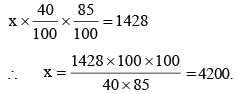
The price of table depreciates every year by 20%. If the value of the table after 2 years will be ₹ 32000, then what is the present price (in ₹) of the table? (SSC Sub. Ins. 2017)
a)
48000
b)
44000
c)
50000
d)
51000
| | Abhiram Mehra answered |
Understanding Depreciation
Depreciation refers to the reduction in the value of an asset over time. In this case, the value of the table decreases by 20% every year.
Formula for Depreciation
The formula to calculate the future value after depreciation is:
Future Value = Present Value * (1 - Depreciation Rate)^Number of Years
Given Values
- Future Value after 2 years = 32,000
- Depreciation Rate = 20% or 0.20
- Number of Years = 2
Calculating Present Value
We can rearrange the formula to find the Present Value:
Present Value = Future Value / (1 - Depreciation Rate)^Number of Years
Now, substituting the known values:
Present Value = 32,000 / (1 - 0.20)^2
Calculating Step-by-Step
1. Calculate (1 - 0.20):
- 1 - 0.20 = 0.80
2. Raise 0.80 to the power of 2:
- 0.80^2 = 0.64
3. Divide Future Value by 0.64:
- Present Value = 32,000 / 0.64
- Present Value = 50,000
Conclusion
Thus, the present price of the table is 50,000. Therefore, the correct answer is option 'C'.
Depreciation refers to the reduction in the value of an asset over time. In this case, the value of the table decreases by 20% every year.
Formula for Depreciation
The formula to calculate the future value after depreciation is:
Future Value = Present Value * (1 - Depreciation Rate)^Number of Years
Given Values
- Future Value after 2 years = 32,000
- Depreciation Rate = 20% or 0.20
- Number of Years = 2
Calculating Present Value
We can rearrange the formula to find the Present Value:
Present Value = Future Value / (1 - Depreciation Rate)^Number of Years
Now, substituting the known values:
Present Value = 32,000 / (1 - 0.20)^2
Calculating Step-by-Step
1. Calculate (1 - 0.20):
- 1 - 0.20 = 0.80
2. Raise 0.80 to the power of 2:
- 0.80^2 = 0.64
3. Divide Future Value by 0.64:
- Present Value = 32,000 / 0.64
- Present Value = 50,000
Conclusion
Thus, the present price of the table is 50,000. Therefore, the correct answer is option 'C'.
The price of sugar is increased by 17%. A person wants to increase his expenditure by 5% only. By approximately what percent should be decrease his consumption? (SSC CGL-2018)- a)10.3
- b)10.7
- c)10.9
- d)9.9
Correct answer is option 'A'. Can you explain this answer?
The price of sugar is increased by 17%. A person wants to increase his expenditure by 5% only. By approximately what percent should be decrease his consumption? (SSC CGL-2018)
a)
10.3
b)
10.7
c)
10.9
d)
9.9
| | Ishaan Roy answered |
Solution:
Let the initial consumption of sugar = 100 units and initial price = Rs. x per unit.
After the price increase of 17%, the new price of sugar = Rs. (1.17x) per unit.
Now, the person wants to increase his expenditure by 5% only.
Let the initial expenditure be Rs. 100.
After the price increase, the expenditure will be = (100/ x) units × Rs. (1.17x) per unit = Rs. 117.
To increase this expenditure by 5%, the new expenditure will be = Rs. (117 × 1.05) = Rs. 122.85.
The person needs to decrease his consumption in such a way that he spends only Rs. 122.85 on sugar.
Let the new consumption be y units.
Then, (y/ x) units × Rs. (1.17x) per unit = Rs. 122.85
y = 100 units × (122.85/ 117) = 104.5 units
Therefore, the person needs to decrease his consumption by (100 - 104.5)/ 100 × 100% ≈ 10.3%.
Hence, the answer is option (a) 10.3.
Let the initial consumption of sugar = 100 units and initial price = Rs. x per unit.
After the price increase of 17%, the new price of sugar = Rs. (1.17x) per unit.
Now, the person wants to increase his expenditure by 5% only.
Let the initial expenditure be Rs. 100.
After the price increase, the expenditure will be = (100/ x) units × Rs. (1.17x) per unit = Rs. 117.
To increase this expenditure by 5%, the new expenditure will be = Rs. (117 × 1.05) = Rs. 122.85.
The person needs to decrease his consumption in such a way that he spends only Rs. 122.85 on sugar.
Let the new consumption be y units.
Then, (y/ x) units × Rs. (1.17x) per unit = Rs. 122.85
y = 100 units × (122.85/ 117) = 104.5 units
Therefore, the person needs to decrease his consumption by (100 - 104.5)/ 100 × 100% ≈ 10.3%.
Hence, the answer is option (a) 10.3.
In an examination, a student must get 36% marks to pass. A student who gets 190 marks failed by 35 marks. The total marks in that examination is: (SSC CGL 1st Sit. 2015)- a)500
- b)625
- c)810
- d)450
Correct answer is option 'B'. Can you explain this answer?
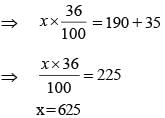
In an examination, a student must get 36% marks to pass. A student who gets 190 marks failed by 35 marks. The total marks in that examination is: (SSC CGL 1st Sit. 2015)
a)
500
b)
625
c)
810
d)
450
 | Ssc Cgl answered |
Let total mark of Examination be x.
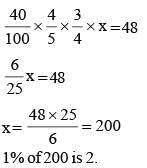
If 40% of a number is 290, then what is the number which is 20% more than the initial number? (SSC Sub. Ins. 2017)- a)870
- b)725
- c)825
- d)680
Correct answer is option 'A'. Can you explain this answer?
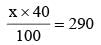
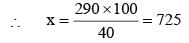
If 40% of a number is 290, then what is the number which is 20% more than the initial number? (SSC Sub. Ins. 2017)
a)
870
b)
725
c)
825
d)
680
 | Pioneer Academy answered |
Let original number = x
According to question,

According to question,
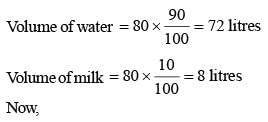
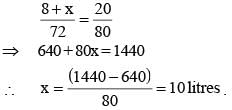

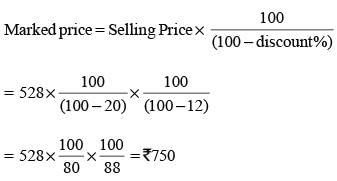
In a class of 45 students, 40% are girls and the remaining are boys. The average marks of the girls is 64 and that of the boys is 60. What is the average marks of the whole class? (SSC Sub. Ins. 2018 )- a)61.8
- b)62.4
- c)61.6
- d)62.9
Correct answer is option 'C'. Can you explain this answer?
In a class of 45 students, 40% are girls and the remaining are boys. The average marks of the girls is 64 and that of the boys is 60. What is the average marks of the whole class? (SSC Sub. Ins. 2018 )
a)
61.8
b)
62.4
c)
61.6
d)
62.9
| | Pranab Goyal answered |
Given:
- Total number of students in the class = 45
- Percentage of girls = 40%
- Average marks of girls = 64
- Average marks of boys = 60
To find:
- The average marks of the whole class
Solution:
We know that the average is calculated by dividing the sum of all the values by the total number of values.
Step 1: Calculate the number of girls and boys in the class
- Percentage of girls = 40%
- Number of girls = 40% of 45 = (40/100) * 45 = 18 girls
- Number of boys = Total number of students - Number of girls = 45 - 18 = 27 boys
Step 2: Calculate the sum of marks of girls and boys
- Sum of marks of girls = Average marks of girls * Number of girls = 64 * 18 = 1152
- Sum of marks of boys = Average marks of boys * Number of boys = 60 * 27 = 1620
Step 3: Calculate the total sum of marks in the class
- Total sum of marks = Sum of marks of girls + Sum of marks of boys = 1152 + 1620 = 2772
Step 4: Calculate the average marks of the whole class
- Average marks of the whole class = Total sum of marks / Total number of students = 2772 / 45 = 61.6
Therefore, the average marks of the whole class is 61.6.
Answer: Option (c) 61.6
- Total number of students in the class = 45
- Percentage of girls = 40%
- Average marks of girls = 64
- Average marks of boys = 60
To find:
- The average marks of the whole class
Solution:
We know that the average is calculated by dividing the sum of all the values by the total number of values.
Step 1: Calculate the number of girls and boys in the class
- Percentage of girls = 40%
- Number of girls = 40% of 45 = (40/100) * 45 = 18 girls
- Number of boys = Total number of students - Number of girls = 45 - 18 = 27 boys
Step 2: Calculate the sum of marks of girls and boys
- Sum of marks of girls = Average marks of girls * Number of girls = 64 * 18 = 1152
- Sum of marks of boys = Average marks of boys * Number of boys = 60 * 27 = 1620
Step 3: Calculate the total sum of marks in the class
- Total sum of marks = Sum of marks of girls + Sum of marks of boys = 1152 + 1620 = 2772
Step 4: Calculate the average marks of the whole class
- Average marks of the whole class = Total sum of marks / Total number of students = 2772 / 45 = 61.6
Therefore, the average marks of the whole class is 61.6.
Answer: Option (c) 61.6
The successive discount of 25%, 20% and 10% is equivalent to a single discount of: (SSC Sub. Ins.2018 )- a)44%
- b)46%
- c)54%
- d)48%
Correct answer is option 'B'. Can you explain this answer?
The successive discount of 25%, 20% and 10% is equivalent to a single discount of: (SSC Sub. Ins.2018 )
a)
44%
b)
46%
c)
54%
d)
48%
| | Ssc Cgl answered |
Amount after first discount 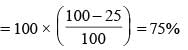
Amount after second discount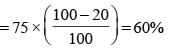
Amount after third discount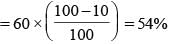
∴ Equivalent discount = 100 – 54 = 46%
Amount after second discount
Amount after third discount
∴ Equivalent discount = 100 – 54 = 46%
An article is subject to two successive discounts of 10% and 5% before being sold. If its marked price is ₹ 800, then its selling price is. (SSC CHSL-2018)- a)₹ 722
- b)₹ 684
- c)₹ 703
- d)₹ 680
Correct answer is option 'B'. Can you explain this answer?
An article is subject to two successive discounts of 10% and 5% before being sold. If its marked price is ₹ 800, then its selling price is. (SSC CHSL-2018)
a)
₹ 722
b)
₹ 684
c)
₹ 703
d)
₹ 680
| | Pranab Goyal answered |
Understanding the Discounts
To find the selling price after two successive discounts, we start with the marked price of the article, which is 800.
First Discount Calculation
- The first discount is 10% of the marked price.
- Calculation: 10% of 800 = 0.10 * 800 = 80.
- After the first discount, the price becomes:
800 - 80 = 720.
Second Discount Calculation
- The second discount is 5% of the new price (720).
- Calculation: 5% of 720 = 0.05 * 720 = 36.
- After the second discount, the price becomes:
720 - 36 = 684.
Final Selling Price
- Therefore, the final selling price of the article after applying both discounts is 684.
Conclusion
- The correct answer is option 'B', which is 684. This result confirms the calculations based on the successive discounts applied to the marked price.
To find the selling price after two successive discounts, we start with the marked price of the article, which is 800.
First Discount Calculation
- The first discount is 10% of the marked price.
- Calculation: 10% of 800 = 0.10 * 800 = 80.
- After the first discount, the price becomes:
800 - 80 = 720.
Second Discount Calculation
- The second discount is 5% of the new price (720).
- Calculation: 5% of 720 = 0.05 * 720 = 36.
- After the second discount, the price becomes:
720 - 36 = 684.
Final Selling Price
- Therefore, the final selling price of the article after applying both discounts is 684.
Conclusion
- The correct answer is option 'B', which is 684. This result confirms the calculations based on the successive discounts applied to the marked price.
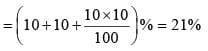
Two successive price increases of 10% and 10% of an article are equivalent to a single price increase of (SSC CGL 2nd Sit. 2010)- a)19%
- b)20%
- c)21%
- d)22%
Correct answer is option 'C'. Can you explain this answer?
Two successive price increases of 10% and 10% of an article are equivalent to a single price increase of (SSC CGL 2nd Sit. 2010)
a)
19%
b)
20%
c)
21%
d)
22%
 | Iq Funda answered |
Single equivalent percentage increase in price
The population of a city increases at the rate of 5% per annum. If the present population of the city is 3,70,440. It population 3 years ago was: (SSC MTS 2017)- a)2,80,000
- b)3,60,000
- c)3,20,000
- d)30,000
Correct answer is option 'C'. Can you explain this answer?
The population of a city increases at the rate of 5% per annum. If the present population of the city is 3,70,440. It population 3 years ago was: (SSC MTS 2017)
a)
2,80,000
b)
3,60,000
c)
3,20,000
d)
30,000
| | Ssc Cgl answered |
Present population = 370440
Rate = 5%
Time = 3 years
According to question,
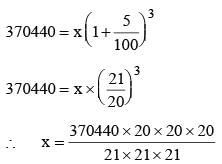
= 320,000
∴ Population of city 3 years was = 320000.
Rate = 5%
Time = 3 years
According to question,
= 320,000
∴ Population of city 3 years was = 320000.
Rahul’s salary is 40% less than Rakesh’s salary. Deepak’s salary is 80% more than Rahul’s salary. If Deepak’s salary is ₹ 34560, then what is the salary of Rakesh? (SSC MTS 2018)- a)₹ 32000
- b)₹ 24000
- c)₹ 28000
- d)₹ 26000
Correct answer is option 'A'. Can you explain this answer?
Rahul’s salary is 40% less than Rakesh’s salary. Deepak’s salary is 80% more than Rahul’s salary. If Deepak’s salary is ₹ 34560, then what is the salary of Rakesh? (SSC MTS 2018)
a)
₹ 32000
b)
₹ 24000
c)
₹ 28000
d)
₹ 26000
 | EduRev SSC CGL answered |
Let the salary of Rakesh be 100 unit
We have given Rahul's salary is 40%
Less than Rakesh's salary and Deepak's salary is 80% more than Rahul's salary.
So the ratio of the salaries are
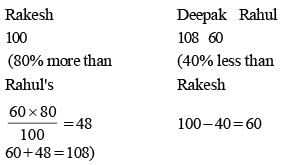
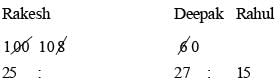
we have Deepak's salary = ₹ 34560
27 unit → ₹ 34560
1 unit → ₹ 1280
Hence the salary of Rakesh is
= 1280 x 25 = ₹ 32000
We have given Rahul's salary is 40%
Less than Rakesh's salary and Deepak's salary is 80% more than Rahul's salary.
So the ratio of the salaries are
we have Deepak's salary = ₹ 34560
27 unit → ₹ 34560
1 unit → ₹ 1280
Hence the salary of Rakesh is
= 1280 x 25 = ₹ 32000
A number is increased by 15% and then decreased by 25% and the number becomes 22 less than the original number. The original number is (SSC Sub. Ins. 2016)- a)120
- b)140
- c)100
- d)160
Correct answer is option 'D'. Can you explain this answer?
A number is increased by 15% and then decreased by 25% and the number becomes 22 less than the original number. The original number is (SSC Sub. Ins. 2016)
a)
120
b)
140
c)
100
d)
160
 | Dipika Sarkar answered |
Understanding the Problem
The problem states that a number is increased by 15% and then decreased by 25%, resulting in a final value that is 22 less than the original number. We need to find the original number.
Let the Original Number be 'x'
- After increasing by 15%, the new value is:
- x + 0.15x = 1.15x
- Then, this increased value is decreased by 25%:
- Decrease of 25% from 1.15x is:
- 0.25 * 1.15x = 0.2875x
- So, the final value becomes:
- 1.15x - 0.2875x = 0.8625x
Setting Up the Equation
According to the problem, this final value is 22 less than the original number:
- 0.8625x = x - 22
Solving the Equation
1. Rearranging the equation:
- x - 0.8625x = 22
- 0.1375x = 22
2. Now, divide both sides by 0.1375 to find x:
- x = 22 / 0.1375
- x = 160
Conclusion
Thus, the original number is 160, which corresponds to option 'D'.
This solution confirms the mathematical reasoning behind the increase and decrease in percentage, leading to a final result that is less than the original by 22.
The problem states that a number is increased by 15% and then decreased by 25%, resulting in a final value that is 22 less than the original number. We need to find the original number.
Let the Original Number be 'x'
- After increasing by 15%, the new value is:
- x + 0.15x = 1.15x
- Then, this increased value is decreased by 25%:
- Decrease of 25% from 1.15x is:
- 0.25 * 1.15x = 0.2875x
- So, the final value becomes:
- 1.15x - 0.2875x = 0.8625x
Setting Up the Equation
According to the problem, this final value is 22 less than the original number:
- 0.8625x = x - 22
Solving the Equation
1. Rearranging the equation:
- x - 0.8625x = 22
- 0.1375x = 22
2. Now, divide both sides by 0.1375 to find x:
- x = 22 / 0.1375
- x = 160
Conclusion
Thus, the original number is 160, which corresponds to option 'D'.
This solution confirms the mathematical reasoning behind the increase and decrease in percentage, leading to a final result that is less than the original by 22.
A box has 100 blue balls, 50 red balls, 50 black ball. 25% of blue balls and 50% of red balls are taken away. percentage of black balls at present is (SSC CGL 2nd Sit. 2013)- a)

- b)40%
- c)50%
- d)25%
Correct answer is option 'A'. Can you explain this answer?
A box has 100 blue balls, 50 red balls, 50 black ball. 25% of blue balls and 50% of red balls are taken away. percentage of black balls at present is (SSC CGL 2nd Sit. 2013)
a)
b)
40%
c)
50%
d)
25%
| | Ssc Cgl answered |
After taking away respective balls,
Number of balls in the box = 75 + 25 + 50 = 150
∴ Percentage of black balls
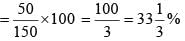
Number of balls in the box = 75 + 25 + 50 = 150
∴ Percentage of black balls
The population of a town is 15000. If the number of males increases by 8% and that of females by 10%, then the population would increase to 16300. Find the number of females in the town. (SSC CGL 2012)- a)4000
- b)6000
- c)3000
- d)5000
Correct answer is option 'D'. Can you explain this answer?
The population of a town is 15000. If the number of males increases by 8% and that of females by 10%, then the population would increase to 16300. Find the number of females in the town. (SSC CGL 2012)
a)
4000
b)
6000
c)
3000
d)
5000
| | EduRev SSC CGL answered |
If the number of females be x, then, number of males = 15000 – x

⇒ 10x + 120000 – 8x = 1300 × 100
⇒ 2x = 130000 – 120000 = 10000
⇒ x = 5000
⇒ 10x + 120000 – 8x = 1300 × 100
⇒ 2x = 130000 – 120000 = 10000
⇒ x = 5000
In an examination, 48% of candidates passed in science and 56% failed in mathematics. If 32% failed in both subjects, then what percent passed in both subjects? (SSC Sub. Ins. 2018)- a)28%
- b)24%
- c)32%
- d)22%
Correct answer is option 'B'. Can you explain this answer?
In an examination, 48% of candidates passed in science and 56% failed in mathematics. If 32% failed in both subjects, then what percent passed in both subjects? (SSC Sub. Ins. 2018)
a)
28%
b)
24%
c)
32%
d)
22%
| | EduRev SSC CGL answered |
Percent of students passed in mathematics
= 100 – 56 = 44%
Number of students passed in either science or math
= 100 – 32 = 68%
Number of students passed in both subjects
n(A ∩ B) = n(A) + n(B) – n(A ∪ B)
= 48% + 44% – 68%
= 24%
= 100 – 56 = 44%
Number of students passed in either science or math
= 100 – 32 = 68%
Number of students passed in both subjects
n(A ∩ B) = n(A) + n(B) – n(A ∪ B)
= 48% + 44% – 68%
= 24%
In an examination 75% candidates passed in English and 60% passed in Mathematics. 25% failed in both and 240 passed the examination. Find the total number of candidates. (SSC Sub. Ins. 2014)- a)492
- b)300
- c)500
- d)400
Correct answer is option 'D'. Can you explain this answer?
In an examination 75% candidates passed in English and 60% passed in Mathematics. 25% failed in both and 240 passed the examination. Find the total number of candidates. (SSC Sub. Ins. 2014)
a)
492
b)
300
c)
500
d)
400
| | Ssc Cgl answered |
Let the total number of students be x.
Let A and B represent the sets of students who passed in English and Mathematics respectively.
Then, number of students passed in one or both the subjects
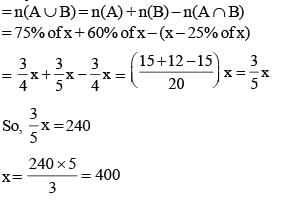
Let A and B represent the sets of students who passed in English and Mathematics respectively.
Then, number of students passed in one or both the subjects


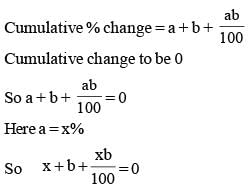
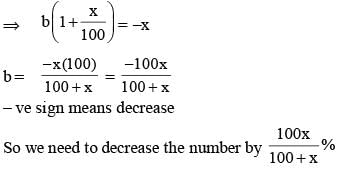
Chapter doubts & questions for Percentage - SSC CGL Previous Year Papers 2026 is part of SSC CGL exam preparation. The chapters have been prepared according to the SSC CGL exam syllabus. The Chapter doubts & questions, notes, tests & MCQs are made for SSC CGL 2026 Exam. Find important definitions, questions, notes, meanings, examples, exercises, MCQs and online tests here.
Chapter doubts & questions of Percentage - SSC CGL Previous Year Papers in English & Hindi are available as part of SSC CGL exam. Download more important topics, notes, lectures and mock test series for SSC CGL Exam by signing up for free.
SSC CGL Previous Year Papers313 docs|325 tests |
