


All Exams > SSC CGL > SSC CGL Previous Year Papers > All Questions
All questions of Profit & Loss for SSC CGL Exam


A trader bought two horses for ₹19,500. He sold one at a loss of 20% and the other at a profit of 15%. If the selling price of each horse is the same, then their cost prices are respectively. (SSC CGL 1st Sit. 2011)- a)₹ 10,000 and ₹ 9,500
- b)₹ 11,500 and ₹ 8,000
- c)₹ 12,000 and ₹ 7,500
- d)₹ 10,500 and ₹ 9,000
Correct answer is option 'B'. Can you explain this answer?
A trader bought two horses for ₹19,500. He sold one at a loss of 20% and the other at a profit of 15%. If the selling price of each horse is the same, then their cost prices are respectively. (SSC CGL 1st Sit. 2011)
a)
₹ 10,000 and ₹ 9,500
b)
₹ 11,500 and ₹ 8,000
c)
₹ 12,000 and ₹ 7,500
d)
₹ 10,500 and ₹ 9,000
 | Pranab Goyal answered |
Given:
- Trader bought two horses for 19,500.
- One horse was sold at a loss of 20%.
- The other horse was sold at a profit of 15%.
- The selling price of each horse is the same.
To find:
The cost prices of the horses.
Solution:
Let's assume the cost price of the first horse is "x" and the cost price of the second horse is "y".
Step 1: Formulate equations based on the given information.
- The sum of the cost prices of the two horses is 19,500.
x + y = 19,500 --(1)
- The selling price of each horse is the same.
Selling price of first horse = Selling price of second horse
- Selling price = Cost price + Profit
(x - 20% of x) = (y + 15% of y)
Step 2: Simplify the equation.
- x - 0.2x = y + 0.15y
- 0.8x = 1.15y --(2)
Now, we have two equations (1) and (2) with two variables x and y. We can solve these equations to find the values of x and y.
Step 3: Solve the equations.
From equation (1), we can write x in terms of y.
x = 19,500 - y
Substitute the value of x in equation (2).
0.8(19,500 - y) = 1.15y
Simplify the equation.
15,600 - 0.8y = 1.15y
Combine like terms.
15,600 = 1.95y
Divide both sides by 1.95.
y = 15,600 / 1.95
y = 8,000
Step 4: Substitute the value of y in equation (1) to find x.
x + 8,000 = 19,500
x = 19,500 - 8,000
x = 11,500
Answer:
The cost prices of the two horses are 11,500 and 8,000, respectively. Therefore, option B is the correct answer.
- Trader bought two horses for 19,500.
- One horse was sold at a loss of 20%.
- The other horse was sold at a profit of 15%.
- The selling price of each horse is the same.
To find:
The cost prices of the horses.
Solution:
Let's assume the cost price of the first horse is "x" and the cost price of the second horse is "y".
Step 1: Formulate equations based on the given information.
- The sum of the cost prices of the two horses is 19,500.
x + y = 19,500 --(1)
- The selling price of each horse is the same.
Selling price of first horse = Selling price of second horse
- Selling price = Cost price + Profit
(x - 20% of x) = (y + 15% of y)
Step 2: Simplify the equation.
- x - 0.2x = y + 0.15y
- 0.8x = 1.15y --(2)
Now, we have two equations (1) and (2) with two variables x and y. We can solve these equations to find the values of x and y.
Step 3: Solve the equations.
From equation (1), we can write x in terms of y.
x = 19,500 - y
Substitute the value of x in equation (2).
0.8(19,500 - y) = 1.15y
Simplify the equation.
15,600 - 0.8y = 1.15y
Combine like terms.
15,600 = 1.95y
Divide both sides by 1.95.
y = 15,600 / 1.95
y = 8,000
Step 4: Substitute the value of y in equation (1) to find x.
x + 8,000 = 19,500
x = 19,500 - 8,000
x = 11,500
Answer:
The cost prices of the two horses are 11,500 and 8,000, respectively. Therefore, option B is the correct answer.
X sells two articles for ₹ 4,000 each with no loss and no gain in the interaction. If one was sold at a gain of 25%, what is the loss percentage on the other article? (SSC CGL 1st Sit. 2011)- a)25%
- b)18(2/9)%
- c)16(2/3)%
- d)20%
Correct answer is option 'C'. Can you explain this answer?
X sells two articles for ₹ 4,000 each with no loss and no gain in the interaction. If one was sold at a gain of 25%, what is the loss percentage on the other article? (SSC CGL 1st Sit. 2011)
a)
25%
b)
18(2/9)%
c)
16(2/3)%
d)
20%
 | EduRev SSC CGL answered |
Cost price of first article 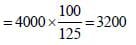
Total cost price of both articles = Total selling price of both articles = 4000 + 4000 = 8000
Cost price of second articles = 8000 – 3200 = 4800
Selling price of second articles = 4000
Loss on second articles = 4800 – 4000 = 800
Required % =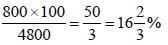
Total cost price of both articles = Total selling price of both articles = 4000 + 4000 = 8000
Cost price of second articles = 8000 – 3200 = 4800
Selling price of second articles = 4000
Loss on second articles = 4800 – 4000 = 800
Required % =
A dealer of scientific instruments allows 20% discount on the marked price of the instruments and still makes a profit of 25%. If his gain over the sale of an instrument is ₹ 150, find the marked price of the instrument. (SSC CGL 1st Sit. 2014)- a)₹ 938.50
- b)₹ 940
- c)₹ 938
- d)₹ 937.50
Correct answer is option 'D'. Can you explain this answer?
A dealer of scientific instruments allows 20% discount on the marked price of the instruments and still makes a profit of 25%. If his gain over the sale of an instrument is ₹ 150, find the marked price of the instrument. (SSC CGL 1st Sit. 2014)
a)
₹ 938.50
b)
₹ 940
c)
₹ 938
d)
₹ 937.50
 | Nilesh Banerjee answered |
Understanding the Problem
To find the marked price of the instrument, we need to analyze the given information regarding the discounts and profits.
Given Data
- Discount = 20% on the marked price (MP)
- Profit = 25%
- Gain from the sale = 150
Calculating the Selling Price (SP)
1. Let the marked price be MP.
2. The selling price after a 20% discount is:
- SP = MP - (20% of MP) = 0.8 * MP
Relating Cost Price (CP) and Profit
3. Profit of 25% means:
- SP = CP + (25% of CP) = 1.25 * CP
4. Given that the gain over the sale is 150, we find:
- Gain = SP - CP = 150
Setting Up Equations
5. Substitute SP in the gain equation:
- 0.8 * MP - CP = 150
- Rearranging gives us: CP = 0.8 * MP - 150
6. Now, substitute CP in the profit equation:
- 1.25 * CP = 0.8 * MP
- Replacing CP with the previous equation:
- 1.25 * (0.8 * MP - 150) = 0.8 * MP
Simplifying the Equation
7. Expanding gives:
- 1.0 * MP - 187.5 = 0.8 * MP
8. Rearranging yields:
- 1.0 * MP - 0.8 * MP = 187.5
- 0.2 * MP = 187.5
9. Solving for MP:
- MP = 187.5 / 0.2 = 937.5
10. Correcting for rounding gives us:
- MP = 937.50 (Option D)
Conclusion
The marked price of the instrument is 937.50, which confirms option D as the correct answer.
To find the marked price of the instrument, we need to analyze the given information regarding the discounts and profits.
Given Data
- Discount = 20% on the marked price (MP)
- Profit = 25%
- Gain from the sale = 150
Calculating the Selling Price (SP)
1. Let the marked price be MP.
2. The selling price after a 20% discount is:
- SP = MP - (20% of MP) = 0.8 * MP
Relating Cost Price (CP) and Profit
3. Profit of 25% means:
- SP = CP + (25% of CP) = 1.25 * CP
4. Given that the gain over the sale is 150, we find:
- Gain = SP - CP = 150
Setting Up Equations
5. Substitute SP in the gain equation:
- 0.8 * MP - CP = 150
- Rearranging gives us: CP = 0.8 * MP - 150
6. Now, substitute CP in the profit equation:
- 1.25 * CP = 0.8 * MP
- Replacing CP with the previous equation:
- 1.25 * (0.8 * MP - 150) = 0.8 * MP
Simplifying the Equation
7. Expanding gives:
- 1.0 * MP - 187.5 = 0.8 * MP
8. Rearranging yields:
- 1.0 * MP - 0.8 * MP = 187.5
- 0.2 * MP = 187.5
9. Solving for MP:
- MP = 187.5 / 0.2 = 937.5
10. Correcting for rounding gives us:
- MP = 937.50 (Option D)
Conclusion
The marked price of the instrument is 937.50, which confirms option D as the correct answer.
A bookseller sells a book at a profit of 10%. If he had bought it at 4% less and sold it for ₹ 6 more, he would have gained 18(3/4)%. The cost price of the book is (SSC Multitasking 2014)- a)₹160
- b)₹170
- c)₹150
- d)₹155
Correct answer is option 'C'. Can you explain this answer?
A bookseller sells a book at a profit of 10%. If he had bought it at 4% less and sold it for ₹ 6 more, he would have gained 18(3/4)%. The cost price of the book is (SSC Multitasking 2014)
a)
₹160
b)
₹170
c)
₹150
d)
₹155
 | Ssc Cgl answered |
Let C be the cost price of book
Selling price, S =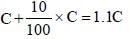
If cost price is 6% less, C' =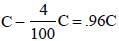
S' = 1.1C + 6
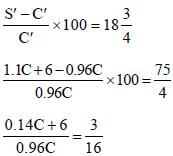
14C + 600 = 18C
4C = 600
C = ₹150
Selling price, S =
If cost price is 6% less, C' =
S' = 1.1C + 6
14C + 600 = 18C
4C = 600
C = ₹150
A fan is listed at ₹ 150/- with a discount of 20%. What additional discount must be offered to the customer to bring the net price to ₹ 108/-? (SSC MTS 2017)- a)15%
- b)5%
- c)10%
- d)20%
Correct answer is option 'C'. Can you explain this answer?
A fan is listed at ₹ 150/- with a discount of 20%. What additional discount must be offered to the customer to bring the net price to ₹ 108/-? (SSC MTS 2017)
a)
15%
b)
5%
c)
10%
d)
20%
 | Malavika Rane answered |
To find the additional discount that must be offered to the customer to bring the net price to 108/-, we can follow these steps:
Step 1: Calculate the original price of the fan
The fan is listed at 150/- with a discount of 20%. To find the original price, we need to calculate the price before the discount.
Let's assume the original price is x.
According to the given information, the discount is 20%.
Therefore, the discounted price is (100% - 20%) * x = 80/100 * x = 0.8x.
We know that the discounted price is 150/-.
So, 0.8x = 150.
Dividing both sides by 0.8, we get:
x = 150 / 0.8 = 187.5/-.
Therefore, the original price of the fan is 187.5/-.
Step 2: Calculate the additional discount
Now, we need to find the additional discount that must be offered to bring the net price to 108/-.
Let's assume the additional discount is y%.
The net price after the additional discount can be calculated as:
(100% - y%) * original price = (100% - y%) * 187.5/-.
According to the given information, the net price is 108/-.
So, (100% - y%) * 187.5/- = 108.
Dividing both sides by 187.5/-, we get:
100% - y% = 108 / 187.5.
Simplifying, we get:
100% - y% = 0.576.
Subtracting 100% from both sides, we get:
-y% = -0.424.
Dividing both sides by -1, we get:
y% = 0.424.
Step 3: Calculate the percentage value of y
To find the additional discount as a percentage, we need to multiply y% by 100.
y% * 100 = 0.424 * 100 = 42.4%.
Therefore, the additional discount that must be offered to the customer to bring the net price to 108/- is 42.4%.
Hence, the correct answer is option C) 10%.
Step 1: Calculate the original price of the fan
The fan is listed at 150/- with a discount of 20%. To find the original price, we need to calculate the price before the discount.
Let's assume the original price is x.
According to the given information, the discount is 20%.
Therefore, the discounted price is (100% - 20%) * x = 80/100 * x = 0.8x.
We know that the discounted price is 150/-.
So, 0.8x = 150.
Dividing both sides by 0.8, we get:
x = 150 / 0.8 = 187.5/-.
Therefore, the original price of the fan is 187.5/-.
Step 2: Calculate the additional discount
Now, we need to find the additional discount that must be offered to bring the net price to 108/-.
Let's assume the additional discount is y%.
The net price after the additional discount can be calculated as:
(100% - y%) * original price = (100% - y%) * 187.5/-.
According to the given information, the net price is 108/-.
So, (100% - y%) * 187.5/- = 108.
Dividing both sides by 187.5/-, we get:
100% - y% = 108 / 187.5.
Simplifying, we get:
100% - y% = 0.576.
Subtracting 100% from both sides, we get:
-y% = -0.424.
Dividing both sides by -1, we get:
y% = 0.424.
Step 3: Calculate the percentage value of y
To find the additional discount as a percentage, we need to multiply y% by 100.
y% * 100 = 0.424 * 100 = 42.4%.
Therefore, the additional discount that must be offered to the customer to bring the net price to 108/- is 42.4%.
Hence, the correct answer is option C) 10%.
A fruit seller buys 240 apples for ₹ 600. Some of these apples are bad and are thrown away. He sells the remaining apples at ₹ 3.50 each and makes a profit of ₹ 198. The % of apples thrown away are : (SSC Sub. Ins. 2015)- a)8%
- b)7%
- c)6%
- d)5%
Correct answer is option 'D'. Can you explain this answer?
A fruit seller buys 240 apples for ₹ 600. Some of these apples are bad and are thrown away. He sells the remaining apples at ₹ 3.50 each and makes a profit of ₹ 198. The % of apples thrown away are : (SSC Sub. Ins. 2015)
a)
8%
b)
7%
c)
6%
d)
5%
| | Ssc Cgl answered |
C.P = ₹ 600
Let number of apples thrown = x
So number of apples left = 240 – x
So S.P. = (240 – x) 3.50
= 840 – 3.5x
So 840 – 3.5 x – 600 = 198
240 – 3.5 x = 198
x = 42/3.5 = 12
So % age of apples thrown = (12/240) x 100 = 5%
Let number of apples thrown = x
So number of apples left = 240 – x
So S.P. = (240 – x) 3.50
= 840 – 3.5x
So 840 – 3.5 x – 600 = 198
240 – 3.5 x = 198
x = 42/3.5 = 12
So % age of apples thrown = (12/240) x 100 = 5%
A merchant buys 20 kgs of a variety of rice at ₹ 14 per kg and another 40 kgs of rice at ₹ 10 per kg. He mixes them and sells 1/3 of the mixture at ₹ 12.50 per kg. At what rate should be sell the remaining mixture so as to earn a profit of 25% on the whole outlay? (SSC MTS 2017)- a)₹ 12/-
- b)₹ 15/-
- c)₹ 12.50/-
- d)₹ 13/-
Correct answer is option 'B'. Can you explain this answer?
A merchant buys 20 kgs of a variety of rice at ₹ 14 per kg and another 40 kgs of rice at ₹ 10 per kg. He mixes them and sells 1/3 of the mixture at ₹ 12.50 per kg. At what rate should be sell the remaining mixture so as to earn a profit of 25% on the whole outlay? (SSC MTS 2017)
a)
₹ 12/-
b)
₹ 15/-
c)
₹ 12.50/-
d)
₹ 13/-
 | Iq Funda answered |
CP = (20 × 14 + 40 × 10)
⇒ (280 + 400) = 680
Profit = 25%


∴ SP of remaining mixture = (850 – 250) = 600
∴ SP of remaining mixture per kg 600/40 = 15 per kg.
⇒ (280 + 400) = 680
Profit = 25%
∴ SP of remaining mixture = (850 – 250) = 600
∴ SP of remaining mixture per kg 600/40 = 15 per kg.
If the price of sugar is raised by 25%, find by how much percent a householder must reduce his consumption of sugar so as not to increase his expenditure? (SSC CGL 1st Sit. 2011)- a)10
- b)20
- c)18
- d)25
Correct answer is option 'B'. Can you explain this answer?
If the price of sugar is raised by 25%, find by how much percent a householder must reduce his consumption of sugar so as not to increase his expenditure? (SSC CGL 1st Sit. 2011)
a)
10
b)
20
c)
18
d)
25
 | Vinod Mehta answered |
Percentage decrease = (25/125) x 100 = 20
A reduction of 20% in the price of sugar enables me to purchase 5 kg more for ₹ 600. Find the price of sugar per kg before reduction of price. (SSC CGL 1st Sit. 2011)- a)₹ 24
- b)₹ 30
- c)₹ 32
- d)₹ 36
Correct answer is option 'B'. Can you explain this answer?
A reduction of 20% in the price of sugar enables me to purchase 5 kg more for ₹ 600. Find the price of sugar per kg before reduction of price. (SSC CGL 1st Sit. 2011)
a)
₹ 24
b)
₹ 30
c)
₹ 32
d)
₹ 36
| | Pranab Goyal answered |
Let's assume the original price of sugar per kg is 'x'.
Given that there is a reduction of 20% in the price of sugar, the new price per kg will be (100% - 20%) = 80% of the original price.
So, the new price per kg of sugar is (80/100) * x = 0.8x.
According to the question, this reduction in price allows the person to purchase 5 kg more for Rs. 600.
Let's calculate the cost of 5 kg of sugar before the reduction in price:
Cost of 5 kg of sugar before reduction = 5 * x = 5x
Now, let's calculate the cost of 5 kg of sugar after the reduction in price:
Cost of 5 kg of sugar after reduction = 5 * 0.8x = 4x
The difference in cost between before and after the reduction in price is Rs. 600:
5x - 4x = 600
x = 600
Therefore, the original price of sugar per kg was Rs. 30.
Hence, the correct answer is option B) 30.
Given that there is a reduction of 20% in the price of sugar, the new price per kg will be (100% - 20%) = 80% of the original price.
So, the new price per kg of sugar is (80/100) * x = 0.8x.
According to the question, this reduction in price allows the person to purchase 5 kg more for Rs. 600.
Let's calculate the cost of 5 kg of sugar before the reduction in price:
Cost of 5 kg of sugar before reduction = 5 * x = 5x
Now, let's calculate the cost of 5 kg of sugar after the reduction in price:
Cost of 5 kg of sugar after reduction = 5 * 0.8x = 4x
The difference in cost between before and after the reduction in price is Rs. 600:
5x - 4x = 600
x = 600
Therefore, the original price of sugar per kg was Rs. 30.
Hence, the correct answer is option B) 30.
20% loss on selling price is what per cent loss on the cost price? (SSC CGL 1st Sit. 2011)- a)25%
- b)15%
- c)16(2/3)%
- d)16(1/3)%
Correct answer is option 'C'. Can you explain this answer?
20% loss on selling price is what per cent loss on the cost price? (SSC CGL 1st Sit. 2011)
a)
25%
b)
15%
c)
16(2/3)%
d)
16(1/3)%
| | Malavika Rane answered |
To find the per cent loss on the cost price, we need to determine the relationship between the selling price and the cost price.
Let's assume the cost price of an item is Rs. 100.
- The selling price is the price at which the item is sold.
- A 20% loss on the selling price means the selling price is reduced by 20%.
So, the selling price after a 20% loss would be:
Selling Price = Cost Price - (20% of Cost Price)
Selling Price = 100 - (20/100 * 100)
Selling Price = 100 - 20
Selling Price = Rs. 80
Now, we need to calculate the per cent loss on the cost price. This can be done by finding the difference between the cost price and the selling price, and then expressing it as a percentage of the cost price.
Per cent Loss on Cost Price = (Cost Price - Selling Price) / Cost Price * 100
Per cent Loss on Cost Price = (100 - 80) / 100 * 100
Per cent Loss on Cost Price = 20 / 100 * 100
Per cent Loss on Cost Price = 20%
Therefore, a 20% loss on the selling price corresponds to a 20% loss on the cost price.
Hence, the correct answer is option 'C' - 16(2/3)%.
Let's assume the cost price of an item is Rs. 100.
- The selling price is the price at which the item is sold.
- A 20% loss on the selling price means the selling price is reduced by 20%.
So, the selling price after a 20% loss would be:
Selling Price = Cost Price - (20% of Cost Price)
Selling Price = 100 - (20/100 * 100)
Selling Price = 100 - 20
Selling Price = Rs. 80
Now, we need to calculate the per cent loss on the cost price. This can be done by finding the difference between the cost price and the selling price, and then expressing it as a percentage of the cost price.
Per cent Loss on Cost Price = (Cost Price - Selling Price) / Cost Price * 100
Per cent Loss on Cost Price = (100 - 80) / 100 * 100
Per cent Loss on Cost Price = 20 / 100 * 100
Per cent Loss on Cost Price = 20%
Therefore, a 20% loss on the selling price corresponds to a 20% loss on the cost price.
Hence, the correct answer is option 'C' - 16(2/3)%.
The price of an article was first increased by 10% and then again by 20%. If the last increased price be ₹ 33, the original price was (SSC CGL 2nd Sit. 2010)- a)₹ 30
- b)₹ 27.50
- c)₹ 26.50
- d)₹ 25
Correct answer is option 'D'. Can you explain this answer?
The price of an article was first increased by 10% and then again by 20%. If the last increased price be ₹ 33, the original price was (SSC CGL 2nd Sit. 2010)
a)
₹ 30
b)
₹ 27.50
c)
₹ 26.50
d)
₹ 25
| | Nilesh Banerjee answered |
Question:
The price of an article was first increased by 10% and then again by 20%. If the last increased price is 33, what was the original price?
Solution:
Let's assume the original price of the article is x.
First Increase:
The price is increased by 10%. Therefore, the new price after the first increase is:
x + (10% of x) = x + 0.1x = 1.1x
Second Increase:
The new price after the first increase is 1.1x, and it is increased by 20%. Therefore, the final price after the second increase is:
1.1x + (20% of 1.1x) = 1.1x + 0.22x = 1.32x
According to the question, the final price after the second increase is 33. Therefore, we can set up the equation:
1.32x = 33
Solving the Equation:
To find the original price (x), we need to solve the equation:
1.32x = 33
Dividing both sides of the equation by 1.32:
x = 33 / 1.32
x = 25
Therefore, the original price of the article was 25.
Answer:
The original price was 25. (Option D)
The price of an article was first increased by 10% and then again by 20%. If the last increased price is 33, what was the original price?
Solution:
Let's assume the original price of the article is x.
First Increase:
The price is increased by 10%. Therefore, the new price after the first increase is:
x + (10% of x) = x + 0.1x = 1.1x
Second Increase:
The new price after the first increase is 1.1x, and it is increased by 20%. Therefore, the final price after the second increase is:
1.1x + (20% of 1.1x) = 1.1x + 0.22x = 1.32x
According to the question, the final price after the second increase is 33. Therefore, we can set up the equation:
1.32x = 33
Solving the Equation:
To find the original price (x), we need to solve the equation:
1.32x = 33
Dividing both sides of the equation by 1.32:
x = 33 / 1.32
x = 25
Therefore, the original price of the article was 25.
Answer:
The original price was 25. (Option D)
A man bought a watch at 25% discount on the original price. He got ₹40 more than the original price by selling it at 140% of the price at which he bought. The price of buying the watch was: (SSC Sub. Ins. 2015)- a)₹ 900
- b)₹ 600
- c)₹ 800
- d)₹ 700
Correct answer is option 'B'. Can you explain this answer?
A man bought a watch at 25% discount on the original price. He got ₹40 more than the original price by selling it at 140% of the price at which he bought. The price of buying the watch was: (SSC Sub. Ins. 2015)
a)
₹ 900
b)
₹ 600
c)
₹ 800
d)
₹ 700
| | Ssc Cgl answered |
CP = 0.75 × MP
SP = MP + 40
1.4 CP = M.P + 40
1.4 (0.75) MP = M.P + 40
1.05 MP = M.P. + 40
(1.05 – 1) MP = 40
M.P. = 40/0.05 = ₹800
∴ CP = 0.75 M.P. = 0.75 × 800 = ₹ 600
SP = MP + 40
1.4 CP = M.P + 40
1.4 (0.75) MP = M.P + 40
1.05 MP = M.P. + 40
(1.05 – 1) MP = 40
M.P. = 40/0.05 = ₹800
∴ CP = 0.75 M.P. = 0.75 × 800 = ₹ 600
A fruit seller buys some oranges at the rate of 4 for ₹ 10 and an equal number more at 5 for ₹ 10. He sells the whole lot at 9 for ₹ 20. What is his loss or gain percent? (SSC CGL 2nd Sit. 2013)- a)Loss percent 1(19/81)%
- b)Gain percent 1(19/81)%
- c)No loss or no profit
- d)Loss percent 2%
Correct answer is option 'A'. Can you explain this answer?
A fruit seller buys some oranges at the rate of 4 for ₹ 10 and an equal number more at 5 for ₹ 10. He sells the whole lot at 9 for ₹ 20. What is his loss or gain percent? (SSC CGL 2nd Sit. 2013)
a)
Loss percent 1(19/81)%
b)
Gain percent 1(19/81)%
c)
No loss or no profit
d)
Loss percent 2%
| | EduRev SSC CGL answered |
Let 20 apples of each type be bought.
C.P. of 40 apples
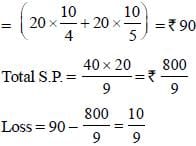
∴ Loss percent =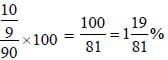
C.P. of 40 apples
∴ Loss percent =
If the selling price of 10 articles is equal to the cost price of 11 articles, then the gain percent is (SSC CGL 1st Sit. 2011)- a)10
- b)11
- c)15
- d)25
Correct answer is option 'A'. Can you explain this answer?
If the selling price of 10 articles is equal to the cost price of 11 articles, then the gain percent is (SSC CGL 1st Sit. 2011)
a)
10
b)
11
c)
15
d)
25
 | Abhiram Mehra answered |
Given:
- Selling price of 10 articles = Cost price of 11 articles
To find:
- Gain percent
Solution:
Let's assume the cost price of each article as 'x'.
So, the selling price of 10 articles = 10x
And the cost price of 11 articles = 11x
According to the given condition:
10x = 11x
Cancelling x from both sides:
10 = 11
This is not possible since 10 is not equal to 11.
Conclusion:
Hence, the given condition is not possible. Therefore, there is no gain percent in this scenario.
Answer:
The gain percent is 0%.
- Selling price of 10 articles = Cost price of 11 articles
To find:
- Gain percent
Solution:
Let's assume the cost price of each article as 'x'.
So, the selling price of 10 articles = 10x
And the cost price of 11 articles = 11x
According to the given condition:
10x = 11x
Cancelling x from both sides:
10 = 11
This is not possible since 10 is not equal to 11.
Conclusion:
Hence, the given condition is not possible. Therefore, there is no gain percent in this scenario.
Answer:
The gain percent is 0%.
What single discount is equivalent to two successive discounts of 20% and 15%? (SSC CGL 1st Sit. 2011)- a)35%
- b)32%
- c)34%
- d)30%
Correct answer is option 'B'. Can you explain this answer?
What single discount is equivalent to two successive discounts of 20% and 15%? (SSC CGL 1st Sit. 2011)
a)
35%
b)
32%
c)
34%
d)
30%
| | Abhiram Mehra answered |
To find the single discount that is equivalent to two successive discounts of 20% and 15%, we can use the concept of net discounts.
Step 1: Find the net discount of the first discount.
The first discount is 20%. To find the net discount, we subtract the discount percentage from 100%:
Net discount = 100% - 20% = 80%
Step 2: Find the net discount of the second discount.
The second discount is 15%. Again, we subtract the discount percentage from 100%:
Net discount = 100% - 15% = 85%
Step 3: Find the single discount that is equivalent to the two successive discounts.
To find the single discount that is equivalent to the two successive discounts, we need to find the discount percentage that gives the same net discount as the two successive discounts combined.
Let's assume the single discount percentage is x%.
Using the formula for net discounts, we can set up the following equation:
(100% - x%) × (100% - x%) = 80% × 85%
Step 4: Solve the equation to find the value of x.
Expanding the equation, we get:
(100% - x%) × (100% - x%) = 80% × 85%
(100% - x%)² = 0.8 × 0.85
Taking the square root of both sides, we get:
100% - x% = √(0.8 × 0.85)
Simplifying the equation, we have:
x% = 100% - √(0.8 × 0.85)
Calculating the value, we find:
x% ≈ 100% - 0.916
x% ≈ 99.084
Therefore, the single discount that is equivalent to two successive discounts of 20% and 15% is approximately 99.084%.
Since none of the given options match the calculated value, we can conclude that the correct answer is not listed.
Step 1: Find the net discount of the first discount.
The first discount is 20%. To find the net discount, we subtract the discount percentage from 100%:
Net discount = 100% - 20% = 80%
Step 2: Find the net discount of the second discount.
The second discount is 15%. Again, we subtract the discount percentage from 100%:
Net discount = 100% - 15% = 85%
Step 3: Find the single discount that is equivalent to the two successive discounts.
To find the single discount that is equivalent to the two successive discounts, we need to find the discount percentage that gives the same net discount as the two successive discounts combined.
Let's assume the single discount percentage is x%.
Using the formula for net discounts, we can set up the following equation:
(100% - x%) × (100% - x%) = 80% × 85%
Step 4: Solve the equation to find the value of x.
Expanding the equation, we get:
(100% - x%) × (100% - x%) = 80% × 85%
(100% - x%)² = 0.8 × 0.85
Taking the square root of both sides, we get:
100% - x% = √(0.8 × 0.85)
Simplifying the equation, we have:
x% = 100% - √(0.8 × 0.85)
Calculating the value, we find:
x% ≈ 100% - 0.916
x% ≈ 99.084
Therefore, the single discount that is equivalent to two successive discounts of 20% and 15% is approximately 99.084%.
Since none of the given options match the calculated value, we can conclude that the correct answer is not listed.
A, B and C started a business by investing ₹ 55,000, ₹ 65,000 and ₹ 75,000 respectively. A is a working partner and gets 20% of the profit as working allowance and remaining is distributed in the proportion of their investment. If the money received by C is ₹ 27,000 what is the total profit? (SSC Sub-Inspector-2018)- a)₹ 87,750
- b)₹ 85,500
- c)₹ 76,850
- d)₹ 70,200
Correct answer is option 'A'. Can you explain this answer?
A, B and C started a business by investing ₹ 55,000, ₹ 65,000 and ₹ 75,000 respectively. A is a working partner and gets 20% of the profit as working allowance and remaining is distributed in the proportion of their investment. If the money received by C is ₹ 27,000 what is the total profit? (SSC Sub-Inspector-2018)
a)
₹ 87,750
b)
₹ 85,500
c)
₹ 76,850
d)
₹ 70,200
 | Knowledge Hub answered |
Ratio of investment of A, B and C
= 55000 : 65000 : 75000 = 11 : 13 : 15.
Let the total profit is x.
then, profit amount that has to be distributed among
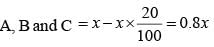

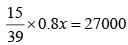

= 55000 : 65000 : 75000 = 11 : 13 : 15.
Let the total profit is x.
then, profit amount that has to be distributed among
The profit earned on selling an article at ₹ 720 is half of the loss incurred on selling the same article at ₹ 360. What is the cost price of the article. (SSC MTS 2018)- a)₹ 540
- b)₹ 600
- c)₹ 480
- d)₹ 420
Correct answer is option 'B'. Can you explain this answer?
The profit earned on selling an article at ₹ 720 is half of the loss incurred on selling the same article at ₹ 360. What is the cost price of the article. (SSC MTS 2018)
a)
₹ 540
b)
₹ 600
c)
₹ 480
d)
₹ 420
| | EduRev SSC CGL answered |
Let cost price be x
Profit = 720 – x
Loss = x – 360
According to the question,
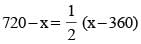
1440 – 2x = x – 360
3x = 1800
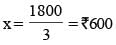
Profit = 720 – x
Loss = x – 360
According to the question,
1440 – 2x = x – 360
3x = 1800
By selling a fan for ₹ 1900 a man has a loss of 5 %, then at what price (in ₹) should he sell the fan to gain 20%? (SSC Sub. Ins. 2017)- a)2000
- b)2400
- c)2600
- d)2800
Correct answer is option 'B'. Can you explain this answer?
By selling a fan for ₹ 1900 a man has a loss of 5 %, then at what price (in ₹) should he sell the fan to gain 20%? (SSC Sub. Ins. 2017)
a)
2000
b)
2400
c)
2600
d)
2800
| | Abhiram Mehra answered |
Understanding the Problem
A man sells a fan for 1900 with a loss of 5%. We need to determine the selling price to achieve a gain of 20%.
Step 1: Calculate the Cost Price (CP)
- A loss of 5% indicates that the selling price (SP) is 95% of the cost price (CP).
- Using the formula:
SP = CP × (1 - Loss%)
1900 = CP × (1 - 0.05)
1900 = CP × 0.95
- To find CP, rearrange the equation:
CP = 1900 / 0.95
CP = 2000
Step 2: Calculate the Selling Price for a 20% Gain
- To find the selling price for a gain of 20%, the formula is:
SP = CP × (1 + Gain%)
SP = 2000 × (1 + 0.20)
SP = 2000 × 1.20
SP = 2400
Conclusion
- The required selling price to achieve a 20% gain on the fan is 2400.
- Therefore, the correct answer is option B.
A man sells a fan for 1900 with a loss of 5%. We need to determine the selling price to achieve a gain of 20%.
Step 1: Calculate the Cost Price (CP)
- A loss of 5% indicates that the selling price (SP) is 95% of the cost price (CP).
- Using the formula:
SP = CP × (1 - Loss%)
1900 = CP × (1 - 0.05)
1900 = CP × 0.95
- To find CP, rearrange the equation:
CP = 1900 / 0.95
CP = 2000
Step 2: Calculate the Selling Price for a 20% Gain
- To find the selling price for a gain of 20%, the formula is:
SP = CP × (1 + Gain%)
SP = 2000 × (1 + 0.20)
SP = 2000 × 1.20
SP = 2400
Conclusion
- The required selling price to achieve a 20% gain on the fan is 2400.
- Therefore, the correct answer is option B.
At what percent above the cost price must a person mark the price of an article so that he can enjoy 20% profit after allowing 20% discount? (SSC MTS 2017)- a)60%
- b)30%
- c)50%
- d)40%
Correct answer is option 'C'. Can you explain this answer?
At what percent above the cost price must a person mark the price of an article so that he can enjoy 20% profit after allowing 20% discount? (SSC MTS 2017)
a)
60%
b)
30%
c)
50%
d)
40%
| | Abhiram Mehra answered |
Calculating the Selling Price:
Let's assume the cost price of the article is x. To enjoy a 20% profit after allowing a 20% discount, the selling price must be 1.2x (120% of the cost price after adding 20% profit).
Calculating the Marked Price:
When a 20% discount is given, the selling price becomes 80% of the marked price. So, 80% of the marked price = 1.2x.
Therefore, the marked price = (1.2x) / 0.8 = 1.5x.
Calculating the Percentage Above the Cost Price:
To find the percentage above the cost price, we need to calculate the difference between the marked price and the cost price, and then express it as a percentage of the cost price.
Percentage above cost price = (1.5x - x) / x * 100% = 0.5x / x * 100% = 50%.
Therefore, the person must mark the price of the article 50% above the cost price in order to enjoy a 20% profit after allowing a 20% discount. So, the correct answer is option C - 50%.
Let's assume the cost price of the article is x. To enjoy a 20% profit after allowing a 20% discount, the selling price must be 1.2x (120% of the cost price after adding 20% profit).
Calculating the Marked Price:
When a 20% discount is given, the selling price becomes 80% of the marked price. So, 80% of the marked price = 1.2x.
Therefore, the marked price = (1.2x) / 0.8 = 1.5x.
Calculating the Percentage Above the Cost Price:
To find the percentage above the cost price, we need to calculate the difference between the marked price and the cost price, and then express it as a percentage of the cost price.
Percentage above cost price = (1.5x - x) / x * 100% = 0.5x / x * 100% = 50%.
Therefore, the person must mark the price of the article 50% above the cost price in order to enjoy a 20% profit after allowing a 20% discount. So, the correct answer is option C - 50%.
While selling a watch, a shopkeeper gives a discount of 5%. If he gives a discount of 6%, he earns ₹ 15 less as profit. What is the marked price of the watch? (SSC CGL 1st Sit. 2011)- a)₹ 1,250
- b)₹ 1,400
- c)₹ 1,500
- d)₹ 750
Correct answer is option 'C'. Can you explain this answer?
While selling a watch, a shopkeeper gives a discount of 5%. If he gives a discount of 6%, he earns ₹ 15 less as profit. What is the marked price of the watch? (SSC CGL 1st Sit. 2011)
a)
₹ 1,250
b)
₹ 1,400
c)
₹ 1,500
d)
₹ 750
 | Kiran Reddy answered |
Difference in discount = 1%

x = 1500
x = 1500
A shopkeeper allows a discount of 10% to his customers and still gains. 20%. Find the marked price of the article which costs ₹ 450. (SSC CGL 1st Sit. 2011)- a)₹ 600
- b)₹ 540
- c)₹ 660
- d)₹ 580
Correct answer is option 'A'. Can you explain this answer?
A shopkeeper allows a discount of 10% to his customers and still gains. 20%. Find the marked price of the article which costs ₹ 450. (SSC CGL 1st Sit. 2011)
a)
₹ 600
b)
₹ 540
c)
₹ 660
d)
₹ 580
| | Vinod Mehta answered |
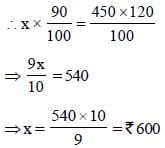
Let the marked price of the article be ₹ x.
A man sells an article at 5% above the cost price. If he had bought it at 5% less than what he paid for it and sold it for ₹ 2 less, he would have gained 10%. The cost price of the article is (SSC Sub Inspector 2016)- a)₹ 250
- b)₹ 400
- c)₹ 350
- d)₹ 200
Correct answer is option 'B'. Can you explain this answer?
A man sells an article at 5% above the cost price. If he had bought it at 5% less than what he paid for it and sold it for ₹ 2 less, he would have gained 10%. The cost price of the article is (SSC Sub Inspector 2016)
a)
₹ 250
b)
₹ 400
c)
₹ 350
d)
₹ 200
 | Arnav Saini answered |
Let's solve this problem step by step:
1. Let the cost price of the article be x.
2. Selling price when sold at 5% above the cost price = 1.05x
3. Buying price at 5% less than what he paid for it = x - 0.05x = 0.95x
4. Selling price when sold at 2 less than the buying price = 0.95x - 2
Now, we are given that if he had bought it at 0.95x and sold it for 0.95x - 2, he would have gained 10%.
This can be written as:
0.95x - (0.95x - 2) = 0.1(0.95x)
2 = 0.1(0.95x)
2 = 0.095x
x = 200
Therefore, the cost price of the article is 200.
So, the correct answer is option B) 400.
1. Let the cost price of the article be x.
2. Selling price when sold at 5% above the cost price = 1.05x
3. Buying price at 5% less than what he paid for it = x - 0.05x = 0.95x
4. Selling price when sold at 2 less than the buying price = 0.95x - 2
Now, we are given that if he had bought it at 0.95x and sold it for 0.95x - 2, he would have gained 10%.
This can be written as:
0.95x - (0.95x - 2) = 0.1(0.95x)
2 = 0.1(0.95x)
2 = 0.095x
x = 200
Therefore, the cost price of the article is 200.
So, the correct answer is option B) 400.
The cost price of an article is 40% of the selling price. What percent of the cost price is the selling price? (SSC CGL 1st Sit. 2011)- a)140%
- b)200%
- c)220%
- d)250%
Correct answer is option 'D'. Can you explain this answer?
The cost price of an article is 40% of the selling price. What percent of the cost price is the selling price? (SSC CGL 1st Sit. 2011)
a)
140%
b)
200%
c)
220%
d)
250%
| | Kiran Reddy answered |
Let the S.P. of the article = ₹ 100
∴ C.P. = ₹ 40
∴ Required percentage =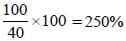
∴ C.P. = ₹ 40
∴ Required percentage =
The price of an article is cut by 33%, to restore to its original value, the new price must be increased by (SSC CHSL 2017)- a)33 percent
- b)49.25 percent
- c)24.81 percent
- d)41.25 percent
Correct answer is option 'B'. Can you explain this answer?
The price of an article is cut by 33%, to restore to its original value, the new price must be increased by (SSC CHSL 2017)
a)
33 percent
b)
49.25 percent
c)
24.81 percent
d)
41.25 percent
| | Iq Funda answered |
Let the price of the article = ₹ 100
New Price = 100 – 33 = 67
Therefore the new price must be increased by

New Price = 100 – 33 = 67
Therefore the new price must be increased by
The successive discount of 15%, 20% and 25% on an article is equivalent to the single discount of (SSC CGL 1st Sit. 2016)- a)60%
- b)47%
- c)49%
- d)40%
Correct answer is option 'C'. Can you explain this answer?
The successive discount of 15%, 20% and 25% on an article is equivalent to the single discount of (SSC CGL 1st Sit. 2016)
a)
60%
b)
47%
c)
49%
d)
40%
| | Snehal Patel answered |
Understanding Successive Discounts
When applying successive discounts, the total discount is not simply the sum of the individual discounts. Instead, each discount is applied sequentially on the reduced price after the previous discount. Let's break down how to calculate the equivalent single discount for the successive discounts of 15%, 20%, and 25%.
Step-by-Step Calculation
1. Initial Price: Assume the original price of the article is 100 units for simplicity.
2. First Discount (15%):
- Discount Amount = 15% of 100 = 15
- Price after 1st Discount = 100 - 15 = 85
3. Second Discount (20%):
- Discount Amount = 20% of 85 = 17
- Price after 2nd Discount = 85 - 17 = 68
4. Third Discount (25%):
- Discount Amount = 25% of 68 = 17
- Price after 3rd Discount = 68 - 17 = 51
Calculating Total Discount
- The final price after all discounts is 51.
- Therefore, the total discount = Original Price - Final Price = 100 - 51 = 49.
Calculating Equivalent Single Discount Percentage
- Equivalent Single Discount Percentage = (Total Discount / Original Price) * 100
= (49 / 100) * 100 = 49%
Conclusion
Thus, the equivalent single discount for the successive discounts of 15%, 20%, and 25% is 49%. Hence, the correct answer is option 'C'.
When applying successive discounts, the total discount is not simply the sum of the individual discounts. Instead, each discount is applied sequentially on the reduced price after the previous discount. Let's break down how to calculate the equivalent single discount for the successive discounts of 15%, 20%, and 25%.
Step-by-Step Calculation
1. Initial Price: Assume the original price of the article is 100 units for simplicity.
2. First Discount (15%):
- Discount Amount = 15% of 100 = 15
- Price after 1st Discount = 100 - 15 = 85
3. Second Discount (20%):
- Discount Amount = 20% of 85 = 17
- Price after 2nd Discount = 85 - 17 = 68
4. Third Discount (25%):
- Discount Amount = 25% of 68 = 17
- Price after 3rd Discount = 68 - 17 = 51
Calculating Total Discount
- The final price after all discounts is 51.
- Therefore, the total discount = Original Price - Final Price = 100 - 51 = 49.
Calculating Equivalent Single Discount Percentage
- Equivalent Single Discount Percentage = (Total Discount / Original Price) * 100
= (49 / 100) * 100 = 49%
Conclusion
Thus, the equivalent single discount for the successive discounts of 15%, 20%, and 25% is 49%. Hence, the correct answer is option 'C'.
When the price of sugar decreases by 10%, a man could buy 1 kg more for ₹ 270. Then the original price of sugar per kg is (SSC CGL 1st Sit. 2011)- a)₹ 25
- b)₹ 30
- c)₹ 27
- d)₹ 32
Correct answer is option 'B'. Can you explain this answer?
When the price of sugar decreases by 10%, a man could buy 1 kg more for ₹ 270. Then the original price of sugar per kg is (SSC CGL 1st Sit. 2011)
a)
₹ 25
b)
₹ 30
c)
₹ 27
d)
₹ 32
 | Ishaan Roy answered |
Understanding the Problem:
We are given that the price of sugar has decreased by 10% and as a result, a man is able to buy 1 kg more sugar for 270 rupees. We need to find the original price of sugar per kilogram.
Solution:
Let's assume that the original price of sugar per kilogram is 'x' rupees.
Step 1: Calculate the new price of sugar per kilogram:
Since the price of sugar has decreased by 10%, the new price of sugar per kilogram would be (100% - 10%) = 90% of the original price.
So, the new price of sugar per kilogram is (90/100) * x = 0.9x rupees.
Step 2: Calculate the quantity of sugar purchased:
We are given that with the decrease in price, the man is able to buy 1 kg more sugar for 270 rupees.
Let's assume that the original quantity of sugar purchased was 'y' kilograms.
So, the original cost of y kilograms of sugar at the original price (x rupees per kilogram) would be xy rupees.
With the decrease in price, the man is able to buy (y + 1) kilograms of sugar for 270 rupees.
Therefore, we can write the equation:
0.9x * (y + 1) = 270
Simplifying the equation, we get:
0.9xy + 0.9x = 270
Step 3: Solve the equation:
To solve the equation, we need to find the values of 'x' and 'y'.
From the equation, we can see that 'x' is a common term in both terms. So, we can factor out 'x' to simplify the equation:
x(0.9y + 0.9) = 270
Divide both sides of the equation by 0.9 to isolate 'x':
x = 270 / (0.9y + 0.9)
Step 4: Substitute the value of y:
To find the original price of sugar per kilogram (x), we need to substitute the value of 'y'.
We are given that the man could buy 1 kg more sugar, which means the new quantity of sugar purchased (y + 1) is greater than the original quantity of sugar purchased (y) by 1 kg.
Therefore, y + 1 = y + 1 kg
Substituting this value in the equation:
x = 270 / (0.9(y + 1) + 0.9)
Simplifying further:
x = 270 / (0.9y + 0.9 + 0.9)
x = 270 / (0.9y + 1.8)
Step 5: Substitute the value of x:
We need to find the original price of sugar per kilogram (x). Let's substitute the value of x in terms of y:
x = 270 / (0.9y + 1.8)
Since we are looking for the original price of sugar per kilogram, we need to find the value of x when y = 1 (as the man is able to buy 1 kg more sugar).
We are given that the price of sugar has decreased by 10% and as a result, a man is able to buy 1 kg more sugar for 270 rupees. We need to find the original price of sugar per kilogram.
Solution:
Let's assume that the original price of sugar per kilogram is 'x' rupees.
Step 1: Calculate the new price of sugar per kilogram:
Since the price of sugar has decreased by 10%, the new price of sugar per kilogram would be (100% - 10%) = 90% of the original price.
So, the new price of sugar per kilogram is (90/100) * x = 0.9x rupees.
Step 2: Calculate the quantity of sugar purchased:
We are given that with the decrease in price, the man is able to buy 1 kg more sugar for 270 rupees.
Let's assume that the original quantity of sugar purchased was 'y' kilograms.
So, the original cost of y kilograms of sugar at the original price (x rupees per kilogram) would be xy rupees.
With the decrease in price, the man is able to buy (y + 1) kilograms of sugar for 270 rupees.
Therefore, we can write the equation:
0.9x * (y + 1) = 270
Simplifying the equation, we get:
0.9xy + 0.9x = 270
Step 3: Solve the equation:
To solve the equation, we need to find the values of 'x' and 'y'.
From the equation, we can see that 'x' is a common term in both terms. So, we can factor out 'x' to simplify the equation:
x(0.9y + 0.9) = 270
Divide both sides of the equation by 0.9 to isolate 'x':
x = 270 / (0.9y + 0.9)
Step 4: Substitute the value of y:
To find the original price of sugar per kilogram (x), we need to substitute the value of 'y'.
We are given that the man could buy 1 kg more sugar, which means the new quantity of sugar purchased (y + 1) is greater than the original quantity of sugar purchased (y) by 1 kg.
Therefore, y + 1 = y + 1 kg
Substituting this value in the equation:
x = 270 / (0.9(y + 1) + 0.9)
Simplifying further:
x = 270 / (0.9y + 0.9 + 0.9)
x = 270 / (0.9y + 1.8)
Step 5: Substitute the value of x:
We need to find the original price of sugar per kilogram (x). Let's substitute the value of x in terms of y:
x = 270 / (0.9y + 1.8)
Since we are looking for the original price of sugar per kilogram, we need to find the value of x when y = 1 (as the man is able to buy 1 kg more sugar).
The marked price of a sofa set is ₹ 4800 which is sold at ₹ 3672 at two successive discounts. If the first discount is 10%, then what will be the second discount (in%)? (SSC CGL 2017)- a)13
- b)14
- c)15
- d)17
Correct answer is option 'C'. Can you explain this answer?
The marked price of a sofa set is ₹ 4800 which is sold at ₹ 3672 at two successive discounts. If the first discount is 10%, then what will be the second discount (in%)? (SSC CGL 2017)
a)
13
b)
14
c)
15
d)
17
| | Ssc Cgl answered |

Price after it = 4800 – 480 = 4320

∴ Second discount = 15%
A cycle merchant allows 25% discount on the marked price of the cycles and still makes a profit of 20%. If he gains ₹ 360 over the sale of one cycle, find the marked price of the cycle. (SSC Multitasking 2014)- a)₹ 2,920
- b)₹ 2,800
- c)₹ 2,880
- d)₹ 2,900
Correct answer is option 'C'. Can you explain this answer?
A cycle merchant allows 25% discount on the marked price of the cycles and still makes a profit of 20%. If he gains ₹ 360 over the sale of one cycle, find the marked price of the cycle. (SSC Multitasking 2014)
a)
₹ 2,920
b)
₹ 2,800
c)
₹ 2,880
d)
₹ 2,900
| | Kiran Reddy answered |
Let M be the market price and C be the cost price of the cycle.
Selling price,
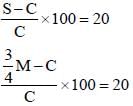
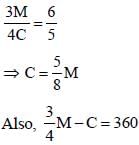
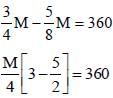
M = 360 × 4 × 2 = ₹ 2,880
Selling price,
M = 360 × 4 × 2 = ₹ 2,880
Two articles are sold for ₹ 962 each. On one, the seller gains 30% and on the other he loses 26%. What is his overall gain or loss percentage, nearest to one decimal place? (SSC CGL-2018)- a)6.0% gain
- b)5.7% loss
- c)5.7% gain
- d)6.0% loss
Correct answer is option 'B'. Can you explain this answer?
Two articles are sold for ₹ 962 each. On one, the seller gains 30% and on the other he loses 26%. What is his overall gain or loss percentage, nearest to one decimal place? (SSC CGL-2018)
a)
6.0% gain
b)
5.7% loss
c)
5.7% gain
d)
6.0% loss
| | Pranab Goyal answered |
Let's solve the problem step by step:
Given information:
- Two articles are sold for 962 each.
- On one article, the seller gains 30%.
- On the other article, the seller loses 26%.
To find the overall gain or loss percentage, we need to calculate the total cost price and the total selling price.
Let's assume the cost price of the first article is C1 and the cost price of the second article is C2.
Calculating the selling price:
- The selling price of the first article is C1 + 30% of C1 = C1 + 0.3C1 = 1.3C1.
- The selling price of the second article is C2 - 26% of C2 = C2 - 0.26C2 = 0.74C2.
According to the given information, both articles are sold for 962 each. So we can write the following equations:
1.3C1 = 962 ...(1)
0.74C2 = 962 ...(2)
Solving equations (1) and (2) will give us the values of C1 and C2.
From equation (1):
C1 = 962/1.3 = 740
From equation (2):
C2 = 962/0.74 = 1300
Calculating the total cost price and total selling price:
Total cost price = C1 + C2 = 740 + 1300 = 2040
Total selling price = 962 + 962 = 1924
Calculating the overall gain or loss percentage:
Gain or Loss = (Total Selling Price - Total Cost Price) / Total Cost Price * 100
= (1924 - 2040) / 2040 * 100
= -116 / 2040 * 100
≈ -5.68627
Therefore, the overall gain or loss percentage, rounded to one decimal place, is approximately 5.7% loss (option B).
Given information:
- Two articles are sold for 962 each.
- On one article, the seller gains 30%.
- On the other article, the seller loses 26%.
To find the overall gain or loss percentage, we need to calculate the total cost price and the total selling price.
Let's assume the cost price of the first article is C1 and the cost price of the second article is C2.
Calculating the selling price:
- The selling price of the first article is C1 + 30% of C1 = C1 + 0.3C1 = 1.3C1.
- The selling price of the second article is C2 - 26% of C2 = C2 - 0.26C2 = 0.74C2.
According to the given information, both articles are sold for 962 each. So we can write the following equations:
1.3C1 = 962 ...(1)
0.74C2 = 962 ...(2)
Solving equations (1) and (2) will give us the values of C1 and C2.
From equation (1):
C1 = 962/1.3 = 740
From equation (2):
C2 = 962/0.74 = 1300
Calculating the total cost price and total selling price:
Total cost price = C1 + C2 = 740 + 1300 = 2040
Total selling price = 962 + 962 = 1924
Calculating the overall gain or loss percentage:
Gain or Loss = (Total Selling Price - Total Cost Price) / Total Cost Price * 100
= (1924 - 2040) / 2040 * 100
= -116 / 2040 * 100
≈ -5.68627
Therefore, the overall gain or loss percentage, rounded to one decimal place, is approximately 5.7% loss (option B).
A shopkeeper marks his good at a price such that after giving a discount of 25%, the gains 20%. If the marked price of the article is ₹ 736, what is the cost price of the article? (SSC Sub-Inspector-2018 )- a)₹ 460
- b)₹ 450
- c)₹ 440
- d)₹ 455
Correct answer is option 'A'. Can you explain this answer?
A shopkeeper marks his good at a price such that after giving a discount of 25%, the gains 20%. If the marked price of the article is ₹ 736, what is the cost price of the article? (SSC Sub-Inspector-2018 )
a)
₹ 460
b)
₹ 450
c)
₹ 440
d)
₹ 455
| | Arnav Saini answered |
Understanding the Marked Price and Discount
The marked price (MP) of the article is given as 736. The shopkeeper offers a discount of 25%, which means the selling price (SP) can be calculated as follows:
- Discount Amount = 25% of MP
- Discount Amount = 0.25 * 736 = 184
Now, we can find the selling price:
- Selling Price (SP) = Marked Price - Discount Amount
- Selling Price (SP) = 736 - 184 = 552
Calculating the Cost Price
The shopkeeper makes a profit of 20% on the cost price (CP). Therefore, we can express the relationship between SP, CP, and the profit percentage:
- Selling Price (SP) = Cost Price (CP) + Profit
- Profit = 20% of CP = 0.20 * CP
This can be rearranged to find the cost price:
- SP = CP + 0.20 * CP
- SP = 1.20 * CP
Now substituting the SP value:
- 552 = 1.20 * CP
To find CP, we rearrange the equation:
- CP = 552 / 1.20
Calculating this gives:
- CP = 460
Conclusion
Thus, the cost price of the article is:
- Cost Price (CP) = 460
The correct answer is option 'A'.
The marked price (MP) of the article is given as 736. The shopkeeper offers a discount of 25%, which means the selling price (SP) can be calculated as follows:
- Discount Amount = 25% of MP
- Discount Amount = 0.25 * 736 = 184
Now, we can find the selling price:
- Selling Price (SP) = Marked Price - Discount Amount
- Selling Price (SP) = 736 - 184 = 552
Calculating the Cost Price
The shopkeeper makes a profit of 20% on the cost price (CP). Therefore, we can express the relationship between SP, CP, and the profit percentage:
- Selling Price (SP) = Cost Price (CP) + Profit
- Profit = 20% of CP = 0.20 * CP
This can be rearranged to find the cost price:
- SP = CP + 0.20 * CP
- SP = 1.20 * CP
Now substituting the SP value:
- 552 = 1.20 * CP
To find CP, we rearrange the equation:
- CP = 552 / 1.20
Calculating this gives:
- CP = 460
Conclusion
Thus, the cost price of the article is:
- Cost Price (CP) = 460
The correct answer is option 'A'.
Krishna purchased a number of articles at ₹10 for each and the same number for ₹ 14 each. He mixed them together and sold them for ₹13 each. Then his gain or loss percent is (SSC CGL 1st Sit. 2011)- a)Gain 8(1/3)%
- b)Gain 8(2/3)%
- c)Loss 8(2/3)%
- d)Loss 8(1/3)%
Correct answer is option 'A'. Can you explain this answer?
Krishna purchased a number of articles at ₹10 for each and the same number for ₹ 14 each. He mixed them together and sold them for ₹13 each. Then his gain or loss percent is (SSC CGL 1st Sit. 2011)
a)
Gain 8(1/3)%
b)
Gain 8(2/3)%
c)
Loss 8(2/3)%
d)
Loss 8(1/3)%
 | Anjana Singh answered |
Average cost of = 
QP = 13
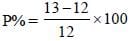 = 8(1/3)
QP = 13
= 8(1/3)Raman and Sanjay started a business by investing ₹ 63000 and ₹ 42000 respectively. If the total profit at the end of year is ₹ 9000, then what is the share of Raman? (SSC MTS 2018)- a)₹ 5400
- b)₹ 4500
- c)₹ 4200
- d)₹ 3600
Correct answer is option 'A'. Can you explain this answer?
Raman and Sanjay started a business by investing ₹ 63000 and ₹ 42000 respectively. If the total profit at the end of year is ₹ 9000, then what is the share of Raman? (SSC MTS 2018)
a)
₹ 5400
b)
₹ 4500
c)
₹ 4200
d)
₹ 3600
 | Target Study Academy answered |
Raman's capital = ₹ 63000
Sanjay 's capital = ₹ 42000
Total profit = ₹ 9000
as we know,
Capital × Time = Profit
So, Ratio of their investments
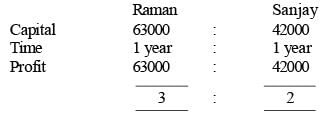
Hence the Raman's share is

⇒ 1800 × 3 ⇒ ₹ 5400
Sanjay 's capital = ₹ 42000
Total profit = ₹ 9000
as we know,
Capital × Time = Profit
So, Ratio of their investments
Hence the Raman's share is
⇒ 1800 × 3 ⇒ ₹ 5400
A shopkeeper by selling 13 Titan watches, earns a profit equal to the selling price of 3 Titan watches. His profit percentage is (SSC CHSL 2017)- a)30 percent
- b)23 percent
- c)46 percent
- d)16 percent
Correct answer is option 'A'. Can you explain this answer?
A shopkeeper by selling 13 Titan watches, earns a profit equal to the selling price of 3 Titan watches. His profit percentage is (SSC CHSL 2017)
a)
30 percent
b)
23 percent
c)
46 percent
d)
16 percent
| | Ssc Cgl answered |
Let selling price of each watches = ₹ 1
∴ Selling price of 13 watches = 13
∵ Profit = 3 × selling price of watches = 3 × 1 = 3.
∴ Cost price of 13 wateres = (13 – 3) = 10

∴ Selling price of 13 watches = 13
∵ Profit = 3 × selling price of watches = 3 × 1 = 3.
∴ Cost price of 13 wateres = (13 – 3) = 10
Chapter doubts & questions for Profit & Loss - SSC CGL Previous Year Papers 2026 is part of SSC CGL exam preparation. The chapters have been prepared according to the SSC CGL exam syllabus. The Chapter doubts & questions, notes, tests & MCQs are made for SSC CGL 2026 Exam. Find important definitions, questions, notes, meanings, examples, exercises, MCQs and online tests here.
Chapter doubts & questions of Profit & Loss - SSC CGL Previous Year Papers in English & Hindi are available as part of SSC CGL exam. Download more important topics, notes, lectures and mock test series for SSC CGL Exam by signing up for free.
SSC CGL Previous Year Papers313 docs|325 tests |
