


All Exams > SSC CGL > SSC CGL Previous Year Papers > All Questions
All questions of Simple & Compound Interest for SSC CGL Exam
A sum of ₹ 10000 is invested in three schemes of simple interest. The annual interest rates are respectively, 4%, 6% and 10%. ₹ 4000 were invested in the first scheme. If the total interest earned after five years is ₹ 2800, then how much money was invested in the third scheme? (SSC MTS 2018)- a)₹ 1500
- b)₹ 5000
- c)₹ 1000
- d)₹ 3000
Correct answer is option 'C'. Can you explain this answer?
A sum of ₹ 10000 is invested in three schemes of simple interest. The annual interest rates are respectively, 4%, 6% and 10%. ₹ 4000 were invested in the first scheme. If the total interest earned after five years is ₹ 2800, then how much money was invested in the third scheme? (SSC MTS 2018)
a)
₹ 1500
b)
₹ 5000
c)
₹ 1000
d)
₹ 3000
 | Bayshore Academy answered |
Let the amount invested in third scheme is x then amount invested in second scheme is 1000 – 4000 – x = (6000 – x)
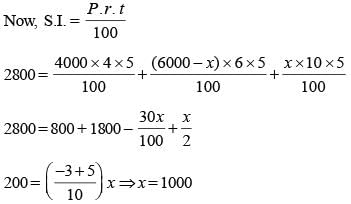
Hence, money invested in third scheme = ₹ 1000.
Hence, money invested in third scheme = ₹ 1000.


A sum of ₹ 1200 is invested at compound interest (compounded half yearly). If the rate of interest is 10% per annum, then what will be the amount after 18 months? (SSC MTS 2018)- a)₹ 1389.15
- b)₹ 1185.45
- c)₹ 1563.25
- d)₹ 1295.35
Correct answer is option 'A'. Can you explain this answer?
A sum of ₹ 1200 is invested at compound interest (compounded half yearly). If the rate of interest is 10% per annum, then what will be the amount after 18 months? (SSC MTS 2018)
a)
₹ 1389.15
b)
₹ 1185.45
c)
₹ 1563.25
d)
₹ 1295.35
 | Iq Funda answered |
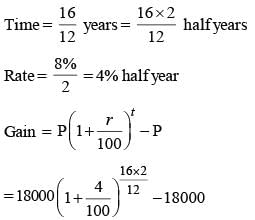
P = 1200
Time = 18 month for half yearly time becomes twice
= 18 × 2 = 36 month = 3 year
Rate = 10% = 5% = for half yearly
Let the principal = 125
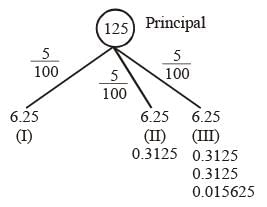
Total amount → 125 + 6.25 + 6.25 + 6.25 + 0.3125 + 0.3125 + 0.3125 + 0.015625
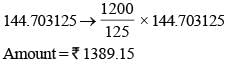
⇒ 144.703125 unit 125 unit → 1200 (given)
Time = 18 month for half yearly time becomes twice
= 18 × 2 = 36 month = 3 year
Rate = 10% = 5% = for half yearly
Let the principal = 125
Total amount → 125 + 6.25 + 6.25 + 6.25 + 0.3125 + 0.3125 + 0.3125 + 0.015625
⇒ 144.703125 unit 125 unit → 1200 (given)
A certain sum of money triples itself in 5 years at simple interest. In how many years it will be five times? (SSC CGL 2017)- a)5
- b)8
- c)10
- d)15
Correct answer is option 'C'. Can you explain this answer?
A certain sum of money triples itself in 5 years at simple interest. In how many years it will be five times? (SSC CGL 2017)
a)
5
b)
8
c)
10
d)
15
 | Pranab Goyal answered |
Understanding the Problem
When a sum of money triples itself in 5 years under simple interest, it means that the interest earned is equal to two times the principal amount. We need to find out how many years it will take for the same sum to become five times under simple interest.
Given Information
- Initial amount (Principal, P) = P
- Amount after 5 years = 3P
- Therefore, Interest for 5 years = 3P - P = 2P
Calculating the Rate of Interest
Using the formula for simple interest:
- Simple Interest (SI) = P * r * t
Here, SI = 2P, t = 5 years, and we need to find the rate (r).
- 2P = P * r * 5
Cancelling P from both sides (assuming P is not zero):
- 2 = r * 5
Thus,
- r = 2/5 = 0.4 or 40% per annum.
Finding Time to Become Five Times
Now, we want to find out the time (t) when the sum becomes five times the principal:
- Amount after t years = 5P
- Interest earned = 5P - P = 4P
Using the simple interest formula again:
- 4P = P * r * t
Cancelling P:
- 4 = r * t
Substituting the value of r (0.4):
- 4 = 0.4 * t
Now, solve for t:
- t = 4 / 0.4 = 10 years.
Conclusion
Thus, it will take 10 years for the sum of money to become five times itself under simple interest. The correct answer is option 'C'.
When a sum of money triples itself in 5 years under simple interest, it means that the interest earned is equal to two times the principal amount. We need to find out how many years it will take for the same sum to become five times under simple interest.
Given Information
- Initial amount (Principal, P) = P
- Amount after 5 years = 3P
- Therefore, Interest for 5 years = 3P - P = 2P
Calculating the Rate of Interest
Using the formula for simple interest:
- Simple Interest (SI) = P * r * t
Here, SI = 2P, t = 5 years, and we need to find the rate (r).
- 2P = P * r * 5
Cancelling P from both sides (assuming P is not zero):
- 2 = r * 5
Thus,
- r = 2/5 = 0.4 or 40% per annum.
Finding Time to Become Five Times
Now, we want to find out the time (t) when the sum becomes five times the principal:
- Amount after t years = 5P
- Interest earned = 5P - P = 4P
Using the simple interest formula again:
- 4P = P * r * t
Cancelling P:
- 4 = r * t
Substituting the value of r (0.4):
- 4 = 0.4 * t
Now, solve for t:
- t = 4 / 0.4 = 10 years.
Conclusion
Thus, it will take 10 years for the sum of money to become five times itself under simple interest. The correct answer is option 'C'.
A sum of money placed at compound interest double itself at 2 years. The year it will take to amount 4 times itself is (SSC Sub. Ins. 2016)- a)6
- b)4
- c)8
- d)3
Correct answer is option 'B'. Can you explain this answer?
A sum of money placed at compound interest double itself at 2 years. The year it will take to amount 4 times itself is (SSC Sub. Ins. 2016)
a)
6
b)
4
c)
8
d)
3
 | Malavika Rane answered |
Understanding Compound Interest
When an amount of money is placed at compound interest, it grows exponentially over time. In this case, we know that the amount doubles in 2 years. To find out how long it will take for the amount to quadruple (become 4 times), we can use the concept of doubling time.
Doubling Time
- Doubling in 2 Years: If the initial amount doubles in 2 years, this means that the growth rate is effective enough to double the principal amount.
- Growth Factor: After 2 years, the amount is 2 times the principal (P). In mathematical terms:
- After 2 years: A = P * (1 + r)^2 = 2P
Quadrupling the Amount
- Quadrupling: To quadruple the amount means to get 4 times the principal amount:
- A = 4P
- Using Doubling Principle: Since the amount doubles every 2 years, we can deduce:
- After 2 years: Amount = 2P
- After another 2 years (total of 4 years): Amount = 2 * 2P = 4P
Conclusion
Thus, it takes a total of 4 years for the initial amount to quadruple. Therefore, the correct answer is:
- 4 years (Option B)
This approach demonstrates the relationship between doubling time and the time required for an amount to grow fourfold.
When an amount of money is placed at compound interest, it grows exponentially over time. In this case, we know that the amount doubles in 2 years. To find out how long it will take for the amount to quadruple (become 4 times), we can use the concept of doubling time.
Doubling Time
- Doubling in 2 Years: If the initial amount doubles in 2 years, this means that the growth rate is effective enough to double the principal amount.
- Growth Factor: After 2 years, the amount is 2 times the principal (P). In mathematical terms:
- After 2 years: A = P * (1 + r)^2 = 2P
Quadrupling the Amount
- Quadrupling: To quadruple the amount means to get 4 times the principal amount:
- A = 4P
- Using Doubling Principle: Since the amount doubles every 2 years, we can deduce:
- After 2 years: Amount = 2P
- After another 2 years (total of 4 years): Amount = 2 * 2P = 4P
Conclusion
Thus, it takes a total of 4 years for the initial amount to quadruple. Therefore, the correct answer is:
- 4 years (Option B)
This approach demonstrates the relationship between doubling time and the time required for an amount to grow fourfold.
The difference between compound interest and simple interest on ₹ x at 15% per annum for 2 years is ₹ 9. What is the value of x? (SSC CGL-2018)- a)600
- b)400
- c)450
- d)500
Correct answer is option 'B'. Can you explain this answer?
The difference between compound interest and simple interest on ₹ x at 15% per annum for 2 years is ₹ 9. What is the value of x? (SSC CGL-2018)
a)
600
b)
400
c)
450
d)
500
| | Malavika Rane answered |
Understanding Simple Interest and Compound Interest
To solve the problem, we need to differentiate between simple interest (SI) and compound interest (CI).
Formula for Simple Interest
- Simple Interest (SI) = P * r * t / 100
Where P = Principal amount, r = rate of interest, t = time (in years).
Formula for Compound Interest
- Compound Interest (CI) = P * (1 + r/100)^t - P
This represents the interest earned on both the principal and the interest that has been added.
Given Information
- Rate of interest (r) = 15% per annum
- Time (t) = 2 years
- Difference between CI and SI = 9
Calculating Simple Interest
- SI = x * 15 * 2 / 100
- SI = (30x) / 100 = 0.3x
Calculating Compound Interest
- CI = x * (1 + 0.15)^2 - x
- CI = x * (1.15)^2 - x
- CI = x * (1.3225) - x
- CI = 1.3225x - x = 0.3225x
Setting Up the Equation
- The difference between CI and SI is given as 9:
0.3225x - 0.3x = 9
0.0225x = 9
Finding x
- x = 9 / 0.0225
- x = 400
Thus, the value of x is 400. Therefore, the correct answer is option 'B'.
To solve the problem, we need to differentiate between simple interest (SI) and compound interest (CI).
Formula for Simple Interest
- Simple Interest (SI) = P * r * t / 100
Where P = Principal amount, r = rate of interest, t = time (in years).
Formula for Compound Interest
- Compound Interest (CI) = P * (1 + r/100)^t - P
This represents the interest earned on both the principal and the interest that has been added.
Given Information
- Rate of interest (r) = 15% per annum
- Time (t) = 2 years
- Difference between CI and SI = 9
Calculating Simple Interest
- SI = x * 15 * 2 / 100
- SI = (30x) / 100 = 0.3x
Calculating Compound Interest
- CI = x * (1 + 0.15)^2 - x
- CI = x * (1.15)^2 - x
- CI = x * (1.3225) - x
- CI = 1.3225x - x = 0.3225x
Setting Up the Equation
- The difference between CI and SI is given as 9:
0.3225x - 0.3x = 9
0.0225x = 9
Finding x
- x = 9 / 0.0225
- x = 400
Thus, the value of x is 400. Therefore, the correct answer is option 'B'.
A certain sum will amount to ₹ 12,100 in 2 years at 10% per annum of compound interest, interest being compounded annually. The sum is: (SSC CGL 1st Sit. 2016)- a)₹ 12000
- b)₹ 6000
- c)₹ 8000
- d)₹ 10000
Correct answer is option 'D'. Can you explain this answer?
A certain sum will amount to ₹ 12,100 in 2 years at 10% per annum of compound interest, interest being compounded annually. The sum is: (SSC CGL 1st Sit. 2016)
a)
₹ 12000
b)
₹ 6000
c)
₹ 8000
d)
₹ 10000
 | Arnav Saini answered |
Understanding Compound Interest
To determine the principal sum that will amount to 12,100 in 2 years at a 10% annual compound interest, we can use the formula for compound interest:
Amount (A) = Principal (P) × (1 + r)^n
Where:
- A = Amount after n years
- P = Principal amount (the sum we need to find)
- r = Rate of interest (in decimal form)
- n = Number of years
Given Values
- A = 12,100
- r = 10% = 0.10
- n = 2 years
Setting Up the Equation
Using the compound interest formula:
12,100 = P × (1 + 0.10)^2
This simplifies to:
12,100 = P × (1.10)^2
Next, calculate (1.10)^2:
- (1.10)^2 = 1.21
Now, substitute back into the equation:
12,100 = P × 1.21
Solving for Principal (P)
To find P, rearrange the equation:
P = 12,100 / 1.21
Now, perform the division:
P = 10,000
Conclusion
The principal sum that will amount to 12,100 in 2 years at a 10% compound interest is:
- 10,000
Thus, the correct answer is option 'D'.
To determine the principal sum that will amount to 12,100 in 2 years at a 10% annual compound interest, we can use the formula for compound interest:
Amount (A) = Principal (P) × (1 + r)^n
Where:
- A = Amount after n years
- P = Principal amount (the sum we need to find)
- r = Rate of interest (in decimal form)
- n = Number of years
Given Values
- A = 12,100
- r = 10% = 0.10
- n = 2 years
Setting Up the Equation
Using the compound interest formula:
12,100 = P × (1 + 0.10)^2
This simplifies to:
12,100 = P × (1.10)^2
Next, calculate (1.10)^2:
- (1.10)^2 = 1.21
Now, substitute back into the equation:
12,100 = P × 1.21
Solving for Principal (P)
To find P, rearrange the equation:
P = 12,100 / 1.21
Now, perform the division:
P = 10,000
Conclusion
The principal sum that will amount to 12,100 in 2 years at a 10% compound interest is:
- 10,000
Thus, the correct answer is option 'D'.
A sum of ₹ 12,800 is invested partly at 15% per annum and the remaining at 12% per annum simple interest. If the total interest at the end of 3 years is ₹ 5,085, then how much money was invested at 15% per annum? (SSC Sub. Ins. 2018)- a)₹ 5,300
- b)₹ 7,500
- c)₹ 5,800
- d)₹ 5,200
Correct answer is option 'A'. Can you explain this answer?
A sum of ₹ 12,800 is invested partly at 15% per annum and the remaining at 12% per annum simple interest. If the total interest at the end of 3 years is ₹ 5,085, then how much money was invested at 15% per annum? (SSC Sub. Ins. 2018)
a)
₹ 5,300
b)
₹ 7,500
c)
₹ 5,800
d)
₹ 5,200
 | EduRev SSC CGL answered |
Let the money invested at 15% p.a. is x.
then amount invested at 12% p.a. is (12800 – x)
ATQ.
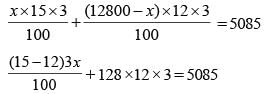
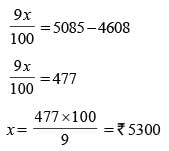
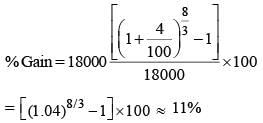
then amount invested at 12% p.a. is (12800 – x)
ATQ.


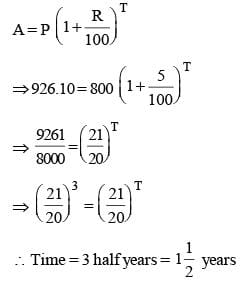
Chapter doubts & questions for Simple & Compound Interest - SSC CGL Previous Year Papers 2026 is part of SSC CGL exam preparation. The chapters have been prepared according to the SSC CGL exam syllabus. The Chapter doubts & questions, notes, tests & MCQs are made for SSC CGL 2026 Exam. Find important definitions, questions, notes, meanings, examples, exercises, MCQs and online tests here.
Chapter doubts & questions of Simple & Compound Interest - SSC CGL Previous Year Papers in English & Hindi are available as part of SSC CGL exam. Download more important topics, notes, lectures and mock test series for SSC CGL Exam by signing up for free.
SSC CGL Previous Year Papers313 docs|325 tests |
