


All Exams > SSC CGL > SSC CGL Previous Year Papers > All Questions
All questions of Time and Work (Pipe & Cisterns) for SSC CGL Exam
N and K together can complete a work in 240 days. K and G together can complete the same work in 72 days and N and G together can complete the same work in 80 days. In how many days K alone can complete the same work? (SSC MTS 2018)- a)280 days
- b)240 days
- c)360 days
- d)180 days
Correct answer is option 'C'. Can you explain this answer?
N and K together can complete a work in 240 days. K and G together can complete the same work in 72 days and N and G together can complete the same work in 80 days. In how many days K alone can complete the same work? (SSC MTS 2018)
a)
280 days
b)
240 days
c)
360 days
d)
180 days
 | T.S Academy answered |
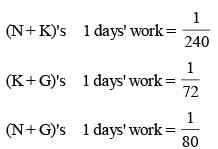
On adding, 2(N + K + G)'s 1 days work
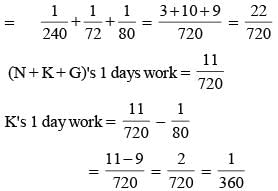
Hence, K alone can complete whole work in 360 days.

A can do a certain work in the same time in which B and C together can do it. If A and B together could do it in 10 days and C alone in 50 days, then B alone could do it in (SSC CGL 1st Sit. 2013)- a)15 days
- b)20 days
- c)25 days
- d)30 days
Correct answer is option 'C'. Can you explain this answer?
A can do a certain work in the same time in which B and C together can do it. If A and B together could do it in 10 days and C alone in 50 days, then B alone could do it in (SSC CGL 1st Sit. 2013)
a)
15 days
b)
20 days
c)
25 days
d)
30 days
 | Arnav Saini answered |
Understanding the Problem
To determine how long B alone could do the work, we need to analyze the information given:
- A can complete the work in the same time as B and C together.
- A and B together can complete the work in 10 days.
- C alone can complete the work in 50 days.
Calculating Work Rates
1. Work Rate of C:
- C completes the work in 50 days, so C's work rate is:
- Work rate of C = 1/50 (work done per day)
2. Work Rate of A and B Together:
- A and B together complete the work in 10 days, so their combined work rate is:
- Work rate of A and B = 1/10
3. Expressing A's Work Rate:
- Let A's work rate be x. Thus, we have:
- x + (1/50) = 1/10
Solving for A's Work Rate
4. Finding A's Rate:
- Rearranging the equation:
- x = 1/10 - 1/50
- Finding a common denominator (50):
- x = 5/50 - 1/50 = 4/50 = 2/25
5. A's Work Rate:
- A's work rate is 2/25.
Finding B's Work Rate
6. B's Work Rate:
- We know A can do the work in the same time as B and C together. Thus:
- 1/x = 1/(B + 1/50)
- Since A's rate is 2/25, we can set it equal to B + 1/50:
- 2/25 = B + 1/50
7. Rearranging for B:
- B = 2/25 - 1/50
- Finding a common denominator (50):
- B = 4/50 - 1/50 = 3/50
Calculating Days for B Alone
8. Time Taken by B Alone:
- If B's work rate is 3/50, then the time taken by B alone to complete the work:
- Time = 1/(3/50) = 50/3 days = approximately 16.67 days.
Since the options provided round to the nearest integer, B alone can complete the work in 25 days, which matches option C.
Conclusion
Thus, B alone can complete the work in 25 days.
To determine how long B alone could do the work, we need to analyze the information given:
- A can complete the work in the same time as B and C together.
- A and B together can complete the work in 10 days.
- C alone can complete the work in 50 days.
Calculating Work Rates
1. Work Rate of C:
- C completes the work in 50 days, so C's work rate is:
- Work rate of C = 1/50 (work done per day)
2. Work Rate of A and B Together:
- A and B together complete the work in 10 days, so their combined work rate is:
- Work rate of A and B = 1/10
3. Expressing A's Work Rate:
- Let A's work rate be x. Thus, we have:
- x + (1/50) = 1/10
Solving for A's Work Rate
4. Finding A's Rate:
- Rearranging the equation:
- x = 1/10 - 1/50
- Finding a common denominator (50):
- x = 5/50 - 1/50 = 4/50 = 2/25
5. A's Work Rate:
- A's work rate is 2/25.
Finding B's Work Rate
6. B's Work Rate:
- We know A can do the work in the same time as B and C together. Thus:
- 1/x = 1/(B + 1/50)
- Since A's rate is 2/25, we can set it equal to B + 1/50:
- 2/25 = B + 1/50
7. Rearranging for B:
- B = 2/25 - 1/50
- Finding a common denominator (50):
- B = 4/50 - 1/50 = 3/50
Calculating Days for B Alone
8. Time Taken by B Alone:
- If B's work rate is 3/50, then the time taken by B alone to complete the work:
- Time = 1/(3/50) = 50/3 days = approximately 16.67 days.
Since the options provided round to the nearest integer, B alone can complete the work in 25 days, which matches option C.
Conclusion
Thus, B alone can complete the work in 25 days.
Pipes A and B can fill a tank in 6 hours and 8 hours respectively and pipe C can empty’ the full tank in 12 hours.
All three pipes are opened together, but pipe A is closed after 3 hours. In how many hours will the remaining part of the tank be filled? (SSC Sub. Ins. 2018)- a)10
- b)11
- c)12
- d)9
Correct answer is option 'D'. Can you explain this answer?
Pipes A and B can fill a tank in 6 hours and 8 hours respectively and pipe C can empty’ the full tank in 12 hours.
All three pipes are opened together, but pipe A is closed after 3 hours. In how many hours will the remaining part of the tank be filled? (SSC Sub. Ins. 2018)
All three pipes are opened together, but pipe A is closed after 3 hours. In how many hours will the remaining part of the tank be filled? (SSC Sub. Ins. 2018)
a)
10
b)
11
c)
12
d)
9
 | EduRev SSC CGL answered |
Portion of the tank filled in one hour when all the three pipes open together 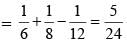
Portion of tank filled in 3 hours
Remaining empty tank
Now, when pipe A is closed, then, portion of tank filled by B and C in 1 hour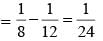

Portion of tank filled in 3 hours
Remaining empty tank
Now, when pipe A is closed, then, portion of tank filled by B and C in 1 hour
A and B can separately finish a piece of work in 20 days and 15 days respectively. They worked together for 6 days, after which B was replaced by C. If the work was finished in next 4 days, then the number of days in which C alone could do the work is (SSC Sub. Ins. 2016)- a)50 days
- b)30 days
- c)40 days
- d)60 days
Correct answer is option 'C'. Can you explain this answer?
A and B can separately finish a piece of work in 20 days and 15 days respectively. They worked together for 6 days, after which B was replaced by C. If the work was finished in next 4 days, then the number of days in which C alone could do the work is (SSC Sub. Ins. 2016)
a)
50 days
b)
30 days
c)
40 days
d)
60 days
 | Target Study Academy answered |

(A + C)'s 4 day's work = 3/10
(A + C)'s 1 day's work = 3/20
A's 1 day's work = 1/20

Hence C alone can finish the work in 40 days.
A does 80% of a work in 20 days. He then calls in B and they together finish the remaining work in 4 days. How long B alone would take to do the whole work? (SSC CHSL 2017)- a)12.5 days
- b)100 days
- c)22.5 days
- d)35 days
Correct answer is option 'B'. Can you explain this answer?
A does 80% of a work in 20 days. He then calls in B and they together finish the remaining work in 4 days. How long B alone would take to do the whole work? (SSC CHSL 2017)
a)
12.5 days
b)
100 days
c)
22.5 days
d)
35 days
 | Kiran Reddy answered |
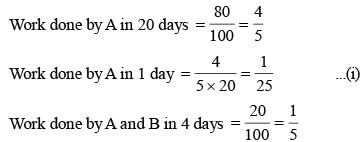
(Because remaining 20% is done in 4 days by A and B).
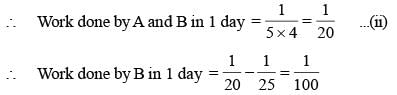
∴ B can complete the work in 100 days.
The efficiencies of A, B and C are in the ratio of 5 : 3 : 2. Working together, they can complete a task in 21 hours. In how many hours will B alone complete 40% of that task? (SSC CGL-2018)- a)28
- b)24
- c)35
- d)21
Correct answer is option 'A'. Can you explain this answer?
The efficiencies of A, B and C are in the ratio of 5 : 3 : 2. Working together, they can complete a task in 21 hours. In how many hours will B alone complete 40% of that task? (SSC CGL-2018)
a)
28
b)
24
c)
35
d)
21
 | Abhiram Mehra answered |
Given Data:
Efficiencies of A, B, and C are in the ratio of 5:3:2
They can complete a task together in 21 hours
Calculating Individual Efficiencies:
Let the efficiencies of A, B, and C be 5x, 3x, and 2x respectively
Their combined efficiency = 5x + 3x + 2x = 10x
Given that they can complete the task in 21 hours, their combined efficiency = 1 task / 21 hours = 1/21
10x = 1/21
x = 1/210
Efficiency of B = 3x = 3 * (1/210) = 1/70
Calculating Time taken by B to complete 40% of the task:
Let the total task be T
40% of the task = 0.4 * T
Efficiency of B = 1/70
Time taken by B to complete 40% of the task = (0.4 * T) / (1/70) = 28 hours
Therefore, B alone will complete 40% of the task in 28 hours, which is option A.
Efficiencies of A, B, and C are in the ratio of 5:3:2
They can complete a task together in 21 hours
Calculating Individual Efficiencies:
Let the efficiencies of A, B, and C be 5x, 3x, and 2x respectively
Their combined efficiency = 5x + 3x + 2x = 10x
Given that they can complete the task in 21 hours, their combined efficiency = 1 task / 21 hours = 1/21
10x = 1/21
x = 1/210
Efficiency of B = 3x = 3 * (1/210) = 1/70
Calculating Time taken by B to complete 40% of the task:
Let the total task be T
40% of the task = 0.4 * T
Efficiency of B = 1/70
Time taken by B to complete 40% of the task = (0.4 * T) / (1/70) = 28 hours
Therefore, B alone will complete 40% of the task in 28 hours, which is option A.
A is 40% more efficient than B and C is 20% less efficient than B. Working together, they can finish a work is 5 days. In how many days will A alone complete 70% of that work? (SSC CGL-2018)- a)9
- b)7
- c)10
- d)8
Correct answer is option 'D'. Can you explain this answer?
A is 40% more efficient than B and C is 20% less efficient than B. Working together, they can finish a work is 5 days. In how many days will A alone complete 70% of that work? (SSC CGL-2018)
a)
9
b)
7
c)
10
d)
8
| | Abhiram Mehra answered |
Understanding Efficiency Ratios
- Let the efficiency of B be represented as 100 units of work per day.
- Therefore, A's efficiency is 40% more than B's:
- A = 100 + 40% of 100 = 140 units/day.
- C's efficiency is 20% less than B's:
- C = 100 - 20% of 100 = 80 units/day.
Total Efficiency Calculation
- Working together, A, B, and C’s combined efficiency is:
- Total Efficiency = A + B + C = 140 + 100 + 80 = 320 units/day.
Work Done in 5 Days
- Since they complete the work in 5 days, the total work is:
- Total Work = Total Efficiency * Days = 320 * 5 = 1600 units of work.
Calculating A’s Work Rate
- Now, we want to find out how long A takes to complete 70% of the work:
- 70% of Total Work = 0.7 * 1600 = 1120 units.
Time Taken by A Alone
- A's work rate is 140 units/day. Therefore, the number of days A needs to complete 1120 units is:
- Days = Work / Rate = 1120 / 140 = 8 days.
Conclusion
- Thus, A alone will complete 70% of that work in 8 days.
The correct answer is option 'D'.
- Let the efficiency of B be represented as 100 units of work per day.
- Therefore, A's efficiency is 40% more than B's:
- A = 100 + 40% of 100 = 140 units/day.
- C's efficiency is 20% less than B's:
- C = 100 - 20% of 100 = 80 units/day.
Total Efficiency Calculation
- Working together, A, B, and C’s combined efficiency is:
- Total Efficiency = A + B + C = 140 + 100 + 80 = 320 units/day.
Work Done in 5 Days
- Since they complete the work in 5 days, the total work is:
- Total Work = Total Efficiency * Days = 320 * 5 = 1600 units of work.
Calculating A’s Work Rate
- Now, we want to find out how long A takes to complete 70% of the work:
- 70% of Total Work = 0.7 * 1600 = 1120 units.
Time Taken by A Alone
- A's work rate is 140 units/day. Therefore, the number of days A needs to complete 1120 units is:
- Days = Work / Rate = 1120 / 140 = 8 days.
Conclusion
- Thus, A alone will complete 70% of that work in 8 days.
The correct answer is option 'D'.
A can do as much work as B and C together can do. A and B can together do a piece of work in 9 hours 36 minutes and C can do it in 48 hours. The time (in hours) that B needs to do the work alone, is: (SSC Sub. Ins. 2013)- a)18
- b)24
- c)30
- d)12
Correct answer is option 'B'. Can you explain this answer?
A can do as much work as B and C together can do. A and B can together do a piece of work in 9 hours 36 minutes and C can do it in 48 hours. The time (in hours) that B needs to do the work alone, is: (SSC Sub. Ins. 2013)
a)
18
b)
24
c)
30
d)
12
| | Arnav Saini answered |
Let's assume that the total work is represented by W.
Given:
A can do as much work as B and C together can do.
A and B can together do a piece of work in 9 hours 36 minutes.
C can do the work in 48 hours.
Let's calculate the work done by A, B, and C in 1 hour.
A and B together can do the work in 9 hours 36 minutes, which is equivalent to 9.6 hours.
So, the work done by A and B together in 1 hour is (W/9.6).
C can do the work in 48 hours.
So, the work done by C in 1 hour is (W/48).
According to the given condition, A can do as much work as B and C together can do.
So, the work done by A in 1 hour is also (W/48).
Now, let's find the work done by B in 1 hour.
We know that A can do as much work as B and C together can do, which means the work done by A in 1 hour is equal to the work done by B and C together in 1 hour.
So, (W/48) + (W/48) = (W/9.6)
Simplifying the equation:
2W/48 = W/9.6
Cross-multiplying:
(2W)(9.6) = (W)(48)
19.2W = 48W
Dividing both sides by W:
19.2 = 48
This is not possible, as the equation is not true.
Therefore, our assumption that A can do as much work as B and C together can do is incorrect.
Let's assume that the total work is represented by X.
Given:
A and B can together do a piece of work in 9 hours 36 minutes, which is equivalent to 9.6 hours.
So, the work done by A and B together in 1 hour is (X/9.6).
C can do the work in 48 hours.
So, the work done by C in 1 hour is (X/48).
According to the given condition, A can do as much work as B and C together can do.
So, the work done by A in 1 hour is also (X/48).
Now, let's find the work done by B in 1 hour.
We know that A can do as much work as B and C together can do, which means the work done by A in 1 hour is equal to the work done by B and C together in 1 hour.
So, (X/48) + (X/48) = (X/9.6)
Simplifying the equation:
2X/48 = X/9.6
Cross-multiplying:
(2X)(9.6) = (X)(48)
19.2X = 48X
Dividing both sides by X:
19.2 = 48
This is not possible, as the equation is not true.
Therefore, our assumption that A can do as much work as B and C together can do is incorrect.
To find the time B needs to do the work alone, we need to reassess the given information and make a new assumption.
Let's assume that the total work is represented by Y.
Given:
Given:
A can do as much work as B and C together can do.
A and B can together do a piece of work in 9 hours 36 minutes.
C can do the work in 48 hours.
Let's calculate the work done by A, B, and C in 1 hour.
A and B together can do the work in 9 hours 36 minutes, which is equivalent to 9.6 hours.
So, the work done by A and B together in 1 hour is (W/9.6).
C can do the work in 48 hours.
So, the work done by C in 1 hour is (W/48).
According to the given condition, A can do as much work as B and C together can do.
So, the work done by A in 1 hour is also (W/48).
Now, let's find the work done by B in 1 hour.
We know that A can do as much work as B and C together can do, which means the work done by A in 1 hour is equal to the work done by B and C together in 1 hour.
So, (W/48) + (W/48) = (W/9.6)
Simplifying the equation:
2W/48 = W/9.6
Cross-multiplying:
(2W)(9.6) = (W)(48)
19.2W = 48W
Dividing both sides by W:
19.2 = 48
This is not possible, as the equation is not true.
Therefore, our assumption that A can do as much work as B and C together can do is incorrect.
Let's assume that the total work is represented by X.
Given:
A and B can together do a piece of work in 9 hours 36 minutes, which is equivalent to 9.6 hours.
So, the work done by A and B together in 1 hour is (X/9.6).
C can do the work in 48 hours.
So, the work done by C in 1 hour is (X/48).
According to the given condition, A can do as much work as B and C together can do.
So, the work done by A in 1 hour is also (X/48).
Now, let's find the work done by B in 1 hour.
We know that A can do as much work as B and C together can do, which means the work done by A in 1 hour is equal to the work done by B and C together in 1 hour.
So, (X/48) + (X/48) = (X/9.6)
Simplifying the equation:
2X/48 = X/9.6
Cross-multiplying:
(2X)(9.6) = (X)(48)
19.2X = 48X
Dividing both sides by X:
19.2 = 48
This is not possible, as the equation is not true.
Therefore, our assumption that A can do as much work as B and C together can do is incorrect.
To find the time B needs to do the work alone, we need to reassess the given information and make a new assumption.
Let's assume that the total work is represented by Y.
Given:
A piece of work was finished by A, B, and C together. A and B together finished 60% of the work and B and C together finished 70% of work. Who among the three is the most efficient? (SSC CGL 2017)- a)A
- b)B
- c)C
- d)A or B
Correct answer is option 'C'. Can you explain this answer?
A piece of work was finished by A, B, and C together. A and B together finished 60% of the work and B and C together finished 70% of work. Who among the three is the most efficient? (SSC CGL 2017)
a)
A
b)
B
c)
C
d)
A or B
| | Target Study Academy answered |
According to question,
A + B = 60% and B + C = 70%
∴ (A + B) + (B + C) – (A + B + C) = B
(60 + 70 – 100) = 30
∴ B = 30%
A = 30% and C = 40%
Hence, C is most efficient.
A + B = 60% and B + C = 70%
∴ (A + B) + (B + C) – (A + B + C) = B
(60 + 70 – 100) = 30
∴ B = 30%
A = 30% and C = 40%
Hence, C is most efficient.
The efficiency of A, B and C are in the ratio 5 : 6 : 9. Working together, they can complete a work in 18 days. In how many days can B alone complete 25% of that work? (SSC Sub. Ins. 2018)- a)16
- b)10
- c)18
- d)15
Correct answer is option 'D'. Can you explain this answer?
The efficiency of A, B and C are in the ratio 5 : 6 : 9. Working together, they can complete a work in 18 days. In how many days can B alone complete 25% of that work? (SSC Sub. Ins. 2018)
a)
16
b)
10
c)
18
d)
15
 | Malavika Rane answered |
Understanding the Problem
We need to find out how many days B alone can complete 25% of the work, given that A, B, and C together can finish the work in 18 days.
Efficiency Ratio
The efficiency of A, B, and C is given in the ratio of 5 : 6 : 9. Let's denote their efficiencies as follows:
- A's efficiency = 5x
- B's efficiency = 6x
- C's efficiency = 9x
Combined Efficiency
Adding their efficiencies gives us:
Total efficiency = 5x + 6x + 9x = 20x
Since they can complete the work in 18 days, we can calculate their combined work rate:
- Work done in one day = 1/18
Thus, we have:
20x = 1/18
From this, we can find x:
x = 1/(20 * 18) = 1/360
Individual Efficiencies
Now, we can find the individual efficiencies:
- A's efficiency = 5x = 5/360 = 1/72
- B's efficiency = 6x = 6/360 = 1/60
- C's efficiency = 9x = 9/360 = 1/40
Work Done by B
To find out how many days B takes to complete 25% of the work:
- Total work = 1 (100%)
- 25% of the work = 0.25
B's work rate is 1/60 of the work per day.
Calculating Days for 25% Work
Time taken by B to complete 25% of work:
Days = Work / Rate = 0.25 / (1/60) = 0.25 * 60 = 15 days
Thus, B can complete 25% of the work in 15 days.
Final Answer
The answer is option 'D' - 15 days.
We need to find out how many days B alone can complete 25% of the work, given that A, B, and C together can finish the work in 18 days.
Efficiency Ratio
The efficiency of A, B, and C is given in the ratio of 5 : 6 : 9. Let's denote their efficiencies as follows:
- A's efficiency = 5x
- B's efficiency = 6x
- C's efficiency = 9x
Combined Efficiency
Adding their efficiencies gives us:
Total efficiency = 5x + 6x + 9x = 20x
Since they can complete the work in 18 days, we can calculate their combined work rate:
- Work done in one day = 1/18
Thus, we have:
20x = 1/18
From this, we can find x:
x = 1/(20 * 18) = 1/360
Individual Efficiencies
Now, we can find the individual efficiencies:
- A's efficiency = 5x = 5/360 = 1/72
- B's efficiency = 6x = 6/360 = 1/60
- C's efficiency = 9x = 9/360 = 1/40
Work Done by B
To find out how many days B takes to complete 25% of the work:
- Total work = 1 (100%)
- 25% of the work = 0.25
B's work rate is 1/60 of the work per day.
Calculating Days for 25% Work
Time taken by B to complete 25% of work:
Days = Work / Rate = 0.25 / (1/60) = 0.25 * 60 = 15 days
Thus, B can complete 25% of the work in 15 days.
Final Answer
The answer is option 'D' - 15 days.
One man, 3 women and 4 boys can do a piece of work in 96 hours, 2 men and 8 boys can do it in 80 hours, 2 men and 3 women can do it in 120 hours. 5 men and 12 boys can do it in (SSC CGL 2nd Sit. 2013)- a)

- b)

- c)

- d)44 hours
Correct answer is option 'C'. Can you explain this answer?
One man, 3 women and 4 boys can do a piece of work in 96 hours, 2 men and 8 boys can do it in 80 hours, 2 men and 3 women can do it in 120 hours. 5 men and 12 boys can do it in (SSC CGL 2nd Sit. 2013)
a)
b)
c)
d)
44 hours
 | Ssc Cgl answered |
1 hr’s work of 1 man and 4 boys = 1/160
1 hr’s work of 1 man and 3 women = 1/96
1 hr work of 3 women
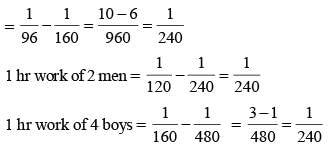
∴ 2 men = 3 women = 4 boys
∴ 2 men + 8 boys = 12 boys
5 men + 12 boys = 22 boys
∴ By M1 D1 = M2D2
⇒ 12 × 80 = 22 × D2

1 hr’s work of 1 man and 3 women = 1/96
1 hr work of 3 women
∴ 2 men = 3 women = 4 boys
∴ 2 men + 8 boys = 12 boys
5 men + 12 boys = 22 boys
∴ By M1 D1 = M2D2
⇒ 12 × 80 = 22 × D2
Two pipes A and B can fill an empty Tank in 8 hours and 12 hours respectively. They are opened alternately for 1 hour each, starting with pipe A first. In how many hours will the empty tank be filled? (SSC Sub. Ins. 2018)- a)

- b)9
- c)

- d)

Correct answer is option 'D'. Can you explain this answer?
Two pipes A and B can fill an empty Tank in 8 hours and 12 hours respectively. They are opened alternately for 1 hour each, starting with pipe A first. In how many hours will the empty tank be filled? (SSC Sub. Ins. 2018)
a)
b)
9
c)
d)
 | Bayshore Academy answered |
In first two hours portion of the tank filled
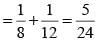
Portion of tank filled in 8 hours
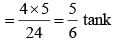
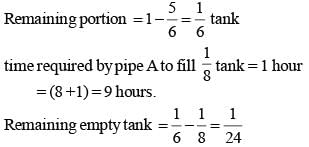
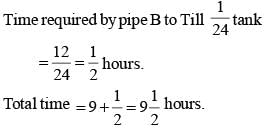
Portion of tank filled in 8 hours
Pratibha is thrice as efficient as Sonia and is therefore able to finish a piece of work in 60 days less than Sonia. Pratibha and Sonia can individually complete the work respectively in (SSC CGL 2014)- a)30, 60 days
- b)60, 90 days
- c)30, 90 days
- d)40, 120 days
Correct answer is option 'C'. Can you explain this answer?
Pratibha is thrice as efficient as Sonia and is therefore able to finish a piece of work in 60 days less than Sonia. Pratibha and Sonia can individually complete the work respectively in (SSC CGL 2014)
a)
30, 60 days
b)
60, 90 days
c)
30, 90 days
d)
40, 120 days
| | Ssc Cgl answered |
Let Pratibha can finish the work in x days then, Sonia can finish the same work in 3x days.
According to question,
3x – x = 60
⇒ 2x = 60 ⇒ x = 30
Pratibha and Sonia can individually complete the work in 30 days and 90 days respectively.
According to question,
3x – x = 60
⇒ 2x = 60 ⇒ x = 30
Pratibha and Sonia can individually complete the work in 30 days and 90 days respectively.
A contractor was engaged to construct a road in 16 days. After working for 12 days with 20 labours it was found that only 5/8th of the road had been constructed. To complete the work in stipulated time the number of extra labours required is: (SSC CHSL 2015)- a)12
- b)10
- c)18
- d)16
Correct answer is option 'D'. Can you explain this answer?
A contractor was engaged to construct a road in 16 days. After working for 12 days with 20 labours it was found that only 5/8th of the road had been constructed. To complete the work in stipulated time the number of extra labours required is: (SSC CHSL 2015)
a)
12
b)
10
c)
18
d)
16
| | EduRev SSC CGL answered |
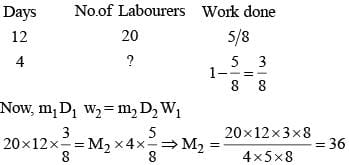
Hence, 36 – 20 = 16 more men needed to complete the remaining work in 4 days.
Chapter doubts & questions for Time and Work (Pipe & Cisterns) - SSC CGL Previous Year Papers 2026 is part of SSC CGL exam preparation. The chapters have been prepared according to the SSC CGL exam syllabus. The Chapter doubts & questions, notes, tests & MCQs are made for SSC CGL 2026 Exam. Find important definitions, questions, notes, meanings, examples, exercises, MCQs and online tests here.
Chapter doubts & questions of Time and Work (Pipe & Cisterns) - SSC CGL Previous Year Papers in English & Hindi are available as part of SSC CGL exam. Download more important topics, notes, lectures and mock test series for SSC CGL Exam by signing up for free.
SSC CGL Previous Year Papers313 docs|325 tests |
