


All Exams > SSC CGL > SSC CGL Previous Year Papers > All Questions
All questions of Mensuration for SSC CGL Exam
A rectangular portion of an airport runway was getting repaired for which an estimate was made on the basis of a rate ₹ R per square unit. But while doing the work, the length of the portion got increased by 10% and the breadth by 8%. Over and above this, there was an increase in the cost of the repair work to the extent of 15%. What was the overall percentage increase in the cost of repair over the estimate? (SSC CHSL-2018)- a)36.62 %
- b)34.58 %
- c)33 %
- d)35.24 %
Correct answer is option 'A'. Can you explain this answer?
A rectangular portion of an airport runway was getting repaired for which an estimate was made on the basis of a rate ₹ R per square unit. But while doing the work, the length of the portion got increased by 10% and the breadth by 8%. Over and above this, there was an increase in the cost of the repair work to the extent of 15%. What was the overall percentage increase in the cost of repair over the estimate? (SSC CHSL-2018)
a)
36.62 %
b)
34.58 %
c)
33 %
d)
35.24 %
 | Pranab Goyal answered |
Understanding the Scenario
The cost of repairing a rectangular portion of an airport runway is based on a rate R per square unit. While the work progressed, both the dimensions and the cost increased.
Step 1: Original Area Calculation
- Let the original length be L and the original breadth be B.
- The original area = L * B.
Step 2: New Dimensions
- The length increased by 10%: New Length = L + 0.10L = 1.10L.
- The breadth increased by 8%: New Breadth = B + 0.08B = 1.08B.
- The new area = 1.10L * 1.08B = 1.188LB.
Step 3: Increase in Area
- The increase in area = New Area / Original Area = 1.188LB / LB = 1.188.
- This translates to a percentage increase in area of (1.188 - 1) * 100 = 18.8%.
Step 4: Increase in Cost
- The cost of repair increased by 15% over the original estimate.
- New Cost = Original Cost * (1 + 0.15) = Original Cost * 1.15.
Step 5: Overall Increase in Cost Calculation
- Let Original Cost = C.
- New Cost = 1.15C.
- The effective area increase leads to the cost paid = 1.15C * 1.188 (due to the increased area).
- Effective new cost = C * 1.15 * 1.188 = 1.365C.
Step 6: Overall Percentage Increase
- Overall increase = (New Cost - Original Cost) / Original Cost * 100.
- Overall increase = (1.365C - C) / C * 100 = 36.5%.
Thus, the overall percentage increase in the cost of repair over the estimate is approximately 36.62%, which corresponds to option 'A'.
The cost of repairing a rectangular portion of an airport runway is based on a rate R per square unit. While the work progressed, both the dimensions and the cost increased.
Step 1: Original Area Calculation
- Let the original length be L and the original breadth be B.
- The original area = L * B.
Step 2: New Dimensions
- The length increased by 10%: New Length = L + 0.10L = 1.10L.
- The breadth increased by 8%: New Breadth = B + 0.08B = 1.08B.
- The new area = 1.10L * 1.08B = 1.188LB.
Step 3: Increase in Area
- The increase in area = New Area / Original Area = 1.188LB / LB = 1.188.
- This translates to a percentage increase in area of (1.188 - 1) * 100 = 18.8%.
Step 4: Increase in Cost
- The cost of repair increased by 15% over the original estimate.
- New Cost = Original Cost * (1 + 0.15) = Original Cost * 1.15.
Step 5: Overall Increase in Cost Calculation
- Let Original Cost = C.
- New Cost = 1.15C.
- The effective area increase leads to the cost paid = 1.15C * 1.188 (due to the increased area).
- Effective new cost = C * 1.15 * 1.188 = 1.365C.
Step 6: Overall Percentage Increase
- Overall increase = (New Cost - Original Cost) / Original Cost * 100.
- Overall increase = (1.365C - C) / C * 100 = 36.5%.
Thus, the overall percentage increase in the cost of repair over the estimate is approximately 36.62%, which corresponds to option 'A'.

The length of one of the diagonals of a rhombus is 48 cm. If the side of the rhombus is 26 cm, then what is the area of the rhombus? (SSC MTS 2018)- a)540 cm2
- b)420 cm2
- c)360 cm2
- d)480 cm2
Correct answer is option 'D'. Can you explain this answer?
The length of one of the diagonals of a rhombus is 48 cm. If the side of the rhombus is 26 cm, then what is the area of the rhombus? (SSC MTS 2018)
a)
540 cm2
b)
420 cm2
c)
360 cm2
d)
480 cm2
 | Nandita Dasgupta answered |
Problem Overview
To find the area of a rhombus when one diagonal and the side length are given, we can use the properties of a rhombus and the Pythagorean theorem.
Given Data
- Length of one diagonal (d1) = 48 cm
- Length of each side (s) = 26 cm
Finding the Other Diagonal
1. In a rhombus, the diagonals bisect each other at right angles.
2. Let the other diagonal be d2. Each diagonal divides the rhombus into four right-angled triangles.
3. The half of diagonal d1 is 24 cm (half of 48 cm).
Using the Pythagorean theorem in one of the right triangles formed:
- (half of d1)^2 + (half of d2)^2 = s^2
- 24^2 + (d2/2)^2 = 26^2
- 576 + (d2/2)^2 = 676
- (d2/2)^2 = 100
- d2/2 = 10
- d2 = 20 cm
Calculating the Area
The area (A) of the rhombus can be calculated using the formula:
- A = (d1 * d2) / 2
Substituting the values:
- A = (48 cm * 20 cm) / 2
- A = 960 cm² / 2
- A = 480 cm²
Conclusion
Thus, the area of the rhombus is 480 cm², which corresponds to option 'D'.
To find the area of a rhombus when one diagonal and the side length are given, we can use the properties of a rhombus and the Pythagorean theorem.
Given Data
- Length of one diagonal (d1) = 48 cm
- Length of each side (s) = 26 cm
Finding the Other Diagonal
1. In a rhombus, the diagonals bisect each other at right angles.
2. Let the other diagonal be d2. Each diagonal divides the rhombus into four right-angled triangles.
3. The half of diagonal d1 is 24 cm (half of 48 cm).
Using the Pythagorean theorem in one of the right triangles formed:
- (half of d1)^2 + (half of d2)^2 = s^2
- 24^2 + (d2/2)^2 = 26^2
- 576 + (d2/2)^2 = 676
- (d2/2)^2 = 100
- d2/2 = 10
- d2 = 20 cm
Calculating the Area
The area (A) of the rhombus can be calculated using the formula:
- A = (d1 * d2) / 2
Substituting the values:
- A = (48 cm * 20 cm) / 2
- A = 960 cm² / 2
- A = 480 cm²
Conclusion
Thus, the area of the rhombus is 480 cm², which corresponds to option 'D'.


If the perimeter of a rhombus is 80 cm and one of its diagonal is 24 cm, then what is the area (in cm2) of the rhombus? (SSC Sub. Ins. 2017)- a)218
- b)192
- c)384
- d)768
Correct answer is option 'C'. Can you explain this answer?
If the perimeter of a rhombus is 80 cm and one of its diagonal is 24 cm, then what is the area (in cm2) of the rhombus? (SSC Sub. Ins. 2017)
a)
218
b)
192
c)
384
d)
768
 | Target Study Academy answered |
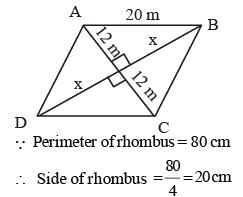
By Pythagorean theorem,
(20)2 = (12)2 + (x2)
∴ x2 = 400 – 144 = 256
∴ x = √256 = 16 cm
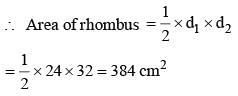
∴ Diagonal of rhombus = 2x = 2 × 16 = 32 cm and other diagonal = 24 cm
Chapter doubts & questions for Mensuration - SSC CGL Previous Year Papers 2026 is part of SSC CGL exam preparation. The chapters have been prepared according to the SSC CGL exam syllabus. The Chapter doubts & questions, notes, tests & MCQs are made for SSC CGL 2026 Exam. Find important definitions, questions, notes, meanings, examples, exercises, MCQs and online tests here.
Chapter doubts & questions of Mensuration - SSC CGL Previous Year Papers in English & Hindi are available as part of SSC CGL exam. Download more important topics, notes, lectures and mock test series for SSC CGL Exam by signing up for free.
SSC CGL Previous Year Papers313 docs|325 tests |
