


All Exams > SSC CGL > SSC CGL Previous Year Papers > All Questions
All questions of History for SSC CGL Exam
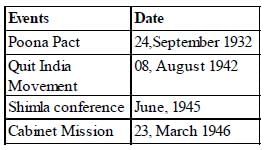
Which one is the correct chronological order of the following events? (SSC CGL 2017)
(I) Quit India Movement
(II) Shimla Conference
(III) Poona Pact
(IV) Cabinet Mission- a)II, IV, I, III
- b)III, IV, II, I
- c)III, I, II, IV
- d)IV, II, III, I
Correct answer is option 'C'. Can you explain this answer?
Which one is the correct chronological order of the following events? (SSC CGL 2017)
(I) Quit India Movement
(II) Shimla Conference
(III) Poona Pact
(IV) Cabinet Mission
(I) Quit India Movement
(II) Shimla Conference
(III) Poona Pact
(IV) Cabinet Mission
a)
II, IV, I, III
b)
III, IV, II, I
c)
III, I, II, IV
d)
IV, II, III, I
 | Mira Sharma answered |

The monuments of Khajuraho in the state of MadhyaPradesh are fine denotations of the________dynasty. (SSC Sub. Ins. 2018)- a)Chalukya
- b)Chandela
- c)Chola
- d)Pallava
Correct answer is option 'B'. Can you explain this answer?
The monuments of Khajuraho in the state of MadhyaPradesh are fine denotations of the________dynasty. (SSC Sub. Ins. 2018)
a)
Chalukya
b)
Chandela
c)
Chola
d)
Pallava
 | Arnav Saini answered |
The correct answer is option 'B', Chandel. The monuments of Khajuraho in the state of Madhya Pradesh are fine denotations of the Chandel dynasty.
The Chandel dynasty was a medieval Indian dynasty that ruled over the region of Bundelkhand in central India from the 9th to the 13th centuries. The dynasty is known for its patronage of art and architecture, particularly the temples of Khajuraho.
The Chandel rulers were great patrons of the arts, and under their rule, Khajuraho flourished as a major cultural and religious center. The temples of Khajuraho were built between the 9th and 11th centuries, during the reign of the Chandel dynasty. These temples are renowned for their exquisite carvings and intricate sculptures, which depict various aspects of life, including gods and goddesses, celestial beings, humans, animals, and erotic scenes.
The temples of Khajuraho are a UNESCO World Heritage Site and are considered one of the finest examples of Indian temple architecture. They are known for their unique architectural style, which combines elements of Hindu, Jain, and Buddhist traditions. The temples are built on a high platform and have a distinct spire-like structure known as shikhara. The walls and pillars of the temples are adorned with intricate carvings that depict various mythological and historical scenes.
The temples of Khajuraho are divided into three groups - the western group, which is the largest and most famous; the eastern group, which is smaller and less elaborate; and the southern group, which is the oldest. Each group has its own unique architectural style and features.
Overall, the monuments of Khajuraho in the state of Madhya Pradesh are fine denotations of the Chandel dynasty, known for their patronage of art and architecture. These temples are a testament to the rich cultural and artistic heritage of India.
The Chandel dynasty was a medieval Indian dynasty that ruled over the region of Bundelkhand in central India from the 9th to the 13th centuries. The dynasty is known for its patronage of art and architecture, particularly the temples of Khajuraho.
The Chandel rulers were great patrons of the arts, and under their rule, Khajuraho flourished as a major cultural and religious center. The temples of Khajuraho were built between the 9th and 11th centuries, during the reign of the Chandel dynasty. These temples are renowned for their exquisite carvings and intricate sculptures, which depict various aspects of life, including gods and goddesses, celestial beings, humans, animals, and erotic scenes.
The temples of Khajuraho are a UNESCO World Heritage Site and are considered one of the finest examples of Indian temple architecture. They are known for their unique architectural style, which combines elements of Hindu, Jain, and Buddhist traditions. The temples are built on a high platform and have a distinct spire-like structure known as shikhara. The walls and pillars of the temples are adorned with intricate carvings that depict various mythological and historical scenes.
The temples of Khajuraho are divided into three groups - the western group, which is the largest and most famous; the eastern group, which is smaller and less elaborate; and the southern group, which is the oldest. Each group has its own unique architectural style and features.
Overall, the monuments of Khajuraho in the state of Madhya Pradesh are fine denotations of the Chandel dynasty, known for their patronage of art and architecture. These temples are a testament to the rich cultural and artistic heritage of India.
Who among the following British persons admitted the Revolt of 1857 as a national revolt? (SSC CGL 1st Sit. 2011)- a)Lord Dalhousie
- b)Lord Canning
- c)Lord Ellenborough
- d)Disraeli
Correct answer is option 'D'. Can you explain this answer?
Who among the following British persons admitted the Revolt of 1857 as a national revolt? (SSC CGL 1st Sit. 2011)
a)
Lord Dalhousie
b)
Lord Canning
c)
Lord Ellenborough
d)
Disraeli
 | Abhiram Mehra answered |
Introduction
The Revolt of 1857, also known as the Sepoy Mutiny, marked a significant turning point in Indian history. While various British officials had differing views on this event, one notable figure stood out in his acknowledgment of it as a national revolt.
Disraeli's Admission
- Benjamin Disraeli, a prominent British politician and Prime Minister, recognized the Revolt of 1857 as a national uprising rather than merely a sepoy mutiny.
- His perspective was crucial as it indicated a shift in understanding the nature of the revolt, viewing it as a reflection of broader nationalist sentiments among Indians rather than just a military rebellion.
Context of the Revolt
- The revolt was fueled by various grievances, including resentment against British policies, social reforms, and economic exploitation.
- It united diverse groups of Indians against colonial rule, showcasing an early expression of nationalistic aspirations.
Impact of Disraeli's View
- Disraeli's acknowledgment of the revolt as a national movement highlighted the complexities of colonial rule and the growing desire for Indian independence.
- This perspective influenced later British policies and attitudes towards India, recognizing the need for reforms and a more nuanced understanding of Indian society.
Conclusion
- In contrast to other British officials who downplayed the significance of the revolt, Disraeli's admission served as an important recognition of the Indian struggle for autonomy.
- His viewpoint is essential in understanding the historical context of the Revolt of 1857 and its implications for the future of British-Indian relations.
The Revolt of 1857, also known as the Sepoy Mutiny, marked a significant turning point in Indian history. While various British officials had differing views on this event, one notable figure stood out in his acknowledgment of it as a national revolt.
Disraeli's Admission
- Benjamin Disraeli, a prominent British politician and Prime Minister, recognized the Revolt of 1857 as a national uprising rather than merely a sepoy mutiny.
- His perspective was crucial as it indicated a shift in understanding the nature of the revolt, viewing it as a reflection of broader nationalist sentiments among Indians rather than just a military rebellion.
Context of the Revolt
- The revolt was fueled by various grievances, including resentment against British policies, social reforms, and economic exploitation.
- It united diverse groups of Indians against colonial rule, showcasing an early expression of nationalistic aspirations.
Impact of Disraeli's View
- Disraeli's acknowledgment of the revolt as a national movement highlighted the complexities of colonial rule and the growing desire for Indian independence.
- This perspective influenced later British policies and attitudes towards India, recognizing the need for reforms and a more nuanced understanding of Indian society.
Conclusion
- In contrast to other British officials who downplayed the significance of the revolt, Disraeli's admission served as an important recognition of the Indian struggle for autonomy.
- His viewpoint is essential in understanding the historical context of the Revolt of 1857 and its implications for the future of British-Indian relations.
Chhatrapati Shivaji was a follower of (SSC Multitasking 2014)- a)Madhava
- b)Kabir
- c)Basava
- d)Ramadasa
Correct answer is option 'D'. Can you explain this answer?
Chhatrapati Shivaji was a follower of (SSC Multitasking 2014)
a)
Madhava
b)
Kabir
c)
Basava
d)
Ramadasa
 | Ssc Cgl answered |
Chhatrapati Shivaji was a follower of Ramayana and Mahabharta from his childhood. Shivaji Maharaj did everything possible to promote Hinduism in every aspect of the fight for independence and establishing his own kingdom. Shivaji Maharaj's assembly of eight ministers was formed based on Hindu ideals. One comes across this concept of eight ministers in the Ramayan and the Mahabharat.
Tulsidas wrote Ramcharitmanas in the reign of (SSC CHSL 2014)- a)Babar
- b)Akbar
- c)Aurangzeb
- d)Jahangir
Correct answer is option 'B'. Can you explain this answer?
Tulsidas wrote Ramcharitmanas in the reign of (SSC CHSL 2014)
a)
Babar
b)
Akbar
c)
Aurangzeb
d)
Jahangir
| | Arnav Saini answered |
Background of Ramcharitmanas
Ramcharitmanas is an epic poem written by the poet Tulsidas. It is a retelling of the Sanskrit Ramayana and is composed in Awadhi, a dialect of Hindi. This work is revered for its poetic beauty and spiritual depth, making it a significant text in Hindu literature.
Historical Context
Tulsidas wrote Ramcharitmanas during the Mughal era, specifically in the reign of Emperor Akbar (1556-1605). This period was marked by a significant cultural and religious synthesis in India.
Why Akbar?
- Support for Arts and Literature: Akbar is renowned for his patronage of the arts and literature. He encouraged cultural exchange and the flourishing of various art forms.
- Religious Tolerance: Akbar's policies of religious tolerance allowed for the free expression of different religious beliefs, which facilitated the writing and dissemination of works like Ramcharitmanas.
- Cultural Renaissance: The Mughal court was a hub of literary and artistic activity. Tulsidas, inspired by the cultural milieu of Akbar’s reign, was able to compose his work without fear of persecution.
Conclusion
Given the cultural and historical context of the time, Tulsidas's Ramcharitmanas is closely associated with the reign of Akbar. This connection highlights the interplay between literature and the socio-political environment of the era, marking it as a notable period in Indian history.
Ramcharitmanas is an epic poem written by the poet Tulsidas. It is a retelling of the Sanskrit Ramayana and is composed in Awadhi, a dialect of Hindi. This work is revered for its poetic beauty and spiritual depth, making it a significant text in Hindu literature.
Historical Context
Tulsidas wrote Ramcharitmanas during the Mughal era, specifically in the reign of Emperor Akbar (1556-1605). This period was marked by a significant cultural and religious synthesis in India.
Why Akbar?
- Support for Arts and Literature: Akbar is renowned for his patronage of the arts and literature. He encouraged cultural exchange and the flourishing of various art forms.
- Religious Tolerance: Akbar's policies of religious tolerance allowed for the free expression of different religious beliefs, which facilitated the writing and dissemination of works like Ramcharitmanas.
- Cultural Renaissance: The Mughal court was a hub of literary and artistic activity. Tulsidas, inspired by the cultural milieu of Akbar’s reign, was able to compose his work without fear of persecution.
Conclusion
Given the cultural and historical context of the time, Tulsidas's Ramcharitmanas is closely associated with the reign of Akbar. This connection highlights the interplay between literature and the socio-political environment of the era, marking it as a notable period in Indian history.
Raja Ram Mohan Roy was the founder of : (SSC CGL 1st Sit. 2015)- a)Brahmo Samaj
- b)Prathna Samaj
- c)Ram Krishna Mission
- d)Arya Samaj
Correct answer is option 'A'. Can you explain this answer?
Raja Ram Mohan Roy was the founder of : (SSC CGL 1st Sit. 2015)
a)
Brahmo Samaj
b)
Prathna Samaj
c)
Ram Krishna Mission
d)
Arya Samaj
 | EduRev SSC CGL answered |
Raja Ram Mohan Roy was a pioneer in the fields of education, social reform, and religious thought. He founded the Brahmo Samaj in 1828, a Hindu reform movement that advocated for monotheism, social equality, and women’s rights. He also played a key role in the abolition of sati, the practice of widow burning.
The_________is an ancient Indian treatise on statecraft, economic policy and military strategy that was written in Sanskrit. Kautilya is traditionally credited as the author of the text. (SSC Sub. Ins. 2018)- a)Rigveda
- b)Arthashastra
- c)Charaka Samhita
- d)Puranas
Correct answer is option 'B'. Can you explain this answer?
The_________is an ancient Indian treatise on statecraft, economic policy and military strategy that was written in Sanskrit. Kautilya is traditionally credited as the author of the text. (SSC Sub. Ins. 2018)
a)
Rigveda
b)
Arthashastra
c)
Charaka Samhita
d)
Puranas
 | Nilesh Banerjee answered |
**Answer:**
The correct answer is option B: Arthashastra.
**Explanation:**
The Arthashastra is an ancient Indian treatise on statecraft, economic policy, and military strategy. It was written in Sanskrit and is traditionally credited to Kautilya, who is also known as Chanakya. The text is believed to have been written around the 4th century BCE.
**Key Points:**
- **Arthashastra**: The Arthashastra is a comprehensive manual that covers various aspects of governance, including statecraft, economics, law, and military strategy. It provides detailed instructions on how to establish and maintain a prosperous and well-governed kingdom.
- **Author**: The text is traditionally attributed to Kautilya, also known as Chanakya. Kautilya was a political advisor and strategist who served as the chief minister to the Mauryan emperor Chandragupta Maurya. He is considered one of the greatest political thinkers in ancient India.
- **Content**: The Arthashastra is divided into 15 books, each dealing with specific topics related to governance. Some of the key areas covered in the text include:
- **Statecraft**: The Arthashastra provides detailed guidance on how to establish and administer an efficient and effective administration. It covers topics such as the selection and training of officials, the management of the treasury, and the maintenance of law and order.
- **Economic Policy**: The text also delves into economic policy and provides guidance on various aspects such as taxation, trade, agriculture, and industry. It emphasizes the importance of a strong and self-sufficient economy for the prosperity of the kingdom.
- **Military Strategy**: The Arthashastra offers insights into military strategy and warfare. It discusses topics such as the organization of the army, tactics for battles, and the use of spies and espionage.
- **Foreign Policy**: The text also covers aspects of foreign policy, including diplomacy, alliances, and the management of relations with neighboring kingdoms.
- **Significance**: The Arthashastra is considered a valuable resource for understanding ancient Indian political and economic systems. It provides insights into the administrative practices and strategic thinking of the time. The text has had a lasting impact on the field of political science and is still studied and referenced by scholars today.
In conclusion, the Arthashastra is an ancient Indian treatise on statecraft, economic policy, and military strategy that was written in Sanskrit. It is traditionally credited to Kautilya and is a comprehensive manual that covers various aspects of governance.
The correct answer is option B: Arthashastra.
**Explanation:**
The Arthashastra is an ancient Indian treatise on statecraft, economic policy, and military strategy. It was written in Sanskrit and is traditionally credited to Kautilya, who is also known as Chanakya. The text is believed to have been written around the 4th century BCE.
**Key Points:**
- **Arthashastra**: The Arthashastra is a comprehensive manual that covers various aspects of governance, including statecraft, economics, law, and military strategy. It provides detailed instructions on how to establish and maintain a prosperous and well-governed kingdom.
- **Author**: The text is traditionally attributed to Kautilya, also known as Chanakya. Kautilya was a political advisor and strategist who served as the chief minister to the Mauryan emperor Chandragupta Maurya. He is considered one of the greatest political thinkers in ancient India.
- **Content**: The Arthashastra is divided into 15 books, each dealing with specific topics related to governance. Some of the key areas covered in the text include:
- **Statecraft**: The Arthashastra provides detailed guidance on how to establish and administer an efficient and effective administration. It covers topics such as the selection and training of officials, the management of the treasury, and the maintenance of law and order.
- **Economic Policy**: The text also delves into economic policy and provides guidance on various aspects such as taxation, trade, agriculture, and industry. It emphasizes the importance of a strong and self-sufficient economy for the prosperity of the kingdom.
- **Military Strategy**: The Arthashastra offers insights into military strategy and warfare. It discusses topics such as the organization of the army, tactics for battles, and the use of spies and espionage.
- **Foreign Policy**: The text also covers aspects of foreign policy, including diplomacy, alliances, and the management of relations with neighboring kingdoms.
- **Significance**: The Arthashastra is considered a valuable resource for understanding ancient Indian political and economic systems. It provides insights into the administrative practices and strategic thinking of the time. The text has had a lasting impact on the field of political science and is still studied and referenced by scholars today.
In conclusion, the Arthashastra is an ancient Indian treatise on statecraft, economic policy, and military strategy that was written in Sanskrit. It is traditionally credited to Kautilya and is a comprehensive manual that covers various aspects of governance.
Stories of Buddha's birth and his previous lives are contained in : (SSC MTS 2017)- a)Tripitakas
- b)Jataka tales
- c)Panchatantra tales
- d)Triratnas
Correct answer is option 'B'. Can you explain this answer?
Stories of Buddha's birth and his previous lives are contained in : (SSC MTS 2017)
a)
Tripitakas
b)
Jataka tales
c)
Panchatantra tales
d)
Triratnas
 | Learners World answered |
The Jataka tales are a volumnous body of literature native to India concerning the previous births of Gautam Buddha, in both Human and Animal form.
Who initiated the movement to form the Indian National Congress : (SSC CGL 1st Sit. 2015)- a)Annie Besant
- b)A.O. Hume
- c)W.C. Banerjee
- d)Gandhi ji
Correct answer is option 'B'. Can you explain this answer?
Who initiated the movement to form the Indian National Congress : (SSC CGL 1st Sit. 2015)
a)
Annie Besant
b)
A.O. Hume
c)
W.C. Banerjee
d)
Gandhi ji
| | Arnav Saini answered |
Introduction to Indian National Congress
The Indian National Congress (INC) was founded as a major political party in India, playing a crucial role in the struggle for independence from British rule. The formation of the INC in 1885 marked a significant milestone in Indian political history.
Key Initiator: A.O. Hume
- A.O. Hume, an Englishman and retired civil servant, was the primary figure behind the initiation of the Indian National Congress.
- He envisioned the INC as a platform for political dialogue between the British government and the Indian populace.
Objectives of Forming INC
- Hume aimed to create a space for educated Indians to express their political aspirations.
- The INC was intended to advocate for constitutional reforms and greater self-governance.
Role of Other Figures
- While A.O. Hume is credited with the founding, other prominent Indian leaders like W.C. Banerjee, who became the first president of the INC, played essential roles in its early development.
- Leaders like Annie Besant and Mahatma Gandhi later contributed significantly to the party's evolution and mobilization efforts.
Conclusion
- The Indian National Congress laid the groundwork for organized political activism in India, eventually leading to the independence movement.
- A.O. Hume's initiative to form the INC was pivotal in channeling the growing nationalist sentiments among Indians and providing a formal structure for political engagement.
Thus, the correct answer to the question is option 'B', A.O. Hume, because he was the primary initiator of the movement that led to the formation of the Indian National Congress.
The Indian National Congress (INC) was founded as a major political party in India, playing a crucial role in the struggle for independence from British rule. The formation of the INC in 1885 marked a significant milestone in Indian political history.
Key Initiator: A.O. Hume
- A.O. Hume, an Englishman and retired civil servant, was the primary figure behind the initiation of the Indian National Congress.
- He envisioned the INC as a platform for political dialogue between the British government and the Indian populace.
Objectives of Forming INC
- Hume aimed to create a space for educated Indians to express their political aspirations.
- The INC was intended to advocate for constitutional reforms and greater self-governance.
Role of Other Figures
- While A.O. Hume is credited with the founding, other prominent Indian leaders like W.C. Banerjee, who became the first president of the INC, played essential roles in its early development.
- Leaders like Annie Besant and Mahatma Gandhi later contributed significantly to the party's evolution and mobilization efforts.
Conclusion
- The Indian National Congress laid the groundwork for organized political activism in India, eventually leading to the independence movement.
- A.O. Hume's initiative to form the INC was pivotal in channeling the growing nationalist sentiments among Indians and providing a formal structure for political engagement.
Thus, the correct answer to the question is option 'B', A.O. Hume, because he was the primary initiator of the movement that led to the formation of the Indian National Congress.
Which Sultan received a robe of honour from the caliph? (SSC Sub. Ins. 2013)- a)Ala-ud-din Khilji
- b)lltutmish
- c)Balban
- d)Qutub-ud-din Albak
Correct answer is option 'B'. Can you explain this answer?
Which Sultan received a robe of honour from the caliph? (SSC Sub. Ins. 2013)
a)
Ala-ud-din Khilji
b)
lltutmish
c)
Balban
d)
Qutub-ud-din Albak
 | Iq Funda answered |
Iltutmish received contlnnation of his robe of honour and title Nasir amir al-muminin (Helper of the Commander of the Faithful) from the 'Abbasid Caliph al-Mustansir in 626 (1229) and remained on the throne for twenty-six years, This added an element of strength to Iltutmish's authority and gave him a status in the Muslim world.
Todar Mal, the brilliant revenue officer served under : (SSC CHSL 2015)- a)Bhagwan Das
- b)Humayun
- c)Baz Bahadur
- d)Sher Shah
Correct answer is option 'D'. Can you explain this answer?
Todar Mal, the brilliant revenue officer served under : (SSC CHSL 2015)
a)
Bhagwan Das
b)
Humayun
c)
Baz Bahadur
d)
Sher Shah
 | Pioneer Academy answered |
Todar Mal started his career as a revenue officer at the court of Sher Shah Suri. After the Sur dynasty was overthrown by the Mughals, Todar Mal continued his service to the then Mughal Emperor Akbar.
Who propounded the "Doctrine of Passive Resistance"? (SSC CGL 1st Sit. 2016)- a)Balgangadhar Tilak
- b)Aurobindo Ghosh
- c)Lala Lajpat Rai
- d)Bipin Chandra Pal
Correct answer is option 'B'. Can you explain this answer?
Who propounded the "Doctrine of Passive Resistance"? (SSC CGL 1st Sit. 2016)
a)
Balgangadhar Tilak
b)
Aurobindo Ghosh
c)
Lala Lajpat Rai
d)
Bipin Chandra Pal
| | Arnav Saini answered |
Doctrine of Passive Resistance
The "Doctrine of Passive Resistance" is closely associated with the philosophy of non-violent protest and civil disobedience, notably championed by Aurobindo Ghosh in the Indian freedom struggle.
Key Contributions of Aurobindo Ghosh
- Aurobindo Ghosh was a prominent nationalist leader and philosopher who emphasized the importance of spiritual awakening and self-realization in the struggle for India’s independence.
- He advocated for the idea that true resistance against colonial rule should be non-violent, focusing on moral and ethical principles rather than physical confrontation.
Concept of Passive Resistance
- The doctrine encourages individuals to refuse to comply with unjust laws and regulations imposed by the British colonial government.
- It promotes the idea that such passive resistance can lead to greater moral and political strength, fostering solidarity among the Indian populace.
Influence on Indian Independence Movement
- Aurobindo's ideas inspired many leaders and movements advocating for Indian self-rule, emphasizing that resistance does not have to involve violence.
- His approach laid the groundwork for future movements led by figures like Mahatma Gandhi, who further developed the concept of non-violent resistance.
Conclusion
In summary, Aurobindo Ghosh’s "Doctrine of Passive Resistance" played a pivotal role in shaping the philosophy of resistance against colonial rule in India, promoting non-violence as a powerful tool for social and political change. His contributions have left a lasting impact on the Indian independence movement, inspiring generations to advocate for justice through peaceful means.
The "Doctrine of Passive Resistance" is closely associated with the philosophy of non-violent protest and civil disobedience, notably championed by Aurobindo Ghosh in the Indian freedom struggle.
Key Contributions of Aurobindo Ghosh
- Aurobindo Ghosh was a prominent nationalist leader and philosopher who emphasized the importance of spiritual awakening and self-realization in the struggle for India’s independence.
- He advocated for the idea that true resistance against colonial rule should be non-violent, focusing on moral and ethical principles rather than physical confrontation.
Concept of Passive Resistance
- The doctrine encourages individuals to refuse to comply with unjust laws and regulations imposed by the British colonial government.
- It promotes the idea that such passive resistance can lead to greater moral and political strength, fostering solidarity among the Indian populace.
Influence on Indian Independence Movement
- Aurobindo's ideas inspired many leaders and movements advocating for Indian self-rule, emphasizing that resistance does not have to involve violence.
- His approach laid the groundwork for future movements led by figures like Mahatma Gandhi, who further developed the concept of non-violent resistance.
Conclusion
In summary, Aurobindo Ghosh’s "Doctrine of Passive Resistance" played a pivotal role in shaping the philosophy of resistance against colonial rule in India, promoting non-violence as a powerful tool for social and political change. His contributions have left a lasting impact on the Indian independence movement, inspiring generations to advocate for justice through peaceful means.
How many times did Babur invade India before 1526 A.D.? (SSC Sub. Ins. 2016)- a)None of these
- b)Four times
- c)Five times
- d)Two times
Correct answer is option 'C'. Can you explain this answer?
How many times did Babur invade India before 1526 A.D.? (SSC Sub. Ins. 2016)
a)
None of these
b)
Four times
c)
Five times
d)
Two times
| | Arnav Saini answered |
Babur's Invasions of India
Babur, the founder of the Mughal Empire, made several attempts to invade India before establishing his rule in 1526 A.D. His invasions were crucial in shaping the political landscape of the Indian subcontinent.
Number of Invasions
- Babur invaded India five times before 1526 A.D.
- These invasions were significant in his quest to expand his empire and establish Mughal dominance.
Details of the Invasions
1. First Invasion (1519):
- Babur attempted to capture the Punjab region but faced resistance from the local rulers and was forced to retreat.
2. Second Invasion (1520):
- He made another attempt, this time successfully capturing the region of Lahore.
3. Third Invasion (1521):
- Babur continued his campaign and captured parts of the Indian territory, facing different regional powers.
4. Fourth Invasion (1524):
- His strategic position improved as he aligned with local allies, further increasing his control in the region.
5. Fifth Invasion (1526):
- The most notable, leading to the First Battle of Panipat, where he defeated Ibrahim Lodi, marking the beginning of the Mughal Empire in India.
Conclusion
In summary, Babur's five invasions laid the groundwork for the establishment of a significant empire in India. His military strategies and alliances were instrumental in overcoming various local powers, ultimately leading to the rise of the Mughal dynasty.
Babur, the founder of the Mughal Empire, made several attempts to invade India before establishing his rule in 1526 A.D. His invasions were crucial in shaping the political landscape of the Indian subcontinent.
Number of Invasions
- Babur invaded India five times before 1526 A.D.
- These invasions were significant in his quest to expand his empire and establish Mughal dominance.
Details of the Invasions
1. First Invasion (1519):
- Babur attempted to capture the Punjab region but faced resistance from the local rulers and was forced to retreat.
2. Second Invasion (1520):
- He made another attempt, this time successfully capturing the region of Lahore.
3. Third Invasion (1521):
- Babur continued his campaign and captured parts of the Indian territory, facing different regional powers.
4. Fourth Invasion (1524):
- His strategic position improved as he aligned with local allies, further increasing his control in the region.
5. Fifth Invasion (1526):
- The most notable, leading to the First Battle of Panipat, where he defeated Ibrahim Lodi, marking the beginning of the Mughal Empire in India.
Conclusion
In summary, Babur's five invasions laid the groundwork for the establishment of a significant empire in India. His military strategies and alliances were instrumental in overcoming various local powers, ultimately leading to the rise of the Mughal dynasty.
Which of the following Pacts sought to be resolved the Hindu - Muslim differences? (SSC Sub. Ins. 2016)- a)Lucknow Pact
- b)Lahore Pact
- c)Gandhi - Irwin Pact
- d)Poona Pact
Correct answer is option 'A'. Can you explain this answer?
Which of the following Pacts sought to be resolved the Hindu - Muslim differences? (SSC Sub. Ins. 2016)
a)
Lucknow Pact
b)
Lahore Pact
c)
Gandhi - Irwin Pact
d)
Poona Pact
 | Bayshore Academy answered |
The Lucknow Pact is an agreement between the Indian National Congress (INC) and the All India Muslim League reached at a joint session of both the parties held at Lucknow in 1916.
Which one of the following was the book written by Amoghvarsha, the Rashtrakuta King? (SSC CGL 2014)- a)Adipurana
- b)Ganitasara Samgraha
- c)Saktayana
- d)Kavirajamarga
Correct answer is option 'D'. Can you explain this answer?
Which one of the following was the book written by Amoghvarsha, the Rashtrakuta King? (SSC CGL 2014)
a)
Adipurana
b)
Ganitasara Samgraha
c)
Saktayana
d)
Kavirajamarga
| | Arnav Saini answered |
Overview of Amoghvarsha
Amoghvarsha was a prominent Rashtrakuta king, known not only for his military prowess but also for his contributions to literature and culture during the 9th century. His reign marked a significant period of flourishing arts and scholarship in the Deccan region of India.
Literary Contributions
Among his notable accomplishments, Amoghvarsha is credited with the composition of the book "Kavirajamarga." This work is particularly significant for several reasons:
Other Works Mentioned
While the other options listed in the question have their own significance, they are not attributed to Amoghvarsha:
Conclusion
In summary, "Kavirajamarga" stands out as the literary work associated with Amoghvarsha, highlighting his role in advancing Kannada literature and poetics during the Rashtrakuta dynasty.
Amoghvarsha was a prominent Rashtrakuta king, known not only for his military prowess but also for his contributions to literature and culture during the 9th century. His reign marked a significant period of flourishing arts and scholarship in the Deccan region of India.
Literary Contributions
Among his notable accomplishments, Amoghvarsha is credited with the composition of the book "Kavirajamarga." This work is particularly significant for several reasons:
- First Treatise on Poetics: "Kavirajamarga" is considered one of the earliest texts in Kannada literature, focusing on the principles of poetics and literary criticism.
- Influence on Kannada Literature: The book laid the foundation for future literary works in Kannada, influencing generations of poets and writers.
- Promotion of Language: Amoghvarsha's work contributed to the elevation of Kannada as a literary language, encouraging its use in formal and artistic contexts.
Other Works Mentioned
While the other options listed in the question have their own significance, they are not attributed to Amoghvarsha:
- Adipurana: This is a significant work in Kannada literature but was not authored by Amoghvarsha.
- Ganitasara Sangraha: Written by Bhaskara II, this work focuses on mathematics, demonstrating a different area of expertise.
- Saktayan: This text is not commonly recognized in the same context as "Kavirajamarga" and does not relate to Amoghvarsha.
Conclusion
In summary, "Kavirajamarga" stands out as the literary work associated with Amoghvarsha, highlighting his role in advancing Kannada literature and poetics during the Rashtrakuta dynasty.
Who among the following Sultans tried to prohibit Sati? (SSC Sub. Ins. 2015)- a)Muhammad Bin Tuglaq
- b)Firoz Tuglaq
- c)Jalaluddin Khilji
- d)Alauddin Khilji
Correct answer is option 'A'. Can you explain this answer?
Who among the following Sultans tried to prohibit Sati? (SSC Sub. Ins. 2015)
a)
Muhammad Bin Tuglaq
b)
Firoz Tuglaq
c)
Jalaluddin Khilji
d)
Alauddin Khilji
| | EduRev SSC CGL answered |
Muhammad Bin Tuglaq prohibited Sati. Muhammad Bin Tuglaq was a Turkic Sultan of Delhi and the eldest son of Ghiyas-ud-din Tughlaq.
Who constructed Humayun’s Tomb in Delhi ? (SSC Sub. Ins. 2015)- a)Haji Begam
- b)Babar
- c)Humayun
- d)Akbar
Correct answer is option 'A'. Can you explain this answer?
Who constructed Humayun’s Tomb in Delhi ? (SSC Sub. Ins. 2015)
a)
Haji Begam
b)
Babar
c)
Humayun
d)
Akbar
 | Knowledge Hub answered |
Hamida Banu Begam, also known as Haji Begam, commenced the construction of Humayun tomb in 1569.
Who was the founder of Arya Samaj? (SSC Multitasking 2014)- a)Kabir Das
- b)Shankaracharya
- c)Ranade
- d)Dayanand Saraswati
Correct answer is option 'D'. Can you explain this answer?
Who was the founder of Arya Samaj? (SSC Multitasking 2014)
a)
Kabir Das
b)
Shankaracharya
c)
Ranade
d)
Dayanand Saraswati
| | Arnav Saini answered |
Founder of Arya Samaj
The Arya Samaj is a significant socio-religious reform movement in India, founded in the late 19th century.
Key Points about Arya Samaj
- Founder: The Arya Samaj was established by Dayanand Saraswati in 1875.
- Objective: It aimed to promote values such as equality, social justice, and the revival of Vedic principles.
- Reformist Ideals: Dayanand Saraswati sought to combat social evils like caste discrimination and idol worship, advocating for a return to the teachings of the Vedas.
- Education and Social Reform: The Arya Samaj emphasized education, establishing schools and colleges to uplift the society and encourage modern scientific thinking.
- Influence: The movement played a crucial role in the Indian independence struggle by encouraging nationalist sentiments and social reform.
Dayanand Saraswati's Contributions
- Philosophy: He promoted the idea of a monotheistic faith, rejecting polytheism and rituals that deviated from Vedic teachings.
- Literary Works: Dayanand wrote several influential works, including the book "Satyarth Prakash," which outlined his views on society and religion.
- Legacy: His teachings and the establishment of Arya Samaj inspired many future reformers and contributed significantly to the socio-cultural landscape of India.
In conclusion, Dayanand Saraswati's vision and efforts in founding Arya Samaj were pivotal in promoting reform and modernization within Indian society during a time of significant change.
The Arya Samaj is a significant socio-religious reform movement in India, founded in the late 19th century.
Key Points about Arya Samaj
- Founder: The Arya Samaj was established by Dayanand Saraswati in 1875.
- Objective: It aimed to promote values such as equality, social justice, and the revival of Vedic principles.
- Reformist Ideals: Dayanand Saraswati sought to combat social evils like caste discrimination and idol worship, advocating for a return to the teachings of the Vedas.
- Education and Social Reform: The Arya Samaj emphasized education, establishing schools and colleges to uplift the society and encourage modern scientific thinking.
- Influence: The movement played a crucial role in the Indian independence struggle by encouraging nationalist sentiments and social reform.
Dayanand Saraswati's Contributions
- Philosophy: He promoted the idea of a monotheistic faith, rejecting polytheism and rituals that deviated from Vedic teachings.
- Literary Works: Dayanand wrote several influential works, including the book "Satyarth Prakash," which outlined his views on society and religion.
- Legacy: His teachings and the establishment of Arya Samaj inspired many future reformers and contributed significantly to the socio-cultural landscape of India.
In conclusion, Dayanand Saraswati's vision and efforts in founding Arya Samaj were pivotal in promoting reform and modernization within Indian society during a time of significant change.
Akbar commissioned _________ to chronicle the story ofhis father Humayun, ‘Humayun-nama’. (SSC Sub. Ins. 2018)- a)Mariam-uz-Zamani
- b)Jodha Begum
- c)Gulbadan Begum
- d)Jagat Gosain Begum
Correct answer is option 'C'. Can you explain this answer?
Akbar commissioned _________ to chronicle the story ofhis father Humayun, ‘Humayun-nama’. (SSC Sub. Ins. 2018)
a)
Mariam-uz-Zamani
b)
Jodha Begum
c)
Gulbadan Begum
d)
Jagat Gosain Begum
| | Mira Sharma answered |
Gulbadan Begum (1523 – 1603) was a Mughal princess and the daughter of Emperor Babur, the founder of the Mughal Empire.
She is best known as the author of Humayun-Nama, the account of the life of her half-brother, Emperor Humayun, which she wrote on the request of her nephew, Emperor Akbar.
Who gave the title of "Sardar" to Ballabh Bhai Patel? (SSC CGL 1st Sit. 2013)- a)Mahatma Gandhi
- b)Vinoba Bhave
- c)Women of Bardoli
- d)Peasants of Gujrat
Correct answer is option 'A'. Can you explain this answer?
Who gave the title of "Sardar" to Ballabh Bhai Patel? (SSC CGL 1st Sit. 2013)
a)
Mahatma Gandhi
b)
Vinoba Bhave
c)
Women of Bardoli
d)
Peasants of Gujrat
| | Abhiram Mehra answered |
Introduction
The title of "Sardar," meaning leader or chief, was conferred upon Vallabhbhai Patel, a prominent leader in India's struggle for independence. This title has historical significance and reflects Patel's leadership qualities and contributions to the nation.
Who Conferred the Title?
- The title "Sardar" was given to Vallabhbhai Patel by the peasants of Bardoli, Gujarat, during the Bardoli Satyagraha in 1928.
- The movement was a response to the government’s unjust increase in land revenue, which burdened the farmers.
Significance of Bardoli Satyagraha
- Patel played a pivotal role in organizing the Satyagraha, which involved non-violent resistance against the oppressive revenue hike.
- His effective leadership and negotiation skills led to the eventual success of the movement, resulting in the government reversing the increased tax.
Why "Sardar"?
- The gratitude and respect earned from the farmers for his unwavering commitment and successful leadership during the struggle led them to affectionately call him "Sardar."
- The term symbolizes his role as a unifying figure and a champion of the rights of the farmers.
Conclusion
- While Mahatma Gandhi played a crucial role in shaping the Indian independence movement, it was the peasants of Bardoli who recognized Patel’s leadership by giving him the title "Sardar."
- This recognition not only marked a significant point in Patel's political career but also established him as a key leader in India's freedom struggle.
The title of "Sardar," meaning leader or chief, was conferred upon Vallabhbhai Patel, a prominent leader in India's struggle for independence. This title has historical significance and reflects Patel's leadership qualities and contributions to the nation.
Who Conferred the Title?
- The title "Sardar" was given to Vallabhbhai Patel by the peasants of Bardoli, Gujarat, during the Bardoli Satyagraha in 1928.
- The movement was a response to the government’s unjust increase in land revenue, which burdened the farmers.
Significance of Bardoli Satyagraha
- Patel played a pivotal role in organizing the Satyagraha, which involved non-violent resistance against the oppressive revenue hike.
- His effective leadership and negotiation skills led to the eventual success of the movement, resulting in the government reversing the increased tax.
Why "Sardar"?
- The gratitude and respect earned from the farmers for his unwavering commitment and successful leadership during the struggle led them to affectionately call him "Sardar."
- The term symbolizes his role as a unifying figure and a champion of the rights of the farmers.
Conclusion
- While Mahatma Gandhi played a crucial role in shaping the Indian independence movement, it was the peasants of Bardoli who recognized Patel’s leadership by giving him the title "Sardar."
- This recognition not only marked a significant point in Patel's political career but also established him as a key leader in India's freedom struggle.
At which location, a sculptor of chariot of Harappan time was found? (SSC Subinspecter 2017)- a)Lothal
- b)Banawali
- c)Daimabad
- d)Kalibangan
Correct answer is option 'C'. Can you explain this answer?
At which location, a sculptor of chariot of Harappan time was found? (SSC Subinspecter 2017)
a)
Lothal
b)
Banawali
c)
Daimabad
d)
Kalibangan
 | T.S Academy answered |
Daimabad is a deserted village in Ahmedabad where a sculptor of chariot of Harappan time was found.
The Bangladesh Liberation War ended on __. (SSC CGL 2018)- a)14th November 1972
- b)16th December 1971
- c)17th October 1971
- d)2nd October 1974
Correct answer is option 'B'. Can you explain this answer?
The Bangladesh Liberation War ended on __. (SSC CGL 2018)
a)
14th November 1972
b)
16th December 1971
c)
17th October 1971
d)
2nd October 1974
| | Nilesh Banerjee answered |
Answer:
The Bangladesh Liberation War was a civil war that took place in East Pakistan (now Bangladesh) from March 26, 1971, to December 16, 1971. It was fought between East Pakistan (led by Bengali nationalists) and West Pakistan (led by the military junta).
End of the War:
The war ended on December 16, 1971, when the Pakistani Army officially surrendered to the joint forces of India and Bangladesh. This day is celebrated as Victory Day in Bangladesh.
The Outcome:
The outcome of the war was the creation of Bangladesh as a separate and independent country. The war resulted in the deaths of approximately 3 million people and the displacement of millions more. It was one of the deadliest wars of the 20th century.
International Recognition:
Bangladesh gained international recognition as a sovereign state after the end of the war. India played a significant role in the war and was the first country to recognize Bangladesh as an independent nation.
Conclusion:
In conclusion, the Bangladesh Liberation War ended on December 16, 1971, with the surrender of the Pakistani Army to the joint forces of India and Bangladesh. The war resulted in the creation of Bangladesh as a separate and independent country.
The Bangladesh Liberation War was a civil war that took place in East Pakistan (now Bangladesh) from March 26, 1971, to December 16, 1971. It was fought between East Pakistan (led by Bengali nationalists) and West Pakistan (led by the military junta).
End of the War:
The war ended on December 16, 1971, when the Pakistani Army officially surrendered to the joint forces of India and Bangladesh. This day is celebrated as Victory Day in Bangladesh.
The Outcome:
The outcome of the war was the creation of Bangladesh as a separate and independent country. The war resulted in the deaths of approximately 3 million people and the displacement of millions more. It was one of the deadliest wars of the 20th century.
International Recognition:
Bangladesh gained international recognition as a sovereign state after the end of the war. India played a significant role in the war and was the first country to recognize Bangladesh as an independent nation.
Conclusion:
In conclusion, the Bangladesh Liberation War ended on December 16, 1971, with the surrender of the Pakistani Army to the joint forces of India and Bangladesh. The war resulted in the creation of Bangladesh as a separate and independent country.
Mahatma Gandhi formed the Natal Indian Congress in theyear ________. (SSC CGL 2018)- a)1874
- b)1894
- c)1854
- d)1863
Correct answer is option 'B'. Can you explain this answer?
Mahatma Gandhi formed the Natal Indian Congress in theyear ________. (SSC CGL 2018)
a)
1874
b)
1894
c)
1854
d)
1863
 | Ishaan Roy answered |
Formation of Natal Indian Congress by Mahatma Gandhi
Mahatma Gandhi, the father of the Indian nation, was one of the most prominent leaders of the Indian independence movement. He was a champion of nonviolent resistance and civil disobedience. Gandhi was deeply committed to the cause of Indian freedom and worked tirelessly to achieve it.
Year of Formation
The Natal Indian Congress was formed in the year 1894 by Mahatma Gandhi. This was one of the earliest Indian nationalist organizations to be formed outside India. Gandhi had arrived in South Africa in 1893 to work as a lawyer for an Indian firm. He was shocked by the discrimination and racism faced by the Indian community in South Africa and decided to take up their cause.
Objective of Natal Indian Congress
The Natal Indian Congress was formed with the objective of fighting for the rights of the Indian community in South Africa. The Congress aimed to achieve this through nonviolent resistance and civil disobedience. The Congress worked towards securing better working conditions, legal rights, and political representation for the Indian community.
Role of Natal Indian Congress
The Natal Indian Congress played a crucial role in the Indian independence movement. The Congress was instrumental in popularizing nonviolent resistance as a means of protest and resistance. The Congress also provided a platform for Indian leaders to come together and discuss issues related to the Indian community in South Africa.
Conclusion
The Natal Indian Congress was a significant milestone in the Indian independence movement. It was one of the earliest Indian nationalist organizations to be formed outside India and played a crucial role in popularizing nonviolent resistance as a means of protest. The Congress also provided a platform for Indian leaders to come together and discuss issues related to the Indian community in South Africa.
Mahatma Gandhi, the father of the Indian nation, was one of the most prominent leaders of the Indian independence movement. He was a champion of nonviolent resistance and civil disobedience. Gandhi was deeply committed to the cause of Indian freedom and worked tirelessly to achieve it.
Year of Formation
The Natal Indian Congress was formed in the year 1894 by Mahatma Gandhi. This was one of the earliest Indian nationalist organizations to be formed outside India. Gandhi had arrived in South Africa in 1893 to work as a lawyer for an Indian firm. He was shocked by the discrimination and racism faced by the Indian community in South Africa and decided to take up their cause.
Objective of Natal Indian Congress
The Natal Indian Congress was formed with the objective of fighting for the rights of the Indian community in South Africa. The Congress aimed to achieve this through nonviolent resistance and civil disobedience. The Congress worked towards securing better working conditions, legal rights, and political representation for the Indian community.
Role of Natal Indian Congress
The Natal Indian Congress played a crucial role in the Indian independence movement. The Congress was instrumental in popularizing nonviolent resistance as a means of protest and resistance. The Congress also provided a platform for Indian leaders to come together and discuss issues related to the Indian community in South Africa.
Conclusion
The Natal Indian Congress was a significant milestone in the Indian independence movement. It was one of the earliest Indian nationalist organizations to be formed outside India and played a crucial role in popularizing nonviolent resistance as a means of protest. The Congress also provided a platform for Indian leaders to come together and discuss issues related to the Indian community in South Africa.
Satara got annexed to East India Company by applying which policy? (SSC Stenographer 2018)- a)Principle of Adjudication
- b)Principle of Paramountcy
- c)Doctrine of Lapse
- d)Doctrine of Land
Correct answer is option 'C'. Can you explain this answer?
Satara got annexed to East India Company by applying which policy? (SSC Stenographer 2018)
a)
Principle of Adjudication
b)
Principle of Paramountcy
c)
Doctrine of Lapse
d)
Doctrine of Land
| | Abhiram Mehra answered |
Doctrine of Lapse: The policy through which Satara got annexed to East India Company.
Explanation:
Doctrine of Lapse was a policy introduced by Lord Dalhousie, Governor-General of India from 1848 to 1856, in which Indian states were annexed by the British East India Company if they had no male heir to succeed the throne. This policy was based on the assumption that Indian rulers were subordinate to British sovereignty, and if they failed to fulfill their duties to their subjects, the British had the right to take over their territory.
In the case of Satara, the last ruler, Pratap Singh, died without a male heir in 1848. According to the Doctrine of Lapse, the British East India Company annexed Satara, which was ruled by the Bhosle dynasty. This was one of the many states that were annexed by the British under this policy.
The Doctrine of Lapse was highly controversial as it was seen as an attack on Indian traditions and customs. Indian rulers who followed the policy of adoption to ensure a male heir were denied the right to do so. The policy was also seen as a violation of the sovereignty of Indian states and led to widespread resentment among Indian rulers and people.
Conclusion:
In conclusion, the Doctrine of Lapse was the policy through which Satara got annexed to the East India Company. This policy was introduced by Lord Dalhousie and led to the annexation of many Indian states by the British. The policy was highly controversial and seen as an attack on Indian traditions and customs.
Explanation:
Doctrine of Lapse was a policy introduced by Lord Dalhousie, Governor-General of India from 1848 to 1856, in which Indian states were annexed by the British East India Company if they had no male heir to succeed the throne. This policy was based on the assumption that Indian rulers were subordinate to British sovereignty, and if they failed to fulfill their duties to their subjects, the British had the right to take over their territory.
In the case of Satara, the last ruler, Pratap Singh, died without a male heir in 1848. According to the Doctrine of Lapse, the British East India Company annexed Satara, which was ruled by the Bhosle dynasty. This was one of the many states that were annexed by the British under this policy.
The Doctrine of Lapse was highly controversial as it was seen as an attack on Indian traditions and customs. Indian rulers who followed the policy of adoption to ensure a male heir were denied the right to do so. The policy was also seen as a violation of the sovereignty of Indian states and led to widespread resentment among Indian rulers and people.
Conclusion:
In conclusion, the Doctrine of Lapse was the policy through which Satara got annexed to the East India Company. This policy was introduced by Lord Dalhousie and led to the annexation of many Indian states by the British. The policy was highly controversial and seen as an attack on Indian traditions and customs.
Swaraj is my Birth Right and I shall have it. This was advocated by : (SSC CGL 1st Sit. 2015)- a)Mahatma Gandhi
- b)Lala Lajpat Rai
- c)Sardar Patel
- d)Lokmanya Tilak
Correct answer is option 'D'. Can you explain this answer?
Swaraj is my Birth Right and I shall have it. This was advocated by : (SSC CGL 1st Sit. 2015)
a)
Mahatma Gandhi
b)
Lala Lajpat Rai
c)
Sardar Patel
d)
Lokmanya Tilak
| | Arnav Saini answered |
Swaraj: A Fundamental Concept in Indian Nationalism
The phrase "Swaraj is my birthright and I shall have it" is famously attributed to Lokmanya Tilak, one of the prominent leaders of the Indian independence movement.
Background of Lokmanya Tilak
- Born in 1856, Tilak was an influential figure who played a crucial role in awakening the Indian populace against British colonial rule.
- He was a strong proponent of self-rule (Swaraj) and believed that Indians should have the right to govern themselves.
Significance of the Phrase
- The declaration encapsulates the sentiment of self-governance and independence that was increasingly gaining traction among Indians during the early 20th century.
- Tilak used this phrase to inspire confidence and mobilize the masses, asserting that sovereignty is a natural right of every individual and community.
Contribution to the Freedom Movement
- Tilak is often referred to as the 'Father of Indian Nationalism' for his efforts in political activism and social reforms.
- He emphasized the need for direct action against colonial policies and was instrumental in the formation of the Indian National Congress.
Influence on Future Leaders
- His assertive stance on Swaraj influenced later leaders like Mahatma Gandhi, who adopted the concept of self-rule in his own philosophy of non-violent resistance.
- The phrase became a rallying cry for the Indian independence movement, symbolizing the collective aspiration for freedom.
In conclusion, "Swaraj is my birthright and I shall have it" is a powerful assertion of the right to self-governance, championed by Lokmanya Tilak, and has left a lasting legacy in India's struggle for independence.
The phrase "Swaraj is my birthright and I shall have it" is famously attributed to Lokmanya Tilak, one of the prominent leaders of the Indian independence movement.
Background of Lokmanya Tilak
- Born in 1856, Tilak was an influential figure who played a crucial role in awakening the Indian populace against British colonial rule.
- He was a strong proponent of self-rule (Swaraj) and believed that Indians should have the right to govern themselves.
Significance of the Phrase
- The declaration encapsulates the sentiment of self-governance and independence that was increasingly gaining traction among Indians during the early 20th century.
- Tilak used this phrase to inspire confidence and mobilize the masses, asserting that sovereignty is a natural right of every individual and community.
Contribution to the Freedom Movement
- Tilak is often referred to as the 'Father of Indian Nationalism' for his efforts in political activism and social reforms.
- He emphasized the need for direct action against colonial policies and was instrumental in the formation of the Indian National Congress.
Influence on Future Leaders
- His assertive stance on Swaraj influenced later leaders like Mahatma Gandhi, who adopted the concept of self-rule in his own philosophy of non-violent resistance.
- The phrase became a rallying cry for the Indian independence movement, symbolizing the collective aspiration for freedom.
In conclusion, "Swaraj is my birthright and I shall have it" is a powerful assertion of the right to self-governance, championed by Lokmanya Tilak, and has left a lasting legacy in India's struggle for independence.
In which year was the Indian National Congress formed : (SSC CGL 1st Sit. 2015)- a)1901
- b)1835
- c)1875
- d)1885
Correct answer is option 'D'. Can you explain this answer?
In which year was the Indian National Congress formed : (SSC CGL 1st Sit. 2015)
a)
1901
b)
1835
c)
1875
d)
1885
| | Ssc Cgl answered |
The Indian National Congress was founded on December 28, 1885, by members of the Theosophical Society. The founders included a prominent member of the Theosophical Society, Allan Octavian Hume as well as Dadabhai Naoroji and Dinshaw Wacha.
Which dynasty came to power in India after the Tughlaq dynasty? (SSC CGL 2017)- a)The Guptas
- b)The Khiljis
- c)The Mughals
- d)The Sayyids
Correct answer is option 'D'. Can you explain this answer?
Which dynasty came to power in India after the Tughlaq dynasty? (SSC CGL 2017)
a)
The Guptas
b)
The Khiljis
c)
The Mughals
d)
The Sayyids
| | Nilesh Banerjee answered |
The Sayyid Dynasty
The Sayyid Dynasty is the dynasty that came to power in India after the Tughlaq dynasty. It is also known as the Sayyid Sultanate. This dynasty ruled over the Delhi Sultanate from 1414 to 1451.
The Sayyid dynasty was established by Khizr Khan, who was appointed as the governor of Multan by the Tughlaq ruler. After the death of the last Tughlaq ruler, he declared himself the ruler of Delhi and founded the Sayyid dynasty. Khizr Khan was a descendent of Prophet Muhammad and belonged to the Sayyid clan.
Key Points:
- The Sayyid dynasty ruled over the Delhi Sultanate for a relatively short period of time, for around 37 years.
- The dynasty faced many challenges during its rule, including regional rebellions and invasions from the Timurid Empire.
- The Sayyid rulers were weak and lacked the military and administrative capabilities of their predecessors. They were unable to maintain control over the vast territories of the Delhi Sultanate.
- The dynasty was also marked by political instability and frequent changes in rulership.
- The Sayyid dynasty came to an end in 1451 when Bahlul Lodi, a governor appointed by the Sayyids, overthrew the last Sayyid ruler and established the Lodi dynasty.
Significance:
- The Sayyid dynasty marked a transitional phase in the history of the Delhi Sultanate. It was a period of decline and instability, paving the way for the emergence of the powerful Mughal Empire.
- The weakness of the Sayyid rulers allowed regional powers to gain autonomy and eventually establish their own independent kingdoms.
- The Sayyid dynasty also witnessed the invasion of Timur, who sacked Delhi and caused great destruction. This invasion further weakened the dynasty and the Delhi Sultanate as a whole.
In conclusion, the Sayyid dynasty came to power in India after the Tughlaq dynasty. However, their rule was marked by weakness, instability, and decline, ultimately leading to their overthrow by Bahlul Lodi and the establishment of the Lodi dynasty.
The Sayyid Dynasty is the dynasty that came to power in India after the Tughlaq dynasty. It is also known as the Sayyid Sultanate. This dynasty ruled over the Delhi Sultanate from 1414 to 1451.
The Sayyid dynasty was established by Khizr Khan, who was appointed as the governor of Multan by the Tughlaq ruler. After the death of the last Tughlaq ruler, he declared himself the ruler of Delhi and founded the Sayyid dynasty. Khizr Khan was a descendent of Prophet Muhammad and belonged to the Sayyid clan.
Key Points:
- The Sayyid dynasty ruled over the Delhi Sultanate for a relatively short period of time, for around 37 years.
- The dynasty faced many challenges during its rule, including regional rebellions and invasions from the Timurid Empire.
- The Sayyid rulers were weak and lacked the military and administrative capabilities of their predecessors. They were unable to maintain control over the vast territories of the Delhi Sultanate.
- The dynasty was also marked by political instability and frequent changes in rulership.
- The Sayyid dynasty came to an end in 1451 when Bahlul Lodi, a governor appointed by the Sayyids, overthrew the last Sayyid ruler and established the Lodi dynasty.
Significance:
- The Sayyid dynasty marked a transitional phase in the history of the Delhi Sultanate. It was a period of decline and instability, paving the way for the emergence of the powerful Mughal Empire.
- The weakness of the Sayyid rulers allowed regional powers to gain autonomy and eventually establish their own independent kingdoms.
- The Sayyid dynasty also witnessed the invasion of Timur, who sacked Delhi and caused great destruction. This invasion further weakened the dynasty and the Delhi Sultanate as a whole.
In conclusion, the Sayyid dynasty came to power in India after the Tughlaq dynasty. However, their rule was marked by weakness, instability, and decline, ultimately leading to their overthrow by Bahlul Lodi and the establishment of the Lodi dynasty.
The Khalji or Khilji dynasty, founded by Jalal-ud-din FiruzKhialji ruled large parts of the Indian subcontinent between________. (SSC Sub. Ins. 2018)- a)1190 and 1220
- b)1320 and 1377
- c)1290 and 1320
- d)1220 and 1290
Correct answer is option 'C'. Can you explain this answer?
The Khalji or Khilji dynasty, founded by Jalal-ud-din FiruzKhialji ruled large parts of the Indian subcontinent between________. (SSC Sub. Ins. 2018)
a)
1190 and 1220
b)
1320 and 1377
c)
1290 and 1320
d)
1220 and 1290
| | Mira Sharma answered |
The Khalji or Khilji dynasty was a Muslim dynasty which ruled large parts of the Indian subcontinent between 1290 and 1320. It was founded by Jalal ud din Firuz Khalji and became the second dynasty to rule the Delhi Sultanate of India.
Chinese travellers visited India primarily because (SSC Sub. Ins. 2014)- a)they were interested in Buddhism
- b)they were invited by the Indian kings
- c)they were interested to study Indian culture
- d)they were interested to stay in India
Correct answer is option 'A'. Can you explain this answer?
Chinese travellers visited India primarily because (SSC Sub. Ins. 2014)
a)
they were interested in Buddhism
b)
they were invited by the Indian kings
c)
they were interested to study Indian culture
d)
they were interested to stay in India
 | Pranab Goyal answered |
The correct answer is option 'A' - Chinese travellers visited India primarily because they were interested in Buddhism. Let's explore this answer in detail.
Buddhism in China:
- Buddhism originated in India in the 6th century BCE and gradually spread to other parts of Asia, including China.
- In China, Buddhism started gaining popularity during the Han Dynasty (206 BCE - 220 CE) and continued to thrive during the subsequent dynasties.
Interest in Buddhism:
- Chinese intellectuals and scholars were fascinated by the teachings of Buddhism, which offered a different perspective on life, spirituality, and morality compared to traditional Chinese philosophies.
- The core teachings of Buddhism, such as the Four Noble Truths and the Eightfold Path, appealed to the Chinese intellectuals who sought answers to existential questions and a path to enlightenment.
- Buddhism was seen as a means to attain inner peace, spiritual liberation, and escape from the cycle of birth and death.
Pilgrimage to India:
- In order to deepen their understanding of Buddhism and learn from renowned Indian Buddhist monks and scholars, many Chinese travellers embarked on long journeys to India.
- These Chinese pilgrims undertook arduous and dangerous trips, often lasting several years, to reach the holy sites associated with the life of Buddha, such as Bodh Gaya (where Buddha attained enlightenment) and Sarnath (where Buddha delivered his first sermon).
- They were motivated by a strong desire to study Buddhist scriptures, engage in philosophical debates with Indian scholars, and bring back valuable Buddhist texts to China.
Notable Chinese travellers:
- One of the most famous Chinese travellers to India was Xuanzang (also known as Hiuen Tsang), who journeyed to India in the 7th century CE.
- Xuanzang spent around 17 years in India, visiting important Buddhist centers, studying under eminent Indian scholars, and collecting sacred Buddhist texts.
- He brought back hundreds of manuscripts to China, which greatly contributed to the spread and development of Buddhism in his homeland.
Conclusion:
Chinese travellers primarily visited India because they were deeply interested in Buddhism. They were driven by a desire to study Buddhist teachings, engage with Indian scholars, and bring back valuable texts to China. The exchange between ancient India and China played a significant role in the transmission and development of Buddhism in both countries.
Buddhism in China:
- Buddhism originated in India in the 6th century BCE and gradually spread to other parts of Asia, including China.
- In China, Buddhism started gaining popularity during the Han Dynasty (206 BCE - 220 CE) and continued to thrive during the subsequent dynasties.
Interest in Buddhism:
- Chinese intellectuals and scholars were fascinated by the teachings of Buddhism, which offered a different perspective on life, spirituality, and morality compared to traditional Chinese philosophies.
- The core teachings of Buddhism, such as the Four Noble Truths and the Eightfold Path, appealed to the Chinese intellectuals who sought answers to existential questions and a path to enlightenment.
- Buddhism was seen as a means to attain inner peace, spiritual liberation, and escape from the cycle of birth and death.
Pilgrimage to India:
- In order to deepen their understanding of Buddhism and learn from renowned Indian Buddhist monks and scholars, many Chinese travellers embarked on long journeys to India.
- These Chinese pilgrims undertook arduous and dangerous trips, often lasting several years, to reach the holy sites associated with the life of Buddha, such as Bodh Gaya (where Buddha attained enlightenment) and Sarnath (where Buddha delivered his first sermon).
- They were motivated by a strong desire to study Buddhist scriptures, engage in philosophical debates with Indian scholars, and bring back valuable Buddhist texts to China.
Notable Chinese travellers:
- One of the most famous Chinese travellers to India was Xuanzang (also known as Hiuen Tsang), who journeyed to India in the 7th century CE.
- Xuanzang spent around 17 years in India, visiting important Buddhist centers, studying under eminent Indian scholars, and collecting sacred Buddhist texts.
- He brought back hundreds of manuscripts to China, which greatly contributed to the spread and development of Buddhism in his homeland.
Conclusion:
Chinese travellers primarily visited India because they were deeply interested in Buddhism. They were driven by a desire to study Buddhist teachings, engage with Indian scholars, and bring back valuable texts to China. The exchange between ancient India and China played a significant role in the transmission and development of Buddhism in both countries.
Who convened the 'Congress of Vienna', 1815? (SSC MTS 2017)- a)Bismarck
- b)Mussolini
- c)Metternich
- d)Napoleon Bonaparte
Correct answer is option 'C'. Can you explain this answer?
Who convened the 'Congress of Vienna', 1815? (SSC MTS 2017)
a)
Bismarck
b)
Mussolini
c)
Metternich
d)
Napoleon Bonaparte
| | Bayshore Academy answered |
Klemens Von Metternick Convened the ‘Congress of Vienna’ 1815.
Cripps Mission came to India in: (SSC Sub. Ins. 2015)- a)1945
- b)1946
- c)1940
- d)1942
Correct answer is option 'D'. Can you explain this answer?
Cripps Mission came to India in: (SSC Sub. Ins. 2015)
a)
1945
b)
1946
c)
1940
d)
1942
| | Ssc Cgl answered |
The Cripps mission was an attempt in late March 1942 by the British government to secure full Indian cooperation and support for their efforts in World War II.
The only lady who has ruled Delhi as a sultan – RaziyaSultan belonged to which dynasty? (SSC Stenographer 2018)- a)Mamluk dynasty
- b)Tughlaq dynasty
- c)Sayyid dynasty
- d)Lodi dynasty
Correct answer is option 'A'. Can you explain this answer?
The only lady who has ruled Delhi as a sultan – RaziyaSultan belonged to which dynasty? (SSC Stenographer 2018)
a)
Mamluk dynasty
b)
Tughlaq dynasty
c)
Sayyid dynasty
d)
Lodi dynasty
| | Arnav Saini answered |
The only lady who has ruled Delhi as a sultan is Razia Sultana. She ruled Delhi Sultanate from 1236 to 1240 and was the first and only female ruler of the Delhi Sultanate.
Who was the first Russian prime minister to visit Independent India? (SSC CGL 2018)- a)Nikolai Bulganin
- b)Mikhail Gorbachev
- c)Boris Yeltsin
- d)Vladimir Putin
Correct answer is option 'A'. Can you explain this answer?
Who was the first Russian prime minister to visit Independent India? (SSC CGL 2018)
a)
Nikolai Bulganin
b)
Mikhail Gorbachev
c)
Boris Yeltsin
d)
Vladimir Putin
| | EduRev SSC CGL answered |
The first Russian Prime Minister to visit Independent India was Nikolai Bulganin.
- Nikolai Bulganin visited India in 1955.
- This visit marked a significant moment in Indo-Russian relations.
- It helped establish a long-lasting partnership between the two countries.
The greatest king of the Pratihara dynasty was (SSC CGL 1st Sit. 2015)- a)Bhoj (Mihir–Bhoj)
- b)Dantidurga
- c)Nagbhatta II
- d)Vatsaraj
Correct answer is option 'A'. Can you explain this answer?
The greatest king of the Pratihara dynasty was (SSC CGL 1st Sit. 2015)
a)
Bhoj (Mihir–Bhoj)
b)
Dantidurga
c)
Nagbhatta II
d)
Vatsaraj
| | Ishaan Roy answered |
Explanation:
Bhoj (Mihir-Bhoj)
Bhoj, also known as Mihir-Bhoj, is considered the greatest king of the Pratihara dynasty. He ruled from around 836 to 885 AD and was known for his military prowess, administrative skills, and patronage of arts and culture.
Military Prowess
Bhoj was a formidable warrior and expanded the territories of the Pratihara kingdom through successful military campaigns. He defeated the Arab invaders and repelled their attempts to invade his kingdom.
Administrative Skills
Bhoj was known for his administrative reforms that improved governance in his kingdom. He established a well-organized administrative system that ensured the efficient functioning of the government.
Patronage of Arts and Culture
Bhoj was a great patron of arts and culture. He supported scholars, poets, and artists, and his court was a center of learning and creativity. He also commissioned the famous Bhojshala and Bhojpur temples, which are architectural marvels.
Legacy
Bhoj's reign is considered a golden age in the history of the Pratihara dynasty. He left a lasting legacy as a great ruler who contributed to the prosperity and cultural richness of his kingdom.
Overall, Bhoj (Mihir-Bhoj) is rightly regarded as the greatest king of the Pratihara dynasty due to his military achievements, administrative reforms, and patronage of arts and culture.
Bhoj (Mihir-Bhoj)
Bhoj, also known as Mihir-Bhoj, is considered the greatest king of the Pratihara dynasty. He ruled from around 836 to 885 AD and was known for his military prowess, administrative skills, and patronage of arts and culture.
Military Prowess
Bhoj was a formidable warrior and expanded the territories of the Pratihara kingdom through successful military campaigns. He defeated the Arab invaders and repelled their attempts to invade his kingdom.
Administrative Skills
Bhoj was known for his administrative reforms that improved governance in his kingdom. He established a well-organized administrative system that ensured the efficient functioning of the government.
Patronage of Arts and Culture
Bhoj was a great patron of arts and culture. He supported scholars, poets, and artists, and his court was a center of learning and creativity. He also commissioned the famous Bhojshala and Bhojpur temples, which are architectural marvels.
Legacy
Bhoj's reign is considered a golden age in the history of the Pratihara dynasty. He left a lasting legacy as a great ruler who contributed to the prosperity and cultural richness of his kingdom.
Overall, Bhoj (Mihir-Bhoj) is rightly regarded as the greatest king of the Pratihara dynasty due to his military achievements, administrative reforms, and patronage of arts and culture.
Which one of the following is the most lasting contribution of the Rastrakutas ? (SSC CHSL 2014)- a)Kailasha Temple
- b)Pampa, Ponna, Ranna, the three writers of Kannada Poetry and Kailasha Temple
- c)Patronage of Jainism
- d)Conquests
Correct answer is option 'A'. Can you explain this answer?
Which one of the following is the most lasting contribution of the Rastrakutas ? (SSC CHSL 2014)
a)
Kailasha Temple
b)
Pampa, Ponna, Ranna, the three writers of Kannada Poetry and Kailasha Temple
c)
Patronage of Jainism
d)
Conquests
| | Arnav Saini answered |
Introduction
The Rashtrakutas were a prominent dynasty in Indian history, known for their significant contributions to culture, architecture, and literature. Among their many achievements, the Kailasha Temple stands out as their most lasting legacy.
Kailasha Temple: A Marvel of Architecture
- The Kailasha Temple, located in Ellora, Maharashtra, is a stunning rock-cut temple dedicated to Lord Shiva.
- Constructed in the 8th century under the reign of Rashtrakuta king Krishna I, it showcases exceptional architectural ingenuity.
- The temple is carved from a single rock, making it one of the largest monolithic structures in the world.
Artistic and Cultural Significance
- The temple complex features intricate sculptures and reliefs that depict various deities, mythological scenes, and celestial beings.
- Its design reflects a blend of Hindu, Buddhist, and Jain architectural styles, highlighting the cultural pluralism of the period.
- The Kailasha Temple not only serves as a religious site but also as a testament to the artistic excellence and engineering skills of the Rashtrakutas.
Lasting Impact on Indian Heritage
- The Kailasha Temple continues to attract tourists and scholars, making it a crucial part of India’s cultural heritage.
- It has influenced subsequent architectural styles and continues to inspire modern architects and artists.
- The temple’s enduring presence in the global heritage narrative underscores the lasting impact of the Rashtrakutas on Indian architecture and culture.
In conclusion, while the Rashtrakutas contributed to various fields, the Kailasha Temple remains their most significant and enduring contribution, symbolizing their architectural brilliance and cultural richness.
The Rashtrakutas were a prominent dynasty in Indian history, known for their significant contributions to culture, architecture, and literature. Among their many achievements, the Kailasha Temple stands out as their most lasting legacy.
Kailasha Temple: A Marvel of Architecture
- The Kailasha Temple, located in Ellora, Maharashtra, is a stunning rock-cut temple dedicated to Lord Shiva.
- Constructed in the 8th century under the reign of Rashtrakuta king Krishna I, it showcases exceptional architectural ingenuity.
- The temple is carved from a single rock, making it one of the largest monolithic structures in the world.
Artistic and Cultural Significance
- The temple complex features intricate sculptures and reliefs that depict various deities, mythological scenes, and celestial beings.
- Its design reflects a blend of Hindu, Buddhist, and Jain architectural styles, highlighting the cultural pluralism of the period.
- The Kailasha Temple not only serves as a religious site but also as a testament to the artistic excellence and engineering skills of the Rashtrakutas.
Lasting Impact on Indian Heritage
- The Kailasha Temple continues to attract tourists and scholars, making it a crucial part of India’s cultural heritage.
- It has influenced subsequent architectural styles and continues to inspire modern architects and artists.
- The temple’s enduring presence in the global heritage narrative underscores the lasting impact of the Rashtrakutas on Indian architecture and culture.
In conclusion, while the Rashtrakutas contributed to various fields, the Kailasha Temple remains their most significant and enduring contribution, symbolizing their architectural brilliance and cultural richness.
In which of the following year the Gandhi-Irwin Pact was signed? (SSC Sub. Ins. 2016)- a)1932
- b)1935
- c)1931
- d)1929
Correct answer is option 'C'. Can you explain this answer?
In which of the following year the Gandhi-Irwin Pact was signed? (SSC Sub. Ins. 2016)
a)
1932
b)
1935
c)
1931
d)
1929
| | Ssc Cgl answered |
The Gandhi Irwin Pact was a political agreement signed by Mahatma Gandhi and the then Viceroy of India, Lord Irwin on 5 March 1931 before the second Round Table Conference in London.
Where did Aurangzeb die? (SSC CGL 1st Sit. 2013)- a)Pune
- b)Aurangabad
- c)Ahmad Nagar
- d)Mumbai
Correct answer is option 'B'. Can you explain this answer?
Where did Aurangzeb die? (SSC CGL 1st Sit. 2013)
a)
Pune
b)
Aurangabad
c)
Ahmad Nagar
d)
Mumbai
| | Arnav Saini answered |
Death of Aurangzeb
Aurangzeb, the sixth Mughal emperor, ruled from 1658 to 1707 and is often remembered for his expansionist policies and religious intolerance. His reign marked both the zenith and the gradual decline of the Mughal Empire.
Where Did Aurangzeb Die?
- Aurangzeb died in Aurangabad on March 3, 1707.
- He spent his last years in the Deccan region, where he focused on military campaigns and administrative matters.
Significance of Aurangabad
- Aurangabad is named after him, reflecting his important connection to the city.
- The city was a significant center during his reign, serving as an administrative and military hub.
Historical Context
- Aurangzeb's death marked a pivotal moment in Indian history, leading to the fragmentation of the Mughal Empire.
- His policies and the ensuing conflicts contributed to the rise of regional powers and the eventual colonization by the British.
Conclusion
In summary, Aurangzeb's death in Aurangabad is a crucial event that influenced the course of Indian history and the fate of the Mughal Empire. Understanding this event provides insight into the complexities of his rule and the socio-political landscape of the time.
Aurangzeb, the sixth Mughal emperor, ruled from 1658 to 1707 and is often remembered for his expansionist policies and religious intolerance. His reign marked both the zenith and the gradual decline of the Mughal Empire.
Where Did Aurangzeb Die?
- Aurangzeb died in Aurangabad on March 3, 1707.
- He spent his last years in the Deccan region, where he focused on military campaigns and administrative matters.
Significance of Aurangabad
- Aurangabad is named after him, reflecting his important connection to the city.
- The city was a significant center during his reign, serving as an administrative and military hub.
Historical Context
- Aurangzeb's death marked a pivotal moment in Indian history, leading to the fragmentation of the Mughal Empire.
- His policies and the ensuing conflicts contributed to the rise of regional powers and the eventual colonization by the British.
Conclusion
In summary, Aurangzeb's death in Aurangabad is a crucial event that influenced the course of Indian history and the fate of the Mughal Empire. Understanding this event provides insight into the complexities of his rule and the socio-political landscape of the time.
The Mughal emperor ______ adopted the title of Alamgir. (SSC CHSL 2018)- a)Akbar
- b)Shah Jahan
- c)Aurangzeb
- d)Jahangir
Correct answer is option 'C'. Can you explain this answer?
The Mughal emperor ______ adopted the title of Alamgir. (SSC CHSL 2018)
a)
Akbar
b)
Shah Jahan
c)
Aurangzeb
d)
Jahangir
| | Mira Sharma answered |
The Sixth Mughal Emperor, Aurangazeb adopted the title of Alamgir -meaning: Conqueror of The World . He was the third son of Mughal Emperor Shah Jahan.
The original name of 'Mahabharata' is (SSC Stenographer 2016)- a)Rajtarangini
- b)Bharat Katha
- c)Kathasaritasagar
- d)Jai Samhita
Correct answer is option 'D'. Can you explain this answer?
The original name of 'Mahabharata' is (SSC Stenographer 2016)
a)
Rajtarangini
b)
Bharat Katha
c)
Kathasaritasagar
d)
Jai Samhita
| | Ssc Cgl answered |
The original name of Mahabharata is ' JAI SAMHITA'. It was naratted by Sage Ved Vyasa and written by Lord Ganesha. Originally, it had only 8,800 slokas. Later more slokas were added to it. Now, Mahabharata has 100,100 slokas.
When was RTI Act enacted in India ? (SSC CHSL 2015)- a)15th August 2005
- b)15th March 2005
- c)15th June 2005
- d)15th July 2005
Correct answer is option 'C'. Can you explain this answer?
When was RTI Act enacted in India ? (SSC CHSL 2015)
a)
15th August 2005
b)
15th March 2005
c)
15th June 2005
d)
15th July 2005
| | Arnav Saini answered |
Introduction to the RTI Act
The Right to Information (RTI) Act is a significant piece of legislation in India that empowers citizens to seek information from public authorities, thereby promoting transparency and accountability in governance.
Date of Enactment
The RTI Act was enacted on 15th June 2005. This date is crucial as it marks the beginning of a new era in citizen engagement with government processes.
Key Features of the RTI Act
- Empowerment of Citizens: The Act allows any citizen to request information from a public authority, which is required to respond within a stipulated time frame.
- Promoting Transparency: It aims to make the functioning of government departments more transparent, reducing corruption and misuse of power.
- Applicability: The RTI Act applies to all levels of government, including central, state, and local bodies.
- Public Authorities: It mandates public authorities to maintain records and proactively disclose certain information, making the process easier for citizens.
Significance of the RTI Act
- Strengthening Democracy: By ensuring that citizens have the right to access information, the RTI Act strengthens democratic governance.
- Informed Citizenry: It encourages citizens to be informed and active participants in the democratic process, fostering a culture of accountability.
- Impact on Governance: The RTI Act has led to significant improvements in the responsiveness of public officials and has been instrumental in exposing corruption.
Conclusion
The enactment of the RTI Act on 15th June 2005 has been a landmark development in India, enhancing the rights of citizens and promoting a more transparent and accountable government.
The Right to Information (RTI) Act is a significant piece of legislation in India that empowers citizens to seek information from public authorities, thereby promoting transparency and accountability in governance.
Date of Enactment
The RTI Act was enacted on 15th June 2005. This date is crucial as it marks the beginning of a new era in citizen engagement with government processes.
Key Features of the RTI Act
- Empowerment of Citizens: The Act allows any citizen to request information from a public authority, which is required to respond within a stipulated time frame.
- Promoting Transparency: It aims to make the functioning of government departments more transparent, reducing corruption and misuse of power.
- Applicability: The RTI Act applies to all levels of government, including central, state, and local bodies.
- Public Authorities: It mandates public authorities to maintain records and proactively disclose certain information, making the process easier for citizens.
Significance of the RTI Act
- Strengthening Democracy: By ensuring that citizens have the right to access information, the RTI Act strengthens democratic governance.
- Informed Citizenry: It encourages citizens to be informed and active participants in the democratic process, fostering a culture of accountability.
- Impact on Governance: The RTI Act has led to significant improvements in the responsiveness of public officials and has been instrumental in exposing corruption.
Conclusion
The enactment of the RTI Act on 15th June 2005 has been a landmark development in India, enhancing the rights of citizens and promoting a more transparent and accountable government.
Name an Indian Saint (priest) who, attended the "World Congress of Religions" held at Chicago (U.S.) in 1893. (SSC Multitasking 2014)- a)Basaveshwara
- b)Swami Vivekananda
- c)Ramanuja
- d)Madhavacharya
Correct answer is option 'B'. Can you explain this answer?
Name an Indian Saint (priest) who, attended the "World Congress of Religions" held at Chicago (U.S.) in 1893. (SSC Multitasking 2014)
a)
Basaveshwara
b)
Swami Vivekananda
c)
Ramanuja
d)
Madhavacharya
| | EduRev SSC CGL answered |
Swami Vivekanand was the Indian saint to attend ' World Congress of Religion' held at Chicago in 1893. He is perhaps best known for his inspiring speech beginning with "Sisters and Brothers of America," through which he introduced Hinduism at the opening session of the Parliament on 11 September. Thereafter he conducted hundreds of public and private lectures and classes, disseminating tenets of Hindu philosophy in America, England and Europe. In America Vivekananda became India's spiritual ambassador.
The Vedic literature was composed between (SSC Sub. Ins. 2016)- a)3500 B.C. and 1000 B.C.
- b)2500 B.C. and 500 B.C.
- c)3000 B.C. and 1000 B.C.
- d)3500 B.C. and 2500 B.C.
Correct answer is option 'B'. Can you explain this answer?
The Vedic literature was composed between (SSC Sub. Ins. 2016)
a)
3500 B.C. and 1000 B.C.
b)
2500 B.C. and 500 B.C.
c)
3000 B.C. and 1000 B.C.
d)
3500 B.C. and 2500 B.C.
| | Arnav Saini answered |
Vedic Literature Overview
The Vedic literature, foundational to Hindu philosophy and culture, was composed over a significant time frame in ancient Indian history.
Time Frame of Composition
- The correct time frame for the composition of Vedic texts is generally accepted as 2500 B.C. to 500 B.C.
- This period marks the transition from the early Vedic period (around 1500 B.C.) to the later Vedic period (around 500 B.C.).
Significance of the Vedic Texts
- The Vedas, including the Rigveda, Samaveda, Yajurveda, and Atharvaveda, form the core of Vedic literature.
- They encapsulate hymns, rituals, and philosophical discourses that have shaped Indian spirituality and culture.
Historical Context
- The Vedic period coincides with the rise of the Indo-Aryans in the Indian subcontinent.
- Archaeological evidence suggests that this time was marked by significant socio-economic developments and the establishment of early urban centers.
Conclusion
- Understanding the timeline of Vedic literature is crucial for grasping the evolution of Indian philosophy and religious practices.
- The option 'B' (2500 B.C. to 500 B.C.) accurately reflects the scholarly consensus regarding this pivotal period in ancient Indian history.
The Vedic literature, foundational to Hindu philosophy and culture, was composed over a significant time frame in ancient Indian history.
Time Frame of Composition
- The correct time frame for the composition of Vedic texts is generally accepted as 2500 B.C. to 500 B.C.
- This period marks the transition from the early Vedic period (around 1500 B.C.) to the later Vedic period (around 500 B.C.).
Significance of the Vedic Texts
- The Vedas, including the Rigveda, Samaveda, Yajurveda, and Atharvaveda, form the core of Vedic literature.
- They encapsulate hymns, rituals, and philosophical discourses that have shaped Indian spirituality and culture.
Historical Context
- The Vedic period coincides with the rise of the Indo-Aryans in the Indian subcontinent.
- Archaeological evidence suggests that this time was marked by significant socio-economic developments and the establishment of early urban centers.
Conclusion
- Understanding the timeline of Vedic literature is crucial for grasping the evolution of Indian philosophy and religious practices.
- The option 'B' (2500 B.C. to 500 B.C.) accurately reflects the scholarly consensus regarding this pivotal period in ancient Indian history.
Who built the "Purana Quilla"? (SSC CHSL 2015)- a)Babar
- b)Shershah
- c)Aurangzeb
- d)Akbar
Correct answer is option 'B'. Can you explain this answer?
Who built the "Purana Quilla"? (SSC CHSL 2015)
a)
Babar
b)
Shershah
c)
Aurangzeb
d)
Akbar
| | Arnav Saini answered |
Introduction to Purana Quilla
The Purana Quilla, also known as the Old Fort, is an important historical monument located in Delhi, India.
Builder of Purana Quilla
- The fort was constructed by Shershah Suri, the founder of the Suri Empire in North India.
- It was built between 1533 and 1545 AD during his reign.
Historical Significance
- The Purana Quilla is one of the oldest forts in Delhi and serves as a testament to the architectural advancements of its time.
- It symbolizes Shershah Suri's power and his efforts to establish a stronghold in the region.
Architectural Features
- The fort showcases a blend of Hindu and Islamic architectural styles.
- It features massive walls made of red sandstone and is surrounded by a moat.
- Key structures within the fort include the Qila-i-Kuhna Mosque, Baoli, and Shershah's Tomb.
Legacy of Shershah Suri
- Shershah Suri is renowned for his administrative reforms and the introduction of the Rupee as currency.
- His impact on Indian history extends beyond the fort, influencing subsequent rulers.
Conclusion
Shershah Suri's construction of the Purana Quilla marks a significant chapter in Indian history, reflecting the architectural prowess and strategic vision of a formidable ruler.
The Purana Quilla, also known as the Old Fort, is an important historical monument located in Delhi, India.
Builder of Purana Quilla
- The fort was constructed by Shershah Suri, the founder of the Suri Empire in North India.
- It was built between 1533 and 1545 AD during his reign.
Historical Significance
- The Purana Quilla is one of the oldest forts in Delhi and serves as a testament to the architectural advancements of its time.
- It symbolizes Shershah Suri's power and his efforts to establish a stronghold in the region.
Architectural Features
- The fort showcases a blend of Hindu and Islamic architectural styles.
- It features massive walls made of red sandstone and is surrounded by a moat.
- Key structures within the fort include the Qila-i-Kuhna Mosque, Baoli, and Shershah's Tomb.
Legacy of Shershah Suri
- Shershah Suri is renowned for his administrative reforms and the introduction of the Rupee as currency.
- His impact on Indian history extends beyond the fort, influencing subsequent rulers.
Conclusion
Shershah Suri's construction of the Purana Quilla marks a significant chapter in Indian history, reflecting the architectural prowess and strategic vision of a formidable ruler.
Who was the President of India during 1977-1982? (SSC Stenographer 2018)- a)Zakir Husain
- b)R Venkataraman
- c)Neelam Sanjiva Reddy
- d)Rajendra Prasad
Correct answer is option 'C'. Can you explain this answer?
Who was the President of India during 1977-1982? (SSC Stenographer 2018)
a)
Zakir Husain
b)
R Venkataraman
c)
Neelam Sanjiva Reddy
d)
Rajendra Prasad
| | Ishaan Roy answered |
President of India during 1977-1982:
The President of India during the period of 1977-1982 was Neelam Sanjiva Reddy.
Here is a detailed explanation of the answer:
- The President of India is the head of state and the first citizen of India.
- The President is elected by an Electoral College consisting of the elected members of both houses of Parliament, as well as the elected members of the Legislative Assemblies of the States.
- The term of the President is five years.
The given options are:
a) Zakir Husain
b) R Venkataraman
c) Neelam Sanjiva Reddy
d) Rajendra Prasad
- Zakir Husain was the third President of India and served from 1967 to 1969. He was not the President during the specified period of 1977-1982.
- R Venkataraman was the eighth President of India and served from 1987 to 1992. He was not the President during the specified period.
- Neelam Sanjiva Reddy was the sixth President of India and served from 1977 to 1982. He was the President during the specified period and hence the correct answer.
- Rajendra Prasad was the first President of India and served from 1950 to 1962. He was not the President during the specified period.
Therefore, the correct answer is option 'C' - Neelam Sanjiva Reddy.
The President of India during the period of 1977-1982 was Neelam Sanjiva Reddy.
Here is a detailed explanation of the answer:
Background:
- The President of India is the head of state and the first citizen of India.
- The President is elected by an Electoral College consisting of the elected members of both houses of Parliament, as well as the elected members of the Legislative Assemblies of the States.
- The term of the President is five years.
Options:
The given options are:
a) Zakir Husain
b) R Venkataraman
c) Neelam Sanjiva Reddy
d) Rajendra Prasad
Explanation:
- Zakir Husain was the third President of India and served from 1967 to 1969. He was not the President during the specified period of 1977-1982.
- R Venkataraman was the eighth President of India and served from 1987 to 1992. He was not the President during the specified period.
- Neelam Sanjiva Reddy was the sixth President of India and served from 1977 to 1982. He was the President during the specified period and hence the correct answer.
- Rajendra Prasad was the first President of India and served from 1950 to 1962. He was not the President during the specified period.
Therefore, the correct answer is option 'C' - Neelam Sanjiva Reddy.
The famous activist Medha Patakar is associated with which movement ? (SSC CHSL 2015)- a)Narmada Bachao Andolan
- b)Save the Tiger
- c)Preserve the wet lands
- d)Beti Padao Andolan
Correct answer is option 'A'. Can you explain this answer?
The famous activist Medha Patakar is associated with which movement ? (SSC CHSL 2015)
a)
Narmada Bachao Andolan
b)
Save the Tiger
c)
Preserve the wet lands
d)
Beti Padao Andolan
 | Target Study Academy answered |
Indian Social activist Medha Patkar is the founder member of Narmada Bachao Andolan.
Name the Kingdom which first used elephants in wars? (SSC Sub. Ins. 2015)- a)Avanti
- b)Champa
- c)Magadha
- d)Kosala
Correct answer is option 'C'. Can you explain this answer?
Name the Kingdom which first used elephants in wars? (SSC Sub. Ins. 2015)
a)
Avanti
b)
Champa
c)
Magadha
d)
Kosala
| | EduRev SSC CGL answered |
If we read the ancient indian history then we will found king Porus used elephants against the Alexander in battle of hydaspas. Chandragupta maurya did used elephants in his conquest of whole India. Elephants were part of Ashoka's army.
In Indian architecture 'Surkhi' was introduced by (SSC Sub. Ins. 2016)- a)Mughals
- b)Kushans
- c)Guptas
- d)Sultanate Sultans
Correct answer is option 'D'. Can you explain this answer?
In Indian architecture 'Surkhi' was introduced by (SSC Sub. Ins. 2016)
a)
Mughals
b)
Kushans
c)
Guptas
d)
Sultanate Sultans
| | Target Study Academy answered |
In indian architecture surkhi was introduced by Sultanate Sultans.
The first country which discovered sea route to India was (SSC Sub. Ins. 2014)- a)Portugal
- b)Dutch
- c)French
- d)Britain
Correct answer is option 'A'. Can you explain this answer?
The first country which discovered sea route to India was (SSC Sub. Ins. 2014)
a)
Portugal
b)
Dutch
c)
French
d)
Britain
| | Pioneer Academy answered |
Vasco da Gama was a Portuguese explorer who discovered the sea route to India from Europe through the Cape of Good Hope.
Which of the following was not an aspect of Later Vedic Age? (SSC Stenographer 2013)- a)Importance of Kingship in political life
- b)Discovery of iron
- c)Polygamy
- d)Simple, non-ritualistic worship
Correct answer is option 'B'. Can you explain this answer?
Which of the following was not an aspect of Later Vedic Age? (SSC Stenographer 2013)
a)
Importance of Kingship in political life
b)
Discovery of iron
c)
Polygamy
d)
Simple, non-ritualistic worship
| | Ssc Cgl answered |
The period of Later Vedic is falls between 1000 BC-600BC, where as In Mesopotamia (Iraq) there is evidence that people were smelting iron around 5000 BC.
A collective term used by the Jains for their sacred books is (SSC CGL 1st Sit. 2016)- a)Prabandhas
- b)Agamas
- c)Nibandhas
- d)Charits
Correct answer is option 'B'. Can you explain this answer?
A collective term used by the Jains for their sacred books is (SSC CGL 1st Sit. 2016)
a)
Prabandhas
b)
Agamas
c)
Nibandhas
d)
Charits
| | Pioneer Academy answered |
The collective term given by the Jainas to their Sacred literature is called Agamas written in Prakrit.
Chapter doubts & questions for History - SSC CGL Previous Year Papers 2026 is part of SSC CGL exam preparation. The chapters have been prepared according to the SSC CGL exam syllabus. The Chapter doubts & questions, notes, tests & MCQs are made for SSC CGL 2026 Exam. Find important definitions, questions, notes, meanings, examples, exercises, MCQs and online tests here.
Chapter doubts & questions of History - SSC CGL Previous Year Papers in English & Hindi are available as part of SSC CGL exam. Download more important topics, notes, lectures and mock test series for SSC CGL Exam by signing up for free.
SSC CGL Previous Year Papers313 docs|325 tests |
