


All Exams > SSC CGL > SSC CGL Previous Year Papers > All Questions
All questions of Statement & Arguments and Statement & Conclusions for SSC CGL Exam
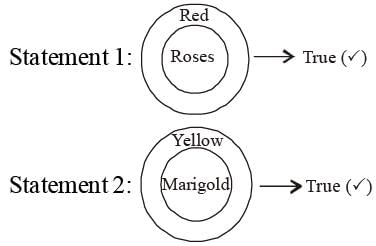
(1) All roses in Sita's garden are red. (SSC CGL 2014)
(2) All marigold flowers in Sita's garden are orange.
(3) All flowers in Sita's garden are either red or orange.If 1st two statements are true, the third is- a)True
- b)False
- c)Uncertain
- d)Vague
Correct answer is option 'C'. Can you explain this answer?
(1) All roses in Sita's garden are red. (SSC CGL 2014)
(2) All marigold flowers in Sita's garden are orange.
(3) All flowers in Sita's garden are either red or orange.
(2) All marigold flowers in Sita's garden are orange.
(3) All flowers in Sita's garden are either red or orange.
If 1st two statements are true, the third is
a)
True
b)
False
c)
Uncertain
d)
Vague
 | Vikram Mehta answered |

In each of the following question below are given some statement followed by some conclusions. Taking the given statements to be true even if they seem to be at variance from commonly known facts, read all the conclusions and then decide which of the given conclusion logically follows the given statemen ts. (SSC CGL 2017)Statements:
I. Some boys are hardworking.
II. No intelligent ar e boys.Conclusions:
I. Some hardwarking are not intelligent.
II. All hardworking are intelligent.
III. Some intelligent are not hardworking.- a)Only conclusion (I) follow.
- b)Only conclusion (I) and (III) follow.
- c)All conclusions follow.
- d)No conclusion follows.
Correct answer is option 'A'. Can you explain this answer?
In each of the following question below are given some statement followed by some conclusions. Taking the given statements to be true even if they seem to be at variance from commonly known facts, read all the conclusions and then decide which of the given conclusion logically follows the given statemen ts. (SSC CGL 2017)
Statements:
I. Some boys are hardworking.
II. No intelligent ar e boys.
I. Some boys are hardworking.
II. No intelligent ar e boys.
Conclusions:
I. Some hardwarking are not intelligent.
II. All hardworking are intelligent.
III. Some intelligent are not hardworking.
I. Some hardwarking are not intelligent.
II. All hardworking are intelligent.
III. Some intelligent are not hardworking.
a)
Only conclusion (I) follow.
b)
Only conclusion (I) and (III) follow.
c)
All conclusions follow.
d)
No conclusion follows.
 | Malavika Rane answered |
Given Statements:
I. Some boys are hardworking.
II. No intelligent are boys.
Conclusions:
I. Some hardworking are not intelligent.
II. All hardworking are intelligent.
III. Some intelligent are not hardworking.
Explanation:
Conclusion (I):
This conclusion follows logically from the given statements. If some boys are hardworking and no intelligent are boys, then it is possible that some hardworking individuals are not intelligent.
Conclusion (II):
This conclusion does not follow from the given statements. While it is true that some hardworking individuals may be intelligent, the statement "No intelligent are boys" does not provide enough information to conclude that all hardworking individuals are intelligent.
Conclusion (III):
This conclusion also follows logically from the given statements. Since no intelligent are boys, it is possible that some intelligent individuals are not hardworking.
Therefore, the correct answer is option 'A', as only conclusion (I) follows from the given statements.
I. Some boys are hardworking.
II. No intelligent are boys.
Conclusions:
I. Some hardworking are not intelligent.
II. All hardworking are intelligent.
III. Some intelligent are not hardworking.
Explanation:
Conclusion (I):
This conclusion follows logically from the given statements. If some boys are hardworking and no intelligent are boys, then it is possible that some hardworking individuals are not intelligent.
Conclusion (II):
This conclusion does not follow from the given statements. While it is true that some hardworking individuals may be intelligent, the statement "No intelligent are boys" does not provide enough information to conclude that all hardworking individuals are intelligent.
Conclusion (III):
This conclusion also follows logically from the given statements. Since no intelligent are boys, it is possible that some intelligent individuals are not hardworking.
Therefore, the correct answer is option 'A', as only conclusion (I) follows from the given statements.
DIRECTIONS: In the questions, Three statements are given followed by two/four conclusions I, II, III, & IV. You have to consider the three statements to be true even if they seem to be at variance from commonly known facts. You have to decide which of the given conclusions if any follow from the given statements. (SSC Steno. 2014)Statements:
All athletes are brave.
All girls are athletes.Conclusions:
I. All girls are brave.
II. Some athletes are girls. - a)Only conclusion II follows.
- b)Both conclusion I and II follow.
- c)Neither conclusion I nor II follows.
- d)Only con clusion I follows.
Correct answer is option 'B'. Can you explain this answer?
DIRECTIONS: In the questions, Three statements are given followed by two/four conclusions I, II, III, & IV. You have to consider the three statements to be true even if they seem to be at variance from commonly known facts. You have to decide which of the given conclusions if any follow from the given statements. (SSC Steno. 2014)
Statements:
All athletes are brave.
All girls are athletes.
All athletes are brave.
All girls are athletes.
Conclusions:
I. All girls are brave.
II. Some athletes are girls.
I. All girls are brave.
II. Some athletes are girls.
a)
Only conclusion II follows.
b)
Both conclusion I and II follow.
c)
Neither conclusion I nor II follows.
d)
Only con clusion I follows.
 | Knowledge Center answered |
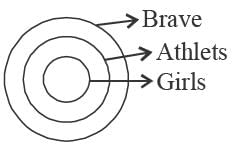
Conclusions: I. True II. T rue
DIRECTIONS: In the questions, Three statements are given followed by two/four conclusions I, II, III, & IV. You have to consider the three statements to be true even if they seem to be at variance from commonly known facts. You have to decide which of the given conclusions if any follow from the given statements. (SSC CHSL 2014)Statements:
1. All clerks are superin tenden ts.
2. All super intendents are managers.
3. All managers ar e supervisors.Conclusions:
I. All supervisors are clerks.
II. Some clerks are supervisors.
III. All superintendents are clerks.- a)Only conclusion I.
- b)Only conclusion II.
- c)Only conclusion III.
- d)Only conclusion IV
Correct answer is option 'B'. Can you explain this answer?
DIRECTIONS: In the questions, Three statements are given followed by two/four conclusions I, II, III, & IV. You have to consider the three statements to be true even if they seem to be at variance from commonly known facts. You have to decide which of the given conclusions if any follow from the given statements. (SSC CHSL 2014)
Statements:
1. All clerks are superin tenden ts.
2. All super intendents are managers.
3. All managers ar e supervisors.
1. All clerks are superin tenden ts.
2. All super intendents are managers.
3. All managers ar e supervisors.
Conclusions:
I. All supervisors are clerks.
II. Some clerks are supervisors.
III. All superintendents are clerks.
I. All supervisors are clerks.
II. Some clerks are supervisors.
III. All superintendents are clerks.
a)
Only conclusion I.
b)
Only conclusion II.
c)
Only conclusion III.
d)
Only conclusion IV
| | Vikram Mehta answered |
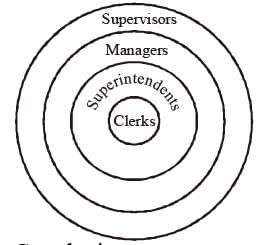
Conclusions:
I. False II. True III. False
DIRECTIONS: In the following Questions, one statement is given followed by two conclusions, I and II.
You have to consider the statement to be true, even if it seems to be at variance from commonly known facts. You are to decide which of the given conclusions can definitely be drawn from the given statement. Indicate your answer. (SSC CGL 1st Sit. 2015)Statement : Aggressive animals can be train ed with care and affection to behave as the occassion demands.Conclusions I : Trained dogs cannot be aggressive.
Conclusions II : Animals are always aggressive unless care and affection is given to them. - a)Only I follows
- b)Only II follows
- c)Neither I nor II follows
- d)Both I and II follow
Correct answer is option 'C'. Can you explain this answer?
DIRECTIONS: In the following Questions, one statement is given followed by two conclusions, I and II.
You have to consider the statement to be true, even if it seems to be at variance from commonly known facts. You are to decide which of the given conclusions can definitely be drawn from the given statement. Indicate your answer. (SSC CGL 1st Sit. 2015)
You have to consider the statement to be true, even if it seems to be at variance from commonly known facts. You are to decide which of the given conclusions can definitely be drawn from the given statement. Indicate your answer. (SSC CGL 1st Sit. 2015)
Statement : Aggressive animals can be train ed with care and affection to behave as the occassion demands.
Conclusions I : Trained dogs cannot be aggressive.
Conclusions II : Animals are always aggressive unless care and affection is given to them.
Conclusions II : Animals are always aggressive unless care and affection is given to them.
a)
Only I follows
b)
Only II follows
c)
Neither I nor II follows
d)
Both I and II follow
| | Vikram Mehta answered |
Conclusion I is not based upon the given statement.
Conclusion II does not prove the given statement so, neither I nor II follows.
Conclusion II does not prove the given statement so, neither I nor II follows.
DIRECTIONS: In question below one or two statements are given followed by two conclusions I and II. You have to consider the statement to be true, even if it seems to be at variance from commonly known facts. You are to decide which of the given conclusions can definitely be drawn from the given statement. Indicate your answer. (SSC Sub. Ins. 2015)Statements:
(a) Some schools are Labor atories
(b) All Laboratories are theatersConclusions:
I. Some theatres are schools
II. No school is a theater- a)Neither conclusion I nor II follow
- b)Conclusion I follows
- c)Conclusion II follows
- d)Conclusion I & II follows
Correct answer is option 'B'. Can you explain this answer?
DIRECTIONS: In question below one or two statements are given followed by two conclusions I and II. You have to consider the statement to be true, even if it seems to be at variance from commonly known facts. You are to decide which of the given conclusions can definitely be drawn from the given statement. Indicate your answer. (SSC Sub. Ins. 2015)
Statements:
(a) Some schools are Labor atories
(b) All Laboratories are theaters
(a) Some schools are Labor atories
(b) All Laboratories are theaters
Conclusions:
I. Some theatres are schools
II. No school is a theater
I. Some theatres are schools
II. No school is a theater
a)
Neither conclusion I nor II follow
b)
Conclusion I follows
c)
Conclusion II follows
d)
Conclusion I & II follows
 | Ssc Cgl answered |
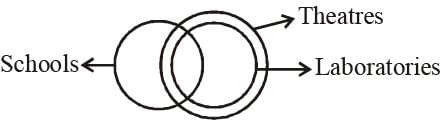
Conclusions: (I) True (II) False
DIRECTIONS: In the following Questions, one statement is given followed by two conclusions, I and II.
You have to consider the statement to be true, even if it seems to be at variance from commonly known facts. You are to decide which of the given conclusions can definitely be drawn from the given statement. Indicate your answer. (SSC CGL 1st Sit. 2015)Statement : Every school should promote partnerships that will increase parental involvement and participation for promoting the growth of children.Conclusions I: For the growth of the children, parents should be involved in various school activities.
Conclusions II: Involvement of parents in school activities has no influence on the growth of the children.- a)Only I follows
- b)Only II follows
- c)Neither I nor II follows
- d)Both I and II follow
Correct answer is option 'A'. Can you explain this answer?
DIRECTIONS: In the following Questions, one statement is given followed by two conclusions, I and II.
You have to consider the statement to be true, even if it seems to be at variance from commonly known facts. You are to decide which of the given conclusions can definitely be drawn from the given statement. Indicate your answer. (SSC CGL 1st Sit. 2015)
You have to consider the statement to be true, even if it seems to be at variance from commonly known facts. You are to decide which of the given conclusions can definitely be drawn from the given statement. Indicate your answer. (SSC CGL 1st Sit. 2015)
Statement : Every school should promote partnerships that will increase parental involvement and participation for promoting the growth of children.
Conclusions I: For the growth of the children, parents should be involved in various school activities.
Conclusions II: Involvement of parents in school activities has no influence on the growth of the children.
Conclusions II: Involvement of parents in school activities has no influence on the growth of the children.
a)
Only I follows
b)
Only II follows
c)
Neither I nor II follows
d)
Both I and II follow
 | Pranab Goyal answered |
Explanation:
Statement: Every school should promote partnerships that will increase parental involvement and participation for promoting the growth of children.
Conclusion I: For the growth of the children, parents should be involved in various school activities.
- This conclusion directly follows from the statement as it emphasizes the importance of parental involvement in promoting the growth of children. When parents are actively involved in school activities, it can have a positive impact on the overall development and well-being of the children.
Conclusion II: Involvement of parents in school activities has no influence on the growth of the children.
- This conclusion is not valid as it contradicts the statement. The statement clearly states that parental involvement is crucial for promoting the growth of children. Therefore, it can be inferred that parental involvement does have a significant influence on the growth of children.
Therefore, only Conclusion I follows as it aligns with the statement provided.
Statement: Every school should promote partnerships that will increase parental involvement and participation for promoting the growth of children.
Conclusion I: For the growth of the children, parents should be involved in various school activities.
- This conclusion directly follows from the statement as it emphasizes the importance of parental involvement in promoting the growth of children. When parents are actively involved in school activities, it can have a positive impact on the overall development and well-being of the children.
Conclusion II: Involvement of parents in school activities has no influence on the growth of the children.
- This conclusion is not valid as it contradicts the statement. The statement clearly states that parental involvement is crucial for promoting the growth of children. Therefore, it can be inferred that parental involvement does have a significant influence on the growth of children.
Therefore, only Conclusion I follows as it aligns with the statement provided.
Two statements are given, each followed by two conclusion/ assumption, I and II. You have to consider the statement to be true even if they seem to be at variance from commonly known facts. You have to decide which of the given conclusion/assumptions, if any, follows from the given statements. (SSC CHSL 2015)Statements:
(i) Some papers are pens.
(ii) All the pencils are pens.Conclusion:
I. Some pens are pencils
II. Some pens are papers- a)Either I or II follows
- b)Both I and II follow
- c)Only I conclusion follows
- d)Only II conclusion follows
Correct answer is option 'B'. Can you explain this answer?
Two statements are given, each followed by two conclusion/ assumption, I and II. You have to consider the statement to be true even if they seem to be at variance from commonly known facts. You have to decide which of the given conclusion/assumptions, if any, follows from the given statements. (SSC CHSL 2015)
Statements:
(i) Some papers are pens.
(ii) All the pencils are pens.
(i) Some papers are pens.
(ii) All the pencils are pens.
Conclusion:
I. Some pens are pencils
II. Some pens are papers
I. Some pens are pencils
II. Some pens are papers
a)
Either I or II follows
b)
Both I and II follow
c)
Only I conclusion follows
d)
Only II conclusion follows
| | Vikram Mehta answered |
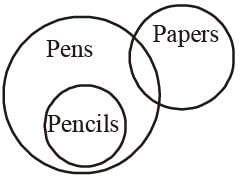
From the Venn diagram it follows.
So, some pens are pencils and some pens are papers.
So, both (I) and (II) follow.
So, some pens are pencils and some pens are papers.
So, both (I) and (II) follow.
DIRECTIONS: In the questions, Three statements are given followed by two/four conclusions I, II, III, & IV. You have to consider the three statements to be true even if they seem to be at variance from commonly known facts. You have to decide which of the given conclusions if any follow from the given statements. (SSC CHSL 2014) Statements:
1. Rabin dranath Tagore wrote many poems.
2. Every poet has aesthetic knowledge.
3. Aesthetic is a part of axiological study.Conclusions:
I. Rabindran ath Tagore did different axiological study.
II. He followed the base of logic and ethics.- a)Only conclusion I.
- b)Both conclusion I and II.
- c)Only conclusion II.
- d)None of these
Correct answer is option 'A'. Can you explain this answer?
DIRECTIONS: In the questions, Three statements are given followed by two/four conclusions I, II, III, & IV. You have to consider the three statements to be true even if they seem to be at variance from commonly known facts. You have to decide which of the given conclusions if any follow from the given statements. (SSC CHSL 2014)
Statements:
1. Rabin dranath Tagore wrote many poems.
2. Every poet has aesthetic knowledge.
3. Aesthetic is a part of axiological study.
1. Rabin dranath Tagore wrote many poems.
2. Every poet has aesthetic knowledge.
3. Aesthetic is a part of axiological study.
Conclusions:
I. Rabindran ath Tagore did different axiological study.
II. He followed the base of logic and ethics.
I. Rabindran ath Tagore did different axiological study.
II. He followed the base of logic and ethics.
a)
Only conclusion I.
b)
Both conclusion I and II.
c)
Only conclusion II.
d)
None of these
| | Vikram Mehta answered |
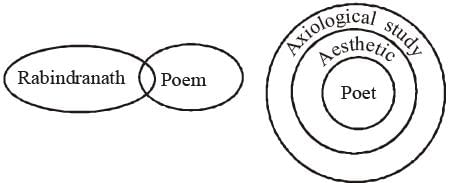
Conclusions:
A. True
B. True
A. True
B. True
DIRECTIONS: Questions, one or statements is given followed by two conclusions/assumptions, I and II. You have to consider the statement to be true, even if it seems to be at variance from commonly known facts. You have to decide which of the given conclusions/assumptions can definitely be drawn from the given statement. (SSC CGL 1st Sit. 2015)Statement: No rod is pod, No pod is flexible.Inferences:
I. No rod is flexible.
II. Some pods are flexible- a)Both of them follows
- b)Only inference I follows
- c)Only in ference II follows
- d)Neither of them follows.
Correct answer is option 'D'. Can you explain this answer?
DIRECTIONS: Questions, one or statements is given followed by two conclusions/assumptions, I and II. You have to consider the statement to be true, even if it seems to be at variance from commonly known facts. You have to decide which of the given conclusions/assumptions can definitely be drawn from the given statement. (SSC CGL 1st Sit. 2015)
Statement: No rod is pod, No pod is flexible.
Inferences:
I. No rod is flexible.
II. Some pods are flexible
I. No rod is flexible.
II. Some pods are flexible
a)
Both of them follows
b)
Only inference I follows
c)
Only in ference II follows
d)
Neither of them follows.
| | Vikram Mehta answered |
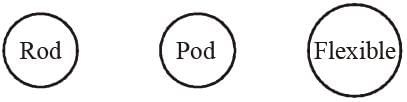
Inferences:
I : (False)
II : (False) Both statements are False, so no conclusion follows.
I : (False)
II : (False) Both statements are False, so no conclusion follows.
DIRECTIONS: In the question, Three statements are given followed by two/four conclusions I, II, III, & IV. You have to consider the three statements to be true even if they seem to be at variance from commonly known facts. You have to decide which of the given conclusions if any follow from the given statements. (SSC Steno. 2014)Statements:
I. Meen a is older than Roma.
II. Rashmi is older than Meena.
III. Roma is older then Rashmi.If 1st two statements are true then 3rd statement is- a)false
- b)uncertain
- c)vague
- d)true
Correct answer is option 'A'. Can you explain this answer?
DIRECTIONS: In the question, Three statements are given followed by two/four conclusions I, II, III, & IV. You have to consider the three statements to be true even if they seem to be at variance from commonly known facts. You have to decide which of the given conclusions if any follow from the given statements. (SSC Steno. 2014)
Statements:
I. Meen a is older than Roma.
II. Rashmi is older than Meena.
III. Roma is older then Rashmi.
I. Meen a is older than Roma.
II. Rashmi is older than Meena.
III. Roma is older then Rashmi.
If 1st two statements are true then 3rd statement is
a)
false
b)
uncertain
c)
vague
d)
true
| | Knowledge Center answered |
I. Meena > Roma
II. Rashmi > Meena
III. Roma > Rashmi
If 1st two statements are ture
⇒ 3rd statement is false.
Rashmi > Meena > Roma
II. Rashmi > Meena
III. Roma > Rashmi
If 1st two statements are ture
⇒ 3rd statement is false.
Rashmi > Meena > Roma
DIRECTIONS: In question below, some statements are given followed by three/two conclusions/assumptions respectively. You have to consider the statements to be true even if they seem to be at variance from commonly known facts.
You have to decide which of the given conclusions/assumptions if any, follow from the given statements. (SSC Sub. Ins. 2014)Statement:
Pictures can tell a story. All story books have pictures.
Some story books have words.Conclusions:
I. Pictures can tell a story better than words can.
II. The stories in story books are very simple.
III. Some story books have both words and pictures.- a)Only conclusion I follows
- b)Only conclusion II follows
- c)Only conclusion III follows
- d)Both conclusions I and II follow
Correct answer is option 'C'. Can you explain this answer?
DIRECTIONS: In question below, some statements are given followed by three/two conclusions/assumptions respectively. You have to consider the statements to be true even if they seem to be at variance from commonly known facts.
You have to decide which of the given conclusions/assumptions if any, follow from the given statements. (SSC Sub. Ins. 2014)
You have to decide which of the given conclusions/assumptions if any, follow from the given statements. (SSC Sub. Ins. 2014)
Statement:
Pictures can tell a story. All story books have pictures.
Some story books have words.
Pictures can tell a story. All story books have pictures.
Some story books have words.
Conclusions:
I. Pictures can tell a story better than words can.
II. The stories in story books are very simple.
III. Some story books have both words and pictures.
I. Pictures can tell a story better than words can.
II. The stories in story books are very simple.
III. Some story books have both words and pictures.
a)
Only conclusion I follows
b)
Only conclusion II follows
c)
Only conclusion III follows
d)
Both conclusions I and II follow
| | Knowledge Center answered |
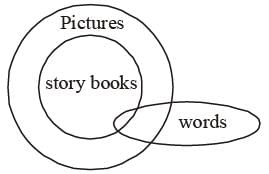
Conclusions:
(a) False
(b) False
(c) True
(d) False
Two statements are given followed by two conclusions I and II. You have to consider the statements to be true, even if they seem to be at variance from commonly known facts. You are to decide which of the given conclusions definitely follows from the given statements. Indicate your answer. (SSC Multitasking 2014)Statements:
All pencils are rails.
All rails are stations.Conclusions:
I. All stations are pencils.
II. Some stations are pencils.- a)Both Conclusions I and II follow
- b)Neither Conclusion I nor II follows
- c)Only Conclusion I follows
- d)Only Conclusion II follows
Correct answer is option 'D'. Can you explain this answer?
Two statements are given followed by two conclusions I and II. You have to consider the statements to be true, even if they seem to be at variance from commonly known facts. You are to decide which of the given conclusions definitely follows from the given statements. Indicate your answer. (SSC Multitasking 2014)
Statements:
All pencils are rails.
All rails are stations.
All pencils are rails.
All rails are stations.
Conclusions:
I. All stations are pencils.
II. Some stations are pencils.
I. All stations are pencils.
II. Some stations are pencils.
a)
Both Conclusions I and II follow
b)
Neither Conclusion I nor II follows
c)
Only Conclusion I follows
d)
Only Conclusion II follows
| | Vikram Mehta answered |
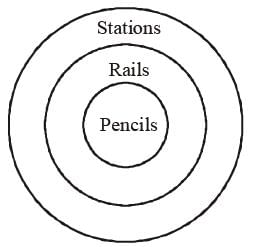
Conclusions:
I. False
II. True
Two statements ar e given followed by three conclusions numbered I, II and III. Assuming the statements to be true, even if they seem to be at variance with commonly known facts, decide which of the conclusions logically follow(s) from the statements. (SSC CGL 2018)Statements:
All utensils are spoons.
All bowls are spoons.
Conclusions:
I. No utensil is a bowls.
II. Some utensils ar e bowls
III. No spoon is a utensil.- a)Only conclusions I follows
- b)Conclusions I and III follow
- c)Either conclusion I or II follows
- d)Only conclusion III follows
Correct answer is option 'C'. Can you explain this answer?
Two statements ar e given followed by three conclusions numbered I, II and III. Assuming the statements to be true, even if they seem to be at variance with commonly known facts, decide which of the conclusions logically follow(s) from the statements. (SSC CGL 2018)
Statements:
All utensils are spoons.
All bowls are spoons.
Conclusions:
I. No utensil is a bowls.
II. Some utensils ar e bowls
III. No spoon is a utensil.
All utensils are spoons.
All bowls are spoons.
Conclusions:
I. No utensil is a bowls.
II. Some utensils ar e bowls
III. No spoon is a utensil.
a)
Only conclusions I follows
b)
Conclusions I and III follow
c)
Either conclusion I or II follows
d)
Only conclusion III follows
| | Malavika Rane answered |
Understanding the Statements
To analyze the conclusions, let's break down the provided statements:
- Statement 1: All utensils are spoons.
- Statement 2: All bowls are spoons.
From these statements, we can visualize the relationships:
- All utensils are contained within the category of spoons.
- All bowls are also contained within the category of spoons.
Evaluating the Conclusions
Now, we assess the conclusions based on the statements.
- Conclusion I: No utensil is a bowl.
- This conclusion does not necessarily follow from the statements. Since both utensils and bowls are types of spoons, they could potentially overlap. Therefore, we cannot conclude that no utensil is a bowl.
- Conclusion II: Some utensils are bowls.
- This conclusion also does not logically follow. While both utensils and bowls are spoons, the statements do not indicate any direct relationship suggesting that some utensils are indeed bowls.
- Conclusion III: No spoon is a utensil.
- This conclusion is incorrect. Since all utensils are classified as spoons, it follows that some spoons are indeed utensils.
Logical Implications
Given the analysis:
- Conclusion I and Conclusion II are both incorrect since they imply a mutually exclusive relationship that does not exist.
- Conclusion III is also incorrect because it contradicts the first statement.
However, since we are exploring logical possibilities rather than definitive truths, the option "either conclusion I or II follows" becomes valid. It implies that at least one of the two conclusions could be considered true under certain interpretations, even though the original statements do not support them directly.
Final Answer
Thus, the correct answer is option 'C': Either conclusion I or II follows.
To analyze the conclusions, let's break down the provided statements:
- Statement 1: All utensils are spoons.
- Statement 2: All bowls are spoons.
From these statements, we can visualize the relationships:
- All utensils are contained within the category of spoons.
- All bowls are also contained within the category of spoons.
Evaluating the Conclusions
Now, we assess the conclusions based on the statements.
- Conclusion I: No utensil is a bowl.
- This conclusion does not necessarily follow from the statements. Since both utensils and bowls are types of spoons, they could potentially overlap. Therefore, we cannot conclude that no utensil is a bowl.
- Conclusion II: Some utensils are bowls.
- This conclusion also does not logically follow. While both utensils and bowls are spoons, the statements do not indicate any direct relationship suggesting that some utensils are indeed bowls.
- Conclusion III: No spoon is a utensil.
- This conclusion is incorrect. Since all utensils are classified as spoons, it follows that some spoons are indeed utensils.
Logical Implications
Given the analysis:
- Conclusion I and Conclusion II are both incorrect since they imply a mutually exclusive relationship that does not exist.
- Conclusion III is also incorrect because it contradicts the first statement.
However, since we are exploring logical possibilities rather than definitive truths, the option "either conclusion I or II follows" becomes valid. It implies that at least one of the two conclusions could be considered true under certain interpretations, even though the original statements do not support them directly.
Final Answer
Thus, the correct answer is option 'C': Either conclusion I or II follows.
Consider the given statement/s to be true and decide which of the given conclusions/assumptions can definitely be drawn from the given statement. (SSC CGL 1st Sit. 2016)Statements:
1. All stenographers are lazy.
2. Some men are stenographers.Conclusions:
I. All lazy people are men.
II. Some men are lazy.- a)Only conclusion I follows
- b)Only conclusion II follows
- c)Both conclusion I and conclusion II follow
- d)Neither conclusion I nor conclusion II follows
Correct answer is option 'B'. Can you explain this answer?
Consider the given statement/s to be true and decide which of the given conclusions/assumptions can definitely be drawn from the given statement. (SSC CGL 1st Sit. 2016)
Statements:
1. All stenographers are lazy.
2. Some men are stenographers.
1. All stenographers are lazy.
2. Some men are stenographers.
Conclusions:
I. All lazy people are men.
II. Some men are lazy.
I. All lazy people are men.
II. Some men are lazy.
a)
Only conclusion I follows
b)
Only conclusion II follows
c)
Both conclusion I and conclusion II follow
d)
Neither conclusion I nor conclusion II follows
 | Nilesh Banerjee answered |
Understanding the Statements
The statements provided are:
1. All stenographers are lazy.
2. Some men are stenographers.
Let's analyze these statements and their implications.
Analyzing the Conclusions
Now, we need to evaluate the conclusions drawn:
Conclusion I: All lazy people are men.
- This conclusion cannot be drawn from the statements. Just because all stenographers (who are lazy) are included within the category of lazy people does not imply that all lazy individuals must be men. There could be lazy people who are not stenographers and not men. Therefore, this conclusion is not valid.
Conclusion II: Some men are lazy.
- This conclusion can be drawn. Since we know that some men are stenographers, and all stenographers are classified as lazy, it follows logically that those men who are stenographers must also be lazy. Hence, this conclusion is valid.
Final Evaluation
Based on the analysis:
- Only conclusion II follows from the provided statements.
Thus, the correct answer is option B: Only conclusion II follows.
The statements provided are:
1. All stenographers are lazy.
2. Some men are stenographers.
Let's analyze these statements and their implications.
Analyzing the Conclusions
Now, we need to evaluate the conclusions drawn:
Conclusion I: All lazy people are men.
- This conclusion cannot be drawn from the statements. Just because all stenographers (who are lazy) are included within the category of lazy people does not imply that all lazy individuals must be men. There could be lazy people who are not stenographers and not men. Therefore, this conclusion is not valid.
Conclusion II: Some men are lazy.
- This conclusion can be drawn. Since we know that some men are stenographers, and all stenographers are classified as lazy, it follows logically that those men who are stenographers must also be lazy. Hence, this conclusion is valid.
Final Evaluation
Based on the analysis:
- Only conclusion II follows from the provided statements.
Thus, the correct answer is option B: Only conclusion II follows.
In the following question below are given some statements followed by some conclusions. Taking the given statements to be true even if they seem to be at variance from commonly known facts, read all the conclusions and then decide which of the given conclusion logically follows the given statements. (SSC CGL 2017)Statements:
I. Some pens are pencils.
II. All pencils are erasers.Conclusions:
I. Some pencils are not pens.
II. Some erasers are not pens.- a)Only conclusion (I) follows.
- b)Only conclusion (II) follows.
- c)Both conclusions follow.
- d)Neither conclusion (I) nor conclusion (II) follows.
Correct answer is option 'C'. Can you explain this answer?
In the following question below are given some statements followed by some conclusions. Taking the given statements to be true even if they seem to be at variance from commonly known facts, read all the conclusions and then decide which of the given conclusion logically follows the given statements. (SSC CGL 2017)
Statements:
I. Some pens are pencils.
II. All pencils are erasers.
I. Some pens are pencils.
II. All pencils are erasers.
Conclusions:
I. Some pencils are not pens.
II. Some erasers are not pens.
I. Some pencils are not pens.
II. Some erasers are not pens.
a)
Only conclusion (I) follows.
b)
Only conclusion (II) follows.
c)
Both conclusions follow.
d)
Neither conclusion (I) nor conclusion (II) follows.
 | EduRev SSC CGL answered |
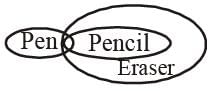
So, neither conclusion I nor II follows.
Three statements are given followed by three conclusions I, II and III. You have to consider the three statements to be true even if they seem to be at variance from commonly known facts. You have to decide which of the given conclusions, if any, follow from the given statements. (SSC Steno. 2016)Statements:
1. Mary said, "Ann and I both have cats,"
2. Ann said, "I don't have a cat."
3. Marry always tells the truth, but Ann sometimes lies.Conclusion:
I. Ann has a cat.
II. Mary has a cat.
III. Ann is lying.- a)I, II and III
- b)I only
- c)II only
- d)I and II only
Correct answer is option 'A'. Can you explain this answer?
Three statements are given followed by three conclusions I, II and III. You have to consider the three statements to be true even if they seem to be at variance from commonly known facts. You have to decide which of the given conclusions, if any, follow from the given statements. (SSC Steno. 2016)
Statements:
1. Mary said, "Ann and I both have cats,"
2. Ann said, "I don't have a cat."
3. Marry always tells the truth, but Ann sometimes lies.
1. Mary said, "Ann and I both have cats,"
2. Ann said, "I don't have a cat."
3. Marry always tells the truth, but Ann sometimes lies.
Conclusion:
I. Ann has a cat.
II. Mary has a cat.
III. Ann is lying.
I. Ann has a cat.
II. Mary has a cat.
III. Ann is lying.
a)
I, II and III
b)
I only
c)
II only
d)
I and II only
 | Abhiram Mehra answered |
Analysis:
Given Statements:
1. Mary said, "Ann and I both have cats,"
2. Ann said, "I don't have a cat."
3. Mary always tells the truth, but Ann sometimes lies.
Conclusion Analysis:
Conclusion I: Ann has a cat.
- Since Mary always tells the truth, and she mentioned that both Ann and she have cats, it implies that Ann must have a cat.
- Therefore, Conclusion I follows from the given statements.
Conclusion II: Mary has a cat.
- Mary stated that both she and Ann have cats. Since Mary always tells the truth, it can be inferred that Mary indeed has a cat.
- Therefore, Conclusion II also follows from the given statements.
Conclusion III: Ann is lying.
- Ann said that she doesn't have a cat, and it is mentioned that Ann sometimes lies. This statement from Ann could be a lie based on the given information.
- Therefore, Conclusion III also follows from the given statements.
Therefore, all three conclusions I, II, and III follow from the given statements. Hence, the correct answer is option 'A' - I, II, and III.
Given Statements:
1. Mary said, "Ann and I both have cats,"
2. Ann said, "I don't have a cat."
3. Mary always tells the truth, but Ann sometimes lies.
Conclusion Analysis:
Conclusion I: Ann has a cat.
- Since Mary always tells the truth, and she mentioned that both Ann and she have cats, it implies that Ann must have a cat.
- Therefore, Conclusion I follows from the given statements.
Conclusion II: Mary has a cat.
- Mary stated that both she and Ann have cats. Since Mary always tells the truth, it can be inferred that Mary indeed has a cat.
- Therefore, Conclusion II also follows from the given statements.
Conclusion III: Ann is lying.
- Ann said that she doesn't have a cat, and it is mentioned that Ann sometimes lies. This statement from Ann could be a lie based on the given information.
- Therefore, Conclusion III also follows from the given statements.
Therefore, all three conclusions I, II, and III follow from the given statements. Hence, the correct answer is option 'A' - I, II, and III.
Consider the given statement/s to be true and decide which of the given conclusions/assumptions can definitely be drawn from the given statement. (SSC CGL 1st Sit. 2016)Statements:
1. Some teacher are followers.
2. Some followers are famous.Conclusions:
I. Some teachers are famous.
II. Some followers are teachers.- a)Only conclusion I follows
- b)Only conclusion II follows
- c)Both conclusion I and II follows
- d)Neither conclusion I nor II follows
Correct answer is option 'B'. Can you explain this answer?
Consider the given statement/s to be true and decide which of the given conclusions/assumptions can definitely be drawn from the given statement. (SSC CGL 1st Sit. 2016)
Statements:
1. Some teacher are followers.
2. Some followers are famous.
1. Some teacher are followers.
2. Some followers are famous.
Conclusions:
I. Some teachers are famous.
II. Some followers are teachers.
I. Some teachers are famous.
II. Some followers are teachers.
a)
Only conclusion I follows
b)
Only conclusion II follows
c)
Both conclusion I and II follows
d)
Neither conclusion I nor II follows
| | Abhiram Mehra answered |
Understanding the Given Statements:
- Some teachers are followers (Teacher → Follower)
- Some followers are famous (Follower → Famous)
Conclusion Analysis:
Conclusion I: Some teachers are famous
- Since there is no direct link between teachers and being famous in the given statements, we cannot definitively conclude that some teachers are famous. Therefore, Conclusion I does not follow.
Conclusion II: Some followers are teachers
- As per the first statement, some teachers are followers. Since followers are also famous according to the second statement, it is possible that some followers who are famous can also be teachers. Therefore, Conclusion II follows.
Therefore, the correct answer is Option B: Only conclusion II follows.
The statemen ts below are followed by four con clusions labeled I, II, III and IV. Assuming that the information in the statements is true, even if it appears to be at variance with generally established facts, decide which conclusion(s) logically and definitely follow(s) from the information given in the statements. (SSC Stenographer 2018)Statements:
No laptop is notebook,
All notebooks are tablets.Conclusions:
I. No laptop is tablets,
II. No tablets is laptop.
III. Some tablets are notebooks.
IV. All the tablets are notebooks.- a)Only conclusion (III) follows.
- b)Only conclusion (II) and (IV) follow.
- c)Only conclusion (III) and (IV) follow.
- d)Only conclusion (I) and (III) follow.
Correct answer is option 'A'. Can you explain this answer?
The statemen ts below are followed by four con clusions labeled I, II, III and IV. Assuming that the information in the statements is true, even if it appears to be at variance with generally established facts, decide which conclusion(s) logically and definitely follow(s) from the information given in the statements. (SSC Stenographer 2018)
Statements:
No laptop is notebook,
All notebooks are tablets.
No laptop is notebook,
All notebooks are tablets.
Conclusions:
I. No laptop is tablets,
II. No tablets is laptop.
III. Some tablets are notebooks.
IV. All the tablets are notebooks.
I. No laptop is tablets,
II. No tablets is laptop.
III. Some tablets are notebooks.
IV. All the tablets are notebooks.
a)
Only conclusion (III) follows.
b)
Only conclusion (II) and (IV) follow.
c)
Only conclusion (III) and (IV) follow.
d)
Only conclusion (I) and (III) follow.
| | Abhiram Mehra answered |
Statements:
1. No laptop is a notebook.
2. All notebooks are tablets.
Conclusions:
I. No laptop is tablets.
II. No tablets is laptop.
III. Some tablets are notebooks.
IV. All the tablets are notebooks.
To determine which conclusions logically and definitely follow from the given statements, let's analyze each conclusion individually:
Conclusion I: No laptop is tablets.
This conclusion is not supported by the given statements. The first statement states that no laptop is a notebook, but it does not provide any information about laptops and tablets. Hence, we cannot conclude that no laptop is tablets. Therefore, conclusion I does not follow.
Conclusion II: No tablets is laptop.
This conclusion is also not supported by the given statements. The second statement states that all notebooks are tablets, but it does not provide any information about tablets and laptops. Hence, we cannot conclude that no tablets is a laptop. Therefore, conclusion II does not follow.
Conclusion III: Some tablets are notebooks.
This conclusion follows logically from the given statements. The second statement states that all notebooks are tablets, which means that every notebook is a tablet. Since the first statement also states that no laptop is a notebook, it implies that some tablets (which are also notebooks) exist. Therefore, conclusion III follows.
Conclusion IV: All the tablets are notebooks.
This conclusion is not supported by the given statements. The second statement states that all notebooks are tablets, but it does not provide any information about tablets and laptops. Therefore, we cannot conclude that all tablets are notebooks. Therefore, conclusion IV does not follow.
In conclusion, only conclusion III (Some tablets are notebooks) logically and definitely follows from the given statements.
1. No laptop is a notebook.
2. All notebooks are tablets.
Conclusions:
I. No laptop is tablets.
II. No tablets is laptop.
III. Some tablets are notebooks.
IV. All the tablets are notebooks.
To determine which conclusions logically and definitely follow from the given statements, let's analyze each conclusion individually:
Conclusion I: No laptop is tablets.
This conclusion is not supported by the given statements. The first statement states that no laptop is a notebook, but it does not provide any information about laptops and tablets. Hence, we cannot conclude that no laptop is tablets. Therefore, conclusion I does not follow.
Conclusion II: No tablets is laptop.
This conclusion is also not supported by the given statements. The second statement states that all notebooks are tablets, but it does not provide any information about tablets and laptops. Hence, we cannot conclude that no tablets is a laptop. Therefore, conclusion II does not follow.
Conclusion III: Some tablets are notebooks.
This conclusion follows logically from the given statements. The second statement states that all notebooks are tablets, which means that every notebook is a tablet. Since the first statement also states that no laptop is a notebook, it implies that some tablets (which are also notebooks) exist. Therefore, conclusion III follows.
Conclusion IV: All the tablets are notebooks.
This conclusion is not supported by the given statements. The second statement states that all notebooks are tablets, but it does not provide any information about tablets and laptops. Therefore, we cannot conclude that all tablets are notebooks. Therefore, conclusion IV does not follow.
In conclusion, only conclusion III (Some tablets are notebooks) logically and definitely follows from the given statements.
DIRECTIONS: In question below one or two statements are given followed by two conclusions I and II. You have to consider the statement to be true, even if it seems to be at variance from commonly known facts. You are to decide which of the given conclusions can definitely be drawn from the given statement. Indicate your answer. (SSC Sub. Ins. 2015)Statement:
Cactus plants are fleshy but need less waterConclusions:
I. All fleshy plants are cactus
II. Cactus plants need less water- a)Neither I nor II follows
- b)Only II follows
- c)Both I and II follows
- d)Only I follows
Correct answer is option 'B'. Can you explain this answer?
DIRECTIONS: In question below one or two statements are given followed by two conclusions I and II. You have to consider the statement to be true, even if it seems to be at variance from commonly known facts. You are to decide which of the given conclusions can definitely be drawn from the given statement. Indicate your answer. (SSC Sub. Ins. 2015)
Statement:
Cactus plants are fleshy but need less water
Cactus plants are fleshy but need less water
Conclusions:
I. All fleshy plants are cactus
II. Cactus plants need less water
I. All fleshy plants are cactus
II. Cactus plants need less water
a)
Neither I nor II follows
b)
Only II follows
c)
Both I and II follows
d)
Only I follows
| | Vikram Mehta answered |
Conclusion s: (I) False (II) True
Which conclusion is true with respect to the given statements? (SSC CHSL 2015)Statements:
(i) Roy studies History and Political Science
(ii) Roy studies in Oxford University.Conclusion:- a)Roy does not study Political Science.
- b)Roy studies History and Political Science in Oxford University.
- c)Roy studies Social Science.
- d)Roy does not study History.
Correct answer is option 'B'. Can you explain this answer?
Which conclusion is true with respect to the given statements? (SSC CHSL 2015)
Statements:
(i) Roy studies History and Political Science
(ii) Roy studies in Oxford University.
(i) Roy studies History and Political Science
(ii) Roy studies in Oxford University.
Conclusion:
a)
Roy does not study Political Science.
b)
Roy studies History and Political Science in Oxford University.
c)
Roy studies Social Science.
d)
Roy does not study History.
| | Vikram Mehta answered |
From the statements (I) and (II) we can conclude that Roy studies History and Political Science in Oxford University.
A 7 metre long piece of cloth is cut into three smaller pieces.How long is the longest of the three pieces? (SSC Sub. Ins. 2016)Given that Statements:
I. One piece is 3.70 metre long.
II. One piece is 1.50 metre longer than another piece and the remaining piece is 90 cm long.- a)Statement I alone but not Statement II alone is sufficient to answer the problem.
- b)Statement I and II both are needed to answer the problem.
- c)Statement II alone but not Statement I alone is sufficient to answer the problem.
- d)Statement I alone sufficient and also statement II alone sufficient to answer the problem.
Correct answer is option 'D'. Can you explain this answer?
A 7 metre long piece of cloth is cut into three smaller pieces.How long is the longest of the three pieces? (SSC Sub. Ins. 2016)
Given that Statements:
I. One piece is 3.70 metre long.
II. One piece is 1.50 metre longer than another piece and the remaining piece is 90 cm long.
I. One piece is 3.70 metre long.
II. One piece is 1.50 metre longer than another piece and the remaining piece is 90 cm long.
a)
Statement I alone but not Statement II alone is sufficient to answer the problem.
b)
Statement I and II both are needed to answer the problem.
c)
Statement II alone but not Statement I alone is sufficient to answer the problem.
d)
Statement I alone sufficient and also statement II alone sufficient to answer the problem.
| | Abhiram Mehra answered |
Understanding the Problem
The problem involves a 7-meter long piece of cloth cut into three smaller pieces. We need to determine the longest piece using the provided statements.
Statement I Analysis
- Statement I states that one piece is 3.70 meters long.
- This means the remaining cloth length after cutting this piece is:
- 7 m - 3.70 m = 3.30 m
- Without additional information, we cannot ascertain if the other two pieces are shorter or longer than 3.70 m. Therefore, we cannot conclusively determine the longest piece based on Statement I alone.
Statement II Analysis
- Statement II indicates:
- One piece is 1.50 meters longer than another piece.
- The remaining piece is 90 cm (0.90 m) long.
- Let the second piece be x meters long. Then:
- The first piece would be x + 1.50 meters.
- The sum of all three pieces must equal 7 meters:
- x + (x + 1.50) + 0.90 = 7
- Simplifying gives 2x + 2.40 = 7
- Thus, 2x = 4.60, leading to x = 2.30 meters.
- Therefore, the lengths of the pieces are:
- First piece: 2.30 + 1.50 = 3.80 meters
- Second piece: 2.30 meters
- Third piece: 0.90 meters
- The longest piece is 3.80 meters.
Conclusion
- Both statements provide sufficient information independently to determine the longest piece:
- Statement I implies one piece is 3.70 m, but lacks comparative context.
- Statement II allows for a complete calculation of all pieces.
- Hence, the correct answer is option 'D': both statements are sufficient individually to find the longest piece.
The problem involves a 7-meter long piece of cloth cut into three smaller pieces. We need to determine the longest piece using the provided statements.
Statement I Analysis
- Statement I states that one piece is 3.70 meters long.
- This means the remaining cloth length after cutting this piece is:
- 7 m - 3.70 m = 3.30 m
- Without additional information, we cannot ascertain if the other two pieces are shorter or longer than 3.70 m. Therefore, we cannot conclusively determine the longest piece based on Statement I alone.
Statement II Analysis
- Statement II indicates:
- One piece is 1.50 meters longer than another piece.
- The remaining piece is 90 cm (0.90 m) long.
- Let the second piece be x meters long. Then:
- The first piece would be x + 1.50 meters.
- The sum of all three pieces must equal 7 meters:
- x + (x + 1.50) + 0.90 = 7
- Simplifying gives 2x + 2.40 = 7
- Thus, 2x = 4.60, leading to x = 2.30 meters.
- Therefore, the lengths of the pieces are:
- First piece: 2.30 + 1.50 = 3.80 meters
- Second piece: 2.30 meters
- Third piece: 0.90 meters
- The longest piece is 3.80 meters.
Conclusion
- Both statements provide sufficient information independently to determine the longest piece:
- Statement I implies one piece is 3.70 m, but lacks comparative context.
- Statement II allows for a complete calculation of all pieces.
- Hence, the correct answer is option 'D': both statements are sufficient individually to find the longest piece.
DIRECTIONS: One/ two statement are given, each followed by two conclusion/assumption, I and II. You have to consider the statement to be true even if they seem to be at variance from commonly known facts. You have to decide which of the given conclusion/ assumptions, if any, follows from the given statements (SSC CHSL 2015)Statement: Travelling by metro in Delhi is more convenient and economical.Assumptions:
I. Other modes of tr ansport are not available.
II. Metro services are reasonably good.- a)Only assumption I is implicit
- b)Neither I nor II are implicit.
- c)Both I and II are implicit
- d)Only assumption II is implicit.
Correct answer is option 'D'. Can you explain this answer?
DIRECTIONS: One/ two statement are given, each followed by two conclusion/assumption, I and II. You have to consider the statement to be true even if they seem to be at variance from commonly known facts. You have to decide which of the given conclusion/ assumptions, if any, follows from the given statements (SSC CHSL 2015)
Statement: Travelling by metro in Delhi is more convenient and economical.
Assumptions:
I. Other modes of tr ansport are not available.
II. Metro services are reasonably good.
I. Other modes of tr ansport are not available.
II. Metro services are reasonably good.
a)
Only assumption I is implicit
b)
Neither I nor II are implicit.
c)
Both I and II are implicit
d)
Only assumption II is implicit.
| | Vikram Mehta answered |
Travelling by metro in Delhi is more convenient and economical. So we can assume that metro services are reasonably good. So assumption II is implicit.
In each of the following question below are given some statements followed by some conclusions. Taking the given statements to be true even if they seem to be at variance from commonly known facts, read all the conclusions and then decide which of the given conclusion logically follows the given statements. (SSC Sub. Ins. 2017)Statements:
I. Some pins are cups.
II. No cup is book.Conclusions:
I. Some pins are books.
II. Some pins are not books.- a)Only conclusion (I) follows
- b)Only conclusion (II) follows
- c)Both conclusion follow
- d)Neither conclusion (I) nor conclusion (II) follows
Correct answer is option 'B'. Can you explain this answer?
In each of the following question below are given some statements followed by some conclusions. Taking the given statements to be true even if they seem to be at variance from commonly known facts, read all the conclusions and then decide which of the given conclusion logically follows the given statements. (SSC Sub. Ins. 2017)
Statements:
I. Some pins are cups.
II. No cup is book.
I. Some pins are cups.
II. No cup is book.
Conclusions:
I. Some pins are books.
II. Some pins are not books.
I. Some pins are books.
II. Some pins are not books.
a)
Only conclusion (I) follows
b)
Only conclusion (II) follows
c)
Both conclusion follow
d)
Neither conclusion (I) nor conclusion (II) follows
| | EduRev SSC CGL answered |

So, only conclusions – II follows.
Two statements are given, followed by two conclusions I and II. You have to consider the statements to be true even if they seems to be at variance from commonly known facts. You have to decide which of the given conclusions, if any, follow from the given statements. (SSC Sub. Ins. 2016)Statements:
1. All Pens are Erasers.
2. All Erasers are Pencils.Conclusion:
I. All Pencils are Pens.
II. All Pens are Pencils.- a)Both conclusions I and II follow.
- b)Only conclusion II follows.
- c)Neither conclusion I nor II follows.
- d)Only conclusion I follows.
Correct answer is option 'B'. Can you explain this answer?
Two statements are given, followed by two conclusions I and II. You have to consider the statements to be true even if they seems to be at variance from commonly known facts. You have to decide which of the given conclusions, if any, follow from the given statements. (SSC Sub. Ins. 2016)
Statements:
1. All Pens are Erasers.
2. All Erasers are Pencils.
1. All Pens are Erasers.
2. All Erasers are Pencils.
Conclusion:
I. All Pencils are Pens.
II. All Pens are Pencils.
I. All Pencils are Pens.
II. All Pens are Pencils.
a)
Both conclusions I and II follow.
b)
Only conclusion II follows.
c)
Neither conclusion I nor II follows.
d)
Only conclusion I follows.
| | Vikram Mehta answered |
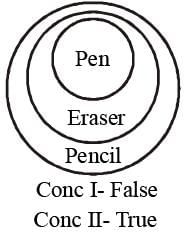
DIRECTIONS: Questions, one or two statements is given followed by two conclusions/assumptions, I and II. You have to consider the statement to be true, even if it seems to be at variance from commonly known facts. You have to decide which of the given conclusions/assumptions can definitely be drawn from the given statement. (SSC CGL 1st Sit. 2015)Statement: A good book even if costly is sold out in no time.Assumptions:
I. Some books are better than others
II. All good books are costly - a)Only I follows
- b)Both I and II follows
- c)Neither I nor II follows
- d)Only II follows
Correct answer is option 'C'. Can you explain this answer?
DIRECTIONS: Questions, one or two statements is given followed by two conclusions/assumptions, I and II. You have to consider the statement to be true, even if it seems to be at variance from commonly known facts. You have to decide which of the given conclusions/assumptions can definitely be drawn from the given statement. (SSC CGL 1st Sit. 2015)
Statement: A good book even if costly is sold out in no time.
Assumptions:
I. Some books are better than others
II. All good books are costly
I. Some books are better than others
II. All good books are costly
a)
Only I follows
b)
Both I and II follows
c)
Neither I nor II follows
d)
Only II follows
| | Vikram Mehta answered |
Neither I nor II assumption follows the given statement.
DIRECTIONS: One/ two statement are given, each followed by two conclusion/assumption, I and II. You have to consider the statement to be true even if they seem to be at variance from commonly known facts. You have to decide which of the given conclusion/ assumptions, if any, follows from the given statements (SSC CHSL 2015)Statement: Continuous training is essential for all employees to increase their productivityAssumptions:
I. Training is an essential component for productivity.
II. Profitability & productivity are supplementary to each other.- a)Only assumption II is implicit
- b)Neither assumption I nor II are implicit.
- c)Both assumption I and II are implicit
- d)Assumption I is implicit.
Correct answer is option 'D'. Can you explain this answer?
DIRECTIONS: One/ two statement are given, each followed by two conclusion/assumption, I and II. You have to consider the statement to be true even if they seem to be at variance from commonly known facts. You have to decide which of the given conclusion/ assumptions, if any, follows from the given statements (SSC CHSL 2015)
Statement: Continuous training is essential for all employees to increase their productivity
Assumptions:
I. Training is an essential component for productivity.
II. Profitability & productivity are supplementary to each other.
I. Training is an essential component for productivity.
II. Profitability & productivity are supplementary to each other.
a)
Only assumption II is implicit
b)
Neither assumption I nor II are implicit.
c)
Both assumption I and II are implicit
d)
Assumption I is implicit.
| | Vikram Mehta answered |
Con tinuous training is essential for all employees to increase productivity so we can assume that for good productivity training is necessary to avoid losses due to unskilled person but statement does not imply profitability and productivity are supplementary to each other. It depends upon other factors also.
In each of the following question below are given some statements followed by some conclusions. Taking the given statements to be true even if they seem to be at variance from commonly known facts, read all the conclusions and then decide which of the given conclusion logically follows the given statements. (SSC Sub. Ins. 2017)Statements:
I. All women are hardworking.
II. All intelligent are advocate.
III. Some intelligent are women.Conclusions:
I. Some advocates ar e women.
II. Some hardworking are women.
III. Some women are advocate.
IV. Some hardworking are intelligent.- a)Only conclusion (II), (III) and (IV) follow
- b)Only conclusion (I), (II), and (III) follow
- c)Only conclusion (I), (III), and (IV) follow
- d)All conclusions follow
Correct answer is option 'D'. Can you explain this answer?
In each of the following question below are given some statements followed by some conclusions. Taking the given statements to be true even if they seem to be at variance from commonly known facts, read all the conclusions and then decide which of the given conclusion logically follows the given statements. (SSC Sub. Ins. 2017)
Statements:
I. All women are hardworking.
II. All intelligent are advocate.
III. Some intelligent are women.
I. All women are hardworking.
II. All intelligent are advocate.
III. Some intelligent are women.
Conclusions:
I. Some advocates ar e women.
II. Some hardworking are women.
III. Some women are advocate.
IV. Some hardworking are intelligent.
I. Some advocates ar e women.
II. Some hardworking are women.
III. Some women are advocate.
IV. Some hardworking are intelligent.
a)
Only conclusion (II), (III) and (IV) follow
b)
Only conclusion (I), (II), and (III) follow
c)
Only conclusion (I), (III), and (IV) follow
d)
All conclusions follow
 | Anjana Singh answered |
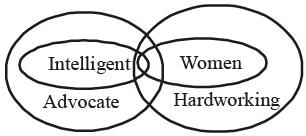
So, all conclusions are follow.
Chapter doubts & questions for Statement & Arguments and Statement & Conclusions - SSC CGL Previous Year Papers 2026 is part of SSC CGL exam preparation. The chapters have been prepared according to the SSC CGL exam syllabus. The Chapter doubts & questions, notes, tests & MCQs are made for SSC CGL 2026 Exam. Find important definitions, questions, notes, meanings, examples, exercises, MCQs and online tests here.
Chapter doubts & questions of Statement & Arguments and Statement & Conclusions - SSC CGL Previous Year Papers in English & Hindi are available as part of SSC CGL exam. Download more important topics, notes, lectures and mock test series for SSC CGL Exam by signing up for free.
SSC CGL Previous Year Papers313 docs|325 tests |
