


All Exams > Class 10 > The Complete SAT Course > All Questions
All questions of Modal Verbs for Class 10 Exam
Complete the following exercise with past modal verbs. Use the correct form of the verbs in parentheses. Choose between affirmative and negative.I got a C on my math test. I ____________ (should / do) better than that. Correct answer is 'should have done'. Can you explain this answer?
Complete the following exercise with past modal verbs. Use the correct form of the verbs in parentheses. Choose between affirmative and negative.
I got a C on my math test. I ____________ (should / do) better than that.
 | Meera Rana answered |
"I got a C on my math test. I should have done better than that."
"We use 'should have done' in this context because it expresses a sense of moral obligation or expectation. It implies that the speaker believes they had the ability or expectation to achieve a better result on the math test. It indicates a feeling of regret or disappointment that they did not perform as well as they believe they could or should have."

Fortunately, I .... working alone otherwise I would have got really bored at the night shift.- a)was supposed to
- b)was to
- c) was used to
- d)would
- e)used to
Correct answer is option 'C'. Can you explain this answer?
Fortunately, I .... working alone otherwise I would have got really bored at the night shift.
a)
was supposed to
b)
was to
c)
was used to
d)
would
e)
used to
 | Ritu Menon answered |
Explanation:
The given sentence is in the past tense, which suggests that the speaker is talking about a past experience or situation. The sentence talks about the speaker's experience of working alone during the night shift.
The correct answer is "was used to" because it implies that the speaker was accustomed to working alone during the night shift, and it was not a new or uncomfortable experience for them.
Let's break down the options and see why they are incorrect:
a) "was supposed to" implies that there was some expectation or obligation for the speaker to work alone during the night shift, but it doesn't convey the idea that the speaker was comfortable with it.
b) "was" is a simple past tense verb that doesn't convey any sense of habit or routine, so it doesn't fit in the context of the sentence.
c) "was used to" is the correct answer because it implies that the speaker had become accustomed to working alone during the night shift, and it was a familiar experience for them.
d) "would" suggests a hypothetical or conditional situation, which doesn't fit in the context of the sentence.
e) "used to" is incorrect because it is a present tense verb that doesn't match the past tense of the sentence.
In summary, the correct answer is "was used to" because it accurately conveys the idea that the speaker was accustomed to working alone during the night shift.
The given sentence is in the past tense, which suggests that the speaker is talking about a past experience or situation. The sentence talks about the speaker's experience of working alone during the night shift.
The correct answer is "was used to" because it implies that the speaker was accustomed to working alone during the night shift, and it was not a new or uncomfortable experience for them.
Let's break down the options and see why they are incorrect:
a) "was supposed to" implies that there was some expectation or obligation for the speaker to work alone during the night shift, but it doesn't convey the idea that the speaker was comfortable with it.
b) "was" is a simple past tense verb that doesn't convey any sense of habit or routine, so it doesn't fit in the context of the sentence.
c) "was used to" is the correct answer because it implies that the speaker had become accustomed to working alone during the night shift, and it was a familiar experience for them.
d) "would" suggests a hypothetical or conditional situation, which doesn't fit in the context of the sentence.
e) "used to" is incorrect because it is a present tense verb that doesn't match the past tense of the sentence.
In summary, the correct answer is "was used to" because it accurately conveys the idea that the speaker was accustomed to working alone during the night shift.
Don't be so hard on yourself. It ______ (may / be) your fault. Correct answer is 'may not have been'. Can you explain this answer?
Don't be so hard on yourself. It ______ (may / be) your fault.
| | Meera Rana answered |
Don't be so hard on yourself. It may not have been your fault.
Here, "may" is used to convey a sense of possibility and to offer comfort and support to the listener by suggesting that the situation might not be entirely their fault.
Smallest cranial nerve :-- a)Abducens
- b)Optic
- c)Olfactory
- d)Auditory
Correct answer is option 'A'. Can you explain this answer?
Smallest cranial nerve :-
a)
Abducens
b)
Optic
c)
Olfactory
d)
Auditory
| | Raghav Bansal answered |
The abducens nerve (or abducent nerve) is the sixth cranial nerve (CNVI), in humans, that controls the movement of the lateral rectus muscle, responsible for outward gaze.
The rest of the class did pretty well. I _____ (should / study) harder. Correct answer is 'should have studied'. Can you explain this answer?
The rest of the class did pretty well. I _____ (should / study) harder.
| | Meera Rana answered |
The correct modal verb to use in this context is "should."
So the complete sentence would be: "The rest of the class did pretty well. I should have studied harder."
"Should" is used to express obligation, duty, or advisability.
As a young woman who had never given birth before, she ---- what the experience of childbirth ---- like.- a)doesn't know / will be
- b)may not know / is
- c)must not have known / will be
- d)may not know / would be
- e)couldn't have known / would be
Correct answer is option 'E'. Can you explain this answer?
As a young woman who had never given birth before, she ---- what the experience of childbirth ---- like.
a)
doesn't know / will be
b)
may not know / is
c)
must not have known / will be
d)
may not know / would be
e)
couldn't have known / would be
 | Vikas Kapoor answered |
The speaker is 100% sure about the reason as the young woman did not give birth earlier, also couldn't have known is used to show 100% certainty. Might, May etc shows chances of other possibilities, hence couldn't have known is the correct answer.
We all think that Maria ---- an interesting person to meet as we ---- a lot of stories about her so far.- a) is / had heard
- b)can be / heard
- c)might have been / hear
- d)would be / have heard
- e)will be / will have heard
Correct answer is option 'D'. Can you explain this answer?
We all think that Maria ---- an interesting person to meet as we ---- a lot of stories about her so far.
a)
is / had heard
b)
can be / heard
c)
might have been / hear
d)
would be / have heard
e)
will be / will have heard
 | Krishna Iyer answered |
In the sentence, the persons are making imagination, in the future he/she will come to know the reality, so the future tense verb will be used i.e. would be.
We all think that Maria would be an interesting person to meet as we have heared a lot of stories about her so far.
We all think that Maria would be an interesting person to meet as we have heared a lot of stories about her so far.
I don't know why Peter is so late; do you think he ---- lost coming here?- a)may get
- b)could get
- c)must have got
- d)might have got
- e) was to have got
Correct answer is option 'D'. Can you explain this answer?
I don't know why Peter is so late; do you think he ---- lost coming here?
a)
may get
b)
could get
c)
must have got
d)
might have got
e)
was to have got
| | Meera Rana answered |
I don't know why Peter is so late; do you think he might have got lost coming here?
I don't know why she didn't ask me how to do it as I ---- her.- a)must have helped
- b)could have helped
- c)might help
- d)should have helped
- e)could help
Correct answer is option 'B'. Can you explain this answer?
I don't know why she didn't ask me how to do it as I ---- her.
a)
must have helped
b)
could have helped
c)
might help
d)
should have helped
e)
could help
| | Divya Saha answered |
Explanation:
This question is based on the concept of modal verbs and their usage in different situations. Modal verbs are used to express different degrees of possibility, ability, permission, obligation, etc. Let's look at the options one by one.
(a) "must have helped" - This option implies a strong obligation or certainty about the past action. It suggests that the speaker is sure that he helped the person, and it is surprising that she did not ask for help. However, this option does not fit the context of the sentence, which is about a missed opportunity to offer help.
(b) "could have helped" - This option suggests a possibility or potential for helping, but it also implies that the speaker did not actually help the person. It fits the context of the sentence, which is about a missed opportunity to offer help. The speaker is saying that he had the ability to help, but the other person did not ask for it.
(c) "might help" - This option suggests a possibility or potential for helping, but it is weaker than "could have helped". It implies that the speaker is not sure if he would have been able to help or not. It does not fit the context of the sentence, which is about a missed opportunity to offer help.
(d) "should have helped" - This option implies a moral obligation or duty to help, and it suggests that the speaker failed to fulfill that obligation. It does not fit the context of the sentence, which is about a missed opportunity to offer help.
(e) "could help" - This option suggests a potential for helping in the present or future. It does not fit the context of the sentence, which is about a missed opportunity to offer help.
Therefore, the correct answer is (b) "could have helped".
This question is based on the concept of modal verbs and their usage in different situations. Modal verbs are used to express different degrees of possibility, ability, permission, obligation, etc. Let's look at the options one by one.
(a) "must have helped" - This option implies a strong obligation or certainty about the past action. It suggests that the speaker is sure that he helped the person, and it is surprising that she did not ask for help. However, this option does not fit the context of the sentence, which is about a missed opportunity to offer help.
(b) "could have helped" - This option suggests a possibility or potential for helping, but it also implies that the speaker did not actually help the person. It fits the context of the sentence, which is about a missed opportunity to offer help. The speaker is saying that he had the ability to help, but the other person did not ask for it.
(c) "might help" - This option suggests a possibility or potential for helping, but it is weaker than "could have helped". It implies that the speaker is not sure if he would have been able to help or not. It does not fit the context of the sentence, which is about a missed opportunity to offer help.
(d) "should have helped" - This option implies a moral obligation or duty to help, and it suggests that the speaker failed to fulfill that obligation. It does not fit the context of the sentence, which is about a missed opportunity to offer help.
(e) "could help" - This option suggests a potential for helping in the present or future. It does not fit the context of the sentence, which is about a missed opportunity to offer help.
Therefore, the correct answer is (b) "could have helped".
No, I _________ (ought to / copy) them. Correct answer is 'ought to copy'. Can you explain this answer?
No, I _________ (ought to / copy) them.
| | Swara Deshpande answered |
Explanation:
The correct answer is "ought to have copied". Let's break down the sentence to understand the answer better:
- The sentence is in the past tense, which means that the action has already taken place.
- "Ought to" is a modal verb used to express necessity or obligation.
- The verb "copy" is in the infinitive form, which means it has not been conjugated to match the subject.
Using "ought to have" in the sentence:
Since the action has already taken place, we need to use "ought to have" instead of "ought to". "Ought to have" is used to express a missed opportunity or regret about a past action or event.
Using the past participle:
The verb "copy" needs to be changed to its past participle form, which is "copied". This is because the action has already taken place.
Putting it all together:
Therefore, the correct sentence is "No, I ought to have copied them."
What ---- to Phil? He said he ---- here at eight o'clock.- a)can have happened / would be.
- b)should have happened / has been
- c)may happen / will have been
- d)would happen / is
- e)might have happened / will be
Correct answer is option 'E'. Can you explain this answer?
What ---- to Phil? He said he ---- here at eight o'clock.
a)
can have happened / would be.
b)
should have happened / has been
c)
may happen / will have been
d)
would happen / is
e)
might have happened / will be
 | Avinash Sharma answered |
Correct option is E. might have happened / will be
This is the correct choice because the first part "What might have happened to Phil?" is a speculation about what could have possibly occurred to Phil. The second part "He said he will be here at eight o'clock." is referring to a future event that Phil had planned. Both parts are grammatically correct and contextually appropriate. The other options do not fit contextually and/or are grammatically incorrect.
This is the correct choice because the first part "What might have happened to Phil?" is a speculation about what could have possibly occurred to Phil. The second part "He said he will be here at eight o'clock." is referring to a future event that Phil had planned. Both parts are grammatically correct and contextually appropriate. The other options do not fit contextually and/or are grammatically incorrect.
One of the US national security advisers ---- there ---- better intelligence sharing before the September 11 attacks.- a)had acknowledged / can be
- b)acknowledges / might be
- c)has acknowledged / could have been
- d)acknowledged / must be
- e) would acknowledge / will have been
Correct answer is option 'C'. Can you explain this answer?
One of the US national security advisers ---- there ---- better intelligence sharing before the September 11 attacks.
a)
had acknowledged / can be
b)
acknowledges / might be
c)
has acknowledged / could have been
d)
acknowledged / must be
e)
would acknowledge / will have been
 | Nikita Singh answered |
One of the US national security advisers has acknowledged there could have been better intelligence sharing before the September 11 attacks.
Some UFO sightings ---- (not explain) easily. No one is able to explain them easily.Correct answer is 'cannot be explained'. Can you explain this answer?
Some UFO sightings ---- (not explain) easily. No one is able to explain them easily.
 | Ishani Rane answered |
Some UFO sightings cannot be explained easily. No one is able to explain them easily.
In the sentence "Some UFO sightings cannot be explained easily," the modal verb "cannot" is used to express impossibility or extreme difficulty in achieving something—in this case, the act of explaining certain UFO sightings. The nature of these sightings is often mysterious, lacking clear evidence, definitive characteristics, or reliable eyewitness accounts, which makes forming a logical, scientific explanation challenging.
He is wearing a gold ring on his fourth finger. He ---- (marry).Correct answer is 'is married'. Can you explain this answer?
He is wearing a gold ring on his fourth finger. He ---- (marry).
| | Meera Rana answered |
He is wearing a gold ring on his fourth finger. He is married.
I don't think it was a good idea to intervene, instead, you .... your child to abandon the habit of thumb-sucking gradually, all by himself.- a)could have allowed
- b)had allowed
- c)must have allowed
- d)were able to allow
- e)have allowed
Correct answer is option 'A'. Can you explain this answer?
I don't think it was a good idea to intervene, instead, you .... your child to abandon the habit of thumb-sucking gradually, all by himself.
a)
could have allowed
b)
had allowed
c)
must have allowed
d)
were able to allow
e)
have allowed
| | Anoushka Tiwari answered |
I don't think it was a good idea to intervene, instead, you could have allowed your child to abandon the habit of thumb-sucking gradually, all by himself.
Try to speak slowly when you give your speech, If you don't, some of your words ---- (misunderstand).Correct answer is 'might be misunderstood'. Can you explain this answer?
Try to speak slowly when you give your speech, If you don't, some of your words ---- (misunderstand).
 | Rhea Gutgutia answered |
Slow speech to avoid Misunderstandings
Introduction: Speaking clearly and slowly is important to ensure that your message is conveyed effectively. If you speak too fast, your audience may not be able to keep up with what you are saying, and some of your words may be misunderstood.
The problem: Misunderstandings can occur when words are not pronounced clearly or when they are spoken too quickly. This can be frustrating for both the speaker and the listener, as it can lead to confusion and miscommunication.
The solution: Speaking slowly is the key to avoiding misunderstandings. When you speak slowly, you give your audience time to process what you are saying and to understand the meaning behind your words. This will help to ensure that your message is conveyed clearly and effectively.
Benefits of speaking slowly:
- Helps to improve communication: Speaking slowly allows you to be more articulate and precise, which can help to improve the clarity of your message. This can help to prevent misunderstandings and improve overall communication.
- Makes it easier for your audience to follow along: When you speak slowly, your audience has more time to process what you are saying, which can make it easier for them to follow along and understand your message.
- Can help to reduce anxiety: Speaking too quickly can make you feel anxious and nervous, which can impact your performance. Speaking slowly can help to reduce anxiety and improve your overall confidence.
Conclusion: In conclusion, speaking slowly is important to avoid misunderstandings and ensure that your message is conveyed effectively. By taking the time to speak clearly and at a reasonable pace, you can improve communication, make it easier for your audience to follow along, and reduce anxiety.
Introduction: Speaking clearly and slowly is important to ensure that your message is conveyed effectively. If you speak too fast, your audience may not be able to keep up with what you are saying, and some of your words may be misunderstood.
The problem: Misunderstandings can occur when words are not pronounced clearly or when they are spoken too quickly. This can be frustrating for both the speaker and the listener, as it can lead to confusion and miscommunication.
The solution: Speaking slowly is the key to avoiding misunderstandings. When you speak slowly, you give your audience time to process what you are saying and to understand the meaning behind your words. This will help to ensure that your message is conveyed clearly and effectively.
Benefits of speaking slowly:
- Helps to improve communication: Speaking slowly allows you to be more articulate and precise, which can help to improve the clarity of your message. This can help to prevent misunderstandings and improve overall communication.
- Makes it easier for your audience to follow along: When you speak slowly, your audience has more time to process what you are saying, which can make it easier for them to follow along and understand your message.
- Can help to reduce anxiety: Speaking too quickly can make you feel anxious and nervous, which can impact your performance. Speaking slowly can help to reduce anxiety and improve your overall confidence.
Conclusion: In conclusion, speaking slowly is important to avoid misunderstandings and ensure that your message is conveyed effectively. By taking the time to speak clearly and at a reasonable pace, you can improve communication, make it easier for your audience to follow along, and reduce anxiety.
I found this book on my desk when I came to class. It (leave) by one of the students in the earlier class.Correct answer is 'must have been left'. Can you explain this answer?
I found this book on my desk when I came to class. It (leave) by one of the students in the earlier class.
| | Krishna Iyer answered |
I found this book on my desk when I came to class. It must have been left by one of the students in the earlier class.
In this context, finding a book on your desk that wasn't there before suggests that it was left there by someone else, presumably during a time you were not present, such as an earlier class. "Must" is a modal verb that indicates a high degree of certainty about a past action, especially when direct evidence or firsthand knowledge is lacking but the circumstances strongly point to a specific conclusion.
According to our teacher, all of our compositions ---- (write) in ink. He won't accept papers written in pencil.Correct answer is 'must be written'. Can you explain this answer?
According to our teacher, all of our compositions ---- (write) in ink. He won't accept papers written in pencil.
| | Aditya Kumar answered |
According to our teacher, all of our compositions must be in ink. He won't accept papers written in pencil.
What? You tripped over a chair at the party and dropped your plate of food into a woman's lap? You ---- (embarrass)!Correct answer is 'must have been embarrassed'. Can you explain this answer?
What? You tripped over a chair at the party and dropped your plate of food into a woman's lap? You ---- (embarrass)!
| | Krishna Iyer answered |
What? You tripped over a chair at the party and dropped your plate of food into a woman's lap? You must be embarrased!
This construction implies a strong likelihood or assumption. In this context, it suggests that it's highly probable or expected for the person to feel embarrassed given the situation described. It's a natural response to such an embarrassing event.
The Sympathetic nervous system (S.N.S.) work through secretion of :-- a)Noradrenaline which stimulates the organ
- b)Acetyl choline which stimulates the organ
- c)Adrenaline which inhibits the organ
- d)Acetyl choline which inhibits the organ
Correct answer is option 'A'. Can you explain this answer?
The Sympathetic nervous system (S.N.S.) work through secretion of :-
a)
Noradrenaline which stimulates the organ
b)
Acetyl choline which stimulates the organ
c)
Adrenaline which inhibits the organ
d)
Acetyl choline which inhibits the organ
 | Tanu Rajput answered |
As the preganglionic cells of sympathetic nervous system are present at spinal cord at thoracic and lumber section..
After the voyaging ship was wrecked during a storm at sea, unfortunately, only two of the men on board .... swim to the small island nearby.- a)might
- b)were supposed to
- c)could
- d)were able to
- e)had to
Correct answer is option 'D'. Can you explain this answer?
After the voyaging ship was wrecked during a storm at sea, unfortunately, only two of the men on board .... swim to the small island nearby.
a)
might
b)
were supposed to
c)
could
d)
were able to
e)
had to
| | Nidhi Khanna answered |
Explanation:
The sentence talks about an unfortunate incident where a ship was wrecked during a storm at sea, and only two of the men on board were able to swim to the small island nearby. The correct option to fill in the blank is "were able to". Here's why:
Headings:
- Context
- Meaning of options
- Elimination process
- Conclusion
Context:
- The sentence talks about a storm that caused a shipwreck and only two men could swim to an island nearby.
Meaning of options:
- Might: This option means that the two men "might" have swum to the island, but we cannot be sure. It does not convey a definite meaning, so it is not the correct answer.
- Were supposed to: This option means that the two men were "supposed to" swim to the island, but it does not convey whether they actually did or not. It is not the correct answer.
- Could: This option means that the two men "could" have swum to the island, but it does not convey whether they actually did or not. It is not the correct answer.
- Were able to: This option means that the two men "were able to" swim to the island, which is the correct meaning conveyed by the sentence.
- Had to: This option means that the two men "had to" swim to the island, but it does not convey whether they actually did or not. It is not the correct answer.
Elimination process:
- We can eliminate the options "might", "were supposed to", "could", and "had to" because they do not convey the correct meaning in the given sentence.
- The only option remaining is "were able to".
Conclusion:
- The correct option to fill in the blank is "were able to" because it conveys the meaning that only two men were capable of swimming to the island.
The sentence talks about an unfortunate incident where a ship was wrecked during a storm at sea, and only two of the men on board were able to swim to the small island nearby. The correct option to fill in the blank is "were able to". Here's why:
Headings:
- Context
- Meaning of options
- Elimination process
- Conclusion
Context:
- The sentence talks about a storm that caused a shipwreck and only two men could swim to an island nearby.
Meaning of options:
- Might: This option means that the two men "might" have swum to the island, but we cannot be sure. It does not convey a definite meaning, so it is not the correct answer.
- Were supposed to: This option means that the two men were "supposed to" swim to the island, but it does not convey whether they actually did or not. It is not the correct answer.
- Could: This option means that the two men "could" have swum to the island, but it does not convey whether they actually did or not. It is not the correct answer.
- Were able to: This option means that the two men "were able to" swim to the island, which is the correct meaning conveyed by the sentence.
- Had to: This option means that the two men "had to" swim to the island, but it does not convey whether they actually did or not. It is not the correct answer.
Elimination process:
- We can eliminate the options "might", "were supposed to", "could", and "had to" because they do not convey the correct meaning in the given sentence.
- The only option remaining is "were able to".
Conclusion:
- The correct option to fill in the blank is "were able to" because it conveys the meaning that only two men were capable of swimming to the island.
The entire valley ---- (see) from their mountain home.Correct answer is 'can be seen'. Can you explain this answer?
The entire valley ---- (see) from their mountain home.
| | Hina Sharma answered |
The entire valley can be seen from their mountain home.
This phrase indicates the possibility or ability to see the entire valley from their mountain home. The use of "can" suggests that it is feasible or within the realm of possibility for someone at their mountain home to have a view of the entire valley.
Martin ---- my tennis racket without asking my permission. I got really angry with him.- a)needn't have taken
- b)must not have taken
- c)shouldn't have taken
- d)didn't need to taken
- e)might not have taken
Correct answer is option 'C'. Can you explain this answer?
Martin ---- my tennis racket without asking my permission. I got really angry with him.
a)
needn't have taken
b)
must not have taken
c)
shouldn't have taken
d)
didn't need to taken
e)
might not have taken
 | Superk Vaidya answered |
Option A is incorrect because there is no mention whether he needed it or not. It is specifically for taking the tennis racket without permission. Option B is incorrect because "must" is a word use for ethical behaviour which is not relevant here. Option D is grammatically incorrect. Option E is again irrelevant because of past tense. So, only Option C is valid as it relates to the permission that Martin did not take.
I ______ go to the club with you on Saturday, but I am visiting my parents and am not sure if they have made plans for me.Correct answer is 'could'. Can you explain this answer?
I ______ go to the club with you on Saturday, but I am visiting my parents and am not sure if they have made plans for me.
 | EduRev GMAT answered |
I could go to the club with you on Saturday, but I am visiting my parents and am not sure if they have made plans for me.
Could – there is a chance of going to the club, but it is not certain. Also acceptable is ‘might’.
In the response, I used the modal verb "can" to express possibility or ability. This modal verb indicates that the person has the capability or option to join at the club on Saturday, given that they are not certain about their parents' plans. It's a polite and open-ended way of suggesting that they are welcome to join if their situation allows. Using "can" in this context acknowledges the individual's agency and the uncertainty of their availability due to their parents' potential plans.
Five of the committee members will be unable to attend the next meeting. In my opinion, the meeting ---- (postpone).Correct answer is 'should be postponed'. Can you explain this answer?
Five of the committee members will be unable to attend the next meeting. In my opinion, the meeting ---- (postpone).
 | Rohit Chavan answered |
Explanation:
Context:
Five committee members will be unable to attend the next meeting.
Opinion:
In my opinion, the meeting should be postponed.
Reasoning:
- When a significant number of committee members are unable to attend a meeting, it can hinder the effectiveness and productivity of the meeting.
- The absence of five committee members could result in a lack of quorum, which is the minimum number of members required to conduct official business.
- Without a quorum, important decisions cannot be made and the meeting may not be considered valid.
- Postponing the meeting allows for all committee members to be present, ensuring that decisions are made collectively and that everyone's input is considered.
- By rescheduling the meeting, the committee can maximize attendance and ensure that all members have the opportunity to contribute and participate in the decision-making process.
- Postponing the meeting also demonstrates a commitment to inclusivity and respect for the committee members who are unable to attend due to various reasons such as personal or professional obligations.
- It allows for better collaboration and the opportunity for all members to be fully engaged in the discussions and decision-making process.
- Additionally, rescheduling the meeting shows that the committee values the time and effort of its members and wants to create an environment where everyone's contributions are valued and taken into account.
Conclusion:
Considering the absence of five committee members, it is advisable to postpone the meeting to ensure a productive and inclusive decision-making process.
Context:
Five committee members will be unable to attend the next meeting.
Opinion:
In my opinion, the meeting should be postponed.
Reasoning:
- When a significant number of committee members are unable to attend a meeting, it can hinder the effectiveness and productivity of the meeting.
- The absence of five committee members could result in a lack of quorum, which is the minimum number of members required to conduct official business.
- Without a quorum, important decisions cannot be made and the meeting may not be considered valid.
- Postponing the meeting allows for all committee members to be present, ensuring that decisions are made collectively and that everyone's input is considered.
- By rescheduling the meeting, the committee can maximize attendance and ensure that all members have the opportunity to contribute and participate in the decision-making process.
- Postponing the meeting also demonstrates a commitment to inclusivity and respect for the committee members who are unable to attend due to various reasons such as personal or professional obligations.
- It allows for better collaboration and the opportunity for all members to be fully engaged in the discussions and decision-making process.
- Additionally, rescheduling the meeting shows that the committee values the time and effort of its members and wants to create an environment where everyone's contributions are valued and taken into account.
Conclusion:
Considering the absence of five committee members, it is advisable to postpone the meeting to ensure a productive and inclusive decision-making process.
‘Now I am here, I ____ give you your Christmas gift. Here it is.’Correct answer is 'can'. Can you explain this answer?
‘Now I am here, I ____ give you your Christmas gift. Here it is.’
| | Chirag Roy answered |
Explanation:
Use of 'can' in the sentence:
- In this sentence, the word 'can' is used to indicate the ability or permission to do something in the present moment.
- The speaker is stating that they are physically present now and therefore have the ability to give the Christmas gift at that moment.
Explanation of the sentence:
- The sentence implies that the speaker was not able to give the gift before but is now able to do so because they are present.
- It also suggests that the act of giving the gift is happening in the present moment, emphasizing the immediacy of the action.
Importance of using 'can':
- Using 'can' in this context is important because it conveys the idea that the speaker is currently in a position to give the gift, which adds a sense of urgency and immediacy to the statement.
- It also highlights the fact that the speaker's presence is essential for the gift-giving to take place, making the act more personal and meaningful.
In conclusion, the use of 'can' in the sentence effectively communicates the speaker's ability to give the Christmas gift in the present moment, emphasizing the significance of their presence in the exchange.
Use of 'can' in the sentence:
- In this sentence, the word 'can' is used to indicate the ability or permission to do something in the present moment.
- The speaker is stating that they are physically present now and therefore have the ability to give the Christmas gift at that moment.
Explanation of the sentence:
- The sentence implies that the speaker was not able to give the gift before but is now able to do so because they are present.
- It also suggests that the act of giving the gift is happening in the present moment, emphasizing the immediacy of the action.
Importance of using 'can':
- Using 'can' in this context is important because it conveys the idea that the speaker is currently in a position to give the gift, which adds a sense of urgency and immediacy to the statement.
- It also highlights the fact that the speaker's presence is essential for the gift-giving to take place, making the act more personal and meaningful.
In conclusion, the use of 'can' in the sentence effectively communicates the speaker's ability to give the Christmas gift in the present moment, emphasizing the significance of their presence in the exchange.
Don't be so hard on yourself. It just ______ (could / be) a more difficult test than usual. Correct answer is 'could have been'. Can you explain this answer?
Don't be so hard on yourself. It just ______ (could / be) a more difficult test than usual.
| | Vaibhav Chakraborty answered |
Explanation:
The correct answer is "could have been" because it is a past tense modal verb phrase that indicates a possibility or hypothetical scenario in the past. Here's a breakdown of the grammar and meaning:
- "Could" is a modal verb that expresses possibility or ability.
- "Have" is the auxiliary verb that indicates the perfect aspect, which implies completed or ongoing action in the past.
- "Been" is the past participle of the verb "be" and is used to form the perfect aspect or passive voice.
Together, "could have been" suggests that the speaker is considering the possibility that the test was more difficult than usual, but is not certain. It also implies that the test is already over and the results are known, as the discussion is in the past tense.
Here's an example of the phrase in context:
- "I can't believe I did so poorly on that test. I studied so hard."
- "Don't be so hard on yourself. It just could have been a more difficult test than usual."
HTML breakdown:
Explanation:
The correct answer is "could have been" because it is a past tense modal verb phrase that indicates a possibility or hypothetical scenario in the past. Here's a breakdown of the grammar and meaning:
- "Could" is a modal verb that expresses possibility or ability.
- "Have" is the auxiliary verb that indicates the perfect aspect, which implies completed or ongoing action in the past.
- "Been" is the past participle of the verb "be" and is used to form the perfect aspect or passive voice.
Together, "could have been" suggests that the speaker is considering the possibility that the test was more difficult than usual, but is not certain. It also implies that the test is already over and the results are known, as the discussion is in the past tense.
Here's an example of the phrase in context:
- "I can't believe I did so poorly on that test. I studied so hard."
- "Don't be so hard on yourself. It just could have been a more difficult test than usual."
HTML breakdown:
Explanation:
- The correct answer is "could have been" because it is a past tense modal verb phrase that indicates a possibility or hypothetical scenario in the past.
- "Could" is a modal verb that expresses possibility or ability.
- "Have" is the auxiliary verb that indicates the perfect aspect, which implies completed or ongoing action in the past.
- "Been" is the past participle of the verb "be" and is used to form the perfect aspect or passive voice.
- Together, "could have been" suggests that the speaker is considering the possibility that the test was more difficult than usual, but is not certain. It also implies that the test is already over and the results are known, as the discussion is in the past tense.
- Here's an example of the phrase in context:
- "I can't believe I did so poorly on that test. I studied so hard."
- "Don't be so hard on yourself. It just could have been a more difficult test than usual."
What you _______ (could / do) differently? Correct answer is 'could have done'. Can you explain this answer?
What you _______ (could / do) differently?
 | Pranav Singh answered |
The correct answer is 'could have done'.
Explanation:
When we use the phrase "could have done," we are referring to a past action or decision that could have been done differently. It indicates a missed opportunity or a different choice that could have been made.
Example:
Imagine you are reflecting on a situation in the past where you made a mistake or could have acted differently. You might say:
"I could have done things differently."
In this sentence, "could have done" suggests that you had the ability or opportunity to make a different choice or take a different action at that time.
Usage:
"Could have done" is used to express regret, reflect on past actions, or consider alternative possibilities. It emphasizes the idea that something different was possible in the past but was not ultimately done.
Example:
Here are a few examples of how "could have done" is used in different contexts:
1. Regret:
- "I could have studied harder for the exam."
- "I could have been more supportive during their difficult time."
2. Reflection on past actions:
- "I could have handled the situation better."
- "I could have chosen a different career path."
3. Alternative possibilities:
- "We could have taken a different route to avoid traffic."
- "She could have chosen a different restaurant for dinner."
In all these examples, "could have done" acknowledges that a different choice or action was possible in the past but was not pursued.
Conclusion:
The correct answer "could have done" is used to discuss past actions or decisions that could have been done differently. It expresses regret, reflection, or alternative possibilities.
Explanation:
When we use the phrase "could have done," we are referring to a past action or decision that could have been done differently. It indicates a missed opportunity or a different choice that could have been made.
Example:
Imagine you are reflecting on a situation in the past where you made a mistake or could have acted differently. You might say:
"I could have done things differently."
In this sentence, "could have done" suggests that you had the ability or opportunity to make a different choice or take a different action at that time.
Usage:
"Could have done" is used to express regret, reflect on past actions, or consider alternative possibilities. It emphasizes the idea that something different was possible in the past but was not ultimately done.
Example:
Here are a few examples of how "could have done" is used in different contexts:
1. Regret:
- "I could have studied harder for the exam."
- "I could have been more supportive during their difficult time."
2. Reflection on past actions:
- "I could have handled the situation better."
- "I could have chosen a different career path."
3. Alternative possibilities:
- "We could have taken a different route to avoid traffic."
- "She could have chosen a different restaurant for dinner."
In all these examples, "could have done" acknowledges that a different choice or action was possible in the past but was not pursued.
Conclusion:
The correct answer "could have done" is used to discuss past actions or decisions that could have been done differently. It expresses regret, reflection, or alternative possibilities.
Jessica (should/must) revise her notes before the exam.Correct answer is 'should'. Can you explain this answer?
Jessica (should/must) revise her notes before the exam.
 | Talent Skill Learning answered |
Jessica should revise her notes before the exam.
We chose "should" over "must" to suggest a strong recommendation rather than an obligation. "Should" is used here to advise that it would be very beneficial for Jessica to review her notes to prepare for the exam, implying that doing so would likely improve her understanding of the material and her performance on the exam. While "must" implies a necessity or requirement, "should" conveys that the action is highly advisable for her own benefit, giving a sense of personal choice in the matter.
Your daughter has a good voice. Her interest in singing ---- (encourage).Correct answer is 'should be encouraged'. Can you explain this answer?
Your daughter has a good voice. Her interest in singing ---- (encourage).
 | Varun Kulkarni answered |
Encouraging Your Daughter's Singing Interest
There are different ways to encourage your daughter's interest in singing. Here's an explanation of why "must be encouraged" is the correct answer to the given statement.
Why "Must Be Encouraged"?
Ways to Encourage Your Daughter's Singing Interest
Conclusion
Encouraging your daughter's singing interest can help her develop her skills and confidence in this area, which can benefit her in various ways. Using "must be encouraged" emphasizes the importance of providing consistent support and motivation for her singing journey. By listening to her sing, providing positive feedback, offering resources and support, and connecting her with others who share her passion, you can help your daughter pursue her singing goals.
There are different ways to encourage your daughter's interest in singing. Here's an explanation of why "must be encouraged" is the correct answer to the given statement.
Why "Must Be Encouraged"?
- Using "must" emphasizes the importance of encouraging your daughter's interest in singing. It suggests that it is crucial to do so.
- The phrase "must be encouraged" implies that it is an ongoing process that requires consistent support and motivation.
- Encouraging your daughter's singing interest can help her develop her skills and confidence in this area, which can benefit her in various ways.
Ways to Encourage Your Daughter's Singing Interest
- Listen to her sing and provide positive feedback. This can help build her confidence and motivate her to continue practicing.
- Encourage her to participate in singing competitions or performances, which can give her opportunities to showcase her talent and receive constructive feedback.
- Provide her with resources for improving her singing skills, such as vocal lessons or online tutorials.
- Show interest in her progress and offer support and encouragement, even if she faces challenges or setbacks.
- Connect her with other singers or musicians who share her interests, which can help her build a network and gain inspiration.
Conclusion
Encouraging your daughter's singing interest can help her develop her skills and confidence in this area, which can benefit her in various ways. Using "must be encouraged" emphasizes the importance of providing consistent support and motivation for her singing journey. By listening to her sing, providing positive feedback, offering resources and support, and connecting her with others who share her passion, you can help your daughter pursue her singing goals.
When the lion attacks, the giraffe ______ escape. It has an even chance of doing so.Correct answer is 'might'. Can you explain this answer?
When the lion attacks, the giraffe ______ escape. It has an even chance of doing so.
 | Sreemoyee Nambiar answered |
Explanation:
Context:
In the given scenario, the lion is attacking the giraffe, and the question is about the giraffe's chances of escaping from the lion's attack.
Probability of Escape:
- When it is mentioned that the giraffe "might" escape, it indicates that there is a possibility of the giraffe managing to get away from the lion.
- The word "might" suggests uncertainty and implies that the outcome of the giraffe escaping is not guaranteed.
Factors affecting Escape:
- The giraffe's chances of escaping depend on various factors such as its speed, agility, environment, and the lion's proximity and hunting tactics.
- Giraffes are known for their speed and ability to run swiftly, which could increase their likelihood of escaping from a predator like a lion.
Even Chance:
- The statement "It has an even chance of doing so" implies that the giraffe has an equal probability of escaping as it does of not escaping.
- This suggests that the giraffe's chances of escaping are uncertain and could go either way.
Conclusion:
In conclusion, the word "might" indicates the uncertainty of the giraffe's escape, while the phrase "even chance" suggests that the probability of escape is equal to the probability of not escaping. Therefore, the giraffe has a fair but uncertain chance of escaping from the lion's attack.
Context:
In the given scenario, the lion is attacking the giraffe, and the question is about the giraffe's chances of escaping from the lion's attack.
Probability of Escape:
- When it is mentioned that the giraffe "might" escape, it indicates that there is a possibility of the giraffe managing to get away from the lion.
- The word "might" suggests uncertainty and implies that the outcome of the giraffe escaping is not guaranteed.
Factors affecting Escape:
- The giraffe's chances of escaping depend on various factors such as its speed, agility, environment, and the lion's proximity and hunting tactics.
- Giraffes are known for their speed and ability to run swiftly, which could increase their likelihood of escaping from a predator like a lion.
Even Chance:
- The statement "It has an even chance of doing so" implies that the giraffe has an equal probability of escaping as it does of not escaping.
- This suggests that the giraffe's chances of escaping are uncertain and could go either way.
Conclusion:
In conclusion, the word "might" indicates the uncertainty of the giraffe's escape, while the phrase "even chance" suggests that the probability of escape is equal to the probability of not escaping. Therefore, the giraffe has a fair but uncertain chance of escaping from the lion's attack.
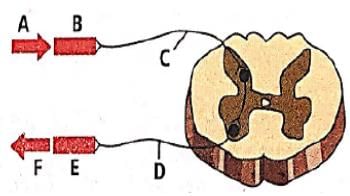
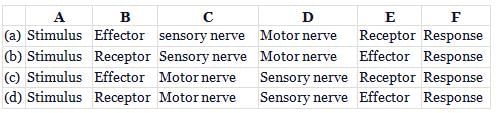
The path of reflex arc is shown in the given figure. Identify the different labellings A, B, C, D, E, F and select the correct option
- a)a
- b)b
- c)c
- d)d
Correct answer is option 'B'. Can you explain this answer?
The path of reflex arc is shown in the given figure. Identify the different labellings A, B, C, D, E, F and select the correct option
a)
a
b)
b
c)
c
d)
d
 | Ambition Institute answered |
To identify the different labels A, B, C, D, E, F in the reflex arc path:
- A (a): stimulus.
- B (b): Receptor
- C (c): Sensory neuron that carries the impulse to the central nervous system (CNS).
- D (d): Motor neuron that transmits the response from the CNS.
- E: (d) Effector (muscle or gland) that produces the response.
In the given image, label B represents the sensory neuron carrying the impulse to the CNS.
- A (a): stimulus.
- B (b): Receptor
- C (c): Sensory neuron that carries the impulse to the central nervous system (CNS).
- D (d): Motor neuron that transmits the response from the CNS.
- E: (d) Effector (muscle or gland) that produces the response.
In the given image, label B represents the sensory neuron carrying the impulse to the CNS.
Chapter doubts & questions for Modal Verbs - The Complete SAT Course 2026 is part of Class 10 exam preparation. The chapters have been prepared according to the Class 10 exam syllabus. The Chapter doubts & questions, notes, tests & MCQs are made for Class 10 2026 Exam. Find important definitions, questions, notes, meanings, examples, exercises, MCQs and online tests here.
Chapter doubts & questions of Modal Verbs - The Complete SAT Course in English & Hindi are available as part of Class 10 exam. Download more important topics, notes, lectures and mock test series for Class 10 Exam by signing up for free.
The Complete SAT Course405 videos|220 docs|164 tests |
