


All Exams > UPSC > UPSC Prelims Paper 2 CSAT - Quant, Verbal & Decision Making > All Questions
All questions of Probability for UPSC CSE Exam
One card is randomly drawn from a pack of 52 cards. What is the probability that the card drawn is a face card(Jack, Queen or King)- a)

- b)

- c)

- d)

Correct answer is option 'C'. Can you explain this answer?
One card is randomly drawn from a pack of 52 cards. What is the probability that the card drawn is a face card(Jack, Queen or King)
a)
b)
c)
d)
 | Nikita Singh answered |
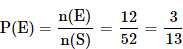
- Total number of cards, n(S) = 52
- Total number of face cards, n(E) = 12 (4 Jacks, 4 Queens, 4 Kings)

A die is rolled twice. What is the probability of getting a sum equal to 9?- a)

- b)

- c)

- d)

Correct answer is option 'D'. Can you explain this answer?
A die is rolled twice. What is the probability of getting a sum equal to 9?
a)
b)
c)
d)
 | Target Study Academy answered |
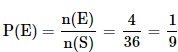
Total number of outcomes possible when a die is rolled = 6 (∵ any one face out of the 6 faces)
- Hence, total number of outcomes possible when a die is rolled twice, n(S) = 6 x 6 = 36
E = Getting a sum of 9 when the two dice fall = {(3,6), (4,5), (5,4), (6,3)}
- Hence, n(E) = 4
A bag contains 2 yellow, 3 green and 2 blue balls. Two balls are drawn at random. What is the probability that none of the balls drawn is blue?- a)

- b)

- c)

- d)

Correct answer is option 'B'. Can you explain this answer?
A bag contains 2 yellow, 3 green and 2 blue balls. Two balls are drawn at random. What is the probability that none of the balls drawn is blue?
a)
b)
c)
d)
 | Future Foundation Institute answered |
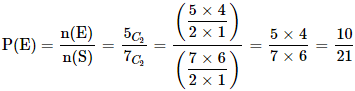
Total number of balls = 2 + 3 + 2 = 7
► Let S be the sample space.
- n(S) = Total number of ways of drawing 2 balls out of 7 = 7C2
► Let E = Event of drawing 2 balls, none of them is blue.
- n(E) = Number of ways of drawing 2 balls from the total 5 (= 7-2) balls = 5C2
(∵ There are two blue balls in the total 7 balls. Total number of non-blue balls = 7 - 2 = 5)
What is the probability of selecting a prime number from 1,2,3,... 10 ?- a)

- b)

- c)

- d)

Correct answer is option 'A'. Can you explain this answer?
What is the probability of selecting a prime number from 1,2,3,... 10 ?
a)
b)
c)
d)
| | Target Study Academy answered |
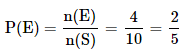
Total count of numbers, n(S) = 10
Prime numbers in the given range are 2,3,5 and 7
Hence, total count of prime numbers in the given range, n(E) = 4
Prime numbers in the given range are 2,3,5 and 7
Hence, total count of prime numbers in the given range, n(E) = 4
Find the chance of throwing at least one ace in a simple throw with two dice- a)1/12
- b)1/3
- c)1/4
- d)11/36
Correct answer is option 'D'. Can you explain this answer?
Find the chance of throwing at least one ace in a simple throw with two dice
a)
1/12
b)
1/3
c)
1/4
d)
11/36
 | Ravi Singh answered |
The possible number of cases is 6×6, or 36.
An ace on one die may be associated with any of the 6 numbers on the other die, and the remaining 5 numbers on the first die may each be associated with the ace on the second die; thus the number of favourable cases is 11.
Therefore the required chance is 11/36
An ace on one die may be associated with any of the 6 numbers on the other die, and the remaining 5 numbers on the first die may each be associated with the ace on the second die; thus the number of favourable cases is 11.
Therefore the required chance is 11/36
Can you explain the answer of this question below:A bag contains 4 black, 5 yellow and 6 green balls. Three balls are drawn at random from the bag. What is the probability that all of them are yellow?
- A:

- B:

- C:

- D:

The answer is A.
A bag contains 4 black, 5 yellow and 6 green balls. Three balls are drawn at random from the bag. What is the probability that all of them are yellow?
 | Divey Sethi answered |
Total number of balls = 4 + 5 + 6 = 15
Let S be the sample space.
- n(S) = Total number of ways of drawing 3 balls out of 15 = 15C3
Let E = Event of drawing 3 balls, all of them are yellow.
- n(E) = Number of ways of drawing 3 balls from the total 5 = 5C3
(∵ there are 5 yellow balls in the total balls)

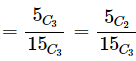
[∵ nCr = nC(n-r). So 5C3 = 5C2. Applying this for the ease of calculation]

Three numbers are chosen at random without replacement from (1, 2, 3 ..., 10). The probability that the minimum number is 3 or the maximum number is 7 is- a)12/37
- b)11/40
- c)13/35
- d)14/35
Correct answer is option 'B'. Can you explain this answer?
Three numbers are chosen at random without replacement from (1, 2, 3 ..., 10). The probability that the minimum number is 3 or the maximum number is 7 is
a)
12/37
b)
11/40
c)
13/35
d)
14/35
 | Aarav Sharma answered |
Given information:
Three numbers are chosen at random without replacement from (1, 2, 3 ..., 10).
To find:
The probability that the minimum number is 3 or the maximum number is 7.
Solution:
Step 1:
Total number of outcomes:
When three numbers are chosen from (1, 2, 3 ..., 10) without replacement, the total number of outcomes is given by the combination formula:
nCr = n! / (r!(n-r)!)
Here, n = 10 (total numbers to choose from)
r = 3 (number of numbers chosen)
Total number of outcomes = 10C3 = 10! / (3!(10-3)!) = 10! / (3!7!) = (10*9*8*7!)/(3*2*1*7!) = (10*9*8)/(3*2*1) = 120
Hence, there are 120 possible outcomes.
Step 2:
Favorable outcomes:
To find the favorable outcomes, we need to consider two cases separately:
Case 1: The minimum number is 3
Case 2: The maximum number is 7
Case 1: The minimum number is 3
If the minimum number is 3, then we can choose the other two numbers from the remaining 9 numbers (4, 5, 6, 7, 8, 9, 10). The number of ways to choose 2 numbers from 9 is given by the combination formula:
9C2 = 9! / (2!(9-2)!) = 9! / (2!7!) = (9*8)/(2*1) = 36
Case 2: The maximum number is 7
If the maximum number is 7, then we can choose the other two numbers from the remaining 9 numbers (1, 2, 3, 4, 5, 6). The number of ways to choose 2 numbers from 6 is given by the combination formula:
6C2 = 6! / (2!(6-2)!) = 6! / (2!4!) = (6*5)/(2*1) = 15
Total favorable outcomes:
Total favorable outcomes = favorable outcomes in Case 1 + favorable outcomes in Case 2 = 36 + 15 = 51
Step 3:
Probability:
Probability = (Total favorable outcomes) / (Total number of outcomes) = 51 / 120 = 17 / 40
Therefore, the probability that the minimum number is 3 or the maximum number is 7 is 17/40, which is equivalent to option B.
Three numbers are chosen at random without replacement from (1, 2, 3 ..., 10).
To find:
The probability that the minimum number is 3 or the maximum number is 7.
Solution:
Step 1:
Total number of outcomes:
When three numbers are chosen from (1, 2, 3 ..., 10) without replacement, the total number of outcomes is given by the combination formula:
nCr = n! / (r!(n-r)!)
Here, n = 10 (total numbers to choose from)
r = 3 (number of numbers chosen)
Total number of outcomes = 10C3 = 10! / (3!(10-3)!) = 10! / (3!7!) = (10*9*8*7!)/(3*2*1*7!) = (10*9*8)/(3*2*1) = 120
Hence, there are 120 possible outcomes.
Step 2:
Favorable outcomes:
To find the favorable outcomes, we need to consider two cases separately:
Case 1: The minimum number is 3
Case 2: The maximum number is 7
Case 1: The minimum number is 3
If the minimum number is 3, then we can choose the other two numbers from the remaining 9 numbers (4, 5, 6, 7, 8, 9, 10). The number of ways to choose 2 numbers from 9 is given by the combination formula:
9C2 = 9! / (2!(9-2)!) = 9! / (2!7!) = (9*8)/(2*1) = 36
Case 2: The maximum number is 7
If the maximum number is 7, then we can choose the other two numbers from the remaining 9 numbers (1, 2, 3, 4, 5, 6). The number of ways to choose 2 numbers from 6 is given by the combination formula:
6C2 = 6! / (2!(6-2)!) = 6! / (2!4!) = (6*5)/(2*1) = 15
Total favorable outcomes:
Total favorable outcomes = favorable outcomes in Case 1 + favorable outcomes in Case 2 = 36 + 15 = 51
Step 3:
Probability:
Probability = (Total favorable outcomes) / (Total number of outcomes) = 51 / 120 = 17 / 40
Therefore, the probability that the minimum number is 3 or the maximum number is 7 is 17/40, which is equivalent to option B.
John and Dani go for an interview for two vacancies. The probability for the selection of John is 1/3 and whereas the probability for the selection of Dani is 1/5. What is the probability that none of them are selected?- a)

- b)

- c)

- d)

Correct answer is option 'C'. Can you explain this answer?
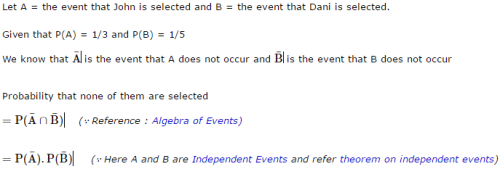
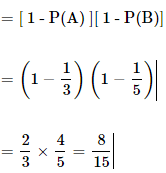
John and Dani go for an interview for two vacancies. The probability for the selection of John is 1/3 and whereas the probability for the selection of Dani is 1/5. What is the probability that none of them are selected?
a)
b)
c)
d)
| | Anaya Patel answered |
A life insurance company insured 25,000 young boys, 14,000 young girls and 16,000 young adults. The probability of death within 10 years of a young boy, young girl and a young adult are 0.02, 0.03 and 0.15 respectively. One of the insured persons dice. What is the probability that the dead person is a young boy?- a)36/165
- b)25/166
- c)26/165
- d)32/165
Correct answer is option 'B'. Can you explain this answer?
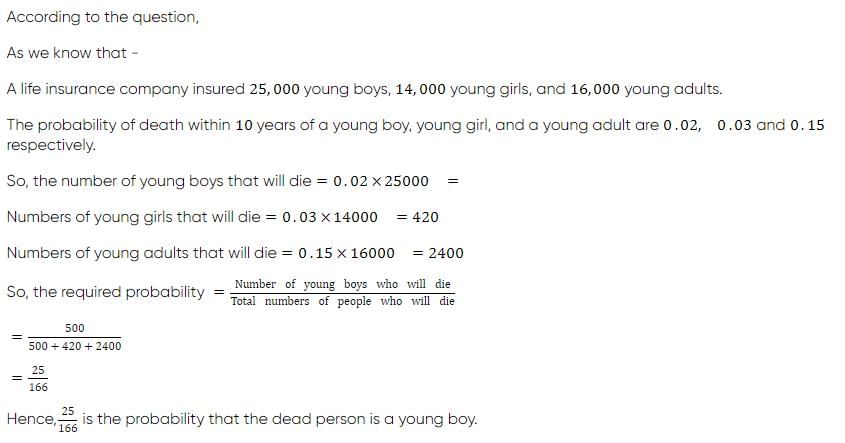
A life insurance company insured 25,000 young boys, 14,000 young girls and 16,000 young adults. The probability of death within 10 years of a young boy, young girl and a young adult are 0.02, 0.03 and 0.15 respectively. One of the insured persons dice. What is the probability that the dead person is a young boy?
a)
36/165
b)
25/166
c)
26/165
d)
32/165
 | Prasad Nair answered |
There are 15 boys and 10 girls in a class. If three students are selected at random, what is the probability that 1 girl and 2 boys are selected?- a)

- b)

- c)

- d)

Correct answer is option 'C'. Can you explain this answer?
There are 15 boys and 10 girls in a class. If three students are selected at random, what is the probability that 1 girl and 2 boys are selected?
a)
b)
c)
d)
 | Bank Exams India answered |
Let S be the sample space.
- n(S) = Total number of ways of selecting 3 students from 25 students = 25C3
Let E = Event of selecting 1 girl and 2 boys
- n(E) = Number of ways of selecting 1 girl and 2 boys
15 boys and 10 girls are there in a class. We need to select 2 boys from 15 boys and 1 girl from 10 girls
Number of ways in which this can be done:
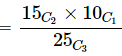
15C2 × 10C1
Hence n(E) = 15C2 × 10C1
15C2 × 10C1
Hence n(E) = 15C2 × 10C1





Out of a pack of 52 cards one is lost; from the remainder of the pack, two cards are drawn and are found to be spades. Find the chance that the missing card is a spade.- a)11/50
- b)11/49
- c)10/49
- d)10/50
Correct answer is option 'A'. Can you explain this answer?
Out of a pack of 52 cards one is lost; from the remainder of the pack, two cards are drawn and are found to be spades. Find the chance that the missing card is a spade.
a)
11/50
b)
11/49
c)
10/49
d)
10/50
 | Dhruv Mehra answered |
Intuitively, the answer should be slightly less than 1/4.
As if you consider two cases:
1) The lost card is spades. (12 spades cards remained out of 51 cards)
2) The lost card is other suits (13 spades cards remained out of 51 cards)
The probability of having two cards drew to be spades is less for 1) than 2), as there are less spades cards for 1).
For more formal calculation:
Let H be the event that the last card is spades.
Let S be the event that the 2 cards drew are spades.
The answer to this question is: P(H|S) = P(S|H)*P(H)/P(S)
We know
P(S|H) = 12/51 * 11/50
P(H) = 1/4
P(S) = 13/52 * 12/51
Hence, the answer is ((12/51 * 11/50) * (1/4)) / (13/52 * 12/51) = 11/50
There are these two sets of letters, and you are going to pick exactly one letter from each set. What is the probability of picking at least one vowel?- a)1/6
- b)1/3
- c)1/2
- d)2/3
- e)5/6
Correct answer is option 'C'. Can you explain this answer?
There are these two sets of letters, and you are going to pick exactly one letter from each set. What is the probability of picking at least one vowel?
a)
1/6
b)
1/3
c)
1/2
d)
2/3
e)
5/6
 | S.S Career Academy answered |
P(at least one vowel) = 1 – P(no vowels)
The probability of picking no vowel from the first set is 3/5. The probability of picking no vowel from the second set is 5/6. In order to get no vowels at all, we need no vowels from the first set AND no vowels from the second set. According to the AND rule, we multiply those probabilities.
P(no vowels) = (3/5)*(5/6) = 1/2
P(at least one vowel) = 1 – P(no vowels) = 1 – 1/2 = 1/2
Baseball's World Series matches 2 teams against each other in a best-of-seven series. The first team to win four games wins the series and no subsequent games are played. If you have no special information about either of the teams, what is the probability that the World Series will consist of fewer than 7 games?- a)12.5%
- b)25%
- c)31.25%
- d)68.75%
- e)75%
Correct answer is option 'D'. Can you explain this answer?
Baseball's World Series matches 2 teams against each other in a best-of-seven series. The first team to win four games wins the series and no subsequent games are played. If you have no special information about either of the teams, what is the probability that the World Series will consist of fewer than 7 games?
a)
12.5%
b)
25%
c)
31.25%
d)
68.75%
e)
75%
| | Nandini Bose answered |
The World Series consists of a best-of-seven series, meaning that the first team to win four games wins the series. In order to determine the probability of the World Series consisting of fewer than seven games, we need to consider the possible scenarios in which this can occur.
- Scenario 1: One team wins four games in a row.
- Scenario 2: One team wins three games in a row, followed by the other team winning three games in a row, resulting in a tie at 3-3 and necessitating a seventh and deciding game.
To calculate the probability of each scenario, we can use the concept of combinations.
- Scenario 1: One team wins four games in a row.
In this scenario, there are two possible outcomes:
- Team A wins 4 games and Team B wins 0 games.
- Team B wins 4 games and Team A wins 0 games.
Since there are two possible outcomes, the probability of either of these scenarios occurring is (1/2) * (1/2) = 1/4.
- Scenario 2: One team wins three games in a row, followed by the other team winning three games in a row.
In this scenario, there are multiple outcomes depending on which team wins the first three games. We need to consider all possible combinations of the winning team in the first three games:
- Team A wins the first three games and Team B wins the next three games.
- Team B wins the first three games and Team A wins the next three games.
Since both teams have an equal chance of winning each game, the probability of either of these scenarios occurring is (1/2) * (1/2) = 1/4.
Therefore, the total probability of the World Series consisting of fewer than seven games is the sum of the probabilities of both scenarios:
(1/4) + (1/4) = 1/2 = 50%.
However, the question asks for the probability that the World Series will consist of fewer than seven games, which means we need to subtract this probability from 100% to find the desired probability:
100% - 50% = 50%.
Thus, the correct answer is option 'D', 68.75%.
- Scenario 1: One team wins four games in a row.
- Scenario 2: One team wins three games in a row, followed by the other team winning three games in a row, resulting in a tie at 3-3 and necessitating a seventh and deciding game.
To calculate the probability of each scenario, we can use the concept of combinations.
- Scenario 1: One team wins four games in a row.
In this scenario, there are two possible outcomes:
- Team A wins 4 games and Team B wins 0 games.
- Team B wins 4 games and Team A wins 0 games.
Since there are two possible outcomes, the probability of either of these scenarios occurring is (1/2) * (1/2) = 1/4.
- Scenario 2: One team wins three games in a row, followed by the other team winning three games in a row.
In this scenario, there are multiple outcomes depending on which team wins the first three games. We need to consider all possible combinations of the winning team in the first three games:
- Team A wins the first three games and Team B wins the next three games.
- Team B wins the first three games and Team A wins the next three games.
Since both teams have an equal chance of winning each game, the probability of either of these scenarios occurring is (1/2) * (1/2) = 1/4.
Therefore, the total probability of the World Series consisting of fewer than seven games is the sum of the probabilities of both scenarios:
(1/4) + (1/4) = 1/2 = 50%.
However, the question asks for the probability that the World Series will consist of fewer than seven games, which means we need to subtract this probability from 100% to find the desired probability:
100% - 50% = 50%.
Thus, the correct answer is option 'D', 68.75%.
Three coins are tossed. What is the probability of getting (i) 2 Tails and 1 Head- a)1/4
- b)3/8
- c)2/3
- d)1/8
Correct answer is option 'B'. Can you explain this answer?
Three coins are tossed. What is the probability of getting (i) 2 Tails and 1 Head
a)
1/4
b)
3/8
c)
2/3
d)
1/8
 | Sagar Sharma answered |
Understanding the Problem
When tossing three coins, each coin has two possible outcomes: Heads (H) or Tails (T). We want to find the probability of getting exactly 2 Tails and 1 Head.
Total Outcomes
- Each coin toss has 2 outcomes.
- For three coins, the total number of outcomes is:
2 * 2 * 2 = 8.
Possible Outcomes
The possible combinations when tossing three coins are:
- HHH
- HHT
- HTH
- HTT
- THH
- THT
- TTH
- TTT
Out of these, we identify the outcomes with exactly 2 Tails and 1 Head:
- HTT
- THT
- TTH
Thus, there are 3 favorable outcomes.
Calculating Probability
- The probability formula is:
Probability = (Number of Favorable Outcomes) / (Total Outcomes).
- Here, the number of favorable outcomes is 3 (HTT, THT, TTH) and the total outcomes are 8.
- Therefore, the probability is:
Probability = 3 / 8.
Conclusion
The probability of getting exactly 2 Tails and 1 Head when tossing three coins is indeed 3/8, which corresponds to option 'B'.
When tossing three coins, each coin has two possible outcomes: Heads (H) or Tails (T). We want to find the probability of getting exactly 2 Tails and 1 Head.
Total Outcomes
- Each coin toss has 2 outcomes.
- For three coins, the total number of outcomes is:
2 * 2 * 2 = 8.
Possible Outcomes
The possible combinations when tossing three coins are:
- HHH
- HHT
- HTH
- HTT
- THH
- THT
- TTH
- TTT
Out of these, we identify the outcomes with exactly 2 Tails and 1 Head:
- HTT
- THT
- TTH
Thus, there are 3 favorable outcomes.
Calculating Probability
- The probability formula is:
Probability = (Number of Favorable Outcomes) / (Total Outcomes).
- Here, the number of favorable outcomes is 3 (HTT, THT, TTH) and the total outcomes are 8.
- Therefore, the probability is:
Probability = 3 / 8.
Conclusion
The probability of getting exactly 2 Tails and 1 Head when tossing three coins is indeed 3/8, which corresponds to option 'B'.
John and Peter are among the nine pl ayers a basketball coach can choose from to field a five-player team. If all five players are chosen at random, what is the probability of choosing a team that includes John and Peter?- a)1/9
- b)1/6
- c)2/9
- d)5/18
- e)1/3
Correct answer is option 'D'. Can you explain this answer?
John and Peter are among the nine pl ayers a basketball coach can choose from to field a five-player team. If all five players are chosen at random, what is the probability of choosing a team that includes John and Peter?
a)
1/9
b)
1/6
c)
2/9
d)
5/18
e)
1/3
 | Pallabi Basu answered |
Calculation:
Total number of ways to choose 5 players out of 9:
- This can be calculated using the combination formula C(n, r) = n! / (r!(n-r)!), where n is the total number of players and r is the number of players to be chosen.
- In this case, n = 9 (total players) and r = 5 (players to be chosen).
- Therefore, the total number of ways to choose 5 players out of 9 is C(9, 5) = 9! / (5! * 4!) = 126 ways.
Number of ways to choose a team that includes John and Peter:
- Since John and Peter are already included in the team, we need to choose 3 players from the remaining 7 players.
- This can be calculated using the combination formula C(7, 3) = 7! / (3! * 4!) = 35 ways.
Probability of choosing a team that includes John and Peter:
- Probability = Number of favorable outcomes / Total number of outcomes
- Probability = 35 (number of ways to choose a team with John and Peter) / 126 (total number of ways to choose 5 players out of 9)
- Probability = 35/126 = 5/18
Therefore, the probability of choosing a team that includes John and Peter is 5/18.
Total number of ways to choose 5 players out of 9:
- This can be calculated using the combination formula C(n, r) = n! / (r!(n-r)!), where n is the total number of players and r is the number of players to be chosen.
- In this case, n = 9 (total players) and r = 5 (players to be chosen).
- Therefore, the total number of ways to choose 5 players out of 9 is C(9, 5) = 9! / (5! * 4!) = 126 ways.
Number of ways to choose a team that includes John and Peter:
- Since John and Peter are already included in the team, we need to choose 3 players from the remaining 7 players.
- This can be calculated using the combination formula C(7, 3) = 7! / (3! * 4!) = 35 ways.
Probability of choosing a team that includes John and Peter:
- Probability = Number of favorable outcomes / Total number of outcomes
- Probability = 35 (number of ways to choose a team with John and Peter) / 126 (total number of ways to choose 5 players out of 9)
- Probability = 35/126 = 5/18
Therefore, the probability of choosing a team that includes John and Peter is 5/18.
A randomly selected year is containing 53 Mondays then probability that it is a leap year- a)2 / 5
- b)3 / 4
- c)1 / 4
- d)2 / 7
Correct answer is option 'A'. Can you explain this answer?
A randomly selected year is containing 53 Mondays then probability that it is a leap year
a)
2 / 5
b)
3 / 4
c)
1 / 4
d)
2 / 7
 | KS Coaching Center answered |
The correct option is A
- Selected year will be a non leap year with a probability 3/4
- Selected year will be a leap year with a probability 1/4
- A selected leap year will have 53 Mondays with probability 2/7
- A selected non leap year will have 53 Mondays with probability 1/7
- E→ Event that randomly selected year contains 53 Mondays
P(E) = (3/4 × 1/7) + (1/4 × 2/7)
P(Leap Year/ E) = (2/28) / (5/28) = 2/5
P(Leap Year/ E) = (2/28) / (5/28) = 2/5
The ratio of number of officers and ladies in the Scorpion Squadron and in the Gunners Squadron are 3 : 1 and 2 : 5 respectively. An individual is selected to be the chairperson of their association. The chance that this individual is selected from the Scorpions is 2/3. Find the probability that the chairperson will be an officer- a)25/42
- b)13/43
- c)11/43
- d)7/42
Correct answer is option 'A'. Can you explain this answer?
The ratio of number of officers and ladies in the Scorpion Squadron and in the Gunners Squadron are 3 : 1 and 2 : 5 respectively. An individual is selected to be the chairperson of their association. The chance that this individual is selected from the Scorpions is 2/3. Find the probability that the chairperson will be an officer
a)
25/42
b)
13/43
c)
11/43
d)
7/42
 | Uday Nambiar answered |
(2/3) x (3/4) + (1/3) x (2/7) = (1/2) + (2/21) = (25/42)


John draws a card from a pack of cards. What is the probability that the card drawn is a card of black suit?- a)

- b)

- c)

- d)

Correct answer is option 'A'. Can you explain this answer?
John draws a card from a pack of cards. What is the probability that the card drawn is a card of black suit?
a)
b)
c)
d)
 | Naroj Boda answered |
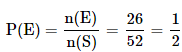
Total number of cards, n(S) = 52
Total number of black cards, n(E) = 26
Total number of black cards, n(E) = 26
A card is randomly drawn from a deck of 52 cards. What is the probability getting either a King or a Diamond?- a)

- b)

- c)

- d)

Correct answer is option 'A'. Can you explain this answer?
A card is randomly drawn from a deck of 52 cards. What is the probability getting either a King or a Diamond?
a)
b)
c)
d)
 | Cstoppers Instructors answered |
Total number of cards = 52
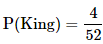
Total Number of King Cards = 4
Total Number of King Cards = 4
Total Number of Diamond Cards = 13
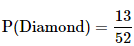
Total Number of Cards which are both King and Diamond = 1

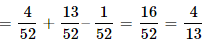
Here a card can be both a Diamond card and a King. Hence these are not mutually exclusive events. (Reference : mutually exclusive events) . By Addition Theorem of Probability, we have P(King or a Diamond) = P(King) + P(Diamond) – P(King and Diamond)
A bag contains 3 green and 7 white balls. Two balls are drawn from the bag in succession without replacement. What is the probability that(i) they are of different colour?- a)7/15
- b)7/9
- c)5/11
- d)7/11
Correct answer is option 'A'. Can you explain this answer?
A bag contains 3 green and 7 white balls. Two balls are drawn from the bag in succession without replacement. What is the probability that
(i) they are of different colour?
a)
7/15
b)
7/9
c)
5/11
d)
7/11
| | Aarav Sharma answered |
Solution:
Given, a bag contains 3 green and 7 white balls.
Probability of drawing 1st ball:
P(Green) = 3/10
P(White) = 7/10
After drawing 1st ball, we have one less ball in the bag.
So, the probability of drawing 2nd ball changes.
If the 1st ball was green, then there are 2 green and 7 white balls left in the bag.
P(2nd ball is White | 1st ball was Green) = 7/9
P(2nd ball is Green | 1st ball was Green) = 2/9
If the 1st ball was white, then there are 3 green and 6 white balls left in the bag.
P(2nd ball is Green | 1st ball was White) = 3/9
P(2nd ball is White | 1st ball was White) = 6/9
(i) Probability that the two balls are of different colour:
P(1st ball is Green and 2nd ball is White) + P(1st ball is White and 2nd ball is Green)
= (3/10 x 7/9) + (7/10 x 3/9)
= 21/90 + 21/90
= 42/90
= 7/15
Therefore, the probability that the two balls are of different colour is 7/15.
Hence, option (a) is correct.
Given, a bag contains 3 green and 7 white balls.
Probability of drawing 1st ball:
P(Green) = 3/10
P(White) = 7/10
After drawing 1st ball, we have one less ball in the bag.
So, the probability of drawing 2nd ball changes.
If the 1st ball was green, then there are 2 green and 7 white balls left in the bag.
P(2nd ball is White | 1st ball was Green) = 7/9
P(2nd ball is Green | 1st ball was Green) = 2/9
If the 1st ball was white, then there are 3 green and 6 white balls left in the bag.
P(2nd ball is Green | 1st ball was White) = 3/9
P(2nd ball is White | 1st ball was White) = 6/9
(i) Probability that the two balls are of different colour:
P(1st ball is Green and 2nd ball is White) + P(1st ball is White and 2nd ball is Green)
= (3/10 x 7/9) + (7/10 x 3/9)
= 21/90 + 21/90
= 42/90
= 7/15
Therefore, the probability that the two balls are of different colour is 7/15.
Hence, option (a) is correct.

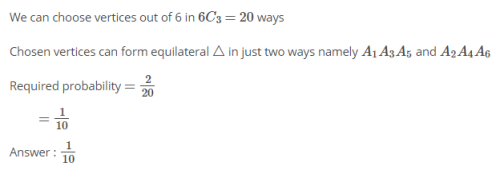
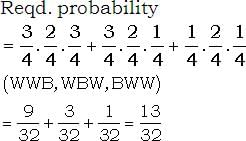
If from each of three boxes containing 3 white and 1 black, 2 white and 2 black, 1 white and 3 black balls, one ball is drawn at random, then the probability that 2 white and 1 black ball will be drawn is- a)13/32
- b)12/14
- c)12/25
- d)3/13
Correct answer is option 'A'. Can you explain this answer?
If from each of three boxes containing 3 white and 1 black, 2 white and 2 black, 1 white and 3 black balls, one ball is drawn at random, then the probability that 2 white and 1 black ball will be drawn is
a)
13/32
b)
12/14
c)
12/25
d)
3/13
 | Sameer Rane answered |
Harriet and Tran each have $10. Together, they flip a fair coin 5 times. Every time the coin lands on heads, Tran gives Harriet $1. Every time the coin lands on tails, Harriet gives Tran $1. After the five coin flips, what is the probability that Harriet has more than $10 but less than $15?- a)5/16
- b)1/2
- c)12/30
- d)15/32
- e)3/8
Correct answer is option 'D'. Can you explain this answer?
Harriet and Tran each have $10. Together, they flip a fair coin 5 times. Every time the coin lands on heads, Tran gives Harriet $1. Every time the coin lands on tails, Harriet gives Tran $1. After the five coin flips, what is the probability that Harriet has more than $10 but less than $15?
a)
5/16
b)
1/2
c)
12/30
d)
15/32
e)
3/8
 | Anagha Patel answered |
To solve this problem, we can use a combination of counting and probability principles. Let's break it down step by step:
1. Possible Outcomes:
- Each coin flip has 2 possible outcomes: heads (H) or tails (T).
- Since there are 5 coin flips, there are a total of 2^5 = 32 possible outcomes.
2. Calculating Harriet's Balance:
- We need to determine Harriet's balance after each coin flip.
- If the outcome is heads (H), Harriet gains $1, and if the outcome is tails (T), Harriet loses $1.
- Let's denote a gain as +$1 and a loss as -$1.
- We can represent the possible outcomes for Harriet's balance in a sequence of +1's and -1's:
- HHHHH: +$1 +$1 +$1 +$1 +$1 = +$5
- HHHHT: +$1 +$1 +$1 +$1 -$1 = +$3
- HHHTH: +$1 +$1 +$1 -$1 +$1 = +$3
- HHTHH: +$1 +$1 -$1 +$1 +$1 = +$3
- HTHHH: +$1 -$1 +$1 +$1 +$1 = +$3
- THHHH: -$1 +$1 +$1 +$1 +$1 = +$3
- HTHHT: +$1 -$1 +$1 +$1 -$1 = +$1
- HTHTH: +$1 -$1 +$1 -$1 +$1 = +$1
- ...
- We can observe that the minimum balance Harriet can have is +$1, and the maximum balance is +$5.
3. Counting Favorable Outcomes:
- We need to count the number of outcomes where Harriet's balance is more than $10 but less than $15.
- From the previous step, we can see that the favorable outcomes are: +$11, +$12, +$13, and +$14.
- We need to count the number of sequences that contain these favorable outcomes.
- Let's denote the favorable outcomes as F and the others as X.
- The favorable sequences can be represented as:
- FXXXX: +$11
- XFXXX: +$12
- XXFXX: +$13
- XXXFX: +$14
- We can distribute the X's among the sequences in the remaining positions, which gives us 2^4 = 16 possible combinations.
- Therefore, there are 16 favorable outcomes.
4. Calculating the Probability:
- The probability is calculated by dividing the number of favorable outcomes by the total number of possible outcomes.
- Probability = Number of favorable outcomes / Total number of possible outcomes
- Probability = 16 / 32 = 1/2
- Therefore, the correct answer is option B, 1/2.
1. Possible Outcomes:
- Each coin flip has 2 possible outcomes: heads (H) or tails (T).
- Since there are 5 coin flips, there are a total of 2^5 = 32 possible outcomes.
2. Calculating Harriet's Balance:
- We need to determine Harriet's balance after each coin flip.
- If the outcome is heads (H), Harriet gains $1, and if the outcome is tails (T), Harriet loses $1.
- Let's denote a gain as +$1 and a loss as -$1.
- We can represent the possible outcomes for Harriet's balance in a sequence of +1's and -1's:
- HHHHH: +$1 +$1 +$1 +$1 +$1 = +$5
- HHHHT: +$1 +$1 +$1 +$1 -$1 = +$3
- HHHTH: +$1 +$1 +$1 -$1 +$1 = +$3
- HHTHH: +$1 +$1 -$1 +$1 +$1 = +$3
- HTHHH: +$1 -$1 +$1 +$1 +$1 = +$3
- THHHH: -$1 +$1 +$1 +$1 +$1 = +$3
- HTHHT: +$1 -$1 +$1 +$1 -$1 = +$1
- HTHTH: +$1 -$1 +$1 -$1 +$1 = +$1
- ...
- We can observe that the minimum balance Harriet can have is +$1, and the maximum balance is +$5.
3. Counting Favorable Outcomes:
- We need to count the number of outcomes where Harriet's balance is more than $10 but less than $15.
- From the previous step, we can see that the favorable outcomes are: +$11, +$12, +$13, and +$14.
- We need to count the number of sequences that contain these favorable outcomes.
- Let's denote the favorable outcomes as F and the others as X.
- The favorable sequences can be represented as:
- FXXXX: +$11
- XFXXX: +$12
- XXFXX: +$13
- XXXFX: +$14
- We can distribute the X's among the sequences in the remaining positions, which gives us 2^4 = 16 possible combinations.
- Therefore, there are 16 favorable outcomes.
4. Calculating the Probability:
- The probability is calculated by dividing the number of favorable outcomes by the total number of possible outcomes.
- Probability = Number of favorable outcomes / Total number of possible outcomes
- Probability = 16 / 32 = 1/2
- Therefore, the correct answer is option B, 1/2.
If 40 percent of all students at College X have brown hair and 70 percent of all students at College X have blue eyes, what is the difference between the minimum and the maximum probability of picking a student from College X who has neither brown hair nor blue eyes?- a)0.2
- b)0.3
- c)0.4
- d)0.6
- e)0.7
Correct answer is option 'B'. Can you explain this answer?
If 40 percent of all students at College X have brown hair and 70 percent of all students at College X have blue eyes, what is the difference between the minimum and the maximum probability of picking a student from College X who has neither brown hair nor blue eyes?
a)
0.2
b)
0.3
c)
0.4
d)
0.6
e)
0.7
 | Tanvi Deshpande answered |
For an overlapping set problem we can use a double-set matrix to organize our information and solve. The values here are percents, and no actual number of students is given or requested. Therefore, we can assign a value of 100 to the total number of students at College X. From the given information in the question we have:
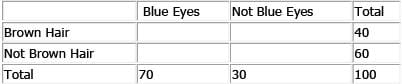
The question asks for the difference between maximum value and the minimum value of the central square, that is, the percent of students who have neither brown hair nor blue eyes. The maximum value is 30, as shown below:
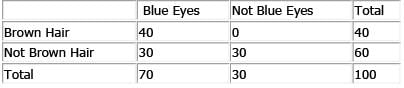
Therefore the maximum probability of picking such a person is 0.3.
Likewise, the minimum value of the central square is zero, as shown below:
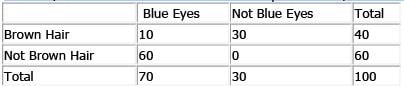
Therefore the minimum probability of picking such a person is 0, and the difference between the maximum and the minimum probability is 0.3.
The question asks for the difference between maximum value and the minimum value of the central square, that is, the percent of students who have neither brown hair nor blue eyes. The maximum value is 30, as shown below:
Therefore the maximum probability of picking such a person is 0.3.
Likewise, the minimum value of the central square is zero, as shown below:
Therefore the minimum probability of picking such a person is 0, and the difference between the maximum and the minimum probability is 0.3.
A license plate in the country Kerrania consists of four digits followed by two letters. The letters A, B, and C are used only by government vehicles while the letters D through Z are used by non-government vehicles. Kerrania's intelligence agency has recently captured a message from the country Gonzalia indicating that an electronic transmitter has been installed in a Kerrania government vehicle with a license plate starting with 79. If it takes the police 10 minutes to inspect each vehicle, what is the probability that the police will find the transmitter within three hours?- a)18/79
- b)1/6
- c)1/25
- d)1/50
- e)1/900
Correct answer is option 'D'. Can you explain this answer?
A license plate in the country Kerrania consists of four digits followed by two letters. The letters A, B, and C are used only by government vehicles while the letters D through Z are used by non-government vehicles. Kerrania's intelligence agency has recently captured a message from the country Gonzalia indicating that an electronic transmitter has been installed in a Kerrania government vehicle with a license plate starting with 79. If it takes the police 10 minutes to inspect each vehicle, what is the probability that the police will find the transmitter within three hours?
a)
18/79
b)
1/6
c)
1/25
d)
1/50
e)
1/900
| | Jhanvi Saha answered |
Since the first two digits of the license plate are known and there are 10 possibilities for each of the remaining two digits (each can be any digit from 0 to 9), the total number of combinations for digits on the license plate will equal 10 ×10 = 100.
Because there are only 3 letters that can be used for government license plates (A, B, or C), there are a total of nine two-letter combinations that could be on the license plate (3 possibilities for first letter × 3 possibilities for the second letter).
Given that we have 100 possible digit combinations and 9 possible letter combinations, the total number of vehicles to be inspected will equal 100 × 9 = 900. Since it takes 10 minutes to inspect one vehicle, the police will have time to inspect 18 vehicles in three hours (3 hours = 180 minutes). Thus, the probability of locating the transmitter within the allotted time is 18/900 = 1/50.
Because there are only 3 letters that can be used for government license plates (A, B, or C), there are a total of nine two-letter combinations that could be on the license plate (3 possibilities for first letter × 3 possibilities for the second letter).
Given that we have 100 possible digit combinations and 9 possible letter combinations, the total number of vehicles to be inspected will equal 100 × 9 = 900. Since it takes 10 minutes to inspect one vehicle, the police will have time to inspect 18 vehicles in three hours (3 hours = 180 minutes). Thus, the probability of locating the transmitter within the allotted time is 18/900 = 1/50.
Jim and Renee will play one game of Rock, Paper, Scissors. In this game, each will select and show a hand sign for one of the three items. Rock beats Scissors, Scissors beat Paper, and Paper beats Rock. Assuming that both Jim and Renee have an equal chance of choosing any one of the hand signs, what is the probability that Jim will win? - a)5/6
- b)2/3
- c)1/2
- d)5/12
- e)1/3
Correct answer is option 'E'. Can you explain this answer?
Jim and Renee will play one game of Rock, Paper, Scissors. In this game, each will select and show a hand sign for one of the three items. Rock beats Scissors, Scissors beat Paper, and Paper beats Rock. Assuming that both Jim and Renee have an equal chance of choosing any one of the hand signs, what is the probability that Jim will win?
a)
5/6
b)
2/3
c)
1/2
d)
5/12
e)
1/3
 | Gargi Pillai answered |
To determine the probability that Jim will win in a game of Rock, Paper, Scissors, we need to consider the possible outcomes and their respective probabilities.
Let's first list the possible outcomes in this game:
1. Jim chooses Rock and Renee chooses Scissors (Jim wins).
2. Jim chooses Scissors and Renee chooses Paper (Jim wins).
3. Jim chooses Paper and Renee chooses Rock (Jim wins).
4. Jim chooses Rock and Renee chooses Paper (Jim loses).
5. Jim chooses Scissors and Renee chooses Rock (Jim loses).
6. Jim chooses Paper and Renee chooses Scissors (Jim loses).
7. Jim chooses Rock and Renee chooses Rock (tie).
8. Jim chooses Scissors and Renee chooses Scissors (tie).
9. Jim chooses Paper and Renee chooses Paper (tie).
There are a total of 9 possible outcomes, and out of these, there are 3 outcomes where Jim wins.
So, the probability that Jim will win is given by:
P(Jim wins) = Number of favorable outcomes / Total number of outcomes
P(Jim wins) = 3 / 9 = 1/3
Therefore, the probability that Jim will win is 1/3.
Hence, the correct answer is option "E".
Let's first list the possible outcomes in this game:
1. Jim chooses Rock and Renee chooses Scissors (Jim wins).
2. Jim chooses Scissors and Renee chooses Paper (Jim wins).
3. Jim chooses Paper and Renee chooses Rock (Jim wins).
4. Jim chooses Rock and Renee chooses Paper (Jim loses).
5. Jim chooses Scissors and Renee chooses Rock (Jim loses).
6. Jim chooses Paper and Renee chooses Scissors (Jim loses).
7. Jim chooses Rock and Renee chooses Rock (tie).
8. Jim chooses Scissors and Renee chooses Scissors (tie).
9. Jim chooses Paper and Renee chooses Paper (tie).
There are a total of 9 possible outcomes, and out of these, there are 3 outcomes where Jim wins.
So, the probability that Jim will win is given by:
P(Jim wins) = Number of favorable outcomes / Total number of outcomes
P(Jim wins) = 3 / 9 = 1/3
Therefore, the probability that Jim will win is 1/3.
Hence, the correct answer is option "E".
Laura has a deck of standard playing cards with 13 of the 52 cards designated as a "heart." If Laura shuffles the deck thoroughly and then deals 10 cards off the top of the deck, what is the probability that the 10th card dealt is a heart? - a)1/4
- b)1/5
- c)5/26
- d)12/42
- e)13/42
Correct answer is option 'A'. Can you explain this answer?
Laura has a deck of standard playing cards with 13 of the 52 cards designated as a "heart." If Laura shuffles the deck thoroughly and then deals 10 cards off the top of the deck, what is the probability that the 10th card dealt is a heart?
a)
1/4
b)
1/5
c)
5/26
d)
12/42
e)
13/42
 | Palak Yadav answered |
Although this may be counter-intuitive at first, the probability that any card in the deck will be a heart before any cards are seen is 13/52 or 1/4.
One way to understand this is to solve the problem analytically for any card by building a probability "tree" and summing the probability of all of its "branches."
For example, let's find the probability that the 2nd card dealt from the deck is a heart. There are two mutually exclusive ways this can happen: (1) both the first and second cards are hearts or (2) only the second card is a heart.
CASE 1: Using the multiplication rule, the probability that the first card is a heart AND the second card is a heart is equal to the probability of picking a heart on the first card (or 13/52, which is the number of hearts in a full deck divided by the number of cards) times the probability of picking a heart on the second card (or 12/51, which is the number of hearts remaining in the deck divided by the number of cards remaining in the deck).
13/52 x 12/51 = 12/204
CASE 2: Similarly, the probability that the first card is a non-heart AND the second card is a heart is equal to the probability that the first card is NOT a heart (or 39/52) times the probability of subsequently picking a heart on the 2nd card (or 13/51). 39/52 x 13/51 = 39/204
Since these two cases are mutually exclusive, we can add them together to get the total probability of getting a heart as the second card: 12/204 + 39/204 = 51/204 = 1/4.
We can do a similar analysis for any card in the deck, and, although the probability tree gets more complicated as the card number gets higher, the total probability that the n th card dealt will be a heart will always end up simplifying to 1/4.
One way to understand this is to solve the problem analytically for any card by building a probability "tree" and summing the probability of all of its "branches."
For example, let's find the probability that the 2nd card dealt from the deck is a heart. There are two mutually exclusive ways this can happen: (1) both the first and second cards are hearts or (2) only the second card is a heart.
CASE 1: Using the multiplication rule, the probability that the first card is a heart AND the second card is a heart is equal to the probability of picking a heart on the first card (or 13/52, which is the number of hearts in a full deck divided by the number of cards) times the probability of picking a heart on the second card (or 12/51, which is the number of hearts remaining in the deck divided by the number of cards remaining in the deck).
13/52 x 12/51 = 12/204
CASE 2: Similarly, the probability that the first card is a non-heart AND the second card is a heart is equal to the probability that the first card is NOT a heart (or 39/52) times the probability of subsequently picking a heart on the 2nd card (or 13/51). 39/52 x 13/51 = 39/204
Since these two cases are mutually exclusive, we can add them together to get the total probability of getting a heart as the second card: 12/204 + 39/204 = 51/204 = 1/4.
We can do a similar analysis for any card in the deck, and, although the probability tree gets more complicated as the card number gets higher, the total probability that the n th card dealt will be a heart will always end up simplifying to 1/4.
A speaks the truth 3 out o f 4 times, and B 5 out o f 6 times. What is the probability that they will contradict each other in stating the same fact?- a)2/3
- b)1/3
- c)5/6
- d)None of these
Correct answer is option 'B'. Can you explain this answer?
A speaks the truth 3 out o f 4 times, and B 5 out o f 6 times. What is the probability that they will contradict each other in stating the same fact?
a)
2/3
b)
1/3
c)
5/6
d)
None of these
| | Aarav Sharma answered |
To solve this problem, we need to find the probability that A and B will contradict each other in stating the same fact.
Given information:
- A speaks the truth 3 out of 4 times, which means A has a probability of 3/4 = 0.75 of speaking the truth.
- B speaks the truth 5 out of 6 times, which means B has a probability of 5/6 ≈ 0.83 of speaking the truth.
We can approach this problem by considering two scenarios:
1. A tells the truth and B lies.
2. A lies and B tells the truth.
Probability of A telling the truth and B lying:
- Probability of A telling the truth = 0.75
- Probability of B lying = 1 - (Probability of B telling the truth) = 1 - 0.83 = 0.17
Probability of A lying and B telling the truth:
- Probability of A lying = 1 - (Probability of A telling the truth) = 1 - 0.75 = 0.25
- Probability of B telling the truth = 0.83
Now, we can calculate the probability of the two scenarios occurring:
- Probability of scenario 1 = Probability of A telling the truth * Probability of B lying = 0.75 * 0.17 = 0.1275
- Probability of scenario 2 = Probability of A lying * Probability of B telling the truth = 0.25 * 0.83 = 0.2075
Finally, we add the probabilities of the two scenarios to get the total probability of A and B contradicting each other:
- Probability of A and B contradicting each other = Probability of scenario 1 + Probability of scenario 2 = 0.1275 + 0.2075 = 0.335
Therefore, the probability that A and B will contradict each other in stating the same fact is approximately 0.335, which can be simplified to 1/3. Hence, the correct answer is option B.
Given information:
- A speaks the truth 3 out of 4 times, which means A has a probability of 3/4 = 0.75 of speaking the truth.
- B speaks the truth 5 out of 6 times, which means B has a probability of 5/6 ≈ 0.83 of speaking the truth.
We can approach this problem by considering two scenarios:
1. A tells the truth and B lies.
2. A lies and B tells the truth.
Probability of A telling the truth and B lying:
- Probability of A telling the truth = 0.75
- Probability of B lying = 1 - (Probability of B telling the truth) = 1 - 0.83 = 0.17
Probability of A lying and B telling the truth:
- Probability of A lying = 1 - (Probability of A telling the truth) = 1 - 0.75 = 0.25
- Probability of B telling the truth = 0.83
Now, we can calculate the probability of the two scenarios occurring:
- Probability of scenario 1 = Probability of A telling the truth * Probability of B lying = 0.75 * 0.17 = 0.1275
- Probability of scenario 2 = Probability of A lying * Probability of B telling the truth = 0.25 * 0.83 = 0.2075
Finally, we add the probabilities of the two scenarios to get the total probability of A and B contradicting each other:
- Probability of A and B contradicting each other = Probability of scenario 1 + Probability of scenario 2 = 0.1275 + 0.2075 = 0.335
Therefore, the probability that A and B will contradict each other in stating the same fact is approximately 0.335, which can be simplified to 1/3. Hence, the correct answer is option B.
In a room filled with 7 people, 4 people have exactly 1 friend in the room and 3 people have exactly 2 friends in the room (Assuming that friendship is a mutual relationship, i.e. if John is Peter's friend, Peter is John's friend). If two individuals are selected from the room at random, what is the probability that those two individuals are NOT friends? - a)5/21
- b)3/7
- c)4/7
- d)5/7
- e)16/21
Correct answer is option 'E'. Can you explain this answer?
In a room filled with 7 people, 4 people have exactly 1 friend in the room and 3 people have exactly 2 friends in the room (Assuming that friendship is a mutual relationship, i.e. if John is Peter's friend, Peter is John's friend). If two individuals are selected from the room at random, what is the probability that those two individuals are NOT friends?
a)
5/21
b)
3/7
c)
4/7
d)
5/7
e)
16/21
| | Akshay Khanna answered |
Begin by counting the number of relationships that exist among the 7 individuals whom we will call A, B, C, D, E, F, and G.
First consider the relationships of individual A: AB, AC, AD, AE, AF, AG = 6 total. Then consider the relationships of individual B without counting the relationship AB that was already counted before: BC, BD, BE, BF, BG = 5 total. Continuing this pattern, we can see that C will add an additional 4 relationships, D will add an additional 3 relationships, E will add an additional 2 relationships, and F will add 1 additional relationship. Thus, there are a total of 6 + 5 + 4 + 3 + 2 + 1 = 21 total relationships between the 7 individuals.
Alternatively, this can be computed formulaically as choosing a group of 2 from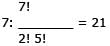
We are told that 4 people have exactly 1 friend. This would account for 2 "friendship" relationships (e.g. AB and CD). We are also told that 3 people have exactly 2 friends. This would account for another 3 "friendship" relationships (e.g. EF, EG, and FG). Thus, there are 5 total "friendship" relationships in the group.
The probability that any 2 individuals in the group are friends is 5/21. The probability that any 2 individuals in the group are NOT friends = 1 – 5/21 = 16/21.
First consider the relationships of individual A: AB, AC, AD, AE, AF, AG = 6 total. Then consider the relationships of individual B without counting the relationship AB that was already counted before: BC, BD, BE, BF, BG = 5 total. Continuing this pattern, we can see that C will add an additional 4 relationships, D will add an additional 3 relationships, E will add an additional 2 relationships, and F will add 1 additional relationship. Thus, there are a total of 6 + 5 + 4 + 3 + 2 + 1 = 21 total relationships between the 7 individuals.
Alternatively, this can be computed formulaically as choosing a group of 2 from
We are told that 4 people have exactly 1 friend. This would account for 2 "friendship" relationships (e.g. AB and CD). We are also told that 3 people have exactly 2 friends. This would account for another 3 "friendship" relationships (e.g. EF, EG, and FG). Thus, there are 5 total "friendship" relationships in the group.
The probability that any 2 individuals in the group are friends is 5/21. The probability that any 2 individuals in the group are NOT friends = 1 – 5/21 = 16/21.
Five children, Anaxagoras, Beatrice, Childeric, Desdemona, and Ethelred, sit randomly in five chairs in a row. What is the probability that Childeric and Ethelred sit next to each other?- a)1/30
- b)1/15
- c)1/5
- d)2/5
- e)7/20
Correct answer is option 'D'. Can you explain this answer?
Five children, Anaxagoras, Beatrice, Childeric, Desdemona, and Ethelred, sit randomly in five chairs in a row. What is the probability that Childeric and Ethelred sit next to each other?
a)
1/30
b)
1/15
c)
1/5
d)
2/5
e)
7/20
 | Ashish Chatterjee answered |
Understanding the Problem
To find the probability that Childeric and Ethelred sit next to each other among five children, we can use combinatorial methods.
Total Arrangements
- There are 5 children, which can be arranged in 5! (factorial) ways.
- 5! = 120 total arrangements.
Grouping Childeric and Ethelred
- To simplify the problem, we can treat Childeric and Ethelred as a single unit or block.
- This block can be arranged in two ways: Childeric next to Ethelred or Ethelred next to Childeric.
Calculating the Block Arrangements
- By treating Childeric and Ethelred as one block, we effectively have 4 units to arrange: (CE), Anaxagoras, Beatrice, and Desdemona.
- The arrangements can be calculated as 4! = 24 ways.
Arranging the Block
- Since the block (CE) can be arranged in 2 ways (CE or EC), the total arrangements for this case are:
- Total = 4! * 2 = 24 * 2 = 48 arrangements.
Calculating the Probability
- The probability that Childeric and Ethelred sit next to each other is the number of favorable arrangements divided by the total arrangements.
- Probability = 48 (favorable) / 120 (total) = 48/120 = 2/5.
Final Result
- Therefore, the probability that Childeric and Ethelred sit next to each other is 2/5.
This aligns with option 'D'.
To find the probability that Childeric and Ethelred sit next to each other among five children, we can use combinatorial methods.
Total Arrangements
- There are 5 children, which can be arranged in 5! (factorial) ways.
- 5! = 120 total arrangements.
Grouping Childeric and Ethelred
- To simplify the problem, we can treat Childeric and Ethelred as a single unit or block.
- This block can be arranged in two ways: Childeric next to Ethelred or Ethelred next to Childeric.
Calculating the Block Arrangements
- By treating Childeric and Ethelred as one block, we effectively have 4 units to arrange: (CE), Anaxagoras, Beatrice, and Desdemona.
- The arrangements can be calculated as 4! = 24 ways.
Arranging the Block
- Since the block (CE) can be arranged in 2 ways (CE or EC), the total arrangements for this case are:
- Total = 4! * 2 = 24 * 2 = 48 arrangements.
Calculating the Probability
- The probability that Childeric and Ethelred sit next to each other is the number of favorable arrangements divided by the total arrangements.
- Probability = 48 (favorable) / 120 (total) = 48/120 = 2/5.
Final Result
- Therefore, the probability that Childeric and Ethelred sit next to each other is 2/5.
This aligns with option 'D'.
A small company employs 3 men and 5 women. If a team of 4 employees is to be randomly selected to organize the company retreat, what is the probability that the team will have exactly 2 women?- a)1/14
- b)1/7
- c)2/7
- d)3/7
- e)1/2
Correct answer is option 'D'. Can you explain this answer?
A small company employs 3 men and 5 women. If a team of 4 employees is to be randomly selected to organize the company retreat, what is the probability that the team will have exactly 2 women?
a)
1/14
b)
1/7
c)
2/7
d)
3/7
e)
1/2
| | Tejas Gupta answered |
First, we must calculate the total number of possible teams (let’s call this t ). Then, we must calculate how many of these possible teams have exactly 2 women (let’s call this w). The probability that a randomly selected team will have exactly 2 women can be expressed as w/t.
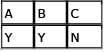
To calculate the number of possible teams, we can use the Anagram Grid method. Since there are 8 employees, 4 of whom will be on the team (represented with a Y) and 4 of whom will not (represented with an N), we can arrange the following anagram grid:
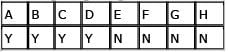
To make the calculation easier, we can use the following shortcut: t = (8!)/(4!)(4!). The (8!) in the numerator comes from the fact that there are 8 total employees to choose from. The first (4!) in the denominator comes from the fact that 4 employees will be on the team, and the other (4!) comes from the fact that 4 employees will not be on the team. Simplifying yields:
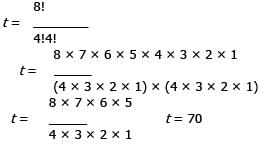
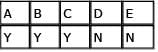
So, there are 70 possible teams of 4 employees. Next, we can use a similar method to determine w, the number of possible teams with exactly 2 women. We note that in order to have exactly 2 women on the team, there must also be 2 men on the team of 4. If we calculate the number of ways that 2 out of 5 women can be selected, and the number of ways that 2 out of 3 men can be selected, we can then multiply the two to get the total number of teams consisting of 2 men and 2 women. Let’s start with the women:
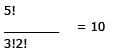
So, the number of ways that 2 women can be selected is 10. Now the men:

Thus, the number of ways that 2 men can be selected is 3. Now we can multiply to get the total number of 2 women teams: w = (10)(3) = 30. Since there are 30 possible teams with exactly 2 women, and 70 possible teams overall, w /t = 30/70 = 3/7.
To calculate the number of possible teams, we can use the Anagram Grid method. Since there are 8 employees, 4 of whom will be on the team (represented with a Y) and 4 of whom will not (represented with an N), we can arrange the following anagram grid:
To make the calculation easier, we can use the following shortcut: t = (8!)/(4!)(4!). The (8!) in the numerator comes from the fact that there are 8 total employees to choose from. The first (4!) in the denominator comes from the fact that 4 employees will be on the team, and the other (4!) comes from the fact that 4 employees will not be on the team. Simplifying yields:
So, there are 70 possible teams of 4 employees. Next, we can use a similar method to determine w, the number of possible teams with exactly 2 women. We note that in order to have exactly 2 women on the team, there must also be 2 men on the team of 4. If we calculate the number of ways that 2 out of 5 women can be selected, and the number of ways that 2 out of 3 men can be selected, we can then multiply the two to get the total number of teams consisting of 2 men and 2 women. Let’s start with the women:
So, the number of ways that 2 women can be selected is 10. Now the men:
Thus, the number of ways that 2 men can be selected is 3. Now we can multiply to get the total number of 2 women teams: w = (10)(3) = 30. Since there are 30 possible teams with exactly 2 women, and 70 possible teams overall, w /t = 30/70 = 3/7.
A pair of fair dice are rolled together till a sum of either 5 or 7 is obtained. The probability that 5 comes before 7 is- a)0.45
- b)0.4
- c)0.5
- d)0.7
Correct answer is option 'B'. Can you explain this answer?
A pair of fair dice are rolled together till a sum of either 5 or 7 is obtained. The probability that 5 comes before 7 is
a)
0.45
b)
0.4
c)
0.5
d)
0.7
| | Uday Nambiar answered |
We do not have to consider any sum other than 5 or 7 occurring.
A sum of 5 can be obtained by any of [4 + 1, 3 + 2, 2 + 3, 1 + 4]
Similarly a sum of 7 can be obtained by any of [6 + 1, 5 + 2, 4 + 3, 3 + 4, 2 + 5, 1 + 6]
For 6: n(E) = 4, n(S) = 6 + 4 P = 0.4
For 7: n(E) = 6 n(S) = 6 + 4 P = 0.6
A sum of 5 can be obtained by any of [4 + 1, 3 + 2, 2 + 3, 1 + 4]
Similarly a sum of 7 can be obtained by any of [6 + 1, 5 + 2, 4 + 3, 3 + 4, 2 + 5, 1 + 6]
For 6: n(E) = 4, n(S) = 6 + 4 P = 0.4
For 7: n(E) = 6 n(S) = 6 + 4 P = 0.6
5 coins are tossed together. What is the probability of getting exactly 2 heads?- a)

- b)

- c)

- d)

Correct answer is option 'B'. Can you explain this answer?
5 coins are tossed together. What is the probability of getting exactly 2 heads?
a)
b)
c)
d)
| | Cstoppers Instructors answered |
Total number of outcomes possible when a coin is tossed = 2 (? Head or Tail)
Hence, total number of outcomes possible when 5 coins are tossed, n(S) = 25
E = Event of getting exactly 2 heads when 5 coins are tossed
n(E) = Number of ways of getting exactly 2 heads when 5 coins are tossed = 5C2
Hence, total number of outcomes possible when 5 coins are tossed, n(S) = 25
E = Event of getting exactly 2 heads when 5 coins are tossed
n(E) = Number of ways of getting exactly 2 heads when 5 coins are tossed = 5C2

When two dice are rolled, what is the probability that the sum is either 7 or 11?- a)

- b)

- c)

- d)

Correct answer is option 'D'. Can you explain this answer?
When two dice are rolled, what is the probability that the sum is either 7 or 11?
a)
b)
c)
d)
| | Target Study Academy answered |
Total number of outcomes possible when a die is rolled = 6 (? any one face out of the 6 faces)
Hence, total number of outcomes possible when two dice are rolled = 6 × 6 = 36
To get a sum of 7, the following are the favourable cases.
(1, 6), (2, 5), {3, 4}, (4, 3), (5, 2), (6,1)
=> Number of ways in which we get a sum of 7 = 6
Hence, total number of outcomes possible when two dice are rolled = 6 × 6 = 36
To get a sum of 7, the following are the favourable cases.
(1, 6), (2, 5), {3, 4}, (4, 3), (5, 2), (6,1)
=> Number of ways in which we get a sum of 7 = 6

To get a sum of 11, the following are the favourable cases. (5, 6), (6, 5) => Number of ways in which we get a sum of 11 = 2

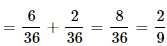
Here, clearly the events are mutually exclusive events. By Addition Theorem of Probability, we have P(a sum of 7 or a sum of 11) = P(a sum of 7) + P( a sum of 11)
In a bag there are 12 black and 6 white balls. Two balls are chosen at random and the first one is found to be black. The probability that the second one is also black is:- a)11/17
- b)12/17
- c)13/18
- d)None of these
Correct answer is option 'A'. Can you explain this answer?
In a bag there are 12 black and 6 white balls. Two balls are chosen at random and the first one is found to be black. The probability that the second one is also black is:
a)
11/17
b)
12/17
c)
13/18
d)
None of these
| | Prasad Nair answered |
11/17 (if the first one is black, there will be 11 black balls left out of 17)
Ms. Barton has four children. You are told correctly that she has at least two girls but you are not told which two of her four children are those girls. What is the probability that she also has two boys? (Assume that the probability of having a boy is the same as the probability of having a girl.) - a)1/4
- b)3/8
- c)5/11
- d)1/2
- e)6/11
Correct answer is option 'E'. Can you explain this answer?
Ms. Barton has four children. You are told correctly that she has at least two girls but you are not told which two of her four children are those girls. What is the probability that she also has two boys? (Assume that the probability of having a boy is the same as the probability of having a girl.)
a)
1/4
b)
3/8
c)
5/11
d)
1/2
e)
6/11
| | Advait Roy answered |
Since each of the 4 children can be either a boy or a girl, there are  possible ways that the children might be born, as listed below: BBBB (all boys) BBBG, BBGB, BGBB, GBBB, (3 boys, 1 girl) BBGG, BGGB, BGBG, GGBB, GBBG, GBGB (2 boys, 2 girls) GGGB, GGBG, GBGG, BGGG (3 girls, 1 boy) GGGG (all girls) Since we are told that there are at least 2 girls, we can eliminate 5 possibilities--the one possibility in which all of the children are boys (the first row) and the four possibilities in which only one of the children is a girl (the second row).
That leaves 11 possibilities (the third, fourth, and fifth row) of which only 6 are comprised of two boys and two girls (the third row). Thus, the probability that Ms. Barton also has 2 boys is 6/11.
possible ways that the children might be born, as listed below: BBBB (all boys) BBBG, BBGB, BGBB, GBBB, (3 boys, 1 girl) BBGG, BGGB, BGBG, GGBB, GBBG, GBGB (2 boys, 2 girls) GGGB, GGBG, GBGG, BGGG (3 girls, 1 boy) GGGG (all girls) Since we are told that there are at least 2 girls, we can eliminate 5 possibilities--the one possibility in which all of the children are boys (the first row) and the four possibilities in which only one of the children is a girl (the second row).That leaves 11 possibilities (the third, fourth, and fifth row) of which only 6 are comprised of two boys and two girls (the third row). Thus, the probability that Ms. Barton also has 2 boys is 6/11.
In the above question, find the probability that the remaining two balls are red.- a)10/231
- b)12/231
- c)12/363
- d)None of these
Correct answer is option 'A'. Can you explain this answer?
In the above question, find the probability that the remaining two balls are red.
a)
10/231
b)
12/231
c)
12/363
d)
None of these
| | Prasad Nair answered |
The required probability would be given by the event definition: First is red and second is red = 5/22 x 4/21 = 10/231
In throwing a fair dice, what is the probability of getting the number ‘3’?- a)1/3
- b)1/6
- c)1/9
- d)1/12
Correct answer is option 'B'. Can you explain this answer?
In throwing a fair dice, what is the probability of getting the number ‘3’?
a)
1/3
b)
1/6
c)
1/9
d)
1/12
| | Alok Verma answered |
Out of a total of 6 occurrences, 3 is one possibility = 1/ 6 .
Bill has a small deck of 12 pl aying cards made up of only 2 suits of 6 cards each. Each of the 6 cards within a suit has a different value from 1 to 6; thus, there are 2 cards in the deck that have the same value. Bill likes to play a game in which he shuffles the deck, turns over 4 cards, and looks for pairs of cards that have the same value. What is the chance that Bill finds at least one pair of cards that have the same value?- a)8/33
- b)62/165
- c)17/33
- d)103/165
- e)25/33
Correct answer is option 'C'. Can you explain this answer?
Bill has a small deck of 12 pl aying cards made up of only 2 suits of 6 cards each. Each of the 6 cards within a suit has a different value from 1 to 6; thus, there are 2 cards in the deck that have the same value. Bill likes to play a game in which he shuffles the deck, turns over 4 cards, and looks for pairs of cards that have the same value. What is the chance that Bill finds at least one pair of cards that have the same value?
a)
8/33
b)
62/165
c)
17/33
d)
103/165
e)
25/33
| | Advait Roy answered |
The chance of getting AT LEAST one pair of cards with the same value out of 4 dealt cards should be computed using the 1-x technique. That is, you should figure out the probability of getting NO PAIRS in those 4 cards (an easier probability to compute), and then subtract that probability from 1.
First card: The probability of getting NO pairs so far is 1 (since only one card has been dealt).
Second card: There is 1 card left in the deck with the same value as the first card. Thus, there are 10 cards that will NOT form a pair with the first card. We have 11 cards left in the deck.
Probability of NO pairs so far = 10/11.
Third card: Since we have gotten no pairs so far, we have two cards dealt with different values. There are 2 cards in the deck with the same values as those two cards. Thus, there are 8 cards that will not form a pair with either of those two cards. We have 10 cards left in the deck.
Probability of turning over a third card that does NOT form a pair in any way, GIVEN that we have NO pairs so far = 8/10.
Cumulative probability of avoiding a pair BOTH on the second card AND on the third card = product of the two probabilities above = (10/11) (8/10) = 8/11.
Fourth card: Now we have three cards dealt with different values. There are 3 cards in the deck with the same values; thus, there are 6 cards in the deck that will not form a pair with any of the three dealt cards. We have 9 cards left in the deck.
Probability of turning over a fourth card that does NOT form a pair in any way, GIVEN that we have NO pairs so far = 6/9.
Cumulative probability of avoiding a pair on the second card AND on the third card AND on the fourth card = cumulative product = (10/11) (8/10) (6/9) = 16/33.
Thus, the probability of getting AT LEAST ONE pair in the four cards is 1 - 16/33 = 17/33.
First card: The probability of getting NO pairs so far is 1 (since only one card has been dealt).
Second card: There is 1 card left in the deck with the same value as the first card. Thus, there are 10 cards that will NOT form a pair with the first card. We have 11 cards left in the deck.
Probability of NO pairs so far = 10/11.
Third card: Since we have gotten no pairs so far, we have two cards dealt with different values. There are 2 cards in the deck with the same values as those two cards. Thus, there are 8 cards that will not form a pair with either of those two cards. We have 10 cards left in the deck.
Probability of turning over a third card that does NOT form a pair in any way, GIVEN that we have NO pairs so far = 8/10.
Cumulative probability of avoiding a pair BOTH on the second card AND on the third card = product of the two probabilities above = (10/11) (8/10) = 8/11.
Fourth card: Now we have three cards dealt with different values. There are 3 cards in the deck with the same values; thus, there are 6 cards in the deck that will not form a pair with any of the three dealt cards. We have 9 cards left in the deck.
Probability of turning over a fourth card that does NOT form a pair in any way, GIVEN that we have NO pairs so far = 6/9.
Cumulative probability of avoiding a pair on the second card AND on the third card AND on the fourth card = cumulative product = (10/11) (8/10) (6/9) = 16/33.
Thus, the probability of getting AT LEAST ONE pair in the four cards is 1 - 16/33 = 17/33.


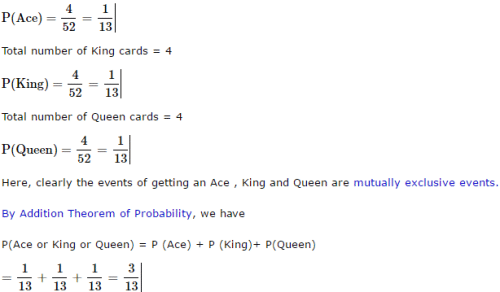
A card is randomly drawn from a deck of 52 cards. What is the probability getting an Ace or King or Queen?- a)

- b)

- c)

- d)

Correct answer is option 'A'. Can you explain this answer?
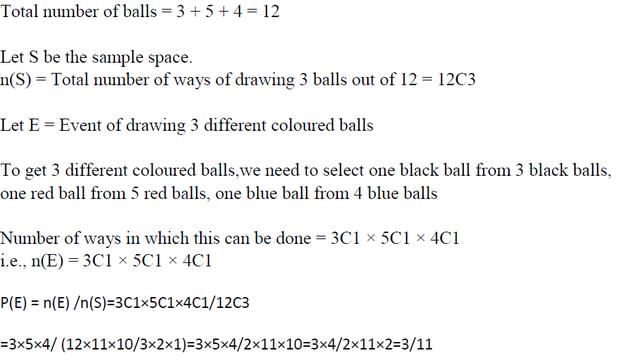
A card is randomly drawn from a deck of 52 cards. What is the probability getting an Ace or King or Queen?
a)
b)
c)
d)
| | Bank Exams India answered |
Total number of cards = 52
Total number of Ace cards = 4
Total number of Ace cards = 4
AMS employs 8 professors on their staff. Their respective probability of remaining in employment for 10 years are 0.2, 0.3, 0.4, 0.5, 0.6, 0.7, 0.8, 0.9. The probability that after 10 years at least 6 of them still work in AMS is- a)0.19
- b)1.22
- c)0.1
- d)None of these
Correct answer is option 'A'. Can you explain this answer?
AMS employs 8 professors on their staff. Their respective probability of remaining in employment for 10 years are 0.2, 0.3, 0.4, 0.5, 0.6, 0.7, 0.8, 0.9. The probability that after 10 years at least 6 of them still work in AMS is
a)
0.19
b)
1.22
c)
0.1
d)
None of these
 | Ishani Rane answered |
here 8 professors are there.
Asking atleast 6 of them continue ,
it has 3 cases.
1 all 8 professors continue.
2 7 professors continue and 1 professors discontinue.
3 6 professors continue and 2 professors discontinue.
1st case all 8 continue is = 2/10*3/10*4/10*5/10*6/10*7/10*/8/10*9/10=9factorial/10power8
=362880/100000000
=>0.00363.
2nd case any 7 professors continue, and 1out of 8 discontinue ,8C1 means 8 ways.
= 2/10*3/10.8/10*1/10, (9/10 prodbability professor discontinue then 1/10)
in this way if we calculate for 8 possibilities then value is =>0.03733.
3rd case any 6 professors continue and 2out of 8 discontinue , 8C2 means 28 ways.
= 2/10*3/10.2/10*1/10( 2 professors discontinue.
if we calculate for 28 possibilites P value is=>0.1436
=0.00363+0.03733+0.1436=0.18456=
0.19
A letter is chosen at random from the letters of the word PROBABILITY. Find the probability that letter chosen is a vowel - a)1/30
- b)4/11
- c)1/6
- d)1/5
- e)1/3
Correct answer is option 'B'. Can you explain this answer?
A letter is chosen at random from the letters of the word PROBABILITY. Find the probability that letter chosen is a vowel
a)
1/30
b)
4/11
c)
1/6
d)
1/5
e)
1/3
 | Riverdale Learning Institute answered |
On the first pick, two of the five letters are vowels — A & E — so the probability of picking a vowel on the first pick is 2/5. On the second pick, only one letter out of the six is a vowel — O — so the probability of picking a vowel on the second pick is 1/6. The two picks are independent: what one selects from one set has absolutely no bearing on what one picks from the other set. Therefore, we can use the generalized AND rule.
P(two vowels) = P(vowel on first pick)*P(vowel on second pick) = (2/5)*(1/6) = 2/30 = 1/15
The probability of a bomb hitting a bridge is 1/2 and two direct hits are needed to destroy it. The least number of bombs required so that the probability of the bridge being destroyed is greater than 0.9 is:- a)7 bombs
- b)3 bombs
- c)8 bombs
- d)9 bombs
Correct answer is option 'A'. Can you explain this answer?
The probability of a bomb hitting a bridge is 1/2 and two direct hits are needed to destroy it. The least number of bombs required so that the probability of the bridge being destroyed is greater than 0.9 is:
a)
7 bombs
b)
3 bombs
c)
8 bombs
d)
9 bombs
| | Nandita Tiwari answered |
Try to find the number of ways in which 0 or 1 bomb hits the bridge if n bombs are thrown.
The required value of the number of bombs will be such that the probability of 0 or 1 bomb hitting the bridge should be less than 0.1.
The required value of the number of bombs will be such that the probability of 0 or 1 bomb hitting the bridge should be less than 0.1.
A bag contains 15 tickets numbered 1 to 15. A ticket is drawn and replaced. Then one more ticket is drawn and replaced. The probability that first number drawn is even and second is odd is- a)56/225
- b)26/578
- c)57/289
- d)None of these
Correct answer is option 'A'. Can you explain this answer?
A bag contains 15 tickets numbered 1 to 15. A ticket is drawn and replaced. Then one more ticket is drawn and replaced. The probability that first number drawn is even and second is odd is
a)
56/225
b)
26/578
c)
57/289
d)
None of these
| | Prasad Nair answered |
In the first draw, we have 7 even tickets out of 15 and in the second we have 8 odd tickets out of 15.
Thus, (7/15) x (8/15) = 56/225.
Thus, (7/15) x (8/15) = 56/225.
If 4 whole numbers are taken at random and multiplied together, what is the chance that the last digit in the product is 1, 3, 7 or 9?- a)15/653
- b)12/542
- c)16/625
- d)17/625
Correct answer is option 'C'. Can you explain this answer?
If 4 whole numbers are taken at random and multiplied together, what is the chance that the last digit in the product is 1, 3, 7 or 9?
a)
15/653
b)
12/542
c)
16/625
d)
17/625
| | Ishani Rane answered |
3,7,9 are not possible in the unit place wen 4 whole numbers are multiplied togethr,only 1 i s possible,if the number chosen hav 1,3(3*3*3*3=81-1 as unit place),7(7*7*7*7=1 in unit place),9(9*9*9*9=1 in unit place)
so,possibilities of 1,3,7,9 in unit place of 4 number is 4C1*4C1*4C1*4C1=4*4*4*4=256..
thus numbers are=>1,11,21,31,41,51,61,71,81,91 with 1 in unit place.:=10 possibilities.
similarly,3,13,23,33,43,53,63,73,83,93:=10 possibilities
likewise 7,17,27,37,47,57,67,77,87,97:=10 poss.
and 9,19,29,39,49,59,69,79,89,99:=10 poss.
total posibilties:=10*10*10*10=10000
probability is 4^4/10^4=256/10000=16/625
Chapter doubts & questions for Probability - UPSC Prelims Paper 2 CSAT - Quant, Verbal & Decision Making 2026 is part of UPSC CSE exam preparation. The chapters have been prepared according to the UPSC CSE exam syllabus. The Chapter doubts & questions, notes, tests & MCQs are made for UPSC CSE 2026 Exam. Find important definitions, questions, notes, meanings, examples, exercises, MCQs and online tests here.
Chapter doubts & questions of Probability - UPSC Prelims Paper 2 CSAT - Quant, Verbal & Decision Making in English & Hindi are available as part of UPSC CSE exam. Download more important topics, notes, lectures and mock test series for UPSC CSE Exam by signing up for free.
UPSC Prelims Paper 2 CSAT - Quant, Verbal & Decision Making69 videos|50 docs|151 tests |
