


All Exams > UPSC > UPSC Prelims Paper 2 CSAT - Quant, Verbal & Decision Making > All Questions
All questions of Factorization for UPSC CSE Exam
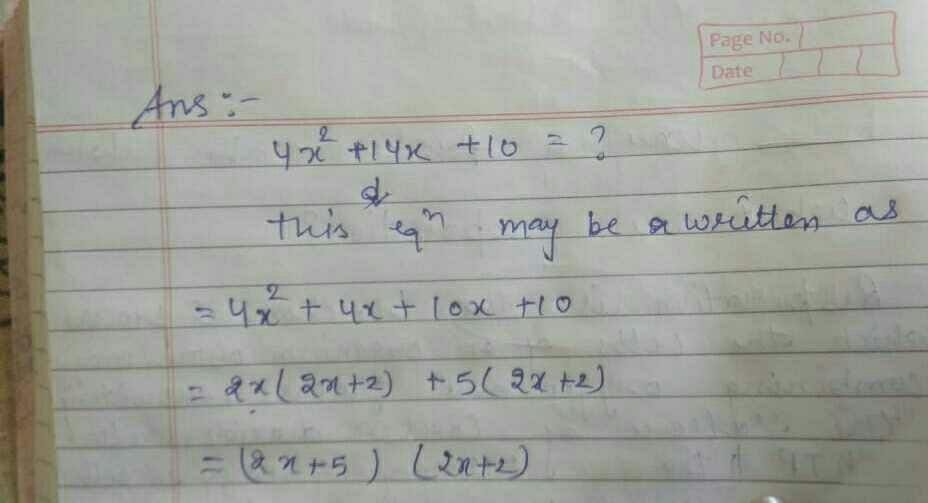

Using factorization, the expression 2x² + 12x + 16 = ?- a)(x + 4) (x + 4)
- b)(2x + 4) (x + 4)
- c)(x - 4) (x - 4)
- d)(2x - 4) (x — 4)
Correct answer is option 'B'. Can you explain this answer?
Using factorization, the expression 2x² + 12x + 16 = ?
a)
(x + 4) (x + 4)
b)
(2x + 4) (x + 4)
c)
(x - 4) (x - 4)
d)
(2x - 4) (x — 4)
 | Lalitha Jyothi answered |
2x^2+12x+16=
=2x^2+8x+4x+16
=2x(x+4) 4(x+4)
=(2x+4)(x+4)
=2x^2+8x+4x+16
=2x(x+4) 4(x+4)
=(2x+4)(x+4)
(a—(b)(a+(b)(a² + b²) = ?- a)(a² - b²)(a² + (b²)
- b)(a² + b²)(a² + (b²)
- c)a4 - b4
- d)a4 + b4
Correct answer is option 'C'. Can you explain this answer?
(a—(b)(a+(b)(a² + b²) = ?
a)
(a² - b²)(a² + (b²)
b)
(a² + b²)(a² + (b²)
c)
a4 - b4
d)
a4 + b4
 | Pallavi Mukherjee answered |
**Explanation:**
To solve this problem, we can use the exponentiation rules and simplify the given expression step by step:
Step 1: Evaluate the expression inside the innermost parentheses, where we have (a b). This means we multiply a and b together.
(a b) = ab
Step 2: Now, substitute the result of step 1 back into the original expression.
(a (b) (a b) = a (b) (ab)
Step 3: Evaluate the expression inside the parentheses from left to right. First, we have (b), which is just b.
(a (b) (ab) = a b (ab)
Step 4: Apply the exponentiation rule, which states that (ab)^n = a^n * b^n. In this case, we have (ab)^2.
(a b (ab))^2 = (a^1 * b^1 * a^1 * b^1)^2
Step 5: Simplify the expression inside the parentheses.
(a^1 * b^1 * a^1 * b^1) = a * b * a * b = a^2 * b^2
Step 6: Substitute the result of step 5 back into the expression.
(a b (ab))^2 = (a^2 * b^2)^2
Step 7: Apply the exponentiation rule again.
(a^2 * b^2)^2 = a^4 * b^4
Therefore, the correct answer is option C: a^4 - b^4.
To solve this problem, we can use the exponentiation rules and simplify the given expression step by step:
Step 1: Evaluate the expression inside the innermost parentheses, where we have (a b). This means we multiply a and b together.
(a b) = ab
Step 2: Now, substitute the result of step 1 back into the original expression.
(a (b) (a b) = a (b) (ab)
Step 3: Evaluate the expression inside the parentheses from left to right. First, we have (b), which is just b.
(a (b) (ab) = a b (ab)
Step 4: Apply the exponentiation rule, which states that (ab)^n = a^n * b^n. In this case, we have (ab)^2.
(a b (ab))^2 = (a^1 * b^1 * a^1 * b^1)^2
Step 5: Simplify the expression inside the parentheses.
(a^1 * b^1 * a^1 * b^1) = a * b * a * b = a^2 * b^2
Step 6: Substitute the result of step 5 back into the expression.
(a b (ab))^2 = (a^2 * b^2)^2
Step 7: Apply the exponentiation rule again.
(a^2 * b^2)^2 = a^4 * b^4
Therefore, the correct answer is option C: a^4 - b^4.
The G.C.D of x³ + 5x² + 6x and x³ + 9x² + 14x = ?- a)x² + 2
- b)(x + 2)(x + 2)
- c)x (x + 2)
- d)x2 (x + 2)
Correct answer is option 'C'. Can you explain this answer?
The G.C.D of x³ + 5x² + 6x and x³ + 9x² + 14x = ?
a)
x² + 2
b)
(x + 2)(x + 2)
c)
x (x + 2)
d)
x2 (x + 2)
 | Ipsita Roy answered |
Given expressions are:
x, 5x, 6x
x, 9x, 14x
To find the G.C.D of these expressions, we need to factorize them first:
x, 5x, 6x = x(1, 5, 6)
x, 9x, 14x = x(1, 9, 14)
Now, we can see that the only common factor among all the expressions is x. Therefore, the G.C.D is x times the G.C.D of the remaining factors.
So, the G.C.D of (1, 5, 6) and (1, 9, 14) is (1), which means the G.C.D of x, 5x, 6x and x, 9x, 14x is x(1) = x.
Hence, the correct answer is option (c) x(x+2).
x, 5x, 6x
x, 9x, 14x
To find the G.C.D of these expressions, we need to factorize them first:
x, 5x, 6x = x(1, 5, 6)
x, 9x, 14x = x(1, 9, 14)
Now, we can see that the only common factor among all the expressions is x. Therefore, the G.C.D is x times the G.C.D of the remaining factors.
So, the G.C.D of (1, 5, 6) and (1, 9, 14) is (1), which means the G.C.D of x, 5x, 6x and x, 9x, 14x is x(1) = x.
Hence, the correct answer is option (c) x(x+2).
Using factorization, the expression a² + ab = ?- a)a² + ab
- b)a + ab²
- c)a² (a + (b))
- d)a (a + (b))
Correct answer is option 'D'. Can you explain this answer?
Using factorization, the expression a² + ab = ?
a)
a² + ab
b)
a + ab²
c)
a² (a + (b))
d)
a (a + (b))
 | Sanchita Singh answered |
**Factorization of the expression a ab**
To factorize the given expression, we need to find the common factors between the terms.
The expression a ab can be rewritten as a * (1 b).
**Explanation of each step:**
1. The given expression is a ab.
2. We can rewrite ab as a * b.
3. Now we have a common factor of 'a' in both terms.
4. So, we can factorize a * (1 b).
**Simplified expression:**
The factorization of the expression a ab is a * (1 b).
Therefore, the correct answer is option D, which is a * (a b).
To factorize the given expression, we need to find the common factors between the terms.
The expression a ab can be rewritten as a * (1 b).
**Explanation of each step:**
1. The given expression is a ab.
2. We can rewrite ab as a * b.
3. Now we have a common factor of 'a' in both terms.
4. So, we can factorize a * (1 b).
**Simplified expression:**
The factorization of the expression a ab is a * (1 b).
Therefore, the correct answer is option D, which is a * (a b).
The G.C.D (Greatest Common Divisor) of a² - b² and (a + (b)² = ?- a)a+b
- b)a-b
- c)a2+b2
- d)a2-b2
Correct answer is option 'A'. Can you explain this answer?
The G.C.D (Greatest Common Divisor) of a² - b² and (a + (b)² = ?
a)
a+b
b)
a-b
c)
a2+b2
d)
a2-b2
Set of numbers is the largest positive integer that divides all the numbers in the set without leaving a remainder. It is also known as the highest common factor (HCF).
To find the GCD of a set of numbers, you can use various methods such as prime factorization, Euclidean algorithm, or using a calculator.
For example, let's find the GCD of the numbers 12, 18, and 24.
1. Prime Factorization Method:
- Write the prime factorization of each number:
12 = 2^2 * 3
18 = 2 * 3^2
24 = 2^3 * 3
- Identify the common prime factors: 2 and 3.
- Multiply these common prime factors together: 2 * 3 = 6.
- Therefore, the GCD of 12, 18, and 24 is 6.
2. Euclidean Algorithm:
- Start by dividing the first two numbers: 18 ÷ 12 = 1 remainder 6.
- Then divide the divisor (12) by the remainder (6): 12 ÷ 6 = 2 remainder 0.
- Since the remainder is 0, the last divisor (6) is the GCD.
- Therefore, the GCD of 12, 18, and 24 is 6.
3. Using a Calculator:
- Many calculators have a GCD function that can find the GCD of a set of numbers.
- Input the numbers 12, 18, and 24 into the calculator and use the GCD function.
- The calculator will display the GCD, which should be 6.
All three methods give the same result, which is the GCD of the set of numbers.
To find the GCD of a set of numbers, you can use various methods such as prime factorization, Euclidean algorithm, or using a calculator.
For example, let's find the GCD of the numbers 12, 18, and 24.
1. Prime Factorization Method:
- Write the prime factorization of each number:
12 = 2^2 * 3
18 = 2 * 3^2
24 = 2^3 * 3
- Identify the common prime factors: 2 and 3.
- Multiply these common prime factors together: 2 * 3 = 6.
- Therefore, the GCD of 12, 18, and 24 is 6.
2. Euclidean Algorithm:
- Start by dividing the first two numbers: 18 ÷ 12 = 1 remainder 6.
- Then divide the divisor (12) by the remainder (6): 12 ÷ 6 = 2 remainder 0.
- Since the remainder is 0, the last divisor (6) is the GCD.
- Therefore, the GCD of 12, 18, and 24 is 6.
3. Using a Calculator:
- Many calculators have a GCD function that can find the GCD of a set of numbers.
- Input the numbers 12, 18, and 24 into the calculator and use the GCD function.
- The calculator will display the GCD, which should be 6.
All three methods give the same result, which is the GCD of the set of numbers.

Using factorization, the expression x² + x - 20 = ?- a)(x + 4) (x + 5)
- b)(x + 4)(x - 5)
- c)(x - 4) (x + 5)
- d)(x -4) (x -5)
Correct answer is option 'C'. Can you explain this answer?
Using factorization, the expression x² + x - 20 = ?
a)
(x + 4) (x + 5)
b)
(x + 4)(x - 5)
c)
(x - 4) (x + 5)
d)
(x -4) (x -5)
 | Kirti Singh answered |
To factorize the expression x^2 - 20, we need to find two binomials whose product is equal to this expression.
1. Identify the common factors:
The expression x^2 - 20 does not have any common factors, so we move on to the next step.
2. Determine the sum and product of the factors:
We are looking for two numbers whose product is -20 and whose sum is 0 (since there is no coefficient of x^2). The numbers that satisfy these conditions are -4 and 5.
3. Write the expression in factored form:
Using the numbers -4 and 5, we can write the expression as:
x^2 - 20 = (x - 4)(x + 5)
Explanation of the factored form:
The factored form of the expression x^2 - 20 is (x - 4)(x + 5). Let's break it down:
1. (x - 4):
This factor represents one of the solutions to the equation x^2 - 20 = 0. When x = 4, this factor becomes zero, satisfying the equation.
2. (x + 5):
This factor represents the other solution to the equation x^2 - 20 = 0. When x = -5, this factor becomes zero, satisfying the equation.
Together, the factors (x - 4)(x + 5) represent all possible solutions to the equation x^2 - 20 = 0.
Conclusion:
The correct factored form of the expression x^2 - 20 is (x - 4)(x + 5), which corresponds to option (c) (x - 4)(x + 5) in the given options.
1. Identify the common factors:
The expression x^2 - 20 does not have any common factors, so we move on to the next step.
2. Determine the sum and product of the factors:
We are looking for two numbers whose product is -20 and whose sum is 0 (since there is no coefficient of x^2). The numbers that satisfy these conditions are -4 and 5.
3. Write the expression in factored form:
Using the numbers -4 and 5, we can write the expression as:
x^2 - 20 = (x - 4)(x + 5)
Explanation of the factored form:
The factored form of the expression x^2 - 20 is (x - 4)(x + 5). Let's break it down:
1. (x - 4):
This factor represents one of the solutions to the equation x^2 - 20 = 0. When x = 4, this factor becomes zero, satisfying the equation.
2. (x + 5):
This factor represents the other solution to the equation x^2 - 20 = 0. When x = -5, this factor becomes zero, satisfying the equation.
Together, the factors (x - 4)(x + 5) represent all possible solutions to the equation x^2 - 20 = 0.
Conclusion:
The correct factored form of the expression x^2 - 20 is (x - 4)(x + 5), which corresponds to option (c) (x - 4)(x + 5) in the given options.
Using factorization, the expression 6x² + 14x + 4 = ?- a)(6x + 2) (x + 2)
- b)(6x - 2) (x + 2)
- c)(6x + 2) (x - 2)
- d)(6x - 2) (x - 2)
Correct answer is option 'A'. Can you explain this answer?
Using factorization, the expression 6x² + 14x + 4 = ?
a)
(6x + 2) (x + 2)
b)
(6x - 2) (x + 2)
c)
(6x + 2) (x - 2)
d)
(6x - 2) (x - 2)
 | Partho Choudhury answered |
To factorize the expression 6x^2 + 14x + 4, we need to find two binomials that, when multiplied together, give us the original expression.
The first step is to look for common factors among the coefficients of the expression. In this case, we can see that all three coefficients (6, 14, and 4) are divisible by 2. So, we can factor out a 2 from the expression:
2(3x^2 + 7x + 2)
Next, we need to find two binomials that, when multiplied together, give us the expression inside the parentheses: 3x^2 + 7x + 2.
To do this, we need to find two numbers that multiply to give us the product of the leading coefficient (3) and the constant term (2), which is 6.
The numbers that satisfy this condition are 3 and 2. We can use these numbers to split the middle term (7x) into two terms: 3x and 2x.
So, the expression becomes:
2(3x^2 + 3x + 2x + 2)
Now, we can group the terms and factor out a common factor from each group:
2((3x^2 + 3x) + (2x + 2))
The common factor in the first group is 3x, and in the second group, it is 2:
2(3x(x + 1) + 2(x + 1))
Notice that we have now created a common binomial factor of (x + 1) in both terms. We can factor out this binomial:
2(x + 1)(3x + 2)
So, the fully factorized expression is:
2(x + 1)(3x + 2)
Therefore, the correct answer is option 'A': (6x + 2)(x + 2).
The first step is to look for common factors among the coefficients of the expression. In this case, we can see that all three coefficients (6, 14, and 4) are divisible by 2. So, we can factor out a 2 from the expression:
2(3x^2 + 7x + 2)
Next, we need to find two binomials that, when multiplied together, give us the expression inside the parentheses: 3x^2 + 7x + 2.
To do this, we need to find two numbers that multiply to give us the product of the leading coefficient (3) and the constant term (2), which is 6.
The numbers that satisfy this condition are 3 and 2. We can use these numbers to split the middle term (7x) into two terms: 3x and 2x.
So, the expression becomes:
2(3x^2 + 3x + 2x + 2)
Now, we can group the terms and factor out a common factor from each group:
2((3x^2 + 3x) + (2x + 2))
The common factor in the first group is 3x, and in the second group, it is 2:
2(3x(x + 1) + 2(x + 1))
Notice that we have now created a common binomial factor of (x + 1) in both terms. We can factor out this binomial:
2(x + 1)(3x + 2)
So, the fully factorized expression is:
2(x + 1)(3x + 2)
Therefore, the correct answer is option 'A': (6x + 2)(x + 2).
Using factorization, the expression 2x² - 2x = ?- a)2x²(x-1
- b)2x(x-1)
- c)2 (x-1)
- d)2(x²-1)
Correct answer is option 'B'. Can you explain this answer?
Using factorization, the expression 2x² - 2x = ?
a)
2x²(x-1
b)
2x(x-1)
c)
2 (x-1)
d)
2(x²-1)
 | Sanjay Rao answered |
2x^2-2x
=2x(x-1)
B is the right answer
=2x(x-1)
B is the right answer
Using factorization, the expression x² + 15x + 36 = ?- a)(x + 3)(x + 4)
- b)(x + 3)(x - 4)
- c)(x + 3) (x + 12)
- d)(x + 3)(x - 12)
Correct answer is option 'C'. Can you explain this answer?
Using factorization, the expression x² + 15x + 36 = ?
a)
(x + 3)(x + 4)
b)
(x + 3)(x - 4)
c)
(x + 3) (x + 12)
d)
(x + 3)(x - 12)
 | Sushant Gupta answered |
Factorization of the expression:
To factorize the expression x^2 + 15x + 36, we need to find two numbers that multiply to give 36 and add up to give 15.
Step 1: Find the factors of 36
The factors of 36 are:
1, 2, 3, 4, 6, 9, 12, 18, 36
Step 2: Find two numbers that add up to 15
The numbers that add up to 15 are:
3 + 12 = 15
Step 3: Rewrite the expression using the two numbers
x^2 + 3x + 12x + 36
Step 4: Group the terms
(x^2 + 3x) + (12x + 36)
Step 5: Factor out the common factors from each group
x(x + 3) + 12(x + 3)
Step 6: Factor out the common factor (x + 3)
(x + 3)(x + 12)
Final Answer:
The expression x^2 + 15x + 36 can be factorized as (x + 3)(x + 12), which corresponds to option C.
To factorize the expression x^2 + 15x + 36, we need to find two numbers that multiply to give 36 and add up to give 15.
Step 1: Find the factors of 36
The factors of 36 are:
1, 2, 3, 4, 6, 9, 12, 18, 36
Step 2: Find two numbers that add up to 15
The numbers that add up to 15 are:
3 + 12 = 15
Step 3: Rewrite the expression using the two numbers
x^2 + 3x + 12x + 36
Step 4: Group the terms
(x^2 + 3x) + (12x + 36)
Step 5: Factor out the common factors from each group
x(x + 3) + 12(x + 3)
Step 6: Factor out the common factor (x + 3)
(x + 3)(x + 12)
Final Answer:
The expression x^2 + 15x + 36 can be factorized as (x + 3)(x + 12), which corresponds to option C.
The expression a³ + 64 = ?- a)(a + 4)(a² + 4a + 16)
- b)(a + 4)(a² — 4a + 16)
- c)(a — 4)(a² — 4a + 16)
- d)(a - 4)(a² + 4a + 16)
Correct answer is option 'B'. Can you explain this answer?
The expression a³ + 64 = ?
a)
(a + 4)(a² + 4a + 16)
b)
(a + 4)(a² — 4a + 16)
c)
(a — 4)(a² — 4a + 16)
d)
(a - 4)(a² + 4a + 16)
| | Ríyâ Räj answered |
Solution~a³+64=(a)³+(4)³=(a+4)(a²-4a+16)..the identity used in this expression is (a³+b³) = (a+b)(a²-ab+b²)..so option b is CORRECT.
Using factorization, the expression x² + 6x + 9 = ?- a)(x + 3)(x - 3)
- b)(x + 1)(x + 2)
- c)(x + 3) (x + 3)
- d)(x + 2) (x + 2)
Correct answer is option 'C'. Can you explain this answer?
Using factorization, the expression x² + 6x + 9 = ?
a)
(x + 3)(x - 3)
b)
(x + 1)(x + 2)
c)
(x + 3) (x + 3)
d)
(x + 2) (x + 2)
 | Zara Khan answered |
x^2 + 6x + 9
x^2 + 3x + 3x + 9
x (x + 3 ) + 3 (x + 3)
(x + 3) (x + 3 )
(x + 3 )^2
The expression 8x³ + 27y³ = ?- a)(2x + 3y)(4x² + 6xy + 9y²)
- b)(2x + 3y)(4x² - 6xy + 9y²)
- c)(2x + 3y)(4x² - 9y²)
- d)(2x + 3y)(4x² + 9y²)
Correct answer is option 'B'. Can you explain this answer?
The expression 8x³ + 27y³ = ?
a)
(2x + 3y)(4x² + 6xy + 9y²)
b)
(2x + 3y)(4x² - 6xy + 9y²)
c)
(2x + 3y)(4x² - 9y²)
d)
(2x + 3y)(4x² + 9y²)
 | Debanshi Sengupta answered |
To simplify the expression 8x + 27y, we can factor out the greatest common factor, which in this case is 1.
Step 1: Identify the common factors
The expression 8x + 27y does not have any common factors other than 1.
Step 2: Factor out the GCF
Since the GCF is 1, we can skip this step.
Step 3: Write the expression in factored form
The factored form of 8x + 27y is (8x + 27y).
The factored form (8x + 27y) is not one of the options provided.
Therefore, none of the options are correct.
Step 1: Identify the common factors
The expression 8x + 27y does not have any common factors other than 1.
Step 2: Factor out the GCF
Since the GCF is 1, we can skip this step.
Step 3: Write the expression in factored form
The factored form of 8x + 27y is (8x + 27y).
The factored form (8x + 27y) is not one of the options provided.
Therefore, none of the options are correct.
Faran thought of a number, if 8 is subtracted from that number, the result is 18, the original number is = ?- a)8
- b)18
- c)10
- d)26
Correct answer is option 'D'. Can you explain this answer?
Faran thought of a number, if 8 is subtracted from that number, the result is 18, the original number is = ?
a)
8
b)
18
c)
10
d)
26
| | Sarita Pandey answered |
Let the original number is athen,According to the question,a-8=18...a=8+18...a=26
Using factorization, the expression 25x² + 15x - 10 =- a)(25x - 10)(x - 1)
- b)(25x + 10) (x - 1)
- c)(25x - 10)(x + 1)
- d)(25x + 10)(x - 1)
Correct answer is option 'C'. Can you explain this answer?
Using factorization, the expression 25x² + 15x - 10 =
a)
(25x - 10)(x - 1)
b)
(25x + 10) (x - 1)
c)
(25x - 10)(x + 1)
d)
(25x + 10)(x - 1)
 | Mira Dey answered |
To factorize the expression 25x^2 - 15x - 10, we need to find two numbers that multiply to give -10 and add to give -15. Let's call these numbers a and b.
1. Finding the factors of -10:
The factors of -10 are: -1, 1, -2, 2, -5, and 5.
2. Finding the numbers a and b:
To find the numbers a and b that add up to -15 and multiply to -10, we can try different combinations of the factors of -10. After some trial and error, we find that -5 and 2 satisfy these conditions.
3. Writing the expression:
Now that we have the numbers a and b, we can write the expression as follows:
25x^2 - 15x - 10 = (5x + a)(5x + b)
Substituting a = -5 and b = 2, we have:
25x^2 - 15x - 10 = (5x - 5)(5x + 2)
Simplifying further, we get:
25x^2 - 15x - 10 = 5(x - 1)(5x + 2)
So, the correct factorization of the expression 25x^2 - 15x - 10 is:
(25x - 10)(x + 1)
1. Finding the factors of -10:
The factors of -10 are: -1, 1, -2, 2, -5, and 5.
2. Finding the numbers a and b:
To find the numbers a and b that add up to -15 and multiply to -10, we can try different combinations of the factors of -10. After some trial and error, we find that -5 and 2 satisfy these conditions.
3. Writing the expression:
Now that we have the numbers a and b, we can write the expression as follows:
25x^2 - 15x - 10 = (5x + a)(5x + b)
Substituting a = -5 and b = 2, we have:
25x^2 - 15x - 10 = (5x - 5)(5x + 2)
Simplifying further, we get:
25x^2 - 15x - 10 = 5(x - 1)(5x + 2)
So, the correct factorization of the expression 25x^2 - 15x - 10 is:
(25x - 10)(x + 1)
(a + 2b)² - (a + 2b)(3a - 7b) by factorization gives- a)(a + 2b)(9b - 2a)
- b)a - 3b + 4ab
- c)5b - 4a
- d)None of above
Correct answer is option 'A'. Can you explain this answer?
(a + 2b)² - (a + 2b)(3a - 7b) by factorization gives
a)
(a + 2b)(9b - 2a)
b)
a - 3b + 4ab
c)
5b - 4a
d)
None of above
 | Nishtha Choudhury answered |
I'm sorry, but your question is incomplete. Please provide more information or context so I can assist you better.
The expression x³ - 125y³ = ?- a)(x — 5y) (x² + 5xy + 25y²)
- b)(x — y)(x²— 5xy + y²)
- c)(x - y)(x² + 5xy + 25y²)
- d)(x — y)(x² — 5xy + 25y²)
Correct answer is option 'A'. Can you explain this answer?
The expression x³ - 125y³ = ?
a)
(x — 5y) (x² + 5xy + 25y²)
b)
(x — y)(x²— 5xy + y²)
c)
(x - y)(x² + 5xy + 25y²)
d)
(x — y)(x² — 5xy + 25y²)
| | Poulomi Kumar answered |
The expression "x" is a variable that represents an unknown value. It can be used in mathematical equations or formulas to represent any number. The value of "x" can be determined or solved for through various methods such as algebraic manipulation or substitution.
Using factorization, the expression x² - 25 = ?- a)(x -5) (x - 5)
- b)(x -5) (x + 5)
- c)(x +5) (x + 5)
- d)None of the above
Correct answer is option 'B'. Can you explain this answer?
Using factorization, the expression x² - 25 = ?
a)
(x -5) (x - 5)
b)
(x -5) (x + 5)
c)
(x +5) (x + 5)
d)
None of the above
| | Ríyâ Räj answered |
Soluton~x²-25 =(x)²-(5)²=(x+5)(x-5).. the Identity used in this expression is a²-b²=(a+b)(a-b)...since, OPTION 'B' is correct..
Chapter doubts & questions for Factorization - UPSC Prelims Paper 2 CSAT - Quant, Verbal & Decision Making 2026 is part of UPSC CSE exam preparation. The chapters have been prepared according to the UPSC CSE exam syllabus. The Chapter doubts & questions, notes, tests & MCQs are made for UPSC CSE 2026 Exam. Find important definitions, questions, notes, meanings, examples, exercises, MCQs and online tests here.
Chapter doubts & questions of Factorization - UPSC Prelims Paper 2 CSAT - Quant, Verbal & Decision Making in English & Hindi are available as part of UPSC CSE exam. Download more important topics, notes, lectures and mock test series for UPSC CSE Exam by signing up for free.
UPSC Prelims Paper 2 CSAT - Quant, Verbal & Decision Making69 videos|50 docs|151 tests |
