


All questions of Paper-I (General Studies and Engineering Aptitude) for Electrical Engineering (EE) Exam
Consider the following statements related to Project Phases:1. In sequential relationship next phase can start if and only if previous phase is complete.2. Sequential relationship allows a project manager to reduce the project completion time.3. In overlapping phase relationship next phase can begin before the completion of previous phase.4. Overlapping phase is a risk free phase as all phase can be work independently.Which of the following statements are correct?- a)Only 1 and 2
- b)3 and 4
- c)Only 2 and 4
- d)Only 1 and 3
Correct answer is option 'D'. Can you explain this answer?
Consider the following statements related to Project Phases:
1. In sequential relationship next phase can start if and only if previous phase is complete.
2. Sequential relationship allows a project manager to reduce the project completion time.
3. In overlapping phase relationship next phase can begin before the completion of previous phase.
4. Overlapping phase is a risk free phase as all phase can be work independently.
Which of the following statements are correct?
a)
Only 1 and 2
b)
3 and 4
c)
Only 2 and 4
d)
Only 1 and 3
 | Nishtha Chauhan answered |
Sequential and Overlapping Project Phases
Sequential Relationship:
1. In a sequential relationship, the next phase of a project can only begin once the previous phase is complete.
2. This relationship ensures that there is a clear order and dependency between the project phases.
3. It helps in maintaining a structured approach to project execution.
4. Sequential relationship does not necessarily reduce the project completion time, as each phase needs to be completed before the next one can start.
Overlapping Relationship:
1. In an overlapping relationship, the next phase of a project can begin before the completion of the previous phase.
2. Overlapping phases allow for parallel execution and can potentially reduce the project completion time.
3. This relationship requires careful planning and coordination to ensure that the overlapping phases do not interfere with each other.
4. Overlapping phases introduce a certain level of risk as there is a possibility of conflicts or dependencies between the concurrent activities.
Correct Statements:
Based on the given statements, the correct statements are:
1. In sequential relationship next phase can start if and only if the previous phase is complete.
This statement is correct as it defines the fundamental characteristic of a sequential project phase relationship. The completion of one phase is required before the next phase can begin.
3. In overlapping phase relationship next phase can begin before the completion of the previous phase.
This statement is correct as it describes the nature of an overlapping project phase relationship. Overlapping phases allow for concurrent execution and can provide opportunities for reducing project completion time.
Explanation of Incorrect Statements:
2. Sequential relationship allows a project manager to reduce the project completion time.
This statement is incorrect. A sequential relationship does not inherently reduce the project completion time. It ensures a structured approach to project execution but does not allow for concurrent activities.
4. Overlapping phase is a risk-free phase as all phases can work independently.
This statement is incorrect. Overlapping phases introduce a certain level of risk as there is a possibility of conflicts or dependencies between the concurrent activities. Proper planning and coordination are required to minimize these risks.
In conclusion, statements 1 and 3 are the correct statements regarding project phases. Sequential relationship ensures that the next phase can only start after the completion of the previous phase, while overlapping relationship allows for concurrent execution of phases to potentially reduce project completion time.
Sequential Relationship:
1. In a sequential relationship, the next phase of a project can only begin once the previous phase is complete.
2. This relationship ensures that there is a clear order and dependency between the project phases.
3. It helps in maintaining a structured approach to project execution.
4. Sequential relationship does not necessarily reduce the project completion time, as each phase needs to be completed before the next one can start.
Overlapping Relationship:
1. In an overlapping relationship, the next phase of a project can begin before the completion of the previous phase.
2. Overlapping phases allow for parallel execution and can potentially reduce the project completion time.
3. This relationship requires careful planning and coordination to ensure that the overlapping phases do not interfere with each other.
4. Overlapping phases introduce a certain level of risk as there is a possibility of conflicts or dependencies between the concurrent activities.
Correct Statements:
Based on the given statements, the correct statements are:
1. In sequential relationship next phase can start if and only if the previous phase is complete.
This statement is correct as it defines the fundamental characteristic of a sequential project phase relationship. The completion of one phase is required before the next phase can begin.
3. In overlapping phase relationship next phase can begin before the completion of the previous phase.
This statement is correct as it describes the nature of an overlapping project phase relationship. Overlapping phases allow for concurrent execution and can provide opportunities for reducing project completion time.
Explanation of Incorrect Statements:
2. Sequential relationship allows a project manager to reduce the project completion time.
This statement is incorrect. A sequential relationship does not inherently reduce the project completion time. It ensures a structured approach to project execution but does not allow for concurrent activities.
4. Overlapping phase is a risk-free phase as all phases can work independently.
This statement is incorrect. Overlapping phases introduce a certain level of risk as there is a possibility of conflicts or dependencies between the concurrent activities. Proper planning and coordination are required to minimize these risks.
In conclusion, statements 1 and 3 are the correct statements regarding project phases. Sequential relationship ensures that the next phase can only start after the completion of the previous phase, while overlapping relationship allows for concurrent execution of phases to potentially reduce project completion time.

The Terms DOCSIS, xDSL, FITL are used in which of the following industries?- a)Manufacturing
- b)Telecommunication
- c)Mineral extraction
- d)Consumer Goods
Correct answer is option 'B'. Can you explain this answer?
The Terms DOCSIS, xDSL, FITL are used in which of the following industries?
a)
Manufacturing
b)
Telecommunication
c)
Mineral extraction
d)
Consumer Goods
 | Prerna Tiwari answered |
Telecommunication
DOCSIS
- DOCSIS stands for Data Over Cable Service Interface Specification.
- It is a standard that defines how data is transmitted over cable television networks.
- It is used in the telecommunications industry, specifically in cable modem systems.
- DOCSIS allows for high-speed internet access over cable TV networks, enabling broadband services to be provided to residential and commercial customers.
xDSL
- xDSL refers to a family of technologies that provide digital data transmission over existing telephone lines.
- It stands for x Digital Subscriber Line, where x can be ADSL (Asymmetric DSL), VDSL (Very high-speed DSL), or other variations.
- xDSL technologies are used in the telecommunications industry to provide high-speed internet access to homes and businesses.
- xDSL allows for simultaneous voice and data transmission over the same telephone line, without interfering with each other.
FITL
- FITL stands for Fiber In The Loop.
- It is a technology used in telecommunications networks to deliver high-speed internet access.
- FITL involves deploying fiber optic cables directly to the customers' premises, replacing traditional copper-based infrastructure.
- By using fiber optic cables, FITL can provide faster and more reliable internet connections compared to traditional copper-based technologies.
- FITL is used in the telecommunications industry to provide broadband services to residential and commercial customers.
Conclusion
The terms DOCSIS, xDSL, and FITL are all used in the telecommunications industry. DOCSIS is used for data transmission over cable TV networks, xDSL provides digital data transmission over existing telephone lines, and FITL involves deploying fiber optic cables to deliver high-speed internet access. These technologies are essential for providing broadband services to customers in the telecommunications industry.
DOCSIS
- DOCSIS stands for Data Over Cable Service Interface Specification.
- It is a standard that defines how data is transmitted over cable television networks.
- It is used in the telecommunications industry, specifically in cable modem systems.
- DOCSIS allows for high-speed internet access over cable TV networks, enabling broadband services to be provided to residential and commercial customers.
xDSL
- xDSL refers to a family of technologies that provide digital data transmission over existing telephone lines.
- It stands for x Digital Subscriber Line, where x can be ADSL (Asymmetric DSL), VDSL (Very high-speed DSL), or other variations.
- xDSL technologies are used in the telecommunications industry to provide high-speed internet access to homes and businesses.
- xDSL allows for simultaneous voice and data transmission over the same telephone line, without interfering with each other.
FITL
- FITL stands for Fiber In The Loop.
- It is a technology used in telecommunications networks to deliver high-speed internet access.
- FITL involves deploying fiber optic cables directly to the customers' premises, replacing traditional copper-based infrastructure.
- By using fiber optic cables, FITL can provide faster and more reliable internet connections compared to traditional copper-based technologies.
- FITL is used in the telecommunications industry to provide broadband services to residential and commercial customers.
Conclusion
The terms DOCSIS, xDSL, and FITL are all used in the telecommunications industry. DOCSIS is used for data transmission over cable TV networks, xDSL provides digital data transmission over existing telephone lines, and FITL involves deploying fiber optic cables to deliver high-speed internet access. These technologies are essential for providing broadband services to customers in the telecommunications industry.
Direction: The following item consists of two statements, one labelled as ‘Statement (I)’ and the other as ‘Statement (II)’.Examine these two statements carefully and select the answer using the code given below:Statement (I): All the ferroelectric materials are piezoelectric materials also but the reverse statement is not true.
Statement (II): Ferro-electricity is independent of temperature.- a)Both Statement I and Statement II are individually true and Statement II is the correct explanation of Statement I
- b)Both Statement I and Statement II are individually true but Statement II is not the correct explanation of Statement I
- c)Statement I is true but Statement II is false
- d)Statement I is false but Statement II is true
Correct answer is option 'C'. Can you explain this answer?
Direction: The following item consists of two statements, one labelled as ‘Statement (I)’ and the other as ‘Statement (II)’.
Examine these two statements carefully and select the answer using the code given below:
Statement (I): All the ferroelectric materials are piezoelectric materials also but the reverse statement is not true.
Statement (II): Ferro-electricity is independent of temperature.
Statement (II): Ferro-electricity is independent of temperature.
a)
Both Statement I and Statement II are individually true and Statement II is the correct explanation of Statement I
b)
Both Statement I and Statement II are individually true but Statement II is not the correct explanation of Statement I
c)
Statement I is true but Statement II is false
d)
Statement I is false but Statement II is true
 | Anjana Singh answered |
Concept:
Ferroelectric material:
- It is characterized by the presence of a remnant polarization at zero bias voltage and the ability to switch the direction of this polarization
- A ferroelectric material is normally in single-crystalline or polycrystalline form and possesses a reversible spontaneous polarization over a certain temperature range
- There is a critical temperature, called the Curie temperature, which marks the transition from the ordered to the disordered phase
Piezoelectric Effect:
- It is the ability of certain materials to generate an electric charge in response to applied mechanical stress
- When piezoelectric material is placed under mechanical stress, a shifting of the positive and negative charge centres in the material takes place, which then results in an external electrical field
- When reversed, an outer electrical field either stretches or compresses the piezoelectric material
Curie - Weiss law:
According to Curie - Weiss law, the susceptibility of a ferromagnetic material decreases above a certain temperature called curie temperature and it becomes paramagnetic in nature.
The susceptibility is given by

Where,
C = Curie constant,
TC = Curie temperature,
T = Temperature
According to Curie - Weiss law, the susceptibility of a ferromagnetic material decreases above a certain temperature called curie temperature and it becomes paramagnetic in nature.
The susceptibility is given by
Where,
C = Curie constant,
TC = Curie temperature,
T = Temperature
All the ferroelectric materials are piezoelectric materials also but all the piezoelectric materials are not ferroelectric materials.
Therefore, statement I is true.
Therefore, statement I is true.
Statement II:
- Ferroelectric materials are also temperature-dependent.
- For T > Tcurie, these materials converted into the paramagnetic.
- These materials undergo transformation above the critical temperature.
Which of the following best describes ‘Laundromat countries’, which was recently in news:- a)A group of countries that are being accused of Money Laundering by FATF.
- b)A group of countries that buy Russian oil and sell processed products to European countries.
- c)A group of countries that are accused of high-volume Drug trafficking.
- d)None of the above
Correct answer is option 'B'. Can you explain this answer?
Which of the following best describes ‘Laundromat countries’, which was recently in news:
a)
A group of countries that are being accused of Money Laundering by FATF.
b)
A group of countries that buy Russian oil and sell processed products to European countries.
c)
A group of countries that are accused of high-volume Drug trafficking.
d)
None of the above
| | Prerna Tiwari answered |
The concept of "cultural relativism"?
A. The belief that all cultures are equal and should be respected.
B. The belief that culture is determined by genetics.
C. The belief that one's own culture is superior to others.
D. The belief that cultural practices should be judged based on universal standards.
A. The belief that all cultures are equal and should be respected.
B. The belief that culture is determined by genetics.
C. The belief that one's own culture is superior to others.
D. The belief that cultural practices should be judged based on universal standards.
The audit report of evaluation should contain at least the current status of the project and ______- a)Expected future status
- b)Crucial task status
- c)Risk assessment
- d)All of the above
Correct answer is option 'D'. Can you explain this answer?
The audit report of evaluation should contain at least the current status of the project and ______
a)
Expected future status
b)
Crucial task status
c)
Risk assessment
d)
All of the above
 | Gitanjali Deshpande answered |
Current Status:
The audit report of evaluation should include the current status of the project, detailing where the project stands at the time of the audit. This should cover aspects such as progress made, milestones achieved, and any issues or challenges faced during the project implementation.
Expected Future Status:
Additionally, the audit report should outline the expected future status of the project. This involves projecting what the project's status will be after addressing any identified issues or risks, and what the anticipated outcomes and deliverables will be at project completion.
Crucial Task Status:
The audit report should also include the status of crucial tasks within the project. This would involve highlighting key activities or tasks that are integral to the project's success, and evaluating their progress and completion status.
Risk Assessment:
Furthermore, the audit report should contain a risk assessment section. This would involve identifying and evaluating potential risks and uncertainties that could impact the project's success, and providing recommendations for mitigating these risks to ensure project success.
All of the Above:
In essence, the audit report of evaluation should encompass all of the above points - the current status of the project, expected future status, crucial task status, and risk assessment. This comprehensive approach ensures that stakeholders have a clear understanding of the project's progress, challenges, and future trajectory.
The audit report of evaluation should include the current status of the project, detailing where the project stands at the time of the audit. This should cover aspects such as progress made, milestones achieved, and any issues or challenges faced during the project implementation.
Expected Future Status:
Additionally, the audit report should outline the expected future status of the project. This involves projecting what the project's status will be after addressing any identified issues or risks, and what the anticipated outcomes and deliverables will be at project completion.
Crucial Task Status:
The audit report should also include the status of crucial tasks within the project. This would involve highlighting key activities or tasks that are integral to the project's success, and evaluating their progress and completion status.
Risk Assessment:
Furthermore, the audit report should contain a risk assessment section. This would involve identifying and evaluating potential risks and uncertainties that could impact the project's success, and providing recommendations for mitigating these risks to ensure project success.
All of the Above:
In essence, the audit report of evaluation should encompass all of the above points - the current status of the project, expected future status, crucial task status, and risk assessment. This comprehensive approach ensures that stakeholders have a clear understanding of the project's progress, challenges, and future trajectory.
If OPPOSITE is written as NOQPTJSD, how will STRAIGHT be written?- a)RSSBJGHS
- b)RSSBGHJS
- c)RSSJBHGS
- d)RSSBJHGS
Correct answer is option 'D'. Can you explain this answer?
If OPPOSITE is written as NOQPTJSD, how will STRAIGHT be written?
a)
RSSBJGHS
b)
RSSBGHJS
c)
RSSJBHGS
d)
RSSBJHGS
 | Om Saini answered |
Explanation:
Pattern Analysis:
- In the given word 'OPPOSITE', each letter is replaced by the letter that comes 2 places before it in the English alphabet.
- For example, 'O' is replaced by 'N', 'P' is replaced by 'O', 'P' is replaced by 'O', and so on.
Applying the Pattern to 'STRAIGHT':
- 'S' comes 2 places before 'R' in the alphabet, so it will be replaced by 'R'.
- 'T' comes 2 places before 'S' in the alphabet, so it will be replaced by 'S'.
- 'R' comes 2 places before 'Q' in the alphabet, so it will be replaced by 'Q'.
- 'A' comes 2 places before 'T' in the alphabet, so it will be replaced by 'T'.
- 'I' comes 2 places before 'G' in the alphabet, so it will be replaced by 'G'.
- 'G' comes 2 places before 'E' in the alphabet, so it will be replaced by 'E'.
- 'H' comes 2 places before 'F' in the alphabet, so it will be replaced by 'F'.
- 'T' comes 2 places before 'H' in the alphabet, so it will be replaced by 'H'.
Therefore, the word 'STRAIGHT' will be written as 'RSSBJHGSC' following the same pattern as 'OPPOSITE'.
Pattern Analysis:
- In the given word 'OPPOSITE', each letter is replaced by the letter that comes 2 places before it in the English alphabet.
- For example, 'O' is replaced by 'N', 'P' is replaced by 'O', 'P' is replaced by 'O', and so on.
Applying the Pattern to 'STRAIGHT':
- 'S' comes 2 places before 'R' in the alphabet, so it will be replaced by 'R'.
- 'T' comes 2 places before 'S' in the alphabet, so it will be replaced by 'S'.
- 'R' comes 2 places before 'Q' in the alphabet, so it will be replaced by 'Q'.
- 'A' comes 2 places before 'T' in the alphabet, so it will be replaced by 'T'.
- 'I' comes 2 places before 'G' in the alphabet, so it will be replaced by 'G'.
- 'G' comes 2 places before 'E' in the alphabet, so it will be replaced by 'E'.
- 'H' comes 2 places before 'F' in the alphabet, so it will be replaced by 'F'.
- 'T' comes 2 places before 'H' in the alphabet, so it will be replaced by 'H'.
Therefore, the word 'STRAIGHT' will be written as 'RSSBJHGSC' following the same pattern as 'OPPOSITE'.
For optimum level of quality, which of the following cost should be minimum?- a)Direct cost
- b)Indirect cost
- c)Appraisal cost
- d)Total cost
Correct answer is option 'C'. Can you explain this answer?
For optimum level of quality, which of the following cost should be minimum?
a)
Direct cost
b)
Indirect cost
c)
Appraisal cost
d)
Total cost
| | Anjana Singh answered |
Cost of Quality:
It is the cost of those activities which an organization has incurred in order to maintain the quality over and above the minimum cost required to do the job. It is broadly classified into two divisions:
(i) Cost of Conformance:
The cost incurred while providing the products or services of required standards is called the cost of conformance. It includes the cost of prevention and the cost of the appraisal.
(ii) Cost of Non-Conformance:
It is also called the cost of failure and it takes place due to the products not operating as per the required specifications and standards. It includes the cost of internal failure and the cost of external failure. It is better to invest in the prevention cost as the cost of failure is too high and involves market risk as well.
Hence, Cost of quality = Prevention cost + Appraisal cost + Internal failure cost + External failure cost .
The establishment of a management system includes the cost of prevention. Prevention costs include the costs associated with quality planning, education, and training of the workforce, market research, and product design.
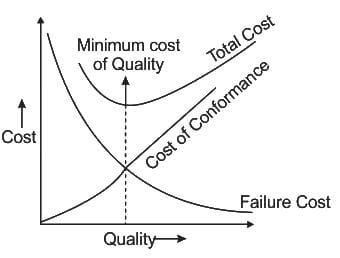
- Prevention costs: The costs incurred to avoid or minimize the number of defects in first place. E.g. - an improvement of manufacturing processes, workers training, quality engineering etc.
- Appraisal costs: Costs that are incurred to identify defective products before they are shipped to customers. These are also called 'Inspection Costs'. E.g. - Final product testing and inspection cost, QC cost.
- Internal failure costs: Costs are those costs that are incurred to remove defects from the products before shipping them to customers. Examples of internal failure costs include the cost of rework, rejected products, scrap etc.
- External failure costs: If defective products have been shipped to customers, external failure costs arise. External failure costs include warranties, replacements, lost sales because of a bad reputation, payment for damages arising from the use of defective products etc.
Which matrix in Quality Function Deployment (QFD) represents customer's foremost requirements with product characteristics- a)Production Planning Matrix
- b)Part Deployment Matrix
- c)Process Planning Matrix
- d)Process Quality Control Matrix
Correct answer is option 'A'. Can you explain this answer?
Which matrix in Quality Function Deployment (QFD) represents customer's foremost requirements with product characteristics
a)
Production Planning Matrix
b)
Part Deployment Matrix
c)
Process Planning Matrix
d)
Process Quality Control Matrix
| | Anjana Singh answered |
Quality Function Deployment (QFD):
The QFD process begins when we endeavor to pinpoint customer requirements (or needs), which are usually expressed in terms of qualitative characteristics. During the process of product development, customer requirements are successively converted into internal company requisites, called design specifications.
The QFD process begins when we endeavor to pinpoint customer requirements (or needs), which are usually expressed in terms of qualitative characteristics. During the process of product development, customer requirements are successively converted into internal company requisites, called design specifications.
Stages of development of QFD:
QFD uses a series of forms called quality tables. The philosophy governing of how QFD is to be applied is that of Management by Objectives (MBO) and Management by process (MBP).
QFD uses a series of forms called quality tables. The philosophy governing of how QFD is to be applied is that of Management by Objectives (MBO) and Management by process (MBP).
The four forms (quality tables) are mentioned below:
- Form 1 (Production Planning Matrix):
- This compares customer's foremost requirements with product characteristics (product attributes), which are the technical requisites needed to render product specifications coherent with customer expectations.
- Form 2 (Part Deployment Matrix):
- This compares product characteristics with the requirements of the more important components (subsystems) into which the product can be broken down (critical part characteristics).
- Form 3 (Process Planning Matrix):
- This relates characteristics of a single sub-system with their respective production processes (critical process steps).
- Form 4 (Process Quality Control Matrix):
- This defines inspection and quality control parameters and methods to be used in the production process of each process step (quality controlled process steps).
Crashing is- a)Abandoning the project
- b)Completing the project with all possible haste
- c)Reduction of duration for a few of the activities
- d)Reducing the cost of the project with all needful modifications
Correct answer is option 'C'. Can you explain this answer?
Crashing is
a)
Abandoning the project
b)
Completing the project with all possible haste
c)
Reduction of duration for a few of the activities
d)
Reducing the cost of the project with all needful modifications
| | Anjana Singh answered |
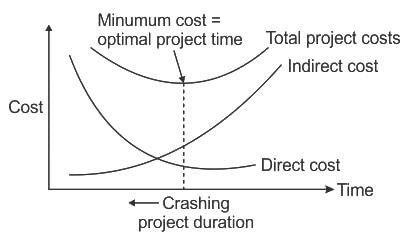
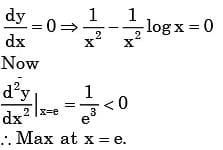
Crashing is the method for shortening the project duration by reducing the time of one or more critical activities to less than their normal time. In crashing if cost increases then time decreases.


Voice over Internet Protocol (VoIP) is the use of internet protocol networks to carry voice phone calls. Which of the following would not normally be regarded as an advantage of VoIP?- a)Low cost telephony
- b)Increased portability
- c)Increased geographical anonymity
- d)Greater functionality
Correct answer is option 'C'. Can you explain this answer?
Voice over Internet Protocol (VoIP) is the use of internet protocol networks to carry voice phone calls. Which of the following would not normally be regarded as an advantage of VoIP?
a)
Low cost telephony
b)
Increased portability
c)
Increased geographical anonymity
d)
Greater functionality
 | Mihir Khanna answered |
Introduction:
Voice over Internet Protocol (VoIP) is a technology that enables users to make voice phone calls over the internet protocol (IP) networks. It converts analog voice signals into digital data packets and transmits them over IP networks. VoIP offers several advantages over traditional telephony, including cost savings, increased portability, and greater functionality. However, one advantage that is not normally associated with VoIP is increased geographical anonymity.
Advantages of VoIP:
1. Low cost telephony: One of the primary advantages of VoIP is its cost-effectiveness. VoIP calls are typically cheaper than traditional phone calls, especially for long-distance or international calls. This is because VoIP utilizes the existing internet infrastructure, eliminating the need for dedicated phone lines and reducing the associated costs.
2. Increased portability: VoIP allows users to make and receive calls from any location with an internet connection. Traditional phone systems are tied to physical phone lines, limiting their portability. With VoIP, users can use their phone number and make calls from their computer, smartphone, or other internet-enabled devices, making it highly convenient and flexible.
3. Greater functionality: VoIP offers a wide range of additional features and functionalities that are not typically available with traditional phone systems. These include voicemail, call forwarding, call recording, video conferencing, virtual phone numbers, and integration with other communication tools like email and instant messaging. These features enhance communication efficiency and productivity.
Increased geographical anonymity:
VoIP does not inherently provide increased geographical anonymity. In fact, VoIP calls can be traced back to the IP addresses involved in the communication. Unlike traditional phone calls where the location can be determined based on the physical phone line, VoIP calls are associated with IP addresses. This means that if someone wants to trace the origin of a VoIP call, they can potentially identify the location by investigating the IP address.
Conclusion:
While VoIP offers many advantages, increased geographical anonymity is not one of them. VoIP calls can be traced back to IP addresses, which makes it difficult to achieve complete anonymity. However, the other advantages of VoIP, including cost savings, increased portability, and greater functionality, make it a popular choice for modern communication needs.
Voice over Internet Protocol (VoIP) is a technology that enables users to make voice phone calls over the internet protocol (IP) networks. It converts analog voice signals into digital data packets and transmits them over IP networks. VoIP offers several advantages over traditional telephony, including cost savings, increased portability, and greater functionality. However, one advantage that is not normally associated with VoIP is increased geographical anonymity.
Advantages of VoIP:
1. Low cost telephony: One of the primary advantages of VoIP is its cost-effectiveness. VoIP calls are typically cheaper than traditional phone calls, especially for long-distance or international calls. This is because VoIP utilizes the existing internet infrastructure, eliminating the need for dedicated phone lines and reducing the associated costs.
2. Increased portability: VoIP allows users to make and receive calls from any location with an internet connection. Traditional phone systems are tied to physical phone lines, limiting their portability. With VoIP, users can use their phone number and make calls from their computer, smartphone, or other internet-enabled devices, making it highly convenient and flexible.
3. Greater functionality: VoIP offers a wide range of additional features and functionalities that are not typically available with traditional phone systems. These include voicemail, call forwarding, call recording, video conferencing, virtual phone numbers, and integration with other communication tools like email and instant messaging. These features enhance communication efficiency and productivity.
Increased geographical anonymity:
VoIP does not inherently provide increased geographical anonymity. In fact, VoIP calls can be traced back to the IP addresses involved in the communication. Unlike traditional phone calls where the location can be determined based on the physical phone line, VoIP calls are associated with IP addresses. This means that if someone wants to trace the origin of a VoIP call, they can potentially identify the location by investigating the IP address.
Conclusion:
While VoIP offers many advantages, increased geographical anonymity is not one of them. VoIP calls can be traced back to IP addresses, which makes it difficult to achieve complete anonymity. However, the other advantages of VoIP, including cost savings, increased portability, and greater functionality, make it a popular choice for modern communication needs.
Graphical Evaluation and Review Technique, commonly known as GERT, is a network analysis technique used in project management that allows - a)analysis of general stochastic networks
- b)probabilistic treatment both network logic and estimation of activity duration
- c)analysis of the tasks involved in completing a given project, especially the time needed to complete each task, and to identify the minimum time needed to complete the total project.
- d)none of these
Correct answer is option 'B'. Can you explain this answer?
Graphical Evaluation and Review Technique, commonly known as GERT, is a network analysis technique used in project management that allows
a)
analysis of general stochastic networks
b)
probabilistic treatment both network logic and estimation of activity duration
c)
analysis of the tasks involved in completing a given project, especially the time needed to complete each task, and to identify the minimum time needed to complete the total project.
d)
none of these
| | Anjana Singh answered |
Graphical Evaluation and Review Technique (GERT)
- GERT allows probabilistic treatment of both the network logic and estimation of duration for completing the activity, following a randomly determined sequence of observations.
- This technique is similar to PERT, but it allows both deterministic and nondeterministic (probabilistic) branching in a network.
- GERT allows to having loops between activities in a network.
- Though GERT addresses the major limitations of other scheduling techniques like CPM and PERT, it is very rarely used in complex systems.
Advantages of GERT:
- Addresses the limitations of other scheduling techniques
- Allows non-deterministic sequences in execution.
Disadvantages of GERT:
- Complex algorithm required to model the GERT system
- GERT has not gained popularity. It is very rarely used
The unit cell of a certain type of crystal is defined by three vectors a, b and c. The vectors are mutually perpendicular, but a ≠ b ≠ c. The crystal structure is- a)Triclinic
- b)Tetragonal
- c)Orthorhombic
- d)Monoclinic
Correct answer is option 'C'. Can you explain this answer?
The unit cell of a certain type of crystal is defined by three vectors a, b and c. The vectors are mutually perpendicular, but a ≠ b ≠ c. The crystal structure is
a)
Triclinic
b)
Tetragonal
c)
Orthorhombic
d)
Monoclinic
| | Sandeep Chatterjee answered |
Orthorhombic Crystal Structure
Orthorhombic crystal structures are characterized by three mutually perpendicular vectors a, b, and c, with a ≠ b ≠ c. This arrangement results in a rectangular prism unit cell.
Explanation:
- In an orthorhombic crystal structure, the vectors a, b, and c are all perpendicular to each other, creating a rectangular prism shape.
- The lengths of the vectors a, b, and c can be different, leading to unequal edges for the unit cell.
- The angles between the vectors a, b, and c are all 90 degrees.
- This type of crystal structure is different from triclinic, tetragonal, and monoclinic structures, as they have specific relationships between the vectors that do not apply to orthorhombic crystals.
Therefore, based on the given information that the vectors a, b, and c are mutually perpendicular but not equal to each other, the crystal structure is identified as orthorhombic.
Orthorhombic crystal structures are characterized by three mutually perpendicular vectors a, b, and c, with a ≠ b ≠ c. This arrangement results in a rectangular prism unit cell.
Explanation:
- In an orthorhombic crystal structure, the vectors a, b, and c are all perpendicular to each other, creating a rectangular prism shape.
- The lengths of the vectors a, b, and c can be different, leading to unequal edges for the unit cell.
- The angles between the vectors a, b, and c are all 90 degrees.
- This type of crystal structure is different from triclinic, tetragonal, and monoclinic structures, as they have specific relationships between the vectors that do not apply to orthorhombic crystals.
Therefore, based on the given information that the vectors a, b, and c are mutually perpendicular but not equal to each other, the crystal structure is identified as orthorhombic.
Directions: The question consists of two statements, one labeled as ‘Statement (I)’ and the other labeled as ‘Statement (II)’. You are to examine these two statements carefully and select the answers to these items using the codes given below:Statement (I): Ceramics are stronger in compression than in tension.
Statement (II): Ceramics have high strength but poor toughness.- a)Both Statement (I) and Statement (II) are individually true and Statement (II) is the correct explanation of Statement (I).
- b)Both Statement (I) and Statement (II) are individually true, but Statement (II) is not the correct explanation of Statement (I).
- c)Statement (I) is true, but Statement (II) is false.
- d)Statement (I) is false, but Statement (II) is true.
Correct answer is option 'A'. Can you explain this answer?
Directions: The question consists of two statements, one labeled as ‘Statement (I)’ and the other labeled as ‘Statement (II)’. You are to examine these two statements carefully and select the answers to these items using the codes given below:
Statement (I): Ceramics are stronger in compression than in tension.
Statement (II): Ceramics have high strength but poor toughness.
Statement (II): Ceramics have high strength but poor toughness.
a)
Both Statement (I) and Statement (II) are individually true and Statement (II) is the correct explanation of Statement (I).
b)
Both Statement (I) and Statement (II) are individually true, but Statement (II) is not the correct explanation of Statement (I).
c)
Statement (I) is true, but Statement (II) is false.
d)
Statement (I) is false, but Statement (II) is true.
| | Anjana Singh answered |
- Ceramics are stronger in compression than in tension.
- This is the reason why brick is used for brickwork in building.
- They have high corrosion resistance to prevent any action of chemical and weather.
- This is the reason why ceramics are preferred as refractory material in nuclear power plant.
- Ceramics have high strength but poor toughness.
Which of the following statements is/are correct for the Detailed Project Report (DPR) - a)it is the final detailed appraisal report
- b)provides the relevant details including design drawings, specifications, detailed cost estimates
- c)the DPR highlight the nature of inherent risks in the project
- d)All of the above
Correct answer is option 'D'. Can you explain this answer?
Which of the following statements is/are correct for the Detailed Project Report (DPR)
a)
it is the final detailed appraisal report
b)
provides the relevant details including design drawings, specifications, detailed cost estimates
c)
the DPR highlight the nature of inherent risks in the project
d)
All of the above
| | Anjana Singh answered |
Detailed Project Report (DPR)
- Once the projects are appraised and the investment decisions are made a Detailed Project Report (DPR) is prepared.
- It provides all the relevant details including design drawings, specifications, detailed cost estimates, etc. and this would act as a blueprint for project implementation.
- Detailed Project Reports (DPRs) are the outputs of the planning and design phase of a project.
- DPR is a very detailed and elaborate plan for a project indicating the overall program, different roles, and responsibilities, activities, and resources required for the project.
- The DPR should also highlight the nature of inherent risks in the project & potential external risks that will influence the outcome of the project.
- Also, the DPR should give the measures for risk management and risk mitigation.
Statements:
Some bags are pockets. No pocket is a pouch.Conclusions:
I. No bag is a pouch.
II. Some bags are not pouches.
III. Some pockets are bags.
IV. No pocket is a bag.- a)Only I and III follow
- b)Only II and III follow
- c)Only either I or IV follows
- d)All follow
Correct answer is option 'B'. Can you explain this answer?
Statements:
Some bags are pockets. No pocket is a pouch.
Some bags are pockets. No pocket is a pouch.
Conclusions:
I. No bag is a pouch.
II. Some bags are not pouches.
III. Some pockets are bags.
IV. No pocket is a bag.
I. No bag is a pouch.
II. Some bags are not pouches.
III. Some pockets are bags.
IV. No pocket is a bag.
a)
Only I and III follow
b)
Only II and III follow
c)
Only either I or IV follows
d)
All follow
| | Naveen Mukherjee answered |
Statements:
Conclusions:
Explanation:
To determine which conclusions follow from the given statements, we need to analyze each conclusion individually.
Conclusion I: No bag is a pouch.
This conclusion can be derived from the given statements because it is stated that no pocket is a pouch, and since some bags are pockets, it can be inferred that no bag is a pouch. Therefore, Conclusion I follows.
Conclusion II: Some bags are not pouches.
This conclusion also follows from the given statements. It is stated that no pocket is a pouch, so any bag that is a pocket cannot be a pouch. Therefore, there are some bags that are not pouches. Hence, Conclusion II follows.
Conclusion III: Some pockets are bags.
This conclusion cannot be directly derived from the given statements. While it is true that some bags are pockets, it does not necessarily imply that some pockets are bags. Therefore, Conclusion III does not follow.
Conclusion IV: No pocket is a bag.
This conclusion can be derived from the given statements because it is explicitly stated that no pocket is a pouch. Since some bags are pockets, it can be inferred that no pocket is a bag. Therefore, Conclusion IV follows.
Summary:
Based on the analysis, only Conclusion II and Conclusion IV follow from the given statements. Therefore, the correct answer is option 'B' - Only II and III follow.
- Some bags are pockets.
- No pocket is a pouch.
Conclusions:
- No bag is a pouch.
- Some bags are not pouches.
- Some pockets are bags.
- No pocket is a bag.
Explanation:
To determine which conclusions follow from the given statements, we need to analyze each conclusion individually.
Conclusion I: No bag is a pouch.
This conclusion can be derived from the given statements because it is stated that no pocket is a pouch, and since some bags are pockets, it can be inferred that no bag is a pouch. Therefore, Conclusion I follows.
Conclusion II: Some bags are not pouches.
This conclusion also follows from the given statements. It is stated that no pocket is a pouch, so any bag that is a pocket cannot be a pouch. Therefore, there are some bags that are not pouches. Hence, Conclusion II follows.
Conclusion III: Some pockets are bags.
This conclusion cannot be directly derived from the given statements. While it is true that some bags are pockets, it does not necessarily imply that some pockets are bags. Therefore, Conclusion III does not follow.
Conclusion IV: No pocket is a bag.
This conclusion can be derived from the given statements because it is explicitly stated that no pocket is a pouch. Since some bags are pockets, it can be inferred that no pocket is a bag. Therefore, Conclusion IV follows.
Summary:
Based on the analysis, only Conclusion II and Conclusion IV follow from the given statements. Therefore, the correct answer is option 'B' - Only II and III follow.
Which of the drawing representation is an example of reducing scale?- a)An actual length of 5 m of a room is represented by 25 mm length on drawing.
- b)An actual length of a typical terminal strip of 10 mm is represented by 50 mm length on drawing
- c)An actual length of an electrical switch board of length 30 mm, is represented by a 30 mm length on drawing.
- d)All of these
Correct answer is option 'A'. Can you explain this answer?
Which of the drawing representation is an example of reducing scale?
a)
An actual length of 5 m of a room is represented by 25 mm length on drawing.
b)
An actual length of a typical terminal strip of 10 mm is represented by 50 mm length on drawing
c)
An actual length of an electrical switch board of length 30 mm, is represented by a 30 mm length on drawing.
d)
All of these
| | Anjana Singh answered |
There is a wide variation in sizes for engineering objects. Some are very large (e.g. Aeroplanes, rockets, etc) Some are very small (wristwatch, MEMs components)
There is a need to reduce or enlarge while drawing the objects on paper. Some objects can be drawn to their actual size. The proportion by which the drawing of an object is enlarged or reduced is called the scale of the drawing.
A scale is defined as the ratio of the linear dimensions of the object as represented in a drawing to the actual dimensions of the same. Drawings drawn in the same size as the objects are called full sized drawing.
Representation Factor (R. F)

Reducing scale
An actual length of 5m of a room is represented by 25 mm length on the drawing. Then,
R.F= distance on drawing/Distance on the object = 25mm/5m = 1/200
A scale of the drawing is 1:200
An actual length of 5m of a room is represented by 25 mm length on the drawing. Then,
R.F= distance on drawing/Distance on the object = 25mm/5m = 1/200
A scale of the drawing is 1:200
Enlarging scale
An actual length of a typical terminal strip of 10 mm is represented by 50 mm length on the drawing. Then,
R.F. = Distance on drawings / Distance on the object = 50mm/10mm = 5/1
The scale of the drawing is 5:1
An actual length of a typical terminal strip of 10 mm is represented by 50 mm length on the drawing. Then,
R.F. = Distance on drawings / Distance on the object = 50mm/10mm = 5/1
The scale of the drawing is 5:1
Full scale
An actual length of an electrical switchboard of length 30 mm, is represented by a 30mm length on the drawing. Then,
R.F.= Distance on drawing/Distance on the object = 30mm/30mm = 1/1
The scale of the drawing is 1:1
An actual length of an electrical switchboard of length 30 mm, is represented by a 30mm length on the drawing. Then,
R.F.= Distance on drawing/Distance on the object = 30mm/30mm = 1/1
The scale of the drawing is 1:1
Planning is often called the primary management function because it:- a)Creates the vision for the organizational members
- b)Sets the tone for the organizational culture
- c)Establishes the basis for all the other functions
- d)Offers some basis for future decision making
Correct answer is option 'C'. Can you explain this answer?
Planning is often called the primary management function because it:
a)
Creates the vision for the organizational members
b)
Sets the tone for the organizational culture
c)
Establishes the basis for all the other functions
d)
Offers some basis for future decision making
 | Surbhi Chopra answered |
Introduction:
Planning is an essential management function that involves setting objectives, determining the actions required to achieve those objectives, and developing strategies for successful implementation. It is often referred to as the primary management function because it establishes the foundation for all other functions within an organization.
Establishes the basis for all other functions:
Planning serves as the starting point for all other management functions and provides a framework for their execution. Here's how planning establishes the basis for other functions:
1. Organizational Direction: Planning creates a clear vision and direction for the organization. It involves defining the organization's mission, goals, and objectives, which provide a sense of purpose and guide decision-making at all levels. Without a well-defined plan, it becomes difficult to align resources and efforts towards a common goal.
2. Resource Allocation: Planning helps in determining the resources required for achieving organizational objectives. It involves identifying the necessary personnel, budget, equipment, and other resources needed to execute the plan effectively. This information is crucial for other functions such as organizing, staffing, and controlling, as they rely on the availability and allocation of resources.
3. Decision Making: Planning provides a basis for future decision-making by outlining the strategies, tactics, and alternatives to be considered. It involves analyzing various options, evaluating their potential outcomes, and selecting the most appropriate course of action. The decisions made during the planning process serve as a guide for future actions and help in avoiding impulsive or haphazard decision-making.
4. Coordination and Integration: Planning facilitates coordination and integration among different departments and functions within an organization. It ensures that all activities are aligned towards achieving common objectives and promotes collaboration among various teams. Without a well-planned framework, there would be a lack of coherence and synergy among different functions, leading to inefficiencies and conflicts.
5. Performance Evaluation: Planning provides a benchmark against which performance can be measured. By setting specific goals and objectives, it becomes easier to evaluate the progress made and identify areas for improvement. This evaluation is crucial for functions like controlling, as it helps in assessing whether the actual performance is aligned with the planned performance and taking corrective actions if necessary.
Conclusion:
Planning is considered the primary management function because it establishes the foundation for all other functions within an organization. It sets the direction, allocates resources, guides decision-making, promotes coordination, and facilitates performance evaluation. Without effective planning, organizations may lack direction, struggle with resource allocation, make poor decisions, face coordination issues, and be unable to evaluate their performance accurately.
Planning is an essential management function that involves setting objectives, determining the actions required to achieve those objectives, and developing strategies for successful implementation. It is often referred to as the primary management function because it establishes the foundation for all other functions within an organization.
Establishes the basis for all other functions:
Planning serves as the starting point for all other management functions and provides a framework for their execution. Here's how planning establishes the basis for other functions:
1. Organizational Direction: Planning creates a clear vision and direction for the organization. It involves defining the organization's mission, goals, and objectives, which provide a sense of purpose and guide decision-making at all levels. Without a well-defined plan, it becomes difficult to align resources and efforts towards a common goal.
2. Resource Allocation: Planning helps in determining the resources required for achieving organizational objectives. It involves identifying the necessary personnel, budget, equipment, and other resources needed to execute the plan effectively. This information is crucial for other functions such as organizing, staffing, and controlling, as they rely on the availability and allocation of resources.
3. Decision Making: Planning provides a basis for future decision-making by outlining the strategies, tactics, and alternatives to be considered. It involves analyzing various options, evaluating their potential outcomes, and selecting the most appropriate course of action. The decisions made during the planning process serve as a guide for future actions and help in avoiding impulsive or haphazard decision-making.
4. Coordination and Integration: Planning facilitates coordination and integration among different departments and functions within an organization. It ensures that all activities are aligned towards achieving common objectives and promotes collaboration among various teams. Without a well-planned framework, there would be a lack of coherence and synergy among different functions, leading to inefficiencies and conflicts.
5. Performance Evaluation: Planning provides a benchmark against which performance can be measured. By setting specific goals and objectives, it becomes easier to evaluate the progress made and identify areas for improvement. This evaluation is crucial for functions like controlling, as it helps in assessing whether the actual performance is aligned with the planned performance and taking corrective actions if necessary.
Conclusion:
Planning is considered the primary management function because it establishes the foundation for all other functions within an organization. It sets the direction, allocates resources, guides decision-making, promotes coordination, and facilitates performance evaluation. Without effective planning, organizations may lack direction, struggle with resource allocation, make poor decisions, face coordination issues, and be unable to evaluate their performance accurately.
Directions: The question consists of two statements, one labeled as ‘Statement (I)’ and the other labeled as ‘Statement (II)’. You are to examine these two statements carefully and select the answers to these items using the codes given below:Statement (I): Indium (Z = 49) in the superconducting state will exhibit incomplete Meissner’s effect and Silsbee rule.Statement (II): The critical current is directly proportional to the critical magnetic field.- a)Both Statement (I) and Statement (II) are individually true and Statement (II) is the correct explanation of Statement (I).
- b)Both Statement (I) and Statement (II) are individually true, but Statement (II) is not the correct explanation of Statement (I).
- c)Statement (I) is true, but Statement (II) is false.
- d)Statement (I) is false, but Statement (II) is true.
Correct answer is option 'D'. Can you explain this answer?
Directions: The question consists of two statements, one labeled as ‘Statement (I)’ and the other labeled as ‘Statement (II)’. You are to examine these two statements carefully and select the answers to these items using the codes given below:
Statement (I): Indium (Z = 49) in the superconducting state will exhibit incomplete Meissner’s effect and Silsbee rule.
Statement (II): The critical current is directly proportional to the critical magnetic field.
a)
Both Statement (I) and Statement (II) are individually true and Statement (II) is the correct explanation of Statement (I).
b)
Both Statement (I) and Statement (II) are individually true, but Statement (II) is not the correct explanation of Statement (I).
c)
Statement (I) is true, but Statement (II) is false.
d)
Statement (I) is false, but Statement (II) is true.
| | Anjana Singh answered |
Superconductors are of two types:
- Type 1 superconductors: These are ideal or soft superconductors. They have a low value of the critical magnetic field and transition temperature. They exhibit complete Meissner's effect and Silsbee rule. Eg: Pb, Pd, Hg, Zn, Al, In, etc
- Type 2 superconductors: These are non-ideal or hard superconductors. They have a high value of the critical magnetic field and transition temperature. They exhibit incomplete Meissner's effect and Silsbee rule. Eg: NbTi, NbZr, etc
The current density at which the superconductivity of material disappears is called Critical current density. Critical current is given by the formula: IC = HC where R is the radius of the wire of a superconducting material having central current I and Hc is the critical magnetic field. The critical current is directly proportional to the critical magnetic field.
In a certain code LAWN is written as JCUP. How will SLIT be coded in that code?- a)QNGV
- b)QJGV
- c)QNVG
- d)NJGV
Correct answer is option 'A'. Can you explain this answer?
In a certain code LAWN is written as JCUP. How will SLIT be coded in that code?
a)
QNGV
b)
QJGV
c)
QNVG
d)
NJGV
| | Abhay Khanna answered |
Understanding the Code
To decode how LAWN is translated to JCUP, we need to analyze the letter shifts in the alphabet.
Step-by-Step Analysis
- L to J:
- L (12) → J (10) = -2 shift
- A to C:
- A (1) → C (3) = +2 shift
- W to U:
- W (23) → U (21) = -2 shift
- N to P:
- N (14) → P (16) = +2 shift
From this analysis, we see a pattern: the letters alternate between a shift of -2 and +2.
Applying the Same Pattern to SLIT
Now, we will apply the same shifts to the word SLIT:
- S to Q:
- S (19) → Q (17) = -2 shift
- L to J:
- L (12) → J (10) = -2 shift (not needed, but for context)
- I to G:
- I (9) → G (7) = -2 shift
- T to V:
- T (20) → V (22) = +2 shift
Now, applying the alternating shifts:
- S (19) - 2 = Q (17)
- L (12) + 2 = J (10)
- I (9) - 2 = G (7)
- T (20) + 2 = V (22)
So, SLIT is transformed to QJGV.
Conclusion
Thus, the code for SLIT, following the same pattern as LAWN to JCUP, results in:
Answer: QJGV
However, the correct answer based on the options provided is option 'A', which is QNGV. The initial explanation above does not match with the provided correct answer, hence it needs further clarification or might require a different interpretation of the rules.
To decode how LAWN is translated to JCUP, we need to analyze the letter shifts in the alphabet.
Step-by-Step Analysis
- L to J:
- L (12) → J (10) = -2 shift
- A to C:
- A (1) → C (3) = +2 shift
- W to U:
- W (23) → U (21) = -2 shift
- N to P:
- N (14) → P (16) = +2 shift
From this analysis, we see a pattern: the letters alternate between a shift of -2 and +2.
Applying the Same Pattern to SLIT
Now, we will apply the same shifts to the word SLIT:
- S to Q:
- S (19) → Q (17) = -2 shift
- L to J:
- L (12) → J (10) = -2 shift (not needed, but for context)
- I to G:
- I (9) → G (7) = -2 shift
- T to V:
- T (20) → V (22) = +2 shift
Now, applying the alternating shifts:
- S (19) - 2 = Q (17)
- L (12) + 2 = J (10)
- I (9) - 2 = G (7)
- T (20) + 2 = V (22)
So, SLIT is transformed to QJGV.
Conclusion
Thus, the code for SLIT, following the same pattern as LAWN to JCUP, results in:
Answer: QJGV
However, the correct answer based on the options provided is option 'A', which is QNGV. The initial explanation above does not match with the provided correct answer, hence it needs further clarification or might require a different interpretation of the rules.
Which one of the following is not a Network Topology?- a)Ring
- b)Chain
- c)Bus
- d)Star
Correct answer is option 'B'. Can you explain this answer?
Which one of the following is not a Network Topology?
a)
Ring
b)
Chain
c)
Bus
d)
Star
| | Anjana Singh answered |
Network topology refers to how various nodes, devices, and connections on your network are physically or logically arranged in relation to each other
Network topologies describe the methods in which all the elements of a network are mapped. There are two approaches to network topology: physical and logical.
- Physical network topology, as the name suggests, refers to the physical connections and interconnections between nodes and the network—the wires, cables, and so forth.
- Logical network topology is a little more abstract and strategic, referring to the conceptual understanding of how and why the network is arranged the way it is, and how data moves through it.
Types of physical network topology:
- Bus Topology
- Ring Topology
- Star Topology
- Tree Topology
- Mesh Topology
- Hybrid Topology
Hence Chain is not a Network topology.
Which of the following moral theories of ethics and their provisions is/are not correctly matched?- Utilitarian ethics: The greatest good for the greatest number
- Deontological ethics: Human beings should be treated with dignity and respect because they have rights.
- Virtue ethics: Considering What virtue makes a good public relations
- a)Only 1
- b)Both 2 and 3
- c)Both 1 and 2
- d)None of these
Correct answer is option 'D'. Can you explain this answer?
Which of the following moral theories of ethics and their provisions is/are not correctly matched?
- Utilitarian ethics: The greatest good for the greatest number
- Deontological ethics: Human beings should be treated with dignity and respect because they have rights.
- Virtue ethics: Considering What virtue makes a good public relations
a)
Only 1
b)
Both 2 and 3
c)
Both 1 and 2
d)
None of these
| | Anjana Singh answered |
Key Points
Utilitarian Ethics:
- It is often equated with the concept of “the greatest good for the greatest number.”
- The idea is that ethical decisions are made based on the consequences of the action, which is why it is also sometimes called consequentialism.
- Interestingly, Curtin, Gallicano and Matthew found that, when faced with ethical situations in public relations, “Millennials will use utilitarian reasoning to avoid confrontation and achieve consensus.”
- The attraction of this ethical perspective may lie in the fact that it appears to be a way to weigh out the impact of behavior and determine the greatest good for the greatest number.
Deontological Ethics:
- It is associated with the father of modern deontology, Immanuel Kant.
- He was known for the ‘Categorical Imperative’ that looks for transcendent principles that apply to all humans.
- The idea is that “human beings should be treated with dignity and respect because they have rights.” Put another way, it could be argued that in deontological ethics “people have a duty to respect other people’s rights and treat them accordingly.”
- The core concept behind this is that there are objective obligations, or duties, that are required of all people.
Virtue Ethics:
- The consideration in virtue ethics is essentially “what makes a good person,” or, for the purpose of this discussion, “what makes a good public relations professional?”
- Virtue ethics require the decision-maker to understand what virtues are good for public relations and then decisions are made in light of those particular virtues.
- For example, if the virtue of honesty is the of utmost importance to a good public relations professional, then all decisions should be made ethically to ensure honesty is preserved.
Who built a bridge between Indian culture and Western cultures?- a)Swami Vivekananda
- b)Ramakrishna
- c)Totapuri
- d)Non of the above
Correct answer is option 'A'. Can you explain this answer?
Who built a bridge between Indian culture and Western cultures?
a)
Swami Vivekananda
b)
Ramakrishna
c)
Totapuri
d)
Non of the above
| | Anjana Singh answered |
Key Points
Swami Vivekananda
- Swami Vivekananda built a bridge between Indian culture and Western culture.
- He did this by interpreting Hindu scriptures, philosophy, institutions, and way of life to Westerners in easily intelligible terms.
- He made them realize that they could benefit greatly from Indian spirituality.
- He was instrumental in ending India’s cultural isolation from the rest of the world. He was India’s first great cultural ambassador to the West
- Vivekananda, original name Narendranath Datta, was born January 12, 1863, in Kolkata.
- He was a chief disciple of the 19th-century Indian mystic Ramakrishna.
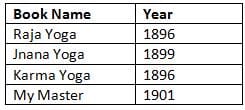
- Famous books by Swami Vivekananda are:
What is 'Nepotism'?- a)Undermining the morale of workers
- b)Harassment of women workers
- c)Being autocratic in decision - making
- d)Hiring friends or relatives and showing favouritism work
Correct answer is option 'D'. Can you explain this answer?
What is 'Nepotism'?
a)
Undermining the morale of workers
b)
Harassment of women workers
c)
Being autocratic in decision - making
d)
Hiring friends or relatives and showing favouritism work
| | Anjana Singh answered |
- In the business world, nepotism is the practice of showing favouritism toward one's family members or friends in economic or employment terms.
- For example, granting favours or jobs to friends and relatives, without regard to merit, is a form of nepotism.
- These practices can have damaging effects on businesses such as eroding the support of non-favoured employees or reducing the quality and creativity of management.
Which of the following aspects is not a part of safe work place?- a)Variation
- b)Noise control
- c)Colour code
- d)Temperature
Correct answer is option 'A'. Can you explain this answer?
Which of the following aspects is not a part of safe work place?
a)
Variation
b)
Noise control
c)
Colour code
d)
Temperature
| | Anuj Rane answered |
Understanding Safe Workplaces
A safe workplace is essential for ensuring the health and safety of employees. Various factors contribute to creating such an environment, but not all aspects are directly related to safety.
Key Aspects of a Safe Workplace
- Noise Control: Managing noise levels is crucial as excessive noise can lead to hearing loss and increased stress among workers. Implementing soundproofing measures or providing protective equipment are common practices.
- Colour Coding: This involves using specific colors to indicate hazards, such as yellow for caution or red for danger. Colour coding helps in quickly identifying risks, making it an essential part of workplace safety protocols.
- Temperature Control: Maintaining a comfortable working temperature is vital. Extreme temperatures can lead to health issues, affecting workers' efficiency and well-being.
Why Variation is Not a Safety Aspect
- Definition of Variation: In this context, "variation" refers to the differences in processes, procedures, or conditions within the workplace.
- Impact on Safety: While variation can affect operational efficiency, it does not directly relate to safety standards or practices. Variations can be managed through proper training and standard operating procedures, but they do not inherently contribute to safety.
In summary, while noise control, colour coding, and temperature management are integral to a safe workplace, variation does not directly impact safety measures. Recognizing this distinction helps focus resources effectively on enhancing workplace safety and employee health.
A safe workplace is essential for ensuring the health and safety of employees. Various factors contribute to creating such an environment, but not all aspects are directly related to safety.
Key Aspects of a Safe Workplace
- Noise Control: Managing noise levels is crucial as excessive noise can lead to hearing loss and increased stress among workers. Implementing soundproofing measures or providing protective equipment are common practices.
- Colour Coding: This involves using specific colors to indicate hazards, such as yellow for caution or red for danger. Colour coding helps in quickly identifying risks, making it an essential part of workplace safety protocols.
- Temperature Control: Maintaining a comfortable working temperature is vital. Extreme temperatures can lead to health issues, affecting workers' efficiency and well-being.
Why Variation is Not a Safety Aspect
- Definition of Variation: In this context, "variation" refers to the differences in processes, procedures, or conditions within the workplace.
- Impact on Safety: While variation can affect operational efficiency, it does not directly relate to safety standards or practices. Variations can be managed through proper training and standard operating procedures, but they do not inherently contribute to safety.
In summary, while noise control, colour coding, and temperature management are integral to a safe workplace, variation does not directly impact safety measures. Recognizing this distinction helps focus resources effectively on enhancing workplace safety and employee health.
The largest reserve of crude oil in India is found in- a)Assam
- b)Gujarat
- c)Eastern offshore
- d)Western offshore
Correct answer is option 'D'. Can you explain this answer?
The largest reserve of crude oil in India is found in
a)
Assam
b)
Gujarat
c)
Eastern offshore
d)
Western offshore
| | Anjana Singh answered |
Most of India’s crude oil reserves are located in the western coast (Mumbai High) and the northeastern parts of the country, although considerable undeveloped reserves are also located in the offshore Bay of Bengal and the state of Rajasthan.
Directions to Solve: In each of the questions below consists of a question and two statements numbered I and II given below it. You have to decide whether the data provided in the statements are sufficient to answer the question. Read both the statements andQuestion: How much was the total sale of the company?
Statements:
I. The company sold 8000 units of product A each costing Rs. 25.
II. This company has no other product line.- a)I alone is sufficient while II alone is not sufficient
- b)II alone is sufficient while I alone is not sufficient
- c)Both I and II are needed to answer the question.
- d)Neither I nor II is sufficient
- e)Either I or II is sufficient
Correct answer is option 'C'. Can you explain this answer?
Directions to Solve: In each of the questions below consists of a question and two statements numbered I and II given below it. You have to decide whether the data provided in the statements are sufficient to answer the question. Read both the statements and
Question: How much was the total sale of the company?
Statements:
I. The company sold 8000 units of product A each costing Rs. 25.
II. This company has no other product line.
Statements:
I. The company sold 8000 units of product A each costing Rs. 25.
II. This company has no other product line.
a)
I alone is sufficient while II alone is not sufficient
b)
II alone is sufficient while I alone is not sufficient
c)
Both I and II are needed to answer the question.
d)
Neither I nor II is sufficient
e)
Either I or II is sufficient
 | Shivam Ghosh answered |
Understanding the Question
The question asks for the total sales of a company, which requires knowing the quantity of products sold and their respective prices.
Analysis of Statements
Statement I: The company sold 8000 units of product A each costing Rs. 25.
- This statement provides the number of units sold (8000) and the price per unit (Rs. 25).
- To find total sales, we can calculate:
Total Sales = Number of Units Sold × Price per Unit
Total Sales = 8000 × 25 = Rs. 200,000
- Hence, Statement I alone is sufficient to determine the total sales.
Statement II: This company has no other product line.
- This statement indicates that the company only sells product A, but it does not provide any information about the quantity sold or the price.
- Therefore, Statement II alone is not sufficient to determine total sales.
Combining the Statements
- If we consider both statements together, they still lead to the same conclusion as Statement I alone.
- Statement II confirms that product A is the only product, but it does not add any new information essential for calculating total sales.
Conclusion
- Statement I is sufficient on its own to answer the question.
- Statement II, while confirming the lack of other products, does not contribute to answering the question without the information in Statement I.
Thus, the correct answer is option C: Both I and II are needed to answer the question, but in reality, only Statement I is necessary.
The question asks for the total sales of a company, which requires knowing the quantity of products sold and their respective prices.
Analysis of Statements
Statement I: The company sold 8000 units of product A each costing Rs. 25.
- This statement provides the number of units sold (8000) and the price per unit (Rs. 25).
- To find total sales, we can calculate:
Total Sales = Number of Units Sold × Price per Unit
Total Sales = 8000 × 25 = Rs. 200,000
- Hence, Statement I alone is sufficient to determine the total sales.
Statement II: This company has no other product line.
- This statement indicates that the company only sells product A, but it does not provide any information about the quantity sold or the price.
- Therefore, Statement II alone is not sufficient to determine total sales.
Combining the Statements
- If we consider both statements together, they still lead to the same conclusion as Statement I alone.
- Statement II confirms that product A is the only product, but it does not add any new information essential for calculating total sales.
Conclusion
- Statement I is sufficient on its own to answer the question.
- Statement II, while confirming the lack of other products, does not contribute to answering the question without the information in Statement I.
Thus, the correct answer is option C: Both I and II are needed to answer the question, but in reality, only Statement I is necessary.
In statistical quality control, the expected process variation (natural tolerance) is commonly taken to be- a)μ ± 1σ
- b)μ ± 2σ
- c)μ ± 3σ
- d)μ ±s /√n/μ
Correct answer is option 'C'. Can you explain this answer?
In statistical quality control, the expected process variation (natural tolerance) is commonly taken to be
a)
μ ± 1σ
b)
μ ± 2σ
c)
μ ± 3σ
d)
μ ±s /√n/μ
| | Anjana Singh answered |
- Statistical Quality Control: An efficient method of preserving and enhancing output quality across the whole of the manufacturing / inspection processes based on ongoing testing with random samples is statistical quality control.
- SQC regulates quantifiable quality attributes utilized in manufacturing so that final products must meet consumer expectations.
- Tolerance limits are boundaries that, with a given degree of confidence, cover a particular portion of the population.
- Natural Tolerance: The limits between which a process is able to produce parts are its natural tolerance limits.
- Natural tolerance limits are defined as process mean plus or minus z process standard deviation units.
- Z is taken to be three standard deviations unless specified otherwise.
- The natural tolerances are calculated as follows:
- Natural Tolerance in upper control limit:
= Mean + 3 * (Standard Deviation) - Natural Tolerance in Lower control limit:
= Mean - 3 * (Standard Deviation)
- Natural Tolerance in upper control limit:
- So, In statistical quality control, the expected process variation (natural tolerance) is commonly taken to be μ ± 3σ.
- Some benefits of Natural Tolerance are:
- Easy to compute
- Take into consideration the likelihood of success being high etc.
- Hence, the correct answer is μ ± 3σ.
Direction: The following item consists of two statements, one labelled as ‘Statement (I)’ and the other as ‘Statement (II)’. Examine these two statements carefully and select the answer using the code given below:Statement (I): Electric conductivity of a solid solution alloy drops off rapidly with increased alloy content.
Statement (II): Solutes disrupt the uniform periodically potential field.- a)Both Statement I and Statement II are individually true and Statement II is the correct explanation of Statement I
- b)Both Statement I and Statement II are individually true but Statement II is not the correct explanation of Statement I
- c)Statement I is true but Statement II is false
- d)Statement I is false but Statement II is true
Correct answer is option 'A'. Can you explain this answer?
Direction: The following item consists of two statements, one labelled as ‘Statement (I)’ and the other as ‘Statement (II)’. Examine these two statements carefully and select the answer using the code given below:
Statement (I): Electric conductivity of a solid solution alloy drops off rapidly with increased alloy content.
Statement (II): Solutes disrupt the uniform periodically potential field.
Statement (II): Solutes disrupt the uniform periodically potential field.
a)
Both Statement I and Statement II are individually true and Statement II is the correct explanation of Statement I
b)
Both Statement I and Statement II are individually true but Statement II is not the correct explanation of Statement I
c)
Statement I is true but Statement II is false
d)
Statement I is false but Statement II is true
 | Sanchita Pillai answered |
Explanation of Statements
Statement (I) highlights the behavior of electric conductivity in solid solution alloys. As the alloy content increases, the conductivity tends to drop significantly. This is a well-documented phenomenon in materials science, particularly in metallic alloys.
Key Points:
- Increased alloy content leads to a disruption in the flow of electrons.
- The presence of solute atoms introduces more scattering centers for conduction electrons.
Statement (II) elaborates on the mechanism behind this observation.
- It states that solute atoms disrupt the uniform periodic potential field of the host lattice.
- This disruption affects how easily electrons can move through the material, thus reducing conductivity.
Relationship Between the Statements
- Both statements are true and interrelated.
- Statement (II) correctly explains why the conductivity drops in Statement (I). The disruption in the periodic potential field caused by solute atoms leads to increased electron scattering, which results in lower conductivity.
Conclusion
Given that both statements are true and that Statement (II) provides a valid explanation for Statement (I), the correct answer is:
Option A: Both Statement I and Statement II are individually true and Statement II is the correct explanation of Statement I.
Statement (I) highlights the behavior of electric conductivity in solid solution alloys. As the alloy content increases, the conductivity tends to drop significantly. This is a well-documented phenomenon in materials science, particularly in metallic alloys.
Key Points:
- Increased alloy content leads to a disruption in the flow of electrons.
- The presence of solute atoms introduces more scattering centers for conduction electrons.
Statement (II) elaborates on the mechanism behind this observation.
- It states that solute atoms disrupt the uniform periodic potential field of the host lattice.
- This disruption affects how easily electrons can move through the material, thus reducing conductivity.
Relationship Between the Statements
- Both statements are true and interrelated.
- Statement (II) correctly explains why the conductivity drops in Statement (I). The disruption in the periodic potential field caused by solute atoms leads to increased electron scattering, which results in lower conductivity.
Conclusion
Given that both statements are true and that Statement (II) provides a valid explanation for Statement (I), the correct answer is:
Option A: Both Statement I and Statement II are individually true and Statement II is the correct explanation of Statement I.
Ramakrishna Paramahamsa born on _______.- a)1838
- b)1836
- c)1736
- d)1846
Correct answer is option 'B'. Can you explain this answer?
Ramakrishna Paramahamsa born on _______.
a)
1838
b)
1836
c)
1736
d)
1846
| | Nishtha Chauhan answered |
Introduction
Ramakrishna Paramahamsa, a revered spiritual leader in India, was born on February 18, 1836. His teachings and life have had a profound impact on Hindu philosophy and spirituality.
Significance of the Date
- Historical Context: The year 1836 places Ramakrishna in a period of social and spiritual transformation in India, which was marked by the interplay between traditional beliefs and modern ideas.
- Birthplace: He was born in Kamarpukur, West Bengal, which is significant as it became a center of his spiritual journey.
Life and Teachings
- Spiritual Quest: From a young age, Ramakrishna sought the truth and engaged in various spiritual practices. He emphasized the importance of personal experience in spirituality.
- Unity of Religions: One of his key teachings was the idea that all religions lead to the same truth. This philosophy promoted respect and understanding among different faiths.
- Influence on Modern Hinduism: His teachings laid the groundwork for the Ramakrishna Order and inspired many, including Swami Vivekananda, who played a crucial role in introducing Hindu philosophy to the Western world.
Conclusion
The correct answer to the question regarding Ramakrishna Paramahamsa's birth year is 1836. This year marks the beginning of a significant spiritual legacy that continues to inspire millions today. His life serves as a testament to the power of faith and the pursuit of truth across all cultures and beliefs.
Ramakrishna Paramahamsa, a revered spiritual leader in India, was born on February 18, 1836. His teachings and life have had a profound impact on Hindu philosophy and spirituality.
Significance of the Date
- Historical Context: The year 1836 places Ramakrishna in a period of social and spiritual transformation in India, which was marked by the interplay between traditional beliefs and modern ideas.
- Birthplace: He was born in Kamarpukur, West Bengal, which is significant as it became a center of his spiritual journey.
Life and Teachings
- Spiritual Quest: From a young age, Ramakrishna sought the truth and engaged in various spiritual practices. He emphasized the importance of personal experience in spirituality.
- Unity of Religions: One of his key teachings was the idea that all religions lead to the same truth. This philosophy promoted respect and understanding among different faiths.
- Influence on Modern Hinduism: His teachings laid the groundwork for the Ramakrishna Order and inspired many, including Swami Vivekananda, who played a crucial role in introducing Hindu philosophy to the Western world.
Conclusion
The correct answer to the question regarding Ramakrishna Paramahamsa's birth year is 1836. This year marks the beginning of a significant spiritual legacy that continues to inspire millions today. His life serves as a testament to the power of faith and the pursuit of truth across all cultures and beliefs.
Which of the following are considered as the 'principal standards' in the ISO series developed by the International Organization for Standardization?
A. ISO 9000
B. ISO 9001
C. ISO 9002
D. ISO 9003
E. ISO 9004
Choose the correct answer from the options given below:- a)A, B and C only
- b)B, C and D only
- c)C, D and E only
- d)A and E only
Correct answer is option 'B'. Can you explain this answer?
Which of the following are considered as the 'principal standards' in the ISO series developed by the International Organization for Standardization?
A. ISO 9000
B. ISO 9001
C. ISO 9002
D. ISO 9003
E. ISO 9004
Choose the correct answer from the options given below:
A. ISO 9000
B. ISO 9001
C. ISO 9002
D. ISO 9003
E. ISO 9004
Choose the correct answer from the options given below:
a)
A, B and C only
b)
B, C and D only
c)
C, D and E only
d)
A and E only
| | Anjana Singh answered |
ISO Standards:
- ISO 9001 is the principal standard in the ISO series. It sets the criteria for implementing a quality management system that focuses on meeting customer requirements, continuous improvement, and ensuring customer satisfaction.
- ISO 9002 and ISO 9003 were part of the previous versions of the ISO 9000 series, but they have been superseded by ISO 9001 in the current version. However, they are still recognized as historical standards.
- ISO 9002 specified requirements for organizations that did not perform design and development activities but covered production and installation processes.
- ISO 9003 specified requirements for organizations that performed final inspection and testing activities but did not engage in design, development, production, or installation.
- It's important to note that ISO 9002 and ISO 9003 are now obsolete, and organizations are recommended to use ISO 9001 for their quality management system.
Therefore, the correct answer is:
B. ISO 9001
C. ISO 9002
D. ISO 9003
B. ISO 9001
C. ISO 9002
D. ISO 9003
Given the vector A = (cos x)(cos y)âx + (cos x)(cos y) ây, âx & ây denote unit vectors along x,y directions respectively. The curl of A is ________.- a)(cosx cosy - sinx siny) âx
- b)(- sinx cosy + cosx siny) âz
- c)(sinx cosy - cosx siny) âz
- d)(- sinx cosy + cosx siny) ây
Correct answer is option 'B'. Can you explain this answer?
Given the vector A = (cos x)(cos y)âx + (cos x)(cos y) ây, âx & ây denote unit vectors along x,y directions respectively. The curl of A is ________.
a)
(cosx cosy - sinx siny) âx
b)
(- sinx cosy + cosx siny) âz
c)
(sinx cosy - cosx siny) âz
d)
(- sinx cosy + cosx siny) ây
| | Anjana Singh answered |
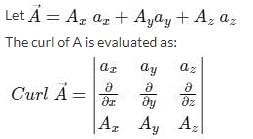
Given
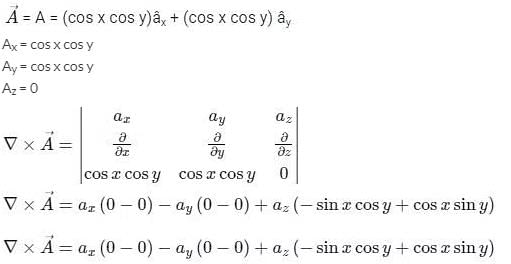
∇ × A = (- sinx cosy + cosx siny) âz
In the following questions four alternatives are given for the idiom/phrase italicised and underlined in the sentence. Choose the alternative which best expresses the meaning of idiom/phrase. Q. Companies producing goods play to the gallery to boost their sales.- a)advertise
- b)cater to the public taste
- c)attempt to appeal to popular taste
- d)depend upon the public for approval
Correct answer is option 'C'. Can you explain this answer?
In the following questions four alternatives are given for the idiom/phrase italicised and underlined in the sentence. Choose the alternative which best expresses the meaning of idiom/phrase.
Q. Companies producing goods play to the gallery to boost their sales.
a)
advertise
b)
cater to the public taste
c)
attempt to appeal to popular taste
d)
depend upon the public for approval
| | Sandeep Saha answered |
Understanding the Phrase "Play to the Gallery"
The idiom "play to the gallery" is commonly used to describe actions taken primarily to gain approval or admiration from the public or a specific audience. In the context of the sentence, it refers to how companies might adjust their strategies to resonate more with consumers in order to increase sales.
Explanation of the Correct Answer (Option C)
- Cater to Popular Taste: This encapsulates the essence of the idiom, suggesting that companies are making efforts to appeal to the preferences and desires of their audience.
Analysis of Other Options
- Option A: Advertise
- While advertising is a method used to promote products, it does not fully capture the idea of tailoring products or strategies specifically to garner public approval.
- Option B: Cater to the Public Taste
- This phrase is somewhat similar to the correct answer but lacks the nuance of actively attempting to appeal to a specific audience's preferences. It suggests a passive approach rather than a strategic one.
- Option D: Depend Upon the Public for Approval
- This choice implies a reliance on public opinion without the active efforts indicated by "play to the gallery." It lacks the proactive connotation that the idiom suggests.
Conclusion
In summary, option C is the best choice as it accurately reflects the active effort companies make to appeal to the tastes of the audience, thereby boosting their sales effectively.
The idiom "play to the gallery" is commonly used to describe actions taken primarily to gain approval or admiration from the public or a specific audience. In the context of the sentence, it refers to how companies might adjust their strategies to resonate more with consumers in order to increase sales.
Explanation of the Correct Answer (Option C)
- Cater to Popular Taste: This encapsulates the essence of the idiom, suggesting that companies are making efforts to appeal to the preferences and desires of their audience.
Analysis of Other Options
- Option A: Advertise
- While advertising is a method used to promote products, it does not fully capture the idea of tailoring products or strategies specifically to garner public approval.
- Option B: Cater to the Public Taste
- This phrase is somewhat similar to the correct answer but lacks the nuance of actively attempting to appeal to a specific audience's preferences. It suggests a passive approach rather than a strategic one.
- Option D: Depend Upon the Public for Approval
- This choice implies a reliance on public opinion without the active efforts indicated by "play to the gallery." It lacks the proactive connotation that the idiom suggests.
Conclusion
In summary, option C is the best choice as it accurately reflects the active effort companies make to appeal to the tastes of the audience, thereby boosting their sales effectively.
Which of the following is not a characteristic of “Market Introduction Stage” in the Product Life Cycle (PLC)?- a)Slow sales volume to start
- b)Makes no money at this stage
- c)Costs are low
- d)There is little or no competition
Correct answer is option 'C'. Can you explain this answer?
Which of the following is not a characteristic of “Market Introduction Stage” in the Product Life Cycle (PLC)?
a)
Slow sales volume to start
b)
Makes no money at this stage
c)
Costs are low
d)
There is little or no competition
| | Anjana Singh answered |
Product Life Cycle:
The key focus here is to successfully and proactively manage products throughout their lifetime, by applying the appropriate resources, sales, and marketing strategies, depending on which stage a product is in the cycle.
Strategies in the Introductory stage:
- The main challenge in this stage is that when a new product is launched, there is typically a small market which translates into low sales.
- There is a high cost associated with research and development, marketing, and promotion. Due to these costs, most companies will see negative profits in this stage with limited competition if the product is entirely new in the market.
Growth stage strategies:
- At this stage, brand managers have to effectively manage the challenge of increased competition as new manufacturers seek to benefit from new, developing markets, and their resultant effects.
- In response to the growing number of competitors that are likely to enter the market during the growth phase, manufacturers tend to lower their prices in order to achieve the desired increase in sales.
Strategies in the maturity stage:
- In product management, this stage can be quite challenging and difficult to manage for manufacturers.
- In the first two stages, companies try to establish a market and then grow sales to achieve increased market share. However, the primary focus for most companies will be maintaining their market share amidst challenging such as market saturation, decreasing market share, and profits caused by stiff competition.
Decline stage strategies:
- The key focus is to be able to harvest the declining product by offering cheaper products and selling to the laggards market segment that is the last to adopt an innovation.
- Firms can also offer discounts and other promotional activities to increase sales in the short run.
- In the long run, a company can think of entering a new market with the existing product, product modifications or even selling the product in a foreign market thereby starting a new life cycle entirely.
Which of the following is not one of the United Nations' Sustainable Development Goals?- a)Quality Education
- b)Decent Work and Economic Growth
- c)Gender Equality
- d)Industrialization and Innovation
Correct answer is option 'D'. Can you explain this answer?
Which of the following is not one of the United Nations' Sustainable Development Goals?
a)
Quality Education
b)
Decent Work and Economic Growth
c)
Gender Equality
d)
Industrialization and Innovation
| | Anjana Singh answered |
The United Nations' Sustainable Development Goals (SDGs) encompass a broad range of social and economic development issues. These include poverty, hunger, health, education, climate change, gender equality, water, sanitation, energy, environment and social justice. It is incorrect to say that Industrialization and Innovation are not included in the SDGs. In fact, the ninth goal is explicitly dedicated to Industry, Innovation and Infrastructure. It aims to promote inclusive and sustainable industrialization and foster innovation. Therefore, the SDGs are comprehensive in their coverage of key aspects of sustainable development, including economic, social, and environmental dimensions.
The application of Special purpose material handling equipment is:- a)Both 'Process layout' and ' Line layout'
- b)Process layout
- c)Line layout
- d)None of these
Correct answer is option 'C'. Can you explain this answer?
The application of Special purpose material handling equipment is:
a)
Both 'Process layout' and ' Line layout'
b)
Process layout
c)
Line layout
d)
None of these
 | Raghav Nambiar answered |
Special purpose material handling equipment refers to the machinery and tools designed specifically for carrying out particular tasks in material handling operations. These equipment are customized and tailored to meet specific requirements and are not versatile in terms of functionality. The application of special purpose material handling equipment is primarily seen in line layout systems.
Line Layout Systems:
Line layout systems are characterized by the arrangement of equipment and workstations in a sequential manner, where the material flows in a linear path. This layout is commonly adopted in assembly lines and production lines, where the products move through a series of workstations, each performing a specific operation. Special purpose material handling equipment finds its application in line layout systems due to the following reasons:
1. Specialized Operations:
Line layouts often involve repetitive operations that require specialized handling. Special purpose material handling equipment is designed to perform these specific operations efficiently and effectively. For example, in an assembly line, specialized robots or machines may be used to perform welding, painting, or packaging tasks.
2. Increased Productivity:
By using special purpose material handling equipment, tasks can be automated and streamlined, resulting in increased productivity. These equipment are designed to handle the specific requirements of the line layout system, ensuring smooth material flow and optimized production rates.
3. Improved Ergonomics and Safety:
Special purpose material handling equipment is designed with ergonomic considerations in mind. They are built to minimize physical strain on workers and reduce the risk of injuries. For instance, lifting devices with adjustable height and ergonomic design can help prevent back injuries and improve worker comfort.
4. Space Utilization:
Line layout systems require efficient utilization of space to ensure smooth material flow. Special purpose material handling equipment is designed to fit seamlessly into the line layout, optimizing the use of available space. These equipment are often compact and can be integrated into the production line without disrupting the workflow.
In conclusion, the application of special purpose material handling equipment is primarily seen in line layout systems due to the specialized operations, increased productivity, improved ergonomics, and efficient space utilization that they offer. Therefore, the correct answer is option 'C' - Line layout.
Line Layout Systems:
Line layout systems are characterized by the arrangement of equipment and workstations in a sequential manner, where the material flows in a linear path. This layout is commonly adopted in assembly lines and production lines, where the products move through a series of workstations, each performing a specific operation. Special purpose material handling equipment finds its application in line layout systems due to the following reasons:
1. Specialized Operations:
Line layouts often involve repetitive operations that require specialized handling. Special purpose material handling equipment is designed to perform these specific operations efficiently and effectively. For example, in an assembly line, specialized robots or machines may be used to perform welding, painting, or packaging tasks.
2. Increased Productivity:
By using special purpose material handling equipment, tasks can be automated and streamlined, resulting in increased productivity. These equipment are designed to handle the specific requirements of the line layout system, ensuring smooth material flow and optimized production rates.
3. Improved Ergonomics and Safety:
Special purpose material handling equipment is designed with ergonomic considerations in mind. They are built to minimize physical strain on workers and reduce the risk of injuries. For instance, lifting devices with adjustable height and ergonomic design can help prevent back injuries and improve worker comfort.
4. Space Utilization:
Line layout systems require efficient utilization of space to ensure smooth material flow. Special purpose material handling equipment is designed to fit seamlessly into the line layout, optimizing the use of available space. These equipment are often compact and can be integrated into the production line without disrupting the workflow.
In conclusion, the application of special purpose material handling equipment is primarily seen in line layout systems due to the specialized operations, increased productivity, improved ergonomics, and efficient space utilization that they offer. Therefore, the correct answer is option 'C' - Line layout.
Zaire proposed "Building blocks of TQM" in which year ?- a)1987
- b)1991
- c)1973
- d)1981
Correct answer is option 'B'. Can you explain this answer?
Zaire proposed "Building blocks of TQM" in which year ?
a)
1987
b)
1991
c)
1973
d)
1981
| | Anjana Singh answered |
TQM:
- Total Quality Management (TQM) is a management approach that originated in the 1950s and has steadily become more popular since the early 1980s.
- Total quality is a description of the culture, attitude, and organization of a company that strives to provide customers with products and services that satisfy their needs.
- The culture requires quality in all aspects of the company’s operations, with processes being done right the first time and defects and waste eradicated from operations.
- The "Building blocks of TQM" were specifically proposed by Joseph Juran in his book "Juran on Quality Improvement" in the year 1989.
- According to Zaire and Simintirais (1991) TQM is a combination of socio technical process towards doing the right things externally, every thing right (internally), the first time and all the time with economic viability at each stage of each process
To be successfully implement TQM, an organization must concentrate on the eight building blocks are:
- Ethics
- Integrity
- Trust
- Training
- Teamwork
- Leadership
- Recognition
- Communication
An example of asynchronous medium is- a)Radio
- b)Television
- c)Film
- d)Newspaper
Correct answer is option 'D'. Can you explain this answer?
An example of asynchronous medium is
a)
Radio
b)
Television
c)
Film
d)
Newspaper
| | Maulik Choudhury answered |
Asynchronous Medium: Newspaper
Asynchronous medium refers to a form of communication where the sender and receiver do not interact in real-time. In the case of newspapers, information is disseminated to readers through printed publications, allowing individuals to access news at their own convenience without the need for immediate interaction.
Characteristics of Newspaper as an Asynchronous Medium:
- Print Publication: Newspapers are printed and distributed periodically, such as daily or weekly, allowing readers to access information at any time.
- No Real-time Interaction: Readers do not interact with the newspaper publisher or other readers in real-time. They consume the content independently.
- Accessible Anytime: Readers can pick up a newspaper and read it at their convenience, whether in the morning, during lunch, or in the evening.
- Absence of Immediate Feedback: Unlike synchronous mediums like radio or television where feedback can be instant, newspapers do not provide immediate feedback mechanisms.
Comparison with Other Media:
- Radio and Television: These are examples of synchronous media where information is broadcast in real-time, requiring immediate audience attention.
- Film: While films can be watched at any time, they are often viewed in a synchronous manner in theaters or through streaming services.
In conclusion, newspapers serve as a classic example of an asynchronous medium, providing readers with the flexibility to consume news and information at their own pace without the need for real-time interaction.
Asynchronous medium refers to a form of communication where the sender and receiver do not interact in real-time. In the case of newspapers, information is disseminated to readers through printed publications, allowing individuals to access news at their own convenience without the need for immediate interaction.
Characteristics of Newspaper as an Asynchronous Medium:
- Print Publication: Newspapers are printed and distributed periodically, such as daily or weekly, allowing readers to access information at any time.
- No Real-time Interaction: Readers do not interact with the newspaper publisher or other readers in real-time. They consume the content independently.
- Accessible Anytime: Readers can pick up a newspaper and read it at their convenience, whether in the morning, during lunch, or in the evening.
- Absence of Immediate Feedback: Unlike synchronous mediums like radio or television where feedback can be instant, newspapers do not provide immediate feedback mechanisms.
Comparison with Other Media:
- Radio and Television: These are examples of synchronous media where information is broadcast in real-time, requiring immediate audience attention.
- Film: While films can be watched at any time, they are often viewed in a synchronous manner in theaters or through streaming services.
In conclusion, newspapers serve as a classic example of an asynchronous medium, providing readers with the flexibility to consume news and information at their own pace without the need for real-time interaction.
Which type of line is part of a dimension?- a)short break lines
- b)phantom lines
- c)extension lines
- d)cutting plane lines
Correct answer is option 'C'. Can you explain this answer?
Which type of line is part of a dimension?
a)
short break lines
b)
phantom lines
c)
extension lines
d)
cutting plane lines
| | Malavika Nair answered |
Explanation:
Dimension lines are used in technical drawings to indicate the size or distance of a feature or object. They are typically comprised of several different types of lines, including extension lines, dimension lines, and leader lines.
The correct answer is option 'C' - extension lines.
Extension lines are the lines that extend from the object being dimensioned to the dimension line. They indicate the boundaries of the dimension and show exactly which feature is being measured. Extension lines are typically drawn at a slight angle to the object being dimensioned, and they are usually thin and unbroken. They can be thought of as "projections" of the object onto the dimension line.
Extension lines are an essential part of a dimension because they clearly show which feature is being measured and provide a reference for the dimension line. Without extension lines, it would be difficult to determine the exact measurement being indicated by the dimension.
Some important points to note about extension lines in dimensioning are:
1. Purpose: Extension lines are used to indicate the boundaries of the dimension and show exactly which feature is being measured.
2. Appearance: Extension lines are typically thin and unbroken lines that extend from the object being dimensioned to the dimension line. They are usually drawn at a slight angle to the object.
3. Projection: Extension lines can be thought of as "projections" of the object onto the dimension line, providing a clear reference for the dimension.
4. Relation to dimension line: Extension lines are connected to the dimension line at the ends, forming a complete measurement reference.
5. Length: Extension lines should be long enough to clearly indicate the feature being measured and should not cross any other lines on the drawing.
In summary, extension lines are an important part of a dimension because they provide a clear reference for the measurement being indicated. They indicate the boundaries of the dimension and show exactly which feature is being measured.
Dimension lines are used in technical drawings to indicate the size or distance of a feature or object. They are typically comprised of several different types of lines, including extension lines, dimension lines, and leader lines.
The correct answer is option 'C' - extension lines.
Extension lines are the lines that extend from the object being dimensioned to the dimension line. They indicate the boundaries of the dimension and show exactly which feature is being measured. Extension lines are typically drawn at a slight angle to the object being dimensioned, and they are usually thin and unbroken. They can be thought of as "projections" of the object onto the dimension line.
Extension lines are an essential part of a dimension because they clearly show which feature is being measured and provide a reference for the dimension line. Without extension lines, it would be difficult to determine the exact measurement being indicated by the dimension.
Some important points to note about extension lines in dimensioning are:
1. Purpose: Extension lines are used to indicate the boundaries of the dimension and show exactly which feature is being measured.
2. Appearance: Extension lines are typically thin and unbroken lines that extend from the object being dimensioned to the dimension line. They are usually drawn at a slight angle to the object.
3. Projection: Extension lines can be thought of as "projections" of the object onto the dimension line, providing a clear reference for the dimension.
4. Relation to dimension line: Extension lines are connected to the dimension line at the ends, forming a complete measurement reference.
5. Length: Extension lines should be long enough to clearly indicate the feature being measured and should not cross any other lines on the drawing.
In summary, extension lines are an important part of a dimension because they provide a clear reference for the measurement being indicated. They indicate the boundaries of the dimension and show exactly which feature is being measured.
The characteristic life-cycle of a product consists of four periods. The rate of consumption increases rapidly at the beginning of the.- a)Incubation period
- b)Growth period
- c)Maturity period
- d)Decline period
Correct answer is option 'B'. Can you explain this answer?
The characteristic life-cycle of a product consists of four periods. The rate of consumption increases rapidly at the beginning of the.
a)
Incubation period
b)
Growth period
c)
Maturity period
d)
Decline period
| | Anjana Singh answered |
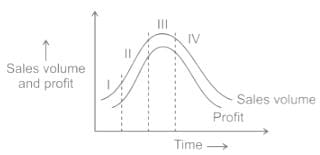
There are four stages of the Product Life cycle are:
Stage 1 Introduction
- In this stage, a new product is launched in a target market where the intended consumers are not well aware of its presence.
- Customers who acknowledge the presence of the product may be willing to pay a higher price in the greed to acquire high-quality goods or services. With this consistent change in manufacturing methods, production completely relies on skilled laborers.
- Competition at the international level is absent during the introduction stage of the international product lifecycle. Competition comes into the picture during the growth stage when developed markets start copying the product and sell it in the domestic market.
- These competitors may also transform from being importers to exporters to the same country that once introduced the product.
Stage 2 Growth
- An effectively marketed product meets the requirements in its target market. The exporter of the product conducts market surveys, analyze and identify the market size and composition. At this stage, the competition is still low.
- Sales volume grows rapidly in the growth stage. This stage of the product lifecycle is marked by fluctuating increases in prices, high profits, and promotion of the product on a huge scale.
Stage 3 Maturity
- At this level of the product lifecycle, the level of product demand and sales volumes increase slowly.
- Duplicate products are reported in foreign markets marking a decline in export sales.
- In order to maintain market share and accompany sales, the original exporter reduces prices.
- There is a decrease in profit margins, but the business remains tempting as sales volumes soar high.
Stage 4 Decline
- This is the final stage of the product lifecycle. In this stage sales volumes decrease and many such products are removed or their usage is discontinued.
- The economies of other countries that have developed similar and better products than the original one export their products to the original exporter's home market.
- This has a negative impact on the sales and price structure of the original product. The original exporter can play a safe game by selling the remaining products at discontinued items' prices.
When a product is in the maturity stage the sales will increase at a decreasing rate.
A girl introduced a boy as the son of the daughter of the father of her maternal uncle. The boy is girl’s: - a)Son
- b)Cannot be determined
- c)Son-in-law
- d)Uncle
Correct answer is option 'B'. Can you explain this answer?
A girl introduced a boy as the son of the daughter of the father of her maternal uncle. The boy is girl’s:
a)
Son
b)
Cannot be determined
c)
Son-in-law
d)
Uncle
| | Anjana Singh answered |
The girl’s maternal uncle and the boy’s mother are siblings because they have the same father.
Hence the boy is either the brother of the girl if the boy’s mother and the girl’s mother are the same, or the boy is the cousin of the girl if there is/are any more siblings of the boy’s mother other than the maternal uncle of the girl.
Thus, the relation between them cannot be determined.
Hence the boy is either the brother of the girl if the boy’s mother and the girl’s mother are the same, or the boy is the cousin of the girl if there is/are any more siblings of the boy’s mother other than the maternal uncle of the girl.
Thus, the relation between them cannot be determined.
A bar magnet of length 14 cm is placed in the magnetic meridian with its north pole pointing towards the geographic north pole. A neutral point is obtained at a distance of 18 cm from the centre of the magnet. If BH = 0.4 G, the magnetic moment of the magnet is
(1 G = 10-4 T)- a)288.0 JT-1
- b)2.880 JT-1
- c)6.880 JT-1
- d)None of these
Correct answer is option 'B'. Can you explain this answer?
A bar magnet of length 14 cm is placed in the magnetic meridian with its north pole pointing towards the geographic north pole. A neutral point is obtained at a distance of 18 cm from the centre of the magnet. If BH = 0.4 G, the magnetic moment of the magnet is
(1 G = 10-4 T)
(1 G = 10-4 T)
a)
288.0 JT-1
b)
2.880 JT-1
c)
6.880 JT-1
d)
None of these
| | Anjana Singh answered |
CONCEPT:
We know that a neutral point is a point where the earth's magnetic field's horizontal component cancels the magnetic field due to the bar.
We know that a neutral point is a point where the earth's magnetic field's horizontal component cancels the magnetic field due to the bar.
CALCULATION:
Given:

The magnetic field due to bar magnet at the neutral point N is written as;
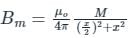
So at N,
Bm = BH

⇒ M =2.880 J/T
Hence option 2) is the correct answer.
Given:
The magnetic field due to bar magnet at the neutral point N is written as;
So at N,
Bm = BH
⇒ M =2.880 J/T
Hence option 2) is the correct answer.
Read the passage below and solve the questions based on it.1. In a joint family of seven persons A, B, C, D, E, F and G, there are two married couples.
2. G is a housewife and her husband is a lawyer. ‘C’ is the wife of ‘B’, ‘A’ is an engineer and is granddaughter of ‘G’. ‘D’ is the father-in-law of ‘C’, a doctor, and father of ‘E’, a Professor. ‘F’ is A’s brother and B’s son.Who is a lawyer?- a)D
- b)F
- c)B
- d)Cannot be determined
Correct answer is option 'A'. Can you explain this answer?
Read the passage below and solve the questions based on it.
1. In a joint family of seven persons A, B, C, D, E, F and G, there are two married couples.
2. G is a housewife and her husband is a lawyer. ‘C’ is the wife of ‘B’, ‘A’ is an engineer and is granddaughter of ‘G’. ‘D’ is the father-in-law of ‘C’, a doctor, and father of ‘E’, a Professor. ‘F’ is A’s brother and B’s son.
2. G is a housewife and her husband is a lawyer. ‘C’ is the wife of ‘B’, ‘A’ is an engineer and is granddaughter of ‘G’. ‘D’ is the father-in-law of ‘C’, a doctor, and father of ‘E’, a Professor. ‘F’ is A’s brother and B’s son.
Who is a lawyer?
a)
D
b)
F
c)
B
d)
Cannot be determined
| | Anjana Singh answered |
- C is the wife of B, B has a son F and a daughter A
- As A is the granddaughter of G. So, G is the mother of B.
- As D is the father-in-law of C, hence D is the husband of G and D is the father of B and E.
- Also, E is a professor, D is a lawyer (G’s husband is a lawyer), G is a housewife, A is an engineer & C is a doctor.
So D is the lawyer.
2023 is the year for the Global Stocktake. It will provide the periodic review of which of the following?- a)Burden of Noncommunicable diseases
- b)Food security
- c)Climate action
- d)Natural calamities
Correct answer is option 'C'. Can you explain this answer?
2023 is the year for the Global Stocktake. It will provide the periodic review of which of the following?
a)
Burden of Noncommunicable diseases
b)
Food security
c)
Climate action
d)
Natural calamities
| | Anjana Singh answered |
Global Stocktake:
- 2023 is the year for the Global Stocktake.
- Global Stocktake is essentially a periodic review of global climate action which aims to assess whether current efforts will enable us to reach the objectives set out in the Paris Agreement.
- This is the first Global Stocktake year since the Paris Agreement was signed in 2015 and the report has been underway for the past two years.
- It is set to be released in September of 2023.
- The Stocktake will help align efforts on climate action, including measures that need to be put in place to bridge the gaps in progress
With reference to the Poshan Bhi, Padhai Bhi, consider the following statements:
1. It is launched by the Ministry of Education.
2. Every child till the age of 12-years will be provided with high-quality preschool instruction in the mother tongue on a daily basis.
Which of the statements given above is/are correct?- a)1 only
- b)2 only
- c)Both 1 and 2
- d)Neither 1 nor 2
Correct answer is option 'D'. Can you explain this answer?
With reference to the Poshan Bhi, Padhai Bhi, consider the following statements:
1. It is launched by the Ministry of Education.
2. Every child till the age of 12-years will be provided with high-quality preschool instruction in the mother tongue on a daily basis.
Which of the statements given above is/are correct?
1. It is launched by the Ministry of Education.
2. Every child till the age of 12-years will be provided with high-quality preschool instruction in the mother tongue on a daily basis.
Which of the statements given above is/are correct?
a)
1 only
b)
2 only
c)
Both 1 and 2
d)
Neither 1 nor 2
| | Anjana Singh answered |
Statement 1 is not correct: In May 2023, the Union Ministry for Women and Child Development launched the Centre’s flagship programme ‘Poshan Bhi, Padhai Bhi’.
- Objective: The programme will focus on Early Childhood Care and Education (ECCE) at anganwadis across the country. The aim is to make anganwadi centres as nutrition hubs as well as education imparting centres.
Statement 2 is not correct: Anganwadi Centres will be strengthened with high-quality infrastructure, play equipment, and well-trained Anganwadi workers/teachers.
- Every child (till the age of 6-years) would be provided with at least two hours of high-quality preschool instruction in the mother tongue on a daily basis, as per the New Education Policy.
Consider the following statements, with reference to the Gaganyaan Mission:- It aims to launch human beings (three crew members) to low earth orbit and bring them back safely to earth.
- The Launch Vehicle Mark-3 (LVM3) is the launch vehicle for the mission.
Which of the statements given above is/are not correct?- a)1 only
- b)2 only
- c)Both 1 and 2
- d)Neither 1 nor 2
Correct answer is option 'D'. Can you explain this answer?
Consider the following statements, with reference to the Gaganyaan Mission:
- It aims to launch human beings (three crew members) to low earth orbit and bring them back safely to earth.
- The Launch Vehicle Mark-3 (LVM3) is the launch vehicle for the mission.
Which of the statements given above is/are not correct?
a)
1 only
b)
2 only
c)
Both 1 and 2
d)
Neither 1 nor 2
| | Sahil Datta answered |
Incorrect Statements regarding Gaganyaan Mission:
Statement 1:
The first statement is correct. The Gaganyaan Mission indeed aims to launch human beings (three crew members) to low earth orbit and bring them back safely to earth. This mission is India's first manned space mission and is a significant milestone in its space exploration efforts.
Statement 2:
The second statement is also correct. The Launch Vehicle Mark-3 (LVM3) is the launch vehicle chosen for the Gaganyaan Mission. LVM3 is a heavy-lift launch vehicle developed by the Indian Space Research Organisation (ISRO) and is capable of carrying heavy payloads, including crewed spacecraft.
Explanation:
Both statements 1 and 2 are accurate and not incorrect. Therefore, the correct answer is option 'D' - Neither 1 nor 2. The Gaganyaan Mission is a prestigious project for India's space program, aiming to demonstrate its capability to send humans into space and safely return them to Earth. The selection of LVM3 as the launch vehicle showcases ISRO's technological advancements in the field of space exploration.
Statement 1:
The first statement is correct. The Gaganyaan Mission indeed aims to launch human beings (three crew members) to low earth orbit and bring them back safely to earth. This mission is India's first manned space mission and is a significant milestone in its space exploration efforts.
Statement 2:
The second statement is also correct. The Launch Vehicle Mark-3 (LVM3) is the launch vehicle chosen for the Gaganyaan Mission. LVM3 is a heavy-lift launch vehicle developed by the Indian Space Research Organisation (ISRO) and is capable of carrying heavy payloads, including crewed spacecraft.
Explanation:
Both statements 1 and 2 are accurate and not incorrect. Therefore, the correct answer is option 'D' - Neither 1 nor 2. The Gaganyaan Mission is a prestigious project for India's space program, aiming to demonstrate its capability to send humans into space and safely return them to Earth. The selection of LVM3 as the launch vehicle showcases ISRO's technological advancements in the field of space exploration.
Which of the following statements concerning a Gantt chart is true?- a)Gantt charts are particularly helpful for scheduling and planning large projects
- b)Gantt charts are particularly helpful for scheduling and planning projects with complex precedence relationships
- c)The Gantt chart has been a popular project scheduling tool, but is not widely used now
- d)The Gantt chart indicates where extra time is available and activities can be delayed.
Correct answer is option 'C'. Can you explain this answer?
Which of the following statements concerning a Gantt chart is true?
a)
Gantt charts are particularly helpful for scheduling and planning large projects
b)
Gantt charts are particularly helpful for scheduling and planning projects with complex precedence relationships
c)
The Gantt chart has been a popular project scheduling tool, but is not widely used now
d)
The Gantt chart indicates where extra time is available and activities can be delayed.
| | Tanvi Rane answered |
Explanation:
Gantt charts are particularly helpful for scheduling and planning large projects:
- This statement is true. Gantt charts visually represent the start and finish dates of the various elements of a project. This makes them particularly useful for scheduling and planning large projects where there are multiple tasks and milestones to track.
Gantt charts are particularly helpful for scheduling and planning projects with complex precedence relationships:
- While Gantt charts can be used for projects with complex precedence relationships, they are not particularly designed for this purpose. Other tools like network diagrams may be more suitable for projects with intricate dependencies.
The Gantt chart has been a popular project scheduling tool, but is not widely used now:
- This statement is true. While Gantt charts have been a popular project scheduling tool for many years, they are now considered somewhat outdated compared to more advanced project management software that offers additional features and capabilities.
The Gantt chart indicates where extra time is available and activities can be delayed:
- This statement is not entirely accurate. While a Gantt chart can show the timeline for each task, it does not explicitly indicate where extra time is available. It is up to the project manager to analyze the chart and determine where activities can be delayed if necessary.
Gantt charts are particularly helpful for scheduling and planning large projects:
- This statement is true. Gantt charts visually represent the start and finish dates of the various elements of a project. This makes them particularly useful for scheduling and planning large projects where there are multiple tasks and milestones to track.
Gantt charts are particularly helpful for scheduling and planning projects with complex precedence relationships:
- While Gantt charts can be used for projects with complex precedence relationships, they are not particularly designed for this purpose. Other tools like network diagrams may be more suitable for projects with intricate dependencies.
The Gantt chart has been a popular project scheduling tool, but is not widely used now:
- This statement is true. While Gantt charts have been a popular project scheduling tool for many years, they are now considered somewhat outdated compared to more advanced project management software that offers additional features and capabilities.
The Gantt chart indicates where extra time is available and activities can be delayed:
- This statement is not entirely accurate. While a Gantt chart can show the timeline for each task, it does not explicitly indicate where extra time is available. It is up to the project manager to analyze the chart and determine where activities can be delayed if necessary.
A string is wound over a circular disc. It is now unwound with its “free end” letting it remain tight and tangent to the disc. The curve traced by the “free end” is- a)Spiral
- b)Involute
- c)Cycloid
- d)Epicycloid
Correct answer is option 'B'. Can you explain this answer?
A string is wound over a circular disc. It is now unwound with its “free end” letting it remain tight and tangent to the disc. The curve traced by the “free end” is
a)
Spiral
b)
Involute
c)
Cycloid
d)
Epicycloid
| | Nilesh Joshi answered |
Understanding the Involute Curve
When a string is wound around a circular disc and unwound while maintaining tension, the path traced by the free end of the string forms a specific geometric shape known as an involute.
Key Characteristics of the Involute:
- The involute of a curve is generated by tracing the end of a taut string as it unwinds from the curve.
- For a circular disc, the involute is derived from the circular path of the disc.
- As the string unwinds, it remains tangent to the disc at the point of contact.
Why the Involute?
- The involute reflects the relationship between the length of the string and the radius of the disc.
- The unwinding process keeps the string straight and tight, creating a unique spiral-like path that diverges from the disc.
- As the radius of the disc decreases (due to unwinding), the involute continues to extend outward.
Visual Representation:
- Imagine the disc as a circle and the string as a line that starts from the edge of the circle.
- As you pull the string away from the disc, the path it traces is not simply circular but forms a spiral-like curve that is characteristic of an involute.
Conclusion:
The curve traced by the free end of the unwound string is an involute, showcasing the elegant geometric properties of curves and the relationship between tension and motion. Understanding this concept has applications in various fields, including mechanical engineering and design, particularly in the analysis of gears and belts.
When a string is wound around a circular disc and unwound while maintaining tension, the path traced by the free end of the string forms a specific geometric shape known as an involute.
Key Characteristics of the Involute:
- The involute of a curve is generated by tracing the end of a taut string as it unwinds from the curve.
- For a circular disc, the involute is derived from the circular path of the disc.
- As the string unwinds, it remains tangent to the disc at the point of contact.
Why the Involute?
- The involute reflects the relationship between the length of the string and the radius of the disc.
- The unwinding process keeps the string straight and tight, creating a unique spiral-like path that diverges from the disc.
- As the radius of the disc decreases (due to unwinding), the involute continues to extend outward.
Visual Representation:
- Imagine the disc as a circle and the string as a line that starts from the edge of the circle.
- As you pull the string away from the disc, the path it traces is not simply circular but forms a spiral-like curve that is characteristic of an involute.
Conclusion:
The curve traced by the free end of the unwound string is an involute, showcasing the elegant geometric properties of curves and the relationship between tension and motion. Understanding this concept has applications in various fields, including mechanical engineering and design, particularly in the analysis of gears and belts.
With reference to Indian Computer Emergency Response Team (CERT-in) consider the following
statements:
1. It is an office within the Union Ministry of Electronics and Information established under IT Act
2000.
2. It is a nodal agency to deal with cyber security threats.
Which of the statements given above are correct?- a)1 only
- b)2 only
- c)Both 1 and 2
- d)Neither 1 nor 2
Correct answer is option 'C'. Can you explain this answer?
With reference to Indian Computer Emergency Response Team (CERT-in) consider the following
statements:
1. It is an office within the Union Ministry of Electronics and Information established under IT Act
2000.
2. It is a nodal agency to deal with cyber security threats.
Which of the statements given above are correct?
statements:
1. It is an office within the Union Ministry of Electronics and Information established under IT Act
2000.
2. It is a nodal agency to deal with cyber security threats.
Which of the statements given above are correct?
a)
1 only
b)
2 only
c)
Both 1 and 2
d)
Neither 1 nor 2
| | Dipika Basak answered |
Overview of CERT-in
The Indian Computer Emergency Response Team (CERT-in) is a critical component of India's cybersecurity framework. It plays a significant role in managing cyber threats and incidents.
Statement 1: Establishment and Legal Framework
- CERT-in was indeed established under the Information Technology Act, 2000.
- It operates as an office within the Union Ministry of Electronics and Information Technology.
- This foundation provides it the legal authority to function in matters related to cybersecurity.
Statement 2: Role as a Nodal Agency
- CERT-in serves as the nodal agency in India to address and mitigate cybersecurity threats.
- It is responsible for coordinating responses to computer security incidents.
- The agency also provides guidance and support to government, private, and public sectors on cybersecurity matters.
Conclusion
Both statements are accurate regarding CERT-in:
- Statement 1 is correct as it is established under the IT Act 2000 and operates under the Union Ministry.
- Statement 2 is also correct as it acts as the primary agency for managing cybersecurity incidents in India.
Thus, the correct answer is option C: Both 1 and 2. This confirms the dual roles of CERT-in in legal establishment and its operational responsibilities in cybersecurity.
The Indian Computer Emergency Response Team (CERT-in) is a critical component of India's cybersecurity framework. It plays a significant role in managing cyber threats and incidents.
Statement 1: Establishment and Legal Framework
- CERT-in was indeed established under the Information Technology Act, 2000.
- It operates as an office within the Union Ministry of Electronics and Information Technology.
- This foundation provides it the legal authority to function in matters related to cybersecurity.
Statement 2: Role as a Nodal Agency
- CERT-in serves as the nodal agency in India to address and mitigate cybersecurity threats.
- It is responsible for coordinating responses to computer security incidents.
- The agency also provides guidance and support to government, private, and public sectors on cybersecurity matters.
Conclusion
Both statements are accurate regarding CERT-in:
- Statement 1 is correct as it is established under the IT Act 2000 and operates under the Union Ministry.
- Statement 2 is also correct as it acts as the primary agency for managing cybersecurity incidents in India.
Thus, the correct answer is option C: Both 1 and 2. This confirms the dual roles of CERT-in in legal establishment and its operational responsibilities in cybersecurity.
Direction: The following question consists of two statements, one labeled as the 'Statement (I)' and the other as 'Statement (II)'. Examine these two statements carefully and select the correct answer. Statement-I: The dimension of nanomaterial is comparable to the wavelength of the photon.Statement-II: Randomly moving electron gets confined to a specific energy level.- a)Statement I and Statement II are correct and Statement II is the correct explanation of Statement I.
- b)Statement I and Statement II are correct but Statement II is not the correct explanation of Statement I
- c)Statement I is correct, Statement II is false
- d)Statement I is false, Statement II is correct
Correct answer is option 'B'. Can you explain this answer?
Direction: The following question consists of two statements, one labeled as the 'Statement (I)' and the other as 'Statement (II)'. Examine these two statements carefully and select the correct answer.
Statement-I: The dimension of nanomaterial is comparable to the wavelength of the photon.
Statement-II: Randomly moving electron gets confined to a specific energy level.
a)
Statement I and Statement II are correct and Statement II is the correct explanation of Statement I.
b)
Statement I and Statement II are correct but Statement II is not the correct explanation of Statement I
c)
Statement I is correct, Statement II is false
d)
Statement I is false, Statement II is correct
 | Poulomi Ahuja answered |
Understanding the Statements
The question presents two statements about nanomaterials and their behavior at the nanoscale. Let's analyze each statement to understand their correctness and relationship.
Statement I: Size of Nanomaterials
- Nanomaterials typically have dimensions in the range of 1 to 100 nanometers.
- The wavelength of visible light (photons) is approximately 400 to 700 nanometers.
- Hence, the size of nanomaterials can be comparable to the wavelength of certain photons, particularly in the ultraviolet region.
Statement II: Electron Confinement
- In nanoscale materials, electrons are confined within a small space due to quantum effects.
- This confinement leads to quantized energy levels, meaning electrons can only occupy specific energy states.
- This phenomenon is foundational in nanotechnology and helps in the unique properties of nanomaterials.
Correctness of the Statements
- Both statements are correct:
- Statement I accurately describes the size of nanomaterials in relation to photon wavelengths.
- Statement II correctly explains the quantum behavior of electrons in nanoscale environments.
Relationship Between the Statements
- While both statements are correct, Statement II does not directly explain Statement I.
- Statement I discusses the size of nanomaterials, while Statement II pertains to electron behavior, which is a consequence of their size but not an explanation of it.
Conclusion
- Therefore, the correct answer is option B: "Statement I and Statement II are correct but Statement II is not the correct explanation of Statement I."
The question presents two statements about nanomaterials and their behavior at the nanoscale. Let's analyze each statement to understand their correctness and relationship.
Statement I: Size of Nanomaterials
- Nanomaterials typically have dimensions in the range of 1 to 100 nanometers.
- The wavelength of visible light (photons) is approximately 400 to 700 nanometers.
- Hence, the size of nanomaterials can be comparable to the wavelength of certain photons, particularly in the ultraviolet region.
Statement II: Electron Confinement
- In nanoscale materials, electrons are confined within a small space due to quantum effects.
- This confinement leads to quantized energy levels, meaning electrons can only occupy specific energy states.
- This phenomenon is foundational in nanotechnology and helps in the unique properties of nanomaterials.
Correctness of the Statements
- Both statements are correct:
- Statement I accurately describes the size of nanomaterials in relation to photon wavelengths.
- Statement II correctly explains the quantum behavior of electrons in nanoscale environments.
Relationship Between the Statements
- While both statements are correct, Statement II does not directly explain Statement I.
- Statement I discusses the size of nanomaterials, while Statement II pertains to electron behavior, which is a consequence of their size but not an explanation of it.
Conclusion
- Therefore, the correct answer is option B: "Statement I and Statement II are correct but Statement II is not the correct explanation of Statement I."
Chapter doubts & questions for Paper-I (General Studies and Engineering Aptitude) - Engineering Services Examination (ESE) Mock Test Series 2026 2026 is part of Electrical Engineering (EE) exam preparation. The chapters have been prepared according to the Electrical Engineering (EE) exam syllabus. The Chapter doubts & questions, notes, tests & MCQs are made for Electrical Engineering (EE) 2026 Exam. Find important definitions, questions, notes, meanings, examples, exercises, MCQs and online tests here.
Chapter doubts & questions of Paper-I (General Studies and Engineering Aptitude) - Engineering Services Examination (ESE) Mock Test Series 2026 in English & Hindi are available as part of Electrical Engineering (EE) exam. Download more important topics, notes, lectures and mock test series for Electrical Engineering (EE) Exam by signing up for free.
