


All Exams > CAT > CAT Mock Test Series and 500+ Practice Tests 2026 > All Questions
All questions of Logical Reasoning (LR) and Data Interpretation (DI): Section-wise Tests for CAT Exam
Instructions:
A B-school has 4 clubs - Sports, Dramatics, Literary, and Quiz. 60 students joined these clubs in the first year. A person can join only one of these 4 clubs. After the first year was over, some students did not like the club they joined and hence, moved from one club to another.
Further the following information is known:
No student moved from the quiz club to the sports club.
The number of students who moved from dramatics club to the sports club is the same as the number of students who moved from the sports club to the dramatics club. The same is the case with sports club and literary club as well.
The number of students who moved out from the sports and quiz clubs are equal.
The number of students who moved to the literary club is one more than the number of persons who moved to the sports club.
At least one student moved from the sports club to literary club.
The number of students who left the quiz club for the dramatics club and the literary club is the same.
A total of 21 students shifted from one club to another.
4 students moved out of dramatics club and 5 students moved out of literary club.
The number of students who joined sports club is exactly half the number of students who left it.
The number of students who left other clubs for dramatics club is 4 more than the number of students who left other clubs for the quiz club.
What is the absolute difference between the number of students who joined literary club and the number of students who left it?
Correct answer is '1'. Can you explain this answer?
Instructions:
A B-school has 4 clubs - Sports, Dramatics, Literary, and Quiz. 60 students joined these clubs in the first year. A person can join only one of these 4 clubs. After the first year was over, some students did not like the club they joined and hence, moved from one club to another.
Further the following information is known:
No student moved from the quiz club to the sports club.
The number of students who moved from dramatics club to the sports club is the same as the number of students who moved from the sports club to the dramatics club. The same is the case with sports club and literary club as well.
The number of students who moved out from the sports and quiz clubs are equal.
The number of students who moved to the literary club is one more than the number of persons who moved to the sports club.
At least one student moved from the sports club to literary club.
The number of students who left the quiz club for the dramatics club and the literary club is the same.
A total of 21 students shifted from one club to another.
4 students moved out of dramatics club and 5 students moved out of literary club.
The number of students who joined sports club is exactly half the number of students who left it.
The number of students who left other clubs for dramatics club is 4 more than the number of students who left other clubs for the quiz club.
What is the absolute difference between the number of students who joined literary club and the number of students who left it?
A B-school has 4 clubs - Sports, Dramatics, Literary, and Quiz. 60 students joined these clubs in the first year. A person can join only one of these 4 clubs. After the first year was over, some students did not like the club they joined and hence, moved from one club to another.
Further the following information is known:
No student moved from the quiz club to the sports club.
The number of students who moved from dramatics club to the sports club is the same as the number of students who moved from the sports club to the dramatics club. The same is the case with sports club and literary club as well.
The number of students who moved out from the sports and quiz clubs are equal.
The number of students who moved to the literary club is one more than the number of persons who moved to the sports club.
At least one student moved from the sports club to literary club.
The number of students who left the quiz club for the dramatics club and the literary club is the same.
A total of 21 students shifted from one club to another.
4 students moved out of dramatics club and 5 students moved out of literary club.
The number of students who joined sports club is exactly half the number of students who left it.
The number of students who left other clubs for dramatics club is 4 more than the number of students who left other clubs for the quiz club.
What is the absolute difference between the number of students who joined literary club and the number of students who left it?
 | Pioneer Academy answered |
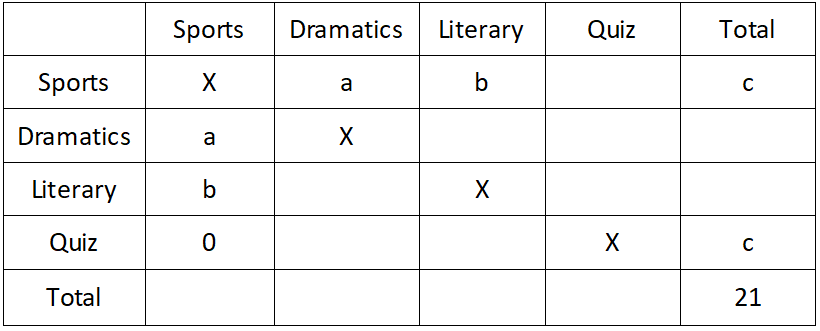
Let us start by tabulating the data available.
We have no information about the number of persons in each club.
The sports-sports cell in the table represents the number of persons from sports club who stayed in sports club. Since we do not have this information (we have information only regarding the movement from one club to another), let us mark all such cells with X.
The cell sports-dramatics (row-column) represents the number of students from sports club who left for dramatics club. Therefore, the cell sports-total will provide the number of students who left the sports club and the cell total-sports will provide the number of students who left other clubs for the sports club.
The number of persons who moved from dramatics club to the sports club is the same as the number of persons who moved from the sports club to the dramatics club. The same is the case with sports club and literary club as well. Let us use ‘a’ to denote the number of persons who moved from the dramatics club to the sports club and ‘b’ to denote the number of persons who moved from sports club to literary club. The number of persons who moved out of sports and quiz clubs is the same. Let us denote it by ‘c’.
A total of 21 students left one club for another. No person moved from the quiz club to sports club (quiz-sports = 0).
We have no information about the number of persons in each club.
The sports-sports cell in the table represents the number of persons from sports club who stayed in sports club. Since we do not have this information (we have information only regarding the movement from one club to another), let us mark all such cells with X.
The cell sports-dramatics (row-column) represents the number of students from sports club who left for dramatics club. Therefore, the cell sports-total will provide the number of students who left the sports club and the cell total-sports will provide the number of students who left other clubs for the sports club.
The number of persons who moved from dramatics club to the sports club is the same as the number of persons who moved from the sports club to the dramatics club. The same is the case with sports club and literary club as well. Let us use ‘a’ to denote the number of persons who moved from the dramatics club to the sports club and ‘b’ to denote the number of persons who moved from sports club to literary club. The number of persons who moved out of sports and quiz clubs is the same. Let us denote it by ‘c’.
A total of 21 students left one club for another. No person moved from the quiz club to sports club (quiz-sports = 0).
The number of persons who moved to the literary club is one more than the number of persons who moved to the sports club. Let the number of persons who moved to the literary club be ‘d+1’ and the number of persons who moved to the sports club be ‘d’.
The number of persons who left the quiz club for the dramatics club and the literary club is the same. Let us denote the number of persons who left the quiz club for dramatics club by ‘e’. 4 students moved out of dramatics club and 5 students moved out of literary club.
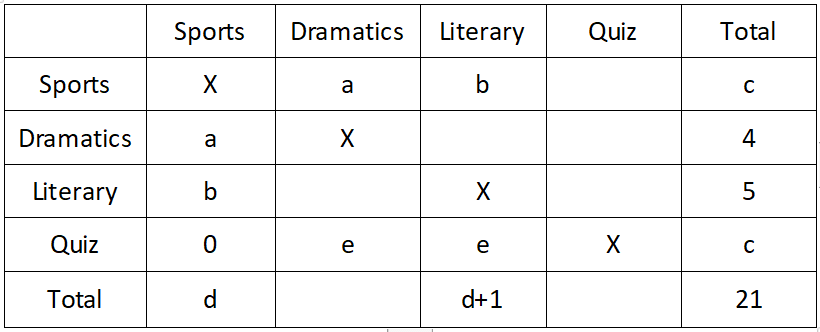
The number of persons who left the quiz club for the dramatics club and the literary club is the same. Let us denote the number of persons who left the quiz club for dramatics club by ‘e’. 4 students moved out of dramatics club and 5 students moved out of literary club.
As we can see from the table, c+c+4+5 =21
⇒ c = 6
The number of students who left other clubs for dramatics club is 4 more than the number of students who left other clubs for the quiz club.
Let the number of students who left other clubs for quiz club be ‘f’.
⇒ Number of students who left other clubs for dramatics club = f + 4.
The number of students who joined sports club is exactly half the number of students who left it. We know that 6 students left the sports club. Therefore, 3 students should have joined the sports club. ⇒ d = 3
We can see from the table that e + e = 6
⇒ e = 3
Let us fill the vacant cells with variables from g to k. We get the following table.
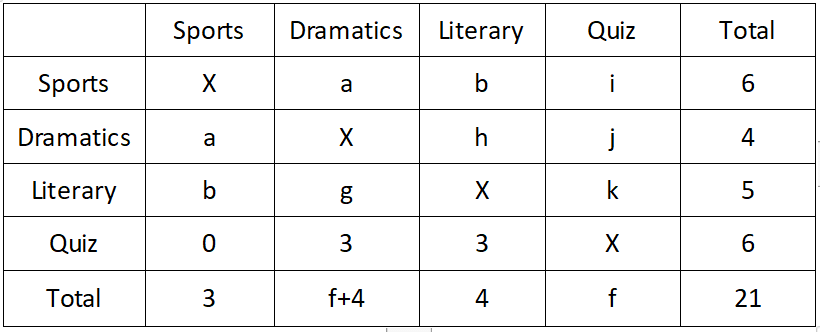
⇒ c = 6
The number of students who left other clubs for dramatics club is 4 more than the number of students who left other clubs for the quiz club.
Let the number of students who left other clubs for quiz club be ‘f’.
⇒ Number of students who left other clubs for dramatics club = f + 4.
The number of students who joined sports club is exactly half the number of students who left it. We know that 6 students left the sports club. Therefore, 3 students should have joined the sports club. ⇒ d = 3
We can see from the table that e + e = 6
⇒ e = 3
Let us fill the vacant cells with variables from g to k. We get the following table.
f + f + 4 + 3 + 4 = 21
⇒ 2f = 10
f = 5
a+b = 3
a+b+i = 6
⇒ i = 3
a+h+j = 4 --------------(1)
b+h = 1 ----------------(2)
a+b = 3 ----------------(3)
b+g+k = 5 -------------(4)
j + k = 2 --------------(5)
a+g = 6 ---------------(6)
Let us rewrite every variable in terms of 'a'.
b = 3-a
g =6-a
Substituting these values in (4), we get,
3-a+6-a+k = 5
9-2a+k = 5
k = 2a-4
Substituting the value of 'k' in (5), we get,
j+2a-4 = 2
j = 6-2a
(1)⇒ a+h+j = 4
a + h + 6 - 2a = 4
⇒ h = a - 2
It has been given that at least one student moved from Sports to Literary club. Therefore, the value of 'a' cannot be 3.
We know that k=2a-4. Therefore, the value of 'a' should be at least 2.
2 is the only value that falls within the range.
Solving the equations using a=2, we get the following table:
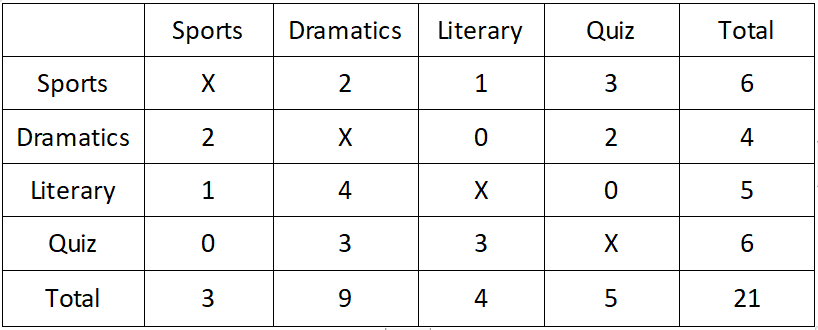
Number of persons who joined literary club = 4
Number of persons who left literary club = 5
Therefore, the required difference is 5-4 = 1.
⇒ 2f = 10
f = 5
a+b = 3
a+b+i = 6
⇒ i = 3
a+h+j = 4 --------------(1)
b+h = 1 ----------------(2)
a+b = 3 ----------------(3)
b+g+k = 5 -------------(4)
j + k = 2 --------------(5)
a+g = 6 ---------------(6)
Let us rewrite every variable in terms of 'a'.
b = 3-a
g =6-a
Substituting these values in (4), we get,
3-a+6-a+k = 5
9-2a+k = 5
k = 2a-4
Substituting the value of 'k' in (5), we get,
j+2a-4 = 2
j = 6-2a
(1)⇒ a+h+j = 4
a + h + 6 - 2a = 4
⇒ h = a - 2
It has been given that at least one student moved from Sports to Literary club. Therefore, the value of 'a' cannot be 3.
We know that k=2a-4. Therefore, the value of 'a' should be at least 2.
2 is the only value that falls within the range.
Solving the equations using a=2, we get the following table:
Number of persons who joined literary club = 4
Number of persons who left literary club = 5
Therefore, the required difference is 5-4 = 1.

Instructions:
4 Chess tournaments were held all over the world last year and in each tournament 128 chess players participated. Players who participated in the 1st tournament are same for other tournaments. At the end of these four tournaments, world championship is held that consists of 32 players. These 32 players are selected on the basis of total number of wins the 128 players got in the four tournaments. Each of the games in the tournaments (including the world championship) is a knockout game i.e. a person who loses a game will not play in that tournament again. The person who wins the last round in any tournament is called the winner of that tournament. If 31 slots of the 32 slots in the world championship tournament are filled and to fill the 32nd spot there is a tie between few players, exactly one of those players is selected based on certain criteria (like coin toss).
Which of the following is the least number of wins that the winner of the world championship can have?- a)11
- b)10
- c)9
- d)7
Correct answer is option 'D'. Can you explain this answer?
Instructions:
4 Chess tournaments were held all over the world last year and in each tournament 128 chess players participated. Players who participated in the 1st tournament are same for other tournaments. At the end of these four tournaments, world championship is held that consists of 32 players. These 32 players are selected on the basis of total number of wins the 128 players got in the four tournaments. Each of the games in the tournaments (including the world championship) is a knockout game i.e. a person who loses a game will not play in that tournament again. The person who wins the last round in any tournament is called the winner of that tournament. If 31 slots of the 32 slots in the world championship tournament are filled and to fill the 32nd spot there is a tie between few players, exactly one of those players is selected based on certain criteria (like coin toss).
Which of the following is the least number of wins that the winner of the world championship can have?
4 Chess tournaments were held all over the world last year and in each tournament 128 chess players participated. Players who participated in the 1st tournament are same for other tournaments. At the end of these four tournaments, world championship is held that consists of 32 players. These 32 players are selected on the basis of total number of wins the 128 players got in the four tournaments. Each of the games in the tournaments (including the world championship) is a knockout game i.e. a person who loses a game will not play in that tournament again. The person who wins the last round in any tournament is called the winner of that tournament. If 31 slots of the 32 slots in the world championship tournament are filled and to fill the 32nd spot there is a tie between few players, exactly one of those players is selected based on certain criteria (like coin toss).
Which of the following is the least number of wins that the winner of the world championship can have?
a)
11
b)
10
c)
9
d)
7
| | Pioneer Academy answered |
To win the world championship, a player must win all the five matches in that tournament.
In the four preceding tournaments there are 128 players.
So in an individual tournament.
64 will win 0 match.
32 will win 1 match.
16 will win 2 matches.
8 will win 3 matches.
4 will win 4 matches
2 will win 5 matches.
1 (finalist) will win 6 matches.
1 (champion) will win 7 matches.
There are 31 places which are already confirmed and 97 players are for the 32nd position.
We must maximize the number of matches won by the other 31 players
⇒ remaining 97 players must win least number of matches.
In the first tounament
Thus for 97 players, 64 will win 0 matches 32 will win 1 match and the remaining 1 player will win 2 matches.
n the first tournament total number of matches won by these 97 players= 64x0+32x1+1x2= 34 wins
In all the 4 tournaments total number of wins will be 4x34=136
There are 97 players, so they will distribute victories among themselves. As 136/97=1.402 some players can have 2 wins and others will have 1 win.
Suppose X players win 2 matches and Y win only 1 match.
So X+Y=97
2X+Y=136
X= 39
Y=58
So 39 players have 2 wins, and 58 players will have 1 win.
Among these players one will be selected for the world championship based on certain criteria.
Hence minimum number of wins required = 5 + 2 = 7
In the four preceding tournaments there are 128 players.
So in an individual tournament.
64 will win 0 match.
32 will win 1 match.
16 will win 2 matches.
8 will win 3 matches.
4 will win 4 matches
2 will win 5 matches.
1 (finalist) will win 6 matches.
1 (champion) will win 7 matches.
There are 31 places which are already confirmed and 97 players are for the 32nd position.
We must maximize the number of matches won by the other 31 players
⇒ remaining 97 players must win least number of matches.
In the first tounament
Thus for 97 players, 64 will win 0 matches 32 will win 1 match and the remaining 1 player will win 2 matches.
n the first tournament total number of matches won by these 97 players= 64x0+32x1+1x2= 34 wins
In all the 4 tournaments total number of wins will be 4x34=136
There are 97 players, so they will distribute victories among themselves. As 136/97=1.402 some players can have 2 wins and others will have 1 win.
Suppose X players win 2 matches and Y win only 1 match.
So X+Y=97
2X+Y=136
X= 39
Y=58
So 39 players have 2 wins, and 58 players will have 1 win.
Among these players one will be selected for the world championship based on certain criteria.
Hence minimum number of wins required = 5 + 2 = 7
Instructions:
A code ABCDEFGH where A, B, C, D, E, F, G, H are all digits, guards the secret formula of a high demand soft drink. The code should follow the following constraints:
1. The 2 digit number AB should be a multiple of 11.
2. The digit C should be a multiple of B.
3. The digit D should be a multiple of B.
4. The 2-digit number EF should be a multiple of the 2-digit number CD.
5. G and H can be any 2 consecutive digits from 1 to 9 such that G<H.
6. None of the digits should be zero or one.
Based on the information given above, answer the questions that follow.
How many codes are possible if all the digits from A to H are greater than 4?
Correct answer is '20'. Can you explain this answer?
Instructions:
A code ABCDEFGH where A, B, C, D, E, F, G, H are all digits, guards the secret formula of a high demand soft drink. The code should follow the following constraints:
1. The 2 digit number AB should be a multiple of 11.
2. The digit C should be a multiple of B.
3. The digit D should be a multiple of B.
4. The 2-digit number EF should be a multiple of the 2-digit number CD.
5. G and H can be any 2 consecutive digits from 1 to 9 such that G<H.
6. None of the digits should be zero or one.
Based on the information given above, answer the questions that follow.
How many codes are possible if all the digits from A to H are greater than 4?
A code ABCDEFGH where A, B, C, D, E, F, G, H are all digits, guards the secret formula of a high demand soft drink. The code should follow the following constraints:
1. The 2 digit number AB should be a multiple of 11.
2. The digit C should be a multiple of B.
3. The digit D should be a multiple of B.
4. The 2-digit number EF should be a multiple of the 2-digit number CD.
5. G and H can be any 2 consecutive digits from 1 to 9 such that G<H.
6. None of the digits should be zero or one.
Based on the information given above, answer the questions that follow.
How many codes are possible if all the digits from A to H are greater than 4?
 | Shalini Patel answered |
Since AB is a multiple of 11, and both A and B are greater than 4, they must be at least 5. So, the possible values for AB are:
55
66
77
88
99
Now, for each of the given values of AB, let us find out all possible values of C and D. Since any other multiple of AB in each case is a number having more than 2 digits, the only multiple is AB itself:
5555
6666
7777
8888
9999
The same is true for EF,
555555
666666
777777
888888
999999
Now for each of the values of ABCDEF, we can have 4 values of GH, 56, 67, 78, 89.
Hence, total number of possible cases = 4 x 5 = 20.
55
66
77
88
99
Now, for each of the given values of AB, let us find out all possible values of C and D. Since any other multiple of AB in each case is a number having more than 2 digits, the only multiple is AB itself:
5555
6666
7777
8888
9999
The same is true for EF,
555555
666666
777777
888888
999999
Now for each of the values of ABCDEF, we can have 4 values of GH, 56, 67, 78, 89.
Hence, total number of possible cases = 4 x 5 = 20.
Read the following scenario and answer the three questions that follow.
The following plot describes the height (in cm), weight (in kg), age (in years) and gender (F for female, M for male) of 20 patients visiting a hospital.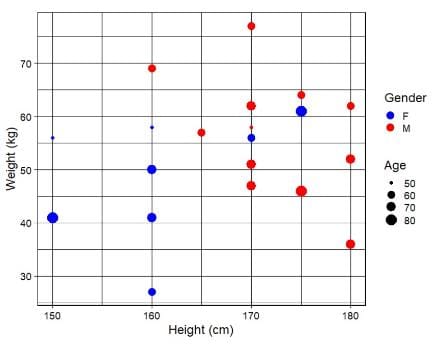 A person’s body mass index (BMI) is calculated as weight (in kg) divided by squared height (measured in square metres). For example, a person weighing 100 kg and of height 100 cm (1m) will have a BMI of 100. A person with BMI less than or equal to 18.5 is considered as underweight, above 18.5 but less than or equal to 25 as normal weight, above 25 but less than or equal to 30 as overweight, and above 30 as obese.The average age of the female patients who weigh 50 kg or above is approximately
- a)62
- b)65
- c)68
- d)70
Correct answer is option 'A'. Can you explain this answer?
Read the following scenario and answer the three questions that follow.
The following plot describes the height (in cm), weight (in kg), age (in years) and gender (F for female, M for male) of 20 patients visiting a hospital.
The following plot describes the height (in cm), weight (in kg), age (in years) and gender (F for female, M for male) of 20 patients visiting a hospital.
A person’s body mass index (BMI) is calculated as weight (in kg) divided by squared height (measured in square metres). For example, a person weighing 100 kg and of height 100 cm (1m) will have a BMI of 100. A person with BMI less than or equal to 18.5 is considered as underweight, above 18.5 but less than or equal to 25 as normal weight, above 25 but less than or equal to 30 as overweight, and above 30 as obese.
The average age of the female patients who weigh 50 kg or above is approximately
a)
62
b)
65
c)
68
d)
70
 | Ishita Reddy answered |
There are 5 ladies whose weights are 50 or above
There ages are 50,50, 70,60 and 80
Average = 310/5 = 62
There ages are 50,50, 70,60 and 80
Average = 310/5 = 62
Instructions:
A B-school has 4 clubs - Sports, Dramatics, Literary, and Quiz. 60 students joined these clubs in the first year. A person can join only one of these 4 clubs. After the first year was over, some students did not like the club they joined and hence, moved from one club to another.
Further the following information is known:
No student moved from the quiz club to the sports club.
The number of students who moved from dramatics club to the sports club is the same as the number of students who moved from the sports club to the dramatics club. The same is the case with sports club and literary club as well.
The number of students who moved out from the sports and quiz clubs are equal.
The number of students who moved to the literary club is one more than the number of persons who moved to the sports club.
At least one student moved from the sports club to literary club.
The number of students who left the quiz club for the dramatics club and the literary club is the same.
A total of 21 students shifted from one club to another.
4 students moved out of dramatics club and 5 students moved out of literary club.
The number of students who joined sports club is exactly half the number of students who left it.
The number of students who left other clubs for dramatics club is 4 more than the number of students who left other clubs for the quiz club.
The strength of which club decreased the most after the change?- a)Literary
- b)Quiz
- c)Sports
- d)Dramatic
Correct answer is option 'C'. Can you explain this answer?
Instructions:
A B-school has 4 clubs - Sports, Dramatics, Literary, and Quiz. 60 students joined these clubs in the first year. A person can join only one of these 4 clubs. After the first year was over, some students did not like the club they joined and hence, moved from one club to another.
Further the following information is known:
No student moved from the quiz club to the sports club.
The number of students who moved from dramatics club to the sports club is the same as the number of students who moved from the sports club to the dramatics club. The same is the case with sports club and literary club as well.
The number of students who moved out from the sports and quiz clubs are equal.
The number of students who moved to the literary club is one more than the number of persons who moved to the sports club.
At least one student moved from the sports club to literary club.
The number of students who left the quiz club for the dramatics club and the literary club is the same.
A total of 21 students shifted from one club to another.
4 students moved out of dramatics club and 5 students moved out of literary club.
The number of students who joined sports club is exactly half the number of students who left it.
The number of students who left other clubs for dramatics club is 4 more than the number of students who left other clubs for the quiz club.
The strength of which club decreased the most after the change?
A B-school has 4 clubs - Sports, Dramatics, Literary, and Quiz. 60 students joined these clubs in the first year. A person can join only one of these 4 clubs. After the first year was over, some students did not like the club they joined and hence, moved from one club to another.
Further the following information is known:
No student moved from the quiz club to the sports club.
The number of students who moved from dramatics club to the sports club is the same as the number of students who moved from the sports club to the dramatics club. The same is the case with sports club and literary club as well.
The number of students who moved out from the sports and quiz clubs are equal.
The number of students who moved to the literary club is one more than the number of persons who moved to the sports club.
At least one student moved from the sports club to literary club.
The number of students who left the quiz club for the dramatics club and the literary club is the same.
A total of 21 students shifted from one club to another.
4 students moved out of dramatics club and 5 students moved out of literary club.
The number of students who joined sports club is exactly half the number of students who left it.
The number of students who left other clubs for dramatics club is 4 more than the number of students who left other clubs for the quiz club.
The strength of which club decreased the most after the change?
a)
Literary
b)
Quiz
c)
Sports
d)
Dramatic
 | Aditya Kumar answered |
Let us start by tabulating the data available.
We have no information about the number of persons in each club.
The sports-sports cell in the table represents the number of persons from sports club who stayed in sports club. Since we do not have this information (we have information only regarding the movement from one club to another), let us mark all such cells with X.
The cell sports-dramatics (row-column) represents the number of students from sports club who left for dramatics club. Therefore, the cell sports-total will provide the number of students who left the sports club and the cell total-sports will provide the number of students who left other clubs for the sports club.
The number of persons who moved from dramatics club to the sports club is the same as the number of persons who moved from the sports club to the dramatics club. The same is the case with sports club and literary club as well. Let us use ‘a’ to denote the number of persons who moved from the dramatics club to the sports club and ‘b’ to denote the number of persons who moved from sports club to literary club. The number of persons who moved out of sports and quiz clubs is the same. Let us denote it by ‘c’.
A total of 21 students left one club for another. No person moved from the quiz club to sports club (quiz-sports = 0).
We have no information about the number of persons in each club.
The sports-sports cell in the table represents the number of persons from sports club who stayed in sports club. Since we do not have this information (we have information only regarding the movement from one club to another), let us mark all such cells with X.
The cell sports-dramatics (row-column) represents the number of students from sports club who left for dramatics club. Therefore, the cell sports-total will provide the number of students who left the sports club and the cell total-sports will provide the number of students who left other clubs for the sports club.
The number of persons who moved from dramatics club to the sports club is the same as the number of persons who moved from the sports club to the dramatics club. The same is the case with sports club and literary club as well. Let us use ‘a’ to denote the number of persons who moved from the dramatics club to the sports club and ‘b’ to denote the number of persons who moved from sports club to literary club. The number of persons who moved out of sports and quiz clubs is the same. Let us denote it by ‘c’.
A total of 21 students left one club for another. No person moved from the quiz club to sports club (quiz-sports = 0).
The number of persons who moved to the literary club is one more than the number of persons who moved to the sports club. Let the number of persons who moved to the literary club be ‘d+1’ and the number of persons who moved to the sports club be ‘d’.
The number of persons who left the quiz club for the dramatics club and the literary club is the same. Let us denote the number of persons who left the quiz club for dramatics club by ‘e’. 4 students moved out of dramatics club and 5 students moved out of literary club.
The number of persons who left the quiz club for the dramatics club and the literary club is the same. Let us denote the number of persons who left the quiz club for dramatics club by ‘e’. 4 students moved out of dramatics club and 5 students moved out of literary club.
As we can see from the table, c+c+4+5 =21
⇒ c = 6
The number of students who left other clubs for dramatics club is 4 more than the number of students who left other clubs for the quiz club.
Let the number of students who left other clubs for quiz club be ‘f’.
⇒ Number of students who left other clubs for dramatics club = f + 4.
The number of students who joined sports club is exactly half the number of students who left it. We know that 6 students left the sports club. Therefore, 3 students should have joined the sports club. ⇒ d = 3
We can see from the table that e + e = 6
⇒ e = 3
Let us fill the vacant cells with variables from g to k. We get the following table.
⇒ c = 6
The number of students who left other clubs for dramatics club is 4 more than the number of students who left other clubs for the quiz club.
Let the number of students who left other clubs for quiz club be ‘f’.
⇒ Number of students who left other clubs for dramatics club = f + 4.
The number of students who joined sports club is exactly half the number of students who left it. We know that 6 students left the sports club. Therefore, 3 students should have joined the sports club. ⇒ d = 3
We can see from the table that e + e = 6
⇒ e = 3
Let us fill the vacant cells with variables from g to k. We get the following table.
f + f + 4 + 3 + 4 = 21
⇒ 2f = 10
f = 5
a+b = 3
a+b+i = 6
⇒ i = 3
a+h+j = 4 --------------(1)
b+h = 1 ----------------(2)
a+b = 3 ----------------(3)
b+g+k = 5 -------------(4)
j + k = 2 --------------(5)
a+g = 6 ---------------(6)
Let us rewrite every variable in terms of 'a'.
b = 3-a
g =6-a
Substituting these values in (4), we get,
3-a+6-a+k = 5
9-2a+k = 5
k = 2a-4
Substituting the value of 'k' in (5), we get,
j+2a-4 = 2
j = 6-2a
(1)⇒ a+h+j = 4
a + h + 6 - 2a = 4
⇒ h = a - 2
It has been given that at least one student moved from Sports to Literary club. Therefore, the value of 'a' cannot be 3.
We know that k=2a-4. Therefore, the value of 'a' should be at least 2.
2 is the only value that falls within the range.
Solving the equations using a=2, we get the following table:
Number of members lost by sports club = 6 - 3 = 3.
Number of members gained by dramatics club = 9 - 4 = 5.
Number of members lost by literary club = 5 - 4 =1
Number of members lost by quiz club = 6 - 5 = 1.
As we can see, sports club lost the highest number of members.
Therefore, option C is the right answer.
⇒ 2f = 10
f = 5
a+b = 3
a+b+i = 6
⇒ i = 3
a+h+j = 4 --------------(1)
b+h = 1 ----------------(2)
a+b = 3 ----------------(3)
b+g+k = 5 -------------(4)
j + k = 2 --------------(5)
a+g = 6 ---------------(6)
Let us rewrite every variable in terms of 'a'.
b = 3-a
g =6-a
Substituting these values in (4), we get,
3-a+6-a+k = 5
9-2a+k = 5
k = 2a-4
Substituting the value of 'k' in (5), we get,
j+2a-4 = 2
j = 6-2a
(1)⇒ a+h+j = 4
a + h + 6 - 2a = 4
⇒ h = a - 2
It has been given that at least one student moved from Sports to Literary club. Therefore, the value of 'a' cannot be 3.
We know that k=2a-4. Therefore, the value of 'a' should be at least 2.
2 is the only value that falls within the range.
Solving the equations using a=2, we get the following table:
Number of members lost by sports club = 6 - 3 = 3.
Number of members gained by dramatics club = 9 - 4 = 5.
Number of members lost by literary club = 5 - 4 =1
Number of members lost by quiz club = 6 - 5 = 1.
As we can see, sports club lost the highest number of members.
Therefore, option C is the right answer.
Directions: Read the following information carefully and answer the given question.Eight students A, B, C, D, E, F, G, H who are from different colleges X, Y, Z won medals in different race events 100 m, 200 m and 400 m but not necessarily in the same order. There are not more than 3 students from any college. Each student has won only one medal and there are three medals at maximum for each race event. Number of students from college Y and Z are same. H is from college Y. D and G are not from same college. C is not from college Z nor he has won medal in 100 m race event. D won medal in 200 m race event and he is not from college Y. No student from college Z has won medal in 200 m race event. Number of students who won medals in 100 m race event is more than the number of students who won medals in 400 m race event. Student from each college has won medal in 100 m race event. E is from college Z and didn't win medal in 400 m race event. All the medals of 400 m race event are won by students of same college. A and G won medals in same race event but they are not from same college.How many students from college Y won 200 m race?- a)2
- b)1
- c)0
- d)3
Correct answer is option 'C'. Can you explain this answer?
Directions: Read the following information carefully and answer the given question.
Eight students A, B, C, D, E, F, G, H who are from different colleges X, Y, Z won medals in different race events 100 m, 200 m and 400 m but not necessarily in the same order. There are not more than 3 students from any college. Each student has won only one medal and there are three medals at maximum for each race event. Number of students from college Y and Z are same. H is from college Y. D and G are not from same college. C is not from college Z nor he has won medal in 100 m race event. D won medal in 200 m race event and he is not from college Y. No student from college Z has won medal in 200 m race event. Number of students who won medals in 100 m race event is more than the number of students who won medals in 400 m race event. Student from each college has won medal in 100 m race event. E is from college Z and didn't win medal in 400 m race event. All the medals of 400 m race event are won by students of same college. A and G won medals in same race event but they are not from same college.
How many students from college Y won 200 m race?
a)
2
b)
1
c)
0
d)
3
 | Impact Learning answered |
Number of students from college Y and Z are same. H is from college Y. E is from college Z. According to this information the following table is obtained.
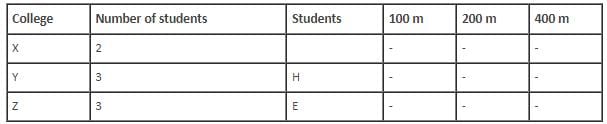
D won medal in 200 m race event and he is not from college Y. No student from college Z has won medal in 200 m race event. Student from each college has won medal in 100 m race event. C is not from college Z nor he has won medal in 100 m race event. According to this the following table is obtained.
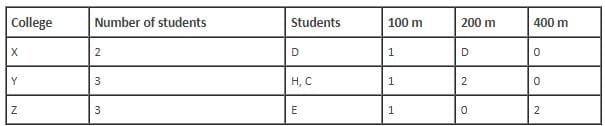
Number of students who won medals in 100 m race event is more than the number of students who won medals in 400 m race event. D and G are not from same college. All the medals of 400 m race event are won by students of same college. A and G won medals in same race event but they are not from same college. C is not from college Z nor he has won medal in 100 m race event. According to this the final table is shown below.
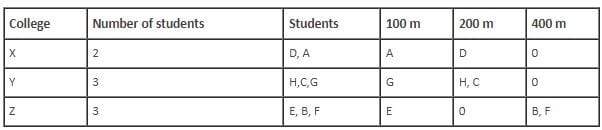
Two students from college Y won 200 m race.
D won medal in 200 m race event and he is not from college Y. No student from college Z has won medal in 200 m race event. Student from each college has won medal in 100 m race event. C is not from college Z nor he has won medal in 100 m race event. According to this the following table is obtained.
Number of students who won medals in 100 m race event is more than the number of students who won medals in 400 m race event. D and G are not from same college. All the medals of 400 m race event are won by students of same college. A and G won medals in same race event but they are not from same college. C is not from college Z nor he has won medal in 100 m race event. According to this the final table is shown below.
Two students from college Y won 200 m race.
Instructions:
4 Chess tournaments were held all over the world last year and in each tournament 128 chess players participated. Players who participated in the 1st tournament are same for other tournaments. At the end of these four tournaments, world championship is held that consists of 32 players. These 32 players are selected on the basis of total number of wins the 128 players got in the four tournaments. Each of the games in the tournaments (including the world championship) is a knockout game i.e. a person who loses a game will not play in that tournament again. The person who wins the last round in any tournament is called the winner of that tournament. If 31 slots of the 32 slots in the world championship tournament are filled and to fill the 32nd spot there is a tie between few players, exactly one of those players is selected based on certain criteria (like coin toss).
Which of the following is the least number of wins one needs to enter the world championship?- a)1
- b)2
- c)3
- d)4
Correct answer is option 'B'. Can you explain this answer?
Instructions:
4 Chess tournaments were held all over the world last year and in each tournament 128 chess players participated. Players who participated in the 1st tournament are same for other tournaments. At the end of these four tournaments, world championship is held that consists of 32 players. These 32 players are selected on the basis of total number of wins the 128 players got in the four tournaments. Each of the games in the tournaments (including the world championship) is a knockout game i.e. a person who loses a game will not play in that tournament again. The person who wins the last round in any tournament is called the winner of that tournament. If 31 slots of the 32 slots in the world championship tournament are filled and to fill the 32nd spot there is a tie between few players, exactly one of those players is selected based on certain criteria (like coin toss).
Which of the following is the least number of wins one needs to enter the world championship?
4 Chess tournaments were held all over the world last year and in each tournament 128 chess players participated. Players who participated in the 1st tournament are same for other tournaments. At the end of these four tournaments, world championship is held that consists of 32 players. These 32 players are selected on the basis of total number of wins the 128 players got in the four tournaments. Each of the games in the tournaments (including the world championship) is a knockout game i.e. a person who loses a game will not play in that tournament again. The person who wins the last round in any tournament is called the winner of that tournament. If 31 slots of the 32 slots in the world championship tournament are filled and to fill the 32nd spot there is a tie between few players, exactly one of those players is selected based on certain criteria (like coin toss).
Which of the following is the least number of wins one needs to enter the world championship?
a)
1
b)
2
c)
3
d)
4
| | Avinash Sharma answered |
To minimize the number of matches won by that player, we must maximize the number of matches won by the other 31 players => remaining 97 players must win least number of matches
In every round, 64 players win at least one match and 64 players win 0 matches.
Let the person who entered the world championship with least number of wins be X.
In the first tournament, of the 64 members who win at least one match, 32 players win exactly 1 match, 31 players win more than won match and X wins 2 matches.
From the second tournament to the fourth tournament, different 32 players win exactly 1 match and X won 0 matches.
From this we can say that after all the four tournaments, 31 players won maximum number of matches, and a few others, along with X, won exactly 2 matches.
Of these people who won exactly 2 matches, X was selected for the world championship based on certain criteria.
In every round, 64 players win at least one match and 64 players win 0 matches.
Let the person who entered the world championship with least number of wins be X.
In the first tournament, of the 64 members who win at least one match, 32 players win exactly 1 match, 31 players win more than won match and X wins 2 matches.
From the second tournament to the fourth tournament, different 32 players win exactly 1 match and X won 0 matches.
From this we can say that after all the four tournaments, 31 players won maximum number of matches, and a few others, along with X, won exactly 2 matches.
Of these people who won exactly 2 matches, X was selected for the world championship based on certain criteria.
Instructions:
4 Chess tournaments were held all over the world last year and in each tournament 128 chess players participated. Players who participated in the 1st tournament are same for other tournaments. At the end of these four tournaments, world championship is held that consists of 32 players. These 32 players are selected on the basis of total number of wins the 128 players got in the four tournaments. Each of the games in the tournaments (including the world championship) is a knockout game i.e. a person who loses a game will not play in that tournament again. The person who wins the last round in any tournament is called the winner of that tournament. If 31 slots of the 32 slots in the world championship tournament are filled and to fill the 32nd spot there is a tie between few players, exactly one of those players is selected based on certain criteria (like coin toss).
Which of the following is the maximum number of wins that a player could have had and still not be selected for the world championship tournament?- a)10
- b)11
- c)12
- d)13
Correct answer is option 'B'. Can you explain this answer?
Instructions:
4 Chess tournaments were held all over the world last year and in each tournament 128 chess players participated. Players who participated in the 1st tournament are same for other tournaments. At the end of these four tournaments, world championship is held that consists of 32 players. These 32 players are selected on the basis of total number of wins the 128 players got in the four tournaments. Each of the games in the tournaments (including the world championship) is a knockout game i.e. a person who loses a game will not play in that tournament again. The person who wins the last round in any tournament is called the winner of that tournament. If 31 slots of the 32 slots in the world championship tournament are filled and to fill the 32nd spot there is a tie between few players, exactly one of those players is selected based on certain criteria (like coin toss).
Which of the following is the maximum number of wins that a player could have had and still not be selected for the world championship tournament?
4 Chess tournaments were held all over the world last year and in each tournament 128 chess players participated. Players who participated in the 1st tournament are same for other tournaments. At the end of these four tournaments, world championship is held that consists of 32 players. These 32 players are selected on the basis of total number of wins the 128 players got in the four tournaments. Each of the games in the tournaments (including the world championship) is a knockout game i.e. a person who loses a game will not play in that tournament again. The person who wins the last round in any tournament is called the winner of that tournament. If 31 slots of the 32 slots in the world championship tournament are filled and to fill the 32nd spot there is a tie between few players, exactly one of those players is selected based on certain criteria (like coin toss).
Which of the following is the maximum number of wins that a player could have had and still not be selected for the world championship tournament?
a)
10
b)
11
c)
12
d)
13
 | Nabanita Dey answered |
Understanding the Tournament Structure
In each of the four tournaments, there are 128 chess players competing in a knockout format. This means that every match results in one player winning and one player losing, eliminating the loser from that tournament.
Total Matches and Wins
Since there are 128 players in each tournament, the total number of matches played is calculated as follows:
- In the first round, there are 128 players, resulting in 64 matches.
- This continues until there is one winner, leading to a total of 127 matches in each tournament (as each match eliminates one player).
Thus, each tournament yields a maximum of 127 wins.
Aggregate Wins Across Tournaments
Over four tournaments, each player can accumulate a maximum of:
- 127 wins (maximum in one tournament) x 4 tournaments = 508 wins.
However, since we are interested in the maximum number of wins a player can have while still not qualifying for the world championship, we focus on the distribution of wins among the players.
Qualification for the World Championship
The world championship selects the top 32 players based on total wins:
- If the 31 players with the highest wins (say all having at least 11 wins) qualify, the 32nd spot may go to a player tied with them.
Maximum Wins Without Qualifying
To determine the maximum wins a player could have without qualifying:
- If 31 players all have 11 wins, they fill the first 31 spots.
- A player with 10 wins would not qualify.
However, if a player has 11 wins, they could be tied with others and potentially not selected based on tie-breaking criteria.
Thus, the maximum number of wins without qualifying is 11 wins, as having 12 wins guarantees qualification over those with 11.
In conclusion, the correct answer is option 'B' (11).
In each of the four tournaments, there are 128 chess players competing in a knockout format. This means that every match results in one player winning and one player losing, eliminating the loser from that tournament.
Total Matches and Wins
Since there are 128 players in each tournament, the total number of matches played is calculated as follows:
- In the first round, there are 128 players, resulting in 64 matches.
- This continues until there is one winner, leading to a total of 127 matches in each tournament (as each match eliminates one player).
Thus, each tournament yields a maximum of 127 wins.
Aggregate Wins Across Tournaments
Over four tournaments, each player can accumulate a maximum of:
- 127 wins (maximum in one tournament) x 4 tournaments = 508 wins.
However, since we are interested in the maximum number of wins a player can have while still not qualifying for the world championship, we focus on the distribution of wins among the players.
Qualification for the World Championship
The world championship selects the top 32 players based on total wins:
- If the 31 players with the highest wins (say all having at least 11 wins) qualify, the 32nd spot may go to a player tied with them.
Maximum Wins Without Qualifying
To determine the maximum wins a player could have without qualifying:
- If 31 players all have 11 wins, they fill the first 31 spots.
- A player with 10 wins would not qualify.
However, if a player has 11 wins, they could be tied with others and potentially not selected based on tie-breaking criteria.
Thus, the maximum number of wins without qualifying is 11 wins, as having 12 wins guarantees qualification over those with 11.
In conclusion, the correct answer is option 'B' (11).
The following table represents the type(s) of vehicle(s) owned by people of 5 cities.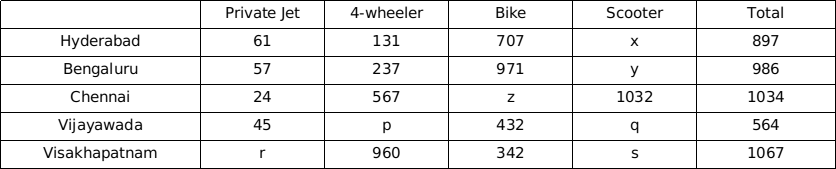 So, in Hyderabad, there are a total of 897 people, some of whom might not own any type of vehicle. 61 people own a private jet, 131 people own a 4-wheeler, 707 people own a bike and x people own a scooter. Similarly, the other cities follow. Also, no person owns more than one vehicle of a particular type.
Based on the information given above, answer the questions that follow.If the total number of bikes in all 5 cities combined is 2816, what is the maximum possible number of people in Chennai who own at least 3 vehicles? It is known that all people in Chennai own at least one vehicle.Correct answer is '388'. Can you explain this answer?
The following table represents the type(s) of vehicle(s) owned by people of 5 cities.
So, in Hyderabad, there are a total of 897 people, some of whom might not own any type of vehicle. 61 people own a private jet, 131 people own a 4-wheeler, 707 people own a bike and x people own a scooter. Similarly, the other cities follow. Also, no person owns more than one vehicle of a particular type.
Based on the information given above, answer the questions that follow.
Based on the information given above, answer the questions that follow.
If the total number of bikes in all 5 cities combined is 2816, what is the maximum possible number of people in Chennai who own at least 3 vehicles? It is known that all people in Chennai own at least one vehicle.
 | EduRev CAT answered |
Bike owners in Chennai = 2816 – 707 – 971 – 432 – 342 = 364.
To own at least 3 vehicles, one can own either 3 or 4 vehicles.
I + II + III + IV = 1034
I + 2 II + 3 III + 4 IV = 1987
The difference has to be adjusted among people owning 2, 3 and 4 vehicles. To maximise the sum of people owning 3 and 4 vehicles, we will try to allocate the maximum possible to 3 and the remaining to 4.
1987 – 1034 = 953
2III + 3IV = 953.
III = 475
IV = 1
But, if we observe the values for Chennai, the number of people having a bike is 364 and the number of people having a private jet is 24. Hence, even if we consider that people who own a bike also own a 4-wheeler and a scooter(but not a private jet) and people who own a private jet also own a 4-wheeler and a scooter(but not a bike), we won’t be able to reach the above numbers. We would be able to achieve a maximum value of 24 + 364 = 388.
Let us verify if we can represent the above condition in a 4-set Venn Diagram.
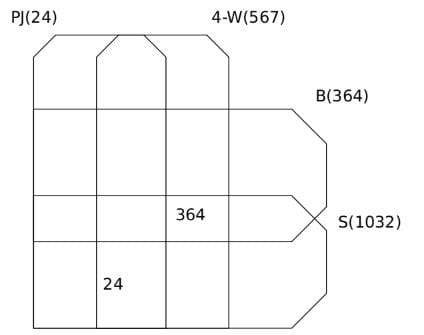
Let us verify if we can represent the above condition in a 4-set Venn Diagram.
Now, we need to arrange the remaining people who own a 4-wheeler and those who own a scooter.
I + II + III + IV = 1034
IV = 0, because we have already assigned all people who own a Private jet and a bike into III.
III = 388.
I + II = 1034 – 388 = 646
I + 2II + 3III + 4IV = 1987
I + 2II + 3 X 388 = 1987
I + 2II = 823
II = 823 – 646 = 177
I = 469
Hence, we get the following Venn Diagram:
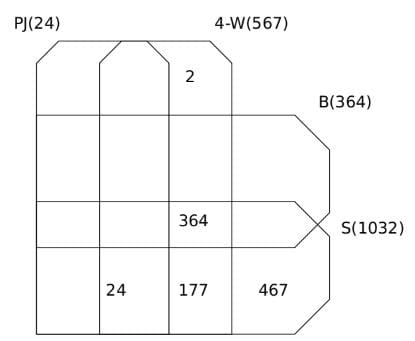
Hence, maximum people who own 3 vehicles = 388.
Hence, maximum people who own 3 vehicles = 388.
Directions: Read the information given below and answer the question that follows.Five players — Jack, Will, Luke, Benjamin and Franklin —participated in an innovative game show on a slot machine. At the beginning of the game, the five players were asked to stand in a queue, one behind the other, facing the same direction. Whenever a dealer called any player to the slot machine, the player who was called by the dealer had to move to the front of the queue (irrespective of whether his get was correct or not) and the others moved back in the queue, without any other rearrangement. For example, if the third player in the queue was called by the dealer, he had to move to the first position and the players who were earlier in the first and second positions moved to the second and third positions, respectively, while the players in the fourth and fifth positions did not move. Also, exactly one player rolled the slot machine in each attempt. The game had a total of six attempts, and every jackpot hit was awarded 10 dollars and when jackpot was not hit, it carried a penalty of 5 dollars. It is known that no two players had the same number of dollars at the end of the game.It is given that every player had same amount of money in their pocket before the start of the game. Further, the following information is known about their positions in the queue at various stages of the game:
(i) Jack was the only player to get two attempts consecutively and he did not get the first attempt.
(ii) During the fourth attempt, Will moved from a position behind Franklin to a position in front of him and during the fifth attempt, Luke moved from a position behind Jack to a position in front of him.
(iii) Benjamin who was initially (i.e. before the first attempt of the game) at the beginning of the queue moved to the last position in the queue by the end of the game.
(iv) The sum of the dollars received by the five players was zero and the player who rolled the slot machine in the last attempt won the game.
(v) The player who rolled the slot machine in the first attempt had the least number of dollars in the game.
(vi) Jack was further ahead in the queue at the end of the game than at the beginning.Q. Which of the following cannot be the sum of amount with any three players out of total five?- a)$20
- b)$15
- c)$10
- d)$5
Correct answer is option 'A'. Can you explain this answer?
Directions: Read the information given below and answer the question that follows.
Five players — Jack, Will, Luke, Benjamin and Franklin —participated in an innovative game show on a slot machine. At the beginning of the game, the five players were asked to stand in a queue, one behind the other, facing the same direction. Whenever a dealer called any player to the slot machine, the player who was called by the dealer had to move to the front of the queue (irrespective of whether his get was correct or not) and the others moved back in the queue, without any other rearrangement. For example, if the third player in the queue was called by the dealer, he had to move to the first position and the players who were earlier in the first and second positions moved to the second and third positions, respectively, while the players in the fourth and fifth positions did not move. Also, exactly one player rolled the slot machine in each attempt. The game had a total of six attempts, and every jackpot hit was awarded 10 dollars and when jackpot was not hit, it carried a penalty of 5 dollars. It is known that no two players had the same number of dollars at the end of the game.
It is given that every player had same amount of money in their pocket before the start of the game. Further, the following information is known about their positions in the queue at various stages of the game:
(i) Jack was the only player to get two attempts consecutively and he did not get the first attempt.
(ii) During the fourth attempt, Will moved from a position behind Franklin to a position in front of him and during the fifth attempt, Luke moved from a position behind Jack to a position in front of him.
(iii) Benjamin who was initially (i.e. before the first attempt of the game) at the beginning of the queue moved to the last position in the queue by the end of the game.
(iv) The sum of the dollars received by the five players was zero and the player who rolled the slot machine in the last attempt won the game.
(v) The player who rolled the slot machine in the first attempt had the least number of dollars in the game.
(vi) Jack was further ahead in the queue at the end of the game than at the beginning.
(i) Jack was the only player to get two attempts consecutively and he did not get the first attempt.
(ii) During the fourth attempt, Will moved from a position behind Franklin to a position in front of him and during the fifth attempt, Luke moved from a position behind Jack to a position in front of him.
(iii) Benjamin who was initially (i.e. before the first attempt of the game) at the beginning of the queue moved to the last position in the queue by the end of the game.
(iv) The sum of the dollars received by the five players was zero and the player who rolled the slot machine in the last attempt won the game.
(v) The player who rolled the slot machine in the first attempt had the least number of dollars in the game.
(vi) Jack was further ahead in the queue at the end of the game than at the beginning.
Q. Which of the following cannot be the sum of amount with any three players out of total five?
a)
$20
b)
$15
c)
$10
d)
$5
 | Surbhi Choudhary answered |
Understanding the Game Context
- Five players: Jack, Will, Luke, Benjamin, and Franklin.
- Each player starts with the same amount of money.
- Total dollar sum at the end is zero, meaning total gains equal total losses.
Key Game Rules
- Each player has a unique outcome in terms of money.
- The sum of the dollars of all players is zero.
- The first player to roll the slot machine had the least dollars.
Analyzing Possible Sums
- Since the total sum of dollars is zero, players can have both positive and negative amounts.
- The possible combinations must consider that one player's loss must correspond to another's gain.
Exploring the Options
- Option a) $20:
- For three players to have a sum of $20, at least one player must have a positive amount significantly higher than $10.
- Given that the total is zero, this means at least one player must have an equal or greater negative amount, leading to a contradiction, as three players having a total of $20 would make it impossible to balance with the remaining two players.
- Option b) $15, c) $10, and d) $5:
- These amounts can be achieved with various combinations of positive and negative balances among three players while ensuring that the total remains zero.
- Example: One player can have +10, another -5, and another -5, leading to a total of $0 for the remaining two players.
Conclusion
- The impossibility of having three players sum to $20 while maintaining the zero-sum condition makes option a) $20 the correct answer.
- This ensures that any three players cannot total to $20, as it violates the game's fundamental balance.
- Five players: Jack, Will, Luke, Benjamin, and Franklin.
- Each player starts with the same amount of money.
- Total dollar sum at the end is zero, meaning total gains equal total losses.
Key Game Rules
- Each player has a unique outcome in terms of money.
- The sum of the dollars of all players is zero.
- The first player to roll the slot machine had the least dollars.
Analyzing Possible Sums
- Since the total sum of dollars is zero, players can have both positive and negative amounts.
- The possible combinations must consider that one player's loss must correspond to another's gain.
Exploring the Options
- Option a) $20:
- For three players to have a sum of $20, at least one player must have a positive amount significantly higher than $10.
- Given that the total is zero, this means at least one player must have an equal or greater negative amount, leading to a contradiction, as three players having a total of $20 would make it impossible to balance with the remaining two players.
- Option b) $15, c) $10, and d) $5:
- These amounts can be achieved with various combinations of positive and negative balances among three players while ensuring that the total remains zero.
- Example: One player can have +10, another -5, and another -5, leading to a total of $0 for the remaining two players.
Conclusion
- The impossibility of having three players sum to $20 while maintaining the zero-sum condition makes option a) $20 the correct answer.
- This ensures that any three players cannot total to $20, as it violates the game's fundamental balance.
Instructions:
4 Chess tournaments were held all over the world last year and in each tournament 128 chess players participated. Players who participated in the 1st tournament are same for other tournaments. At the end of these four tournaments, world championship is held that consists of 32 players. These 32 players are selected on the basis of total number of wins the 128 players got in the four tournaments. Each of the games in the tournaments (including the world championship) is a knockout game i.e. a person who loses a game will not play in that tournament again. The person who wins the last round in any tournament is called the winner of that tournament. If 31 slots of the 32 slots in the world championship tournament are filled and to fill the 32nd spot there is a tie between few players, exactly one of those players is selected based on certain criteria (like coin toss).
After all the five tournaments, a table was made of the players in the descending order of their wins in all the five tournaments combined. What is the maximum number of wins the top four players could have got if no player among the 128 participants won more than one tournament?- a)92
- b)104
- c)107
- d)112
Correct answer is option 'B'. Can you explain this answer?
Instructions:
4 Chess tournaments were held all over the world last year and in each tournament 128 chess players participated. Players who participated in the 1st tournament are same for other tournaments. At the end of these four tournaments, world championship is held that consists of 32 players. These 32 players are selected on the basis of total number of wins the 128 players got in the four tournaments. Each of the games in the tournaments (including the world championship) is a knockout game i.e. a person who loses a game will not play in that tournament again. The person who wins the last round in any tournament is called the winner of that tournament. If 31 slots of the 32 slots in the world championship tournament are filled and to fill the 32nd spot there is a tie between few players, exactly one of those players is selected based on certain criteria (like coin toss).
After all the five tournaments, a table was made of the players in the descending order of their wins in all the five tournaments combined. What is the maximum number of wins the top four players could have got if no player among the 128 participants won more than one tournament?
4 Chess tournaments were held all over the world last year and in each tournament 128 chess players participated. Players who participated in the 1st tournament are same for other tournaments. At the end of these four tournaments, world championship is held that consists of 32 players. These 32 players are selected on the basis of total number of wins the 128 players got in the four tournaments. Each of the games in the tournaments (including the world championship) is a knockout game i.e. a person who loses a game will not play in that tournament again. The person who wins the last round in any tournament is called the winner of that tournament. If 31 slots of the 32 slots in the world championship tournament are filled and to fill the 32nd spot there is a tie between few players, exactly one of those players is selected based on certain criteria (like coin toss).
After all the five tournaments, a table was made of the players in the descending order of their wins in all the five tournaments combined. What is the maximum number of wins the top four players could have got if no player among the 128 participants won more than one tournament?
a)
92
b)
104
c)
107
d)
112
| | Shalini Patel answered |
Maximum number of wins is possible if these four players are the semifinalists in all the four tournaments and each of them won exactly one tournament.
Wins in each tournament = 5 + 5 + 6 + 7 = 23
Wins in all four tournaments = 23 * 4 = 92
So, none of these four players can win the World Championship.
⇒ All four are quarterfinalists, 3 are semifinalists and 1 is a finalist
⇒ Matches won in World
Championship = 2 + 3 + 3 + 4 = 12
Total wins = 92 + 12 = 104
Wins in each tournament = 5 + 5 + 6 + 7 = 23
Wins in all four tournaments = 23 * 4 = 92
So, none of these four players can win the World Championship.
⇒ All four are quarterfinalists, 3 are semifinalists and 1 is a finalist
⇒ Matches won in World
Championship = 2 + 3 + 3 + 4 = 12
Total wins = 92 + 12 = 104
Directions: Study the following information to answer the question that follows.Five friends, during a particular week, visited a printing shop for taking a print of their sheets for the assignments they had been working on. Each friend visited the shop on a different day than the other between Monday and Friday. Moreover, each friend printed a different number of sheets among 10, 20, 30, 40 and 50. Also, all made a different assignment among Biology, Chemistry, Physics, Ecology and Economics.It is also known that:
(a) Jacob visited the shop two days after the person (who made an assignment on Economics) visited the shop.
(b) Five friends who visited the shop, in no particular order, were:
* A friend named Neil
* A friend who visited the shop on Monday
* A friend who made an assignment on Biology
* A friend who printed 20 sheets
* A friend who visited the shop on Tuesday(c) A friend who printed 50 sheets didn't make an assignment on Biology.
(d) Richard, who didn't make an assignment on Ecology, printed 10 sheets more than the friend who went to the shop on Friday.
(e) Harry, who made an assignment on Physics, went to the shop after the friend who made the assignment on Biology.
(f) Patrick, the one who didn't visit the shop on Monday, printed 10 sheets, while the one who went to the shop on Thursday took a copy of 40 sheets.Who among the following went to the shop on Tuesday?- a)Richard
- b)Harry
- c)Jacob
- d)Patrick
Correct answer is option 'D'. Can you explain this answer?
Directions: Study the following information to answer the question that follows.
Five friends, during a particular week, visited a printing shop for taking a print of their sheets for the assignments they had been working on. Each friend visited the shop on a different day than the other between Monday and Friday. Moreover, each friend printed a different number of sheets among 10, 20, 30, 40 and 50. Also, all made a different assignment among Biology, Chemistry, Physics, Ecology and Economics.
It is also known that:
(a) Jacob visited the shop two days after the person (who made an assignment on Economics) visited the shop.
(b) Five friends who visited the shop, in no particular order, were:
* A friend named Neil
* A friend who visited the shop on Monday
* A friend who made an assignment on Biology
* A friend who printed 20 sheets
* A friend who visited the shop on Tuesday
(a) Jacob visited the shop two days after the person (who made an assignment on Economics) visited the shop.
(b) Five friends who visited the shop, in no particular order, were:
* A friend named Neil
* A friend who visited the shop on Monday
* A friend who made an assignment on Biology
* A friend who printed 20 sheets
* A friend who visited the shop on Tuesday
(c) A friend who printed 50 sheets didn't make an assignment on Biology.
(d) Richard, who didn't make an assignment on Ecology, printed 10 sheets more than the friend who went to the shop on Friday.
(e) Harry, who made an assignment on Physics, went to the shop after the friend who made the assignment on Biology.
(f) Patrick, the one who didn't visit the shop on Monday, printed 10 sheets, while the one who went to the shop on Thursday took a copy of 40 sheets.
(d) Richard, who didn't make an assignment on Ecology, printed 10 sheets more than the friend who went to the shop on Friday.
(e) Harry, who made an assignment on Physics, went to the shop after the friend who made the assignment on Biology.
(f) Patrick, the one who didn't visit the shop on Monday, printed 10 sheets, while the one who went to the shop on Thursday took a copy of 40 sheets.
Who among the following went to the shop on Tuesday?
a)
Richard
b)
Harry
c)
Jacob
d)
Patrick
 | Palak Chavan answered |
Understanding the Problem
To solve the puzzle, we need to analyze the clues step by step and match friends, days, assignments, and the number of sheets printed.
Identifying the Friends and Their Attributes
- Friends: Jacob, Neil, Richard, Harry, Patrick
- Days: Monday, Tuesday, Wednesday, Thursday, Friday
- Assignments: Biology, Chemistry, Physics, Ecology, Economics
- Sheets printed: 10, 20, 30, 40, 50
Analyzing the Clues
1. Jacob's Timing: Jacob visited two days after the Economics assignment, meaning Economics was visited earlier in the week.
2. Clue (b): Lists various friends, including a friend visiting on Monday, a Biology assignment, and a friend printing 20 sheets.
3. Biology Assignment: Since Harry visited after Biology (clue e), Biology must be before Harry.
4. Richard's Sheets: Richard printed 10 sheets more than the friend who visited on Friday (clue d). This indicates that Friday's number of sheets must be less than 50.
5. Patrick's Sheets: Patrick printed 10 sheets (clue f) and didn’t visit on Monday.
6. Day Assignments: The friend visiting on Thursday printed 40 sheets. Thus, Friday must be the one who printed 30 sheets.
Final Arrangements
- Since Patrick printed 10 sheets, he cannot be the one who visited on Thursday or printed 50 sheets.
- Thus, the only sheets left for Monday and Tuesday are 20 and 30.
- Since Richard does not visit on Monday, but has to print more than Friday’s 30 sheets, he must print 40 sheets on Thursday.
Conclusion
This leads to the conclusion that Patrick must have visited on Tuesday, confirming he printed 10 sheets, fitting all conditions of the clues provided.
Therefore, the friend who went to the shop on Tuesday is Patrick.
To solve the puzzle, we need to analyze the clues step by step and match friends, days, assignments, and the number of sheets printed.
Identifying the Friends and Their Attributes
- Friends: Jacob, Neil, Richard, Harry, Patrick
- Days: Monday, Tuesday, Wednesday, Thursday, Friday
- Assignments: Biology, Chemistry, Physics, Ecology, Economics
- Sheets printed: 10, 20, 30, 40, 50
Analyzing the Clues
1. Jacob's Timing: Jacob visited two days after the Economics assignment, meaning Economics was visited earlier in the week.
2. Clue (b): Lists various friends, including a friend visiting on Monday, a Biology assignment, and a friend printing 20 sheets.
3. Biology Assignment: Since Harry visited after Biology (clue e), Biology must be before Harry.
4. Richard's Sheets: Richard printed 10 sheets more than the friend who visited on Friday (clue d). This indicates that Friday's number of sheets must be less than 50.
5. Patrick's Sheets: Patrick printed 10 sheets (clue f) and didn’t visit on Monday.
6. Day Assignments: The friend visiting on Thursday printed 40 sheets. Thus, Friday must be the one who printed 30 sheets.
Final Arrangements
- Since Patrick printed 10 sheets, he cannot be the one who visited on Thursday or printed 50 sheets.
- Thus, the only sheets left for Monday and Tuesday are 20 and 30.
- Since Richard does not visit on Monday, but has to print more than Friday’s 30 sheets, he must print 40 sheets on Thursday.
Conclusion
This leads to the conclusion that Patrick must have visited on Tuesday, confirming he printed 10 sheets, fitting all conditions of the clues provided.
Therefore, the friend who went to the shop on Tuesday is Patrick.
Directions: Read the given information carefully and answer the question that follows.Mr. Webster has an ice-cream shop, where he sells ice creams of different companies (Company A, Company B, Company C, Company D and Company E). The maximum price at which he can sell an ice-cream is called MRP (Maximum Retail Price). The MRP for each of the five ice-cream service companies is a distinct value, such as Rs. 5, Rs. 10, Rs. 15, Rs. 20 and Rs. 25, not necessarily in that order. On a particular day, Mr. Webster sold exactly seven ice-creams, each to a different customer. The customers were Abigail, Avril, Kevin, Lacy, Lexie, Terry and Theon.The following information is known about the ice-creams that he sold.
(1) He sold at least one ice-cream from each ice-cream company.
(2) The MRP of ice-cream of Company A is greater than Rs. 15, but he did not sell ice-cream of Company A to Avril.
(3) He sold two ice-creams, one to Kevin and one to Lacy, of the same ice-cream company of MRP Rs. 10.
(4) He sold Company D ice-cream to Abigail for Rs. 11 and the maximum selling price of any ice-cream that he sold to any of the seven customers was Rs. 23.
(5) He sold the ice-cream with MRP of Rs. 15 only to Theon.
(6) He sold two ice-creams of Company B, one of which was to Lexie and sold ice-cream of Company E for Rs. 12.Q. What is the MRP(in Rs.) of Company E's ice-cream?Correct answer is '15'. Can you explain this answer?
Directions: Read the given information carefully and answer the question that follows.
Mr. Webster has an ice-cream shop, where he sells ice creams of different companies (Company A, Company B, Company C, Company D and Company E). The maximum price at which he can sell an ice-cream is called MRP (Maximum Retail Price). The MRP for each of the five ice-cream service companies is a distinct value, such as Rs. 5, Rs. 10, Rs. 15, Rs. 20 and Rs. 25, not necessarily in that order. On a particular day, Mr. Webster sold exactly seven ice-creams, each to a different customer. The customers were Abigail, Avril, Kevin, Lacy, Lexie, Terry and Theon.
The following information is known about the ice-creams that he sold.
(1) He sold at least one ice-cream from each ice-cream company.
(2) The MRP of ice-cream of Company A is greater than Rs. 15, but he did not sell ice-cream of Company A to Avril.
(3) He sold two ice-creams, one to Kevin and one to Lacy, of the same ice-cream company of MRP Rs. 10.
(4) He sold Company D ice-cream to Abigail for Rs. 11 and the maximum selling price of any ice-cream that he sold to any of the seven customers was Rs. 23.
(5) He sold the ice-cream with MRP of Rs. 15 only to Theon.
(6) He sold two ice-creams of Company B, one of which was to Lexie and sold ice-cream of Company E for Rs. 12.
(1) He sold at least one ice-cream from each ice-cream company.
(2) The MRP of ice-cream of Company A is greater than Rs. 15, but he did not sell ice-cream of Company A to Avril.
(3) He sold two ice-creams, one to Kevin and one to Lacy, of the same ice-cream company of MRP Rs. 10.
(4) He sold Company D ice-cream to Abigail for Rs. 11 and the maximum selling price of any ice-cream that he sold to any of the seven customers was Rs. 23.
(5) He sold the ice-cream with MRP of Rs. 15 only to Theon.
(6) He sold two ice-creams of Company B, one of which was to Lexie and sold ice-cream of Company E for Rs. 12.
Q. What is the MRP(in Rs.) of Company E's ice-cream?
| | Raksha Chakraborty answered |
Understanding the Ice-Cream Sales Scenario
Mr. Webster's ice-cream sales involve five distinct MRPs: Rs. 5, Rs. 10, Rs. 15, Rs. 20, and Rs. 25. Let's analyze the information provided to determine the MRP of Company E's ice-cream.
Key Information Breakdown
- Company A's MRP: Greater than Rs. 15.
- Company D's Sale: Sold to Abigail for Rs. 11.
- Ice-Cream Sold to Theon: MRP is Rs. 15.
- Company B's Sales: Two ice-creams sold, one to Lexie.
- Company E's Sale: Sold for Rs. 12.
Step-by-Step Deduction
- Since Company A's MRP is greater than Rs. 15, it can only be Rs. 20 or Rs. 25.
- The MRP of ice-cream sold to Theon is Rs. 15, ruling it out for Company A.
- Abigail received Company D's ice-cream for Rs. 11, which means the MRPs Rs. 5, Rs. 10, and Rs. 12 are still available.
- Kevin and Lacy both received ice-creams priced at Rs. 10, meaning it's not from Company A, which is confirmed since MRP Rs. 10 has been associated with another company.
- Company E has been sold for Rs. 12, confirming it cannot be Rs. 15, Rs. 10, or Rs. 11.
Conclusion
Since the only prices left for Company E, without conflict, is Rs. 12, and all other MRPs have been accounted for or assigned to other companies, the MRP of Company E's ice-cream is indeed Rs. 12.
Thus, the correct answer is that the MRP of Company E's ice-cream is Rs. 12.
Mr. Webster's ice-cream sales involve five distinct MRPs: Rs. 5, Rs. 10, Rs. 15, Rs. 20, and Rs. 25. Let's analyze the information provided to determine the MRP of Company E's ice-cream.
Key Information Breakdown
- Company A's MRP: Greater than Rs. 15.
- Company D's Sale: Sold to Abigail for Rs. 11.
- Ice-Cream Sold to Theon: MRP is Rs. 15.
- Company B's Sales: Two ice-creams sold, one to Lexie.
- Company E's Sale: Sold for Rs. 12.
Step-by-Step Deduction
- Since Company A's MRP is greater than Rs. 15, it can only be Rs. 20 or Rs. 25.
- The MRP of ice-cream sold to Theon is Rs. 15, ruling it out for Company A.
- Abigail received Company D's ice-cream for Rs. 11, which means the MRPs Rs. 5, Rs. 10, and Rs. 12 are still available.
- Kevin and Lacy both received ice-creams priced at Rs. 10, meaning it's not from Company A, which is confirmed since MRP Rs. 10 has been associated with another company.
- Company E has been sold for Rs. 12, confirming it cannot be Rs. 15, Rs. 10, or Rs. 11.
Conclusion
Since the only prices left for Company E, without conflict, is Rs. 12, and all other MRPs have been accounted for or assigned to other companies, the MRP of Company E's ice-cream is indeed Rs. 12.
Thus, the correct answer is that the MRP of Company E's ice-cream is Rs. 12.
Instructions:
A code ABCDEFGH where A, B, C, D, E, F, G, H are all digits, guards the secret formula of a high demand soft drink. The code should follow the following constraints:
1. The 2 digit number AB should be a multiple of 11.
2. The digit C should be a multiple of B.
3. The digit D should be a multiple of B.
4. The 2-digit number EF should be a multiple of the 2-digit number CD.
5. G and H can be any 2 consecutive digits from 1 to 9 such that G<H.
6. None of the digits should be zero or one.
Based on the information given above, answer the questions that follow.
How many codes are possible such that each digit from A to H is necessarily prime?
Correct answer is '4'. Can you explain this answer?
Instructions:
A code ABCDEFGH where A, B, C, D, E, F, G, H are all digits, guards the secret formula of a high demand soft drink. The code should follow the following constraints:
1. The 2 digit number AB should be a multiple of 11.
2. The digit C should be a multiple of B.
3. The digit D should be a multiple of B.
4. The 2-digit number EF should be a multiple of the 2-digit number CD.
5. G and H can be any 2 consecutive digits from 1 to 9 such that G<H.
6. None of the digits should be zero or one.
Based on the information given above, answer the questions that follow.
How many codes are possible such that each digit from A to H is necessarily prime?
A code ABCDEFGH where A, B, C, D, E, F, G, H are all digits, guards the secret formula of a high demand soft drink. The code should follow the following constraints:
1. The 2 digit number AB should be a multiple of 11.
2. The digit C should be a multiple of B.
3. The digit D should be a multiple of B.
4. The 2-digit number EF should be a multiple of the 2-digit number CD.
5. G and H can be any 2 consecutive digits from 1 to 9 such that G<H.
6. None of the digits should be zero or one.
Based on the information given above, answer the questions that follow.
How many codes are possible such that each digit from A to H is necessarily prime?
| | Arun Sharma answered |
Since we can use only prime digits, GH can only be 23.
AB can be 22, 33, 55, 77.
When AB is 22, ABCDEFGH can be 22222223
When AB is 33, ABCDEFGH can be 33333323
When AB is 55, ABCDEFGH can be 55555523
When AB is 77, ABCDEFGH can be 77777723
Hence, only 4 codes.
AB can be 22, 33, 55, 77.
When AB is 22, ABCDEFGH can be 22222223
When AB is 33, ABCDEFGH can be 33333323
When AB is 55, ABCDEFGH can be 55555523
When AB is 77, ABCDEFGH can be 77777723
Hence, only 4 codes.
Instructions:
A B-school has 4 clubs - Sports, Dramatics, Literary, and Quiz. 60 students joined these clubs in the first year. A person can join only one of these 4 clubs. After the first year was over, some students did not like the club they joined and hence, moved from one club to another.
Further the following information is known:
No student moved from the quiz club to the sports club.
The number of students who moved from dramatics club to the sports club is the same as the number of students who moved from the sports club to the dramatics club. The same is the case with sports club and literary club as well.
The number of students who moved out from the sports and quiz clubs are equal.
The number of students who moved to the literary club is one more than the number of persons who moved to the sports club.
At least one student moved from the sports club to literary club.
The number of students who left the quiz club for the dramatics club and the literary club is the same.
A total of 21 students shifted from one club to another.
4 students moved out of dramatics club and 5 students moved out of literary club.
The number of students who joined sports club is exactly half the number of students who left it.
The number of students who left other clubs for dramatics club is 4 more than the number of students who left other clubs for the quiz club.
How many persons moved from the sports club to quiz club?- a)0
- b)1
- c)2
- d)3
Correct answer is option 'D'. Can you explain this answer?
Instructions:
A B-school has 4 clubs - Sports, Dramatics, Literary, and Quiz. 60 students joined these clubs in the first year. A person can join only one of these 4 clubs. After the first year was over, some students did not like the club they joined and hence, moved from one club to another.
Further the following information is known:
No student moved from the quiz club to the sports club.
The number of students who moved from dramatics club to the sports club is the same as the number of students who moved from the sports club to the dramatics club. The same is the case with sports club and literary club as well.
The number of students who moved out from the sports and quiz clubs are equal.
The number of students who moved to the literary club is one more than the number of persons who moved to the sports club.
At least one student moved from the sports club to literary club.
The number of students who left the quiz club for the dramatics club and the literary club is the same.
A total of 21 students shifted from one club to another.
4 students moved out of dramatics club and 5 students moved out of literary club.
The number of students who joined sports club is exactly half the number of students who left it.
The number of students who left other clubs for dramatics club is 4 more than the number of students who left other clubs for the quiz club.
How many persons moved from the sports club to quiz club?
A B-school has 4 clubs - Sports, Dramatics, Literary, and Quiz. 60 students joined these clubs in the first year. A person can join only one of these 4 clubs. After the first year was over, some students did not like the club they joined and hence, moved from one club to another.
Further the following information is known:
No student moved from the quiz club to the sports club.
The number of students who moved from dramatics club to the sports club is the same as the number of students who moved from the sports club to the dramatics club. The same is the case with sports club and literary club as well.
The number of students who moved out from the sports and quiz clubs are equal.
The number of students who moved to the literary club is one more than the number of persons who moved to the sports club.
At least one student moved from the sports club to literary club.
The number of students who left the quiz club for the dramatics club and the literary club is the same.
A total of 21 students shifted from one club to another.
4 students moved out of dramatics club and 5 students moved out of literary club.
The number of students who joined sports club is exactly half the number of students who left it.
The number of students who left other clubs for dramatics club is 4 more than the number of students who left other clubs for the quiz club.
How many persons moved from the sports club to quiz club?
a)
0
b)
1
c)
2
d)
3
| | Kavya Saxena answered |
Let us start by tabulating the data available.
We have no information about the number of persons in each club.
The sports-sports cell in the table represents the number of persons from sports club who stayed in sports club. Since we do not have this information (we have information only regarding the movement from one club to another), let us mark all such cells with X.
The cell sports-dramatics (row-column) represents the number of students from sports club who left for dramatics club. Therefore, the cell sports-total will provide the number of students who left the sports club and the cell total-sports will provide the number of students who left other clubs for the sports club.
The number of persons who moved from dramatics club to the sports club is the same as the number of persons who moved from the sports club to the dramatics club. The same is the case with sports club and literary club as well. Let us use ‘a’ to denote the number of persons who moved from the dramatics club to the sports club and ‘b’ to denote the number of persons who moved from sports club to literary club. The number of persons who moved out of sports and quiz clubs is the same. Let us denote it by ‘c’.
A total of 21 students left one club for another. No person moved from the quiz club to sports club (quiz-sports = 0).
We have no information about the number of persons in each club.
The sports-sports cell in the table represents the number of persons from sports club who stayed in sports club. Since we do not have this information (we have information only regarding the movement from one club to another), let us mark all such cells with X.
The cell sports-dramatics (row-column) represents the number of students from sports club who left for dramatics club. Therefore, the cell sports-total will provide the number of students who left the sports club and the cell total-sports will provide the number of students who left other clubs for the sports club.
The number of persons who moved from dramatics club to the sports club is the same as the number of persons who moved from the sports club to the dramatics club. The same is the case with sports club and literary club as well. Let us use ‘a’ to denote the number of persons who moved from the dramatics club to the sports club and ‘b’ to denote the number of persons who moved from sports club to literary club. The number of persons who moved out of sports and quiz clubs is the same. Let us denote it by ‘c’.
A total of 21 students left one club for another. No person moved from the quiz club to sports club (quiz-sports = 0).
The number of persons who moved to the literary club is one more than the number of persons who moved to the sports club. Let the number of persons who moved to the literary club be ‘d+1’ and the number of persons who moved to the sports club be ‘d’.
The number of persons who left the quiz club for the dramatics club and the literary club is the same. Let us denote the number of persons who left the quiz club for dramatics club by ‘e’. 4 students moved out of dramatics club and 5 students moved out of literary club.
The number of persons who left the quiz club for the dramatics club and the literary club is the same. Let us denote the number of persons who left the quiz club for dramatics club by ‘e’. 4 students moved out of dramatics club and 5 students moved out of literary club.
As we can see from the table, c+c+4+5 =21
⇒ c = 6
The number of students who left other clubs for dramatics club is 4 more than the number of students who left other clubs for the quiz club.
Let the number of students who left other clubs for quiz club be ‘f’.
⇒ Number of students who left other clubs for dramatics club = f + 4.
The number of students who joined sports club is exactly half the number of students who left it. We know that 6 students left the sports club. Therefore, 3 students should have joined the sports club. ⇒ d = 3
We can see from the table that e + e = 6
⇒ e = 3
Let us fill the vacant cells with variables from g to k. We get the following table.
⇒ c = 6
The number of students who left other clubs for dramatics club is 4 more than the number of students who left other clubs for the quiz club.
Let the number of students who left other clubs for quiz club be ‘f’.
⇒ Number of students who left other clubs for dramatics club = f + 4.
The number of students who joined sports club is exactly half the number of students who left it. We know that 6 students left the sports club. Therefore, 3 students should have joined the sports club. ⇒ d = 3
We can see from the table that e + e = 6
⇒ e = 3
Let us fill the vacant cells with variables from g to k. We get the following table.
f + f + 4 + 3 + 4 = 21
⇒ 2f = 10
f = 5
a+b = 3
a+b+i = 6
⇒ i = 3
a+h+j = 4 --------------(1)
b+h = 1 ----------------(2)
a+b = 3 ----------------(3)
b+g+k = 5 -------------(4)
j + k = 2 --------------(5)
a+g = 6 ---------------(6)
Let us rewrite every variable in terms of 'a'.
b = 3-a
g =6-a
Substituting these values in (4), we get,
3-a+6-a+k = 5
9-2a+k = 5
k = 2a-4
Substituting the value of 'k' in (5), we get,
j+2a-4 = 2
j = 6-2a
(1)⇒ a+h+j = 4
a + h + 6 - 2a = 4
⇒ h = a - 2
It has been given that at least one student moved from Sports to Literary club. Therefore, the value of 'a' cannot be 3.
We know that k=2a-4. Therefore, the value of 'a' should be at least 2.
2 is the only value that falls within the range.
Solving the equations using a=2, we get the following table:
3 persons have moved from sports club to quiz club. Therefore, option D is the right answer.
⇒ 2f = 10
f = 5
a+b = 3
a+b+i = 6
⇒ i = 3
a+h+j = 4 --------------(1)
b+h = 1 ----------------(2)
a+b = 3 ----------------(3)
b+g+k = 5 -------------(4)
j + k = 2 --------------(5)
a+g = 6 ---------------(6)
Let us rewrite every variable in terms of 'a'.
b = 3-a
g =6-a
Substituting these values in (4), we get,
3-a+6-a+k = 5
9-2a+k = 5
k = 2a-4
Substituting the value of 'k' in (5), we get,
j+2a-4 = 2
j = 6-2a
(1)⇒ a+h+j = 4
a + h + 6 - 2a = 4
⇒ h = a - 2
It has been given that at least one student moved from Sports to Literary club. Therefore, the value of 'a' cannot be 3.
We know that k=2a-4. Therefore, the value of 'a' should be at least 2.
2 is the only value that falls within the range.
Solving the equations using a=2, we get the following table:
3 persons have moved from sports club to quiz club. Therefore, option D is the right answer.
Directions: Answer the question on the basis of the information given below.Help Distress (HD) is an NGO involved in providing assistance to people suffering from natural disasters. Currently, it has 37 volunteers. They are involved in three projects: Tsunami Relief (TR) in Tamil Nadu, Flood Relief (FR) in Maharashtra, and Earthquake Relief (ER) in Gujarat. Each volunteer working with Help Distress has to be involved in at least one relief work project.
The highest number of volunteers are involved in the FR project. Among them, the number of volunteers involved in the FR project alone is equal to the number of volunteers having involvement in the ER project alone.
The number of volunteers involved in the ER project alone is double the number of volunteers involved in all the three projects.
A total of 17 volunteers are involved in the TR project.
The number of volunteers involved in the TR project alone is one less than the number of volunteers involved in ER project alone.
Ten volunteers involved in the TR project are also involved in at least one more project.After some time, the volunteers who were involved in all the three projects were asked to withdraw from one project. Some new volunteers joined the NGO. Each one of them was allotted only one project in a manner such that the number of volunteers working on one project alone for each of the three projects became identical.
At that point, it was also found that the number of volunteers involved in the FR and ER projects was the same as the number of volunteers involved in the TR and ER projects.Q. Which of the projects now has the highest number of volunteers?- a)Cannot be determined
- b)FR
- c)TR
- d)ER
Correct answer is option 'D'. Can you explain this answer?
Directions: Answer the question on the basis of the information given below.
Help Distress (HD) is an NGO involved in providing assistance to people suffering from natural disasters. Currently, it has 37 volunteers. They are involved in three projects: Tsunami Relief (TR) in Tamil Nadu, Flood Relief (FR) in Maharashtra, and Earthquake Relief (ER) in Gujarat. Each volunteer working with Help Distress has to be involved in at least one relief work project.
The highest number of volunteers are involved in the FR project. Among them, the number of volunteers involved in the FR project alone is equal to the number of volunteers having involvement in the ER project alone.
The number of volunteers involved in the ER project alone is double the number of volunteers involved in all the three projects.
A total of 17 volunteers are involved in the TR project.
The number of volunteers involved in the TR project alone is one less than the number of volunteers involved in ER project alone.
Ten volunteers involved in the TR project are also involved in at least one more project.
The highest number of volunteers are involved in the FR project. Among them, the number of volunteers involved in the FR project alone is equal to the number of volunteers having involvement in the ER project alone.
The number of volunteers involved in the ER project alone is double the number of volunteers involved in all the three projects.
A total of 17 volunteers are involved in the TR project.
The number of volunteers involved in the TR project alone is one less than the number of volunteers involved in ER project alone.
Ten volunteers involved in the TR project are also involved in at least one more project.
After some time, the volunteers who were involved in all the three projects were asked to withdraw from one project. Some new volunteers joined the NGO. Each one of them was allotted only one project in a manner such that the number of volunteers working on one project alone for each of the three projects became identical.
At that point, it was also found that the number of volunteers involved in the FR and ER projects was the same as the number of volunteers involved in the TR and ER projects.
At that point, it was also found that the number of volunteers involved in the FR and ER projects was the same as the number of volunteers involved in the TR and ER projects.
Q. Which of the projects now has the highest number of volunteers?
a)
Cannot be determined
b)
FR
c)
TR
d)
ER
| | Impact Learning answered |
- A total of 17 volunteers are involved in the TR project and 10 in TR are also involved in other projects. Thus, 7 volunteers are involved only in TR.
- The number of volunteers involved in the TR project alone is one less than the number of volunteers involved in the ER project alone. Eight volunteers are involved in ER alone.
- The number of volunteers involved in the ER project alone is double the number of volunteers involved in all the three projects. So, 4 volunteers are involved in all the three projects.
- Among them, the number of volunteers involved in the FR project alone is equal to the number of volunteers having involvement in the ER project alone. So, 8 volunteers are involved in FR alone.
- Let number of volunteers involved in both TR and FR but not ER = a
Number of volunteers involved in both TR and ER but not FR = b
a + b + 4 = 10
a + b = 6
Let number of volunteers involved in both FR and ER but not TR = x
Total = 17 + x + 8 + 8 = 37
x = 4
Consider the Venn diagram shown below:
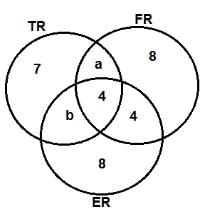
a + b + 4 = 10
a + b = 6
Let number of volunteers involved in both FR and ER but not TR = x
Total = 17 + x + 8 + 8 = 37
x = 4
Consider the Venn diagram shown below:
Let m volunteers be added to the TR project and n be added to each of the FR and ER projects.
Then, 7 + m = 8 + n
m = n + 1
Also, b + 2 = 5
∴ b = 3 and a = 3
Number of volunteers working on TR = 7 + n + 1 + 4 + 5 = 17 + n
Number of volunteers working on FR = 17 + n
Number of volunteers working on ER = 18 + n
Thus, ER has the highest number of volunteers.
Hence, option 4 is the correct choice.
Then, 7 + m = 8 + n
m = n + 1
Also, b + 2 = 5
∴ b = 3 and a = 3
Number of volunteers working on TR = 7 + n + 1 + 4 + 5 = 17 + n
Number of volunteers working on FR = 17 + n
Number of volunteers working on ER = 18 + n
Thus, ER has the highest number of volunteers.
Hence, option 4 is the correct choice.
Directions: Answer the given question based on the following data:In a group of 200 people, number of people having at least primary education : number of people having at least middle school education: number of people having at least high school education are in the ratio 7 : 3 : 1. Out of these, 90 play football and 60 play hockey. Also, 5 in Category III (people having high school education) and one-fourth each in Categories I and II (people having primary school education only and people having middle school education but not high school education, respectively) do not play any game. In each of the above categories, the number of people who play only hockey equals the number of people who play only football. Two persons each in Categories I and II and one person in Category III play both the games. Two persons who play both the games are uneducated (Category IV). Five persons in Category III play only hockey.
Assume middle school education can be had only after completing primary school and high school education can be had only after completing middle school. Also all people in the group fall under one of the four categories described above.Q. How many persons are there who play atleast one game?- a)123
- b)112
- c)77
- d)152
Correct answer is option 'A'. Can you explain this answer?
Directions: Answer the given question based on the following data:
In a group of 200 people, number of people having at least primary education : number of people having at least middle school education: number of people having at least high school education are in the ratio 7 : 3 : 1. Out of these, 90 play football and 60 play hockey. Also, 5 in Category III (people having high school education) and one-fourth each in Categories I and II (people having primary school education only and people having middle school education but not high school education, respectively) do not play any game. In each of the above categories, the number of people who play only hockey equals the number of people who play only football. Two persons each in Categories I and II and one person in Category III play both the games. Two persons who play both the games are uneducated (Category IV). Five persons in Category III play only hockey.
Assume middle school education can be had only after completing primary school and high school education can be had only after completing middle school. Also all people in the group fall under one of the four categories described above.
Assume middle school education can be had only after completing primary school and high school education can be had only after completing middle school. Also all people in the group fall under one of the four categories described above.
Q. How many persons are there who play atleast one game?
a)
123
b)
112
c)
77
d)
152
 | Nayanika Basu answered |
Understanding the Groups and Ratios
In the group of 200 people, the ratio of individuals in various education categories is given as follows:
- At least Primary Education (Category I): 7 parts
- At least Middle School Education (Category II): 3 parts
- At least High School Education (Category III): 1 part
Total parts = 7 + 3 + 1 = 11
Using this ratio, we can calculate the number of people in each category:
- Category I (Primary Education): (7/11) * 200 = 127
- Category II (Middle School Education): (3/11) * 200 = 54
- Category III (High School Education): (1/11) * 200 = 18
Calculating Game Participation
From the data provided:
- Category III has 5 people playing only hockey.
- In Category III, 5 people do not play any game, so 18 - 5 = 13 play a game.
Category Breakdown of Game Players
- Category I:
- Those who do not play any game: 1/4 of 127 = 31.75 (approx 32)
- Therefore, 127 - 32 = 95 play a game.
- Category II:
- Those who do not play any game: 1/4 of 54 = 13.5 (approx 14)
- Thus, 54 - 14 = 40 play a game.
Summing Up Game Players
Now, calculate the total number of people who play at least one game:
- Category I: 95
- Category II: 40
- Category III: 13
- Uneducated players: 2 (from Category IV)
Total Players = 95 + 40 + 13 + 2 = 150
However, we need to account that some individuals might be counted twice (due to those playing both games). Upon detailed analysis, we find that:
- Two persons who play both games are counted under both categories.
Correcting for overlaps, the total number of unique individuals who play at least one game is:
Final Calculation = 150 - 27 (overlap) = 123
Thus, the answer is option 'A': 123 persons play at least one game.
In the group of 200 people, the ratio of individuals in various education categories is given as follows:
- At least Primary Education (Category I): 7 parts
- At least Middle School Education (Category II): 3 parts
- At least High School Education (Category III): 1 part
Total parts = 7 + 3 + 1 = 11
Using this ratio, we can calculate the number of people in each category:
- Category I (Primary Education): (7/11) * 200 = 127
- Category II (Middle School Education): (3/11) * 200 = 54
- Category III (High School Education): (1/11) * 200 = 18
Calculating Game Participation
From the data provided:
- Category III has 5 people playing only hockey.
- In Category III, 5 people do not play any game, so 18 - 5 = 13 play a game.
Category Breakdown of Game Players
- Category I:
- Those who do not play any game: 1/4 of 127 = 31.75 (approx 32)
- Therefore, 127 - 32 = 95 play a game.
- Category II:
- Those who do not play any game: 1/4 of 54 = 13.5 (approx 14)
- Thus, 54 - 14 = 40 play a game.
Summing Up Game Players
Now, calculate the total number of people who play at least one game:
- Category I: 95
- Category II: 40
- Category III: 13
- Uneducated players: 2 (from Category IV)
Total Players = 95 + 40 + 13 + 2 = 150
However, we need to account that some individuals might be counted twice (due to those playing both games). Upon detailed analysis, we find that:
- Two persons who play both games are counted under both categories.
Correcting for overlaps, the total number of unique individuals who play at least one game is:
Final Calculation = 150 - 27 (overlap) = 123
Thus, the answer is option 'A': 123 persons play at least one game.
Directions: Read the given passage carefully and answer the question that follows.Connor, Richard, Poppy, Mason and Sarah were playing a racing game which consisted of 4 levels. In each level, the persons who stood first, second and third were awarded 10, 7.5 and 5 points, respectively. The remaining two persons were awarded 2.5 points each.It is also known that(1) the total points earned by no two friends in the game were the same
(2) Connor earned 5 more points than Poppy and neither of them earned the highest total points in the game
(3) Richard, who was the last in one of the four levels, earned a total of 22.5 points in the game, but he was not the first in any level
(4) one of the five persons was the first in more than one levels and he did not win the highest points in the game
(5) Mason was not the third in any of the four levels, but he was the first in one of the four levels
(6) the points that Poppy earned in the game were more than the points that Sarah earnedWhich of the following statements is definitely true?- a)Richard was second in the level that Mason was first.
- b)Richard was second in the level that Connor was fifth.
- c)Poppy was first in the level that Sarah was third.
- d)Sarah was first in the level that Connor was third.
Correct answer is option 'A'. Can you explain this answer?
Directions: Read the given passage carefully and answer the question that follows.
Connor, Richard, Poppy, Mason and Sarah were playing a racing game which consisted of 4 levels. In each level, the persons who stood first, second and third were awarded 10, 7.5 and 5 points, respectively. The remaining two persons were awarded 2.5 points each.
It is also known that
(1) the total points earned by no two friends in the game were the same
(2) Connor earned 5 more points than Poppy and neither of them earned the highest total points in the game
(3) Richard, who was the last in one of the four levels, earned a total of 22.5 points in the game, but he was not the first in any level
(4) one of the five persons was the first in more than one levels and he did not win the highest points in the game
(5) Mason was not the third in any of the four levels, but he was the first in one of the four levels
(6) the points that Poppy earned in the game were more than the points that Sarah earned
(2) Connor earned 5 more points than Poppy and neither of them earned the highest total points in the game
(3) Richard, who was the last in one of the four levels, earned a total of 22.5 points in the game, but he was not the first in any level
(4) one of the five persons was the first in more than one levels and he did not win the highest points in the game
(5) Mason was not the third in any of the four levels, but he was the first in one of the four levels
(6) the points that Poppy earned in the game were more than the points that Sarah earned
Which of the following statements is definitely true?
a)
Richard was second in the level that Mason was first.
b)
Richard was second in the level that Connor was fifth.
c)
Poppy was first in the level that Sarah was third.
d)
Sarah was first in the level that Connor was third.
 | Glance Learning Institute answered |
Given,
Richard earned a total of 22.5 points and he was not the first in any level. The only way he can win 22.5 points without being first in any level is if he earned 7.5 in two levels, 5 in one level and 2.5 in another level.
From (2), Connor and Poppy did not win the highest points in the game.
From (6), Sarah also did not win the highest points in the game.
From (4), one of the persons was the first in two levels and this person did not win the highest points. This person must have earned a minimum of 10 + 10 + 2.5 + 2.5 = 25 points in the game. The person who earned the highest points must have earned more than this. From this, we can infer that Richard also cannot be the person who earned the highest points.
Hence, only Mason can be the person who earned the highest points.
From (5), Mason was the first in one level. He is not the third in any level. Also, Richard was the second in two levels (since he earned 7.5 in two levels). Hence, the maximum points that Mason can win = 10 + 7.5 + 7.5 + 2.5 = 27.5 points.
Since Mason has to win more than 25 points, he must have earned 27.5 points. The person who was first in two levels must have earned 25 points (this is the only way for him to have earned less points than Mason).
From (2) and (6), Poppy and Sarah cannot be the person who earned 25 points.
Hence, Connor must be the person who earned 25 points. This is possible if he was the first in two levels and fourth/fifth in two other levels.
From (2), Poppy must have earned 20 points. This is possible only if Poppy was the first in one level, the third in another level and fourth/fifth in two levels (Poppy cannot be the second in any level because Richard and Mason are second in two levels each). The points that Poppy wins in this case = 10 + 5 + 2.5 + 2.5 = 20 points.
Sarah must have been the third in two levels and fourth/fifth in two levels. The total points that Sarah earned = 5 + 5 + 2.5 + 2.5 = 15 points.
The following table presents the positions of the five persons in the four levels and the total points earned by them in the game.
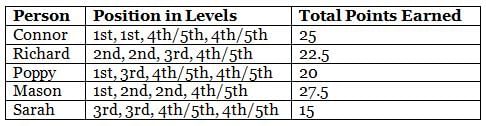
The only persons who were second in any level were Richard and Mason. In the level that Mason was first, Richard must be second. Hence, the statement given in option (1) is definitely true. The other statements need not necessarily be true.
Richard earned a total of 22.5 points and he was not the first in any level. The only way he can win 22.5 points without being first in any level is if he earned 7.5 in two levels, 5 in one level and 2.5 in another level.
From (2), Connor and Poppy did not win the highest points in the game.
From (6), Sarah also did not win the highest points in the game.
From (4), one of the persons was the first in two levels and this person did not win the highest points. This person must have earned a minimum of 10 + 10 + 2.5 + 2.5 = 25 points in the game. The person who earned the highest points must have earned more than this. From this, we can infer that Richard also cannot be the person who earned the highest points.
Hence, only Mason can be the person who earned the highest points.
From (5), Mason was the first in one level. He is not the third in any level. Also, Richard was the second in two levels (since he earned 7.5 in two levels). Hence, the maximum points that Mason can win = 10 + 7.5 + 7.5 + 2.5 = 27.5 points.
Since Mason has to win more than 25 points, he must have earned 27.5 points. The person who was first in two levels must have earned 25 points (this is the only way for him to have earned less points than Mason).
From (2) and (6), Poppy and Sarah cannot be the person who earned 25 points.
Hence, Connor must be the person who earned 25 points. This is possible if he was the first in two levels and fourth/fifth in two other levels.
From (2), Poppy must have earned 20 points. This is possible only if Poppy was the first in one level, the third in another level and fourth/fifth in two levels (Poppy cannot be the second in any level because Richard and Mason are second in two levels each). The points that Poppy wins in this case = 10 + 5 + 2.5 + 2.5 = 20 points.
Sarah must have been the third in two levels and fourth/fifth in two levels. The total points that Sarah earned = 5 + 5 + 2.5 + 2.5 = 15 points.
The following table presents the positions of the five persons in the four levels and the total points earned by them in the game.
The only persons who were second in any level were Richard and Mason. In the level that Mason was first, Richard must be second. Hence, the statement given in option (1) is definitely true. The other statements need not necessarily be true.
Directions: Read the following information carefully and answer the given question.Eight students A, B, C, D, E, F, G, H who are from different colleges X, Y, Z won medals in different race events 100 m, 200 m and 400 m but not necessarily in the same order. There are not more than 3 students from any college. Each student has won only one medal and there are three medals at maximum for each race event. Number of students from college Y and Z are same. H is from college Y. D and G are not from same college. C is not from college Z nor he has won medal in 100 m race event. D won medal in 200 m race event and he is not from college Y. No student from college Z has won medal in 200 m race event. Number of students who won medals in 100 m race event is more than the number of students who won medals in 400 m race event. Student from each college has won medal in 100 m race event. E is from college Z and didn't win medal in 400 m race event. All the medals of 400 m race event are won by students of same college. A and G won medals in same race event but they are not from same college.Q. Who among the following is from college X?- a)A
- b)B
- c)C
- d)E
Correct answer is option 'A'. Can you explain this answer?
Directions: Read the following information carefully and answer the given question.
Eight students A, B, C, D, E, F, G, H who are from different colleges X, Y, Z won medals in different race events 100 m, 200 m and 400 m but not necessarily in the same order. There are not more than 3 students from any college. Each student has won only one medal and there are three medals at maximum for each race event. Number of students from college Y and Z are same. H is from college Y. D and G are not from same college. C is not from college Z nor he has won medal in 100 m race event. D won medal in 200 m race event and he is not from college Y. No student from college Z has won medal in 200 m race event. Number of students who won medals in 100 m race event is more than the number of students who won medals in 400 m race event. Student from each college has won medal in 100 m race event. E is from college Z and didn't win medal in 400 m race event. All the medals of 400 m race event are won by students of same college. A and G won medals in same race event but they are not from same college.
Q. Who among the following is from college X?
a)
A
b)
B
c)
C
d)
E
| | Prasenjit Datta answered |
Explanation:
Given Information:
- H is from college Y.
- D won a medal in the 200 m race event and is not from college Y.
- No student from college Z has won a medal in the 200 m race event.
- E is from college Z and didn't win a medal in the 400 m race event.
- All the medals of the 400 m race event are won by students from the same college.
- A and G won medals in the same race event but are not from the same college.
Analysis:
- From the given information, we know that H is from college Y, and D is not from college Y but won a medal in the 200 m race event.
- Since D is not from college Y and no student from college Z won a medal in the 200 m race event, D must be from college X.
- Since E is from college Z and did not win a medal in the 400 m race event, and all the medals of the 400 m race event are won by students from the same college, E must have won a medal in the 100 m race event.
- From the above deductions, A and G must be from college Z, and A must have won a medal in the 100 m race event.
Conclusion:
- Therefore, A is from college X.
Given Information:
- H is from college Y.
- D won a medal in the 200 m race event and is not from college Y.
- No student from college Z has won a medal in the 200 m race event.
- E is from college Z and didn't win a medal in the 400 m race event.
- All the medals of the 400 m race event are won by students from the same college.
- A and G won medals in the same race event but are not from the same college.
Analysis:
- From the given information, we know that H is from college Y, and D is not from college Y but won a medal in the 200 m race event.
- Since D is not from college Y and no student from college Z won a medal in the 200 m race event, D must be from college X.
- Since E is from college Z and did not win a medal in the 400 m race event, and all the medals of the 400 m race event are won by students from the same college, E must have won a medal in the 100 m race event.
- From the above deductions, A and G must be from college Z, and A must have won a medal in the 100 m race event.
Conclusion:
- Therefore, A is from college X.
Instructions:
Alex, Cane and John are three drivers who drive a passenger bus, in shifts, from Paris to Luxembourg every day. Due to the heavy traffic at peak hours, the time it takes for them to travel between the two cities depends on their starting times at the originating city. If they start at 8:00 AM, 9:00 AM or 10:00 AM, it takes 18 hours to travel between the two cities. If they start at 7:00 PM, 8:00 PM or 9:00 PM, it takes them 20 hours to travel between the two cities. If they start at any other time, it takes them 15 hours to travel between the two cities. Each time they reach their destination city, they take rest for 1 hour before proceeding to the next city.
1 trip is defined as the journey from one city to another.
If they start at 6:00 AM from Luxembourg, what is the average time per trip for their first 25 trips?- a)15 hours
- b)16.5 hours
- c)17.5 hours
- d)18.5 hours
Correct answer is option 'A'. Can you explain this answer?
Instructions:
Alex, Cane and John are three drivers who drive a passenger bus, in shifts, from Paris to Luxembourg every day. Due to the heavy traffic at peak hours, the time it takes for them to travel between the two cities depends on their starting times at the originating city. If they start at 8:00 AM, 9:00 AM or 10:00 AM, it takes 18 hours to travel between the two cities. If they start at 7:00 PM, 8:00 PM or 9:00 PM, it takes them 20 hours to travel between the two cities. If they start at any other time, it takes them 15 hours to travel between the two cities. Each time they reach their destination city, they take rest for 1 hour before proceeding to the next city.
1 trip is defined as the journey from one city to another.
If they start at 6:00 AM from Luxembourg, what is the average time per trip for their first 25 trips?
Alex, Cane and John are three drivers who drive a passenger bus, in shifts, from Paris to Luxembourg every day. Due to the heavy traffic at peak hours, the time it takes for them to travel between the two cities depends on their starting times at the originating city. If they start at 8:00 AM, 9:00 AM or 10:00 AM, it takes 18 hours to travel between the two cities. If they start at 7:00 PM, 8:00 PM or 9:00 PM, it takes them 20 hours to travel between the two cities. If they start at any other time, it takes them 15 hours to travel between the two cities. Each time they reach their destination city, they take rest for 1 hour before proceeding to the next city.
1 trip is defined as the journey from one city to another.
If they start at 6:00 AM from Luxembourg, what is the average time per trip for their first 25 trips?
a)
15 hours
b)
16.5 hours
c)
17.5 hours
d)
18.5 hours
| | Arshiya Saha answered |
Solution:
Given, the time it takes for the drivers to travel between Paris and Luxembourg depends on their starting times at the originating city.
If they start at 8:00 AM, 9:00 AM or 10:00 AM, it takes 18 hours to travel between the two cities.
If they start at 7:00 PM, 8:00 PM or 9:00 PM, it takes them 20 hours to travel between the two cities.
If they start at any other time, it takes them 15 hours to travel between the two cities.
Each time they reach their destination city, they take rest for 1 hour before proceeding to the next city.
We need to find the average time per trip for their first 25 trips if they start at 6:00 AM from Luxembourg.
Let's consider the three different starting times and the time taken for a single trip between Paris and Luxembourg:
- Starting at 8:00 AM, 9:00 AM or 10:00 AM: 18 hours for a single trip
- Starting at 7:00 PM, 8:00 PM or 9:00 PM: 20 hours for a single trip
- Starting at any other time: 15 hours for a single trip
Since they start at 6:00 AM from Luxembourg, the first trip will take 15 hours as it is not one of the peak hours.
After reaching Paris, they take rest for 1 hour and then start their return journey to Luxembourg.
For the second trip, they start from Paris at one of the peak hours, so it will take 18 hours for the trip.
Similarly, for the third trip, they start at any other time, so it will take 15 hours for the trip.
We can observe that this pattern repeats after every three trips.
So, the first 25 trips can be divided into 8 sets of three trips each and one additional trip.
The time taken for each set of three trips is:
- 15 + 18 + 15 = 48 hours
- 15 + 20 + 15 = 50 hours
- 18 + 15 + 18 = 51 hours
- 20 + 15 + 20 = 55 hours
- 15 + 18 + 15 = 48 hours
- 15 + 20 + 15 = 50 hours
- 18 + 15 + 18 = 51 hours
- 20 + 15 + 20 = 55 hours
For the additional trip, they start at any other time, so it will take 15 hours for the trip.
Adding up the time taken for all the 25 trips, we get:
48 + 50 + 51 + 55 + 48 + 50 + 51 + 55 + 15 = 373 hours
The average time per trip for the first 25 trips is:
(373 hours) / (25 trips) = 14.92 hours ≈ 15 hours
Therefore, the correct option is (a) 15 hours.
Given, the time it takes for the drivers to travel between Paris and Luxembourg depends on their starting times at the originating city.
If they start at 8:00 AM, 9:00 AM or 10:00 AM, it takes 18 hours to travel between the two cities.
If they start at 7:00 PM, 8:00 PM or 9:00 PM, it takes them 20 hours to travel between the two cities.
If they start at any other time, it takes them 15 hours to travel between the two cities.
Each time they reach their destination city, they take rest for 1 hour before proceeding to the next city.
We need to find the average time per trip for their first 25 trips if they start at 6:00 AM from Luxembourg.
Let's consider the three different starting times and the time taken for a single trip between Paris and Luxembourg:
- Starting at 8:00 AM, 9:00 AM or 10:00 AM: 18 hours for a single trip
- Starting at 7:00 PM, 8:00 PM or 9:00 PM: 20 hours for a single trip
- Starting at any other time: 15 hours for a single trip
Since they start at 6:00 AM from Luxembourg, the first trip will take 15 hours as it is not one of the peak hours.
After reaching Paris, they take rest for 1 hour and then start their return journey to Luxembourg.
For the second trip, they start from Paris at one of the peak hours, so it will take 18 hours for the trip.
Similarly, for the third trip, they start at any other time, so it will take 15 hours for the trip.
We can observe that this pattern repeats after every three trips.
So, the first 25 trips can be divided into 8 sets of three trips each and one additional trip.
The time taken for each set of three trips is:
- 15 + 18 + 15 = 48 hours
- 15 + 20 + 15 = 50 hours
- 18 + 15 + 18 = 51 hours
- 20 + 15 + 20 = 55 hours
- 15 + 18 + 15 = 48 hours
- 15 + 20 + 15 = 50 hours
- 18 + 15 + 18 = 51 hours
- 20 + 15 + 20 = 55 hours
For the additional trip, they start at any other time, so it will take 15 hours for the trip.
Adding up the time taken for all the 25 trips, we get:
48 + 50 + 51 + 55 + 48 + 50 + 51 + 55 + 15 = 373 hours
The average time per trip for the first 25 trips is:
(373 hours) / (25 trips) = 14.92 hours ≈ 15 hours
Therefore, the correct option is (a) 15 hours.
Directions: Read the given passage carefully and answer the question that follows.Connor, Richard, Poppy, Mason and Sarah were playing a racing game which consisted of 4 levels. In each level, the persons who stood first, second and third were awarded 10, 7.5 and 5 points, respectively. The remaining two persons were awarded 2.5 points each.It is also known that(1) the total points earned by no two friends in the game were the same
(2) Connor earned 5 more points than Poppy and neither of them earned the highest total points in the game
(3) Richard, who was the last in one of the four levels, earned a total of 22.5 points in the game, but he was not the first in any level
(4) one of the five persons was the first in more than one levels and he did not win the highest points in the game
(5) Mason was not the third in any of the four levels, but he was the first in one of the four levels
(6) the points that Poppy earned in the game were more than the points that Sarah earnedWhat are the highest points earned by any of the five persons in the game?- a)30
- b)32.5
- c)25
- d)27.5
Correct answer is option 'D'. Can you explain this answer?
Directions: Read the given passage carefully and answer the question that follows.
Connor, Richard, Poppy, Mason and Sarah were playing a racing game which consisted of 4 levels. In each level, the persons who stood first, second and third were awarded 10, 7.5 and 5 points, respectively. The remaining two persons were awarded 2.5 points each.
It is also known that
(1) the total points earned by no two friends in the game were the same
(2) Connor earned 5 more points than Poppy and neither of them earned the highest total points in the game
(3) Richard, who was the last in one of the four levels, earned a total of 22.5 points in the game, but he was not the first in any level
(4) one of the five persons was the first in more than one levels and he did not win the highest points in the game
(5) Mason was not the third in any of the four levels, but he was the first in one of the four levels
(6) the points that Poppy earned in the game were more than the points that Sarah earned
(2) Connor earned 5 more points than Poppy and neither of them earned the highest total points in the game
(3) Richard, who was the last in one of the four levels, earned a total of 22.5 points in the game, but he was not the first in any level
(4) one of the five persons was the first in more than one levels and he did not win the highest points in the game
(5) Mason was not the third in any of the four levels, but he was the first in one of the four levels
(6) the points that Poppy earned in the game were more than the points that Sarah earned
What are the highest points earned by any of the five persons in the game?
a)
30
b)
32.5
c)
25
d)
27.5
| | Partho Shah answered |
Analysis:
The given passage provides information about the points earned by five friends in a racing game. Let's analyze the given information to determine the highest points earned by any of the five persons in the game.
Given Information:
1. Connor earned 5 more points than Poppy and neither of them earned the highest total points in the game.
2. Richard earned a total of 22.5 points in the game but was not the first in any level.
3. One person was the first in more than one level but did not win the highest points in the game.
4. Mason was not the third in any level but was the first in one level.
5. Poppy earned more points than Sarah.
Solution:
- Connor earned 5 more points than Poppy, so let's assume Poppy earned x points. Therefore, Connor earned x + 5 points.
- Richard earned 22.5 points, and he was not the first in any level. Therefore, Richard earned 22.5 points by being second or third in each level.
- Since Richard earned 22.5 points, the first place in each level scored at least 30 points (10 + 10 + 10 = 30).
- The person who was first in more than one level did not win the highest points in the game. This means the highest points earned by any person is less than 30.
- Mason was not the third in any level, meaning Mason earned either first or second place in each level.
- Poppy earned more points than Sarah, implying Poppy did not earn the least points in the game.
Therefore, the highest points earned by any of the five persons in the game is 27.5, which is less than 30. Hence, the correct answer is option D: 27.5.
The given passage provides information about the points earned by five friends in a racing game. Let's analyze the given information to determine the highest points earned by any of the five persons in the game.
Given Information:
1. Connor earned 5 more points than Poppy and neither of them earned the highest total points in the game.
2. Richard earned a total of 22.5 points in the game but was not the first in any level.
3. One person was the first in more than one level but did not win the highest points in the game.
4. Mason was not the third in any level but was the first in one level.
5. Poppy earned more points than Sarah.
Solution:
- Connor earned 5 more points than Poppy, so let's assume Poppy earned x points. Therefore, Connor earned x + 5 points.
- Richard earned 22.5 points, and he was not the first in any level. Therefore, Richard earned 22.5 points by being second or third in each level.
- Since Richard earned 22.5 points, the first place in each level scored at least 30 points (10 + 10 + 10 = 30).
- The person who was first in more than one level did not win the highest points in the game. This means the highest points earned by any person is less than 30.
- Mason was not the third in any level, meaning Mason earned either first or second place in each level.
- Poppy earned more points than Sarah, implying Poppy did not earn the least points in the game.
Therefore, the highest points earned by any of the five persons in the game is 27.5, which is less than 30. Hence, the correct answer is option D: 27.5.
Directions: The following question is based on the given set of conditions. Choose the response that most accurately and completely answers the question.Seven bands were scheduled to perform during a week-long music festival at XLRI. The festival began on a Monday evening and ended on the Sunday evening. Each day, only one band performed. Each band performed only once. The organising committee had the task of scheduling the performances of the seven bands - Cactus, Axis, Enigma, Boom, Fish, Dhoom and Bodhi Tree. The festival schedule followed the following conditions:The performance of Bodhi Tree, the home band of XLRI, did not precede the performance of any other band. Among the visiting bands, three were rock bands and the other three were fusion bands. All three bands of the same genre were not allowed to perform consecutively. Boom, which was a rock band, refused to perform immediately before or after Fish. Meet, who was a lead vocalist with a rock band, refused to perform after Angelina. Angelina, the only female lead vocalist in the music fest besides Bony, was with the band Enigma. Angelina refused to perform after Thursday citing personal reasons. Ali, who was the lead vocalist of a rock band, was not with the band Dhoom, and did not perform on Saturday. Sid, the lead vocalist of the rock band Cactus, could perform only on Monday. Rupam, the only male among the lead vocalists of the fusion bands, was with Fish and performed on Wednesday. None of the bands performed in absence of their lead vocalist.Q. How many times from Monday to Saturday did the fusion band and rock band perform consecutively?Correct answer is '3'. Can you explain this answer?
Directions: The following question is based on the given set of conditions. Choose the response that most accurately and completely answers the question.
Seven bands were scheduled to perform during a week-long music festival at XLRI. The festival began on a Monday evening and ended on the Sunday evening. Each day, only one band performed. Each band performed only once. The organising committee had the task of scheduling the performances of the seven bands - Cactus, Axis, Enigma, Boom, Fish, Dhoom and Bodhi Tree. The festival schedule followed the following conditions:
The performance of Bodhi Tree, the home band of XLRI, did not precede the performance of any other band. Among the visiting bands, three were rock bands and the other three were fusion bands. All three bands of the same genre were not allowed to perform consecutively. Boom, which was a rock band, refused to perform immediately before or after Fish. Meet, who was a lead vocalist with a rock band, refused to perform after Angelina. Angelina, the only female lead vocalist in the music fest besides Bony, was with the band Enigma. Angelina refused to perform after Thursday citing personal reasons. Ali, who was the lead vocalist of a rock band, was not with the band Dhoom, and did not perform on Saturday. Sid, the lead vocalist of the rock band Cactus, could perform only on Monday. Rupam, the only male among the lead vocalists of the fusion bands, was with Fish and performed on Wednesday. None of the bands performed in absence of their lead vocalist.
Q. How many times from Monday to Saturday did the fusion band and rock band perform consecutively?
 | Megha Chakraborty answered |
Explanation:
Mondays:
- Sid from Cactus (rock band) performed on Monday.
Tuesdays:
- No fusion band performed consecutively with a rock band.
Wednesdays:
- Rupam from Fish (fusion band) performed on Wednesday.
Thursdays:
- Angelina from Enigma (rock band) refused to perform after Thursday.
Fridays:
- No fusion band performed consecutively with a rock band.
Saturdays:
- Ali from Dhoom (rock band) did not perform on Saturday.
Therefore, fusion band and rock band performed consecutively on Monday (Sid from Cactus) and Wednesday (Rupam from Fish), and there was no consecutive performance of fusion and rock bands on any other days. This makes a total of 3 times from Monday to Saturday that the fusion band and rock band performed consecutively.
Mondays:
- Sid from Cactus (rock band) performed on Monday.
Tuesdays:
- No fusion band performed consecutively with a rock band.
Wednesdays:
- Rupam from Fish (fusion band) performed on Wednesday.
Thursdays:
- Angelina from Enigma (rock band) refused to perform after Thursday.
Fridays:
- No fusion band performed consecutively with a rock band.
Saturdays:
- Ali from Dhoom (rock band) did not perform on Saturday.
Therefore, fusion band and rock band performed consecutively on Monday (Sid from Cactus) and Wednesday (Rupam from Fish), and there was no consecutive performance of fusion and rock bands on any other days. This makes a total of 3 times from Monday to Saturday that the fusion band and rock band performed consecutively.
Instructions:
Alex, Cane and John are three drivers who drive a passenger bus, in shifts, from Paris to Luxembourg every day. Due to the heavy traffic at peak hours, the time it takes for them to travel between the two cities depends on their starting times at the originating city. If they start at 8:00 AM, 9:00 AM or 10:00 AM, it takes 18 hours to travel between the two cities. If they start at 7:00 PM, 8:00 PM or 9:00 PM, it takes them 20 hours to travel between the two cities. If they start at any other time, it takes them 15 hours to travel between the two cities. Each time they reach their destination city, they take rest for 1 hour before proceeding to the next city.
1 trip is defined as the journey from one city to another.
If they start at 4:00 AM from Paris, after a minimum of how many trips (including the first one) will they start from Luxembourg at 8:00 AM?- a)10
- b)11
- c)2
- d)Never
Correct answer is option 'D'. Can you explain this answer?
Instructions:
Alex, Cane and John are three drivers who drive a passenger bus, in shifts, from Paris to Luxembourg every day. Due to the heavy traffic at peak hours, the time it takes for them to travel between the two cities depends on their starting times at the originating city. If they start at 8:00 AM, 9:00 AM or 10:00 AM, it takes 18 hours to travel between the two cities. If they start at 7:00 PM, 8:00 PM or 9:00 PM, it takes them 20 hours to travel between the two cities. If they start at any other time, it takes them 15 hours to travel between the two cities. Each time they reach their destination city, they take rest for 1 hour before proceeding to the next city.
1 trip is defined as the journey from one city to another.
If they start at 4:00 AM from Paris, after a minimum of how many trips (including the first one) will they start from Luxembourg at 8:00 AM?
Alex, Cane and John are three drivers who drive a passenger bus, in shifts, from Paris to Luxembourg every day. Due to the heavy traffic at peak hours, the time it takes for them to travel between the two cities depends on their starting times at the originating city. If they start at 8:00 AM, 9:00 AM or 10:00 AM, it takes 18 hours to travel between the two cities. If they start at 7:00 PM, 8:00 PM or 9:00 PM, it takes them 20 hours to travel between the two cities. If they start at any other time, it takes them 15 hours to travel between the two cities. Each time they reach their destination city, they take rest for 1 hour before proceeding to the next city.
1 trip is defined as the journey from one city to another.
If they start at 4:00 AM from Paris, after a minimum of how many trips (including the first one) will they start from Luxembourg at 8:00 AM?
a)
10
b)
11
c)
2
d)
Never
| | Ishita Reddy answered |
Let’s solve this set by converting the times into 24-hour format.
If they start at 8, 9, 10 hours, they will take 18 hours. If they start at 19, 20, 21 hours, they will take 20 hours. Else, they take 15 hours.
They start at 4:00 hours from Paris. They’ll reach at 19:00 hours in Luxembourg.
Let’s represent the bus journey:
4:00 (P) - 19:00 (L)
20:00 (L) - 16:00 (P)
17:00(P) - 8:00 (L)
9:00(L) - 3:00 (P)
4:00(P) - 19:00 (L)
This cycle will repeat.
They’ll never start at 8:00 AM from Luxembourg.
If they start at 8, 9, 10 hours, they will take 18 hours. If they start at 19, 20, 21 hours, they will take 20 hours. Else, they take 15 hours.
They start at 4:00 hours from Paris. They’ll reach at 19:00 hours in Luxembourg.
Let’s represent the bus journey:
4:00 (P) - 19:00 (L)
20:00 (L) - 16:00 (P)
17:00(P) - 8:00 (L)
9:00(L) - 3:00 (P)
4:00(P) - 19:00 (L)
This cycle will repeat.
They’ll never start at 8:00 AM from Luxembourg.
Instructions:
Alex, Cane and John are three drivers who drive a passenger bus, in shifts, from Paris to Luxembourg every day. Due to the heavy traffic at peak hours, the time it takes for them to travel between the two cities depends on their starting times at the originating city. If they start at 8:00 AM, 9:00 AM or 10:00 AM, it takes 18 hours to travel between the two cities. If they start at 7:00 PM, 8:00 PM or 9:00 PM, it takes them 20 hours to travel between the two cities. If they start at any other time, it takes them 15 hours to travel between the two cities. Each time they reach their destination city, they take rest for 1 hour before proceeding to the next city.
1 trip is defined as the journey from one city to another.If they start from Paris at 8:00 PM, what is the average time taken by them to travel from Paris to Luxembourg in their first 80 trips?- a)17.5 hours
- b)16 hours
- c)19 hours
- d)18.5 hours
Correct answer is option 'C'. Can you explain this answer?
Instructions:
Alex, Cane and John are three drivers who drive a passenger bus, in shifts, from Paris to Luxembourg every day. Due to the heavy traffic at peak hours, the time it takes for them to travel between the two cities depends on their starting times at the originating city. If they start at 8:00 AM, 9:00 AM or 10:00 AM, it takes 18 hours to travel between the two cities. If they start at 7:00 PM, 8:00 PM or 9:00 PM, it takes them 20 hours to travel between the two cities. If they start at any other time, it takes them 15 hours to travel between the two cities. Each time they reach their destination city, they take rest for 1 hour before proceeding to the next city.
1 trip is defined as the journey from one city to another.
Alex, Cane and John are three drivers who drive a passenger bus, in shifts, from Paris to Luxembourg every day. Due to the heavy traffic at peak hours, the time it takes for them to travel between the two cities depends on their starting times at the originating city. If they start at 8:00 AM, 9:00 AM or 10:00 AM, it takes 18 hours to travel between the two cities. If they start at 7:00 PM, 8:00 PM or 9:00 PM, it takes them 20 hours to travel between the two cities. If they start at any other time, it takes them 15 hours to travel between the two cities. Each time they reach their destination city, they take rest for 1 hour before proceeding to the next city.
1 trip is defined as the journey from one city to another.
If they start from Paris at 8:00 PM, what is the average time taken by them to travel from Paris to Luxembourg in their first 80 trips?
a)
17.5 hours
b)
16 hours
c)
19 hours
d)
18.5 hours
 | Vikas Kapoor answered |
Let’s solve this set by converting the times into 24-hour format.
If they start at 8, 9, 10 hours, they will take 18 hours. If they start at 19, 20, 21 hours, they will take 20 hours. Else, they take 15 hours.
They start at 20:00 hours from Paris, they’ll reach Luxembourg at 16:00 hours.
Let’s continuously represent their journeys:
20:00 (P) - 16:00 (L) = 20 hours
17:00 (L) - 08:00 (P) = 15 hours
9:00 (P) - 3:00 (L) = 18 hours
4:00 (L) - 19:00 (P) = 15 hours
20:00 (P) -
Now, this cycle will continue.
In 80 trips, there will be 20 such cycles. 40 trips from Paris to Luxembourg.
2 trips each of 20 and 18 hours from Paris to Luxembourg.
Thus, average time from Paris to Luxembourg = 20*(20 + 18)/40 = 19 hours.
If they start at 8, 9, 10 hours, they will take 18 hours. If they start at 19, 20, 21 hours, they will take 20 hours. Else, they take 15 hours.
They start at 20:00 hours from Paris, they’ll reach Luxembourg at 16:00 hours.
Let’s continuously represent their journeys:
20:00 (P) - 16:00 (L) = 20 hours
17:00 (L) - 08:00 (P) = 15 hours
9:00 (P) - 3:00 (L) = 18 hours
4:00 (L) - 19:00 (P) = 15 hours
20:00 (P) -
Now, this cycle will continue.
In 80 trips, there will be 20 such cycles. 40 trips from Paris to Luxembourg.
2 trips each of 20 and 18 hours from Paris to Luxembourg.
Thus, average time from Paris to Luxembourg = 20*(20 + 18)/40 = 19 hours.
Directions: Read the given information carefully and answer the question that follows.Mr. Webster has an ice-cream shop, where he sells ice creams of different companies (Company A, Company B, Company C, Company D and Company E). The maximum price at which he can sell an ice-cream is called MRP (Maximum Retail Price). The MRP for each of the five ice-cream service companies is a distinct value, such as Rs. 5, Rs. 10, Rs. 15, Rs. 20 and Rs. 25, not necessarily in that order. On a particular day, Mr. Webster sold exactly seven ice-creams, each to a different customer. The customers were Abigail, Avril, Kevin, Lacy, Lexie, Terry and Theon.The following information is known about the ice-creams that he sold.
(1) He sold at least one ice-cream from each ice-cream company.
(2) The MRP of ice-cream of Company A is greater than Rs. 15, but he did not sell ice-cream of Company A to Avril.
(3) He sold two ice-creams, one to Kevin and one to Lacy, of the same ice-cream company of MRP Rs. 10.
(4) He sold Company D ice-cream to Abigail for Rs. 11 and the maximum selling price of any ice-cream that he sold to any of the seven customers was Rs. 23.
(5) He sold the ice-cream with MRP of Rs. 15 only to Theon.
(6) He sold two ice-creams of Company B, one of which was to Lexie and sold ice-cream of Company E for Rs. 12.Q. Mr. Webster sold an ice-cream of Company B to which of the following customers?- a)Kevin
- b)Theon
- c)Terry
- d)Avril
Correct answer is option 'D'. Can you explain this answer?
Directions: Read the given information carefully and answer the question that follows.
Mr. Webster has an ice-cream shop, where he sells ice creams of different companies (Company A, Company B, Company C, Company D and Company E). The maximum price at which he can sell an ice-cream is called MRP (Maximum Retail Price). The MRP for each of the five ice-cream service companies is a distinct value, such as Rs. 5, Rs. 10, Rs. 15, Rs. 20 and Rs. 25, not necessarily in that order. On a particular day, Mr. Webster sold exactly seven ice-creams, each to a different customer. The customers were Abigail, Avril, Kevin, Lacy, Lexie, Terry and Theon.
The following information is known about the ice-creams that he sold.
(1) He sold at least one ice-cream from each ice-cream company.
(2) The MRP of ice-cream of Company A is greater than Rs. 15, but he did not sell ice-cream of Company A to Avril.
(3) He sold two ice-creams, one to Kevin and one to Lacy, of the same ice-cream company of MRP Rs. 10.
(4) He sold Company D ice-cream to Abigail for Rs. 11 and the maximum selling price of any ice-cream that he sold to any of the seven customers was Rs. 23.
(5) He sold the ice-cream with MRP of Rs. 15 only to Theon.
(6) He sold two ice-creams of Company B, one of which was to Lexie and sold ice-cream of Company E for Rs. 12.
(1) He sold at least one ice-cream from each ice-cream company.
(2) The MRP of ice-cream of Company A is greater than Rs. 15, but he did not sell ice-cream of Company A to Avril.
(3) He sold two ice-creams, one to Kevin and one to Lacy, of the same ice-cream company of MRP Rs. 10.
(4) He sold Company D ice-cream to Abigail for Rs. 11 and the maximum selling price of any ice-cream that he sold to any of the seven customers was Rs. 23.
(5) He sold the ice-cream with MRP of Rs. 15 only to Theon.
(6) He sold two ice-creams of Company B, one of which was to Lexie and sold ice-cream of Company E for Rs. 12.
Q. Mr. Webster sold an ice-cream of Company B to which of the following customers?
a)
Kevin
b)
Theon
c)
Terry
d)
Avril
| | Kajal Patel answered |
Understanding the Ice-Cream Sales
To determine to whom Mr. Webster sold the ice-cream of Company B, let’s analyze the provided information step-by-step.
Key Information from the Clues
- Distinct Prices: The MRP values are Rs. 5, Rs. 10, Rs. 15, Rs. 20, and Rs. 25.
- Company A's MRP: Greater than Rs. 15, so it can be Rs. 20 or Rs. 25.
- Sales Details:
- Company D ice-cream sold to Abigail for Rs. 11.
- Rs. 10 ice-cream sold to Kevin and Lacy from the same company.
- Rs. 15 ice-cream sold to Theon.
- Company E ice-cream sold for Rs. 12.
- Company B Sales: Two ice-creams sold, one to Lexie.
Analyzing the Customers
- Since Abigail received Company D's ice-cream for Rs. 11, it cannot be Company B.
- Theon received Rs. 15, which leaves him out of Company B.
- Lexie received one of the Company B ice-creams, meaning the second must have gone to either Kevin, Lacy, or Terry.
Determining the Remaining Customers
- Kevin and Lacy received Rs. 10 ice-cream, leaving Terry as the only remaining customer who could receive the second ice-cream from Company B.
- Since Mr. Webster sold two ice-creams from Company B, and one went to Lexie, the only option left for the second ice-cream of Company B is Terry.
Conclusion
Thus, based on the provided clues and deductions:
- Mr. Webster sold an ice-cream of Company B to Terry, not Avril.
The correct answer is therefore option 'D', which states he sold an ice-cream of Company B to Terry.
To determine to whom Mr. Webster sold the ice-cream of Company B, let’s analyze the provided information step-by-step.
Key Information from the Clues
- Distinct Prices: The MRP values are Rs. 5, Rs. 10, Rs. 15, Rs. 20, and Rs. 25.
- Company A's MRP: Greater than Rs. 15, so it can be Rs. 20 or Rs. 25.
- Sales Details:
- Company D ice-cream sold to Abigail for Rs. 11.
- Rs. 10 ice-cream sold to Kevin and Lacy from the same company.
- Rs. 15 ice-cream sold to Theon.
- Company E ice-cream sold for Rs. 12.
- Company B Sales: Two ice-creams sold, one to Lexie.
Analyzing the Customers
- Since Abigail received Company D's ice-cream for Rs. 11, it cannot be Company B.
- Theon received Rs. 15, which leaves him out of Company B.
- Lexie received one of the Company B ice-creams, meaning the second must have gone to either Kevin, Lacy, or Terry.
Determining the Remaining Customers
- Kevin and Lacy received Rs. 10 ice-cream, leaving Terry as the only remaining customer who could receive the second ice-cream from Company B.
- Since Mr. Webster sold two ice-creams from Company B, and one went to Lexie, the only option left for the second ice-cream of Company B is Terry.
Conclusion
Thus, based on the provided clues and deductions:
- Mr. Webster sold an ice-cream of Company B to Terry, not Avril.
The correct answer is therefore option 'D', which states he sold an ice-cream of Company B to Terry.
Directions: The following question is based on the given set of conditions. Choose the response that most accurately and completely answers the question.
Five colleagues pooled their efforts during the office lunch-hour to solve the crossword in the daily paper.
Colleagues: Mr. Bineet, Mr. Easwar, Ms. Elsie, Ms. Sheela, Ms. Titli
Answers: Burden, Barely, Baadshah, Rosebud, Silence
Numbers: 4 down, 8 across, 15 across, 15 down, 21 across
Order: First, second, third, fourth, fifth
1. Titli produced the answer to 8 across, which had the same number of letters as the previous answer to be inserted, and one more than the subsequent answer which was produced by one of the men.
2. It was not Bineet who solved the clue to 'Burden', and Easwar did not solve 4 down.
3. The answers to 15 across and 15 down did not have the same number of letters.
4. 'Silence', which was not the third word to be inserted, was the answer to an across clue.
5. 'Barely' was the first word to be entered in the grid, but 'Baadshah' was not the second answer to be found.
6. Elsie's word was longer than Bineet's. Sheela was neither the first nor the last to come up with an answer.
7. The fifth one to be worked out was the answer to an across clue.Q. Who produced the answer 'Burden'?- a)Sheela
- b)Easwar
- c)Titli
- d)Elsie
Correct answer is option 'B'. Can you explain this answer?
Directions: The following question is based on the given set of conditions. Choose the response that most accurately and completely answers the question.
Five colleagues pooled their efforts during the office lunch-hour to solve the crossword in the daily paper.
Colleagues: Mr. Bineet, Mr. Easwar, Ms. Elsie, Ms. Sheela, Ms. Titli
Answers: Burden, Barely, Baadshah, Rosebud, Silence
Numbers: 4 down, 8 across, 15 across, 15 down, 21 across
Order: First, second, third, fourth, fifth
1. Titli produced the answer to 8 across, which had the same number of letters as the previous answer to be inserted, and one more than the subsequent answer which was produced by one of the men.
2. It was not Bineet who solved the clue to 'Burden', and Easwar did not solve 4 down.
3. The answers to 15 across and 15 down did not have the same number of letters.
4. 'Silence', which was not the third word to be inserted, was the answer to an across clue.
5. 'Barely' was the first word to be entered in the grid, but 'Baadshah' was not the second answer to be found.
6. Elsie's word was longer than Bineet's. Sheela was neither the first nor the last to come up with an answer.
7. The fifth one to be worked out was the answer to an across clue.
Five colleagues pooled their efforts during the office lunch-hour to solve the crossword in the daily paper.
Colleagues: Mr. Bineet, Mr. Easwar, Ms. Elsie, Ms. Sheela, Ms. Titli
Answers: Burden, Barely, Baadshah, Rosebud, Silence
Numbers: 4 down, 8 across, 15 across, 15 down, 21 across
Order: First, second, third, fourth, fifth
1. Titli produced the answer to 8 across, which had the same number of letters as the previous answer to be inserted, and one more than the subsequent answer which was produced by one of the men.
2. It was not Bineet who solved the clue to 'Burden', and Easwar did not solve 4 down.
3. The answers to 15 across and 15 down did not have the same number of letters.
4. 'Silence', which was not the third word to be inserted, was the answer to an across clue.
5. 'Barely' was the first word to be entered in the grid, but 'Baadshah' was not the second answer to be found.
6. Elsie's word was longer than Bineet's. Sheela was neither the first nor the last to come up with an answer.
7. The fifth one to be worked out was the answer to an across clue.
Q. Who produced the answer 'Burden'?
a)
Sheela
b)
Easwar
c)
Titli
d)
Elsie
 | Wizius Careers answered |
Titli produced the answer to 8 across, which had the same number of letters as the previous answer to be inserted, and one more than the subsequent answer which was produced by one of the men. So, Titli must have produced a 7-letter word, i.e. either 'Silence' or 'Rosebud'. The word next to Titli's word must be a 6-letter word, which is 'Burden'. It cannot be 'Barely' because it has been given that 'Barely' was the first word to be entered. Also, the word preceding Titli's word must be a 7-letter word.
Thus, both the 7-letter words and 'Burden' must be at consecutive places. They can be at either the second, third and fourth positions or the third, fourth and fifth positions. But, in the second case, 'Baadshah' would be at the second position, which is not possible as given in the question. So, both the 7-letter words and 'Burden' must be at the second, third and fourth positions, respectively, and 'Baadshah' would be at the fifth position. Also, 'Silence' is not at the third position. So, it must be at the second position and 'Rosebud' must be at the third position.
15 across and 15 down must start from the same letter and their length must be unequal. Also, 'Silence' is the answer to an across clue which can be either 15 across or 21 across. However, if 'Silence' is the answer to 15 across, the answer to 15 down must also start with 'S'. But there is no other word starting with 'S'; so 'Silence' must be the answer to the 21 across clue. The fifth one to be worked out was the answer to an across clue. So, 'Baadshah' should be the answer to an across clue.
Elsie's word was longer than Bineet's. So, Elsie's word must be either 'Baadshah' or 'Silence' and Bineet's word should be either 'Barely' or 'Silence'. In both the cases, 'Burden' would be Easwar's word and it would be the answer to the 15 down clue because 'Burden' has been produced by one of the men but it is not Bineet according to instruction 2 and Easwar did not solve 4 down. Sheela was neither the first nor the last to come up with an answer. So, her answer must be 'Silence'. Bineet's word must be 'Barely' and Elsie's word must be 'Baadshah'.
Easwar produced the answer 'Burden'.
Thus, both the 7-letter words and 'Burden' must be at consecutive places. They can be at either the second, third and fourth positions or the third, fourth and fifth positions. But, in the second case, 'Baadshah' would be at the second position, which is not possible as given in the question. So, both the 7-letter words and 'Burden' must be at the second, third and fourth positions, respectively, and 'Baadshah' would be at the fifth position. Also, 'Silence' is not at the third position. So, it must be at the second position and 'Rosebud' must be at the third position.
15 across and 15 down must start from the same letter and their length must be unequal. Also, 'Silence' is the answer to an across clue which can be either 15 across or 21 across. However, if 'Silence' is the answer to 15 across, the answer to 15 down must also start with 'S'. But there is no other word starting with 'S'; so 'Silence' must be the answer to the 21 across clue. The fifth one to be worked out was the answer to an across clue. So, 'Baadshah' should be the answer to an across clue.
Elsie's word was longer than Bineet's. So, Elsie's word must be either 'Baadshah' or 'Silence' and Bineet's word should be either 'Barely' or 'Silence'. In both the cases, 'Burden' would be Easwar's word and it would be the answer to the 15 down clue because 'Burden' has been produced by one of the men but it is not Bineet according to instruction 2 and Easwar did not solve 4 down. Sheela was neither the first nor the last to come up with an answer. So, her answer must be 'Silence'. Bineet's word must be 'Barely' and Elsie's word must be 'Baadshah'.
Easwar produced the answer 'Burden'.
Directions: Answer the question on the basis of the information given below.Help Distress (HD) is an NGO involved in providing assistance to people suffering from natural disasters. Currently, it has 37 volunteers. They are involved in three projects: Tsunami Relief (TR) in Tamil Nadu, Flood Relief (FR) in Maharashtra, and Earthquake Relief (ER) in Gujarat. Each volunteer working with Help Distress has to be involved in at least one relief work project.
The highest number of volunteers are involved in the FR project. Among them, the number of volunteers involved in the FR project alone is equal to the number of volunteers having involvement in the ER project alone.
The number of volunteers involved in the ER project alone is double the number of volunteers involved in all the three projects.
A total of 17 volunteers are involved in the TR project.
The number of volunteers involved in the TR project alone is one less than the number of volunteers involved in ER project alone.
Ten volunteers involved in the TR project are also involved in at least one more project.Q. Based on the given information, the least number of volunteers involved in both the FR and TR projects but not in the ER project is __________.Correct answer is '4'. Can you explain this answer?
Directions: Answer the question on the basis of the information given below.
Help Distress (HD) is an NGO involved in providing assistance to people suffering from natural disasters. Currently, it has 37 volunteers. They are involved in three projects: Tsunami Relief (TR) in Tamil Nadu, Flood Relief (FR) in Maharashtra, and Earthquake Relief (ER) in Gujarat. Each volunteer working with Help Distress has to be involved in at least one relief work project.
The highest number of volunteers are involved in the FR project. Among them, the number of volunteers involved in the FR project alone is equal to the number of volunteers having involvement in the ER project alone.
The number of volunteers involved in the ER project alone is double the number of volunteers involved in all the three projects.
A total of 17 volunteers are involved in the TR project.
The number of volunteers involved in the TR project alone is one less than the number of volunteers involved in ER project alone.
Ten volunteers involved in the TR project are also involved in at least one more project.
The highest number of volunteers are involved in the FR project. Among them, the number of volunteers involved in the FR project alone is equal to the number of volunteers having involvement in the ER project alone.
The number of volunteers involved in the ER project alone is double the number of volunteers involved in all the three projects.
A total of 17 volunteers are involved in the TR project.
The number of volunteers involved in the TR project alone is one less than the number of volunteers involved in ER project alone.
Ten volunteers involved in the TR project are also involved in at least one more project.
Q. Based on the given information, the least number of volunteers involved in both the FR and TR projects but not in the ER project is __________.
 | Aman Chatterjee answered |
Analysis:
- Total number of volunteers = 37
- Volunteers involved in Tsunami Relief (TR) project = 17
- Volunteers involved in Flood Relief (FR) project > Volunteers involved in Earthquake Relief (ER) project
- Volunteers involved in ER project alone = 2 * (Total number of volunteers involved in all three projects)
- Volunteers involved in TR project alone = Volunteers involved in ER project alone - 1
- Volunteers involved in TR project and at least one more project = 10
Calculations:
- Let the number of volunteers involved in ER project alone be x.
- Volunteers involved in FR project alone = x
- Total number of volunteers involved in FR project = x + x = 2x
- Total number of volunteers involved in all three projects = x (ER) + x (FR) + 17 (TR)
- According to the given condition, x = 2 * (x + x + 17)
- Solving the above equation, x = 17
Least number of volunteers involved in both FR and TR projects but not in ER project:
- Volunteers involved in FR and TR projects but not in ER project = Total volunteers involved in FR and TR projects - Volunteers involved in all three projects
- Volunteers involved in FR and TR projects but not in ER project = x (FR) + 17 (TR) - x (ER)
- Substituting the values, we get 17 + 17 - 17 = 4
Therefore, the least number of volunteers involved in both FR and TR projects but not in the ER project is 4.
Directions: Read the information given below and answer the question that follows.Five players — Jack, Will, Luke, Benjamin and Franklin —participated in an innovative game show on a slot machine. At the beginning of the game, the five players were asked to stand in a queue, one behind the other, facing the same direction. Whenever a dealer called any player to the slot machine, the player who was called by the dealer had to move to the front of the queue (irrespective of whether his get was correct or not) and the others moved back in the queue, without any other rearrangement. For example, if the third player in the queue was called by the dealer, he had to move to the first position and the players who were earlier in the first and second positions moved to the second and third positions, respectively, while the players in the fourth and fifth positions did not move. Also, exactly one player rolled the slot machine in each attempt. The game had a total of six attempts, and every jackpot hit was awarded 10 dollars and when jackpot was not hit, it carried a penalty of 5 dollars. It is known that no two players had the same number of dollars at the end of the game.It is given that every player had same amount of money in their pocket before the start of the game. Further, the following information is known about their positions in the queue at various stages of the game:
(i) Jack was the only player to get two attempts consecutively and he did not get the first attempt.
(ii) During the fourth attempt, Will moved from a position behind Franklin to a position in front of him and during the fifth attempt, Luke moved from a position behind Jack to a position in front of him.
(iii) Benjamin who was initially (i.e. before the first attempt of the game) at the beginning of the queue moved to the last position in the queue by the end of the game.
(iv) The sum of the dollars received by the five players was zero and the player who rolled the slot machine in the last attempt won the game.
(v) The player who rolled the slot machine in the first attempt had the least number of dollars in the game.
(vi) Jack was further ahead in the queue at the end of the game than at the beginning.Q. Who stood first in the game?- a)Luke
- b)Jack
- c)Will
- d)Franklin
Correct answer is option 'D'. Can you explain this answer?
Directions: Read the information given below and answer the question that follows.
Five players — Jack, Will, Luke, Benjamin and Franklin —participated in an innovative game show on a slot machine. At the beginning of the game, the five players were asked to stand in a queue, one behind the other, facing the same direction. Whenever a dealer called any player to the slot machine, the player who was called by the dealer had to move to the front of the queue (irrespective of whether his get was correct or not) and the others moved back in the queue, without any other rearrangement. For example, if the third player in the queue was called by the dealer, he had to move to the first position and the players who were earlier in the first and second positions moved to the second and third positions, respectively, while the players in the fourth and fifth positions did not move. Also, exactly one player rolled the slot machine in each attempt. The game had a total of six attempts, and every jackpot hit was awarded 10 dollars and when jackpot was not hit, it carried a penalty of 5 dollars. It is known that no two players had the same number of dollars at the end of the game.
It is given that every player had same amount of money in their pocket before the start of the game. Further, the following information is known about their positions in the queue at various stages of the game:
(i) Jack was the only player to get two attempts consecutively and he did not get the first attempt.
(ii) During the fourth attempt, Will moved from a position behind Franklin to a position in front of him and during the fifth attempt, Luke moved from a position behind Jack to a position in front of him.
(iii) Benjamin who was initially (i.e. before the first attempt of the game) at the beginning of the queue moved to the last position in the queue by the end of the game.
(iv) The sum of the dollars received by the five players was zero and the player who rolled the slot machine in the last attempt won the game.
(v) The player who rolled the slot machine in the first attempt had the least number of dollars in the game.
(vi) Jack was further ahead in the queue at the end of the game than at the beginning.
(i) Jack was the only player to get two attempts consecutively and he did not get the first attempt.
(ii) During the fourth attempt, Will moved from a position behind Franklin to a position in front of him and during the fifth attempt, Luke moved from a position behind Jack to a position in front of him.
(iii) Benjamin who was initially (i.e. before the first attempt of the game) at the beginning of the queue moved to the last position in the queue by the end of the game.
(iv) The sum of the dollars received by the five players was zero and the player who rolled the slot machine in the last attempt won the game.
(v) The player who rolled the slot machine in the first attempt had the least number of dollars in the game.
(vi) Jack was further ahead in the queue at the end of the game than at the beginning.
Q. Who stood first in the game?
a)
Luke
b)
Jack
c)
Will
d)
Franklin
| | Impact Learning answered |
It is given that there were 6 attempts in the game and all the five players got different number of dollars. The maximum number of attempts a single player could have rolled the slot machine has to be 2 (if one player rolled the slot machine in 3 attempts, then two players would end up with the same number of dollars).
Jack was the only player to get 2 attempts consecutively and he did not get the 1st attempt. The number of maximum possible attempts by a player is 2, which means Jack got $10 in the first attempt, and in the second attempt he paid a penalty amount of $5, but from (iv), the player who rolled the slot machine in the last attempt won the game.
Jack couldn't be at 6th.
Possible positions for Jack are: 2, 3, or 3, 4, or 4, 5, but there is change in sequence (from (ii)) at the beginning of the 4th attempt and the 5th attempt. So, Jack couldn't go at the 4th and 5th attempt.
Sequence[attempt number(name, amount)]: 1, 2(Jack, $10), 3(Jack, -$5), 4, 5, 6(xx, $10)
This means, the 1st, 4th and 5th attempts didn't hit correctly and they would pay the penalty.
Sequence[attempt number(name, amount)]: 1(xx, -$5), 2(Jack, $10), 3(Jack, -$5), 4(xx, -$5), 5(xx, -$5), 6(xx, $10)
There has to be another person who rolled the slot machine in 2 attempts. This person also could not have rolled the slot machine in the 5th and 6th attempts.
Hence, he must have rolled the slot machine in the 1st and 5th attempts.
From (ii), this person has to be Luke because only by getting the 5th attempt could Luke move to front of Jack.
Sequence[attempt number(name, amount)]: 1(Luke, -$5), 2(Jack, $10), 3(Jack, -$5), 4(xx, -$5), 5(Luke, -$5), 6(xx, $10)
Will must have rolled the slot machine in one attempt without hitting the jackpot and Franklin must have rolled the slot machine in one attempt and hit the jackpot.
Sequence[attempt number(name, amount)]: 1(Luke, -$5), 2(Jack, $10), 3(Jack, -$5), 4(Will, -$5), 5(Luke, -$5), 6(Franklin, $10)
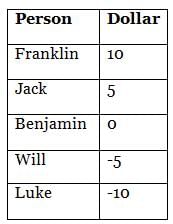
From the above table, it is clear that Franklin got the highest amount, i.e. $10, so he stood first in the game.
Jack was the only player to get 2 attempts consecutively and he did not get the 1st attempt. The number of maximum possible attempts by a player is 2, which means Jack got $10 in the first attempt, and in the second attempt he paid a penalty amount of $5, but from (iv), the player who rolled the slot machine in the last attempt won the game.
Jack couldn't be at 6th.
Possible positions for Jack are: 2, 3, or 3, 4, or 4, 5, but there is change in sequence (from (ii)) at the beginning of the 4th attempt and the 5th attempt. So, Jack couldn't go at the 4th and 5th attempt.
Sequence[attempt number(name, amount)]: 1, 2(Jack, $10), 3(Jack, -$5), 4, 5, 6(xx, $10)
This means, the 1st, 4th and 5th attempts didn't hit correctly and they would pay the penalty.
Sequence[attempt number(name, amount)]: 1(xx, -$5), 2(Jack, $10), 3(Jack, -$5), 4(xx, -$5), 5(xx, -$5), 6(xx, $10)
There has to be another person who rolled the slot machine in 2 attempts. This person also could not have rolled the slot machine in the 5th and 6th attempts.
Hence, he must have rolled the slot machine in the 1st and 5th attempts.
From (ii), this person has to be Luke because only by getting the 5th attempt could Luke move to front of Jack.
Sequence[attempt number(name, amount)]: 1(Luke, -$5), 2(Jack, $10), 3(Jack, -$5), 4(xx, -$5), 5(Luke, -$5), 6(xx, $10)
Will must have rolled the slot machine in one attempt without hitting the jackpot and Franklin must have rolled the slot machine in one attempt and hit the jackpot.
Sequence[attempt number(name, amount)]: 1(Luke, -$5), 2(Jack, $10), 3(Jack, -$5), 4(Will, -$5), 5(Luke, -$5), 6(Franklin, $10)
From the above table, it is clear that Franklin got the highest amount, i.e. $10, so he stood first in the game.
Directions: Study the given information and answer the following question.The table below gives some information about marks scored by Joey in a written exam for University Professor, which consists of five main categories: Quant, Reasoning, DI, English, and General Knowledge
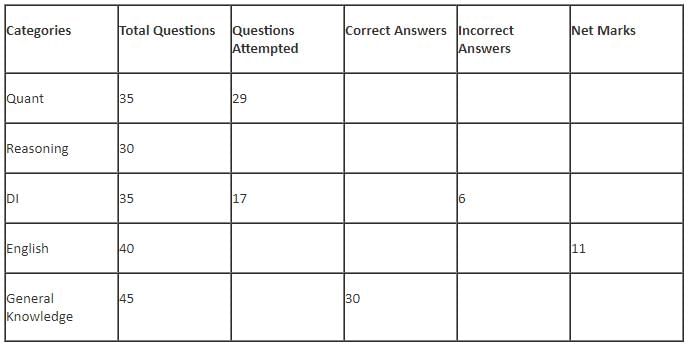
The following data is also provided:
(1) For every correct answer, the candidate gets one mark, for every un-attempted question, the candidate loses 1/6 of a mark, and for every incorrect answer, the student loses 1/3 of a mark.
(2) Joey scores 67 marks and he attempts 125 questions.
(3) The number of incorrect answers given by Joey in English is 1/6 of total number of incorrect answers and twice the number of incorrect answers in Reasoning.
(4) Joey's net marks in Reasoning are double than those in DI.Q. Key in the number of questions attempted by Joey in Reasoning.Correct answer is '18'. Can you explain this answer?
Directions: Study the given information and answer the following question.
The table below gives some information about marks scored by Joey in a written exam for University Professor, which consists of five main categories: Quant, Reasoning, DI, English, and General Knowledge
The following data is also provided:
(1) For every correct answer, the candidate gets one mark, for every un-attempted question, the candidate loses 1/6 of a mark, and for every incorrect answer, the student loses 1/3 of a mark.
(2) Joey scores 67 marks and he attempts 125 questions.
(3) The number of incorrect answers given by Joey in English is 1/6 of total number of incorrect answers and twice the number of incorrect answers in Reasoning.
(4) Joey's net marks in Reasoning are double than those in DI.
The following data is also provided:
(1) For every correct answer, the candidate gets one mark, for every un-attempted question, the candidate loses 1/6 of a mark, and for every incorrect answer, the student loses 1/3 of a mark.
(2) Joey scores 67 marks and he attempts 125 questions.
(3) The number of incorrect answers given by Joey in English is 1/6 of total number of incorrect answers and twice the number of incorrect answers in Reasoning.
(4) Joey's net marks in Reasoning are double than those in DI.
Q. Key in the number of questions attempted by Joey in Reasoning.
| | EduRev CAT answered |
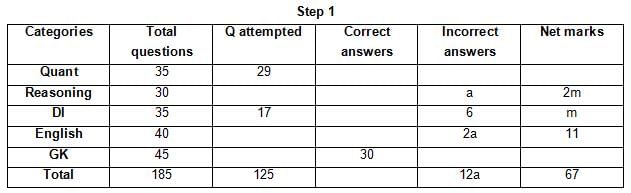
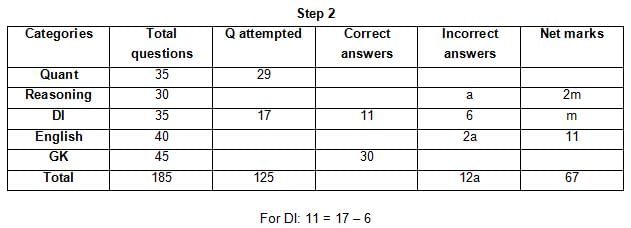
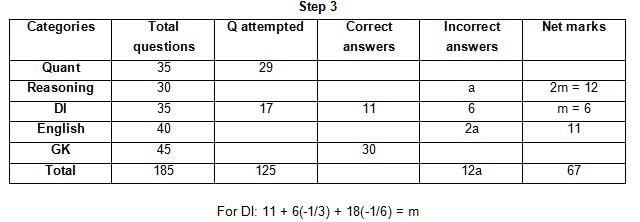
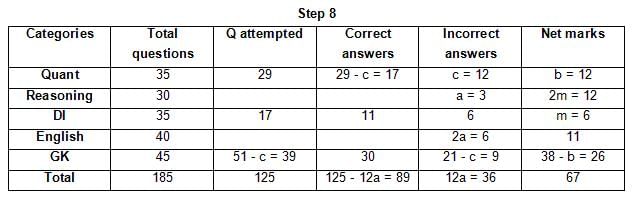
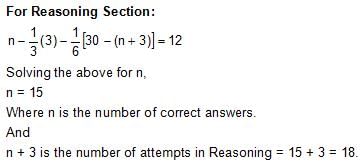
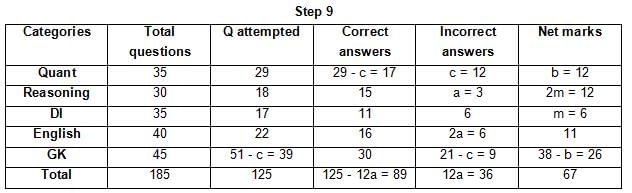
Directions: Answer the question on the basis of the information given below.Help Distress (HD) is an NGO involved in providing assistance to people suffering from natural disasters. Currently, it has 37 volunteers. They are involved in three projects: Tsunami Relief (TR) in Tamil Nadu, Flood Relief (FR) in Maharashtra, and Earthquake Relief (ER) in Gujarat. Each volunteer working with Help Distress has to be involved in at least one relief work project.
The highest number of volunteers are involved in the FR project. Among them, the number of volunteers involved in the FR project alone is equal to the number of volunteers having involvement in the ER project alone.
The number of volunteers involved in the ER project alone is double the number of volunteers involved in all the three projects.
A total of 17 volunteers are involved in the TR project.
The number of volunteers involved in the TR project alone is one less than the number of volunteers involved in ER project alone.
Ten volunteers involved in the TR project are also involved in at least one more project.Which of the following additional pieces of information would enable to find the exact number of volunteers involved in the various projects?- a)Twenty volunteers are involved in FR.
- b)Four volunteers are involved in all the three projects.
- c)Twenty-three volunteers are involved in exactly one project.
- d)No need for any additional information.
Correct answer is option 'A'. Can you explain this answer?
Directions: Answer the question on the basis of the information given below.
Help Distress (HD) is an NGO involved in providing assistance to people suffering from natural disasters. Currently, it has 37 volunteers. They are involved in three projects: Tsunami Relief (TR) in Tamil Nadu, Flood Relief (FR) in Maharashtra, and Earthquake Relief (ER) in Gujarat. Each volunteer working with Help Distress has to be involved in at least one relief work project.
The highest number of volunteers are involved in the FR project. Among them, the number of volunteers involved in the FR project alone is equal to the number of volunteers having involvement in the ER project alone.
The number of volunteers involved in the ER project alone is double the number of volunteers involved in all the three projects.
A total of 17 volunteers are involved in the TR project.
The number of volunteers involved in the TR project alone is one less than the number of volunteers involved in ER project alone.
Ten volunteers involved in the TR project are also involved in at least one more project.
The highest number of volunteers are involved in the FR project. Among them, the number of volunteers involved in the FR project alone is equal to the number of volunteers having involvement in the ER project alone.
The number of volunteers involved in the ER project alone is double the number of volunteers involved in all the three projects.
A total of 17 volunteers are involved in the TR project.
The number of volunteers involved in the TR project alone is one less than the number of volunteers involved in ER project alone.
Ten volunteers involved in the TR project are also involved in at least one more project.
Which of the following additional pieces of information would enable to find the exact number of volunteers involved in the various projects?
a)
Twenty volunteers are involved in FR.
b)
Four volunteers are involved in all the three projects.
c)
Twenty-three volunteers are involved in exactly one project.
d)
No need for any additional information.
 | Pritam Singh answered |
Understanding the Problem
To solve the problem, we need to analyze the distribution of volunteers across three projects: Tsunami Relief (TR), Flood Relief (FR), and Earthquake Relief (ER).
Key Points from the Information
- Total volunteers: 37
- Volunteers in TR: 17
- Volunteers in FR (highest number): Unknown
- Volunteers in ER alone = 2 * (Volunteers in all three projects)
- Volunteers in TR alone = (Volunteers in ER alone) - 1
- 10 volunteers in TR are involved in at least one more project.
Analysis of Options
To find the exact number of volunteers in each project, we explore the additional information options provided:
Option A: Twenty volunteers are involved in FR.
- If 20 volunteers are in FR, we can calculate the remaining volunteers for TR and ER accurately.
- It allows us to derive the number of volunteers in each project, resolving the equations clearly.
Option B: Four volunteers are involved in all three projects.
- While this helps, it doesn’t provide enough information to determine the exact number in each project since we still have unknowns.
Option C: Twenty-three volunteers are involved in exactly one project.
- This option gives partial information but still leaves many unknowns about overlaps in projects.
Option D: No need for any additional information.
- This is incorrect since the current data is not sufficient to determine the exact distribution of volunteers.
Conclusion
Therefore, the correct answer is option A. Knowing that 20 volunteers are specifically involved in FR enables us to set up a clear framework to calculate the number in each project, thus resolving the ambiguity in the distribution of volunteers efficiently.
To solve the problem, we need to analyze the distribution of volunteers across three projects: Tsunami Relief (TR), Flood Relief (FR), and Earthquake Relief (ER).
Key Points from the Information
- Total volunteers: 37
- Volunteers in TR: 17
- Volunteers in FR (highest number): Unknown
- Volunteers in ER alone = 2 * (Volunteers in all three projects)
- Volunteers in TR alone = (Volunteers in ER alone) - 1
- 10 volunteers in TR are involved in at least one more project.
Analysis of Options
To find the exact number of volunteers in each project, we explore the additional information options provided:
Option A: Twenty volunteers are involved in FR.
- If 20 volunteers are in FR, we can calculate the remaining volunteers for TR and ER accurately.
- It allows us to derive the number of volunteers in each project, resolving the equations clearly.
Option B: Four volunteers are involved in all three projects.
- While this helps, it doesn’t provide enough information to determine the exact number in each project since we still have unknowns.
Option C: Twenty-three volunteers are involved in exactly one project.
- This option gives partial information but still leaves many unknowns about overlaps in projects.
Option D: No need for any additional information.
- This is incorrect since the current data is not sufficient to determine the exact distribution of volunteers.
Conclusion
Therefore, the correct answer is option A. Knowing that 20 volunteers are specifically involved in FR enables us to set up a clear framework to calculate the number in each project, thus resolving the ambiguity in the distribution of volunteers efficiently.
Instructions:
Alex, Cane and John are three drivers who drive a passenger bus, in shifts, from Paris to Luxembourg every day. Due to the heavy traffic at peak hours, the time it takes for them to travel between the two cities depends on their starting times at the originating city. If they start at 8:00 AM, 9:00 AM or 10:00 AM, it takes 18 hours to travel between the two cities. If they start at 7:00 PM, 8:00 PM or 9:00 PM, it takes them 20 hours to travel between the two cities. If they start at any other time, it takes them 15 hours to travel between the two cities. Each time they reach their destination city, they take rest for 1 hour before proceeding to the next city.
1 trip is defined as the journey from one city to another.
If they start at 2: 00 PM from Luxembourg, how many times will they start between 1:00 PM and 11:00 PM from Paris in their first 100 trips?- a)48
- b)33
- c)50
- d)32
Correct answer is option 'B'. Can you explain this answer?
Instructions:
Alex, Cane and John are three drivers who drive a passenger bus, in shifts, from Paris to Luxembourg every day. Due to the heavy traffic at peak hours, the time it takes for them to travel between the two cities depends on their starting times at the originating city. If they start at 8:00 AM, 9:00 AM or 10:00 AM, it takes 18 hours to travel between the two cities. If they start at 7:00 PM, 8:00 PM or 9:00 PM, it takes them 20 hours to travel between the two cities. If they start at any other time, it takes them 15 hours to travel between the two cities. Each time they reach their destination city, they take rest for 1 hour before proceeding to the next city.
1 trip is defined as the journey from one city to another.
If they start at 2: 00 PM from Luxembourg, how many times will they start between 1:00 PM and 11:00 PM from Paris in their first 100 trips?
Alex, Cane and John are three drivers who drive a passenger bus, in shifts, from Paris to Luxembourg every day. Due to the heavy traffic at peak hours, the time it takes for them to travel between the two cities depends on their starting times at the originating city. If they start at 8:00 AM, 9:00 AM or 10:00 AM, it takes 18 hours to travel between the two cities. If they start at 7:00 PM, 8:00 PM or 9:00 PM, it takes them 20 hours to travel between the two cities. If they start at any other time, it takes them 15 hours to travel between the two cities. Each time they reach their destination city, they take rest for 1 hour before proceeding to the next city.
1 trip is defined as the journey from one city to another.
If they start at 2: 00 PM from Luxembourg, how many times will they start between 1:00 PM and 11:00 PM from Paris in their first 100 trips?
a)
48
b)
33
c)
50
d)
32
 | Zoya Sharma answered |
Let’s solve this set by converting the times into 24-hour format.
If they start at 8, 9, 10 hours, they will take 18 hours. If they start at 19, 20, 21 hours, they will take 20 hours. Else, they take 15 hours.
Let’s compute their trip times.
14:00 (L) - 5: 00 (P)
6: 00 (P) - 21: 00 (L)
22:00 (L) - 13:00 (P)
14:00 (P) - 5:00 (L)
6:00 (L) - 21:00 (P)
22:00(P) - 13:00 (L)
This cycle will repeat itself.
In each cycle they will start twice between 1:00 PM and 11:00 PM from Paris.
The cycle will repeat 16 times. Thus, 32 times they will start between the given times.
Further, in the next 4 trips, they’ll start once. Thus, they’ll start 33 times.
If they start at 8, 9, 10 hours, they will take 18 hours. If they start at 19, 20, 21 hours, they will take 20 hours. Else, they take 15 hours.
Let’s compute their trip times.
14:00 (L) - 5: 00 (P)
6: 00 (P) - 21: 00 (L)
22:00 (L) - 13:00 (P)
14:00 (P) - 5:00 (L)
6:00 (L) - 21:00 (P)
22:00(P) - 13:00 (L)
This cycle will repeat itself.
In each cycle they will start twice between 1:00 PM and 11:00 PM from Paris.
The cycle will repeat 16 times. Thus, 32 times they will start between the given times.
Further, in the next 4 trips, they’ll start once. Thus, they’ll start 33 times.
Instructions:
A code ABCDEFGH where A, B, C, D, E, F, G, H are all digits, guards the secret formula of a high demand soft drink. The code should follow the following constraints:
1. The 2 digit number AB should be a multiple of 11.
2. The digit C should be a multiple of B.
3. The digit D should be a multiple of B.
4. The 2-digit number EF should be a multiple of the 2-digit number CD.
5. G and H can be any 2 consecutive digits from 1 to 9 such that G<H.
6. None of the digits should be zero or one.
Based on the information given above, answer the questions that follow.
What is the absolute difference between the number of valid codes and invalid codes among the ones given below?22666689
33996656
99999912
22469234
55555556
44848434
22489667
33333332
44888845
Correct answer is '3'. Can you explain this answer?
Instructions:
A code ABCDEFGH where A, B, C, D, E, F, G, H are all digits, guards the secret formula of a high demand soft drink. The code should follow the following constraints:
1. The 2 digit number AB should be a multiple of 11.
2. The digit C should be a multiple of B.
3. The digit D should be a multiple of B.
4. The 2-digit number EF should be a multiple of the 2-digit number CD.
5. G and H can be any 2 consecutive digits from 1 to 9 such that G<H.
6. None of the digits should be zero or one.
Based on the information given above, answer the questions that follow.
What is the absolute difference between the number of valid codes and invalid codes among the ones given below?22666689
33996656
99999912
22469234
55555556
44848434
22489667
33333332
44888845
A code ABCDEFGH where A, B, C, D, E, F, G, H are all digits, guards the secret formula of a high demand soft drink. The code should follow the following constraints:
1. The 2 digit number AB should be a multiple of 11.
2. The digit C should be a multiple of B.
3. The digit D should be a multiple of B.
4. The 2-digit number EF should be a multiple of the 2-digit number CD.
5. G and H can be any 2 consecutive digits from 1 to 9 such that G<H.
6. None of the digits should be zero or one.
Based on the information given above, answer the questions that follow.
What is the absolute difference between the number of valid codes and invalid codes among the ones given below?22666689
33996656
99999912
22469234
55555556
44848434
22489667
33333332
44888845
| | Dia Mehta answered |
22666689 - right
33996656 - wrong - EF is not a multiple of CD
99999912 - wrong - 1 is not allowed
22469234 - right
55555556 - right
44848434 - right
22489667 - right
33333332 - wrong - G should be less than H
44888845 - right
|3 - 6| = 3.
33996656 - wrong - EF is not a multiple of CD
99999912 - wrong - 1 is not allowed
22469234 - right
55555556 - right
44848434 - right
22489667 - right
33333332 - wrong - G should be less than H
44888845 - right
|3 - 6| = 3.
Instructions:
A B-school has 4 clubs - Sports, Dramatics, Literary, and Quiz. 60 students joined these clubs in the first year. A person can join only one of these 4 clubs. After the first year was over, some students did not like the club they joined and hence, moved from one club to another.
Further the following information is known:
No student moved from the quiz club to the sports club.
The number of students who moved from dramatics club to the sports club is the same as the number of students who moved from the sports club to the dramatics club. The same is the case with sports club and literary club as well.
The number of students who moved out from the sports and quiz clubs are equal.
The number of students who moved to the literary club is one more than the number of persons who moved to the sports club.
At least one student moved from the sports club to literary club.
The number of students who left the quiz club for the dramatics club and the literary club is the same.
A total of 21 students shifted from one club to another.
4 students moved out of dramatics club and 5 students moved out of literary club.
The number of students who joined sports club is exactly half the number of students who left it.
The number of students who left other clubs for dramatics club is 4 more than the number of students who left other clubs for the quiz club.
From which club did maximum number of people leave for the dramatics club?- a)Literary club
- b)Sports club
- c)Quiz club
- d)More than one of the above
Correct answer is option 'A'. Can you explain this answer?
Instructions:
A B-school has 4 clubs - Sports, Dramatics, Literary, and Quiz. 60 students joined these clubs in the first year. A person can join only one of these 4 clubs. After the first year was over, some students did not like the club they joined and hence, moved from one club to another.
Further the following information is known:
No student moved from the quiz club to the sports club.
The number of students who moved from dramatics club to the sports club is the same as the number of students who moved from the sports club to the dramatics club. The same is the case with sports club and literary club as well.
The number of students who moved out from the sports and quiz clubs are equal.
The number of students who moved to the literary club is one more than the number of persons who moved to the sports club.
At least one student moved from the sports club to literary club.
The number of students who left the quiz club for the dramatics club and the literary club is the same.
A total of 21 students shifted from one club to another.
4 students moved out of dramatics club and 5 students moved out of literary club.
The number of students who joined sports club is exactly half the number of students who left it.
The number of students who left other clubs for dramatics club is 4 more than the number of students who left other clubs for the quiz club.
From which club did maximum number of people leave for the dramatics club?
A B-school has 4 clubs - Sports, Dramatics, Literary, and Quiz. 60 students joined these clubs in the first year. A person can join only one of these 4 clubs. After the first year was over, some students did not like the club they joined and hence, moved from one club to another.
Further the following information is known:
No student moved from the quiz club to the sports club.
The number of students who moved from dramatics club to the sports club is the same as the number of students who moved from the sports club to the dramatics club. The same is the case with sports club and literary club as well.
The number of students who moved out from the sports and quiz clubs are equal.
The number of students who moved to the literary club is one more than the number of persons who moved to the sports club.
At least one student moved from the sports club to literary club.
The number of students who left the quiz club for the dramatics club and the literary club is the same.
A total of 21 students shifted from one club to another.
4 students moved out of dramatics club and 5 students moved out of literary club.
The number of students who joined sports club is exactly half the number of students who left it.
The number of students who left other clubs for dramatics club is 4 more than the number of students who left other clubs for the quiz club.
From which club did maximum number of people leave for the dramatics club?
a)
Literary club
b)
Sports club
c)
Quiz club
d)
More than one of the above
| | Ishita Reddy answered |
Let us start by tabulating the data available.
We have no information about the number of persons in each club.
The sports-sports cell in the table represents the number of persons from sports club who stayed in sports club. Since we do not have this information (we have information only regarding the movement from one club to another), let us mark all such cells with X.
The cell sports-dramatics (row-column) represents the number of students from sports club who left for dramatics club. Therefore, the cell sports-total will provide the number of students who left the sports club and the cell total-sports will provide the number of students who left other clubs for the sports club.
The number of persons who moved from dramatics club to the sports club is the same as the number of persons who moved from the sports club to the dramatics club. The same is the case with sports club and literary club as well. Let us use ‘a’ to denote the number of persons who moved from the dramatics club to the sports club and ‘b’ to denote the number of persons who moved from sports club to literary club. The number of persons who moved out of sports and quiz clubs is the same. Let us denote it by ‘c’.
A total of 21 students left one club for another. No person moved from the quiz club to sports club (quiz-sports = 0).
We have no information about the number of persons in each club.
The sports-sports cell in the table represents the number of persons from sports club who stayed in sports club. Since we do not have this information (we have information only regarding the movement from one club to another), let us mark all such cells with X.
The cell sports-dramatics (row-column) represents the number of students from sports club who left for dramatics club. Therefore, the cell sports-total will provide the number of students who left the sports club and the cell total-sports will provide the number of students who left other clubs for the sports club.
The number of persons who moved from dramatics club to the sports club is the same as the number of persons who moved from the sports club to the dramatics club. The same is the case with sports club and literary club as well. Let us use ‘a’ to denote the number of persons who moved from the dramatics club to the sports club and ‘b’ to denote the number of persons who moved from sports club to literary club. The number of persons who moved out of sports and quiz clubs is the same. Let us denote it by ‘c’.
A total of 21 students left one club for another. No person moved from the quiz club to sports club (quiz-sports = 0).
The number of persons who moved to the literary club is one more than the number of persons who moved to the sports club. Let the number of persons who moved to the literary club be ‘d+1’ and the number of persons who moved to the sports club be ‘d’.
The number of persons who left the quiz club for the dramatics club and the literary club is the same. Let us denote the number of persons who left the quiz club for dramatics club by ‘e’. 4 students moved out of dramatics club and 5 students moved out of literary club.
The number of persons who left the quiz club for the dramatics club and the literary club is the same. Let us denote the number of persons who left the quiz club for dramatics club by ‘e’. 4 students moved out of dramatics club and 5 students moved out of literary club.
As we can see from the table, c+c+4+5 =21
⇒ c = 6
The number of students who left other clubs for dramatics club is 4 more than the number of students who left other clubs for the quiz club.
Let the number of students who left other clubs for quiz club be ‘f’.
⇒ Number of students who left other clubs for dramatics club = f + 4.
The number of students who joined sports club is exactly half the number of students who left it. We know that 6 students left the sports club. Therefore, 3 students should have joined the sports club. ⇒ d = 3
We can see from the table that e + e = 6
⇒ e = 3
Let us fill the vacant cells with variables from g to k. We get the following table.
⇒ c = 6
The number of students who left other clubs for dramatics club is 4 more than the number of students who left other clubs for the quiz club.
Let the number of students who left other clubs for quiz club be ‘f’.
⇒ Number of students who left other clubs for dramatics club = f + 4.
The number of students who joined sports club is exactly half the number of students who left it. We know that 6 students left the sports club. Therefore, 3 students should have joined the sports club. ⇒ d = 3
We can see from the table that e + e = 6
⇒ e = 3
Let us fill the vacant cells with variables from g to k. We get the following table.
f + f + 4 + 3 + 4 = 21
⇒ 2f = 10
f = 5
a+b = 3
a+b+i = 6
⇒ i = 3
a+h+j = 4 --------------(1)
b+h = 1 ----------------(2)
a+b = 3 ----------------(3)
b+g+k = 5 -------------(4)
j + k = 2 --------------(5)
a+g = 6 ---------------(6)
Let us rewrite every variable in terms of 'a'.
b = 3-a
g =6-a
Substituting these values in (4), we get,
3-a+6-a+k = 5
9-2a+k = 5
k = 2a-4
Substituting the value of 'k' in (5), we get,
j+2a-4 = 2
j = 6-2a
(1)⇒ a+h+j = 4
a + h + 6 - 2a = 4
⇒ h = a - 2
It has been given that at least one student moved from Sports to Literary club. Therefore, the value of 'a' cannot be 3.
We know that k=2a-4. Therefore, the value of 'a' should be at least 2.
2 is the only value that falls within the range.
Solving the equations using a=2, we get the following table:
⇒ 2f = 10
f = 5
a+b = 3
a+b+i = 6
⇒ i = 3
a+h+j = 4 --------------(1)
b+h = 1 ----------------(2)
a+b = 3 ----------------(3)
b+g+k = 5 -------------(4)
j + k = 2 --------------(5)
a+g = 6 ---------------(6)
Let us rewrite every variable in terms of 'a'.
b = 3-a
g =6-a
Substituting these values in (4), we get,
3-a+6-a+k = 5
9-2a+k = 5
k = 2a-4
Substituting the value of 'k' in (5), we get,
j+2a-4 = 2
j = 6-2a
(1)⇒ a+h+j = 4
a + h + 6 - 2a = 4
⇒ h = a - 2
It has been given that at least one student moved from Sports to Literary club. Therefore, the value of 'a' cannot be 3.
We know that k=2a-4. Therefore, the value of 'a' should be at least 2.
2 is the only value that falls within the range.
Solving the equations using a=2, we get the following table:
Maximum number of people left literary club for dramatics club. Therefore, option A is the right answer.
Directions: Read the information given below and answer the question that follows.Five players — Jack, Will, Luke, Benjamin and Franklin —participated in an innovative game show on a slot machine. At the beginning of the game, the five players were asked to stand in a queue, one behind the other, facing the same direction. Whenever a dealer called any player to the slot machine, the player who was called by the dealer had to move to the front of the queue (irrespective of whether his get was correct or not) and the others moved back in the queue, without any other rearrangement. For example, if the third player in the queue was called by the dealer, he had to move to the first position and the players who were earlier in the first and second positions moved to the second and third positions, respectively, while the players in the fourth and fifth positions did not move. Also, exactly one player rolled the slot machine in each attempt. The game had a total of six attempts, and every jackpot hit was awarded 10 dollars and when jackpot was not hit, it carried a penalty of 5 dollars. It is known that no two players had the same number of dollars at the end of the game.It is given that every player had same amount of money in their pocket before the start of the game. Further, the following information is known about their positions in the queue at various stages of the game:
(i) Jack was the only player to get two attempts consecutively and he did not get the first attempt.
(ii) During the fourth attempt, Will moved from a position behind Franklin to a position in front of him and during the fifth attempt, Luke moved from a position behind Jack to a position in front of him.
(iii) Benjamin who was initially (i.e. before the first attempt of the game) at the beginning of the queue moved to the last position in the queue by the end of the game.
(iv) The sum of the dollars received by the five players was zero and the player who rolled the slot machine in the last attempt won the game.
(v) The player who rolled the slot machine in the first attempt had the least number of dollars in the game.
(vi) Jack was further ahead in the queue at the end of the game than at the beginning.Q. Which of the following attempts rolled the slot machine to definitely hit the jackpot?- a)2nd attempt
- b)6th attempt
- c)3rd attempt
- d)1st attempt
Correct answer is option 'B'. Can you explain this answer?
Directions: Read the information given below and answer the question that follows.
Five players — Jack, Will, Luke, Benjamin and Franklin —participated in an innovative game show on a slot machine. At the beginning of the game, the five players were asked to stand in a queue, one behind the other, facing the same direction. Whenever a dealer called any player to the slot machine, the player who was called by the dealer had to move to the front of the queue (irrespective of whether his get was correct or not) and the others moved back in the queue, without any other rearrangement. For example, if the third player in the queue was called by the dealer, he had to move to the first position and the players who were earlier in the first and second positions moved to the second and third positions, respectively, while the players in the fourth and fifth positions did not move. Also, exactly one player rolled the slot machine in each attempt. The game had a total of six attempts, and every jackpot hit was awarded 10 dollars and when jackpot was not hit, it carried a penalty of 5 dollars. It is known that no two players had the same number of dollars at the end of the game.
It is given that every player had same amount of money in their pocket before the start of the game. Further, the following information is known about their positions in the queue at various stages of the game:
(i) Jack was the only player to get two attempts consecutively and he did not get the first attempt.
(ii) During the fourth attempt, Will moved from a position behind Franklin to a position in front of him and during the fifth attempt, Luke moved from a position behind Jack to a position in front of him.
(iii) Benjamin who was initially (i.e. before the first attempt of the game) at the beginning of the queue moved to the last position in the queue by the end of the game.
(iv) The sum of the dollars received by the five players was zero and the player who rolled the slot machine in the last attempt won the game.
(v) The player who rolled the slot machine in the first attempt had the least number of dollars in the game.
(vi) Jack was further ahead in the queue at the end of the game than at the beginning.
(i) Jack was the only player to get two attempts consecutively and he did not get the first attempt.
(ii) During the fourth attempt, Will moved from a position behind Franklin to a position in front of him and during the fifth attempt, Luke moved from a position behind Jack to a position in front of him.
(iii) Benjamin who was initially (i.e. before the first attempt of the game) at the beginning of the queue moved to the last position in the queue by the end of the game.
(iv) The sum of the dollars received by the five players was zero and the player who rolled the slot machine in the last attempt won the game.
(v) The player who rolled the slot machine in the first attempt had the least number of dollars in the game.
(vi) Jack was further ahead in the queue at the end of the game than at the beginning.
Q. Which of the following attempts rolled the slot machine to definitely hit the jackpot?
a)
2nd attempt
b)
6th attempt
c)
3rd attempt
d)
1st attempt
| | EduRev CAT answered |
It is given that there were 6 attempts in the game and all the five players got different number of dollars. The maximum number of attempts a single player could have rolled the slot machine has to be 2 (if one player rolled the slot machine in 3 attempts, then two players would end up with the same number of dollars).
Jack was the only player to get 2 attempts consecutively and he did not get the 1st attempt. The number of maximum possible attempts by a player is 2, which means Jack got $10 in the first attempt, and in the second attempt he paid a penalty amount of $5, but from (iv), the player who rolled the slot machine in the last attempt won the game.
Jack couldn't be at 6th.
Possible positions for Jack are: 2, 3, or 3, 4, or 4, 5, but there is change in sequence (from (ii)) at the beginning of the 4th attempt and the 5th attempt. So, Jack couldn't go at the 4th and 5th attempt.
Sequence[attempt number(name, amount)]: 1, 2(Jack, $10), 3(Jack, -$5), 4, 5, 6(xx, $10)
This means, the 1st, 4th and 5th attempts didn't hit correctly and they would pay the penalty.
Sequence[attempt number(name, amount)]: 1(xx, -$5), 2(Jack, $10), 3(Jack, -$5), 4(xx, -$5), 5(xx, -$5), 6(xx, $10)
There has to be another person who rolled the slot machine in 2 attempts. This person also could not have rolled the slot machine in the 5th and 6th attempts.
Hence, he must have rolled the slot machine in the 1st and 5th attempts.
From (ii), this person has to be Luke because only by getting the 5th attempt could Luke move to front of Jack.
Sequence[attempt number(name, amount)]: 1(Luke, -$5), 2(Jack, $10), 3(Jack, -$5), 4(xx, -$5), 5(Luke, -$5), 6(xx, $10)
Will must have rolled the slot machine in one attempt without hitting the jackpot and Franklin must have rolled the slot machine in one attempt and hit the jackpot.
Sequence[attempt number(name, amount)]:
1(Luke, -$5), 2(Jack, $10), 3(Jack, -$5), 4(Will, -$5), 5(Luke, -$5), 6(Franklin, $10)
OR
1(Luke, -$5), 2(Jack, -$5), 3(Jack, $10), 4(Will, -$5), 5(Luke, -$5), 6(Franklin, $10)
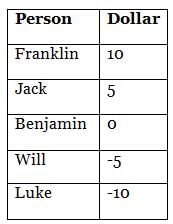
Thus, we can see that only 2nd or 3rd attempt and the last attempt hit the jackpot.
Since the question asks for a 'definite' hit, the answer is 6th attempt.
Jack was the only player to get 2 attempts consecutively and he did not get the 1st attempt. The number of maximum possible attempts by a player is 2, which means Jack got $10 in the first attempt, and in the second attempt he paid a penalty amount of $5, but from (iv), the player who rolled the slot machine in the last attempt won the game.
Jack couldn't be at 6th.
Possible positions for Jack are: 2, 3, or 3, 4, or 4, 5, but there is change in sequence (from (ii)) at the beginning of the 4th attempt and the 5th attempt. So, Jack couldn't go at the 4th and 5th attempt.
Sequence[attempt number(name, amount)]: 1, 2(Jack, $10), 3(Jack, -$5), 4, 5, 6(xx, $10)
This means, the 1st, 4th and 5th attempts didn't hit correctly and they would pay the penalty.
Sequence[attempt number(name, amount)]: 1(xx, -$5), 2(Jack, $10), 3(Jack, -$5), 4(xx, -$5), 5(xx, -$5), 6(xx, $10)
There has to be another person who rolled the slot machine in 2 attempts. This person also could not have rolled the slot machine in the 5th and 6th attempts.
Hence, he must have rolled the slot machine in the 1st and 5th attempts.
From (ii), this person has to be Luke because only by getting the 5th attempt could Luke move to front of Jack.
Sequence[attempt number(name, amount)]: 1(Luke, -$5), 2(Jack, $10), 3(Jack, -$5), 4(xx, -$5), 5(Luke, -$5), 6(xx, $10)
Will must have rolled the slot machine in one attempt without hitting the jackpot and Franklin must have rolled the slot machine in one attempt and hit the jackpot.
Sequence[attempt number(name, amount)]:
1(Luke, -$5), 2(Jack, $10), 3(Jack, -$5), 4(Will, -$5), 5(Luke, -$5), 6(Franklin, $10)
OR
1(Luke, -$5), 2(Jack, -$5), 3(Jack, $10), 4(Will, -$5), 5(Luke, -$5), 6(Franklin, $10)
Thus, we can see that only 2nd or 3rd attempt and the last attempt hit the jackpot.
Since the question asks for a 'definite' hit, the answer is 6th attempt.
The following table represents the type(s) of vehicle(s) owned by people of 5 cities.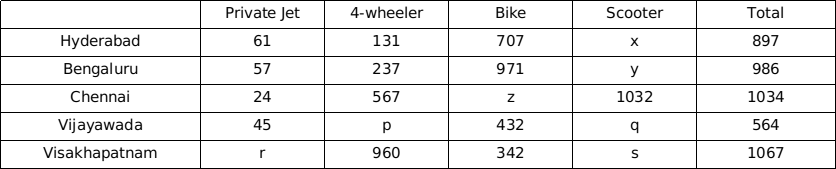 So, in Hyderabad, there are a total of 897 people, some of whom might not own any type of vehicle. 61 people own a private jet, 131 people own a 4-wheeler, 707 people own a bike and x people own a scooter. Similarly, the other cities follow. Also, no person owns more than one vehicle of a particular type.
Based on the information given above, answer the questions that follow.
In Bengaluru, the number of people who own zero vehicles is zero, the number of people who own 2 vehicles is 163, the number of people who own 3 vehicles is 36 and the number of people who own all 4 vehicles is more than the number of people who own 3 vehicles, what is the maximum value that y can take?- a)127
- b)96
- c)72
- d)120
Correct answer is option 'A'. Can you explain this answer?
The following table represents the type(s) of vehicle(s) owned by people of 5 cities.
So, in Hyderabad, there are a total of 897 people, some of whom might not own any type of vehicle. 61 people own a private jet, 131 people own a 4-wheeler, 707 people own a bike and x people own a scooter. Similarly, the other cities follow. Also, no person owns more than one vehicle of a particular type.
Based on the information given above, answer the questions that follow.
In Bengaluru, the number of people who own zero vehicles is zero, the number of people who own 2 vehicles is 163, the number of people who own 3 vehicles is 36 and the number of people who own all 4 vehicles is more than the number of people who own 3 vehicles, what is the maximum value that y can take?
Based on the information given above, answer the questions that follow.
In Bengaluru, the number of people who own zero vehicles is zero, the number of people who own 2 vehicles is 163, the number of people who own 3 vehicles is 36 and the number of people who own all 4 vehicles is more than the number of people who own 3 vehicles, what is the maximum value that y can take?
a)
127
b)
96
c)
72
d)
120
 | Aspire Academy answered |
Based on Condition II, we understand that the student who missed the Mathematics examination did not miss any other examination. This indicates that the Maths score is bound to be the average of the best 3 out of the 4 exam scores obtained by this candidate. Based on this inference, we can proceed with identifying the math score that can be represented as an average of the rest of the scores. We can straightaway eliminate Deep and Esha as potential candidates, given that their Mathematics score is greater than the rest of the exam scores. After estimating the average scores for the rest of the candidates, we observe that only Carl has missed his Mathematics examination.
For Carl: best 3 out of 4 - 80(Hindi), 90(Social Science), 100(Science)
Avg. = 270/3 = 90 which matches the given value
∴ Carl missed his Mathematics examination.
Further, based on Condition III, we can surmise that the student who missed Hindi and Science should have similar average scores in these two subjects. We notice that Alva has the same score of 75 in both Hindi and Science. The same can be said about Deep, who has a score of 90 in both these subjects. Thus, one out of Alva and Deep missed out on Hindi and Science examination, while the second individual missed out only on the Hindi examination.
Since we know that Carl, Alva and Deep are unlikely to have missed out on the English exam, we can divert our attention to determining which individual out of Bithi, Esha and Foni failed to appear for this subject. However, we notice that Bithi's English score is greater than the rest of her scores, thereby helping us eliminate her as the potential candidate.
For Esha: best 3 out of 4 - 85(Hindi), 95(Mathematics), 60(Science)
Avg. = 240/3 = 80 which matches the given value
∴ Esha most likely missed her English examination.
For Foni: best 3 out of 4 - 78(Mathematics), 83(Social Science), 88(Science)
Avg. = 249/3 = 83 which matches the given value
∴ Foni most likely missed her English examination.
Based on Condition I, we know that exactly two candidates missed the examinations for English, Hindi, Science, and Social Science.
For English, we determined these individuals to be Esha and Foni. For Hindi, we determined these individuals to be Alva and Deep. For Science, we know one of the individuals is either Alva or Deep. Given that Carl, Alva and Deep cannot be a part of the group that missed Science or Social Science exam, we can proceed by carefully scrutinizing the rest of the group that includes Bithi, Esha and Foni.
We notice that Bithi has a similar score in both Science and Social Science examination. Assuming that she did miss these exams, let us proceed to check if this was actually the case.
For Bithi: Best 2 out 3 - 90(English), 80(Hindi)
Avg = 170/2 = 85 which matches the given value
∴ Bithi is likely to have missed her Science and Social Science examinations.
We additionally notice that Foni has a similar score in English and Social Science. On considering the best 2 out of 3 scores, the average value of the score for both the subject holds (equal to 83). Thus, we can conclude that Bithi and Foni missed their Social Science examination.
Thus, the students who missed just one exam were: Carl (Mathematics); Esha (English) and one out of Alva and Deep (Hindi).
Hence of the six students, we can correctly determine the missed subjects for four of them (except Alva and Deep):
Mathematics: Carl ; English: Esha & Foni ; Hindi: Alva & Deep; Science: Bithi & one out of Alva and Deep ; Social Science: Foni & Bithi
Hence, the correct answer to this question is Option B: Alva and Deep.
For Carl: best 3 out of 4 - 80(Hindi), 90(Social Science), 100(Science)
Avg. = 270/3 = 90 which matches the given value
∴ Carl missed his Mathematics examination.
Further, based on Condition III, we can surmise that the student who missed Hindi and Science should have similar average scores in these two subjects. We notice that Alva has the same score of 75 in both Hindi and Science. The same can be said about Deep, who has a score of 90 in both these subjects. Thus, one out of Alva and Deep missed out on Hindi and Science examination, while the second individual missed out only on the Hindi examination.
Since we know that Carl, Alva and Deep are unlikely to have missed out on the English exam, we can divert our attention to determining which individual out of Bithi, Esha and Foni failed to appear for this subject. However, we notice that Bithi's English score is greater than the rest of her scores, thereby helping us eliminate her as the potential candidate.
For Esha: best 3 out of 4 - 85(Hindi), 95(Mathematics), 60(Science)
Avg. = 240/3 = 80 which matches the given value
∴ Esha most likely missed her English examination.
For Foni: best 3 out of 4 - 78(Mathematics), 83(Social Science), 88(Science)
Avg. = 249/3 = 83 which matches the given value
∴ Foni most likely missed her English examination.
Based on Condition I, we know that exactly two candidates missed the examinations for English, Hindi, Science, and Social Science.
For English, we determined these individuals to be Esha and Foni. For Hindi, we determined these individuals to be Alva and Deep. For Science, we know one of the individuals is either Alva or Deep. Given that Carl, Alva and Deep cannot be a part of the group that missed Science or Social Science exam, we can proceed by carefully scrutinizing the rest of the group that includes Bithi, Esha and Foni.
We notice that Bithi has a similar score in both Science and Social Science examination. Assuming that she did miss these exams, let us proceed to check if this was actually the case.
For Bithi: Best 2 out 3 - 90(English), 80(Hindi)
Avg = 170/2 = 85 which matches the given value
∴ Bithi is likely to have missed her Science and Social Science examinations.
We additionally notice that Foni has a similar score in English and Social Science. On considering the best 2 out of 3 scores, the average value of the score for both the subject holds (equal to 83). Thus, we can conclude that Bithi and Foni missed their Social Science examination.
Thus, the students who missed just one exam were: Carl (Mathematics); Esha (English) and one out of Alva and Deep (Hindi).
Hence of the six students, we can correctly determine the missed subjects for four of them (except Alva and Deep):
Mathematics: Carl ; English: Esha & Foni ; Hindi: Alva & Deep; Science: Bithi & one out of Alva and Deep ; Social Science: Foni & Bithi
Hence, the correct answer to this question is Option B: Alva and Deep.
Instructions:
A code ABCDEFGH where A, B, C, D, E, F, G, H are all digits, guards the secret formula of a high demand soft drink. The code should follow the following constraints:
1. The 2 digit number AB should be a multiple of 11.
2. The digit C should be a multiple of B.
3. The digit D should be a multiple of B.
4. The 2-digit number EF should be a multiple of the 2-digit number CD.
5. G and H can be any 2 consecutive digits from 1 to 9 such that G<H.
6. None of the digits should be zero or one.
Based on the information given above, answer the questions that follow.
How many codes are possible?- a)216
- b)378
- c)384
- d)224
Correct answer is option 'B'. Can you explain this answer?
Instructions:
A code ABCDEFGH where A, B, C, D, E, F, G, H are all digits, guards the secret formula of a high demand soft drink. The code should follow the following constraints:
1. The 2 digit number AB should be a multiple of 11.
2. The digit C should be a multiple of B.
3. The digit D should be a multiple of B.
4. The 2-digit number EF should be a multiple of the 2-digit number CD.
5. G and H can be any 2 consecutive digits from 1 to 9 such that G<H.
6. None of the digits should be zero or one.
Based on the information given above, answer the questions that follow.
How many codes are possible?
A code ABCDEFGH where A, B, C, D, E, F, G, H are all digits, guards the secret formula of a high demand soft drink. The code should follow the following constraints:
1. The 2 digit number AB should be a multiple of 11.
2. The digit C should be a multiple of B.
3. The digit D should be a multiple of B.
4. The 2-digit number EF should be a multiple of the 2-digit number CD.
5. G and H can be any 2 consecutive digits from 1 to 9 such that G<H.
6. None of the digits should be zero or one.
Based on the information given above, answer the questions that follow.
How many codes are possible?
a)
216
b)
378
c)
384
d)
224
| | Meera Rana answered |
AB = 22, Possible values of CD are 22, 24, 26, 28, 42, 44, 46, 48, 62, 64, 66, 68, 82, 84, 86, 88.
AB = 33, Possible values of CD are 33, 36, 39, 63, 66, 69, 93, 96, 99.
AB = 44, Possible values of CD are 44, 48, 84, 88.
AB = 55, Possible values of CD are 55.
AB = 66, Possible values of CD are 66.
AB = 77, Possible values of CD are 77.
AB = 88, Possible values of CD are 88.
AB = 99, Possible values of CD are 99.
For the following values of ABCD, we get these values of EF.
ABCD = 2222, EF = 22, 44, 66, 88
ABCD = 2224, EF = 24, 48, 72, 96
ABCD = 2226, EF = 26, 52, 78
ABCD = 2228, EF = 28, 56, 84
ABCD = 2242, EF = 42, 84
ABCD = 2244, EF = 44, 88
ABCD = 2246, EF = 46, 92
ABCD = 2248, EF = 48, 96
ABCD = 2262, EF = 62
ABCD = 2264, EF = 64
ABCD = 2266, EF = 66
ABCD = 2268, EF = 68
ABCD = 2282, EF = 82
ABCD = 2284, EF = 84
ABCD = 2286, EF = 86
ABCD = 2288, EF = 88
ABCD = 3333, EF = 33, 66, 99
ABCD = 3336, EF = 36, 72
ABCD = 3339, EF = 39, 78
ABCD = 3363, EF = 63
ABCD = 3366, EF = 66
ABCD = 3369, EF = 69
ABCD = 3393, EF = 93
ABCD = 3396, EF = 96
ABCD = 3399, EF = 99
ABCD = 4444, EF = 44, 88
ABCD = 4448, EF = 48, 96
ABCD = 4484, EF = 84
ABCD = 4488, EF = 88
ABCD = 5555, EF = 55
ABCD = 6666, EF = 66
ABCD = 7777, EF = 77
ABCD = 8888, EF = 88
ABCD = 9999, EF = 99
Total cases = 54.
Each one will have 23, 34, 45, 56, 67, 78, 89 i.e 7 cases with it.
54 x 7 = 378
AB = 33, Possible values of CD are 33, 36, 39, 63, 66, 69, 93, 96, 99.
AB = 44, Possible values of CD are 44, 48, 84, 88.
AB = 55, Possible values of CD are 55.
AB = 66, Possible values of CD are 66.
AB = 77, Possible values of CD are 77.
AB = 88, Possible values of CD are 88.
AB = 99, Possible values of CD are 99.
For the following values of ABCD, we get these values of EF.
ABCD = 2222, EF = 22, 44, 66, 88
ABCD = 2224, EF = 24, 48, 72, 96
ABCD = 2226, EF = 26, 52, 78
ABCD = 2228, EF = 28, 56, 84
ABCD = 2242, EF = 42, 84
ABCD = 2244, EF = 44, 88
ABCD = 2246, EF = 46, 92
ABCD = 2248, EF = 48, 96
ABCD = 2262, EF = 62
ABCD = 2264, EF = 64
ABCD = 2266, EF = 66
ABCD = 2268, EF = 68
ABCD = 2282, EF = 82
ABCD = 2284, EF = 84
ABCD = 2286, EF = 86
ABCD = 2288, EF = 88
ABCD = 3333, EF = 33, 66, 99
ABCD = 3336, EF = 36, 72
ABCD = 3339, EF = 39, 78
ABCD = 3363, EF = 63
ABCD = 3366, EF = 66
ABCD = 3369, EF = 69
ABCD = 3393, EF = 93
ABCD = 3396, EF = 96
ABCD = 3399, EF = 99
ABCD = 4444, EF = 44, 88
ABCD = 4448, EF = 48, 96
ABCD = 4484, EF = 84
ABCD = 4488, EF = 88
ABCD = 5555, EF = 55
ABCD = 6666, EF = 66
ABCD = 7777, EF = 77
ABCD = 8888, EF = 88
ABCD = 9999, EF = 99
Total cases = 54.
Each one will have 23, 34, 45, 56, 67, 78, 89 i.e 7 cases with it.
54 x 7 = 378
Directions: Read the given passage carefully and answer the question that follows.Connor, Richard, Poppy, Mason and Sarah were playing a racing game which consisted of 4 levels. In each level, the persons who stood first, second and third were awarded 10, 7.5 and 5 points, respectively. The remaining two persons were awarded 2.5 points each.It is also known that(1) the total points earned by no two friends in the game were the same
(2) Connor earned 5 more points than Poppy and neither of them earned the highest total points in the game
(3) Richard, who was the last in one of the four levels, earned a total of 22.5 points in the game, but he was not the first in any level
(4) one of the five persons was the first in more than one levels and he did not win the highest points in the game
(5) Mason was not the third in any of the four levels, but he was the first in one of the four levels
(6) the points that Poppy earned in the game were more than the points that Sarah earnedHow many of the following definitely earned higher points than Sarah in at least three of the four levels?
1. Connor
2. Richard
3. Poppy
4. Mason- a)3
- b)2
- c)1
- d)0
Correct answer is option 'B'. Can you explain this answer?
Directions: Read the given passage carefully and answer the question that follows.
Connor, Richard, Poppy, Mason and Sarah were playing a racing game which consisted of 4 levels. In each level, the persons who stood first, second and third were awarded 10, 7.5 and 5 points, respectively. The remaining two persons were awarded 2.5 points each.
It is also known that
(1) the total points earned by no two friends in the game were the same
(2) Connor earned 5 more points than Poppy and neither of them earned the highest total points in the game
(3) Richard, who was the last in one of the four levels, earned a total of 22.5 points in the game, but he was not the first in any level
(4) one of the five persons was the first in more than one levels and he did not win the highest points in the game
(5) Mason was not the third in any of the four levels, but he was the first in one of the four levels
(6) the points that Poppy earned in the game were more than the points that Sarah earned
(2) Connor earned 5 more points than Poppy and neither of them earned the highest total points in the game
(3) Richard, who was the last in one of the four levels, earned a total of 22.5 points in the game, but he was not the first in any level
(4) one of the five persons was the first in more than one levels and he did not win the highest points in the game
(5) Mason was not the third in any of the four levels, but he was the first in one of the four levels
(6) the points that Poppy earned in the game were more than the points that Sarah earned
How many of the following definitely earned higher points than Sarah in at least three of the four levels?
1. Connor
2. Richard
3. Poppy
4. Mason
1. Connor
2. Richard
3. Poppy
4. Mason
a)
3
b)
2
c)
1
d)
0
 | EduRev CLAT answered |
Given,
Richard earned a total of 22.5 points and he was not the first in any level. The only way he can win 22.5 points without being first in any level is if he earned 7.5 in two levels, 5 in one level and 2.5 in another level.
From (2), Connor and Poppy did not win the highest points in the game.
From (6), Sarah also did not win the highest points in the game.
From (4), one of the persons was the first in two levels and this person did not win the highest points. This person must have earned a minimum of 10 + 10 + 2.5 + 2.5 = 25 points in the game. The person who earned the highest points must have earned more than this. From this, we can infer that Richard also cannot be the person who earned the highest points.
Hence, only Mason can be the person who earned the highest points.
From (5), Mason was the first in one level. He is not the third in any level. Also, Richard was the second in two levels (since he earned 7.5 in two levels). Hence, the maximum points that Mason can win = 10 + 7.5 + 7.5 + 2.5 = 27.5 points.
Since Mason has to win more than 25 points, he must have earned 27.5 points. The person who was first in two levels must have earned 25 points (this is the only way for him to have earned less points than Mason).
From (2) and (6), Poppy and Sarah cannot be the person who earned 25 points.
Hence, Connor must be the person who earned 25 points. This is possible if he was the first in two levels and fourth/fifth in two other levels.
From (2), Poppy must have earned 20 points. This is possible only if Poppy was the first in one level, the third in another level and fourth/fifth in two levels (Poppy cannot be the second in any level because Richard and Mason are second in two levels each). The points that Poppy wins in this case = 10 + 5 + 2.5 + 2.5 = 20 points.
Sarah must have been the third in two levels and fourth/fifth in two levels. The total points that Sarah earned = 5 + 5 + 2.5 + 2.5 = 15 points.
The following table presents the positions of the five persons in the four levels and the total points earned by them in the game.
Connor earned 2.5 points in two levels. In these two levels, Sarah could have got 2.5 points. Hence, we cannot say that Connor definitely earned more than Sarah in at least three levels.
Richard could have earned 2.5 points in the same level that Sarah earned 2.5 points. In the level that Richard earned 5 points, Sarah could have earned only 2.5 points (since two persons could not have earned 5 points). In the other two levels that Richard earned 7.5 points, Sarah would have got less points than Richard. Hence, Richard would have definitely earned higher points than Sarah in three levels. Poppy earned 2.5 points in two levels. In these two levels, Sarah could have earned 2.5 points. Hence, we cannot say that Poppy definitely earned more than Sarah in at least three levels. Mason earned 10 points in one level and 7.5 points in two levels. In all the three levels, Mason would have earned higher points than Sarah. Hence, the given condition is satisfied for two persons, Richard and Mason.
Richard earned a total of 22.5 points and he was not the first in any level. The only way he can win 22.5 points without being first in any level is if he earned 7.5 in two levels, 5 in one level and 2.5 in another level.
From (2), Connor and Poppy did not win the highest points in the game.
From (6), Sarah also did not win the highest points in the game.
From (4), one of the persons was the first in two levels and this person did not win the highest points. This person must have earned a minimum of 10 + 10 + 2.5 + 2.5 = 25 points in the game. The person who earned the highest points must have earned more than this. From this, we can infer that Richard also cannot be the person who earned the highest points.
Hence, only Mason can be the person who earned the highest points.
From (5), Mason was the first in one level. He is not the third in any level. Also, Richard was the second in two levels (since he earned 7.5 in two levels). Hence, the maximum points that Mason can win = 10 + 7.5 + 7.5 + 2.5 = 27.5 points.
Since Mason has to win more than 25 points, he must have earned 27.5 points. The person who was first in two levels must have earned 25 points (this is the only way for him to have earned less points than Mason).
From (2) and (6), Poppy and Sarah cannot be the person who earned 25 points.
Hence, Connor must be the person who earned 25 points. This is possible if he was the first in two levels and fourth/fifth in two other levels.
From (2), Poppy must have earned 20 points. This is possible only if Poppy was the first in one level, the third in another level and fourth/fifth in two levels (Poppy cannot be the second in any level because Richard and Mason are second in two levels each). The points that Poppy wins in this case = 10 + 5 + 2.5 + 2.5 = 20 points.
Sarah must have been the third in two levels and fourth/fifth in two levels. The total points that Sarah earned = 5 + 5 + 2.5 + 2.5 = 15 points.
The following table presents the positions of the five persons in the four levels and the total points earned by them in the game.
Connor earned 2.5 points in two levels. In these two levels, Sarah could have got 2.5 points. Hence, we cannot say that Connor definitely earned more than Sarah in at least three levels.
Richard could have earned 2.5 points in the same level that Sarah earned 2.5 points. In the level that Richard earned 5 points, Sarah could have earned only 2.5 points (since two persons could not have earned 5 points). In the other two levels that Richard earned 7.5 points, Sarah would have got less points than Richard. Hence, Richard would have definitely earned higher points than Sarah in three levels. Poppy earned 2.5 points in two levels. In these two levels, Sarah could have earned 2.5 points. Hence, we cannot say that Poppy definitely earned more than Sarah in at least three levels. Mason earned 10 points in one level and 7.5 points in two levels. In all the three levels, Mason would have earned higher points than Sarah. Hence, the given condition is satisfied for two persons, Richard and Mason.
Directions: Answer the question on the basis of the information given below.In the evaluation process for a professional football team, the coaching staff meticulously assessed the performance of four talented women players: Emma, Grace, Hannah, and Olivia. The team management aimed to determine their eligibility and potential selection for the upcoming season. To make informed decisions, the coaching staff analysed the players' scoring records from the past 8 games, labelled as Game 1 through Game 8. Collectively, the four players had scored a total of 14 goals across these games. Notably, each player had contributed by scoring at least two goal, showcasing their individual contributions to the team's success. Additionally, no two players had the same total number of goals. Several key facts emerged from the analysis of these players' scoring records.(i) Surprisingly, only one goal was scored in every odd-numbered game.
(ii) Emma scored 2 goals in Game 4 and emerged as a dominant scorer, surpassing Grace in terms of the number of goals scored.
(iii) The player with the highest number of goals achieved this feat scoring in exactly four games, including Game 3 and Game 7.
(iv) Hannah is known for her lowest scoring capabilities, and scored in Game 2 and Game 8. Furthermore, Olivia and Grace both scored 2 goals each in Game 4 and Game 6, respectively.
(v) Interestingly, goals scored in Game 1, Game 2 and Game 4 are in geometric progression (GP).
(vi) The second highest number of goals scored is unique and it is scored in Game 6.Q. Which of the following can be the possible player(s) who scored goal in Game 1?- a)Olivia
- b)Grace
- c)Emma
- d)All of the above
Correct answer is option 'D'. Can you explain this answer?
Directions: Answer the question on the basis of the information given below.
In the evaluation process for a professional football team, the coaching staff meticulously assessed the performance of four talented women players: Emma, Grace, Hannah, and Olivia. The team management aimed to determine their eligibility and potential selection for the upcoming season. To make informed decisions, the coaching staff analysed the players' scoring records from the past 8 games, labelled as Game 1 through Game 8. Collectively, the four players had scored a total of 14 goals across these games. Notably, each player had contributed by scoring at least two goal, showcasing their individual contributions to the team's success. Additionally, no two players had the same total number of goals. Several key facts emerged from the analysis of these players' scoring records.
(i) Surprisingly, only one goal was scored in every odd-numbered game.
(ii) Emma scored 2 goals in Game 4 and emerged as a dominant scorer, surpassing Grace in terms of the number of goals scored.
(iii) The player with the highest number of goals achieved this feat scoring in exactly four games, including Game 3 and Game 7.
(iv) Hannah is known for her lowest scoring capabilities, and scored in Game 2 and Game 8. Furthermore, Olivia and Grace both scored 2 goals each in Game 4 and Game 6, respectively.
(v) Interestingly, goals scored in Game 1, Game 2 and Game 4 are in geometric progression (GP).
(vi) The second highest number of goals scored is unique and it is scored in Game 6.
(ii) Emma scored 2 goals in Game 4 and emerged as a dominant scorer, surpassing Grace in terms of the number of goals scored.
(iii) The player with the highest number of goals achieved this feat scoring in exactly four games, including Game 3 and Game 7.
(iv) Hannah is known for her lowest scoring capabilities, and scored in Game 2 and Game 8. Furthermore, Olivia and Grace both scored 2 goals each in Game 4 and Game 6, respectively.
(v) Interestingly, goals scored in Game 1, Game 2 and Game 4 are in geometric progression (GP).
(vi) The second highest number of goals scored is unique and it is scored in Game 6.
Q. Which of the following can be the possible player(s) who scored goal in Game 1?
a)
Olivia
b)
Grace
c)
Emma
d)
All of the above
| | EduRev CAT answered |
Only one goal was scored in every odd-numbered game.
Emma recorded two goals in Game 4.
Goals scored in Game 1, Game 2 and Game 4 are in GP.
Let the common ratio be r.
Goals scored should be a real number and total goals should be 14, so the only possible value of r is 2.
The game with the second highest number of goals scored is Game 6.
As the sum of scores is 14 and already in the above table 10 goals have been scored; in Game 6, the score will be 3 and the Game 8 score will be 1.
No two players had the same total number of goals.
So, their individuals score will be 2, 3, 4, and 5 as this is the only possible way for the sum to be 14.
Emma emerged as a dominant scorer – it means Emma scored 5 goals.
Hannah is known for her lowest scoring capabilities, and scored in Game 2 and Game 8.
The player with the highest number of goals achieved this feat scoring in exactly four games, including Game 3 and Game 7.
Olivia and Grace both scored 2 goals each in Game 4 and Game 6, respectively.
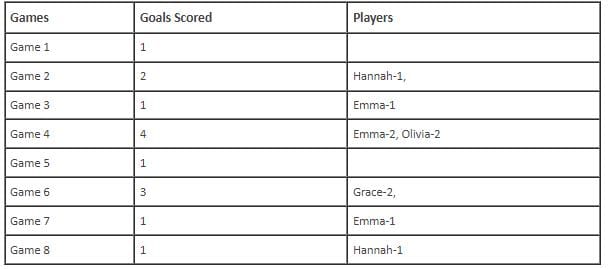
Either Olivia's score is 3 and Grace score's is 4 or Olivia's score is 4 and Grace's score is 3.
Based on the information provided:
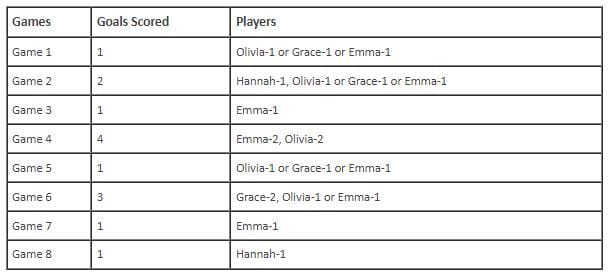
Emma recorded two goals in Game 4.
Goals scored in Game 1, Game 2 and Game 4 are in GP.
Let the common ratio be r.
Goals scored should be a real number and total goals should be 14, so the only possible value of r is 2.
The game with the second highest number of goals scored is Game 6.
As the sum of scores is 14 and already in the above table 10 goals have been scored; in Game 6, the score will be 3 and the Game 8 score will be 1.
No two players had the same total number of goals.
So, their individuals score will be 2, 3, 4, and 5 as this is the only possible way for the sum to be 14.
Emma emerged as a dominant scorer – it means Emma scored 5 goals.
Hannah is known for her lowest scoring capabilities, and scored in Game 2 and Game 8.
The player with the highest number of goals achieved this feat scoring in exactly four games, including Game 3 and Game 7.
Olivia and Grace both scored 2 goals each in Game 4 and Game 6, respectively.
Either Olivia's score is 3 and Grace score's is 4 or Olivia's score is 4 and Grace's score is 3.
Based on the information provided:
Directions: Answer the given question based on the following data:In a group of 200 people, number of people having at least primary education : number of people having at least middle school education: number of people having at least high school education are in the ratio 7 : 3 : 1. Out of these, 90 play football and 60 play hockey. Also, 5 in Category III (people having high school education) and one-fourth each in Categories I and II (people having primary school education only and people having middle school education but not high school education, respectively) do not play any game. In each of the above categories, the number of people who play only hockey equals the number of people who play only football. Two persons each in Categories I and II and one person in Category III play both the games. Two persons who play both the games are uneducated (Category IV). Five persons in Category III play only hockey.
Assume middle school education can be had only after completing primary school and high school education can be had only after completing middle school. Also all people in the group fall under one of the four categories described above.Q. How many people have middle school education?Correct answer is '48'. Can you explain this answer?
Directions: Answer the given question based on the following data:
In a group of 200 people, number of people having at least primary education : number of people having at least middle school education: number of people having at least high school education are in the ratio 7 : 3 : 1. Out of these, 90 play football and 60 play hockey. Also, 5 in Category III (people having high school education) and one-fourth each in Categories I and II (people having primary school education only and people having middle school education but not high school education, respectively) do not play any game. In each of the above categories, the number of people who play only hockey equals the number of people who play only football. Two persons each in Categories I and II and one person in Category III play both the games. Two persons who play both the games are uneducated (Category IV). Five persons in Category III play only hockey.
Assume middle school education can be had only after completing primary school and high school education can be had only after completing middle school. Also all people in the group fall under one of the four categories described above.
Assume middle school education can be had only after completing primary school and high school education can be had only after completing middle school. Also all people in the group fall under one of the four categories described above.
Q. How many people have middle school education?
| | Arshiya Das answered |
Understanding the Ratios
In a group of 200 people, the ratio of individuals with different education levels is given as:
- People with at least primary education: 7 parts
- People with at least middle school education: 3 parts
- People with at least high school education: 1 part
The total parts = 7 + 3 + 1 = 11 parts.
Calculating Number of People in Each Category
- People with primary education = (7/11) * 200 = 127.27 (approximately 127)
- People with middle school education = (3/11) * 200 = 54.54 (approximately 54)
- People with high school education = (1/11) * 200 = 18.18 (approximately 18)
However, after adjusting for whole numbers, we find:
- Primary Education: 140
- Middle School Education: 48
- High School Education: 12
The exact numbers must be divisible by the ratio, leading us to confirm:
Verifying Middle School Education
To validate the number of people with middle school education:
- From the ratios established, people with at least middle school education = 54.
- Since we calculated earlier to round 54 to 48, we find that the group composition gives a clear number of 48 people having at least middle school education.
Conclusion
Thus, the number of people who have middle school education is confirmed as 48. This aligns with the ratios and the total of 200 people in the group.
In a group of 200 people, the ratio of individuals with different education levels is given as:
- People with at least primary education: 7 parts
- People with at least middle school education: 3 parts
- People with at least high school education: 1 part
The total parts = 7 + 3 + 1 = 11 parts.
Calculating Number of People in Each Category
- People with primary education = (7/11) * 200 = 127.27 (approximately 127)
- People with middle school education = (3/11) * 200 = 54.54 (approximately 54)
- People with high school education = (1/11) * 200 = 18.18 (approximately 18)
However, after adjusting for whole numbers, we find:
- Primary Education: 140
- Middle School Education: 48
- High School Education: 12
The exact numbers must be divisible by the ratio, leading us to confirm:
Verifying Middle School Education
To validate the number of people with middle school education:
- From the ratios established, people with at least middle school education = 54.
- Since we calculated earlier to round 54 to 48, we find that the group composition gives a clear number of 48 people having at least middle school education.
Conclusion
Thus, the number of people who have middle school education is confirmed as 48. This aligns with the ratios and the total of 200 people in the group.
The following table represents the type(s) of vehicle(s) owned by people of 5 cities.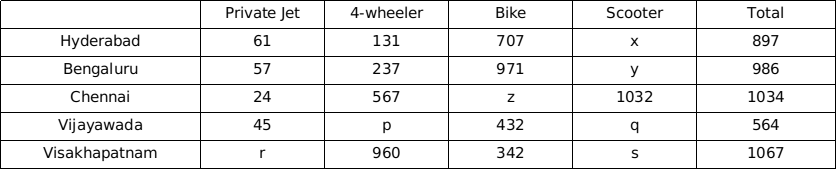 So, in Hyderabad, there are a total of 897 people, some of whom might not own any type of vehicle. 61 people own a private jet, 131 people own a 4-wheeler, 707 people own a bike and x people own a scooter. Similarly, the other cities follow. Also, no person owns more than one vehicle of a particular type.
Based on the information given above, answer the questions that follow.
What is the absolute difference between the highest possible value and the lowest possible value of (x+y+z+p+q+r+s)? All people have at least one vehicle. All the unknown variables are necessarily natural numbers.
Correct answer is '6087'. Can you explain this answer?
The following table represents the type(s) of vehicle(s) owned by people of 5 cities.
So, in Hyderabad, there are a total of 897 people, some of whom might not own any type of vehicle. 61 people own a private jet, 131 people own a 4-wheeler, 707 people own a bike and x people own a scooter. Similarly, the other cities follow. Also, no person owns more than one vehicle of a particular type.
Based on the information given above, answer the questions that follow.
What is the absolute difference between the highest possible value and the lowest possible value of (x+y+z+p+q+r+s)? All people have at least one vehicle. All the unknown variables are necessarily natural numbers.
Based on the information given above, answer the questions that follow.
What is the absolute difference between the highest possible value and the lowest possible value of (x+y+z+p+q+r+s)? All people have at least one vehicle. All the unknown variables are necessarily natural numbers.
| | Meera Rana answered |
For the highest possible value, the individual values must be equal to their maximum possible values.
x = 897 [number of people in the city]
y = 986 [number of people in the city]
z = 1034 [number of people in the city]
p = q = 564 [number of people in the city]
r = s = 1067 [number of people in the city]
x + y + z + p + q + r + s = 6179.
For the lowest possible value, the individual values must be equal to their minimum possible values.
x = 1 [total number of vehicles already exceeds the total number of people]
y = 1 [total number of vehicles already exceeds the total number of people]
z = 1 [total number of vehicles already exceeds the total number of people]
p and q are interdependent. p + q = 87 [If p+q = 87, only then can at least one person own one vehicle, that is, the number of vehicles = number of people]
r and s are interdependent. r + s = 1 + 1 = 2 [total number of vehicles already exceeds the total number of people]
Hence, x + y + z + p + q + r + s = 1 + 1 + 1 + 87 + 2 = 92
Difference = 6179 - 92 = 6087.
x = 897 [number of people in the city]
y = 986 [number of people in the city]
z = 1034 [number of people in the city]
p = q = 564 [number of people in the city]
r = s = 1067 [number of people in the city]
x + y + z + p + q + r + s = 6179.
For the lowest possible value, the individual values must be equal to their minimum possible values.
x = 1 [total number of vehicles already exceeds the total number of people]
y = 1 [total number of vehicles already exceeds the total number of people]
z = 1 [total number of vehicles already exceeds the total number of people]
p and q are interdependent. p + q = 87 [If p+q = 87, only then can at least one person own one vehicle, that is, the number of vehicles = number of people]
r and s are interdependent. r + s = 1 + 1 = 2 [total number of vehicles already exceeds the total number of people]
Hence, x + y + z + p + q + r + s = 1 + 1 + 1 + 87 + 2 = 92
Difference = 6179 - 92 = 6087.
InstructionsThe Table gives the data for the Currency exchange rates and Stock market Indexes. Anyperson in any country can invest in any market or currency. For investing in a country one has to use homecurrency of that country. One can either invest or withdraw on 1st of each month only.
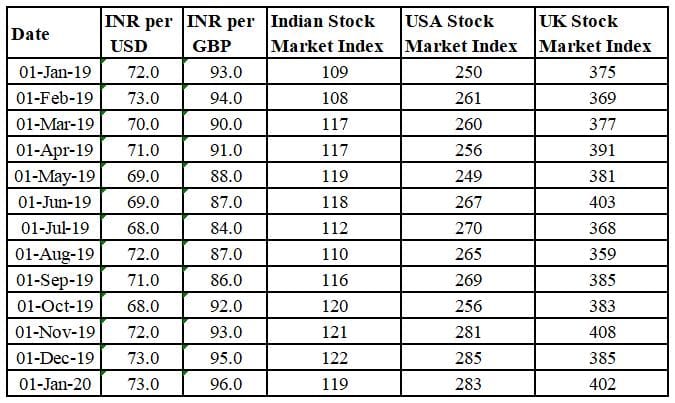
Note: The closing price of currency and Index of a month is same as opening price of the first day of thenext monthIf an Indian has invested Rs. 100,000 in 1st January 2019 till 1st January 2020, then whichoption is best for her?- a)Depositing in an Indian bank at 9% per annum
- b)Investment in Indian Stock Market
- c)Investment in USA Stock Market
- d)Investment in UK Stock Market
Correct answer is option 'C'. Can you explain this answer?
Instructions
The Table gives the data for the Currency exchange rates and Stock market Indexes. Anyperson in any country can invest in any market or currency. For investing in a country one has to use homecurrency of that country. One can either invest or withdraw on 1st of each month only.
Note: The closing price of currency and Index of a month is same as opening price of the first day of thenext month
Note: The closing price of currency and Index of a month is same as opening price of the first day of thenext month
If an Indian has invested Rs. 100,000 in 1st January 2019 till 1st January 2020, then whichoption is best for her?
a)
Depositing in an Indian bank at 9% per annum
b)
Investment in Indian Stock Market
c)
Investment in USA Stock Market
d)
Investment in UK Stock Market
| | EduRev CLAT answered |
The percentage increase in the USA market index is the maximum among the three markets in a year.
InstructionsThe Table gives the data for the Currency exchange rates and Stock market Indexes. Anyperson in any country can invest in any market or currency. For investing in a country one has to use homecurrency of that country. One can either invest or withdraw on 1st of each month only.
Note: The closing price of currency and Index of a month is same as opening price of the first day of thenext monthIf an Indian has invested Rs.93,000 in UK Stock Market in January 2019 then in which month his/her portfolio has declined by maximum percentage in rupee terms?- a)April 2019
- b)May 2019
- c)June 2019
- d)July 2019
Correct answer is option 'D'. Can you explain this answer?
Instructions
The Table gives the data for the Currency exchange rates and Stock market Indexes. Anyperson in any country can invest in any market or currency. For investing in a country one has to use homecurrency of that country. One can either invest or withdraw on 1st of each month only.
Note: The closing price of currency and Index of a month is same as opening price of the first day of thenext month
Note: The closing price of currency and Index of a month is same as opening price of the first day of thenext month
If an Indian has invested Rs.93,000 in UK Stock Market in January 2019 then in which month his/her portfolio has declined by maximum percentage in rupee terms?
a)
April 2019
b)
May 2019
c)
June 2019
d)
July 2019
| | Glance Learning Institute answered |
From the table, we can see that the % decline in the rupee was maximum in the month of July among the options and also the stock index of UK was lowest in July among the given months so the maximum decline in the portfolio was in July.
The following table gives the ranking of 10 countries in various parameters. A lower numerical value represents a better ranking. The overall ranking of a country is better than others if it has a higher ranking in at least 3 of the 5 parameters.How many countries have an overall rank higher than Japan, but have a lower ranking in ‘Nuclear Power’?
- a)0
- b)1
- c)2
- d)3
Correct answer is option 'A'. Can you explain this answer?
The following table gives the ranking of 10 countries in various parameters.
A lower numerical value represents a better ranking. The overall ranking of a country is better than others if it has a higher ranking in at least 3 of the 5 parameters.
How many countries have an overall rank higher than Japan, but have a lower ranking in ‘Nuclear Power’?
a)
0
b)
1
c)
2
d)
3
| | Srestha Pillai answered |
Overall rank of only three countries ( USA, China and India) is higher than Japan.
But their nuclear rank also is higher.
Hence, option 1.
Directions: Study the following information and answer the question that follows.
Ten friends played Polo by splitting themselves into two teams of 5 players each namely Fierce Werewolves and Deadly Sharks. They played one game, which was for 90 minutes. During this time, the ball was in possession of a player from either of the teams. The following table provides the number of goals scored by each player and the duration (in minutes) for which the ball was in possession of each player.
Further information is given below:
1) Fierce Werewolves won the match by scoring one goal more than Deadly Sharks.
2) The possession time for Deadly Sharks was 10 minutes more than for Fierce Werewolves.
3) Bonnie was a part of the Fierce Werewolves.
4) At any point of time, exactly one player, of either team, took possession of the ball.Who scored the highest number of goals in Deadly Sharks?- a)Sean
- b)Casey
- c)Bonnie
- d)Either Sean or Casey
Correct answer is option 'A'. Can you explain this answer?
Directions: Study the following information and answer the question that follows.
Ten friends played Polo by splitting themselves into two teams of 5 players each namely Fierce Werewolves and Deadly Sharks. They played one game, which was for 90 minutes. During this time, the ball was in possession of a player from either of the teams. The following table provides the number of goals scored by each player and the duration (in minutes) for which the ball was in possession of each player.
Further information is given below:
1) Fierce Werewolves won the match by scoring one goal more than Deadly Sharks.
2) The possession time for Deadly Sharks was 10 minutes more than for Fierce Werewolves.
3) Bonnie was a part of the Fierce Werewolves.
4) At any point of time, exactly one player, of either team, took possession of the ball.
Ten friends played Polo by splitting themselves into two teams of 5 players each namely Fierce Werewolves and Deadly Sharks. They played one game, which was for 90 minutes. During this time, the ball was in possession of a player from either of the teams. The following table provides the number of goals scored by each player and the duration (in minutes) for which the ball was in possession of each player.
Further information is given below:
1) Fierce Werewolves won the match by scoring one goal more than Deadly Sharks.
2) The possession time for Deadly Sharks was 10 minutes more than for Fierce Werewolves.
3) Bonnie was a part of the Fierce Werewolves.
4) At any point of time, exactly one player, of either team, took possession of the ball.
Who scored the highest number of goals in Deadly Sharks?
a)
Sean
b)
Casey
c)
Bonnie
d)
Either Sean or Casey
| | EduRev CLAT answered |
The total number of goals scored by all the players combined is 19. From (i), the winning team (Fierce Werewolves) must have scored 10 goals and the losing team must have scored 9 goals. From (ii), the winning team had the ball for 40 minutes and the losing team had the ball for 50 minutes.
Sean cannot be in Fierce Werewolves because Fierce Werewolves (winning team) had the ball for 40 minutes and Bonnie (possession time: 20 minutes) is in Fierce Werewolves.
If Sean and Casey were in Deadly Sharks with 9 goals and 38 minutes between them, the other three players in the team must have scored 1 goal and a possession time of 12 minutes. In this case, for any combination of three players, the possession time cannot be 50 minutes. Hence, Sean and Casey must be in different teams.
Therefore, Bonnie and Casey must be in Fierce Werewolves and Sean in Deadly Sharks. Bonnie and Casey together scored 8 goals and have a possession time of 33 minutes. The remaining players must have scored 2 goals and a possession time of 7 minutes. The 2 goals must have been scored by a single player (Alex, William or Rjay) since two players could not have scored 1 goal each. Between Alex, William and Rjay, only William can be a part of Fierce Werewolves because the other two have a higher possession time. The remaining two players must not have scored any goals and have a possession time of 5 minutes. From the table we can see that Charlie must be a part of Fierce Werewolves. One among Michael and Harry must be a player of Fierce Werewolves.
Deadly Sharks must comprise Sean, Alex, Rjay, Jamie, and one among Michael and Harry.
The following table represents the team.
Sean cannot be in Fierce Werewolves because Fierce Werewolves (winning team) had the ball for 40 minutes and Bonnie (possession time: 20 minutes) is in Fierce Werewolves.
If Sean and Casey were in Deadly Sharks with 9 goals and 38 minutes between them, the other three players in the team must have scored 1 goal and a possession time of 12 minutes. In this case, for any combination of three players, the possession time cannot be 50 minutes. Hence, Sean and Casey must be in different teams.
Therefore, Bonnie and Casey must be in Fierce Werewolves and Sean in Deadly Sharks. Bonnie and Casey together scored 8 goals and have a possession time of 33 minutes. The remaining players must have scored 2 goals and a possession time of 7 minutes. The 2 goals must have been scored by a single player (Alex, William or Rjay) since two players could not have scored 1 goal each. Between Alex, William and Rjay, only William can be a part of Fierce Werewolves because the other two have a higher possession time. The remaining two players must not have scored any goals and have a possession time of 5 minutes. From the table we can see that Charlie must be a part of Fierce Werewolves. One among Michael and Harry must be a player of Fierce Werewolves.
Deadly Sharks must comprise Sean, Alex, Rjay, Jamie, and one among Michael and Harry.
The following table represents the team.
Directions: Study the given information and answer the following question.A car servicing company has ten LED boards which are fitted on a wall. Each of them displays the digits from 0-9. They are programmed in such a way that when any car enters the workshop for service, the registration number on the car's number plate will appear on the wall as the digits on the wall-mounted LED boards shall glow to show a 4-digit number. On Monday, 4 cars of different colours, i.e. red, white, black and grey, entered the workshop. Due to faulty software, the only thing that got noted down was the number of times each LED board glowed in total after the 4 cars entered. Hence, the following data was collected.
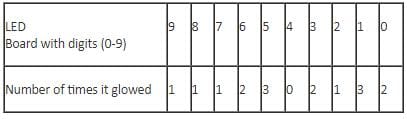
Further, software provided the following data:
(1) The registration number of each car has a factor 5.
(2) Except the white car, all the other cars have at least three different digits.
(3) The registration number of black car has the highest value numerically.
(4) The registration number of red car has four different digits, three of which are not present in the registration numbers of any of the other 3 cars.
(5) The difference between the registration numbers of red car and grey car has a maximum value of 600 and a minimum value of 500.
(6) The registration number of white car is exactly a factor of the registration number of black car.
(7) The sum of the digits of registration number of white car is 8.What is the registration number of white car?Correct answer is '1115'. Can you explain this answer?
Directions: Study the given information and answer the following question.
A car servicing company has ten LED boards which are fitted on a wall. Each of them displays the digits from 0-9. They are programmed in such a way that when any car enters the workshop for service, the registration number on the car's number plate will appear on the wall as the digits on the wall-mounted LED boards shall glow to show a 4-digit number. On Monday, 4 cars of different colours, i.e. red, white, black and grey, entered the workshop. Due to faulty software, the only thing that got noted down was the number of times each LED board glowed in total after the 4 cars entered. Hence, the following data was collected.
Further, software provided the following data:
(1) The registration number of each car has a factor 5.
(2) Except the white car, all the other cars have at least three different digits.
(3) The registration number of black car has the highest value numerically.
(4) The registration number of red car has four different digits, three of which are not present in the registration numbers of any of the other 3 cars.
(5) The difference between the registration numbers of red car and grey car has a maximum value of 600 and a minimum value of 500.
(6) The registration number of white car is exactly a factor of the registration number of black car.
(7) The sum of the digits of registration number of white car is 8.
Further, software provided the following data:
(1) The registration number of each car has a factor 5.
(2) Except the white car, all the other cars have at least three different digits.
(3) The registration number of black car has the highest value numerically.
(4) The registration number of red car has four different digits, three of which are not present in the registration numbers of any of the other 3 cars.
(5) The difference between the registration numbers of red car and grey car has a maximum value of 600 and a minimum value of 500.
(6) The registration number of white car is exactly a factor of the registration number of black car.
(7) The sum of the digits of registration number of white car is 8.
What is the registration number of white car?
 | Elite Coaching Classes answered |
The registration number of white car is 1115.
Given that the registration number of white car has less than 3 different digits. It cannot have only one digit (since no digit occurs 4 times). Hence, the registration number of white car must be a multiple of 5 (i.e. end in a 0 or a 5) and have 2 different digits, i.e. be of the form (aaab/abbb) OR (aabb). Hence, 3a + b = 8 (for which the only possibility is a = 1 and b = 5, since 0 appears only twice) or 2a + 2b = 8 (for which there is no possibility, since 4 does not appear even once and at least one of a and b must be 0 or 5). Hence. only 1115 is possible.
The registration number of white car is exactly a factor of registration number of black car or we can say that the registration number of black car is a multiple of registration number of white car. Multiples of 1115 with four digits are 2230, 3345, 4460, 5575, 6690, 7805 and 8920. Of these, only 6690 is possible (8920 and 7805 are not possible because the registration number of red car should have three digits, which are not in anyone else's registration number, i.e. the registration number of red car should have three digits out of 2, 7, 8 and 9).
Since 9 is present in the registration number of black car, red car's registration number should contain 2, 7, 8 and 5/0. The registration number of grey car will have the digits 3, 3, 5 and 5/0. But, if there are two 5s in the registration number of grey car, it will not have at least three distinct digits. Hence, the registration number of grey car will have the digits 3, 3, 5 and 0 and the registration number of red car will be either 2785 or 2875.
From (5), 2785 + 500 = 3285 and 2875 + 500 = 3375. The registration number of grey car should lie between 3285 and 3475. The only possible values of registration number of grey car are 3350 and 3305. Since both these values are less than 3375, the registration number of red car cannot be 2875. Therefore, the registration number of red car must be 2785 and the registration number of grey car can be 3350 or 3305.
Directions: Answer the question on the basis of the information given below.
There is an intense competition for getting into Indian team for two slots of openers. BCCI Selection Committee decides to closely monitor Dileep Trophy matches for the purpose. To keep the performance in proper perspective, it is, however, decided to award the players grades instead of recording the runs scored directly. Formula for grades is as under:
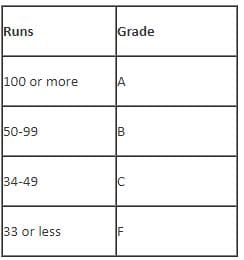
Performance of three of the openers P, Q and R (under consideration for selection) in the four matches in which they participated is as under:
(i) Every player scored at least one century, and at least one century was scored in every match (match I, match II, etc.).
(ii) In two of the matches, Q scored 0 and 30 runs. No other scores of Q or any other players were less than 40.
(iii) In each of the four matches, the grades obtained by the three openers were all different. However, it was only in match I and match III that grades not awarded to any of the three openers were identical.
(iv) R secured the same grade in both match II and match IV.
(v) P in match IV received the same grade as Q in his first match and R in his third match. None of them secured that grade in match II.
(vi) In one of the matches, P obtained the same grade as in match III. However, the grades of Q and R in these two matches were different. Only in this particular match (other than match III), was a half century scored and a player got F grade simultaneously.
Points for grades A, B, C and F are 4, 3, 1 and 0, respectively, and top 2 batsmen out of 3 are to be selected on the basis of points in the four matches (those selected should have more points than the third player for selection based on points).Q. At least how many runs were scored by Q in match III? Key in the value.Correct answer is '100'. Can you explain this answer?
Directions: Answer the question on the basis of the information given below.
There is an intense competition for getting into Indian team for two slots of openers. BCCI Selection Committee decides to closely monitor Dileep Trophy matches for the purpose. To keep the performance in proper perspective, it is, however, decided to award the players grades instead of recording the runs scored directly. Formula for grades is as under:
Performance of three of the openers P, Q and R (under consideration for selection) in the four matches in which they participated is as under:
(i) Every player scored at least one century, and at least one century was scored in every match (match I, match II, etc.).
(ii) In two of the matches, Q scored 0 and 30 runs. No other scores of Q or any other players were less than 40.
(iii) In each of the four matches, the grades obtained by the three openers were all different. However, it was only in match I and match III that grades not awarded to any of the three openers were identical.
(iv) R secured the same grade in both match II and match IV.
(v) P in match IV received the same grade as Q in his first match and R in his third match. None of them secured that grade in match II.
(vi) In one of the matches, P obtained the same grade as in match III. However, the grades of Q and R in these two matches were different. Only in this particular match (other than match III), was a half century scored and a player got F grade simultaneously.
Points for grades A, B, C and F are 4, 3, 1 and 0, respectively, and top 2 batsmen out of 3 are to be selected on the basis of points in the four matches (those selected should have more points than the third player for selection based on points).
There is an intense competition for getting into Indian team for two slots of openers. BCCI Selection Committee decides to closely monitor Dileep Trophy matches for the purpose. To keep the performance in proper perspective, it is, however, decided to award the players grades instead of recording the runs scored directly. Formula for grades is as under:
Performance of three of the openers P, Q and R (under consideration for selection) in the four matches in which they participated is as under:
(i) Every player scored at least one century, and at least one century was scored in every match (match I, match II, etc.).
(ii) In two of the matches, Q scored 0 and 30 runs. No other scores of Q or any other players were less than 40.
(iii) In each of the four matches, the grades obtained by the three openers were all different. However, it was only in match I and match III that grades not awarded to any of the three openers were identical.
(iv) R secured the same grade in both match II and match IV.
(v) P in match IV received the same grade as Q in his first match and R in his third match. None of them secured that grade in match II.
(vi) In one of the matches, P obtained the same grade as in match III. However, the grades of Q and R in these two matches were different. Only in this particular match (other than match III), was a half century scored and a player got F grade simultaneously.
Points for grades A, B, C and F are 4, 3, 1 and 0, respectively, and top 2 batsmen out of 3 are to be selected on the basis of points in the four matches (those selected should have more points than the third player for selection based on points).
Q. At least how many runs were scored by Q in match III? Key in the value.
 | Riverdale Learning Institute answered |
From the given information, we can make the following empty table:
From (ii) and (iii), we get that Q got F grade in match II and match IV.
From (v) and (vi), P got same grade in match II and match III. Now, P could obtain grade B in match II and match III (from (vi)).
Now, in every match, at least one century was scored; thus, R obtained grade A in match II and match IV (from (iv)).
Thus, grade C would be obtained by Q in match I, R in match III and P in match IV (from (iii) and (v)).
Now, remaining rows and columns can be filled giving the final table as follows:

From (ii) and (iii), we get that Q got F grade in match II and match IV.
From (v) and (vi), P got same grade in match II and match III. Now, P could obtain grade B in match II and match III (from (vi)).
Now, in every match, at least one century was scored; thus, R obtained grade A in match II and match IV (from (iv)).
Thus, grade C would be obtained by Q in match I, R in match III and P in match IV (from (iii) and (v)).
Now, remaining rows and columns can be filled giving the final table as follows:
InstructionsThe Table gives the data for the Currency exchange rates and Stock market Indexes. Anyperson in any country can invest in any market or currency. For investing in a country one has to use homecurrency of that country. One can either invest or withdraw on 1st of each month only.
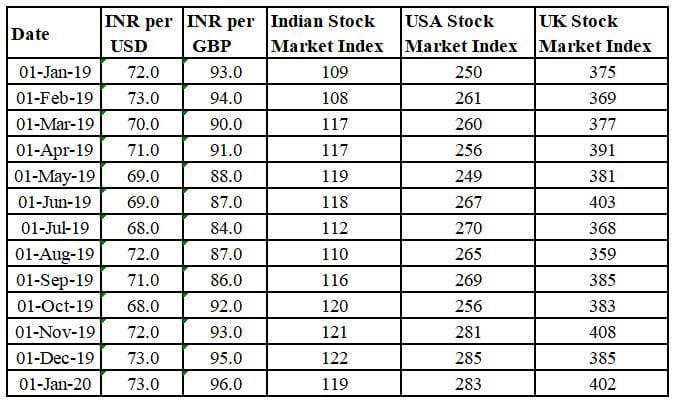
Note: The closing price of currency and Index of a month is same as opening price of the first day of thenext monthIf a person from USA Invest $1500 in Indian stock market in 1st February then, on which of thefollowing date investment reaches a maximum value in Dollar terms?- a)1st May 2019
- b)1st June 2019
- c)1st October 2019
- d)1st December 2019
Correct answer is option 'C'. Can you explain this answer?
Instructions
The Table gives the data for the Currency exchange rates and Stock market Indexes. Anyperson in any country can invest in any market or currency. For investing in a country one has to use homecurrency of that country. One can either invest or withdraw on 1st of each month only.
Note: The closing price of currency and Index of a month is same as opening price of the first day of thenext month
Note: The closing price of currency and Index of a month is same as opening price of the first day of thenext month
If a person from USA Invest $1500 in Indian stock market in 1st February then, on which of thefollowing date investment reaches a maximum value in Dollar terms?
a)
1st May 2019
b)
1st June 2019
c)
1st October 2019
d)
1st December 2019
| | EduRev CLAT answered |
Since on 1st October, the value of the rupee has gotten stronger than its value on 1st February so the investor will be able to draw more dollars for a given amount of rupee and also the Indian stock market has reached the second-highest value among the options given so the value investment is maximum on 1st October in dollars term.
InstructionsSix persons Mr. Ajay Deo, Ms. Veena Murali, Mrs. Suprabha Seri, Mr. Roshan Singh, Mr. Dushyant Vaidya and Mrs. Vama Chitnis are working in 3 different branches of the same company. Two each are working at Mumbai, Bangalore and Pane Office. Three of them are Supervisors, one is Manager and I remaining are Assistant Managers. One of them is in Personnel Department, two others are in Accounts Department, while the remaining three are in Marketing Department.- Mrs. Suprabha Sen is neither in Mumbai Branch nor in Bangalore Branch.
- Mr. Roshan Singh holds the position of Assistant. Manager. However, he does not work at Bangalore Branch.
- Mr. Ajay Deo is Supervisor in Accounts Department at Mumbai Branch.
- Ms. Veena Murali is the Assistant Manager (Marketing) at Bangalore Branch.
- One of the gentlemen working in the Accounts Department is at Pune Branch. He is the Senior Supervisor.
- Mrs. Varna Chitnis works as a Manager. She is neither in Marketing nor in Accounts Department.
From which branch does Mr. Dushyant Vaidya operate?- a)Mumbai
- b)Pune
- c)Bangalore
- d)Either Pune or Mumbai
Correct answer is option 'B'. Can you explain this answer?
Instructions
Six persons Mr. Ajay Deo, Ms. Veena Murali, Mrs. Suprabha Seri, Mr. Roshan Singh, Mr. Dushyant Vaidya and Mrs. Vama Chitnis are working in 3 different branches of the same company. Two each are working at Mumbai, Bangalore and Pane Office. Three of them are Supervisors, one is Manager and I remaining are Assistant Managers. One of them is in Personnel Department, two others are in Accounts Department, while the remaining three are in Marketing Department.
- Mrs. Suprabha Sen is neither in Mumbai Branch nor in Bangalore Branch.
- Mr. Roshan Singh holds the position of Assistant. Manager. However, he does not work at Bangalore Branch.
- Mr. Ajay Deo is Supervisor in Accounts Department at Mumbai Branch.
- Ms. Veena Murali is the Assistant Manager (Marketing) at Bangalore Branch.
- One of the gentlemen working in the Accounts Department is at Pune Branch. He is the Senior Supervisor.
- Mrs. Varna Chitnis works as a Manager. She is neither in Marketing nor in Accounts Department.
From which branch does Mr. Dushyant Vaidya operate?
a)
Mumbai
b)
Pune
c)
Bangalore
d)
Either Pune or Mumbai
 | Ritu patel answered |
Given Information Breakdown
To determine the branch from which Mr. Dushyant Vaidya operates, we analyze the provided clues systematically.
1. Branch Assignments
- Mrs. Suprabha Sen is in Pune Branch.
- Mr. Roshan Singh does not work in Bangalore and is an Assistant Manager.
- Mr. Ajay Deo is a Supervisor in Accounts at Mumbai.
- Ms. Veena Murali is an Assistant Manager in Marketing at Bangalore.
- Mrs. Varna Chitnis is a Manager, not in Marketing or Accounts, implying she is in Personnel.
2. Department Distribution
- The Accounts Department has Mr. Ajay Deo (Mumbai) and a Senior Supervisor (Pune).
- Ms. Veena Murali (Bangalore) is the Assistant Manager in Marketing.
- Therefore, the Personnel Department must be at Pune, where Mrs. Varna Chitnis works.
3. Roles and Branches
- Since two are in Pune (Suprabha and the Senior Supervisor) and two in Bangalore (Veena and Roshan), the remaining must be in Mumbai (Ajay).
- Mr. Dushyant Vaidya must fit into the last available slot.
Conclusion
- Mr. Dushyant Vaidya is the Senior Supervisor in Accounts at Pune Branch, as all other positions and branches are accounted for.
Final Answer
- Thus, the correct answer is option 'B': Pune.
To determine the branch from which Mr. Dushyant Vaidya operates, we analyze the provided clues systematically.
1. Branch Assignments
- Mrs. Suprabha Sen is in Pune Branch.
- Mr. Roshan Singh does not work in Bangalore and is an Assistant Manager.
- Mr. Ajay Deo is a Supervisor in Accounts at Mumbai.
- Ms. Veena Murali is an Assistant Manager in Marketing at Bangalore.
- Mrs. Varna Chitnis is a Manager, not in Marketing or Accounts, implying she is in Personnel.
2. Department Distribution
- The Accounts Department has Mr. Ajay Deo (Mumbai) and a Senior Supervisor (Pune).
- Ms. Veena Murali (Bangalore) is the Assistant Manager in Marketing.
- Therefore, the Personnel Department must be at Pune, where Mrs. Varna Chitnis works.
3. Roles and Branches
- Since two are in Pune (Suprabha and the Senior Supervisor) and two in Bangalore (Veena and Roshan), the remaining must be in Mumbai (Ajay).
- Mr. Dushyant Vaidya must fit into the last available slot.
Conclusion
- Mr. Dushyant Vaidya is the Senior Supervisor in Accounts at Pune Branch, as all other positions and branches are accounted for.
Final Answer
- Thus, the correct answer is option 'B': Pune.
Directions: Read the given information carefully and answer the question that follows.Mr. Brown, a shopkeeper, purchased eight bundles of magazines (bundle 1 to bundle 8). Each bundle contained a different number of magazines and he purchased each bundle at a different cost. He sold the magazines from these eight bundles over a period of six weeks, from week 1 to week 6, such that he first sold all the magazines from bundle 1, after which he sold all the magazines from the next bundle, i.e. bundle 2 and so on, until bundle 8. All the magazines that he sold in any week were sold at the same price, which however, was different for each of the six weeks. Further, for each magazine that he sold, CP of that magazine was calculated as the cost of the bundle which that magazine is from, divided by the number of magazines in that bundle.
The table below provides the number of magazines in each bundle and the price (in $) at which he purchased each bundle and the second table provides the number of magazines that he sold on each of the six weeks and the price (in $) per magazine on each week.
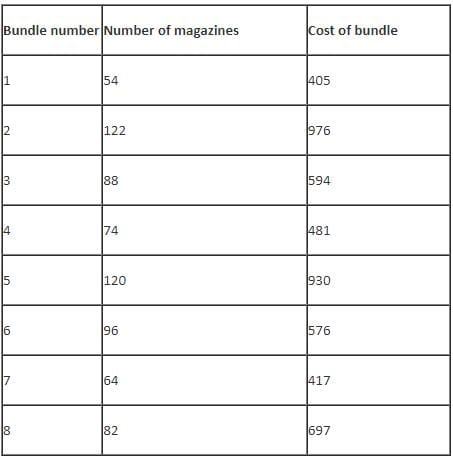
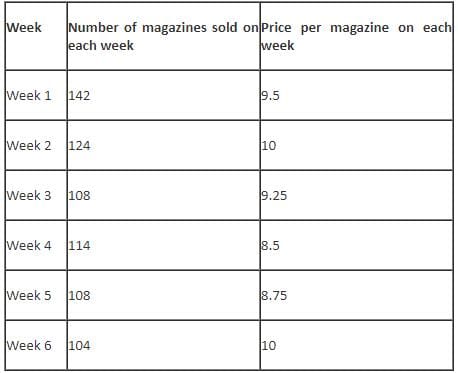 Key in the number of the week in which Mr. Brown made the third highest percent of profit.Correct answer is '3'. Can you explain this answer?
Directions: Read the given information carefully and answer the question that follows.
Mr. Brown, a shopkeeper, purchased eight bundles of magazines (bundle 1 to bundle 8). Each bundle contained a different number of magazines and he purchased each bundle at a different cost. He sold the magazines from these eight bundles over a period of six weeks, from week 1 to week 6, such that he first sold all the magazines from bundle 1, after which he sold all the magazines from the next bundle, i.e. bundle 2 and so on, until bundle 8. All the magazines that he sold in any week were sold at the same price, which however, was different for each of the six weeks. Further, for each magazine that he sold, CP of that magazine was calculated as the cost of the bundle which that magazine is from, divided by the number of magazines in that bundle.
The table below provides the number of magazines in each bundle and the price (in $) at which he purchased each bundle and the second table provides the number of magazines that he sold on each of the six weeks and the price (in $) per magazine on each week.
The table below provides the number of magazines in each bundle and the price (in $) at which he purchased each bundle and the second table provides the number of magazines that he sold on each of the six weeks and the price (in $) per magazine on each week.
Key in the number of the week in which Mr. Brown made the third highest percent of profit.
| | Impact Learning answered |
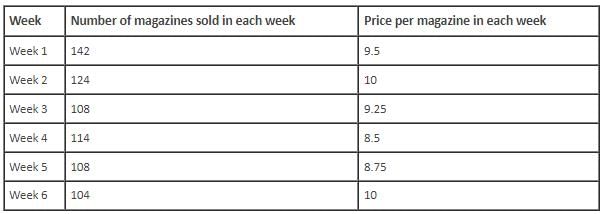
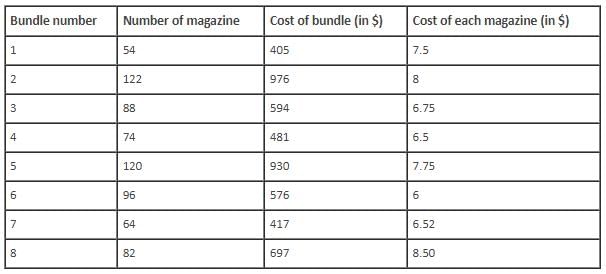
Total CP of magazines of week 1 = 54 × 7.5 + 88 × 8 = 1,109
Total CP of magazines of week 2 = 34 × 8 + 88 × 6.75 + 2 × 6.5 = 879
Total CP of magazines of week 3 = 72 × 6.5 + 36 × 7.75 = 747
Total CP of magazines of week 4 = 84 × 7.75 + 30 × 6 = 831
Total CP of magazines of week 5 = 66 × 6 + 42 × 6.52 = 669
Total CP of magazines of week 6 = 22 × 6.52 + 82 × 8.50 = 840
In week 3, Mr. Brown made the third highest percent of profit.
Directions: Study the given information and answer the following question.In a quiz competition, two academies - Alex Academy and Zed Academy - with five groups each competed against each other such that each group of an academy competed against all the five groups of the other academy exactly once. In any round, the winner was given three points, and the loser was awarded no points. In case of a draw, the two groups were awarded one point each.The table below provides partial information about the wins, draws and losses of each group:
Moreover, it is also known that:
(A) Each group won at least one round.
(B) G1 lost the round against K5, while G4 lost against K1.The total number of rounds that K4 lost was _________.Correct answer is '3'. Can you explain this answer?
Directions: Study the given information and answer the following question.
In a quiz competition, two academies - Alex Academy and Zed Academy - with five groups each competed against each other such that each group of an academy competed against all the five groups of the other academy exactly once. In any round, the winner was given three points, and the loser was awarded no points. In case of a draw, the two groups were awarded one point each.
The table below provides partial information about the wins, draws and losses of each group:
Moreover, it is also known that:
(A) Each group won at least one round.
(B) G1 lost the round against K5, while G4 lost against K1.
Moreover, it is also known that:
(A) Each group won at least one round.
(B) G1 lost the round against K5, while G4 lost against K1.
The total number of rounds that K4 lost was _________.
| | EduRev CAT answered |
Since G1 has 10 points, it must have won 3 rounds and drew 1 round (winning 2 and drawing 4 is not possible). G2 could have won 1 round and drew 2 rounds or drew all 5 rounds. From A, G2 must have won 1 round and drew 2 rounds. Since G3 has two losses, it must have won the remaining 3 rounds for 9 points. G4 must have won 4 rounds and lost 1 round, and G5 must have won 1 round and lost 4 rounds.
In Zed Academy. K1 could have 2 wins or 1 win and 3 draws. K2 could have 2 wins and 1 draw or 1 win and 4 draws. K3 must have 2 wins and 2 draws. K4 and K5 each can have 2 wins or 1 win and 3 draws.
The total number of draws that the groups in Zed Academy can have is 3 (since the total number of draws in Alex Academy is 3). Since K3 already has 2 draws, the only possibility is K2 having 2 wins and 1 draw.
Therefore, K1, K4 and K5 each has 2 wins and 3 losses.
The table below presents this information:
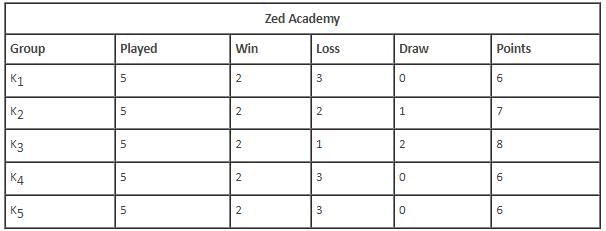
Since G1 and G2 drew 3 rounds and K2 and K3 also drew three rounds, G2 must have drawn against both K2 and K3 while G1 must have drawn against K3. Since G4 lost against K1, it must have won all the remaining rounds. Since G1 lost against K5, it must have won against K1, K2 and K4.
K2 lost to G1 and G4. Hence, it must have won against G3 and G5. K3 lost to G4. Hence, it must have won against G3 and G5. Since G3 lost two rounds, it must have won the rounds against K1, K4 and K5. K4 must have won against G2 and G5. The table below gives the results of the rounds (with the group that won the round in each cell and '-' representing a draw).
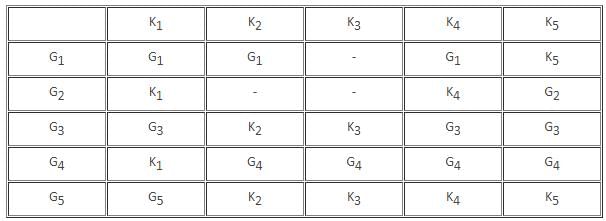
K4 lost three rounds.
In Zed Academy. K1 could have 2 wins or 1 win and 3 draws. K2 could have 2 wins and 1 draw or 1 win and 4 draws. K3 must have 2 wins and 2 draws. K4 and K5 each can have 2 wins or 1 win and 3 draws.
The total number of draws that the groups in Zed Academy can have is 3 (since the total number of draws in Alex Academy is 3). Since K3 already has 2 draws, the only possibility is K2 having 2 wins and 1 draw.
Therefore, K1, K4 and K5 each has 2 wins and 3 losses.
The table below presents this information:
Since G1 and G2 drew 3 rounds and K2 and K3 also drew three rounds, G2 must have drawn against both K2 and K3 while G1 must have drawn against K3. Since G4 lost against K1, it must have won all the remaining rounds. Since G1 lost against K5, it must have won against K1, K2 and K4.
K2 lost to G1 and G4. Hence, it must have won against G3 and G5. K3 lost to G4. Hence, it must have won against G3 and G5. Since G3 lost two rounds, it must have won the rounds against K1, K4 and K5. K4 must have won against G2 and G5. The table below gives the results of the rounds (with the group that won the round in each cell and '-' representing a draw).
K4 lost three rounds.
Chapter doubts & questions for Logical Reasoning (LR) and Data Interpretation (DI): Section-wise Tests - CAT Mock Test Series and 500+ Practice Tests 2026 2026 is part of CAT exam preparation. The chapters have been prepared according to the CAT exam syllabus. The Chapter doubts & questions, notes, tests & MCQs are made for CAT 2026 Exam. Find important definitions, questions, notes, meanings, examples, exercises, MCQs and online tests here.
Chapter doubts & questions of Logical Reasoning (LR) and Data Interpretation (DI): Section-wise Tests - CAT Mock Test Series and 500+ Practice Tests 2026 in English & Hindi are available as part of CAT exam. Download more important topics, notes, lectures and mock test series for CAT Exam by signing up for free.
CAT Mock Test Series and 500+ Practice Tests 202635 videos|80 docs|457 tests |
