


All Exams > CAT > CAT Mock Test Series and 500+ Practice Tests 2026 > All Questions
All questions of Profit, Loss and Discount for CAT Exam
A sells a car to B at 10% loss. If B sells it for Rs. 54000 and gains 20%, the cost price of the car for A was
a)Rs. 25000
b)Rs. 50000
c)Rs. 37500
d)Rs. 60000
Correct answer is option 'B'. Can you explain this answer?
 | Gaurav Datta answered |
Selling price of the car = Rs.54,000
gain 20%
Friend's cost price of the car = Rs. 54000 x 100/120 = Rs.45,000
Now selling price of the car of the first owner Rs.45000
Loss 10%
Cost price of the car = 45000 x 100/90
= Rs.50,000
gain 20%
Friend's cost price of the car = Rs. 54000 x 100/120 = Rs.45,000
Now selling price of the car of the first owner Rs.45000
Loss 10%
Cost price of the car = 45000 x 100/90
= Rs.50,000

If a material is sold for Rs.34.80, there is a loss of 25%. Find out the cost price of the material?
- a)Rs.46.40
- b)Rs.44
- c)Rs.42
- d)Rs.47.20
Correct answer is option 'A'. Can you explain this answer?
If a material is sold for Rs.34.80, there is a loss of 25%. Find out the cost price of the material?
a)
Rs.46.40
b)
Rs.44
c)
Rs.42
d)
Rs.47.20
 | EduRev CAT answered |
The correct answer is A as
cost price
=34.80×100/75
=46.40
cost price
=34.80×100/75
=46.40
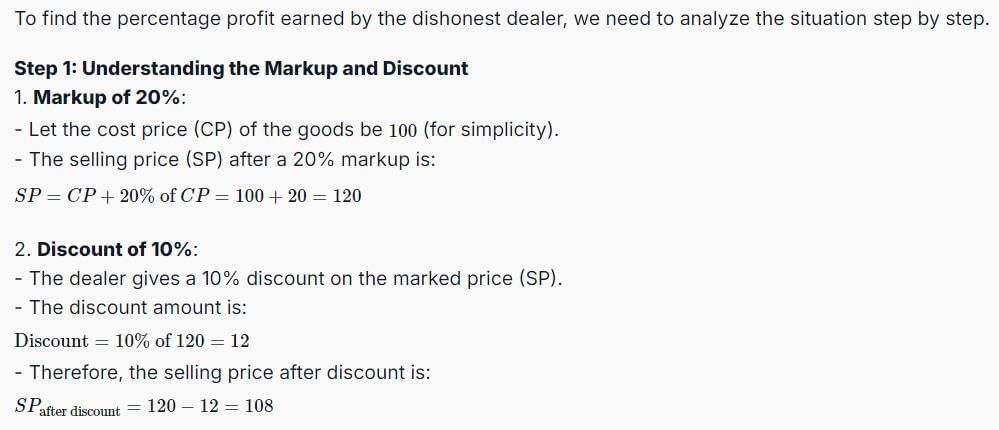
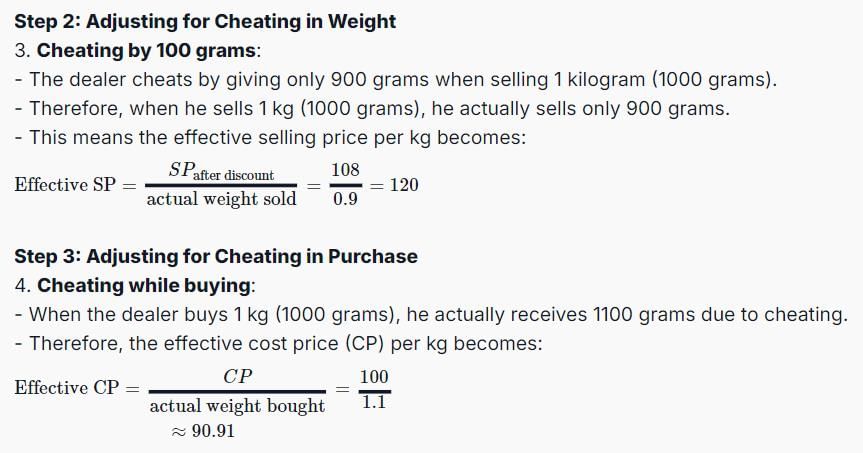
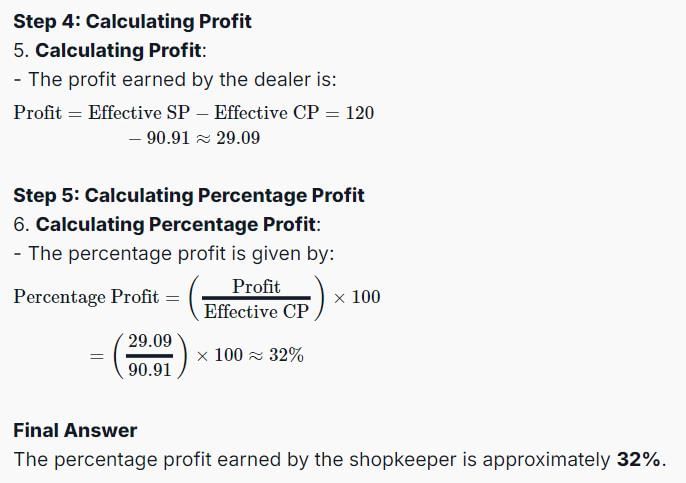
A dishonest dealer marks up the price of his goods by 20% and gives a discount of 10% to the customer. Besides, he also cheats both his supplier and his buyer by 100 grams while buying or selling 1 kilogram. Find the percentage profit earned by the shopkeeper.- a)20%
- b)25%
- c)27.5%
- d)32%
Correct answer is option 'D'. Can you explain this answer?
A dishonest dealer marks up the price of his goods by 20% and gives a discount of 10% to the customer. Besides, he also cheats both his supplier and his buyer by 100 grams while buying or selling 1 kilogram. Find the percentage profit earned by the shopkeeper.
a)
20%
b)
25%
c)
27.5%
d)
32%
 | Arya Roy answered |
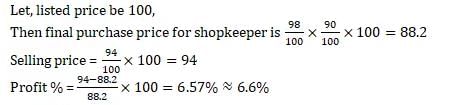
A shopkeeper purchases his goods at a discount of 10% on the list price. He normally gives a discount of 6% to his customers. If during a special scheme, he gets an additional discount of 2% on his purchase price, find his approximate profit percentage.a)8.8%b)7.8%c)6.6%d)None of theseCorrect answer is option 'C'. Can you explain this answer?
 | Aisha Gupta answered |

John buys an old scooter for Rs. 4700 and spends Rs. 800 on its repairs. If he sells the scooter for Rs. 5800, what is his gain percent ?- a)12%
- b)10%
- c)4 + 4 / 7%
- d)5 + 5 / 11%
Correct answer is option 'D'. Can you explain this answer?
John buys an old scooter for Rs. 4700 and spends Rs. 800 on its repairs. If he sells the scooter for Rs. 5800, what is his gain percent ?
a)
12%
b)
10%
c)
4 + 4 / 7%
d)
5 + 5 / 11%
 | Milan Chaudhary answered |
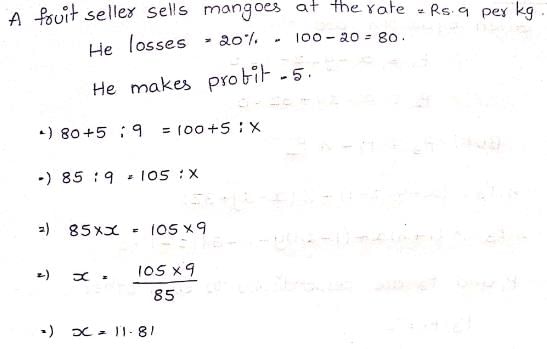
Whenever we get this type of question, we should have formula in mind that,
Gain% = (gain/cost) x 100
Cost = 4700 + 800 = Rs. 5500
S.P. = Rs. 5800
Profit = 5800 - 5500 = 300
Gain% = (gain/cost) x 100
Cost = 4700 + 800 = Rs. 5500
S.P. = Rs. 5800
Profit = 5800 - 5500 = 300
Sunny marks up his goods by 40% and gives a discount of 10%. Apart from this, he uses a faulty balance which reads 800 gms for 1000 gms. What is his net profit/ loss percentage?- a)37.5%
- b)57.2%
- c)8%
- d)None of these
Correct answer is option 'A'. Can you explain this answer?
Sunny marks up his goods by 40% and gives a discount of 10%. Apart from this, he uses a faulty balance which reads 800 gms for 1000 gms. What is his net profit/ loss percentage?
a)
37.5%
b)
57.2%
c)
8%
d)
None of these
| | Ravi Singh answered |
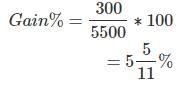
Since he sells the goods at a discount the selling price will be (40% - 10%) = 30% profit.
The profit is 30%.
Lets take the buying price as x.
The profit on the 1000g rather 1 kg will be 30% of x.
This gives us 0.3x
In reality this is the profit for 800 g.
The profit he gets for 1000g will be :
1000/800 × 0.3x = 0.375x
To change this to percentage it becomes :
0.375x/x × 100% = 37.5
The overall percentage profit gained by the seller will be given as : 37.5%
A man sells a TV set for Rs. 33000 and makes a profit of 10%. He sells another TV at a loss of 20%. If on the whole, he neither gains nor loses, find the selling price of the second TV set.- a)Rs.15,000
- b)Rs.30,000
- c)Rs.12,000
- d)Rs.27,000
Correct answer is option 'C'. Can you explain this answer?
A man sells a TV set for Rs. 33000 and makes a profit of 10%. He sells another TV at a loss of 20%. If on the whole, he neither gains nor loses, find the selling price of the second TV set.
a)
Rs.15,000
b)
Rs.30,000
c)
Rs.12,000
d)
Rs.27,000
 | Ishani Rane answered |
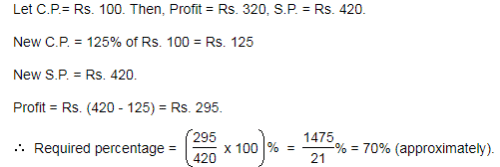
Let's denote the cost price of the first TV as CP1, the cost price of the second TV as CP2, and the selling price of the second TV as SP2.
The man makes a profit of 10% on the first TV, so we can write the selling price of the first TV as:
SP1 = CP1 + 10% of CP1
33000 = CP1 + 0.1 * CP1
33000 = 1.1 * CP1
CP1 = 33000 / 1.1
CP1 = 30000
He sells the second TV at a loss of 20%, so we can write the selling price of the second TV as:
SP2 = CP2 - 20% of CP2
SP2 = 0.8 * CP2
Since he neither gains nor loses on the whole, the total cost price equals the total selling price:
CP1 + CP2 = SP1 + SP2
We already know the values of CP1 and SP1, so we can substitute them in the equation:
30000 + CP2 = 33000 + SP2
We also know that SP2 = 0.8 * CP2, so we can substitute that as well:
30000 + CP2 = 33000 + 0.8 * CP2
Now, we can solve for CP2:
0.2 * CP2 = 3000
CP2 = 15000
Now that we have the cost price of the second TV, we can find its selling price using the relation we found earlier:
SP2 = 0.8 * CP2
SP2 = 0.8 * 15000
SP2 = 12000
So the selling price of the second TV set is Rs. 12000.
The man makes a profit of 10% on the first TV, so we can write the selling price of the first TV as:
SP1 = CP1 + 10% of CP1
33000 = CP1 + 0.1 * CP1
33000 = 1.1 * CP1
CP1 = 33000 / 1.1
CP1 = 30000
He sells the second TV at a loss of 20%, so we can write the selling price of the second TV as:
SP2 = CP2 - 20% of CP2
SP2 = 0.8 * CP2
Since he neither gains nor loses on the whole, the total cost price equals the total selling price:
CP1 + CP2 = SP1 + SP2
We already know the values of CP1 and SP1, so we can substitute them in the equation:
30000 + CP2 = 33000 + SP2
We also know that SP2 = 0.8 * CP2, so we can substitute that as well:
30000 + CP2 = 33000 + 0.8 * CP2
Now, we can solve for CP2:
0.2 * CP2 = 3000
CP2 = 15000
Now that we have the cost price of the second TV, we can find its selling price using the relation we found earlier:
SP2 = 0.8 * CP2
SP2 = 0.8 * 15000
SP2 = 12000
So the selling price of the second TV set is Rs. 12000.
A shopkeeper purchases a packet of 50 pens at Rs 10 per pen. He sells a part of the packet at a profit of 30%. On the remaining part, he incurs a loss of 10%. If his overall profit on the whole packet is 10%, the number of pens he sold at profit isa)25b)30c)20d)15Correct answer is option 'A'. Can you explain this answer?
 | Naroj Boda answered |
E sold at table to R at a profit of 25%.R sold the same table to S for Rs. 90 thereby making a profit of 20%. Find the price at which E bought the table from Z if it is known that Z gained 25% in the transaction.- a)Rs.80
- b)Rs.75
- c)Rs.90
- d)Rs.60
Correct answer is option 'D'. Can you explain this answer?
E sold at table to R at a profit of 25%.R sold the same table to S for Rs. 90 thereby making a profit of 20%. Find the price at which E bought the table from Z if it is known that Z gained 25% in the transaction.
a)
Rs.80
b)
Rs.75
c)
Rs.90
d)
Rs.60
| | Ritika Choudhury answered |
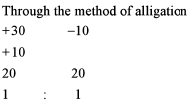
R sold the table at 20% profit at Rs. 90. Thus cost price would be given by: CPR X 1.2 = 90
R’s Cost price = Rs. 75.
We also know that E sold it to R at 25% profit. Thus,
E’s Cost price X 1.25 = 75
-> E’s cost price = 60.
R’s Cost price = Rs. 75.
We also know that E sold it to R at 25% profit. Thus,
E’s Cost price X 1.25 = 75
-> E’s cost price = 60.

On selling 17 balls at Rs. 720, there is a loss equal to the cost price of 5 balls. What is the cost price of a ball?
- a)Rs. 43
- b)Rs. 60
- c)Rs. 55
- d)Rs. 34
Correct answer is option 'B'. Can you explain this answer?
a)
Rs. 43
b)
Rs. 60
c)
Rs. 55
d)
Rs. 34
| | Alok Verma answered |
Let the cost price of a ball be Rs. x.
So, the CP of 17 balls is Rs. 17x.
The CP of 5 balls is Rs. 5x.
Since Loss = CP - SP
So, 5x = 17x - 720
On solving, we get
12 x = 720
that is, x = 60
So, the cost price of a ball is Rs. 60.
Murali purchased 20 dozens of toys at the rate of Rs. 375 per dozen. He sold each one of them at the rate of Rs. 33. Find out his profit percentage.- a)3.5
- b)5.6
- c)4.1
- d)3.4
Correct answer is 'B'. Can you explain this answer?
Murali purchased 20 dozens of toys at the rate of Rs. 375 per dozen. He sold each one of them at the rate of Rs. 33. Find out his profit percentage.
a)
3.5
b)
5.6
c)
4.1
d)
3.4
 | Gowri Chakraborty answered |
The cost price of 20 dozens of toys = 375*20 i.e per dozen 375= Rs 7500/-the selling price of one dozen toys = 12*33= Rs 396/-the selling price of 20 dozen toys = 396*20= Rs 7920/-gain=sp-cp = 7920-7500 =Rs.420/-gain%=(gain/cp)*100 = 420/7500*100 =5.6%
A vendor bought bananas at 6 for a rupee. How many for a rupee must he sell to gain 20%?
- a)3
- b)4
- c)5
- d)6
Correct answer is 'C'. Can you explain this answer?
a)
3
b)
4
c)
5
d)
6
 | Pallabi Deshpande answered |
Go through this doc which will help you understand the basic concepts of profit, loss, and discount for CAT exam.

Read the passage below and solve the questions based on it, Patna-mart, sister concern of Wal-marL is planning to establish a mechanism to give discount, it is actually a Kind Ja Simsim kind of game where if you win any round, you will gel some discount specific to dial round, and it you lose, you will be losing al! the discounts so far won.
Now, round l is hav ing discount coupons of 2%.
Round 2 is having discount coupons of 4%.
Round 3 is having discount coupons of 6%, And so on...............
There are infinite round sand you can participate in all the rounds but you can participate in any round only once and before participating in round N (any particular round), you should have participated in round 1 - round N -1 (all die rounds before that particular round.) All the discounts won will be successive, eg., if you win Round 1 and then round 2 also, you will get a successive discount of 2% and then 4%. But again as the rule goes on. if you lose round 3, you will be losing ail the discount coupons won so far Bui despite losing round 3, you can participate in round 4 and hence.Q.What is the minimum number of rounds to obtain maximum possible discount?- a)50
- b)100
- c)Infinite
- d)Cannot be determined
Correct answer is option 'A'. Can you explain this answer?
Read the passage below and solve the questions based on it, Patna-mart, sister concern of Wal-marL is planning to establish a mechanism to give discount, it is actually a Kind Ja Simsim kind of game where if you win any round, you will gel some discount specific to dial round, and it you lose, you will be losing al! the discounts so far won.
Now, round l is hav ing discount coupons of 2%.
Round 2 is having discount coupons of 4%.
Round 3 is having discount coupons of 6%, And so on...............
There are infinite round sand you can participate in all the rounds but you can participate in any round only once and before participating in round N (any particular round), you should have participated in round 1 - round N -1 (all die rounds before that particular round.) All the discounts won will be successive, eg., if you win Round 1 and then round 2 also, you will get a successive discount of 2% and then 4%. But again as the rule goes on. if you lose round 3, you will be losing ail the discount coupons won so far Bui despite losing round 3, you can participate in round 4 and hence.
Now, round l is hav ing discount coupons of 2%.
Round 2 is having discount coupons of 4%.
Round 3 is having discount coupons of 6%, And so on...............
There are infinite round sand you can participate in all the rounds but you can participate in any round only once and before participating in round N (any particular round), you should have participated in round 1 - round N -1 (all die rounds before that particular round.) All the discounts won will be successive, eg., if you win Round 1 and then round 2 also, you will get a successive discount of 2% and then 4%. But again as the rule goes on. if you lose round 3, you will be losing ail the discount coupons won so far Bui despite losing round 3, you can participate in round 4 and hence.
Q.
What is the minimum number of rounds to obtain maximum possible discount?
a)
50
b)
100
c)
Infinite
d)
Cannot be determined
| | Anaya Patel answered |
Maximum possible discount in any case can be only 100% and any discount more than 100% is actually 100% only. Now, whatever is the discount, till the moment we get a discount of 100%, value of the article cannot be zero (even infinite discounts of 99.99% won’t make it equal to a discount of 100%) So, number of rounds needed to obtain 100% discount = 50.
A man sells an article at 10% above its cost price. If he had bought it at 15% less than what he paid for it and sold it for Rs. 33 less, he would have gained 10%. Find the cost price of the article.- a)Rs.400
- b)Rs.200
- c)Rs.325
- d)Rs.260
Correct answer is option 'B'. Can you explain this answer?
A man sells an article at 10% above its cost price. If he had bought it at 15% less than what he paid for it and sold it for Rs. 33 less, he would have gained 10%. Find the cost price of the article.
a)
Rs.400
b)
Rs.200
c)
Rs.325
d)
Rs.260
 | Surbhi Joshi answered |
Given:
Selling price = Cost price + 10% of cost price
Let the cost price be x
Selling price = 1.1x
To find:
Cost price of the article
Solution:
Let the original selling price be y
The cost price of the article if he had bought it at 15% less than what he paid for it = 0.85y
He sold it for Rs. 33 less, so the selling price = y - 33
He gained 10%
Selling price = Cost price + 10% of cost price
1.1x = 1.1(0.85y) + 0.1(0.85y)
1.1x = 0.935y + 0.085y
1.1x = 1.02y
y = 1.078x
Substituting the value of y in the equation y - 33 = 1.1(0.85y)
1.078x - 33 = 0.935y
1.078x - 33 = 0.935(1.078x)
1.078x - 33 = 1.00883x
0.06917x = 33
x = 33/0.06917
x = Rs. 476.86
Therefore, the cost price of the article is Rs. 476.86
But, the options given are not in decimals
So, the closest option to Rs. 476.86 is Rs. 200
Hence, the correct option is (B) Rs. 200.
Selling price = Cost price + 10% of cost price
Let the cost price be x
Selling price = 1.1x
To find:
Cost price of the article
Solution:
Let the original selling price be y
The cost price of the article if he had bought it at 15% less than what he paid for it = 0.85y
He sold it for Rs. 33 less, so the selling price = y - 33
He gained 10%
Selling price = Cost price + 10% of cost price
1.1x = 1.1(0.85y) + 0.1(0.85y)
1.1x = 0.935y + 0.085y
1.1x = 1.02y
y = 1.078x
Substituting the value of y in the equation y - 33 = 1.1(0.85y)
1.078x - 33 = 0.935y
1.078x - 33 = 0.935(1.078x)
1.078x - 33 = 1.00883x
0.06917x = 33
x = 33/0.06917
x = Rs. 476.86
Therefore, the cost price of the article is Rs. 476.86
But, the options given are not in decimals
So, the closest option to Rs. 476.86 is Rs. 200
Hence, the correct option is (B) Rs. 200.
A shopkeeper uses a “point of sales” software which prepares the bill for customers based on the number of units per unit. Both of the above are 2-digit numbers. While entering the data, he erroneously swaps the digits of both quantity of units and price. As a result, the closing stock balance is lowered by 72 units, and the sales value shown is Rs 1,368. How many units have actually been sold?- a)27
- b)91
- c)83
- d)None of these
Correct answer is option 'B'. Can you explain this answer?
A shopkeeper uses a “point of sales” software which prepares the bill for customers based on the number of units per unit. Both of the above are 2-digit numbers. While entering the data, he erroneously swaps the digits of both quantity of units and price. As a result, the closing stock balance is lowered by 72 units, and the sales value shown is Rs 1,368. How many units have actually been sold?
a)
27
b)
91
c)
83
d)
None of these
 | Target Study Academy answered |
9(x - y ) = 72, x - y = 8
Therefore, only possibility is 19 or 91.
Apublisher printed 3,000 copies of ‘Future Shock ’ at a cost of Rs 2,400. He gave 500 copies free to different philanthropic institutions. He allowed a discount of 25% on the published price and gave one copy free for every 25 copies bought at a time. He was able to sell all the copies in this manner. If the published price is Rs 3.25, then what is his overall gain or loss percentage in the whole transaction?- a)113%
- b)130%
- c)162%
- d)144%
Correct answer is option 'D'. Can you explain this answer?
Apublisher printed 3,000 copies of ‘Future Shock ’ at a cost of Rs 2,400. He gave 500 copies free to different philanthropic institutions. He allowed a discount of 25% on the published price and gave one copy free for every 25 copies bought at a time. He was able to sell all the copies in this manner. If the published price is Rs 3.25, then what is his overall gain or loss percentage in the whole transaction?
a)
113%
b)
130%
c)
162%
d)
144%
 | Cstoppers Instructors answered |
Cost Rs 2400
Published Price Rs 3.25
SP = 75/100 x 3.25 = Rs 2.4375
No. of free copy = (3000/25) = 120 + 500 = 620
So, total SP = 2380 x Rs 2.4375 = Rs 5801.25
Hence percentage gain = 5801.25 - 2400/2400 - 100 = 144%
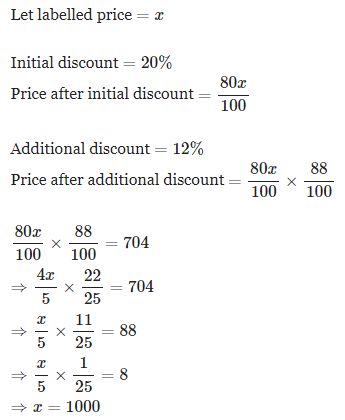
A trader gives 12% additional discount on the discounted price, after giving an initial discount of 20% on the labeled price of an item. The final sale price of the item is Rs.704. Find out the labeled price?
- a)1000
- b)2000
- c)1200
- d)920
Correct answer is option 'A'. Can you explain this answer?
a)
1000
b)
2000
c)
1200
d)
920
| | Gowri Chakraborty answered |
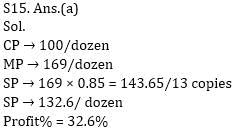
A bookseller marks his books at an advance of 69% on the actual cost of production. He allows a discount of 15% and also given a copy free for every dozen sold at a time. What rate per cent profit does the bookseller make, if books are sold in lots of 12?- a)32.6
- b)47.5
- c)24.9
- d)None of these
Correct answer is option 'A'. Can you explain this answer?
A bookseller marks his books at an advance of 69% on the actual cost of production. He allows a discount of 15% and also given a copy free for every dozen sold at a time. What rate per cent profit does the bookseller make, if books are sold in lots of 12?
a)
32.6
b)
47.5
c)
24.9
d)
None of these
 | Divey Sethi answered |
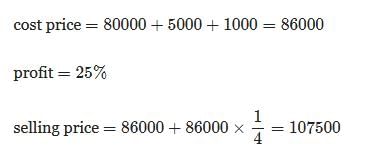
The cost price of 20 articles is the same as the selling price of x articles. If the profit is 25%, find out the value of x
- a)15
- b)25
- c)18
- d)16
Correct answer is 'D'. Can you explain this answer?
a)
15
b)
25
c)
18
d)
16
 | Sameer Rane answered |
Let C.P. of each article be Re. 1 C.P. of x articles = Rs. x.S.P. of x articles = Rs. 20.Profit = Rs. (20 - x).because [(20 - x)/x] x 100 = 25=> 2000 - 100x = 25x=> 125x = 2000 x = 16.

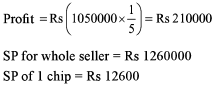
A wholeseller supplies few chips to a retailer every year. Each chip costs Rs 10,000 to the wholeseller. 5% of the chips are defective and they are to be replaced without charging anything extra. If the wholeseller still makes a profit of 20%, at what price is he selling it to retailer?- a)Rs 12,300
- b)Rs 12,600
- c)Rs 13,200
- d)None of these
Correct answer is option 'B'. Can you explain this answer?
A wholeseller supplies few chips to a retailer every year. Each chip costs Rs 10,000 to the wholeseller. 5% of the chips are defective and they are to be replaced without charging anything extra. If the wholeseller still makes a profit of 20%, at what price is he selling it to retailer?
a)
Rs 12,300
b)
Rs 12,600
c)
Rs 13,200
d)
None of these
 | Yash Patel answered |
Let No. of chips supplied = 100
For whole seller, Net CP = (10000 x 100 + 5 x 10000) = Rs 1050000
Read the passage below and solve the questions based on it.
In the ' Gel-One'' supermarket, a new software was installed in the computerized billing section which made the calculations of each of the item sold very easy on the first day of the operations. To verify the workability of the software only one of the item was billed Oil the computer.
Due to some technical problem in the software, it reversed both the numbers of the item sold and price per piece as a result of which the closing of the slock items showed 63 items less and the value on the items still left was show n Rs 936.
It was known that both die slocks left and die price per piece are two digit numbers.Q.What is the correct collection for the day if 44 pieces were sold?- a)Rs 2,288
- b)Rs 1,744
- c)Rs 1,444
- d)None of these
Correct answer is option 'D'. Can you explain this answer?
Read the passage below and solve the questions based on it.
In the ' Gel-One'' supermarket, a new software was installed in the computerized billing section which made the calculations of each of the item sold very easy on the first day of the operations. To verify the workability of the software only one of the item was billed Oil the computer.
Due to some technical problem in the software, it reversed both the numbers of the item sold and price per piece as a result of which the closing of the slock items showed 63 items less and the value on the items still left was show n Rs 936.
It was known that both die slocks left and die price per piece are two digit numbers.
In the ' Gel-One'' supermarket, a new software was installed in the computerized billing section which made the calculations of each of the item sold very easy on the first day of the operations. To verify the workability of the software only one of the item was billed Oil the computer.
Due to some technical problem in the software, it reversed both the numbers of the item sold and price per piece as a result of which the closing of the slock items showed 63 items less and the value on the items still left was show n Rs 936.
It was known that both die slocks left and die price per piece are two digit numbers.
Q.
What is the correct collection for the day if 44 pieces were sold?
a)
Rs 2,288
b)
Rs 1,744
c)
Rs 1,444
d)
None of these
| | Ravi Singh answered |
Rate = 936/18= 52
It is given that price/piece was also reversed.
So, price/piece = Rs 25
Collection = Rs 25 x 44 = Rs 1100
Read the passage below and solve the questions based on it, Patna-mart, sister concern of Wal-marL is planning to establish a mechanism to give discount, it is actually a Kind Ja Simsim kind of game where if you win any round, you will gel some discount specific to dial round, and it you lose, you will be losing al! the discounts so far won.
Now, round l is hav ing discount coupons of 2%.
Round 2 is having discount coupons of 4%.
Round 3 is having discount coupons of 6%, And so on...............
There are infinite round sand you can participate in all the rounds but you can participate in any round only once and before participating in round N (any particular round), you should have participated in round 1 - round N -1 (all die rounds before that particular round.) All the discounts won will be successive, eg., if you win Round 1 and then round 2 also, you will get a successive discount of 2% and then 4%. But again as the rule goes on. if you lose round 3, you will be losing ail the discount coupons won so far Bui despite losing round 3, you can participate in round 4 and hence.Q.What is the minimum possible discount after 20 rounds provided that customer has won a minimum of 18 rounds?- a)100%
- b)50%
- c)0%
- d)None of these
Correct answer is option 'C'. Can you explain this answer?
Read the passage below and solve the questions based on it, Patna-mart, sister concern of Wal-marL is planning to establish a mechanism to give discount, it is actually a Kind Ja Simsim kind of game where if you win any round, you will gel some discount specific to dial round, and it you lose, you will be losing al! the discounts so far won.
Now, round l is hav ing discount coupons of 2%.
Round 2 is having discount coupons of 4%.
Round 3 is having discount coupons of 6%, And so on...............
There are infinite round sand you can participate in all the rounds but you can participate in any round only once and before participating in round N (any particular round), you should have participated in round 1 - round N -1 (all die rounds before that particular round.) All the discounts won will be successive, eg., if you win Round 1 and then round 2 also, you will get a successive discount of 2% and then 4%. But again as the rule goes on. if you lose round 3, you will be losing ail the discount coupons won so far Bui despite losing round 3, you can participate in round 4 and hence.
Now, round l is hav ing discount coupons of 2%.
Round 2 is having discount coupons of 4%.
Round 3 is having discount coupons of 6%, And so on...............
There are infinite round sand you can participate in all the rounds but you can participate in any round only once and before participating in round N (any particular round), you should have participated in round 1 - round N -1 (all die rounds before that particular round.) All the discounts won will be successive, eg., if you win Round 1 and then round 2 also, you will get a successive discount of 2% and then 4%. But again as the rule goes on. if you lose round 3, you will be losing ail the discount coupons won so far Bui despite losing round 3, you can participate in round 4 and hence.
Q.
What is the minimum possible discount after 20 rounds provided that customer has won a minimum of 18 rounds?
a)
100%
b)
50%
c)
0%
d)
None of these
 | Navin Kumar Jha answered |
If he loses in 19 th round, all previous 18 round wins gets cancelled. Hence assuming he loses 20 th round minimum discount will be zero and maximum can be 2 % if he wins it. so answer is C
Mohit goes to furniture shop to buy a sofa set and a center table. He bargains for a 10% discount on the center table and 25% discount on sofa set. However, the shopkeeper, by mistake, interchanged the discount percentage figures while making the bill and mohit paid accordingly. When compared to what he should pay for his purchases, what percentage did mohit pay extra given that the center table costs 40% as much as the sofa set.- a)12.3%
- b)7.2%
- c)8.1%
- d)6.3%
Correct answer is option 'C'. Can you explain this answer?
Mohit goes to furniture shop to buy a sofa set and a center table. He bargains for a 10% discount on the center table and 25% discount on sofa set. However, the shopkeeper, by mistake, interchanged the discount percentage figures while making the bill and mohit paid accordingly. When compared to what he should pay for his purchases, what percentage did mohit pay extra given that the center table costs 40% as much as the sofa set.
a)
12.3%
b)
7.2%
c)
8.1%
d)
6.3%
| | Aisha Gupta answered |

When an item is sold for Rs. 18,700, the owner loses 15%. At what price should that plot be sold to get a gain of 15%?
- a)Rs. 25100
- b)Rs. 24200
- c)Rs. 25300
- d)Rs. 21200
Correct answer is option 'C'. Can you explain this answer?
a)
Rs. 25100
b)
Rs. 24200
c)
Rs. 25300
d)
Rs. 21200
 | Avi Shah answered |
First we find CP.
If SP is Rs. 85 then CP = Rs 100
If SP is Rs. 18,700, then
CP = = Rs 22,000
Now, if CP is Rs 100, then SP = Rs. 115
Thus, if CP is Rs. 22,000, then
SP = =Rs 25,300
If SP is Rs. 85 then CP = Rs 100
If SP is Rs. 18,700, then
CP =
= Rs 22,000Now, if CP is Rs 100, then SP = Rs. 115
Thus, if CP is Rs. 22,000, then
SP =
=Rs 25,300
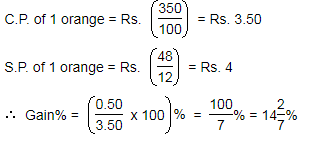
A trader mixes 26 kg of rice at Rs. 20 per kg with 30 kg of rice of other variety at Rs. 36 per kg and sells the mixture at Rs. 30 per kg. What is his profit percentage?
- a)6%
- b)5%
- c)4%
- d)7%
Correct answer is option 'B'. Can you explain this answer?
A trader mixes 26 kg of rice at Rs. 20 per kg with 30 kg of rice of other variety at Rs. 36 per kg and sells the mixture at Rs. 30 per kg. What is his profit percentage?
a)
6%
b)
5%
c)
4%
d)
7%
 | Manoj Ghosh answered |
C.P. of 56 kg rice = Rs. (26 x 20 + 30 x 36) = Rs. (520 + 1080) = Rs. 1600.
S.P. of 56 kg rice = Rs. (56 x 30) = Rs. 1680.
Gain =(80/1600*100) % = 5%
Read the passage below and solve the questions based on it, A shop has the following discount layers 1st layer - Buy Jn get 2 free. 2nd layer - Buy 2, get 3 free. 3rd layer - Buy 3, gel 4 free And so on there are infinite layers on the same patternQ.For how many of these discount layers discount percentage offered is more than 50%?- a)4
- b)27
- c)99
- d)None of these
Correct answer is option 'D'. Can you explain this answer?
Read the passage below and solve the questions based on it, A shop has the following discount layers 1st layer - Buy Jn get 2 free. 2nd layer - Buy 2, get 3 free. 3rd layer - Buy 3, gel 4 free And so on there are infinite layers on the same pattern
Q.
For how many of these discount layers discount percentage offered is more than 50%?
a)
4
b)
27
c)
99
d)
None of these
| | Anaya Patel answered |
Since in all these cases, more articles are given free than the purchased article, so the net discount is more than 50%. Hence in all these layers, the discount offered is more than 50%. (If the articles given free is equal to the articles purchased, discount percentage will be equal to 50%).
A group of students prepared stuffed toys as part of their group activity. They spent Rs 100 on velvet, Rs 5 on thread and needle and Rs 27 on miscellaneous items. They made 30 toys, 50% of which were purchased by force by some senior students causing them a loss of 50%. At what % profit should they sell the remaining toys so as to gain 50% on their total cost?- a)100%
- b)150%
- c)75%
- d)None of these
Correct answer is option 'B'. Can you explain this answer?
A group of students prepared stuffed toys as part of their group activity. They spent Rs 100 on velvet, Rs 5 on thread and needle and Rs 27 on miscellaneous items. They made 30 toys, 50% of which were purchased by force by some senior students causing them a loss of 50%. At what % profit should they sell the remaining toys so as to gain 50% on their total cost?
a)
100%
b)
150%
c)
75%
d)
None of these
| | Ishani Rane answered |
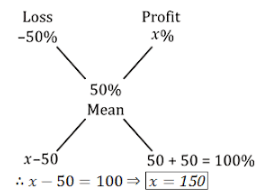
Murali purchased 20 dozens of toys at the rate of Rs. 375 per dozen. He sold each one of them at the rate of Rs. 33. Find out his profit percentage.- a)3.5
- b)5.6
- c)4.1
- d)3.4
Correct answer is option 'B'. Can you explain this answer?
Murali purchased 20 dozens of toys at the rate of Rs. 375 per dozen. He sold each one of them at the rate of Rs. 33. Find out his profit percentage.
a)
3.5
b)
5.6
c)
4.1
d)
3.4
| | Arya Roy answered |
Cost Price of 1 toy = Rs.375/12 = Rs. 31.25
Selling Price of 1 toy = Rs. 33
So, Gain = Rs. (33 - 31.25) = Rs. 1.75
Profit % = [(1.75/31.25) x 100 ]% = 28/5 % = 5.6%
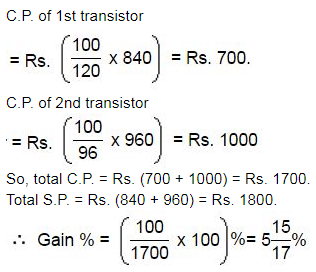
Read the passage below and solve the questions based on it.
The following table shows the relationship between production volumes, unit price and unit cost of a particular product. Refer lo the following table to answer the questions that Follow: Contribution == volume x (price - cost)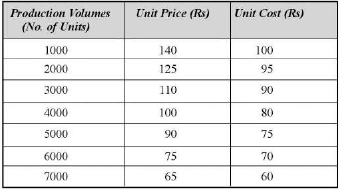 Q.At what volume will the contribution be maximum?
- a)2,000 units
- b)3,000 units
- c)4,000 units
- d)5,000 units
Correct answer is option 'C'. Can you explain this answer?
Read the passage below and solve the questions based on it.
The following table shows the relationship between production volumes, unit price and unit cost of a particular product. Refer lo the following table to answer the questions that Follow: Contribution == volume x (price - cost)
The following table shows the relationship between production volumes, unit price and unit cost of a particular product. Refer lo the following table to answer the questions that Follow: Contribution == volume x (price - cost)
Q.
At what volume will the contribution be maximum?
a)
2,000 units
b)
3,000 units
c)
4,000 units
d)
5,000 units
| | Divey Sethi answered |
Using the options,
(a) 2,000 units, C = 2,000 x 30 = Rs 60,000
(b) 3,000 units, C = 3,000 x 20 = Rs 60,000
(c) 4,000 units, C = 4,000 x 20 = Rs 80,000
(d) 5,000 units, C = 5,000 x 15 = Rs 75,000
Read the passage below and solve the questions based on it Newspaper major The Asian Times is dying to enter the city of Paperabad. where already two newspapers The Deccan
City and Good Morning Pape rah ad are in circulation. The population of the city is 35 lakhs of which, according to the recent survey, 60% read newspaper. The two evening newspapers sell at Rs 1.75 per copy on weekdays and Rs3.00 per copy on Sundays. The Asian Times promised its readers newspapers at Rs 1.50 per copy per day. Since people w'crc aware of the quality7 of the paper, the management thought that it can capture a major chunk of the newspaper reading population. On weekdays, the operational cost of the The Asian Times w-crc Rs 62.500 per day and the cost for the material and printing charges was Rs 2.75 per newspaper. For the Sunday edition the cost of the newspaper per copy was Rs 3.00 and the operational cost were Rs 75,000. The number of the copies of tire newspaper The Asian Tunes sold on Sunday was 16.66% less than the number of copies sold on any of the week days. The number of copies sold on any weekday being the same. The amount collected through the advertisement on any weekday was the same and equaled Rs 2.50,000 per day while for Sunday it was 4.35.000.Q.If 50,000 of the readers of The Deccan City now read The Asian Times on all weekdays, how much profit would The Asian Times expect to make every week?- a)2,55,000
- b)3,85,000
- c)4,57,000
- d)Cannot be determined
Correct answer is option 'D'. Can you explain this answer?
Read the passage below and solve the questions based on it Newspaper major The Asian Times is dying to enter the city of Paperabad. where already two newspapers The Deccan
City and Good Morning Pape rah ad are in circulation. The population of the city is 35 lakhs of which, according to the recent survey, 60% read newspaper. The two evening newspapers sell at Rs 1.75 per copy on weekdays and Rs3.00 per copy on Sundays. The Asian Times promised its readers newspapers at Rs 1.50 per copy per day. Since people w'crc aware of the quality7 of the paper, the management thought that it can capture a major chunk of the newspaper reading population. On weekdays, the operational cost of the The Asian Times w-crc Rs 62.500 per day and the cost for the material and printing charges was Rs 2.75 per newspaper. For the Sunday edition the cost of the newspaper per copy was Rs 3.00 and the operational cost were Rs 75,000. The number of the copies of tire newspaper The Asian Tunes sold on Sunday was 16.66% less than the number of copies sold on any of the week days. The number of copies sold on any weekday being the same. The amount collected through the advertisement on any weekday was the same and equaled Rs 2.50,000 per day while for Sunday it was 4.35.000.
City and Good Morning Pape rah ad are in circulation. The population of the city is 35 lakhs of which, according to the recent survey, 60% read newspaper. The two evening newspapers sell at Rs 1.75 per copy on weekdays and Rs3.00 per copy on Sundays. The Asian Times promised its readers newspapers at Rs 1.50 per copy per day. Since people w'crc aware of the quality7 of the paper, the management thought that it can capture a major chunk of the newspaper reading population. On weekdays, the operational cost of the The Asian Times w-crc Rs 62.500 per day and the cost for the material and printing charges was Rs 2.75 per newspaper. For the Sunday edition the cost of the newspaper per copy was Rs 3.00 and the operational cost were Rs 75,000. The number of the copies of tire newspaper The Asian Tunes sold on Sunday was 16.66% less than the number of copies sold on any of the week days. The number of copies sold on any weekday being the same. The amount collected through the advertisement on any weekday was the same and equaled Rs 2.50,000 per day while for Sunday it was 4.35.000.
Q.
If 50,000 of the readers of The Deccan City now read The Asian Times on all weekdays, how much profit would The Asian Times expect to make every week?
a)
2,55,000
b)
3,85,000
c)
4,57,000
d)
Cannot be determined
 | Preeti Khanna answered |
Since we are not having any information regarding the total number of copies sold (the information is talking about the reader of “The Deccan City”), we cannot determine the profit.
The cost price of 20 articles is the same as the selling price of x articles. If the profit is 25%, find out the value of x
- a)15
- b)25
- c)18
- d)16
Correct answer is option 'D'. Can you explain this answer?
a)
15
b)
25
c)
18
d)
16
 | Dhruv Mehra answered |
Let the Cost Price of one article = Rs. 1
CP of x articles = Rs. x
CP of 20 articles = 20
Selling price of x articles = 20
Profit = 25% [Given]
⇒ (SP - CP) / CP = 25 / 100 = 1/4 ⇒ (20-x) / x = 1/4
⇒ 80−4x=x
⇒ 5x=80
⇒ x = 80/5 = 16
Read the passage below and solve the questions based on it.
The following table shows the relationship between production volumes, unit price and unit cost of a particular product. Refer lo the following table to answer the questions that Follow: Contribution == volume x (price - cost)Q.A breakeven point is the volume of production at which for the first time the contribution equals fixed costs. If the fixed costs are Rs 60,000, then the production level at which the break even is reached, is- a)2,000 units
- b)4,000 units
- c)5,000 units
- d)6,000 units
Correct answer is option 'A'. Can you explain this answer?
Read the passage below and solve the questions based on it.
The following table shows the relationship between production volumes, unit price and unit cost of a particular product. Refer lo the following table to answer the questions that Follow: Contribution == volume x (price - cost)
The following table shows the relationship between production volumes, unit price and unit cost of a particular product. Refer lo the following table to answer the questions that Follow: Contribution == volume x (price - cost)
Q.
A breakeven point is the volume of production at which for the first time the contribution equals fixed costs. If the fixed costs are Rs 60,000, then the production level at which the break even is reached, is
a)
2,000 units
b)
4,000 units
c)
5,000 units
d)
6,000 units
| | Alok Verma answered |
From question number 38 At 2,000 units, C = Rs 60,000.
Chapter doubts & questions for Profit, Loss and Discount - CAT Mock Test Series and 500+ Practice Tests 2026 2026 is part of CAT exam preparation. The chapters have been prepared according to the CAT exam syllabus. The Chapter doubts & questions, notes, tests & MCQs are made for CAT 2026 Exam. Find important definitions, questions, notes, meanings, examples, exercises, MCQs and online tests here.
Chapter doubts & questions of Profit, Loss and Discount - CAT Mock Test Series and 500+ Practice Tests 2026 in English & Hindi are available as part of CAT exam. Download more important topics, notes, lectures and mock test series for CAT Exam by signing up for free.
CAT Mock Test Series and 500+ Practice Tests 202635 videos|80 docs|457 tests |
