


All Exams > UPSC > Mechanical Engineering Optional Notes for UPSC > All Questions
All questions of Applications for UPSC CSE Exam
Pure dehumidification can be achieved by passing air through the spray water maintained at- a)DBT
- b)WBT
- c)Dew point temperature
- d)Any of the above
Correct answer is option 'C'. Can you explain this answer?
Pure dehumidification can be achieved by passing air through the spray water maintained at
a)
DBT
b)
WBT
c)
Dew point temperature
d)
Any of the above
 | Avinash Sharma answered |
Pure dehumidification is achieved by passing air through the spray water which is maintained at dew point temperature. By doing this, excess moisture condenses and temperature remains constant.

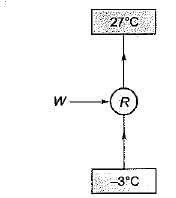
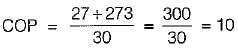
One tonne refrigerator machine means that- a)one tonne is the total mass of machine.
- b)one tonne of refrigerator is used.
- c)one tonne of water can be converted onto ice.
- d)one tonne of ice when melts from and at 0°C in 24 hours, the refrigerating effect produced is equivalent to 210 kJ/min.
Correct answer is option 'D'. Can you explain this answer?
One tonne refrigerator machine means that
a)
one tonne is the total mass of machine.
b)
one tonne of refrigerator is used.
c)
one tonne of water can be converted onto ice.
d)
one tonne of ice when melts from and at 0°C in 24 hours, the refrigerating effect produced is equivalent to 210 kJ/min.
 | Lavanya Menon answered |
1 tonne of refrigeration is the rate of heat removal required to freeze a metric ton (1000 kg) of water at 0°C in 24 hours. Based on the heat of fusion being 333.55 kJ/kg, 1 tonne of refrigeration = 13,898 kJ/h = 3.861 kW
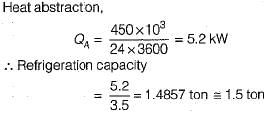
In refrigeration system refrigerant gains heat at- a)compressor
- b)evaporator
- c)condenser
- d)expansion valve
Correct answer is option 'B'. Can you explain this answer?
In refrigeration system refrigerant gains heat at
a)
compressor
b)
evaporator
c)
condenser
d)
expansion valve
 | Garima Kulkarni answered |
In refrigeration system, heat is absorbed at evaporator and rejected at condenser.
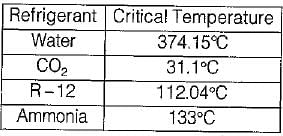
Which of the following is not true in respect of an ideal refrigerant?- a)High latent heat of vaporization and specific heat.
- b)Critical pressure and temperature well above the maximum operating pressure and temperature limits.
- c)Low value of specific volume.
- d)High value of thermal conductivity
Correct answer is option 'A'. Can you explain this answer?
Which of the following is not true in respect of an ideal refrigerant?
a)
High latent heat of vaporization and specific heat.
b)
Critical pressure and temperature well above the maximum operating pressure and temperature limits.
c)
Low value of specific volume.
d)
High value of thermal conductivity
 | Niharika Iyer answered |
Desirable properties of an ideal refrigerant:
-Low boiling point
- High critical temperature
- High latent heat of vaporization
- Low specific heat of liquid
- Low specific volume of vapour
- Non-corrosive to metal
- Non-flammable and non-explosive
- Non-toxic
- Low cost
- Easy to liquify at moderate pressure and temperature
- Easy of locating leaks by odour or suitable indicator
- Mixes well with oil
-Low boiling point
- High critical temperature
- High latent heat of vaporization
- Low specific heat of liquid
- Low specific volume of vapour
- Non-corrosive to metal
- Non-flammable and non-explosive
- Non-toxic
- Low cost
- Easy to liquify at moderate pressure and temperature
- Easy of locating leaks by odour or suitable indicator
- Mixes well with oil
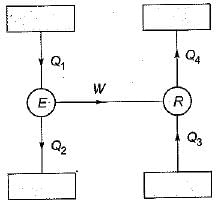

Dry ice is suitable for ____ temperature refrigeration.- a)low
- b)high
- c)all range of
- d)none of the mentioned
Correct answer is option 'A'. Can you explain this answer?
Dry ice is suitable for ____ temperature refrigeration.
a)
low
b)
high
c)
all range of
d)
none of the mentioned
 | Neha Joshi answered |
Dry ice when exposed to atmosphere sublimates by absorbing latent heat of sublimation.
The best capacity control method suitable for domestic refrigerant compressor is- a)On and Off control
- b)Holding the valves open
- c)Hot gas bypass
- d)Using multiple unit
Correct answer is option 'A'. Can you explain this answer?
The best capacity control method suitable for domestic refrigerant compressor is
a)
On and Off control
b)
Holding the valves open
c)
Hot gas bypass
d)
Using multiple unit
| | Tanishq Rane answered |
The best capacity control method suitable for domestic refrigerant compressor is On and Off control.
Explanation:
On and Off control is the most suitable capacity control method for domestic refrigerant compressors. This method involves turning the compressor on and off to maintain the desired temperature in the refrigeration system. Here are the reasons why On and Off control is the best option:
1. Simplicity:
On and Off control is a simple and straightforward method. It does not require any complex control mechanisms or additional components. The compressor is either running at full capacity or completely turned off, making it easy to implement and understand.
2. Energy Efficiency:
In domestic refrigeration systems, the load demand can vary significantly throughout the day. On and Off control allows the compressor to operate only when cooling is required. This helps in conserving energy by reducing the runtime of the compressor when it is not needed.
3. Cost-effectiveness:
Since On and Off control does not involve any additional control components, it is a cost-effective solution for domestic refrigeration systems. The simplicity of this method reduces the overall system cost and maintenance requirements.
4. Reliability:
On and Off control is a reliable method as it does not rely on complex control mechanisms that can fail or malfunction. The compressor operates at full capacity when it is on, providing efficient cooling performance.
5. Temperature Control:
On and Off control allows for precise temperature control in the refrigeration system. When the desired temperature is reached, the compressor turns off, and when the temperature rises above the set point, the compressor turns on again. This ensures that the temperature is maintained within the desired range.
In conclusion, On and Off control is the best capacity control method for domestic refrigerant compressors due to its simplicity, energy efficiency, cost-effectiveness, reliability, and temperature control capabilities.
Explanation:
On and Off control is the most suitable capacity control method for domestic refrigerant compressors. This method involves turning the compressor on and off to maintain the desired temperature in the refrigeration system. Here are the reasons why On and Off control is the best option:
1. Simplicity:
On and Off control is a simple and straightforward method. It does not require any complex control mechanisms or additional components. The compressor is either running at full capacity or completely turned off, making it easy to implement and understand.
2. Energy Efficiency:
In domestic refrigeration systems, the load demand can vary significantly throughout the day. On and Off control allows the compressor to operate only when cooling is required. This helps in conserving energy by reducing the runtime of the compressor when it is not needed.
3. Cost-effectiveness:
Since On and Off control does not involve any additional control components, it is a cost-effective solution for domestic refrigeration systems. The simplicity of this method reduces the overall system cost and maintenance requirements.
4. Reliability:
On and Off control is a reliable method as it does not rely on complex control mechanisms that can fail or malfunction. The compressor operates at full capacity when it is on, providing efficient cooling performance.
5. Temperature Control:
On and Off control allows for precise temperature control in the refrigeration system. When the desired temperature is reached, the compressor turns off, and when the temperature rises above the set point, the compressor turns on again. This ensures that the temperature is maintained within the desired range.
In conclusion, On and Off control is the best capacity control method for domestic refrigerant compressors due to its simplicity, energy efficiency, cost-effectiveness, reliability, and temperature control capabilities.
One tonnes of refrigeration is equal to- a)210 kJ/min
- b)3.5 kJ/min
- c)105 kJ/min
- d)250 kJ/min
Correct answer is option 'A'. Can you explain this answer?
One tonnes of refrigeration is equal to
a)
210 kJ/min
b)
3.5 kJ/min
c)
105 kJ/min
d)
250 kJ/min
 | Ashutosh Sharma answered |
One Tonnes of Refrigeration (TR) is equal to 210 kJ/min.
Explanation:
- One Tonnes of Refrigeration (TR) is a unit of power used in refrigeration and air conditioning industries.
- It is defined as the amount of cooling required to freeze one metric tonne (1000 kg) of water from 0°C to -1°C in 24 hours.
- TR is commonly used to rate the capacity of refrigeration and air conditioning systems.
- The conversion factor from TR to kJ/min is 210.
- Therefore, one TR is equal to 210 kJ/min.
Formula:
- The formula to calculate the cooling capacity in TR is given as: Q = m × Cp × ΔT / 24
- Where Q is the cooling capacity in TR, m is the mass of water to be frozen (in kg), Cp is the specific heat of water (4.18 kJ/kg°C), and ΔT is the temperature difference (in °C) between the initial and final temperatures of water.
- For example, if we want to freeze 1000 kg of water from 0°C to -1°C in 24 hours, the cooling capacity required will be:
Q = 1000 × 4.18 × (0-(-1)) / 24 = 34.9 kJ/min
- To convert this cooling capacity in TR, we need to divide it by 211. That is:
Q(TR) = 34.9 / 210 = 0.166 TR
Conclusion:
- One Tonnes of Refrigeration (TR) is equal to 210 kJ/min.
- It is used to rate the capacity of refrigeration and air conditioning systems.
- The formula to calculate the cooling capacity in TR is Q = m × Cp × ΔT / 24.
- To convert the cooling capacity in TR to kJ/min, we need to multiply it by 210.
Explanation:
- One Tonnes of Refrigeration (TR) is a unit of power used in refrigeration and air conditioning industries.
- It is defined as the amount of cooling required to freeze one metric tonne (1000 kg) of water from 0°C to -1°C in 24 hours.
- TR is commonly used to rate the capacity of refrigeration and air conditioning systems.
- The conversion factor from TR to kJ/min is 210.
- Therefore, one TR is equal to 210 kJ/min.
Formula:
- The formula to calculate the cooling capacity in TR is given as: Q = m × Cp × ΔT / 24
- Where Q is the cooling capacity in TR, m is the mass of water to be frozen (in kg), Cp is the specific heat of water (4.18 kJ/kg°C), and ΔT is the temperature difference (in °C) between the initial and final temperatures of water.
- For example, if we want to freeze 1000 kg of water from 0°C to -1°C in 24 hours, the cooling capacity required will be:
Q = 1000 × 4.18 × (0-(-1)) / 24 = 34.9 kJ/min
- To convert this cooling capacity in TR, we need to divide it by 211. That is:
Q(TR) = 34.9 / 210 = 0.166 TR
Conclusion:
- One Tonnes of Refrigeration (TR) is equal to 210 kJ/min.
- It is used to rate the capacity of refrigeration and air conditioning systems.
- The formula to calculate the cooling capacity in TR is Q = m × Cp × ΔT / 24.
- To convert the cooling capacity in TR to kJ/min, we need to multiply it by 210.
The by-pass factor of a cooling coil decreases with - a)decrease in fin spacing and increase in number of rows.
- b)increase in fin spacing and increase in number of rows. .
- c)increase in fin spacing and decrease in number of rows.
- d)decrease in fin spacing and decrease in number of rows.
Correct answer is option 'A'. Can you explain this answer?
The by-pass factor of a cooling coil decreases with
a)
decrease in fin spacing and increase in number of rows.
b)
increase in fin spacing and increase in number of rows. .
c)
increase in fin spacing and decrease in number of rows.
d)
decrease in fin spacing and decrease in number of rows.
 | Harshad Iyer answered |
The BPF depends upon the following factors:
1. The number of fins provided in a unit length i.e. the pitch of the cooling coil fins.
2. The number of rows in a coil in the direction of flow.
3. The velocity of flow of air.
1. The number of fins provided in a unit length i.e. the pitch of the cooling coil fins.
2. The number of rows in a coil in the direction of flow.
3. The velocity of flow of air.
Match List-I with List-ll and select the correct answer using the codes given below the lists:
List-I
A. Milk Chilling plant
B. Textile Mills
C. Biological process industry
List-ll
1. Strict control of temperature and humidity
2. Strict control of humidity
3. Strict control of temperature
Codes:
A B C
(a) 3 2 1
(b) 1 2 3
(c) 2 3 1
(d) 2 1 3- a)(a)
- b)(b)
- c)(c)
- d)(d)
Correct answer is option 'A'. Can you explain this answer?
Match List-I with List-ll and select the correct answer using the codes given below the lists:
List-I
A. Milk Chilling plant
B. Textile Mills
C. Biological process industry
List-ll
1. Strict control of temperature and humidity
2. Strict control of humidity
3. Strict control of temperature
Codes:
A B C
(a) 3 2 1
(b) 1 2 3
(c) 2 3 1
(d) 2 1 3
List-I
A. Milk Chilling plant
B. Textile Mills
C. Biological process industry
List-ll
1. Strict control of temperature and humidity
2. Strict control of humidity
3. Strict control of temperature
Codes:
A B C
(a) 3 2 1
(b) 1 2 3
(c) 2 3 1
(d) 2 1 3
a)
(a)
b)
(b)
c)
(c)
d)
(d)
| | Saptarshi Khanna answered |
- Strict control of temperature metrological laboratories, precision m/c shops, computer centres etc.
- Relative humidity control-paper and textile mills.
- Strict control of both-chemical and biological industries.
The correct nomenclature for ethylene is- a)R 150
- b)R 740
- c)R 1150
- d)R 12
Correct answer is option 'A'. Can you explain this answer?
The correct nomenclature for ethylene is
a)
R 150
b)
R 740
c)
R 1150
d)
R 12
| | Tanishq Rane answered |
Correct nomenclature for ethylene is R 150
Explanation:
The nomenclature system used for naming refrigerants is called the "Refrigerant Numbering System" or the "R-number system". This system was developed by the American Society of Heating, Refrigerating and Air-Conditioning Engineers (ASHRAE) and is widely used in the industry.
Refrigerant R 150:
R 150 is the correct nomenclature for ethylene. Ethylene is a hydrocarbon compound with the chemical formula C2H4. It is a colorless gas with a sweet odor and is commonly used as a refrigerant in low-temperature applications.
Significance of R-number:
The R-number assigned to a refrigerant provides important information about its chemical composition, thermodynamic properties, and environmental impact. The R-number system helps in identifying and categorizing different refrigerants based on their characteristics.
Other options:
- R 740: This nomenclature is not correct for ethylene. R 740 refers to carbon dioxide (CO2), which is another commonly used refrigerant.
- R 1150: This nomenclature is not correct for ethylene. R 1150 refers to ethane (C2H6), which is also a hydrocarbon compound but has different properties compared to ethylene.
- R 12: This nomenclature is not correct for ethylene. R 12 refers to dichlorodifluoromethane (CCl2F2), which is an ozone-depleting refrigerant commonly known as Freon-12.
Conclusion:
The correct nomenclature for ethylene is R 150. It is important to use the correct nomenclature when working with refrigerants to ensure proper identification and handling.
Explanation:
The nomenclature system used for naming refrigerants is called the "Refrigerant Numbering System" or the "R-number system". This system was developed by the American Society of Heating, Refrigerating and Air-Conditioning Engineers (ASHRAE) and is widely used in the industry.
Refrigerant R 150:
R 150 is the correct nomenclature for ethylene. Ethylene is a hydrocarbon compound with the chemical formula C2H4. It is a colorless gas with a sweet odor and is commonly used as a refrigerant in low-temperature applications.
Significance of R-number:
The R-number assigned to a refrigerant provides important information about its chemical composition, thermodynamic properties, and environmental impact. The R-number system helps in identifying and categorizing different refrigerants based on their characteristics.
Other options:
- R 740: This nomenclature is not correct for ethylene. R 740 refers to carbon dioxide (CO2), which is another commonly used refrigerant.
- R 1150: This nomenclature is not correct for ethylene. R 1150 refers to ethane (C2H6), which is also a hydrocarbon compound but has different properties compared to ethylene.
- R 12: This nomenclature is not correct for ethylene. R 12 refers to dichlorodifluoromethane (CCl2F2), which is an ozone-depleting refrigerant commonly known as Freon-12.
Conclusion:
The correct nomenclature for ethylene is R 150. It is important to use the correct nomenclature when working with refrigerants to ensure proper identification and handling.
The solution circuit in vapour-absorption cycle comprises of- a)Absorber
- b)Absorber + pump
- c)Generator + valve + absorber + pump
- d)Generator + absorber + pump
Correct answer is option 'C'. Can you explain this answer?
The solution circuit in vapour-absorption cycle comprises of
a)
Absorber
b)
Absorber + pump
c)
Generator + valve + absorber + pump
d)
Generator + absorber + pump
 | Samarth Chaudhary answered |
In vapour-absorption cycle, the system formed by the generator-valve-absorber-pump may be considered to represent the heat engine part of the cycle. In this part, only the refrigerant- absorbent solution circulates. This part is known as solution circuit.
COP of a domestic refrigerator in comparison to domestic air conditioner will be- a)more
- b)less
- c)same
- d)depends on other factors
Correct answer is option 'B'. Can you explain this answer?
COP of a domestic refrigerator in comparison to domestic air conditioner will be
a)
more
b)
less
c)
same
d)
depends on other factors
| | Simran Dasgupta answered |
Due to low temperature in domestic refrigerator COP of domestic refrigerator < COP of domestic air-conditioner.
The bank of tubes at the back of a domestic refrigerator of vapour compression type are- a)condenser tubes
- b)evaporator tubes
- c)capillary tubes
- d)tubes carrying electric wires
Correct answer is option 'A'. Can you explain this answer?
The bank of tubes at the back of a domestic refrigerator of vapour compression type are
a)
condenser tubes
b)
evaporator tubes
c)
capillary tubes
d)
tubes carrying electric wires
 | Raghav Saini answered |
The Bank of Tubes at the Back of a Domestic Refrigerator
The bank of tubes at the back of a domestic refrigerator of the vapor compression type is known as the condenser tubes. These tubes play a crucial role in the refrigeration cycle by facilitating the transfer of heat from the refrigerant to the surrounding environment.
Explanation:
Refrigeration Cycle
To understand the function of the condenser tubes, it is essential to have a basic understanding of the refrigeration cycle. The refrigeration cycle is a continuous process that involves the circulation of refrigerant through various components of the refrigeration system. These components include the compressor, condenser, expansion valve, and evaporator.
1. Compressor: The compressor is responsible for compressing the low-pressure refrigerant vapor coming from the evaporator and raising its temperature and pressure.
2. Condenser: The condenser is where the hot refrigerant vapor from the compressor is condensed into a high-pressure liquid. This process releases heat to the surrounding environment.
3. Expansion Valve: The expansion valve controls the flow of the high-pressure liquid refrigerant into the evaporator.
4. Evaporator: In the evaporator, the low-pressure liquid refrigerant evaporates, absorbing heat from the area being cooled.
Function of the Condenser Tubes
The condenser tubes are located at the back of the refrigerator and are responsible for transferring heat from the hot refrigerant vapor to the surrounding environment. This heat transfer process causes the refrigerant to condense into a high-pressure liquid.
Heat Transfer
The condenser tubes are designed to facilitate efficient heat transfer. The hot refrigerant vapor flows through these tubes, while the cooler air from the surrounding environment passes over the tubes. As the air comes into contact with the hot tubes, heat is transferred from the refrigerant to the air.
Condensation Process
As the heat is transferred, the refrigerant undergoes a phase change from a vapor to a liquid state. This condensation process releases a significant amount of heat energy, which is why the condenser tubes are located at the back of the refrigerator to allow for proper heat dissipation.
Conclusion
In conclusion, the bank of tubes at the back of a domestic refrigerator of the vapor compression type is known as the condenser tubes. These tubes are responsible for transferring heat from the hot refrigerant vapor to the surrounding environment, causing the refrigerant to condense into a high-pressure liquid. This is an essential step in the refrigeration cycle, allowing the refrigerator to cool and maintain low temperatures inside.
The bank of tubes at the back of a domestic refrigerator of the vapor compression type is known as the condenser tubes. These tubes play a crucial role in the refrigeration cycle by facilitating the transfer of heat from the refrigerant to the surrounding environment.
Explanation:
Refrigeration Cycle
To understand the function of the condenser tubes, it is essential to have a basic understanding of the refrigeration cycle. The refrigeration cycle is a continuous process that involves the circulation of refrigerant through various components of the refrigeration system. These components include the compressor, condenser, expansion valve, and evaporator.
1. Compressor: The compressor is responsible for compressing the low-pressure refrigerant vapor coming from the evaporator and raising its temperature and pressure.
2. Condenser: The condenser is where the hot refrigerant vapor from the compressor is condensed into a high-pressure liquid. This process releases heat to the surrounding environment.
3. Expansion Valve: The expansion valve controls the flow of the high-pressure liquid refrigerant into the evaporator.
4. Evaporator: In the evaporator, the low-pressure liquid refrigerant evaporates, absorbing heat from the area being cooled.
Function of the Condenser Tubes
The condenser tubes are located at the back of the refrigerator and are responsible for transferring heat from the hot refrigerant vapor to the surrounding environment. This heat transfer process causes the refrigerant to condense into a high-pressure liquid.
Heat Transfer
The condenser tubes are designed to facilitate efficient heat transfer. The hot refrigerant vapor flows through these tubes, while the cooler air from the surrounding environment passes over the tubes. As the air comes into contact with the hot tubes, heat is transferred from the refrigerant to the air.
Condensation Process
As the heat is transferred, the refrigerant undergoes a phase change from a vapor to a liquid state. This condensation process releases a significant amount of heat energy, which is why the condenser tubes are located at the back of the refrigerator to allow for proper heat dissipation.
Conclusion
In conclusion, the bank of tubes at the back of a domestic refrigerator of the vapor compression type is known as the condenser tubes. These tubes are responsible for transferring heat from the hot refrigerant vapor to the surrounding environment, causing the refrigerant to condense into a high-pressure liquid. This is an essential step in the refrigeration cycle, allowing the refrigerator to cool and maintain low temperatures inside.
In a vapour compression refrigeration system, a throttle valve is used in place of expander because- a)it leads to significant cost reduction
- b)it considerably reduces the system work
- c)positive work in isentropic expansion of liquid is very small
- d)improves COP
Correct answer is option 'C'. Can you explain this answer?
In a vapour compression refrigeration system, a throttle valve is used in place of expander because
a)
it leads to significant cost reduction
b)
it considerably reduces the system work
c)
positive work in isentropic expansion of liquid is very small
d)
improves COP
 | Kirti Bose answered |
There are practical difficulties in smoothly expanding a liquid of a highly wet vapour in an expander. As vg → vf, the positive work of isentropic expansion is seldom large enough to justify the cost of an expander. The the rmodynamic and friction losses of an expander if employed, may even exceed the gain in work. Accordingly, the isentropic expansion process may be replaced by the use of an expansion device such as a throttle valve or a capillary tube.
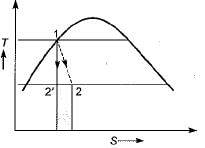
For cooling and dehumidification of unsaturated moist air, it must be passed over a coil at a temperature- a)of adiabatic saturation of incoming steam
- b)which is lower than the dew point of incoming stream
- c)which lies between dry bulb and wet bulb temperature
- d)which lies between wet bulb and dew point temperature of incoming stream
Correct answer is option 'B'. Can you explain this answer?
For cooling and dehumidification of unsaturated moist air, it must be passed over a coil at a temperature
a)
of adiabatic saturation of incoming steam
b)
which is lower than the dew point of incoming stream
c)
which lies between dry bulb and wet bulb temperature
d)
which lies between wet bulb and dew point temperature of incoming stream
| | Sinjini Nambiar answered |
Cooling and dehumidification : The dehumidification of air is only possible when the effective surface temperature of the cooling coil is less than the dew point temperature of the air entering the coil.
Atmospheric air at DBT of 15°C enters a heating coil whose surface temperature is maintained at 40°C. The air leaves the heating coil at 25°C. What will be the by-pass factor of heating coil?- a)0.376
- b)0.4
- c)0.6
- d)0.67
Correct answer is option 'C'. Can you explain this answer?
Atmospheric air at DBT of 15°C enters a heating coil whose surface temperature is maintained at 40°C. The air leaves the heating coil at 25°C. What will be the by-pass factor of heating coil?
a)
0.376
b)
0.4
c)
0.6
d)
0.67
| | Raghavendra Goyal answered |
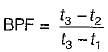
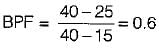
Where
t3 = temperature of heating coil = 40°C
t2 = exit temperature of air = 25°C
t1 = temperature of air at inlet = 15°C
Solid CO2 is produced by- a)vapour absorption method
- b)simple vapour compression cycle
- c)vapour compression cycle with compounding of compressor
- d)pressure snow chamber method
Correct answer is option 'D'. Can you explain this answer?
Solid CO2 is produced by
a)
vapour absorption method
b)
simple vapour compression cycle
c)
vapour compression cycle with compounding of compressor
d)
pressure snow chamber method
| | Manasa Sen answered |
Solid CO2, also known as dry ice, is produced by the pressure snow chamber method. This method involves the conversion of gaseous carbon dioxide (CO2) into a solid state under high pressure.
Explanation:
1. Pressure Snow Chamber Method:
The pressure snow chamber method is a process used to produce solid CO2. In this method, gaseous carbon dioxide is compressed to a high pressure of about 5 to 10 MPa (megapascals). When the gas is compressed to such high pressures, it undergoes a phase change directly from a gas to a solid, bypassing the liquid phase. This solid form of carbon dioxide is known as dry ice.
Advantages of the Pressure Snow Chamber Method:
- The pressure snow chamber method allows for the direct conversion of gaseous carbon dioxide into a solid state without the need for intermediate steps.
- It is a relatively simple and efficient process for producing solid CO2.
- The high-pressure conditions ensure that the solid CO2 is produced in a dense and compact form, making it suitable for various applications.
Applications of Solid CO2:
Solid CO2 (dry ice) has several applications, including:
- Cold storage and transportation: Solid CO2 is commonly used for preserving and transporting perishable goods that require low temperatures.
- Cleaning and blasting: Dry ice blasting is a non-abrasive cleaning method that uses solid CO2 pellets to remove dirt, grime, and contaminants from surfaces.
- Special effects: Solid CO2 is used in the entertainment industry for creating smoke and fog effects in theatrical productions and concerts.
- Food and beverage industry: Solid CO2 is used for chilling and freezing food products, as well as in carbonation processes for beverages.
In conclusion, solid CO2 is produced by the pressure snow chamber method, which involves compressing gaseous carbon dioxide to high pressures to directly convert it into a solid state. This method is efficient and provides solid CO2 in a dense and compact form for various applications.
Explanation:
1. Pressure Snow Chamber Method:
The pressure snow chamber method is a process used to produce solid CO2. In this method, gaseous carbon dioxide is compressed to a high pressure of about 5 to 10 MPa (megapascals). When the gas is compressed to such high pressures, it undergoes a phase change directly from a gas to a solid, bypassing the liquid phase. This solid form of carbon dioxide is known as dry ice.
Advantages of the Pressure Snow Chamber Method:
- The pressure snow chamber method allows for the direct conversion of gaseous carbon dioxide into a solid state without the need for intermediate steps.
- It is a relatively simple and efficient process for producing solid CO2.
- The high-pressure conditions ensure that the solid CO2 is produced in a dense and compact form, making it suitable for various applications.
Applications of Solid CO2:
Solid CO2 (dry ice) has several applications, including:
- Cold storage and transportation: Solid CO2 is commonly used for preserving and transporting perishable goods that require low temperatures.
- Cleaning and blasting: Dry ice blasting is a non-abrasive cleaning method that uses solid CO2 pellets to remove dirt, grime, and contaminants from surfaces.
- Special effects: Solid CO2 is used in the entertainment industry for creating smoke and fog effects in theatrical productions and concerts.
- Food and beverage industry: Solid CO2 is used for chilling and freezing food products, as well as in carbonation processes for beverages.
In conclusion, solid CO2 is produced by the pressure snow chamber method, which involves compressing gaseous carbon dioxide to high pressures to directly convert it into a solid state. This method is efficient and provides solid CO2 in a dense and compact form for various applications.
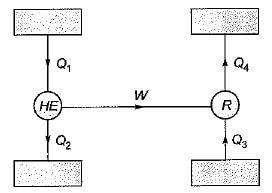
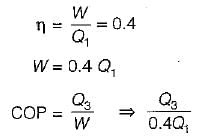
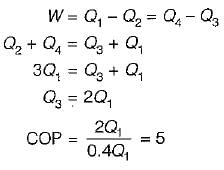
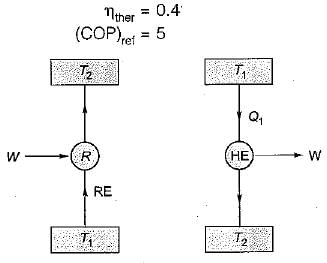
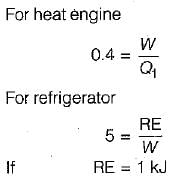
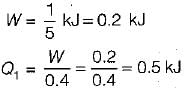
If an engine of 40% thermal efficiency drives a refrigerator having a coefficient of performance of 5, then the heat input to engine for each kJ of heat removed from the cold body of the refrigerator is- a)0.50 kJ
- b)0.75 kJ
- c)1 kJ
- d)1.25 k
Correct answer is option 'A'. Can you explain this answer?
If an engine of 40% thermal efficiency drives a refrigerator having a coefficient of performance of 5, then the heat input to engine for each kJ of heat removed from the cold body of the refrigerator is
a)
0.50 kJ
b)
0.75 kJ
c)
1 kJ
d)
1.25 k
| | Navya Saha answered |
For small installations of refrigeration systems (up to 35 kW), which type of condenser is used?- a)shell and tube type
- b)shell and coil type
- c)double tube type
- d)air cooled type
Correct answer is option 'D'. Can you explain this answer?
For small installations of refrigeration systems (up to 35 kW), which type of condenser is used?
a)
shell and tube type
b)
shell and coil type
c)
double tube type
d)
air cooled type
| | Vaibhav Khanna answered |
Air-cooled condensers used only in small capacity machines. Air cooled condensers are seldom made in sizes over 5 TR because of high head pressure, excessive power consumption and objectionable fan noise. In air-cooled condensers, heat is removed by air using either natural or forced circulation.
The refrigerant circuit in vapour-absorption cycle consists of- a)condenser + expansion device
- b)condenser + expansion device + evaporator
- c)condenser + expansion device + absorber
- d)condenser + absorber + pump
Correct answer is option 'B'. Can you explain this answer?
The refrigerant circuit in vapour-absorption cycle consists of
a)
condenser + expansion device
b)
condenser + expansion device + evaporator
c)
condenser + expansion device + absorber
d)
condenser + absorber + pump
 | Machine Experts answered |
The compressor
Compression is the first step in the refrigeration cycle, and a compressor is the piece of equipment that increases the pressure of the working gas. Refrigerant enters the compressor as low-pressure, low-temperature gas, and leaves the compressor as a high-pressure, high-temperature gas.
Types of compressors
Compression can be achieved through a number of different mechanical processes, and because of that, several compressor designs are used in HVAC and refrigeration today. Other examples exist, but some popular choices are:
1. Reciprocating compressors
2. Scroll compressors
3. Rotary compressors
The condenser
The condenser, or condenser coil, is one of two types of heat exchangers used in a basic refrigeration loop. This component is supplied with high-temperature high-pressure, vaporized refrigerant coming off the compressor. The condenser removes heat from the hot refrigerant vapor gas vapor until it condenses into a saturated liquid state, a.k.a. condensation.
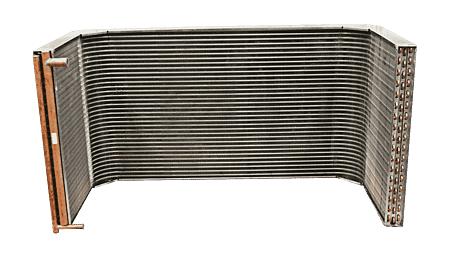
After condensing, the refrigerant is a high-pressure, low-temperature liquid, at which point it’s routed to the loop’s expansion device.
The expansion device
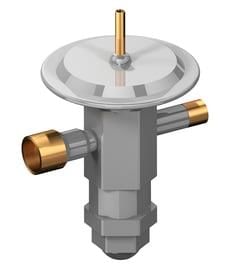
These components come in a few different designs. Popular configurations include fixed orifices, thermostatic expansion valves (TXV) or thermal expansion valves (pictured above), and the more advanced electronic expansion valves (EEVs). But regardless of configuration, the job of a system’s expansion device is the same - create a drop in pressure after the refrigerant leaves the condenser. This pressure drop will cause some of that refrigerant to quickly boil, creating a two-phase mixture.
This rapid phase change is called flashing, and it helps tee up the next piece of equipment in the circuit, the evaporator, to perform its intended function.
The evaporator
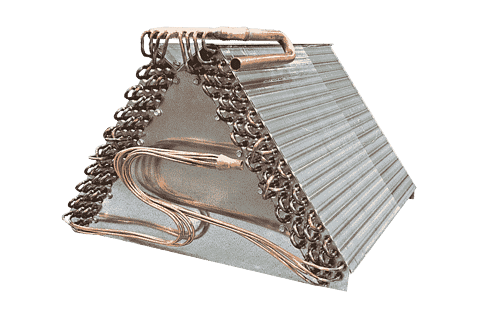
The evaporator is the second heat exchanger in a standard refrigeration circuit, and like the condenser, it’s named for its basic function. It serves as the “business end” of a refrigeration cycle, given that it does what we expect air conditioning to do – absorb heat.
This happens when refrigerant enters the evaporator as a low temperature liquid at low pressure, and a fan forces air across the evaporator’s fins, cooling the air by absorbing the heat from the space in question into the refrigerant.
After doing so, the refrigerant is sent back to the compressor, where the process restarts. And that, in a nutshell, is how a refrigeration loop works. If you have any questions about the refrigeration cycle or its components and how they work, give us a call. We've been helping customers get the most out of their HVAC and refrigeration equipment for nearly 100 years.
If COP of a refrigerator is 5 and efficiency of a heat engine of the same temperature limit is 50%. Then what is the ratio of heat supplied to engine to heat absorbed by the refrigerator from the space- a)2.5
- b)0.4
- c)4
- d)0.25
Correct answer is option 'B'. Can you explain this answer?
If COP of a refrigerator is 5 and efficiency of a heat engine of the same temperature limit is 50%. Then what is the ratio of heat supplied to engine to heat absorbed by the refrigerator from the space
a)
2.5
b)
0.4
c)
4
d)
0.25
| | Gauri Roy answered |
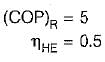
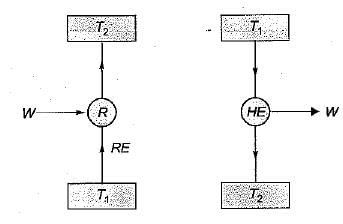
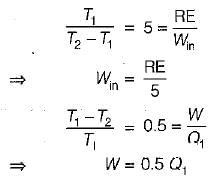
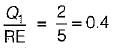
By equating, we get

⇒
Absorbent in a vapour absorption refrigerator system separates from the refrigerant only when it- a)is sufficiently heated
- b)is sprayed on cooling water
- c)is cooled
- d)reacts with refrigerant
Correct answer is option 'A'. Can you explain this answer?
Absorbent in a vapour absorption refrigerator system separates from the refrigerant only when it
a)
is sufficiently heated
b)
is sprayed on cooling water
c)
is cooled
d)
reacts with refrigerant
| | Bhargavi Sarkar answered |
When the mixture of absorbent and refrigerant is heated sufficiently in the generator they get separate and refrigerant vapour is send to condenser and absorbent is sent back to the absorber.
The domestic refrigerator has.a refrigeration load of the order of- a)less than 0.25 ton
- b)between 0.5 and 1 ton
- c)more than 1 ton
- d)more than 5 ton
Correct answer is option 'A'. Can you explain this answer?
The domestic refrigerator has.a refrigeration load of the order of
a)
less than 0.25 ton
b)
between 0.5 and 1 ton
c)
more than 1 ton
d)
more than 5 ton
 | Dipika Bose answered |
Refrigeration Load of Domestic Refrigerator
Definition of Refrigeration Load
Refrigeration load is defined as the amount of heat that needs to be removed from a space or substance in order to achieve a desired temperature.
Refrigeration Load of Domestic Refrigerator
The refrigeration load of a domestic refrigerator is the amount of heat that needs to be removed from the interior of the refrigerator in order to keep the temperature low enough to preserve food and beverages.
Calculation of Refrigeration Load
The refrigeration load of a domestic refrigerator can be calculated by determining the heat gain into the refrigerator and then calculating the amount of heat that needs to be removed to maintain the desired temperature. Factors that contribute to the heat gain into the refrigerator include:
- Ambient temperature
- Insulation quality
- Door opening frequency
- Type and quantity of food stored
Answer Explanation
The refrigeration load of a domestic refrigerator is typically less than 0.25 ton. This is because the size of a domestic refrigerator is relatively small compared to commercial refrigeration systems, and the amount of heat gain into the refrigerator is relatively low due to the insulation quality and infrequent door opening. Therefore, the amount of heat that needs to be removed is also relatively low.
Definition of Refrigeration Load
Refrigeration load is defined as the amount of heat that needs to be removed from a space or substance in order to achieve a desired temperature.
Refrigeration Load of Domestic Refrigerator
The refrigeration load of a domestic refrigerator is the amount of heat that needs to be removed from the interior of the refrigerator in order to keep the temperature low enough to preserve food and beverages.
Calculation of Refrigeration Load
The refrigeration load of a domestic refrigerator can be calculated by determining the heat gain into the refrigerator and then calculating the amount of heat that needs to be removed to maintain the desired temperature. Factors that contribute to the heat gain into the refrigerator include:
- Ambient temperature
- Insulation quality
- Door opening frequency
- Type and quantity of food stored
Answer Explanation
The refrigeration load of a domestic refrigerator is typically less than 0.25 ton. This is because the size of a domestic refrigerator is relatively small compared to commercial refrigeration systems, and the amount of heat gain into the refrigerator is relatively low due to the insulation quality and infrequent door opening. Therefore, the amount of heat that needs to be removed is also relatively low.
The cooling system used for supersonic aircrafts and rockets is- a)simple air cooling system
- b)boot-strap air cooling system
- c)reduced ambient air cooling system
- d)regenerative air cooling system
Correct answer is option 'D'. Can you explain this answer?
The cooling system used for supersonic aircrafts and rockets is
a)
simple air cooling system
b)
boot-strap air cooling system
c)
reduced ambient air cooling system
d)
regenerative air cooling system
| | Sinjini Bose answered |
The regenerative air cooling system is a modification of simple air system with the addition of a secondary heat exchanger in which the air from the primary heat exchanger is further cooled with a portion of the refrigerated air bled after expansion in the turbine.
The wet bulb depression is zero, when relative humidity is equal to- a)zero
- b)0.5
- c)0.75
- d)1.0
Correct answer is option 'D'. Can you explain this answer?
The wet bulb depression is zero, when relative humidity is equal to
a)
zero
b)
0.5
c)
0.75
d)
1.0
 | Sandeep Sengupta answered |
Explanation:
The wet bulb depression is a measure of the difference between the dry bulb temperature and the wet bulb temperature. It represents the cooling effect of evaporation on the wet bulb temperature.
The wet bulb depression is zero when the relative humidity is equal to 1.0 or 100%. This means that the air is saturated with moisture and cannot hold any more water vapor. When the air is saturated, the wet bulb temperature is equal to the dry bulb temperature.
Why is the wet bulb depression zero when the relative humidity is 1.0?
When the relative humidity is 1.0, it means that the air is holding the maximum amount of water vapor it can at a given temperature. The air is saturated with moisture, and any additional water vapor will condense into liquid water.
In this saturated condition, there is no evaporation occurring from the wet bulb. Evaporation is a cooling process, and it lowers the temperature of the wet bulb. However, when the air is already holding as much moisture as it can, there is no more room for evaporation to take place. As a result, the wet bulb temperature is equal to the dry bulb temperature, and the wet bulb depression is zero.
Significance of wet bulb depression:
The wet bulb depression is an important parameter in determining the comfort level and heat stress in a given environment. It provides an indication of the cooling effect of evaporation and the potential for heat transfer through sweating.
When the wet bulb depression is high, it means that there is a significant difference between the dry and wet bulb temperatures. This indicates that evaporation is occurring and the air has the potential to provide cooling. This is desirable in hot and humid conditions as it helps in dissipating heat from the body.
On the other hand, when the wet bulb depression is low or zero, it indicates that the air is already saturated with moisture and evaporation is not occurring. This can lead to discomfort and heat stress as the body's ability to cool down through sweating is limited.
In conclusion, the wet bulb depression is zero when the relative humidity is equal to 1.0 or 100%. This means that the air is saturated with moisture and there is no room for evaporation. Understanding the wet bulb depression is important in assessing the comfort level and heat stress in a given environment.
The wet bulb depression is a measure of the difference between the dry bulb temperature and the wet bulb temperature. It represents the cooling effect of evaporation on the wet bulb temperature.
The wet bulb depression is zero when the relative humidity is equal to 1.0 or 100%. This means that the air is saturated with moisture and cannot hold any more water vapor. When the air is saturated, the wet bulb temperature is equal to the dry bulb temperature.
Why is the wet bulb depression zero when the relative humidity is 1.0?
When the relative humidity is 1.0, it means that the air is holding the maximum amount of water vapor it can at a given temperature. The air is saturated with moisture, and any additional water vapor will condense into liquid water.
In this saturated condition, there is no evaporation occurring from the wet bulb. Evaporation is a cooling process, and it lowers the temperature of the wet bulb. However, when the air is already holding as much moisture as it can, there is no more room for evaporation to take place. As a result, the wet bulb temperature is equal to the dry bulb temperature, and the wet bulb depression is zero.
Significance of wet bulb depression:
The wet bulb depression is an important parameter in determining the comfort level and heat stress in a given environment. It provides an indication of the cooling effect of evaporation and the potential for heat transfer through sweating.
When the wet bulb depression is high, it means that there is a significant difference between the dry and wet bulb temperatures. This indicates that evaporation is occurring and the air has the potential to provide cooling. This is desirable in hot and humid conditions as it helps in dissipating heat from the body.
On the other hand, when the wet bulb depression is low or zero, it indicates that the air is already saturated with moisture and evaporation is not occurring. This can lead to discomfort and heat stress as the body's ability to cool down through sweating is limited.
In conclusion, the wet bulb depression is zero when the relative humidity is equal to 1.0 or 100%. This means that the air is saturated with moisture and there is no room for evaporation. Understanding the wet bulb depression is important in assessing the comfort level and heat stress in a given environment.
An ideal vapour compression refrigerator operates between a condenser pressure P1 and an evaporator pressure P2. Which of the following changes would increase its COP?- a)Increasing P1 by Δ P and keeping P2 constant
- b)Decreasing P2 by Δ P and keeping P1 constant
- c)Adopting wet compression
- d)Subcooling the refrigerant
Correct answer is option 'D'. Can you explain this answer?
An ideal vapour compression refrigerator operates between a condenser pressure P1 and an evaporator pressure P2. Which of the following changes would increase its COP?
a)
Increasing P1 by Δ P and keeping P2 constant
b)
Decreasing P2 by Δ P and keeping P1 constant
c)
Adopting wet compression
d)
Subcooling the refrigerant
| | Aniket Mehta answered |
COP decreases both with decreasing evaporator and increasing condenser pressures. The COP increases by installing a subcooler between the condenser and the expansion valve. The subcooling reduces flashing of the liquid during expansion and increases refrigerating effect.
Thermoelectric refrigeration system is based on- a)Peltier effect
- b)Joule effect
- c)Joule-Thomson throtting
- d)Adiabatic demagnetization
Correct answer is option 'A'. Can you explain this answer?
Thermoelectric refrigeration system is based on
a)
Peltier effect
b)
Joule effect
c)
Joule-Thomson throtting
d)
Adiabatic demagnetization
| | Divya Banerjee answered |
Thermoelectric refrigeration system is based on Peltier effect.
Explanation:
Thermoelectric refrigeration system works on the principle of Peltier effect. This effect was discovered by Jean Charles Athanase Peltier, a French physicist in the year 1834. According to the Peltier effect, when a current flows through a junction of two different materials, heat is either absorbed or evolved at the junction depending on the direction of current flow.
Working of thermoelectric refrigeration system:
The thermoelectric refrigeration system consists of a thermoelectric module which is made up of two different materials such as n-type and p-type semiconductors. These two materials are connected electrically in series and thermally in parallel. When a current is passed through the thermoelectric module, one side of the module gets heated and the other side gets cooled. The cooling effect is due to the absorption of heat from the surrounding medium.
Advantages of thermoelectric refrigeration system:
- It is a compact and lightweight system.
- It does not require any moving parts for its operation.
- It can operate in any orientation.
- It is highly reliable and requires low maintenance.
Applications of thermoelectric refrigeration system:
- It is used in small-scale refrigeration applications such as electronic devices, cooling of laser diodes, and medical refrigeration.
- It is also used in spacecraft and satellites where conventional refrigeration systems cannot be used due to the absence of gravity.
Conclusion:
Thus, the thermoelectric refrigeration system is based on the Peltier effect, where the cooling effect is due to the absorption of heat from the surrounding medium. This system is highly reliable, lightweight, and requires low maintenance, making it suitable for small-scale refrigeration applications.
Explanation:
Thermoelectric refrigeration system works on the principle of Peltier effect. This effect was discovered by Jean Charles Athanase Peltier, a French physicist in the year 1834. According to the Peltier effect, when a current flows through a junction of two different materials, heat is either absorbed or evolved at the junction depending on the direction of current flow.
Working of thermoelectric refrigeration system:
The thermoelectric refrigeration system consists of a thermoelectric module which is made up of two different materials such as n-type and p-type semiconductors. These two materials are connected electrically in series and thermally in parallel. When a current is passed through the thermoelectric module, one side of the module gets heated and the other side gets cooled. The cooling effect is due to the absorption of heat from the surrounding medium.
Advantages of thermoelectric refrigeration system:
- It is a compact and lightweight system.
- It does not require any moving parts for its operation.
- It can operate in any orientation.
- It is highly reliable and requires low maintenance.
Applications of thermoelectric refrigeration system:
- It is used in small-scale refrigeration applications such as electronic devices, cooling of laser diodes, and medical refrigeration.
- It is also used in spacecraft and satellites where conventional refrigeration systems cannot be used due to the absence of gravity.
Conclusion:
Thus, the thermoelectric refrigeration system is based on the Peltier effect, where the cooling effect is due to the absorption of heat from the surrounding medium. This system is highly reliable, lightweight, and requires low maintenance, making it suitable for small-scale refrigeration applications.
For air with a relative humidity of 80%- a)the dry bulb temperature is less than the wet bulb temperature
- b)the dew point temperature is less than wet bulb temperature
- c)the dew point and wet bulb temperatures are equal
- d)the dry bulb and dew point temperatures are equai
Correct answer is option 'B'. Can you explain this answer?
For air with a relative humidity of 80%
a)
the dry bulb temperature is less than the wet bulb temperature
b)
the dew point temperature is less than wet bulb temperature
c)
the dew point and wet bulb temperatures are equal
d)
the dry bulb and dew point temperatures are equai
| | Jaideep Malik answered |
For unsaturated air
DBT > WBT > DPT
DBT > WBT > DPT
Which of the following machines can be used to obtain refrigeration at the place where there is no electric power?- a)Air refrigeration
- b)Steam jet refrigeration
- c)Vapour compression refrigeration
- d)Vapour absorption refrigeration
Correct answer is option 'D'. Can you explain this answer?
Which of the following machines can be used to obtain refrigeration at the place where there is no electric power?
a)
Air refrigeration
b)
Steam jet refrigeration
c)
Vapour compression refrigeration
d)
Vapour absorption refrigeration
| | Aditi Sarkar answered |
Vapour absorption refrigeration is heat operated refrigeration system and can operate by taking heat from the solar system.
Heating of air without changing its moisture content takes place on Psychrometric chart along- a)rising line
- b)a horizontal line of the constant dew point
- c)a vertical line of constant dry bulb temperature
- d)curved line
Correct answer is option 'B'. Can you explain this answer?
Heating of air without changing its moisture content takes place on Psychrometric chart along
a)
rising line
b)
a horizontal line of the constant dew point
c)
a vertical line of constant dry bulb temperature
d)
curved line
| | Siddharth Menon answered |
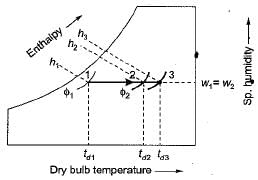
Where
td1 = dry bulb temperature of air entering to the coil
td2 = dry bulb temperature of air living the coil
td3 = dry bulb temperature of coil
Degree of saturation or percentage humidity is- a)the mass of water vapour present in 1 m3 of dry air
- b)the mass of water vapour present in 1 kg of dry air
- c)the ratio of the actual mass of water vapour in a unit mass of dry air to the mass of water vapour in the same mass of dry air when it is saturated at the same temperature and pressure
- d)the ratio of actual mass of water vapour in a given volume of moist air to the mass of water vapour in the same volume of saturated air at the same temperature and pressure
Correct answer is option 'C'. Can you explain this answer?
Degree of saturation or percentage humidity is
a)
the mass of water vapour present in 1 m3 of dry air
b)
the mass of water vapour present in 1 kg of dry air
c)
the ratio of the actual mass of water vapour in a unit mass of dry air to the mass of water vapour in the same mass of dry air when it is saturated at the same temperature and pressure
d)
the ratio of actual mass of water vapour in a given volume of moist air to the mass of water vapour in the same volume of saturated air at the same temperature and pressure
| | Neha Joshi answered |
Degree of saturation is the ratio of actual specific humidity to the specific humidity under saturated condition.
Which one of the following is correct relation between (COP)HP and (COP)R- a)(COP)HP-(COP)R - 1
- b)(COP)R - (COP)HP = 1
- c)(COP)Hp + (COP)R = 1
- d)(COP)HP + (COP)H = 0
Correct answer is option 'A'. Can you explain this answer?
Which one of the following is correct relation between (COP)HP and (COP)R
a)
(COP)HP-(COP)R - 1
b)
(COP)R - (COP)HP = 1
c)
(COP)Hp + (COP)R = 1
d)
(COP)HP + (COP)H = 0
| | Shail Rane answered |
Relation between coefficient of performance of heat pump and refrigerator:
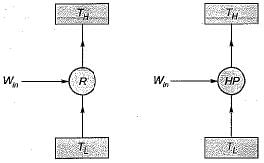
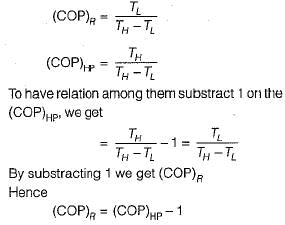
In a boot-strap air evaporative cooling system, the evaporator is provided- a)between the combustion chauber and the first heat exchanger.
- b)between the first heat exchanger and the secondary compressor.
- c)between the secondary compressor and the second heat exchanger.
- d)between the second heat exchanger and the cooling turbine.
Correct answer is option 'D'. Can you explain this answer?
In a boot-strap air evaporative cooling system, the evaporator is provided
a)
between the combustion chauber and the first heat exchanger.
b)
between the first heat exchanger and the secondary compressor.
c)
between the secondary compressor and the second heat exchanger.
d)
between the second heat exchanger and the cooling turbine.
| | Nayanika Joshi answered |
Boot-strap air evaporative cooling system is similar to boot-strap air cycle system except that the addition of an evaporator between the second heat exchanger and the cooling turbine.
The number of hydrogen atoms in the refrigerant R-12 is- a)4
- b)2
- c)1
- d)0
Correct answer is option 'D'. Can you explain this answer?
The number of hydrogen atoms in the refrigerant R-12 is
a)
4
b)
2
c)
1
d)
0
| | Subham Unni answered |
R - 012
By comparing R-(m - 1)(n + 1) P
m - 1 = 0 ⇒ m = 1
n + 1 = 1 ⇒ n = 0
P = 2
where, n = number of hydrogen atom
m = number of carbon atom
By comparing R-(m - 1)(n + 1) P
m - 1 = 0 ⇒ m = 1
n + 1 = 1 ⇒ n = 0
P = 2
where, n = number of hydrogen atom
m = number of carbon atom
Consider the following statements: In a chemical dehumidification process,
1. DPT decreases
2. WBT decreases
3. DBT decreasesQ. Which of these are correct?- a)1,2 and 3
- b)1 and 2
- c)1 and 3
- d)2 and 3
Correct answer is option 'B'. Can you explain this answer?
Consider the following statements: In a chemical dehumidification process,
1. DPT decreases
2. WBT decreases
3. DBT decreases
1. DPT decreases
2. WBT decreases
3. DBT decreases
Q. Which of these are correct?
a)
1,2 and 3
b)
1 and 2
c)
1 and 3
d)
2 and 3
| | Naina Das answered |
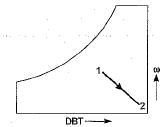
1→2 : Chemical dehumidication so, DBT increases
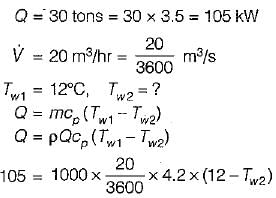


The heat load from the occupants in air conditioning load calculation is a source of- a)Sensible heat only
- b)Latent heat only
- c)Both sensible and latent heat
- d)None of these
Correct answer is option 'C'. Can you explain this answer?
The heat load from the occupants in air conditioning load calculation is a source of
a)
Sensible heat only
b)
Latent heat only
c)
Both sensible and latent heat
d)
None of these
| | Abhay Banerjee answered |
Sensible heat load is due to following:
1. The heat flowing into the building by conduction through exterior walls, floors, ceilings, doors and windows due to temperature difference
2. Heat received by solar radiation through glass of window, ventilations
3. Heat gained by lightnings, machineries, cooking operations, industrial processes etc.
Latent heat load is due to following:
1. Heat gain due to moisture in the outside air entering by infiltration.
2. Heat gain due to condensation of moisture from occupants.
3. Heat gain due to condensation of moisture from any process such as cooking.
1. The heat flowing into the building by conduction through exterior walls, floors, ceilings, doors and windows due to temperature difference
2. Heat received by solar radiation through glass of window, ventilations
3. Heat gained by lightnings, machineries, cooking operations, industrial processes etc.
Latent heat load is due to following:
1. Heat gain due to moisture in the outside air entering by infiltration.
2. Heat gain due to condensation of moisture from occupants.
3. Heat gain due to condensation of moisture from any process such as cooking.
For an office building the outdoor design conditions are 45°C dbt and humidity ratio of 0.015. The indoor design conditions are 25°C dbt and 0.01 humidity ratio. The supply air state is 15°C dbt and 0.007 humidity ratio. If the supply air flow rate is 1000 m3/min and fresh air flow rate is 100 m3/min, room sensible and room latent heat loads are, respectively- a)408 kW and 400 kW
- b)408 kW and 150 kW
- c)204 kW and 400 kW
- d)204 kW and 150 kW
Correct answer is option 'D'. Can you explain this answer?
For an office building the outdoor design conditions are 45°C dbt and humidity ratio of 0.015. The indoor design conditions are 25°C dbt and 0.01 humidity ratio. The supply air state is 15°C dbt and 0.007 humidity ratio. If the supply air flow rate is 1000 m3/min and fresh air flow rate is 100 m3/min, room sensible and room latent heat loads are, respectively
a)
408 kW and 400 kW
b)
408 kW and 150 kW
c)
204 kW and 400 kW
d)
204 kW and 150 kW
| | Jay Menon answered |
SHL = 0.0204 x cmm x ΔT
= 0.0204 x 1000 x (25 - 15) = 204 kW
LHL = 50 cmm x Δw
= 50 x 1000 x (0.01 - 0.007)
= 50 x 1000 x 0.003 = 150 kW
= 0.0204 x 1000 x (25 - 15) = 204 kW
LHL = 50 cmm x Δw
= 50 x 1000 x (0.01 - 0.007)
= 50 x 1000 x 0.003 = 150 kW
The thermodynamic cycle used in aircraft refrigeration is- a)reversed Carnot
- b)reversed Brayton
- c)vapour Compression cycle
- d)reversed Stirling
Correct answer is option 'B'. Can you explain this answer?
The thermodynamic cycle used in aircraft refrigeration is
a)
reversed Carnot
b)
reversed Brayton
c)
vapour Compression cycle
d)
reversed Stirling
| | Sai Sarkar answered |
In aircraft refrigeration system Beil Coleman cycle is used. It is a reversed Brayton Cycle.
In the absorption refrigeration cycle, the compressor of the vapour compression refrigeration cycle is replaced by- a)liquid pump
- b)generator
- c)absorber and generator
- d)absorber, liquid pump and generator
Correct answer is option 'D'. Can you explain this answer?
In the absorption refrigeration cycle, the compressor of the vapour compression refrigeration cycle is replaced by
a)
liquid pump
b)
generator
c)
absorber and generator
d)
absorber, liquid pump and generator
| | Sreemoyee Chauhan answered |
In the absorption refrigeration system the compressor of the vapour compression refrigeration cycle is replaced by pump, absorber and generator.
Air at state 1 (DPT = 10°C, w = 0.0040 kg/kg) mixes with air at state 2 (DPT = 18°C, w = 0.0051 kg/kg) in the ratio 1 to 3 by weight. The degree of saturation (%) of the mixture is (The specific humidity of saturated air at 13.6°C. w = 0.01 kg/kg)- a)25
- b)30
- c)48
- d)62
Correct answer is option 'C'. Can you explain this answer?
Air at state 1 (DPT = 10°C, w = 0.0040 kg/kg) mixes with air at state 2 (DPT = 18°C, w = 0.0051 kg/kg) in the ratio 1 to 3 by weight. The degree of saturation (%) of the mixture is (The specific humidity of saturated air at 13.6°C. w = 0.01 kg/kg)
a)
25
b)
30
c)
48
d)
62
| | Anshul Chakraborty answered |
kg of moisture actually contained
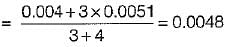
kg of moisture in saturated air of mixture
= 0.01 kg/kg of air
Degree of saturation
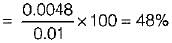
kg of moisture in saturated air of mixture
= 0.01 kg/kg of air
Degree of saturation
The reciprocating refrigerant compressors are very much suitable for- a)small displacements and low condensing pressures,
- b)large displacements and high condensing pressures.
- c)large displacements and low condensing pressures.
- d)small displacements and high condensing pressures.
Correct answer is option 'D'. Can you explain this answer?
The reciprocating refrigerant compressors are very much suitable for
a)
small displacements and low condensing pressures,
b)
large displacements and high condensing pressures.
c)
large displacements and low condensing pressures.
d)
small displacements and high condensing pressures.
| | Neha Joshi answered |
The reciprocating refrigerant compressors are very suitable for Small displacements and high condensing pressures.
Which of the following parameters is made as basis of comparing different type of air- refrigeration systems?- a)Mass flow rate of air
- b)Refrigerating capacity of air cycle in kW
- c)Mach number
- d)Dry air rated temperature
Correct answer is option 'D'. Can you explain this answer?
Which of the following parameters is made as basis of comparing different type of air- refrigeration systems?
a)
Mass flow rate of air
b)
Refrigerating capacity of air cycle in kW
c)
Mach number
d)
Dry air rated temperature
| | Anirudh Banerjee answered |
DART (Dry air rated temperature): It is the temperature of the discharge air from the expander if there is no condensed moisture present and is calculated by specific procedure. The refrigerating capacity of the air cycle unit in kW has no particular relevance. The refrigerating capacity is usually expressed in terms of the mass flow rate of air at DART. In a modern jet aircraft, typical values are 1.8 kg/s of air at 10°C DART just after take-off, and 1.4 kg/s of air at 12.8°C when the aircraft is cruising.
The following statements are concerned with psychrometric chart:
1. Constant relative humidity lines are uphill straight lines to the right
2. Constant wet bulb temperature lines are downhill straight lines to the right
3. Constant specific volume lines are downhill straight lines to the right
4. Constant enthalpy fines are coincident with constant wet bulb temperature lines
Q. Which of the statements are correct?- a)2 and 3
- b)1 and 2
- c)1 and 3
- d)2 and 4
Correct answer is option 'D'. Can you explain this answer?
The following statements are concerned with psychrometric chart:
1. Constant relative humidity lines are uphill straight lines to the right
2. Constant wet bulb temperature lines are downhill straight lines to the right
3. Constant specific volume lines are downhill straight lines to the right
4. Constant enthalpy fines are coincident with constant wet bulb temperature lines
Q. Which of the statements are correct?
1. Constant relative humidity lines are uphill straight lines to the right
2. Constant wet bulb temperature lines are downhill straight lines to the right
3. Constant specific volume lines are downhill straight lines to the right
4. Constant enthalpy fines are coincident with constant wet bulb temperature lines
Q. Which of the statements are correct?
a)
2 and 3
b)
1 and 2
c)
1 and 3
d)
2 and 4
 | Anmol Saini answered |
Psychrometric Chart
The psychrometric chart is a graphical representation of the thermodynamic properties of air-water vapor mixtures. It is a valuable tool used by engineers and scientists to analyze and design systems involving air conditioning, heating, and ventilation. The chart provides information about various properties of moist air, such as temperature, humidity, specific volume, and enthalpy.
Statements and Analysis
Let's analyze each statement and determine whether it is correct or not.
1. Constant relative humidity lines are uphill straight lines to the right.
This statement is incorrect. Constant relative humidity lines on the psychrometric chart are not straight lines. They are curved lines that slope upwards to the right. This is because as temperature increases, the absolute humidity (amount of moisture in the air) required to maintain a constant relative humidity decreases. Therefore, the constant relative humidity lines curve upwards towards the right.
2. Constant wet bulb temperature lines are downhill straight lines to the right.
This statement is correct. Constant wet bulb temperature lines on the psychrometric chart are straight lines that slope downwards to the right. The wet bulb temperature represents the lowest temperature that can be achieved by evaporative cooling. As the moisture content in the air increases, the wet bulb temperature decreases. Therefore, the constant wet bulb temperature lines slope downwards towards the right.
3. Constant specific volume lines are downhill straight lines to the right.
This statement is incorrect. Constant specific volume lines on the psychrometric chart are not straight lines. They are curved lines that slope downwards to the right. The specific volume of air-water vapor mixture decreases as the humidity ratio (mass of water vapor per unit mass of dry air) increases. Therefore, the constant specific volume lines curve downwards towards the right.
4. Constant enthalpy fines are coincident with constant wet bulb temperature lines.
This statement is correct. Constant enthalpy lines on the psychrometric chart coincide with constant wet bulb temperature lines. Enthalpy is a measure of the total heat content of the air-water vapor mixture. The enthalpy value remains constant along a given line. Since the wet bulb temperature is directly related to the enthalpy of the air, the constant enthalpy lines align with the constant wet bulb temperature lines.
Conclusion
Based on the analysis, the correct statements are:
2. Constant wet bulb temperature lines are downhill straight lines to the right.
4. Constant enthalpy fines are coincident with constant wet bulb temperature lines.
Therefore, the correct answer is option 'D' - 2 and 4.
The psychrometric chart is a graphical representation of the thermodynamic properties of air-water vapor mixtures. It is a valuable tool used by engineers and scientists to analyze and design systems involving air conditioning, heating, and ventilation. The chart provides information about various properties of moist air, such as temperature, humidity, specific volume, and enthalpy.
Statements and Analysis
Let's analyze each statement and determine whether it is correct or not.
1. Constant relative humidity lines are uphill straight lines to the right.
This statement is incorrect. Constant relative humidity lines on the psychrometric chart are not straight lines. They are curved lines that slope upwards to the right. This is because as temperature increases, the absolute humidity (amount of moisture in the air) required to maintain a constant relative humidity decreases. Therefore, the constant relative humidity lines curve upwards towards the right.
2. Constant wet bulb temperature lines are downhill straight lines to the right.
This statement is correct. Constant wet bulb temperature lines on the psychrometric chart are straight lines that slope downwards to the right. The wet bulb temperature represents the lowest temperature that can be achieved by evaporative cooling. As the moisture content in the air increases, the wet bulb temperature decreases. Therefore, the constant wet bulb temperature lines slope downwards towards the right.
3. Constant specific volume lines are downhill straight lines to the right.
This statement is incorrect. Constant specific volume lines on the psychrometric chart are not straight lines. They are curved lines that slope downwards to the right. The specific volume of air-water vapor mixture decreases as the humidity ratio (mass of water vapor per unit mass of dry air) increases. Therefore, the constant specific volume lines curve downwards towards the right.
4. Constant enthalpy fines are coincident with constant wet bulb temperature lines.
This statement is correct. Constant enthalpy lines on the psychrometric chart coincide with constant wet bulb temperature lines. Enthalpy is a measure of the total heat content of the air-water vapor mixture. The enthalpy value remains constant along a given line. Since the wet bulb temperature is directly related to the enthalpy of the air, the constant enthalpy lines align with the constant wet bulb temperature lines.
Conclusion
Based on the analysis, the correct statements are:
2. Constant wet bulb temperature lines are downhill straight lines to the right.
4. Constant enthalpy fines are coincident with constant wet bulb temperature lines.
Therefore, the correct answer is option 'D' - 2 and 4.
In an absorption type refrigerator, the heat is supplied to NH3 generator by condensing steam at 2 bar and 90% dry. The temperature in the refrigerator is to be maintained at - 5°C. If the refrigeration load is 20 tones and actual COP is 70% of the maximum then mass of steam required per hour is
(Take atmospheric temperature as 30°C saturation temperature of steam at pressure of 2 bar is 120.2°C, hfg at 2 bar is 2201.6 kJ/kg)- a)93.12 kg/hr
- b)80.2 kg/hr
- c)76.73 kg/hr
- d)79.8 kg/hr
Correct answer is option 'A'. Can you explain this answer?
In an absorption type refrigerator, the heat is supplied to NH3 generator by condensing steam at 2 bar and 90% dry. The temperature in the refrigerator is to be maintained at - 5°C. If the refrigeration load is 20 tones and actual COP is 70% of the maximum then mass of steam required per hour is
(Take atmospheric temperature as 30°C saturation temperature of steam at pressure of 2 bar is 120.2°C, hfg at 2 bar is 2201.6 kJ/kg)
(Take atmospheric temperature as 30°C saturation temperature of steam at pressure of 2 bar is 120.2°C, hfg at 2 bar is 2201.6 kJ/kg)
a)
93.12 kg/hr
b)
80.2 kg/hr
c)
76.73 kg/hr
d)
79.8 kg/hr
| | Aashna Chakraborty answered |
Given: TG = 393.2 k, Tc = 303 k,
TE = -5 + 273 = 268 k

actual COP = 0.7 x 1.756 = 1.229
actual heat supplied = Refrigeration load/Actual COP

Assuming that only latent heat of steam is used for heating
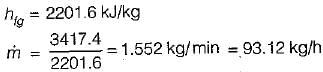
TE = -5 + 273 = 268 k
actual COP = 0.7 x 1.756 = 1.229
actual heat supplied = Refrigeration load/Actual COP
Assuming that only latent heat of steam is used for heating
Chapter doubts & questions for Applications - Mechanical Engineering Optional Notes for UPSC 2026 is part of UPSC CSE exam preparation. The chapters have been prepared according to the UPSC CSE exam syllabus. The Chapter doubts & questions, notes, tests & MCQs are made for UPSC CSE 2026 Exam. Find important definitions, questions, notes, meanings, examples, exercises, MCQs and online tests here.
Chapter doubts & questions of Applications - Mechanical Engineering Optional Notes for UPSC in English & Hindi are available as part of UPSC CSE exam. Download more important topics, notes, lectures and mock test series for UPSC CSE Exam by signing up for free.
Mechanical Engineering Optional Notes for UPSC298 videos|461 docs|250 tests |
