


All Exams > A Level > Mathematics for A Level > All Questions
All questions of Coordinate Geometry- Ellipse for A Level Exam
 +
+  = 1, and its corresponding point Q on the auxiliary circle meet on the line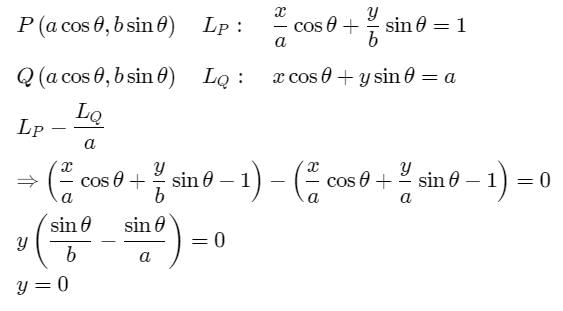

The centre of the ellipse 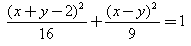 is:
is:- a)(0, 1)
- b)(1, 1)
- c)(0, 0)
- d)(1, 0)
Correct answer is option 'B'. Can you explain this answer?
The centre of the ellipse is:
is:a)
(0, 1)
b)
(1, 1)
c)
(0, 0)
d)
(1, 0)
 | Lohit Matani answered |
Centre of the ellipse is the intersection point of
x+y−1=0.........(1)
x−y=0............(2)
Substituting x from equation 2 in equation 1 two equations, we get,
2y=2, y=1
Replacing, we get x=1
⇒(1,1) is the centre
x+y−1=0.........(1)
x−y=0............(2)
Substituting x from equation 2 in equation 1 two equations, we get,
2y=2, y=1
Replacing, we get x=1
⇒(1,1) is the centre
A tangent having slope of _ to the ellipse
 +
+  = 1 intersects the major & minor axes in points A & B respectively. If C is the centre of the ellipse then the area of the triangle ABC is
- a)12 sq. units
- b)24 sq. units
- c)36 sq. units
- d)48 sq. units
Correct answer is option 'B'. Can you explain this answer?
A tangent having slope of _ to the ellipse
to the ellipse + = 1 intersects the major & minor axes in points A & B respectively. If C is the centre of the ellipse then the area of the triangle ABC isa)
12 sq. units
b)
24 sq. units
c)
36 sq. units
d)
48 sq. units
 | Preeti Khanna answered |
Since the major axis is along the y-axis.
∴ Equation of tangent is x = my + [b2m2 + a]1/2
Slope of tangent = 1/m = −4/3
⇒ m = −3/4
Hence, equation of tangent is 4x+3y=24 or
x/6 + y/8 = 1
Its intercepts on the axes are 6 and 8.
Area (ΔAOB) = 1/2×6×8
= 24 sq. unit
∴ Equation of tangent is x = my + [b2m2 + a]1/2
Slope of tangent = 1/m = −4/3
⇒ m = −3/4
Hence, equation of tangent is 4x+3y=24 or
x/6 + y/8 = 1
Its intercepts on the axes are 6 and 8.
Area (ΔAOB) = 1/2×6×8
= 24 sq. unit
The equation of the ellipse whose one focus is at (4, 0) and whose eccentricity is 4/5 is:- a)

- b)

- c)

- d)

Correct answer is option 'D'. Can you explain this answer?
The equation of the ellipse whose one focus is at (4, 0) and whose eccentricity is 4/5 is:
a)
b)
c)
d)
 | Neha Sharma answered |
focus lies on x axis
So, the equation of ellipse is x2/a2 + y2/b2 = 1
Co-ordinate of focus(+-ae, 0)
ae = 4
e = ⅘
a = 4/e => 4/(⅘)
a = 5
(a)2 = 25
b2 = a2(1-e2)
= 25(1-16/25)
b2 = 9
Required equation : x2/(5)2 + y2/(3)2 = 1
So, the equation of ellipse is x2/a2 + y2/b2 = 1
Co-ordinate of focus(+-ae, 0)
ae = 4
e = ⅘
a = 4/e => 4/(⅘)
a = 5
(a)2 = 25
b2 = a2(1-e2)
= 25(1-16/25)
b2 = 9
Required equation : x2/(5)2 + y2/(3)2 = 1
If the curve x2 3y2 = 9 subtends an obtuse angle at the point (2α, α), then a possible value of α2 is - a) 1
- b) 2
- c) 3
- d) 4
Correct answer is option 'A'. Can you explain this answer?
If the curve x2 3y2 = 9 subtends an obtuse angle at the point (2α, α), then a possible value of α2 is
a)
1b)
2c)
3d)
4  | Ishan Choudhury answered |
The given curve is  whose director circle is x2 + y2 = 12.
For the required condition (2α, α) should lie inside the circle and outside the ellipse i.e.,



whose director circle is x2 + y2 = 12.For the required condition (2α, α) should lie inside the circle and outside the ellipse i.e.,
If distance between the directrices be thrice the distance between the foci, then eccentricity of ellipse is- a)

- b)

- c)

- d)

Correct answer is option 'C'. Can you explain this answer?
If distance between the directrices be thrice the distance between the foci, then eccentricity of ellipse is
a)
b)
c)
d)
 | Trisha Vashisht answered |
Distance between the directrices is 2a/e
Distance between the foci is 2ae
Given: 2a/e = 3∗2ae
Or,e2 = 1/3
∴ e=1/√3
Distance between the foci is 2ae
Given: 2a/e = 3∗2ae
Or,e2 = 1/3
∴ e=1/√3
From point P (8, 27), tangent PQ and PR are drawn to the ellipse  Then the angle subtended by QR at origin is
 - a)

- b)

- c)

- d)

Correct answer is option 'D'. Can you explain this answer?
From point P (8, 27), tangent PQ and PR are drawn to the ellipse Then the angle subtended by QR at origin is
Then the angle subtended by QR at origin is a)
b)
c)
d)
 | Om Desai answered |
Equation of QR is T = 0 (chord of contact)

⇒ 2x + 3y = 1 .....(i)
Now, equation of the pair of lines passing through origin and points Q, R is given by
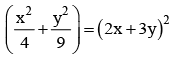
(making equation of ellipse homogeneous using Eq (i)
∴135x2 + 432xy + 320y2 = 0
⇒ 2x + 3y = 1 .....(i)
Now, equation of the pair of lines passing through origin and points Q, R is given by
(making equation of ellipse homogeneous using Eq (i)
∴135x2 + 432xy + 320y2 = 0
The eccentricity of an ellipse whose latus rectum is equal to distance between foci is:- a)

- b)

- c)

- d)

Correct answer is option 'A'. Can you explain this answer?
The eccentricity of an ellipse whose latus rectum is equal to distance between foci is:
a)
b)
c)
d)
 | Suresh Reddy answered |
Distance between the foci of an ellipse = length of latus rectum
i.e. (2b2)/a=2ae
e=b2/a2
But e=[1−b2/a2]1/2
Then e=(1−e)1/2
Squaring both sides, we get
e2 +e−1=0
e=−1 ± (1 + 4)1/2]/2
(∵ Eccentricity cannot be negative)
e=[(5)1/2 − 1]/2
i.e. (2b2)/a=2ae
e=b2/a2
But e=[1−b2/a2]1/2
Then e=(1−e)1/2
Squaring both sides, we get
e2 +e−1=0
e=−1 ± (1 + 4)1/2]/2
(∵ Eccentricity cannot be negative)
e=[(5)1/2 − 1]/2
The radius of the circle given by 2x2 + 2y2 – x = 0 is- a)1/4
- b)1
- c)2
- d)1/2
Correct answer is option 'A'. Can you explain this answer?
The radius of the circle given by 2x2 + 2y2 – x = 0 is
a)
1/4
b)
1
c)
2
d)
1/2
 | Geetika Shah answered |
2x² + 2y² - x = 0 .
==> 2 ( x² + y² - x/2 ) = 0 .
==> 2/2 ( x² + y² - x/2 ) = 0/2 .
==> x² - x/2 + y² = 0 .
==> ( x² - x/2 + (1/4)² ) + y² = (1/4)² .
==> ( x - 1/4 )² + ( y - 0 )² = (1/4)²
Centre (-¼, 0) radius(¼)
==> 2 ( x² + y² - x/2 ) = 0 .
==> 2/2 ( x² + y² - x/2 ) = 0/2 .
==> x² - x/2 + y² = 0 .
==> ( x² - x/2 + (1/4)² ) + y² = (1/4)² .
==> ( x - 1/4 )² + ( y - 0 )² = (1/4)²
Centre (-¼, 0) radius(¼)
The length of the semi-latus-rectum of an ellipse is one third of its major axis, its eccentricity would be- a)

- b)

- c)2/3
- d)

Correct answer is option 'A'. Can you explain this answer?
The length of the semi-latus-rectum of an ellipse is one third of its major axis, its eccentricity would be
a)
b)
c)
2/3
d)
| | Suresh Iyer answered |
Correct Answer :- a
Explanation : Semi latus rectum of ellipse = one half the last rectum
b2/a = 1/3*2a
b2 = 2a2/3
b = (2a/3)1/2...........(1)
So, b2/a = a(1-e2)
b2 = a2(1-e2)
Substituting from (1)
2a2/3 = a2(1-e2)
e2 = 1-2/3
e2 = 1/(3)1/2
If maximum distance of any point on the ellipse x2 + 2y2 + 2xy = 1 from its centre be r, then r is equal to- a)

- b)

- c)

- d)

Correct answer is option 'C'. Can you explain this answer?
If maximum distance of any point on the ellipse x2 + 2y2 + 2xy = 1 from its centre be r, then r is equal to
a)
b)
c)
d)
| | Naina Sharma answered |
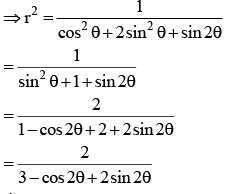
Here centre of the ellipse is (0,0) Let P (r cos θ, r sinθ) be any point on the given ellipse then r2 cos2θ + 2r2 sin2 θ + 2r2 sinθ cosθ = 1


The line passing through the extremely A of the major axis and extremity B of the minor axis of the ellipse x2 + 9y2 = 9 meets its auxiliary circle at the point M . Then the area of the triangle with vertices at A,M and the origin O is- a)31/10
- b)29/10
- c)21/10
- d)27/10
Correct answer is option 'D'. Can you explain this answer?
The line passing through the extremely A of the major axis and extremity B of the minor axis of the ellipse x2 + 9y2 = 9 meets its auxiliary circle at the point M . Then the area of the triangle with vertices at A,M and the origin O is
a)
31/10
b)
29/10
c)
21/10
d)
27/10
 | Bibek Nambiar answered |
Explanation:
The given ellipse equation is x^2 + 9y^2 = 9, which can be written as x^2/9 + y^2/1 = 1. This ellipse has a major axis of length 6 (2a = 6) and a minor axis of length 2 (2b = 2).
Finding the Endpoints of Major and Minor Axes:
- The endpoints of the major axis are (3, 0) and (-3, 0) denoted by points A and A'.
- The endpoints of the minor axis are (0, 1) and (0, -1) denoted by points B and B'.
Finding the Point of Intersection with Auxiliary Circle:
- The auxiliary circle of the ellipse has the equation x^2 + y^2 = 1.
- Substituting the equation of the ellipse into the auxiliary circle equation, we get x^2 + 9y^2 = 9 = x^2 + y^2.
- Solving the above equation gives y^2 = 1/10, which implies y = ±1/√10.
- Therefore, the points of intersection are (3, 1/√10) and (3, -1/√10) denoted by M and M'.
Calculating the Area of the Triangle:
- The area of the triangle with vertices A, M, and the origin O can be calculated using the formula for the area of a triangle given by half the magnitude of the cross product of vectors AM and AO.
- The vector AM is (3, 1/√10) and the vector AO is (-3, 0).
- Calculating the cross product magnitude gives |AM x AO| = |3(0) - (1/√10)(-3)| = 3/√10.
- Therefore, the area of the triangle is 1/2 * base * height = 1/2 * 3 * 3/√10 = 9/2√10 = 9√10/20 = 9/10.
- So, the correct answer is option 'D' (27/10).
Q is a point on the auxiliary circle of an ellipse. P is the corresponding point on ellipse. N is the foot of perpendicular from focus S, to the tangent of auxiliary circle at Q. Then- a)SP = SN
- b)SP = PQ
- c)PN = SP
- d)NQ = SP
Correct answer is option 'A'. Can you explain this answer?
Q is a point on the auxiliary circle of an ellipse. P is the corresponding point on ellipse. N is the foot of perpendicular from focus S, to the tangent of auxiliary circle at Q. Then
a)
SP = SN
b)
SP = PQ
c)
PN = SP
d)
NQ = SP
| | Naina Sharma answered |
P = (acosθ, bsinθ)
Q = (acosθ, asinθ)
equation of tangent at Q
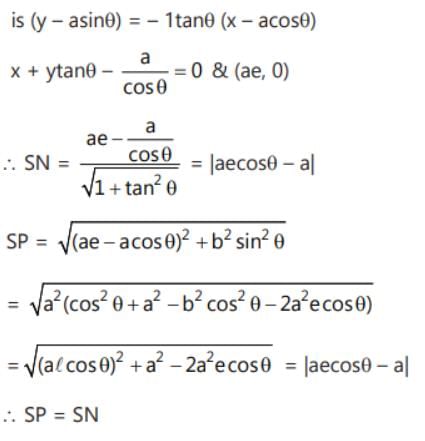
Q = (acosθ, asinθ)
equation of tangent at Q
 +
+  = 1 at the positive end of latus rectum is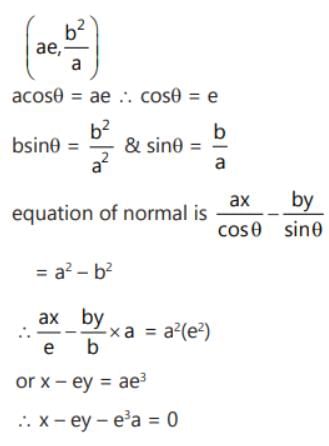
x – 2y + 4 = 0 is a common tangent to y2 = 4x &  +
+  = 1. Then the value of b and the other common tangent are given by
- a)b = √3 ;x + 2y + 4 = 0
- b)b = 3; x + 2y + 4 = 0
- c)b = √3 ;x + 2y– 4 = 0
- d)b = √3 ; x – 2y – 4 = 0
Correct answer is option 'A'. Can you explain this answer?
x – 2y + 4 = 0 is a common tangent to y2 = 4x & + = 1. Then the value of b and the other common tangent are given by
+ = 1. Then the value of b and the other common tangent are given bya)
b = √3 ;x + 2y + 4 = 0
b)
b = 3; x + 2y + 4 = 0
c)
b = √3 ;x + 2y– 4 = 0
d)
b = √3 ; x – 2y – 4 = 0
 | Knowledge Hub answered |
Equation of tangent of ellipse is
y=mx±+ ..............(i)
Given equation is x−2y+4=0 .........(ii)
Since (i) & (ii) are same, comparing them, we get
m=1/2&a2m2 + b2 = 2
⇒4*1/4+b2=4
b=±3
Equation of tangent of parabola
y=mx+1/m .........(iii)
by (i) & (iii)
1/m^2= a2m2+b2
on solving it we get m=±1/2
with m = −1/2 , we get x+2y+4=0
y=mx±+ ..............(i)
Given equation is x−2y+4=0 .........(ii)
Since (i) & (ii) are same, comparing them, we get
m=1/2&a2m2 + b2 = 2
⇒4*1/4+b2=4
b=±3
Equation of tangent of parabola
y=mx+1/m .........(iii)
by (i) & (iii)
1/m^2= a2m2+b2
on solving it we get m=±1/2
with m = −1/2 , we get x+2y+4=0
The normal at a variable point P on an ellipse  +
+  = 1 of eccentricity e meets the axes of the ellipse in Q and R then the locus of the mid-point of QR is a conic with an eccentricity e' such that
- a)e' is independent of e
- b)e' = 1
- c)e' = e
- d)e' = 1/e
Correct answer is option 'C'. Can you explain this answer?
The normal at a variable point P on an ellipse + = 1 of eccentricity e meets the axes of the ellipse in Q and R then the locus of the mid-point of QR is a conic with an eccentricity e' such that
+ = 1 of eccentricity e meets the axes of the ellipse in Q and R then the locus of the mid-point of QR is a conic with an eccentricity e' such thata)
e' is independent of e
b)
e' = 1
c)
e' = e
d)
e' = 1/e
| | Pooja Shah answered |
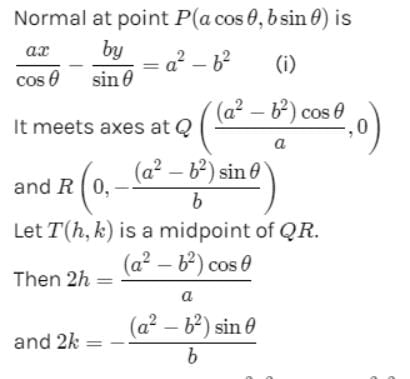
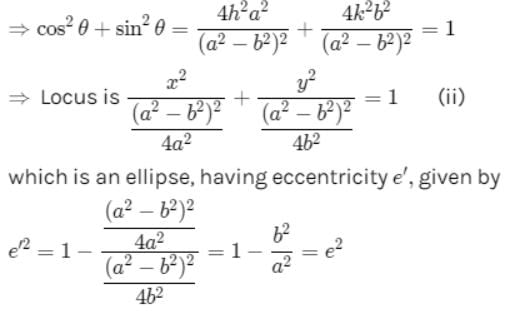
e’ = e
A circle has the same centre as an ellipse & passes through the foci F1 & F2 of the ellipse, such that the two curves intersect in 4 points. Let `P' be any one of their point of intersection. If the major axis of the ellipse is 17 & the area of the triangle PF1F2 is 30, then the distance between the foci is less than- a)12
- b)13
- c)14
- d)15
Correct answer is option 'B'. Can you explain this answer?
A circle has the same centre as an ellipse & passes through the foci F1 & F2 of the ellipse, such that the two curves intersect in 4 points. Let `P' be any one of their point of intersection. If the major axis of the ellipse is 17 & the area of the triangle PF1F2 is 30, then the distance between the foci is less than
a)
12
b)
13
c)
14
d)
15
 | Nandini Kumar answered |
If a circle has the same center as an ellipse, it means that the center point of the circle is also the center point of the ellipse. This implies that the two shapes share a common point around which they are symmetrical.
However, it is important to note that even though they have the same center, the circle and the ellipse are still distinct shapes with different properties. The circle is a special case of an ellipse where the lengths of both semi-axes are equal, resulting in a perfectly symmetrical shape. The ellipse, on the other hand, has two semi-axes of different lengths, resulting in an elongated or stretched-out shape.
So, while the circle and the ellipse may share a common center, they have different overall shapes and characteristics.
However, it is important to note that even though they have the same center, the circle and the ellipse are still distinct shapes with different properties. The circle is a special case of an ellipse where the lengths of both semi-axes are equal, resulting in a perfectly symmetrical shape. The ellipse, on the other hand, has two semi-axes of different lengths, resulting in an elongated or stretched-out shape.
So, while the circle and the ellipse may share a common center, they have different overall shapes and characteristics.
 such that the line joining the foci subtends a right angle only at two points on ellipse, is
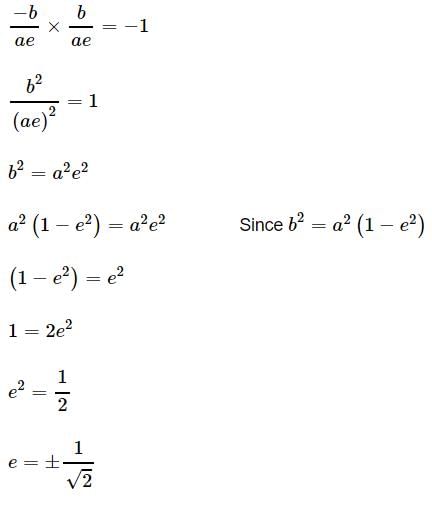

If a tangent of slope 2 of the ellipse 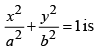 is normal to the circle x2 + y2 + 4x + 1 = 0 , then the maximum value of ab is
- a)4
- b)2
- c)1
- d)None of these
Correct answer is option 'A'. Can you explain this answer?
If a tangent of slope 2 of the ellipse is normal to the circle x2 + y2 + 4x + 1 = 0 , then the maximum value of ab is
is normal to the circle x2 + y2 + 4x + 1 = 0 , then the maximum value of ab isa)
4
b)
2
c)
1
d)
None of these
| | Geetika Shah answered |
Let 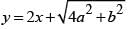 be the tangent
It is passing through(-2,0)
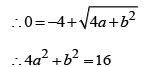
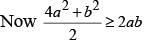


be the tangentIt is passing through(-2,0)
The eccentricity of an ellipse, with its centre at the origin, is 1/2. If one of the directrix is x = 4, then the equation of the ellipse is:- a)

- b)
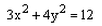
- c)

- d)

Correct answer is option 'B'. Can you explain this answer?
The eccentricity of an ellipse, with its centre at the origin, is 1/2. If one of the directrix is x = 4, then the equation of the ellipse is:
a)
b)
c)
d)
| | Naina Sharma answered |
Let the equation of ellipse (x2)/(a2)+(y2)/(b2)=1
Here a > ba > b because the directrix is parallel to y axis.
b2=a2(1−e2)
Given e= 1/2
⇒b2 = (3/4)a2
But a/e=4
⇒a=2
Putting a=2 we get b= (3)1/2
Required ellipse is (x2)/4+(y2)/3=1
⇒3x2+4y2=12
Here a > ba > b because the directrix is parallel to y axis.
b2=a2(1−e2)
Given e= 1/2
⇒b2 = (3/4)a2
But a/e=4
⇒a=2
Putting a=2 we get b= (3)1/2
Required ellipse is (x2)/4+(y2)/3=1
⇒3x2+4y2=12
If tan q1. tan q2 = – then the chord joining two points q1 & q2 on the ellipse
  +
+  = 1 will subtend a right angle at
- a)Focus
- b)Centre
- c)End of the major axis
- d)End of the minor axis
Correct answer is option 'B'. Can you explain this answer?
If tan q1. tan q2 = – then the chord joining two points q1 & q2 on the ellipse + = 1 will subtend a right angle at
then the chord joining two points q1 & q2 on the ellipse + = 1 will subtend a right angle ata)
Focus
b)
Centre
c)
End of the major axis
d)
End of the minor axis
 | Lavanya Menon answered |
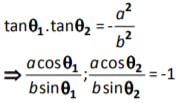
Clearly, they subtend right angle at centre.
The eccentricity of the ellipse 9x2 + 5y2 – 30y = 0 is:- a)1/3
- b)2/3
- c)3/4
- d)None of these
Correct answer is option 'B'. Can you explain this answer?
The eccentricity of the ellipse 9x2 + 5y2 – 30y = 0 is:
a)
1/3
b)
2/3
c)
3/4
d)
None of these
| | Preeti Iyer answered |
9x2 + 5y2 - 30y = 0
9x2 + 5(y−3)2 = 45
We can write it as : [(x-0)2]/5 + [(y-3)2]/9 = 1
Compare it with x2/a2 + y2/b2 = 1
e = [(b2 - a2)/b2]½
e = [(9-5)/9]1/2
e = (4/9)½
e = ⅔
9x2 + 5(y−3)2 = 45
We can write it as : [(x-0)2]/5 + [(y-3)2]/9 = 1
Compare it with x2/a2 + y2/b2 = 1
e = [(b2 - a2)/b2]½
e = [(9-5)/9]1/2
e = (4/9)½
e = ⅔
In the ellipse x2 + 3y2 = 9 the distance between the foci is- a)3
- b)

- c)

- d)

Correct answer is option 'B'. Can you explain this answer?
In the ellipse x2 + 3y2 = 9 the distance between the foci is
a)
3
b)
c)
d)
 | Learners Habitat answered |
x2 + 3y2 = 9
⇒(x2)/9 + (y2)/3=1
⇒a2=9, b2=3
⇒e=[1−b2/a2]1/2
=(2/3)1/2
Therefore, distance between foci is =2ae = 2 × 3 × (2/3)1/2
=2(6)1/2
⇒(x2)/9 + (y2)/3=1
⇒a2=9, b2=3
⇒e=[1−b2/a2]1/2
=(2/3)1/2
Therefore, distance between foci is =2ae = 2 × 3 × (2/3)1/2
=2(6)1/2
The area of the rectangle formed by the perpendiculars from the centre of the standard ellipse to the tangent and normal at its point whose eccentric angle is p/4 is- a)

- b)

- c)

- d)

Correct answer is option 'A'. Can you explain this answer?
The area of the rectangle formed by the perpendiculars from the centre of the standard ellipse to the tangent and normal at its point whose eccentric angle is p/4 is
a)
b)
c)
d)
| | Lohit Matani answered |
Let equation of ellipse is
x2/a2 + y2/b2 = 1
Equation of tangent at P
(acos π/4, bsin π/4) is x/a + y/b = √2
Equation of normal at P is
√2ax − √2by = a2 − b2
Now
OT = |-√2ab/√(a2 + b2)|
And ON = −(a2 − b2)/[√2 * √(a2 + b2)]
Hence area is (a2 − b2)ab/(a2 + b2)
x2/a2 + y2/b2 = 1
Equation of tangent at P
(acos π/4, bsin π/4) is x/a + y/b = √2
Equation of normal at P is
√2ax − √2by = a2 − b2
Now
OT = |-√2ab/√(a2 + b2)|
And ON = −(a2 − b2)/[√2 * √(a2 + b2)]
Hence area is (a2 − b2)ab/(a2 + b2)
 =1, the length of the major axis is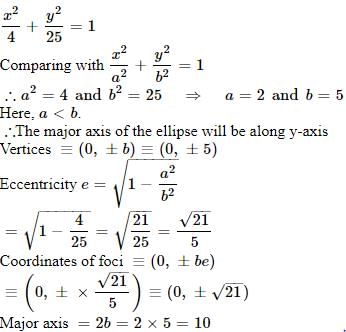
PQ is a double ordinate of the ellipse x2+ 9y2 = 9, the normal at P meets the diameter through Q at R, then the locus of the mid point of PR is- a)A circle
- b)A parabola
- c)An ellipse
- d)A hyperbola
Correct answer is option 'C'. Can you explain this answer?
PQ is a double ordinate of the ellipse x2+ 9y2 = 9, the normal at P meets the diameter through Q at R, then the locus of the mid point of PR is
a)
A circle
b)
A parabola
c)
An ellipse
d)
A hyperbola
| | Avik Nair answered |
Given an ellipse with equation x^2/9 + y^2/1 = 1, let's analyze the given information step by step to understand why the locus of the midpoint of PR is an ellipse.
1. Finding the coordinates of point P:
Since PQ is a double ordinate, it means that the line segment PQ passes through the center of the ellipse. The center of the ellipse is (0, 0), so the coordinates of point P are (0, 1).
2. Finding the equation of the normal at point P:
To find the equation of the normal at point P, we need to find the slope of the tangent at point P. Differentiating the equation of the ellipse, we get:
2x/9 + 2y(dy/dx) = 0
dy/dx = -9x/(2y)
The slope of the normal is the negative reciprocal of the slope of the tangent, so the slope of the normal at P is (2y)/(9x).
Using the point-slope form of a line, the equation of the normal at P is given by:
y - 1 = (2y)/(9x) * (x - 0)
9xy - 9x = 2y^2 - 2y
2y^2 - 9xy + 9x - 2y + 2 = 0
3. Finding the coordinates of point Q:
Since PQ is a double ordinate, it means that the distance between points P and Q is equal to 2 times the distance between point P and the center of the ellipse. The distance between P and the center is 1, so the distance between P and Q is 2.
Since point P is at (0, 1), point Q can be at either (2, 1) or (-2, 1).
4. Finding the equation of the diameter through point Q:
Since point Q lies on the diameter, we can find the equation of the diameter passing through point Q by finding the equation of the line passing through points P and Q.
Using the two-point form of a line, the equation of the diameter is given by:
(y - 1) = (1 - 1)/(0 - 2) * (x - 2)
(x + 2) = 0
So the equation of the diameter is x = -2.
5. Finding the coordinates of point R:
Point R is the intersection of the normal at P and the diameter passing through Q. Since the equation of the diameter is x = -2, the x-coordinate of point R is -2. We can substitute this value into the equation of the normal to find the y-coordinate of point R.
2y^2 - 9(-2)y + 9(-2) - 2y + 2 = 0
2y^2 + 18y - 18 - 2y + 2 = 0
2y^2 + 16y - 16 = 0
y^2 + 8y - 8 = 0
Using the quadratic formula, we can solve for y:
y = (-8 ± √(8^2 - 4*1*(-8)))/2
y = (-8 ± √(64 + 32))/2
y = (-8 ± √96)/2
y = (-
1. Finding the coordinates of point P:
Since PQ is a double ordinate, it means that the line segment PQ passes through the center of the ellipse. The center of the ellipse is (0, 0), so the coordinates of point P are (0, 1).
2. Finding the equation of the normal at point P:
To find the equation of the normal at point P, we need to find the slope of the tangent at point P. Differentiating the equation of the ellipse, we get:
2x/9 + 2y(dy/dx) = 0
dy/dx = -9x/(2y)
The slope of the normal is the negative reciprocal of the slope of the tangent, so the slope of the normal at P is (2y)/(9x).
Using the point-slope form of a line, the equation of the normal at P is given by:
y - 1 = (2y)/(9x) * (x - 0)
9xy - 9x = 2y^2 - 2y
2y^2 - 9xy + 9x - 2y + 2 = 0
3. Finding the coordinates of point Q:
Since PQ is a double ordinate, it means that the distance between points P and Q is equal to 2 times the distance between point P and the center of the ellipse. The distance between P and the center is 1, so the distance between P and Q is 2.
Since point P is at (0, 1), point Q can be at either (2, 1) or (-2, 1).
4. Finding the equation of the diameter through point Q:
Since point Q lies on the diameter, we can find the equation of the diameter passing through point Q by finding the equation of the line passing through points P and Q.
Using the two-point form of a line, the equation of the diameter is given by:
(y - 1) = (1 - 1)/(0 - 2) * (x - 2)
(x + 2) = 0
So the equation of the diameter is x = -2.
5. Finding the coordinates of point R:
Point R is the intersection of the normal at P and the diameter passing through Q. Since the equation of the diameter is x = -2, the x-coordinate of point R is -2. We can substitute this value into the equation of the normal to find the y-coordinate of point R.
2y^2 - 9(-2)y + 9(-2) - 2y + 2 = 0
2y^2 + 18y - 18 - 2y + 2 = 0
2y^2 + 16y - 16 = 0
y^2 + 8y - 8 = 0
Using the quadratic formula, we can solve for y:
y = (-8 ± √(8^2 - 4*1*(-8)))/2
y = (-8 ± √(64 + 32))/2
y = (-8 ± √96)/2
y = (-
The foci of the ellipse 25 (x + 1)2 + 9(y + 2)2 = 225 are at:- a)(–2, 1) and (–2, 6)
- b)(–1, 2) and (–1, –6)
- c)(–1, –2) and (–1, –6)
- d)(–1, –2) and (–2, –1)
Correct answer is option 'B'. Can you explain this answer?
The foci of the ellipse 25 (x + 1)2 + 9(y + 2)2 = 225 are at:
a)
(–2, 1) and (–2, 6)
b)
(–1, 2) and (–1, –6)
c)
(–1, –2) and (–1, –6)
d)
(–1, –2) and (–2, –1)
| | Poonam Reddy answered |
Here equation of ellipse is 25(x + 1)2 + 9(y + 2)2 = 225
0r (x + 1)2/9 + (y + 2)2/25 = 1
Centre of the ellipse is (–1,–2)
a2 = 9, b2 = 25
a = 3, b = 5
e = (1-a2/b2)1/2
e = (1-9/25)1/2
e = +-4/5
be = +-4
Foci : (-1,-6)(-1,2)
0r (x + 1)2/9 + (y + 2)2/25 = 1
Centre of the ellipse is (–1,–2)
a2 = 9, b2 = 25
a = 3, b = 5
e = (1-a2/b2)1/2
e = (1-9/25)1/2
e = +-4/5
be = +-4
Foci : (-1,-6)(-1,2)
The number of points on X-axis which are at a distance c units (c < 3) from (2, 3) is- a)1
- b)0
- c)3
- d)2
Correct answer is option 'B'. Can you explain this answer?
The number of points on X-axis which are at a distance c units (c < 3) from (2, 3) is
a)
1
b)
0
c)
3
d)
2
 | Mohit Rajpoot answered |
Distance of 'c' units from (2,3)
Let the no: of points be (x,0)
By distance formula
{(2−x)2+(3−0)2}=c
4−4x+x2+9=c
⇒x2−4x+13 = c:c=2,2
There are the points of c,such that when they are applied back to the equations,the number of points will become zero.
Let the no: of points be (x,0)
By distance formula
{(2−x)2+(3−0)2}=c
4−4x+x2+9=c
⇒x2−4x+13 = c:c=2,2
There are the points of c,such that when they are applied back to the equations,the number of points will become zero.
An ellipse is such that the length of the latus rectum is equal to the sum of the lengths of its semi principal axes. Then- a)Ellipse becomes a circle
- b)Ellipse becomes a line segment between the two foci
- c)Ellipse becomes a parabola
- d)None of these
Correct answer is option 'A'. Can you explain this answer?
An ellipse is such that the length of the latus rectum is equal to the sum of the lengths of its semi principal axes. Then
a)
Ellipse becomes a circle
b)
Ellipse becomes a line segment between the two foci
c)
Ellipse becomes a parabola
d)
None of these
| | Pooja Shah answered |
Sum of the lengths of its semi−principal axis is : a+b
Given, 2b2/a=a+b
Or,2b2=a2+ab
Or,2b2−ab−a2 =0
Or,2b2−2ab+ab−a2=0
Or,2b(b−a)+a(b−a)=0
Or,(2b+a)(b−a)=0
Since,both are positive quantity, b=a
∴ It’s a circle.
Given, 2b2/a=a+b
Or,2b2=a2+ab
Or,2b2−ab−a2 =0
Or,2b2−2ab+ab−a2=0
Or,2b(b−a)+a(b−a)=0
Or,(2b+a)(b−a)=0
Since,both are positive quantity, b=a
∴ It’s a circle.
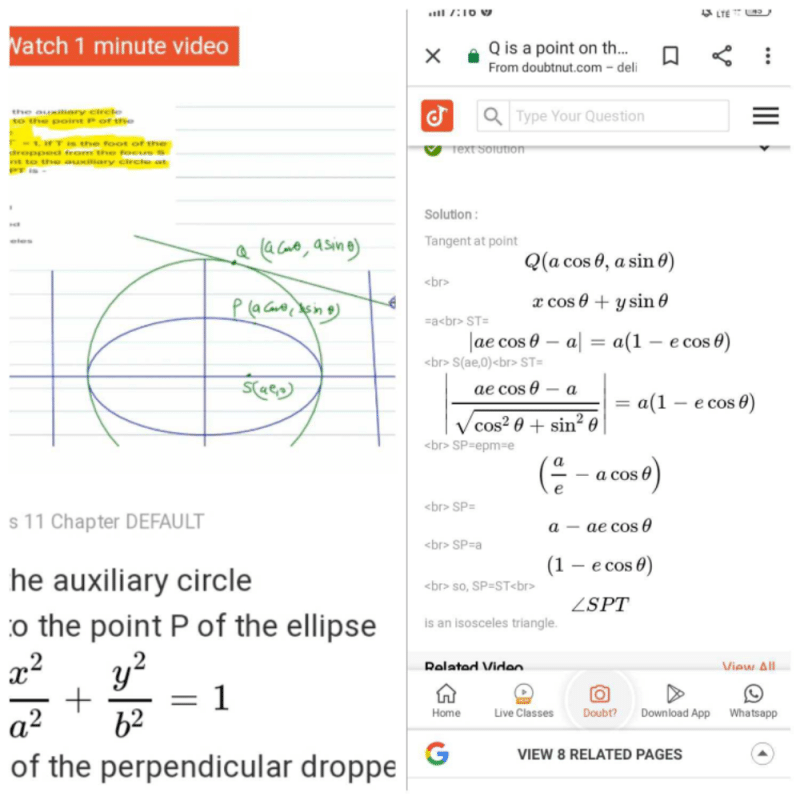
Q is a point on the auxiliary circle corresponding to the point P of the ellipse  +
+  = 1. If T is the foot of the perpendicular dropped from the focus S onto the tangent to the auxiliary circle at Q then the D SPT is
- a)Isosceles
- b)Equilateral
- c)Right angled
- d)Right isosceles
Correct answer is option 'A'. Can you explain this answer?
Q is a point on the auxiliary circle corresponding to the point P of the ellipse + = 1. If T is the foot of the perpendicular dropped from the focus S onto the tangent to the auxiliary circle at Q then the D SPT is
+ = 1. If T is the foot of the perpendicular dropped from the focus S onto the tangent to the auxiliary circle at Q then the D SPT isa)
Isosceles
b)
Equilateral
c)
Right angled
d)
Right isosceles
| | Rising Star answered |
Which of the following is the eccentricity for ellipse?- a)1
- b)3/2
- c)2/3
- d)5/2
Correct answer is option 'C'. Can you explain this answer?
Which of the following is the eccentricity for ellipse?
a)
1
b)
3/2
c)
2/3
d)
5/2
 | Rishabh Das answered |
The eccentricity for ellipse is always less than 1. The eccentricity is always 1 for any parabola. The eccentricity is always 0 for a circle. The eccentricity for a hyperbola is always greater than 1.
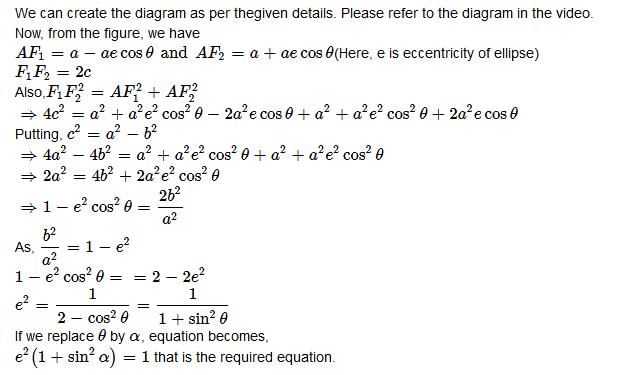
The tangent at the point α on the ellipse  meets the auxiliary circle in two points which subtends a right angle at the centre, then the eccentricity ‘e’ of the ellipse is given by the equation :
- a)e2 (1 + cos2 α) = 1
- b)e2 (cosec2α - 1) = 1
- c)e2 (1 + sin2 α) = 1
- d)e2 (1 + tan2 α) = 1
Correct answer is option 'C'. Can you explain this answer?
The tangent at the point α on the ellipse meets the auxiliary circle in two points which subtends a right angle at the centre, then the eccentricity ‘e’ of the ellipse is given by the equation :
meets the auxiliary circle in two points which subtends a right angle at the centre, then the eccentricity ‘e’ of the ellipse is given by the equation :a)
e2 (1 + cos2 α) = 1
b)
e2 (cosec2α - 1) = 1
c)
e2 (1 + sin2 α) = 1
d)
e2 (1 + tan2 α) = 1
 | Sinjini Datta answered |
Method to Solve :
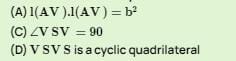
The tangent at any point P on a standard ellipse with foci as S & S¢ meets the tangents at the vertcies A & A¢ in the points V & V¢, then- a)l(AV).l(A'V') = b2
- b)l(AV).l(A'V') = a2
- c)∠V'SV = 90º
- d)VS' VS is a cyclic quadrilateral
Correct answer is option 'A,C,D'. Can you explain this answer?
The tangent at any point P on a standard ellipse with foci as S & S¢ meets the tangents at the vertcies A & A¢ in the points V & V¢, then
a)
l(AV).l(A'V') = b2
b)
l(AV).l(A'V') = a2
c)
∠V'SV = 90º
d)
VS' VS is a cyclic quadrilateral
| | Geetika Shah answered |
The tangent at any point P on a standard ellipse with foci as S & S' meds the tangent at the vertices A & A' in the points V & V' then
An ellipse has the points (1, -1) and (2, -1) as its foci and x +y - 5 = 0 as one of its tangents. Then the point where this line touches the ellipse is- a)

- b)

- c)

- d)None of these
Correct answer is option 'C'. Can you explain this answer?
An ellipse has the points (1, -1) and (2, -1) as its foci and x +y - 5 = 0 as one of its tangents. Then the point where this line touches the ellipse is
a)
b)
c)
d)
None of these
 | Nabanita Singh answered |
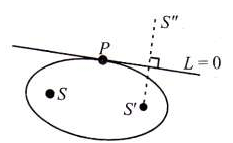
Let image of S'' be with respect to x +y - 5 = 0

Let P be the point of contact.
Because the line L = 0 is tangent to the ellipse, there exists a point P uniquely on the line such that PS + PS ' = 2a .
Since PS ' = 2a Hence, P should be the collinear with SS ''
Hence P is a point of intersection of SS '' (4x - 5 y = 9) , and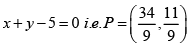
Let P be the point of contact.
Because the line L = 0 is tangent to the ellipse, there exists a point P uniquely on the line such that PS + PS ' = 2a .
Since PS ' = 2a Hence, P should be the collinear with SS ''
Hence P is a point of intersection of SS '' (4x - 5 y = 9) , and
The eccentricity of the conic 9x2 − 16y2 = 144 is- a)4/3
- b)5/4
- c)√7
- d)4/5
Correct answer is option 'B'. Can you explain this answer?
The eccentricity of the conic 9x2 − 16y2 = 144 is
a)
4/3
b)
5/4
c)
√7
d)
4/5
 | Mihir Chaudhary answered |
+16y2=144 is:
To find the eccentricity of a conic, we need to first identify the type of conic. We can rewrite the given equation as:
9x^2/144 + 16y^2/144 = 1
Dividing both sides by 144, we get:
x^2/16 + y^2/9 = 1
This is the equation of an ellipse. To find the eccentricity, we need to first find the distance between the center of the ellipse and one of its foci. The center of the ellipse is at the point (0,0). We can find the length of the semi-major axis (a) and the semi-minor axis (b) using the equation:
a^2 = 16, b^2 = 9
a = 4, b = 3
The distance between the center and one of the foci (c) can be found using the equation:
c^2 = a^2 - b^2
c^2 = 16 - 9 = 7
c = sqrt(7)
The eccentricity (e) of the ellipse is given by the equation:
e = c/a
e = sqrt(7)/4
Therefore, the eccentricity of the conic 9x^2+16y^2=144 is sqrt(7)/4.
To find the eccentricity of a conic, we need to first identify the type of conic. We can rewrite the given equation as:
9x^2/144 + 16y^2/144 = 1
Dividing both sides by 144, we get:
x^2/16 + y^2/9 = 1
This is the equation of an ellipse. To find the eccentricity, we need to first find the distance between the center of the ellipse and one of its foci. The center of the ellipse is at the point (0,0). We can find the length of the semi-major axis (a) and the semi-minor axis (b) using the equation:
a^2 = 16, b^2 = 9
a = 4, b = 3
The distance between the center and one of the foci (c) can be found using the equation:
c^2 = a^2 - b^2
c^2 = 16 - 9 = 7
c = sqrt(7)
The eccentricity (e) of the ellipse is given by the equation:
e = c/a
e = sqrt(7)/4
Therefore, the eccentricity of the conic 9x^2+16y^2=144 is sqrt(7)/4.
An ellipse is sliding along the co-ordinate axes. If the foci of the ellipse are (1,1) and (3,3), then area of the director circle of the ellipse (in sq. units) is- a)2π
- b)4π
- c)6π
- d)8π
Correct answer is option 'D'. Can you explain this answer?
An ellipse is sliding along the co-ordinate axes. If the foci of the ellipse are (1,1) and (3,3), then area of the director circle of the ellipse (in sq. units) is
a)
2π
b)
4π
c)
6π
d)
8π
 | Pankaj Sengupta answered |
Since x-axis and y-axis are perpendicular tangents to the ellipse, (0,0) lies on the director circle and midpoint of foci (2,2) is centre of the circle.
Hence, radius = 2√2
⇒ the area is 8π units.
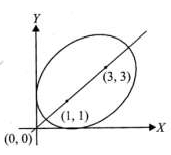
Hence, radius = 2√2
⇒ the area is 8π units.
 t ∈ R represents
The equations x = at2, y = 4at ; t ∈ R represent- a)a parabola
- b)a circle
- c)an ellipse
- d)a hyperbola
Correct answer is option 'A'. Can you explain this answer?
The equations x = at2, y = 4at ; t ∈ R represent
a)
a parabola
b)
a circle
c)
an ellipse
d)
a hyperbola
| | Abhay Mehta answered |
The given equations are:
x = at^2
y = 4at
To eliminate the variable t and find an equation relating x and y, we can solve the second equation for t:
t = y / (4a)
Substituting this value of t into the first equation, we get:
x = a(y / (4a))^2
x = (y^2) / (16a)
Therefore, the equation relating x and y is:
x = (y^2) / (16a)
x = at^2
y = 4at
To eliminate the variable t and find an equation relating x and y, we can solve the second equation for t:
t = y / (4a)
Substituting this value of t into the first equation, we get:
x = a(y / (4a))^2
x = (y^2) / (16a)
Therefore, the equation relating x and y is:
x = (y^2) / (16a)
The line y = c is a tangent to the parabola 7/2 if c is equal to- a)a
- b)0
- c)2a
- d)none of these
Correct answer is option 'D'. Can you explain this answer?
The line y = c is a tangent to the parabola 7/2 if c is equal to
a)
a
b)
0
c)
2a
d)
none of these
| | Sravya Nair answered |
y = x is tangent to the parabola
y=ax2+c
if a= then c=?
y′ =2ax
y’ = 2(7/2)x =1
x = 1/7
1/7 = 2(1/7)2 + c
c = 1/7 * 2/49
c = 7/2
y=ax2+c
if a= then c=?
y′ =2ax
y’ = 2(7/2)x =1
x = 1/7
1/7 = 2(1/7)2 + c
c = 1/7 * 2/49
c = 7/2
An ellipse is sliding along the co-ordinate axes. If the foci of the ellipse are (1,1) and (3,3), then area of the director circle of the ellipse (in sq. units) is- a)2π
- b)4π
- c)6π
- d)8π
Correct answer is option 'D'. Can you explain this answer?
An ellipse is sliding along the co-ordinate axes. If the foci of the ellipse are (1,1) and (3,3), then area of the director circle of the ellipse (in sq. units) is
a)
2π
b)
4π
c)
6π
d)
8π
 | Lekshmi Bose answered |
Since x-axis and y-axis are perpendicular tangents to the ellipse, (0,0) lies on the director circle and midpoint of foci (2,2) is centre of the circle.
Hence, radius = 2√2
⇒ the area is 8π units.
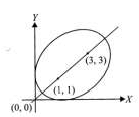
Hence, radius = 2√2
⇒ the area is 8π units.
A and B are two distinct points, Locus of a point P satisfying |PA| + |PB| = 2k, a constant is- a)nothing can be said
- b)the line segment [AB]
- c)an ellipse
- d)a hyperbola
Correct answer is option 'A'. Can you explain this answer?
A and B are two distinct points, Locus of a point P satisfying |PA| + |PB| = 2k, a constant is
a)
nothing can be said
b)
the line segment [AB]
c)
an ellipse
d)
a hyperbola
| | Ram Mohith answered |
I think the locus of P is an ellipse because if you take any point on the ellipse then the sum of distance from focii to that
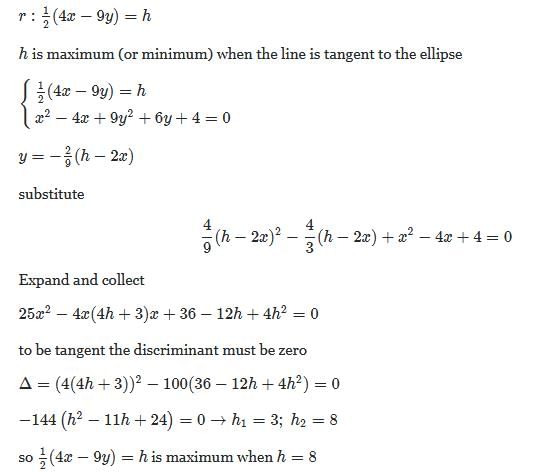
Let x and y satisfy the relation x2 + 9y2 - 4x + 6y + 4 = 0, then maximum value of the expression (4x - 9y),- a)15
- b)11
- c)16
- d)21
Correct answer is option 'C'. Can you explain this answer?
Let x and y satisfy the relation x2 + 9y2 - 4x + 6y + 4 = 0, then maximum value of the expression (4x - 9y),
a)
15
b)
11
c)
16
d)
21
| | Sinjini Datta answered |
Given equation is
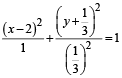
Let x - 2 = cos θ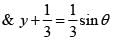
Then 4x - 9y = 11+ 4 cosθ - 3sinθ
Let x - 2 = cos θ
Then 4x - 9y = 11+ 4 cosθ - 3sinθ
The angle between the tangents drawn from the origin to the circle = (x−7)2+(y+1)2 = 25 is - a)π/8
- b)π/2
- c)π/6
- d)π/3
Correct answer is option 'B'. Can you explain this answer?
The angle between the tangents drawn from the origin to the circle = (x−7)2+(y+1)2 = 25 is
a)
π/8
b)
π/2
c)
π/6
d)
π/3
| | Shalini Yadav answered |
Let the equation of tangent drawn from (0,0) to the circle be y=mx. Then, p = a ⇒ 7m+1/(m2+1)1/2= 5
⇒24m2 + 14m−24=0
⇒12m2 + 7m−12=0
⇒m1m2 = −12/12 =−1
∴ Required angle = π/2
⇒24m2 + 14m−24=0
⇒12m2 + 7m−12=0
⇒m1m2 = −12/12 =−1
∴ Required angle = π/2
An ellipse having foci at (3,3) and (–4,4) and passing though the origin has eccentricity equal to - a)3/7
- b)2/7
- c)5/7
- d)3/5
Correct answer is option 'C'. Can you explain this answer?
An ellipse having foci at (3,3) and (–4,4) and passing though the origin has eccentricity equal to
a)
3/7
b)
2/7
c)
5/7
d)
3/5
 | Anjali Sen answered |
Since the question is incomplete, I cannot provide a complete answer. Please provide the missing information.


Chapter doubts & questions for Coordinate Geometry- Ellipse - Mathematics for A Level 2026 is part of A Level exam preparation. The chapters have been prepared according to the A Level exam syllabus. The Chapter doubts & questions, notes, tests & MCQs are made for A Level 2026 Exam. Find important definitions, questions, notes, meanings, examples, exercises, MCQs and online tests here.
Chapter doubts & questions of Coordinate Geometry- Ellipse - Mathematics for A Level in English & Hindi are available as part of A Level exam. Download more important topics, notes, lectures and mock test series for A Level Exam by signing up for free.
Mathematics for A Level124 videos|167 docs|207 tests |
