


All Exams > Judiciary Exams > Quantitative Techniques for Judiciary Exam > All Questions
All questions of Time, Speed and Distance for Judiciary Exams Exam
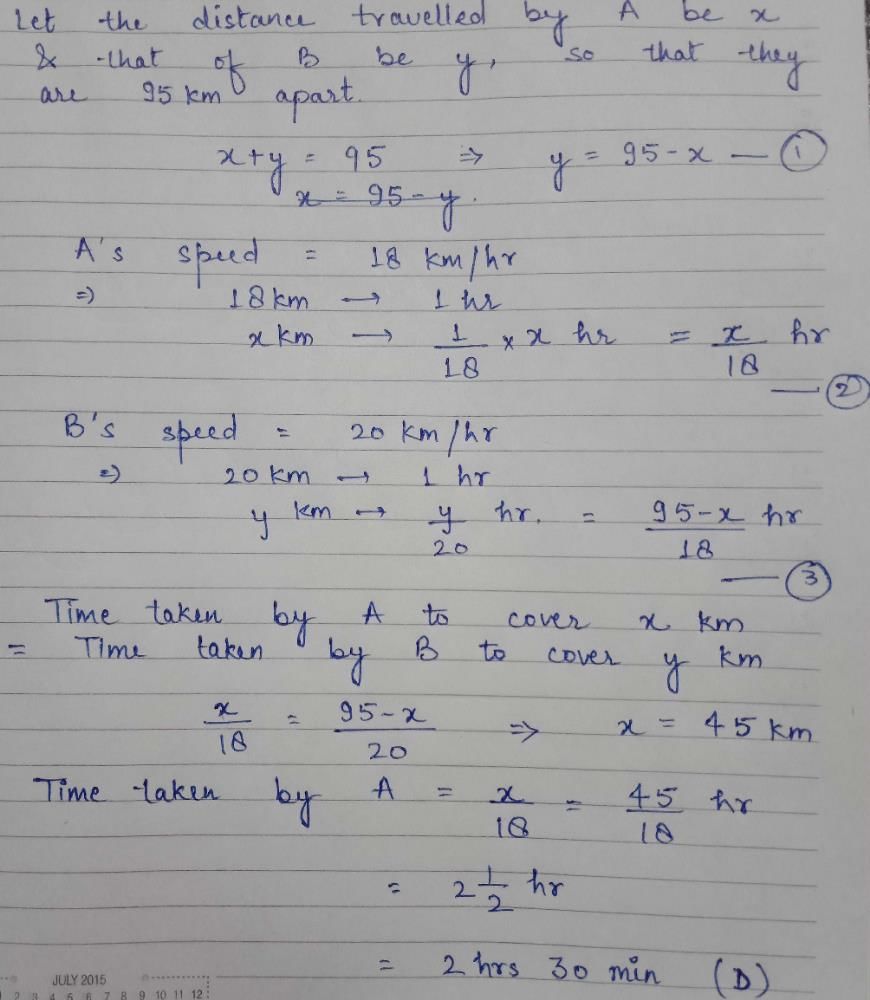
Two cyclists A and B start from the same place at the same time, one going towards north at 18 km/hr and other going towards south at 20 km/hr. What time will they take to be 95 km apart?- a)4 hrs 30 min
- b)4 hrs 45 min
- c)5 hrs 16 min
- d)2 hrs 30 min
Correct answer is option 'D'. Can you explain this answer?
Two cyclists A and B start from the same place at the same time, one going towards north at 18 km/hr and other going towards south at 20 km/hr. What time will they take to be 95 km apart?
a)
4 hrs 30 min
b)
4 hrs 45 min
c)
5 hrs 16 min
d)
2 hrs 30 min
 | Shanaya Sharma answered |

Train – A crosses a stationary train –B in 35 seconds and a pole in 14 seconds with the same speed. The length of the train – A is 280 meters. What is the length of the stationary train – B?- a)360 meters
- b)480 meters
- c)400 meters
- d)None of these
Correct answer is option 'D'. Can you explain this answer?
Train – A crosses a stationary train –B in 35 seconds and a pole in 14 seconds with the same speed. The length of the train – A is 280 meters. What is the length of the stationary train – B?
a)
360 meters
b)
480 meters
c)
400 meters
d)
None of these
 | Anaya Patel answered |
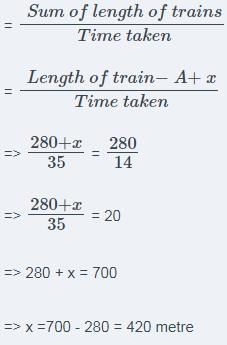
Let the length of train B be x metre
∴ Speed of train A
∴ Speed of train A
A certain distance is covered at a certain speed. If half of this distance is covered in double the time, the ratio of the two speeds is- a)4 :1
- b)1 : 4
- c)2 : 1
- d)1 : 2
Correct answer is option 'A'. Can you explain this answer?
A certain distance is covered at a certain speed. If half of this distance is covered in double the time, the ratio of the two speeds is
a)
4 :1
b)
1 : 4
c)
2 : 1
d)
1 : 2
| | Prakhya Shrivastava answered |
Let distance 'x' is covered by speed 'S' in time 't'
i.e. S=x/t ...(1)
Now if new speed is 's' which is covered half of distance (x) in double time (t)
i.e. distance for speed 's' = x/2 (half of actual distance)
and time taken by speed 's' = 2t (double of actual time)
Then, s = (x/2)/2t = (1/4)×(x/t)
Putting x/t = S from eqn. (1)
=> s = (1/4)×S
=> S:s = 4:1
i.e. S=x/t ...(1)
Now if new speed is 's' which is covered half of distance (x) in double time (t)
i.e. distance for speed 's' = x/2 (half of actual distance)
and time taken by speed 's' = 2t (double of actual time)
Then, s = (x/2)/2t = (1/4)×(x/t)
Putting x/t = S from eqn. (1)
=> s = (1/4)×S
=> S:s = 4:1
A person crosses a 600 m long street in 5 minutes. What is his speed in km per hour?- a)3.6
- b)7.2
- c)8.4
- d)10
Correct answer is option 'B'. Can you explain this answer?
A person crosses a 600 m long street in 5 minutes. What is his speed in km per hour?
a)
3.6
b)
7.2
c)
8.4
d)
10
| | Prakhya Shrivastava answered |
Given Distance = 600m = 0.6km and time =5min = 1/12 hour by formula Speed = distance/time => Speed = 0.6/(1/12) km/hour => Speed = 0.6×12 km/hour => Speed = 7.2km/hour Thus option B is correct
A 320 meter long train moving with an average speed of 120 km/hr crosses a platform in 24 seconds. A man crosses the same platform in 4 minutes. What is the speed of man in meter/second?- a)2.4
- b)1.5
- c)1.6
- d)2.0
Correct answer is option 'C'. Can you explain this answer?
A 320 meter long train moving with an average speed of 120 km/hr crosses a platform in 24 seconds. A man crosses the same platform in 4 minutes. What is the speed of man in meter/second?
a)
2.4
b)
1.5
c)
1.6
d)
2.0
| | Anaya Patel answered |
Speed of train = 120 kmph
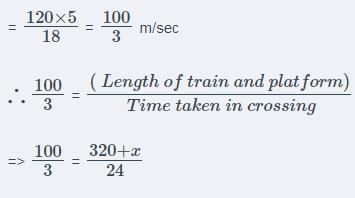
Where x = length of platform
 = 320 + x
= 320 + x800 = 320 +x
x = 800 - 320 = 480 m
∴ Man's speed = 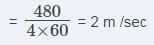
In a flight of 600 km, an aircraft was slowed down due to bad weather. Its average speed for the trip was reduced by 200 km/hr and the time of flight increased by 30 minutes. The duration of the flight is:- a)1 hour
- b)2 hours
- c)3 hours
- d)4 hours
Correct answer is option 'A'. Can you explain this answer?
In a flight of 600 km, an aircraft was slowed down due to bad weather. Its average speed for the trip was reduced by 200 km/hr and the time of flight increased by 30 minutes. The duration of the flight is:
a)
1 hour
b)
2 hours
c)
3 hours
d)
4 hours
 | Yogiraj Sadaphal answered |
For Normal case
Distance = 600km
Speed = x km/hr
Time of flight = y hrs
⇒ Distance = speed × time
600 = xy .... (i)
For Stormy Weather
Distance = 600km
Distance = 600km
Speed = (x - 200) km/hr
Time of flight = (y + 1/2) hrs
⇒ Distance = speed × time
600 = (x - 200) × (y + 1/2)
⇒ 600 = xy + (x/2) - 200y - 100 .... (ii)
From eq. (i) & (ii)
⇒ 600 = 600 + (x/2) - 200 × (600/x) - 100
⇒ (x/2) - (120000/x) - 100 = 0
⇒ x2 - 200x - 240000 = 0
⇒ x2 - 600x + 400x -240000 = 0
⇒ x (x - 600) + 400 (x -600) = 0
⇒ (x - 600) (x + 400) = 0
⇒ x = 600 or x = - 400
But x = Speed hence can't be negative
⇒ x = 600 km/hr
Substituting value of x in Eq. (i)
600 = 600 × y
⇒ y = 1 hr
Distance = 600km
Speed = x km/hr
Time of flight = y hrs
⇒ Distance = speed × time
600 = xy .... (i)
For Stormy Weather
Distance = 600km
Distance = 600km
Speed = (x - 200) km/hr
Time of flight = (y + 1/2) hrs
⇒ Distance = speed × time
600 = (x - 200) × (y + 1/2)
⇒ 600 = xy + (x/2) - 200y - 100 .... (ii)
From eq. (i) & (ii)
⇒ 600 = 600 + (x/2) - 200 × (600/x) - 100
⇒ (x/2) - (120000/x) - 100 = 0
⇒ x2 - 200x - 240000 = 0
⇒ x2 - 600x + 400x -240000 = 0
⇒ x (x - 600) + 400 (x -600) = 0
⇒ (x - 600) (x + 400) = 0
⇒ x = 600 or x = - 400
But x = Speed hence can't be negative
⇒ x = 600 km/hr
Substituting value of x in Eq. (i)
600 = 600 × y
⇒ y = 1 hr
A 300 meter long train moving with an average speed of 126 km/hr crosses a platform in 24 seconds. A man crosses the same platform in 5 minutes. What is the speed of man in meter / second?- a)1.8m/s
- b)1.2m/s
- c)1.5m/s
- d)Cannot be determined
Correct answer is option 'A'. Can you explain this answer?
A 300 meter long train moving with an average speed of 126 km/hr crosses a platform in 24 seconds. A man crosses the same platform in 5 minutes. What is the speed of man in meter / second?
a)
1.8m/s
b)
1.2m/s
c)
1.5m/s
d)
Cannot be determined
| | Wahid Khan answered |
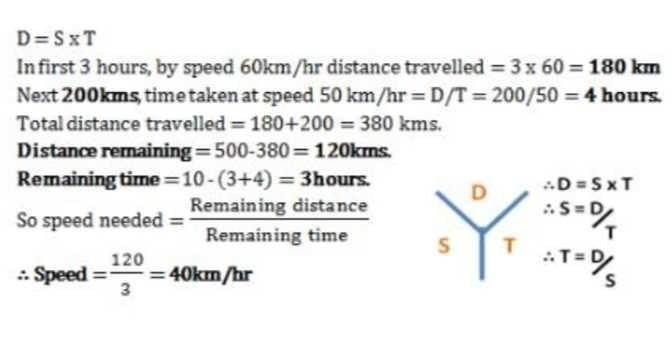
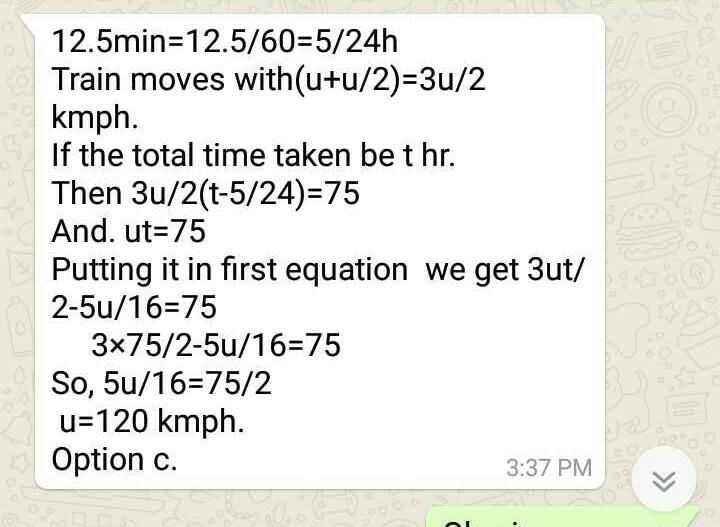
A train can travel 50% faster than a car. Both start from point A at the same time and reach point B 75 kms away from A at the same time. On the way, however, the train lost about 12.5 minutes while stopping at the stations. The speed of the car is:- a)100 kmph
- b)110 kmph
- c)120 kmph
- d)130 kmph
Correct answer is option 'C'. Can you explain this answer?
A train can travel 50% faster than a car. Both start from point A at the same time and reach point B 75 kms away from A at the same time. On the way, however, the train lost about 12.5 minutes while stopping at the stations. The speed of the car is:
a)
100 kmph
b)
110 kmph
c)
120 kmph
d)
130 kmph
 | Niladrita Chakraborty answered |
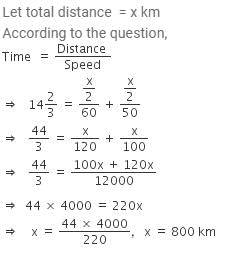
Ajay covers certain distance with his own speed but when he reduces his speed by 10kmph his time duration for the journey increases by 40 hours while if he increases his speed by 5 kmph from his original speed he takes 10 hours less than the original time taken. Find the distance covered by him. - a) 1000 km
- b)1200 km
- c)1500 km
- d)1800 km
Correct answer is option 'C'. Can you explain this answer?
Ajay covers certain distance with his own speed but when he reduces his speed by 10kmph his time duration for the journey increases by 40 hours while if he increases his speed by 5 kmph from his original speed he takes 10 hours less than the original time taken. Find the distance covered by him.
a)
1000 km
b)
1200 km
c)
1500 km
d)
1800 km
| | Aisha Gupta answered |
x/(y – 10) – x/y = 40
x = 4y(y-10) —(i)
x/y – x/(y + 5) = 10
x = 2y(y + 5) — (ii) From (i) and (ii) ⇒ y = 25; x = 1500
x = 4y(y-10) —(i)
x/y – x/(y + 5) = 10
x = 2y(y + 5) — (ii) From (i) and (ii) ⇒ y = 25; x = 1500
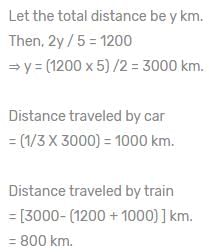
Suresh travelled 1200 km by air which formed (2/5) of his trip. One third of the whole trip, he travelled by car and the rest of the journey he performed by train. The distance travelled by trains was- a)1600 km
- b)800 km
- c)1800 km
- d)480 km
Correct answer is option 'B'. Can you explain this answer?
Suresh travelled 1200 km by air which formed (2/5) of his trip. One third of the whole trip, he travelled by car and the rest of the journey he performed by train. The distance travelled by trains was
a)
1600 km
b)
800 km
c)
1800 km
d)
480 km
 | Dia Mehta answered |
Pranav walked at 5 kmph for certain part of the journey and then he took an auto for the remaining part of the journey travelling at 25 kmph. If he took 10 hours for the entire journey, what part of journey did he travelled by auto if the average speed of the entire journey be 17 kmph- a)750 km
- b)100 km
- c)150 km
- d)200 km
Correct answer is option 'C'. Can you explain this answer?
Pranav walked at 5 kmph for certain part of the journey and then he took an auto for the remaining part of the journey travelling at 25 kmph. If he took 10 hours for the entire journey, what part of journey did he travelled by auto if the average speed of the entire journey be 17 kmph
a)
750 km
b)
100 km
c)
150 km
d)
200 km
 | Naroj Boda answered |
Total distance = 17*10 = 170
Let Journey travelled by auto in x hr
25 * x + (10-x ) 5 = 170
25 x + 50 – 5x = 170
x = 6
Required Distance = 6 * 25 = 150 km
A thief steals a car at 9 am and drive at the rate of 20 km/h. The theft is discovered and police starts chasing him at 9.30 am. in a jeep at the speed of 40 km/h. The thief will be caught at ………- a)10 am
- b)10.30 am.
- c)11 am.
- d)None
- e)All of the above
Correct answer is option 'A'. Can you explain this answer?
A thief steals a car at 9 am and drive at the rate of 20 km/h. The theft is discovered and police starts chasing him at 9.30 am. in a jeep at the speed of 40 km/h. The thief will be caught at ………
a)
10 am
b)
10.30 am.
c)
11 am.
d)
None
e)
All of the above
| | Dia Mehta answered |
The correct answer is A as
Relative speed = 40-20 (same distance)
Distance = 10 KM
Time = distance/time = 10/20 = 1/2 hours = 30 minutes
9.30 + 30 = 10 AM
Relative speed = 40-20 (same distance)
Distance = 10 KM
Time = distance/time = 10/20 = 1/2 hours = 30 minutes
9.30 + 30 = 10 AM
If a boy takes as much time in running 10 m as a car takes in covering 25 m, the distance covered by the boy during the time the car covers 1 km is- a)400 m
- b)40 m
- c)250 m
- d)650 m
Correct answer is option 'A'. Can you explain this answer?
If a boy takes as much time in running 10 m as a car takes in covering 25 m, the distance covered by the boy during the time the car covers 1 km is
a)
400 m
b)
40 m
c)
250 m
d)
650 m
 | Shanaya Sharma answered |
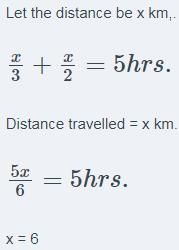
Let in t time , boy covers 10m and car covers 25m.
for car , 1m distance is covered in t/25
Then , 1km is covered in = (t/25)*1000 = 40t
In t time , boy covers = 10m
So in 40t time , boy covers = 40*10=400m
Correct option is a) 400m
for car , 1m distance is covered in t/25
Then , 1km is covered in = (t/25)*1000 = 40t
In t time , boy covers = 10m
So in 40t time , boy covers = 40*10=400m
Correct option is a) 400m
Two rabbits start running towards each other, one from A to B and another from B to A. They cross each other after one hour and the first rabbit reaches B, 5/6 hour before the second rabbit reaches A. If the distance between A and B is 50 km. what is the speed of the slower rabbit?- a)20 kmph
- b)10 kmph
- c)15 kmph
- d)25 kmph
Correct answer is option 'A'. Can you explain this answer?
Two rabbits start running towards each other, one from A to B and another from B to A. They cross each other after one hour and the first rabbit reaches B, 5/6 hour before the second rabbit reaches A. If the distance between A and B is 50 km. what is the speed of the slower rabbit?
a)
20 kmph
b)
10 kmph
c)
15 kmph
d)
25 kmph
 | Divey Sethi answered |
Let second rabbit takes x hr with speed s2
First rabbit takes x-5/6 hr with speed s1
Total distance = 50km
S1 = 50/(x-(5/6))
S2 = 50/x
As they cross each other in 1hr…
Total speed = s1 + s2
Now, T = D / S
50/(s1+s2) = 1
x = 5/2, 1/3
Put x = 5/2 in s2 –> 20km/hr
First rabbit takes x-5/6 hr with speed s1
Total distance = 50km
S1 = 50/(x-(5/6))
S2 = 50/x
As they cross each other in 1hr…
Total speed = s1 + s2
Now, T = D / S
50/(s1+s2) = 1
x = 5/2, 1/3
Put x = 5/2 in s2 –> 20km/hr
Train – A crosses a pole in 25 seconds and another Train B crosses a pole in 1 minute and 15 seconds. Length of train A is half length of train B. what is the respective ratio between the speed of train A and Train – B?- a)3 : 2
- b)3 : 4
- c)4 : 3
- d)Cannot be determined
Correct answer is option 'A'. Can you explain this answer?
Train – A crosses a pole in 25 seconds and another Train B crosses a pole in 1 minute and 15 seconds. Length of train A is half length of train B. what is the respective ratio between the speed of train A and Train – B?
a)
3 : 2
b)
3 : 4
c)
4 : 3
d)
Cannot be determined
| | Wahid Khan answered |
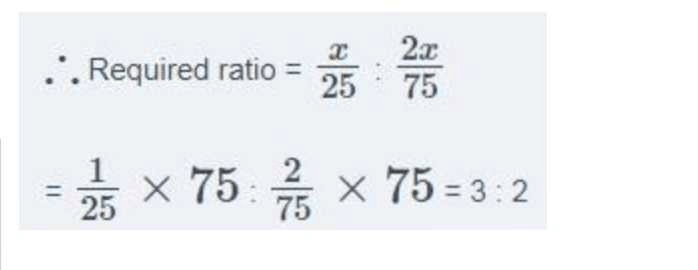
Train – A crosses a pole in 33 seconds and another Train –B crosses a pole in 55 seconds. Length of Train-A is three-fourth of Train-B. What is the respective ratio between the speed of Train–A and Train – B?- a)5 : 11
- b)5 : 4
- c)11 : 3
- d)Cannot be determined
Correct answer is option 'B'. Can you explain this answer?
Train – A crosses a pole in 33 seconds and another Train –B crosses a pole in 55 seconds. Length of Train-A is three-fourth of Train-B. What is the respective ratio between the speed of Train–A and Train – B?
a)
5 : 11
b)
5 : 4
c)
11 : 3
d)
Cannot be determined
| | Stellar Institute answered |
A train crosses a platform of length 350 m in 12 sec and a man standing on platform in 2 sec. Find the speed of train.- a)100 km/h
- b)126 km/h
- c)130 km/h
- d)None
- e)All of the above
Correct answer is option 'B'. Can you explain this answer?
A train crosses a platform of length 350 m in 12 sec and a man standing on platform in 2 sec. Find the speed of train.
a)
100 km/h
b)
126 km/h
c)
130 km/h
d)
None
e)
All of the above
| | Shanaya Sharma answered |
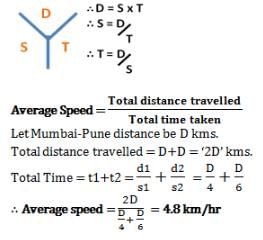
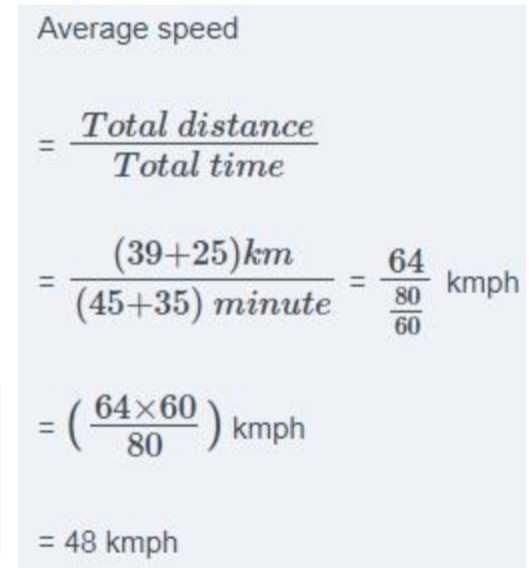
Let the length of train be x m. Since the train crosses the man in 2 sec Speed of train = x/2 m/s Also it crosses the platform of length 350 m in 12 sec So speed of train = (350+x)/12 Equating both the speeds of train ,we get x/2 = (350+x)/12 x = (350+x)/6 6x = 350+x 5x = 350 x = 70 Thus length of train = 70 m Now, speed of train = 70/2 = 35 m/s = 35/1000*3600 = 35/5*18 =126 km/hr
Two places A and B are at a distance of 480Km. Sita started from A towards B at the speed of 40Kmph. After 2 hours Gita started from B towards A at speed of 60 Kmph. They meet at a Place C then what is the difference between the time taken by them to reach their destinations from Place C?- a)1 hour
- b)2 hours
- c)3 hours
- d)4 hours
- e)Cannot be determined
Correct answer is option 'B'. Can you explain this answer?
Two places A and B are at a distance of 480Km. Sita started from A towards B at the speed of 40Kmph. After 2 hours Gita started from B towards A at speed of 60 Kmph. They meet at a Place C then what is the difference between the time taken by them to reach their destinations from Place C?
a)
1 hour
b)
2 hours
c)
3 hours
d)
4 hours
e)
Cannot be determined
 | Faizan Khan answered |
t*40+ (t-2)*60 = 480
t=6
From Place C to A = C to B = 240
Then time taken by Sita = 6hours and GIta = 4 hours
Difference = 6-4 = 2 hours
t=6
From Place C to A = C to B = 240
Then time taken by Sita = 6hours and GIta = 4 hours
Difference = 6-4 = 2 hours
A boat running downstream covers a distance of 40 km in 5 hrs and for covering the same distance upstream it takes 10 hrs. What is the speed of the stream? - a)5 km/hr
- b)2 km/hr
- c)6 km/hr
- d)4 km/hr
- e)3 km/hr
Correct answer is option 'B'. Can you explain this answer?
A boat running downstream covers a distance of 40 km in 5 hrs and for covering the same distance upstream it takes 10 hrs. What is the speed of the stream?
a)
5 km/hr
b)
2 km/hr
c)
6 km/hr
d)
4 km/hr
e)
3 km/hr
 | Kavya Saxena answered |
Downstream speed = 40/5 = 8 km/hr
Upstream speed = 40/10 = 4 km/hr
So speed of stream = 1/2*(8-4)
Upstream speed = 40/10 = 4 km/hr
So speed of stream = 1/2*(8-4)
If a Car runs at 45Km/hr it reaches its destination by 10 min late. If it runs at 60Km/hr it is late by 4min. Then what is the correct time for the journey?- a)12 min
- b)14 min
- c)16 min
- d)18 min
- e)Cannot be determined
Correct answer is option 'B'. Can you explain this answer?
If a Car runs at 45Km/hr it reaches its destination by 10 min late. If it runs at 60Km/hr it is late by 4min. Then what is the correct time for the journey?
a)
12 min
b)
14 min
c)
16 min
d)
18 min
e)
Cannot be determined
| | Divey Sethi answered |
45(t+10) = 60(t+4)
T = 14
T = 14
Speed of a man in still water is 5 km/hr and the river is running at 3km/hr. The total time taken to go to a place and come back is 10 hours. What is the distance travelled?- a)10 km
- b)16 km
- c)24 km
- d)32 km
- e)36 km
Correct answer is option 'D'. Can you explain this answer?
Speed of a man in still water is 5 km/hr and the river is running at 3km/hr. The total time taken to go to a place and come back is 10 hours. What is the distance travelled?
a)
10 km
b)
16 km
c)
24 km
d)
32 km
e)
36 km
 | Preeti Khanna answered |
Down speed = 5+3 = 8
Up speed = 5-3 = 2
Let distance travelled = X
(X/8)+(X/2) = 10
X= 16 km
Total distance is 16+16 = 32
Up speed = 5-3 = 2
Let distance travelled = X
(X/8)+(X/2) = 10
X= 16 km
Total distance is 16+16 = 32
Mr.Kavin walks at 4/5 of his normal speed and takes 60 minutes more than the usual time. What will be the new time taken by Mr. Kavin?- a)260 minutes
- b)235 minutes
- c)220 minutes
- d)300 minutes
Correct answer is option 'D'. Can you explain this answer?
Mr.Kavin walks at 4/5 of his normal speed and takes 60 minutes more than the usual time. What will be the new time taken by Mr. Kavin?
a)
260 minutes
b)
235 minutes
c)
220 minutes
d)
300 minutes
 | Target Study Academy answered |
4/5 of speed = 5/4 of original time
5/4 of original time = original time + 60 minutes;
1/4 of original time = 60 minutes;
Thus, original time = 60*4 = 240 minutes = 240 + 60 = 300 minutes
5/4 of original time = original time + 60 minutes;
1/4 of original time = 60 minutes;
Thus, original time = 60*4 = 240 minutes = 240 + 60 = 300 minutes
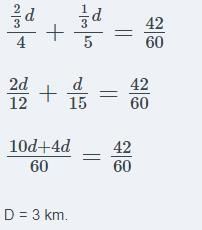
A car travels from a place A to B in 7 hour. It covers half the distance at 30 kmph and the remaining distance at 40 kmph, what is the total distance between A and B?- a) 120 Km
- b) 250 Km
- c)240 Km
- d)150 Km
Correct answer is option 'C'. Can you explain this answer?
A car travels from a place A to B in 7 hour. It covers half the distance at 30 kmph and the remaining distance at 40 kmph, what is the total distance between A and B?
a)
120 Km
b)
250 Km
c)
240 Km
d)
150 Km
| | Kavya Saxena answered |
Total Distance = x
(x/2*30) +(x/2*40) = 7
x = 240
(x/2*30) +(x/2*40) = 7
x = 240
The distance of the School and house of Suresh is 80km. One day he was late by 1 hour than the normal time to leave for the college, so he increased his speed by 4km/h and thus he reached to college at the normal time. What is the changed speed of Suresh?- a)28 kmph
- b)25 kmph
- c)20 kmph
- d)24 kmph
Correct answer is option 'C'. Can you explain this answer?
The distance of the School and house of Suresh is 80km. One day he was late by 1 hour than the normal time to leave for the college, so he increased his speed by 4km/h and thus he reached to college at the normal time. What is the changed speed of Suresh?
a)
28 kmph
b)
25 kmph
c)
20 kmph
d)
24 kmph
| | Divey Sethi answered |
80/x – 80/(x+4) = 1
x(x+20) – 16(x+20) = 0
x = 16kmph
Increased speed = 20 kmph
x(x+20) – 16(x+20) = 0
x = 16kmph
Increased speed = 20 kmph
Two places R and S are 800 km apart from each other. Two persons start from R towards S at an interval of 2 hours. Whereas A leaves R for S before B. The speeds of A and B are 40 kmph and 60 kmph respectively. B overtakes A at M, which is on the way from R to S. What is the ratio of time taken by A and B to meet at M?- a)1:3
- b)1:2
- c)1:4
- d)3:2
- e)None of these
Correct answer is option 'D'. Can you explain this answer?
Two places R and S are 800 km apart from each other. Two persons start from R towards S at an interval of 2 hours. Whereas A leaves R for S before B. The speeds of A and B are 40 kmph and 60 kmph respectively. B overtakes A at M, which is on the way from R to S. What is the ratio of time taken by A and B to meet at M?
a)
1:3
b)
1:2
c)
1:4
d)
3:2
e)
None of these
| | Kavya Saxena answered |
Time taken by B to reach at M = 4h
Time taken by A to reach at M = 6h
Ratio = 6:4 = 3:2
Time taken by A to reach at M = 6h
Ratio = 6:4 = 3:2
Aravind started for the station half a km from his home walking at 1 km/h to catch the train in time. After 3 minutes he realised that he had forgotten a document at home and returned with increased, but constant speed to get it succeded in catching the train. Find his latter speed in kmph?- a)1.25
- b)1.1
- c)11/9
- d)2
Correct answer is option 'C'. Can you explain this answer?
Aravind started for the station half a km from his home walking at 1 km/h to catch the train in time. After 3 minutes he realised that he had forgotten a document at home and returned with increased, but constant speed to get it succeded in catching the train. Find his latter speed in kmph?
a)
1.25
b)
1.1
c)
11/9
d)
2
| | Kavya Saxena answered |
Distance covered in 3 minutes = 3*(1000/60) = 50
Now he has to cover (500+50)m in (30-3) minutes
Required speed = (550/1000)/(27/60) = 11/9 km/h
A car covers first half of its journey at the rate of 15km/h and second half at the rate of 12km/h and total time taken to complete the journey is 9 hours. Find the length of journey.- a)60 km
- b)240 km
- c)120 km
- d)None
- e)All of the above
Correct answer is option 'C'. Can you explain this answer?
A car covers first half of its journey at the rate of 15km/h and second half at the rate of 12km/h and total time taken to complete the journey is 9 hours. Find the length of journey.
a)
60 km
b)
240 km
c)
120 km
d)
None
e)
All of the above
| | Sajal Bdw answered |
Let total distance be x
(x/2)/15+(x/2)/12=9
=>x/15+x/12=18
=>x=(60×18)/9=120kmph
(x/2)/15+(x/2)/12=9
=>x/15+x/12=18
=>x=(60×18)/9=120kmph

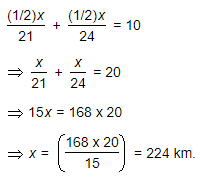
A boat running upstream takes 9 hours 48 minutes to cover a certain distance, while it takes 7 hours to cover the same distance running downstream. What is the ratio between the speed of the boat and speed of the water current respectively?- a)5:2
- b)7:4
- c)6:1
- d)8:3
- e)2:5
Correct answer is option 'C'. Can you explain this answer?
A boat running upstream takes 9 hours 48 minutes to cover a certain distance, while it takes 7 hours to cover the same distance running downstream. What is the ratio between the speed of the boat and speed of the water current respectively?
a)
5:2
b)
7:4
c)
6:1
d)
8:3
e)
2:5
| | Yash Patel answered |
Distance covered upstream in 9hrs 48 min = Distance covered downstream in 7hrs
(X-Y) 49/5 = (X+Y)7
X/y = 1/6
(X-Y) 49/5 = (X+Y)7
X/y = 1/6
A man traveled 100 km by Bike in 2 hours. He then traveled in Bus for 8 hrs and then Train in 9 hrs. Ratio of Speeds of Bus to Train is 4:5. If speed of train is 4/5 of Bike speed then the entire journey covered by him in Km is?- a)516 Km
- b)616 Km
- c)716 Km
- d)816 Km
- e)None
Correct answer is option 'C'. Can you explain this answer?
A man traveled 100 km by Bike in 2 hours. He then traveled in Bus for 8 hrs and then Train in 9 hrs. Ratio of Speeds of Bus to Train is 4:5. If speed of train is 4/5 of Bike speed then the entire journey covered by him in Km is?
a)
516 Km
b)
616 Km
c)
716 Km
d)
816 Km
e)
None
| | Aarav Sharma answered |
Given information:
- Distance traveled by bike = 100 km
- Time taken by bike = 2 hours
- Time taken by bus = 8 hours
- Time taken by train = 9 hours
- Ratio of speed of bus to train = 4:5
- Speed of train = 4/5 of bike speed
Calculating the speed of bike:
- Speed = Distance/Time = 100/2 = 50 km/hr
Calculating the speed of train:
- Speed of train = 4/5 * 50 = 40 km/hr
Calculating the speed of bus:
- Let the ratio of speed of bus to train be 4x and 5x respectively
- Total distance traveled by bus = Speed * Time = 4x * 8 = 32x km
- Total distance traveled by train = Speed * Time = 5x * 9 = 45x km
- Therefore, 32x + 45x = Total distance traveled by bus and train = Distance traveled by bike = 100 km
- Solving for x, x = 2
- Therefore, speed of bus = 4x = 8 * 4 = 32 km/hr
Calculating the total distance traveled:
- Distance traveled by bike = 100 km
- Distance traveled by bus = Speed * Time = 32 * 8 = 256 km
- Distance traveled by train = Speed * Time = 40 * 9 = 360 km
- Total distance traveled = 100 + 256 + 360 = 716 km
Hence, option (c) 716 km is the correct answer.
- Distance traveled by bike = 100 km
- Time taken by bike = 2 hours
- Time taken by bus = 8 hours
- Time taken by train = 9 hours
- Ratio of speed of bus to train = 4:5
- Speed of train = 4/5 of bike speed
Calculating the speed of bike:
- Speed = Distance/Time = 100/2 = 50 km/hr
Calculating the speed of train:
- Speed of train = 4/5 * 50 = 40 km/hr
Calculating the speed of bus:
- Let the ratio of speed of bus to train be 4x and 5x respectively
- Total distance traveled by bus = Speed * Time = 4x * 8 = 32x km
- Total distance traveled by train = Speed * Time = 5x * 9 = 45x km
- Therefore, 32x + 45x = Total distance traveled by bus and train = Distance traveled by bike = 100 km
- Solving for x, x = 2
- Therefore, speed of bus = 4x = 8 * 4 = 32 km/hr
Calculating the total distance traveled:
- Distance traveled by bike = 100 km
- Distance traveled by bus = Speed * Time = 32 * 8 = 256 km
- Distance traveled by train = Speed * Time = 40 * 9 = 360 km
- Total distance traveled = 100 + 256 + 360 = 716 km
Hence, option (c) 716 km is the correct answer.
A boat goes 4 km against the current of the stream in 1 hour and goes 1 km along the current in 10 minutes. How long will it take to go 15 km in stationary water?- a)2 hour 15 min
- b)2 hour
- c)3hr
- d)3hr 30 min
- e)None of these
Correct answer is option 'C'. Can you explain this answer?
A boat goes 4 km against the current of the stream in 1 hour and goes 1 km along the current in 10 minutes. How long will it take to go 15 km in stationary water?
a)
2 hour 15 min
b)
2 hour
c)
3hr
d)
3hr 30 min
e)
None of these
| | Aisha Gupta answered |
Rate downstream = 1/10 * 60 = 6kmph
Rate upstream = 4 km/hr.
Speed in still water = ½ * 10 = 5 kmph
Required time = 15/5 = 3 hr
Rate upstream = 4 km/hr.
Speed in still water = ½ * 10 = 5 kmph
Required time = 15/5 = 3 hr
Car A leaves Delhi at a certain time, after 5 hours Car B leaves Delhi in the same direction as of A. Speed of Car A is 20Km/hr and Speed of Car B is 40Km/hr. In how much time Car B will be 20Km ahead of Car A?- a)5 Hours
- b)6 Hours
- c)8 Hours
- d)11 Hours
- e)None
Correct answer is option 'B'. Can you explain this answer?
Car A leaves Delhi at a certain time, after 5 hours Car B leaves Delhi in the same direction as of A. Speed of Car A is 20Km/hr and Speed of Car B is 40Km/hr. In how much time Car B will be 20Km ahead of Car A?
a)
5 Hours
b)
6 Hours
c)
8 Hours
d)
11 Hours
e)
None
| | Alok Verma answered |
20 =40*(t-5) – 20*t
T = 11
11-5 = 6
T = 11
11-5 = 6
Two Cars started at same time, same place and towards same direction. First Car goes at uniform speed of 12Km/hr. Second Car goes at speed of 4 Km/hr in first hour and increases it speed by 1 Km/hr for every hour. Then what is the distance traveled by car B when the both the Cars meet for the first time?- a)196 Km
- b)198 Km
- c)200 Km
- d)204 Km
- e)None
Correct answer is option 'D'. Can you explain this answer?
Two Cars started at same time, same place and towards same direction. First Car goes at uniform speed of 12Km/hr. Second Car goes at speed of 4 Km/hr in first hour and increases it speed by 1 Km/hr for every hour. Then what is the distance traveled by car B when the both the Cars meet for the first time?
a)
196 Km
b)
198 Km
c)
200 Km
d)
204 Km
e)
None
| | Anaya Patel answered |
12*x = x/2(2*4+(x-1)*1)
X= 17
D = 17*12 =204
X= 17
D = 17*12 =204
Anita goes to College at 20 km/h and reaches college 4 minutes late. Next time she goes at 25 km/h and reaches the college 2 minutes earlier than the scheduled time. What is the distance of her school?- a)16 km
- b)12 km
- c)15 km
- d)10 km
Correct answer is option 'D'. Can you explain this answer?
Anita goes to College at 20 km/h and reaches college 4 minutes late. Next time she goes at 25 km/h and reaches the college 2 minutes earlier than the scheduled time. What is the distance of her school?
a)
16 km
b)
12 km
c)
15 km
d)
10 km
| | Anaya Patel answered |
20*25/(25-20)*6/60=10.
A boat whose speed in 20 km/hr in still water goes 40 km downstream and comes back in a total of 5 hours. The approx. speed of the stream (in km/hr) is:- a)6 km/hr
- b)9 km/hr
- c)12 km/hr
- d)16 km/hr
- e)18 km/hr
Correct answer is option 'B'. Can you explain this answer?
A boat whose speed in 20 km/hr in still water goes 40 km downstream and comes back in a total of 5 hours. The approx. speed of the stream (in km/hr) is:
a)
6 km/hr
b)
9 km/hr
c)
12 km/hr
d)
16 km/hr
e)
18 km/hr
 | Cstoppers Instructors answered |
Let the speed of the stream be x km/hr. Then,
Speed downstream = (20 + x) km/hr,
Speed upstream = (20 – x) km/hr.
40/20+x + 40/20-x = 5
X = 9 approx
Speed downstream = (20 + x) km/hr,
Speed upstream = (20 – x) km/hr.
40/20+x + 40/20-x = 5
X = 9 approx
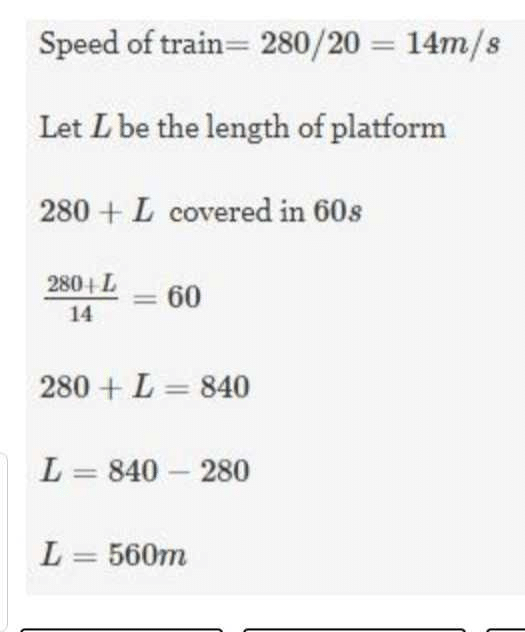
A 280 meters long train travelling at a uniform speed, crosses a platform in 60 seconds and a man standing on the platform in 20 seconds. What is the length of the platform?- a)640 meters
- b)420 meters
- c)280 meters
- d) None of these
Correct answer is option 'D'. Can you explain this answer?
A 280 meters long train travelling at a uniform speed, crosses a platform in 60 seconds and a man standing on the platform in 20 seconds. What is the length of the platform?
a)
640 meters
b)
420 meters
c)
280 meters
d)
None of these
| | Wahid Khan answered |
An aeroplane flies with an average speed of 756 km/hr. A helicopter takes 48 hours to cover twice the distance covered by aeroplane in 9 hours. How much distance will the helicopter cover in 18 hours? (assuming that flights are non-stop and moving with uniform speed)- a)5014 km
- b)5140 km
- c)5130 km
- d)5103 km
Correct answer is option 'D'. Can you explain this answer?
An aeroplane flies with an average speed of 756 km/hr. A helicopter takes 48 hours to cover twice the distance covered by aeroplane in 9 hours. How much distance will the helicopter cover in 18 hours? (assuming that flights are non-stop and moving with uniform speed)
a)
5014 km
b)
5140 km
c)
5130 km
d)
5103 km
| | Wahid Khan answered |
Distance covered by aeroplane in 18 hours =speed xtime
=756x18
=13608km
the distance covered by helicopter in 48 hours=twice distance of the aeroplane
=2x13608
=27216km
speed of helicopter
=27216/48=567kmper hour
distance covered by helicopter in 9 hours
=567x9
=5103km
=756x18
=13608km
the distance covered by helicopter in 48 hours=twice distance of the aeroplane
=2x13608
=27216km
speed of helicopter
=27216/48=567kmper hour
distance covered by helicopter in 9 hours
=567x9
=5103km
A truck travelled to a place Q from P, the first 50 km at 10 kmph faster than the usual speed, but it returned the same distance at 10 kmph slower than usual speed. If the total time taken by the truck is 12 hours, then how many hours will travel at the faster speed?- a)8 hours
- b)6 hours
- c) 2 hours
- d)3 hours
Correct answer is option 'C'. Can you explain this answer?
A truck travelled to a place Q from P, the first 50 km at 10 kmph faster than the usual speed, but it returned the same distance at 10 kmph slower than usual speed. If the total time taken by the truck is 12 hours, then how many hours will travel at the faster speed?
a)
8 hours
b)
6 hours
c)
2 hours
d)
3 hours
| | Kavya Saxena answered |
Total time taken,
[50/(x-10)] + 50/(x +10)] = 12 hours.
By solving the equation, we get
x = 15
Time is taken by the truck at faster speed = 50/(15+10) = 2 hours.
[50/(x-10)] + 50/(x +10)] = 12 hours.
By solving the equation, we get
x = 15
Time is taken by the truck at faster speed = 50/(15+10) = 2 hours.
A boat can travel 20 km downstream in 24 min. The ratio of the speed of the boat in still water to the speed of the stream is 4 : 1. How much time will the boat take to cover 15 km upstream?- a)20 min
- b)22 min
- c)25 min
- d)30 min
- e)35 min
Correct answer is option 'D'. Can you explain this answer?
A boat can travel 20 km downstream in 24 min. The ratio of the speed of the boat in still water to the speed of the stream is 4 : 1. How much time will the boat take to cover 15 km upstream?
a)
20 min
b)
22 min
c)
25 min
d)
30 min
e)
35 min
 | KS Coaching Center answered |
Down speed = 20/24*60 = 50km/hr
4:1 = 4x:x
Downstream speed = 4x+x = 5x
Upstream speed = 4x-x = 3x
5x = 50; x = 10
so up speed 3*10 = 30
Time = 15/30*60 = 30min.
4:1 = 4x:x
Downstream speed = 4x+x = 5x
Upstream speed = 4x-x = 3x
5x = 50; x = 10
so up speed 3*10 = 30
Time = 15/30*60 = 30min.
A man rows to a place 40 km distant and come back in 9 hours. He finds that he can row 5 km with the stream in the same time as 4 km against the stream. The rate of the stream is:- a)1 km/hr
- b)1.5 km/hr
- c)2 km/hr
- d)2.5 km/hr
- e)None of these
Correct answer is option 'A'. Can you explain this answer?
A man rows to a place 40 km distant and come back in 9 hours. He finds that he can row 5 km with the stream in the same time as 4 km against the stream. The rate of the stream is:
a)
1 km/hr
b)
1.5 km/hr
c)
2 km/hr
d)
2.5 km/hr
e)
None of these
| | Aarav Sharma answered |
Given data:
Distance = 40 km
Total time taken = 9 hours
Rate of rowing downstream = 5 km/hr
Rate of rowing upstream = 4 km/hr
To find:
Rate of stream
Solution:
Let the speed of the boat in still water be x km/hr and the speed of the stream be y km/hr.
1. Time taken to row downstream:
Distance = 40 km
Speed = (x + y) km/hr
Time = Distance / Speed
Time taken to row downstream = 40 / (x + y) hours
2. Time taken to row upstream:
Distance = 40 km
Speed = (x - y) km/hr
Time = Distance / Speed
Time taken to row upstream = 40 / (x - y) hours
3. Total time taken:
Total time taken = Time taken to row downstream + Time taken to row upstream
9 = 40 / (x + y) + 40 / (x - y)
4. Simplifying the equation:
Multiplying both sides by (x + y)(x - y):
9(x + y)(x - y) = 40(x - y) + 40(x + y)
9x² - 9y² = 80x
x² - y² = 80/9 * x
5. Using the given data:
Rate of rowing downstream = 5 km/hr
Rate of rowing upstream = 4 km/hr
(x + y) = 5
(x - y) = 4
Solving these equations, we get:
x = 4.5 km/hr (speed of boat in still water)
y = 0.5 km/hr (speed of stream)
Therefore, the rate of stream is 0.5 km/hr or 1 km/hr (approx).
Hence, option A is the correct answer.
Distance = 40 km
Total time taken = 9 hours
Rate of rowing downstream = 5 km/hr
Rate of rowing upstream = 4 km/hr
To find:
Rate of stream
Solution:
Let the speed of the boat in still water be x km/hr and the speed of the stream be y km/hr.
1. Time taken to row downstream:
Distance = 40 km
Speed = (x + y) km/hr
Time = Distance / Speed
Time taken to row downstream = 40 / (x + y) hours
2. Time taken to row upstream:
Distance = 40 km
Speed = (x - y) km/hr
Time = Distance / Speed
Time taken to row upstream = 40 / (x - y) hours
3. Total time taken:
Total time taken = Time taken to row downstream + Time taken to row upstream
9 = 40 / (x + y) + 40 / (x - y)
4. Simplifying the equation:
Multiplying both sides by (x + y)(x - y):
9(x + y)(x - y) = 40(x - y) + 40(x + y)
9x² - 9y² = 80x
x² - y² = 80/9 * x
5. Using the given data:
Rate of rowing downstream = 5 km/hr
Rate of rowing upstream = 4 km/hr
(x + y) = 5
(x - y) = 4
Solving these equations, we get:
x = 4.5 km/hr (speed of boat in still water)
y = 0.5 km/hr (speed of stream)
Therefore, the rate of stream is 0.5 km/hr or 1 km/hr (approx).
Hence, option A is the correct answer.
Two persons A and B start from the opposite ends of a 450 km straight track and run to and from between the two ends. The speed of the first person is 25 m/s and the speed of other is 35 m/s. They continue their motion for 10 hours. How many times did they pass each other? - a) 1
- b)4
- c)3
- d)2
Correct answer is option 'D'. Can you explain this answer?
Two persons A and B start from the opposite ends of a 450 km straight track and run to and from between the two ends. The speed of the first person is 25 m/s and the speed of other is 35 m/s. They continue their motion for 10 hours. How many times did they pass each other?
a)
1
b)
4
c)
3
d)
2
| | Alok Verma answered |
First person speed = 25 m/s * 18/5 = 90 kmph
Second person speed = 35 m/s * 18/5 = 126 kmph
First person covers 90 * 10 = 900km
900/450 = 2
Second person speed = 35 m/s * 18/5 = 126 kmph
First person covers 90 * 10 = 900km
900/450 = 2
A boat takes 28 hours for travelling downstream from point A to point B and coming back to point C midway between A and B. If the velocity of the stream is 6km/hr and the speed of the boat in still water is 9 km/hr, what is the distance between A and B?- a)115 km
- b)120 km
- c)140 km
- d)165 km
- e)150 km
Correct answer is option 'B'. Can you explain this answer?
A boat takes 28 hours for travelling downstream from point A to point B and coming back to point C midway between A and B. If the velocity of the stream is 6km/hr and the speed of the boat in still water is 9 km/hr, what is the distance between A and B?
a)
115 km
b)
120 km
c)
140 km
d)
165 km
e)
150 km
| | KS Coaching Center answered |
Downstream speed = 9+6 = 15
Upstream speed = 9-6 = 3
Now total time is 28 hours
If distance between A and B is d, then distance BC = d/2
Now distance/speed = time, so
d/15 + (d/2)/3 = 28
Solve, d = 120 km
Upstream speed = 9-6 = 3
Now total time is 28 hours
If distance between A and B is d, then distance BC = d/2
Now distance/speed = time, so
d/15 + (d/2)/3 = 28
Solve, d = 120 km
The driver of an ambulance sees a college bus 40 m ahead of him after 20 seconds, the college bus is 60 meter behind. If the speed of the ambulance is 30 km/h, what is the speed of the college bus?- a)10 kmph
- b)12 kmph
- c)15 kmph
- d)22 kmph
Correct answer is option 'B'. Can you explain this answer?
The driver of an ambulance sees a college bus 40 m ahead of him after 20 seconds, the college bus is 60 meter behind. If the speed of the ambulance is 30 km/h, what is the speed of the college bus?
a)
10 kmph
b)
12 kmph
c)
15 kmph
d)
22 kmph
 | Rajeev Kumar answered |
Relative Speed = (Total distance)/total time
= (60+40) /20 = 5 m/s = (5*18)/5 = 18 kmph
Relative Speed = (speed of ambulance – speed of College bus)
Speed of College bus = speed of ambulance – relative speed.
= 30-18 = 12 kmph.
= (60+40) /20 = 5 m/s = (5*18)/5 = 18 kmph
Relative Speed = (speed of ambulance – speed of College bus)
Speed of College bus = speed of ambulance – relative speed.
= 30-18 = 12 kmph.
Two Vans start from a place with a speed of 50 kmph at an interval of 12 minutes. What is the speed of a car coming from the opposite direction towards the place if the car meets the vans at an interval of 10 minutes?- a)13 kmph
- b)10 kmph
- c)14 kmph
- d)16 kmph
- e)None of these
Correct answer is option 'B'. Can you explain this answer?
Two Vans start from a place with a speed of 50 kmph at an interval of 12 minutes. What is the speed of a car coming from the opposite direction towards the place if the car meets the vans at an interval of 10 minutes?
a)
13 kmph
b)
10 kmph
c)
14 kmph
d)
16 kmph
e)
None of these
| | Faizan Khan answered |
50*12/60 = 10/60 * (50+x)
600 = 500 + 10x
x = 10 kmph
600 = 500 + 10x
x = 10 kmph
Two Cars started at same time, same place and towards same direction. First Car goes at a speed of 5km/hr in first and 7 Km/hr in second hour and repeats the cycle over the entire journey. Similarly second Car goes at 4km/hr in first hour and 9km/hr in second hour and repeats the cycle over the entire journey.Then these two Cars for the first time for after how many hours of journey?- a)3 Hours
- b)6 Hours
- c)9 Hours
- d)12 Hours
- e)None
Correct answer is option 'A'. Can you explain this answer?
Two Cars started at same time, same place and towards same direction. First Car goes at a speed of 5km/hr in first and 7 Km/hr in second hour and repeats the cycle over the entire journey. Similarly second Car goes at 4km/hr in first hour and 9km/hr in second hour and repeats the cycle over the entire journey.Then these two Cars for the first time for after how many hours of journey?
a)
3 Hours
b)
6 Hours
c)
9 Hours
d)
12 Hours
e)
None
| | Aarav Sharma answered |
First car : 5,12,17
Second Car: 4,3,17
Chapter doubts & questions for Time, Speed and Distance - Quantitative Techniques for Judiciary Exam 2026 is part of Judiciary Exams exam preparation. The chapters have been prepared according to the Judiciary Exams exam syllabus. The Chapter doubts & questions, notes, tests & MCQs are made for Judiciary Exams 2026 Exam. Find important definitions, questions, notes, meanings, examples, exercises, MCQs and online tests here.
Chapter doubts & questions of Time, Speed and Distance - Quantitative Techniques for Judiciary Exam in English & Hindi are available as part of Judiciary Exams exam. Download more important topics, notes, lectures and mock test series for Judiciary Exams Exam by signing up for free.
Quantitative Techniques for Judiciary Exam45 videos|71 docs|100 tests |
