


All Exams > Class 10 > Olympiad Preparation for Class 10 > All Questions
All questions of Electricity for Class 10 Exam


The resistivity of a wire depends on its- a)Length
- b)Cross-sectional area
- c)Dimensions
- d)Material
Correct answer is option 'D'. Can you explain this answer?
The resistivity of a wire depends on its
a)
Length
b)
Cross-sectional area
c)
Dimensions
d)
Material
 | Ritu Saxena answered |
From Resistance,

Where R = resistance, l = length, A = area of cross-section and ρ = resistivity
If l = 1 m and A = 1 m2, then
R = ρ i.e.
Where R = resistance, l = length, A = area of cross-section and ρ = resistivity
If l = 1 m and A = 1 m2, then
R = ρ i.e.
- Resistivity is numerically equal to the resistance of a substance having unit area of cross-section and unit length.
- Resistivity is the intrinsic property of the substance. It is independent of shape and size of the body i.e. on length and area. Hence, option 1 and 2 is incorrect.
- Formula of resistivity is

Where, m = mass of electron, n = Number of electron per unit volume of the conductor, τ = relaxation time. - Therefore, the resistivity of a wire depends on its material (n)
- For different substances their resistivity is also different as ‘n’ will be different.
- Resistivity depends on the temperature.
Calculate the electrical energy consumed by an electric bulb of 200 watt in 15 hours- a)3 kwh
- b)5 kwh
- c)6 kwh
- d)30 kwh
Correct answer is option 'A'. Can you explain this answer?
Calculate the electrical energy consumed by an electric bulb of 200 watt in 15 hours
a)
3 kwh
b)
5 kwh
c)
6 kwh
d)
30 kwh
 | Rounak Joshi answered |
To calculate the electrical energy consumed by an electric bulb, we need to use the formula:
Energy (in kilowatt-hours) = Power (in kilowatts) × Time (in hours)
Given:
Power of the electric bulb = 200 watts
Time = 15 hours
Using the formula, we can calculate the energy consumed as follows:
Energy = (Power × Time)/1000
Substituting the given values:
Energy = (200 × 15)/1000
= 3000/1000
= 3 kilowatt-hours (kWh)
Therefore, the electrical energy consumed by the electric bulb in 15 hours is 3 kWh.
Explanation:
- The formula for calculating electrical energy is Energy = Power × Time.
- In this case, the power of the electric bulb is given as 200 watts and the time is given as 15 hours.
- To use the formula, we need to convert the power from watts to kilowatts by dividing it by 1000.
- After substituting the values into the formula, we calculate the energy consumed as 3 kilowatt-hours (kWh).
- This means that the electric bulb consumes 3 kilowatt-hours of electrical energy over a period of 15 hours.
Energy (in kilowatt-hours) = Power (in kilowatts) × Time (in hours)
Given:
Power of the electric bulb = 200 watts
Time = 15 hours
Using the formula, we can calculate the energy consumed as follows:
Energy = (Power × Time)/1000
Substituting the given values:
Energy = (200 × 15)/1000
= 3000/1000
= 3 kilowatt-hours (kWh)
Therefore, the electrical energy consumed by the electric bulb in 15 hours is 3 kWh.
Explanation:
- The formula for calculating electrical energy is Energy = Power × Time.
- In this case, the power of the electric bulb is given as 200 watts and the time is given as 15 hours.
- To use the formula, we need to convert the power from watts to kilowatts by dividing it by 1000.
- After substituting the values into the formula, we calculate the energy consumed as 3 kilowatt-hours (kWh).
- This means that the electric bulb consumes 3 kilowatt-hours of electrical energy over a period of 15 hours.
If a wire of resistance R is stretched to double of its length, then new resistance will be:- a)Two - times
- b)Four - times
- c)Eight – times
- d)Remains the same
Correct answer is option 'B'. Can you explain this answer?
If a wire of resistance R is stretched to double of its length, then new resistance will be:
a)
Two - times
b)
Four - times
c)
Eight – times
d)
Remains the same
| | Ritu Saxena answered |
When length (l) of a wire doubled (2 l), its cross-sectional area (A) is reduced to half (A/2) as the volume of the wire is constant.
Now resistance of the wire
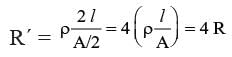
Now resistance of the wire
A multimeter is used to measure- a)Current only
- b)Resistance only
- c)Voltage only
- d)All of the above
Correct answer is option 'D'. Can you explain this answer?
A multimeter is used to measure
a)
Current only
b)
Resistance only
c)
Voltage only
d)
All of the above
| | Ritu Saxena answered |
- A multimeter can measure voltage, current, and resistance.
- It can also be used to generate square wave and for checking shorts in a circuit.
- An ammeter is an instrument for measuring electric current in amperes while Voltmeter is an instrument for measuring electric potential in volts.
- An ohmmeter is an electrical instrument that measures electrical resistance.
We have three resistors containing 3 ohms each. To get an equivalent resistance of 2 ohms, we should connect them- a)In series
- b)In parallel
- c)Two in parallel and third in series with combination
- d)Two in series and third in parallel in a combination
Correct answer is option 'D'. Can you explain this answer?
We have three resistors containing 3 ohms each. To get an equivalent resistance of 2 ohms, we should connect them
a)
In series
b)
In parallel
c)
Two in parallel and third in series with combination
d)
Two in series and third in parallel in a combination
 | Tanvi verma answered |
Explanation:
To find the equivalent resistance of a combination of resistors, we need to consider the rules for resistors connected in series and parallel.
Resistors in Series:
When resistors are connected in series, their resistances add up. The equivalent resistance (Rₑ) of resistors in series can be calculated using the formula:
Rₑ = R₁ + R₂ + R₃ + ...
Resistors in Parallel:
When resistors are connected in parallel, their equivalent resistance is given by the formula:
1/Rₑ = 1/R₁ + 1/R₂ + 1/R₃ + ...
Combination:
To achieve an equivalent resistance of 2 ohms using three 3-ohm resistors, we need to connect them in a combination of series and parallel.
Connecting the resistors:
By connecting two resistors in series, we can achieve an equivalent resistance of 6 ohms (3 + 3 = 6). Let's call this combination A.
By connecting the third resistor in parallel with combination A, we can calculate the equivalent resistance.
1/Rₑ = 1/6 + 1/3
Simplifying the equation:
1/Rₑ = 1/6 + 2/6
1/Rₑ = 3/6
1/Rₑ = 1/2
Rₑ = 2 ohms
Therefore, connecting two resistors in series and the third resistor in parallel with the combination will give us an equivalent resistance of 2 ohms. The correct answer is option 'D'.
Note: It is important to understand the concepts of series and parallel connections of resistors to solve such problems.
If the potential difference across the ends of a conductor is doubled, what will be the effect on the current flowing through it ?- a)It gets doubled
- b)It gets halved
- c)It remains same
- d)None of these
Correct answer is option 'A'. Can you explain this answer?
If the potential difference across the ends of a conductor is doubled, what will be the effect on the current flowing through it ?
a)
It gets doubled
b)
It gets halved
c)
It remains same
d)
None of these
 | Meera Mehta answered |
Understanding Potential Difference and Current
When the potential difference (voltage) across the ends of a conductor is altered, it directly influences the current flowing through it. This relationship is described by Ohm's Law.
Ohm's Law Explained
Ohm's Law states that:
- V = I × R
Where:
- V = Potential difference (voltage)
- I = Current
- R = Resistance
From this equation, we can derive that:
- I = V / R
This implies that current is directly proportional to the voltage applied across the conductor, given that the resistance remains constant.
Effect of Doubling Voltage
When the potential difference is doubled:
- New Voltage (V') = 2V
Substituting into Ohm's Law:
- I' = V' / R
- I' = (2V) / R
- I' = 2(V / R)
- I' = 2I
This shows that the current also doubles when the voltage is doubled, assuming that resistance remains unchanged.
Conclusion
In summary, if the potential difference across a conductor is doubled, the current flowing through it will also double. Thus, the correct answer is:
- a) It gets doubled.
Understanding this fundamental relationship is crucial for analyzing electrical circuits and their behavior.
When the potential difference (voltage) across the ends of a conductor is altered, it directly influences the current flowing through it. This relationship is described by Ohm's Law.
Ohm's Law Explained
Ohm's Law states that:
- V = I × R
Where:
- V = Potential difference (voltage)
- I = Current
- R = Resistance
From this equation, we can derive that:
- I = V / R
This implies that current is directly proportional to the voltage applied across the conductor, given that the resistance remains constant.
Effect of Doubling Voltage
When the potential difference is doubled:
- New Voltage (V') = 2V
Substituting into Ohm's Law:
- I' = V' / R
- I' = (2V) / R
- I' = 2(V / R)
- I' = 2I
This shows that the current also doubles when the voltage is doubled, assuming that resistance remains unchanged.
Conclusion
In summary, if the potential difference across a conductor is doubled, the current flowing through it will also double. Thus, the correct answer is:
- a) It gets doubled.
Understanding this fundamental relationship is crucial for analyzing electrical circuits and their behavior.
The flow of electric current can be compared to that of water flow because current flows from- a)Higher potential difference to lower potential difference
- b)Higher resistance to lower resistance
- c)Higher potential energy to lower potential energy
- d)Any direction of the circuit
Correct answer is option 'A'. Can you explain this answer?
The flow of electric current can be compared to that of water flow because current flows from
a)
Higher potential difference to lower potential difference
b)
Higher resistance to lower resistance
c)
Higher potential energy to lower potential energy
d)
Any direction of the circuit
| | Radha Iyer answered |
When two points at different potentials are connected with the help of a conductor, electric current flows through the conductor from the point at a higher potential to the point at a lower potential till the potentials of both points are same.
A circuit has a fuse of 5 A. What is the maximum number of 100 W (220 V) bulbs, can be safely used in this circuit ?- a)11
- b)14
- c)15
- d)20
Correct answer is option 'A'. Can you explain this answer?
A circuit has a fuse of 5 A. What is the maximum number of 100 W (220 V) bulbs, can be safely used in this circuit ?
a)
11
b)
14
c)
15
d)
20
 | Priyanka Kapoor answered |
Power, P = VI = 220 × 5 = 1100 Watt
P = 11 × 100 Watt
P = 11 × 100 Watt
A wire of resistance 1 Ω is divided into two halves and both halves are connected in parallel. The new resistance will be- a)1 Ω
- b)0.5 Ω
- c)0.25 Ω
- d)2 Ω
Correct answer is option 'C'. Can you explain this answer?
A wire of resistance 1 Ω is divided into two halves and both halves are connected in parallel. The new resistance will be
a)
1 Ω
b)
0.5 Ω
c)
0.25 Ω
d)
2 Ω
| | Ritu Saxena answered |
Resistance of each half = 1Ω/2 = 0.5 Ω (R ∝ l) Since these two halves are in parallel, Resultant resistance = 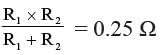
How much work is done in moving a charge of 5 C from a point in circuit at 220 volts to another point at 240 volts ?- a)50 Joules
- b)100 Joules
- c)125 Joules
- d)250 Joules
Correct answer is option 'B'. Can you explain this answer?
How much work is done in moving a charge of 5 C from a point in circuit at 220 volts to another point at 240 volts ?
a)
50 Joules
b)
100 Joules
c)
125 Joules
d)
250 Joules
 | Pooja chauhan answered |
To determine the amount of work done in moving a charge from one point to another in an electric circuit, we can use the formula:
Work = Charge × Voltage
Here, the charge is given as 5 C (coulombs), and the voltage difference between the two points is given as 240 volts - 220 volts = 20 volts.
Hence, the work done can be calculated as:
Work = 5 C × 20 V = 100 Joules
Therefore, the correct answer is option B, 100 Joules.
Explanation:
To understand why the work done is 100 Joules, let's break down the concept behind it.
The work done in an electric circuit is given by the product of the charge and the voltage. When a charge moves from a point with lower potential (220 volts) to a point with higher potential (240 volts), work is done on the charge by an external agent.
The work done on a charge can be thought of as the energy transferred to the charge. In this case, as the charge moves against the electric field, energy is required to overcome the potential difference.
The unit of work is Joules, which represents the amount of energy transferred. In this scenario, the charge of 5 C is moved across a potential difference of 20 volts. Multiplying these values together gives us the amount of work done, which is 100 Joules.
Therefore, the correct answer is option B, 100 Joules.
Work = Charge × Voltage
Here, the charge is given as 5 C (coulombs), and the voltage difference between the two points is given as 240 volts - 220 volts = 20 volts.
Hence, the work done can be calculated as:
Work = 5 C × 20 V = 100 Joules
Therefore, the correct answer is option B, 100 Joules.
Explanation:
To understand why the work done is 100 Joules, let's break down the concept behind it.
The work done in an electric circuit is given by the product of the charge and the voltage. When a charge moves from a point with lower potential (220 volts) to a point with higher potential (240 volts), work is done on the charge by an external agent.
The work done on a charge can be thought of as the energy transferred to the charge. In this case, as the charge moves against the electric field, energy is required to overcome the potential difference.
The unit of work is Joules, which represents the amount of energy transferred. In this scenario, the charge of 5 C is moved across a potential difference of 20 volts. Multiplying these values together gives us the amount of work done, which is 100 Joules.
Therefore, the correct answer is option B, 100 Joules.
If equal resistances of 5 Ω each are connected in parallel with a battery, then- a)The total resistance is also 5 Ω
- b)The current flowing in each resistor will be same
- c)The potential difference across each resistance is not same
- d)None of the above
Correct answer is option 'B'. Can you explain this answer?
If equal resistances of 5 Ω each are connected in parallel with a battery, then
a)
The total resistance is also 5 Ω
b)
The current flowing in each resistor will be same
c)
The potential difference across each resistance is not same
d)
None of the above
| | Ritu Saxena answered |
Consider the wire of resistance 'R' is cut into five equal parts
Thus, Resistance of each part will be R/5
Equivalent resistance R' will be given by,
1/R' = 5/R + 5/R + 5/R + 5/R + 5/R ...( resistances connected in parallel)
Thus, equivalent resistance R' = R/25.
Thus, Resistance of each part will be R/5
Equivalent resistance R' will be given by,
1/R' = 5/R + 5/R + 5/R + 5/R + 5/R ...( resistances connected in parallel)
Thus, equivalent resistance R' = R/25.
The number of electrons constituting one coulomb of charge is- a)6.25 × 10⁻¹⁸
- b)6.1 × 10⁻¹⁹
- c)6.25 × 10⁻¹⁹
- d)6.25 × 10¹⁸
Correct answer is option 'D'. Can you explain this answer?
The number of electrons constituting one coulomb of charge is
a)
6.25 × 10⁻¹⁸
b)
6.1 × 10⁻¹⁹
c)
6.25 × 10⁻¹⁹
d)
6.25 × 10¹⁸
 | Tanishq Chauhan answered |
Understanding Charge and Electrons
The question revolves around the relationship between electric charge and the number of electrons. To find the number of electrons in one coulomb of charge, we need to know the charge of a single electron.
Charge of an Electron
- Each electron carries a fundamental charge of approximately -1.6 × 10^-19 coulombs.
Calculating the Number of Electrons
To find the total number of electrons in one coulomb, we divide the total charge (1 coulomb) by the charge of one electron.
- Formula:
Number of electrons = Total charge / Charge of one electron
- Using the values:
Number of electrons = 1 C / (1.6 × 10^-19 C/electron)
- Performing the calculation:
Number of electrons = 1 / (1.6 × 10^-19)
≈ 6.25 × 10^18 electrons
Conclusion
Thus, one coulomb of charge is constituted by approximately 6.25 × 10^18 electrons, confirming that the correct answer is option 'D'.
This relationship underscores the concept of charge at the atomic level and illustrates how a seemingly large unit of charge like a coulomb is composed of an exceedingly vast number of elementary particles like electrons. Understanding this helps in grasping the fundamentals of electric charge and its quantization.
The question revolves around the relationship between electric charge and the number of electrons. To find the number of electrons in one coulomb of charge, we need to know the charge of a single electron.
Charge of an Electron
- Each electron carries a fundamental charge of approximately -1.6 × 10^-19 coulombs.
Calculating the Number of Electrons
To find the total number of electrons in one coulomb, we divide the total charge (1 coulomb) by the charge of one electron.
- Formula:
Number of electrons = Total charge / Charge of one electron
- Using the values:
Number of electrons = 1 C / (1.6 × 10^-19 C/electron)
- Performing the calculation:
Number of electrons = 1 / (1.6 × 10^-19)
≈ 6.25 × 10^18 electrons
Conclusion
Thus, one coulomb of charge is constituted by approximately 6.25 × 10^18 electrons, confirming that the correct answer is option 'D'.
This relationship underscores the concept of charge at the atomic level and illustrates how a seemingly large unit of charge like a coulomb is composed of an exceedingly vast number of elementary particles like electrons. Understanding this helps in grasping the fundamentals of electric charge and its quantization.
If two copper wires of length l and 2l, area A and 2A are taken, then- a)The specific resistance of first is greater than that of the second
- b)The specific resistance of the second wire is greater than that of the first
- c)The specific resistance of both the wires is same
- d)The specific resistance is not be predictable
Correct answer is option 'C'. Can you explain this answer?
If two copper wires of length l and 2l, area A and 2A are taken, then
a)
The specific resistance of first is greater than that of the second
b)
The specific resistance of the second wire is greater than that of the first
c)
The specific resistance of both the wires is same
d)
The specific resistance is not be predictable
| | Ritu Saxena answered |

A 60 W bulb carries a current of 0.5A. The charge that passes through it in 2 hours is- a)3600 C
- b)3000 C
- c)6000 C
- d)1500 C
Correct answer is option 'A'. Can you explain this answer?
A 60 W bulb carries a current of 0.5A. The charge that passes through it in 2 hours is
a)
3600 C
b)
3000 C
c)
6000 C
d)
1500 C
| | Ritu Saxena answered |
Q = I t = 0.5 × (2 × 60 min × 60 sec) = 3600 seconds
Note : wattage of the bulb does not affect the flow of charge in this case
Note : wattage of the bulb does not affect the flow of charge in this case
The proper presentation of series combination of cells of obtain maximum potential is

- a)Fig (i)
- b)Fig (ii)
- c)Fig (iii)
- d)None of these
Correct answer is option 'A'. Can you explain this answer?
The proper presentation of series combination of cells of obtain maximum potential is
a)
Fig (i)
b)
Fig (ii)
c)
Fig (iii)
d)
None of these
| | Ritu Saxena answered |
For series combination of cells, the negative terminal of first cell should be connected to the positive terminal of the second cell, and so on.
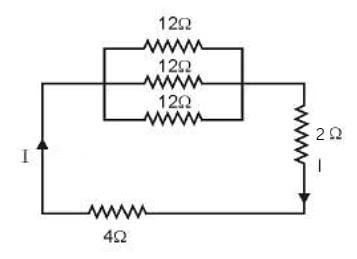
Find out the equivalent resistance of the circuit given below:
- a)6 Ω
- b)10 Ω
- c)12 Ω
- d)8 Ω
Correct answer is option 'B'. Can you explain this answer?
Find out the equivalent resistance of the circuit given below:
a)
6 Ω
b)
10 Ω
c)
12 Ω
d)
8 Ω
| | Ritu Saxena answered |
Three resistors of 12 Ω each in parallel have effective resistance Re, as
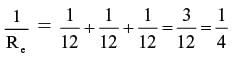
This effective Re is in series with two other resistors of 2 Ω and 4 Ω. Thus, overall resistance of whole circuit is
Rc = Re + R1 + R2 = 4 + 2 + 4 = 10 Ω
This effective Re is in series with two other resistors of 2 Ω and 4 Ω. Thus, overall resistance of whole circuit is
Rc = Re + R1 + R2 = 4 + 2 + 4 = 10 Ω
What does this graph with straight line OA represents?
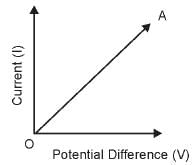
- a)V is directly proportional to I
- b)V is inversely proportional to I
- c)V is independent of I
- d)V and I goes in opposite directions
Correct answer is option 'A'. Can you explain this answer?
What does this graph with straight line OA represents?
a)
V is directly proportional to I
b)
V is inversely proportional to I
c)
V is independent of I
d)
V and I goes in opposite directions
| | Radha Iyer answered |
Ohm's law: The current flowing through a conductor is directly proportional to the voltage applied across the conductor means I ∝ V.
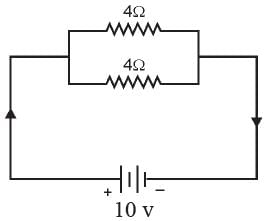
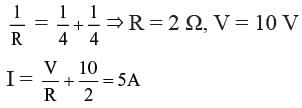
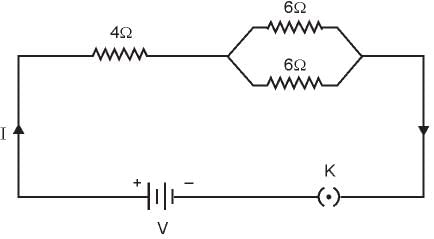
Three resistors are connected as shown below in a closed circuit. What is the effective resistance of the whole circuit
- a)4 Ω
- b)7 Ω
- c)10 Ω
- d)16 Ω
Correct answer is option 'B'. Can you explain this answer?
Three resistors are connected as shown below in a closed circuit. What is the effective resistance of the whole circuit
a)
4 Ω
b)
7 Ω
c)
10 Ω
d)
16 Ω
| | Ritu Saxena answered |
Re = 4 Ω + Rp of 2 resistors of 6 Ω each
1/Rp = 1/6 + 1/6 ⇒ Rp = 3 Ω
∴ Re = 4 Ω + 3 Ω = 7 Ω
1/Rp = 1/6 + 1/6 ⇒ Rp = 3 Ω
∴ Re = 4 Ω + 3 Ω = 7 Ω
The V-I graph of three resistors A, B and C are as shown in the figure given below. Which resistors has the maximum resistance?
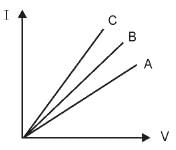
- a)A
- b)B
- c)C
- d)All three have same resistances
Correct answer is option 'A'. Can you explain this answer?
The V-I graph of three resistors A, B and C are as shown in the figure given below. Which resistors has the maximum resistance?
a)
A
b)
B
c)
C
d)
All three have same resistances
| | Ritu Saxena answered |
By Ohm’s Law V = IR
⇒ R= V/I = slope of V-I graph
Therefore, the slope of the V-I graph represents the effective resistance.
Now in series combination of the resistance all the resistances get summed up
Req = R1 + R2 + R3+ ………….+ Rn.
Therefore, the series combination will have the maximum resistance than the other resistors.
Hence the line with maximum slope (line C) will give the series combination of the other two resistors.
⇒ R= V/I = slope of V-I graph
Therefore, the slope of the V-I graph represents the effective resistance.
Now in series combination of the resistance all the resistances get summed up
Req = R1 + R2 + R3+ ………….+ Rn.
Therefore, the series combination will have the maximum resistance than the other resistors.
Hence the line with maximum slope (line C) will give the series combination of the other two resistors.
Calculate the equivalent resistance of the circuit shown below
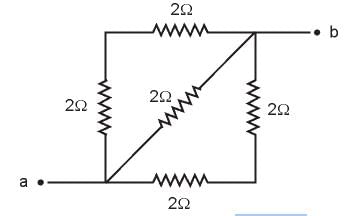
- a)1 Ω
- b)2 Ω
- c)6 Ω
- d)8 Ω
Correct answer is option 'A'. Can you explain this answer?
Calculate the equivalent resistance of the circuit shown below
a)
1 Ω
b)
2 Ω
c)
6 Ω
d)
8 Ω
 | Vivek Bansal answered |
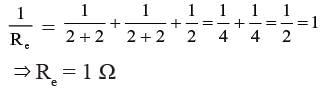
It is a parallel combination with two resistors each in series.
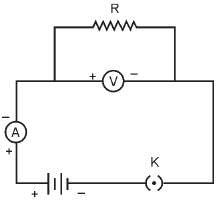
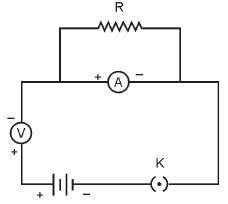
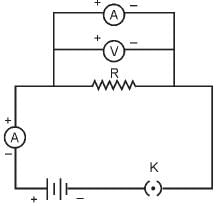
Which of the following circuit set-ups shows the dependence current on potential difference across a resistor (as per Ohm’s Law)- a)
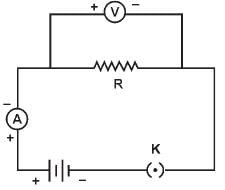
- b)
- c)
- d)
Correct answer is option 'A'. Can you explain this answer?
Which of the following circuit set-ups shows the dependence current on potential difference across a resistor (as per Ohm’s Law)
a)
b)
c)
d)
| | Ritu Saxena answered |
The voltmeter should be connected parallel to the resistor and the ammeter should be in series with the resistor.
100 J of heat is produced each second in a 4 Ω resistance. The potential difference across the resistor is- a)50 V
- b)25 V
- c)100 V
- d)20 V
Correct answer is option 'D'. Can you explain this answer?
100 J of heat is produced each second in a 4 Ω resistance. The potential difference across the resistor is
a)
50 V
b)
25 V
c)
100 V
d)
20 V
| | Ritu Saxena answered |
V = W/Q = W/ I t and V = I R (work done is equal to heat generated)
⇒ W = VI W = I2 R t
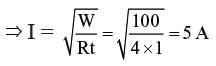
V = I R = 5 A × 4 Ω = 20 V
⇒ W = VI W = I2 R t
V = I R = 5 A × 4 Ω = 20 V
Chapter doubts & questions for Electricity - Olympiad Preparation for Class 10 2026 is part of Class 10 exam preparation. The chapters have been prepared according to the Class 10 exam syllabus. The Chapter doubts & questions, notes, tests & MCQs are made for Class 10 2026 Exam. Find important definitions, questions, notes, meanings, examples, exercises, MCQs and online tests here.
Chapter doubts & questions of Electricity - Olympiad Preparation for Class 10 in English & Hindi are available as part of Class 10 exam. Download more important topics, notes, lectures and mock test series for Class 10 Exam by signing up for free.
Olympiad Preparation for Class 1070 videos|236 docs|187 tests |
