


All Exams > UPSC > History for UPSC CSE > All Questions
All questions of Indus Valley Civilisation for UPSC CSE Exam
Which of the following sites has furnished the proof of the sea faring activity of the Harappan people?- a)Lothal
- b)Sotka Koh
- c)Kot Diji
- d)Balakot
Correct answer is option 'A'. Can you explain this answer?
Which of the following sites has furnished the proof of the sea faring activity of the Harappan people?
a)
Lothal
b)
Sotka Koh
c)
Kot Diji
d)
Balakot
 | Amit Sharma answered |
• Lothal was one of the southernmost cities of the ancient Indus Valley Civilization, located in the Bhāl region of the modern state of Gujarāt. Construction of the city began around 2200 BCE.
• Discovered in 1954, Lothal was excavated from 13 February 1955 to 19 May 1960 by the Archaeological Survey of India (ASI), the official Indian government agency for the preservation of ancient monuments.
• According to the ASI, Lothal had the world's earliest known dock, which connected the city to an ancient course of the Sabarmati river on the trade route between Harappan cities in Sindh and the peninsula of Saurashtra when the surrounding Kutch desert of today was a part of the Arabian Sea.

Match the following: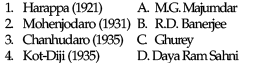
- a)1-D, 2-B, 3-A, 4-C
- b)1-B, 2-D, 3-C, 4-A
- c)1-C, 2-A, 3-B, 4-D
- d)1-A, 2-C, 3-D, 4-B
Correct answer is option 'A'. Can you explain this answer?
Match the following:
a)
1-D, 2-B, 3-A, 4-C
b)
1-B, 2-D, 3-C, 4-A
c)
1-C, 2-A, 3-B, 4-D
d)
1-A, 2-C, 3-D, 4-B
| | Prakhya Shrivastava answered |
Harappa was discovered in 1920-1921 by Rai Bahadur Daya Ram Sahni Mohanjodaro was discovered in 1922 by R. D. Banerji, Chanhudaro was discovered by N G Majumdar in 1931, Kot diji was discovered in 1935 by ghumey Above information is true hence option A is correct.
It has been observed by the excavation that the pottery fabrics and forms found at some places show a closed affinity with the early Baluchistan and Iranian pottery. Identify the places.- a)Rangpur and Ropar
- b)Amri and Banwali
- c)Lothal and Banwali
- d)Mohenjodaro and Lothal
Correct answer is option 'B'. Can you explain this answer?
It has been observed by the excavation that the pottery fabrics and forms found at some places show a closed affinity with the early Baluchistan and Iranian pottery. Identify the places.
a)
Rangpur and Ropar
b)
Amri and Banwali
c)
Lothal and Banwali
d)
Mohenjodaro and Lothal
 | Deepak Pandey answered |
C
The term “Late Harappan”, which is gaining currency now stands for:- a)Declining phase of the culture.
- b)Use of iron by the Harappans.
- c)The post-urban phase of the culture.
- d)Regional variation in the culture.
Correct answer is option 'C'. Can you explain this answer?
The term “Late Harappan”, which is gaining currency now stands for:
a)
Declining phase of the culture.
b)
Use of iron by the Harappans.
c)
The post-urban phase of the culture.
d)
Regional variation in the culture.
 | Uttam Rathore answered |
Answer must be A) i think?

It is found in Mesopotamian records that there were two intermediate trading stations between Mesopotamia and Harappan regions. Identify the places.- a)Meluha and Dilmun
- b)Makan and Meluha
- c)Makan and Dilmun
- d)Malwa and Dilmun.
Correct answer is option 'C'. Can you explain this answer?
It is found in Mesopotamian records that there were two intermediate trading stations between Mesopotamia and Harappan regions. Identify the places.
a)
Meluha and Dilmun
b)
Makan and Meluha
c)
Makan and Dilmun
d)
Malwa and Dilmun.
| | Neha Kataria answered |
C is correct, Dilmun and Makan were the two places.
Consider the following statements:1. The town planning of Indus Valley Civilization was based on the division of towns into two main parts: citadel/acropolis and lower town.
2. The use of burnt bricks in the Harappan cities was a standard practice which was also observed in the contemporary buildings of Egypt.
3. Kalibangan is known for its houses that had individual wells.
Which of the statements given above is/are correct?- a)1 Only
- b)1 and 3 Only
- c)1 and 2 Only
- d)1, 2 and 3
Correct answer is option 'B'. Can you explain this answer?
Consider the following statements:
1. The town planning of Indus Valley Civilization was based on the division of towns into two main parts: citadel/acropolis and lower town.
2. The use of burnt bricks in the Harappan cities was a standard practice which was also observed in the contemporary buildings of Egypt.
3. Kalibangan is known for its houses that had individual wells.
Which of the statements given above is/are correct?
2. The use of burnt bricks in the Harappan cities was a standard practice which was also observed in the contemporary buildings of Egypt.
3. Kalibangan is known for its houses that had individual wells.
Which of the statements given above is/are correct?
a)
1 Only
b)
1 and 3 Only
c)
1 and 2 Only
d)
1, 2 and 3
 | Master Training Institute answered |
- The town planning of Indus Valley Civilization was based on the division of towns into two main parts: citadel/acropolis and lower town.
- This is correct. The town planning of major Indus Valley cities like Harappa, Mohenjo-Daro, and Dholavira typically included a division into two parts: the citadel (a raised, fortified area housing important structures like granaries or the Great Bath) and the lower town (where most of the population lived in well-planned residential areas).
- The use of burnt bricks in the Harappan cities was a standard practice which was also observed in the contemporary buildings of Egypt.
- This is incorrect. While the use of burnt (fired) bricks was indeed a standard practice in Harappan cities, contemporary Egyptian buildings primarily used sun-dried mud bricks for most constructions, including houses and some monumental structures. Stone was used for temples and pyramids in Egypt, but burnt bricks were not a common feature as in the Indus Valley.
- Kalibangan is known for its houses that had individual wells.
- This is correct. Kalibangan, an important Indus Valley site, is known for its urban planning, including houses that often had individual wells, a feature also seen in other major sites like Mohenjo-Daro. This reflects the civilization's advanced water management systems.
Conclusion: Statements 1 and 3 are correct, while Statement 2 is incorrect.
Answer: B: 1 and 3 Only
The evidence of Indian ships and a piece of woven cloth has been discovered from the seals of which of the following sites?- a)Lothal
- b)Chanhudaro
- c)Mohenjodaro
- d)Kalibangan
Correct answer is option 'C'. Can you explain this answer?
The evidence of Indian ships and a piece of woven cloth has been discovered from the seals of which of the following sites?
a)
Lothal
b)
Chanhudaro
c)
Mohenjodaro
d)
Kalibangan
 | Abhijeet Gupta answered |
Evidence of Indian ships and a piece of woven cloth has been discovered from the seals of the Mohenjodaro site.
Explanation:
Mohenjodaro is an ancient Indus Valley Civilization site located in present-day Pakistan. It was one of the largest and most advanced cities of its time, with well-planned streets, buildings, and drainage systems. Archaeologists have discovered many artifacts from this site, including seals that provide information about the trade and commerce of the period.
Some of the seals found at Mohenjodaro depict images of ships and sea creatures, suggesting that the people of the Indus Valley Civilization engaged in maritime trade. The seals also depict images of animals like bulls and elephants, which were likely traded for their meat, hides, and ivory.
In addition to the seals, archaeologists have also found a piece of woven cloth at Mohenjodaro. This suggests that the people of the Indus Valley Civilization were skilled in weaving and textiles.
Overall, the discoveries made at Mohenjodaro provide valuable insights into the economic, social, and cultural practices of the Indus Valley Civilization.
Explanation:
Mohenjodaro is an ancient Indus Valley Civilization site located in present-day Pakistan. It was one of the largest and most advanced cities of its time, with well-planned streets, buildings, and drainage systems. Archaeologists have discovered many artifacts from this site, including seals that provide information about the trade and commerce of the period.
Some of the seals found at Mohenjodaro depict images of ships and sea creatures, suggesting that the people of the Indus Valley Civilization engaged in maritime trade. The seals also depict images of animals like bulls and elephants, which were likely traded for their meat, hides, and ivory.
In addition to the seals, archaeologists have also found a piece of woven cloth at Mohenjodaro. This suggests that the people of the Indus Valley Civilization were skilled in weaving and textiles.
Overall, the discoveries made at Mohenjodaro provide valuable insights into the economic, social, and cultural practices of the Indus Valley Civilization.
The Harappans did not know the use of- a)Copper
- b)Iron
- c)Bronze
- d)Gold
Correct answer is option 'B'. Can you explain this answer?
The Harappans did not know the use of
a)
Copper
b)
Iron
c)
Bronze
d)
Gold
 | Pooja Shah answered |
The Harappans did not know the use of Iron. Iron was not discovered by the Harappan people. Since it was a bronze age civilization, it had made many metallurgical advances in copper and bronze but not in Iron. Harappans procured raw material from other neighboring countries like Silver from Afghanistan, Iran, and Iraq, Lead from Kashmir, Rajasthan, Gold was obtained from Karnataka and Copper from Rajasthan. Iron was actually not known to Indus Valley Civilization people or Harappan people.
Post-Harappan culture has been found in- a)Amri and Kot Diji
- b)Kalibangan and Banwali
- c)Rangpur and Rojdi
- d)Chanhudaro and Surkotada
Correct answer is option 'B'. Can you explain this answer?
Post-Harappan culture has been found in
a)
Amri and Kot Diji
b)
Kalibangan and Banwali
c)
Rangpur and Rojdi
d)
Chanhudaro and Surkotada
 | Kiran Mehta answered |
- Banawali, earlier known as Vanavali is a village and archaeological site situated around 15 km from Fatehabad district of Haryana, India. It belongs to the Indus Valley Civilization period which got settled on the left banks of dried river Saraswati.It was built on the upper middle valley compared to Kalibangan town which was on the lower part.
- Kalibangan, ancient site of the Indus valley civilization, in northern Rajasthan state, northwestern India.
Consider the following statements regarding the drainage system of Harappa and the Great Bath:1. The main drains in Harappa were constructed using bricks set in mortar and were mostly covered and hidden underground.2. The Great Bath of Mohenjo-daro is considered the earliest public water tank of the ancient world.3. The drainage systems in Harappa included small settling pools and traps to collect sediment and other materials.Which of the statements given above is/are correct?- a)1 Only
- b)1 and 2 Only
- c)1 and 3 Only
- d)1, 2 and 3
Correct answer is option 'D'. Can you explain this answer?
Consider the following statements regarding the drainage system of Harappa and the Great Bath:
1. The main drains in Harappa were constructed using bricks set in mortar and were mostly covered and hidden underground.
2. The Great Bath of Mohenjo-daro is considered the earliest public water tank of the ancient world.
3. The drainage systems in Harappa included small settling pools and traps to collect sediment and other materials.
Which of the statements given above is/are correct?
a)
1 Only
b)
1 and 2 Only
c)
1 and 3 Only
d)
1, 2 and 3
 | Ayush Yadav answered |
Overview of Harappa's Drainage System
The drainage system of the Harappan civilization, particularly in Harappa and Mohenjo-daro, reflects advanced urban planning and engineering skills.
Statement 1: Main Drains in Harappa
- The main drains were indeed constructed using bricks set in mortar, showcasing the architectural sophistication of the Harappan people.
- These drains were mostly covered and hidden underground, which helped in maintaining sanitation and preventing foul odors in the urban environment.
Statement 2: The Great Bath of Mohenjo-daro
- The Great Bath is recognized as one of the earliest public water tanks in the ancient world.
- Its design suggests it was used for ritualistic purposes and public bathing, indicating the importance of water management in Harappan culture.
Statement 3: Drainage Systems in Harappa
- The drainage systems incorporated small settling pools and traps to collect sediment and other materials, thus improving the overall sanitation of the city.
- This feature highlights the practicality of their urban planning, ensuring that waste was efficiently managed.
Conclusion
All three statements accurately describe the sophisticated drainage and water management systems of the Harappan civilization. Therefore, the correct answer is option 'D', as all statements are correct.
The drainage system of the Harappan civilization, particularly in Harappa and Mohenjo-daro, reflects advanced urban planning and engineering skills.
Statement 1: Main Drains in Harappa
- The main drains were indeed constructed using bricks set in mortar, showcasing the architectural sophistication of the Harappan people.
- These drains were mostly covered and hidden underground, which helped in maintaining sanitation and preventing foul odors in the urban environment.
Statement 2: The Great Bath of Mohenjo-daro
- The Great Bath is recognized as one of the earliest public water tanks in the ancient world.
- Its design suggests it was used for ritualistic purposes and public bathing, indicating the importance of water management in Harappan culture.
Statement 3: Drainage Systems in Harappa
- The drainage systems incorporated small settling pools and traps to collect sediment and other materials, thus improving the overall sanitation of the city.
- This feature highlights the practicality of their urban planning, ensuring that waste was efficiently managed.
Conclusion
All three statements accurately describe the sophisticated drainage and water management systems of the Harappan civilization. Therefore, the correct answer is option 'D', as all statements are correct.
What is the primary architectural feature of the Great Granary in Harappa ?- a)Large columns supporting the structure
- b)Wooden superstructure on top of the brick foundation
- c)Two rows of six rooms along a central passageway
- d)Small triangular openings serving as air ducts
Correct answer is option 'C'. Can you explain this answer?
What is the primary architectural feature of the Great Granary in Harappa ?
a)
Large columns supporting the structure
b)
Wooden superstructure on top of the brick foundation
c)
Two rows of six rooms along a central passageway
d)
Small triangular openings serving as air ducts
 | Prasad Yadav answered |
The Great Granary of Harappa
The Great Granary is a significant archaeological structure from the Indus Valley Civilization, specifically located in Harappa. Its architectural features provide insight into the advanced urban planning and storage techniques of the time.
Primary Architectural Feature
The most prominent feature of the Great Granary is:
Significance of the Design
The architecture of the Great Granary reflects the following:
Conclusion
In summary, the Great Granary's architectural design, characterized by two rows of six rooms along a central passageway, exemplifies the sophistication of the Harappan civilization in terms of agricultural management and urban planning. This feature not only served practical purposes but also indicated a high level of social organization and economic strategy.
The Great Granary is a significant archaeological structure from the Indus Valley Civilization, specifically located in Harappa. Its architectural features provide insight into the advanced urban planning and storage techniques of the time.
Primary Architectural Feature
The most prominent feature of the Great Granary is:
- Two rows of six rooms along a central passageway: This layout was designed for efficient storage and access to large quantities of grain. The rooms allowed for organized stacking and retrieval, highlighting the granary's role in managing food supplies.
Significance of the Design
The architecture of the Great Granary reflects the following:
- Efficient Use of Space: The arrangement of rooms facilitated easy movement and handling of goods, which was crucial for trade and sustenance in a bustling urban environment.
- Enhanced Storage Capacity: The structured design maximized the available space, allowing for the storage of significant amounts of agricultural produce.
- Central Passageway: This feature provided a systematic approach to accessing the stored grains, ensuring that they could be used or distributed as needed.
Conclusion
In summary, the Great Granary's architectural design, characterized by two rows of six rooms along a central passageway, exemplifies the sophistication of the Harappan civilization in terms of agricultural management and urban planning. This feature not only served practical purposes but also indicated a high level of social organization and economic strategy.
What does the presence of small settling pools and traps in the drainage system of Harappa primarily indicate?- a)Importance attached to social and personal hygiene
- b)Advancement in Municipal system
- c)Proper agricultural technique
- d)Good knowledge of brick mortar construction
Correct answer is option 'B'. Can you explain this answer?
What does the presence of small settling pools and traps in the drainage system of Harappa primarily indicate?
a)
Importance attached to social and personal hygiene
b)
Advancement in Municipal system
c)
Proper agricultural technique
d)
Good knowledge of brick mortar construction
| | Master Training Institute answered |
The inclusion of small settling pools and traps in the drainage system of Harappa reflects a highly advanced municipal system. These features were designed to collect sediment and debris, preventing blockages and facilitating maintenance of the drainage network. This demonstrates sophisticated urban planning and engineering, characteristic of the Indus Valley Civilization's municipal infrastructure.
Consider the following statements:Statement-I:
The Indus Valley Civilization had entered a mature stage by 2600 BC with the establishment of large urban centers like Harappa and Mohenjodaro.Statement-II:
The signs of a gradual decline of the Indus River Valley Civilization started around 1800 BC.Which one of the following is correct in respect of the above statements?- a)Both Statement-I and Statement-II are correct, but Statement-II does not explain Statement-I
- b) Both Statement-I and Statement-II are correct and Statement-II explains Statement-I
- c)Statement-I is correct, but Statement-II is incorrect
- d)Statement-I is incorrect, but Statement-II is correct
Correct answer is option 'A'. Can you explain this answer?
Consider the following statements:
Statement-I:
The Indus Valley Civilization had entered a mature stage by 2600 BC with the establishment of large urban centers like Harappa and Mohenjodaro.
The Indus Valley Civilization had entered a mature stage by 2600 BC with the establishment of large urban centers like Harappa and Mohenjodaro.
Statement-II:
The signs of a gradual decline of the Indus River Valley Civilization started around 1800 BC.
The signs of a gradual decline of the Indus River Valley Civilization started around 1800 BC.
Which one of the following is correct in respect of the above statements?
a)
Both Statement-I and Statement-II are correct, but Statement-II does not explain Statement-I
b)
Both Statement-I and Statement-II are correct and Statement-II explains Statement-I
c)
Statement-I is correct, but Statement-II is incorrect
d)
Statement-I is incorrect, but Statement-II is correct
 | Aspire Academy answered |
Statement-I: The Indus Valley Civilization reached its mature phase around 2600 BC with urban centers like Harappa and Mohenjodaro. This is historically accurate as these cities exemplified urban planning, architecture, and social organization.
Statement-II: The decline of the Indus Valley Civilization is observed around 1800 BC. Archaeological evidence suggests signs of decline, such as reduced urban quality and changes in settlement patterns.
Both statements are correct, but Statement-II about the decline does not explain the mature stage described in Statement-I. Thus, option A is correct.
Statement-II: The decline of the Indus Valley Civilization is observed around 1800 BC. Archaeological evidence suggests signs of decline, such as reduced urban quality and changes in settlement patterns.
Both statements are correct, but Statement-II about the decline does not explain the mature stage described in Statement-I. Thus, option A is correct.
Which of the following showed the greatest uniformity in Indus Valley Civilization settlement?- a) Town planning
- b)Bricks
- c) Religious practices
- d)Building
Correct answer is option 'A'. Can you explain this answer?
Which of the following showed the greatest uniformity in Indus Valley Civilization settlement?
a)
Town planning
b)
Bricks
c)
Religious practices
d)
Building
 | Innovative Classes answered |
The greatest uniformity is noticed in the layouts of the towns, streets, structures, brick size, drains, etc. Almost all the major sites (Harappa, Mohenjodaro, Kalibangan and others) are divided into two parts-a citadel on higher mound on the western side and a lower town on the eastern side of the Indus Valley Civilization settlement.
Therefore Correct Answer- Option A
Therefore Correct Answer- Option A
What is a defining feature of the town planning in the cities of the Indus Valley civilization?- a)Presence of towering skyscrapers
- b)Extensive use of wooden structures
- c)Scientific drainage system
- d)Lack of any defensive walls
Correct answer is option 'C'. Can you explain this answer?
What is a defining feature of the town planning in the cities of the Indus Valley civilization?
a)
Presence of towering skyscrapers
b)
Extensive use of wooden structures
c)
Scientific drainage system
d)
Lack of any defensive walls
 | Goel UPSC Coaching Center answered |
The town planning in the cities of the Indus Valley civilization was characterized by the presence of a scientific drainage system. This advanced system showcased the civilization's high level of sophistication and urban development. The efficient management of wastewater and sanitation in these cities indicates a remarkable understanding of urban planning and public health for that era.
Consider the following statements regarding Old Stone Age sites.1. The Old Stone age sites were generally located away from water sources to avoid flooding.2. Most of these Old stone age sites are concentrated in Southern India with the exception of Adamgarh hill and Bhimbetka.Which of the above statements is/are correct?- a)1 only
- b)2 only
- c)Both 1 and 2
- d)Neither 1 nor 2
Correct answer is option 'D'. Can you explain this answer?
Consider the following statements regarding Old Stone Age sites.
1. The Old Stone age sites were generally located away from water sources to avoid flooding.
2. Most of these Old stone age sites are concentrated in Southern India with the exception of Adamgarh hill and Bhimbetka.
Which of the above statements is/are correct?
a)
1 only
b)
2 only
c)
Both 1 and 2
d)
Neither 1 nor 2
| | Kavya Shah answered |
Old Stone Age Sites in India
Introduction:
The Old Stone Age, also known as the Paleolithic period, is the earliest and longest period of human history. The archaeological sites of this period provide us with a glimpse of the life and culture of our ancestors. In India, Old Stone Age sites are found in various parts of the country.
Statement 1: The Old Stone age sites were generally located away from water sources to avoid flooding.
This statement is incorrect. Old Stone Age sites were generally located near water sources such as rivers, lakes, and springs. This is because water was essential for the survival of early humans as it provided them with drinking water and also helped in hunting and gathering activities.
Statement 2: Most of these Old stone age sites are concentrated in Southern India with the exception of Adamgarh hill and Bhimbetka.
This statement is also incorrect. Old Stone Age sites are found all over India, from the foothills of the Himalayas to the Deccan Plateau. Some of the important Old Stone Age sites in India are:
- Bhimbetka in Madhya Pradesh
- Adamgarh hill in Madhya Pradesh
- Hunsgi in Karnataka
- Kurnool caves in Andhra Pradesh
- Narmada valley in Madhya Pradesh and Gujarat
- Soan valley in Punjab and Haryana
- Bori in Maharashtra
Conclusion:
In conclusion, both the statements given in the question are incorrect. Old Stone Age sites in India were generally located near water sources and are found all over the country. These sites provide valuable insights into the life and culture of our ancestors and are an important part of our heritage.
Introduction:
The Old Stone Age, also known as the Paleolithic period, is the earliest and longest period of human history. The archaeological sites of this period provide us with a glimpse of the life and culture of our ancestors. In India, Old Stone Age sites are found in various parts of the country.
Statement 1: The Old Stone age sites were generally located away from water sources to avoid flooding.
This statement is incorrect. Old Stone Age sites were generally located near water sources such as rivers, lakes, and springs. This is because water was essential for the survival of early humans as it provided them with drinking water and also helped in hunting and gathering activities.
Statement 2: Most of these Old stone age sites are concentrated in Southern India with the exception of Adamgarh hill and Bhimbetka.
This statement is also incorrect. Old Stone Age sites are found all over India, from the foothills of the Himalayas to the Deccan Plateau. Some of the important Old Stone Age sites in India are:
- Bhimbetka in Madhya Pradesh
- Adamgarh hill in Madhya Pradesh
- Hunsgi in Karnataka
- Kurnool caves in Andhra Pradesh
- Narmada valley in Madhya Pradesh and Gujarat
- Soan valley in Punjab and Haryana
- Bori in Maharashtra
Conclusion:
In conclusion, both the statements given in the question are incorrect. Old Stone Age sites in India were generally located near water sources and are found all over the country. These sites provide valuable insights into the life and culture of our ancestors and are an important part of our heritage.
Which archaeological site of the Indus Valley Civilization also known as Parasaram-ka-khera?- a)Alamgirpur
- b)Lothal
- c) Harappa
- d) Mohenjodaro
Correct answer is option 'A'. Can you explain this answer?
Which archaeological site of the Indus Valley Civilization also known as Parasaram-ka-khera?
a)
Alamgirpur
b)
Lothal
c)
Harappa
d)
Mohenjodaro
| | Learnpro Institute answered |
The archaeological site known as Parasaram-ka-khera is identified as Alamgirpur. This site is significant for its connection to the Indus Valley Civilization.
- Alamgirpur is located in the present-day state of Uttar Pradesh, India.
- It is one of the earliest sites of the Indus Valley Civilization.
- Excavations have revealed various artefacts that provide insights into the culture and lifestyle of its inhabitants.
Match the following: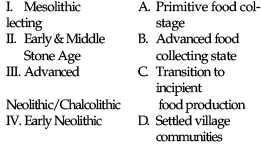
- a)[A-II], [B-I], [C-IV], [D-III]
- b)[A-I], [B-II], [C-III], [D-IV]
- c)[A-III], [B-II], [C-I], [D-IV]
- d)[A-II], [B-I], [C-III], [D-IV]
Correct answer is option 'A'. Can you explain this answer?
Match the following:
a)
[A-II], [B-I], [C-IV], [D-III]
b)
[A-I], [B-II], [C-III], [D-IV]
c)
[A-III], [B-II], [C-I], [D-IV]
d)
[A-II], [B-I], [C-III], [D-IV]
| | Rutuja Ainapure answered |
1) The Mesolithic or middle stone age is an archaeological term used to describe specific cultures that fall between the paleolithic and neolithic periods. Mesolithic identified as a prehistoric period. Some Mesolithic people continued with intensive hunting, while others practiced the initial stages of domestication. Some Mesolithic settlements were villages of huts, others walled cities.
2) Advanced Neolithic is the final division of stone age. In these, sedentary villages had been established. As the Natufians had become dependent on wild cereals in their diet and a sedentary way of life had begun among them, the climatic changes associated with the Younger Dryas (about 10000 BC) are thought to have forced people to develop farming. In other words, farming communities had arisen in this period.
3) Early Neolithic is the initiation to age of chipped stone tools and preceded the bronze age or early period of metal tools. There was incipient means beginning.
So according to me,
1-B;. 2-A;. 3- D; 4- C.
2) Advanced Neolithic is the final division of stone age. In these, sedentary villages had been established. As the Natufians had become dependent on wild cereals in their diet and a sedentary way of life had begun among them, the climatic changes associated with the Younger Dryas (about 10000 BC) are thought to have forced people to develop farming. In other words, farming communities had arisen in this period.
3) Early Neolithic is the initiation to age of chipped stone tools and preceded the bronze age or early period of metal tools. There was incipient means beginning.
So according to me,
1-B;. 2-A;. 3- D; 4- C.
Consider the following statements regarding ancient civilizations:1. The Chinese civilization emerged around the Hwang Ho river basin.2. The Mesoamerican civilization developed in the region of modern-day Iraq and Syria.3. The Indus Valley Civilization had the largest geographical extent among ancient civilizations.Which of the statements given above is/are correct?- a)1 Only
- b)1 and 2 Only
- c)1 and 3 Only
- d)1, 2 and 3
Correct answer is option 'C'. Can you explain this answer?
Consider the following statements regarding ancient civilizations:
1. The Chinese civilization emerged around the Hwang Ho river basin.
2. The Mesoamerican civilization developed in the region of modern-day Iraq and Syria.
3. The Indus Valley Civilization had the largest geographical extent among ancient civilizations.
Which of the statements given above is/are correct?
a)
1 Only
b)
1 and 2 Only
c)
1 and 3 Only
d)
1, 2 and 3
 | Saumya Roy answered |
First, let's analyze each statement:
1. The Chinese civilization emerged around the Hwang Ho river basin:
This statement is correct. The Chinese civilization, also known as the ancient Chinese civilization, originated and developed around the Yellow River (Huang He) basin in China. The Yellow River is often referred to as the cradle of Chinese civilization due to its importance in the development of agriculture, cities, and culture in ancient China.
2. The Mesoamerican civilization developed in the region of modern-day Iraq and Syria:
This statement is incorrect. The Mesoamerican civilization actually developed in ancient Mexico and Central America. It was known for its advanced agricultural practices, complex urban centers, and sophisticated cultural achievements.
3. The Indus Valley Civilization had the largest geographical extent among ancient civilizations:
This statement is correct. The Indus Valley Civilization, also known as the Harappan Civilization, was one of the most widespread ancient civilizations, covering a large area that included parts of modern-day India, Pakistan, and Afghanistan. It had well-planned cities, advanced drainage systems, and a sophisticated writing system.
Therefore, the correct answer is option C) 1 and 3 Only. The Chinese civilization did emerge around the Hwang Ho river basin, and the Indus Valley Civilization did have the largest geographical extent among ancient civilizations.
1. The Chinese civilization emerged around the Hwang Ho river basin:
This statement is correct. The Chinese civilization, also known as the ancient Chinese civilization, originated and developed around the Yellow River (Huang He) basin in China. The Yellow River is often referred to as the cradle of Chinese civilization due to its importance in the development of agriculture, cities, and culture in ancient China.
2. The Mesoamerican civilization developed in the region of modern-day Iraq and Syria:
This statement is incorrect. The Mesoamerican civilization actually developed in ancient Mexico and Central America. It was known for its advanced agricultural practices, complex urban centers, and sophisticated cultural achievements.
3. The Indus Valley Civilization had the largest geographical extent among ancient civilizations:
This statement is correct. The Indus Valley Civilization, also known as the Harappan Civilization, was one of the most widespread ancient civilizations, covering a large area that included parts of modern-day India, Pakistan, and Afghanistan. It had well-planned cities, advanced drainage systems, and a sophisticated writing system.
Therefore, the correct answer is option C) 1 and 3 Only. The Chinese civilization did emerge around the Hwang Ho river basin, and the Indus Valley Civilization did have the largest geographical extent among ancient civilizations.
Consider the following statements:
Statement I: The Great Granary in Mohenjodaro was built on a massive brick foundation and featured a central passageway.
Statement II: The design of the Great Granary allowed for air circulation beneath the floor to keep the stored grain cool and dry.
Which one of the following is correct in respect of the above statements?- a)Both Statement-I and Statement-II are correct and Statement-II is not the correct explanation for Statement-I
- b)Both Statement-I and Statement-II are correct and Statement-II is the correct explanation for Statement-I
- c)Statement-I is correct but Statement-II is incorrect
- d)Statement-I is incorrect but Statement-II is correct
Correct answer is option 'A'. Can you explain this answer?
Consider the following statements:
Statement I: The Great Granary in Mohenjodaro was built on a massive brick foundation and featured a central passageway.
Statement II: The design of the Great Granary allowed for air circulation beneath the floor to keep the stored grain cool and dry.
Which one of the following is correct in respect of the above statements?
Statement I: The Great Granary in Mohenjodaro was built on a massive brick foundation and featured a central passageway.
Statement II: The design of the Great Granary allowed for air circulation beneath the floor to keep the stored grain cool and dry.
Which one of the following is correct in respect of the above statements?
a)
Both Statement-I and Statement-II are correct and Statement-II is not the correct explanation for Statement-I
b)
Both Statement-I and Statement-II are correct and Statement-II is the correct explanation for Statement-I
c)
Statement-I is correct but Statement-II is incorrect
d)
Statement-I is incorrect but Statement-II is correct
 | Future Foundation Institute answered |
Statement I: The Great Granary in Mohenjo-Daro was built on a massive brick foundation and featured a central passageway: This is correct. The Great Granary, a significant structure in Mohenjo-Daro, was constructed on a large platform made of baked bricks to protect it from flooding. Archaeological evidence suggests it had a central passageway or aisles, likely for loading and unloading grain or for ventilation purposes.
Statement II: The design of the Great Granary allowed for air circulation beneath the floor to keep the stored grain cool and dry.: This is also correct. The granary's design included raised platforms with air ducts or channels beneath the floor, which facilitated air circulation. This helped keep the stored grain cool and dry, preventing spoilage.
However, Statement II is not the correct explanation for Statement I. While the air circulation system was an important feature, it was not the reason why the foundation was massive or why there was a central passageway. The passageway was more likely related to the design for storage and movement of goods rather than the ventilation system itself.
Hence, the correct answer - Option A
Consider the following statements:Statement-I: The Indus Valley civilization is known for its highly developed town planning, featuring planned cities with a scientific drainage system.Statement-II: The lower town in Indus cities was primarily inhabited by the working class, while the citadel was reserved for the ruling elite and administrative buildings.Which one of the following is correct in respect of the above statements?- a)Both Statement-I and Statement-II are correct and Statement-II explains Statement-I
- b)Both Statement-I and Statement-II are correct, but Statement-II does not explain Statement-I
- c)Statement-I is correct, but Statement-II is incorrect
- d)Statement-I is incorrect, but Statement-II is correct
Correct answer is option 'B'. Can you explain this answer?
Consider the following statements:
Statement-I: The Indus Valley civilization is known for its highly developed town planning, featuring planned cities with a scientific drainage system.
Statement-II: The lower town in Indus cities was primarily inhabited by the working class, while the citadel was reserved for the ruling elite and administrative buildings.
Which one of the following is correct in respect of the above statements?
a)
Both Statement-I and Statement-II are correct and Statement-II explains Statement-I
b)
Both Statement-I and Statement-II are correct, but Statement-II does not explain Statement-I
c)
Statement-I is correct, but Statement-II is incorrect
d)
Statement-I is incorrect, but Statement-II is correct
| | Arya Das answered |
Explanation of the Statements
The two statements provided pertain to the characteristics of the Indus Valley Civilization, also known as the Harappan Civilization.
Statement-I: Town Planning
- The Indus Valley civilization is indeed celebrated for its advanced town planning.
- This civilization featured well-organized cities such as Harappa and Mohenjo-Daro.
- Key aspects included grid-pattern layouts, standardized brick sizes, and sophisticated drainage systems that demonstrate a high level of urban planning and civil engineering.
Statement-II: Social Structure
- The statement accurately reflects the social stratification in Indus cities.
- The lower town was generally associated with the working class, where artisans, laborers, and merchants lived.
- The citadel was likely reserved for the ruling elite and housed important administrative and religious buildings, indicating a clear division of space based on social hierarchy.
Conclusion
- Both statements are correct in their descriptions of the Indus Valley civilization.
- However, Statement-II does not explain Statement-I. While Statement-I describes the overall urban planning and architectural achievements, Statement-II focuses on the social structure of the population in those cities.
- Therefore, the correct answer is option 'B': Both Statement-I and Statement-II are correct, but Statement-II does not explain Statement-I.
The two statements provided pertain to the characteristics of the Indus Valley Civilization, also known as the Harappan Civilization.
Statement-I: Town Planning
- The Indus Valley civilization is indeed celebrated for its advanced town planning.
- This civilization featured well-organized cities such as Harappa and Mohenjo-Daro.
- Key aspects included grid-pattern layouts, standardized brick sizes, and sophisticated drainage systems that demonstrate a high level of urban planning and civil engineering.
Statement-II: Social Structure
- The statement accurately reflects the social stratification in Indus cities.
- The lower town was generally associated with the working class, where artisans, laborers, and merchants lived.
- The citadel was likely reserved for the ruling elite and housed important administrative and religious buildings, indicating a clear division of space based on social hierarchy.
Conclusion
- Both statements are correct in their descriptions of the Indus Valley civilization.
- However, Statement-II does not explain Statement-I. While Statement-I describes the overall urban planning and architectural achievements, Statement-II focuses on the social structure of the population in those cities.
- Therefore, the correct answer is option 'B': Both Statement-I and Statement-II are correct, but Statement-II does not explain Statement-I.
Consider the following statements :Statement-I:
Amri is situated south of Mohenjo-daro.Statement-II:Balakot is located on the left bank of the Indus River in the Sindh province of Pakistan.Which one of the following is correct in respect of the above statements?- a)Both Statement-I and Statement-II are correct and Statement-II explains Statement-I
- b)Both Statement-I and Statement-II are correct, but Statement-II does not explain Statement-I
- c)Statement-I is correct, but Statement-II is incorrect
- d)Statement-I is incorrect, but Statement-II is correct
Correct answer is option 'C'. Can you explain this answer?
Consider the following statements :
Statement-I:
Amri is situated south of Mohenjo-daro.
Amri is situated south of Mohenjo-daro.
Statement-II:
Balakot is located on the left bank of the Indus River in the Sindh province of Pakistan.
Which one of the following is correct in respect of the above statements?
a)
Both Statement-I and Statement-II are correct and Statement-II explains Statement-I
b)
Both Statement-I and Statement-II are correct, but Statement-II does not explain Statement-I
c)
Statement-I is correct, but Statement-II is incorrect
d)
Statement-I is incorrect, but Statement-II is correct
| | Sonal Shah answered |
Analysis of Statement-I
- Location of Amri: Amri is an archaeological site located in the Sindh province of Pakistan.
- Relation to Mohenjo-daro: Mohenjo-daro is also in Sindh, but it is situated to the northwest of Amri. Thus, Statement-I is incorrect as Amri is not south of Mohenjo-daro.
Analysis of Statement-II
- Location of Balakot: Balakot is indeed located in the Sindh province of Pakistan.
- Geographical Position: It is situated on the left bank of the Indus River. This statement is accurate and correctly describes the geographical placement of Balakot.
Conclusion
- Correctness of Statements:
- Statement-I is incorrect.
- Statement-II is correct.
Given this analysis, the correct answer is option 'C': Statement-I is correct, but Statement-II is incorrect.
In summary, while Statement-II accurately describes Balakot's location, Statement-I misrepresents the geographical relationship between Amri and Mohenjo-daro.
- Location of Amri: Amri is an archaeological site located in the Sindh province of Pakistan.
- Relation to Mohenjo-daro: Mohenjo-daro is also in Sindh, but it is situated to the northwest of Amri. Thus, Statement-I is incorrect as Amri is not south of Mohenjo-daro.
Analysis of Statement-II
- Location of Balakot: Balakot is indeed located in the Sindh province of Pakistan.
- Geographical Position: It is situated on the left bank of the Indus River. This statement is accurate and correctly describes the geographical placement of Balakot.
Conclusion
- Correctness of Statements:
- Statement-I is incorrect.
- Statement-II is correct.
Given this analysis, the correct answer is option 'C': Statement-I is correct, but Statement-II is incorrect.
In summary, while Statement-II accurately describes Balakot's location, Statement-I misrepresents the geographical relationship between Amri and Mohenjo-daro.
Consider the following statements about the architectural features of the Indus Valley Civilization:- The streets of Harappa and Mohenjo-Daro were oriented from east to west only
- Burnt bricks were used in construction in Harappan cities, unlike the contemporary buildings of Egypt which used mainly dried bricks.
- The Great Bath of Mohenjo-Daro served a ritualistic purpose in addition to being an ancient public water tank.
How many of the statements given above are correct?- a)Only one
- b)Only two
- c)All three
- d)None
Correct answer is option 'B'. Can you explain this answer?
Consider the following statements about the architectural features of the Indus Valley Civilization:
- The streets of Harappa and Mohenjo-Daro were oriented from east to west only
- Burnt bricks were used in construction in Harappan cities, unlike the contemporary buildings of Egypt which used mainly dried bricks.
- The Great Bath of Mohenjo-Daro served a ritualistic purpose in addition to being an ancient public water tank.
How many of the statements given above are correct?
a)
Only one
b)
Only two
c)
All three
d)
None
| | Prisha Nair answered |
Analysis of Statements
To determine the correctness of the statements regarding the architectural features of the Indus Valley Civilization, we will analyze each one individually.
Statement 1: Orientation of Streets
- The streets of Harappa and Mohenjo-Daro were not oriented from east to west only.
- In fact, the layout of these cities was highly planned, with a grid pattern that included streets oriented in multiple directions, primarily north-south and east-west.
- Conclusion: This statement is incorrect.
Statement 2: Use of Burnt Bricks
- The Harappan civilization is indeed known for its use of burnt bricks, which were more durable than the sun-dried bricks commonly used in ancient Egypt.
- Burnt bricks allowed for more sophisticated construction techniques and contributed to the longevity of their structures.
- Conclusion: This statement is correct.
Statement 3: The Great Bath of Mohenjo-Daro
- The Great Bath is believed to have served both a ritualistic purpose and as a public water tank.
- Its design suggests it was used for ceremonial bathing, reflecting the importance of water in rituals, as well as social gatherings.
- Conclusion: This statement is correct.
Final Assessment
- Out of the three statements, two are correct (Statement 2 and Statement 3), while one is incorrect (Statement 1).
- Therefore, the correct answer is option 'B' - Only two statements are correct.
This analysis highlights the advanced urban planning and architectural practices of the Indus Valley Civilization, showcasing their distinct characteristics compared to contemporaneous civilizations.
To determine the correctness of the statements regarding the architectural features of the Indus Valley Civilization, we will analyze each one individually.
Statement 1: Orientation of Streets
- The streets of Harappa and Mohenjo-Daro were not oriented from east to west only.
- In fact, the layout of these cities was highly planned, with a grid pattern that included streets oriented in multiple directions, primarily north-south and east-west.
- Conclusion: This statement is incorrect.
Statement 2: Use of Burnt Bricks
- The Harappan civilization is indeed known for its use of burnt bricks, which were more durable than the sun-dried bricks commonly used in ancient Egypt.
- Burnt bricks allowed for more sophisticated construction techniques and contributed to the longevity of their structures.
- Conclusion: This statement is correct.
Statement 3: The Great Bath of Mohenjo-Daro
- The Great Bath is believed to have served both a ritualistic purpose and as a public water tank.
- Its design suggests it was used for ceremonial bathing, reflecting the importance of water in rituals, as well as social gatherings.
- Conclusion: This statement is correct.
Final Assessment
- Out of the three statements, two are correct (Statement 2 and Statement 3), while one is incorrect (Statement 1).
- Therefore, the correct answer is option 'B' - Only two statements are correct.
This analysis highlights the advanced urban planning and architectural practices of the Indus Valley Civilization, showcasing their distinct characteristics compared to contemporaneous civilizations.
When did settlements begin in the Indus Valley Civilization, marking the first signs of urbanization?- a)4000 BCE
- b)3500 BCE
- c)3000 BCE
- d)2500 BCE
Correct answer is option 'C'. Can you explain this answer?
When did settlements begin in the Indus Valley Civilization, marking the first signs of urbanization?
a)
4000 BCE
b)
3500 BCE
c)
3000 BCE
d)
2500 BCE
| | Akanksha Patel answered |
Settlements in the Indus Valley Civilization
The settlements in the Indus Valley Civilization began around 3000 BCE, marking the first signs of urbanization in the region.
Key Points:
- The Indus Valley Civilization, also known as the Harappan Civilization, was one of the world's earliest urban civilizations.
- The major urban centers of this civilization included Harappa, Mohenjo-Daro, and Dholavira.
- These settlements were characterized by well-planned streets, advanced drainage systems, and standardized brick sizes, indicating a high level of urban development.
- The people of the Indus Valley Civilization were skilled in crafts such as pottery, metalworking, and bead-making.
- Agriculture was the main economic activity, with the Indus River providing fertile land for farming.
- Trade networks extended to regions such as Mesopotamia, Oman, and Afghanistan, showcasing the civilization's economic prosperity.
- The decline of the Indus Valley Civilization around 1900 BCE remains a topic of debate among historians, with theories ranging from environmental factors to invasions.
In conclusion, the settlements in the Indus Valley Civilization that began around 3000 BCE represented a significant step towards urbanization, with well-developed cities and advanced infrastructure setting the stage for a flourishing civilization.
The settlements in the Indus Valley Civilization began around 3000 BCE, marking the first signs of urbanization in the region.
Key Points:
- The Indus Valley Civilization, also known as the Harappan Civilization, was one of the world's earliest urban civilizations.
- The major urban centers of this civilization included Harappa, Mohenjo-Daro, and Dholavira.
- These settlements were characterized by well-planned streets, advanced drainage systems, and standardized brick sizes, indicating a high level of urban development.
- The people of the Indus Valley Civilization were skilled in crafts such as pottery, metalworking, and bead-making.
- Agriculture was the main economic activity, with the Indus River providing fertile land for farming.
- Trade networks extended to regions such as Mesopotamia, Oman, and Afghanistan, showcasing the civilization's economic prosperity.
- The decline of the Indus Valley Civilization around 1900 BCE remains a topic of debate among historians, with theories ranging from environmental factors to invasions.
In conclusion, the settlements in the Indus Valley Civilization that began around 3000 BCE represented a significant step towards urbanization, with well-developed cities and advanced infrastructure setting the stage for a flourishing civilization.
Consider the following pairs:1. Mesopotamian Civilization - Basin of Nile river2. Egyptian Civilization - Nile river valley3. Indus Valley Civilization - Indus river and its tributaries4. Chinese Civilization - Hwang Ho river basinHow many pairs given above are correctly matched?- a)Only one pair
- b)Only two pairs
- c)Only three pairs
- d)All four pairs
Correct answer is option 'C'. Can you explain this answer?
Consider the following pairs:
1. Mesopotamian Civilization - Basin of Nile river
2. Egyptian Civilization - Nile river valley
3. Indus Valley Civilization - Indus river and its tributaries
4. Chinese Civilization - Hwang Ho river basin
How many pairs given above are correctly matched?
a)
Only one pair
b)
Only two pairs
c)
Only three pairs
d)
All four pairs
| | Rutuja Gupta answered |
Explanation:
Indus Valley Civilization - Indus river and its tributaries:
- The Indus Valley Civilization was located in the basin of the Indus River and its tributaries in present-day Pakistan and northwest India. This civilization flourished around 2600-1900 BCE.
Chinese Civilization - Hwang Ho river basin:
- The Chinese Civilization developed in the Hwang Ho (Yellow River) basin in China. The Yellow River played a crucial role in the development of Chinese civilization, providing fertile land for agriculture.
Conclusion:
- Based on the information provided, three out of the four pairs are correctly matched. Mesopotamian Civilization is associated with the Tigris and Euphrates rivers, not the Nile river as mentioned in the first pair. Therefore, the correct answer is option 'C' - Only three pairs.
Indus Valley Civilization - Indus river and its tributaries:
- The Indus Valley Civilization was located in the basin of the Indus River and its tributaries in present-day Pakistan and northwest India. This civilization flourished around 2600-1900 BCE.
Chinese Civilization - Hwang Ho river basin:
- The Chinese Civilization developed in the Hwang Ho (Yellow River) basin in China. The Yellow River played a crucial role in the development of Chinese civilization, providing fertile land for agriculture.
Conclusion:
- Based on the information provided, three out of the four pairs are correctly matched. Mesopotamian Civilization is associated with the Tigris and Euphrates rivers, not the Nile river as mentioned in the first pair. Therefore, the correct answer is option 'C' - Only three pairs.
Where was Sutkagendor located, and what significant archaeological features were unearthed at this site?- a)Sutkagendor was located in the Punjab region of India, and artifacts such as bronze sculptures and jewelry were discovered.
- b)Sutkagendor was situated in the Makran district of Balochistan, Pakistan, and it revealed stone vessels, pottery, shell beads, and clay bangles.
- c)Sutkagendor was found in the Ganges Valley of India, showcasing early agricultural tools and terracotta figurines.
- d)Sutkagendor was positioned in the Fertile Crescent, and artifacts like cuneiform tablets and ziggurats were excavated.
Correct answer is option 'B'. Can you explain this answer?
Where was Sutkagendor located, and what significant archaeological features were unearthed at this site?
a)
Sutkagendor was located in the Punjab region of India, and artifacts such as bronze sculptures and jewelry were discovered.
b)
Sutkagendor was situated in the Makran district of Balochistan, Pakistan, and it revealed stone vessels, pottery, shell beads, and clay bangles.
c)
Sutkagendor was found in the Ganges Valley of India, showcasing early agricultural tools and terracotta figurines.
d)
Sutkagendor was positioned in the Fertile Crescent, and artifacts like cuneiform tablets and ziggurats were excavated.
| | Akanksha Patel answered |
Location of Sutkagendor
Sutkagendor was situated in the Makran district of Balochistan, Pakistan.
Archaeological Discoveries
- The site of Sutkagendor revealed various significant archaeological features, including:
- Stone vessels
- Pottery
- Shell beads
- Clay bangles
These artifacts provide insights into the culture, lifestyle, and craftsmanship of the ancient inhabitants of Sutkagendor. The discovery of such items helps archaeologists and historians understand the social, economic, and religious practices of the people who lived in this region during that time period. The presence of these objects also suggests the level of sophistication and skill that existed among the residents of Sutkagendor.
Sutkagendor was situated in the Makran district of Balochistan, Pakistan.
Archaeological Discoveries
- The site of Sutkagendor revealed various significant archaeological features, including:
- Stone vessels
- Pottery
- Shell beads
- Clay bangles
These artifacts provide insights into the culture, lifestyle, and craftsmanship of the ancient inhabitants of Sutkagendor. The discovery of such items helps archaeologists and historians understand the social, economic, and religious practices of the people who lived in this region during that time period. The presence of these objects also suggests the level of sophistication and skill that existed among the residents of Sutkagendor.
Consider the following statements about the Indus Valley Civilisation:Statement I:
Most Harappan inscriptions were recorded on seals.Statement II:
The Harappans were the earliest people to produce cotton.Which one of the following is correct in respect of the above statements?- a)Statement I is correct, but Statement II is incorrect
- b)Both Statement I and Statement II are correct, and Statement II explains Statement I
- c)Both Statement I and Statement II are correct, but Statement II does not explain Statement I
- d)Statement I is incorrect, but Statement II is correct
Correct answer is option 'C'. Can you explain this answer?
Consider the following statements about the Indus Valley Civilisation:
Statement I:
Most Harappan inscriptions were recorded on seals.
Most Harappan inscriptions were recorded on seals.
Statement II:
The Harappans were the earliest people to produce cotton.
The Harappans were the earliest people to produce cotton.
Which one of the following is correct in respect of the above statements?
a)
Statement I is correct, but Statement II is incorrect
b)
Both Statement I and Statement II are correct, and Statement II explains Statement I
c)
Both Statement I and Statement II are correct, but Statement II does not explain Statement I
d)
Statement I is incorrect, but Statement II is correct
 | Tushar Das answered |
Explanation:
Statement I:
- Most Harappan inscriptions were recorded on seals: This statement is correct. The Harappan civilization, also known as the Indus Valley Civilization, left behind numerous seals with inscriptions. These seals were typically made of steatite and had short inscriptions in the ancient script of the Harappan people.
Statement II:
- The Harappans were the earliest people to produce cotton: This statement is also correct. The Harappans were indeed among the earliest people to cultivate and produce cotton. Archaeological evidence suggests that cotton was grown and used in the Indus Valley Civilization for textile production.
Therefore, Option C is the correct answer as both Statement I and Statement II are correct, and Statement II explains Statement I. The Harappans used seals to record inscriptions, and they were also known for their early cotton production.
Statement I:
- Most Harappan inscriptions were recorded on seals: This statement is correct. The Harappan civilization, also known as the Indus Valley Civilization, left behind numerous seals with inscriptions. These seals were typically made of steatite and had short inscriptions in the ancient script of the Harappan people.
Statement II:
- The Harappans were the earliest people to produce cotton: This statement is also correct. The Harappans were indeed among the earliest people to cultivate and produce cotton. Archaeological evidence suggests that cotton was grown and used in the Indus Valley Civilization for textile production.
Therefore, Option C is the correct answer as both Statement I and Statement II are correct, and Statement II explains Statement I. The Harappans used seals to record inscriptions, and they were also known for their early cotton production.
Consider the following statements:Statement-I:
Chanhudaro is often referred to as the Lancashire of ancient India and notably lacks a citadel.Statement-II:
Banawali comprises a well-structured fort town encompassed by a defensive wall standing at a height of 4.5m.Which one of the following is correct in respect of the above statements?- a)Both Statement-I and Statement-II are correct and Statement-II explains Statement-I
- b)Both Statement-I and Statement-II are correct, but Statement-II does not explain Statement-I
- c)Statement-I is correct, but Statement-II is incorrect
- d)Statement-I is incorrect, but Statement-II is correct
Correct answer is option 'B'. Can you explain this answer?
Consider the following statements:
Statement-I:
Chanhudaro is often referred to as the Lancashire of ancient India and notably lacks a citadel.
Chanhudaro is often referred to as the Lancashire of ancient India and notably lacks a citadel.
Statement-II:
Banawali comprises a well-structured fort town encompassed by a defensive wall standing at a height of 4.5m.
Banawali comprises a well-structured fort town encompassed by a defensive wall standing at a height of 4.5m.
Which one of the following is correct in respect of the above statements?
a)
Both Statement-I and Statement-II are correct and Statement-II explains Statement-I
b)
Both Statement-I and Statement-II are correct, but Statement-II does not explain Statement-I
c)
Statement-I is correct, but Statement-II is incorrect
d)
Statement-I is incorrect, but Statement-II is correct
| | Sameer Yadav answered |
Explanation:
Chanhudaro and Banawali are two important archaeological sites of the Indus Valley Civilization. Let's analyze each statement individually:
Statement-I:
- Chanhudaro is often referred to as the Lancashire of ancient India because it was an important center for the production of beads and copper tools.
- It notably lacks a citadel, which sets it apart from other Indus Valley sites like Mohenjo-Daro and Harappa, which had citadels for administrative and defensive purposes.
Statement-II:
- Banawali is another archaeological site of the Indus Valley Civilization.
- Banawali comprises a well-structured fort town encompassed by a defensive wall standing at a height of 4.5m, which indicates the presence of a citadel or fortified area for protection.
Correct Answer:
Both Statement-I and Statement-II are correct, but Statement-II does not explain Statement-I.
Therefore, option B is the correct answer as both statements are individually correct but do not have a direct explanatory relationship.
Chanhudaro and Banawali are two important archaeological sites of the Indus Valley Civilization. Let's analyze each statement individually:
Statement-I:
- Chanhudaro is often referred to as the Lancashire of ancient India because it was an important center for the production of beads and copper tools.
- It notably lacks a citadel, which sets it apart from other Indus Valley sites like Mohenjo-Daro and Harappa, which had citadels for administrative and defensive purposes.
Statement-II:
- Banawali is another archaeological site of the Indus Valley Civilization.
- Banawali comprises a well-structured fort town encompassed by a defensive wall standing at a height of 4.5m, which indicates the presence of a citadel or fortified area for protection.
Correct Answer:
Both Statement-I and Statement-II are correct, but Statement-II does not explain Statement-I.
Therefore, option B is the correct answer as both statements are individually correct but do not have a direct explanatory relationship.
Consider the following statements:1. The earliest evidence of dentistry dates back to the Indus Valley Civilization.2. The Indus Valley Civilization was contemporary with the Egyptian and Mesopotamian civilizations.3. The ruins of Mohenjo-Daro were designated a UNESCO World Heritage site in 1980.Which of the statements given above is/are correct?- a)1 Only
- b)1 and 2 Only
- c)1 and 3 Only
- d)1, 2 and 3
Correct answer is option 'D'. Can you explain this answer?
Consider the following statements:
1. The earliest evidence of dentistry dates back to the Indus Valley Civilization.
2. The Indus Valley Civilization was contemporary with the Egyptian and Mesopotamian civilizations.
3. The ruins of Mohenjo-Daro were designated a UNESCO World Heritage site in 1980.
Which of the statements given above is/are correct?
a)
1 Only
b)
1 and 2 Only
c)
1 and 3 Only
d)
1, 2 and 3
| | Arya Saha answered |
Understanding the Statements
The question revolves around the historical significance of the Indus Valley Civilization (IVC) and its contemporaries. Let's analyze each statement:
1. The earliest evidence of dentistry dates back to the Indus Valley Civilization.
- This statement is correct. Archaeological findings in the IVC, particularly in the city of Mohenjo-Daro, reveal evidence of dental practices, including the drilling of teeth, which indicates a level of sophistication in dental care.
2. The Indus Valley Civilization was contemporary with the Egyptian and Mesopotamian civilizations.
- This statement is also correct. The IVC flourished around 2500 BCE, during a period when the Egyptian and Mesopotamian civilizations were also developing. These cultures interacted and influenced each other, sharing advancements in trade, writing, and architecture.
3. The ruins of Mohenjo-Daro were designated a UNESCO World Heritage site in 1980.
- This statement is correct as well. In 1980, UNESCO recognized the ruins of Mohenjo-Daro for their historical and cultural significance, highlighting the importance of the IVC in the broader context of human history.
Conclusion
Since all three statements are accurate, the correct answer is indeed option 'D' - 1, 2, and 3. Each statement provides insight into the remarkable achievements and relevance of the Indus Valley Civilization in the context of world history.
The question revolves around the historical significance of the Indus Valley Civilization (IVC) and its contemporaries. Let's analyze each statement:
1. The earliest evidence of dentistry dates back to the Indus Valley Civilization.
- This statement is correct. Archaeological findings in the IVC, particularly in the city of Mohenjo-Daro, reveal evidence of dental practices, including the drilling of teeth, which indicates a level of sophistication in dental care.
2. The Indus Valley Civilization was contemporary with the Egyptian and Mesopotamian civilizations.
- This statement is also correct. The IVC flourished around 2500 BCE, during a period when the Egyptian and Mesopotamian civilizations were also developing. These cultures interacted and influenced each other, sharing advancements in trade, writing, and architecture.
3. The ruins of Mohenjo-Daro were designated a UNESCO World Heritage site in 1980.
- This statement is correct as well. In 1980, UNESCO recognized the ruins of Mohenjo-Daro for their historical and cultural significance, highlighting the importance of the IVC in the broader context of human history.
Conclusion
Since all three statements are accurate, the correct answer is indeed option 'D' - 1, 2, and 3. Each statement provides insight into the remarkable achievements and relevance of the Indus Valley Civilization in the context of world history.
Consider the following statements:1. The Harappans were the earliest people to produce cotton.2. The Great Bath at Mohenjo-Daro is surrounded by a paved courtyard.3. Stone implements were largely used by the Indus people.Which of the statements given above is/are correct?- a)1 Only
- b)1, 2 and 3
- c)1 and 3 Only
- d)1 and 2 Only
Correct answer is option 'D'. Can you explain this answer?
Consider the following statements:
1. The Harappans were the earliest people to produce cotton.
2. The Great Bath at Mohenjo-Daro is surrounded by a paved courtyard.
3. Stone implements were largely used by the Indus people.
Which of the statements given above is/are correct?
a)
1 Only
b)
1, 2 and 3
c)
1 and 3 Only
d)
1 and 2 Only
 | Target Study Academy answered |
1. The Harappans were the earliest people to produce cotton: This statement is correct. The Indus Valley Civilisation is known to have been among the earliest cultures to cultivate and use cotton, as evidenced by archaeological findings.
2. The Great Bath at Mohenjo-Daro is surrounded by a paved courtyard: This statement is correct. The Great Bath, one of the most famous structures at Mohenjo-Daro, is indeed surrounded by a paved courtyard, indicating advanced engineering and architectural skills.
3. Stone implements were largely used by the Indus people: This statement is Incorrect. The Indus people primarily used bronze and copper tools rather than stone implements. The civilisation belongs to the Bronze Age, meaning metal tools were dominant, though stone tools were still used occasionally.
Thus, only the first two statements are correct. Therefore, the correct answer is Option D.
Which one of the following was the most suitable reasons, which made the Harappans move away from their urban settlement?- a)Hydrological changes
- b)Ecological changes
- c)Foreign invasion
- d)Demographic changes
Correct answer is option 'A'. Can you explain this answer?
Which one of the following was the most suitable reasons, which made the Harappans move away from their urban settlement?
a)
Hydrological changes
b)
Ecological changes
c)
Foreign invasion
d)
Demographic changes
 | Wizius Careers answered |
Archaeological and geological evidence strongly suggests that hydrological changes—such as the drying up or shifting of rivers, especially the Ghaggar-Hakra (believed by some to be the mythical Saraswati River)—played a critical role in the decline of the Harappan Civilization. These changes affected agriculture, water supply, and trade routes, making it difficult to sustain large urban centers.
Other options are less supported as primary causes:
b) Ecological changes: While they may have contributed, they are often linked to hydrological shifts.
c) Foreign invasion: This theory (e.g., Aryan invasion) has largely been discredited.
d) Demographic changes: These were more likely a result than a cause of the decline.
c) Foreign invasion: This theory (e.g., Aryan invasion) has largely been discredited.
d) Demographic changes: These were more likely a result than a cause of the decline.
So, hydrological changes are considered the most suitable and well-supported reason.

Consider the following pairs:1. Mehrgarh, Pakistan - Earliest evidence of dentistry2. Mohenjo-Daro - UNESCO World Heritage site since 19803. Pallavaram - First evidence of human beings in India4. Guptas - Issued the largest number of silver coinsHow many pairs given above are correctly matched?- a)Only one pair
- b)Only two pairs
- c)Only three pairs
- d)All four pairs
Correct answer is option 'B'. Can you explain this answer?
Consider the following pairs:
1. Mehrgarh, Pakistan - Earliest evidence of dentistry
2. Mohenjo-Daro - UNESCO World Heritage site since 1980
3. Pallavaram - First evidence of human beings in India
4. Guptas - Issued the largest number of silver coins
How many pairs given above are correctly matched?
a)
Only one pair
b)
Only two pairs
c)
Only three pairs
d)
All four pairs
| | Pranjal Choudhary answered |
Analysis of the Pairs
To determine how many pairs are correctly matched, we need to evaluate each statement:
1. Mehrgarh, Pakistan - Earliest evidence of dentistry
- Mehrgarh is indeed one of the earliest known agricultural sites in South Asia, with evidence of early dental practices, including drilling of teeth. Thus, this pair is correct.
2. Mohenjo-Daro - UNESCO World Heritage site since 1980
- Mohenjo-Daro was designated a UNESCO World Heritage site in 1980, recognizing its significance as an archaeological site of the Indus Valley Civilization. This pair is also correct.
3. Pallavaram - First evidence of human beings in India
- While Pallavaram is significant for its archaeological findings, it is not the site of the earliest evidence of human beings in India. Other sites, such as Bhimbetka and the Narmada Valley, have older evidence. Therefore, this pair is incorrect.
4. Guptas - Issued the largest number of silver coins
- The Gupta Empire is well-known for its extensive coinage, but it is not accurate to state that they issued the largest number of silver coins. Other dynasties also issued significant quantities, making this pair incorrect.
Conclusion
- After analyzing the pairs, we find that only two pairs are correctly matched: Mehrgarh and Mohenjo-Daro. Therefore, the correct answer is indeed option 'B'.
To determine how many pairs are correctly matched, we need to evaluate each statement:
1. Mehrgarh, Pakistan - Earliest evidence of dentistry
- Mehrgarh is indeed one of the earliest known agricultural sites in South Asia, with evidence of early dental practices, including drilling of teeth. Thus, this pair is correct.
2. Mohenjo-Daro - UNESCO World Heritage site since 1980
- Mohenjo-Daro was designated a UNESCO World Heritage site in 1980, recognizing its significance as an archaeological site of the Indus Valley Civilization. This pair is also correct.
3. Pallavaram - First evidence of human beings in India
- While Pallavaram is significant for its archaeological findings, it is not the site of the earliest evidence of human beings in India. Other sites, such as Bhimbetka and the Narmada Valley, have older evidence. Therefore, this pair is incorrect.
4. Guptas - Issued the largest number of silver coins
- The Gupta Empire is well-known for its extensive coinage, but it is not accurate to state that they issued the largest number of silver coins. Other dynasties also issued significant quantities, making this pair incorrect.
Conclusion
- After analyzing the pairs, we find that only two pairs are correctly matched: Mehrgarh and Mohenjo-Daro. Therefore, the correct answer is indeed option 'B'.
Consider the following pairs:1. Sutkagendor - Located in the Fatehabad district of Haryana2. Chanhudaro - Located along the Indus River in Sindh, Pakistan3. Surkotada - Evidence of horse bones found4. Banawali - Discovered by N.G. MajumdarHow many pairs given above are correctly matched?- a)Only one pair
- b)Only two pairs
- c)Only three pairs
- d)All four pairs
Correct answer is option 'B'. Can you explain this answer?
Consider the following pairs:
1. Sutkagendor - Located in the Fatehabad district of Haryana
2. Chanhudaro - Located along the Indus River in Sindh, Pakistan
3. Surkotada - Evidence of horse bones found
4. Banawali - Discovered by N.G. Majumdar
How many pairs given above are correctly matched?
a)
Only one pair
b)
Only two pairs
c)
Only three pairs
d)
All four pairs
| | Surbhi Joshi answered |
Correctly Matched Pairs
1. Sutkagendor - Located in the Fatehabad district of Haryana
- This pair is correctly matched as Sutkagendor is indeed located in the Fatehabad district of Haryana.
2. Chanhudaro - Located along the Indus River in Sindh, Pakistan
- This pair is also correctly matched as Chanhudaro is an archaeological site located along the Indus River in Sindh, Pakistan.
Incorrectly Matched Pairs
3. Surkotada - Evidence of horse bones found
- This pair is not correctly matched. Surkotada is actually known for its archaeological remains related to the Harappan civilization but not specifically for evidence of horse bones.
4. Banawali - Discovered by N.G. Majumdar
- This pair is also not correctly matched. Banawali is an archaeological site in Haryana, but it was discovered by R. S. Bisht, not N.G. Majumdar.
Therefore, out of the given pairs, only two of them are correctly matched (Sutkagendor and Chanhudaro), while the other two pairs are not accurately matched.
1. Sutkagendor - Located in the Fatehabad district of Haryana
- This pair is correctly matched as Sutkagendor is indeed located in the Fatehabad district of Haryana.
2. Chanhudaro - Located along the Indus River in Sindh, Pakistan
- This pair is also correctly matched as Chanhudaro is an archaeological site located along the Indus River in Sindh, Pakistan.
Incorrectly Matched Pairs
3. Surkotada - Evidence of horse bones found
- This pair is not correctly matched. Surkotada is actually known for its archaeological remains related to the Harappan civilization but not specifically for evidence of horse bones.
4. Banawali - Discovered by N.G. Majumdar
- This pair is also not correctly matched. Banawali is an archaeological site in Haryana, but it was discovered by R. S. Bisht, not N.G. Majumdar.
Therefore, out of the given pairs, only two of them are correctly matched (Sutkagendor and Chanhudaro), while the other two pairs are not accurately matched.
Consider the following statements regarding the archaeological findings from Harappan sites:1. The double citadel with fire altars and evidence of the cult of sacrifice was found in Kalibangan.2. A dockyard and wharf loading platform were discovered at Lothal along with rice husk.3. The site of Kot Diji revealed a Mesopotamian seal made of ivory and chess game pieces.Which of the statements given above is/are correct?- a)1 Only
- b)1 and 2 Only
- c)1 and 3 Only
- d)1, 2 and 3
Correct answer is option 'B'. Can you explain this answer?
Consider the following statements regarding the archaeological findings from Harappan sites:
1. The double citadel with fire altars and evidence of the cult of sacrifice was found in Kalibangan.
2. A dockyard and wharf loading platform were discovered at Lothal along with rice husk.
3. The site of Kot Diji revealed a Mesopotamian seal made of ivory and chess game pieces.
Which of the statements given above is/are correct?
a)
1 Only
b)
1 and 2 Only
c)
1 and 3 Only
d)
1, 2 and 3
| | Arya Saha answered |
Overview of Harappan Archaeological Findings
The Harappan civilization, also known as the Indus Valley Civilization, showcases remarkable archaeological findings. Let's analyze the statements regarding these findings to determine their correctness.
Statement 1: Double Citadel in Kalibangan
- The double citadel with fire altars and evidence of a cult of sacrifice was indeed found in Kalibangan.
- This site is significant for its unique architectural features and ritualistic practices.
Statement 2: Dockyard at Lothal
- Lothal is famously known for its dockyard and wharf loading platform, which were used for maritime trade.
- The discovery of rice husk at Lothal indicates agricultural practices and possibly trade in rice, supporting the site's significance in the region.
Statement 3: Findings at Kot Diji
- Kot Diji is an important archaeological site but did not reveal a Mesopotamian seal made of ivory or chess game pieces.
- This statement is incorrect as there is no evidence of such artifacts from Kot Diji.
Conclusion: Correct Statements
- Based on the analysis:
- Statement 1 is correct.
- Statement 2 is correct.
- Statement 3 is incorrect.
Thus, the correct answer is b) 1 and 2 only.
The Harappan civilization, also known as the Indus Valley Civilization, showcases remarkable archaeological findings. Let's analyze the statements regarding these findings to determine their correctness.
Statement 1: Double Citadel in Kalibangan
- The double citadel with fire altars and evidence of a cult of sacrifice was indeed found in Kalibangan.
- This site is significant for its unique architectural features and ritualistic practices.
Statement 2: Dockyard at Lothal
- Lothal is famously known for its dockyard and wharf loading platform, which were used for maritime trade.
- The discovery of rice husk at Lothal indicates agricultural practices and possibly trade in rice, supporting the site's significance in the region.
Statement 3: Findings at Kot Diji
- Kot Diji is an important archaeological site but did not reveal a Mesopotamian seal made of ivory or chess game pieces.
- This statement is incorrect as there is no evidence of such artifacts from Kot Diji.
Conclusion: Correct Statements
- Based on the analysis:
- Statement 1 is correct.
- Statement 2 is correct.
- Statement 3 is incorrect.
Thus, the correct answer is b) 1 and 2 only.
Which one of the following statements about the significance of large granaries of Indus valley towns is not correct?- a)They reflect the solvency of the administrative organisation.
- b)At that time taxes had to be paid in kind, so these granaries must have served the purpose of public treasuries.
- c)They were used for storing the surplus produce of the country used for maintaining the cities.
- d)They indicate the surplus agricultural production and developed means for the storage of food-grains
- e)All the above are correct.
Correct answer is option 'E'. Can you explain this answer?
Which one of the following statements about the significance of large granaries of Indus valley towns is not correct?
a)
They reflect the solvency of the administrative organisation.
b)
At that time taxes had to be paid in kind, so these granaries must have served the purpose of public treasuries.
c)
They were used for storing the surplus produce of the country used for maintaining the cities.
d)
They indicate the surplus agricultural production and developed means for the storage of food-grains
e)
All the above are correct.
| | Rajni Divakar answered |
A
Consider the following statements:1. The site of Ropar was discovered by Y. D. Sharma in 1953.2. Dholavira is one of the two largest Harappan settlements in India, the other being Rakhigarhi.3. The excavations at Dholavira revealed that the town was divided into three principal divisions, two of which were protected by rectangular fortification.Which of the statements given above is/are correct?- a)1 Only
- b)1 and 2 Only
- c)1 and 3 Only
- d)1, 2 and 3
Correct answer is option 'D'. Can you explain this answer?
Consider the following statements:
1. The site of Ropar was discovered by Y. D. Sharma in 1953.
2. Dholavira is one of the two largest Harappan settlements in India, the other being Rakhigarhi.
3. The excavations at Dholavira revealed that the town was divided into three principal divisions, two of which were protected by rectangular fortification.
Which of the statements given above is/are correct?
a)
1 Only
b)
1 and 2 Only
c)
1 and 3 Only
d)
1, 2 and 3
| | Arya Saha answered |
Overview of Harappan Civilization
The Harappan Civilization, also known as the Indus Valley Civilization, is one of the world's oldest urban cultures, flourishing around 2500 BCE. Understanding significant archaeological sites like Ropar and Dholavira is crucial in appreciating this ancient civilization.
Statement 1: Ropar Discovery
- The site of Ropar was indeed discovered by Y. D. Sharma in 1953.
- This discovery contributed significantly to the understanding of the early Harappan culture in the Punjab region.
Statement 2: Dholavira and Rakhigarhi
- Dholavira is recognized as one of the two largest Harappan settlements in India.
- Rakhigarhi is the other major site, highlighting the extensive urban planning and culture of the Harappan Civilization.
Statement 3: Excavations at Dholavira
- Excavations at Dholavira revealed a sophisticated urban layout.
- The town was divided into three principal divisions, two of which were protected by rectangular fortifications, indicating advanced city planning and defensive strategies.
Conclusion
- All three statements are correct, as they reflect significant findings and facts about the Harappan Civilization.
- Thus, the correct answer is option 'D', confirming the accuracy of all provided statements.
This comprehensive understanding of Ropar and Dholavira enhances our knowledge of one of the most remarkable ancient civilizations.
The Harappan Civilization, also known as the Indus Valley Civilization, is one of the world's oldest urban cultures, flourishing around 2500 BCE. Understanding significant archaeological sites like Ropar and Dholavira is crucial in appreciating this ancient civilization.
Statement 1: Ropar Discovery
- The site of Ropar was indeed discovered by Y. D. Sharma in 1953.
- This discovery contributed significantly to the understanding of the early Harappan culture in the Punjab region.
Statement 2: Dholavira and Rakhigarhi
- Dholavira is recognized as one of the two largest Harappan settlements in India.
- Rakhigarhi is the other major site, highlighting the extensive urban planning and culture of the Harappan Civilization.
Statement 3: Excavations at Dholavira
- Excavations at Dholavira revealed a sophisticated urban layout.
- The town was divided into three principal divisions, two of which were protected by rectangular fortifications, indicating advanced city planning and defensive strategies.
Conclusion
- All three statements are correct, as they reflect significant findings and facts about the Harappan Civilization.
- Thus, the correct answer is option 'D', confirming the accuracy of all provided statements.
This comprehensive understanding of Ropar and Dholavira enhances our knowledge of one of the most remarkable ancient civilizations.
Consider the following pairs:1. Amri - Situated near Gunthali in Nakhatrana taluka of Bhuj district (Gujarat)2. Balakot - Discovered by Robert Raikes3. Desalpur - Situated south of Mohenjo-daro4. Amri - Knowledge of metal working, use of wheel pottery with animal figures painted on itHow many pairs given above are correctly matched?- a)Only one pair
- b)Only two pairs
- c)Only three pairs
- d)All four pairs
Correct answer is option 'B'. Can you explain this answer?
Consider the following pairs:
1. Amri - Situated near Gunthali in Nakhatrana taluka of Bhuj district (Gujarat)
2. Balakot - Discovered by Robert Raikes
3. Desalpur - Situated south of Mohenjo-daro
4. Amri - Knowledge of metal working, use of wheel pottery with animal figures painted on it
How many pairs given above are correctly matched?
a)
Only one pair
b)
Only two pairs
c)
Only three pairs
d)
All four pairs
| | Debanshi Rane answered |
Overview of the Pairs
To evaluate how many pairs are correctly matched, let's analyze each one individually:
1. Amri - Situated near Gunthali in Nakhatrana taluka of Bhuj district (Gujarat)
- This pair is incorrect. Amri is located in the Sindh region of Pakistan, not in Gujarat, India.
2. Balakot - Discovered by Robert Raikes
- This pair is incorrect. Balakot is not associated with Robert Raikes, who is known for founding the Sunday School movement in England. Balakot is an archaeological site in Pakistan.
3. Desalpur - Situated south of Mohenjo-daro
- This pair is correct. Desalpur is an archaeological site located to the south of Mohenjo-daro, which is part of the ancient Indus Valley Civilization.
4. Amri - Knowledge of metal working, use of wheel pottery with animal figures painted on it
- This pair is correct. Amri is known for its archaeological findings, including evidence of metalworking and painted pottery typical of the Indus Valley Civilization.
Summary of Correct Matches
- Correctly matched pairs:
- Pair 3 (Desalpur and Mohenjo-daro)
- Pair 4 (Amri and its cultural artifacts)
Conclusion
- In total, 2 pairs are correctly matched. Thus, the correct answer is option 'B' (Only two pairs).
To evaluate how many pairs are correctly matched, let's analyze each one individually:
1. Amri - Situated near Gunthali in Nakhatrana taluka of Bhuj district (Gujarat)
- This pair is incorrect. Amri is located in the Sindh region of Pakistan, not in Gujarat, India.
2. Balakot - Discovered by Robert Raikes
- This pair is incorrect. Balakot is not associated with Robert Raikes, who is known for founding the Sunday School movement in England. Balakot is an archaeological site in Pakistan.
3. Desalpur - Situated south of Mohenjo-daro
- This pair is correct. Desalpur is an archaeological site located to the south of Mohenjo-daro, which is part of the ancient Indus Valley Civilization.
4. Amri - Knowledge of metal working, use of wheel pottery with animal figures painted on it
- This pair is correct. Amri is known for its archaeological findings, including evidence of metalworking and painted pottery typical of the Indus Valley Civilization.
Summary of Correct Matches
- Correctly matched pairs:
- Pair 3 (Desalpur and Mohenjo-daro)
- Pair 4 (Amri and its cultural artifacts)
Conclusion
- In total, 2 pairs are correctly matched. Thus, the correct answer is option 'B' (Only two pairs).
Consider the following pairs:1. Harappa - Located on the river Ravi2. Mohenjo-Daro - Known for the Seal of Pashupati3. Kalibangan - Houses had wells4. Lothal - Known for the Great BathHow many pairs given above are correctly matched?- a)Only one pair
- b)Only two pairs
- c)Only three pairs
- d)All four pairs
Correct answer is option 'C'. Can you explain this answer?
Consider the following pairs:
1. Harappa - Located on the river Ravi
2. Mohenjo-Daro - Known for the Seal of Pashupati
3. Kalibangan - Houses had wells
4. Lothal - Known for the Great Bath
How many pairs given above are correctly matched?
a)
Only one pair
b)
Only two pairs
c)
Only three pairs
d)
All four pairs
| | Pranav Mehta answered |
Correctly Matched Pairs from the Indus Valley Civilization
The question assesses knowledge of the Indus Valley Civilization (IVC) and its major archaeological sites. Let's analyze each pair to determine how many are correctly matched.
1. Harappa - Located on the river Ravi
- **Incorrect**: Harappa is actually located near the Ravi River, but it is more closely associated with the nearby Ghaggar-Hakra River system.
2. Mohenjo-Daro - Known for the Seal of Pashupati
- **Correct**: Mohenjo-Daro is famous for the steatite seal depicting "Pashupati," often considered a prototype of the Hindu god Shiva, showcasing the advanced artistic skills of the civilization.
3. Kalibangan - Houses had wells
- **Correct**: Kalibangan is known for its well-planned drainage system and houses that indeed included wells, indicating a sophisticated approach to urban planning and sanitation.
4. Lothal - Known for the Great Bath
- **Incorrect**: Lothal is known for its dockyard and trade activities, not the Great Bath, which is actually associated with Mohenjo-Daro.
Conclusion
- Out of the four pairs, two are correct (Mohenjo-Daro and Kalibangan), while the others are not accurately matched. Thus, the correct answer is **option 'b' (Only two pairs)**, not option 'c' as stated in the question.
Understanding these mismatches is crucial for a comprehensive grasp of the IVC's archaeological significance and urban planning.
The question assesses knowledge of the Indus Valley Civilization (IVC) and its major archaeological sites. Let's analyze each pair to determine how many are correctly matched.
1. Harappa - Located on the river Ravi
- **Incorrect**: Harappa is actually located near the Ravi River, but it is more closely associated with the nearby Ghaggar-Hakra River system.
2. Mohenjo-Daro - Known for the Seal of Pashupati
- **Correct**: Mohenjo-Daro is famous for the steatite seal depicting "Pashupati," often considered a prototype of the Hindu god Shiva, showcasing the advanced artistic skills of the civilization.
3. Kalibangan - Houses had wells
- **Correct**: Kalibangan is known for its well-planned drainage system and houses that indeed included wells, indicating a sophisticated approach to urban planning and sanitation.
4. Lothal - Known for the Great Bath
- **Incorrect**: Lothal is known for its dockyard and trade activities, not the Great Bath, which is actually associated with Mohenjo-Daro.
Conclusion
- Out of the four pairs, two are correct (Mohenjo-Daro and Kalibangan), while the others are not accurately matched. Thus, the correct answer is **option 'b' (Only two pairs)**, not option 'c' as stated in the question.
Understanding these mismatches is crucial for a comprehensive grasp of the IVC's archaeological significance and urban planning.
Consider the following pairs regarding archaeological findings from Harappan sites:
1. Lothal: Chess game
2. Harappa: Two rows of six Granaries
3. Kalibangan: Fire altars
4. Kot Diji: Mesopotamian seal made of ivory
How many pairs given above are correctly matched?- a)Only one pair
- b)Only two pairs
- c)Only three pairs
- d)All four pairs
Correct answer is option 'C'. Can you explain this answer?
Consider the following pairs regarding archaeological findings from Harappan sites:
1. Lothal: Chess game
2. Harappa: Two rows of six Granaries
3. Kalibangan: Fire altars
4. Kot Diji: Mesopotamian seal made of ivory
How many pairs given above are correctly matched?
1. Lothal: Chess game
2. Harappa: Two rows of six Granaries
3. Kalibangan: Fire altars
4. Kot Diji: Mesopotamian seal made of ivory
How many pairs given above are correctly matched?
a)
Only one pair
b)
Only two pairs
c)
Only three pairs
d)
All four pairs
| | Rutuja Gupta answered |
Correctly Matched Pairs of Archaeological Findings from Harappan Sites:
1. Lothal: Chess game
- Lothal, an ancient city of the Indus Valley Civilization, is known for its well-planned urban infrastructure and advanced dockyard. However, the discovery of a chess game at Lothal is not historically accurate. There is no evidence to support the presence of chess in Harappan culture.
2. Harappa: Two rows of six Granaries
- Harappa, one of the major urban centers of the Indus Valley Civilization, indeed had two rows of six granaries. These granaries were used for storing surplus food grains, showcasing the advanced urban planning and organizational skills of the Harappan people.
3. Kalibangan: Fire altars
- Kalibangan, a Harappan site located in present-day Rajasthan, is famous for the discovery of fire altars. These fire altars were used for performing ritualistic ceremonies and indicate the religious beliefs and practices of the Harappan people.
4. Kot Diji: Mesopotamian seal made of ivory
- Kot Diji, a pre-Harappan site in Pakistan, is not associated with the discovery of a Mesopotamian seal made of ivory. The seals found at Kot Diji are typically made of steatite and display unique Harappan motifs and inscriptions.
Therefore, among the pairs provided, only three pairs are correctly matched: Harappa with two rows of six granaries, Kalibangan with fire altars, and Kot Diji with Mesopotamian seal made of ivory. The pair of Lothal with a chess game is not accurate based on archaeological findings.
1. Lothal: Chess game
- Lothal, an ancient city of the Indus Valley Civilization, is known for its well-planned urban infrastructure and advanced dockyard. However, the discovery of a chess game at Lothal is not historically accurate. There is no evidence to support the presence of chess in Harappan culture.
2. Harappa: Two rows of six Granaries
- Harappa, one of the major urban centers of the Indus Valley Civilization, indeed had two rows of six granaries. These granaries were used for storing surplus food grains, showcasing the advanced urban planning and organizational skills of the Harappan people.
3. Kalibangan: Fire altars
- Kalibangan, a Harappan site located in present-day Rajasthan, is famous for the discovery of fire altars. These fire altars were used for performing ritualistic ceremonies and indicate the religious beliefs and practices of the Harappan people.
4. Kot Diji: Mesopotamian seal made of ivory
- Kot Diji, a pre-Harappan site in Pakistan, is not associated with the discovery of a Mesopotamian seal made of ivory. The seals found at Kot Diji are typically made of steatite and display unique Harappan motifs and inscriptions.
Therefore, among the pairs provided, only three pairs are correctly matched: Harappa with two rows of six granaries, Kalibangan with fire altars, and Kot Diji with Mesopotamian seal made of ivory. The pair of Lothal with a chess game is not accurate based on archaeological findings.
Consider the following statements regarding the archaeological site Sutkagendor:1. Sutkagendor is located in the Makran district of Balochistan, Pakistan.2. The site is known for its citadel and a 30-foot-wide defensive wall.3. Sutkagendor was discovered in 1964 by J.P. Joshi.Which of the statements given above is/are correct?- a)1 Only
- b)1 and 2 Only
- c)1 and 3 Only
- d)1, 2 and 3
Correct answer is option 'B'. Can you explain this answer?
Consider the following statements regarding the archaeological site Sutkagendor:
1. Sutkagendor is located in the Makran district of Balochistan, Pakistan.
2. The site is known for its citadel and a 30-foot-wide defensive wall.
3. Sutkagendor was discovered in 1964 by J.P. Joshi.
Which of the statements given above is/are correct?
a)
1 Only
b)
1 and 2 Only
c)
1 and 3 Only
d)
1, 2 and 3
| | Pranjal Choudhary answered |
Overview of Sutkagendor
Sutkagendor is an important archaeological site that provides insights into ancient civilizations in the region. Here’s a detailed explanation of the statements provided:
Statement 1: Location
- Correct: Sutkagendor is indeed located in the Makran district of Balochistan, Pakistan. This region is significant for its historical connections and archaeological importance.
Statement 2: Citadel and Defensive Wall
- Correct: The site is known for its impressive citadel and a defensive wall that measures approximately 30 feet in width. This feature indicates the site's strategic importance and the architectural skills of the civilization that built it.
Statement 3: Discovery
- Incorrect: Sutkagendor was not discovered in 1964 by J.P. Joshi. While J.P. Joshi contributed significantly to the study of the site, it was actually discovered earlier, in the 1950s.
Conclusion
Based on the analysis of the statements:
- Correct Statements: 1 and 2
- Incorrect Statement: 3
Thus, the correct answer is option B: 1 and 2 Only. This highlights the significance of Sutkagendor in understanding the historical and cultural landscape of ancient Balochistan.
Sutkagendor is an important archaeological site that provides insights into ancient civilizations in the region. Here’s a detailed explanation of the statements provided:
Statement 1: Location
- Correct: Sutkagendor is indeed located in the Makran district of Balochistan, Pakistan. This region is significant for its historical connections and archaeological importance.
Statement 2: Citadel and Defensive Wall
- Correct: The site is known for its impressive citadel and a defensive wall that measures approximately 30 feet in width. This feature indicates the site's strategic importance and the architectural skills of the civilization that built it.
Statement 3: Discovery
- Incorrect: Sutkagendor was not discovered in 1964 by J.P. Joshi. While J.P. Joshi contributed significantly to the study of the site, it was actually discovered earlier, in the 1950s.
Conclusion
Based on the analysis of the statements:
- Correct Statements: 1 and 2
- Incorrect Statement: 3
Thus, the correct answer is option B: 1 and 2 Only. This highlights the significance of Sutkagendor in understanding the historical and cultural landscape of ancient Balochistan.
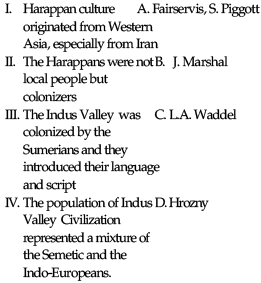

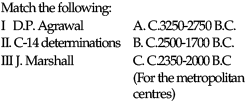

- a)[A-I], [B-II], [C-III], [D-IV]
- b)[A-II], [B-I], [C-IV], [D-III]
- c)[A-III], [B-IV], [C-I], [D-II]
- d)[A-IV], [B-II], [C-III], [D-I]
Correct answer is option 'C'. Can you explain this answer?
a)
[A-I], [B-II], [C-III], [D-IV]
b)
[A-II], [B-I], [C-IV], [D-III]
c)
[A-III], [B-IV], [C-I], [D-II]
d)
[A-IV], [B-II], [C-III], [D-I]
 | Praveena Np answered |
J.Marshall: C.3250-2750 B.C.
D.M. Wheeler: C.2500-1700 B.C.
D.P.Agarwal: C.2350-2000 B.C
C-14 determinations: C.2400-1700 B.C.
D.M. Wheeler: C.2500-1700 B.C.
D.P.Agarwal: C.2350-2000 B.C
C-14 determinations: C.2400-1700 B.C.
Consider the following statements regarding the drainage system of the Indus Valley Civilization:- Each house had a private drinking well connected to the city's main drainage system.
- The main drains were covered with limestone blocks or baked bricks.
- Small settling pools and traps were integrated into the drainage system for maintenance and cleaning.
How many of the statements given above are correct?- a)Only one
- b)All three
- c)Only two
- d)None
Correct answer is option 'C'. Can you explain this answer?
Consider the following statements regarding the drainage system of the Indus Valley Civilization:
- Each house had a private drinking well connected to the city's main drainage system.
- The main drains were covered with limestone blocks or baked bricks.
- Small settling pools and traps were integrated into the drainage system for maintenance and cleaning.
How many of the statements given above are correct?
a)
Only one
b)
All three
c)
Only two
d)
None
 | Tejas Datta answered |
Correct Answer: c) All three
Explanation:
Private Drinking Wells:
- Each house in the Indus Valley Civilization had a private drinking well connected to the city's main drainage system.
- This ensured that each household had access to clean water for drinking and other purposes.
Main Drains:
- The main drains in the civilization were indeed covered with limestone blocks or baked bricks.
- This construction material helped in the durability and efficient functioning of the drainage system.
Settling Pools and Traps:
- Small settling pools and traps were integrated into the drainage system for maintenance and cleaning purposes.
- These settling pools and traps helped in filtering out debris and sediment, ensuring the proper functioning of the drainage system over time.
Therefore, all three statements regarding the drainage system of the Indus Valley Civilization are correct. The civilization's advanced urban planning and sanitation systems highlight their engineering prowess and emphasis on cleanliness and hygiene.
Explanation:
Private Drinking Wells:
- Each house in the Indus Valley Civilization had a private drinking well connected to the city's main drainage system.
- This ensured that each household had access to clean water for drinking and other purposes.
Main Drains:
- The main drains in the civilization were indeed covered with limestone blocks or baked bricks.
- This construction material helped in the durability and efficient functioning of the drainage system.
Settling Pools and Traps:
- Small settling pools and traps were integrated into the drainage system for maintenance and cleaning purposes.
- These settling pools and traps helped in filtering out debris and sediment, ensuring the proper functioning of the drainage system over time.
Therefore, all three statements regarding the drainage system of the Indus Valley Civilization are correct. The civilization's advanced urban planning and sanitation systems highlight their engineering prowess and emphasis on cleanliness and hygiene.
Consider the following statements:Statement-I:
Kalibangan is situated on the ancient Sarasvati, now called Ghaggar in Rajasthan.
Since the Harappan city overlies the earlier proto-Harappan, clear house plans of the earlier city are not available.Statement-II:
Lothal is situated on the bank of Bhogavar.
Only at Lothal and Rangpur, Rice husk has been found.Which one of the following is correct in respect of the above statements?- a)Both Statement-I and Statement-II are correct and Statement-II explains Statement-I
- b)Statement-I is correct, but Statement-II is incorrect
- c)Both Statement-I and Statement-II are correct, but Statement-II does not explain Statement-I
- d)Statement-I is incorrect, but Statement-II is correct
Correct answer is option 'C'. Can you explain this answer?
Consider the following statements:
Statement-I:
Kalibangan is situated on the ancient Sarasvati, now called Ghaggar in Rajasthan.
Since the Harappan city overlies the earlier proto-Harappan, clear house plans of the earlier city are not available.
Kalibangan is situated on the ancient Sarasvati, now called Ghaggar in Rajasthan.
Since the Harappan city overlies the earlier proto-Harappan, clear house plans of the earlier city are not available.
Statement-II:
Lothal is situated on the bank of Bhogavar.
Only at Lothal and Rangpur, Rice husk has been found.
Lothal is situated on the bank of Bhogavar.
Only at Lothal and Rangpur, Rice husk has been found.
Which one of the following is correct in respect of the above statements?
a)
Both Statement-I and Statement-II are correct and Statement-II explains Statement-I
b)
Statement-I is correct, but Statement-II is incorrect
c)
Both Statement-I and Statement-II are correct, but Statement-II does not explain Statement-I
d)
Statement-I is incorrect, but Statement-II is correct
| | Surbhi Joshi answered |
Statement Analysis:
Statement-I:
Kalibangan is situated on the ancient Sarasvati, now called Ghaggar in Rajasthan. Since the Harappan city overlies the earlier proto-Harappan, clear house plans of the earlier city are not available.
Statement-II:
Lothal is situated on the bank of Bhogavar. Only at Lothal and Rangpur, Rice husk has been found.
Explanation:
Statement-I:
Kalibangan indeed is located on the ancient Sarasvati river, which is now known as Ghaggar in Rajasthan. The statement also mentions that due to the Harappan city being built over the earlier proto-Harappan settlement, clear house plans of the earlier city are not available. This indicates that the site has undergone multiple layers of habitation and development.
Statement-II:
Lothal is situated on the bank of the Bhogavar river. Additionally, the statement highlights that rice husk has been found only at Lothal and Rangpur. This information is specific to the presence of rice husk at these particular locations, indicating a unique aspect of these sites compared to others.
Conclusion:
The correct option is Both Statement-I and Statement-II are correct, but Statement-II does not explain Statement-I. Both statements provide accurate information about their respective archaeological sites, but they are independent of each other and do not directly explain or relate to one another.
Statement-I:
Kalibangan is situated on the ancient Sarasvati, now called Ghaggar in Rajasthan. Since the Harappan city overlies the earlier proto-Harappan, clear house plans of the earlier city are not available.
Statement-II:
Lothal is situated on the bank of Bhogavar. Only at Lothal and Rangpur, Rice husk has been found.
Explanation:
Statement-I:
Kalibangan indeed is located on the ancient Sarasvati river, which is now known as Ghaggar in Rajasthan. The statement also mentions that due to the Harappan city being built over the earlier proto-Harappan settlement, clear house plans of the earlier city are not available. This indicates that the site has undergone multiple layers of habitation and development.
Statement-II:
Lothal is situated on the bank of the Bhogavar river. Additionally, the statement highlights that rice husk has been found only at Lothal and Rangpur. This information is specific to the presence of rice husk at these particular locations, indicating a unique aspect of these sites compared to others.
Conclusion:
The correct option is Both Statement-I and Statement-II are correct, but Statement-II does not explain Statement-I. Both statements provide accurate information about their respective archaeological sites, but they are independent of each other and do not directly explain or relate to one another.
Consider the following statements:Statement-I:
Inscriptions are more and better evidence than coins. Any script written on the hard surface is called inscription and their study is called epigraphy.Statement-II:
Monuments and sculptures can be used as a remembrance of a person or event which has become part of the cultural heritage.Which one of the following is correct in respect of the above statements?- a)Both Statement-I and Statement-II are correct and Statement-II explains Statement-I
- b)Statement-I is correct, but Statement-II is incorrect
- c)Both Statement-I and Statement-II are correct, but Statement-II does not explain Statement-I
- d)Statement-I is incorrect, but Statement-II is correct
Correct answer is option 'C'. Can you explain this answer?
Consider the following statements:
Statement-I:
Inscriptions are more and better evidence than coins. Any script written on the hard surface is called inscription and their study is called epigraphy.
Inscriptions are more and better evidence than coins. Any script written on the hard surface is called inscription and their study is called epigraphy.
Statement-II:
Monuments and sculptures can be used as a remembrance of a person or event which has become part of the cultural heritage.
Monuments and sculptures can be used as a remembrance of a person or event which has become part of the cultural heritage.
Which one of the following is correct in respect of the above statements?
a)
Both Statement-I and Statement-II are correct and Statement-II explains Statement-I
b)
Statement-I is correct, but Statement-II is incorrect
c)
Both Statement-I and Statement-II are correct, but Statement-II does not explain Statement-I
d)
Statement-I is incorrect, but Statement-II is correct
| | Arya Saha answered |
Explanation of Statements
The question presents two statements regarding the significance of inscriptions and monuments in historical studies and cultural heritage.
Statement-I Analysis
- Inscriptions are indeed considered valuable historical evidence, often providing direct insights into the past.
- The study of inscriptions, known as epigraphy, helps scholars understand historical contexts, languages, and cultures.
- Thus, Statement-I is correct in asserting the importance of inscriptions over coins.
Statement-II Analysis
- Monuments and sculptures serve as significant reminders of individuals or events and contribute to cultural heritage.
- They embody historical narratives and societal values, making them essential for understanding cultural identity.
- Therefore, Statement-II is also accurate, emphasizing the role of monuments in cultural remembrance.
Relationship Between Statements
- While both statements are correct, Statement-II does not explain Statement-I.
- Statement-I focuses on the nature of inscriptions as a form of evidence, while Statement-II discusses the cultural significance of monuments.
Conclusion
- Since both statements are correct but do not have a direct explanatory relationship, the answer is option 'C': "Both Statement-I and Statement-II are correct, but Statement-II does not explain Statement-I."
The question presents two statements regarding the significance of inscriptions and monuments in historical studies and cultural heritage.
Statement-I Analysis
- Inscriptions are indeed considered valuable historical evidence, often providing direct insights into the past.
- The study of inscriptions, known as epigraphy, helps scholars understand historical contexts, languages, and cultures.
- Thus, Statement-I is correct in asserting the importance of inscriptions over coins.
Statement-II Analysis
- Monuments and sculptures serve as significant reminders of individuals or events and contribute to cultural heritage.
- They embody historical narratives and societal values, making them essential for understanding cultural identity.
- Therefore, Statement-II is also accurate, emphasizing the role of monuments in cultural remembrance.
Relationship Between Statements
- While both statements are correct, Statement-II does not explain Statement-I.
- Statement-I focuses on the nature of inscriptions as a form of evidence, while Statement-II discusses the cultural significance of monuments.
Conclusion
- Since both statements are correct but do not have a direct explanatory relationship, the answer is option 'C': "Both Statement-I and Statement-II are correct, but Statement-II does not explain Statement-I."
Where was the site of Amri located and who directed the excavations there in 1959-1962?- a)Near Mohenjo-daro, directed by Robert Raikes
- b)South of Mohenjo-daro, directed by Jean-Marie Casal
- c)Near Balakot, directed by P. P Pandya
- d)In Bhuj district, directed by MA Dhakey
Correct answer is option 'B'. Can you explain this answer?
Where was the site of Amri located and who directed the excavations there in 1959-1962?
a)
Near Mohenjo-daro, directed by Robert Raikes
b)
South of Mohenjo-daro, directed by Jean-Marie Casal
c)
Near Balakot, directed by P. P Pandya
d)
In Bhuj district, directed by MA Dhakey
| | Arya Saha answered |
Location of Amri
The archaeological site of Amri is situated in the Sindh province of Pakistan, south of the more famous site of Mohenjo-daro. It is located near the banks of the Indus River, providing crucial insights into the early Indus Valley Civilization.
Excavation Details
The excavations at Amri from 1959 to 1962 were directed by Jean-Marie Casal, a prominent French archaeologist known for his work in the Indus Valley. His efforts were significant in uncovering the cultural and historical contexts of the area.
Significance of Amri
- Cultural Insights: The site revealed artifacts and structures that contribute to understanding the lifestyle, trade, and social organization of early urban societies in the Indus Valley.
- Chronological Relevance: Amri is considered to be an important site for studying the transition from the Neolithic to the Bronze Age in South Asia.
- Comparative Studies: Findings at Amri allow for comparisons with contemporaneous sites like Mohenjo-daro and Harappa, enriching the narrative of the Indus Valley Civilization.
Conclusion
In summary, Amri is a vital archaeological site located south of Mohenjo-daro, with excavations led by Jean-Marie Casal from 1959 to 1962. The discoveries made here continue to shed light on one of the world's earliest urban civilizations, making it a focus of study for archaeologists and historians alike.
The archaeological site of Amri is situated in the Sindh province of Pakistan, south of the more famous site of Mohenjo-daro. It is located near the banks of the Indus River, providing crucial insights into the early Indus Valley Civilization.
Excavation Details
The excavations at Amri from 1959 to 1962 were directed by Jean-Marie Casal, a prominent French archaeologist known for his work in the Indus Valley. His efforts were significant in uncovering the cultural and historical contexts of the area.
Significance of Amri
- Cultural Insights: The site revealed artifacts and structures that contribute to understanding the lifestyle, trade, and social organization of early urban societies in the Indus Valley.
- Chronological Relevance: Amri is considered to be an important site for studying the transition from the Neolithic to the Bronze Age in South Asia.
- Comparative Studies: Findings at Amri allow for comparisons with contemporaneous sites like Mohenjo-daro and Harappa, enriching the narrative of the Indus Valley Civilization.
Conclusion
In summary, Amri is a vital archaeological site located south of Mohenjo-daro, with excavations led by Jean-Marie Casal from 1959 to 1962. The discoveries made here continue to shed light on one of the world's earliest urban civilizations, making it a focus of study for archaeologists and historians alike.
Consider the following statements:Statement-I:
Ropar is situated near the confluence of Sutlej, some 25 km east of Bara.Statement-II:
Dholavira is the latest and one of the two largest Harappan settlements in India, the other being Rakhigarhi in Haryana.Which one of the following is correct in respect of the above statements?- a)Both Statement-I and Statement-II are correct and Statement-II explains Statement-I
- b)Both Statement-I and Statement-II are correct, but Statement-II does not explain Statement-I
- c)Statement-I is correct, but Statement-II is incorrect
- d)Statement-I is incorrect, but Statement-II is correct
Correct answer is option 'B'. Can you explain this answer?
Consider the following statements:
Statement-I:
Ropar is situated near the confluence of Sutlej, some 25 km east of Bara.
Ropar is situated near the confluence of Sutlej, some 25 km east of Bara.
Statement-II:
Dholavira is the latest and one of the two largest Harappan settlements in India, the other being Rakhigarhi in Haryana.
Dholavira is the latest and one of the two largest Harappan settlements in India, the other being Rakhigarhi in Haryana.
Which one of the following is correct in respect of the above statements?
a)
Both Statement-I and Statement-II are correct and Statement-II explains Statement-I
b)
Both Statement-I and Statement-II are correct, but Statement-II does not explain Statement-I
c)
Statement-I is correct, but Statement-II is incorrect
d)
Statement-I is incorrect, but Statement-II is correct
| | Krithika Chauhan answered |
Explanation:
Statement-I:
- Ropar is indeed situated near the confluence of Sutlej, approximately 25 km east of Bara.
- This statement is factually correct.
Statement-II:
- Dholavira is one of the latest and largest Harappan settlements in India, along with Rakhigarhi in Haryana.
- This statement is also correct.
Analysis:
- Both Statement-I and Statement-II are factually correct.
- However, Statement-II does not provide any explanation or connection to Statement-I.
- Hence, the correct answer is option B: Both Statement-I and Statement-II are correct, but Statement-II does not explain Statement-I.
Statement-I:
- Ropar is indeed situated near the confluence of Sutlej, approximately 25 km east of Bara.
- This statement is factually correct.
Statement-II:
- Dholavira is one of the latest and largest Harappan settlements in India, along with Rakhigarhi in Haryana.
- This statement is also correct.
Analysis:
- Both Statement-I and Statement-II are factually correct.
- However, Statement-II does not provide any explanation or connection to Statement-I.
- Hence, the correct answer is option B: Both Statement-I and Statement-II are correct, but Statement-II does not explain Statement-I.
Chapter doubts & questions for Indus Valley Civilisation - History for UPSC CSE 2026 is part of UPSC CSE exam preparation. The chapters have been prepared according to the UPSC CSE exam syllabus. The Chapter doubts & questions, notes, tests & MCQs are made for UPSC CSE 2026 Exam. Find important definitions, questions, notes, meanings, examples, exercises, MCQs and online tests here.
Chapter doubts & questions of Indus Valley Civilisation - History for UPSC CSE in English & Hindi are available as part of UPSC CSE exam. Download more important topics, notes, lectures and mock test series for UPSC CSE Exam by signing up for free.
History for UPSC CSE123 videos|724 docs|168 tests |
