


All Exams > NEET > 4 Months Preparation for NEET > All Questions
All questions of Mechanical Properties of Solids for NEET Exam
The materials which have the same elastic properties in all directions are called __________.- a)Isotropic
- b)Brittle
- c)Homogeneous
- d)Hard
Correct answer is option 'A'. Can you explain this answer?
The materials which have the same elastic properties in all directions are called __________.
a)
Isotropic
b)
Brittle
c)
Homogeneous
d)
Hard
 | Pooja Shah answered |
Same elastic properties in all direction is called the homogenity of a material.

Putty or mud is an example of- a)semi elastic
- b)plastic material
- c)elastomers
- d)elastic material
Correct answer is option 'B'. Can you explain this answer?
Putty or mud is an example of
a)
semi elastic
b)
plastic material
c)
elastomers
d)
elastic material
 | New Words answered |
Since mud or putty have no gross tendency to regain their previous shape & they get permanently deformed, they are close to ideal plastics.
- Perfectly plastic bodies are those that retain their distorted shape or size after external pressures applied to them have been released.
- Partially elastic bodies are those that partially return to their former shape or size when external forces are eliminated.
- The shape or size of mud or putty is now altered when force is applied, and the body does not return to its original state when the force is removed. Only perfectly plastic bodies, as already established, exhibit this feature.
- Additionally, many elasticity moduli types are used to measure elasticity.
- The ratio of stress to strain given to a body under various variations in dimension is what makes up an elastic modulus.
- Young's Modulus, Shear Modulus, and Bulk Modulus are the three forms of elastic moduli. Since Young's modulus or longitudinal stress by strain for mud or putty is almost zero, they are theoretically proven to be almost ideal plastic bodies.
Hence, putty or mud is an example of a perfectly plastic body.
Material is said to be ductile if- a)a large amount of plastic deformation takes place between the elastic limit and the fracture point
- b)fracture occurs soon after the elastic limit is passed
- c)material cross section is not significantly reduced at failure
- d)material breaks suddenly at little elongation
Correct answer is option 'A'. Can you explain this answer?
Material is said to be ductile if
a)
a large amount of plastic deformation takes place between the elastic limit and the fracture point
b)
fracture occurs soon after the elastic limit is passed
c)
material cross section is not significantly reduced at failure
d)
material breaks suddenly at little elongation
 | Nandini Iyer answered |
A ductile material is one that can withstand a large amount of plastic deformation between the elastic limit and the fracture point.
A material that breaks suddenly when elongated or fracture occurs in it soon after the elastic limit is crossed is called a brittle material.
A ductile material that exhibits extra elongation or deformation and does not fracture is also referred as superplastic material.
A material that breaks suddenly when elongated or fracture occurs in it soon after the elastic limit is crossed is called a brittle material.
A ductile material that exhibits extra elongation or deformation and does not fracture is also referred as superplastic material.
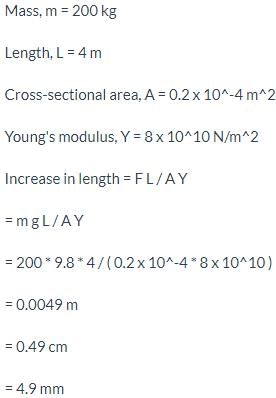
A 200-kg load is hung on a wire with a length of 4.00 m, a cross-sectional area of 0.200 × 10⁻⁴ m2, and a Young’s modulus of 8.00 × 10¹⁰N/ m2. What is its increase in length?- a)4.80 mm
- b)4.90 mm
- c)4.80 mm2.4.90 mm
- d)80 mm2.4.90 mm3.
Correct answer is option 'C'. Can you explain this answer?
A 200-kg load is hung on a wire with a length of 4.00 m, a cross-sectional area of 0.200 × 10⁻⁴ m2, and a Young’s modulus of 8.00 × 10¹⁰N/ m2. What is its increase in length?
a)
4.80 mm
b)
4.90 mm
c)
4.80 mm2.4.90 mm
d)
80 mm2.4.90 mm3.
 | Jyoti Sengupta answered |
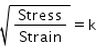
Which of the following represents Hooke’s Law?- a)Stress = k x strain
- b)
- c)Stress = k x (strain)2
- d)Stress2 = k x strain
Correct answer is option 'A'. Can you explain this answer?
Which of the following represents Hooke’s Law?
a)
Stress = k x strain
b)
c)
Stress = k x (strain)2
d)
Stress2 = k x strain
 | Gaurav Kumar answered |
The law states that the strain in a solid is proportional to the applied stress within the elastic limit of that solid body i.e. stress = k x strain.


If we compress or elongate the solids, what happens to their potential energy?- a)P.E. of solid decreases whether it is compressed or elongated
- b)P.E. of solid increases if it is elongated
- c)P.E. of solid increases whether it is compressed or elongated
- d)P.E. of solid increases if it is compressed
Correct answer is option 'C'. Can you explain this answer?
If we compress or elongate the solids, what happens to their potential energy?
a)
P.E. of solid decreases whether it is compressed or elongated
b)
P.E. of solid increases if it is elongated
c)
P.E. of solid increases whether it is compressed or elongated
d)
P.E. of solid increases if it is compressed
 | Anjali Iyer answered |
When a soild is compressed or elongated, it's P.E increases. Potential energy increases because work has to be done against force of repulsion during compression and against force of attraction during elongation.
You hang a flood lamp from the end of a vertical steel wire. The flood lamp stretches the wire 0.18 mm and the stress is proportional to the strain. How much would it have stretched if the wire had the same length but twice the diameter?- a)0.065 mm
- b)0.055 mm
- c)0.045 mm
- d)0.075 mm
Correct answer is option 'C'. Can you explain this answer?
You hang a flood lamp from the end of a vertical steel wire. The flood lamp stretches the wire 0.18 mm and the stress is proportional to the strain. How much would it have stretched if the wire had the same length but twice the diameter?
a)
0.065 mm
b)
0.055 mm
c)
0.045 mm
d)
0.075 mm
 | Madhuri Jadhav answered |
I think B
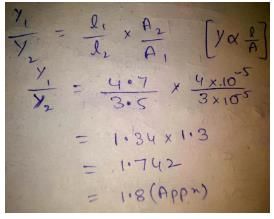
A steel wire of length 4.7 m and cross-sectional area 3.0 × 10⁻⁵ m2 stretches by the same amount as a copper wire of length 3.5 m and cross-sectional area of 4.0 × 10⁻⁵ m2 under a given load. What is the ratio of the Young’s modulus of steel to that of copper?- a)1.2
- b)1.6
- c)1.8
- d)2.0
Correct answer is option 'C'. Can you explain this answer?
A steel wire of length 4.7 m and cross-sectional area 3.0 × 10⁻⁵ m2 stretches by the same amount as a copper wire of length 3.5 m and cross-sectional area of 4.0 × 10⁻⁵ m2 under a given load. What is the ratio of the Young’s modulus of steel to that of copper?
a)
1.2
b)
1.6
c)
1.8
d)
2.0
 | Krishna Iyer answered |
With reference to figure the elastic zone is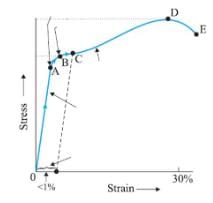
- a)BC
- b)CD
- c)AB
- d)OA
Correct answer is option 'D'. Can you explain this answer?
With reference to figure the elastic zone is
a)
BC
b)
CD
c)
AB
d)
OA
 | Hansa Sharma answered |
Hooke’s law: a law stating that the strain in a solid is proportional to the applied stress within the elastic limit of that solid.
In the OA line Hooke’s law is valid because stress is directly proportional to strain.
In the OA line Hooke’s law is valid because stress is directly proportional to strain.
The modulus of elasticity of steel is greater than that of rubber because under the same stress- a)the strain in steel is less than rubber
- b)the strain in steel is more than rubber
- c)elongation in steel is more than in rubber
- d)none of these
Correct answer is option 'A'. Can you explain this answer?
The modulus of elasticity of steel is greater than that of rubber because under the same stress
a)
the strain in steel is less than rubber
b)
the strain in steel is more than rubber
c)
elongation in steel is more than in rubber
d)
none of these
 | Om Desai answered |
Modulus of elasticity= stress/strain =(F/A)/(ΔL/L) So, for same stress Modulus of elasticity ∝( L/ΔL)and ΔL for rubber is more as compared to steel so Modulus of elasticity for rubber will be less as they are inversely proportional and also ΔL/L is less for steel
What diameter should a 10-m-long steel wire have if we do not want it to stretch more than 0.5 cm under a tension of 940 N? Take Young's modulus of steel as 20 × 1010 Pa- a)3.2 mm
- b)3.0 mm
- c)3.4 mm
- d)3.6 mm
Correct answer is option 'C'. Can you explain this answer?
What diameter should a 10-m-long steel wire have if we do not want it to stretch more than 0.5 cm under a tension of 940 N? Take Young's modulus of steel as 20 × 1010 Pa
a)
3.2 mm
b)
3.0 mm
c)
3.4 mm
d)
3.6 mm
 | Rajesh Gupta answered |
Y=F x l/A x Δ l
Δ l=0.5cm=0.5x10⁻²m, l=10M, F=940N
Y=20x1010pa
20x1010=940x10/πr2x0.5x10-10
πr2=94x100/5x10-3x2x1011=94x102/10x108
r2=94/π x 10-7 =2.99 x 10⁻⁶
r2 ≅3x10⁻⁶
r=1.13x10⁻¹⁰ m
diameter=2r=3.6mm
Δ l=0.5cm=0.5x10⁻²m, l=10M, F=940N
Y=20x1010pa
20x1010=940x10/πr2x0.5x10-10
πr2=94x100/5x10-3x2x1011=94x102/10x108
r2=94/π x 10-7 =2.99 x 10⁻⁶
r2 ≅3x10⁻⁶
r=1.13x10⁻¹⁰ m
diameter=2r=3.6mm
You hang a flood lamp from the end of a vertical steel wire. The flood lamp stretches the wire 0.18 mm and the stress is proportional to the strain. How much would it have stretched if the wire were twice as long?- a)0.36 mm
- b)0.34 mm
- c)0.38 mm
- d)0.40 mm
Correct answer is option 'A'. Can you explain this answer?
You hang a flood lamp from the end of a vertical steel wire. The flood lamp stretches the wire 0.18 mm and the stress is proportional to the strain. How much would it have stretched if the wire were twice as long?
a)
0.36 mm
b)
0.34 mm
c)
0.38 mm
d)
0.40 mm
| | Rajesh Gupta answered |
F/A = e/L
F/A = 0.18/l ( let the length be l)
F/A = x/2l
0.18/L = x/2l
0.18×2l = xl
0.36l = xl
x = 0.36
F/A = 0.18/l ( let the length be l)
F/A = x/2l
0.18/L = x/2l
0.18×2l = xl
0.36l = xl
x = 0.36
Tissue of aorta blood vessel is an example of- a)state of permanant deformation
- b)perfectly plastic body
- c)perfectly elastic body
- d)elastomer
Correct answer is option 'D'. Can you explain this answer?
Tissue of aorta blood vessel is an example of
a)
state of permanant deformation
b)
perfectly plastic body
c)
perfectly elastic body
d)
elastomer
| | Gaurav Kumar answered |
Elastomers are popular in vascular engineering applications, as they offer the ability to design implants that match the compliance of native tissue.
Substances like tissue of aorta can be stretched to cause large strain.
Substances like tissue of aorta can be stretched to cause large strain.
Yield point may be defined as the point where- a)working stress ends and breaking stress begins
- b)breaking stress ends and working stress begins
- c)elastic behavior ends and plastic behavior begins
- d)plastic behavior ends and elastic behavior begins
Correct answer is option 'C'. Can you explain this answer?
Yield point may be defined as the point where
a)
working stress ends and breaking stress begins
b)
breaking stress ends and working stress begins
c)
elastic behavior ends and plastic behavior begins
d)
plastic behavior ends and elastic behavior begins
| | Neha Joshi answered |
At the yield point, stress is not proportional to strain i.e: hooke's law is not obeyed. Hence the elastic behaviour ends and plastic behaviour begins.
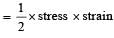
If proportional limit is not exceeded, energy per unit volume in stretched wire is- a)1/2 x stress x strain
- b)stress x strain
- c)stress x strain 2
- d)1/2 stress x strain 2
Correct answer is 'A'. Can you explain this answer?
If proportional limit is not exceeded, energy per unit volume in stretched wire is
a)
1/2 x stress x strain
b)
stress x strain
c)
stress x strain 2
d)
1/2 stress x strain 2
 | Suresh Reddy answered |
strain energy=1/2×stress × strain Work done by a force on a wire
W =2LAy(ΔL)2/2L
=1/2(yALΔ/L)ΔL
=1/2(yΔL/L)(ΔL/L)(AL)
=1/2(Stress)(Strain)(Volume)
(Work)/(volume)=1/2(stress)(strain)
W =2LAy(ΔL)2/2L
=1/2(yALΔ/L)ΔL
=1/2(yΔL/L)(ΔL/L)(AL)
=1/2(Stress)(Strain)(Volume)
(Work)/(volume)=1/2(stress)(strain)
When a 13.2 kg mass is placed on top of a vertical spring, the spring compresses by 5.93 cm. Find the force constant of the spring.- a)2281 N/m
- b)3181 N/m
- c)2175 N/m
- d)3085 N/m
Correct answer is option 'C'. Can you explain this answer?
When a 13.2 kg mass is placed on top of a vertical spring, the spring compresses by 5.93 cm. Find the force constant of the spring.
a)
2281 N/m
b)
3181 N/m
c)
2175 N/m
d)
3085 N/m
| | Preeti Iyer answered |
From Hooke's Law: F =kx
The force on the spring is the weight of the object , 13.2*9.8 = 129 N
x = 5.93 cm =0.0593 m
129 = (0.0593) x
x = 2175 N/m
When an elastic material with Young’s modulus Y is subjected to stretching stress S, elastic energy stored per unit volume of the material is- a)YS/2
- b)S2Y/2 [1989]
- c)S2/2Y
- d)S/2Y
Correct answer is option 'C'. Can you explain this answer?
When an elastic material with Young’s modulus Y is subjected to stretching stress S, elastic energy stored per unit volume of the material is
a)
YS/2
b)
S2Y/2 [1989]
c)
S2/2Y
d)
S/2Y
 | Aniket Chawla answered |
Energy stored per unit volume
 stress (stress / Young' s modulus) (stress)2 /( Young ' s modulus)
A body is said to be perfectly plastic if- a)it does not recover its original shape / size when the deforming force is removed
- b)it has the property of stretching indefinitely
- c)it expands without breaking, on subjection of large strain
- d)it is not effected by external force
Correct answer is option 'A'. Can you explain this answer?
A body is said to be perfectly plastic if
a)
it does not recover its original shape / size when the deforming force is removed
b)
it has the property of stretching indefinitely
c)
it expands without breaking, on subjection of large strain
d)
it is not effected by external force
| | Neha Joshi answered |
A body is said to be plastic when its coefficient of restitution or reformation is zero that means that whatever hits it loses its all kinetic energy once the body gets deformed does not reform.
An iron bar of length l cm and cross section A cm2 is pulled by a force F dynes from the ends so as to produce an elongation l cm. Which of the following statements is correct?- a)Elongation is directly proportional to area of cross-section A.
- b)Elongation is inversely proportional to length
- c)Elongation is inversely proportional to area of cross-section A.
- d)Elongation is directly proportional to Young’s modulus.
Correct answer is option 'C'. Can you explain this answer?
An iron bar of length l cm and cross section A cm2 is pulled by a force F dynes from the ends so as to produce an elongation l cm. Which of the following statements is correct?
a)
Elongation is directly proportional to area of cross-section A.
b)
Elongation is inversely proportional to length
c)
Elongation is inversely proportional to area of cross-section A.
d)
Elongation is directly proportional to Young’s modulus.
| | Gaurav Kumar answered |
F =AYΔl/L
Δl = FL/AY
Δl = FL/AY
Elasticity is the property of a body, by virtue of which- a)it remains in original size and shape when the force is applied
- b)it changes size and shape when the force is applied and stays in that shape when applied force is removed
- c)it tends to regain its original size and shape when the applied force is removed
- d)it is distorted or stretches without the application of force
Correct answer is option 'C'. Can you explain this answer?
Elasticity is the property of a body, by virtue of which
a)
it remains in original size and shape when the force is applied
b)
it changes size and shape when the force is applied and stays in that shape when applied force is removed
c)
it tends to regain its original size and shape when the applied force is removed
d)
it is distorted or stretches without the application of force
 | Suraj Raj answered |
A
According to Hooke’s law- a)For small deformations the stress and strain are inversely proportional to each other
- b)For small deformations the stress is proportional to square of strain
- c)For large deformations the stress and strain are proportional to each other
- d)For small deformations the stress and strain are proportional to each other
Correct answer is option 'D'. Can you explain this answer?
According to Hooke’s law
a)
For small deformations the stress and strain are inversely proportional to each other
b)
For small deformations the stress is proportional to square of strain
c)
For large deformations the stress and strain are proportional to each other
d)
For small deformations the stress and strain are proportional to each other
| | Krishna Iyer answered |
Hook’s Law states that for small deformations the stress and strain are proportional to each other.
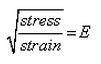
Which of the following represents Hooke’s Law?- a)Stress = Estrain2
- b)Stress = Estrain
- c)Stress2 = Estrain
- d)
Correct answer is option 'B'. Can you explain this answer?
Which of the following represents Hooke’s Law?
a)
Stress = Estrain2
b)
Stress = Estrain
c)
Stress2 = Estrain
d)
| | Hansa Sharma answered |
E=stress/strain
Strain x E= Stress
Strain x E= Stress
Young’s modulus is defined as the ratio of longitudinal stress to longitudinal strain. Which of the following is the unit of Young’s modulus?- a)dyne per square cm.
- b)dyne cm2
- c)dyne/cm
- d)dyne cm
Correct answer is option 'A'. Can you explain this answer?
Young’s modulus is defined as the ratio of longitudinal stress to longitudinal strain. Which of the following is the unit of Young’s modulus?
a)
dyne per square cm.
b)
dyne cm2
c)
dyne/cm
d)
dyne cm
| | Riya Banerjee answered |
Stress = Force per area and strain is unit less.
Therefore in CGS units dyne per cm square.
Hence A is correct.
Therefore in CGS units dyne per cm square.
Hence A is correct.
The following four wires are made of the same material. Which of these will have the largest extension when the same tension is applied ? [NEET 2013]- a)Length = 100 cm, diameter = 1 mm
- b)Length = 200 cm, diameter = 2 mm
- c)Length = 300 cm, diameter = 3 mm
- d)Length = 50 cm, diameter = 0.5 mm
Correct answer is option 'D'. Can you explain this answer?
The following four wires are made of the same material. Which of these will have the largest extension when the same tension is applied ? [NEET 2013]
a)
Length = 100 cm, diameter = 1 mm
b)
Length = 200 cm, diameter = 2 mm
c)
Length = 300 cm, diameter = 3 mm
d)
Length = 50 cm, diameter = 0.5 mm
 | Akshat Chavan answered |

So, extension, 
[∵ F and Y are constant]


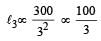

The ratio of  is maximum for case (d).
Hence, option (d) is correct.
is maximum for case (d).Hence, option (d) is correct.
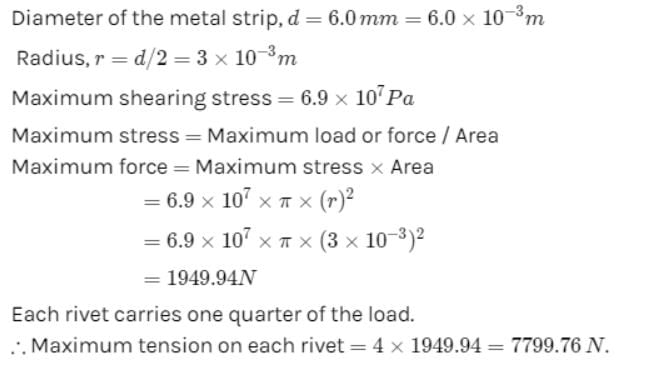
Two strips of metal are riveted together at their ends by four rivets, each of diameter 6.0 mm. What is the maximum tension that can be exerted by the riveted strip if the shearing stress on the rivet is not to exceed 6.9 × 10⁷Pa? Assume that each rivet is to carry one quarter of the load.- a)749 kN
- b)856 kN
- c)652 N
- d)None of these
Correct answer is option 'D'. Can you explain this answer?
Two strips of metal are riveted together at their ends by four rivets, each of diameter 6.0 mm. What is the maximum tension that can be exerted by the riveted strip if the shearing stress on the rivet is not to exceed 6.9 × 10⁷Pa? Assume that each rivet is to carry one quarter of the load.
a)
749 kN
b)
856 kN
c)
652 N
d)
None of these
| | Sanchita Mukherjee answered |
In Hooke’s law, the constant of proportionality signifies- a)modulus of elasticity
- b)modulus of strain
- c)elasticity of wire
- d)modulus of stress
Correct answer is option 'A'. Can you explain this answer?
In Hooke’s law, the constant of proportionality signifies
a)
modulus of elasticity
b)
modulus of strain
c)
elasticity of wire
d)
modulus of stress
| | Nayanika Chakraborty answered |
Introduction:
Hooke's Law is a principle in physics that relates the force applied to a spring or elastic material to the resulting deformation or change in length of the material. It states that the force applied to a spring is directly proportional to the displacement or change in length of the spring.
Explanation:
The constant of proportionality in Hooke's Law is known as the modulus of elasticity or Young's modulus. It is represented by the symbol 'E' and is a measure of the stiffness or rigidity of a material. The modulus of elasticity signifies how much a material will deform when a force is applied to it.
Modulus of Elasticity:
The modulus of elasticity is a material property that describes how it responds to stress. It is defined as the ratio of stress to strain within the elastic limit of the material. In other words, it measures how much stress a material can withstand before it starts to deform permanently.
Modulus of Strain:
The modulus of strain is not a property used in Hooke's Law. Strain is the measure of deformation or change in length of a material, and the modulus of strain is not directly related to the constant of proportionality in Hooke's Law.
Elasticity of Wire:
The elasticity of a wire refers to its ability to return to its original shape after being stretched or deformed. It is related to Hooke's Law as the law describes the linear relationship between the force applied to a wire and the resulting deformation or change in length of the wire.
Modulus of Stress:
The modulus of stress is not a term used in Hooke's Law. Stress is defined as the force applied per unit area of a material, and the modulus of stress is not directly related to the constant of proportionality in Hooke's Law.
Conclusion:
In conclusion, the constant of proportionality in Hooke's Law signifies the modulus of elasticity. It is a measure of the stiffness or rigidity of a material and describes how much a material will deform when a force is applied to it. The modulus of elasticity is a fundamental property used to understand the behavior of elastic materials and is essential in various fields such as engineering and materials science.
Hooke's Law is a principle in physics that relates the force applied to a spring or elastic material to the resulting deformation or change in length of the material. It states that the force applied to a spring is directly proportional to the displacement or change in length of the spring.
Explanation:
The constant of proportionality in Hooke's Law is known as the modulus of elasticity or Young's modulus. It is represented by the symbol 'E' and is a measure of the stiffness or rigidity of a material. The modulus of elasticity signifies how much a material will deform when a force is applied to it.
Modulus of Elasticity:
The modulus of elasticity is a material property that describes how it responds to stress. It is defined as the ratio of stress to strain within the elastic limit of the material. In other words, it measures how much stress a material can withstand before it starts to deform permanently.
Modulus of Strain:
The modulus of strain is not a property used in Hooke's Law. Strain is the measure of deformation or change in length of a material, and the modulus of strain is not directly related to the constant of proportionality in Hooke's Law.
Elasticity of Wire:
The elasticity of a wire refers to its ability to return to its original shape after being stretched or deformed. It is related to Hooke's Law as the law describes the linear relationship between the force applied to a wire and the resulting deformation or change in length of the wire.
Modulus of Stress:
The modulus of stress is not a term used in Hooke's Law. Stress is defined as the force applied per unit area of a material, and the modulus of stress is not directly related to the constant of proportionality in Hooke's Law.
Conclusion:
In conclusion, the constant of proportionality in Hooke's Law signifies the modulus of elasticity. It is a measure of the stiffness or rigidity of a material and describes how much a material will deform when a force is applied to it. The modulus of elasticity is a fundamental property used to understand the behavior of elastic materials and is essential in various fields such as engineering and materials science.
The volume of a spherical body is decreased by 10-3% when it is subjected to pressure of 40 atmospheres. Find the bulk modulus of body.
(1 atm = 1.01 x 10⁵ N/m2).- a)4.04 x 10¹¹ N/m2
- b)4.04 x 10⁶N/m2
- c)4.04 x 10³ N/m2
- d)4.04 x 10² N/m2
Correct answer is option 'A'. Can you explain this answer?
The volume of a spherical body is decreased by 10-3% when it is subjected to pressure of 40 atmospheres. Find the bulk modulus of body.
(1 atm = 1.01 x 10⁵ N/m2).
(1 atm = 1.01 x 10⁵ N/m2).
a)
4.04 x 10¹¹ N/m2
b)
4.04 x 10⁶N/m2
c)
4.04 x 10³ N/m2
d)
4.04 x 10² N/m2
| | Geetika Shah answered |
We know that magnitude of bulk modulus
K=[P/(dV/V)]
Now, percentage change in volume is. 10-3 %
Therefore, (dV/V)x100=10-3
So, dV/V=10-5
Hence, k is,
K=40atm/10-5=40x1.01x105 /10-5 =4.04x10¹¹ N/m2
K=[P/(dV/V)]
Now, percentage change in volume is. 10-3 %
Therefore, (dV/V)x100=10-3
So, dV/V=10-5
Hence, k is,
K=40atm/10-5=40x1.01x105 /10-5 =4.04x10¹¹ N/m2
How does the modulus of elasticity change with temperature?- a)It does not depend on temperature
- b)It decreases with increase in temperature
- c)It increases with increase in temperature
- d)It sometimes increases, sometimes decreases with increase in temperature
Correct answer is option 'B'. Can you explain this answer?
How does the modulus of elasticity change with temperature?
a)
It does not depend on temperature
b)
It decreases with increase in temperature
c)
It increases with increase in temperature
d)
It sometimes increases, sometimes decreases with increase in temperature
| | Pooja Shah answered |
As the temperature increases, the inter-atomic distance also increases. So, it results in an increase in the area (stress = force /area). As the area increases stress decreases, this results in a decrease in Young's modulus.
Two wires A and B are of the same material. Their lengths are in the ratio 1 : 2 and the diameter are in the ratio 2 : 1. If they are pulled by the same force, then increase in length will be in the ratio- a)2 : 1
- b)1 : 4 [1988]
- c)1 : 8
- d)8 : 1
Correct answer is option 'C'. Can you explain this answer?
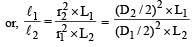
Two wires A and B are of the same material. Their lengths are in the ratio 1 : 2 and the diameter are in the ratio 2 : 1. If they are pulled by the same force, then increase in length will be in the ratio
a)
2 : 1
b)
1 : 4 [1988]
c)
1 : 8
d)
8 : 1
 | Nilotpal Gupta answered |
We know that Young's modulus

Since Y, F are same for both the wires, we have,

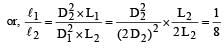
So, ℓ1 : ℓ2 = 1 : 8
What type of stress is produced in a body when the deforming force produces sheer strain?- a)shear stress
- b)Longitudinal stress
- c)Normal stress
- d)Tangential stress
Correct answer is option 'A'. Can you explain this answer?
What type of stress is produced in a body when the deforming force produces sheer strain?
a)
shear stress
b)
Longitudinal stress
c)
Normal stress
d)
Tangential stress
| | Pooja Shah answered |
Explanation:
When a deforming force is applied to a body in a direction parallel to its surface, it produces a shear strain. Shear strain is the deformation that occurs when one layer of a material slides past another layer. This type of deformation produces shear stress, which is the force that is acting parallel to the surface of the material. Shear stress is calculated as the force per unit area and is expressed in units of pressure, such as pascals (Pa) or pounds per square inch (psi).
A steel rod 2.0 m long has a cross-sectional area of 0.30 cm2. It is hung by one end from a support, and a 550-kg milling machine is hung from its other end. Determine the elongation. Take Young's modulus of steel as 20 × 1010 Pa- a)2.0 mm
- b)1.6 mm
- c)2.2 mm
- d)1.8 mm
Correct answer is option 'D'. Can you explain this answer?
A steel rod 2.0 m long has a cross-sectional area of 0.30 cm2. It is hung by one end from a support, and a 550-kg milling machine is hung from its other end. Determine the elongation. Take Young's modulus of steel as 20 × 1010 Pa
a)
2.0 mm
b)
1.6 mm
c)
2.2 mm
d)
1.8 mm
| | Gaurav Kumar answered |
σ=Stress and ε=strain
σ=F/A= (550kg) × (9.81m/s2)3×10-5m2/=0.18GPA
ε=Δl/l0=σ/Υ=0.18×109/200×109=9×10-4
Δl=εl0= (9×10⁻⁴) (2m) = 0.0018m=1.8mm
σ=F/A= (550kg) × (9.81m/s2)3×10-5m2/=0.18GPA
ε=Δl/l0=σ/Υ=0.18×109/200×109=9×10-4
Δl=εl0= (9×10⁻⁴) (2m) = 0.0018m=1.8mm
Two wires P and Q of same length and material but radii in the ratio 2 : 1 are suspended from a rigid support. Find the ratio of strain produced in the wires when both are under same force.- a)1:2
- b)4:1
- c)1:4
- d)2:1
Correct answer is option 'C'. Can you explain this answer?
Two wires P and Q of same length and material but radii in the ratio 2 : 1 are suspended from a rigid support. Find the ratio of strain produced in the wires when both are under same force.
a)
1:2
b)
4:1
c)
1:4
d)
2:1
| | Upasana Bose answered |
Using Hooke ‘s Law we get
Stress directly proportional to stress = Load/Area=F/pie*r*r
And rp:rq=2:1
When both the wires are under the same stress,strain produced will be the same.
When both the wires are under the same stress,strain produced will be the same.
2.when both the wires are loaded by same weight then
Strain p/strain q=(rq)2/(rp)2=¼
A steel rod 2.0 m long has a cross-sectional area of 0.30 cm2 . It is hung by one end from a support, and a 550-kg milling machine is hung from its other end. Determine the resulting strain. Young's Modulus of Steel (Y) = 20×1010 Pa- a)8.0 × 10⁻⁴
- b)10.0 × 10⁻⁴
- c)7.0 × 10⁻⁴
- d)9.0 × 10⁻⁴
Correct answer is option 'D'. Can you explain this answer?
A steel rod 2.0 m long has a cross-sectional area of 0.30 cm2 . It is hung by one end from a support, and a 550-kg milling machine is hung from its other end. Determine the resulting strain. Young's Modulus of Steel (Y) = 20×1010 Pa
a)
8.0 × 10⁻⁴
b)
10.0 × 10⁻⁴
c)
7.0 × 10⁻⁴
d)
9.0 × 10⁻⁴
| | Naina Bansal answered |
from the Hooke’s law :
ε = σ/Y = (1.8 x 10^8 Pa)/(20 x 10^10 Pa)
= 9.0 x 10^−4
volume strain is defined- a)as the change in volume ΔV
- b)as the ratio of change in volume (ΔV) to the original volume V
- c)as the ratio of change in volume (ΔV) to thrice the original volume V
- d)as the ratio of change in volume (ΔV) to twice the original volume V
Correct answer is option 'B'. Can you explain this answer?
volume strain is defined
a)
as the change in volume ΔV
b)
as the ratio of change in volume (ΔV) to the original volume V
c)
as the ratio of change in volume (ΔV) to thrice the original volume V
d)
as the ratio of change in volume (ΔV) to twice the original volume V
| | Ameya Unni answered |
Understanding Volume Strain
Volume strain is an important concept in mechanics and materials science that describes how a material deforms when subjected to external forces.
Definition of Volume Strain
- Volume strain is defined specifically as the ratio of the change in volume (ΔV) to the original volume (V0) of a material.
- Mathematically, it can be expressed as: Volume Strain = ΔV / V0.
Why Option B is Correct
- Change in Volume (ΔV): This represents the difference between the final volume after deformation and the initial volume before deformation.
- Original Volume (V0): This is the volume of the material before any external forces have been applied.
- Ratio Significance: By taking the ratio of the change in volume to the original volume, we obtain a dimensionless quantity that allows for comparison across different materials and conditions.
Other Options Explained
- Option A (Change in Volume V): This does not provide a comparative metric and lacks the necessary context of the original volume.
- Option C (Thrice the Original Volume): This is an arbitrary scaling that does not conform to the standard definition of volume strain.
- Option D (Twice the Original Volume): Similar to Option C, this does not reflect the true relationship defined in mechanics.
Conclusion
In conclusion, volume strain is fundamentally about understanding how a material's volume changes relative to its original volume, which is effectively captured by Option B. This definition is crucial for engineers and scientists to assess material behavior under stress.
Volume strain is an important concept in mechanics and materials science that describes how a material deforms when subjected to external forces.
Definition of Volume Strain
- Volume strain is defined specifically as the ratio of the change in volume (ΔV) to the original volume (V0) of a material.
- Mathematically, it can be expressed as: Volume Strain = ΔV / V0.
Why Option B is Correct
- Change in Volume (ΔV): This represents the difference between the final volume after deformation and the initial volume before deformation.
- Original Volume (V0): This is the volume of the material before any external forces have been applied.
- Ratio Significance: By taking the ratio of the change in volume to the original volume, we obtain a dimensionless quantity that allows for comparison across different materials and conditions.
Other Options Explained
- Option A (Change in Volume V): This does not provide a comparative metric and lacks the necessary context of the original volume.
- Option C (Thrice the Original Volume): This is an arbitrary scaling that does not conform to the standard definition of volume strain.
- Option D (Twice the Original Volume): Similar to Option C, this does not reflect the true relationship defined in mechanics.
Conclusion
In conclusion, volume strain is fundamentally about understanding how a material's volume changes relative to its original volume, which is effectively captured by Option B. This definition is crucial for engineers and scientists to assess material behavior under stress.
An Indian rubber cube of side 10 cm has one side fixed while a tangential force of 1800 N is applied to the opposite side. Find the shear strain produced. Take η = 2 x 10⁶ N/ m2.- a)0.9
- b)0.009
- c)0.09
- d)9
Correct answer is option 'C'. Can you explain this answer?
An Indian rubber cube of side 10 cm has one side fixed while a tangential force of 1800 N is applied to the opposite side. Find the shear strain produced. Take η = 2 x 10⁶ N/ m2.
a)
0.9
b)
0.009
c)
0.09
d)
9
 | Mohit Rajpoot answered |
To calculate the shear strain, we use the formula:
shear strain = shear stress / shear modulus.
Shear stress is defined as force/area.
Here, the area is 10 cm × 10 cm = 0.1 m × 0.1 m = 0.01 m².
Therefore, the shear stress is 1800 N / 0.01 m² = 180,000 N/m².
Given the shear modulus (η) is 2 × 10⁶ N/m²,
the shear strain = 180,000 N/m² / 2 × 10⁶ N/m² = 0.09.
Hence, the correct answer is option c) 0.09.
The length of the wire is increased by 1 mm on the application of a given load. In a wire of the same material but of length and radius twice that of the first, on application of the same force, extension produced is- a)0.25 mm
- b)2 mm
- c)4 mm
- d)0.5 mm
Correct answer is option 'D'. Can you explain this answer?
The length of the wire is increased by 1 mm on the application of a given load. In a wire of the same material but of length and radius twice that of the first, on application of the same force, extension produced is
a)
0.25 mm
b)
2 mm
c)
4 mm
d)
0.5 mm
| | Shreya Gupta answered |
Let F be the load applied on the wire of length L, area of cross-section a; such that the produced extension is I ( = 1 mm )
F=Y a l/L.... ( i )
Now, when same force F is applied on the wire of same material with length 2L and radius 2 R , let the extension produced be r .
Then, l' = F(2L) Y ( 4 a )
Or, substituting the value of F from ( i ) , we get
I' = 1 / 2
or, 1' = 1mm/ 2 = 0.5 mm
After prolonged use, springs deform permanently because of- a)its rigidity
- b)elastic fatigue
- c)elastic after effect
- d)plastic fatigue
Correct answer is option 'B'. Can you explain this answer?
After prolonged use, springs deform permanently because of
a)
its rigidity
b)
elastic fatigue
c)
elastic after effect
d)
plastic fatigue
| | Rohan Singh answered |
Springs deform permanently because of elastic fatigueness. The elasticity of the material of spring is lost and it deforms permanently.
Materials that show very small plastic range beyond elastic limit are called- a)Brittle materials
- b)Elastomers
- c)Elastic materials
- d)Ductile materials
Correct answer is option 'A'. Can you explain this answer?
Materials that show very small plastic range beyond elastic limit are called
a)
Brittle materials
b)
Elastomers
c)
Elastic materials
d)
Ductile materials
| | Anjali Iyer answered |
Brittle materials have shorter plastic region, i.e., the proportional and fracture points are close.
Elastomers are materials- a)which can be stretched without corresponding stress
- b)which cannot be stretched to cause large strains
- c)which cannot be stretched to beyond elastic limit
- d)which can be stretched to cause large strains
Correct answer is option 'D'. Can you explain this answer?
Elastomers are materials
a)
which can be stretched without corresponding stress
b)
which cannot be stretched to cause large strains
c)
which cannot be stretched to beyond elastic limit
d)
which can be stretched to cause large strains
| | Rajeev Saxena answered |
An elastomer is a polymer with viscoelasticity (i. e., both viscosity and elasticity) and very weak intermolecular forces, and generally low Young's modulus and high failure strain compared with other materials. Elastomer rubber compounds are made from five to ten ingredients, each ingredient playing a specific role. Polymer is the main component, and determines heat and chemical resistance, as well as low- temperature performance. Reinforcing filler is used, typically carbon black, for strength properties.
A circular steel wire 2.00 m long must stretch no more than 0.25 cm when a tensile force of 400 N is applied to each end of the wire. What minimum diameter is required for the wire? Given that the Young's modulus for steel is Young's modulus of the material is 2.00×10¹¹ N/m2)- a)1.4 mm
- b)10 mm
- c)1.5 mm
- d)12.4 mm
Correct answer is option 'A'. Can you explain this answer?
A circular steel wire 2.00 m long must stretch no more than 0.25 cm when a tensile force of 400 N is applied to each end of the wire. What minimum diameter is required for the wire? Given that the Young's modulus for steel is Young's modulus of the material is 2.00×10¹¹ N/m2)
a)
1.4 mm
b)
10 mm
c)
1.5 mm
d)
12.4 mm
 | EduRev NEET answered |
A mild steel wire of length 1.0 m and cross-sectional area 0.50 × 10⁻² cm2 is stretched, well within its elastic limit, horizontally between two pillars. A mass of 100 g is suspended from the mid-point of the wire. Calculate the depression at the midpoint.- a)1.1 cm
- b)1.0 cm
- c)0.9 cm
- d)1.2 cm
Correct answer is option 'A'. Can you explain this answer?
A mild steel wire of length 1.0 m and cross-sectional area 0.50 × 10⁻² cm2 is stretched, well within its elastic limit, horizontally between two pillars. A mass of 100 g is suspended from the mid-point of the wire. Calculate the depression at the midpoint.
a)
1.1 cm
b)
1.0 cm
c)
0.9 cm
d)
1.2 cm
| | Siddharth Mehra answered |
The final point on the stress strain graph is called- a)Fracture point
- b)yield point
- c)Elastic point
- d)Proportional limit
Correct answer is option 'A'. Can you explain this answer?
The final point on the stress strain graph is called
a)
Fracture point
b)
yield point
c)
Elastic point
d)
Proportional limit
| | Alok Mehta answered |
This part of stress strain curve is called hardening region.When the load reaches a maximum value, the engineering stress at this point is called the tensile strength or ultimate tensile strength of the material.
Dimensional formula of stress is same as that of- a)pressure
- b)impulse
- c)force
- d)strain
Correct answer is option 'A'. Can you explain this answer?
Dimensional formula of stress is same as that of
a)
pressure
b)
impulse
c)
force
d)
strain
| | Mira Sharma answered |
This means stress is newtons per square meter, or N/m^2. However, stress has its own SI unit, called the pascal. 1 pascal (symbol Pa) is equal to 1 N/m^2. In Imperial units, stress is measured in pound-force per square inch, which is often shortened to "psi". The dimension of stress is the same as that of pressure.
When a solid is deformed,- a)the atoms or molecules do not move from their equilibrium position
- b)only the atoms or molecules at some points move from their equilibrium position
- c)only the atoms or molecules of the surface move from their equilibrium position
- d)all the atoms or molecules are displaced from their equilibrium positions causing a change in inter atomic (or intermolecular) distances.
Correct answer is option 'D'. Can you explain this answer?
When a solid is deformed,
a)
the atoms or molecules do not move from their equilibrium position
b)
only the atoms or molecules at some points move from their equilibrium position
c)
only the atoms or molecules of the surface move from their equilibrium position
d)
all the atoms or molecules are displaced from their equilibrium positions causing a change in inter atomic (or intermolecular) distances.
 | Sravya Banerjee answered |
Explanation:External force permanently distubed the equilibrium position of the interatomic ( or intermolecular ) forces between the particles of solid bodies.
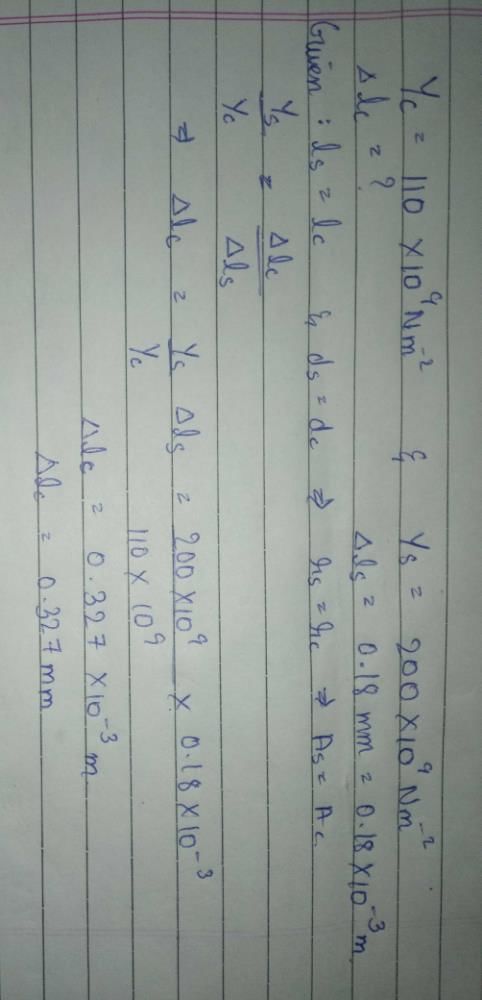
You hang a flood lamp from the end of a vertical steel wire. The flood lamp stretches the wire 0.18 mm and the stress is proportional to the strain. How much would it have stretched for a copper wire of the original length and diameter?- a)0.39 mm
- b)0.37 mm
- c)0.33 mm
- d)0.18 mm
Correct answer is option 'C'. Can you explain this answer?
You hang a flood lamp from the end of a vertical steel wire. The flood lamp stretches the wire 0.18 mm and the stress is proportional to the strain. How much would it have stretched for a copper wire of the original length and diameter?
a)
0.39 mm
b)
0.37 mm
c)
0.33 mm
d)
0.18 mm
 | Darshan Nagesh answered |
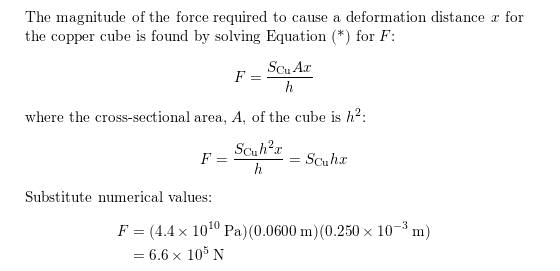
A lead cube measures 6.00 cm on each side. The bottom face is held in place by very strong glue to a flat horizontal surface, while a horizontal force F is applied to the upper face parallel to one of the edges. How large must F be to cause the cube to deform by 0.250 mm? (Shear modulus of lead = 0.6 × 10¹⁰Pa)- a)7.0 * 105 N
- b)6* 105 N
- c)6.6 * 105 N
- d)5.6 * 105 N
Correct answer is option 'C'. Can you explain this answer?
A lead cube measures 6.00 cm on each side. The bottom face is held in place by very strong glue to a flat horizontal surface, while a horizontal force F is applied to the upper face parallel to one of the edges. How large must F be to cause the cube to deform by 0.250 mm? (Shear modulus of lead = 0.6 × 10¹⁰Pa)
a)
7.0 * 105 N
b)
6* 105 N
c)
6.6 * 105 N
d)
5.6 * 105 N
| | Sanchita Mukherjee answered |
Shear modulus or modulus of rigidity is- a)the ratio of shearing stress to the corresponding lateral strain
- b)the ratio of shearing stress to the corresponding shearing strain
- c)the ratio of longitudinal stress to the corresponding shearing strain
- d)the ratio of shearing strain to the corresponding shearing stress
Correct answer is option 'B'. Can you explain this answer?
Shear modulus or modulus of rigidity is
a)
the ratio of shearing stress to the corresponding lateral strain
b)
the ratio of shearing stress to the corresponding shearing strain
c)
the ratio of longitudinal stress to the corresponding shearing strain
d)
the ratio of shearing strain to the corresponding shearing stress
| | Ameya Choudhury answered |
Shear modulus or modulus of rigidity is the ratio of shearing stress to the corresponding shearing strain, by the definition of shear modulus.
In constructing a large mobile, an artist hangs an aluminum sphere of mass 6.0 kg from a vertical steel wire 0.50 m long and 2.5 × 10⁻³ cm2in cross-sectional area. On the bottom of the sphere he attaches a similar steel wire, from which he hangs a brass cube of mass 10.0 kg. Compute the elongation.- a)3.7 mm upper, 1.0 mm lower
- b)3.4 mm upper, 1.0 mm lower
- c)3.5 mm upper, 1.1 mm lower
- d)1.6 mm upper, 1.0 mm lower
Correct answer is option 'D'. Can you explain this answer?
In constructing a large mobile, an artist hangs an aluminum sphere of mass 6.0 kg from a vertical steel wire 0.50 m long and 2.5 × 10⁻³ cm2in cross-sectional area. On the bottom of the sphere he attaches a similar steel wire, from which he hangs a brass cube of mass 10.0 kg. Compute the elongation.
a)
3.7 mm upper, 1.0 mm lower
b)
3.4 mm upper, 1.0 mm lower
c)
3.5 mm upper, 1.1 mm lower
d)
1.6 mm upper, 1.0 mm lower
| | Muskaan Kumar answered |
Hence 1.6 mm upper, 1.0 mm lower is correct.
Chapter doubts & questions for Mechanical Properties of Solids - 4 Months Preparation for NEET 2026 is part of NEET exam preparation. The chapters have been prepared according to the NEET exam syllabus. The Chapter doubts & questions, notes, tests & MCQs are made for NEET 2026 Exam. Find important definitions, questions, notes, meanings, examples, exercises, MCQs and online tests here.
Chapter doubts & questions of Mechanical Properties of Solids - 4 Months Preparation for NEET in English & Hindi are available as part of NEET exam. Download more important topics, notes, lectures and mock test series for NEET Exam by signing up for free.
4 Months Preparation for NEET402 videos|1598 docs|512 tests |
