NEET Exam  >  NEET Test  >  Topic-wise MCQ Tests  >  31 Years NEET Previous Year Questions: Biomolecules - 1 - NEET MCQ

31 Years NEET Previous Year Questions: Biomolecules - 1 Free MCQ Practice


MCQ Practice Test & Solutions: 31 Years NEET Previous Year Questions: Biomolecules - 1 (50 Questions)

You can prepare effectively for NEET Topic-wise MCQ Tests for NEET with this dedicated MCQ Practice Test (available with solutions) on the important topic of "31 Years NEET Previous Year Questions: Biomolecules - 1 ". These 50 questions have been designed by the experts with the latest curriculum of NEET 2026, to help you master the concept.

Test Highlights:

  • - Format: Multiple Choice Questions (MCQ)
  • - Duration: 50 minutes
  • - Number of Questions: 50

Sign up on EduRev for free to attempt this test and track your preparation progress.

31 Years NEET Previous Year Questions: Biomolecules - 1 - Question 1

The protein portion of an enzyme is called:     [NEET 2025]

Detailed Solution: Question 1

  • Enzymes are biological catalysts that speed up chemical reactions in living organisms without being consumed in the process.
  • Enzymes are composed of two main parts: the protein portion and the non-protein portion.
  • The protein portion of an enzyme is called an Apoenzyme, and it is inactive by itself.
  • The non-protein part, which can either be a cofactor or coenzyme, binds to the apoenzyme to form an active enzyme known as a holoenzyme.

Holoenzyme = Apoenzyme + Coenzyme

31 Years NEET Previous Year Questions: Biomolecules - 1 - Question 2

Name the class of enzyme that usually catalyze the following reaction: N    [NEET 2025]

2025

Where, G → a group other than hydrogen
S → a substrate
S# → another substate

Detailed Solution: Question 2

Enzymes are divided into 6 classes, each with 4-13 subclasses and named accordingly by a four-digit number.

  • Transferases: Enzymes catalysing a transfer of a group, G (other than hydrogen), between a pair of substrates S and S’

S - G + S' → S + S' - G

  • Hydrolases: Enzymes catalysing hydrolysis of ester, ether, peptide, glycosidic, C-C, C-halide or P-N bonds.
  • Oxidoreductases/dehydrogenases: Enzymes which catalyse oxidoreduction of two substrates S and S’.
  • Lyases: Enzymes that catalyse removal of groups from substrates by mechanisms other than hydrolysis leaving double bonds.
  • Isomerases: Includes all enzymes catalysing inter-conversion of optical, geometric or positional isomers.
  • Ligases: Enzymes catalysing the linking together of 2 compounds, e.g., enzymes which catalyse joining of C-O, C-S, C-N, P-O etc. bonds

31 Years NEET Previous Year Questions: Biomolecules - 1 - Question 3

Which one of the following enzymes contains 'Haem' as the prosthetic group?      [NEET 2025]

Detailed Solution: Question 3

Catalase:

  • Catalase is an enzyme that contains haem as its prosthetic group.
  • It plays a critical role in protecting cells from oxidative damage by decomposing hydrogen peroxide (H2O2).
  • The haem group in catalase contains iron, which is essential for the enzyme's catalytic activity.
  • The reaction catalyzed by catalase is:
    2H2O2 → 2H2O + O2
  • This enzyme is highly efficient and critical for maintaining cellular health in aerobic organisms.

Other Options:

RuBisCo:

  • RuBisCo (Ribulose-1,5-bisphosphate carboxylase-oxygenase) is a key enzyme involved in the Calvin cycle of photosynthesis.
  • It catalyzes the fixation of carbon dioxide (CO2) into organic compounds in plants.
  • It does not contain haem; instead, it is a protein enzyme with no metalloprotein or haem group association.

Carbonic anhydrase:

  • This enzyme catalyzes the reversible conversion of carbon dioxide (CO2) and water (H2O) into carbonic acid (H2CO3), which then dissociates into bicarbonate (HCO3-) and protons (H+).
  • It contains zinc (Zn2+) as a cofactor

Succinate dehydrogenase:

  • This enzyme is part of the citric acid cycle (Krebs cycle) and the electron transport chain in mitochondria.
  • It facilitates the oxidation of succinate to fumarate and contains iron-sulfur clusters and FAD (flavin adenine dinucleotide) as cofactors.

31 Years NEET Previous Year Questions: Biomolecules - 1 - Question 4

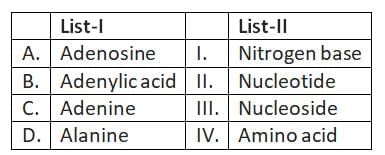
Match List-I with List-II:     [NEET 2025]
2025

Choose the option with all correct matches.

Detailed Solution: Question 4
Correct option: A

Adenosine is a nucleoside, formed by the linkage of the nitrogenous base adenine to the pentose sugar ribose. This corresponds to III.

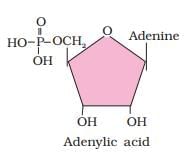
Adenylic acid (AMP) is adenosine monophosphate, a nucleotide made of adenine, ribose and a phosphate group. This corresponds to II.

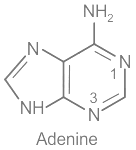
Adenine is a nitrogenous base found in nucleic acids. This corresponds to I.

Alanine is an α-amino acid used in protein synthesis. This corresponds to IV.

Therefore the correct matching is A-III, B-II, C-I, D-IV, i.e., option A.

20252025

31 Years NEET Previous Year Questions: Biomolecules - 1 - Question 5

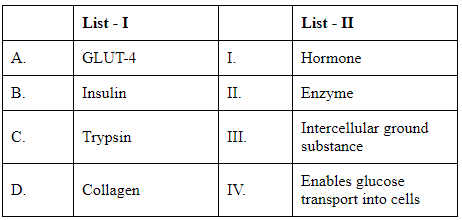
Match List I with List II      [NEET 2024]
2024

Choose the correct answer from the options given below.

Detailed Solution: Question 5

To solve this matching question, we need to correctly identify what each item in List I represents and match it with its corresponding description in List II:

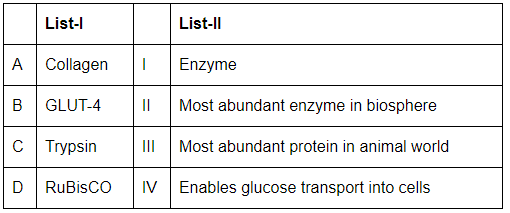
  • GLUT-4 is a glucose transporter protein that allows glucose to be absorbed into cells when insulin is present. Hence, it should be matched with "Enables glucose transport into cells."
  • Insulin is a hormone produced by the pancreas that helps regulate blood glucose levels by facilitating the uptake of glucose into tissues. It should be matched with "Hormone."
  • Trypsin is an enzyme that aids in the digestion of proteins in the digestive system. It should be matched with "Enzyme."
  • Collagen is a primary structural protein that forms connective tissues throughout the body, including the extracellular matrix. It should be matched with "Intercellular ground substance."

Here's how we match each term with the correct description from List II:

A-IV, B-I, C-II, D-III

This corresponds to:

  • A (GLUT-4) - IV (Enables glucose transport into cells)
  • B (Insulin) - I (Hormone)
  • C (Trypsin) - II (Enzyme)
  • D (Collagen) - III (Intercellular ground substance)

Therefore, the answer is Option A

31 Years NEET Previous Year Questions: Biomolecules - 1 - Question 6

Regarding catalytic cycle of an enzyme action, select the correct sequential steps:    [NEET 2024]
A. Substrate enzyme complex formation.
B. Free enzyme ready to bind with another substrate.
C. Release of products.
D. Chemical bonds of the substrate broken.
E. Substrate binding to active site.
Choose the correct answer from the options given below :

Detailed Solution: Question 6

The correct order of the steps in the catalytic cycle of enzyme action involves the following key events:

  1. Substrate binding to the active site: Before any reaction can take place, the substrate must bind to the enzyme's active site. This is where the substrate is correctly positioned for the reaction.
  2. Formation of the substrate-enzyme complex: Once the substrate binds to the active site, a substrate-enzyme complex is formed. This complex stabilizes the transition state of the reaction and lowers the activation energy required for the reaction.
  3. Chemical bonds of the substrate broken : Within the substrate-enzyme complex, the specific chemical reaction occurs, leading to the breaking of bonds within the substrate. This step often involves changes to the chemical structure of the substrate, turning it into the product(s) of the reaction.
  4. Release of products: After the reaction occurs, the product(s) of the reaction are released from the enzyme, leaving the enzyme unchanged.
  5. Free enzyme ready to bind with another substrate: Once the product is released, the enzyme is free again to bind with another substrate, repeating the cycle.

Given the correct sequence and your provided options, the correct answer is: Option A
This sequence correctly describes the steps involved in the catalytic cycle of enzyme action, from substrate binding to the release of products and the readiness of the enzyme to start a new cycle.

31 Years NEET Previous Year Questions: Biomolecules - 1 - Question 7

 Which of the following statement is incorrect about enzymes?    [NEET 2024]

Detailed Solution: Question 7

(a) They are highly substrate specific: This is true. Enzymes are highly specific to the substrate they act upon, meaning they catalyze reactions with particular molecules.
(b) In thermophilic organisms, enzymes can catalyze reactions at high temperatures, i.e. 90°C: This is true. Thermophilic organisms have enzymes that can function at extremely high temperatures, even up to 90°C or more.
(c) All enzymes are proteinaceous in nature: This is incorrect. While most enzymes are proteins, some are made of RNA molecules, known as ribozymes.
(d) Some enzymes have metal ions: This is true. Many enzymes require metal ions (such as zinc, magnesium, or iron) to function properly as cofactors.
Therefore, the incorrect statement is (c).

31 Years NEET Previous Year Questions: Biomolecules - 1 - Question 8

Which of the following are not fatty acids?     [NEET 2024]
A. Glutamic acid 
B. Arachidonic acid 
C. Palmitic acid 
D. Lecithin
E. Aspartic  acid 
Choose the correct answer from the options given below:

Detailed Solution: Question 8

  • A. Glutamic acid: This is an amino acid, not a fatty acid.
  • B. Arachidonic acid: This is a fatty acid. It is an essential polyunsaturated fatty acid found in the cell membranes.
  • C. Palmitic acid: This is a fatty acid. It is a saturated fatty acid found in animal fats and plant oils.
  • D. Lecithin: Lecithin is a phospholipid, not a fatty acid. It is composed of fatty acids, but it itself is not a fatty acid.
  • E. Aspartic acid: This is an amino acid, not a fatty acid.

Therefore, A, D, and E are not fatty acids, making (c) A, D, and E only the correct answer.

31 Years NEET Previous Year Questions: Biomolecules - 1 - Question 9

The following can be found as a zwitter ion:    [NEET 2024]

Detailed Solution: Question 9

  • (a) Fatty acid: Fatty acids do not typically exist as zwitterions. They are usually in their ionized form at physiological pH.
  • (b) Monosaccharide: Monosaccharides (simple sugars) do not form zwitterions. They generally have hydroxyl groups and do not carry both positive and negative charges on the same molecule.
  • (c) Amino acid: This is correct. Amino acids, at physiological pH, exist as zwitterions. They contain both a positively charged amino group (—NH₃+) and a negatively charged carboxyl group (—COO-), making them neutral overall but having both positive and negative charges.
  • (d) Nucleic acid: Nucleic acids, such as DNA and RNA, do not exist as zwitterions. They contain acidic phosphate groups but are not zwitterions.

Therefore, the correct answer is (c) Amino acid.

31 Years NEET Previous Year Questions: Biomolecules - 1 - Question 10

The cofactor of the enzyme carboxypeptidase is:      [NEET 2024]

Detailed Solution: Question 10

The enzyme carboxypeptidase is well-known for its utilization of a zinc ion as a cofactor in its catalytic mechanism. The zinc ion plays a crucial role in the hydrolysis of peptide bonds, the reaction facilitated by carboxypeptidase. The presence of zinc allows for proper stabilization of water molecules which are necessary in the catalysis, making the hydrolysis of the peptide bond effective. This zinc dependency categorizes carboxypeptidase as a metalloenzyme.
Therefore, the correct answer is: Option A: Zinc
Other options mentioned, such as Niacin, Flavin, and Haem, serve as cofactors for different enzymes. For example, Niacin is involved in the formation of NAD+ (Nicotinamide adenine dinucleotide) which acts as an electron carrier in many enzymatic reactions. Flavins (like FMN and FAD) are involved in a myriad of oxidation-reduction (redox) reactions. Haem, found in hemoglobin and cytochromes, also plays crucial roles primarily in electron transfer processes and oxygen transport. These are not associated with the functioning of carboxypeptidase, which specifically requires zinc for its enzymatic activity.

31 Years NEET Previous Year Questions: Biomolecules - 1 - Question 11

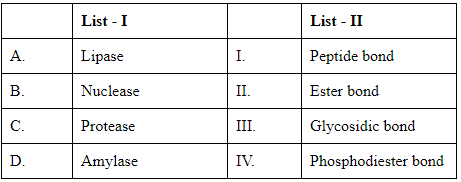
Match List I with List II:      [NEET 2024]
2024

Choose the correct answer from the options given below :

Detailed Solution: Question 11

Answer: Option C.

Lipase hydrolyses ester bonds in triglycerides, so it corresponds to II.

Nuclease cleaves the phosphodiester bonds in nucleic acids, so it corresponds to IV.

Protease hydrolyses peptide bonds in proteins, so it corresponds to I.

Amylase breaks glycosidic bonds in polysaccharides (starch), so it corresponds to III.

Thus the correct matching is A-II, B-IV, C-I, D-III, which is Option C.

31 Years NEET Previous Year Questions: Biomolecules - 1 - Question 12

Which of the following is not a complex polysaccharide?   [NEET 2024]

Detailed Solution: Question 12

  • (a) Inulin: Inulin is a type of carbohydrate, specifically a fructan, that is a polysaccharide but is not considered a "complex" polysaccharide. It consists of fructose units and is typically used by plants as a storage carbohydrate.
  • (b) Chitin: Chitin is a complex polysaccharide made of N-acetylglucosamine, found in the exoskeletons of arthropods and the cell walls of fungi. It is a complex polysaccharide.
  • (c) Glucosamine: Glucosamine is not a polysaccharide itself but is an amino sugar that forms part of larger polysaccharides such as glycosaminoglycans (e.g., in cartilage).
  • (d) N-acetyl galactosamine: This is an amino sugar that forms part of complex polysaccharides, such as glycosaminoglycans.

Therefore, Inulin is not a complex polysaccharide, making (a) the correct answer.

31 Years NEET Previous Year Questions: Biomolecules - 1 - Question 13

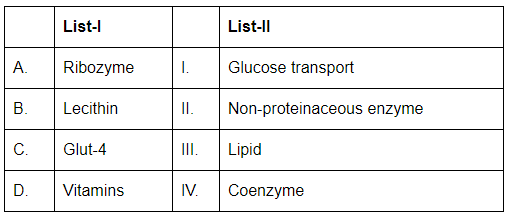
Match List-I with List-II:   [NEET 2024]
2024

Choose the correct answer from the options given below : 

Detailed Solution: Question 13

  • A. Ribozyme (II. Non-proteinaceous enzyme): A ribozyme is a non-proteinaceous enzyme, meaning it is made of RNA and not protein.
  • B. Lecithin (III. Lipid): Lecithin is a type of lipid, specifically a phospholipid, commonly found in cell membranes.
  • C. Glut-4 (I. Glucose transport): GLUT-4 (Glucose transporter type 4) is involved in glucose transport in cells, particularly in muscle and fat cells.
  • D. Vitamins (IV. Coenzyme): Vitamins often act as coenzymes or precursors to coenzymes in various metabolic reactions.

Therefore, the correct matching is A-II, B-III, C-I, D-IV.

31 Years NEET Previous Year Questions: Biomolecules - 1 - Question 14

Match List-I with List-II    [NEET 2024]
2024

Choose the correct answer from the options given below:

Detailed Solution: Question 14

  • A. Collagen (III. Most abundant protein in animal world): Collagen is the most abundant protein in the animal world, providing structural support in tissues.
  • B. GLUT-4 (IV. Enables glucose transport into cells): GLUT-4 is a glucose transporter that enables the transport of glucose into muscle and fat cells.
  • C. Trypsin (I. Enzyme): Trypsin is a digestive enzyme that breaks down proteins in the small intestine.
  • D. RuBisCO (II. Most abundant enzyme in biosphere): RuBisCO is the most abundant enzyme on Earth, playing a key role in the Calvin cycle of photosynthesis.

Therefore, the correct matching is A-III, B-IV, C-I, D-II.

31 Years NEET Previous Year Questions: Biomolecules - 1 - Question 15

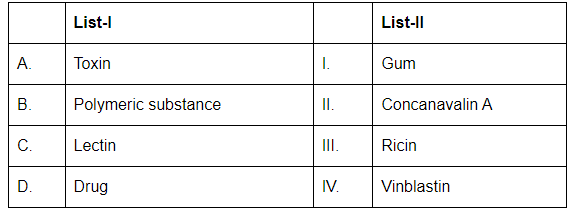
Match List-I with List-II   [NEET 2024]

2024

Choose the correct answer from the options given below:

Detailed Solution: Question 15

  • A. Toxin (III. Ricin): Ricin is a toxic protein derived from castor beans. It is a well-known toxin.
  • B. Polymeric substance (I. Gum): Gums are polysaccharides or polymeric substances derived from plants that form gels when hydrated.
  • C. Lectin (II. Concanavalin A): Concanavalin A is a type of lectin, which is a protein that binds to specific carbohydrate structures on cell surfaces.
  • D. Drug (IV. Vinblastin): Vinblastine is a drug used in cancer treatment, particularly for its role in inhibiting cell division.

Therefore, the correct matching is A-III, B-I, C-II, D-IV.

31 Years NEET Previous Year Questions: Biomolecules - 1 - Question 16

Lecithin, a small molecular weight organic compound found in living tissues, is an example of:     [NEET 2024]

Detailed Solution: Question 16

The correct answer is option (b).
Some lipids have phosphorous and a phosphorylated organic compound in them. These are phospholipids. They are found in cell membrane. Lecithin is one example.
Option (c) is incorrect as glycerides are another group of lipids in which both glycerol and fatty acids are present.
Option (a) and (d) are incorrect as amino acids and carbohydrates are separate groups of biomolecules.

31 Years NEET Previous Year Questions: Biomolecules - 1 - Question 17

Inhibition of Succinic dehydrogenase enzyme by malonate is a classical example of:     [NEET 2024]

Detailed Solution: Question 17

The inhibition of the enzyme succinic dehydrogenase by malonate is a classic example of competitive inhibition. To understand why this is the case, let's explore the mechanism and dynamics of this specific type of inhibition in the context of the given enzyme and inhibitor.
Competitive Inhibition: 
This type of enzyme inhibition occurs when an inhibitor compound resembles the substrate's structure and competes with the substrate for binding to the active site of the enzyme. If the inhibitor binds to the active site, it prevents the substrate from binding, temporarily blocking the enzyme’s activity. Importantly, competitive inhibition can typically be overcome by increasing the concentration of the substrate, as this can displace the inhibitor from the active site.
Succinic Dehydrogenase and Malonate: 
Succinic dehydrogenase is an enzyme that plays a critical role in the citric acid cycle, an essential metabolic pathway for energy production. It catalyzes the oxidation of succinate into fumarate. The structure of malonate is closely similar to that of succinate, the natural substrate of succinic dehydrogenase. Because of its structural similarity, malonate competes with succinate for the active site on succinic dehydrogenase. When malonate binds to the active site, it effectively inhibits the enzyme from catalyzing the reaction to convert succinate into fumarate.
Conclusion: 
Considering these points, Option C, Competitive inhibition, is correct for describing the inhibition of succinic dehydrogenase by malonate, as it directly competes with the substrate for the active site of the enzyme.
Other options such as cofactor inhibition, feedback inhibition, and enzyme activation do not accurately describe the situation with malonate and succinic dehydrogenase. Cofactor inhibition involves inhibition by substances that affect the enzyme's cofactors, feedback inhibition generally pertains to the regulation of biochemical pathways by their product, and enzyme activation is a process that increases the enzyme's activity, none of which apply in this context.

31 Years NEET Previous Year Questions: Biomolecules - 1 - Question 18

Which of the following graphs explains the effect of pH on the enzyme activity?    [NEET 2024]

Detailed Solution: Question 18

The graph that explains the effect of pH on enzyme activity typically shows that enzyme activity increases as the pH moves towards an optimal level, then decreases as the pH becomes too high or too low. This is a typical bell-shaped curve, where the enzyme activity is highest at a specific optimal pH, which matches the graph in option (a).

31 Years NEET Previous Year Questions: Biomolecules - 1 - Question 19

The catalytic cyclic of an enzyme action is described as:    [NEET 2024]
A. Enzyme releases products of the reaction and gets free.
B. Substrate induces the enzyme to alter its shape.
C. The substrate binds with the active site of the enzyme.
D. Enzymes-product complex is formed.

Detailed Solution: Question 19

  • C. The substrate binds with the active site of the enzyme: The substrate first binds to the enzyme's active site.
  • B. Substrate induces the enzyme to alter its shape: The binding of the substrate often induces a conformational change in the enzyme (induced fit model).
  • D. Enzyme-product complex is formed: The enzyme catalyzes the reaction, forming the enzyme-product complex.
  • A. Enzyme releases products of the reaction and gets free: Finally, the enzyme releases the products and returns to its original form, ready for the next cycle.

Therefore, the correct order is C → B → D → A.

31 Years NEET Previous Year Questions: Biomolecules - 1 - Question 20

Which of the following is a nucleotide?    [NEET 2024]

Detailed Solution: Question 20

  • Adenylic acid is a nucleotide, which consists of a nitrogenous base (adenine), a sugar (ribose or deoxyribose), and a phosphate group.
  • Uridine is a nucleoside, not a nucleotide, as it lacks the phosphate group.
  • Guanine is a nitrogenous base, not a nucleotide.
  • Guanosine is a nucleoside, as it consists of the base guanine and a sugar but lacks the phosphate group.

31 Years NEET Previous Year Questions: Biomolecules - 1 - Question 21

Enzymes that catalyse the removal of groups from substrates by mechanisms other than hydrolysis leaving double bonds, are known as:   [NEET 2024]

Detailed Solution: Question 21

  • Lyases are enzymes that catalyze the removal of groups from substrates by mechanisms other than hydrolysis, often leaving double bonds. Examples include dehydratases, decarboxylases, and other enzymes that break bonds without the use of water.
  • Transferases catalyze the transfer of functional groups.
  • Oxidoreductases are enzymes that catalyze oxidation-reduction reactions.
  • Dehydrogenases are a subclass of oxidoreductases that specifically catalyze the removal of hydrogen atoms.

31 Years NEET Previous Year Questions: Biomolecules - 1 - Question 22

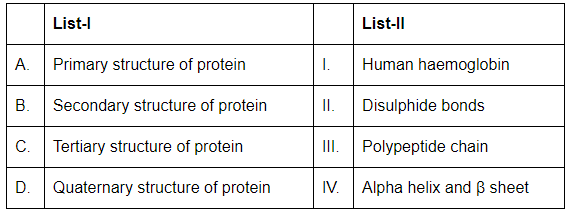
Match List-I with List-II:   [NEET 2024]
2024

Choose the correct answer from the options given below:

Detailed Solution: Question 22

  • A. Primary structure of protein (III. Polypeptide chain): The primary structure of a protein refers to the sequence of amino acids in the polypeptide chain.
  • B. Secondary structure of protein (IV. Alpha helix and β sheet): The secondary structure of a protein involves the regular folding of the polypeptide chain into structures like alpha helices and beta sheets.
  • C. Tertiary structure of protein (II. Disulphide bonds): The tertiary structure refers to the overall three-dimensional shape of the protein, which is stabilized by interactions such as disulfide bonds.
  • D. Quaternary structure of protein (I. Human haemoglobin): The quaternary structure is the arrangement of multiple polypeptide chains in a multi-subunit protein, like human hemoglobin.

Thus, the correct matching is A-III, B-IV, C-II, D-I.

31 Years NEET Previous Year Questions: Biomolecules - 1 - Question 23

Which of the following graphs depicts the effect of substrate concentration on velocity of enzyme catalysed reaction?    [NEET 2024]

Detailed Solution: Question 23

The graph in (a) depicts the typical effect of substrate concentration on the velocity of an enzyme-catalyzed reaction. As the substrate concentration increases, the reaction velocity increases proportionally until it reaches a maximum velocity (Vmax), at which point all enzyme active sites are occupied, and further increases in substrate concentration do not increase the reaction rate. This is a classic Michaelis-Menten kinetics graph.

31 Years NEET Previous Year Questions: Biomolecules - 1 - Question 24

Ligases is a class of enzymes responsible for catalysing the linking together of two compounds. Which of the following bonds is not catalysed by it?   [NEET 2024]

Detailed Solution: Question 24

  • Ligases are enzymes that catalyze the joining of two molecules, typically using energy derived from ATP or another nucleotide triphosphate. They are involved in forming various types of bonds, but not all bonds.
  • (a) C-C: This is generally not catalyzed by ligases. C-C bond formation typically requires other mechanisms or enzymes.
  • (b) P-O: Ligases can catalyze the formation of phosphodiester bonds (P-O), such as in the joining of DNA strands.
  • (c) C-O: Ligases can catalyze the formation of C-O bonds, such as in the joining of alcohols and other molecules.
  • (d) C-N: Ligases can also catalyze the formation of C-N bonds, for example, in the synthesis of peptides or other amide linkages.

Therefore, the bond that is not catalyzed by ligases is C-C.

31 Years NEET Previous Year Questions: Biomolecules - 1 - Question 25

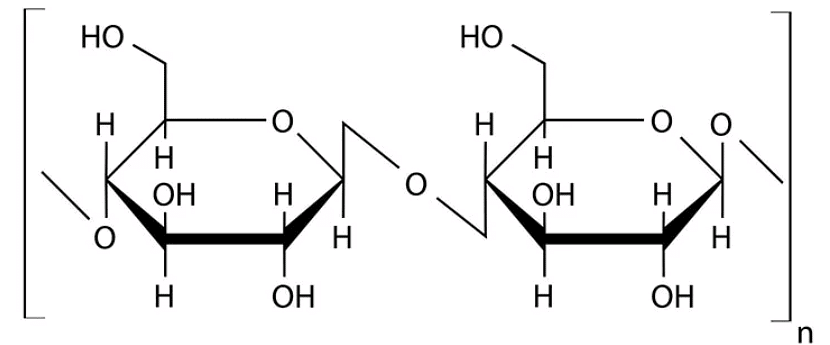
Cellulose does not form blue colour with Iodine because      [NEET 2023]

Detailed Solution: Question 25
2023

Option (c) is the correct answer because cellulose does not contain complex helices and hence cannot hold iodine molecules. Option (a), (b) and (d) are not correct

31 Years NEET Previous Year Questions: Biomolecules - 1 - Question 26

Given below are two statements:     [NEET 2023]
Statement I: A protein is imagined as a line, the left end represented by first amino acid (C-terminal) and the right end represented by last amino acid (N-terminal).
Statement II: Adult human haemoglobin, consists of 4 subunits (two subunits of α type and two subunits of β type.)
In the light of the above statements, choose the correct answer from the options given below:

Detailed Solution: Question 26

Statement I is false - because the C-terminal represents the last amino acid in the protein chain, not the first. The N-terminal represents the first amino acid.
Statement II is true -  Adult human hemoglobin consists of 4 subunits: two subunits of α-type and two subunits of β-type. These subunits come together to form a complex protein structure responsible for carrying oxygen in the blood.
The correct option is (C): Statement I is false but Statement II is true

31 Years NEET Previous Year Questions: Biomolecules - 1 - Question 27

Given below are two statements:      [NEET 2023]
Statement I: low temperature preserves the enzyme in a temporarily inactive state whereas high temperature destroys enzymatic activity because proteins are denatured by heat.
Statement II: when the inhibitor closely resembles the substrate in its molecular structure and inhibits the activity of enzyme, it is known as competitive inhibitor.

Detailed Solution: Question 27

  • Statement I is true - Low temperatures can slow down enzymatic reactions by placing the enzyme in an inactive state, and high temperatures can denature proteins, including enzymes, which can lead to a loss of enzymatic activity.
  • Statement II is also true - A competitive inhibitor is a molecule that closely resembles the substrate of an enzyme and competes for the active site, thus reducing the enzyme's activity. This type of inhibition is called competitive inhibition.

So, the correct answer is : Option A : Both Statement I and Statement II are true.

31 Years NEET Previous Year Questions: Biomolecules - 1 - Question 28

Malonate inhibits the growth of pathogenic bacteria by inhibiting the activity of:     [NEET 2023]

Detailed Solution: Question 28

Malonate is a competitive inhibitor of succinic dehydrogenase. Succinic dehydrogenase is an enzyme in the citric acid cycle (Krebs cycle) that helps in the conversion of succinate to fumarate. Malonate mimics succinate and competes for the same binding site on the enzyme, thereby inhibiting its activity and blocking the bacterial growth.

31 Years NEET Previous Year Questions: Biomolecules - 1 - Question 29

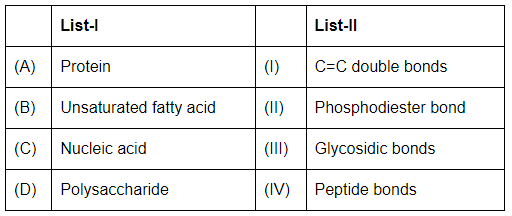
Match List - I with List - II     (NEET 2023)
2023

Choose the correct answer from the options given below:

Detailed Solution: Question 29

  • Protein (A): Peptide bonds (IV) link amino acids in proteins.
  • Unsaturated fatty acid (B): C=C double bonds (I) are present in unsaturated fatty acids, making them unsaturated.
  • Nucleic acid (C): Phosphodiester bonds (II) join nucleotides in nucleic acids like DNA and RNA.
  • Polysaccharide (D): Glycosidic bonds (III) link monosaccharides in polysaccharides like starch and cellulose.

31 Years NEET Previous Year Questions: Biomolecules - 1 - Question 30

Inulin is a polymer of:     [NEET 2023]

Detailed Solution: Question 30

Inulin is a carbohydrate polymer made up of fructose units linked together. It is a type of fructan and is commonly found in plants like chicory and Jerusalem artichoke. Inulin is used as a dietary fiber and has various health benefits.

View more questions
6 docs|803 tests
Information about 31 Years NEET Previous Year Questions: Biomolecules - 1 Page
In this test you can find the Exam questions for 31 Years NEET Previous Year Questions: Biomolecules - 1 solved & explained in the simplest way possible. Besides giving Questions and answers for 31 Years NEET Previous Year Questions: Biomolecules - 1 , EduRev gives you an ample number of Online tests for practice
Download as PDF