
Differential Equations - 13 - Free MCQ Test with solutions for Maths
MCQ Practice Test & Solutions: Differential Equations - 13 (20 Questions)
You can prepare effectively for Mathematics Topic-wise Tests & Solved Examples for Mathematics with this dedicated MCQ Practice Test (available with solutions) on the important topic of "Differential Equations - 13". These 20 questions have been designed by the experts with the latest curriculum of Mathematics 2026, to help you master the concept.
Test Highlights:
- - Format: Multiple Choice Questions (MCQ)
- - Duration: 60 minutes
- - Number of Questions: 20
Sign up on EduRev for free to attempt this test and track your preparation progress.

The function f defined by f(x) - x [1 + 1/3 sin (log x2)], a ≠ 0,/(0) = 0 ([] represents the greatest integer function) is
Detailed Solution: Question 1
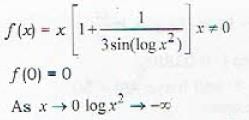
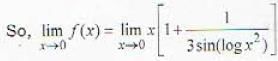
 due to factor x in it.
If f is twice differentiable function such that f ''(x) = - f(x), f '(x) = g(x) and h(x) = [f(x)]2 + [g(x)]2, also if h(5) = 11, then h(10) is equal to
Detailed Solution: Question 2

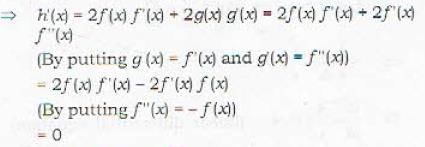
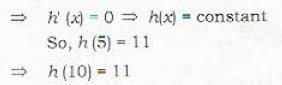

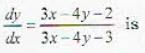
Detailed Solution: Question 3
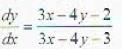 ........(i)
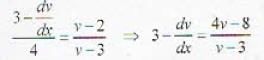
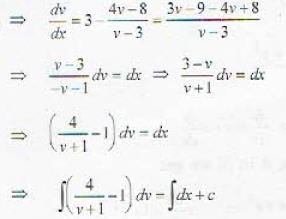
Detailed Solution: Question 4
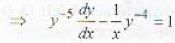 .....(i)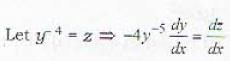
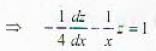


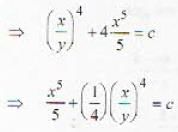

Detailed Solution: Question 5
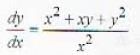 ....(i)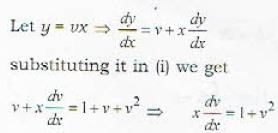
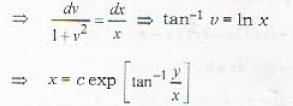
The solution of the differential equation y(2xy + ex)dx - exdy = 0 is
Detailed Solution: Question 6

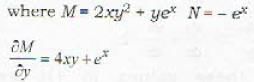
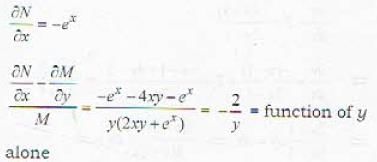
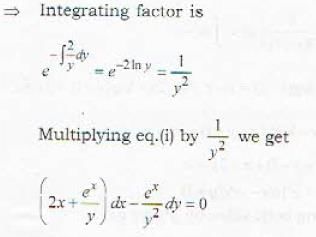



Detailed Solution: Question 7
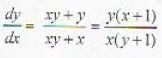
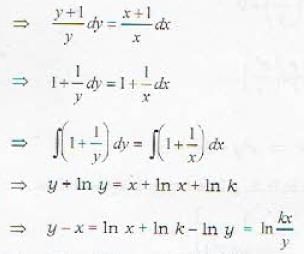
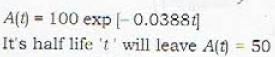
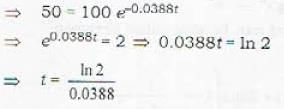
The half-life of a radioactive substance is the time required for one-half of that substance to decay. The amount of 11C, an isotope of carbon present at a future time t (in months) is given by A(t) = 100 exp [- 0.0338 t]. The half life of the material in months is
Detailed Solution: Question 8
Consider a pair of differential equations 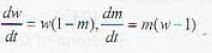
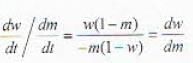
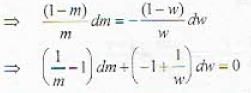
Eliminating t in the two equations results in
Eliminating t in the two equations results in
Detailed Solution: Question 9

Detailed Solution: Question 10
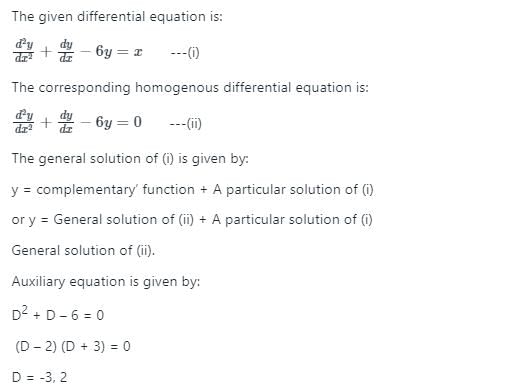
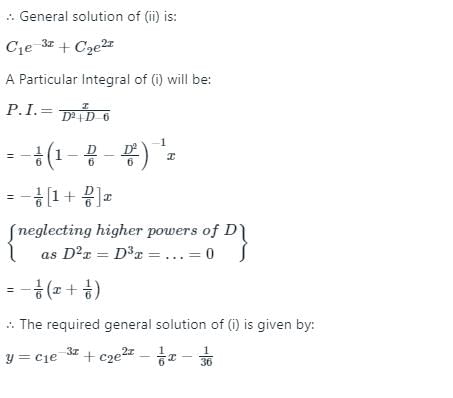
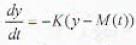
The rare at which body changes temperature is proportional to the difference between its temperature and ihat of the surrounding medium. This is called Newton's law of cooling. If y = f{t} is the unknown temperature of The body at time t and M(t) denotes the known temperature of the surrounding medium, Newton's law' leads to the differential equation where k is a positive constant.
Detailed Solution: Question 11
tan-1 x + tan-1 y = c is the general solution of the differential equation
Detailed Solution: Question 12

 (By differentiating)
 represents
Detailed Solution: Question 13

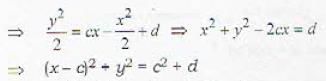

Detailed Solution: Question 14


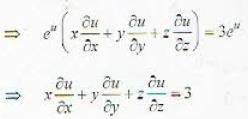

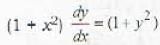
The solution of the differential equal ion (1 + x2) dy/dx = (1 + y2) is
Detailed Solution: Question 15
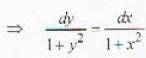 ......(i)
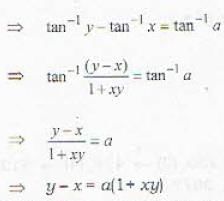
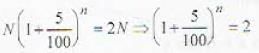
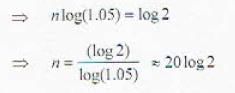
If a population grows at the rate of 5% per year, it will double (in years) after
Detailed Solution: Question 16
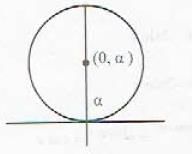
The differential equation of all circles passing through the origin and having their centres on the y-axis is
Detailed Solution: Question 17
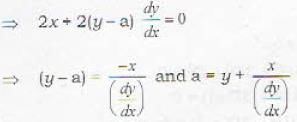
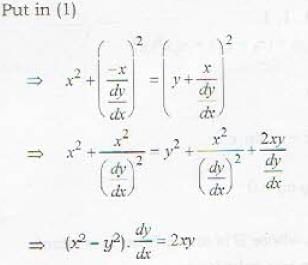
The geometrical interpretation of the graph of the differential equation:  is a family of
is a family ofDetailed Solution: Question 18
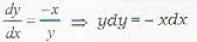


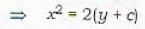
The solution curves of the given differential equation: xdx - dy = 0 constitute a family of
Detailed Solution: Question 19

If left to grow undisturbed, the fish population in a lake would be 50 per cent more than it was in the previous year. However, for research purposes 100 fishes are added to the population each year. If the initial population of fish in the pond was zero then how many years the slocking program should continue till the population increases to 2000?
Detailed Solution: Question 20

27 docs|150 tests |
