EMRS Exam  >  EMRS Test  >   TGT Mock Test Series 2026  >  EMRS TGT Hindi Mock Test - 2 - EMRS MCQ

EMRS TGT Hindi Mock Test - 2 Free Online Test 2026


Full Mock Test & Solutions: EMRS TGT Hindi Mock Test - 2 (130 Questions)

You can boost your EMRS 2026 exam preparation with this EMRS TGT Hindi Mock Test - 2 (available with detailed solutions).. This mock test has been designed with the analysis of important topics, recent trends of the exam, and previous year questions of the last 3-years. All the questions have been designed to mirror the official pattern of EMRS 2026 exam, helping you build speed, accuracy as per the actual exam.

Mock Test Highlights:

  • - Format: Multiple Choice Questions (MCQ)
  • - Duration: 180 minutes
  • - Total Questions: 130
  • - Analysis: Detailed Solutions & Performance Insights
  • - Sections covered: General Awareness, Reasoning Ability, Knowledge of ICT, Teaching Aptitude, Domain Knowledge, General English, General Hindi, English

Sign up on EduRev for free and get access to these mock tests, get your All India Rank, and identify your weak areas to improve your marks & rank in the actual exam.

EMRS TGT Hindi Mock Test - 2 - Question 1

How many types of elasticity of supply is available?

Detailed Solution: Question 1

Five types of elasticity of supply:

  1. Perfectly elastic supply
  2. Relatively elastic supply
  3. Unitary elastic supply
  4. Relatively inelastic supply
  5. Perfectly inelastic supply

EMRS TGT Hindi Mock Test - 2 - Question 2

Who among the following has written the famous poem, 'Sarfaroshi Ki Tamanna'?

Detailed Solution: Question 2

Sarfaroshi ki Tamanna:

-  is a patriotic poem in Urdu

-  written by “Bismil Azimabadi” of Patna in 1921

-  was also immortalized as a “freedom war cry during the British Raj period in India”

-  first published in the journal Sabah, published from Delhi

EMRS TGT Hindi Mock Test - 2 - Question 3

Who was the architect of Taj Mahal?

Detailed Solution: Question 3

It was Ustad Ahmad Lahouri from Persia, who was the chief architect behind the construction of the magnificent Taj Mahal. While designing Taj Mahal he has tried to combine the Persian, Islamic and Mughal architecture to give Taj Mahal its splendour look, and its construction took place from 1632 to 1648.

EMRS TGT Hindi Mock Test - 2 - Question 4

Who among the following has become the first woman judge to be appointed as the Chief Justice of the Jammu and Kashmir High Court?

Detailed Solution: Question 4

Justice Geeta Mittal was appointed as the Chief Justice of the Jammu and Kashmir High Court, becoming the first woman judge in the history to head it.

Justice Mittal was till now the Acting Chief Justice of the Delhi High Court. On 3rd August 2018, Sindhu Sharma became the first woman judge of the Jammu and Kashmir HC.

EMRS TGT Hindi Mock Test - 2 - Question 5

In the following question assuming the given statements to be True, find which of the conclusion among given conclusions is/are definitely true and then give your answers accordingly.

Statements:
P < Q < R; R = S ≤ T

Conclusions:

I. Q > T

II. S > P

Detailed Solution: Question 5

Given statements: P < Q < R; R = S ≤ T

On combining: P < Q < R = S ≤ T

Conclusions:

I. Q > T → False (as Q < R and R = S ≤ T → Q < R = S ≤ T → Q ≤ T)

II. S > P → True (as P < Q < R; R = S → P < Q < R = S → P < S)

Hence, only conclusion II is true.

EMRS TGT Hindi Mock Test - 2 - Question 6

In the following question, assuming the given statements to be true, find which of the following among the given conclusions is/are definitely true and then give your answers accordingly.

Statement: 
S = U > K > L ≥ Y < R ≤ B

Conclusion:

I. K < Y

II. L > Y

III. L = Y

Detailed Solution: Question 6

Statement: S = U > K > L ≥ Y < R ≤ B

Conclusion:

I. K < Y → False (As, S = U > K > L ≥ Y)

II. L > Y → False (As, S = U > K > L ≥ Y)

III. L = Y → False (As, S = U > K > L ≥ Y)

But conclusion II and III forms a complementary pair.

Hence, either conclusion II or III follows.

EMRS TGT Hindi Mock Test - 2 - Question 7

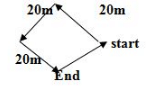
Sarita leaves from home .She walk 25m in North west direction and then 25m in south west direction.Next she walks 25m in south east direction.Finally she turn toward her house.Now in which direction she was moving ?

Detailed Solution: Question 7
EMRS TGT Hindi Mock Test - 2 - Question 8

A, B, C , D ,E , F, G and H are sitting around a circular table in the same order for a discussion at equal distances .Their positions are clockwise.If G sits in the north ,then what will be the position of D?

Detailed Solution: Question 8
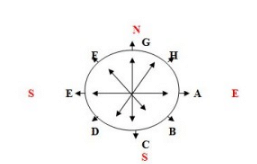

From the diagram, we can see that the position of D is South- west.

EMRS TGT Hindi Mock Test - 2 - Question 9

Setting for the mouse, display, sound, network, and keyboard can be changed in which section of Microsoft Windows?

Detailed Solution: Question 9

  • It consists of options like adding or removing software and hardware, changing accessibility options, controlling user accounts, and changing network settings.
  • It also provides audio and video drivers, input devices, and networking tools.
  • It was first released in the year 1985 and has been part of Microsoft Windows since Windows 1.0.
  • Thus it nearly controls everything about how the windows will work and how it will look.

EMRS TGT Hindi Mock Test - 2 - Question 10

Which is not a browser for surfing the Internet?

Detailed Solution: Question 10

  • Internet Explorer is a series of graphical web browsers and included in the Microsoft Windows line of operating systems.
  • It was developed by Microsoft and started in 1995.
  • Mozilla Firefox is a web browser developed by the Mozilla foundation. 
  • Opera Browser is a web browser developed by Opera Software initially on 10th April 1995.
  • A gaming browser called Opera GX was launched on 11 June 2019

EMRS TGT Hindi Mock Test - 2 - Question 11

Which of the following is NOT an example of hardware?

Detailed Solution: Question 11

Hardware 

Computer hardware is the collection of all the parts of the computer you can physically touch.

For example - computer case, monitor, keyboard, printer, scanner, and mouse, etc. 

Software

Software is a set of programs, which is designed to perform a well-defined function. A program is a sequence of instructions written to solve a particular problem.

For example -  Operating System, Compilers, Interpreter, Assemblers, Payroll Software, Student Record Software, Inventory Management Software, Income Tax Software, Railways Reservation Software, Microsoft Office Suite Software, etc.

There are two types :

  • System Software
  • Application Software

EMRS TGT Hindi Mock Test - 2 - Question 12

In which folder are unfinished emails are stored without sending them?

Detailed Solution: Question 12

The correct answer is Drafts.

Key Points

  • An email is a computer-based communication that is used to exchange messages between users over the internet.
  • This allows the users to send messages to multiple users with the help of email.
  • Inbox is a folder in an email that stores incoming messages. You can see all the received messages in a list. Click each mail to view the content.
  • If you want to store a message temporarily before sending it, you can save it in the Draft folder. It contains unsent emails. Hence option 3 is correct.

Additional Information

  • The trash folder holds all the deleted emails. You can always retrieve the deleted ones before they are permanently deleted. Trash holds the emails for 30 days.
  • Sent folder in the email display all the messages that are sent.
  • Spam emails are also called junk emails or harmful that are sent to a bulk number of users. They are often sent for asking your bank details for fraudulent purposes.
  • To retrieve emails quickly, you can filter the emails. For example, you can filter the emails that have attachment in it.

EMRS TGT Hindi Mock Test - 2 - Question 13

Which of the following Education committee/Education Commission recommended first to stop the problem of wastage and stagnation?

Detailed Solution: Question 13

  • The Hartog Committee (1929), which for the first time pointed out that the “massive wastage and stagnation are taking place in primary education. Primary Education is ineffective unless it at least produces literacy”.
  • While clarifying the meaning of the word in education Hartog Committee remarked the following:“By wastage we mean premature withdrawal of children from schools at any stage before completion of the primary courses”.
  • The Hartog Committee reports, “By stagnation we mean the retention in a lower class of a child for a period of more than one year. Of course stagnation always means wastage”.

EMRS TGT Hindi Mock Test - 2 - Question 14

‘Failure in a class’, according to Hartog is known as

Detailed Solution: Question 14

Students fail and remain in the same class. These failed students repeat the same class and course whereas their other colleagues pass that class and study in the next upper class. This process has been called the process of stagnation. 

EMRS TGT Hindi Mock Test - 2 - Question 15

In which part of Indian Constitution every citizen of India is permitted to give education according to his religion?

Detailed Solution: Question 15

Article 26: gives every religious group a right to establish and maintain institutions for religious and charitable purposes, manage its affairs, properties as per the law. This guarantee is available to only Citizens of India and not to aliens.
Article 30 provides an absolute right to the minorities that they can establish their own linguistic and religious institutions and at the same time can also claim for grant-in-aid without any discrimination. Madarsas enjoy this right in India.

EMRS TGT Hindi Mock Test - 2 - Question 16

Which of the following is the key behaviour contributing to effective teaching?

Detailed Solution: Question 16

Borich states that there are five key behaviors that make effective teachers: lesson clarity, instructional variety, teacher task orientation, engagement in the learning process, and student success rate.
Explanation

  • Lesson clarity:
    • Ideas should be clear to all learners at all levels.
    • Ideas should be conveyed in a clear step-by-step order, they should be uncomplicated and with minimal distractions.
    • For example, using advance organizers at beginning of a lesson and a summary at end of the lesson is very helpful for clarity.
  • Instructional variety:
    • Used of variety of teaching tools (technology, materials, activities, space, and displays).
    • Use a variation in voice and gestures, rewards, and reinforcers.
    • For example, use of a variety of questions: fact questions, process questions, convergent questions, divergent questions, etc.
  • Teacher task orientation:
    • To maximize the time spent teaching, be sure to handle inevitable interruptions quickly, expedite the giving and collecting of materials, prevent or quickly put an end to distracting behavior, organize lessons well, and establish smooth transitions.
  • Engagement in the learning process:
    • Constantly monitor any seat work and group work set rules for when students can leave class without disruption, keep a daily schedule to minimize confusion of students, give independent work that is interesting
    • For example, have abundant resources on hand that are at or slightly above student abilities.
  • Student success rate:
    • Students should spend about 60-70% of their time on tasks that allow an almost complete understanding of the material being taught with only occasional errors.
    • The content should reflect prior learning, with easy to grasp steps for the new material.

Some of the additional behaviors include, set clear and fair expectations, have a positive attitude, are patient with students, and assess their teaching on a regular basis. But, explaining concepts in a logical step-by-step presentation is the key behavior contributing to effective teaching.

Thus, option 4 is the correct answer.

EMRS TGT Hindi Mock Test - 2 - Question 17

Which of the following is effective in enhancing trust in student-teacher relationship?

Detailed Solution: Question 17

Educational objectives can be achieved by a good and healthy relationship between teacher and student. Every teacher should have love and affection towards his/her students. The remarkable performance of the student is developed by the good behavior of the students. it is the responsibility of the teacher to keep relationships with students focused on pedagogical goals and academic requirements.

A good teacher-student relationship is characterized by openness, safety, confidence, unconditional acceptance, empathy, and positive regard.

Explanation Effective in enhancing trust in a student-teacher relationship:

  • An attitude of unconditional acceptance of the student by the teacher.
  • Don’t use or encourage others to use harsh, disparaging, or discouraging words.
  • Don’t encourage any discriminatory words or practices in the class.
  • Don’t encourage unhealthy comparisons and competitions among students.
  • Don’t demean the performance of poor performers in the class rather try to provide them with alternative scopes to enhance their performance.
  • So we can consider that an attitude of unconditional acceptance of the student by the teacher is effective in enhancing trust in the student-teacher relationship.

Other Related Points Relationship between teacher and students can be enhanced by:

  • Mutual Trust and feedback: Teachers and students both should be liable for maintaining trust between each other. This Mutual trust can only build if the teacher is dedicated to giving the right information to the students and the students would express their feelings or any matter to the teacher in a rightful manner.
  • Teacher as a Motivator: Many decisions that a teacher makes have an effect on students' motivation. The grading method a teacher uses, for example, can motivate students to try harder or to give up. Any classroom material chosen with student interest and ability in mind may help motivate students to learn.
  • Warmth and Enthusiasm: Teachers who are warm and friendly inspire and instill positive attitudes and a love for learning in their students. Such teachers are known to be more effective in terms of students' increased attention, achievement, willingness to learn, and favourable attitude towards the content. Positive traits of your personality will maintain a good student-teacher relationship.

EMRS TGT Hindi Mock Test - 2 - Question 18

Which of the following indicates that a student is an active learner?

Detailed Solution: Question 18

Active learning:

  • This is the most desirable method where students/learners play the central role generally.
  • It focuses on 'how' they learn, not just on 'what' they learn.
  • Learners are encouraged to ‘think hard’, rather than receiving information from the teacher passively.

Characteristics of active learner:

  • Students are involved in learning not only in listening.
  • Less emphasis is given on delivering lectures and taking notes.
  • This method emphasis extending students' ideas and skills.
  • Students are involved in higher-order thinking, analysis of facts, synthesis, and evaluation.
  • Students also engaged in activities e.g., reading, writing, discussion, etc..
  • Greater emphasis is placed on students' exploration of their own attitudes, values, and prior experiences.

Conclusion: Attend class regularly or taking notes or answer to a question all are the reflection of the attentiveness of the student in the class. But when a student started asking questions to the teacher about any delivered topic with which he/she is not agreed is a reflection of their activity. In the active learning process, teachers try to challenge their students to think in-depth instead of understanding simple facts only.

EMRS TGT Hindi Mock Test - 2 - Question 19

For the purpose of comprehensive assessment, a teacher should:

Detailed Solution: Question 19

Comprehensive assessment entails the whole system of assessing student understanding as a mechanism to improve teaching and learning. Teachers use multiple strategies to gather and share information about what students understand and to identify where they may be struggling.

Explanation A comprehensive assessment aimed to achieve qualitative education and meet the following objectives of all aspects of learning:

  • Cognitive Approach - Knowledge, understanding, application, analysis, synthesis, evaluation.
  • Effectiveness –  Accepting, responding, assimilating, thinking, organizing, specializing in value group.
  • Functional/Psychomotor – stimulation, control, functioning, disposition, adjustment, habit building.

Thus by all these references, we can consider that learning is done in all the aspects if it is emphasized by the comprehensive assessment, For the purpose of comprehensive assessment, a teacher should consider the outcome as well as the process of learning for students.

Other Related Points The objectives behind creating the Continuous Comprehensive Evaluation (CCE) pattern were:

  • Making the learning process student-friendly
  • Reducing the difficulty level of learning
  • Diagnosing Learning Difficulties
  • Promoting Remedial Learning
  • Emphasizing Student self-evaluation

EMRS TGT Hindi Mock Test - 2 - Question 20

What is the primary objective of teaching?

Detailed Solution: Question 20

Explanation

  • The primary objective of teaching is to transmit knowledge to students. This includes both factual knowledge and conceptual knowledge. Teachers help students to understand the world around them and to develop the skills they need to succeed in life.
  • The other options are incorrect. Disciplining students is important, but it is not the primary objective of teaching. Promoting competition among students can be counterproductive, as it can lead to students feeling stressed and anxious. Encouraging creativity and innovation is important, but it is not the primary objective of teaching.

Here are some other objectives of teaching, in addition to transmitting knowledge:

  • Developing critical thinking skills
  • Fostering a love of learning
  • Preparing students for the workforce
  • Shaping character and values
  • Promoting social and emotional skills

Hence, the correct option is 1.

EMRS TGT Hindi Mock Test - 2 - Question 21

Ruhi always thinks of multiple solutions to a problem many of which are original solutions. Ruhi is displaying characteristics of a/an

Detailed Solution: Question 21

Creative Thinker: Creativity is the ability of a student which creates something new and presents novel ideas. Creative students have the ability to use imagination and critical reasoning to create new and meaningful ideas. Creative students have the ability to create or produce something.

Important Points
The Qualities of Creative Students are as follows:

  • Ability to synthesize and closure
  • Anxious and highly flexible
  • They are neat and have self-actualization ability
  • They are not afraid of abstract objects and thoughts
  • Always in a state of thinking so that he can find various ways to solve a problem
  • Divergent Thinker
  • Quick learner and problem solver

Mistake Point

  • Convergent Thinking: It refers to thinking that is required to solve problems that have only one correct answer. The mind converges to the correct solution. It is based on a number series, where you have to find the next number. Only one right answer is expected.
  • Egocentric speech: It refers to internal communication by which children direct themselves. It is a mechanism to turn shared knowledge into personal knowledge.

Hence, it becomes clear that Ruhi is displaying the characteristics of a Creative Thinker.

EMRS TGT Hindi Mock Test - 2 - Question 22

निर्देश : कविता की पंक्त्तियाँ पढ़कर निम्नलिखित प्रश्नों में सबसे उचित विकल्प चुनिए। 

मेघ आए, बड़े बन-ठन के सँवर के 
आगे-आगे नाचती-गाती बयार चली 
दरवाजे-खिड़कियाँ खुलने लगीं गली-गली 
पाहुन ज्यों आए हों गाँव में शहर के । 
मेघ आए बड़े बन-ठन के सँवर के 
पेड़ झुक झाँकने लगे गरदन उचकाए 
आँधी चली, धूल भागी घाघरा उठाए, 
बाँकी चितवन उठा नदी ठिठकी घूँघट सरके। 
मेघ आए बड़े बन-ठन के सँवर के। 
बूढ़े पीपल ने आगे बढ़कर घर की 
बरस बाद सुधि लीन्ही 
बोली अकुलाई लता ओट हो किवार की 
हरसाया ताल लाया पानी परात भर के 
मेघ आए बड़े बन-ठन के सँवर के 
झितिज-अटारी गहराई दामिनी दमकी, 
क्षमा करो गाँठ खुल गई अब भरम की 
बाँध टूटा झर-झर मिलन के अश्रु ढरके, 
मेघ आए बड़े बन-ठन के सँवर के।

प्रश्न: मेघों के आने से क्या लगता है?

Detailed Solution: Question 22

"पाहुन ज्यों आए हों गाँव में शहर के" प्रयुक्त पंक्ति से यह स्पष्ट होता है की मेघों के आने से ऐसा लगता है जैसे गाँव में मानों शहर से मेहमान आ गये हो।

EMRS TGT Hindi Mock Test - 2 - Question 23

राष्ट्रीय शिक्षा नीति 2020 के अनुसार निम्नलिखित में से कौन-सा ऐसा मूलभूत सिद्धान्त नहीं है जो बड़े स्तर पर शिक्षा प्रणाली और व्यक्तिगत संस्थानों का मार्गदर्शन करेगा?

Detailed Solution: Question 23

राष्ट्रीय शिक्षा नीति 2020 में शिक्षा प्रणाली को विद्यार्थियों के सर्वांगीण विकास और उनकी व्यक्तिगत क्षमताओं के अनुसार ढालने पर जोर दिया गया है।

  • नीति के मूलभूत सिद्धांत बच्चों की विशिष्ट क्षमताओं की पहचान, स्वीकृति और उनके अकादमिक एवं अन्य क्षमताओं के संतुलित विकास पर केंद्रित हैं।

Explanation

  • शिक्षकों और अभिभावकों को बच्चों की विशिष्ट क्षमताओं से अलग रखना ऐसा सिद्धांत नहीं है जो शिक्षा प्रणाली और संस्थानों का मार्गदर्शन करे।
  • नीति का उद्देश्य बच्चों के विकास में शिक्षकों और अभिभावकों की सक्रिय भागीदारी सुनिश्चित करना है।
  • बच्चों की क्षमताओं से उन्हें अलग रखना न केवल विकास में बाधा उत्पन्न करेगा बल्कि नीति के समग्र दृष्टिकोण के विपरीत है।

Hint

  • प्रत्येक बच्चे की विशिष्ट क्षमताओं की पहचान नीति का मूल आधार है।
  • बच्चे की अकादमिक और अन्य क्षमताओं में उसके सर्वांगीण विकास पर जोर नीति का महत्वपूर्ण सिद्धांत है।
  • प्रत्येक बच्चे की विशिष्ट क्षमताओं की स्वीकृति शिक्षा में समावेशिता और समान अवसर सुनिश्चित करती है।

अतः, सही उत्तर है 'शिक्षकों और अभिभावकों को इन विशिष्ट क्षमताओं से अलग रखना'।

EMRS TGT Hindi Mock Test - 2 - Question 24

The following sentence has been split into four segments. Identify the segment that contains a grammatical error.

(1) Ganga was (2) out shopping at the mall (3) and ran over (4) her schoolmate.

Detailed Solution: Question 24

The correct answer is Option 1)
Explanation
  • The primary issue in the sentence is the phrase "ran over" in part 3.
  • The phrase "ran over" implies hitting someone with a vehicle, which is not the intended meaning here.
  • A more appropriate phrase would be "ran into her schoolmate," which means meeting someone by chance.
  • Thus, the error is located in part 3 of the sentence.
  • Therefore, the correct answer is 3.
Correct Sentence: "Ganga was out shopping at the mall and ran into her schoolmate."
Other Related Points
  • 1: "Ganga was" – This part of the sentence is grammatically correct and does not require any changes.
  • 2: "out shopping at the mall" – This part of the sentence is grammatically correct and does not require any changes.
  • 3: "and ran over" – This part contains the error as explained above.
  • No error – This would be the correct option if there were no mistakes in the sentence, but there is an error in part 3.

EMRS TGT Hindi Mock Test - 2 - Question 25

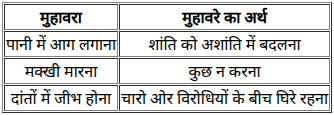
'अण्ड़े का शहजादा' मुहावरा का सही अर्थ का चयन कीजिये |

Detailed Solution: Question 25
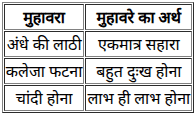
'अंडे का शहजादा' यानी 'अनुभवहीन व्यक्ति'।अतः 'अनुभवहीन व्यक्ति' सही विकल्प है।अन्य सभी विकल्प असंगत है।

  • वाक्य प्रयोग:- गौरव को कुछ नही आता इस धंधे में वो अंडे का शहजादा है।

Explanation

  • मुहावरे की परिभाषा: ऐसे वाक्यांश जो सामान्य अर्थ का बोध न कराकर किसी विलक्षण अर्थ की प्रतीति कराये,मुहावरा कहलाता है।
  • जैसे: परीक्षा होते ही करण चादर तानकर सो गया है।


Other Related Points
अन्य मह्त्वपूर्ण मुहावरे:

EMRS TGT Hindi Mock Test - 2 - Question 26

समस्या-समाधान के लिए किन चीज़ों से बचने के लिए कहा गया है?

Detailed Solution: Question 26

सही उत्तर है - सहानुभूति और दया
Explanation
गद्यांश में लेखक कहता है:-

  • समस्याएँ आने पर हम दूसरों की सहानुभूति चाहते हैं लेकिन सहानुभूति या दया से कोई समस्या हल नहीं होती।
  • दरसल हम मुश्किलों का रोना रोते हैं, लेकिन कभी समाधान के बारे में नहीं सोचते।
  • हम हथियार डालते हुए यह मान लेते हैं, जैसे बड़ी भारी मुसीबत आ गई हो ।
  • दिन-रात इसी मुसीबत के बारे में सोचते हैं, समस्या दिलों-दिमाग पर पूरी तरह छा जाती हैं इस पूरी प्रक्रिया में स्वयं द्वारा किए गए कार्यों का मूल्यांकन करना भूल जाते हैं।

EMRS TGT Hindi Mock Test - 2 - Question 27

Select the most appropriate synonym of the given word.
Enrage

Detailed Solution: Question 27

The correct answer is: Option 3 i.e. Infuriate.

Explanation

  • The word "Enrage" means to make someone very angry. (क्रोधित करना)
    • Example: His rude comments were enough to enrage everyone in the room.
  • "Infuriate" means to make someone extremely angry. (क्रोध दिलाना)
    • Example: Her dismissive attitude infuriated her colleagues.

Therefore, the correct answer is: Infuriate.

Other Related Points

Here are the other options explained along with their Hindi meanings and example sentences:

  • Expand (विस्तार करना): To increase in size, number, or importance.
    • Example: The company plans to expand its operations overseas.
  • Eradicate (समाप्त करना): To destroy or get rid of something completely.
    • Example: Efforts are being made to eradicate polio worldwide.
  • Stimulate (प्रेरित करना): To encourage or cause something to happen or develop.
    • Example: The government introduced measures to stimulate economic growth.

EMRS TGT Hindi Mock Test - 2 - Question 28

Select the most appropriate meaning of the given idiom.
At the eleventh hour

Detailed Solution: Question 28

The correct answer is: Option 1 i.e. At the last possible moment.

Explanation

  • The phrase "At the eleventh hour" means at the last possible moment before a deadline or before something is due to happen. (अंतिम क्षण में)
    • Example: They managed to finalize the project at the eleventh hour, just before the deadline.
  • Hence, we can infer that "At the eleventh hour" means "At the last possible moment."

Therefore, the correct answer is: Option 1 i.e. At the last possible moment.

Other Related Points

Here are the other options explained along with their Hindi meanings and example sentences:

  • At the break of the day (सुबह के समय): Refers to the time when the sun rises and the day begins.
    • Example: She loves to go for a jog at the break of the day.
  • At the present time (वर्तमान समय में): Means currently or at this moment.
    • Example: At the present time, we are focusing on improving our skills.
  • At the distance (दूरी पर): Means being far away or at a remote place.
    • Example: We could see the mountains at the distance.

EMRS TGT Hindi Mock Test - 2 - Question 29

Select the most appropriate meaning of the given idiom.

A storm in a teacup

Detailed Solution: Question 29

The correct answer is: Option 3 i.e. Unnecessary anger or worry.

Explanation

  • The idiom "A storm in a teacup" means a lot of unnecessary anger or worry about something that is not important. (बेकार की चिंता या गुस्सा)
    • Example: The whole argument was just a storm in a teacup; it didn't really matter in the end.
  • "Unnecessary anger or worry" refers to being upset or anxious about something trivial or insignificant. (अनावश्यक गुस्सा या चिंता)
    • Example: His reaction to the small delay was unnecessary anger or worry.
  • Hence, we can infer that the meaning of the idiom "A storm in a teacup" is "Unnecessary anger or worry".

Therefore, the correct answer is: Option 3.

Other Related Points

Here are the other options explained along with their Hindi meanings and example sentences:

  • A hidden advantage (छिपा हुआ लाभ): An unseen or unexpected benefit.
    • Example: The new software has a hidden advantage that makes data processing faster.
  • An easy and pleasant job (आसान और सुखद काम): A task that is both simple and enjoyable.
    • Example: Being a tour guide in a beautiful city is an easy and pleasant job.
  • More than expected or required (उम्मीद से अधिक या आवश्यक से अधिक): Exceeding expectations or requirements.
    • Example: The students' performance in the exam was more than expected or required.

EMRS TGT Hindi Mock Test - 2 - Question 30

Select the most appropriate phrasal verb to fill in the blank.

We need to ________ a solution to this problem before it gets worse.

Detailed Solution: Question 30

The correct answer is 'come up with'.
Explanation
  • The phrasal verb "come up with" means to think of, to devise, or to produce something, such as a plan or an idea. (के बारे में सोचना या प्रस्ताव देना)
  • Using "come up with" implies that there is an active effort to find or create a solution.
  • The other options: "cut down on," "break down," and "break up" do not fit the context as appropriately.

Therefore, the correct answer is 'Option 4'.

Complete Sentence: We need to come up with a solution to this problem before it gets worse.

Other Related Points
  • Cut down on (कमी करना): means to reduce the amount of something.
  • Break down (टूटना): means to stop working properly or to analyze something in detail.
  • Break up (तोड़ना): means to end a relationship or to disperse.

View more questions
5 docs|25 tests
Information about EMRS TGT Hindi Mock Test - 2 Page
In this test you can find the Exam questions for EMRS TGT Hindi Mock Test - 2 solved & explained in the simplest way possible. Besides giving Questions and answers for EMRS TGT Hindi Mock Test - 2, EduRev gives you an ample number of Online tests for practice
Download as PDF