CUET Exam  >  CUET Test  >   UG Mock Test Series 2026  >  English Language Mock Test - 10 - CUET MCQ

CUET UG English Language Mock Test - 10 Free Online Test 2026


Full Mock Test & Solutions: English Language Mock Test - 10 (50 Questions)

You can boost your CUET 2026 exam preparation with this English Language Mock Test - 10 (available with detailed solutions).. This mock test has been designed with the analysis of important topics, recent trends of the exam, and previous year questions of the last 3-years. All the questions have been designed to mirror the official pattern of CUET 2026 exam, helping you build speed, accuracy as per the actual exam.

Mock Test Highlights:

  • - Format: Multiple Choice Questions (MCQ)
  • - Duration: 60 minutes
  • - Total Questions: 50
  • - Analysis: Detailed Solutions & Performance Insights

Sign up on EduRev for free and get access to these mock tests, get your All India Rank, and identify your weak areas to improve your marks & rank in the actual exam.

English Language Mock Test - 10 - Question 1

Which significant battle did Pharaoh Ramses II fight against the Hittite Empire?

Detailed Solution: Question 1

The passage states that one of the most notable military campaigns of Pharaoh Ramses II was the Battle of Kadesh, fought against the Hittite Empire under Muwatalli II near the city of Kadesh on the Orontes River. This makes option (b) the correct answer.

  • Option (a) Battle of Megiddo was fought by Pharaoh Thutmose III.
  • Option (c) Battle of Thermopylae was fought between the Greeks and the Persians.
  • Option (d) Battle of Marathon was part of the Greco-Persian Wars.

English Language Mock Test - 10 - Question 2

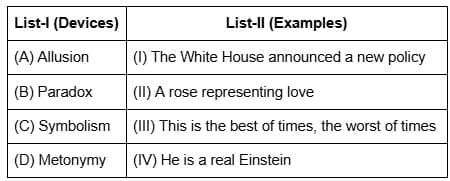
Match the literary devices in List-I with their examples in List-II.
Detailed Solution: Question 2

"Allusion" is indirect reference, as in calling someone "Einstein" for genius (IV). "Paradox" presents contradictory ideas, like "best of times, worst of times" (III). "Symbolism" uses objects to represent ideas, e.g., a rose for love (II). "Metonymy" substitutes related terms, such as "White House" for the U.S. government (I). Devices like these layer meaning in literature.

English Language Mock Test - 10 - Question 3

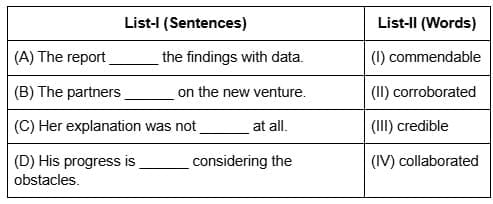
Complete the sentences in List-I with the appropriate words from List-II.
Detailed Solution: Question 3

Reports "corroborate" findings with data. Business partners "collaborate." An explanation must be "credible" to be believable. Progress that deserves praise is "commendable." Therefore Option D is correct.

English Language Mock Test - 10 - Question 4

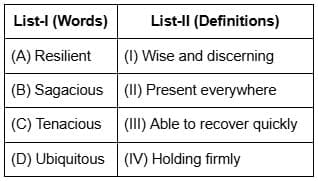
Match the words in List-I with their definitions in List-II.
Detailed Solution: Question 4

"Resilient" means bouncing back from setbacks, as in (III). "Sagacious" describes sound judgment, matching (I). "Tenacious" refers to persistent grip, aligning with (IV). "Ubiquitous" means omnipresent, corresponding to (II). These words describe qualities or states.

English Language Mock Test - 10 - Question 5

Re-arrange the following phrases in the right sequence to form a meaningful sentence.
(A) through a powerful telescope
(B) the astronomer observed stars
(C) in the observatory
(D) mapping the night sky

Detailed Solution: Question 5

The correct sequence forms the sentence: "In the observatory, the astronomer observed stars through a powerful telescope, mapping the night sky." Location sets the scene, followed by action, tool, and purpose. Astronomical observations are framed by setting and instruments for systematic charting.

English Language Mock Test - 10 - Question 6

Re-arrange the following phrases in the right sequence to form a meaningful sentence.
(A) to grow vibrant flowers
(B) nurturing them daily
(C) in fertile soil
(D) the gardener planted seeds

Detailed Solution: Question 6

The correct sequence forms the sentence: "The gardener planted seeds in fertile soil, nurturing them daily to grow vibrant flowers." Location and care lead to goal. Horticultural practices involve ongoing care for growth.

English Language Mock Test - 10 - Question 7

Re-arrange the following phrases in the right sequence to form a meaningful sentence.
(A) of marginalized communities
(B) gaining widespread support
(C) the activist campaigned for rights
(D) through peaceful protests

Detailed Solution: Question 7

The correct sequence forms the sentence: "The activist campaigned for rights of marginalized communities through peaceful protests, gaining widespread support." Object, method, and result follow. Activism histories show nonviolent approaches building alliances.

English Language Mock Test - 10 - Question 8

Re-arrange the following phrases in the right sequence to form a meaningful sentence.
(A) in the stadium
(B) the athlete celebrated victory
(C) with arms raised high
(D) after crossing the finish line

Detailed Solution: Question 8

The correct sequence forms the sentence: "The athlete celebrated victory in the stadium after crossing the finish line with arms raised high." The main clause comes first, followed by place, time, and manner.

English Language Mock Test - 10 - Question 9

Re-arrange the following phrases in the right sequence to form a meaningful sentence.
(A) using advanced algorithms
(B) for everyday use
(C) the programmer coded an app
(D) that solved complex problems

Detailed Solution: Question 9

The correct sequence forms the sentence: "The programmer coded an app using advanced algorithms that solved complex problems for everyday use." Method and function precede purpose. Programming methodologies apply algorithms for practical solutions.

English Language Mock Test - 10 - Question 10

Fill in the blank with the correct option.
The project was completed ahead of schedule ______ the team's efficient collaboration.

Detailed Solution: Question 10

"Due to" is a prepositional phrase expressing cause and is correctly followed by the noun phrase "the team's efficient collaboration." It explains the reason for early completion. Options like "because" would require a clause (e.g., "because the team collaborated efficiently"), while "despite" and "although" indicate contrast rather than cause.

English Language Mock Test - 10 - Question 11

Fill in the blank with the correct option.
She would have won the award if she ______ harder for the competition.

Detailed Solution: Question 11

The past perfect "had prepared" is used in the third conditional to express a hypothetical past situation where better preparation could have changed the outcome. This tense contrasts with present forms like "prepares." Conditional structures in grammar allow for discussing unrealised possibilities, aiding in reflective narratives about efforts and results.

English Language Mock Test - 10 - Question 12

Fill in the blank with the correct option.
When the truth came out, he had to ______ and admit his mistake.

Detailed Solution: Question 12

The idiom "face the music" means to accept the unpleasant consequences of one's actions, suiting the scenario of admitting a mistake after revelation. Unlike "hit the jackpot" (achieve great success), it conveys accountability. Idiomatic expressions like this are used in everyday language to describe confronting difficult realities in personal or professional situations.

English Language Mock Test - 10 - Question 13

Fill in the blank with the correct option.
The CEO's vision for the company was ______ innovative, sparking industry-wide changes.

Detailed Solution: Question 13

"Profoundly" means deeply or significantly, emphasizing the depth of innovation that led to widespread impact. This opposes "superficially" or "marginally," which suggest shallow or minor effects. In business analyses, such adverbs describe the extent of influence exerted by leadership strategies on market dynamics.

English Language Mock Test - 10 - Question 14

In 1279 BC, the realm of Egypt was under the autocratic rule of Pharaoh______.

Detailed Solution: Question 14

The correct answer is 'Ramses II'

Key Points

  • The passage specifies that in "1279 BC, the realm of Egypt was under the autocratic rule of Pharaoh Ramses II," indicating the pharaoh's identity during this historical period.
  • Ramses II is also referred to as "Ramses the Great," a testament to his formidable leadership and the significant military campaigns under his rule.
  • The Battle of Kadesh, a notable event during Ramses II's rule, serves as an additional identifying factor, linking Ramses II to the specified time frame.
  • Ramses II's proactive reaction to the Hittites' territorial expansion into his vassal states further emphasizes his autocratic rule during this era.

Therefore, the correct answer is Option 3, Ramses II.

English Language Mock Test - 10 - Question 15

Statement (i) - Ramses II led Egypt during the Battle of Kadesh.
Statement (ii) - The Hittites surrendered in the Battle of Kadesh.

Choose the right option:

Detailed Solution: Question 15

The correct answer is 'Statement (i) is true, and Statement (ii) is false'.

Key Points

  • The initial part of your earlier passage explicitly states that "In 1279 BC, the realm of Egypt was under the autocratic rule of Pharaoh Ramses II." It further identifies Ramses II as the leader of Egypt during the Battle of Kadesh, "With these territories viewed as part of his vassal states, Ramses II commanded a sizeable force to retake control." Therefore, Statement (i) is accurate in claiming Ramses II's leadership at the time of the battle.
  • As for Statement (ii), the text details that "Despite the odds, these forces battled to a stalemate," which clearly indicates that neither the Egyptians under Ramses II nor the Hittites under Muwatalli II surrendered. The battle ended in a stalemate, leading to an ensuing peace treaty.
  • Given these insights from the passage, it's evident that the Hittites did not surrender during the Battle of Kadesh.
  • These highlights from the passage, therefore, solidify that Ramses II led Egypt during the Battle of Kadesh and the Hittites did not surrender in this battle.

Therefore, the correct answer is Option 1, Statement (i) is true, and Statement (ii) is false

English Language Mock Test - 10 - Question 16

What was the cause of the Battle of Kadesh and its final outcome under Pharaoh Ramses II's reign?

Detailed Solution: Question 16

The correct answer is 'Ramses II was opposing Hittite expansion into his territories, and the battle ended in a historic peace treaty.'

Key Points

  • The Battle of Kadesh was instigated by territorial disputes, as Ramses II was opposing the Hittite's expansion into vassal states he deemed his, as stated, "The battle, believed to be the earliest in recorded history, found its genesis in the Pharaoh's fury over Hittite expansion into Syrian territories."
  • Both Ramses II and Muwatalli II marshalled large forces for the battle, demonstrating the significance of the conflict, as highlighted in the passage, "Ramses II commanded a sizeable force to retake control. Muwatalli, resilient, countered with a similarly large force..."
  • There was manipulation of intel by the Hittites claiming their forces were further away, which was later discovered by the Egyptians, as in the excerpt, "The Hittites tricked Egyptian intelligence, claiming their forces were further off, fortifying their defensive postures."
  • The battle did not result in a decisive victory for either side but led to a peace treaty, as stated, "Despite the odds, these forces battled to a stalemate, leading to a historic peace treaty."

Therefore, the correct answer is Option 2.

English Language Mock Test - 10 - Question 17

Why has the method, by which we may master any subject, not been applied to language?

Detailed Solution: Question 17

Refer to the line "It has not been applied to language… held on with wonderful tenacity." It says that the old method has been in existence even before modern science was invented and we have held onto it with determination. Hence, option (a) is the correct answer.

English Language Mock Test - 10 - Question 18

Which of the following is the meaning of 'splitting hairs', as used in the passage?

Detailed Solution: Question 18

'Split hairs' is an idiom, which means to try to make petty distinctions. Hence, option (c) is the correct answer.

English Language Mock Test - 10 - Question 19

Which of the following can be said to be true about languages like Latin and Greek?

Detailed Solution: Question 19

Option (a) is incorrect since the passage says that the ancient languages (Greek and Latin) were mechanical systems. It is the modern language that depends upon logical relationships. Options (c) and (d) are incorrect because the passage does not tell us if and how the ancient languages can be mastered. Option (b) can be directly inferred from the passage. Hence, option (b) is the correct answer.

English Language Mock Test - 10 - Question 20

What has been described as a horrifying task in the passage?

Detailed Solution: Question 20

The passage says that as far as spellings are concerned, the irregularities of our language have left us with no other choice than to memorise them and memorising every word seems to be an appaling task. 'Memorising every word' means memorising the spelling of every word. Hence, option (b) is the correct answer.

English Language Mock Test - 10 - Question 21

What issues, according to the passage, should form the basis for the Left to rise and be counted?

Detailed Solution: Question 21

Refer to the last sentence of the first paragraph. "…issues concerning economic deprivation… foundation of any reinvention of the Left." So, option (c) is the correct answer.

English Language Mock Test - 10 - Question 22

Why have remedial measures been taken in Bolivia, Cuba and Venezuela?

Detailed Solution: Question 22

Refer to the first sentence of the third paragraph. It clearly says that the measures have been taken to check the erratic plays or unpredictable moves of market forces. So, option (c) is the correct answer.

English Language Mock Test - 10 - Question 23

Hegemony means

Detailed Solution: Question 23

'Hegemony' means influence or control over another country, a group of people, etc.

English Language Mock Test - 10 - Question 24

What do you feel is the political ideology of leaders like Hugo Chavez, Fidel Castro and Evo Morales?

Detailed Solution: Question 24

Refer to the first sentence of the second paragraph.
It clearly states that the three have moved towards the international agenda for social reconstruction within which socialism must be put forward as a programme to salvage a world from inequality, abuse of power and the hegemony of the US. So, option (b) is the correct answer.

English Language Mock Test - 10 - Question 25

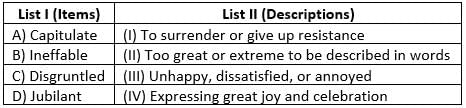
Match the Items in List-I with their Description in List-II :
Detailed Solution: Question 25

A) Capitulate means to surrender or give up resistance.
B) Ineffable refers to something so extreme or extraordinary that it cannot be described.
C) Disgruntled means unhappy or dissatisfied.
D) Jubilant refers to expressing great joy or celebration.

English Language Mock Test - 10 - Question 26

Match the Items in List-I with their Description in List-II :
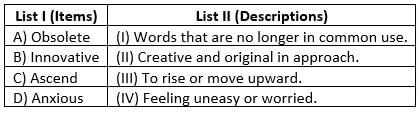
Detailed Solution: Question 26

A) Obsolete refers to words or things that are no longer in common use.
B) Innovative means being creative and original, often in a new or groundbreaking way.
C) Ascend means to rise or move upward, such as in a physical or metaphorical sense.
D) Anxious refers to a feeling of worry or unease.

English Language Mock Test - 10 - Question 27

Match the Items in List-I with their Description in List-II :
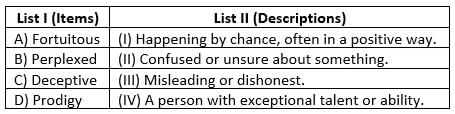
Detailed Solution: Question 27

A) Fortuitous means something that happens by chance, usually with a positive outcome.
B) Perplexed describes the state of being confused or unsure.
C) Deceptive refers to something that is misleading or intended to trick others.
D) Prodigy refers to a person with exceptional abilities or talents, particularly at a young age.

English Language Mock Test - 10 - Question 28

Match the Items in List-I with their Description in List-II :
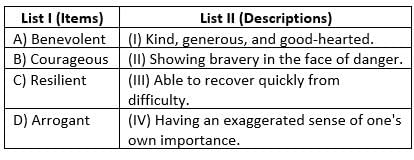
Detailed Solution: Question 28

A) Benevolent means being kind, generous, and caring toward others.
B) Courageous refers to showing bravery, especially when facing danger or adversity.
C) Resilient means being able to recover quickly from difficult situations or setbacks.
D) Arrogant describes a person with an inflated sense of their own importance, often leading to a lack of humility.

English Language Mock Test - 10 - Question 29

Match the Items in List-I with their Description in List-II :
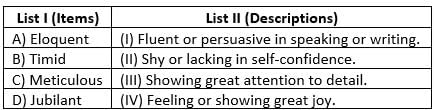
Detailed Solution: Question 29

A) Eloquent means speaking or writing in a fluent, persuasive, and effective manner.
B) Timid refers to being shy, lacking confidence, or easily frightened.
C) Meticulous means paying close attention to detail, being careful and precise.
D) Jubilant refers to a feeling of great joy, often expressed outwardly.

English Language Mock Test - 10 - Question 30

Select the word OPPOSITE in meaning to the underlined word.
The rigid rules upset the students.

Detailed Solution: Question 30

"Rigid" means stiff, inflexible, or unyielding, often used to describe rules or structures. The opposite would be something adaptable or bendable. "Strict," "firm," and "tough" are all synonyms of "rigid," as they indicate inflexibility. "Flexible" means capable of bending or adapting, which is the opposite of "rigid." Therefore, the correct answer is a) flexible.

View more questions
41 docs|160 tests
Information about English Language Mock Test - 10 Page
In this test you can find the Exam questions for English Language Mock Test - 10 solved & explained in the simplest way possible. Besides giving Questions and answers for English Language Mock Test - 10, EduRev gives you an ample number of Online tests for practice
Download as PDF