CBSE Class 10  >  Class 10 Test  >  Olympiad Preparation  >  Math Olympiad Test: Real Numbers- 4 - Class 10 MCQ

Math Olympiad Test: Real Numbers- 4 - Free MCQ with solutions Class 10


MCQ Practice Test & Solutions: Math Olympiad Test: Real Numbers- 4 (10 Questions)

You can prepare effectively for Class 10 Olympiad Preparation for Class 10 with this dedicated MCQ Practice Test (available with solutions) on the important topic of "Math Olympiad Test: Real Numbers- 4". These 10 questions have been designed by the experts with the latest curriculum of Class 10 2026, to help you master the concept.

Test Highlights:

  • - Format: Multiple Choice Questions (MCQ)
  • - Duration: 10 minutes
  • - Number of Questions: 10

Sign up on EduRev for free to attempt this test and track your preparation progress.

Math Olympiad Test: Real Numbers- 4 - Question 1

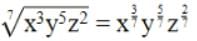
The rationalising factor of  is ____.

Detailed Solution: Question 1

Given number: 
Rationalising factor is the number which when multiplied with given number removes all surds.
∴ Rationalising factor = 

Math Olympiad Test: Real Numbers- 4 - Question 2

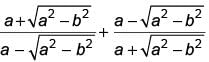
The value of  is ____.

Detailed Solution: Question 2

We have, 
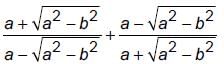
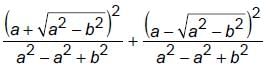
Rationalising both terms, we get

Math Olympiad Test: Real Numbers- 4 - Question 3

A real number  will have ________. 

Detailed Solution: Question 3
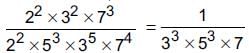
Given number,

If the prime factorisation of denominator has power of 2, power of 5 or both, then the number should always be terminating decimals. So, it is a non-terminating and repeating decimal expansion.

Math Olympiad Test: Real Numbers- 4 - Question 4

Which of the following is an irrational number?

Detailed Solution: Question 4

π is an irrational number, which means that it is a real number that cannot be expressed by a simple fraction. That's because pi is what mathematicians call an "infinite decimal" — after the decimal point, the digits go on forever and ever.

Math Olympiad Test: Real Numbers- 4 - Question 5

In a seminar the number of participants in Mathematics, Physics and Biology are 192, 240 and 168. Find the minimum number of rooms required if in each room same number of participants is to be seated and all of them being in the same subject.

Detailed Solution: Question 5

HCF of (192, 240, 168) = 2 × 2 × 2 × 3 = 24
Number of rooms for participants in Mathematics, Physics and Biology respectively is= 192/24 = 8, 240/24 = 10 and 168/24 = 7
∴ Total minimum number of required rooms = 25

Math Olympiad Test: Real Numbers- 4 - Question 6

According to the Fundamental Theorem of Arithmetic, if p (a prime number) divides b2 and b is positive, then ________.

Detailed Solution: Question 6

Let b = p1​, p2​, p3​, p4​.....pn​ where p1​, p2​, p3​,.. are prime numbers which are necessarily not distinct,  
⇒ b2 = (p1​, p2​, p3​, p4.....pn​)(p1​, p2​, p3​, p4​.....pn​) 
It is given that p divides b2
From Fundamental theorem of Arithmetic, we know that every composite number can be expressed as product of unique prime numbers. 
This means p belongs to p1​, p2​, p3​, ..pn​ and is one of them.
Also, b = p1​, p2​, p3​, p4​...pn​, thus p divides b.

Math Olympiad Test: Real Numbers- 4 - Question 7

A boy multiplied 987 by a certain number and obtained 559981 as his answer. If in the answer both 9s are wrong and the other  digits are correct, then the correct answer would be ________.

Detailed Solution: Question 7

987 = 3 × 7 × 47
So, the required number must be divisible by each one of 3, 7, 47.
553681→ (Sum of digits = 28, not divisible by 3)
555181→ (Sum of digits = 25, not divisible by 3)
555681 is divisible by 3, 7, 47.

Math Olympiad Test: Real Numbers- 4 - Question 8

Sam, Advik and Trishu go for a morning walk. They step off together and their steps measure 35 cm, 32 cm and 40 cm, respectively. What is the minimum distance each should walk so that each can cover the same distance in complete steps?

Detailed Solution: Question 8

L.C.M. (35, 32, 40) = 25 × 5 × 7 = 1120
So, each should walk 1120 cm so that each can cover the same distance in complete steps.

Math Olympiad Test: Real Numbers- 4 - Question 9

Four different electronic devices make a beep after every 30 minutes, 1 hour, 1(1/2) hour and 1 hour 45 minutes respectively. All the devices beeped together at 12 noon. They will again beep together at ________.

Detailed Solution: Question 9

First device beeps in every 30 min
Second device beeps in every 60 min
Third device beeps in every 90 min
Fourth device beeps in every 105 min
That means together they beep after how many minutes
We calculate LCM(30, 60, 90, 105)
30 = 2 × 3 × 5
60 = 2 × 2 × 3 × 5
90 = 2 × 3 × 3 × 5
105 = 3 × 5 × 7
So, LCM = 22 × 32 × 5 × 7 = 1260
⇒ ie, in 601260​ = 21hrs they beep together.
⇒ All beeped together after 12 noon at 21 hrs later. i.e, (12 + 21)hrs = 9 a.m.
∴  Next, they will beeped together at 9 a.m.

Math Olympiad Test: Real Numbers- 4 - Question 10

A boy was asked to multiply a given number by (8/17). Instead, he divided the given number by (8/17) and got the result 225 more than what he should have got if he had multiplied the number by (8/17). The given number was ________.

Detailed Solution: Question 10

Let the number be x.
Then, according to question, 
⇒ 225x = 8 × 17 × 225 ⇒ x = 136

70 videos|236 docs|187 tests
Information about Math Olympiad Test: Real Numbers- 4 Page
In this test you can find the Exam questions for Math Olympiad Test: Real Numbers- 4 solved & explained in the simplest way possible. Besides giving Questions and answers for Math Olympiad Test: Real Numbers- 4, EduRev gives you an ample number of Online tests for practice
Download as PDF