NEET PG Exam  >  NEET PG Tests  >  Test: C.O.P.D & Bronchiectasis and Suppurative Lung Diseases- 1 - NEET PG MCQ

Test: C.O.P.D & Bronchiectasis and Suppurative Lung Diseases- 1 - NEET PG MCQ


Test Description

20 Questions MCQ Test - Test: C.O.P.D & Bronchiectasis and Suppurative Lung Diseases- 1

Test: C.O.P.D & Bronchiectasis and Suppurative Lung Diseases- 1 for NEET PG 2025 is part of NEET PG preparation. The Test: C.O.P.D & Bronchiectasis and Suppurative Lung Diseases- 1 questions and answers have been prepared according to the NEET PG exam syllabus.The Test: C.O.P.D & Bronchiectasis and Suppurative Lung Diseases- 1 MCQs are made for NEET PG 2025 Exam. Find important definitions, questions, notes, meanings, examples, exercises, MCQs and online tests for Test: C.O.P.D & Bronchiectasis and Suppurative Lung Diseases- 1 below.
Solutions of Test: C.O.P.D & Bronchiectasis and Suppurative Lung Diseases- 1 questions in English are available as part of our course for NEET PG & Test: C.O.P.D & Bronchiectasis and Suppurative Lung Diseases- 1 solutions in Hindi for NEET PG course. Download more important topics, notes, lectures and mock test series for NEET PG Exam by signing up for free. Attempt Test: C.O.P.D & Bronchiectasis and Suppurative Lung Diseases- 1 | 20 questions in 20 minutes | Mock test for NEET PG preparation | Free important questions MCQ to study for NEET PG Exam | Download free PDF with solutions
Test: C.O.P.D & Bronchiectasis and Suppurative Lung Diseases- 1 - Question 1

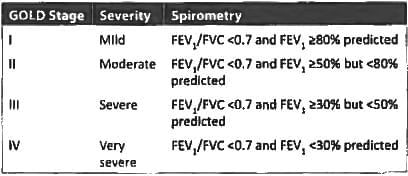
Gold Criteria for very severe COPD is defined as? (Recent Pattern 2018)
Detailed Solution for Test: C.O.P.D & Bronchiectasis and Suppurative Lung Diseases- 1 - Question 1

Gold Criteria for Severity of Airflow Obstruction In COPD

Abbreviation: COPD stands for chronic obstructive pulmonary disease; GOLD refers to the Global Initiative for Lung Disease.

Test: C.O.P.D & Bronchiectasis and Suppurative Lung Diseases- 1 - Question 2

Which is correct about ILD? (Recent Pattern Questions)

Detailed Solution for Test: C.O.P.D & Bronchiectasis and Suppurative Lung Diseases- 1 - Question 2

In ILD, oxygen levels are typically normal but can decrease due to a diffusion defect. The levels are further reduced during a 6-minute walk test.

Additionally, the washout of carbon dioxide results in respiratory alkalosis as a consequence of hyperventilation.

Test: C.O.P.D & Bronchiectasis and Suppurative Lung Diseases- 1 - Question 3

Increased Reid index is classically associated with? (APPG 2016)

Detailed Solution for Test: C.O.P.D & Bronchiectasis and Suppurative Lung Diseases- 1 - Question 3

Reid's index is a ratio between the thickness of the submucosal mucus secreting glands and the thickness between the epithelium and cartilage that covers the bronchi.
A normal Reid Index should be smaller than 0.4, the thickness of the wall is always more than double the thickness of the glands it contains. Chronic smoking causes submucosal gland hypertrophy and hyperplasia, leading to a Reid Index of >0.5 indicating chronic bronchitis.

Test: C.O.P.D & Bronchiectasis and Suppurative Lung Diseases- 1 - Question 4

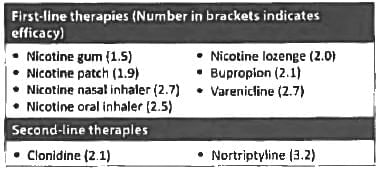
Which are the drugs used for smoking cessation? (Bihar PG 2015)
Detailed Solution for Test: C.O.P.D & Bronchiectasis and Suppurative Lung Diseases- 1 - Question 4

Effective Pharmacologic Interventions

Test: C.O.P.D & Bronchiectasis and Suppurative Lung Diseases- 1 - Question 5

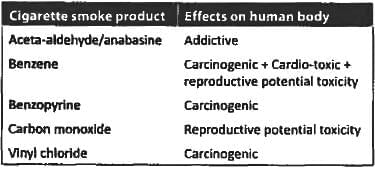
Which component of cigarette smoke is responsible for CAD? (Recent Question 2015-16)
Detailed Solution for Test: C.O.P.D & Bronchiectasis and Suppurative Lung Diseases- 1 - Question 5

Test: C.O.P.D & Bronchiectasis and Suppurative Lung Diseases- 1 - Question 6

Smoking causes all cancers EXCEPT? (Recent Question 2015-16)

Detailed Solution for Test: C.O.P.D & Bronchiectasis and Suppurative Lung Diseases- 1 - Question 6

Smoking does not lead to primary brain cancer. However, it is linked to kidney and bladder cancers. Tobacco use is responsible for cancers affecting the:

  • lip
  • oral cavity
  • nasopharynx
  • oropharynx
  • nasal cavity
  • stomach
  • esophagus
  • pancreas
  • colon
  • rectum
  • genitourinary system
  • acute myeloid leukaemia
Test: C.O.P.D & Bronchiectasis and Suppurative Lung Diseases- 1 - Question 7

Central bronchiectasis is seen with? (Recent Pattern 2015-16)

Detailed Solution for Test: C.O.P.D & Bronchiectasis and Suppurative Lung Diseases- 1 - Question 7

Central bronchiectasis is frequently observed in conjunction with ABPA and is also associated with cystic fibrosis. In cystic fibrosis, bronchiectasis is central and primarily affects the upper lobes, unlike post-infectious bronchiectasis, which typically occurs in the lower lobes.

  • In adults with cystic fibrosis, the disease tends to be more widespread than in idiopathic bronchiectasis, involving five or six lobes.
  • In conditions with compromised mucociliary clearance, involvement of the lower lobes is more prevalent.
Test: C.O.P.D & Bronchiectasis and Suppurative Lung Diseases- 1 - Question 8

Bronchiectasis sicca is seen with: (Recent Pattern 2014-15)

Detailed Solution for Test: C.O.P.D & Bronchiectasis and Suppurative Lung Diseases- 1 - Question 8

Bronchiectasis sicca, or dry bronchiectasis, is an uncommon condition characterised by all the symptoms of bronchiectasis, but notably lacking the excessive sputum production typically associated with it. HRCT reveals abnormal dilation of the bronchial tree without the presence of infective sputum. This condition arises as a result of tuberculosis.

Test: C.O.P.D & Bronchiectasis and Suppurative Lung Diseases- 1 - Question 9

All are complications of bronchiectasis except: (Recent Pattern 2014-15)

Detailed Solution for Test: C.O.P.D & Bronchiectasis and Suppurative Lung Diseases- 1 - Question 9

Due to the presence of infection in the lungs, hematogenous spread of the infection may result in abscess formation in either the brain or the lungs. As this infection is chronic, AA type amyloidosis can develop.

Test: C.O.P.D & Bronchiectasis and Suppurative Lung Diseases- 1 - Question 10

All are seen in emphysema except: (Recent Pattern 2014-15)

Detailed Solution for Test: C.O.P.D & Bronchiectasis and Suppurative Lung Diseases- 1 - Question 10

Rhonchi are observed in chronic bronchitis, whereas they are absent in emphysema, where the presence of blebs in the airways results in air trapping.

  • A hyper-inflated chest is typical in emphysema.
  • The deterioration of alveoli in emphysema results in a decreased DLCO.
Test: C.O.P.D & Bronchiectasis and Suppurative Lung Diseases- 1 - Question 11

Emphysema presents with all except: (Recent Pattern 2014-15)

Detailed Solution for Test: C.O.P.D & Bronchiectasis and Suppurative Lung Diseases- 1 - Question 11

Emphysema is defined by damage to the respiratory bronchioles, which results in the formation of blebs. This leads to air being trapped in the lungs, causing hypoxia. However, these individuals do not exhibit cyanosis and are referred to as PINK PUFFERS.
The primary cause of emphysema is cigarette smoking, and the specific type identified is known as centri-acinar emphysema. Patients suffering from this condition often develop type 1 respiratory failure, and the resulting hypoxia contributes to a barrel-shaped chest in these individuals.

Test: C.O.P.D & Bronchiectasis and Suppurative Lung Diseases- 1 - Question 12

The drug varenicline is used in: (Recent Pattern 2014-15)

Detailed Solution for Test: C.O.P.D & Bronchiectasis and Suppurative Lung Diseases- 1 - Question 12

Varenicline functions as a partial agonist for the α4β2 subtype of the nicotinic acetylcholine receptor. Additionally, it interacts with α3β4 and has a weak effect on α3β2 and α6-containing receptors.

  • As a partial agonist, varenicline attaches to and partially activates the α4β2 receptor, but it does not elicit the full response that nicotine does.
  • Due to its competitive binding at these receptors, varenicline inhibits nicotine's ability to bind and activate the mesolimbic dopamine system.

Varenicline also functions as an agonist at 5-HT receptors, which might play a role in the mood-altering effects associated with varenicline.

Test: C.O.P.D & Bronchiectasis and Suppurative Lung Diseases- 1 - Question 13

False about emphysema is: (Recent Pattern 2014-15)

Detailed Solution for Test: C.O.P.D & Bronchiectasis and Suppurative Lung Diseases- 1 - Question 13

Increased diffusion capacity can be observed in:

  • Acute congestive heart failure
  • Asthma
  • Polycythaemia
  • Pulmonary haemorrhage/Good pasture syndrome

Decreased diffusion capacity is noted in:

  • Pulmonary fibrosis
  • Emphysema
  • Pulmonary hypertension
Test: C.O.P.D & Bronchiectasis and Suppurative Lung Diseases- 1 - Question 14
All are seen in chronic bronchitis except? (Recent Pattern 2014-15)
Detailed Solution for Test: C.O.P.D & Bronchiectasis and Suppurative Lung Diseases- 1 - Question 14

The three primary symptoms in COPD include:

  • cough
  • sputum production
  • exertional dyspnoea

Numerous patients experience these symptoms for months or even years prior to seeking medical assistance. While the progression of airflow obstruction is a gradual phenomenon, many individuals attribute the beginning of their condition to an acute illness or exacerbation. In advanced cases, some patients exhibit a paradoxical inward movement of the rib cage during inspiration (known as Hoover's sign). This occurs due to a change in the vector of diaphragmatic contraction on the rib cage as a consequence of chronic hyperinflation.

Test: C.O.P.D & Bronchiectasis and Suppurative Lung Diseases- 1 - Question 15
The complication least likely to occur in a case of chronic bronchitis is: (Recent Pattern 2014-15)
Detailed Solution for Test: C.O.P.D & Bronchiectasis and Suppurative Lung Diseases- 1 - Question 15

Spontaneous pneumothorax occurs as a result of a bulla rupture in an emphysematous individual. Chronic hypoxia associated with chronic bronchitis results in:

  • Pulmonary artery hypertension
  • Cor pulmonale

Retention of CO2 causes respiratory acidosis. The prolonged duration of the condition can lead to AA-type amyloidosis.

Test: C.O.P.D & Bronchiectasis and Suppurative Lung Diseases- 1 - Question 16

Chronic Cor pulmonale is seen in all except: (PGI-Dec-04)

Detailed Solution for Test: C.O.P.D & Bronchiectasis and Suppurative Lung Diseases- 1 - Question 16

Extensive pulmonary embolism results in acute cor pulmonale.

Test: C.O.P.D & Bronchiectasis and Suppurative Lung Diseases- 1 - Question 17
Bilateral Rhonchii may be seen in all of the following Except (PGI June 08)
Detailed Solution for Test: C.O.P.D & Bronchiectasis and Suppurative Lung Diseases- 1 - Question 17

Pulmonary embolism results in cor pulmonale, characterised by:

  • loud P2
  • murmur of TR
  • S3 gallop
  • RV heave
  • ascites

The lungs exhibit pulmonary oligamia without any distinct findings.

Test: C.O.P.D & Bronchiectasis and Suppurative Lung Diseases- 1 - Question 18

A 40-year-old male alcoholic presents with features of fever and productive cough that increases with posture change. CXR of the patient is given below. Which of the following is the most appropriate management of this patient? (AIIMS Nov 2016)
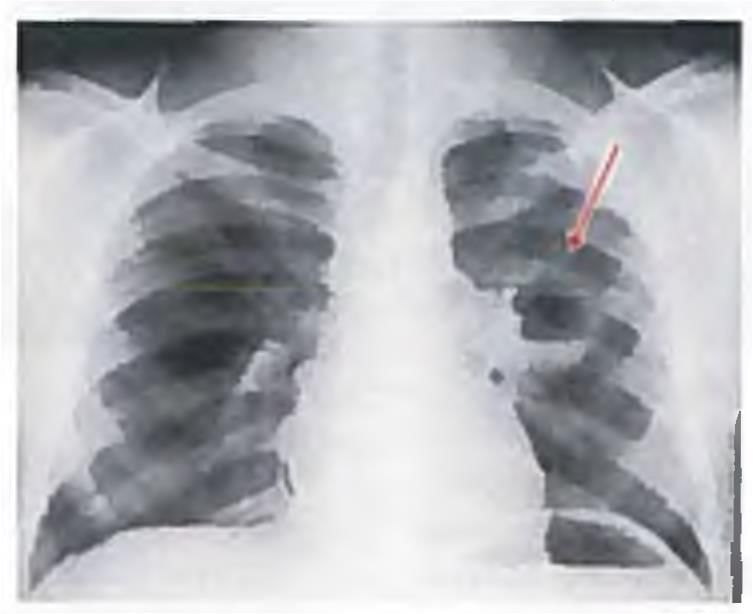
Detailed Solution for Test: C.O.P.D & Bronchiectasis and Suppurative Lung Diseases- 1 - Question 18

The CXR reveals an air fluid level characteristic of a lung abscess. A history of alcoholism increases the likelihood of suppression of the protective airway reflexes due to alcohol consumption.

  • This allows anaerobic organisms present in saliva to enter the airway, potentially leading to the formation of a suppurative lung abscess.
  • The primary clinical indicator of a lung abscess is a change in the posture of purulent sputum.

The most effective antibiotic for treating an anaerobic lung abscess is Clindamycin. In this instance, Metronidazole is ineffective. Tuberculosis typically causes cavities, particularly in the RUZ.

Test: C.O.P.D & Bronchiectasis and Suppurative Lung Diseases- 1 - Question 19
Which of the following is correct clinical finding in patients with post tubercular bronchiectasis? (AIIMS May 2016)
Detailed Solution for Test: C.O.P.D & Bronchiectasis and Suppurative Lung Diseases- 1 - Question 19

Bronchiectasis is a consequence of pulmonary TB (both primary and post-primary) and arises due to endobronchial TB. Crackling sounds are produced when air passes through secretions in the significantly dilated bronchi associated with bronchiectasis. These crackles are coarse and exhibit a gurgling quality.

Secondary tubercular bronchiectasis results from the destruction of lung parenchyma, particularly affecting the upper lobes (Bronchiectasis Sicca). In this scenario, haemoptysis occurs, but sputum is absent because the secretions cannot drain, which leads to fine crackles.

  • Early inspiratory crackles: Bronchiolitis, chronic bronchitis, and asthma
  • Mid-inspiratory crackles: Bilateral in the lower lung fields, often seen in pulmonary oedema
  • Late inspiratory crackles: Associated with interstitial lung disease, atelectasis, and resolving pneumonia
  • Bibasilar crackles: Present in both phases of respiration, indicative of interstitial pulmonary fibrosis
  • Bronchial breathing: I:E Ratio = 1:1, commonly found in pneumonia
Test: C.O.P.D & Bronchiectasis and Suppurative Lung Diseases- 1 - Question 20
A 43-year-old diabetic male presents with cough, fever and weight loss with loss of appetite since 2 months. CT chest shows? (Recent Question 2016-17)
Detailed Solution for Test: C.O.P.D & Bronchiectasis and Suppurative Lung Diseases- 1 - Question 20

The CT scan reveals a cavity with thick walls in the right lung, observed within the clinical context of diabetes, which is likely indicative of a fungal infection.

Information about Test: C.O.P.D & Bronchiectasis and Suppurative Lung Diseases- 1 Page
In this test you can find the Exam questions for Test: C.O.P.D & Bronchiectasis and Suppurative Lung Diseases- 1 solved & explained in the simplest way possible. Besides giving Questions and answers for Test: C.O.P.D & Bronchiectasis and Suppurative Lung Diseases- 1, EduRev gives you an ample number of Online tests for practice
Download as PDF