NEET PG Exam  >  NEET PG Tests  >  Test: C.O.P.D & Bronchiectasis and Suppurative Lung Diseases- 2 - NEET PG MCQ

Test: C.O.P.D & Bronchiectasis and Suppurative Lung Diseases- 2 - NEET PG MCQ


Test Description

15 Questions MCQ Test - Test: C.O.P.D & Bronchiectasis and Suppurative Lung Diseases- 2

Test: C.O.P.D & Bronchiectasis and Suppurative Lung Diseases- 2 for NEET PG 2025 is part of NEET PG preparation. The Test: C.O.P.D & Bronchiectasis and Suppurative Lung Diseases- 2 questions and answers have been prepared according to the NEET PG exam syllabus.The Test: C.O.P.D & Bronchiectasis and Suppurative Lung Diseases- 2 MCQs are made for NEET PG 2025 Exam. Find important definitions, questions, notes, meanings, examples, exercises, MCQs and online tests for Test: C.O.P.D & Bronchiectasis and Suppurative Lung Diseases- 2 below.
Solutions of Test: C.O.P.D & Bronchiectasis and Suppurative Lung Diseases- 2 questions in English are available as part of our course for NEET PG & Test: C.O.P.D & Bronchiectasis and Suppurative Lung Diseases- 2 solutions in Hindi for NEET PG course. Download more important topics, notes, lectures and mock test series for NEET PG Exam by signing up for free. Attempt Test: C.O.P.D & Bronchiectasis and Suppurative Lung Diseases- 2 | 15 questions in 15 minutes | Mock test for NEET PG preparation | Free important questions MCQ to study for NEET PG Exam | Download free PDF with solutions
Test: C.O.P.D & Bronchiectasis and Suppurative Lung Diseases- 2 - Question 1

Most common type of bronchiectasis? (Recent Question 2016-17)

Detailed Solution for Test: C.O.P.D & Bronchiectasis and Suppurative Lung Diseases- 2 - Question 1

The most prevalent form of bronchiectasis is the cylindrical type.

Test: C.O.P.D & Bronchiectasis and Suppurative Lung Diseases- 2 - Question 2

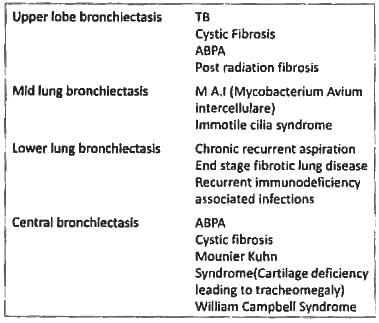
Mid lung field bronchiectasis is seen with? (Recent Question 2016-17)

Detailed Solution for Test: C.O.P.D & Bronchiectasis and Suppurative Lung Diseases- 2 - Question 2


Bronchiectasis Sicca: Only hemoptysis is present without sputum production. It has upper lobe involvement.

Test: C.O.P.D & Bronchiectasis and Suppurative Lung Diseases- 2 - Question 3

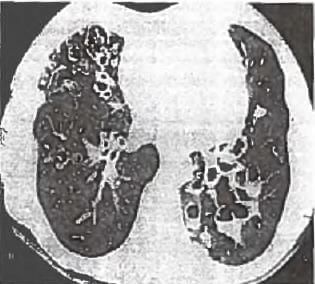
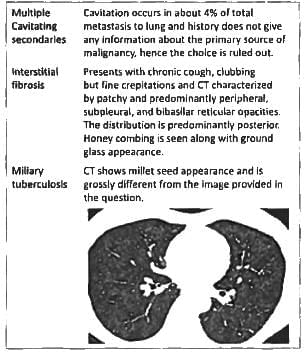
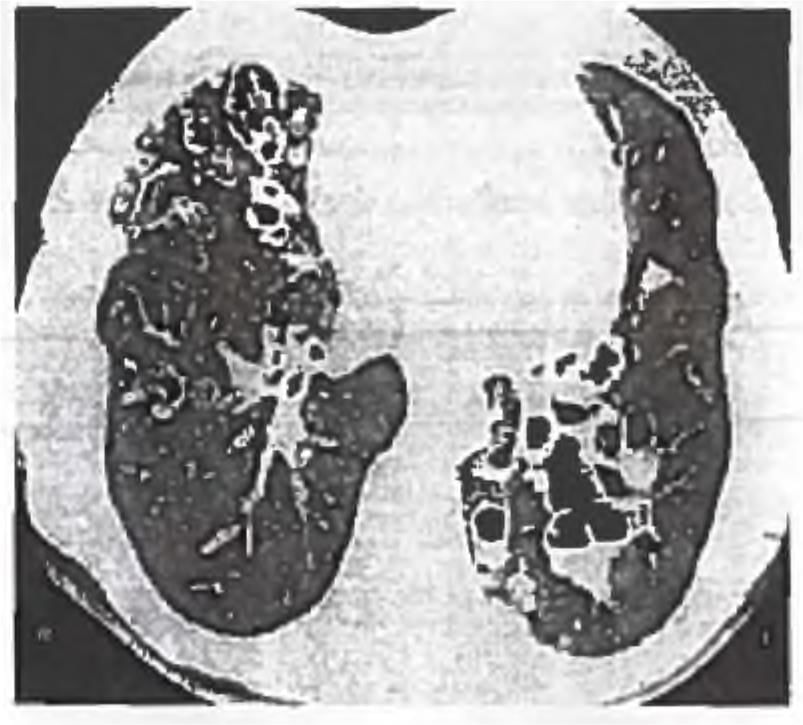
This patient came with chronic productive cough and clubbing and coarse rales. What is the diagnosis of the CT scan above? (APPG 2015)
Detailed Solution for Test: C.O.P.D & Bronchiectasis and Suppurative Lung Diseases- 2 - Question 3


The image displays numerous cystic clusters of thin-walled cystic spaces within the lung parenchyma on both sides, with a more pronounced presence on the left, as the left lower lobe is more frequently affected in bronchiectasis.

  • Fluid-filled bronchi appear as tubular or branching formations when they extend horizontally.
  • The term "varicose bronchiectasis" denotes irregular bronchial dilatation.

Test: C.O.P.D & Bronchiectasis and Suppurative Lung Diseases- 2 - Question 4

IOC for Bronchiectasis: (Recent Question 2015-16)

Detailed Solution for Test: C.O.P.D & Bronchiectasis and Suppurative Lung Diseases- 2 - Question 4

The most effective examination to assess the damage and expansion of significant airways filled with pus in Bronchiectasis is HRCT.

  • Spiral CT is the preferred method for detecting pulmonary embolism.
  • Pulmonary angiography is performed for lung sequestration and is considered the gold standard for pulmonary embolism.
Test: C.O.P.D & Bronchiectasis and Suppurative Lung Diseases- 2 - Question 5

Chest X-ray in a 45 yr old patient shows cavity in upper lobe of lung. Next investigation for diagnosis is: (Recent Pattern 2014-15)

Detailed Solution for Test: C.O.P.D & Bronchiectasis and Suppurative Lung Diseases- 2 - Question 5

The CT scan allows better delineation of parenchymal processes, pleural disease, masses or nodules, and cavity.

Test: C.O.P.D & Bronchiectasis and Suppurative Lung Diseases- 2 - Question 6

Most likely precursor to bronchiectasis is: (Recent Pattern 2014-15)

Detailed Solution for Test: C.O.P.D & Bronchiectasis and Suppurative Lung Diseases- 2 - Question 6

Bronchiectasis can be a consequence of various necrotising infections that are either poorly managed or left untreated. A primary infection is especially a frequent trigger for bronchiectasis.

Test: C.O.P.D & Bronchiectasis and Suppurative Lung Diseases- 2 - Question 7

Best method for detecting minimal bronchiectasis is:

Detailed Solution for Test: C.O.P.D & Bronchiectasis and Suppurative Lung Diseases- 2 - Question 7

Chest CT is more specific for bronchiectasis and is the imaging modality of choice for confirming the diagnosis.

Test: C.O.P.D & Bronchiectasis and Suppurative Lung Diseases- 2 - Question 8

In a patient with COPD, with low spo2 at rest best management option is? (Recent Question 2015-16)

Detailed Solution for Test: C.O.P.D & Bronchiectasis and Suppurative Lung Diseases- 2 - Question 8
  • In COPD, Ventilation/perfusion matching leads to under- ventilated lung which usually has low oxygen content which leads to localized vasoconstriction limiting blood flow to that lung tissue.
  • Supplemental oxygen abolishes this constriction, leading to improved ventilation/perfusion matching.
  • High flow oxygen is not tolerated as it leads to crusting, dryness and epistaxis.
  • The treatment is guided by PaO2 which should be maintained at 60 mm Hg or so (SaO2 of 85-90%). During the period of exercise, sleep or other activities, the flow rate may be increased by another 1-2 L/min.
  • While continuous therapy is required for patients who show hypoxaemia at rest, intermittent treatment during specific periods may be used for patients who demonstrate intermittent hypoxaemia
Test: C.O.P.D & Bronchiectasis and Suppurative Lung Diseases- 2 - Question 9

Most common cause of lung abscess in comatose patient? (Recent Pattern 2015-16)

Detailed Solution for Test: C.O.P.D & Bronchiectasis and Suppurative Lung Diseases- 2 - Question 9
  • The term lung abscess refers to a microbial infection of the lung which results in necrosis of the pulmonary parenchyma.
  • In the given choices almost all cause lung abscess. However Harrisons mentions: Most lung abscesses in moribund intubated patients are due to anaerobic bacteria, like pepto streptococcus, Bacteroides etc.
Test: C.O.P.D & Bronchiectasis and Suppurative Lung Diseases- 2 - Question 10

Ultrastructural abnormalities reported in immotile cilia syndrome are: (Recent Pattern 2014-15)

Detailed Solution for Test: C.O.P.D & Bronchiectasis and Suppurative Lung Diseases- 2 - Question 10

Structures that make up the cilia including inner and/or outer dynein arms, central apparatus, radial spokes, etc. are missing or dysfunctional and thus the axoneme structure lacks the ability to move. Axonemes are the elongated structures that make up cilia and flagella. The underlying cause, dysfunction of the cilia begins during and impacts the embryologic phase of development, in immotile cilia syndrome.

Test: C.O.P.D & Bronchiectasis and Suppurative Lung Diseases- 2 - Question 11

In a patient with smoking history, which is important? (Recent Question 2015-16)

Detailed Solution for Test: C.O.P.D & Bronchiectasis and Suppurative Lung Diseases- 2 - Question 11

Though this is a highly debatable topic, most search results and discussion with faculty and google books mentions duration of smoking to be more important that the number of cigarettes smoked.

Test: C.O.P.D & Bronchiectasis and Suppurative Lung Diseases- 2 - Question 12

Parents of a child with bronchiectasis may give a past history of: (Recent Pattern 2014-15)

Detailed Solution for Test: C.O.P.D & Bronchiectasis and Suppurative Lung Diseases- 2 - Question 12

Typical offending organisms that have been known to cause bronchiectasis include the following

  1. Pertussis
  2. Influenza virus
  3. Herpes simplex virus
  4. Certain types of adenovirus
  5. Measles virus
  6. Mycobacterium tuberculosis/Mycoplasa pneumoniae

These organisms lead to progressive bronchial wall damage and dilation.

Test: C.O.P.D & Bronchiectasis and Suppurative Lung Diseases- 2 - Question 13

Not a CT finding in bronchiectasis: (Recent Pattern 2014-15)

Detailed Solution for Test: C.O.P.D & Bronchiectasis and Suppurative Lung Diseases- 2 - Question 13
  • While chest radiographs lack sensitivity, the presence of "tram tracks" indicating dilated airways is seen with bronchiectasis.
  • Chest CT is more specific for bronchiectasis and is the imaging modality of choice for confirming the diagnosis. CT findings include airway dilation detected as parallel "tram tracks” or as the “signet-ring sign”-a cross-sectional area of the airway with a diameter at least 1.5 times that of the adjacent vessel.
  • The crazy-paving pattern is seen in pulmonary alveolar proteinois and also can be observed in exogenous lipoid pneumonia, sarcoidosis, mucinous bronclioalveolar cell carcinoma, and acute respiratory distress syndrome.
Test: C.O.P.D & Bronchiectasis and Suppurative Lung Diseases- 2 - Question 14

Bronchiectasis is most common in: (Recent Pattern 2014-15)

Detailed Solution for Test: C.O.P.D & Bronchiectasis and Suppurative Lung Diseases- 2 - Question 14
  • Idiopathic bronchiectatic lesions are most commonly found in the lower lobes, probably because mucociliary clearance is facilitated by gravity in the upper lobes.
  • The lesions are identified most commonly in the left lower lobe, followed by the right lower lobe and left upper lobe
  • Bronchiectasis due to primary ciliary dyskinesia in the middle lobe, and bronchiectasis due to hypogammaglobulinemia in the lower/middle lobe and lingual segment
  • The most common organisms are Haemophilus influenza (15%), Staphylococcus aureus (13%), Streptococcus pneumonia (5%), Pseudomonas aeruginosa (5%), and Mycoplasma pneumonia (5%).
Test: C.O.P.D & Bronchiectasis and Suppurative Lung Diseases- 2 - Question 15
Which of the following bronchiectasis : is NOT a complication of (AIIMS Sept 96, AI 1998)
Detailed Solution for Test: C.O.P.D & Bronchiectasis and Suppurative Lung Diseases- 2 - Question 15
Asthenospermia, characterised by inadequate sperm motility, arises from absent dynein arms, which is the fundamental defect associated with Kartagener's syndrome. This condition is a ciliopathic, autosomal recessive genetic disorder. The triad of symptoms includes:
  • situs inversus
  • chronic sinusitis
  • bronchiectasis
Information about Test: C.O.P.D & Bronchiectasis and Suppurative Lung Diseases- 2 Page
In this test you can find the Exam questions for Test: C.O.P.D & Bronchiectasis and Suppurative Lung Diseases- 2 solved & explained in the simplest way possible. Besides giving Questions and answers for Test: C.O.P.D & Bronchiectasis and Suppurative Lung Diseases- 2, EduRev gives you an ample number of Online tests for practice
Download as PDF